Tag Archives: Christianity

Expectant

Rabbi Yisrael Reisman describes on a tape entitled “Great Expectations” his recollections of an incident that occurred when he was yet a young Yeshiva student. He had positioned himself in his dorm room so his bed would be adjacent to the sink for some strategic purpose. The sink, he soon discovered, had a constant drip which he promptly reported to the powers that be. Understanding that it was just a matter of a washer or some such nickel or dime item he assumed it would be taken care of pronto. The next few nights he lay awake tossing and turning to the dripping faucet becoming more upset, frustrated and resentful.

Finally after a couple of days, the janitor arrived. It was a loose washer. The whole thing took a few moments and cost next to nothing. The dripping was finally was over. That very evening there was huge rain storm and as he lay there in bed ready for a good night’s sleep he became aware of the dripping from the roof to the window sill below- the same constant drip- drip and it didn’t bother him a bit.

He wondered why one drip sound stirred him so and the other had zero effect. He concluded that the dripping sound was not what was actually annoying him. The proof is that the water from the rain didn’t wrinkle his psyche at all. What bothered him about the sink? The answer is that he assumed somebody would do something about it, it would be done right away, that his request would be fulfilled and honored swiftly etc. And it wasn’t…it wasn’t true!

I once heard from Rabbi Yitzchok Kirzner ztl two words that he called “the secret to happiness”. Admittedly, at the time I felt it sounded rather negative. Over many years, though, I have grown in appreciation for the wisdom of his insight. I share it often with my children and myself too. It’s a hard pill, “Expect Nothing!”

-Rabbi Label Lam
“Expect Nothing!”
Parashas Mishpatim
Torah.org

It is true that expectations can lead to unhappiness, especially if those expectations are unrealistic or simply mistaken. A few days ago, I commented on my own expectations in a blog post called Nothing’s Perfect. Over the past year or two, I set a series of actions into motion based, in part, on what I felt was the right thing to do and what I expected should happen as a result of those actions. What I did was rather dramatic in the sense that, after many years at one congregation, serving on the board of elders and doing some writing and teaching, I gave my resignation, not only from my formal leadership position, but from membership within the congregation.

This horrified just about everyone, including my wife (her response kind of surprised me), since I was generally well-regarded in the congregation and many in the community of faith felt that difficult things would happen to me if I had no fellowship among the body of believers.

Needless to say, I felt I had compelling reasons to make such a decision and still believe my reasoning was sound. I also had expectations about what was to happen next, maybe not in the immediate sense, but over a period of weeks and months.

Guess what?

My expectations did not pan out. Like young Yisrael Reisman enduring the dripping faucet, I had an expectation about what was supposed to happen after a while. He expected someone to come fairly quickly and to fix the leak. I expected a certain response from my spouse and from God. Both of us didn’t get what we wanted in the way or the time frame that we expected.

But Rabbi Lam’s story (actually, Rabbi Reisman’s) story missed something. Here’s a clue.

Understanding that it was just a matter of a washer or some such nickel or dime item he assumed it would be taken care of pronto.

Rabbi Reisman, as a young Yeshiva student, knew the problem with the faucet could probably be fixed by replacing a cheap washer. All he needed to do, if he was tired of waiting, was to purchase this inexpensive item and repair the faucet himself. Maybe he was concerned that he shouldn’t perform this task it was supposed to be done by the janitor, but it was within his abilities (apparently) to fix the drip if he really wanted to do so.

What about me?

Fulfilling my expectation isn’t that simple, but it isn’t that difficult either, at least in principle. It depends on how I choose to look at my situation. If I feel that I have the ability to fix my own “dripping faucet,” I can choose to seek fellowship within a community of faith. It would be a matter of generating the effort to seek one out (which might involve visiting a fair number of Christian communities) and begin attending. This isn’t without its problems, as I’ve already stated in another of my “meditations,” Why I Don’t Go to Church. Nevertheless, it’s not like I am without options.

On the other hand, I could choose to look at my situation as Rabbi Reisman did when the rain started falling and dripping noises came from the window sill of his room. I can decide that there is nothing to be done. The rain is the rain and it makes all sorts of sounds, some of which are quite soothing. I could simply follow Rabbi Reisman’s example, allow the situation to be what it is, and do nothing. Here though, Rabbi Reisman did not explain the whole story. It won’t rain forever. True, we never really know how long a rain storm will last, (barring a report from the weatherman) but we know it will end at some point. We also know that God knows when the rain will end.

When Rabbi Kirzner advises “expect nothing,” it is true that if you expect nothing, you will be disappointed by nothing that happens or doesn’t happen. On the other hand, it’s difficult for most people to plan out even a trip to the grocery store without some small set of expectations. If such is true for a small task like shopping, how much more so should we have expectations when we plan out our walk on a lifelong path of faith?

It is unreasonable expectations and inflexible expectations that often get us in trouble one way or another. We expect a raise so we can afford to go on vacation, and we don’t get it. We expect our spouse to cook dinner one night and she decides to go out to see a friend instead. The result of these inflexible expectations is usually feeling resentment toward the person who disappointed us. Rabbi Reisman felt resentful toward the janitor for taking so long to fix his faucet. There are people who are very resentful of God for also not meeting expectations.

But it’s not like we can’t expect to depend on God. If we could not rely on God for our daily food, our shelter, our livelihood, and our comfort in distress, we would truly feel lost in a chaotic and random world. Fortunately, such is not the case.

He is my God, my living Redeemer,
Rock of my pain in time of distress.
He is my banner, a refuge for me,
the portion in my cup on the day I call.
Into His hand I shall entrust my spirit
when I go to sleep — and I shall awaken!
With my spirit shall my body remain.
HASHEM is with me, I shall not fear.

-from Adon Olam

Adon Olam or “Master of the Universe” is a blessing sung in synagogues all over the world on every Shabbat. It is also the last blessing recited during the bedtime Shema by a Jew right before he retires. It is an expectation that when he goes to sleep and in some small sense, enters the realm of “death,” that he will awaken the next morning, with his spirit returned to him by God. It is true that some people go to sleep and do not awaken and ultimately, as mortal beings, that awaits us all. However, we rely on God and depend on Him to preserve us and to protect us. This is why, upon awakening, a Jew recites Modeh Ani.

I gratefully thank You,
living and existing King,
for returning my soul to me with compassion;
abundant is Your faithfulness.

While I have no idea what will actually happen after I go to sleep or what each day will bring when I first wake up, I expect that God will be there during my sleeping and waking. Near the end of his life, David composed a final Psalm in which he expects that the work he has left unfinished as King will be continued by his son Solomon. It could also be read as a prophesy of the Messiah’s coming and how he will finish the work of tikkun olam; repairing our broken world.

My his name endure forever, may his name connote mastery as long as the sun endures; and all the nations will bless themselves by him; they will praise him. Blessed is Hashem, God, the God of Israel, Who alone does wondrous things. Blessed is His glorious Name forever; and may all the earth be filled with His glory. Amen and Amen.

Psalm 72:17-19 (Stone Edition Tanakh)

I don’t know what is going to happen, today, tomorrow, or next week, but I do know that whatever happens, God will be present in my life. If I were to expect nothing, I would have no reason to be disappointed, but I would also have nothing to hope for, and without hope, what is life? The future is a great mystery to human beings but it is not an entirely dark unknown. I know that God is there, my rock and my redeemer and regardless of the direction my path of faith takes, around each bend, at the bottom of each ravine, and at the top of each height, I expect God.

Nothing’s Perfect

You have to begin with the knowledge that there is nothing perfect in this world.

Our job is not to hunt down perfection and live within it. It is to take whatever broken pieces we have found and sew them together as best we can.

—the Rebbe’s response to a girl who wanted to leave her school for what she thought to be a better one.
as related by Rabbi Tzvi Freeman
Chabad.org

Oh, duh! No, that’s not my Homer Simpson imitation, it’s my “light dawns on marble head” moment and the reason I’m writing this “extra meditation.” I’m going to use the above quoted phrase for tomorrow’s “morning meditation,” but as I was doing one of my obsessive reviews of tomorrow’s blog, trying to find all the typos I will invariably miss, it hit me.

Life isn’t perfect.

I suppose that’s obvious to you and really, it’s obvious to me too, but I spontaneously applied it to something specific in my own context and everything suddenly made sense. Let me explain.

I periodically kvetch about how hard it is to find other people who see things in the world of faith that are even remotely similar to how I see them (although my “morning meditation” for today has attracted some very nice comments). I also complain about my desire for a sense of community, particularly with my wife, and how frustrated I am that what I planned (boy, God must be having a good chuckle right now) doesn’t seem to be working out.

But what did I expect?

It’s not so much the statement that the Rebbe made above (as related by Rabbi Freeman), it’s the circumstances around the statement that made something “click” inside of me.

…the Rebbe’s response to a girl who wanted to leave her school for what she thought to be a better one.

I’ve probably said some variation of this a thousand times to relatives and friends when they’ve told me how life isn’t perfect for them, either. I just find it funny that God chose here and now to give me my “light bulb moment.”

It should have come sooner but I wasn’t paying attention.

I was having a conversation with the Missus the other day, again talking about the possibility of taking a class or two with her at one of the synagogues here in town. Somehow, we got on the topic of intermarried couples and, since she knows I’m reading Rabbi Boteach’s book Kosher Jesus, we talked about the very distinct differences in how Christians and Jews see the world, the Bible, the Messiah, and God. As we were talking, I was reflecting to myself on how one of the reasons I left the “Messianic” movement, at least in terms of physical worship and self-identification, was because I perceived it as a barrier to my joining her in a Jewish worship and study context.

I mentioned to her in our conversation, that I know there are plenty of intermarried couples in both the Reform shul and Chabad communities, and then she said something that stopped me cold. She said those couples were all comprised of one Jewish spouse and one non-religious (specifically non-Christian) spouse. They’re all Jew/Gentile intermarried, but not “mixed-religious couples”.

I see.

I suddenly realized where the barrier is located in my wife getting comfortable including me in her Jewish community. It’s located squarely at the intersection of “Jesus Street” and “Christian Avenue”. In other words (taking my tongue out of my cheek), she really doesn’t want to take her Christian husband into a Jewish synagogue to interact with her Jewish community. The real problem wasn’t just the negative perception many Jews have about Messianics. That’s why my leaving the Messianic community didn’t produce the desired result. My being a Christian is the real problem.

Oh.

Did you ever play “Battleship” when you were a kid? Ever have your fleet sunk? Mine ended up soundly torpedoed and sent swiftly to the bottom of the cold, cold Atlantic.

I was pretty grumpy about it initially. In fact, I’ve been pretty grumpy about it until about thirty minutes ago (as I write this). Then I re-read the Rebbe’s words and the context in which he said them, and realized that if I thought I was going to get my way, I was sadly mistaken. I won’t even say that “life’s not fair,” because I don’t think fairness has anything to do with it. It’s not like I have some sort of “right” here. It was more of a desire to join with my wife at the level of worship and perhaps to take my meager level of Jewish learning up a notch.

That’s not going to happen now. Of course, it’s not like it was owed to me or something. Sure, it would have been nice, but it’s not my right to enter into someone else’s world if I don’t belong there. It’s not so much that I wanted in the Jewish world. I wanted in the Jewish world so I could share my wife’s world with her.

But life’s not perfect. In fact, life has never been perfect, even among those who have served God with outstanding faithfulness, which doesn’t exactly describe me. No perfect life. No perfect people.

The king’s primary function is to dispense justice and righteousness in Israel. Second Samuel 8:15 tells us, “David reigned over all Israel; and David administered justice and righteousness for all his people.” The Psalmist says, “The strength of the King loves justice; You have established equity; You have executed justice and righteousness in Jacob.” (Psalm 99:4) When Israel practiced justice and righteousness, she was blessed, but when she strayed from justice and righteousness under the influence of wicked kings, the prophets rebuked her. “I will make justice the measuring line and righteousness the level,” (Isaiah 28:17) the LORD declares through the prophet Isaiah. The Psalmist prays for the Davidic King, saying, “Give the king Your judgments (mishpatim), O God, and Your righteousness to the king’s son. May he judge Your people with righteousness and Your afflicted with justice.” (Psalm 72:1-2)

“Righteousness and Justice”
Weekly eDrash
Commentary on Torah Portion Mishpatim
First Fruits of Zion

Israel was the only nation specifically established by God, and given a personal and corporate set of laws and ordinances by which the Hebrews were supposed to obey their Creator as a people. If any country was to have operated with flawless perfection, it should have been Israel, and yet even a casual reading of the Tanakh (Old Testament) tells us that they experienced dramatic swings, from amazing prosperity to bitter and total defeat…and back again. Life wasn’t perfect for the Children of Israel and it isn’t perfect for the Jewish people today. Life isn’t perfect for the church, and certainly it hasn’t been perfect over the past 2,000 years of Christian history.

Why should even this one thing that I ask for be perfect for me? There’s no reason it should be.

Oh, I know the Christian platitudes: “Go bathe it in prayer” and such, but frankly, I’ve seen some of the most faithful people I know end up disappointed in so many ways and still maintain their faith and trust.

I’m not going to “win” this one, but I guess I can’t say that I mind all that much (well, I mind a little). There’s so much else that is going right. My wife and I are together after almost 29 years of marriage. We both are reasonably healthy, we have three children and one grandson. We are fed, and clothed, and housed. We are gainfully employed and are able to meet our needs and a number of our wants. Life isn’t perfect, but it isn’t horrible, either.

Most of all, both my wife and I are relating to God, each in our own way and in our own manner, as Jew and Christian. I’m a really unconventional Christian and she’s not always the typical Jew, but we get by.

Now that this realization has happened, I don’t know what comes next. I don’t have “a plan” anymore. Maybe I’ll finish out my year long experiment here and then “sink” this blog along with my hopes or maybe I won’t. I’ll have to wait and see if God decides to fill in the blanks in my life with something I haven’t anticipated, or if He’ll just let me have blanks in my life for a day, or a week, or a month, or a year or ten.

Right now, I guess I’ll take the Rebbe’s advice, try to find whatever broken pieces of my aspirations that God has left lying around and see if I can patch them together into something that makes some sort of sense.

I’ll let you know how it goes.

Another Chance

The Ishbitzer Rebbe, zt”l, explains the deeper meaning of yovel and why houses within cities walled since the time of Yehoshua bin Nun do not return during yovel. “Yovel teaches that everything has a time. God doesn’t remain angry at anyone forever. Even if someone’s sins force him to sell his portion or to be sold as a slave, this cannot be forever. Eventually he will be redeemed and his inherited field will return to him. But batei arei chomah are an exception. This alludes to the two chomos, the two barriers—teeth of bone and lips of flesh—that God gave us to rein in what we say, as discussed on Arachin 15…Indulging one’s arrogance by failing to hold back one’s anger at his friend is no simple matter. If the victim remained silent in the face of his rage, the sinner’s merits are transferred to the recipient of his anger.

“Unlike sins between man and his Creator, sins between man and his fellow do not have an automatic limit. These misdemeanors remain until his friend forgives him. One has only limited time to beg his friend’s forgiveness. Failure to do so causes his merits to remain with his friend. His inability to accept his wrongdoing and make it up to his friend causes him losses he would never have imagined.”

But the rebbe concluded with words of chizzuk. “Nevertheless, we find that kohanim and leviim can always sell and always redeem. This teaches that even if one has sinned, if he begins to serve God in earnest, he can always redeem what he has lost. Through the dynamic change he gains through his avodah he always has another chance!”

Daf Yomi Digest
Stories Off the Daf
“The Walled Cities”
Arachin 31

What is being said here? We learn from the construction or organization of the Ten Commandments brought down from Sinai that there are two general classifications of sin: sin between man and God and sin between man and man. Of the first, God will forgive by His own grace and mercy and not necessarily because of the merit of the sinner. We rely on God to give us something we could not possibly earn. However of the second, we will not be forgiven until (or unless) we ask for forgiveness from our fellow. In this, we must take a much more active role, otherwise forgiveness will never occur. We also learn that if we stubbornly refuse to admit our wrongdoing against our fellow, this affects our relationship with God as well, so we have in some sense, doubly sinned.

The commentary concludes that, “even if one has sinned, if he begins to serve God in earnest, he can always redeem what he has lost.” But how can this be? If you sin against a person, ignore your responsibility for that sin, and go on to seemingly “serve God in earnest,” are you really serving God while remaining unrepentant? The answer is in the last sentence of the teaching: “the dynamic change he gains through his avodah he always has another chance!”

I suppose this could be read as saying that by serving God, even though you have not sought forgiveness of the person you sinned against, your service to the Almighty somehow compensates. I don’t think that’s what is being said here, though, since the sin against your friend remains. I think it is much more likely that, by honestly and truly serving God, it will become necessary for your soul to turn to Him and in order to do so, you will have to see the stains on your own character. Once you do, and with your desire to serve God earnestly still intact, as part of that service, you must go back to the one you offended and beg forgiveness. Only then, can you return to God and have your response to Him gain real meaning.

So if you are offering your gift at the altar and there remember that your brother has something against you, leave your gift there before the altar and go. First be reconciled to your brother, and then come and offer your gift. –Matthew 5:23-24

We see that the Master is in agreement with the Ishbitzer Rebbe. Living a life in this world does not detract from living a life of holiness, as long as we keep our perspective.

It is not business, not money, nor career, nor human relationships that tears our souls from us and us from our G-d.

There is as much beauty in any of those as there is in any flower from the Garden of Eden. As much G-dliness as in any temple.

It is the way we lock ourselves inside each one, begging it to take us as its slave, refusing to watch from above, to preserve our dignity as human beings.

As you enter each thing, stay above it.

Rabbi Tzvi Freeman
“Unslavery”
Based on letters and talks of the Rebbe
Rabbi M. M. Schneerson
Chabad.org

As much as we fail and allow ourselves to become slaves of the world around us or even our own emotions and pride, God provides every opportunity for us to make amends and to succeed in serving God and serving our fellow. If we do not surrender to anger, frustration, and despair, and continue to seek Him, we will always have another chance.

The Uncertain Gospel

The editing done to purge the crimes of the Romans and to delete references to Jesus’ rebellion against them was an intricate and difficult job. Part of it was left incomplete. Remember, thousands of manuscripts were circulating around. Not all could be completely purged. Flashes of accuracy remain. “We have found this man subverting our nation. He opposes payment of taxes to Caesar and claims to be the Messiah, a king.” (Luke 23:2 NIV) This statement in Luke indicates that corrupt priests delivered Jesus to his oppressors, the Roman administration, because he was a rebel against Roman rule pure and simple. Because it is so different from other statements throughout the rest of the Gospels, which take great pains to make Jesus non-political, it is an obvious piece of real history that slipped through, contrary to the intent of editors publishing Paul’s concept of a strictly spiritual Jesus.

-Rabbi Shmuley Boteach
“Chapter 8: Jesus Never Claimed to Be Divine” pg 51
Kosher Jesus

This is bound to be a part of Rabbi Boteach’s book that will be a major problem with most Christians. Boteach insists that the Gospels were heavily edited to remove any (or most) traces of not only the “Jewishness” of Jesus, but the “fact” that he was executed by the Romans for being a rebel and attempting to lead the Jewish people in a revolt against their Roman occupiers. The portions of the Gospel that seem to support Boteach’s position, he declares as “real history,” while anything that denies his perspective is considered to have been significantly changed by later editors to make the New Testament more palatable to Rome.

You might easily conclude, as a Christian, that Boteach is writing to support a strictly Orthodox Jewish viewpoint of Jesus and “to heck” with the inerrancy of the Gospels. However, he’s not the only one to suggest that the Bible we have today is not completely consistent with the actual, original texts. Amazing? Unheard of? Consider this:

It was dated by one of the world’s leading paleographers. He said he was ‘certain’ that it was from the first century. If this is true, it would be the oldest fragment of the New Testament known to exist. Up until now, no one has discovered any first-century manuscripts of the New Testament. The oldest manuscript of the New Testament has been P52, a small fragment from John’s Gospel, dated to the first half of the second century. It was discovered in 1934.

How do these manuscripts change what we believe the original New Testament to say? We will have to wait until they are published next year, but for now we can most likely say this: As with all the previously published New Testament papyri (127 of them, published in the last 116 years), not a single new reading has commended itself as authentic. Instead, the papyri function to confirm what New Testament scholars have already thought was the original wording or, in some cases, to confirm an alternate reading—but one that is already found in the manuscripts. As an illustration: Suppose a papyrus had the word “the Lord” in one verse while all other manuscripts had the word “Jesus.” New Testament scholars would not adopt, and have not adopted, such a reading as authentic, precisely because we have such abundant evidence for the original wording in other manuscripts. But if an early papyrus had in another place “Simon” instead of “Peter,” and “Simon” was also found in other early and reliable manuscripts, it might persuade scholars that “Simon” is the authentic reading. In other words, the papyri have confirmed various readings as authentic in the past 116 years, but have not introduced new authentic readings. The original New Testament text is found somewhere in the manuscripts that have been known for quite some time.

Daniel B. Wallace
“Dr. Wallace: Earliest Manuscript of the New Testament Discovered?”
February 9, 2012
DTS.edu

Many Christians don’t realize that there is an ongoing debate over just how accurate our Gospels really happen to be. Do the Gospels you read in your Bible every day tell you the true story of Jesus of Nazareth? Do they accurately capture his teachings to the Apostles and to us? If we could find and read an actual first century manuscript of the Gospel of Mark, for example, would we be shocked and dismayed at how different (assuming we could translate it from the ancient Greek) the Jesus chronicled on the recently discovered 2,000 year old papyri, is from the person we’ve come to know in our 21st century Bibles?

Dr. Wallace seems confident that not only are these papyri valid documents, but that they will confirm to a high degree of fidelity, that the Gospels of today are the Gospels of yesteryear. However, Jeffrey García in his blog post More the First Century Gospel of Mark isn’t so sure.

In a previous post I mentioned that Dr. Daniel Wallace referred to a hitherto unknown first century manuscript (now fragment) of Mark in a debate with Dr. Bart Ehrman. As I noted before, the blogosphere sparked with suspicions regarding the Wallace’s claim. We are currently lacking any announcement as to its discovery, the so-called world renown paleographer who has dated the fragment remains anonymous, and the Brill publication is still, according to Wallace, about a year away. Unfortunately, Wallace’s new post on this has not alleviated any of these concerns. Texts that remain “hidden” texts are regarded with a significant degree of hesitation, especially when the information is disseminated through one person (a bit gnostic if you ask me). If the long history of the Dead Sea Scroll publications is any indication, when texts remain privately held and controlled for so long, some crazy things begin to leak out or are simply invented. Hopefully, the identification of this text is not based on the conjugation “kai” a la initial claims of the some scholars who thought gospel manuscripts were found in the caves. In any event, see the post quoted below (again, hopefully this text will be released shortly for other scholars to chime in)”

García is primarily dubious regarding the validity of this find, rather than whether or not it will substantiate our current understanding of the Gospel of Mark, but New Testament scholars such as Bart D. Ehrman aren’t convinced that our Gospels tell us an accurate story about Jesus. In his book Jesus, Interrupted: Revealing the Hidden Contradictions in the Bible (and many other of his works), he contends that there are numerous internal inconsistencies contained within the New Testament and that it is no where near a seamless, flawless record of the life of Jesus and the origins of the first century church.

One of the criticisms against Ehrman is that he was a Christian who lost his faith, not based on his studies of the New Testament, but over his inability to understand why there is such terrible suffering in the world created by a loving God. I’ve written several blog posts including Faith and the Book of Bart as a response to Jesus, Interrupted, and find Ehrman to be a gifted scholar and (like the rest of us) a flawed human being. That the Bible or life doesn’t line up with our preconceived expectations or our personal desires, doesn’t mean that Jesus isn’t the Messiah and that God is a fantasy. It more likely means that we suffer from our own human misconceptions and probably are victims of centuries old teachings and interpretations that are at best mistaken, and at worse, deliberately falsified to satisfy an agenda.

This is something I’ve just recently discussed and perhaps may even be part of God’s intricate plan for how history is supposed to unfold between the first and second appearance of the Messiah. I know, it seems cruel. How can God make us struggle, not only in our day-to-day lives, but in our attempts to understand a Bible that is not guaranteed to be completely, totally, and supernaturally accurate?

I’m no Bible scholar, so I can’t comment with any sort of authority on this matter, but I do find it fascinating that within the realm of Christian scholarship, there are questions being investigated that the majority of the people in our churches never, ever hear about. Matters of scholastic contention and mystery are presented as absolute fact from the pulpit, which I suppose is the way most people like it, since dancing on the head of uncertainty is no way to become comfortable with your faith. When I first encountered these sorts of questions, I wondered how my faith could possibly endure, and yet God made it possible. The Bible doesn’t have to be perfect to be inspired. The Bible translations I read from don’t have to represent an absolute fidelity to the original texts in order to mean that the Messiah exists and that faith in God is not in vain.

If I admit to a certain “fallibility” in our current Bible translations, am I then living a fantasy and pretending the object of my faith is real? Not at all, although I can certainly see how an atheist or a person weak in the faith might perceive it that way. God works with human beings using supernatural methods, but it doesn’t mean that the Bible you can purchase in any book store in this country is supernaturally accurate and describes, word for word, every single detail of the life of Jesus with no errors or mistakes whatsoever.

Like so many of my other “meditations,” I’m not writing this to give you answers but to make you ask questions. If faith cannot tolerate a few really hard questions, then its foundation must be sand and not rock (Matthew 7:24-27). No, I’m not being critical of anyone, because when I first met this challenge, I was thrown for a loop, too (which is an understatement). But if we don’t ask these questions, how will we ever know if we can endure the answers, if they exist, or the uncertainty if they don’t? How will we ever know if we really have faith?

The Torah of Fellowship and Peace

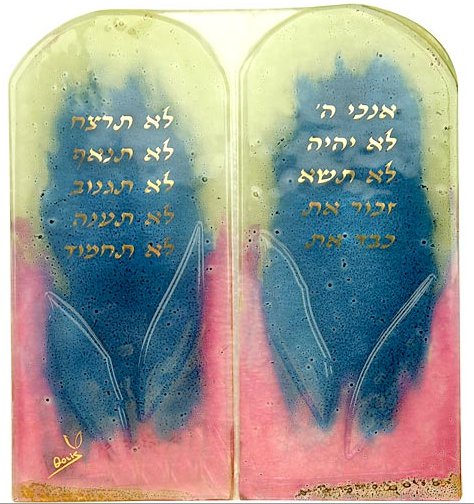
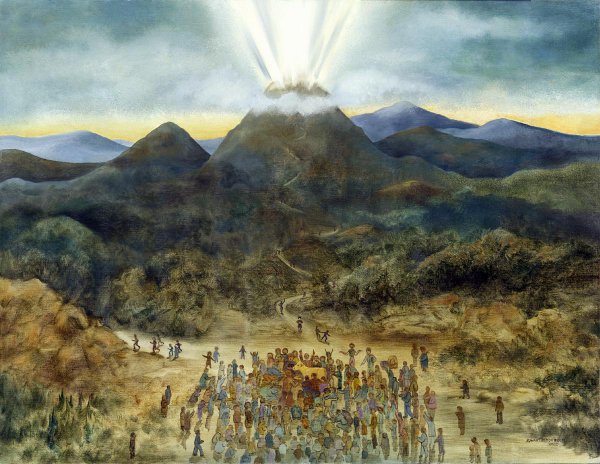
The Ten Commandments (Shemos 22:2-17, Devarim 5:6-21) as spoken by G-d to the Jewish nation at Sinai were engraved upon the Shnei Luchos Habris, Two Tablets of the Covenant. The first Five Commandments belong to the category of laws between “man and his Creator” while the remaining Five Commandments are precepts between “man and man”.

The Ten Commandments engraved upon the tablets of stone and brought down by Moshe from G-d to the Jewish people are accorded a special distinction over all the other 613 precepts.

The Ten Commandments written upon the Two Tablets are comparable to the Kesubah, “marriage contract” drawn up as the essential contractual terms under which a Jewish man and woman enter into Jewish matrimony. Herein the parties pledge their allegiance and the principle obligations to each other thereafter. (The Avos deRabbi Nosson 2:3 fascinatingly explains this is why Moshe smashed the Two Tablets, tearing up the marriage contract, when the Children of Israel were disloyal by worshipping the Golden Calf and had to provide a substitute upon their national repentance).

The Ten Commandments forge this eternal relationship.

The covenant struck between “two” parties, affirming the relationship between G-d as the “Source” and Israel as the “product”, is mirrored in the Ten Commandments inscribed upon the Shnei Luchos HaBris, “Two” Tablets of the “Covenant”. The emphasis is on how this relates to the eternal bris, “covenant” of Torah that unites man and his Creator.

How this bond is intrinsic to the national Jewish psyche is magnificently captured in the Ten Commandments engraved through the thickness of the Tablets – such that the letters and stone were inseparably one.

Herein is included the symmetrical record of the laws pertaining both to man’s relationship to “G-d” and to “man”. The first grouping, those of “man-G-d laws”, relate to G-d the “Source” while the second grouping, those of “interpersonal laws”, relates to man, the “product”.

Side-by-side, the Ten Commandments are the microcosm to all 613 Commandments (See Bamidbar Rabbah 13:15). They embrace the acceptance of G- d’s Sovereignty at Sinai as the essential platform for strict adherence to all the other 613 laws in the Torah, which serve to polish and perfect man to become more G-dly.

Through its symbolism of the “eternal covenant” between man and G-d, of two parties inextricably bound in their mutual relationship…

-Rabbi Osher Chaim Levene
from his commentary on Torah Portion Yitro
“Two Tablets: Prescription for Jewish Observance”
Torah.org

When the Prushim heard that he had shut the mouth of the Tzaddukim, they conferred together. A certain sage among them asked him a question to test him, saying, “Rabbi, which is the greatest mitzvah in the Torah?” Yeshua said to him,

“Love HaShem your God with all of your heart, with all of your soul, and with all of your knowledge.” This is the greatest and first mitzvah. But the second is similar to it: “Love your fellow as yourself.” The entire Torah and the Prophets hang on these two mitzvot.Matthew 22:34-40 (DHE Gospels)

In one of my recent morning meditations, I commented how the Torah functioned as a ketubah or “wedding contract” between God, the groom, and national Israel, the bride. For Christianity, this is a puzzle (unless you wholly substitute “the Church” for “Israel” in this event), since how can God be eternally married to the Jewish people, the inheritors of the Mosaic covenant, and at the same time, have the Christian church be “the bride of Christ? I asked this question on the aforementioned “meditation,” but no one was willing or able to respond to my query.

In studying the Torah portion for last Shabbat, I noticed an interesting parallel between the Rabbinic commentary and the teachings of the Master:

Side-by-side, the Ten Commandments are the microcosm to all 613 Commandments… -Rabbi Levene

The entire Torah and the Prophets hang on these two mitzvot. –Matthew 22:40 (DHE Gospels)

Traditional Judaism, at least as Rabbi Levene describes it, compresses the entire 613 commandments into the ten mitzvot we see on the two tablets that Moses brought down from his personal encounter with God, while Jesus tells us that they are represented, along with all of the writings of the Prophets, by the two greatest commandments, which he cites from Deuteronomy 6:5 and Leviticus 19:18. Neither source is saying that all we need are only the ten commandments or the two greatest commandments, but they are the foundation and representation upon which we formally base our obedience to God, for Jew and Christian.

Am I saying that both Jews and Christians have identical responsibilities to God relative to the Torah? Absolutely not. There have been plenty of debates, both among scholars and on the various religious blogospheres on this topic, and my personal opinion is that we non-Jewish disciples of the Master are not obligated to take upon ourselves the full yoke of Sinai. The Master himself tells us that “my yoke is easy, and my burden is light” (Matthew 11:30) while we find Peter, who walked with the Master, saying, “why are you putting God to the test by placing a yoke on the neck of the disciples that neither our fathers nor we have been able to bear? (Acts 15:10), referring to the non-Jewish disciples (and a comparison of these two verses is a study all its own).

So are we to say that God has two brides, that there are two paths to salvation, and that there are two laws? Is this the veil of separation that I’m rebuilding between Jew and Gentile that was supposedly torn down? (Ephesians 2:14)

Heaven forbid.

Yet, if I am not describing two brides separated by a veil, must I say that the only resolution to this conflict is to adopt a supersessionist viewpoint and to declare that the Church has replaced Judaism in all of the covenant promises, creating a new “spiritual Israel” out of the non-Jewish Christians? Must I say that the Jews become “one new man” with the Church only be renouncing their Judaism in totality and converting mind, body, and soul into Gentile Christians, trading in the Jewish Messiah for the “Greek” Jesus?

No, I’m not saying that, either.

According to Rabbi Dr. Stuart Dauermann in his blog post Inconvenient Truths: The One New Man:

Rather than superseding the Jewish people, the Church from among the nations joins with them as part of the Commonwealth of Israel. Only in this way can the “dividing wall of hostility” – which supersessionism maintains – be removed. Gentiles are no longer categorically outsiders to the community of God’s people, but neither do they supplant Israel. However if Gentiles were required to obey Torah and live as Jews, one would be perpetuating their categorical exclusion as Gentiles. And it is a major component of the good news as proclaimed by Paul that this former categorical exclusion is over and done with through the work of Messiah!

The balance of unity and diversity in the One New Man is further highlighted in Ephesians 3:6, where Paul says “Gentiles are fellow heirs and fellow members of the body, and fellow partakers of the promise in Christ Jesus through the gospel.” The terms “fellow heirs, fellow members, and fellow partakers” require another communal reality with whom the Gentiles are joined, and that other partner is the community of Messianic Jews living in solidarity with wider Israel. It is only as Messianic Jews embrace this calling that their communities become the communal joining point whereby the Church from among the nations is joined to the Commonwealth of Israel.

Admittedly, this is a set of points that most traditional Christians and Jews will find difficult to absorb into their current understanding of how God relates to each of our religious groups. This also gives us something new to think about in terms of how Jews and Christians are supposed to relate to each other. But in giving the Torah at Sinai and the blood of the Son at Calvary, God provided the means by which the Jews could become a special, unique and “peculiar people” to God in a way no other people or nation had ever or has ever become to Him, and has also opened the door for the rest of the world, through the Messianic covenant, to allow the larger body of humanity to draw close to God, alongside the descendants of Jacob.

This isn’t a realization that all Jews and all non-Jews have, even though this open door is available to everyone. Secular Jews are just as much a part of Sinai as their religious brothers, whether they choose to acknowledge that fact or not. Every non-Jewish person on earth is equally invited to stand before the throne of the King by the mercy of God who sent the Messiah to both Jewish and Gentile humanity, if only we will accept that gracious offer. Jesus presents the Jews with the continual and perpetual fulfillment of the prophesy of the Messiah and a life lived in obedience to Torah as God intended from the beginning, and brings close a “grafted in” humanity together with the Jews in one Kingdom as we too respond to the Torah as proceeds from Jerusalem and as it is meant for us to comprehend and obey.

There is one Torah but two intents. Torah is the ketubah of Sinai for the Jews and at the same time, it is a light unto the nations. How Jews are forever “married” to God and we Christians are the “bride” of Messiah, I do not know, but of all the different mitzvot among the 613, many are selected to identify Jews as Jews forever, and other portions are indeed universal truths applied to all, for no man made in the image of the Creator should murder his fellow, or steal from him, or covet his property, or blaspheme the name of God or worship idols of stone or wood or paper.

Jew and Gentile, where do we start? Where do we start establishing a relationship with God and an understanding of each other? We start with studying the mitzvot of the tablets and the commandments of the Messiah. Most of all, we start with this one, new commandment that I believe Moshiach gave to each and every one of us, if only we have ears to hear.

I am giving you a new mitzvah: that you love one another. As I have loved you, so you must love one another. –John 13:34 (DHE Gospels)

and many peoples shall come, and say:
“Come, let us go up to the mountain of the LORD,
to the house of the God of Jacob,
that he may teach us his ways
and that we may walk in his paths.”
For out of Zion shall go the law,
and the word of the LORD from Jerusalem. –Isaiah 2:3

The Torah has gone forth from Zion, carried on the teachings of Jesus and the Apostles, and we among the nations have heard the words of the Messiah and the “Word made flesh”. If we who are Christians can learn those lessons and the Jewish people can turn their hearts toward the Torah given by Moses and Jesus, then we will someday truly love one another in obedience to that Torah, and sit and eat together at the table of Abraham, Isaac, and Jacob (Matthew 8:11) in fellowship and peace.

The Torah of Hashem is perfect, restoring the soul; the testimony of Hashem is trustworthy, making the simple one wise; the orders of Hashem are upright, gladdening the heart; the command of Hashem is clear, enlightening the eyes; the fear of Hashem is pure, enduring forever; the judgments of Hashem are true, altogether righteous. They are more desirable than gold, than even much fine gold; and sweeter than honey, and the drippings from its combs. –Psalm 19:8-11 (Stone Edition Tanakh)

Understanding the Infinite Scroll

One year there was a drought and the price for food rose exorbitantly. In Frankfurt, some Jews literally could not put bread on their table. Rav Avraham Avish, the Av Beis Din of Frankfurt, zt”l, literally gave every penny he owned to help the destitute during that year. One student wondered how this could be halachically permitted. “Didn’t we learn that it is forbidden to give over twenty percent of one’s property to charity?” he asked.

Rav Avraham Avish rejected this claim out of hand. “Although you have learned you still do not grasp how to understand a sugya in depth. It is true that in general one who gives over a fifth of his property to tzedakah violates a rabbinic prohibition, but that is irrelevant in a year where there is no food and people are endangered. To save a life, we even desecrate Shabbos which is much more stringent than any rabbinic decree!”

Daf Yomi Digest
Stories Off the Daf
“Not more than a Fifth”
Arachin 28

For the Christians reading this, and perhaps for some Jews, the meaning of my quote “off the Daf” today may not seem very relevant, but I posted it above for a single, important reason. There’s a sentence that teaches us something we need to constantly keep in the forefront of our thoughts:

Although you have learned you still do not grasp how to understand a sugya in depth.

It means that you can be smart and even well educated, and still not be able to look at something in the way that’s necessary or in sufficient depth to be able to understand it. We see this all the time in the various sciences, especially as we examine the history of scientific discoveries and knowledge. First the Earth is flat and now it’s round. First the Earth is the center of the universe, and all heavenly bodies revolve around us, now Earth revolves around a mediocre star off to one side of our huge galaxy. First you cure a fever by applying leeches to drain bodily fluids, now you give the person antibiotics to cure their infection.

As we investigate our world, we learn, but at each point in our journey of discovery across the long stretch of history, we thought we knew exactly what we were doing and what was going on. We couldn’t have possibly imagined that the world wasn’t flat or that applying blood-sucking parasites to our bodies really wouldn’t cure a fever or other types of ailments.

And although a student of Rav Avraham Avish understood that the general principle is to give only up to one-fifth of your income to charity to avoid bankrupting yourself and failing to support the needs of your own family, he still didn’t understand the underlying foundation behind the principle that would allow the Rav to contribute his very last dime to starving people, and still not violate halacha.

But what’s all that got to do with us?

Has it ever occurred to you that you could be wrong?

It probably has, especially on those occasions when you were sure you were correct in some matter of judgment, or thought you could spell the word “Mediterranean” without looking it up. OK, we’re human and we can make mistakes. It happens to the best of us and most people have learned to admit it.

Almost.

The conversation in my extra meditation from yesterday turned into a mini-debate on the letter to the Hebrews found in the New Testament. Since this letter has always been a bit of a puzzle to me, I’ve found that I’ve been at sort of a loss as to how to respond to the traditional supersessionist interpretation of it. Fortunately, many people have responded to me, both in blog comments and via email, to suggest different references, and even have sent me information to help illuminate my path in this particular direction. One such piece of illumination is as follows:

Unique among all the scholars I consulted, Charles P. Anderson sees Hebrews in a Jewish communal context. It is as if all the other commentators have been wearing sunglasses, and only he is wearing clear lenses. All the others see the recipients of Hebrews as Christian individuals of Jewish background rather than as a group of Jews who see themselves in the context of their community with each other, with the wider Jewish world, and with their people throughout time. His perspective is in my view the right one, his argument convincing and illuminating. Throughout my research on Hebrews I was longing to find someone who saw things this way. Finally, toward the end of my research, I found Anderson’s brief chapter.

Charles P. Anderson is Associate Professor of Religious Studies, University of British Columbia, Vancouver, British Columbia, Canada. I am reproducing here a large body of quotations from his article ” Who are the Heirs of the New Age in the Epistle to the Hebrews?” Especially when read against the background of common assumptions concerning the Letter to the Hebrews, his perspective stands out as something fresh, and to me, thrilling. I would hope that all who read his article and these quotations from it would be moved to say, “Why didn’t I see this before?” The answer to that question is “Because of the Christian exegetical tradition.”

-from a paper presented by Stuart Dauermann
commenting on Charles P. Anderson’s article
“Who are the Heirs of the New Age in the Epistle to the Hebrews?”

Carl Kinbar was kind enough to send me a PDF of the appendix to Dauerman’s paper which includes the above-quoted statement. This is the point I’m trying to drive home, both about understanding Hebrews and understanding the broader Biblical context.

It’s not that easy.

We may think it is easy because we’ve got hundreds and hundreds of years of traditional Christian interpretations to fall back on, and we’ve concluded that the correct way of understanding Hebrews is to say (gasp) that the Law of Moses was replaced by the Grace of Christ.

Period.

But like anyone who gets into a particular habit that may once have been helpful, we have to ask ourselves if the “habit” of our traditional way of understanding Hebrews (or any part of the Bible) really the best way we’ve got right now?

That’s a tough one. It’s difficult for me to say there is one and only one correct way for to understand the Biblical text. True, from God’s point of view, there probably is one correct, objective understanding, but we are mere humans and don’t enjoy God’s infinite wisdom and vision. It’s also possible that at least some parts of the Bible were never intended to mean the same things to all populations across all generations. After all, the Jews don’t keep slaves any more, so are the laws in the Torah about slavery still “eternal truths?”

This is what bothers me a little about blog posts that are titled Reading Acts 15:21 Correctly. While Derek Leman no doubt believes how he interprets this passage in the New Testament is the correct interpretation (and I don’t necessarily disagree with him), it’s obvious from reading the different comments in response to his blog post, that not everyone sees the same thing in that single verse of the Bible. If we can disagree about a the meaning of a single sentence in the Bible, how much more do we all disagree on the letters of Paul and the product of our dear letter writer to the Hebrews? How can any one person say, “this is what such-and-thus means in the Bible, forever and ever?”

Adding to this puzzle is the concept in Judaism that the Bible can only be interpreted correctly using accepted tradition. Sure, as the Daf above explains, there are endless ways to “dig deeper” into the text, but you don’t just “shoot from the hip” as far as understanding Biblical or Rabbinic halacha is concerned. I suppose Christians could say the same thing about their (our) standard interpretive traditions, but we have a problem (technically, so does traditional Judaism, but I’ll set that part aside for another time). Our problem is that our entire perspective on interpreting the Bible completely ignores the viewpoint and mindset of the original writers, who were first century Jews, steeped in “the hashkafah of the Tanakh.” Without said-viewpoint based on a first century Jewish worldview, it is likely we may have missed a step or two over the past 2,000 years in terms of New Testament scholarship.

The deal is, we who call ourselves Christians might need to stop and consider for a moment what we believe about the Jews and why. If our perspective on Jews and Judaism includes the necessity to declare Jews, Judaism, and the Torah of Sinai obsolete, and results in us believing that Jews who continue to worship and live within a classical Jewish framework are being rebellious and sinful, we should think about the possibility of a reasonable alternate explanation. The explanation should be one that would make sense to our first century writers and scholars and should not require that God abrogate His promise that the Hebrews would be a “peculiar people” before Him forever.

I say “reasonable” because there are just billions of “pop” theologies out there on the web that “tickle the ears” but have little substance or validity (although they can weave a multi-layered tapestry of mashed up Biblical cross-connections confused enough to “cross a Rabbi’s eyes”). They’re like cotton candy for the brain; tastes really sweet and initially invigorating, but containing zero nutritional value. However, as my little snippet from the paper written by Stuart Dauermann shows, solid Biblical research, although unconventional from a traditional Christian viewpoint, exists and provides a valid and compelling alternate interpretation to understanding the New Testament text, including the Book of Hebrews.

Obviously, I’m in no position to present that alternate interpretation of Hebrews in any detail at the moment, but I just wanted to show that it exists and should be seriously considered by any Christian who has an honest desire to place truth and a correct understanding of the intent of God and the Apostolic writers ahead of our old, comfortable, Gentile-friendly theologies. I’ll be writing on this topic again in the months that follow.

Oh, in case you were curious how our “Story Off the Daf” ends up, here’s the rest. It’s also an interesting “test” in terms of determining the identity of the Messiah.

In Yemen nine centuries ago, life was especially hard due to harsh decrees. In the middle of these challenges to the community one man secretly claimed to be Moshiach, soon to bring the longawaited redemption. Although many Jews were convinced, others were unsure and put the matter to the Rambam, zt”l. The Rambam sent students to test this man and discern if he could possibly be Moshiach. When they returned they began to tell the Rambam everything that they had observed. “This man disburses every cent he has on charity.”

The moment the Rambam heard this he immediately interjected that this man cannot be Moshiach. “It is clear that a person who violates our sages’ command not to give more than a fifth to charity is not our redeemer. Although it is permitted to give more to redeem one’s sins, Moshiach should not have any sins to redeem!”

I’ll wrap this up by quoting from Rabbi Tzvi Freeman’s interpretation of the Lubavitcher Rebbe, which illustrates an additional challenge we encounter in understanding the Word of God.

This Torah we were given is not of the world, nor is it something extraneous to it. Rather, it is the hidden essence, the primal thought from which all the cosmos and each thing within it extends. It is not about the world, it is the world—the world as its Creator sees it and knows it to be.

The sages of the Talmud told us that the Torah is the blueprint G-d used to design His creation. There is not a thing that cannot be found there. Even more, they told us, G-d and His Torah are one, for His thoughts are not outside of Him as our thoughts are.

But He took that infinite wisdom and condensed it a thousandfold, a billionfold, and more, into finite, earthly terms that we could grasp—yet without losing a drop of its purity, its intimate bond with Him. Then He put it into our hands to learn, to explore and to extend.

So now, when our mind grasps a thought of Torah, thoroughly, with utter clarity, we grasp that inner wisdom. And at the time we are completely absorbed in the process of thought, comprehension and application, our self and being is absorbed in that infinite wisdom which is the essence of all things. We have grasped it, and it grasps us. In truth, we become that essence.

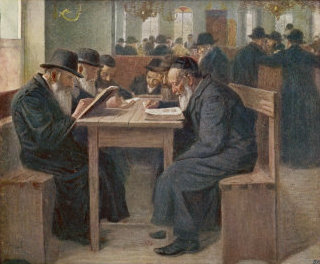
studying-talmudThis is a very mystical understanding of the “life” of the Torah and how in Chasidic Judaism, it transcends the physical scroll and exists as both the blueprint of the Universe and the means of its creation. Since we in Christianity understand that “the Word became flesh” (John 1:14) and that through the living Word, “things were made through him, and without him was not any thing made that was made,” (John 1:3) we also have a mystical understanding of the Bible, the Messiah, and creation, so perhaps the simple text on paper we see when we read our Bible and try to interpret it is not so simple after all. More than that, perhaps we cannot allow ourselves to limit that Word or that Messiah to what our Christian tradition says it all means, even if it makes us uncomfortable and stretches our understanding.

To drink “new wine,” we must prepare “new wine skins.”

Good Shabbos.