Tag Archives: Christianity

When Christians Aren’t Israel

In writing the review, I mentioned that I had gone back to J.K.McKee‘s A Part of Israel? as a resource for scholarly exposition of Scripture related to the place of non-Jews who come to Messiah. You’ll remember I lamented not having reviewed the book… Well, I started reading it again and couldn’t put it down! ‘Nuff said?

He is gracious in doing so, but is clear to demonstrate where there is error in various understandings of what the Kingdom of Israel looks like and who is in it! Example passages would be 30 pages dedicated to the predictably selected Ephesians 2:11-13 passage. He specifically addresses politeia, a Greek word we have looked at before, however, he understandably takes a much more coy approach as to whether non-Jews will have an inheritance in the land.

-Pete Rambo
from portions of his review of
JK McKee’s ‘Are Non-Jewish Believers Really A Part Of Israel?

I normally ignore these sorts of topics since historically in the blogosphere, debating the issues involved in Jewish/Gentile relationships in modern Messianic Judaism and/or the ancient ekklesia of “the Way” have, at best, proven unfruitful, and at worst, hostile and abusive.

But I’ve always had good, civil, and friendly conversations with Pete, including in the comments section on another of his blog posts,. So when I read his review, I was prompted to consider responding. After all, the legal and community status of the ancient Gentile disciples of the Jewish Messiah King relative to the synagogue, Jewish co-participants, and ultimately national Israel not only have applications in modern Christianity, but ultimately will be realized in the Messianic Kingdom when the New Covenant Age comes toward completion.

I requested a review copy of McKee’s book from the publisher and received a very nice and prompt reply stating that they do not honor such requests. Fair enough, since self-publication does not usually allow for such an option.

When I read Pete’s review last night, I got stuck on a single word: politeia. My commentary rather narrowly focuses on this word and how it is used since I can’t comment more generally on what McKee has written.

The word “politeia” is used in the following passages of scripture:

Then the commander said, “I had to pay a lot of money for my citizenship.”

Acts 22:28 (NASB)

…remember that at that time you were separate from Christ, excluded from citizenship in Israel and foreigners to the covenants of the promise, without hope and without God in the world.

Ephesians 2:12 (NASB)

I’ve bolded the English word corresponding to the Greek word “politeia” which is rendered as “citizenship” in both cases in the NASB translation.

However, this creates a number of questions.

  • Is Paul telling us (or his readers) that non-Jewish members of the Messianic ekklesia are now legally citizens of national Israel by faith in Messiah?
  • If so, then does such citizenship automatically require that the Gentile disciples adhere to, by obligation, the same Torah mitzvot in the same manner as the Jewish disciples/citizens?
  • Can “politeia” be translated in any other way besides “citizenship” and if so, what are the implications for the relationship of Gentiles and Jews belonging to Messiah in relationship to national Israel?

politeiaAs you can see from my source material, depending on the translation and in which part of scripture the word occurs, it can be translated differently. In Acts 22:28 using the KJV translation, it is rendered “freedom,” while in Ephesians 2:12, the NAS, KJV, and INT translations all present the word as “commonwealth”.

In fact, “citizenship” is only one of three major ways to translate”politeia”:

  1. the administration of civil affairs (Xenophon, mem. 3, 9, 15; Aristophanes, Aeschines, Demosthenes (others)).
  2. a state, commonwealth (2 Macc. 4:11 2Macc. 8:17 2Macc. 13:14; Xenophon, Plato, Thucydides (others)): with a genitive of the possessor, τοῦ Ἰσραήλ, spoken of the theocratic or divine commonwealth, Ephesians 2:12.
  3. citizenship, the rights of a citizen (some make this sense the primary one): Acts 22:28 (3Macc. 3:21, 23; Herodotus 9, 34; Xenophon, Hell. 1, 1, 26; 1, 2, 10; (4, 4, 6, etc.); Demosthenes, Polybius, Diodorus, Josephus, others).

I’m not a linguistic scholar, but I’ve known enough of them to understand that any sort of translation from one language to another is much more complicated than saying a particular word in language A always means another particular word in language B, especially when those languages are separated by nearly two-thousand years of history.

I am absolutely not saying McKee is making such a “rookie error,” but I will say that we all read and translate the Bible from a particular perspective, usually one that supports our own biases (everyone has biases, it’s not a dirty word). And yes, it’s easy to read those two verses in the New Testament and conclude that Paul must be making Israeli citizens out of Gentile believers in Jesus.

Tel Aviv
Tel Aviv

A lot of Evangelical Christians believe we’re “spiritual” citizens of Israel too, and expect to take over physical, national Israel when Jesus comes back. Naturally, Jewish people object to being kicked out of their own Land (even by allegory) and those teachers in Messianic Judaism who I follow do not believe we Gentiles will be moving to Jerusalem, or Tel Aviv, or Haifa once Messiah ascends the Davidic throne.

So where does that leave us? What’s the “differential diagnoses?”

If indeed it is the case that in Christ these Gentiles have a portion in [Israel’s covenant membership and national eschatology], i.e. that they are saved as Gentiles, then it suffices to apply to them the same ethical principles that would in any case apply to righteous Gentiles living with the people of Israel, i.e. resident aliens.

-Markus Bockmuehl
“Jewish Law in Gentile Churches:
Halakhah and the Beginning of Christian Public Ethics”
(Grand Rapids, MI: Baker Academic, 2000), 165

While the gerim in the days of Moses were not Israelites as such and did not obtain full membership status in the nation due to lack of tribal affiliation, they did observe a large number (majority? nearly-full obligation?) of the Torah mitzvot in the days of Moses and beyond. The argument of some branches of the Hebrew Roots movement is that the gerim status can be wholly transferred to the Gentile disciples of Jesus and be used to justify Gentile Christian obligation to the full yoke of Torah. Lancaster has spent considerable effort in his commentary to illustrate how James and the Council exempted the Gentiles from the full yoke of Torah because they were not born Jews or converts. Now, he apparently brings in an element in explaining the four prohibitions that could reverse his argument.

-from my blog post Return to Jerusalem, Part 6
based on my reviews of First Fruits of Zion’s (FFOZ) Torah Club series Chronicles of the Apostles

Up to JerusalemThe key to all this is in understanding what sort of decision the Council of Apostles and Elders made in Jerusalem about the legal status of Gentiles in “the Way”. The question was brought up (Acts 15:1-2) and after much debate, Paul and his detractors couldn’t make any headway toward a solution, so they took it to a higher authority in Jerusalem. After much deliberation, the Council rendered what amounts to a binding legal decision and issued halachah specific to the communal role and responsibilities of Gentile disciples of the Master. Did they have to undergo the proselyte rite and become wholly obligated to the Torah mitzvot? If not, how could they be included as equal co-participants in Jewish worship and community and yet not be Jewish? How could they be included in covenant?

How do we resolve the matter of the ancient Ger as applied to the late Second Temple Gentile God-fearing disciple? Lancaster doesn’t make that clear, but based on my own reading, particularly of Cohen, the full role of a Ger as it existed in the days of Moses was to allow a non-Israelite to live among the people of God as permanent resident aliens without being able to formally become national citizens due to lack of tribal affiliation. After the Babylonian exile, a tribal basis for Israelite society was lost and affiliation by clan was emphasized. By the time of Jesus, this clan affiliation basis was too lost, and thus the rationale for the status of Ger as it was originally applied no longer was valid. A Gentile in the days of Jesus or later, who wanted to join the community of Israel, in most cases, would convert to Judaism, since becoming a Ger was not an option.

-from my aforementioned blog post

To further cite Shaye J.D. Cohen:

Biblical law frequently refers to the “resident alien” (ger in Hebrew) who is grouped with the widow, the orphan, and the Levite. All of these are landless and powerless, and all are the potential victims of abuse. (An American analogy to the ger is the Chicano (specifically, undocumented alien) farmworker; a European analogy is the Turkish laborer in Germany.) The Bible nowhere states how a ger might ameliorate his status and become equal to the native born, because there was no legal institution by which a foreigner could be absorbed by a tribal society living on its ancestral land. Resident aliens in the cities of pre-Hellenistic Greece fared no better.

But there’s another authoritative source that should be considered:

and in order that the Gentiles might glorify God for his mercy. As it is written,

“Therefore I will confess you among the Gentiles,
and sing praises to your name”;
and again he says,

“Rejoice, O Gentiles, with his people”;
and again,

“Praise the Lord, all you Gentiles,
and let all the peoples praise him”;
and again Isaiah says,

“The root of Jesse shall come,
the one who rises to rule the Gentiles;
in him the Gentiles shall hope.”

Romans 15:9-12 (NASB)

To which Nanos responds:

Christian gentiles worshiping the One God in the midst of the congregation of Israel — my point exactly! (emph. mine)

-Mark D. Nanos
Chapter 6: Romans 13:1-7: Christian Obedience to Synagogue Authority, pg 326
The Mystery of Romans: The Jewish Context of Paul’s Letters

Paul is urging the Gentile believers to take note of their position, their role, and their halachic status as “resident aliens” within the midst of corporate Israel, which here is the synagogue context in Rome.
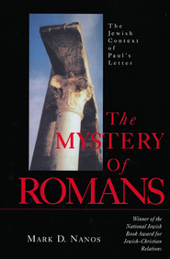
-from my review of Nanos’s book

The Mystery of RomansThe alternative explanation, based Bockmuehl, Cohen, Lancaster, and Nanos, is that the Gentiles were included in the commonwealth of Israel but not as equal national citizens. It would be as if my wife, as a Jew, decided to make aliyah, become an Israeli citizen and live in Israel. As her husband, even though I’m not Jewish, I would be allowed a permanent status as a resident in Israel as well, but I do not have an automatic right to become a citizen, as does my wife, because I am not Jewish.

I would still have most or all of the same rights as Jewish Israelis and I would have most or all of the same obligations as Jewish Israelis, but none of that would make me Jewish, nor would the Chief Rabbis of Israel or any other Jewish religious authority expect me to observe Torah as they proscribe because I’m not Jewish.

I know you’re going to say that’s all secular law (with the exception of the authority of the Chief Rabbis) and has little or nothing to do with how God sees things, but I’m using the above example by way of analogy. When James and the Council issued their decision, it wasn’t some magical, spiritual event, it was a legal ruling on the same order as the authorities among the Pharisees made, and was binding halachah upon the community.

However, there is another citizenship I have and one in which I’m looking forward to living out in the age to come. It’s a status I currently possess since according to at least one interpretation of the New Covenant, I need to start living my life as if the world were already fully under the rule of Messiah, Son of David, as he is seated on his Throne in Jerusalem.

I consider myself a citizen of the worldwide Messianic Kingdom to come and many wonderful blessings come from this status. I will be resurrected from dead flesh and made immortal (assuming I die before Messiah’s return). I will have my sins fully, permanently cleansed from me. I will have the Holy Spirit poured into me to such fullness that I will have an apprehension of God in the same or even greater manner than the prophets of old. I will have my heart of stone turned to a heart of flesh and God will write His Word upon it so that it will be my natural inclination to always obey Him and not return to sin.

And as a Gentile of the nations, I will reside in a country that is a vassal state to national Israel, subservient to Israel which will be the head of all nations, and ultimately I and my nation of residence will be accountable to the King of Israel, Moshiach. I expect that I and everyone else like me will be planning our vacations around the festivals and making regular pilgrimages to Jerusalem to spend time with family and friends and pay homage and honor to our King.

The goyishness of Christianity is a sign of its success, not its failure!

-Rabbi Dr. Stuart Dauermann
“The Problem With Hebrew Roots, or, It’s Good to be a Goy”
Interfaithfulness.org

Stuart Dauermann
Rabbi Dr. Stuart Dauermann

R. Dauermann makes a compelling argument that Gentiles who attach themselves to the God of Israel are intended by God to remain Gentiles. The prophets of the Tanakh who spoke of the Messianic Age all seemed to share that belief. I’ll only quote two of them:

And foreigners who bind themselves to the Lord
to minister to him,
to love the name of the Lord,
and to be his servants,
all who keep the Sabbath without desecrating it
and who hold fast to my covenant—
these I will bring to my holy mountain
and give them joy in my house of prayer.
Their burnt offerings and sacrifices
will be accepted on my altar;
for my house will be called
a house of prayer for all nations.”

Isaiah 56:6-7 (NASB)

“In that day

“I will restore David’s fallen shelter—
I will repair its broken walls
and restore its ruins—
and will rebuild it as it used to be,
so that they may possess the remnant of Edom
and all the nations that bear my name,”
declares the Lord, who will do these things. (emph. mine)

Amos 9:11-12 (NASB)

And to quote verse 14:

and I will bring my people Israel back from exile. (emph. mine)

which can also be interpreted as:

will restore the fortunes of my people Israel. (emph. mine)

In both of these prophetic examples describing Jews and Gentiles in the Messianic Age, it is clear that Gentiles will become attached to the God of Jacob as Gentiles and as citizens of the nations. While Isaiah paints for us a portrait of Gentiles offering sacrifices at the Temple of God (something which was allowed during the time of Herod’s Temple), Amos 9:14 makes a clear distinction between the Gentiles of the nations who “bear my name” and Israel!

It is true that Isaiah describes Gentiles keeping to the covenant, but after all, we will receive blessings because of our Abrahamic faith under the New Covenant, and in Messianic Days, I expect it will be more common for even the citizens of vassal nations to have laws and observances that more closely mirror national Israel’s including Sabbath keeping.

I’m not even saying (with apologies to R. Dauermann) that Gentiles in Messiah shouldn’t observe Sabbath in the present age. I’ve met many who do.

What I am saying is that none of what I see in the Bible, particularly the use of a single Greek word, absolutely mandates that all non-Jewish people who are disciples of Jesus be made into citizens of Israel, either in the present age or in the Messianic future.

God made a covenant with Abraham that was specifically and narrowly passed down to Abraham’s son Isaac (but not to Ishmael or any of Abraham’s subsequent children) and then to Isaac’s son Jacob (but not to Esau) and then to Jacob’s twelve sons who became the heads of the twelve tribes, who became the nation of Israel (but not to any other people group or nations).

That Abraham would also become the father of many nations and that through his seed (singular) Messiah, the nations would be blessed, does not abrogate the part of the covenant that specifically promises Israel only to the direct biological offspring of Abraham, and Isaac, and Jacob.

Having not read his book, I can’t say for sure, but if  McKee comes to a different conclusion in his writing, then in spite of his stated education and scholarship, I’m forced to disagree with him.

I don’t write this against Pete or anyone else who holds to his views of scripture, but rather to illustrate that there are other valid and educated views of the Bible that come to other valid and educated conclusions.

I considered just making a few comments on Pete’s blog but as you see, the response requires a lot of words and it’s easier to write out my thoughts here and then just to share a link to my blog with him (and anyone else who is interested).

Beth Immanuel ShavuotConsidering all of the different viewpoints involved in this sort of discussion, I see the position of One Law/One Torah (OL/OT) as existing at one end of a continuum and what’s been called Bilateral Ecclesiology (BE) positioned at the opposite end. While I obviously am leaning closer to the BE end of the scale, I’m not sitting right on top of it.

Of those congregations I am aware of that I consider authentic Messianic Jewish synagogues, including Beth Immanuel, Tikvat Israel, and Ahavat Zion, they all have a majority membership/attendance of non-Jewish people worshiping the God of Israel and giving honor and glory to Yeshua HaMoshiach (Jesus Christ), with a smaller membership and usually leadership of Jews. In fact, the primary teacher at Beth Immanuel is a Gentile: D. Thomas Lancaster. And yet Beth Immanuel is a Jewish community and worship venue that adheres to specific standards of established halachah.

From my perspective, that’s the current state of Messianic Judaism, or at least those portions I know about in my little corner of the world.

That I don’t consider non-Jewish disciples to be literally citizens of national Israel does not exclude us from many incredible blessings or from association with our Jewish brothers and sisters in Messiah. I am quite comfortable inside of my own skin, so to speak, being a person among the nations who is called by His Name. Being married to a Jewish wife, I am content to recognize that she is among her people Israel and I’m dedicated to supporting her, and all other Jewish people I’m associated with, being and becoming closer to the God of Jacob as HIs people Israel through the mitzvot and within their unique community and nation which was established forever by Hashem.

Reflections on Romans 4

What then shall we say was gained by Abraham, our forefather according to the flesh?

Romans 4:1 (ESV)

Remember that in my reflection on Romans 3, Paul was toggling back and forth between Jewish obligation to the Law (Torah) and justification by faith, making sure that his audience, probably Jewish and Gentile believers in the synagogues in Rome (but talking about Gentile relationships with non-Jesus-believing Jews), understood the proper association, that Jews had many advantages including those Jews who had not yet come to faith in Messiah Yeshua, (Christ Jesus) but that only faith ultimately justifies one before the Almighty.

It must have been a struggle, especially for the Gentile Jesus-believers, to comprehend the relationship between faith and Torah observance. My reading of Romans tells me that these Gentiles might have been getting pretty arrogant, especially in relationship with the non-Jesus-believing Jews they encountered, because they had the Torah but not faith in Messiah. The Gentiles may have concluded that they were justified before God as were their Jewish Jesus-believing counterparts, but not the non-believing (in Jesus) Jews. After all, keeping the Law doesn’t justify.

Paul was trying to correct the error of the Gentiles’ thinking. Christians today tend to mess this up as well, but if we apply Paul to today’s Jewish communities, we see they too must have many advantages, and that God has not abandoned them or replaced them with the Church or even with the community of Jesus-believing Messianic Jews.

Chapter four sees Paul continuing to make his point and expand upon it.

What then shall we say that Abraham, our forefather according to the flesh, has found? For if Abraham was justified by works, he has something to boast about, but not before God. For what does the Scripture say? “Abraham believed God, and it was credited to him as righteousness.” Now to the one who works, his wage is not credited as a favor, but as what is due. But to the one who does not work, but believes in Him who justifies the ungodly, his faith is credited as righteousness…

Romans 4:1-5 (NASB)

Paul continues to state that Abraham wasn’t justified by what he did, by any works, including circumcision, he was justified by faith and his faith was credited to him as righteousness, even as faith is credited to his readers and to us as disciples of the Master.

But that didn’t mean Abraham wasn’t subject to behavioral expectations by God. That doesn’t mean he didn’t have to obey:

So Abram went forth as the Lord had spoken to him; and Lot went with him. Now Abram was seventy-five years old when he departed from Haran. Abram took Sarai his wife and Lot his nephew, and all their possessions which they had accumulated, and the persons which they had acquired in Haran, and they set out for the land of Canaan; thus they came to the land of Canaan.

Genesis 12:4-5 (NASB)

Now it came about after these things, that God tested Abraham, and said to him, “Abraham!” And he said, “Here I am.” He said, “Take now your son, your only son, whom you love, Isaac, and go to the land of Moriah, and offer him there as a burnt offering on one of the mountains of which I will tell you.” So Abraham rose early in the morning and saddled his donkey, and took two of his young men with him and Isaac his son; and he split wood for the burnt offering, and arose and went to the place of which God had told him. On the third day Abraham raised his eyes and saw the place from a distance. Abraham said to his young men, “Stay here with the donkey, and I and the lad will go over there; and we will worship and return to you.” Abraham took the wood of the burnt offering and laid it on Isaac his son, and he took in his hand the fire and the knife. So the two of them walked on together. Isaac spoke to Abraham his father and said, “My father!” And he said, “Here I am, my son.” And he said, “Behold, the fire and the wood, but where is the lamb for the burnt offering?” Abraham said, “God will provide for Himself the lamb for the burnt offering, my son.” So the two of them walked on together.

Genesis 22:1-8 (NASB)

Abraham was faithful to God and obeyed him, even at great personal cost. Picture what it must be like to, at the word of God, pack up your family and all your possessions and head out in a direction with no stated destination in sight.

The AkedahBut that pales in comparison to the commandment to take your son and serve him up on the altar like a lamb to slaughter. As a father and grandfather, I can only imagine how Abraham’s heart must have been in anguish at knowing not only that his son would die, but that he would have to bind him and kill him with a knife.

Midrash says that Abraham believed that God would allow the sacrifice of Isaac but that God would resurrect him. However, the Torah is silent about this area of Abraham’s thoughts, so we’ll never be sure this side of Messiah what Abraham did and didn’t believe.

We only know that out of faith in God, he obeyed. Thus we can’t say that faith replaces obedience, only that it precedes it. From this I extrapolate that Paul is saying once justified by faith, Jews are expected to continue to observe the mitzvot and that in fact, their observance will have more depth of meaning because of faith.

But there’s something else:

David also speaks of the blessing on the man to whom God credits righteousness apart from works:

“Blessed are those whose lawless deeds have been forgiven, And whose sins have been covered. “Blessed is the man whose sin the Lord will not take into account.”

Is this blessing then on the circumcised, or on the uncircumcised also? For we say, “Faith was credited to Abraham as righteousness.” How then was it credited? While he was circumcised, or uncircumcised? Not while circumcised, but while uncircumcised; and he received the sign of circumcision, a seal of the righteousness of the faith which he had while uncircumcised, so that he might be the father of all who believe without being circumcised, that righteousness might be credited to them, and the father of circumcision to those who not only are of the circumcision, but who also follow in the steps of the faith of our father Abraham which he had while uncircumcised.

Romans 4:6-12 (NASB)

In short, the forgiveness of sins is by faith, not by performance of the mitzvot, thus both Jews and Gentiles receive forgiveness by their faith and the Gentiles don’t have to be concerned that their sins will be counted against them if they don’t also observe the mitzvot in the manner of the Jews.

Remember I said that I thought the Gentiles were probably getting arrogant in their status of saved by faith apart from the Torah? It’s possible that the non-believing (in Jesus) Jews were “pushing back” with their advantage as Jews, having the Torah, the oracles of God, and maybe getting back at the Gentiles among them by pointing out what the Jews had that the Gentiles would never have.

If indeed there was a “war of egos” going on between the Jesus-believing Gentiles and the non-Jesus-believing Jews (with the Jesus believing Jews caught in the middle), then each party would be pressing their own perceived advantage against the other. Paul’s writing this letter to even things out. He’s saying that yes, non-Messianic Jews continue to have the advantages under the Abrahamic and Sinai covenants, but that under one of the blessings of Abraham, it is faith that removes sin for all, not Torah observance, so everyone who has faith will be saved.

DaveningAlso remember that the non-believing (in Jesus) Jews weren’t faithless. They had faith, probably great faith, not in Jesus being Messiah but rather in Hashem, God of Creation, Master of Legions. Yes, faith in Messiah as the first fruits of the dead is the next logical, historical, and Biblical step in Jewish faith in God and the advancement of God’s plan to bring the New Covenant into the world, but non-believing (in Jesus) Jews were not totally abandoned by God, nor were they bereft of His compassion.

For the promise to Abraham or to his descendants that he would be heir of the world was not through the Law, but through the righteousness of faith. For if those who are of the Law are heirs, faith is made void and the promise is nullified; for the Law brings about wrath, but where there is no law, there also is no violation.

Romans 4:13-15 (NASB)

This sounds like one of those either/or statements about faith being good and the Law bringing wrath, but what about the Law brings wrath?

If someone depended on their behavior alone with no faith in God and with the absence of intent to serve God, the response would be wrath, for without faith, no one can be saved from the consequences of their sin and from God’s righteous judgment. Yes, the Jews had the promises and they were (and are) heirs to the Land of Israel, but if observance is what you believe justifies you before God, then “faith is null,” as Paul wrote. Of course, the other side of that wrath is a Jew who claims to have faith in God but who is not observant. The Torah is clear about the consequences of disobedience or abandoning God’s Law for a Jew. But what about Gentiles in Messiah?

We see that there are two standards of judging obedience. They may overlap, but they’re hardly identical. If the Gentile disciples of the Master were not expected to observe the Torah in the manner of the Jews as per the legal ruling of the Council of Apostles and Elders (see Acts 15), then those without the Law (Torah), that is, the Gentile disciples, are not under the wrath of the Law. They are not expected to obey thus if they fail to observe the mitzvot, there is no transgression.

But as I said above, the other wrinkle is that even if a Jew has great faith and is justified before God, if he or she does not observe the Torah commandments (the conditions of fulfilling the Sinai Covenant), imagining somehow that they are like the Gentiles (and I can imagine that a few Jews may have taken this as Paul’s meaning), then that Jewish person would be under condemnation. Abandoning the Torah is written all over the history of the Israelites.

But to the wicked God says,
“What right have you to tell of My statutes
And to take My covenant in your mouth?
“For you hate discipline,
And you cast My words behind you.”

Psalm 50:16-17 (NASB)

Just to show you that I’m not making up the idea that a Jew could misunderstand Paul’s intent in teaching Jewish Torah obligation and Gentile non-obligation…

And when they heard it they began glorifying God; and they said to him, “You see, brother, how many thousands there are among the Jews of those who have believed, and they are all zealous for the Law; and they have been told about you, that you are teaching all the Jews who are among the Gentiles to forsake Moses, telling them not to circumcise their children nor to walk according to the customs.

Acts 21:20-21 (NASB)

Apparently some Jewish people got the idea that because Paul was teaching the Gentiles that they did not have to observe the Torah commandments (Moses) and they didn’t have to circumcise their sons, that Paul was also teaching the Jews the diaspora the same thing. Maybe some Jews reading Paul’s letters or hearing him teach actually thought he was applying the same “freedom” he was preaching to the Gentiles to Jewish believers in Yeshua.

Here was James’ solution to the problem and his attempt to clarify what Paul was really doing:

Therefore do this that we tell you. We have four men who are under a vow; take them and purify yourself along with them, and pay their expenses so that they may shave their heads; and all will know that there is nothing to the things which they have been told about you, but that you yourself also walk orderly, keeping the Law. But concerning the Gentiles who have believed, we wrote, having decided that they should abstain from meat sacrificed to idols and from blood and from what is strangled and from fornication.”

Acts 21:23-25 (NASB)

The Jewish PaulPaul was to pay the expenses of four Jewish men under a vow (probably a Nazarite vow) in order to graphically illustrate that he continued to observe the mitzvot and that there was nothing to the erroneous rumors about him teaching “lawlessness” to diaspora Jews. Verse 25 presents the distinction for the Gentile believers, citing the Acts 15 letter, which limits the observance of the Messianic Goyim to a subset of the commandments.

Thus Paul was not teaching Jews that their level of observance was reduced to that of the Gentile disciples but rather, Paul remained a Torah-observant Jew teaching other Jews to keep to the commandments while at the same time, teaching the Gentile disciples a different or overlapping set of observances that were not nearly as strict or involved.

No wonder the Romans letter seems so difficult to follow. Paul was trying to explain circumstances that were (and are) very difficult to understand.

The common denominator for Jews and Gentiles in Messiah is faith. Faith justifies, makes one righteousness, and erases all guilt of sin (after repentance, of course), and only afterward are we to live a life of obedience by faith. Only then will God judge our hearts and hold us accountable to the level of our observance as specifically assigned to Jew or Gentile.

I know I’m going to get some “push back” for all that, but it’s the only way to explain what Paul is saying that makes any sort of sense to me.

For this reason it is by faith, in order that it may be in accordance with grace, so that the promise will be guaranteed to all the descendants, not only to those who are of the Law, but also to those who are of the faith of Abraham, who is the father of us all, (as it is written, “A father of many nations have I made you”) in the presence of Him whom he believed, even God, who gives life to the dead and calls into being that which does not exist. In hope against hope he believed, so that he might become a father of many nations according to that which had been spoken, “So shall your descendants be.”

Romans 4:16-18 (NASB)

Like I said, faith is the common denominator in accordance with grace. Abraham has two lines of descendants, those who are of the Law, that is, the Jewish people, and those who are of the faith of Abraham, that is, the Gentile believers. This isn’t to say that the Jews have only the Law and Gentiles are the ones with all the faith. Like I said, faith is the common link between Jews and Gentiles. But we Gentiles are joined to the covenant blessings by faith and we do not have the Law.

The Law, that is, the Torah, the conditions of the Sinai covenant between God and Israel, is particularly identifying of Jews. That’s why (in my opinion), Paul structured his sentence as he did. The Jews are the ones whose obligations to God are specifically defined in the Torah. The Gentiles, by contrast, are specifically identified, not by the Law obviously, but as children of Abraham by faith alone. The Gentile behavioral conditions are summarized in the Acts 15 letter. Remember, the Jews were also physically children of Abraham, so they had their link back to the Patriarch both by faith and by bloodline. Gentiles are Abraham’s children by faith alone. This is how Abraham would be the father of the Jews but also the “father of many nations.”

sarah and isaacThe final verses of this chapter pull Paul’s points together, citing Abraham’s faith in the promise of an offspring, even in the face of both his and Sarah’s great age, and repeating that Abraham’s faith was credited to him as righteousness. Paul then points all this back to Jesus, the keeper of the New Covenant promises, the seed of Abraham (Galatians 3:16; 3:29), the one God raised from the dead, the one who was delivered over to sinful men for the transgressions of the world, for the sake of the Jews but also the Gentiles, that through faith in him and the resurrection, we have the hope of living in the New Covenant age, in an age of peace and tranquility, in an age without strife or sin, with Messiah the King.

Christians and Tisha B’Av

…Should I weep in the fifth month [Av], separating myself, as I have done these so many years?

Zechariah 7:3

In the fifth month, on the seventh day of the month …came Nebuzaradan … and he burnt the house of the L-RD…

II Kings 25:8-9

In the fifth month, on the tenth day of the month… came Nebuzaradan … and he burnt the house of the L-RD…

Jeremiah 52:12-13

Tisha B’Av, the Fast of the Ninth of Av, is a day of mourning to commemorate the many tragedies that have befallen the Jewish people, many of which have occurred on the ninth of Av. Tisha B’Av means “the ninth (day) of Av.” It occurs in July or August.

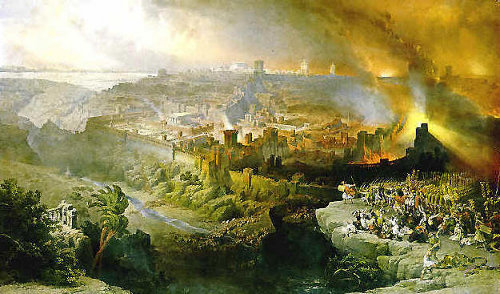
Tisha B’Av primarily commemorates the destruction of the first and second Temples, both of which were destroyed on the ninth of Av (the first by the Babylonians in 586 B.C.E.; the second by the Romans in 70 C.E.).

Although this holiday is primarily meant to commemorate the destruction of the Temple, it is appropriate to consider on this day the many other tragedies of the Jewish people, many of which occurred on this day, most notably the expulsion of the Jews from Spain in 1492 and from England in 1290.

-from Judaism 101

Sometime before May of 2011, as chronicled on my former blog, I significantly reduced many activities that I had erroneously believed were my obligation to Torah observance. Not that my observance was performed with any sort of accuracy as an observant Jew might consider it, but at one time in my life I made the mistake of thinking that Jews and Jesus-believing Gentiles were assigned identical obligations to God and for all intents and purposes, a homogenous identity.

All that changed over the period of about a year and one of the primary motivators of that change was me watching my Jewish wife integrate into the local Jewish community across two synagogues and into her exploration of who she is as a Jew.

I realized that by attempting to “mimic” Jewish observance and behavior, I was diminishing my wife in her Jewish identity and diminishing the special chosen status the Jews have received from God.

Which left me with the question of just how much Jews and Christians can and should share, at least relative to Messianic Judaism but ultimately as an act of interactive fellowship between all Christians and all Jews.

And that brings me to Tisha B’Av or the ninth day of the month of Av on the Jewish religious calendar. You can click the link posted in the last sentence as well as the Judaism 101 link to learn more about this event and the weeks leading up to it.

The question is, can I or should I fast on Tisha B’Av? What is the purpose of a non-Jew fasting on a day of Jewish mourning? I’m sure the question has been asked so I went searching for questions and answers.

QUESTION: Is it OK for a Noahide to fast on Tisha B’Av? [The 9th/Tisha of the Hebrew month of Menachem Av, when Jews observe total fasting for about 24 hours and 40 minutes, as part of their traditional mourning on this anniversary of the destruction of both the first and the second Holy Temples in Jerusalem. When the 9th falls on the Seventh Day as in this year, the fast is pushed off 24 hours, and starts on Saturday night.]

ANSWER: It would seem that if a Noahide would make a full observance of all the Jewish precepts of Tisha B’Av, he would be making a religiously-observed memorial day for himself, which is like innovating a religious observance, which is forbidden.

Rabbi Moshe Weiner, author of Sefer Sheva Mitzvot HaShem, says that the only point upon which an individual Noahide could justify fasting is that he is mourning the temporary (but far too long) destruction of the Holy Temple and the exile of the Divine Presence. Since this is a permitted activity, it depends on his intention.

-from “Remembering the destruction of the Temples”
AskNoah.org

rainbow-forestYou may think it strange that I started looking for answers by exploring the propriety of a Noahide (a Gentile who observes the Seven Noahide Commandments [see Genesis 9] and is considered a “righteous Gentile” from a religious Jewish perspective) observing the fast. After all, I previously explored the idea of a Christian also being seen as a “righteous Gentile” and found, with rare exception, that the two states are incompatible.

But since this question (and many others like it) has probably been considered by the various branches of Judaism for hundreds of years or more, why not seek out their viewpoint? After all, it is a Jewish commemoration.

I only quoted from part of the article, but as you can see, it’s not considered obligatory for a Noahide to observe the fast or any of the other customary events leaving up to the actual fast day.

While a complete fast is discouraged, there are other recommended behaviors that are thought appropriate according to the Ask Noah Rabbi:

You can certainly increase in deeds of goodness and kindness for others, especially in giving donations to proper charities (which are not in conflict with Torah laws or morals)

Certainly a Noahide is encouraged to pray that the Third Holy Temple shall be established by Moshiach ben David very speedily in our days. And it very appropriate for a Noahide to read the Book of Lamentations on the night and/or day of Tisha B’Av.

The Rabbi also recommended the traditional reading of the Book of Job.

Rabbi Qury Cherki at the Noahide World Center has a similar opinion:

There are no commandments binding on a Noahide on the Ninth of Av. Any actions that he or she takes are completely voluntary. Anybody who decides to fast, or to read the Book of Lamentations or the Wars of the Jews and the Romans by Josephus, will be blessed for compassion.

The same is true of other restrictions, such as not listening to music, not greeting other people, and not using makeup. All such practices are copied from the obligations of Israel and are voluntary for Noahides. Children should not be told to fast.

Noahides can also decide on their own conditions. For example, they might allow themselves a partial fast by drinking but not eating any food. They can freely choose their own conditions.

This commentary seems a bit more relaxed than the “Ask Noah” opinion but it ultimately centers on any action the Noahide takes in response to Tisha B’Av being completely voluntary and a blessing for compassion.

churchBut what about Christians? Since the Church has been the source of much Jewish misery over the long centuries, would it be considered forbidden for a Christian to participate, or would it be (perhaps) considered an obligation as a matter of Teshuvah? If we have caused Jewish suffering, should we now, as an act of repentance, share in Jewish mourning?

It’s not easy to find anything online about Christianity and Tisha B’Av. I did manage to locate a letter written by Rabbi Yechiel Eckstein posted at the International Fellowship of Christians and Jews. It’s addressed “Dear Pastor and Friend of the Fellowship,” so the audience is generically Christian. The letter seems educational in nature and is more advice to a Pastor on how to explain the Jewish significance of Tisha B’Av to Christian congregations.

R. Eckstein ends his letter:

It is my hope that these materials will help you gain greater insights into the Jewish roots of the Christian faith and understand the significance of Tisha b’Av.

I thank you for your continued interest and partnership in building bridges of understanding between our two faith communities.

May God bless you richly as you and your congregation continue to study His word.

The Christian Broadcasting Network posted an article by John Parsons of Hebrew for Christians Ministries entitled Tishah B’Av: Remembering the Destruction of Zion, but that too was an informational piece with no specific recommendations for Christian observance of the fast.

Which brings me to First Fruits of Zion’s (FFOZ) article The Affliction of Av.

This day holds intense significance for the Jewish people, but what about Christians, the followers of Messiah? Should believers mourn as well? Yes, we more than anyone else.

This is the first and only affirmation I could find (granted, my search was hardly exhaustive) that Christians not only could but should observe the fast. The article continues to conclusion:

The afflictions of Tisha b’Av were not just limited to the days of the Bible. Tisha b’Av has continued to be an ominous day for the Jewish people throughout their history. Sadly, many of these tragedies have been at the hands of “Christian” rulers, popes, and angry mobs. Whether by crusades, inquisitions, pogroms, or blood libels, so-called followers of Yeshua have tortured, burned, and murdered Jews. In so doing, these “Christians” have maligned the name of the Master and blasphemed His character.

But though some of these tragedies may seem like ancient history, “Christian” persecution is still fresh in the collective mind of the Jewish people. Given that fact, perhaps Tisha b’Av should become a Christian tradition as well. We must continue to rid our congregations of the sin of anti-Semitism in whatever form it takes, whether in thought, speech, or theology.

Once again, tzom kal – May you have an easy fast.

If the Church can be said to be obligated at all to the observance of Tisha B’Av, repentance for our historic (and maybe more modern) crimes against Israel, Judaism, and the Jewish people is the reason. Beyond Teshuvah is fasting as an act of compassion and solidarity. From a Christian and Messianic point of view, we are all looking to a future time when Messiah comes (returns) and rebuilds the Temple in Jerusalem, defeating Israel’s enemies, and bringing a lasting peace to the entire world for all nations…for Jews and Gentiles alike.

Each of them will sit under his vine
And under his fig tree,
With no one to make them afraid,
For the mouth of the Lord of hosts has spoken.

Micah 4:4 (NASB)

fall-of-jerusalemYesterday, I posted both a blessing and a cautionary tale about praying for the peace of Jerusalem or, conversely and even fatally, failing to do so. I believe Christians are commanded to pray for Israel’s shalom as a matter of aligning ourselves with the will of God for the Jewish nation and all of her people. In that light, I can see Christian observance of Tisha B’Av on some level to be obligatory as well. That most church Pastors and their congregations know nothing at all of Tisha B’Av may be a tragedy and a crime. Could it also be a sin?

As I write this, it is the first day of the month of Av, which begins the Jewish observance of the Nine Days leading up to the fast day. You can also learn a lot more about the three weeks leaving up to Tisha B’Av at Chabad.org.

This year, Tisha B’Av begins just before sundown on Monday, August 4th and ends about forty minutes after sundown the following day, Tuesday the 5th.

If you are Jewish and reading this and you don’t have a practice of fasting on Tisha B’Av (unless for a medical reason) I encourage you to strongly consider participating in the fast as a matter of community with all of Jewry, your brothers. If you are a Christian, from a traditional Jewish point of view, any observance of Tisha B’Av is completely voluntary and you are free to not observe the fast at all. However, the reality from a Messianic point of view (and who is to say this isn’t God’s point of view as well) is that observing Tisha B’Av can be seen as an obligation for Gentile Jesus-believers as both a matter of repentance and compassion.

This could be akin to that portion of Psalm 122 which pronounces prosperity for anyone who prays for the peace of Jerusalem and who loves the Holy City, as well as to Genesis 12 which announces blessings for those who bless Israel and curses for those who curse her.

Thus not only should we pray for Israel’s peace but we should also mourn with her in her loss.

“Be joyful with Jerusalem and rejoice for her, all you who love her; Be exceedingly glad with her, all you who mourn over her…”

Isaiah 66:10

“He who does not mourn over the Destruction of Zion will not live to see her joy.”

-T. Bab Bathra, fol. 60. 2. & Caphtor, fol. 118. 2.

RestorationOur hope as Christians is in the return of the Messiah and the resurrection in the New Covenant age when Jerusalem will be rebuilt and Israel will raised as the head of all the nations. Jerusalem will be in her uttermost joy, but according to Jewish tradition, those who do not mourn for Zion now will not be alive in the Messianic future to receive her joy. This is commentary on both Isaiah 66:10 and Genesis 12. This is a warning to all believers who still embrace hatred of Israel in their (our) hearts.

May God grant wisdom and compassion to His worshipers among the nations, and may He teach us to weep bitter tears over the fallen Temple, so that we may sing with joy when Messiah raises the Mikdash, the Holy Temple, again.

What I Learned in Church Today: Pray for Jerusalem

I was glad when they said to me,
“Let us go to the house of the Lord.”
Our feet are standing
Within your gates, O Jerusalem,
Jerusalem, that is built
As a city that is compact together;
To which the tribes go up, even the tribes of the Lord—
An ordinance for Israel—
To give thanks to the name of the Lord.
For there thrones were set for judgment,
The thrones of the house of David.
Pray for the peace of Jerusalem:
“May they prosper who love you.
“May peace be within your walls,
And prosperity within your palaces.”
For the sake of my brothers and my friends,
I will now say, “May peace be within you.”
For the sake of the house of the Lord our God,
I will seek your good.

Psalm 122 (NASB)

Not that the sermon wasn’t good or the Sunday school class wasn’t stimulating, but this is the best thing I learned in church today (yesterday as you read this). Pastor Randy returned from being away for several weeks in California and led the congregation in an impassioned prayer for Israel in these trying times. Randy lived in Israel for fifteen years and still has many Jewish friends there. One of his friends calls Randy every three days or so and gives him an update on what is really happening there, events you’ll never see reported on CNN or MSNBC.

The Iron Dome missile defense is working but when a missile was intercepted directly over the home of Randy’s friend, they heard the loud explosion followed by the rain of shrapnel hitting the roof. The missile alarms go off daily prompting everyone to go to the shelters.

The friend’s adult age daughter’s boyfriend is an officer of an elite ground unit in the IDF. This officer was leading his men (in the IDF officers don’t tell soldiers to go and do something while sitting back, they always say “follow me” and then lead their troops) through one of the thirty-eight known Hamas terrorist tunnels in Gaza when a booby trap bomb blew up literally in his face.

The three men behind him died but amazingly, this man survived. A number of bones on his face were broken, bomb fragments are in both eyes, and he’s lost the hearing in one ear.

He will regain his sight eventually but will always be partially deaf.

Randy was insistent that we must pray for the peace of Jerusalem. He also said this:

And I will bless those who bless you,
And the one who curses you I will curse.

Genesis 12:3 (NASB)

Not only did Randy speak of blessings but of curses, and he even invoked these curses against all of Israel’s enemies.

He also recited Psalm 122:6 in Hebrew and wished we could read and speak it in Hebrew as well:

שַׁאֲלוּ, שְׁלוֹם יְרוּשָׁלִָם

Remember the second half of that verse:

May they prosper who love you…

Which strongly implies the opposite to those who hate Jerusalem.

terror tunnel discoveredFrom my point of view, loving Israel and cherishing Jerusalem is a “no brainer,” but after all, my wife of over thirty years is a Jew and I have learned a deep-seated compassion for the nation and the people whom God has called His “priests” and the “apple of His eye”.

I also consider it spiritual suicide to not love Israel for in the end, God Himself will defend her against all of her enemies in war, which sadly I fear, includes the nation in which I live.

This topic wasn’t supposed to spill over into Sunday school class but when Charlie was asking for prayer requests, I mentioned that Randy fulfilled my typical request in a much better way than I ever could. That started a discussion and one fellow, who tends to have a “sparky” temper at times, inserted the “there are two sides to every story” argument.

I didn’t mind, and in fact I agreed with him, when he said that the Arab non-combatants in Gaza are as much victims of Hamas as the Jewish Israelis, but he then downgraded Israel and her current Jewish population saying they are guilty of doing many wrongs as well.

I can’t speak for the actions of every individual in Israel, but I can see that God didn’t promise to fight off the enemies of the “Palestine,” He will defeat the enemies of Israel. To stand against Israel now, even in the slightest degree, isn’t only standing on the wrong side of history, it’s standing on the wrong side of God.

I wasn’t the only one to come to Israel’s defense in class, and shortly afterward, this fellow seeing “both sides” got up and left, followed a minute or so later by his wife.

I actually feel bad about that because on many other levels, this person does love Jesus and sincerely serves him (he just returned with a group from our church who went on a short-term missions trip to the Philippines and Thailand). It’s just that so many Christians are blind as to the true focus of Christ’s love and what Jerusalem means to him.

I mentioned before that I thought John MacArthur’s current battle against the Presbyterian Church (U.S.A.) over PCUSA’s support of “marriage equality” was something of a Red Herring, not because MacArthur isn’t sincere (he’s always sincere), but because the center of God’s attention is always Israel.

This isn’t to say that missions trips or the many other fine endeavors of the Church are “Red Herrings,” but we can’t let all of these other activities make us take our eye off the ball, so to speak, lest we lose the prosperity that comes of loving Jerusalem and praying for her Shalom.

The rest of the world, and particularly Europe, are attacking the Jews over perceived Israeli injustices in Gaza. Sometimes those attacks include physical assaults against Jewish people. How long before European nations start marshalling their armies and physically attack the nation of the Jews: Israel?

Here in America, we have lost our way as well and can no longer see the moral chasm between Israel and Hamas (that last link leads to an article written by General James T. Conway, who retired in 2010, and was the 34th commandant of the U.S. Marine Corps). Most of us, including many in the Church, swallow the anti-Israel, anti-Jewish propaganda being pumped at us by the mainstream news media as well as social media venues. We pay attention to secular “wisdom” and abandon the Word of God. More’s the pity.

IsraelRandy said that in the days of the Temple, many of the songs of ascents would be sung by those who were going up to Jerusalem, to the House of the God of Jacob, He asked us to imagine going up the steps with Psalm 122 on our lips. Imagine the Levitical priests singing the songs as you entered the Temple court. Imagine the anticipation, the grandeur, the beauty, the thrill of approaching a tangible encounter with God in the only place in the world He has placed His Name.

I reminded my Sunday school class that in modern Judaism, you can pray the Psalms for different occasions. This is a good occasion to pray Psalm 122 for the peace of Israel.

Pray for the peace of Jerusalem; those who love you will be serene. May there be peace within your wall, serenity within your palaces. For the sake of my brethren and my comrades, I shall speak of peace in your midst. For the sake of the House of Hashem, our God, I will request good for you.

Psalm 122:6-9 (Stone Edition Tanakh)

“Come, I will show you the Bride, the wife of the Lamb.” And he carried me away in the Spirit to a great, high mountain, and showed me the holy city of Jerusalem coming down out of heaven from God…

Revelation 21:9-10 (ESV)

One last cautionary note. Verse five of Psalm 122 says, “For there sat thrones of judgment.” There will be a judgment against those who do not seek Israel’s peace. Choose a blessing and not a curse. Choose life.

Where Do We Encounter God?

They shall make for Me a Sanctuary and I shall dwell among them.

Exodus 25:8

The Midrash notes that God did not say, “I shall dwell within it” (the Sanctuary), but “I shall dwell among them” (the Israelites), i.e. the Divine Presence will be within each person.

-Rabbi Abraham J. Twerski
“Growing Each Day,” Tammuz 26
Aish.com

That sounds incredibly like this:

When the day of Pentecost had come, they were all together in one place. And suddenly there came from heaven a noise like a violent rushing wind, and it filled the whole house where they were sitting. And there appeared to them tongues as of fire distributing themselves, and they rested on each one of them. And they were all filled with the Holy Spirit and began to speak with other tongues, as the Spirit was giving them utterance.

Acts 2:1-4 (NASB)

Well, maybe not exactly. Actually, the “Pentecost event” sounds more like this:

The Lord descended in a cloud and spoke to him, and He increased some of the spirit that was on him and bestowed it on the seventy elders. And when the spirit rested upon them, they prophesied, but they did not continue.

Numbers 11:25 (Chabad Torah Commentary)

So we have two examples from the Bible, Numbers 11:25 and Acts 2:1-4, where we witness the Holy Spirit of God being imparted to groups of devout Jews and whereupon they prophesy. Then we have a Midrash on a portion of the Torah that says it was God’s intent to dwell among Israel by dwelling within each individual Israelite, rather than in (or in addition to) the Sanctuary itself.

When the Midrash states God did not say, “I shall dwell within it” (the Sanctuary), but “I shall dwell among them”, it seems more like clever word play than an obvious interpretation leading to the aforementioned conclusion.

Still, it’s a compelling thought, since it summons images of God desiring, even as He commands the Mishkan to be built, to dwell within the devout of His people.

But dwelling among His people can also be compared to this:

They heard the sound of the Lord God moving about in the garden at the breezy time of day; and the man and his wife hid from the Lord God among the trees of the garden. The Lord God called out to the man and said to him, “Where are you?”

Genesis 3:8-9 (JPS Tanakh)

Here too we see God “dwelling” among His people in Gan Eden (the Garden of Eden) but we don’t see the Divine Presence dwelling within Adam and Havah (Eve). Can we say that the Divine Presence dwelt among Israel with the Tabernacle (and later the Temple) as the focus of His presence in the same manner as He dwelt (or at least visited) the Garden?

After all, the Midrash presented by Rabbi Twerski isn’t the only one referencing Exodus 25:8:

And they shall make Me a sanctuary: And they shall make in My name a house of sanctity.

Rashi’s commentary on Exodus 25:8

Rabbi Prof. David Golinkin

Rabbi Professor David Golinkin, President of the Schechter Institute of Jewish Studies in Jerusalem, wrote a commentary on Exodus 25:8 in 2003 called Why Do We Need Synagogues in which he offered numerous Midrashim on this particular verse.

Of all of the Midrashim proffered, he believes this one best defines the reason for the commandment to build the Mishkan:

This whole matter of the Menorah, the Table, the Altar, the boards, the Tent, the curtains, and the utensils – what is it for? Said Israel before the Holy One Blessed be He: Lord of the Universe, the kings of the nations have a tent and a table and a menorah and incense and these are the trappings of kingship, for every king needs this. You are our king, our redeemer, our savior – shouldn’t you have the trappings of kingship until all people know that you are the king? God said to them: My children, flesh and blood need all that, but I do not, because I don’t eat or drink and I don’t need light… [Finally God relented:] If so, do what you want, but do it as I instruct you: As it is written: “And let them make me a sanctuary… make the menorah… make the table… make the altar…” (Midrash Aggadah to Parashat Terumah, p. 170).

The Jewish people built the mishkan and later the mikdash and later the synagogue because they – like all human beings – had a need for a physical place in which to worship God.

We are physical beings designed to live in the material world. God is Spirit and exists outside of Creation and indeed, there is no place where God does not and cannot exist. We are limited and He is limitless. So if He desires to dwell among us, where do we meet? We cannot go to His realm for how does a finite human visit infinity? He must somehow “reduce” Himself and come to us where we live. It was for us that all of Creation was made.

And who knows what aspect of the Almighty was “moving about in the garden” on that breezy day?

But R. Golinkin also quoted his father Rabbi Noah Golinkin from the senior R. Golinkin’s booklet Say Something New Each Day (1973, p. 18):

God, where are You?
Where do I find You?
You do not live here.
You have no address.
The Universe is filled with Your glory.
You live in every mountain
and in every valley
and on the busy turnpike outside.
You live in the beautiful riot of many colors
of the Indian summer;
and You live in my soul.

“You live in my soul.” But there’s more:

And yet
I have built for You a special building,
Beautiful, dignified, majestic,
Intimate, warm and friendly.
For whom did I build it?
For You and me.
For our conversations together.
For Your glory, O God,
And for my humble need.
I should be talking to You –
When I see You in the beautiful sunrise,
When I see You in the innocent smile of a child
When I see You in the kind deed of a man.

Inner lightIt seems there doesn’t have to be an inconsistency between God dwelling among us and God dwelling within our souls. He speaks to us from within ourselves but also meets with us in Holy places of worship.

I should say that, particularly in Judaism, personal worship and study is conducted in the home and the synagogue is reserved for communal worship and study. Jews pray individually but to join a minyan, must go to the synagogue.

Then the LORD God said, “It is not good for the man to be alone…

Genesis 2:18 (NASB)

Behold, how good and how pleasant it is For brothers to dwell together in unity!

Psalm 133:1 (NASB)

In the Garden, in the Mishkan, in the Temple, in the Synagogue, and dare I say it, in the Church, people were not meant to encounter God as individuals, because we can do that anywhere, including within our souls. God commanded the Mishkan to be built so that the community, the nation of Israel could gather and dwell with God.

The indwelling of the Spirit is inexorably coupled with the New Covenant:

Moreover, I will give you a new heart and put a new spirit within you; and I will remove the heart of stone from your flesh and give you a heart of flesh. I will put My Spirit within you and cause you to walk in My statutes, and you will be careful to observe My ordinances.

Ezekiel 36:26-27 (NASB)

“Thus you will know that I am in the midst of Israel,
And that I am the Lord your God,
And there is no other;
And My people will never be put to shame.
It will come about after this
That I will pour out My Spirit on all mankind;
And your sons and daughters will prophesy,
Your old men will dream dreams,
Your young men will see visions.
Even on the male and female servants
I will pour out My Spirit in those days.”

Joel 2:27-29 (NASB)

In Gan Eden, human beings had an unparalleled intimacy with God which they took for granted because they had never known separation from God. It was only after the first act of disobedience that they truly understood was it was to be separated from God, the anguish, and agony of having known God and then becoming alienated from Him. How like our Master when he took upon himself the sins of humanity, thus for the first time also becoming separate from the Father:

About the ninth hour Jesus cried out with a loud voice, saying, “ELI, ELI, LAMA SABACHTHANI?” that is, “MY GOD, MY GOD, WHY HAVE YOU FORSAKEN ME?”

Matthew 27:46 (NASB)

exileHumanity has been separated from God for virtually all of human history. And yet not only has God desired to once again dwell with us, but as the Midrash testifies, we have yearned to dwell with Him. But once broken, shattered, torn asunder, intimacy with God is not so easily recovered. We see a series of steps, from the Mishkan, to the Temple, to the Master (John 1:14) and the Master’s Good News that the New Covenant was (is) near, to the giving of the Spirit to the Jews (Acts 2) and the Gentiles (Acts 10).

But the best is yet to come.

While most Christians don’t give much serious thought to Midrash, it’s a reminder that the desire for intimacy with God is much older than the Church and that the people who authored the Bible also witnessed the Divine Presence descending upon a structure that man built at the command of God.

Then the cloud covered the tent of meeting, and the glory of the Lord filled the tabernacle. Moses was not able to enter the tent of meeting because the cloud had settled on it, and the glory of the Lord filled the tabernacle. Throughout all their journeys whenever the cloud was taken up from over the tabernacle, the sons of Israel would set out; but if the cloud was not taken up, then they did not set out until the day when it was taken up. For throughout all their journeys, the cloud of the Lord was on the tabernacle by day, and there was fire in it by night, in the sight of all the house of Israel.

Exodus 40:34-38 (NASB)

The Divine Presence of God descended upon the Tabernacle but God also dwelt within the souls of each individual Jew. Messiah will someday come to rebuild the Temple, but Paul also called our bodies Temples of the Holy Spirit (1 Corinthians 6:19). We don’t have to conclude that an infinite God can only reside within one domicile within our world, for nothing is impossible with God.

But if not for human frailty and folly, where would God be to be among us?

The purpose of the tabernacle and the subsequent Temples was “they shall make me a sanctuary that I may dwell amongst them” (Exodus 25:8).

The great kabbalist Rabbi Isaiah Halevi Horowitz (1560-1630), author of the monumental work the Sheloh, writes that since the verse employs the plural “them” rather than the singular, the Torah must be referring not to the sanctuary but to the people themselves.

According to this mystical interpretation, God’s commandment was never for a home of gold, silver and marble. Rather, God’s desire is that we create a space in our hearts and souls for him to abide in. Our very beings should function as portable temples that elevate our lives to be sanctified wherever we are.

-Rabbi Shlomo Zarchi
“Torah: Why do we pursue justice? The answer lies inside all of us” – March 7, 2013
JWeekly.com

R. Twersky concludes his commentary on a similar note:

If my relationship to God is limited to going to the Sanctuary and praying for my needs, then I am merely using Him, and God becomes an external object. But when I make His will mine, then His will resides within me and He becomes part of me. This is undoubtedly what the Zohar means by, “Israel, the Torah, and God are one unit,” because the Torah, which is the Divine will, is inseparable from God, and when one incorporates the Torah with one’s own code of conduct and values, one unites with God.

PrayingWe meet God in multiple venues in the present world, within our churches and synagogues, but also within ourselves. But even as God resides within our souls and as His Spirit infuses our flesh, the union is still incomplete. The word is not yet written upon circumcised hearts. The Messiah has not yet brought that to us.

So we yearn. Our souls groan for what they don’t know but have once known in antediluvian ages past. May the Spirit of God quicken within us and may Messiah come soon and in our days.

Amen.

Reflections on Romans 1 and 2

For I am not ashamed of the gospel, for it is the power of God for salvation to everyone who believes, to the Jew first and also to the Greek. For in it the righteousness of God is revealed from faith to faith; as it is written, “But the righteous man shall live by faith.”

Romans 1:16-17 (NASB)

When I was preparing for last week’s Sunday school class for the study on Romans 10:1-13, I decided to read the entire Epistle to the Romans. I’ve studied Romans before, principally using the Mark Nanos book The Mystery of Romans, but there’s something to be said for just reading the Bible and letting it speak to you.

I prefer, when I can, to read entire books in the Bible rather than just a few verses at a time. Imagine reading your favorite novel three or four sentences at a time, then putting the book down for four days, picking it up and reading another few sentences.

First of all, it would take you forever to get through the novel and secondly, you probably would have a tough time keeping the book’s overarching narrative in your mind as a complete story.

But we think nothing of treating the Bible or any of the books it contains as if it were a large collection of “sound bytes”.

Paul wrote each of his letters to be read as a whole, including Romans. Why don’t we read them that way? The impression we get of the epistle (or any other single book in the Bible) will probably be different and perhaps yield a more complete impression in the mind of the reader.

Alas, I can’t review the whole epistle to the Romans in a single blog post, so I’ll have to break my own rule. But I can use a series of blog posts to communicate my overall impression of Romans a few chapters at a time? Hopefully, that will be sufficient.

None of this is scientific or scholarly. I don’t read Biblical Greek and I didn’t use any references or other study aids while reading Romans. I just read Romans and took notes on the margins of the pages as I was reading. That’s what I’m going to share with you.

Oh, these are just impressions. Little bits and pieces that I picked up in my overall read of the letter. I’m not going to comment on all the verses in each chapter. Just what prompted me to write a note down.

Take it for what it’s worth.

The first thing I noted in my reading of Romans was the above-quoted verses. Paul was not ashamed of the Good News of Messiah. That good news is the “power of God for salvation to everyone who believes, to the Jew first and also to the Greek.”

What is “salvation?” We like to think that it’s as simple as being saved from the consequences of our sins and being reconciled to God, but remember, for Jesus and for Paul, based on the New Covenant promises, having your sins forgiven is only the first step.

The New Covenant promises are aimed solely at the Jewish people and the nation of Israel, and include restoring national Israel to its former glory and elevating her as the head of all the nations of the world. It’s the promise that Israel’s Messiah King will rule with justice and mercy, not over just Israel, but the nations of the Earth. It’s the promise that Messiah will completely end the Jewish exile and return all Jews to their nation. It’s the promise to rebuild the Temple and to restore the sacrificial system in accordance to the commandments. It’s the promise to defeat all of Israel’s enemies and bring them (us) under subjugation. It’s the promise to establish a reign of worldwide peace and tranquility. It’s the promise of the resurrection for the just, that they (hopefully, we) will live in the resurrection under Messiah’s reign, for that is the hope of our faith. It is the promise…

You get the idea.

So when Paul says something as simple as “power of God for salvation to everyone who believes, to the Jew first and also to the Greek,” he’s really saying all of the stuff I put into the previous, large paragraph. That’s why it’s first to the Jew. Because promises were made to the Jewish people. Gentiles, by God’s mercy and favor, get to come along for the ride…but I’ll get to that in a subsequent blog post.

For even though they knew God, they did not honor Him as God or give thanks, but they became futile in their speculations, and their foolish heart was darkened.

Romans 1:21 (NASB)

balaam_israelI read this the same weekend I read Torah Portion Pinchas and hopefully you’ll see the connection. After Israel was spared being cursed and was in fact blessed by the Gentile prophet Balaam, Balaam had the “brilliant” suggestion to have Moabite and Midianite women seduce the men of Israel sexually to incite them to worship their (foreign) gods.

It worked. If not for the zeal of the Kohen Pinchas (Phinehas), the plague of Hashem might have consumed the whole nation:

The Lord spoke to Moses, saying, “Phinehas, son of Eleazar son of Aaron the priest, has turned back My wrath from the Israelites by displaying among them his passion for Me, so that I did not wipe out the Israelite people in My passion. Say, therefore, ‘I grant him My pact of friendship. It shall be for him and his descendants after him a pact of priesthood for all time, because he took impassioned action for his God, thus making expiation for the Israelites.'”

The name of the Israelite who was killed, the one who was killed with the Midianite woman, was Zimri son of Salu, chieftain of a Simeonite ancestral house. The name of the Midianite woman who was killed was Cozbi daughter of Zur; he was the tribal head of an ancestral house in Midian.

The Lord spoke to Moses, saying, “Assail the Midianites and defeat them—for they assailed you by the trickery they practiced against you—because of the affair of Peor and because of the affair of their kinswoman Cozbi, daughter of the Midianite chieftain, who was killed at the time of the plague on account of Peor.”

When the plague was over…

Numbers 25:10-19 (JPS Tanakh)

The Israelites knew God but they did not honor Him.

There’s also the corresponding Psalm for this Torah Portion:

But to the wicked God says,
“What right have you to tell of My statutes
And to take My covenant in your mouth?
“For you hate discipline,
And you cast My words behind you.
“When you see a thief, you are pleased with him,
And you associate with adulterers.
“You let your mouth loose in evil
And your tongue frames deceit.
“You sit and speak against your brother;
You slander your own mother’s son.
“These things you have done and I kept silence;
You thought that I was just like you;
I will reprove you and state the case in order before your eyes.
“Now consider this, you who forget God,
Or I will tear you in pieces, and there will be none to deliver.
“He who offers a sacrifice of thanksgiving honors Me;
And to him who orders his way aright
I shall show the salvation of God.”

Psalm 50:16-23 (NASB)

Even in the condemnation of the faithless and the wicked, God still offers a path back to salvation and redemption.

Or not…

And just as they did not see fit to acknowledge God any longer, God gave them over to a depraved mind, to do those things which are not proper, being filled with all unrighteousness, wickedness, greed, evil; full of envy, murder, strife, deceit, malice; they are gossips, slanderers, haters of God, insolent, arrogant, boastful, inventors of evil, disobedient to parents, without understanding, untrustworthy, unloving, unmerciful; and although they know the ordinance of God, that those who practice such things are worthy of death, they not only do the same, but also give hearty approval to those who practice them.

Romans 1:28-32 (NASB)

teshuvahGod always offers a way back, but you have to be willing to take it. You can only access the path of teshuvah and return to God if you repent of your sins. If you don’t, if you are guilty of what the above-quoted verses state, if you fail to acknowledge God, then God, according to how I read Paul, will give you enough rope to hang yourself with.

Or do you think lightly of the riches of His kindness and tolerance and patience, not knowing that the kindness of God leads you to repentance?

Romans 2:4 (NASB)

God doesn’t always “drop the hammer” the minute we stray from the path of light and into darkness. In fact, often he just lets us do what we want to do, and it’s easy to take that as a sign that God doesn’t seem to mind. No, that’s not it. He’s giving us the rope with which to hang ourselves, but he’s also giving us time to realize how badly we’ve messed up. He’s giving us time to repent. For when our time is up, then and only then will it be too late.

He thereupon says to them, “Permit me to go repent!” And they answer him and say, “You fool! Do you know that this world is like the Sabbath and the world whence you have come is like the eve of the Sabbath? If a man does not prepare his meal on the eve of the Sabbath, what shall he eat on the Sabbath?”

-from Ruth Rabbah 3:3
quoted by Young in
Chapter 15: Death and Eschatology: The Theology of Imminence, pp 281-2
The Parables: Jewish Tradition and Christian Interpretation

I quoted this yesterday and for the same reason. To illustrate that we have lots and lots of time, at least as humans measure time (but maybe not as much time as we think), but in the end, God’s justice prevails. Don’t take God’s patience lightly.

There will be tribulation and distress for every soul of man who does evil, of the Jew first and also of the Greek, but glory and honor and peace to everyone who does good, to the Jew first and also to the Greek. For there is no partiality with God.

Romans 2:9-11 (NASB)

I found this rather sobering. God puts the Jew first in both good and evil. If the blessings of the New Covenant come to the Jew first, so does tribulation and distress. There’s a definitely negative aspect to being at the center of God’s attention. I read “no partiality” both as God delivering consequences equally upon the Jew and Greek and as God not being partial to Israel giving her only good but not evil.

For all who have sinned without the Law will also perish without the Law, and all who have sinned under the Law will be judged by the Law…

Romans 2:12 (NASB)

under-law-torahIt seems that Jews will be held to a higher standard than Gentiles. But was Paul writing to believing and unbelieving Jews and to pagan Gentiles when he said “under the Law” and “not under the Law”? Paul was writing to the “church” in Rome, which Nanos said was more likely to the believing and non-believing Jews and the believing Gentiles in the synagogue. Paul had no audience with the pagans and his letter wasn’t addressed to them. So who is under the Law and not under the Law? Were the believing Gentiles under the Law?

…for it is not the hearers of the Law who are just before God, but the doers of the Law will be justified. For when Gentiles who do not have the Law do instinctively the things of the Law, these, not having the Law, are a law to themselves, in that they show the work of the Law written in their hearts, their conscience bearing witness and their thoughts alternately accusing or else defending them, on the day when, according to my gospel, God will judge the secrets of men through Christ Jesus.

Romans 2:13-16 (NASB)

This is getting very close to something like having the law “written on hearts,” for how would Gentiles who were not given the Law at Sinai “instinctively” know to do the things of the Law? And what did they do? Did Gentiles “instinctively” put tzitzit on their garments and lay tefillin? Did they “instinctively” start observing the Shabbat and keeping kosher? Or is being kind, gracious, and compassionate a more “instinctive” response in doing the Law?

If Paul is talking about Gentiles who are already disciples of Jesus, then they would possess the Holy Spirit and the finger of God would be just beginning to write the Law upon their hearts.

But the Jewish believers (and non-believers) already had the Law.

But if you bear the name “Jew” and rely upon the Law and boast in God, and know His will and approve the things that are essential, being instructed out of the Law, and are confident that you yourself are a guide to the blind, a light to those who are in darkness, a corrector of the foolish, a teacher of the immature, having in the Law the embodiment of knowledge and of the truth, you, therefore, who teach another, do you not teach yourself?

Romans 2:17-21 (NASB)

Is it possible to take a gift for granted. Were there Jews who relied on outward behavior alone to justify them before God. Yes, it is the “doer” of the Law who is made righteous, but only by faith. Performing the mitzvot without faith is not effective. See Psalm 50 above if you don’t believe me.

Hopefully, a believing Jew would not take the Torah for granted, but if Nanos is right, Paul was also writing to Jews who were not believers in Jesus as the Messiah, and some of them may have strayed from their faith, relying on behavior and ethnic identity alone to justify them before Hashem. This is Paul’s dire warning to his brothers.

…you, therefore, who teach another, do you not teach yourself? You who preach that one shall not steal, do you steal? You who say that one should not commit adultery, do you commit adultery? You who abhor idols, do you rob temples? You who boast in the Law, through your breaking the Law, do you dishonor God? For “the name of God is blasphemed among the Gentiles because of you,” just as it is written.

Romans 2:21-24 (NASB)

Hypocrisy? Jesus accused his brothers among the Pharisees of hypocrisy more times than I can count.

Then Jesus spoke to the crowds and to His disciples, saying: “The scribes and the Pharisees have seated themselves in the chair of Moses; therefore all that they tell you, do and observe, but do not do according to their deeds; for they say things and do not do them.”

Matthew 23:1-3 (NASB)

PhariseesI’ve quoted Noel S. Rabbinowitz’s paper Matthew 23:2-4: Does Jesus Recognize the Authority of the Pharisees and Does He Endorse Their Halakhah (PDF) more than once to illustrate while Jesus accused at least some of the Pharisees of not practicing what they taught, he confirmed that what they taught was correct, and that they had the proper authority to be teachers in Israel.

Applying that forward to Paul, he may well have accused some of the Jews in the Roman synagogues of hypocrisy but at the same time acknowledged what they taught was correct and that they had the authority to teach in the synagogues. Thus, Paul was criticizing the hypocritical practices of some of his audience, not their validity as Jews nor the validity of the Torah as a continued covenant obligation for Jews.

But someone may well say, “You have faith and I have works; show me your faith without the works, and I will show you my faith by my works.” You believe that God is one. You do well; the demons also believe, and shudder. But are you willing to recognize, you foolish fellow, that faith without works is useless? Was not Abraham our father justified by works when he offered up Isaac his son on the altar? You see that faith was working with his works, and as a result of the works, faith was perfected; and the Scripture was fulfilled which says, “And Abraham believed God, and it was reckoned to him as righteousness,” and he was called the friend of God.

James 2:18-23 (NASB)

Faith and works are required. They come as a set. You cannot properly separate them. Faith without works is dead but so is works without faith.

Make no mistake though. God fully intended (intends) for Jews to observe the mitzvot.

“For this commandment which I command you today is not too difficult for you, nor is it out of reach. It is not in heaven, that you should say, ‘Who will go up to heaven for us to get it for us and make us hear it, that we may observe it?’ Nor is it beyond the sea, that you should say, ‘Who will cross the sea for us to get it for us and make us hear it, that we may observe it?’ But the word is very near you, in your mouth and in your heart, that you may observe it.

Deuteronomy 30:11-14 (NASB)

That completely shoots down any Christian argument that God gave the Jews the Law to prove how impossible it would be to keep, thus showing them that they could only be “saved” by faith and grace alone, apart from the Torah.

For indeed circumcision is of value if you practice the Law; but if you are a transgressor of the Law, your circumcision has become uncircumcision. So if the uncircumcised man keeps the requirements of the Law, will not his uncircumcision be regarded as circumcision? And he who is physically uncircumcised, if he keeps the Law, will he not judge you who though having the letter of the Law and circumcision are a transgressor of the Law? For he is not a Jew who is one outwardly, nor is circumcision that which is outward in the flesh. But he is a Jew who is one inwardly; and circumcision is that which is of the heart, by the Spirit, not by the letter; and his praise is not from men, but from God.

Romans 2:25-29 (NASB)

If a Jew fails to perform a mitzvah, does he stop being a Jew? Does he become “uncircumcised?” This used to puzzle me. The whole “For he is not a Jew who is one outwardly, nor is circumcision that which is outward in the flesh” thing has been used to justify calling Christians “spiritual Jews” and to support the old, tired theology of supersessionism. But I don’t think that’s what Paul is saying.

Paul is trying to inspire zeal for the Torah and for faith in Messiah in his non-believing Jewish brothers in Rome. How would he do that by insulting them and rejecting them? Worse, how would he do that by denigrating the Torah? He couldn’t.

JewishBut he could be saying that a Jew is justified before God if he is outwardly a Jew, that is, if he is obedient to the commandments, and if he is inwardly a Jew, that is, if he has faith in God and that faith is the motivation for obedience. The two go together…faith and works.

I had intended to cover Chapter 3 as well in this first “reflection” but I can see this “meditation” is long enough as it is.

This is an experiment of sorts, so let me know what you think. Should I continue writing my reflections of Romans for the entire epistle?

Next up: Reflections on Romans 3.