Tag Archives: Christianity

Review: John MacArthur on Judaism, Part 2

Now, I’ve entitled this portion, beginning in chapter 18 verse 18 through chapter 19 verse 7, we’ve entitle (sic) it From Judaism to Jesus because it does portray for us a transition. We have made the mention in past studies that the Book of Acts records for us transitions and we see the fading out of Judaism and the coming in of Christianity. In understanding this, we have to understand that it sometimes was a slow transition. Salvation is not a transition; it’s a momentary miracle. But losing all of the trappings of Judaism came a little slower. People would get saved and then find it hard to let go over everything, and so there was a certain amount of difficulty in making the transition from Judaism to Jesus. And as I said last week, we find that true very often today, even with Jews who come to Jesus Christ and find it difficult to break with patterns that were so much a part of Judaism.

Now, I think part of this is due to the fact, maybe most of it is due to the fact that Judaism in itself is such a distinct kind of life. Now, we could talk for a long time about the distinctions of Judaism and I don’t mean to do that, but in some generality to point out to you the distinctness of Judaism, in order that you might understand how difficult the transition comes about.

-John MacArthur
“From Judaism to Jesus, Part 2,” January 20, 1974
Commentary on Acts 18:24-28
GTY.org

I reviewed part one of this series last week and I can’t say I’ve received Pastor MacArthur’s rendering of ancient or modern Judaism with any sort of enthusiasm. MacArthur characterizes the Book of Acts as a chronicle of transition, literally “from Judaism to Jesus.” I couldn’t disagree more, but to give him a fair shake (to the best of my admittedly waning ability), I’ll continue to read the sermons of this series and offer my comments.

MacArthur says that the transition away from Judaism was really difficult for the Jewish people because of this:

For example, a Jewish town or a Jewish city or township or village, no matter whether it was centered right in the midst of a Pagan country or whether it was butted up against a Pagan society in another city, still maintained an amazing uniqueness, and no matter how much interrelation and intercourse economically and culturally and all it happened to have with Pagans, it seemed never to be tainted by Paganism. There was just such a unique identity and this was particularly around the time of Christ and the time of the New Testament.

You couldn’t even enter a Jewish town or enter a Jewish village without feeling like you had almost stepped into another world. You get that feeling today when you go to Jerusalem, not so much when you see the hustle and bustle of a modern city, but when you happen to be isolated with a group, say, of Orthodox Jews who are doing what only Orthodox Jews do, you feel that somehow something’s wrong. You’re out of whack or they’re out of whack with the world.

Interestingly enough, even among modern observant Jews, the sense of distinctiveness between the Jewish community and the surrounding peoples is considered not only normal but necessary in order to fulfill the requirements of God for the Jewish people.

MacArthur distinguishes Christianity and Judaism in a number of ways during his sermon, but I found this paragraph rather telling.

I think that, for most of us, we tend to look at religion in this frame. But Judaism was not such an isolated creed of theology. You see, it was a whole way of life. It pervaded every single human relationship. It pervaded every single attitude toward eating and drinking and clothing and all kinds of things in terms of economy, not just a set of observances, not just a creed, but a way of life and you could never just suck Jewish theology out and remove Judaism. No, because Judaism was a way of life.

Although, at least in theory, being a Christian should also be a way of life, in fact, MacArthur seems to say that Judaism is more of a way of life than Christianity. He says this is why the Jewish people had so difficult a time in giving up Judaism, because it completely defined every aspect of Jewish living. Really, MacArthur. You say all that and you still don’t see a problem with requiring that Jewish people surrender everything that defines them, makes them unique, and enables them to continue forward through history without being destroyed on the altar of assimilation?

To his credit, MacArthur does say that there was faith, grace, and salvation in the Old Testament, but he blows past that part very quickly and “starts in” on the Rabbis.

…throughout the history of Israel, there have always been rabbis, which means teacher or master. And all of these rabbis were teaching and interpreting and adding to Scripture. And, of course, the esteem of a rabbi was so great that what the rabbi said was often written down. And all of these things were gathered and gathered and accumulated until today, you have this monstrous set of volumes known as the Talmud. And the Talmud is all of these rabbinical statements added onto the Biblical, and you will find that if you visit any rabbi who was at all involved in what he ought to be involved in as a rabbi, you would find that he has not only prescribed his life around the Old Testament, but perhaps even more so around the Talmud where he is following up all of the interpretations and suggestions of all the rabbis, some of which, most of which are unnecessary and unbiblical.

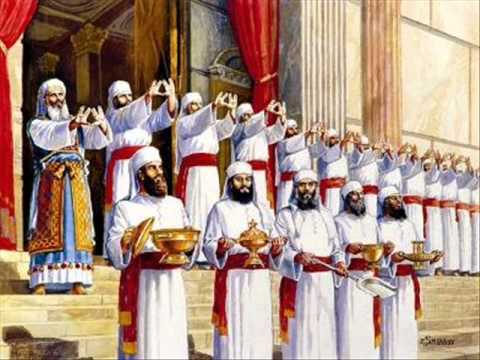
ancient_rabbisThis is MacArthur’s conceptualization of Rabbinic Judaism, the body of religious and cultural Judaism that enabled the continuation of the Jewish people after the destruction of the Temple and after most of collective human Israel had been exiled from their Land. In the world according to MacArthur, the Rabbis were just a bunch of guys who added unnecessary stuff to the Bible.

He briefly makes some sort of commentary on the “Shimah.” I’ll take it for granted that whoever transcribed MacArthur’s sermon didn’t know the accepted English spelling of “Shema” and that MacArthur didn’t find it necessary to proofread the text. On the other hand, his sermons could have been transcribed years or decades after the fact.

But then there’s this story:

There was a rabbi by the name of Rabbi Jacanon Van Saccai (sic). It was written of him that he said this at his death. And it was interesting because he was called The Light of Israel. He lived at the time of the destruction of the temple. He was a very famous man, highly esteemed. And he was the president of the San Hedron (sic) or the ruling body of Israel. So he was not a small-time rabbi, but a very important man. On his deathbed, he began to weep just bitterly and profusely, and some of his students who had studied under him and sat at his feet couldn’t believe this.

Just to clarify, MacArthur is referring to Rabbi Yohanan ben Zakkai who I’ll discuss a bit later, and the “San Hedron” is the Sanhedrin, which is not a ruling body but the highest religious court assembly in ancient Israel.

And they asked him how such a man who had lived as he could have such fear of death, and this was his reply and I quote, “If I were now to be brought before an Earthly kind who lives today and dies tomorrow, whose wrath and whose bonds are not everlasting and whose sentence of death even is not that to everlasting death, who can be assuaged by arguments or perhaps bought off by money, I should still tremble and weep. How much more reason have I for it when about to be led before the King of Kings, the Holy One, Blessed by (sic) He who liveth and abideth forever, whose chains are chains forevermore, whose sentence of death kills forever, whom I cannot assuage with words nor bride (sic) with money and not only so, but there are before me two ways: one’s a paradise and the other one to hell. And I know not which of the two ways I shall have to go. How then shall I not shed tears?” End quote. The man believed that there was only one (way) to enter into heaven and that was to keep the law and he knew in his conscious (conscience?) that he hadn’t done it, and he had a fear of spending forever in hell. You see, he had no concept of faith, no concept of grace. He was in a system that bound him and if he didn’t do what the system wanted him to do, he believed he’d go to hell forever.

This is a fairly well-known story, but my memory of it didn’t match MacArthur’s description which seems to contain blatant assumptions about why the revered sage was so fearful. I did a bit of research and found more about the rather tragic deathbed scene as recorded by Rabbi Dovid Rosenfeld at Torah.org

In spite of it all, R. Yochanan was plagued with doubts for the rest of his life. The Talmud records that on his deathbed, he tearfully told his students that he has two paths before him — to Heaven and to Hell — and he was literally unsure along which one he would be led (Brachos 28b). He took it upon himself to change the course of Jewish history, and to his dying moments was never truly sure he had chosen right. (I heard this explanation of the Talmud from R. Berel Wein.)
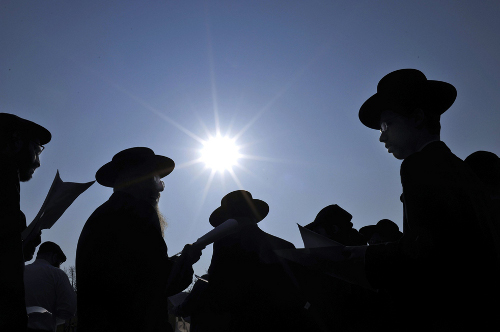
jewish-traditionBut according to Rabbi Rosenfeld, R. Yochanan was not terrified of “going to Hell” because he relied on an unreliable Torah and lacked the grace of Jesus Christ, he was deeply troubled that he had not made the correct decision in preserving the Jewish people and the Torah.

According to the Talmud (Gittin 56), when the Romans had surrounded Jerusalem in the final siege that heralded the destruction of the Temple, many Jewish people wanted to fight and die rather than give in to the Romans, but R. Yochanan was concerned that this would only result in total extermination of the Jews and elimination of the Torah from all the earth.

As the story goes, R. Yochanan had himself smuggled out of Jerusalem in a coffin and eventually made an arrangement with the Roman general Vespasian to establish a center of learning in Yavneh, along with its sages, so that the study and observance of Torah could continue.

This agreement wasn’t incredibly popular with a lot of Jewish people as you might imagine, and even to the end of his days, R. Yochanan was tortured with whether or not he made the right decision to hand Jerusalem and the Temple over to the enemy, even to preserve Jewish lives and ensure the continuation of Torah study.

Sorry to occupy so much space on what seems to be a minor portion of MacArthur’s sermon, but I felt it necessary to set the record straight and present the Jewish point of view (to the best of my ability) on the life and death of Yochanan ben Zakkai.

MacArthur tends to play fast and loose with Jewish history, Jewish concepts, and Jewish people (see his comments on “sloppy” below), and since he’s made the decision to eliminate Judaism at Acts 2 and to declare that it was going through a slow and agonizing death, I have some concerns that MacArthur, for all of his apparent education, may not truly understand some of the things and people he’s talking about.

Now that we have MacArthur’s opinion on R. Yochanan, this is how he sees the apostle Paul:

Well, now watch. Into this system comes a man by the name of Paul and he’s running around say(ing), “Grace. Grace. Forget all the laws.” And the Jews are having culture shock. There’s no way they can handle that. That’s why when he went into the synagogue the reaction was so violent. See?

Never mind a more scholarly approach that does not present Paul as rather gleefully “Law-free,” such as what I’ve been studying in the Mark Nanos books The Mystery of Romans and The Irony of Galatians. According to MacArthur, Paul just made Judaism go away and proceeded to enter the various synagogues in the diaspora claiming, “Grace. Grace. Forget all the laws.” This isn’t a description of a real to life, complicated, intelligent human being with a very difficult task as the Jewish emissary of Messiah to the Gentiles. MacArthur seems to be describing Paul as a cartoon. Who’s adding to scripture now?

And what about Peter and Acts 10?

“And which were all matter of four-footed beasts of the earth, wild beasts, creeping things,” that’s snakes and reptiles and birds, fowls of the air. “And there came a voice to him, ‘Rise, Peter. Kill and eat.'” Now, that sounds like a simple thing. He sees in his vision all these animals and the voice says, “Go ahead, Peter, just kill them all and eat.”

Now what’s he saying? Well, in effect, he’s saying there’s no distinction because in the Old Testament there were certain things a Jew couldn’t eat, right? And Peter had lived all his life that way. And now in the New Covenant, Jew and Gentile were going to be one in the church, and God didn’t want any difference anymore. There is no difference.

You think Peter could’ve gone, “Oh, fine Lord. Sure. Just pass the plate. I’ll eat whatever’s there.” No. Couldn’t handle it.

Verse 14. “And Peter said, ‘Not so Lord.'” Peter actually said, “No, Lord.” That’s pretty flagrant disobedience. This can’t be. Are you kidding me? “For I’ve never eaten anything that is common or unclean in my life, I’ve never done that. Salvation or no salvation, I can’t handle it.” See.

jewish-t-shirtMaybe what’s rubbing me the wrong way is MacArthur’s casual and even disrespectful manner in talking about Yochanan ben Zakkai, Paul, and Peter. He seems to be making fun of them because they couldn’t “let go” of this “Jewish stuff.” Maybe it’s because my wife and kids are Jewish. I just get the feeling MacArthur wants to laugh at them or to discount them. I hope I’m not being too personal in my review.

It also seems like MacArthur is reading a lot into the text (adding to scripture?), as if God really expected Peter to start shoveling a sheet load of “trief” down without so much as a by your leave. In fact, the vision of Peter in Acts 10 had nothing to do with unclean food:

And he said to them, “You yourselves know how unlawful it is for a man who is a Jew to associate with a foreigner or to visit him; and yet God has shown me that I should not call any man unholy or unclean. (emph. mine)

Acts 10:28

There’s also a difference between unkosher animals and unclean foods, but for the sake of time, I’ll refer you to the First Fruits of Zion (FFOZ) television episode All Foods Clean or my review of the program for the details.

Of the lives of the apostles, MacArthur said:

Now, we want to live by biblical doctrine, but I’m not interested in going back there. I’m not interested in having trouble over what I eat like Peter did. I’m not interested in going over to the temple in Jerusalem and making vows like Paul did and having to take a Nazarite vow and cut all my hair and haul my hair half way across the world so I can burn it properly in Jerusalem. I’m not interested in all the trappings of Judaism.

I suppose I don’t blame him for saying that since he believes Judaism was horribly burdensome and became extinct after Acts 2, but he really shouldn’t worry since, not being Jewish, he wouldn’t have been required to observe Torah in the manner of believing (or unbelieving) Jews (see the Acts 15 legal decision). Besides, a Nazarite vow was totally voluntary and most Jews likely never took that particular vow.

But what does any of this have to do with Acts 18:24-28? Not much. Apparently it takes MacArthur quite a while to set the stage for what he’s actually going to talk about.

And you see, here’s Paul. You say, “He’s a Christian. What’s he doing?” Sure, he’s a Christian, but as a Christian, he’s also a Jew. He’s been a Christian a little while. He’s been a Jew all his life. And he’s saying to himself, “I’m grateful to God for what He did, and the way that I know best how to show Him how grateful I am is to do what all good Jews do.” And the high point of their thanks is to take a Nazarite vow, and so he did what a Jew would do. Because that was his life, that was the way he thought.

This is part of what was taught during the sermon and at Sunday school last week at the church I attend. I didn’t go last week, but I did do the homework for class, which is based in part on MacArthur’s opinion of Paul and Nazarite vows. I didn’t find anything in Numbers 6 that mapped to why MacArthur believes one takes such a vow out of gratitude for what God has done. My understanding is that one took a Nazarite vow in order to temporarily experience a heightened state of ritual purity.

Now a Jew named Apollos, an Alexandrian by birth, an eloquent man, came to Ephesus; and he was mighty in the Scriptures. This man had been instructed in the way of the Lord; and being fervent in spirit, he was speaking and teaching accurately the things concerning Jesus, being acquainted only with the baptism of John; and he began to speak out boldly in the synagogue. But when Priscilla and Aquila heard him, they took him aside and explained to him the way of God more accurately. And when he wanted to go across to Achaia, the brethren encouraged him and wrote to the disciples to welcome him; and when he had arrived, he greatly helped those who had believed through grace, for he powerfully refuted the Jews in public, demonstrating by the Scriptures that Jesus was the Christ.

Acts 18:24-28 (NASB)

I didn’t really think much about all this. It made sense in those days that because information traveled rather slowly throughout the then-civilized world, different bodies of believers might have inconsistent knowledge of the teachings of the Master and the experience of disciples in other places.

But MacArthur interprets this portion of scripture in a unique way:

Now, Apollos is a Jew and he is from the city of Alexandria.

He was a powerful man in terms of teaching. And let me just say at this point that his power at this point was the natural. He was not a Christian at this point, so consequently, did not have the indwelling Holy Spirit.

I believe that Apollos was not a Christian but that he was a student of John the Baptist.

Now, see, here is a man who accepted all the way of the Lord in the Old Testament, accepted the ministry of John the Baptist, saw that John pointed to Jesus and said, Behold the lamb of God that taketh away the sin of the world,” and he believed that Jesus was the Messiah. You say then, “Why wasn’t he a Christian?” Because he didn’t know what happened in the death, resurrection and Pentecost that followed the life of Jesus. He was pre-cross.

On the wrong side of the cross? Oh gee. Is that concept even in scripture as applied to the apostolic age? And Apollos didn’t have the Spirit?  What about verse 25 where it says, “and being fervent in spirit?” In reading MacArthur’s sermons, I get the impression the man is always shooting from the hip. Anyway…

No, he wasn’t a Christian. But technically, neither were any of the apostles, including Paul, or any of the Jewish (and arguably Gentile) disciples. You can’t anachronistically force the concept of Christianity as we understand it today back into the apostolic era. Apollos was a Jew and he practiced Judaism as a disciple of Moshiach (Messiah).

And just to wrap things up:

Now, there’s another angle in this word. It’s used one other time in Ephesians 5:15, which would be helpful. Paul says “See that you walk acrabos, with exactness.” The Christian should live his life with the same kind of preciseness that we interpret the Scripture, with the same kind of preciseness that God wrote it. God didn’t give us a sloppy revelation, did he? And God doesn’t want us to slop up his revelation and God doesn’t want us to slop up our lives either. Same word in all three areas.

Well, there you meet two in transition, Paul and Apollos. And how exciting it is to see what God is doing in their lives and how grateful we are that the Spirit of God brought about the transition that they might have influence on us.

MacArthur in churchSee what I mean about “sloppy?”

What really scares me is the thought that, back in January 1974 (and no doubt today), the people listening to MacArthur’s sermon probably lapped it up. How many of them would have decided to look up his references and examine his sources, especially about Jewish Biblical and Rabbinic history? After all, the entire thrust of this sermon series is to declare the elimination of Judaism in any form in the pages of Luke’s Acts of the Apostles. But I don’t find MacArthur’s presentation on Judaism to be either serious or accurate.

It’s like he’s saying, “Gee, look how dumb these Jews were. They had Jesus and grace and still couldn’t give up that nasty, ol’ law. Thank the Lord we’re nothing like them. I’m so glad God doesn’t care about what food I eat or what day of the week I worship, or any of that terrible stuff.”

OK, I made that last bit up, but it certainly seems to fit the tone of what MacArthur was preaching.

I can’t do this. I can’t think like he does. I can’t believe like he does. How am I supposed to participate in the rebuilding of the Tent of David in the Christian church when men like MacArthur and sermons such as this one are expending no small effort in cheerfully burning that tent down to the ground?

See Part 3 of my review on this series to see how it turns out.
Sampling Tent Builders

The church is supposed to be a partner with Israel. If it doesn’t see this then it’s not fulfilling it’s function.

-Boaz Michael
“Envision the Ideal Church” session
Tent Builders presentation

I mentioned a few days ago that I’d received a DVD in the mail from First Fruits of Zion (FFOZ) providing an eighty-two minute “sampler” of the day-long conference called “Tent Builders” which is meant to accompany and augment the message in FFOZ President Boaz Michael’s book Tent of David: Healing the Vision of the Messianic Gentile.

I’ve read Boaz’s book more than once but never had any of the education or training that is supposed to equip the target audience on methods of approaching the Church with the Messianic message of just how Jewish the Jewish Messiah is and what it means to “partner” the Church with Israel.

The sampler DVD is divided into four portions:

  1. Envision the Ideal Church
  2. The Strategic Mission
  3. Interview with Boaz’s Pastor
  4. About the Book Tent of David

This review focuses on the first two portions which were taken from a presentation Boaz gave in Atlanta, Georgia. I won’t try to dissect everything Boaz taught and certain sections of his teaching came, more or less, out of the book, so if you’ve read “Tent of David,” you already have some familiarity with the message. The sampler disc contains excerpts of what I imagine is supposed to be a DVD containing the entire conference sessions, so that people who weren’t able to attend the in-person conferences, could still benefit from everything that was taught. It’s also meant to be accompanied by a workbook and presumes that the audience has already read “Tent of David.”

The goal of the conference and of participation is to become a “sent out one” or an emissary into the Church, to share the wonderful message we as “Messianic Gentiles” were given in order to assist the Church in ceasing to be the stumbling block standing in the way of Israel seeing the truth of Messiah. One of Boaz’s key phrases is that we must change the Church for the sake of Israel.

This was actually born out of Boaz’s own experience at a small Baptist church in Marshfield, Missouri where he and his family have been living. He actually began attending this church almost by accident, thanks to a visit to Marshfield by Rabbi and Messianic blogger Derek Leman. It was out of the development of the relationship between Boaz and his wife with the members of their local church that Boaz realized this “model” could be replicated “on the ground” so to speak, by many, many other Christians across the country.

For over two decades, FFOZ has been producing books, magazines, seminars, and many other educational materials trying to get its message out, but in spite of the expectation that at any minute, the floodgates would open and the Christian Church as an entire unit across the world would “see the light,” nothing happened. Groups of Christians would leave the Church disillusioned by shallow teachings and Christian disdain for Israel, and they would join small groups of like-minded Gentile believers, but over the years and decades, these groups didn’t grow, didn’t show fruit, and nothing happened. The Church certainly didn’t change and most of these small groups stayed small groups, generally spinning their wheels and sometimes complaining about “Christians.”

BoazOccasionally, through his contacts, Boaz would know of a motivated family of Gentiles who were “Messianically” minded and know of a willing and open Pastor in the same community. He’d put them together and the combination would result in change in the local church. Boaz and his wife Tikvah in their own local church had the same experience. It seemed like something that could be replicated on a large-scale, but at the grass-roots level.

But it’s not that easy. It wasn’t easy for Boaz and Tikvah and it isn’t easy for anyone else. While some churches have managed to change trajectories away for teaching supersessionism and toward an enlightened view of the Jewish Messiah (which is a lot more than just saying “Jesus was Jewish”) and the significance of Israel and Torah, it required tremendous sacrifices in time, money, and participation in portions of church teachings that are not always spiritually enlightening. It also isn’t always accepted and Boaz even said that it’s a message the Church usually doesn’t want to hear.

Boaz challenged his audience in the first session to envision the ideal church, write down their description, and then participate in making that ideal church happen at the local level.

I have a vision about what an “ideal church” would look like too, but I haven’t the faintest idea how to make it happen, especially all by myself. But as I listened to Boaz, I began to feel guilty because he described many Messianic Gentiles as either complainers or just people who wanted others to do the work of changing the Church for the sake of Israel. Am I a bad, complaining, lazy person for feeling discouraged?

Moving to the “Strategic Mission” session, Boaz expanded on what was needed. He used to think that having a good message was enough, but that hasn’t worked for the past twenty years. He finally discovered, though a gentle rebuke by someone he trusted, that without the involvement in the Holy Spirit and without relationship and familiarity, the message was never going to be successfully delivered.

The core of “Tent of David” is derived from a passage in Amos 9:11-12 that’s quoted by James in Acts 15:16-18. You can look up the text, but it paints portrait and prophesy of a time when the people of the nations will partner with Israel in rebuilding the fallen tent of David and restore Israel in the Messianic Age. James, leader of the Apostolic Council in Jerusalem saw the participation of the first Gentile disciples in the Jewish movement of “the Way” as the beginning of the fulfillment of that prophesy. The prophesy of Gentiles coming alongside Israel to strive for a mutual goal without requiring that those Gentiles convert to Judaism and take on the full yoke of Torah. In fact, the prophesy can’t be fulfilled if Gentiles convert to Judaism or otherwise are circumcised to become “pseudo-converts” with the belief that they are obligated to the full yoke of the mitzvot in the manner of the Jewish people. Jews and Gentiles must continue distinct roles and identities within the body of Messiah and become interdependent elements in the creation of the Messianic future.

ChurchIs this how the Church sees its role in relation to Christ? In most cases, probably not. In fact, the apostles including Paul, would not even recognize what most Churches teach today as having much or anything to do with the original gospel message they transmitted to Jews and Gentiles in the first decades after the resurrection and ascension of the Master. The Church, for the most part, thinks the greatest revelation and the only revelation of Jesus has already happened: the message of Salvation through the life, death, and resurrection of Christ.

Of course that is amazingly good news, but the story doesn’t stop there and in fact, according to Boaz, the best part is yet to come…the establishment of the Messianic Kingdom with Jesus on the Throne of David in Jerusalem, raising Israel to the head of all the nations, returning all the exiled Jews to their Land, and establishing a reign of world-wide peace. It’s the promise of what is yet to come.

And the Church has missed it. Oh sure, churches talk all the time about the “end times” and the “return of Jesus” and how “the Church” will be the thing that’s elevated and glorified, but at the end, people go up to Heaven as opposed to what it actually says in the Bible of God coming to earth and living among His people as He once did in Eden.

Boaz unpackaged the message that he believes the “grass-roots tent builders” need to be taking back into their local churches. I won’t go into all of his points, but I want to cover the one that I think is most important but also the message that the Church will find most difficult. The centrality of Israel. What does that mean?

The Church believes that it’s all about “the Church.” The Church will be raptured to Heaven, the Church will return with Jesus, the Church will rule and reign.

In reading the Bible, if I substitute the Greek word “ekklesia” for “church,” and I realize that generically “ekklesia” just means an assembly of people gathered for a common purpose, the “magical significance” of the word “church” is taken down a peg or two. When Jesus speaks of his “church” he is speaking of an assembly of human beings gathered together to begin to fulfill the prophesy of Amos (and many other prophesies) to establish the first fruits of a partnership of Jews and Gentiles together in the body of Messiah, to ultimately summon the coming Messianic Age which will see Jesus as the King of Israel who will bring total peace to humanity.

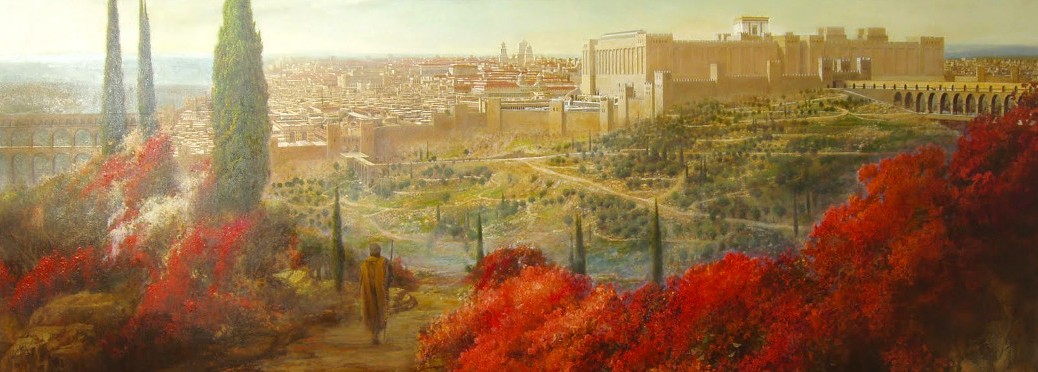
ancient_jerusalemBut this requires we realize that in all of the ancient prophesies and how they were understood by the apostles and first century Jewish and Gentile disciples, it was always Israel that was restored, and Israel that was central to God’s entire redemptive and restorative plan, and Israel that was the center and lynchpin of the entire Biblical message and the good news of Messiah. This is not the message Christianity has promoted and instead, they have caused the basic concept of “ekklesia” to evolve, morph, and develop into a separate and self-defined entity known as “the Church,” which across Christian history and into modern times has wholly separated from Israel, from its original purpose and mission, and has watered down the gospel message into “merely” one of personal salvation, denying the vast, panoramic scope of the Messianic Kingdom to come that we must all strive to bring to fruition.

As Boaz continued to lay out everything involved in this grand plan, I started to feel overwhelmed. Every time he said something meant to inspire his audience to greatness, I compared it to my actual experience in my local church. Boaz sees success in the Tent of David plan because it puts together enthusiastic Messianics with Pastors in local churches who are at least receptive to relationship and partnering, but what if the local church leaders are so assured of their theology and doctrine that they see the relationship as one where the church needs to convince the intelligent but misguided Messianic that Church tradition based on the Reformation, Calvinism, and Dispensationalism (none of which existed in the time of the apostles) is actually the true message of Jesus Christ?

So my primary take away as I ejected the DVD from my computer and prepared for bed was a combination of guilt and feeling overwhelmed with more than a hint of failure added to the mix.

Boaz ended his “Strategic Mission” session with a story about his daughter who is currently serving with the IDF. I don’t know how much I should reveal about her, even though she has been uncompromising in her devotion to Messiah and has not hidden this from anyone who knows her in Israel. Also, as Boaz said, he’s a public figure, so it wouldn’t be hard to find out who his daughter is and what her family believes.

It’s actually an amazing story. I knew some of it just because I’ve briefly spoken with Shayna a few times and am her “friend” on Facebook, but Boaz filled in the details as only a very proud father can. Boaz and Tikvah raised all their children with a strong sense of mission. I guess growing up within the context of the development and progression of First Fruits of Zion’s mission must have had a strong impact.

Boaz laid that sense of mission and dynamic struggle squarely at the feet of his audience. Of course, I only got to see a small portion of the conference and nothing at all about how the students received the message or interacted with Boaz and each other. I have absolutely no idea at all how this is actually playing out in churches across America and I don’t know anyone else who is a “Tent of David” graduate and how they have met with success, failure, or anything else.

Boaz in churchBoaz said that in the church he attends, two HaYesod classes had been taught, one Torah Club cycle had been completed, and there was a group viewing the various episodes of FFOZ’s television series A Promise of What is to Come and using them as topics of discussion.

I won’t lie. That really sounds wonderful, but in my current context, none of that will ever be received. I previously mentioned that having Tent Builders graduates attempt to go into some place like Pastor John MacArthur’s congregation would likely result in a less than enthusiastic reception. It is true that time, relationship, and familiarity helps the “Messianic Gentile” in church gain credibility and even a minority voice in Sunday school discussions, but there will always be churches that will listen and decide that they see and hear nothing that should deter them from what they have always believed to be true about the Bible, about Jesus, and about God, Judaism and Israel notwithstanding.

I’m enjoying D. Thomas Lancaster’s sermon series Holy Epistle to the Hebrews and recently I discovered the sermons of Rabbi David Rudolph. I can “feed my head” all I want and struggle in my personal relationship with God and what all this is supposed to mean, but except for how some people see my blog as a positive or even inspirational influence, that still has little or no effect at the level of the local church, and it certainly isn’t a testimony to changing the Church for the sake of Israel.

Do I think the “Tent Builders” mission is good? Yes, of course I do. You may be surprised to read that sentence after everything else I’ve said, but I still think it’s essentially sound. The thing that Boaz didn’t say in the DVD sampler though he mentions it in his book, is that the mission isn’t for everyone. He also doesn’t mention, though it should be obvious (it certainly is to me) that not only does the Church not want this message, but in some cases (how many, I don’t know), the message will be continually resisted, regardless of relationship, and ultimately rejected.

The Messianic Gentile can then decide (assuming he or she hasn’t been ejected from the local church) to either continue going for the sake of fellowship (which Boaz recommends) and perhaps with hope beyond hope that eventually some people will be more accepting of the paradigm shift Boaz suggests, or that Messianic person can leave.

I don’t know if there’s a “plan B” built into the Tent Builder’s mission profile. Try again at another church after months or years at the first? Try a less formal venue such as a local Bible study or home fellowship? Retire into the world of virtual study and quiet contemplation? Boaz maps out a highly public, visible, dynamic mission of reaching out to the local church, all of the local churches with the Tent Builders message built on relationship and familiarity, inspired and supported by the Holy Spirit, with the ultimate end goal to show the Church their true priority and purpose in partnering with Israel to bring the time of the return of the Messiah.

a-better-placeI suspect that it is not going to come very quickly. Conferences aside, it’s like the ads for going back to the gym that are popular right after New Years when people are feeling the remorse of eating too much during the holidays. People get pumped up and excited and join a gym, but I can tell you from personal experience that after the enthusiasm wanes or, in this case, the conference is over and months have passed, there’s only you and the weights. You either show up each morning and start working, or you stay home and get fat.

This metaphor breaks down when you realize that exercising is between you and the exercise machines. All you need is motivation and the will to carry on over the long haul. In the local church, what people think about you, about your message, about Jews, about Judaism, and about the very real threat that change represents makes a huge difference, and you have control over none of that. You can do everything “right” and still fall flat on your face.

There are no “magic” answers. Win, lose, or draw, there is only God.

Good Shabbos.

Twoness and Oneness: From Sermons by David Rudolph

So if we synthesize what Rudolph is saying this is what we get:

(1) ethnic prioritization is Biblical even though it results in non-ethnic members feeling like “second-class citizens” (to use Rudolph’s phrase);
(2) just as Yeshua’s mission excluded non-Jews, Tikvat Israel’s mission excludes non-Jews, seeking to build a community from within the Richmond JEWISH community.

-Peter Vest
“David Rudolph to Gentiles: ‘Like Yeshua, Our Mission is to Jews, not Gentiles'”
orthodoxmessianic.blogspot.com

I don’t often interact with Peter let alone comment on his blog. I especially hesitate to write about his content on my blog since this type of conversation often degrades into the unresolvable debates our little corner of cyberspace is known for. Religious arguments can get very ugly.

But in reading Peter’s commentary on David Rudolph and Rudolph’s congregation Tikvat Israel, I wanted to learn more about the source of Peter’s allegations. Unfortunately, he hadn’t posted a link to his source material. Fortunately, Peter was willing to provide it when I asked, so I clicked the link he gave me and started listening to Rabbi David Rudolph’s twenty-minute sermon called Our Mission.

I don’t know Rudolph except through his writing and editing. I read the book he and Joel Willitts co-created, Introduction to Messianic Judaism: Its Ecclesial Context and Biblical Foundations and wrote a fairly large number of reviews of most of the different contributions to this book. Given that Rudolph’s co-editor and friend Joel Willitts is a Christian and that about half of the book’s contributors are Gentiles, it didn’t seem to me that Rudolph had some sort of bias against non-Jewish people.

Still, I was just slightly nervous about what I would hear when I clicked the “play” button on the recording. Actually, I didn’t find anything even slightly disturbing.

Is it OK to have a Chinese church?

That’s one of the questions Rudolph asked during his sermon. No one in his audience complained. I wouldn’t complain. I pass a Korean Christian Church every time I drive to the Meridian Public Library a few miles from my home. Often Christians who have a particular ethnic, national, and linguistic commonality will form churches on those platforms. I suppose I’d be welcome at the Korean church if I chose to go one Sunday, but likely I’d feel out-of-place since I don’t speak Korean and am not familiar with their cultural and ethnic practices. For the Koreans present however, it would be “home.”

Is it OK to have a Messianic Jewish congregation that has a mission specific to the local Jewish population? That’s just a bit more dicey, at least from the point of view of some Christians. I’ve attended the Reform/Conservative synagogue in my community and I wasn’t the only Gentile present (I suspect I wasn’t the only Jesus-believer present, but that’s beside the point), but I never lost the sense that this was a Jewish community. Nor would I, even in some moment of insanity, demand that the Rabbi be “inclusive” and adapt the synagogue to be more “Gentile-friendly.” In fact, that particular synagogue is already pretty inclusive, but as I said, it’s still Jewish.

Even the local Chabad synagogue will accept Gentiles, typically those who are married to Jews, although I’ve known some Christian Gentiles who have attended a number of the Rabbi’s classes. He’s OK with this on the principle of peace within the community, as long as the Gentiles don’t try to proselytize the Jews present.

But Messianic Judaism is unique in that it professes a faith in Yeshua, in Jesus of Nazareth as the Messiah, a faith that is accessible to Jew and Gentile alike. Should Tikvat Israel’s mission be aimed generically at all human beings in the Richmond, Virginia area? Is it racism or bigotry to reach out only to the Jewish people in the vicinity? Is it racism or bigotry for the Korean Church in Meridian, Idaho to reach out only to the larger Korean community? Can the Korean church offer an environment that specifically meets the needs of the larger Korean community in a way that other churches could not?

No, it’s not racism and bigotry and yes, the Korean church can offer a specific and specialized environment that’s particularly friendly and adapted to Koreans. So it is with Jewish congregations, including Messianic Jewish congregations.

david_rudolphRudolph made a large number of what I considered convincing arguments about why it was OK for his congregation Tikvat Israel, to have a mission specific to the Jews in and around Richmond. For one thing, many Jews traditionally don’t feel comfortable in normative Christian churches, particularly those believing Jews who also practice Judaism as Jews, which many Christians don’t understand and which some Christians find offensive.

A Messianic Jewish congregation makes sense for Jews who are believers and who are observant Jews. Rudolph didn’t fail to acknowledge the Gentiles who attend Tikvat Israel as Gentiles who love the Jewish people and who desire to come alongside Messianic Jews within a Jewish context. Rudolph further said that if Gentile Christianity in general over the last nearly two-thousand years, had loved the Jewish people the way that the Gentiles in Tikvat Israel love the Jewish people, Jewish people wouldn’t have learned to be afraid of Christians and Church.

From an article Rudolph wrote, I know he believes in unity between believing Jews and Gentiles within a Messianic context and indeed, that believing Jews and Gentiles are interdependent. Based on many of the writings of the staff and contributors of the Messianic ministry First Fruits of Zion (FFOZ), I have experienced and commented on that interdependence.

I performed a wider search and came across a larger listing of Rabbi David Rudolph’s sermons including one called “We Need Each Other” (on the “Sermons” page, scroll down until you see a heading called “Unity”).

Rudolph’s sermon was focused on the following piece of scripture:

…by abolishing in His flesh the enmity, which is the Law of commandments contained in ordinances, so that in Himself He might make the two into one new man, thus establishing peace…

Ephesians 2:15 (NASB)

By odd coincidence, in reviewing some commentary by Pastor John MacArthur, I came across the following statement which seems to apply to the current circumstance:

Because the Bible would never tolerate a Jewish church and a Gentile church.That is the one thing that the Apostle Paul spent the last months of his ministry trying to resolve,trying to get those two together; and when he wrote Ephesians, he said, “The middle wall is…what?…broken down and they two have become one new man.” And my own belief is that it is ludicrous to have a Messianic Jewish temple, as much as it would be to have announced out here that this is the Grace Community Gentile church. Now, how do you think that would sit with Jewish people? They would say one thing. They’re anti-Semitic. See? There’s no reason for that.

Rudolph quoted well-known American biblical scholar Harold Hoehner as saying something similar (I’m copying this quote from an audio recording, so the accuracy of the quote here is only as good as my notes):

Paul referred to a whole new race that is raceless. Not Jewish or Gentile, but a body of Christians who make up the Church.

This is much like how MacArthur and my own Pastor see Ephesians 2 in particular and the identity of “the Church” in general.

0 RInterestingly enough, Rudolph once had a very lengthy conversation with Dr. Hoehner on Ephesians 2:15, and it should be noted here that Rudolph referred to Hoehner in very complementary ways and called him a “man of God.”

Rudolph suggested alternative ways to read this passage. I won’t go into all the details. You can listen to the twenty-five minute sermon yourself, since I provided the link. Briefly though, Rudolph felt that what was torn down was a specific set of ordinances that inhibited Jews from associating with Gentiles, particularly in relation to the Temple.

However, Rudolph emphasized that the body of Messiah is a single body made up of Jewish and Gentile members who remain Jewish and Gentile, much as how Paul described the Messianic body in Ephesians 5:21-33 and referenced Genesis 2:24 where one man and one woman both became “one flesh” and yet remained distinctly one man and one woman. The married “one flesh” does not delete or replace the man and woman any more than the body of Messiah, “the Church” replaces or deletes the identities or uniqueness of the Jews and Gentiles in the body.

We become what in Hebrew is called (forgive my faulty transliteration) “Besar Echad,” one flesh, a composite unity.

At the end of his sermon (and I’m skipping over quite a bit of content), Rudolph asked how Tikvat Israel’s “twoness” and “oneness” is expressed. The “twoness” is what you’d expect if you have any sort of familiarity with the more “conservative” forms of Messianic Judaism. Jewish people in Messianic Judaism and specifically at Tikvat Israel, should remain Jewish and not assimilate into Gentile Christianity. In fact, they should endeavor to become even more observant as Jews. The Gentiles in the congregation should not try to pretend to be Jewish but to come alongside their Jewish co-participants, and support and love the Jewish people and Israel.

The “oneness” exists most obviously at the “macro” level or the overarching expression of Messianic Judaism, but it can also be observed on the “micro” level of the Tikvat Israel community. In that community you have two peoples who are of one mind and one spirit, all working together to build a community for Yeshua with a mission to reach out to the larger Jewish community. To the degree that there are Gentiles present, then it should be obvious that Gentiles are also reached by and respond to this mission, but that is part of the interdependence of Jews and Gentiles within the Messianic body.

To understand the concept of Jewish/Gentile interdependence within the Messianic Jewish community, see my commentary on articles appearing in Rudolph’s and Willitts’ book. The relevant reviews are An Exercise in Wholeness and Interdependence or Collapse.

Rudolph summed up the point of his sermon with the four words of its title: We Need Each Other. The congregation of Jews and Gentiles broke out in spontaneous applause.

I don’t find anything bigoted, racist, or exclusionary about how David Rudolph describes Tikvat Israel. I do understand why Messianic Judaism needs to reach out primarily or even exclusively to the larger Jewish population. Reading the sermons of John MacArthur makes me appreciate how “dangerous” and even “hostile” many Christian venues are to Jewish believers who have chosen not to assimilate into a Gentile Christian lifestyle but who continue to be a part of the larger Jewish community, a part of national Israel, and to be loyal to their covenant connection to Hashem and Moshiach through the observance of the mitzvot.

jewish-davening-by-waterI’ve seen how important it is for my wife to be a part of the local Jewish community, especially since she was not raised in an observant Jewish home. It’s taken a lot of courage and struggle for her to even walk through the doors of a synagogue let alone become a functioning member. This is something that most Christians would never understand but something Jewish people comprehend all too well.

Here’s something else:

Many non-Jews, and increasingly many Jews as well, find Judaism’s stress on endogamy to be racist. That’s nonsense. Membership in the Jewish people is open to any human being who is willing to take on the same commitment as those who stood at Sinai. Judaism does not sanctify gene pools but rather commitment to a mission.

One need not be Jewish to serve God. Judaism is unique among major monotheistic religions in not viewing eternal reward as contingent on becoming Jewish. Yet Jews have always believed that they were chosen for a unique mission.

-Jonathan Rosenblum
“Yair Netanyahu and His Non-Jewish Girlfriend”
Aish.com

Most non-Jews are unconscious of the critical mission required to maintain the tiny population of Jews worldwide rather than let the Jewish people fall into extinction due to assimilation. This is an even more vital and difficult mission in the Messianic Jewish movement with its continual struggle to maintain Jewish distinctiveness in the face of overwhelming Christian (including Gentile Hebrew Roots) pressure to either make Messianic groups more “Gentile-friendly” by de-emphasizing Jewish identity or by demanding that all Jewish identity also belongs to the “Messianic Gentile.” While Rosenblum is unlikely to be Messianic, his assessment of the needs of the Jewish community is spot on and applies very well to Rabbi Rudolph’s mission and message.

While I expect men like MacArthur to be relatively “clueless” to this process, many Gentile Hebrew Roots practitioners, even if they have some familiarity with their local Jewish communities, operate on the same belief that, to use MacArthur’s words, “the Bible would never tolerate a Jewish church and a Gentile church.” Both Fundamentalist Christianity and Gentile Hebrew Roots (yes, I know I’m generalizing) demand the elimination of Jewish uniqueness either by forming “one church/congregation” of one homogenous “non-racial” group, or they play the “racism” card. There can be no “twoness” only “oneness,” no matter what the cost to the continued distinctiveness and even the continued existence of the Jewish people.

I’m sorry if something Rudolph said in a sermon seems distasteful to some non-Jewish (and even a few Jewish) people. Rudolph says he wants to do what Paul tried to do; break down specific barriers that prevent Jewish and Gentile fellowship within the body of Messiah, but all the while, first going to the Jew because of the covenant connection between Hashem and the Jewish people, and only afterward, also going to the Gentile with the good news of the Messiah, that all human beings can be reconciled to God without surrendering their nationality or identity, which includes Jewish nationality and identity, as well as what each of us possesses as people of the nations who are called by His Name.

Read more in Oneness, Twoness, and Three Converts.

Sermon Review of the Holy Epistle to the Hebrews: Solomon’s Porch

At the hands of the apostles many signs and wonders were taking place among the people; and they were all with one accord in Solomon’s portico.

Acts 5:12 (NASB)

Sermon Three: Solomon’s Porch
from the Holy Epistle to the Hebrews sermon series

In this third sermon on the Epistle to the Hebrews, Beth Immanuel Sabbath Fellowship teacher D. Thomas Lancaster expands on why the writer of the Book of Hebrews constructed this word of exhortation to the letter’s recipients and further identifies them as Jewish disciples of Messiah living in or around Jerusalem sometime in the early 60s CE (common era).

Where did the first Christians go to church?

This is how Lancaster started his sermon. He says the question is nonsensical because the first Christians were actually Jews. They didn’t go to church because the modern concept of “church” didn’t exist. Neither did the modern concept of “Christianity.” The first Christians were Jews and they practiced Judaism. As you saw in the quote at the top of the page, the first Jewish believers commonly met in an area on the east side of the Temple called Solomon’s Colonnade.

Lancaster speculates that, because of the prophesy in Zechariah, saying the Messiah would descend upon the Mount of Olives and enter the Temple through the eastern gate, the disciples met there in anticipation, since the Mount of Olives was plainly visible from Solomon’s Colonnade.

Then Lancaster diverted his sermon, taking the audience back in time twenty years or so, recalling a conversation he had with his Father who had been a Baptist minister. Somehow, they got to talking about the Book of Hebrews and his Father, remember, this was twenty years ago, twenty years before Lancaster thought of producing this sermon series on Hebrews, commented on Hebrews 13:22:

But I urge you, brethren, bear with this word of exhortation, for I have written to you briefly.

Thirteen chapters is hardly brief and in fact, Hebrews is one of the longest epistles in the New Testament. Lancaster’s father suggested that Hebrews was originally written in two parts: a longer sermon intended to be delivered to a Jewish audience and a shorter letter accompanying the sermon as an explanation.

That’s pretty much was Lancaster suggested in last week’s sermon.

Lancaster’s father said something else rather interesting. He said he thought that Hebrews was written to a group of believing Jews who had been kicked out of the Temple and who didn’t know what to do next. This was a group of Jews who, if they renounced Yeshua (Jesus) as Messiah, would be allowed to return to the Temple. Hebrews then, was a letter and a word of consolation to those Jews to not give up their faith but to hold fast to their devotion to Messiah.

Traditional Christian teaching about the Book of Hebrews states that the epistle was a warning to believing Jews to not “backslide” into Judaism and return to Temple worship, so the senior Lancaster’s suggestion was the exact opposite of how most of the Church understands the meaning of Hebrews.

But Lancaster’s Dad’s interpretation has several advantages, according to the younger Lancaster:

    1. It doesn’t anachronistically require a fully-developed Christian identity that is separated from the normative Judaisms of the mid-first century CE.
    2. It doesn’t require that Jesus abolish the Torah or the Levitical system.
    3. It better explains the arguments within Hebrews (which will be covered in subsequent sermons).
    4. It fits much better with what we know about the early Jewish believers and their relationship with the Temple.

The Early Jewish Believers and the Temple

This part of the sermon fits within the realm of established fact as we see in the scriptures and doesn’t require any speculation. It does require setting aside traditional Christian doctrine about the early “Jewish Christians” and taking the scriptural text, primarily in Acts, at face value.

levites-aaronic-blessingWhat was the relationship of the early believing Jews to the Temple? They revered it, just as their Master Jesus revered the Temple.

Lancaster covered those portions of the Gospels that demonstrated Jesus’ devotion to the Temple, his first recorded appearance there as a boy to debate the scholars, evicting the moneychangers, calling the Temple “my Father’s house,” and so on. You can listen to the recording to get the details, including how Jesus, when he returns, will rebuild the Temple and reinstitute the Temple services.

After the ascension, the disciples returned to the Temple. They may have received the Spirit while praying at the Temple (Acts2). Acts 2:46 mentions their presence at the Temple. Acts 3:1-3 speaks of the disciples participating in prayer services at the Temple. And Acts 5:42 asserts that the disciples were in the Temple daily teaching and preaching of the Messiah.

It is strongly believed in normative Christianity that the disciples must have given up the Temple sacrifices since Jesus fulfilled them all, and yet Acts also speaks of many Priests in the Temple coming to faith in Messiah because of the devotion of the disciples. According to Lancaster, these Priests didn’t give up their jobs and stop administering the sacrifices, but rather, found greater meaning in their Priestly duties, seeing Messiah’s blood in each of their services.

In fact, the only occasions on which the disciples were accused of speaking against the Temple, were when they were accused by false witnesses. The trial of Stephen before the Sanhedrin is an example, and Stephen took a full chapter in Acts to deny and refute the false accusations.

Lancaster also points out that the Bible never, ever says that the disciples stopped offering the sacrifices. This would have been a big deal and if it were so, you’d think Luke would have mentioned it. It’s assumed by most Christians that the Jewish disciples stopped offering Temple sacrifices based on doctrines that were much later established by the Christian church, not because it says so in the Bible.

If we look at Acts 24:17 and the surrounding text, we can see how, thirty years later after the crucifixion, resurrection, and ascension of the Master, Paul was encouraged to offer sacrifices at the Temple to show many other believing Jews that the accusations stating Paul was teaching against Torah and against the Temple were utterly false.

Maybe you can accuse Paul of vainly clinging to obsolete Jewish customs by offering sacrifices but what about James, brother to Jesus, steward of the Throne of David, head of the apostolic community? If anyone should have known the truth about the teachings of Jesus, it should have been James. If Jesus had taught against the Temple and abolished the sacrifices, James should have known about it and advocated for that position. Obviously, he didn’t.

A plain reading of the relevant passages, without being filtered through Christian anti-Torah, anti-Jewish, anti-Temple bias reveals this. Except as viewed through the heavily-colored filter of Christian tradition, there’s nothing in the Bible that says the Torah, including the Temple sacrifices, were ever to be abolished. If you want more information about this, watch the First Fruits of Zion television episode The Torah is Not Canceled. It’s only thirty minutes long and well worth your time.

History records the death of James the Just, the brother of Messiah, the leader of the Council of Apostles and head of the entire body of believers, as happening in 62 CE. Lancaster dates the Book of Hebrews at just a few years later. According to Lancaster, this was also about the time issues came to a head between the disciples in Jerusalem and their arch foes, the Essenes, the group of corrupt Rome-collaborators who illegally had control of the Temple. The Essenes wanted the disciples out of the Temple and wanted them to renounce their faith in Jesus as Messiah.

Speculation

This next part can’t be firmly established through scripture or historical texts and is extrapolated from Lancaster’s understanding of the content in Hebrews. He believes that after the death of James, the Essenes held their own Sanhedrin, leaving out the Pharisees, and forbade the Jewish believers from Temple participation, cutting them off (“Koret”) until such time as they renounced Yeshua.

The Master even predicted this would happen in John 16:2. And this was the purpose of the sermon and letter of Hebrews: to encourage and support the Jewish believers in Jerusalem who had been removed forcefully from Temple participation to keep the faith, keep faith in Yeshua, and not to break faith, even for the sake of returning to the Temple.

MessiahYes, Temple devotion was appropriate and desired. Every year during the pilgrim festivals thousands upon thousands of Jews from all over ancient Palestine and the diaspora nations would converge on Jerusalem to offer sacrifices at the Temple in obedience to the commandments.

But devotion to Moshiach and devotion to the Temple were not to be considered mutually exclusive and the writer of Hebrews was earnestly imploring the Jews in Jerusalem to not forsake Messiah in the face of being removed from the Temple.

For even if removed, and even after the Temple was destroyed, it has been promised in Messianic Days that the Temple will be rebuilt and Jews as well as many, many people from all the nations will go up to the Mountain of the Lord and the House of the God of Jacob and worship Him there in Jerusalem.

What Did I Learn?

Well, again, quite a lot. I was wondering how Lancaster was going to firm up his suppositions from last week and I admit he did a pretty good job of it in this sermon. His point kind of wavers when he suggests last week that the disciples were Greek speaking Jews and this week they seemed more likely to be Jews who were native to the Land, but I suppose it could go either way, or even involve a more general population of Jewish believers.

I’m certainly getting a very different picture of the Book of Hebrews than I imagined, and indeed, one more consistent with my understanding of the over all message of the “good news” to the Jewish people.

At the very end of this sermon, Lancaster said he was finally finished setting up the required background and that in next week’s sermon, we’ll begin to actually study the Epistle to the Hebrews. I know that I’ve been turning some of the more difficult passages of this part of scripture over in my head and wondering how they can be seen as consistent with the overarching message Lancaster is presenting. Can all of the book of Hebrews, even the “pesky” parts, really be interpreted as an encouragement for believing Jews in Jerusalem to keep the faith in Messiah, even though denied access to the Temple, which both they and the Master revered? In my next review, we’ll begin to discover the answer.

Edit: Where it says above that the “Essenes” were involved in the death of James and in opposition to the believing Jews in Jerusalem, it should read “Sadducees”.  I apparently misunderstood what was said on the recording and apologize for the error.

A Brief Introduction to Tent Builders

The church is the biggest stumbling block for the people of Israel to see the true message, the redemptive message of the Messiah.

The church is fundamentally good but the church needs to change.

-Boaz Michael
from a short video introducing his
Tent Builders Seminar

I have inserted the link to the YouTube video at the bottom of this page, so you can see Boaz’s entire presentation below. It’s not quite seven minutes long, so it won’t take much of your time to review.

I’m writing this for a couple of reasons. The first is that I received a DVD in the mail from First Fruits of Zion (FFOZ) that contains an eighty-two minute “sampler” of Boaz’s eight-hour Tent Builders Conference, which he presented in various venues across North America (registration is now closed so I assume there’ll be no additional conferences).

This is, or was, the training companion piece to Boaz’s book Tent of David: Healing the Vision of the Messianic Gentile, which I most recently reviewed last October 6th and October 10th.

I haven’t had a chance to view the DVD yet, but I feel it’s necessary because in spite of all of my efforts and my reading and re-reading of Boaz’s book, something’s still wrong.

I’ve gotten this sense of “wrongness” most recently from writing the first part of my review on MacArthur’s sermon series From Judaism to Jesus. If you’ve read that review, you know that I’m appalled and dismayed at MacArthur’s approach not only to the early Messianic Jews of the apostolic era, but to their modern-day counterparts, the Messianic Jews of the twenty-first century.

Boaz MichaelI’ve already read the second part of MacArthur’s three-part series and have written the review (it will appear online next Sunday morning). I can’t say my opinion of John MacArthur or any of his perspectives on Judaism has improved. More’s the pity, because Pastor MacArthur is one of the significant voices if not “the voice” of the modern Evangelical Fundamentalist movement in Christianity today. He’s been writing and preaching for over forty years and even though I had never heard of him before  last year, his name is practically a household word among the members of many churches.

I wanted to view the Tent Builders DVD sampler but only have the ability to currently hear Boaz’s brief introductory video on YouTube. He describes Tent Builders as a missionary effort which provides a purpose in which each Christian can participate. The “mission field,” so to speak, is the Church. Christians in the church or “Messianic Gentiles” who have left the church, can find in Tent Builders, a path back, a path that can lead to teaching that the church must see itself in partnership with Israel, not in competition with or as a replacement for Israel.

Another question that comes in…in relationship to something that’s happening in our current church scene today is explain why we have Messianic Jewish temples. What is the need for them? Are you familiar with this? Recently, there has been a…a…a surge of Messianic Jewish temples.

But what’s happened is, I think that many well-meaning Christian people, evangelical people, are catering more to a sociological minority movement than they are to the Word of God. Because the Bible would never tolerate a Jewish church and a Gentile church.That is the one thing that the Apostle Paul spent the last months of his ministry trying to resolve…

Dr. Feinberg said to me one day, he says, “I don’t know why everybody thinks because we’re Jewish Christians, we’re something special. We’re not.” Something special to God. Something marvelous to be Jewish, but not something for which you deserve an entire church all to yourselves. And now they have Christian bar mitzvahs. What is a Christian bar mitzvah?…You know, there were some people who filled out applications to go to Talbot Seminary, and they applied because they wanted to become Christian rabbis. Dr. Feinberg said to me, “What is a Christian rabbi?” They’re out of their mind. They think a church wants a Christian rabbi? They think a synagogue wants a Christian rabbi? No, neither want either.

So you know what they do? They start their own Messianic temple. Some of these dear people really mean well; and I…I pray God that they’ll win people to Christ; but that isn’t what it’s all about.That’s, in a sense, Judaizing. I don’t see any need for that at all. I praise God for the Jewish people in our…in our church. All you have to do is read Acts chapter 13, and you read about the five pastors there. Some of ’em were Jews. Some of ’em were Gentiles. Some of ’em were white. Some of ’em were black. Read it, Acts 13. They all pastor the same church. We don’t have the Grace Community Irish-American Church. Don’t see the point.

-John MacArthur
“Bible Questions and Answers, Part 5”
Grace to You: Unleashing God’s Truth One Verse at a Time
scribd.com

Well, tact isn’t exactly one of MacArthur’s strong suits but beyond that, he obviously has definite, though incredibly uninformed opinions about Messianic Judaism. Do you think a few Tent Builders graduates in his church are going to make much headway?

In the video I’m referencing, Boaz does say that the goal is to find receptive churches who may have never considered the Messianic perspective on the good news of Jesus Christ and help them understand what it is to partner with Israel. The implication is that not all churches are going to be receptive based on a variety of factors, not the least of which is the doctrine of the church and how married they are, especially the Pastoral staff and Board of Directors, to said-doctrine.

Boaz says it’s important, even vital to change the church for the sake of Israel.

But what can one person do?

Tent BuildersYes, I did hear Boaz’s “pep talk” in the brief video, how easy it is to get discouraged, how we can be part of the hope for the future in summoning the Messianic Age.

Either God introduced me to a brick wall I’m incapable of breaching in any respect, or He put me in a situation I should be very capable of managing, but instead, I’ve managed to fail.

True, I’m not in John MacArthur’s congregation, but his thoughts, opinions, and presence are written all over the walls of the church I do attend.

How important is it to you that your children follow in your footsteps as Jews and that they marry Jews? If it is important, then you have to realize that you are their role model. Your love of Judaism and things Jewish is what will communicate to your children. You can’t legislate feelings — they are felt and internalized. When Jews came to America and found the difficulties facing them in living Jewishly, the lament was often heard, “Oy, it’s tough to be a Jew!” If it’s tough to be a Jew, then why would your child want to be Jewish? You have to feel the joy, the meaning, the beauty in being a Jew — it’s GREAT to be a Jew! Then you have hope with your kids.

-Rabbi Kalman Packouz
“Shabbat Shalom Weekly”
Aish.com

MacArthur would never understand in a million years that even as a Christian husband and father, it is very important for me that my Children live as Jews. I’ve really dropped the ball on this one, especially when my kids were growing up. If I knew twenty-five years ago what I know now, the course of my life and their lives would be very different, but in a universe created by God, you don’t get “do overs”. There are no time machines, and I can’t send radio waves back to the past to talk to my younger self.

Boaz called the church “the biggest stumbling block for the people of Israel to see the true message, the redemptive message of the Messiah,” but the church, or at least MacArthur’s version of it, is also a stumbling block for me. If he were the only example of what it is to be a Christian when I was about to come to faith nearly twenty years ago, I’d have dropped Christianity like an angry rattlesnake.

Boaz said that if there is not a healthy Messianic community available to a “Messianic Gentile,” they should join a church for the sake of fellowship. After all, the mission of Tent Builders only works in the context of relationship.

But given men like MacArthur and the Calvinistic and supersessionistic shroud he has cast over church worship and teaching, what am I supposed to do with that relationship now? I’m hoping Boaz’s DVD has some answers.

Review: John MacArthur on Judaism, Part 1

Coming to the 18th chapter of Acts, I’ve entitled this particular message, “From Judaism to Jesus.” The story of the book of Acts has proven to us to be a study in transitions. I want to belabor the point for a moment, because I think it’s important for you to understand that.

The book of Acts, written by Luke, describing the early years of the church after its beginning, is really a book of transitions. It’s a book of beginnings. In a sense, it’s the genesis of the New Covenant. It’s all of the beginnings as the church begins to find itself and form itself and sever itself from Judaism. It was particularly a time of transition for the Jews of the early church. The old things of Judaism faded out very slowly, slowly, and the new gradually phased in.

The writer of the book of Hebrews gives us the theology of the transition, or the theology of the change from Judaism to Jesus. He very clearly lays it out. He says, for example, that Moses and David and Joshua and Aaron and all of the priests and all of those great characters of Judaism have all been replaced, as it were, by Jesus. He goes beyond that, and he says that the laws and the ceremonies and the rituals and the patterns of the Old Testament have given way to a whole grace kind of life. No longer are you ruled by externals but you’re ruled by the Spirit within.

God’s people, Israel, have given way to God’s people, the church. The system of multiple sacrifices has given way to the one final sacrifice. All the way through Hebrews, as we studied it some months ago, we saw the tremendous viewpoint of the New Covenant as it means the old is set aside. The writer of the book of Hebrews even says, “The old decays and fades away.”

John MacArthur
“From Judaism to Jesus, Part 1: Paul in Transition”
Commentary on Acts 18:18-23, January 13, 1974
GTY.org

As Borowsky has already said, Christian scholars, educational organizations, and other groups are already changing their own assumptions which previously provided for the continuation of supersessionism and attempting to pass down their knowledge to the church. But how well is that knowledge being passed down to the families who worship in their churches every Sunday?

The answer is, not very well. This may not be the fault of church leaders and scholars but of the individual Christian. Human nature tends to lead us on the path of least resistance in whatever activities we may find ourselves, including how we understand God and the Bible. While believers may go to church diligently, attend Sunday school classes, participate in mid-week Bible studies and the like, most won’t “go the extra mile” and actively pursue the latest research in New Testament studies, fresh understanding of Scripture, and become involved in interfaith activities. Most people get to a certain level in their lives, whether it is in marriage, at work, or in their faith, and then they’ll plateau and just stay there.

James Pyles
“Origin of Supersessionism in the Church:
Part 4: “Leaving Supersessionism Behind”
Messiah Journal, December 2012/Issue 112
First Fruits of Zion

When I wrote, “This may not be the fault of church leaders and scholars but of the individual Christian,” perhaps I should have clarified that this can include the individual Christian Pastors and teachers, particularly those who either don’t keep up with the latest developments in Biblical scholarship or who choose to discard them in favor of centuries old Christian tradition.

I’ve been encouraged to take a look at some of the sermons of various Christian Pastors including John MacArthur. But where to start? In terms of MacArthur’s recorded messages, at the Grace to You website, if you go to the Sermons page, you’ll see a list of sermons that goes all the way back to 1969. Assuming that MacArthur’s messages were recorded for every Sunday spanning from 1969 to today, that’s a lot of material. How should I choose something representative?

I decided to do a search on a topic that is of particular interest to me. What is John MacArthur’s opinion of Messianic Judaism?

I don’t know. The search didn’t turn up any sermons that specific, but I did come across a three-part series called “From Judaism to Jesus.”

The title alone is provocative because it full-out states that Judaism has nothing to do with the Jewish Messiah, as if Judaism and the Messiah are mutually exclusive terms. That seems not only inaccurate but a little crazy. The Jewish people from ancient days have been longing for the coming of the Messiah as the savior and deliverer of Israel, as the King of the Jewish nation, and as the Monarch who would place Israel at the head of all the nations and inaugurate an age of world-wide peace.

So how could there be a “transition” from Judaism to Jesus as if Jesus was an entirely new and unanticipated “thing” in the plan of God?

John MacArthurAccording to John MacArthur, Jesus replaced Judaism. This is classic supersessionism, also known as fulfillment theology and replacement theology. I’ve been assured that MacArthur is not anti-Semitic, but I don’t know what else to call someone who advocates a theology that in part has resulted in every persecution and pogrom that has ever victimized the Jewish people, culminating in the worst of all atrocities, the Holocaust.

In part one of MacArthur’s sermon series, he invokes the Epistle to the Hebrews to support his position. The primary reason I’m reviewing D. Thomas Lancaster’s sermon series Holy Epistle to the Hebrews is to see an alternate interpretation of this book of the New Testament, one that more accurately portrays the intent of the anonymous author toward his Jewish audience and that flows more evenly with the letters of Paul, which I believe also have been misunderstood, and which I believe, when correctly interpreted, offer messages of hope and good news to the Jewish people and to the normative Judaisms of his day (and for Judaism today) and only then also offer good news to the people of the nations as well.

MacArthur and other supersessionists like him, have put the cart before the horse and say that Paul, as well as the writer of the Book of Hebrews, offered “good news” to the Gentiles that grace had replaced the Law, and that if the Jews wanted a piece of it, they had to dismantle Judaism and leave its broken pieces behind them in the dirt, boarding the train to Heaven with Jesus in their new identities as goyishe Christians.

Finally, I want to acknowledge the victims of certain interpretations of Paul’s voice, especially those who have suffered the Shoah. Their suffering cannot be separated from the prejudices resulting from those interpretations any more than it can be wholly attributed to them. To them I dedicate the effort represented in this book.

-Mark D. Nanos
from the Acknowledgments, pg ix
The Irony of Galatians: Paul’s Letter in First-Century Context

You may remember this quote from my blog post Prologue to the Irony of Galatians. The traditional view of Paul and the mainstream historical interpretation of the message of the New Testament may seem totally benign and all but unquestionable to the Church, both across time and in the present, but the damage it has done to collective Jewry over the last twenty centuries has been incalculable.

Of course, men like MacArthur would counter that consequence aside, if how he preaches the “good news” is an accurate interpretation of the scriptures, he can only tell the truth of the Word of God. He can’t help how it’s been misused.

But he fails to ask himself the question (and frankly, I understand why) if he and the Church’s traditions and “ritual” interpretations of scripture are accurate. After all, these traditional interpretations of the Bible are based on the earliest writings of the “Church fathers” in the first few centuries of the common era, who unswervingly sought to distance the newly minted Gentile Christian “Church” from anything related to Jewish people, Judaism, and the Jewish nation that had been razed by the Romans and left wandering the diaspora without King, Temple, or Priesthood.

mj112The basic understanding of the writings of the Epistles has changed only somewhat for many Christians since the time of the Church fathers and the later Councils such as Nicaea, and for many Protestants, the core of Biblical interpretation has changed hardly at all in the five hundred years since the Reformation.

In the last part of my “Origin of Supersessionism in the Church” series for Messiah Journal, I wrote an optimistic message of how the Church was leaving behind this dark set of chapters from its past. Shocked out of apathy by Shoah, Christianity was seeking a way to reconcile with the Jewish people, and even in some cases, embracing the Jewish Roots of the faith. But that optimism may have been misplaced. I wrote it long before I read John MacArthur’s opinion on what Judaism means to Christianity today:

It was ordained of God. It’s a way of life, a point of pride, a divine institution, and it doesn’t die easily. We see that even today. Jewish people who come to Jesus Christ, if they’ve been involved in any depth of Judaism, and certainly Orthodox Judaism or Conservative Judaism in some cases, they become Christians, but it’s very difficult for them to break with all of those traditions. They very often hang on to those things.

Dr. Feinberg himself expressed to me that this is one of the tragedies or one of the problems the church has to deal with, and that is allowing the Jews to become a full part of the body of Christ. Very often, they themselves resist that. The statistics are staggering when you think that in LA there are multiple tens of thousands of Jewish believers and a few hundred of them are involved in local churches.

So it’s very difficult for the transition from Judaism to Jesus. The church needs to do everything it can to stretch out its arms of love to incorporate them in every way and at the same time allow those old institutions to die out.

It amazes me that MacArthur, in the same breath, can complain about how most believing Jews don’t join the local church and also make “from Judaism to Jesus” the key phrase of his diatribe.

Am I being too harsh in calling MacArthur’s sermon a diatribe, “a forceful and bitter verbal attack against someone or something”? Maybe. I don’t think (I’m trying to be fair) that MacArthur meant to attack the Jewish people in general and Jewish believers in particular, but imagine how all this sounds to Jewish people.

How does this sound?

In the character of the book of Acts, the church is born, and Judaism in God’s eyes is a dead issue…

I personally know Jewish people who are deeply involved in religious and cultural Judaism who are also disciples of Yeshua (Jesus) as the Messiah and not only do they not see Judaism and faith in Moshiach as mutually exclusive, they see their devotion to the Messiah as the logical and ultimate extension of their Jewish faith and Jewish identity.

John MacArthur would take that all away and replace it with a pale shadow of the richness of a Jew kneeling before the King of Israel in homage, devotion, and in celebration that Messiah, Son of David, has come and will one day return to restore all that has been lost, bringing the world to perfection in the coming Messianic Age.

It’s funny, because MacArthur saw this vision as well, he simply rejected it out of hand.

It indicates the difficulty in his mind of seeing Christianity as a unit all its own composed of Jew and Gentile, but rather, they saw it as an extension of Judaism. It’s understandable, right, because Jesus was their Messiah? He was the fulfillment of Judaism.

burning-the-talmudMacArthur couldn’t have mapped out his theology more openly (and notice that he said Jesus was – past tense – the Jewish Messiah, not is). Instead of seeing Biblical history extending forward across the Torah, the Prophets, and the Writings into the Apostolic scriptures and up through history to today, an extension of the original promises of God to Israel culminated in Messiah, he sees a total break in Biblical prophesy. The “extension” shatters at the first chapter of Matthew’s Gospel, and by the time Luke records the Acts of the Apostles, those promises have reformed into an entirely new and unanticipated entity. Jews are absorbed into the new thing called “the Church” where Jews and Gentiles are rendered as a completely homogenous mass, something like mixing the different ingredients for “Wonder Bread” into a bowl and baking it up in an oven. Once it’s fully baked, take out the loaf, slice it up, and each piece is pretty much like any other piece…

…anonymous and nutritionally deficient. Everything important has been bleached out.

You have to remember, then, that there was flux in the book of Acts, and that many of these Jewish people who are coming to Christ are finding it hard to get all the way over to the features of Christianity. Not only because of the strength of Judaism but watch this— Secondly, because all of the features of Christianity hadn’t been revealed yet. They really didn’t know what to substitute for it.

Christianity is a substitute for Judaism or rather, a replacement. As the missus would say, “Oy!”

In fact, the Romans considered Christianity a sect of Judaism. As they stood apart and looked at it, they just figured it’s a sect of Judaism. That’s how tightly tied it was.

I apologize, but there’s only one response to that last quote: Oh, duh!

To give you an idea of how entrenched he (the apostle Paul) was in Judaism, Galatians 1:13. He says, “You heard of my manner of life in time past in Judaism. Beyond measure I persecuted the church and wasted it. I profited in the Jews’ religion above many of my equals in my own nation. More exceedingly zealous in the traditions of my fathers.” He says, “I was a Jew in every sense, even beyond the normal pattern of my fellows.”

Philippians 3:5. “Circumcised the eighth day of the stock of Israel, of the tribe of Benjamin, a Hebrew of the Hebrews, touching the law, a Pharisee.” He was a superlegalist. “Concerning zeal, persecuting the church. Touching the righteousness which is in the law blameless.” He carried through every little nitpicking iota of the ceremonial legalist system. He was a Jew at the limit of Judaism’s capacities.

Yet he became a Christian. When he became a Christian, you can’t make a change even though the man’s heart was changed, and he was a new creation, the transformation of his person took time. I’ve always said, “You take a person with a rotten temper and a stinking disposition and get him saved, and you’ve got a Christian with a rotten temper and a stinking disposition.”

MacArthur says that Paul was “entrenched” in Jewish tradition, but in reading MacArthur’s sermon, it’s more than abundantly clear that his own entrenchment in Christian interpretive tradition has blinded him to what the Bible is actually saying. MacArthur’s shooting all around the target but even after decades, he’s still missing it.

In the quote above, MacArthur unfavorably compares Judaism to having “a rotten temper and a stinking disposition.” He had to know how this would sound. I guess his audience didn’t mind. I know I would have, though. In fact, I do mind it right now.

So what am I supposed to learn from reading the sermons of Christian Pastors? What am I supposed to learn from reading John MacArthur’s sermons? Granted, he delivered this sermon over forty years ago, but based on his more recent sermons and commentaries, I have no reason to believe he’s changed his viewpoints on Jews and Judaism one bit.

If I’m being offered a choice between MacArthur’s version of Christianity and a more Judaic and Messianic perspective, based on part one of “From Judaism to Jesus,” I know which direction to go in.

The road

Addendum: In his sermon, MacArthur said that by Acts 2, God considered Judaism to be a dead issue. I just read that in 1942, Adolf Hitler said something quite similar and planned to create “a Museum of Judaism, to remember the dead Jewish religion, culture and people.” Go to the small article at Aish.com and find out how Hitler’s intent completely backfired and ended up “as a living testimony to the indestructibility of the Jewish people.” I think that speaks to Christian assumptions about the “death” of Judaism as well.

For more, go to Part 2 of my review.