Tag Archives: Christianity

Apostasy, Pentecostalism, and Other Things That Go “Bump” in the Night

Witch huntApostasy is not new or shocking to me; years ago, my younger brother Aaron gave up faith in Yeshua and converted to Orthodox Judaism. My cousin Anthony went from Christianity to Messianic Judaism to atheism. A family friend, Alice, got involved in Karaite Judaism and lost faith in Messiah. There was a time in my own life where I considered agnosticism.

I grok doubt and sympathize with people going through it.

And in my 10 years writing this blog, I’ve seen several other Messianic bloggers lose faith…

-Judah Gabriel Himango
“The 3 signs of apostasy, and how to deal with doubt in your life”
Kineti L’Tziyon

And despite this, Evangelicalism has thrown open its arms and welcomed this Trojan Horse, allowing an idol in the city of God. This idol has fast taken over.

MacArthur then contrasted Reformed theology with the charismatic movement and said that Reformed theology is not a haven for false teachers. It is not where false teachers reside or where greedy deceivers and liars end up.

-Pastor John MacArthur
as quoted by Tim Challies
Challies.com

I didn’t want to do this. I didn’t want to enter into this conversation. I see some good points made by these men, but I wonder if it’s really worth the cost.

Let me explain.

As you probably know, I’ve already expressed some criticism of Pastor John MacArthur and his recent Strange Fire conference, which strongly addressed problems with the Pentecostal church and the Charismatic movement in Christianity. I’m planning on using the record of the conference presentations on the blog of Pastor and well-known Christian blogger Tim Challies to do a more detailed (and hopefully fair) examination of MacArthur, his information, and most importantly his intentions, in holding his conference and publicly “calling out” the Charismatic movement and its followers.

However, well-known Messianic/Hebrew Roots blogger Judah Himango seemed to mirror MacArthur in drawing attention to another six ton elephant in the room, apostasy from Christianity (or in this case, the Messianic Jewish and/or Hebrew Roots movement, which could be considered a form of Christianity).

Pentecostalism and Messianic Judaism/Hebrew Roots are different in that the Pentecostal church has hundreds of millions of followers worldwide, while Messianic Judaism and Hebrew Roots are (so far) rather minimally attended (I don’t have any specific figures on the population of either group). Other than that though, from a traditional, fundamentalist Christian viewpoint, both movements can be considered the same “strange fire,” that is, both are outside of what might be considered acceptable and “normative” Christianity relative to how Reformed theologians such as MacArthur might see them.

I’m not going to address the actual content presented by MacArthur and Himango. Both have a good deal to say about their relative subjects and in sampling both, they also have a great deal of good information to present, information that should be considered, information that is very likely useful and beneficial.

But at what cost?

In order for both of these gentlemen to do what they’ve done, make public significant difficulties among specific movements and specific individuals, they have to objectify those movements and particularly the individuals involved. To one degree or another, they have to set aside any concern for how the subjects of their criticism will be impacted by what they are saying and publishing.

After the Strange Fire conference (or actually even before it), there was a power surge of criticism against MacArthur for being insensitive, for being hurtful, for being damaging to millions upon millions of fellow Christian brothers of sisters. Being right was more important than how MacArthur’s being right would injure all these people, many, perhaps most of whom, sincerely believe they are serving God and following Christ.

Judah Gabriel HimangoTo read Himango’s blog post on apostasy, as well as another Messianic blogger’s kudos to Himango, you’d think that this young man wrote the most beneficial religious commentary in the past century.

I won’t deny that Himango had a number of good points and I don’t doubt his intensions are sincere, but in order to make them, he had to…no, let me change that, he chose to name names. He started with his family and moved on to others, some that I am familiar with and at least one who I’ve known quite well.

Did Himango or anyone else ask them if they wanted to be “outed” like this?

When you have been a member of the Christian faith and you leave, that usually provokes a lot of strong feelings in those believers you’ve left behind. Those strong feelings are almost never pleasant, and it’s never pleasant to be on the receiving end when they are expressed.

I recently had to create a comments policy on my blog in order to contain some otherwise negative statements being made. As part of my policy, I issued the following statement:

In Jewish religious tradition, Leviticus 25:17 which states “You will not wrong one another,” is interpreted as wronging someone in speech. This includes any statement that will embarrass, insult, or deceive a person or cause that person emotional pain and distress. Even statements believed to be true and factual but that cause another harm are considered wrongful speech.

Of course, there’s a problem. Sometimes it really is the right thing to discuss problems in the faith, difficult issues, and even “difficult people,” so how to you balance that against the principle of harmful speech, and avoid damaging any other human being by what you say, even if what you’re saying is factual and truthful?

I wish I knew. I only know that in order for good people to hurt other good people, you have to do something to your “target” in your head. You have to objectify them. You have to make them, in some way, less than human. Otherwise, if you have even the tiniest bit of compassion and pity in your soul, you couldn’t bear to put someone you love or once loved through pain and torture by putting them in the spotlight and pointing a harsh finger at them, even if you think you’re doing it for the right reasons.

So how do you do it?

I’m going to present a couple of really extreme examples.

Look at how we convinced American military personal to kill Nazis and Japanese during World War II. Look at how we convinced the American public to support a World War, condone the bombing of millions, endure severe shortages of goods and services so they could be diverted to the war effort. How did we do it? By making Germans and Japanese less than human. That’s also how we herded masses of Japanese living in America into prison camps, men, women, and children, even as the Nazis were herding millions of Jews and other “undesirables” into prison camps, men, women, and children.

World War 2 posterHow have we aborted untold millions of unborn children in our nation since 1973? How have we made abortion a wildly successful financial effort? How have we sold abortion as “women’s reproductive services” to an entire nation, and completely ignored the fact that the only difference between a fetus being aborted and an unborn baby who is already loved by mother and father is that one is unwanted and the other is wanted?

By turning an unborn human being into a “fetus,” a “thing.” Yes, the term “fetus” is technically accurate, but shifting the emotional context from baby to thing is what’s required to eliminate a thing. Then it’s not killing a baby. Then we can live with ourselves and get to sleep at night…most of us.

That’s also how to kill an enemy in war. To one degree or another, it’s how you attack another human being in speech, a person who was created just as much in the image of God as you were. By “objectifying” them.

I told you these were extreme examples. Imagine though, that we can still do others some measure of harm, even when we’re not being “extreme.”

If we remember that someone who worships God in a Pentecostal church is a person, just like we are, someone who is a parent, a child, someone who goes to work, who goes to the movies, someone who loves, cries, becomes afraid, is capable of compassion, just like we are, then it’s not quite as easy to say that everything they experience in their worship of God is really a product of the Adversary and grieves the heart of God.

Maybe all that is true, but it’s how we say it and with what intent that makes the difference.

We can also “out” and disdain people, human beings just like us, if we don’t think of them as people just like us but rather as “apostates.” An apostate is a special class of being who has done the unthinkable, he has, in the context of my message as well as Himango’s blog post, rejected Jesus Christ of Nazareth. Or in more Judaic terms, rejected Yeshua HaHashiach, the Son of David, King of Yisra’el.

Regardless of how apostasy within the Church affects you, can you say that because a person leaves the faith, all bets are off and you can treat them anyway you want?

Maybe. After all, the Master said this:

“If your brother sins, go and show him his fault in private; if he listens to you, you have won your brother. But if he does not listen to you, take one or two more with you, so that by the mouth of two or three witnesses every fact may be confirmed. If he refuses to listen to them, tell it to the church; and if he refuses to listen even to the church, let him be to you as a Gentile and a tax collector.

Matthew 18:15-17 (NASB)

If someone continually refuses to repent of their sin, Jesus says they are to be treated as a Gentile and a tax collector,” not really desirable companions in that place and time. But notice that Jesus began by saying “show him his fault in private” and continues with “if he listens to you, you have won your brother.”

Talk to him in private avoids embarrassing him unnecessarily. Your goal is to win your brother, and in this context, the converse must be true. It must be possible to “lose” your brother, with the understanding that on some level, this person is still your brother, though you may have to ask him to be removed from the community of faith until he repents.

When MacArthur accused Charismatic people of offering “strange fire” to God, he was massively criticized on the web. There was and is a lot of debate about whether MacArthur was right in his message and right in his method. I don’t really need to speak of MacArthur or defend Charismatics, since that’s already been done in abundance. But in our little corner of the Messianic and Hebrew Roots blogosphere, who takes a hard look at the methods by which some writers are addressing those who have left our ranks, either to become atheists or to pursue more traditional (non-believing) Judaism as converts or people who are halachically Jewish?

nadab-abihu-fireI’m not defending leaving the faith, but is the only response to that act to revile and assault those who have? I have very personal reasons for not dragging Jewish non-believers through the mud, but I won’t “name names” or specifics on my blog so I can avoid creating “targets.” Can’t we instead respond to this tragedy with compassion, mercy, and even pity? Can’t we leave the door to friendship open? Is there no room for Christians and Jews to associate and even be friends, or does that constitute a “yoking” problem?

What is God’s point of view on all this? I can only infer it from the Bible. Certainly, God has been capable of more than a little wrath. MacArthur’s invocation of “strange fire” is a prime example of that, relative to Aaron’s sons Nadav and Abihu and their horrible, fiery end.

But God is also a God of compassion, mercy, pity, and love.

The thirteen attributes of God are captured for us in the following:

Merciful God, merciful God, powerful God, compassionate and gracious, slow to anger, and abundant in kindness and truth. Preserver of kindness for thousands of generations, forgiver of iniquity, willful sin and error, and Who cleanses.

Exodus 34:6-7

The Master’s own compassion for an unrepentant Jerusalem is the echo of Moshe’s encounter with Hashem:

Yerushalayim, Yerushalayim, who kills the prophets and stones those who are sent to her! How many times I have desired to gather your sons like a hen gathers her chicks under her wings, but you were unwilling! Listen: your house will be abandoned for you, desolate. For I say to you, from now on you will not see me until you say, “Blessed is the one who comes in the name of Hashem!”

Matthew 23:37-39 (DHE Gospels)

Compassion, even in the face of a very hard truth.

In his blog post, Himango says that Heresy hunting is a problem. What about Apostate hunting? We don’t burn “witches” anymore, we just embarrass them on the Internet. I must say that Himango was rather measured and even considerate in his write up, in spite of the fact that he listed names and biographies for those on his “apostate list,” but the person who started the ball rolling, so to speak, was much less merciful, and all the more harsh, and in fact, betrayed a personal trust based on friendship in “exposing” another person’s very difficult choice to leave the body of Yeshua.

Never take your own revenge, beloved, but leave room for the wrath of God, for it is written, “Vengeance is Mine, I will repay,” says the Lord. “But if your enemy is hungry, feed him, and if he is thirsty, give him a drink; for in so doing you will heap burning coals on his head.” Do not be overcome by evil, but overcome evil with good.

Romans 12:19-21

Jesus showed pity and regret to Jerusalem and even asked the Father to forgive his executioners (Luke 23:34). Paul quotes the Torah in imploring the Romans (and us) to not respond to hurt with revenge, but to only show compassion, charity, and mercy.

13 Attributes of MercyAre we to answer someone else’s “strange fire” by incinerating them in speech or in writing, or can we emulate, Jesus, Paul, and God, by being “compassionate and gracious, slow to anger, and abundant in kindness?”

Is the fault in any problem always in someone else? Is it never in who we are and what we do, even in the name of Christ?

A final note. I’m less than pond scum algae to men like John MacArthur, so I doubt he’ll ever be aware of my existence, let alone my blog, but Judah Himango and I have exchanged a number of comments over the past few years, so I don’t doubt that when he finds out I wrote this (and to be fair, I’ll let him know before I click the “Publish” button), he’ll have something to say about it, probably something not very complementary. Unfortunately, you can’t write something like this without becoming a target.

Again, I don’t doubt that Judah had good intensions in writing his blog post and he did make many good points. I believe he sincerely wants to support and encourage people, especially those associated with the Hebrew Roots and Messianic Jewish movements, in staying the course and continuing in the faith.

But there’s a price to be paid, a cost to be exacted from those people we put under our microscope. Is it worth it?

I didn’t want to write this. But I had to write it.

Toldot: Eating Words

eat_words1“And Yitzhak was forty years old when he took Rivkah, the daughter of Besuail the Aromite, from Padan Arom, the sister of Lavan the Aromite, for himself for a wife”

Genesis 25:20

The Torah has already stated (in last week’s Torah portion) that Rivkah was the daughter of Besuail, the sister of Lavan, and was from Padan Arom. What do we learn from this seemingly superfluous information?

Rashi asks this question and answers that the Torah is emphasizing the praises of Rivkah. She was the daughter of an evil person, the sister of an evil person and lived in a community of evil people. Nevertheless, she did not learn from their behavior!

Many people try to excuse their faults by blaming others as the cause of their behavior. “It’s not my fault I have this bad trait, I learned it from my father and mother.” “I’m not to blame for this bad habit since all my brothers and sisters do it also.” “Everyone in my neighborhood does this or does not do that, so how could I be any different?” They use this as a rationalization for failing to make an effort to improve.

Dvar Torah on Torah Portion Toldot
based on Growth Through Torah by Rabbi Zelig Pliskin
quoted at Aish.com by Rabbi Kalman Packouz

I’ve had the displeasure of reading two very vitriolic and venomous blog posts written by a single individual (with comments, some of which were equally virulent) this week (no, not in my “morning meditations,” fortunately). I have to remind myself that online attack dogs are often really victims in a real or perceived sense (even if you misinterpret what is going on around you as “victimizing,” the emotional distress is still the same).

In this week’s Torah portion, we see some rather disturbing behavior by Isaac, his wife Rebecca, their son Jacob, and particularly Esau. Esau thinks so little of his birthright that he sells it to the rather clever Jacob for the price of a meal (it’s unlikely Esau was literally starving on that occasion). Both Isaac and Rebecca play favorites among their children, though Rebecca has some “inside information” about Jacob from God to guide her reasoning. And his two apparent acts of deception force Jacob to abruptly leave home and seek out the relative safety of the ancestral home of Paddan-aram and the house of Beuthuel.

Isaac is the son of Abraham, who walked with God, and yet he and his family, who should have known better, would be called “dysfunctional” in our day and age. But what does the Dvar Torah say of Rebecca (Rivkah)? She was raised in an environment of evil and you would expect that she’d emulate her family, including her father Laban.

We see from Rivkah that regardless of the faulty behavior of those in your surrounding, you have the ability to be more elevated. Of course, it takes courage and a lot of effort to be different. The righteous person might be considered a nonconformist and even rebellious by those in his environment whose standard of values are below his level. However, a basic Torah principle is that we are responsible for our own actions. Pointing to others in your environment who are worse than you is not a valid justification for not behaving properly.

Here we see that pointing the finger at others, even if the others are “worse” than you (or you only believe them to be worse) is no excuse for what you do or fail to do. Yes, it takes courage to walk the moral high road, to show compassion rather than negativity, to offer friendship rather than rejection, but how often is this kind of courage displayed by those people in the Bible who were closest to God?

messiah-prayerAlthough Sodom was unspeakably evil, Abraham pleaded with God to spare the city if it contained just ten righteous people (Genesis 18:16-33). After the sin of the Golden Calf, God was intent on destroying the Children of Israel and ready to start over by making a great nation of Moses, but Moses begged God to relent (Exodus 32:11-14). Even the Master, suffering on the cross, spoke no curses against those who were killing him but instead said, “Father, forgive them; for they do not know what they are doing,” (Luke 23:34).

If you ever find yourself saying, “It’s not my fault I did this. It’s because of the way I was raised or because I learned it from so and so,” change your focus to, “I’ll make a special effort to improve in this area to overcome the tendency to follow in the footsteps of others.”

Blaming others for your faults and saying that you cannot do anything to change them will be a guarantee that they will remain with you. Make a list of the negative traits you picked up from your early environment. Develop a plan of action to improve in those areas!

Even if someone wrongs you, even if someone disappoints you, even if someone you trusted seems to have betrayed you, how you react to them tells the world more about you than any flaw another person may have or display (whether that flaw is real of just imagined by you).

There’s no excuse for playing the victim card in order to express hostility, maliciousness, malevolence, spitefulness, viciousness, vindictiveness, or any other harsh or savage behavior or speech (and “speech” includes what you post in the blogosphere, in discussion forums, and on websites).

As a disciple of the Master, you have a responsibility to represent him in this world. So do I. So do all of us. We can either exalt or denigrate his name by our behavior. Provocation is no excuse. Any sense of victimization by others (real or imagined) is no excuse. Rachel didn’t use that excuse. Abraham prayed for Sodom. Moses pleaded for the Children of Israel. Our Master asked that the Father forgive his executioners.

Look at yourself in the mirror and ask, “What am I supposed to say and do?”

Be careful of the words you say. Keep them soft and sweet, because you never know, from day to day, which ones you’ll have to eat.

-K. McCarthy

Good Shabbos.

The Failing Light

Candle in ObsidianIn some naïve areas of Christian consensus people imagine that Jews obey Torah because they believe that this will save them. However, a simple conversation with the average religious Jew, or reading in books by religious Jews will demonstrate this to be a fantasy. And which of us has not heard the proposition that Judaism is a religion of law and Christianity a religion of grace, with Judaism being pictured as Mount Sinai covered in thunderbolts, and Christianity, the grace of Jesus dying on the cross. People forget, or never seem to get, that it was on that very same Mount Sinai that God revealed himself as “the LORD, the LORD, merciful and abounding in steadfast love and faithfulness.”

-Rabbi Dr. Stuart Dauermann
“The Foundational Reason Jews, Including Messianic Jews, Should Obey Torah”
Interfaithfulness.org

There are times when I think I’m going crazy. No, not hallucinating, voice-hearing, I-need-my-meds crazy, but when the world of Messiah that I see being constructed around me is roundly and soundly contradicted in every detail by people I respect and admire, I feel crazy.

I had the “crazy” experience last night in my weekly meeting with my Pastor. I had several weeks to “get my ducks in a row,” so to speak, to present my side of the story about why Jews remain obligated to Torah, but there’s a difference between walking into your Pastor’s office with half a dozen books in hand plus a bunch of notes, and being a Pastor who has decades of experience interpreting scripture, a Master’s degree in the subject, and someone in a Doctoral program in religious studies.

I’d need about twenty years to catch up and he’d always have the same amount of time to stay ahead of me.

I used to be amazed that I seemed to be able to “hold my own” in our little debates, but last night was proof positive that I’ve definitely been “fighting out of my weight class” all along.

As a “Messianic apologist,” I’m terrible.

But when I read commentaries such as Dr. Dauermann’s or many of the resources produced by First Fruits of Zion (FFOZ), what they say seems to make so much sense, and they don’t require “retrofitting” the Tanakh (Old Testament) with later interpretations to make the Messianic prophesies work alongside what the Apostolic Scriptures say about Yeshua (Jesus).

They answered and said to Him, “Abraham is our father.” Yeshua said to them, “If you are Abraham’s children, do the deeds of Abraham.”

John 8:39

Deeds are a natural response to faith. In fact, one can’t exist without the other. Messiah’s brother knew this all too well.

What use is it, my brethren, if someone says he has faith but he has no works? Can that faith save him? If a brother or sister is without clothing and in need of daily food, and one of you says to them, “Go in peace, be warmed and be filled,” and yet you do not give them what is necessary for their body, what use is that? Even so faith, if it has no works, is dead, being by itself.

But someone may well say, “You have faith and I have works; show me your faith without the works, and I will show you my faith by my works.” You believe that God is one. You do well; the demons also believe, and shudder. But are you willing to recognize, you foolish fellow, that faith without works is useless? Was not Abraham our father justified by works when he offered up Isaac his son on the altar? You see that faith was working with his works, and as a result of the works, faith was perfected; and the Scripture was fulfilled which says, “And Abraham believed God, and it was reckoned to him as righteousness,” and he was called the friend of God. You see that a man is justified by works and not by faith alone. In the same way, was not Rahab the harlot also justified by works when she received the messengers and sent them out by another way? For just as the body without the spirit is dead, so also faith without works is dead.

James 2:14-26 (NASB)

abraham-covenant-starsI see a completely clear line leading from Abraham to his physical son, the only son he had that was promised the inheritance, his son Isaac, and that line extends to Isaac’s son Jacob (but not Esau), and then to Jacob’s offspring, whose descendants are the twelve tribes of Israel, with that line extending out of Egypt, to Sinai, to the Torah, to the Mountain of God, to the Land of Israel, to the Messianic promises, to Messiah.

Unfortunately, I can’t verbally articulate that line and all of its details, at least not convincingly. Sure, I can write and write and write, but as you can see, over a thousand blog posts later, I’m still writing, I’m still exploring. I’m still trying to understand.

But I still can’t explain why it seems so simple and so reasonable and so Biblical that Jewish people, past, present, and future, and yes, Jewish people in Messiah, are obligated to observe the mitzvot, not as a condition of salvation, but because of the continual stream of ratified covenants God made with Israel and only Israel (name a covenant God made that wasn’t with Israel) and as a definition of the relationship Jewish people have with each other, with the Land of Israel, and with God.

The LORD appeared to Isaac just as He had appeared to Abraham. He told him, “I will establish the oath which I swore to your father Abraham” (Genesis 26:3). He restated the promise to multiply his descendants, to give them the land and to bless all nations through them “because Abraham obeyed Me and kept My charge, My commandments, My statutes and My laws” (Genesis 26:5). Isaac was inheriting the Abrahamic blessing because Abraham had merited God’s favor.

How did Abraham keep God’s charge, commandments, statutes and laws? The commandments of God’s Torah—His divine law—had not been given yet. Did Abraham know all the laws of the Torah given through Moses at Mount Sinai? If not, how could he be said to have kept them?

Rashi claims that this means Abraham kept the entire Torah and the oral traditional law of Judaism. That seems like a stretch, but what does it really mean? What laws did Abraham keep?

-from “Abraham’s Torah”
Commentary on Torah Portion Toldot
FFOZ.org

The Torah and the Prophets never really talk about salvation the way the New Testament does, so it’s hard to make comparisons. People like Abraham, Jacob, Moses, and Joshua didn’t seem to worry or fret over their own salvation or the personal salvation of others. They worried about listening to God, and obeying God, and encouraging others to obey God, lest they become disobedient and as a consequence, die physically (their ultimate spiritual fate was never discussed).

So how can I compare the importance of obedience as we see in the case of Abraham above, when we have to deal with Paul?

But now apart from the Law the righteousness of God has been manifested, being witnessed by the Law and the Prophets, even the righteousness of God through faith in Jesus Christ for all those who believe; for there is no distinction; for all have sinned and fall short of the glory of God, being justified as a gift by His grace through the redemption which is in Christ Jesus; whom God displayed publicly as a propitiation in His blood through faith. This was to demonstrate His righteousness, because in the forbearance of God He passed over the sins previously committed; for the demonstration, I say, of His righteousness at the present time, so that He would be just and the justifier of the one who has faith in Jesus.

Where then is boasting? It is excluded. By what kind of law? Of works? No, but by a law of faith. For we maintain that a man is justified by faith apart from works of the Law. Or is God the God of Jews only? Is He not the God of Gentiles also? Yes, of Gentiles also, since indeed God who will justify the circumcised by faith and the uncircumcised through faith is one.

Romans 3:21-30 (NASB)

practicing_faithFaith has to be the common currency for salvation, otherwise non-Jews could never be justified before God without converting to Judaism and observing the entire Torah. Faith was counted to Abraham as righteousness, and so it is with us, but then why does God commend Abraham, not for his faith, but for obeying God and keeping his “commandments, statutes, and laws?” (Genesis 26:5). In fact, in verse 3 of the same chapter, God says that it’s because of Abraham’s obedience that he re-established this promise with Isaac to multiply Abraham’s descendants, to give those descendants the Land of Israel, and “bless all nations through them.” It’s because of Abraham’s faith and obedience to God’s commandments, statues, and laws that we, the people of the nations, are blessed through Abraham’s seed, that is, Messiah.

I don’t want to quote from too much of Dr. Dauermann’s article, but commenting on the siege of Jerusalem by Babylon recorded in Jeremiah 35, he says:

What point is the Holy One Blessed be He making here? Just this: that the Jewish people have failed to show to Him the honor and respect due him. While the Rechabites show honor to their father Jonadab by obeying his rulings, the people of Israel dishonor God by not obeying his Torah.

And THAT is the reason we as a people, and as a movement, should be far more concerned with Torah living—because we honor God when we do so, and we dishonor him when we do not.

This very closely mirrors something the Master said to his disciples and his critics among the Jewish people:

Whoever then annuls one of the least of these commandments, and teaches others to do the same, shall be called least in the kingdom of heaven; but whoever keeps and teaches them, he shall be called great in the kingdom of heaven.

Matthew 5:19 (NASB)

Jewish people, and especially Jewish teachers, who annul (fail to obey or disregard) the least of the commandments of God (Torah), will be called the least in the Kingdom of Heaven, the Messianic Age. But those who keep and teach the commandments, statutes, and laws of the Torah will be called great in the Kingdom of Heaven. A Jew annulling the Torah is dishonoring God and as a result, will be least, but a Jew who keeps the Law and teaches other Jews to do so, is honoring God and as a result, will be great.

If this makes so much sense to me, why can’t I communicate that convincingly to someone else? Really, I’m not making all this up, it’s in the Bible. If the primary matrix with which you interact with God is your intellect, and your primary tool for doing so is the Bible, shouldn’t you at least consider the possibility that this explanation has merit, even if it conflicts with your current tradition of Biblical interpretation?

Sigh.

smallI’m ranting. It’s been a frustrating week. I have to keep reminding myself that no matter what happens to me, if I get tossed out on my ear into the street tomorrow, it won’t affect God or His promises to Jewish Israel in the slightest. The fate of the world doesn’t rest on my shoulders.

So why am I here? Why do I matter? Do I matter?

In principle, the Bible seems to say so, but in the face of an infinite God, I always feel so terribly small and insignificant.

After reading some commentaries written by Christian blogger Tim Challies about MacArthur’s Strange Fire conference, I posted this on Facebook and Google+:

I was just thinking of MacArthur and his “Strange Fire” conference again (reading a Fundamentalist blogger my Pastor recommended). It occurred to me that MacArthur would no doubt view the Messianic movement as “strange fire” as well. I got to thinking that if MacArthur were aware of my existence, he might “come after” me, too. Then I realized I’m just small potatoes and I would be totally beneath his notice. I also realized in the same moment that I am never beneath God’s notice. What an odd situation. I can be too small to be noticed by a big-time famous Christian Pastor but I’m never too small to escape the notice of God.

In the 1994 film True Lies, starring Arnold Schwarzenegger and Jamie Lee Curtis, the character Simon, played by Bill Paxton, delivers this line when he erroneously thinks he’s going to be killed by Schwarzenegger’s character:

Oh God, no, please don’t kill me. I’m not a spy. I’m nothing. I’m navel lint!

Compared to all the Christian Pastors, and Christian bloggers, and Christian theological instructors, a guy like me “on the ground,” just praying, and studying, and worshiping day by day is pretty much “navel lint.” Compared to an infinite and cosmic God, I absolutely am “navel lint,” and actually, far, far less.

So why am I here? Why do I matter? Do I matter?

Why do I feel like God expects something out of me and that I have some sort of job to do…and if I fail, it won’t be a good thing…it will matter if I fail?

There are two ways of spreading light: to be the candle or the mirror that reflects it.

-Edith Wharton, American writer

I don’t know what’s going to happen. I know that Israel was called to be a light to the nations by God (Israel 42:6). I know that Jesus, as Messiah, the firstborn son of Israel said he was the light of the world (nations) (John 8:12), and he said that his disciples (presumably including all future disciples such as me) are the light of the world (nations) (Matthew 5:14). If all that is true and it filters down to the level of the individual, that is to say, me, then I’m supposed to be a light to the world around me.

As Edith Wharton rather aptly states, I can be a candle or a mirror. I guess either will do. The worst thing that can happen is that I can go dark, either because I’ve been blown out or I’ve been shattered into tiny pieces.

walking-into-churchFortunately, Messiah’s light can never go out, and his light isn’t dependent on me. In the parable of the ten virgins (Matthew 25:1-12), five let their lamps go out, so I guess it’s not impossible for my light to fail as well, at least while it’s in my charge.

But if I have failed, then what use am I? Of the billions of “second chances” God has already given me, does He have one more, or is it all over?

I don’t know. I guess all I can do is keep showing up until I find out one way or another.

The Next Reformation of the Church

reformation_sundayNearly five centuries ago in Central Europe, an unknown Augustinian monk decided to nail 95 theses to a church door, sparking a religious revolution felt to the present day.

Reformation Day, the anniversary of when Martin Luther began the Protestant Reformation, is an observance remembered by hundreds of American churches in the modern day. While the exact date of Luther’s call to theological debate was Oct. 31, or the Eve of All Saints’ Day, many Protestant congregations choose to observe the occasion on the last Sunday in the month. This year, Reformation Sunday will fall on Oct. 27, with Protestant denominations such as Lutherans, Presbyterians, and Baptists drawing attention to the past.

by Michael Gryboski, Christian Post Reporter
“Churches Remembering Martin Luther With Reformation Sunday Observance,” October 27, 2013
ChristianPost.com

Yesterday I had the pleasure of celebrating Reformation Day at a wonderful inner-city Anglican church in Melbourne, St. Matt’s Prahan, speaking on Rom 3:21-26.

It’s a great day to get your Luther on, unleash your inner Calvin, channel some Bucer, reconnect with your “sola” power panels, thank God for Tyndale, and play with your Ridley and Latimer action figurines. But such a day does lead to a question or two. Is Reformation Sunday a bit like commemorating a divorce, vindicate the violence between Protestants and Catholics, reinforce old prejudices, rent further apart the already fractured body of Christ, become an exercise in Roman Catholic bashing, and Anabaptist drowning?

by Michael F. Bird
“Reformation Sunday Reflection”
Patheos.com

I’d never even heard of “Reformation Sunday” until Sunday before last when my Pastor briefly mentioned it from the pulpit. Last Sunday, Reformation Sunday, he gave a short presentation about this day during the “announcements” portion of the service. I didn’t take notes but near the end of his presentation, Pastor said something that sounded like the Church needing a Reformation again.

I can see his point.

We had recently discussed my viewpoint on John MacArthur’s conference Strange Fire. I know Pastor, in last Sunday’s evening service, delivered a sermon called “Should We Put Out Strange Fire?” (I’ll have to listen to the recording when it’s posted online).

I don’t want to rehash all that, but I do want to use the topic as a jumping off point for why the Church (big “C”) needs another reformation. Yes, I agree with my Pastor, but I think the direction and form of that reformation is a lot different in my eyes than they are in his.

Last Sunday, my Pastor preached on Acts 16:1-5. It’s just amazing how much insight and information he can draw from a simple five verses in scripture. For instance, one of the things Pastor said by way of introduction (I’m working from my notes, here) is that Paul always visited the synagogue when he arrived at any location. By the time he left, he had founded a separate church and believing Jews would leave the local synagogue and join the church, presumably with Gentile believers.

Naturally I chafed at this summary, as it depicts the Jewish worship and devotion to the Jewish Messiah as not Jewish at all, but rather a “Christian” activity wholly divorced from Judaism…and that’s an important distinction.

Burning-Star-of-DavidThe information he presented did not denigrate the Jewish people in the slightest, but it was still designed to separate the Jewish believer from Judaism. This has been the source of more than a few debates between us.

The “sister” blog post to this one is called What Church Taught Me About Jews and the Torah, and ironically, uses portions of Pastor’s sermon to fill in the gaps of my argument supporting Jewish continuing observance of Torah within the body of Messiah.

As I write this, he hasn’t read that blog post, nor have we been able to discuss it. I know that no matter how logical an argument I make, and no matter how well I think I’ve supported it in scripture, theologian that he is, Pastor will find numerous other scriptures to use to refute my opinion.

And yet, for me, the “Jewishness” and the “Judaism” of Jewish faith in Messiah is inescapable. Pastor sees the Church as a new entity that separated itself from Judaism, sort of like the train of God’s plan extending forward from Torah and the Prophets “jumped the tracks” at Acts 2 and took a whole different trajectory into the future, leaving the original path (and the covenant requirements, blessings, and promises along with them) abandoned. I can’t read the way most Christians see the development of the faith back into the Tanakh.

That’s why the general viewpoint of Messianic Judaism, including the perspective of Postmissionary Messianic Judaism makes more sense to me than Fundamentalist Christianity and Progressive Revelation. In order to celebrate Reformation Sunday as a significant holiday in the church, I have to conclude that the idea of Progressive Revelation must extend into the post-Biblical period and was active as recently as five hundred years ago, if we are required to see the Reformation as a Revelation of God.

And if it’s not a revelation from God, then it’s just another set of theologies and doctrines created by human beings who are trying to understand the Bible, God, and who we are as Christians.

You can’t have it both ways.

I could write a whole other blog post (and I probably will at some point) about whether or not the Holy Spirit continues to be manifest in our world or not (Pentecostals say “yes,” Fundamentalists say “not so much”). But for the moment, let me assume that God didn’t abandon us all for the past two-thousand years with only various translations and copies of copies of copies of the Bible to speak for Him. Let’s assume God actually cares about us enough to whisper in an ear or two from time to time.

And let’s assume that such whispers might even contain instructions for the periodic “course correction” of the great ship of the oceans called “the Church.” Obviously the authors of the Reformation felt the ship was off course and made efforts to steer her in a better direction. Obviously, they wouldn’t have made such changes if they didn’t believe it was within the will of God. Otherwise, they’d just be a bunch of guys reading what they wanted to in the Bible and acting out of their interpretations.

But then, it’s not like people don’t do stuff like that sometimes.

Yes, I believe God’s Presence still makes itself felt in our world. I don’t think we can put God in a box. Oh yes, we can make our boxes and say we’ve put God inside because it’s a perfect fit, but I think God has other ideas about Himself. He said that the tabernacle was not truly His home, since all the Earth is His footstool, so to speak. What makes us think we can make a theological box that is big enough to “fit” God yet small enough for us to carry around with us?

I can’t argue with history. Good, bad, or indifferent, the Reformation happened and it sent ripples across the timeline that still rock our boats today.

prophetic_return1But the Church (and all of its little churches, hundreds of them, thousands of them, all the little denominations, movements, and streams) has gotten really static. Even suggesting a paradigm shift meets with strong resistance. Inertia can be such a difficult thing. So hard to push start the truck on a cold morning when all it wants to do is to stay in its nice, comfy garage.

I really do think that the Church needs another Reformation. I think that by the time Messiah gets back, it will go through a whopping big one, whether we’re ready for it or not. I think that the beginnings of such a Reformation are already evidenced in our world. I write about those beginnings all the time. I wrote about one just recently and will continue to do so.

I can’t prove what I’m about to say, but I believe it’s a credible suggestion. I believe the next big Reformation for the Church is the restoration of Messianic Judaism. The Church was artificially carved from Judaism probably in the second and third centuries of the Common Era. Before that, it was one of a number of functioning Judaisms in occupied Israel and the Diaspora. I think Paul was instrumental in spreading this Judaism to both Jews and Gentiles in the Roman empire of his day. I think that he, like the ancient prophets of the Tanakh who came before him, intended that the Messianic promise should move forward in history as Israel’s path of redemption and restoration, with Israel as the light and Messiah as the light bearer, attracting the people of all the nations to that light to join in Messiah’s body…a Jewish body…a Judaism.

The next Reformation for the Church is for the Church to stop seeing itself as a separate thing and to stop seeing Judaism as dead. The next Reformation of the Church is to come alongside the resurrected Judaism of Messianic Judaism, the reborn Jewish faith stream of “the Way,” and to cease requiring Jews to become Christians and to leave being Jews and being part of Judaism and Israel and instead, for the Gentile Christians to realize that we must join them, not them joining us.

FFOZ TV Review: Binding and Loosing

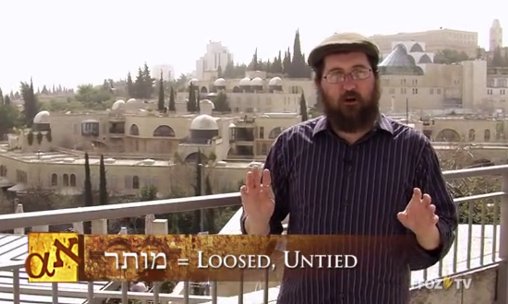
FFOZ Bind and LooseEpisode 17: Over the years numerous explanations have been given for what Jesus meant when he talked about binding and loosing, not the least of which is that it refers to restraining demons. In episode seventeen viewers will discover that the context of Jesus’ words is that of a legal nature. When the Jewish background to the terms “bind” and “loose” is examined, Christians can get a clearer understanding of what Messiah was teaching about. Binding and loosing in actuality refers to legal rulings in regards to the Scriptures and not spiritual warfare.

-from the Introduction to FFOZ TV: The Promise of What is to Come
Episode 17: Binding and Loosing

The Lesson: The Mystery of Binding and Loosing

I haven’t given much thought to the traditional Christian understanding of the concepts of “binding” and “loosing” since I only looked at them from a Hebrew Roots/Messianic Jewish driven perspective, however, First Fruits of Zion author and teacher Toby Janicki started with the Christian viewpoint of these ideas. He described a prayer meeting he attended when he was young where the following passage from scripture was read:

Truly, I say to you, whatever you bind on earth shall be bound in heaven, and whatever you loose on earth shall be loosed in heaven.

Matthew 18:18 (ESV)

Toby told his audience that immediately after this verse was read, the people began to pray, “We bind you Satan in the name of Jesus,” suggesting that Matthew 18:18 was a description of Jesus giving the disciples the power to “bind Satan.” I immediately thought of my recent commentary on John MacArthur as well as my conversation with my Pastor on the matter, and how both seem to take the point of view that people can’t really summon the power of the Holy Spirit to make any effective spiritual or physical changes in our world.

the mystery of binding and loosingToby brought up an interesting and useful point to this issue. If Jesus gave his disciples (i.e. “us”) the power to “bind Satan,” why would he give us the power to “loose” him as well? It doesn’t make sense.

Invoking “context is king,” Toby reads from the larger selection of scripture containing the key verse:

“If your brother sins against you, go and tell him his fault, between you and him alone. If he listens to you, you have gained your brother. But if he does not listen, take one or two others along with you, that every charge may be established by the evidence of two or three witnesses. If he refuses to listen to them, tell it to the church. And if he refuses to listen even to the church, let him be to you as a Gentile and a tax collector. Truly, I say to you, whatever you bind on earth shall be bound in heaven, and whatever you loose on earth shall be loosed in heaven. Again I say to you, if two of you agree on earth about anything they ask, it will be done for them by my Father in heaven. For where two or three are gathered in my name, there am I among them.”

Matthew 18:15-20 (ESV)

I’ve accused Christian Bible studies before about “cherry picking” specific verses in the Bible to create a particular picture or doctrine and Toby showed us how true this can be. He deconstructed this passage to show us what really seems to be happening here.

  1. “If a brother sins against you” indicates that an infraction has occurred within the congregational body, committed by an individual.
  2. The procedure of adjudicating the infraction is outlined in first the direct witness approaching the sinner, then with several witnesses, and finally the entire congregation.
  3. If the sinner continues to refuse to repent through each stage of adjudication, the congregational leaders have the authority to remove the sinner from their midst.

It’s no coincidence that it requires two or three witnesses to perform this function:

A single witness shall not stand up against any man for any iniquity or for any error, regarding any sin that he may commit; according to two witnesses or according to three witnesses shall the matter be confirmed.

Deuteronomy 19:15 (Stone Edition Tanakh)

The sequence of events described in Matthew 18:15-20 references a legal proceeding. If an infraction, error, or sin is committed, a set of legal steps is set in motion. First the individual who was offended may attempt to settle it privately, but if that isn’t effective, then two or three witnesses are brought in. Finally, if the matter cannot be settled, the entire congregation makes a decision to set the sinner out.

The two or three witnesses, according to Toby, are actually the authorities within the community who are acting as judges. Of three witnesses, at least two or all three must agree for any legal decision to be binding. This is how a Beit Din of Jewish Rabbinic court operates today. Jesus was giving his disciples the authority to make binding legal decisions for the Messianic community of “the Way.” This is also mirrored today in more than one Christian church system where the board of deacons, elders, or directors make authoritative decisions for the entire church.

Here we have the first clue:

Clue 1: Jesus’s words about “binding” and “loosing” occur in a legal context.

binding and loosing language lessonI was (again) struck by the fact that the church can (quite often) misunderstand the Bible in general and the New Testament writings in particular by ignoring the Jewish cultural, historical, and legal context of scripture. Even fundamentalist and literalist Christians will miss important and even critical details by failing to take the “Jewishness” of the Jewish scriptures (i.e. the Bible) into account.

The scene shifts to FFOZ teacher and translator Aaron Eby in Israel in search of our second clue. He takes us through a small vocabulary lesson about the Hebrew words for “loose” and “loosed” as well as “bind” and “bound.” The Hebrew words for “loose” and “loosed” are understood as “prohibit” and “prohibited.” The Hebrew words for “loose” and “loosed” correspond to “permit” and “permitted” (Aaron’s actual description is more detailed and you’ll have to watch the episode to get all the information).

For instance, an Israeli “No smoking” sign in Hebrew can be literally translated as “Smoking is bound” or “prohibited.” Aaron also tells us that in religious Judaism, a particular Rabbi can prohibit or “bind” a particular activity as well as “loose” or permit an activity. A Jewish person unfamiliar with the rulings on a specific topic can consult a Rabbinic sage and receive a judgment on whether it is bound or loosed (prohibited or permitted) but it is bound (prohibited) to go from Rabbi to Rabbi in search of a favorable legal opinion.

While Toby used the English Standard Version of the Bible (purposely) from which to quote scriptures, Aaron backs up his point by referencing the Delitzsch Hebrew Gospels to read from Matthew 16:19 (a scripture we looked at just last week):

I will give you the keys of the kingdom of Heaven, and all that you forbid on earth will be forbidden in heaven, and all that you permit on earth will be permitted in heaven.

Back with Toby in the studio, he reads from the DHE Gospels, as Aaron did, but quotes Matthew 18:18 again:

Amen, I say to you, all that you forbid on the earth will be forbidden in heaven and all that you permit on earth will be permitted in heaven.

If a matter is legally decided by two or three judges or authorities within the congregation on earth, then it will be supported by the Heavenly authority as well (which makes me wonder how all that works today with so many different and contradictory Christian and Jewish groups, each issuing authoritative legal rulings for their congregations…which one(s) does/do Heaven support?).

We now have the second clue for this program:

Clue 2: “Bind” and “Loose” are figures of speech in the Hebrew.

I probably would have said that “Bind” and “Loose” are legal terms in ancient and modern religious Judaism, but you get the idea.

I was wondering why Toby needed a third clue since it seemed to me the point was well made, but he continued by quoting from the Mishnah an example of a legal ruling about fruit grown in Israel, which needs to be tithed, or grown outside Israel, which does not need to be tithed. I’ll skip the details because you will want to watch this episode without knowing everything it teaches ahead of time.

Toby also referenced Acts 15 where the Messianic community exercised their authority to bind or loose in relation to the question of whether or not Gentiles could be allowed into the community without converting to Judaism. Should Gentiles by bound or prohibited from formal entry until they legally converted, or should they be loosed or permitted to join without such a conversion?

An examination of the Acts 15 process (and remember, Luke only recorded a small summary of what was assuredly a much longer and involved proceeding) illustrates the matter of deliberations by those who possessed the authority given them by the Master, and the ultimate decision was to loose the Gentiles from conversion and full Torah obligation, although they were bound to what we refer to as the “four essentials” in order to enter (as an interesting exercise, you can try reading Acts 15 and see if you can determine the actual authorities involved [two or more judges] in making the legal ruling about the Gentiles).

Toby didn’t put it into these terms, but the Council of Apostles and Elders in Acts 15 established halachah or a legal ruling about the procedure of Gentile admittance into “the Way.”

Clue 3: Examples from Rabbinic literature and the New Testament support the two previous clues and their conclusion.

Toby further references Isaiah 11:3-4 to establish that Messiah will also “bind” and “loose” during his reign as King and Judge, as well as Isaiah 2:3-4 to make a similar illustration.

At the end of the episode, Toby made a point of trying to “smooth things over” for whoever in his traditional Christian audience might be disappointed that they didn’t really have the power to “bind Satan” based on Matthew 18:18. He reminded everyone that elsewhere in scripture, Jesus gave the disciples the power to cast out demons, and in Revelation 20:1-2, Satan will be literally bound. I again thought of MacArthur and my Pastor, both of whom probably never believed that Christians have had the power to bind or cast out demons after the close of Biblical canon.

What Did I Learn?

ancient_beit_dinI was again taken by the fact that without an understanding of the first century Jewish Rabbinic, legal, and religious context and comprehension of the words of Jesus, it is quite possible and likely that the Church misunderstands large portions of the Biblical text. This supports my ongoing discussion with my Pastor that we grossly misunderstand Paul in those sections of scripture where he seems to denigrate the Torah and call for its practice to be abolished or “put on hold” by Jewish and Gentile disciples (not that the Gentile disciples were ever “bound” to Torah in the manner the Jewish people were).

Without the Mishnah as well as a historical understanding of how Jesus’s immediate Jewish audience and the Jewish readers of Matthew’s gospel would have comprehended these words, we will fail to learn what Jesus (or any of his apostles or disciples) are trying to teach us today. We will anachronistically read the text and make it say what translates from the Greek to the English to support erroneous doctrine. We’ve seen over the majority of the Church’s supersessionistic history how making such errors has led to Christianity as a whole committing heinous atrocities, all in the “name of Christ.”

I also saw a minor but interesting point in Isaiah 2:3:

Many peoples will go and say, “Come, let us go up to the Mountain of Hashem, to the Temple of the God of Jacob, and He will teach us of His ways and we will walk in His paths. (emph. mine)

Since the word “halachah” refers to a way of walking, this also seems to link up to learning the legally binding methods of behaving in worship and devotion to the God of Jacob. In Messianic days, we, the “many peoples” from the nations, will go up to the “Mountain of Hashem,” the Holy Temple in Jerusalem, and learn the Torah of God from Messiah.

I’ve mentioned before that I believe the Acts 15 halachic decision binds Gentiles differently to the Torah than it does Jews, but it will be interesting to see how or if any of that changes once Messiah is ruling from the Throne of David in Jerusalem. I can’t wait to find out.


The Mystery of Romans: A Review of Chapter One

The Mystery of RomansMoreover, Paul does not seem to be confronting an inflated view of the Torah in Rome among the Christian gentiles (“judaizing”) as is often assumed. Instead, he confronts the failure of the Christian gentiles in Rome to respect the role of Torah in the life of Israel as God’s special gift; in fact, he emphatically elevates the status of the Torah. Note, for example, the great advantage of the Jewish people is “that they were entrusted with the oracles of God” (3:2), and elsewhere in the litany of Jewish privileges he includes “the giving of the Law” (9:4); that the “Law is spiritual” (7:14) and again, “the Law is holy, and the commandment is holy and righteous and good” (7:12); and further that “the gifts [which clearly included as central the Law; cf. 9:4] and the calling [Israel’s election] of God are irrevocable” (11:29). Paul refers to the “Law of faith (3:27) and asserts that he is not teaching that faith nullifies the Law: “Christ is the end [goal] of the Law” (10:4). In fact, he even regards the “love” he is calling for among his Christian gentile readers “the fulfillment of the law” (13:8-10; cf. 8:4), not a demonstration of its failure but the embodiment of its true aims.

-Mark D. Nanos
“Chapter 1: To the Jew First and Also to the Greek,” pg 22
The Mystery of Romans: The Jewish Context of Paul’s Letter

No, I haven’t given up on my serial review of the articles in First Fruits of Zion’s (FFOZ) periodical Messiah Journal issue 114, but I’m also reading the Nanos “Romans” book (his book on Galatians is waiting in the wings) and I want to discuss my impressions so far (just gotten through Chapter 1 at this point).

As I read, I usually keep some post-it notes and a pen handy to take notes and stick on the appropriate pages for later reference (beats marking up the inside of the book with my poor handwriting). All I’m going to do here is review my notes and do a “data dump” into this blog post, along with a few of my thoughts on the matters brought up. To start off, I can certainly see why Nanos is considered “Messianic Judaism-friendly”.

For instance, in footnote 5 on page 23:

I don’t mean to suggest the doing of the Law was an “entrance requirement” for salvation, but rather the application of the Law and Jewish customs to the lifestyle of those believing in Jesus as the Christ; for the Jew believing in Christ Jesus would continue to be a Jew and thus obey the Law, and the gentile believing in Christ Jesus would continue to be a gentile and thus not under the Law, however, the gentile would now through Christ Jesus have a new relationship with Israel that made it necessary to respect the “rules of behavior” that had been developed in Judaism to define the minimal requirements of Law and custom for the “God-fearing” gentile wishing to associate with God and his people. Thus the phrase “Law-respectful gospel” is offered here to contrast with the “Law-free gospel” usually assumed to represent Paul and Pauline Christianity, incorrectly in my opinion.

A lot is packed into that one short paragraph regarding Nanos and his opinions on the relationship Jews and Gentiles in Messiah have with Torah, the Gospel, and each other. He is definite that the “Messianic Jew” remains a Jew and thus fully bound to the Torah of Moses, while the Gentile is bound, not to Torah as such, but to the essentials of the Acts 15 legal ruling that authoritatively established the halachah for Gentile admission into “the Way.”

Nanos, in my opinion, is also correct in saying that much of Christianity believes that Paul established a “law-free gospel” for both Gentiles and Jews in Christ and that the Church’s viewpoint has largely ignored what Paul was really saying. The quote from page 22 of the Nanos book above shows multiple examples of how Paul had a high view of Torah for the Jewish people in Messiah (and all of Israel). We also see from the “footnote 5” quote that Gentiles were admitted into the community of Messiah but with a different legal status than the Jews, one that did not make them “Israel” but that affirmed the Jewish people as “Israel” and “God’s people”. Gentiles are “associating” with God and Israel within the Messianic body.

That’s disturbing language for some Christians and Hebrew Roots adherents as it appears to develop “classes” within the body of Messiah, with the Jews in the ascendant position and the Gentiles being subordinate to them. My Pastor is an example of a Christian who believes Jews and Gentiles are totally uniform in identity and status based on the absence of the Law, while many in Hebrew Roots believe in the same uniformity, but based on an identical binding of Jew and Gentile to Torah.

Nanos also associates “Law-respecting lifestyle” for the Gentile with the concept of halachah, which literally means “walking” and denotes rules of behavior, usually as legally defined within a Rabbinic Jewish court system. As Nanos says, “it denotes rules of behavior…and is a frequent idiom in the Bible as well for discussing proper behavior” (pg 22, footnote 6). This again harkens back to the Acts 15 decision for Gentile disciples, which Paul appears to be upholding in his letter to the Romans (chapters 5-16, according to Nanos, and particularly chapter 14).

Upon his arrival he would execute his customary two-step pattern to ensure the restoration of the dispersed of Israel in the synagogues of Rome first, thereafter bringing the good news to the gentiles also, which was, surprisingly, a necessary part of the process of Israel’s restoration, a “mystery” in which those addressed shared an extremely significant role.

-Nanos, pg 26

everlastingI’ve been writing about the “extremely significant role” of gentile Christians as “a necessary part of the process of Israel’s restoration” ever since I attended my first FFOZ Shavuot conference in May of 2012. I often include a link to my blog post Provoking Zealousness as an illustration of this principle. I originally wondered where Boaz Michael came up with such a concept, and I can see now that in part, it must have come from the research and writing of Mark Nanos.

In May 2012, this whole idea of the Gentiles exalted role in relation to Israel was as clear as “Mississippi mud” to me, but I chose to struggle with it rather than discarding it out of hand. I’m glad I did. Things are much clearer for me now.

Paul’s concerns are those of a Jewish missionary, and his message and framework of thinking are those of one who considers himself working within the historical expectations of Israel — the Savior of Israel has come to Zion to rebuild the tabernacle of David and to bring light to all the nations — for the One God of Israel is the One God of the whole world.

-ibid, pp 26-7

I don’t know if Boaz Michael was thinking of Nanos when he conceived of and authored his book Tent of David: Healing the Vision of the Messianic Gentile, but the connection seems very apparent, and dovetails well with Boaz’s message to the “Messianic Gentile” audience of the book in how we have a critical role in restoring Israel that must be communicated to our traditionally Christian brothers and sisters in the Church.

Notwithstanding the many historical concerns associated with harmonizing the Paul of Romans with the Paul of Luke-Acts (note the conclusion of Beker, “Luke’s Paul as the Legacy of Paul,” p. 511: “The history of research has made it abundantly clear that the attempt to harmonize the historical Paul with the Paul of Luke-Acts has come to a radical end”), features of Luke’s presentation of Paul’s view of Law-respectful behavior and his two-step missionary pattern are to be noted in the Paul we meet in the text of Romans (see particularly chapters 4 and 5 herein). Note the challenge of Jervell, “Retrospect and Prospect in Luke-Acts Interpretation,” on p. 403: “What made the Lucan Paul possible? We have at least three different Pauls: The Paul of the Pauline letters, the Paul of Acts, and the Paul of the deuteropauline letters and Pastorals…”

-ibid, pg 28, footnote 13

I include this note here to illustrate that the confusing image I get of Paul in different parts of the New Testament isn’t some failing on my part. New Testament scholars experience Paul this way too, and struggle to make sense of how one man can present himself or be presented in such contradictory ways. Just who the heck is Paul, anyway? If we are to accept that the New Testament is the inspired Word of God and therefore “profitable for teaching, for reproof, for correction, for training in righteousness,” (2 Timothy 3:16) then we must believe that all that we read of Paul and about Paul is correct and consistent with a single man, who himself was consistent in regard to his faith in Messiah and his approach to the Jewish people, the Torah, and God.

So if the fault in understanding Paul isn’t to be found in an inconsistent and flawed New Testament record, it must be found in ourselves and how we are reading that inspired record. Where is the Holy Spirit when we need Him the most?

These observations challenge the prevailing views of Paul’s purpose for writing to Rome and, necessarily, the hermeneutical assumptions that lie behind the interpretation of Romans. Was Paul opposed to the practice of the Law and Jewish customs in the church in Rome? Did he believe that the church needed to sever ties with Judaic notions of righteous behavior? Was legalism his central concern, that is, faith versus works or grace versus the law? Was the church a completely separate institution from the synagogue that must seek to assert a Law-free interpretation of salvation and Christian behavior over against Judaism?

-ibid, pp 28-9

My Pastor would probably say “yes” to answer all those questions and then move on as if nothing were wrong, but I can’t do that. Nanos can’t either.

This reading of Romans suggests that the traditional answers to these questions are inadequate and that the historical situation addressed in Romans should be approached in a vastly different light than it has been in the past. For example, the message derived from Paul’s letter to Galatia should not be allowed, as it has so often in the past, to dictate the probable interpretation of Paul’s intentions toward Rome. The implied audience and the circumstances are quite different, including the important fact that Paul had an instrumental role in the development of the community he wrote to in Galatia while he had never been to Rome. Galatians was written to confront Christian gentiles attempting to “judaize,” and thus, in the opinion of Paul, to compromise the universal application of the promised salvation to all people equally through faith in Jesus Christ, whether Jew or gentile, for Paul emphatically argued that the One God of Israel was also the One God of the nations equally accessible to gentiles through faith in Jesus Christ.

ibid, pg 29

Mark NanosTraditional answers are inadequate and we cannot apply the situation and circumstances that inspired Galatians to what we see in Romans. We cannot ignore the context of each letter, the period of time in which each one was written (in all likelihood, Galatians was written before the Acts 15 decision and Romans afterward), Paul’s intent, his state of mind, the identity of his audience, and how they likely would receive and comprehend Paul’s words within their historic, cultural, linguistic, educational, and national context…a context which we either largely lack or ignore in favor of our historical, cultural, and traditional interpretation of Paul within the Christian Protestant church.

Nanos goes on to give a smart summary of why Paul wrote Galatians and how his motivation was different in writing Romans based on different circumstances. The Gentiles in the Galatian churches were somehow led to believe that only by converting to Judaism and observing all of the Torah mitzvot in the manner of the Jews could they be justified before God. This may have been driven by Jewish ethnocentrism or the belief that the Jews and only the Jews had the inside track with God, the Messianic Gospel notwithstanding.

In Romans, the problem seemed to be the opposite among the Gentiles. They believed that the grace of Jesus Christ diminished if not extinguished the binding of the Jewish believers and non-believers to Torah and even watered down any Gentile sensibilities required for Gentile/Jewish fellowship within the synagogue. There seems to have been a dynamic play between the Gentile position and the Jewish “pushback”, with each population asserting that they had the upper hand, the Gentiles because of grace and the Jews because of the Law. Paul was trying to “balance both sides of the equation,” so to speak. No easy task as anyone from the modern Messianic Jewish movement has discovered in speaking with our more traditional Christian brothers in the Church.

These traces have survived in the texts of Romans and the Apostolic Fathers in spite of Roman Christianity’s later disregard for these Jewish roots as it developed into the thoroughly gentile organization (the “gentilization” of the church).

-ibid, pp 32-3

It wasn’t that long ago that I had my own gentilization experience in my Sunday school class, and I can tell you it was disturbing. According to Nanos, we see the first, encroaching shadows of this behavior among the Gentile disciples in the synagogue in Rome, and it has been “snowballing” ever since.

Nanos repeatedly declares in this chapter of his book that Paul’s letter to the Romans was a reminder to the church in Rome, a large group of Gentiles associating with Jews under the authority of the synagogue, “of the importance of their ‘obedience of faith’…to clarify just how important the halakhah that had been developed in the synagogues of the Diaspora to define the behavior incumbant upon righteous gentiles really was now for redefining the Christian gentiles…” (ibid, pg 34).

In modern Judaism, there is also the concept of righteous Gentiles usually associated with those non-Jews who served some role in rescuing Jewish victims of the Nazi Holocaust, but a Gentile can be considered righteous as a Noahide as well. I find it rather illuminating to classify the status of the early Gentile believers in Jesus the Messiah as “righteous Gentiles” seeing that no one, Jewish or Gentile, has any righteous standing before God apart from faith in Messiah.

On page 37, Nanos states that the Gentile believers were “equal coparticipants in the blessings of God through faith without the need to become Jews.” He goes on to say that the Gentile “coparticipants” possessed an “explicit obligation…to serve non-Christian Jews in love by subordinating themselves to the authority of the synagogue…” inserting the idea that the problem with the Jewish/Gentile relationship in the synagogue did not only involve believing Jews. Was this the first recorded occasion of (Gentile) Christians playing the “grace” and “salvation” card in a game with the Jewish people, asserting superiority over the ancient people of God? Many Christians have historically played that card and many Churches today continue to do so, much to their shame.

However, Romans includes the unmistakable caveat that while Israel’s historical place is preeminent it is not exclusive, and while Christian gentiles must practice the intentions of the apostolic decree they must not misunderstand this and assume, as some were being tempted to assume in Galatia, that they are thereby in need of placing themselves fully under the Law…in order to be equal coparticipants in the blessings God promised to Abraham and revealed in Jesus Christ for all who believe in Him.

-ibid, pp 38-9

returning-the-torahI know I continue to repeat myself, but how like the current difficulties we experience in the Messianic movement were the struggles of Paul and the “church” in Rome. Paul could see clearly their dilemma and ours, but in the final chapter of his life, he was helpless to stop the rift between Gentiles and Jews from forming and ultimately dividing them and us. The question is, can we succeed where Paul (apparently) failed? Paul knew the answers we struggle so hard to acquire and yet he still couldn’t stop destiny’s cruel hand. On the last page of this chapter (40), Nanos reiterates what he said before about the true role of the Gentile in the Jewish community of “the Way”:

…Paul’s intended trip to Rome to bring about in Rome the beginning of the “fulness of the Gentiles.” This procedure would mark, paradoxically, the end of the suffering of the part of Israel presently hardened as it triggered the saving jealousy of “some of them,” resulting in the eschatological restoration of “all” of Israel — for of at least one mystery Paul was certain: “all Israel will be saved.”

The only hope Christianity and the Messianic Jewish movement has of coming to terms and then to unity is in the realization of Paul’s goal for the Romans, the proper orientation of the Gentile believers, not only to Messianic Jews, but to Israel as a whole, and that by provoking Jewish “zealousness” to repentance and Torah, we will not only help in sealing that ancient and bleeding wound, but summon the coming of Messiah, Son of David, may he come soon and in our day.

If this is what only one chapter of the Nanos “Romans” book holds, I’m looking forward to reading (and reviewing) the rest of it.