Tag Archives: Christianity

Introduction to Messianic Judaism: The Non-Climax of Covenant

sprout-root-of-jesseBeginning with the call of Abraham, the history of redemption is the history of God’s election of his chosen people from among the nations. As Paul argues in Romans 15:7-13, God’s commitment to Israel for the sake of the nations forms the bedrock of the Church’s hope. Viewed from this perspective, Messianic Judaism reminds us not only of God’s faithfulness demonstrated in Israel’s history, and of his grace, now magnified in the Messiah, but also of his promises for the future of his people, to be fulfilled in the final redemption of Jews and Gentiles.

-Scott J. Hafemann
“Chapter 19: The Redemption of Israel for the Sake of the Gentiles,” pg 206
Introduction to Messianic Judaism: Its Ecclesial Context and Biblical Foundations
David J Rudolph and Joel Willitts, editors

I reviewed most but not all of the chapters in the Rudolph and Willitts book and I probably skipped this one. I tried to be thorough, but all together I wrote eleven separate reviews of different portions of this book. It’s really worthy of that kind of attention, and I’m grateful to the book’s publisher, Zondervan, for including links to my reviews in an email they sent to their academic readers.

I bring up the Hafemann chapter because last Wednesday, my Pastor, who’s been reading this book, mentioned that he had just read it and really enjoyed what Hafemann had to say. I have to admit that I read this book only once and that was months ago, so I didn’t immediately recall the content. I decided to re-read Hafemann’s article to see what Pastor Randy might have liked about it. I was curious, since we don’t always agree on the nature and character of Messianic Judaism.

Before continuing, I should say that I’ve written blog after blog on how we non-Jewish believers in the Jewish Messiah are dependent upon the covenant relationship God established with the Jewish people and Israel for our own redemption and salvation and, without Israel, we would have no link to the God of Heaven at all. As Hafemann says:

Given the development of this Jew-Gentile theme throughout Romans, it is not surprising, though often overlooked, that it is precisely the relationship between Jews and Gentiles, both in history and within the church, that forms “the climax of the epistle…”

-ibid, pp 206-7

Most Christians probably wouldn’t get this, since historically, supersessionist theology has taught that the church replaced Jews and Judaism in the promises of God. Most non-Jewish believers don’t recognize any sort of relationship with, let alone a dependence upon, the Jewish people by the Gentile Christian Church. More’s the pity.

However, Hafemann’s focus is not just on the past or even the present, but on the future of this relationship and what it means for us all.

We must be cautious at (Romans) 15:7, however. Redemptive history is not over for Jews and Gentiles as Jews and Gentiles. Paul’s careful use of the Scriptures in Romans 15:9-12 makes it clear that the present church, made up of a small remnant of Jews and Gentiles, is not the final fulfillment of Israel’s hope for restoration, as if God’s covenant promises “climaxed” with the first coming of the Messiah.

-ibid, pg 207

Given my recent conversations with Pastor, I’m a little puzzled at his enthusiasm over statements like this one, or perhaps we simply are reading this material differently. What I read is a couple of things. First, within the body of Messiah (i.e. “church”), Jews remain Jews and Gentiles remain Gentiles. The distinctions continue to exist, which for me, means that distinctions based on separate or overlapping responsibilities to God, relative to Torah, continue to exist in the present. The Second point is that the first coming of Messiah did not “finish the job,” so to speak, and that Christ’s work of restoring (notice Hafemann said “restoration,” not “salvation” … there’s a difference) Israel will not be addressed and completed until his return.

LichtensteinPastor and I go ’round and ’round about what “fulfilled” means, and he says a lot of Jewish identity and the Torah is “fulfilled” as in no longer active except in pointing to Messiah. To me, “fulfilled” is to “fill full,” as in, the Messiah is the perfect example of what it is to be a Torah observant Jewish person, and the example and role model to be emulated by all Jewish believers everywhere. The Torah goes forward in time and as 19th century Rabbi Isaac Lichtenstein observed, Jesus as Messiah gives the fullness of meaning and holiness to the performance of the mitzvot for an observant Jew.

I don’t think the above-quoted paragraph of Hafemann’s can be true unless Rabbi Lichtenstein’s life experience as an observant Jewish believer is true.

My Pastor is a great believer in the future of Jewish Israel in eschatology, which is what Hafemann is discussing a well. Israel has a future role in the plan of God and the rest of us are dependent on Israel meeting and fulfilling that role for the sake of humanity.

My Pastor tells a story that illustrates how rare Hafemann’s and Pastor’s perspectives are. Pastor was at a conference on one occasion some years ago when, by chance, he was seated next to a rather well-known and published Christian author and theologian (Pastor mentioned his name, but I didn’t recognize it and, in any event, it would be poor form on my part to use it here). The conversation turned to Revelation and eschatology, and the topic of the 144,000 (see Revelation 7:4-8) came up. Pastor believes that they are literally the twelve tribes of Israel, 12,000 per tribe, while this renowned Christian writer and preacher said that the 144,000 represented the church in allegory.

Pastor said that if their conversation had ended at that point, they probably would have parted amicably, but Pastor added one more sentence. He said something like (I’m paraphrasing, of course), “I suppose one tribe would be the Baptists, and the next tribe would be the Presbyterians, and the next tribe would be…”

Our highly esteemed Christian theologian pointedly shifted around in his chair to show Pastor as much of his back as possible in a very obvious snub.

Interestingly enough, Pastor and I were both trying to make a point based in this sort of behavior, but we were making different points.

His point is that no matter who in Christianity has such beliefs and attempts to delete Jews and the Jewish tribes from future redemptive history, their opinions don’t matter because they aren’t speaking from Scripture. My point was that Christianity is still dominated by such poor attitudes of future Judaism and that most of the believers sitting in the pews, and particularly those who read this gentleman’s books, are going to swallow his story hook, line, and sinker and believe that it’s all “gospel.”

The conclusion to Hafemann’s chapter tells the story that the Gentile Christian church should read and take to heart.

Our passage thus gives no ground for seeing Israel’s identity and eschatological hopes reconfigured into Christ and/or the present Church, having been transformed by Paul into exclusively present realities. Redemptive history does not become abstracted into the “Christ-event” or personalized into an eschatological “community,” but continues on after Christ’s coming and establishment of the Church just as concretely and historically as it did before. The “climax of the covenant” remains Israel’s future restoration for the sake of the nations. Moreover, it is precisely this climax to the covenant that secures the believer’s salvific hope in the return of Christ. In light of God’s promises to the patriarchs (Romans 15:8), the Messiah, as the servant to the circumcision, must come again to judge the nations in order to restore Israel and save the Gentiles (15:12; cf. 11:29). Messianic Judaism puts flesh on the (Ezekiel-)bones of this crucial conviction.

-ibid, pp 212-13
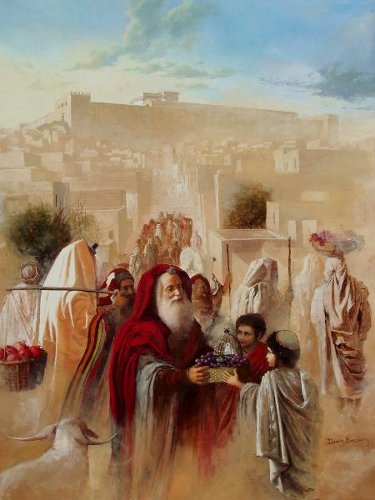
ancient_jerusalem(As an aside, I’m just a tad uncomfortable with Hafemann’s referring to the united Jewish-Gentile body of Messiah as “Church,” since the word implies removing the Jewishness from the Jewish members, but I think I know where he’s coming from.)

I can’t read the above-quoted paragraph any other way but to say that there is no “climax of the covenant” at the cross and in fact, this “climax” will not occur until the return of Messiah and all that must be done is finally completed. In fact, the covenant can’t climax, according to Hafemann, until Messiah returns, restores Israel for the sake of the nations, and judges the nations for the sake of Israel.

The logical implication of Hafemann (and no, he didn’t say so explicitly) is that if God’s covenant relationship with Israel didn’t climax at the cross, and must not climax until after the second coming and the progression of all the events subsequently required by prophesy, then Jewish covenant identity and responsibility to God has not been reduced, eliminated, and certainly is not “fulfilled” at the cross and is not done in the present age (with the understanding that many of the mitzvot are held in abeyance since the Temple, the functional Priesthood, and the Sanhedrin currently do not exist).

Jewish people remain distinctly Jewish people in the covenant, which includes all of their covenant responsibilities, the Torah mitzvot, to God.

My understanding of this small chapter probably is different than my Pastor’s, at least on this point, but again, I can’t see any other way of reading Hafemann. The Torah didn’t “climax” at the end of the Gospels and indeed, the covenant remains for the Jewish people, including and especially the Jewish believers in Yeshua, until his return and for some time afterward.

Systems

broken-crossThe eye sees, and the heart desires.

-Rashi, Numbers 15:39

People cannot help when an improper impulse comes to mind, but they certainly can stop themselves from harboring the thought and allowing it to dominate their thinking. Yet, sometimes one may be responsible even for the impulse itself.

While some impulses are completely spontaneous, others arise out of stimulation. If a person reads, hears, or sees things which can provoke improper thoughts and feelings, he or she is then responsible for the impulses that are the consequences of that reading, listening, or observing.

This concept is especially important in our era, when not even a semblance of a code of decency exists as to what may or may not be publicly displayed. All varieties of media exploit our basest biological drives.

Given the interpretation of the right of free speech under which such provocative displays occur, the government has no way to restrain them. However, each person has not only a right, but also an obligation to be his or her own censor. No one has to look at everything that is displayed nor hear everything that is broadcast. Those who fail to exert their own personal censorship are tacitly stimulating immoral impulses, and for that alone they are liable.

Today I shall…

…try to avoid looking, hearing, and reading things which can have a degenerating effect.

-Rabbi Abraham J. Twerski
“Growing Each Day, Elul 16”
Aish.com

I know that Rabbi Twerski was thinking of something else entirely, but when I consider trying to avoid exposing myself to things that have a “degenerating effect,” I have to include the world around me, including the world of “religion.” Well, “degenerating” isn’t the right term. “Discouraging” is.

Although you won’t read this until Sunday morning, I’m writing this on Thursday in response to my Wednesday night meeting with my Pastor. We were supposed to be discussing Chapter 8 in D. Thomas Lancaster’s book The Holy Epistle to the Galatians, but we got sidetracked on a few things.

I bring up the book because of my Pastor’s response to it. He told me that he was having difficulty accepting some of Lancaster’s assertions early on in the book out of concern that if he assented, he would end up traveling down a trail he didn’t agree with. That’s how I felt last night as Pastor and I talked about salvation, Jewish people, and the future of Judaism and Torah. I felt like I was being led to agree with doctrines that I wasn’t comfortable with but didn’t know how to refute. In going over the little pamphlet about Baptist Distinctives (that is, what makes the Baptist church different from all other churches), I could feel myself being tugged down the “garden path,” so to speak.

I ended our meeting by stepping out of the bowl of alphabet soup, all the letters and words of denominational doctrine and distinctives, and exploring actual experiences and relationships.

Well, sort of.

I’ve often imagined what it would have been like to live in the late Second Temple period in Jerusalem. What would it have been like to go into the Court of the Gentiles at the Temple. How many people would be there? Who would I see? What would the air smell like? Then, I’d humbly kneel and pray to Hashem. This close to the actual “house of prayer for all peoples,” would I feel the tangible presence of the God of Israel? Would I hear the songs of the priests ministering in the inner court?

0 RI’ve often imagined what it would have been like to be one of the non-Hebrew shepherds tending the flocks of Abraham in Canaan. In the heat of the day, I watch him in the distance, studying his mannerisms and appearance, knowing that this is a man, among all human beings, who has spoken to God “face to face.” In the evenings after a meal, around the fire, would he teach us of his God? What would he tell us about a relationship with Him? How does one pray to the God of Abraham as a humble shepherd? In blessing Abraham, would I be blessing God and also myself? What a hard and yet simple life, living close to a prophet and to the One God.

We read “Bible stories” about “Bible characters” as if reading morality fables or fairy tales. We “know” that they’re real, but do we? It’s just words on a page. Does “Biblical inerrancy” result in forgetting that Abraham was and is a real human being? Do we discount the moments of his life we don’t find in the Bible but nevertheless, moments that must have occurred? When, in reading the Bible and praying, do we allow Abraham to stop being a work of “fiction” and become a living, breathing, talking, experiencing human being?

Religion is all about systems, and Christianity, in all of its flavors, is just another series of systems. The systems exist to tell us what the Bible means and how we are supposed to live our lives. The systems tell us what is right and what is wrong, who is right and who is wrong, and what, if anything, we’re supposed to do about it.

But the systems totally ignore awe, majesty, terror, magnificence, and everything else everyone from Abraham in Canaan to a lowly, nameless goy in the Court of the Gentiles would experience in a living, breathing, bleeding, authentic, moment-by-moment encounter with God; the sights, sounds, smells, touches, tastes, thoughts, feelings, and dreams of actually being there instead of just reading the Bible and especially instead of filtering the Bible and everything else through religious systems that so very much remove us from authenticity and the jarring, electrifying, naked connection to our Creator.

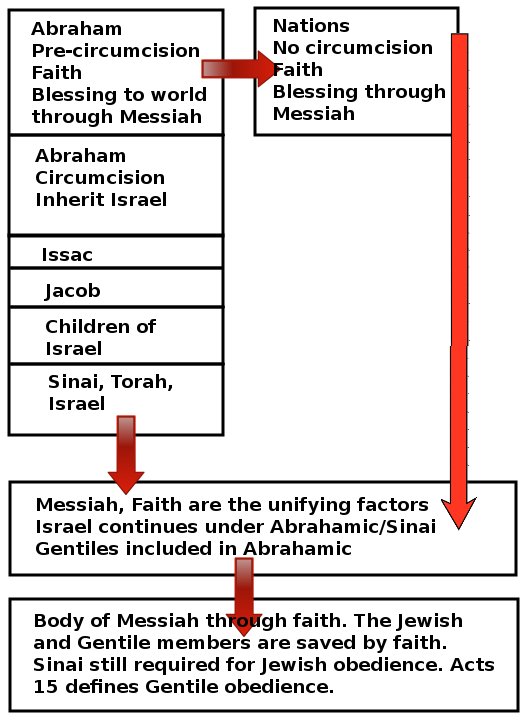
I tried to explain how I thought that Jews and Gentiles both are a part of the unified body of Christ and yet the Jewish connection to the Sinai covenant and its conditions, the Torah, are not undone by that unity. I drew a diagram, which I’ve reproduced below, to explain my thoughts. “But the Jewish people haven’t accepted Christ, so they can’t be saved,” he says (I’m paraphrasing). “Not just faith in ‘a Messiah’ but ‘The Messiah,’ in Jesus,” he says (I’m paraphrasing again).

Something’s wrong. I’m agreeing to things I’m not sure about. My Pastor is so sure of so many things that I think we can only see through “a glass darkly,” and that exist as much in the realm of God as they do in the material world. I don’t know how to explain it, so it’s difficult to know what to say.

covenant_chart1And there are so many other people who seem so sure about unsure things. I suppose it shouldn’t have surprised me that U.S. Army PFC Bradley Manning, just one day after being sentenced to 35 years in Federal Prison for releasing 700,000 secret military documents to Wikileaks, should come out as transsexual and declare that he wants to live the rest of his life as a woman, obviously changing how prison will be “applied” to Manning.

Religious systems. We craft them saying that we see their foundations in the Bible. But we craft them to say whatever we believe is important to us, and thus they reflect the political and social agendas and imperatives of the occupants of these systems. Extracting religious systems from the Bible is supposed to be guided by the Holy Spirit, but because human beings are involved, they end up dramatically contradicting each other, sometimes (often?) based on generational changes in attitudes.

I’ve mentioned before that I don’t think I’d make a good Baptist, not because I have anything against Baptists per se, but because I don’t think any denomination or modern religious stream, old school or new, holds all the keys and unlocks all the doors.

I know they think they do. They all think they do. But being an outsider, I can see a different perspective. I can see lots of perspectives, and none of them make a lot of sense. Pastor pretty much agrees with what he reads in Thomas Schreiner’s book 40 Questions About Christians and Biblical Law and I can barely stand a single thing Schreiner wrote.

Pastor is also reading Rudolph’s and Willitts’s book Introduction to Messianic Judaism: Its Ecclesial Context and Biblical Foundations. He’s just finished the chapter written by Scott J. Hafemann, “The Redemption of Israel for the Sake of the Gentiles” and he likes it very much. I’m going to re-read it to refresh my memory of the text. What did the Pastor see in this chapter that we can agree upon?

Can there be a peace? Or is the only peace in the presence of God and to heck with the systems?

Ki Tavo: Chosen

jewish-davening-by-waterAnd the Lord has affirmed this day that you are, as He promised you, His treasured people who shall observe all His commandments, and that He will set you, in fame and renown and glory, high above all the nations that He has made; and that you shall be, as He promised, a holy people to the Lord your God.

Deuteronomy 26:18-19 (JPS Tanakh)

What does it mean to be the Chosen People? To many Jews it is a source of embarrassment and consternation. To many Christians it is a source of awe and admiration — and to some Christians, jealousy. And to our Muslim cousins — hatred?

Why is the concept of Chosen People an embarrassment and consternation to some Jews? The great concepts of equality and liberty flow from our Torah. That we should think of ourselves as “chosen” rubs against the grain that all people are created in the image of God. Also, if our Chosen-ness makes others jealous, who needs to give more justifications for crusades, pogroms and holocausts? Some Jews think that we have suffered because the Almighty calls us His Chosen People. And even if our suffering is not because of the appellation, then what good does it do for us to be called the Chosen People?

-Rabbi Kalman Packouz
“Shabbat Shalom Weekly”
Commentary for Torah Portion Ki Tavo
Aish.com

That’s a good question. Especially in America where we have the principles of equality and fair play, and especially in the modern, progressive age where it seems almost offensive to many if one group is given a special status, having a “chosen people” seems anachronistic, elitist, and even racist. How dare the Jewish people be chosen? What could God have been thinking? Who are the rest of us, chopped liver?

An additional wrinkle is that many Christians believe that they have taken over that “chosen” position and replaced the Jews and Israel in the covenant promises of God. Thomas Schreiner’s book 40 Questions About Christians and Biblical Law is a perfect example of this kind of thinking in the church. Fortunately, this perspective is slowly evolving beyond such a state, but we have a long way to go.

Rabbi Packouz cites the above quoted portion of Deuteronomy, from this week’s Torah reading, along with Exodus 19:5-6, Deuteronomy 7:6, and Deuteronomy 14:1-3 to illustrate Israel’s chosen status and specialness in the eyes of God.

The Rabbi further states:

While the concept of Chosen People does not mean a superior people, it does imply a special closeness of the Jewish people to the Almighty. Why is there that special closeness, that special relationship?

The concept of Chosen People means both chosen and choosing. Chosen for the responsibility to be a light unto the nations, to be a moral signpost for the nations of the world. Choosing means that the Jewish people accepted on Mt. Sinai to fulfill this mandate and to do the will of God. We are not chosen for special benefits; we are chosen for extra responsibility.

In my recent review of the FFOZ TV episode Ingathering of Israel, I mentioned that in the Biblical prophecies describing the ingathering of the elect at the second coming of Christ, the elect are clearly Israel, the Jewish people:

“Ho there! Flee from the land of the north,” declares the Lord, “for I have dispersed you as the four winds of the heavens,” declares the Lord. “Ho, Zion! Escape, you who are living with the daughter of Babylon.” For thus says the Lord of hosts, “After glory He has sent me against the nations which plunder you, for he who touches you, touches the apple of His eye. For behold, I will wave My hand over them so that they will be plunder for their slaves. Then you will know that the Lord of hosts has sent Me. Sing for joy and be glad, O daughter of Zion; for behold I am coming and I will dwell in your midst,” declares the Lord.

Zechariah 2:6-10 (NASB)

jewish-christianIt is true that the non-Jewish disciples of the Jewish Messiah also have a role to play, a very important role, but we must never lose sight of what the Bible says about the Jewish people, especially not in order to elevate ourselves as Gentile Christians above the status God gave to us as “people of the nations who are called by His Name.”

In considering the phrase “one new man” from Ephesians 2:15 (and it’s not like I haven’t written about Ephesians a time or two), Christianity has spun a web that captures all people in Christ as being the same and eliminating the “chosenness” from the Jewish people, replacing it with the “chosenness” of Christianity. If Jews wish to have a “chosen” status, they must now convert to (Gentile) Christianity, abandoning Jewishness, Judaism, and especially Torah observance.

The flip side, and this is a minority view among Gentile believers, is that the almost the opposite happens. “One new man” describes all believers, Jewish and Gentile, adopting and embracing Jewish identity, Judaism, and especially Torah observance, but without Gentile conversion to Judaism.

No matter which way you slice it though, Jewish people and Israel lose being chosen the minute they enter any sort of Gentile Christian religious space, Hebrew Roots included.

Elhanan Ben-Avraham, in his article “Replacing Replacement”, written for the Summer 2013 issue of Messiah Magazine, defends the Jewish people against the traditional Christian theology of supersessionism.

Adherents of replacement theology claim that God has rejected his rebellious firstborn son and adopted a new son in his place. Part of their perspective includes the viewpoint that Jews must now become part of that church in order to be saved. Throughout the ages this has forced Jewish people to reject living as Jews and to accept Christianity instead with all its forms, rituals, symbols, practices and theologies.

It’s like a loving father choosing to kick out his first-born son and adopt a different son to replace him. I know a few adoptive families and I also know it’s quite possible to adopt a child without first removing the other children in the home. And yet, this traditional doctrine of the church seems to deny that fact and also, to deny that God’s first-born son, the Jewish people, could possibly retain any specialness in God’s view after the coming of Jesus, who after all, is God’s first-born son as an individual, and the living embodiment of everything it is to be Jewish and to embrace a life of Torah observance.

In his Torah commentary, Rabbi Packouz concludes:

Because of our voluntary acceptance, the Almighty made an eternal covenant with us that we will be His people and He will be our God. Any individual can come close to the Almighty, but the ultimate relationship comes through entering the covenant of Abraham and fulfilling the Torah. This special relationship is open to any member of humanity who wishes to enter the covenant irrespective of race, religion or ethnic origin.

Every nation, every people, every religion thinks that it is better than any other nation, people or religion. The Jewish people know that the issue is not whether we are better than anyone else, but whether we fulfill our part of the covenant with the Almighty to hold high the values of the Torah and to do the Almighty’s will.

abraham-covenant-starsThat Messiah came and opened the door, though one of the conditions of the Abrahamic covenant for the people of the nations to also enter into a relationship with God, does not delete any other covenants God made with the nation of Israel and the Jewish people. They remain chosen. We Gentiles who voluntarily accepted Yeshua as Lord, also are considered chosen or elect, but not with an identical set of responsibilities as the Jewish people. This is the confusing part.

This is why most Christians believe that the Torah was done away with, so that Jews and Gentiles can be identical. This is why some folks in the Hebrew Roots movement believe that Jesus applied the Torah to all people equally upon coming to faith in Messiah. The splitting of status and responsibility and the Jewish people retaining “chosenness” unique to themselves, even among Gentiles who follow the God of Israel, is an extraordinarily difficult thing to grasp, let alone to embrace, for everyone (or almost everyone) who isn’t Jewish.

And yet to deny this is to deny all of the promises of God to Israel and indeed, to deny God’s authority to choose Israel and have them remain chosen.

Thus says the Lord, Who gives the sun for light by day And the fixed order of the moon and the stars for light by night, Who stirs up the sea so that its waves roar; The Lord of hosts is His name: “If this fixed order departs From before Me,” declares the Lord, “Then the offspring of Israel also will cease From being a nation before Me forever.”

Jeremiah 31:35-36 (NASB)

How can any non-Jewish religious movement or group demand that Jews cease to be unique, chosen, and set apart from the people of the nations, even the believing people of the nations, unless they set God’s Word aside in order to gratify the Gentile need to be “equal?”

As Rabbi Packouz said, being chosen isn’t easy. Being God’s elect has many difficult responsibilities attached. Pogroms, inquisitions, torture, maiming, blood libel, and murder have always followed the Jewish people because of their status. When the nations could not destroy them using those methods, they switched to assimilation, conversion, identity theft, and inclusion, and they are also very effective weapons.

And yet after thousands upon thousands of years, the Jewish people have not disappeared. God’s promises of return and restoration of the people to their Land, to Israel, remain intact. Only a fool would oppose God.

Good Shabbos.

33 days.

It Isn’t Done

first-fruits-barleyThen the Lord spoke to Moses, saying, “Speak to the sons of Israel and say to them, ‘When you enter the land which I am going to give to you and reap its harvest, then you shall bring in the sheaf of the first fruits of your harvest to the priest. He shall wave the sheaf before the Lord for you to be accepted; on the day after the sabbath the priest shall wave it. Now on the day when you wave the sheaf, you shall offer a male lamb one year old without defect for a burnt offering to the Lord. Its grain offering shall then be two-tenths of an ephah of fine flour mixed with oil, an offering by fire to the Lord for a soothing aroma, with its drink offering, a fourth of a hin of wine. Until this same day, until you have brought in the offering of your God, you shall eat neither bread nor roasted grain nor new growth. It is to be a perpetual statute throughout your generations in all your dwelling places.

Leviticus 23:9-14 (NASB)

I don’t have my notes from last Sunday’s sermon so I’m pretty much winging it, but Pastor, in describing the Festival of First Fruits, said an interesting thing. He said that God gave the Children of Israel and their descendants, the Jewish people, the Land of Israel in perpetuity, that is, forever. He said that this giving of the Land to the Jews goes well beyond the Messianic Age and even to the end of our understanding of time as presented in the Bible. He said that should settle all of the political wrangling we see in current times, and the various attempts to persuade or coerce the Jewish people to surrendering some (all) of their Land to the Arab people living among them, in exchange for the Arabs not committing various acts of terrorism.

The Land of Israel was given to the Jewish people by God for all time through the Almighty’s promises to Abraham, and to Isaac, and to Jacob.

Now let’s look at one of the functions of Torah. Torah, as it was given at Sinai and recorded by Moses throughout the forty years in the desert, was to operate as the national constitution of the nation of Israel. It described all of the civil and criminal laws, as well as social customs and mores, as well as what we think of as “religion” today, though Torah doesn’t specifically categorize these distinctions. This is just how the Jewish people, as citizens of Israel, were to behave in all the various details of their lives, with God as their King.

We know that verse 14 in the above-quoted passage indicates that the Festival of First Fruits was “to be a perpetual statute throughout your generations in all your (the Jewish people’s) dwelling places.” Perpetual. Forever.

But according to Pastor, the only thing left of this particular festival in modern Judaism is the Counting of the Omer. Actually, Leviticus 23:15-16 says to count the days, not the Omer.

When Torah was given, it was tailored to an agrarian society, one where the primary economy is based on agriculture. So the sacrificial system involves the products of such a society, the religious calendar is geared to the timing of the harvests.

But how can God give the Israelites a commandment that says the Festival of First Fruits is perpetual when there is no Temple? How can this be a perpetual command when there have been times when the Jewish people have been exiled from their Land and arguably, continue to remain in exile until the return of Messiah?

If you believe that the Jewish people were given perpetual possession of the Land of Israel by God, and you believe that the Torah is the national constitution of the Land of Israel when ruled either by God directly or a King appointed by God, and you believe that at least the Festival of First Fruits (and possibly the other festivals…certainly Sukkot) is to be a perpetual festival before the Lord, and you believe that Messiah will restore Israel completely to the Jewish people, rebuilding Jerusalem, and rebuilding the Temple, then how can you believe that the Torah is no longer valid and will never again be valid?

I know, I know. It depends on what you call Torah. That gets pretty complicated, at least from a Christian point of view. If everything I said in the paragraph above is true, then Torah must include all of the commandments related to the perpetual festivals and if that’s true, then the commandments related to the Temple and the Priesthood must all continue to be valid, although currently held in abeyance.

Consider the Babylonian exile. Consider the Israelites either scattered or held captive in a foreign country, with only a tiny remnant remaining in the Land. Consider the destruction of Solomon’s Temple. Did that cancel the Torah? Were the Laws of Moses removed? Were the Jewish people deleted from any significance in the course of history?

temple-prayersNo, of course not. Then why should the destruction of Herod’s Temple mean the cancellation of Torah and the “dejudizing” of the Jewish people? Oh, because of Jesus and the cross? Why should that make a difference? Because of Paul? Why does Paul get to re-write God’s law for the Jewish people? Why does the Christian viewpoint of the Jewish Messiah exist in such opposition to everything else we see in the Bible?

You’d think Messiah would exist in harmony with the Word of God. You’d think Messiah would be the pinnacle, the culmination, the very height of the commandments of God. In Torah, it is said that the King must possess a personal copy of the Torah and study it daily, so he does not place himself above his people, but that he functions as King among his people, the perfect example of obedience to God as a Jewish man and ruler.

As the perfect and final King, shouldn’t that also be the role of Messiah, of Jesus?

On the cross, Jesus said, “It is finished,” (John 19:30) and this is interpreted to mean that Judaism and the Torah are finished and that finally grace reigns in their stead. But then what was actually finished if we have this?

And He who sits on the throne said, “Behold, I am making all things new.” And He said, “Write, for these words are faithful and true.” Then He said to me, “It is done (emph. mine). I am the Alpha and the Omega, the beginning and the end. I will give to the one who thirsts from the spring of the water of life without cost. He who overcomes will inherit these things, and I will be his God and he will be My son.

Revelation 21:5-7 (NASB)

I’ve said before that I don’t think all of the work of Messiah was finished at the cross. How could it be? If it were, why would he need to return or for that matter, why did he leave? What was finished at the cross was his suffering and he was brought to the point of death. The forgiveness of sins for all the people of the earth was established through Messiah and the beginning of the process of the New Covenant, which also is not yet finished, for we do not all yet know God.

But God said, “It is done,” right before the coming of New Jerusalem, right before the final time, right before the end of all things as we understand them.

Revelation 21:22 says that the New Jerusalem has no Temple in it because God and the Lamb are the Temple, but that doesn’t occur until everything else we are waiting for as prophesied in the Bible is finally completed. We are no where near that point in human history.

What men like Thomas Schreiner describes in books like 40 Questions About Christians and Biblical Law can’t possibly be correct because such a viewpoint denies God’s promises to the Jewish people about the Land, the Temple, the Torah, and particularly the Messiah. Christian theological blinders inhibit a view of the “big picture” of the Bible. It’s a fascination with a piece of bark on one tree while ignoring the panorama of the forest. It’s like focusing on every detail of a freeway rest stop when you need to be planning a major road trip that includes all of the miles between Los Angeles and New York.

In the span of one Sunday church sermon, my Pastor inserted enough information that confirms and supports the continuation of the Torah of Moses…the Torah of God in the lives of the Jewish people, both in the present and especially in the future.

Jews on the Wrong Side of the Cross

crossAngela Buchdahl was born to an Ashkenazi, Reform Jewish father and a Korean Buddhist mother, yet on her path to the rabbinate did not take the time to convert to Judaism.

-Yori Yanover
“It’s Official: You Can Be a Non-Jewish Rabbi”
Published: August 14th, 2013 Latest update: August 15th, 2013
JewishPress.com

Now that’s an odd story. I was having coffee with my friend Tom last Sunday afternoon when he mentioned this news item. Today, he sent me the link via Facebook. But Reform Rabbi Angela Buchdahl’s tale isn’t quite as it appears.

Exactly 30 years ago, in 1983, the Reform movement in America adopted the bilineal policy: “The Central Conference of American Rabbis declares that the child of one Jewish parent is under the presumption of Jewish descent. This presumption of the Jewish status of the offspring of any mixed marriage is to be established through appropriate and timely public and formal acts of identification with the Jewish faith and people. The performance of these mitzvot serves to commit those who participate in them, both parent and child, to Jewish life.”

It should be noted that outside the U.S. the Reform movement is yet to adopt the sweeping “presumption of Jewish descent” doctrine, but they do, by and large, offer “accelerated conversions” to children of a Jewish father.

In the Hebrew Roots and Messianic Jewish movements (and their various branches), Jewish identity is an important issue. Who is Jewish and who isn’t directly relates to the roles and responsibilities of individuals within Messianic Judaism and great efforts are made to maintain such distinctions, particularly since Messianic Jewish congregations contain (typically) a minority of halachically Jewish members and a majority of Gentile believers who choose to worship within a Jewish context.

Yori Yanover, in his article says that Reform Rabbi Buchdahl’s synagogue on the Lower East Side of Manhattan can be seen to have a number of African and Hispanic attendees and that, as far as diversity goes, Yanover would “beam with pride” over “gentiles who embrace the Jewish faith and who go through the grueling process of converting to Judaism.” But that presupposes conversion to Judaism and adoption of Jewish identity.

Yet outside of Reform Judaism, especially the United States expression of it, Rabbi Buchdahl would be considered a non-Jew and the lines defining Jewish identity have gone beyond being blurred to being eradicated. A non-Jewish Rabbi and Cantor?

Indeed, the more the Reform movement is reinventing itself, the closer it gets to Christianity. She’s been active, among other things, at Auburn Theological Seminary, “an interfaith platform to address global issues and build bridges across religious traditions.” “Angela is an extraordinary religious leader,” Rev. Katherine Henderson, Auburn’s president, told Hadassah. At a gathering for a Presbyterian group last year, Buchdahl “led worship that was completely authentic for her as a Jew and yet completely accessible for this group of Christians,” says Henderson. “We were all able to praise God together!”

But should Jewish writer Yanover be complaining? Shouldn’t we all be getting along as people of faith? And as a Christian, shouldn’t I delight to see Judaism and Christianity coming together, merging, forming a combined corporate identity? Isn’t this just one more step to converting Jews to Christians and becoming “one new man?”

In 1827, Czar Nicholas I decreed that all Jewish boys be forcibly conscripted into the Russian Army at age 12. Called “cantonists,” these boys were kidnapped from their parents’ home, and tortured repeatedly with the implication that conditions would improve if they’d accept Christianity. (Many died of their wounds.) The boys were indoctrinated in military prep school until age 18, and thereafter served 25 years in the army. The authorities saw it as a corrective, forced assimilation of stubborn Jews into Russian society, and as a way to undermine the authority of Jewish communal leaders. Some 50,000 Jewish boys were forced into Czar Nicholas’ army, and most never returned to the families they had left at age 12. The policy was abolished in 1855, with the death of Nicholas.

Day in Jewish History – Elul 15
Aish.com

gentile-jesusI was talking with another Christian recently and the topic of Jews being forced to convert to Christianity under torture came up. In the course of conversation, my companion said that the Jewish people ultimately need to accept Jesus as the Messiah and that it’s wrong for Jews to refuse to convert. Frankly, I could hardly believe my ears. Was this person saying that a Jewish person who felt that the blue-eyed, Goyishe Jesus was not the Jewish Messiah and who believed that Christianity embodied polytheism and idolatry should nevertheless accept conversion to Christianity while under torture as an act of obeying God?

That’s plain nuts. Yes, I believe that Jesus is the Jewish Messiah, but it is not “Christian” to torture someone to conversion. Further, if you force a “conversion,” how sincere can it be? Did Jesus advocate such monstrous acts? Did Paul routinely beat, starve, burn, and cut other Jews who refused to see his side of the story about Jesus? How can this be right? How is this uplifting the Name of God and keeping it Holy?

I’m not saying that Judaism trumps the Word of God or the message of Messiah anymore than Christianity does. We are all (or should all be) seeking an encounter with God, not blindly marching after a series of theologies, doctrines, and dogmas. But is being Jewish nothing to God? Didn’t He call Abraham as the first Hebrew? Didn’t He require that the Children of Israel set themselves apart from the nations as His treasured possession, a kingdom of priests, and a holy nation? (Exodus 19:5-6) And even on the “other side of the cross,” were not there many thousands of Jews who were all believers in Jesus as Messiah and all of them zealous for the Torah? (Acts 21:20)

It hardly seems as if God established the Jewish people and required them to be unique and set apart from the other nations and peoples of the world, and yet after the crucifixion, deleted them from any significance in the course of human history and the plan of the most Holy and One God.

Is God among the Jewish people who have not accepted Jesus as Messiah?

A commenter recently stated that he had no intention of reading anything by Abraham Joshua Heschel because he did not believe he could “grow spiritually” by reading “someone that doesn’t have the type of faith that’s required to be a born again believer in Yeshua.” I am not writing this response with the intention of casting aspersions on the commenter. I simply want to stand against this idea that we cannot learn from or grow spiritually by reading the ideas of people who do not share faith with us in Jesus.

I think the idea is baseless. I’d like to discuss it from various angles, not least of which is the observation that Christianity and Judaism both have long histories of believing otherwise. The theology behind the idea that spiritual truth can only be learned from people with Jesus-faith is not biblical, is not sound thinking about God and his ways, and has its basis in a spiritual triumphalism of the shallowest proportions. I am not saying that people who believe in the Jesus-believers-only theology are shallow, but they have been influenced by an arrogant religious culture.

-Derek Leman
“Can We Learn From ‘Unbelievers?'”
DerekLeman.com

Abraham-Joshua-HeschelI can’t imagine Abraham Joshua Heschel not being a man of God, and certainly his famed book God in Search of Man is a testimony to every man’s spiritual search for his Creator.

Part of the response I posted on Derek’s blog states:

The whole idea of taking “sides of the cross,” so to speak, drives me nuts. In Scot McKnight’s book The King Jesus Gospel, McKnight tells a story about a chance meeting with another Pastor and McKnight asked in the course of the conversation if Jesus preached the gospel. The Pastor without hesitation said that it was impossible for Jesus to even have understood the gospel message because he was born on the wrong side of the cross! Apparently, this Pastor believed that no one understood the gospel message until Paul.

While Jesus changed a great deal in terms of non-Jewish covenant access to God, he didn’t revolutionize the universe and radically transform Judaism by eliminating any connection between Jewish people and God at the cross. Jesus, as the Jewish Messiah King, should be seen as both a continuation of Judaism across time and as an amplification of Judaism’s greatest gift to the Jewish people and the world.

I found the following Rabbinic stories at Aish.com and I encounter them elsewhere from time to time.

Rabbi Shimon ben Shatach once bought a donkey and found a gem in the carrying case which came with it. The rabbis congratulated him on the windfall with which he had been blessed. “No,” said Rabbi Shimon, “I bought a donkey, but I didn’t buy a diamond.” He proceeded to return the diamond to the donkey’s owner, an Arab, who remarked, “Blessed be the God of Shimon ben Shatach.”

A non-Jew once approached Rabbi Safra and offered him a sum of money to purchase an item. Since Rabbi Safra was in the midst of prayer at the time, he could not respond to the man, who interpreted the silence as a rejection of his offer and therefore told him that he would increase the price. When Rabbi Safra again did not respond, the man continued to raise his offer. When Rabbi Safra finished, he explained that he had been unable to interrupt his prayer, but had heard the initial amount offered and had silently consented to it in his heart. Therefore, the man could have the item for that first price. Here too, the astounded customer praised the God of Israel.

praying-at-the-kotelIn Judaism, kiddush Hashem means “sanctifying the Divine Name,” usually by some sort of behavior. While I can’t say that all Jewish people across the world and across time have always lived up to this principle, I know for a fact that not all Christians have, either. We can hardly point to the cross and the fact that we were born on the “right” side of it as evidence that we have the spiritual upper hand. We certainly can’t say that our efforts to delete Jewish people and Judaism over the last nearly 2,000 years, using tools ranging from torture and murder to assimilation and conversion, represents the highest standard of kiddush Hashem. Are we introducing the Jewish people to their Messiah who holds the message of the good news for Jews, Israel, and through them, the rest of the world, or are we trying to earn points in the church by bringing another one to the Gentile Christ?

In my conversation with my Pastor last week, we discussed the range of beliefs within overall Christianity from fundamental to liberal and where people fall off the “scale of Christianity” on both edges. Yoni Yanover believes such a thing is possible in Judaism as well.

This reporter is known to be flippant, so I very much want to avoid being flippant about this story. I don’t think we should denounce people like Angela Buchdahl, or condemn the Reform movement for its straying so far out of the Rabbinical Jewish tent. But we should remain steadfast in not calling any of these people and the nice things they do “Jewish” in any way at all. We’re already not permitted to set foot inside their houses of worship. We should probably stop calling their religious teachers “Rabbi” – perhaps “Reform Rabbi” will do. And we should look forward to the time when calling someone “Reform” would simply mean a really nice non-Jew.

I’ve written before about the fundamental, core beliefs a person must hold to authentically call themselves “Christian,” but how does our treatment of Jewish people figure in to those beliefs? Is it OK to treat Jewish people and their beliefs with contempt and still call ourselves disciples of the King of the Jews? Can we really say that God is never, ever among the Jewish people because of the cross? How do we know?

“Jerusalem, Jerusalem, who kills the prophets and stones those who are sent to her! How often I wanted to gather your children together, the way a hen gathers her chicks under her wings, and you were unwilling. Behold, your house is being left to you desolate! For I say to you, from now on you will not see Me until you say, ‘Blessed is He who comes in the name of the Lord!’”

Matthew 23:37-39 (NASB)

This set of verses is often used by Christians to condemn the Jewish people, but listen to the compassion and love in Messiah’s lament. He longs to gather his people to him. He begs them to open their eyes and see him. It breaks his heart knowing that Jerusalem will soon be ravaged by Roman armies and be left desolate of her exiled people. He knows that his people, the Jewish people, will see him when they say, Blessed is the one who comes in the name of the Lord.

New Testament scholar Larry Hurtado just wrote a blog post called A Future for NT Studies?.

But, to take a slightly different approach, let’s consider why there is (and should continue to be) a field of study, a discipline, of NT Studies. It’s not practical here to do more than state some things briefly. “Byron” claims that NT scholars are simply “chasing their own tails.” That may characterize some work(ers) perhaps, but as a generalization is an unfair, and uninformed, view of things.

bible_read_meIf, after nearly 2,000 years, our studies of the New Testament record have not produced an understanding of the Jewish Messiah, the Jewish Apostles, the Jewish disciples, and their interaction with and tutelage of the newly minted Gentile disciples who struggled to enter and maintain their presence in a Jewish religious venue, then we can only say that New Testament scholars and theologians are only “chasing their own tails” if they keep studying the same scriptures and coming up with the same conclusions that result in anti-Semitism, supersessionism, and (frankly) worship of the cross instead of the Jewish King who died on it.

As Gentile Christians, we should be provoking zealousness among the Jewish people as the means to emphasizing the need for them to return to the Torah and there, find the Messiah.

I apologize if this blog post has offended or upset anyone. I can’t imagine that I haven’t offended or upset practically everyone with today’s “extra meditation,” but we really, really need to stop worshiping Christianity, especially in a manner that must delete Judaism in order to ensure our continued existence. Seek God and His desires. If He continues to love and cherish the Jewish people, who are we as Christians in the church to do otherwise?

Schreiner and Acts 15

Apostle-Paul-PreachesThe so-called apostolic decree is described by Luke in Acts 15. The leaders of the churches from Jerusalem and Antioch met in Jerusalem to determine whether circumcision would be mandatory for Gentiles who believed Jesus was the Messiah. As we saw…they decided that circumcision was not necessary. But James recommended that the Gentiles follow four other prescriptions, and these laws often are called the apostolic decree.

Why are these requirements added after the church has agreed that Gentiles are free from the requirement of circumcision? Does the law come in the back door after it has been shut out the front door? And what do these requirements mean?

-Thomas Schreiner
“Question 31: What Is the Apostolic Decree of Acts 15 and What Does It Contribute to Luke’s Theology of Law?” pg 181
40 Questions About Christians and Biblical Law

I hadn’t intended to write anymore about my impressions of this book. I didn’t think Schreiner had anything more to say to me that I hadn’t read in earlier parts of his work. He is just restating the same point of view and applying it to different parts of the Bible. In reading Schreiner, he seems almost like the poster child for Biblical eisegesis, reading his theology into the text rather than, by exegesis, developing his belief systems from out of the text.

But Acts 15 is near and dear to my heart, so I thought I’d present my impressions of Schreiner and how he perceives the four apostolic decrees.

Even in the above-quoted opening passages, we see that Schreiner continues to link circumcision and any behavioral expectations for Gentile believers as a direct requirement for non-Jewish disciples to respond to “the law.” But he misses that “circumcision” is shorthand for “conversion to Judaism,” so what we see is that James and the Apostolic Council did not require that Gentiles convert to Judaism and take on board the full yoke of Torah in order to have a covenant connection to God and join the community of the Way.

In Acts 15:1, the question was, “Do Gentiles need to convert to Judaism and observe Torah in order to be saved?” However, salvation, from a Jewish perspective, while it can be individual, is understood as corporate. The expectation of the Messiah is that he would “save” Israel nationally and corporately, by returning the exiled Jews to their Land, establishing peace and security for national Israel, including removing all military threats (which at that time meant removing Roman occupation from Israel), and placing Israel at the head of all nations, with Messiah as King.

In order to be “saved,” would Gentile disciples have to join Israel nationally by converting to Judaism? This, of course, would be in addition to being saved from their sins and meriting a place in the world to come.

The Council’s decision was “no,” which should please Schreiner, since they are saying that one does not have to be obligated to Torah obedience in order to have personal salvation. Corporate salvation is another story, but I’d interpret that as Messiah establishing peace for all countries on Earth, hence, we are “saved” by the provision of peace among the nations as well as in Israel.

But Schreiner still doesn’t get why Gentile believers should have any behavioral requirements at all. That just seems too much like “the law” and any “law” should only be applied to the circumcised. Really?

Schreiner goes on to say:

…but this should not be interpreted as if there are not moral requirements for believers. Gentiles would misinterpret freedom from the law if they thought they were free to worship idols, murder their neighbors, commit sexual sin, and mistreat others.

D.T. LancasterOK, so we do have behavioral expectations and they don’t have to function like “the law” as such. But if Schreiner objects to the four decrees of the apostles, then where are these “moral requirements” supposed to come from? Schreiner doesn’t answer the question in this chapter, but based on other portions of his book, I gather that in our communion with the Holy Spirit, we would be guided in all things, including righteous behavior as Christians. The “law” is written on our hearts. So, why the decrees, then? Schreiner examines different perspectives including one of which I’m familiar:

Richard Bauckham proposes an even more specific interpretation, finding the key in the phrase “in your/their midst” in Leviticus 17:8, 10, 12, 13, and 18:26. According to Bauckham, these commands, which are based on Leviticus 17-18, were required of Gentiles who lived in the midst of Israel. The commands, then, do not represent a pragmatic compromise to facilitate fellowship between Jews and Gentiles according to Bauckham. On the contrary, these commands were required of Gentiles who lived in the midst of Israel

-Schreiner, pp 182-3

I wrote a commentary of this viewpoint as it was presented by D. Thomas Lancaster in Torah Club, Volume 6, Chronicles of the Apostles. Schreiner, of course, disagrees with Bauckham and thus Lancaster, but then goes on to say something I consider rather amazing.

One of the problems with Bauckham’s solution relates to Paul. According to Acts, Paul was at the apostolic council and accepted the apostolic decree. Bauckham thinks that Paul later changed his mind and ended up rejecting the council’s decrees.

-ibid, pg 183

What? When did Paul do this? It’s not in Acts 15 and it would have been illogical for Paul to accept the limitations of the decree upon himself as a Jew. The decree was issued as a solution to how Gentiles could be allowed to enter a Jewish religious space as equal members and with a covenant connection to God. The Council decided that Gentiles would not be required to convert to Judaism and take upon themselves the full yoke of Torah (my Return to Jerusalem series goes into all of the details). The Council’s decision was incumbent upon only the Gentiles in the Way.

Paul was Jewish, so the Council’s decision had nothing to do with him personally, nor any other Jewish disciple of the Jewish Messiah. I have no idea how Bauckham (or Schreiner) could think otherwise. It doesn’t make sense.

fracturedSchreiner’s final conclusion is that the apostolic decree was put in place to smooth over the relationship between Gentiles and Jews and that obedience to the decrees was not a Gentile requirement for salvation. Schreiner reads Acts 15:21 not as an indication that Gentiles should “learn Torah” in order to better understand the teachings of Jesus (which are all based on a close understanding of Torah) but in order to learn “Jewish sensibilities” and to become “acquainted with customs that bothered Jews.”

I agree that obeying the apostolic decree or for that matter, any or all of the Torah mitzvot does not provide personal salvation apart from faith in God through Moshiach, but not only does Schreiner completely misunderstand the purpose of the decree (which can be unpacked and understood as a much more in-depth compilation of behavioral requirements), but he clearly doesn’t comprehend that the decree was not designed to impact Jewish obedience to God.

Schreiner’s understanding of Acts 15 is firmly rooted in his dismissal of all of the covenant connections of the Jewish people and Israel with God and his replacement of the Torah as the God-given method of Jewish obedience to God with the law-free Gospel of Jesus Christ.