Tag Archives: Christianity

Wednesday Night in My Pastor’s Office

iron-sharpens-iron-hotWhat then? Are we better than they? Not at all; for we have already charged that both Jews and Greeks are all under sin; as it is written, “There is none righteous, not even one; There is none who understands, There is none who seeks for God…”

Romans 3:9-11 (NASB)

There is no person on earth so righteous, who does only good and does not sin.

Ecclesiastes 7:20

Reading the suggestions for ridding oneself of character defects, someone might say, “These are all very helpful for someone who has character defects, but I do not see anything about myself that is defective.”

In the above-cited verse, Solomon states what we should all know: no one is perfect. People who cannot easily find imperfections within themselves must have a perception so grossly distorted that they may not even be aware of major defects. By analogy, if a person cannot hear anything, it is not that the whole world has become absolutely silent, but that he or she has lost all sense of hearing and may thus not be able to hear even the loudest thunder.

In his monumental work, Duties of the Heart, Rabbeinu Bachaye quotes a wise man who told his disciples, “If you do not find defects within yourself, I am afraid you have the greatest defect of all: vanity.” In other words, people who see everything from an “I am great/right” perspective will of course believe that they do no wrong.

When people can see no faults in themselves, it is generally because they feel so inadequate that the awareness of any personal defects would be devastating. Ironically, vanity is a defense against low self-esteem. If we accept ourselves as fallible human beings and also have a sense of self-worth, we can become even better than we are.

Today I shall…

…be aware that if I do not find things within myself to correct, it may be because I am threatened by such discoveries.

-Rabbi Abraham J. Twersky
“Growing Each Day, Av 25”
Aish.com

Iron sharpens iron, So one man sharpens another.

Proverbs 27:17 (NASB)

Last night I met with Pastor Randy for the first time in several weeks. He has been away in Southern California as part of his Ph.D program and just returned late last week. Prior to our meeting, he sent me two PDFs as email attachments, one was a chart he had drawn as a graphic representation all the covenants, and the other was a text description of the covenants. I have to admit, I was intimidated. He was responding to something I had blogged earlier in the week. I wasn’t sure what to expect.

In response and to prepare for the meeting, I sent him a link to my blog post Abraham, Jews, and Christians, since I suspected we’d be discussing the differences between how Jews and Christians are connected by covenant to God and specifically why I believe that the Torah, the conditions pertaining to the Sinai covenant, still apply to the Jewish people today.
AbrahamI hadn’t slept well the night before, so I was running on three hours rest and as much chutzpah as I could summon. All I wanted to do was to go to bed (our meeting was scheduled for 6:30 p.m., so as you can imagine, I must have been really tired), but I wanted to have this meeting, too. Armed with my hardcopy printouts and my Bible, I went to church.

Actually, it was a blast. I had a great time. When we started talking, I forgot completely about being tired. Pastor gifted me with Thomas Schreiner’s book 40 Questions About Christians and Biblical Law, which I’ll start as soon as I finish the Septuagint book. I suspect Schreiner’s book is going to be a “challenge” to me, but that’s almost always a good way to learn. During our conversation, he suggested half a dozen other books for me, which I’m not going to reference here, so I suspect my reading list has been reserved for the next few months.

We actually agreed on most of the details of the covenant connection Christians have through Abraham and why that results in the Gentile church “bypassing” the Sinai covenant, but following a series of links from Abraham, to the New Covenant, to the “Last Supper,” to Paul’s commentary on Abraham in Galatians 3:16. The only link we Christians have through the Abrahamic covenant is stated in Genesis 12:1-3 which is the Messianic blessing on all the peoples of the earth. This was stated before the portion of the covenant requiring circumcision (which links the rest of the Abrahamic covenant directly through Isaac, through Jacob, and then to Jacob’s sons, the Patriarchs, and then the twelve tribes of Israel, and ultimately the Jewish people).

Where we disagreed was familiar territory: the duration of the Sinai covenant. Pastor believes that it should have ended at the cross with a “transitionary period” lasting until the close of the Biblical canon. My opinion is that it extends much further, well past our current age and through the Messianic Era, finally terminating at what we could consider “the end of time” as we understand it.

I saw no temple in it, for the Lord God the Almighty and the Lamb are its temple. And the city has no need of the sun or of the moon to shine on it, for the glory of God has illumined it, and its lamp is the Lamb. The nations will walk by its light, and the kings of the earth will bring their glory into it. In the daytime (for there will be no night there) its gates will never be closed; and they will bring the glory and the honor of the nations into it; and nothing unclean, and no one who practices abomination and lying, shall ever come into it, but only those whose names are written in the Lamb’s book of life.

Revelation 21:22-27 (NASB)

temple-prayersAs long as there’s a Temple in Jerusalem or the promise that it will be rebuilt (which we have in the promise of Messiah’s return), then the Torah cannot pass away from existence and neither can Israel and the Jewish people (Jeremiah 31:35-36, Matthew 5:17-19). The best one can say is that certain portions (the Laws pertaining to the Temple, the Priesthood, the Sanhedrin, and certain other ordinances regarding the Land of Israel itself) go into abeyance, a state of being temporarily set aside. When Hebrews 8:13 talks about the “Old Covenant” passing away, it describes the process of currently passing away, not having already passed away. I just happen to think that “passing away” process doesn’t end until the coming of New Jerusalem (Revelation 21:10).

We also agreed on one thing that will make a lot of Christians a little nervous. We agreed that the New Covenant isn’t yet a “done deal.” In other words, not all the work was finished “on the cross.”

“But this is the covenant which I will make with the house of Israel after those days,” declares the Lord, “I will put My law within them and on their heart I will write it; and I will be their God, and they shall be My people. They will not teach again, each man his neighbor and each man his brother, saying, ‘Know the Lord,’ for they will all know Me, from the least of them to the greatest of them,” declares the Lord, “for I will forgive their iniquity, and their sin I will remember no more.”

Jeremiah 31:33-34 (NASB)

Pastor used another term, but the way I see it, God’s finger is still in the process of writing the Law within us and on our hearts. If He had already finished it with the first coming of Messiah, we would all “Know the Lord” and we don’t yet. The moving finger has not yet “writ” and thus has yet to move on. Link the still writing finger of Jeremiah 31 with the slowly passing away of the Old Covenant in Hebrews 8:13 and I think you’ll see the Torah as it currently exists will be with us for quite some time.

We still went ’round a bit on the purpose and reason for the Law and finally agreed that how it is applied is largely situational (which I mentioned a few days ago). Pastor again tried to tell me that the Torah was given to show the Israelites that it was too hard for anyone to obey His Law and that they needed Messiah. I pointed to Deuteronomy 30, and he replied, Romans 4. I pointed out that one part of the Bible doesn’t cancel another and that only certain parts of Torah have been temporarily set aside as I mentioned above. I also referred back to Psalm 19 and Psalm 119 to illustrate that the Israelites didn’t experience Torah as a burden or a hardship but instead, their foremost joy.

Reading_TorahHe says the Torah does not provide salvation. I know that and I agree. It never did. When Israel violated the conditions of Torah they were ultimately exiled. And they were ultimately called back to God and restored to their Land. Why? Because of God’s love and grace. He never let them go. In that, we Christians are no different, though the nations are not corporately linked to God as is Israel. When we are disobedient, we are not abandoned but instead disciplined. When we become humbled and cry out, God brings us back, even as He has Israel. The Torah doesn’t save. It works as a specific set of conditions indicating the Jewish people are set aside for God, and the conditions apply to them alone on top of the obligations Torah applies to we Gentile believers.

Like I said in the quotes above, no one is righteous, no not even one. The Torah doesn’t confer righteousness, only our faith and God’s grace does that.

I don’t think he’s convinced, but I did the best I could to illuminate my end of the conversation. Part of the problem is Pastor’s perception of “Rabbinic Judaism,” but right then, I was only trying to show that during New Testament times, Torah continued to apply and the Torah moves forward across history. I didn’t want to even comment about the post-Biblical Rabbinic period until I created a bridge that started at Sinai and moved past the crucifixion, burial, resurrection, and ascendance, with the Torah moving across that bridge and forward, spanning the history of the Jewish people. Jesus didn’t just observe the Law because he was born on the “wrong side of the cross,” he did so because that’s the obligation and the joy for all Jews under covenant. His death didn’t change that.

Boaz Michael puts things is proper perspective, I think:

This may sound counterintuitive to many, but the gospel—the story of Jesus’ first coming, his earthly life, his death and resurrection—is not the fulfillment or even the climax of Israel’s story. It does not complete or resolve the narrative that begins with the call of Abraham in Genesis 12. It does not fulfill God’s promises to David in the books of the early prophets. It does not fulfill the promises of the later prophets concerning Israel’s final destiny. It does not even fulfill the Torah itself, in which God promises certain things to his people Israel after their return from exile.

The completion or resolution of Israel’s story does not and will not occur until she is redeemed from her exile, planted firmly in the land God has promised to her, and returned to a state of loving obedience to the Torah under the leadership of the Son of David, Yeshua the Messiah.

I mentioned the example of 19th century Rabbi Isaac Lichtenstein who came to faith in Yeshua past the age of sixty; a person who was wholly Jewish before and after coming to Messianic faith who found that Torah was illuminated, expanded, and possessed of great joy by the Messiah. When Messiah “fulfills” the Torah, it doesn’t end, but it is shown to be truly perfect in Moshiach! Observance goes on for the Jewish believers, but it is Torah observance with much greater meaning, something that as a Gentile Christian, I can hardly even imagine.

Pastor surprised me a bit. My opinion has been that the population of Jews in Messiah dwindled more or less steadily past the Biblical period and finally extinguished completely sometime between the fourth and seventh centuries CE, and then finding a slow resurgence in the past several centuries.

Pastor contradicted me and said he believes that across the past two-thousand years, there has always been a remnant of Messianic Jews. I’d love to believe that but I need to see some evidence. He pointed me to a book called Our Jewish Friends by Louis Goldberg, which I’ll certainly have to read to see the validity of such a claim and how it could possibly be substantiated. Does Goldberg mean Jewish converts to Christianity? To me that’s not the same thing as people who live fully Jewish lives realized in Messiah. Now that would be a thrill to discover.
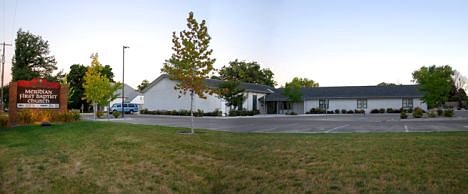
first-baptist-churchIn many ways, last night’s talk was one of our most productive conversations, at least for me. We won’t be able to meet again for another couple of weeks, but I’m looking forward to it. I mentioned to Pastor that the following day’s “meditation” would be called On Being a Good Christian and was based on his sermon from last Sunday. That led to my angst on ever being able to officially join a local church and the dilemma of “denominationalism” for me. We know that Paul frowned on such divisions in the church (1 Corinthians 1:10-17) but he told me (surprising me again) that we can’t anachronistically apply Paul to our modern church.

We agreed that at the heart of all disciples in Messiah, we must all contain a set of core beliefs, without which, we cannot call ourselves “Christians” (which in this case, would include “Messianics”). Beyond that, denominations provide additional dimensions based on social, cultural, and sometimes even ethnic similarities. I had a brief epiphany and said that denominations were not unlike the evolution of the different streams of ancient and modern Judaism including the addition of elements of culture and tradition. I don’t think Pastor expected that comparison and hopefully it will be food for thought in subsequent conversations.

But since I opened the door, our next conversation in two weeks will be on the differences in Christian denominations. I actually need this since my grasp on the topic is extremely weak. I don’t know if I’m learning to be a better Christian, but I hope I’m growing and learning to be a better child of God.

Blessings on my Pastor for his patience, his intelligence, his passion, and his friendship.


On Being a Good Christian

churchesAfter they had preached the gospel to that city and had made many disciples…

Acts 14:21a (NASB)

Last Sunday, Pastor Randy preached on Acts 14:21-28 in a sermon he called, “What Makes a Good Missionary (Part 3)?” In many ways, the title could be expressed as “What Makes a Good Christian” since it is Pastor’s opinion that all believers are responsible for preaching the Good News of Jesus Christ, whether we’re formally called missionaries or not. Pastor spent most of his adult life as a missionary and his parents were missionaries, so it’s completely understandable why his perspective would be as it is.

When he was teaching about what a disciple is, he used several different phrases to describe them/us. I want to focus on one of those phrases:

A good Christian is a person who places himself/herself under a local church authority as a member.

Whoa!

Yeah, I even wrote “whoa” in my notes during the sermon. A member?

Pastor listed a number or reasons for this including giving the person a sense of accountability, opportunities for service, both to the other members of the church and to the larger world, and displaying commitment to the body of believers.

I know what you’re thinking? Aren’t we all as believers, part of the body of Christ anyway, what Pastor called “the universal church?”

Yes, but he used Paul’s model of “planting churches” (I can’t imagine Paul actually used that term) to emphasize how we can’t really function effectively in the body unless we join with a local church and display a commitment to that body as one of the operational parts. The sense of community would also contribute to the individual growing in “Christ-likeness” and, as I said before, providing a platform to allow the individual to minister to God’s people.

I’ve been campaigning to completely redesign the church’s website, which currently looks like a throwback to the ancient web of the 1990s. I’ve gotten some traction, but there’s a bottleneck in the process and until that bottleneck is cleared (which I’m told will be soon), I can’t actively begin my redesign project. Most of the information on the current site is obsolete, however, I did manage to pull this from the “Beliefs” page:

Because the Bible is the complete, true and sufficient Word of God, holding absolute authority for the church and the individual, we believe and teach the following:

  • Jesus Christ as the one and only begotten Son of God, is fully Jehovah God (the second person of the trinity) (John 1:1-14). In Mary’s womb, He joined to His divine nature, a human nature and was virgin born, thus becoming ‘God-man’ (Philippians 2:5-7 / Hebrews 10:5-10).
  • Jesus was tempted by Satan but remained sinless because He was and is God, and it is impossible for God to sin (Deuteronomy 32:3-4). Still, the temptations were both valid and real to the God-man. Oh, how he can sympathize with us (Hebrews 4:15-16).
  • Christ was literally crucified on the cross, His blood becoming the sufficient cleansing for our sins. He died and was buried. Then on the third day, He physically arose in victory over sin and death (1st Corinthians 1-5). He who truly believes that Jesus is the Christ, the Son of God is rescued from eternity in hell and given eternal life (Salvation – John 20:31).
  • The next prophetic event will be the taking up into heaven of all believers, ‘The Rapture,’ (1st Thessalonians 4:15-17). Then following the tribulation, Christ will return to the earth with us, His glorified saints, to establish His literal rule over all the earth for 1,000 years (The Millennial Kingdom), and we will rule with Him (Jude 14-15). This is our destiny as Sons of God (Romans 8).
  • Saving faith is by grace alone and not by works of merit that we can do (Ephesians 2:8-9).

churchmembershipI object to the use of “Jehovah” as if that were the actual pronunciation of the Tetragrammaton, and I’m not crazy about the “rapture” doctrine. Becoming an actual church member means taking some classes and then signing on the dotted line that you buy all of their doctrine, dogma, and theology hook, line, and sinker.

I’ve had enough conversations with my Pastor to realize our points of disagreement and, if being a member of my church or some other local church is a requirement for being a “good Christian,” then I have a problem.

Sunday afternoon, I had coffee with my good friend Tom. Tom’s been a Christian for over forty years and he and I have both been through the Hebrew Roots “wringer” as well. We have a good many attitudes in common, but he agrees with my Pastor that I will never be truly effective in my community until I formally become a member. Tom’s been a member of his church for about three years now. I asked him what he does about the bits and pieces of church doctrine with which he disagrees. He’s discussed it with his Pastor and his Pastor’s response is, “We’ll work on that.”

I’d interpret that statement to mean that Tom’s Pastor will try to convince Tom of the correctness of whatever Tom currently has issues with. I guess that situation is a work in progress.

But what about me? Frankly, I don’t think any church has their understanding 100% correct. How am I supposed to pretend that the church I attend does? I’m already anticipating a major disagreement next week in Sunday school class over the “symbolic” meaning of the moadim.

By the way, I took a closer look at the study notes for next week’s class and my blood ran cold. I’m actually kind of nervous about this. The notes mainly describe how the primary purpose of all of the Festivals just point to the reality of Jesus Christ. In other words, they had no value of their own to draw the Israelites closer to God (never mind that the word “sacrifice” in Hebrew is “korban” which gives the meaning of “drawing closer to” God). Dispensationalism isn’t supposed to be inherently supersessionistic but this part of it is getting close.

But anyway…

Since Pastor is anachronistically applying the “missionary journeys” of Paul to modern Christian missionary work anyway, let’s apply that process to “church membership.” When Paul “planted churches,” and appointed leaders, how did Gentiles join the community? Besides professing faith in Messiah, was there some additional process of agreeing to the specific conditions and rules of that community in order to join? Maybe, but remember, there weren’t “church denominations” in those days. Yes, there were different streams of Judaism, and “the Way” was the Jewish stream that contained the Jewish and Gentile disciples of Messiah. However, within the Way, were there different and competing variations? Did you have to choose one and forsake all others or could you just be a “generic” Jewish or Gentile disciple of the Jewish Messiah?

Actually, it looks like there were some divisions:

Now I exhort you, brethren, by the name of our Lord Jesus Christ, that you all agree and that there be no divisions among you, but that you be made complete in the same mind and in the same judgment. For I have been informed concerning you, my brethren, by Chloe’s people, that there are quarrels among you. Now I mean this, that each one of you is saying, “I am of Paul,” and “I of Apollos,” and “I of Cephas,” and “I of Christ.” Has Christ been divided? Paul was not crucified for you, was he? Or were you baptized in the name of Paul? I thank God that I baptized none of you except Crispus and Gaius, so that no one would say you were baptized in my name. Now I did baptize also the household of Stephanas; beyond that, I do not know whether I baptized any other. For Christ did not send me to baptize, but to preach the gospel, not in cleverness of speech, so that the cross of Christ would not be made void.

1 Corinthians 1:10-17 (NASB)

broken-crossOn the other hand, it looks like Paul took a dim view of these divisions and urged unity in Messiah, not in the name of some “leader” or “teacher” (or “denomination”).

I know, I know. I can’t anachronistically apply conditions as they existed in Paul’s day to the modern “church” because after all, the “church” isn’t a unified entity, at least at the level of human organizational meaning. Times have changed significantly in the past twenty centuries or so, and being a “good Christian” now means different things to different streams of Christianity.

I currently attend a small, Baptist church in Southwestern Idaho. They have definite standards and a formal process of baptism and education leading to entry into membership. I suppose I could attend and worship there forever as unaffiliated, but then, I wouldn’t meet the qualifications of a “good Christian.”

It’s not that I object to being committed to a community, having affiliation, accountability, and opportunity for service, but it’s the albatross being hung around my neck of all the specific doctrine and dogma to which I object (and if taking Calvinism on board is a requirement, then it’s an absolute “showstopper”). I can’t lie about believing stuff when I don’t believe it, so how can I ever join any church anywhere? How can I, as Pastor puts it, be a “good Christian?”

Oh, and apparently Pastor isn’t alone in his opinion about joining a church. Another collision between the principals outlined in Boaz Michael’s book Tent of David and the reality of “going to church.”

Where Does Faith Go When It Is Lost?

strange-landWhat happens when one day a rabbi discovers that he has lost his faith? Dr. Paul Shrell-Fox, a clinical psychologist and researcher asked himself that question – which turned into to a fascinating study.

Seven rabbis agreed to “talk about it” – three Conservative community rabbis in the United States, and four strictly Orthodox rabbis who live in Israel and have a double identity: Secretly atheists, and rabbis and believers openly.

-Tali Farkash
“Atheists in closet: Rabbis who lost God”
Published 07.28.13, 11:13, ynetnews.com

Over a year ago, I published a blog post on a very similar topic called When We’re Left Behind. It was based on an article written by Barbara Bradley Hagerty for NPR.org called “From Minister to Atheist: A Story of Losing Faith”.

How crushing would it be to love your Pastor or Rabbi, having attended his (or her) congregation for years and growing close to him (or her) as a model of faith, and then to discover that this “Holy person” has no faith in God at all and in fact is an atheist? What would that do you your faith (or mine)?

I don’t want to recycle something I’ve written before, but this brings up some new questions about the nature of religion (as opposed to faith) and how we live it out in our lives. While I certainly can’t deny the social role of church for Christians, we lack (in most cases) the connection to our religious community based on ethnicity, culture, and sometimes race. It is true there are churches that have such a basis, such as African-American churches and Korean churches, but for the most part, the Church as a social entity is just a group of people who (in theory) share the same theology and doctrine about God but who otherwise come from a wide spectrum of social, economic, educational, and employment backgrounds (this probably isn’t true in an absolute sense, but I’ll use it as a general principle for the sake of this essay).

Jewish synagogue life is a different thing because what is being shared is a lot of cultural, ethnic, traditional, religious, and even national and DNA components. It goes back to the difference between “What is a Jew?” and “What is a Christian?” You can’t just say people who have different religions. Being Jewish is enormously more complicated and in some ways, elusive in definition.

So I can see a Rabbi who becomes an atheist having a tougher time in leaving his/her community than a Pastor in the same situation (not that it wouldn’t be really hard on the Pastor as well). From a Rabbi’s point of view, if you are leading a shul in a small community, leaving the synagogue would be leaving behind your entire social, friendship, and possibly family circles. Your entire life, or most of it, probably flows through synagogue life. I suppose something similar could be said of a Pastor as well, but perhaps not quite to the same depth.

How about extending the topic beyond Rabbis and Pastors? My wife says that at our local Reform/Conservative synagogue, the Friday night service is aimed at more secular Jews who connect socially and through traditions, while the Saturday Shabbat service is more for “religious Jews.” The missus even says that some of the synagogue members wish that the current Rabbi would retire/move on (he’s still in his 40s, so is nowhere near retirement age) because he’s “too religious.”

At the opposite religious extreme are the Ultra-Orthodox or the Haredim, who seem to take the slightest infraction of the mitzvot, even among those Jewish people who are not Haredi, so, so seriously, to the point of being abusive and assaultive. It seems like something has gone horribly wrong in certain corners religious Judaism where, on the one extreme, God is all but ignored, and on the other, God is exceptionally tightfisted and punitive, and adherents experience no problem in actually attacking other human beings.

I don’t know if you get that exactly in Christianity, although to be sure, we have churches that are so extremely liberal that God seems like an afterthought and Biblical standards are as fluid as quicksand. We also have churches and groups so hyper-conservative that they too don’t care who they hurt or what damage they do to other human beings, even desecrating the funerals of military men and women for the sake of their distorted theology and need to push their weight around. I’d call that going horribly wrong, too.

It’s enough to make me lose my faith in religious people.

Waiting to danceBut what makes a person lose their faith in God? Of some of the folks and groups I’ve just mentioned, they probably didn’t have faith as such to begin with. Their religious venues are more a tradition-based, cultural, and social outlet, as opposed to a gathering where an encounter with God is sought. At the opposite extreme, it may not be God that anyone is looking for, but the need to impose internal punitive, restrictive, and ultra-conservative standards on the entire environment of human beings. As far as I can tell, God’s chosen method of operation isn’t to either ignore His standards or massively exaggerate them and then force them on others without so much as a by your leave.

I know my Pastor will disagree with me, but I believe we have a choice. I believe we have lots of choices in life, the first or at least the most important being whether or not we are going to have a relationship with God. After that, other choices follow. I believe God is like a Father or teacher (sometimes the roles overlap). Certainly if we act foolishly, we should fear Him, but fear isn’t the primary foundation upon which our relationship is built. Neither is hate. Neither is casualness and pandering to social agendas.

Once we have faith in God, and more importantly, trust, how can we lose that? Some folks say you can’t unless you never had it in the first place:

My sheep hear My voice, and I know them, and they follow Me; and I give eternal life to them, and they will never perish; and no one will snatch them out of My hand. My Father, who has given them to Me, is greater than all; and no one is able to snatch them out of the Father’s hand. I and the Father are one.”

John 10:27-30 (NASB)

That creates a problem because here we see people, Pastors and Rabbis, who have lost their faith (although Jews, because they are born into covenant, are accountable whether they have faith or not). Did they have it in the first place or did something else happen? What if they actually have faith somewhere at their core, faith in God that is, but lost something else instead? What if they lost their faith in religious people or the mechanics of religion?

I don’t think I could lose faith in God but there are days I’d throw religion and religious people out the window, slam it shut, lock it, and never look out again. A life in community, whether in person or online, can be really frustrating at times. We have all of these high ideals about love, companionship, worship, and holiness, but our real lives are so messy by comparison. We don’t always treat each other well, even when we intend to.

Some people are cranky by their nature or because they have adopted a victim stance and out of that, are perpetually defensive (I know bloggers who write out of that position pretty much all the time). Some people are generally OK until you hit one of their “hot button topics,” and then watch out (I wonder if that’s how I’m going to be next week in Sunday school?). Being in community with religious people is like walking through a mine field or living in an alcoholic family. You never know when the peace will be shattered by an abrupt and devastating explosion.

If I ever lost my faith, it wouldn’t be in God, it would be in human beings.

“You must not lose faith in humanity. Humanity is an ocean; if a few drops of the ocean are dirty, the ocean does not become dirty.”

-Mahatma Gandhi

There are times when I think it’s the ocean that’s dirty and only a few drops are clean.

Until you can see the good within a person, you are incapable of helping him.

-Rabbi Tzvi Freeman
“Helping”
Based on letters and talks of the Rebbe, Rabbi M. M. Schneerson
Chabad.org

desert-islandAnd sometimes that’s an amazingly difficult thing to do. Reading quotes from Gandhi and Rabbi Freeman present a very pleasant picture, but life in the trenches of religion is anything but, at least for those folks who are struggling with faith (and don’t we all at some point).

I know why a Rabbi and Pastor (or probably just ordinary people) would stay in their religious communities after they’d lost faith in God…because of the continued social rewards. Most people who lose faith in people but not God would just leave the community and either try to find another or bail on community life entirely. But what if community life fails you but you still find God is present within the synagogue or church? What do you do then? Are you even aware that it’s God who’s holding you there? Maybe what feels like losing faith in God is just a protracted silence? God doesn’t always talk. But we’re supposed to have faith in the desert too.

I don’t have all the answers. Sometimes I don’t even know the right questions to ask. I just know that this religious life that is supposed to bring us closer to God isn’t pain-free, and it seems for some folks that the pain increases exponentially as we strive to approach Holiness. Maybe that’s why most religious people hit a comfortable plateau and just stay there, neither being too hot or too cold in their spirituality, but only lukewarm. Maybe that’s why some people quit completely, because being numb is better than being set on fire and writhing in the flames.

Where are the Gandhis and the Freemans with their soothing, supportive words? Where is the so called “community of faith?” Where is God?

The fault, dear Brutus, is not in our stars, but in ourselves…

-William Shakespeare
“Julius Caesar (I, ii, 140-141)”

The First and Second Shema

Jewish_men_praying2The most obvious difference between the two sections is that the first simply instructs the Jew to pursue his or her relationship with G‑d, without promising reward or threatening punishment. The second section, while enjoining us to do the very same things as the first, informs us of the benefits of doing so (“I will give the rain of your land in its due season . . . and you shall eat and be sated”; “In order that your days be multiplied . . . upon the land”) and warns us of the consequences of transgression (“He will stop up the heavens”; “You will soon perish from the good land”). Other than that, however, the second section seems a repetition of the first, with only minor differences in wording and syntax.

Rashi, in his commentary on these verses, cites several further examples of how the second section introduces a concept or injunction not included in the first.

In the second section, the commandment to love G‑d is given in the plural (“with all your hearts and with all your souls”) rather than the singular (“with all your heart, with all your soul”) employed by the first section. The first section, explains Rashi, is an injunction to the individual, while the second is an injunction to the community. (This difference is repeated throughout the two sections. The Hebrew language distinguishes between second-person singular and second-person plural, as Old English does with “thou” and “you.” The entire first section speaks in second-person singular, the second section in second-person plural.)

-Rabbi Yanki Tauber
“The Second Chapter of the Shema”
Based on the teachings of the Lubavitcher Rebbe, Rabbi Menachem Mendel Schneerson
Chabad.org

According to this commentary, a Jew is obligated to recite the Shema each morning and each evening of his life. Accepting that, why am I writing about the Shema? For that matter, as a Christian, why am I writing about the Torah and Judaism? Derek Leman recently wrote a blog post emphasizing lengthy and careful Torah study for Christians which I also commented upon. Nothing in the Bible is irrelevant, although some portions cannot be acted upon today by any Jewish person (or anyone else) and some portions can only be acted upon by Jewish people.

I’m also interested in the Torah pursuant to my desire to answer my Pastor’s question what is the purpose of the Torah, especially for Messianic Jews?

Reading Rabbi Tauber’s commentary, I was provided with a few clues about the application of the Shema and thus the Torah in the lives of observant Jewish people.

This isn’t going to be a scientific or academic response. I lack the educational “chops” for such an analysis and frankly, as I write this, I’m pretty tired, not having gotten enough sleep last night. My brain is foggy. Don’t expect a lot. I suppose I should delay in writing this, but the drive inside me has other ideas.

Rabbi Tauber lists many different ways to interpret the first and second sections of the Shema, but I want to focus on the emphasis between the text being directed at the individual Jewish person vs. the Jewish community.

Jewish individual vs. community devotion to God and observance of the mitzvot is a unique concept. Christianity doesn’t really have such a viewpoint. Oh sure, there’s the concept of what we do as individual Christians as opposed to Christian community activity, but it just doesn’t “feel” the same. Christianity doesn’t convey the same cohesive identity that Judaism does. Further, we don’t have a focused set of commandments that delineate the duties of individuals in the church in contrast to the body of believers as a whole.

According to Rabbi Tauber, there is such a thing for Jews and Judaism.

The most obvious difference between the two sections is that the first simply instructs the Jew to pursue his or her relationship with G‑d, without promising reward or threatening punishment.

The directive to the individual Jewish person relative to the Shema and the Torah is an instruction to pursue a relationship with God. Period. No mention of punishments or rewards. Is that supposed to tell us something about how God responds to the virtues or the failures of an individual Jewish person? Maybe not, but keep that in mind.

The second section, while enjoining us to do the very same things as the first, informs us of the benefits of doing so (“I will give the rain of your land in its due season . . . and you shall eat and be sated”; “In order that your days be multiplied . . . upon the land”) and warns us of the consequences of transgression (“He will stop up the heavens”; “You will soon perish from the good land”).

ancient_jerusalemThe second section seems to say more or less the same as the first except that it’s directed at the community of Israel as a whole and that it includes rewards and punishments for obedience or failure to obey (for length, I’m not quoting everything from the article that supports my points, so you’ll need to read the source to “fill in the blanks”).

The story of the Bible does mention individual Jewish people such as Abraham, Isaac, Jacob, Joseph, Moses, Aaron, and so on, but the grand, overarching epic is really the story of collective Israel. It’s Israel that is blessed by God, or Israel that is sent into exile. Solomon builds the Temple for Israel, or the Temple is destroyed to punish Israel. Individuals play their parts and individuals are blessed or suffer, but it’s really the consequences to the nation, for good or for ill, that are at stake.

Why?

In the second section, the commandments to don tefillin, study and teach Torah and affix mezuzot immediately follow the warning that “you will swiftly perish from the good land that G‑d is giving you.” This, says Rashi (citing Sifri), is to teach us that also after you are exiled, you must distinguish yourselves with the mitzvot: put on tefillin, make mezuzot, so that these not be new to you when you return.

Taken on its own, the first section implies a connection to G‑d only through the Torah and its mitzvot as observed in the Holy Land. We need the second section to tell that all this is equally applicable in exile.

The first section describes a relationship whose relevance we can assume only under conditions of closeness to G‑d: when we dwell secure in the land that “G‑d’s eyes are constantly upon,” and when He manifests His presence amongst us in His holy home in Jerusalem. But when He hides His face from us and banishes us like children exiled from their father’s table, our ability to love Him, to comprehend His truth and to implement His will can be questioned. Indeed, we cannot even assume that these precepts are meant to apply to such conditions of spiritual darkness.

Not so the second section. Because the relationship is one of our making, because it stems from within, it becomes ingrained in our very essence. Integrally us, it persists wherever and whenever we persist.

There seems to be differences in application between the first and second section of the Shema based on whether or not Israel, collective Israel, is in exile. To be sure, there is no collective Israel if there isn’t a response from the many, many individual Jewish people, but it’s Israel in exile. Some individual Jews have it better and some worse in the diaspora. Look at the differences in life for Jews in America vs. in the Arab nations or some European countries.

My Pastor lived in Israel for fifteen years and in his experience, when Jews made aliyah, they had one or two responses: either they became more religious or they stopped being religious completely. In Israel, as a Jew, you don’t have anything to prove. Of course you’re Jewish. You made aliyah. You live in Israel.

But the instruction from the Shema for Jews in exile is another thing.

In the second section, the commandments to don tefillin, study and teach Torah and affix mezuzot immediately follow the warning that “you will swiftly perish from the good land that G‑d is giving you.” This, says Rashi (citing Sifri), is to teach us that also after you are exiled, you must distinguish yourselves with the mitzvot: put on tefillin, make mezuzot, so that these not be new to you when you return.

daven-tefillin-siddurWhat has helped the Jewish people survive as the Jewish people throughout each long exile from their Land? For the last nearly two-thousand years, it’s been obedience to the mitzvot; carving out a uniquely Jewish lifestyle that separates them from the peoples of the nations. This may be one of the reasons why halachically Jewish people, particularly those who were born and raised in observant Jewish households, and who have the benefit of a Jewish education, object to non-Jews taking on behaviors reflective of the Jewish sign commandments (wearing tzitzit publicly and so on) and engaging in what one Christian blogger has referred to as Evangelical Jewish Cosplay.

“Messing around” with someone else’s survival mechanism is likely to result in a very strong and unpleasant response.

Which is what we often see in clashes between Jewish Messianic Judaism and Gentile Hebrew Roots. Often non-Jewish people fail to appreciate the collective historical “consciousness” of the Jewish people. I remember sitting in the local Reform synagogue around the time the film The Passion of the Christ (2004) was released. There was tremendous fear in that room about how the local Christian community, not to mention the worldwide Christian community, would respond to that film, particularly in their (our) interactions with Jews.

You wouldn’t imagine that one film would inspire so much anxiety, but historically, after every passion play, there has been a pogrom. It was as if their grandfathers and great-grandfathers and the elders of Israel were whispering in the ears of every Jewish person in shul that morning, telling them of the horrors they had experienced in decades and centuries past. “They’ll watch this film, then something terrible will happen,” they might have been saying to their grandchildren. “I’ve been through this before. I know,” said the plaintive voice.

There’s something woven into the subconscious and in the marrow of every Jew that responds to what has threatened the community of Jews across the ages.

The Torah and the collective lifestyle of Judaism has preserved individual Jews and the Jewish community for untold centuries all over the world. At the core, you can’t really completely separate a Jew from the Torah, anymore than you could take away a person’s eye color or blood type.

There’s a reason why Jews are obligated to recite the Shema twice daily. There’s a reason why there’s a tremendous amount of repetition built into Jewish observance of Torah and of prayer.

If you were to observe large numbers of individual Jewish people in their lives, you would see the scale of religious observance run the gamut from no observance at all as an atheist to an extreme attention to every tiny facet of halachah in Orthodox Jewish life.

That’s the life of an individual Jew as addressed by the first section of the Shema. Individual Jewish people can be observant to one degree or another or completely unobservant. They’re born into covenant, like it or not, but they make choices just like everybody makes choices. An individual Jew may live or die, old or young.

shoahBut collective Jewry has always survived perhaps because, especially at “crunch time,” when the world is doing its best to exterminate all Jews from the face of the earth, Jews rally, the Jewish community unites, they seek distinction and uniqueness, because being Jewish together insures that Judaism will survive, even if some individual Jewish people reject their heritage. Even if individual Jews die Jewish people and Judaism continue.

In Israel, a Jew may not have so much to prove because they are Jewish in the Jewish homeland, but everywhere else, in order to be Jewish, they must not take being Jewish for granted. Every time that’s happened, bad things have resulted.

If you want to see just how “Jewish” a Jewish person is, try to take that Jewishness away from them or claim it for your own as a non-Jew. What God built into the Jewish people from the beginning will erupt. Sometimes, such as when assimilation threatens, that’s not only a good thing, but it’s necessary for survival.

And God intends that Judaism should survive. If you want to know one of the purposes of the Torah and particularly the Shema, that’s a really being one.

Seeking Korach’s Peace, Part 2

homogenizedKorach apparently desired to bring “peace” by homogenizing all of the Levites with the Kohenim (Priests). However there were two things wrong with that plan. The first is that God did not desire to remove the distinctions between the Kohenim and the Levites. The second was the Korach’s motives were less than pure, both according to Midrash and by how God “reacted” to Korach and the other rebels.

This is the second part of this two-part series. If you haven’t done so already, please read Part 1 and then continue here.

Rabbi Yanki Tauber and Rabbinic commentary states that Korach and his co-conspirators objected to mattanot kehunah, or the “gifts to the Kohanim,” the giving to the Priests of a portion of each Israelite’s crop or the “first shearings” of his flock, as well as the other gifts. Korach felt that all the Levites should be included, and attempted to elevate himself and the rest of the Levites to a level that was never intended for them. While it is noble for anyone to desire to be elevated spiritually, we must do so within the plan of God for our lives. God determined that certain of the mitzvot, the wearing of tzitzit and tefillin, were signs for the Jewish people, so my performing those mitzvot as a non-Jewish Christian, even out of the desire to draw closer to God, won’t do me any good. In fact, if I do so out of ego and the desire to exalt myself before others, I am opposing the plan of God.

Rabbi Tauber continues:

Korach was right: our involvement with the material can be no less G-dly an endeavor than the most transcendent flights of spirit. Indeed, our sages consider man’s sanctification of material life the ultimate objective of creation. “G-d desired a dwelling in the lowly realms,” states the Midrash; “This,” writes Rabbi Schneur Zalman of Liadi in his Tanya, “is what man is all about; [this is] the purpose of his creation, and the creation of all worlds, supernal and terrestrial.” But Korach erred in his understanding of the nature of this “dwelling in the lowly realms” that G-d desires, and the manner in which man can indeed fashion a divine home out of his material self and world.

unworthyKorach’s underlying motivation was a feeling of inferiority and his response to that experience was to lead a “bloodless coup” (though eventually his own blood would be shed) against the Kohenim and against Moses (and against God) by artificially raising himself and the two-hundred and fifty rebels to a level they did not merit. But is it a bad thing to be “lowly?” In Jewish mystic thought, God actually desires to dwell among the lowly. There is no one so insignificant and so humble that God does not desire to dwell with them.

And the Master also taught humility:

“When you are invited by someone to a wedding feast, do not take the place of honor, for someone more distinguished than you may have been invited by him, and he who invited you both will come and say to you, ‘Give your place to this man,’ and then in disgrace you proceed to occupy the last place. But when you are invited, go and recline at the last place, so that when the one who has invited you comes, he may say to you, ‘Friend, move up higher’; then you will have honor in the sight of all who are at the table with you. For everyone who exalts himself will be humbled, and he who humbles himself will be exalted.”

Luke 14:8-11 (NASB)

Imagine if I, as a Christian, attempted to adopt a role that God had never designed for me. How humiliating it would be for me to be chastised by the Master of the banquet, Messiah himself, and be told to take a lesser seat. Better that I should seek the most humble and unassuming place at the table and if he so desires, the King can invite me to a better place.

And it’s not like the King was not willing to humble himself. Messiah humbled himself in becoming an ordinary human being.

Do nothing from selfishness or empty conceit, but with humility of mind regard one another as more important than yourselves; do not merely look out for your own personal interests, but also for the interests of others. Have this attitude in yourselves which was also in Christ Jesus, who, although He existed in the form of God, did not regard equality with God a thing to be grasped, but emptied Himself, taking the form of a bond-servant, and being made in the likeness of men.

Philippians 2:3-7 (NASB)

For even the Son of Man did not come to be served, but to serve, and to give His life a ransom for many.”

Mark 10:45 (NASB)

servingThe King came to serve his subjects, even to the point of death. He left Heaven and became a poor human being, wearing flesh and blood rather than his rightful Divinity, even as the Divine Presence descended from Heaven to occupy an “ordinary” tent of earthly materials. It is said that even the Torah is Divine and must wear “garments” in order to become accessible to human beings.

Rabbi Tauber’s commentary says that, unlike modern progressive and inclusionist thought, spirituality within the human population and within the individual human being does take the form of a hierarchy of sorts. The Kohen Gadol (High Priest) does have duties that place him in closer proximity with the Holy, closer than the other members of the tribe of Levi or the rest of the Jewish people. So it is between the Jewish disciples of Messiah and the Gentile followers. No, it doesn’t mean that Jewish people are “better” or “more loved” by God than Gentile Christians, just that their “duties” are such that they have unique opportunities to perform Holiness by certain of the mitzvot that are not offered to the people of the nations who are called by Messiah’s name.

Conversely, as commentary has previously stated, God desires to dwell in the “lowly realm” and thus among the lowest levels of Creation. In that act, God descends to us, and in that very act, God allows us to ascend toward Him, particularly without requiring that we usurp mitzvot that are not our own.

Korach attempted to reverse the order by elevating himself first, imagining that such an act would “force” the Almighty to descend to him. The opposite happened and God “lowered” Korach quite literally into the earth, burying him alive. Whatever peace Korach had hoped to achieve by his defiance was a pipe dream, and whatever peace he had already been granted by God was buried with him.

Ironically, Korach, as a Levite, already possessed a special and “vertical” role as ordained by God, but that wasn’t good enough for him. Christians too have a special and ordained role but we must be diligent to fulfill that role, lest we also lose everything God has given us. If we can’t take care of even a little, how will we be granted greater blessings. Indeed, we’ll lose even what we’ve got.

“And the one also who had received the one talent came up and said, ‘Master, I knew you to be a hard man, reaping where you did not sow and gathering where you scattered no seed. And I was afraid, and went away and hid your talent in the ground. See, you have what is yours.’

“But his master answered and said to him, ‘You wicked, lazy slave, you knew that I reap where I did not sow and gather where I scattered no seed. Then you ought to have put my money in the bank, and on my arrival I would have received my money back with interest. Therefore take away the talent from him, and give it to the one who has the ten talents.’

“For to everyone who has, more shall be given, and he will have an abundance; but from the one who does not have, even what he does have shall be taken away. Throw out the worthless slave into the outer darkness; in that place there will be weeping and gnashing of teeth.

Matthew 25:24-30 (NASB)

I’ve written on numerous occasions, including in Provoking Zealousness, about the special role we Christians have in relation to the Jewish people, to Israel, and to God. A role that no one else can fulfill. A role that is different from the Jewish believers, but one vital to them and to us. Rather than, like Korach, demanding a role that is not ours, we must give it back, take up our own “cross,” and follow the Master of our lives.

returning-the-torahWhen a Christian demands that a believing Jew give up a Jewish lifestyle, give up the Torah of Moses, and give up the mitzvot, it is as if Korach demanded that Moses and Aaron surrender their roles as Prophet and High Priest and join the other Levites or the other Jewish people in the “mundane”. When a Hebrew Roots person demands that they take possession of the specific “sign” mitzvot that uniquely identify the Jewish people as distinct from the rest of the nations, it is as if Korach demanded to become Prophet and High Priest, elevating himself to a level not given to him by God.

In either case, they are violating the purpose of Torah that provides for harmony between different and distinct groups of people while maintaining distinctions.

I know that the Pirkei Avot, the body of Midrash, and the Tayna are not likely to be viewed as having any authority in relation to the lives of Christians and Christian Hebrew Roots followers, but these sources illustrate important principles. We all travel on trails of spiritual enlightenment, following a path carved out for us by God, striving to become better today than we were the day before. This is praiseworthy and desirable, but we must remember that it is God who creates and defines the universe and everything in it, not us. We work in partnership with God but we are definitely junior partners. When we decide to elevate ourselves outside the plan of the Almighty, not only are we trying to become more important than other human beings, but to take the role of God as well.

Nor does Torah endeavor to create a uniform world society: its detailed laws delineate the many different roles (man and woman, Jew and non-Jew, Israelite, Levite and Kohen, full-time Torah scholar and layman, etc.) to comprise the overall mission of humanity.

-Rabbi Yanki Tauber

We are commanded to love the Lord our God with everything we’ve got and to love our neighbor as ourselves. To obey that Torah, we must be humble and servile to our fellows and particularly to our Creator. Everyone who seeks to exalt himself will be lowered, like Korach, and the most humble, like Moses, will be elevated.

A Christian Brings a Tanakh to Sunday School

jerusalem_templeSome people believe the 4 spring holidays (Passover, Unleavened Bread, Firstfruits, and Feast of Weeks/Pentacost) were fulfilled in Messiah’s 1st coming and that the 3 autumn holidays (Feast of Trumpets, Day of Atonement, and Feast of Booths/Tabernacles) will be fulfilled at his 2nd coming.

-from Sunday School study notes
for August 4th, “Leviticus 23, Feasts of Israel: God’s Picture of Things to Come”

Help.

I knew Pastor Randy was going to start giving a series of sermons on the Festivals to better educate folks about their past and future (and hopefully their present) meaning. I forgot that meant my Sunday School class would be teaching on them too, since my class “mirrors” the Pastor’s sermons.

I like my Sunday School teacher but in many ways he has a very “basic” approach to the Bible, that is to say, very basically Christian. I’ve had to bite my tongue on a few occasions during a study rather than open a can of worms that would not easily be closed again.

To his credit, the teacher came up to me before the start of class today and said he expected I’d have a lot to say about next week’s lesson. That’s something of an understatement. I plan to really do my homework this weekend, come prepared with a lot of notes, and bring my Stone Edition Tanakh for good measure.

What’s kind of scary is that the Festivals won’t be approached based on their own merit, but on their “symbolic meaning” relative to Jesus and all that “fulfilling” stuff.

Really, Passover has been “fulfilled?” I’m not sure what that’s even supposed to mean. Does that mean it’s over. No more Pesach seders? Then why did Jesus say “do this in remembrance of Me” (Luke 22:19)? Oh. Am I supposed to believe that the sacrament of communion replaced Passover? What happens when the Temple is rebuilt? Will there be no Pesach sacrifices because Jesus “fulfilled” Passover?

Actually, I told my teacher that I do sometimes keep my mouth shut and my opinions to myself in his class on various occasions. Our conversation was light-hearted but I know I’m going to have concerns over the next two months. I won’t be as quiet as I have been in the past. I can’t be.

Actually, in preaching on Acts 14:21-28, I encountered my Pastor’s opinion on Shabbat as applied to Christians. This section of Acts addresses the end of Paul’s “first missionary trip” and his return to Syrian Antioch. Although the text doesn’t actually say Paul and his team rested, it’s assumed that once they returned to their “home church,” they may have taken it easy for a bit.

Both Pastor and my Sunday School teacher emphasized the importance of taking a break from our duties to recharge our “spiritual batteries,” so to speak. Pastor went so far as to mention the Shabbat, “but not in a legalistic sense” (Oy). He did say that he felt it was important to take one day out of the week as a day of total rest. That day can’t be Sunday for him since it’s his busiest day, but every Monday, he and his wife spend the day at their cabin. No phone and no Internet. Just taking it easy and pursuing some personal activities and projects.

From the way he’s described it to me, it doesn’t sound like a “Jewish” Shabbat as such, but it is a day of rest. However, Pastor says we can choose whatever day we want. I don’t see that in the Bible, but then, he’s not going to be preaching a Saturday Shabbat to his congregation, either.

levites-aaronic-blessingAs an aside, in ancient times, the Kohenim (Levitical Priesthood) also worked on Shabbat and yet were held blameless (Matthew 12:5). I wonder when they rested? Of course, in the days of Jesus, the Priests worked on a rotational basis, so maybe it wasn’t as bad as all that. However, what about Rabbis working on Shabbat? But I digress.

I wonder if Pastor or anyone else at church would consider actually observing a Saturday Shabbat as “legalistic,” particularly if observed from sunset Friday to sunset Saturday and abstaining from some form of the Melachot or the thirty-nine types of work traditionally forbidden on Shabbos? Would it be legalistic to observe Shabbat because it honors God as the Creator rather than just because we need a rest?

Christianity didn’t switch Shabbat from Saturday to Sunday, they eliminated it altogether. Few Christians treat Sunday the way a religious Jew observes Shabbat, not even close. I think the church surrendering the Sabbath and its traditional observance was like Christianity shooting itself in the foot. Could you imagine the enormous relief and freedom we could experience if we didn’t choose to treat Sunday pretty much like any other day of the week?

That’s pretty much what I’m going to be addressing at church for the next two months. I’m actually kind of excited to hear what Pastor is going to say about the Festivals, but I’m also kind of dreading how it’s going to play in Sunday School. I’m going to go. In some ways, I really want to go. And I’m going to give input. People have become aware of my basic leanings and seem to be OK with it, but this will be the real test.

People are going to find out that in my own small way, I do observe the Festivals. My wife and kids being Jewish, we have a family seder each spring and I build a sukkah in our backyard each fall. I eat matzah instead of leavened products for the eight days of unleavened bread. And although I don’t always fast on Yom Kippur, I have done so periodically in solidarity with the Jewish people.

Too bad this didn’t come up before Tisha B’Av.

I’m sure I’ll have more to say after next Sunday’s message and Bible school study. This is where my real life experience and the mission illustrated in Boaz Michael’s book Tent of David intersect, hopefully not to forcefully, though.