Tag Archives: Christianity

Debate or Beer?

beerOne of the glories of life in the Messianic Jewish community is the unity of worship and service between its Jewish and Gentile members within a specifically Jewish context. In recent years, however, a trend has developed that challenges the Messianic Jewish community on this very issue. This trend involves various groups and movements that teach that all Jews and Gentiles under the new covenant are called to keep the same Torah in all regards.

In so doing, these One Law movements not only misinterpret a great body of Scripture, but they also miss the unique calling of Jews and Gentiles within the Body of Messiah, robbing both groups of the biblical richness of their identity. They lose the new covenant vision of unity in Messiah between Jews and Gentiles and replace it with a man-made rallying cry, which One Law advocate Tim Hegg has expressed as “One people, One Messiah, One Torah.”

-Daniel Juster and Russ Resnik
“One Law Movements: A Challenge to the Messianic Jewish Community” (January 2005)
As downloaded from Messianic Jewish Musings
Original Source: MJ Studies

This has already started something of a minor “buzz” in the Messianic Jewish and Hebrew Roots blogospheres. I wasn’t going to write about it, but since a certain amount if misinformation (or disinformation) is already becoming promoted (no, not at Derek’s blog) on the web, I felt it necessary to present a more balanced perspective. Also, since the Juster and Resnik paper significantly mentions Acts 15 and since I’ve already spent a lot of time and effort addressing Acts 15 from the current perspective of First Fruits of Zion (FFOZ) as published in D. Thomas Lancaster’s commentary in Torah Club Volume 6, I thought my perspective might provide just a little illumination.

I also want to say that FFOZ is mentioned in the Juster and Resnik paper and not in a complementary fashion. The paper was published in 2005 and references material produced by FFOZ from 2003 which was written by then-contributor Tim Hegg, a well-known Hebrew Roots scholar and proponent of “One Torah.” Since that time, FFOZ has shifted its theological and doctrinal perspective to be quite a bit more like that of Juster and Resnik as documented in their paper. It’s not identical but it’s pretty close. Unfortunately, this dates the Juster/Resnik paper somewhat, but the other content they present is fairly well “spot on.”

A few things.

By the time of Yeshua, an interpretative tradition was developing concerning the requirements for Gentiles. These later became formulated as the Noahide laws, binding on all people and rooted in the covenant with Noah. Already in the first century, Judaism made a distinction between universal requirements and requirements that were the particular responsibility of Jews.

Juster/Resnik, pg 4

This statement could be misconstrued to suggest that Juster and Resnik believe the Acts 15 letter is a reworking of the Noahide Laws and that such laws were the only restrictions incumbent upon the Gentile believers in Christ from the perspective of James and the Jerusalem Council. However, a further reading of the paper reveals this is not entirely true.

As has been noted, these are very similar to the Noahide laws. This does not mean that Gentiles are free to murder, steal, and dishonor their parents. The passage assumes a universal morality, as do Paul, Peter, and James (who were present that day), and John in their writings. As Romans 2 notes, Gentiles can perceive the law of God, even without the revelation of Moses, and are responsible for many standards that are also expressed in the Bible. For example, classic Roman moral law taught the ideals of monogamous marriage, honoring parents, honesty and much more. The essential and unique addition of New Covenant ethics is the sacrificial example of Yeshua.

-ibid
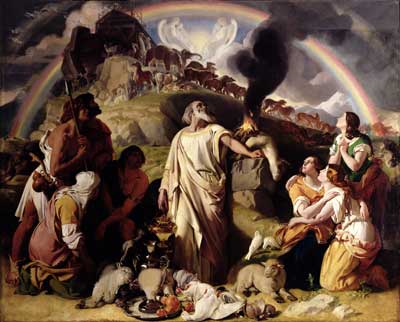
noah-rainbowI disagree that the halachah developed by James for the Gentile believers was a reworking of the Noahide Laws although this is a commonly held belief by many scholars and laypeople. But according to Lancaster, it would make little sense to require the Gentile believers to comply only to the Noahide Laws when in fact all of humanity is accountable to God by those standards. In fact, as I’ve mentioned on one of my blog posts, Lancaster states that James only uses the Noahide Laws as a starter and seems to leverage Leviticus 17 and 18 to forge a distinct Gentile identity in Messiah based, to some degree, on the stranger or “ger” in Israel.

In those chapters, the Torah describes the sins of the Canaanites, warns the people of Israel against imitating their ways, and prescribes four prohibitions which both the Israelite and the stranger who dwells among the nation much keep. “These correspond to the four prohibitions of the apostolic decree, in the order in which they occur in the apostolic letter.” [Richard Bauckham, “James and the Jerusalem Church,” in “The Book of Acts In Its Palestinian Setting, (Grand Rapids, MI: Wm. Eerdmans Publishing Co., 1995), 459]

-D. Thomas Lancaster
Torah Club, Volume 6: Chronicles of the Apostles
from First Fruits of Zion (FFOZ)
Torah Portion Mishpatim (“Judgments”) (pg 461)
Commentary on Acts 15:20-31

I would also direct the reader to Toby Janicki’s article The Gentile Believer’s Obligation to the Torah of Moses, found in issue 109 of Messiah Journal (Winter 2012), pp 45-62 to understand how the deceptively brief “four prohibitions” are extended to provide a rich and robust Torah observance for the non-Jewish believers that does not intrude on Jewish identity or unique covenant obligation to God.

Having read one staunch critic of the paper as well as Leman this morning, I agree that the Noahide Laws cannot be applied to the “fourfold decree” of the apostles, but that doesn’t shoot down the foundation of Juster’s and Resnik’s argument opposing the position of “grafted in” Gentile believers and Jewish believers forming a fused and completely uniform corporate identity. The so-called “One Law/One Torah” position by necessity, essentially eliminates the Jewish people in Messiah and replaces them with “One Torah” cookie cutter produced humanity. This may be inadvertent replacement theology on the part of One Law/One Torah advocates, but it is replacement theology nonetheless.

As far as I can tell, the criticism of the Juster/Resnik paper I read this morning is based on only a single element and since the Juster/Resnik position, as we see in Lancaster, is otherwise well supported, then the basic assumption of the paper remains valid.

Acts 15 specifically declares that nothing should be required of the Gentiles but four laws, three of them related to blood. Galatians 5 warns Gentiles not to receive circumcision or they will be required to keep the whole Torah. The clear implication here is that without circumcision, Gentiles are not required to keep the whole Torah. Colossians 2 warns that no one is to judge the Colossians with regard to Sabbath, New Moons or festivals. These are a shadow; the substance is Messiah. In Galatians 4:10 Paul writes that he fears that he labored over the Galatian Gentile congregations in vain because they were now observing “special days, months, seasons and years.”

Juster/Resnik, pg 2

This is probably one of the more devastating portions of their argument since the statement emphasized in the quote above plainly illustrates that the non-Jewish believers could not be obligated to keep the Torah mitzvot in the manner of the Jews unless they were circumcised (i.e. converted to Judaism).

line-in-the-sandOne of the comments I made on Leman’s blog was that Juster and Resnik seem to draw a hard and clear line in the sand between Jewish and Gentile Torah observance, especially in their belief of how Paul saw the matter, while the Lancaster commentary appears to allow for more leeway, providing a sort of “permission” for Gentiles to extend themselves into more of the mitzvot without an implicit or explicit command to be obligated to full Torah observance over some undefined period of time.

One of the things I liked about the Juster/Resnik paper is that it was very clear in showing what Paul, or James for that matter, didn’t say (I apologize in advance for the length of this quote):

One Law teachers make a big point of James’s statement that “Moses has been read every week in the Synagogue” (Acts 15:21). This is taken to imply that Gentile believers will, in the normal course of their new life, attend synagogue and adopt more and more of the whole Torah. Since Torah life is good and beautiful, why wouldn’t he? On this basis, the verse is taken as an exhortation to further learning and the adoption of the whole Torah. Thus, One Law teachers transform an ambiguous statement into a strong and unambiguous exhortation.

They apparently overlook, however, the fact that these words spoken in the council were not included in the apostolic letter that was circulated among the congregations. If this were such a crucial exhortation to Gentiles, it is amazing indeed that the apostles, under the guidance of the Holy Spirit, did not think it important enough to put in their letter!

It is most telling that in all the epistles to congregations there is not a single word commanding Gentiles to adopt the whole Torah, and no direct statement of hope that they will eventually adopt a fully Torah- keeping life in the same way as the Jews. There is no word of such an exhortation or even mild encouragement throughout the whole book of Acts, which is written in part to show the relationship of Jewish-Gentile fellowship!

Even were we to say that Gentiles are free to embrace Torah, the calendar of Israel, and more, there is no word that there is any covenant responsibility for Gentiles to do so. Acts 21 reinforces this impression. Here James tells Paul of the rumor that he teaches Jews who embrace Yeshua to forsake Torah. This of course is not true. So, Paul demonstrates this to be a false rumor by his Temple involvement. James reminds Paul that Gentiles were freed from responsibility for the full weight of Torah. Neither Paul nor James gives the slightest hint that they were encouraging full Torah observance among Gentiles. Paul could have said, “Not only do I not teach Jews to forsake Moses, but I even encourage Gentiles to embrace more and more of the Torah as they come to understand and appreciate it.” This is the emphasis of the One Law teachers, but there is not one word in the New Testament that explicitly encourages Gentiles to grow in keeping the whole Torah.

Galatians 5 is a watershed passage. Here Paul in the strongest terms exhorts Gentiles not to receive circumcision. Some One Law teachers want to allow a legitimate option of circumcision, so they add the proviso that it should not be done for the wrong reasons. Yet, this is not in the text. The New Covenant offers the fullness of God’s blessing upon Gentiles without the necessity of circumcision. This was not the case in the Mosaic order.

ibid, pg 5
white-pigeon-kotelI think when added to the body of work produced by Lancaster, we find ample support for the Juster/Resnik position. I mentioned on Leman’s blog that I hope, given the age of the paper, the authors would be willing at some point to update and expand the document to reflect changes that have occurred in the movement and in research over the past eight years.

But given my numerous blog posts of this week, lest you think I’m talking out of both sides of my mouth, I also said this on Leman’s blog:

My blog post tomorrow is my tying up all the loose ends of my “rant” for this week regarding these sorts of debates. One of the problems I have with some of our discussions is they tend to overlook the fact that, even though we disagree, we *all* still are part of the body of Messiah. I believe it is important to point out error and to support a more correct interpretation of the Bible, but how do we balance that against the need to bring organization and some manner of unity to *all* of the members of the body of Yeshua, Jewish and Gentile alike?

Rob Roy, a One Law supporter, said on the same blog post:

Probably a sign that folks are growing tired of this debate.

I’m getting tired of it, too. But my question to Derek stands. In spite of the radical differences in perspective, theology, and theory between Messianic Judaism and certain expressions of Hebrew Roots, we are all disciples of the same Master and members of the body of Messiah. If the internal organs of a person’s body fought each other as much as we do, the person would die. What’s going to happen to the body of Messiah because of us and because of the much wider “battle” of body parts we find in the various Christianites of the modern era?

My appeal to “come together” will be published in tomorrow’s morning meditation. In the meantime, we still have to talk and we’ll still disagree. May God have mercy on our limitations and particularly on our foolishness in presuming we know more than our Master.

Now can we all go out for a beer or two and loosen up or are we going to just fragment the body some more?

Looking for Good

looking-for-goodEverything that occurs comes from Him, and He is only good.

But if you and your world are not prepared to receive such good, it may manifest itself as apparent bad.

Struggle hard to see the good, think positively—and then the good will become revealed.

-Rabbi Tzvi Freeman
“Focus”
Based on letters and talks of the Rebbe
Rabbi M. M. Schneerson
Chabad.org

My father once said to a Rav, who labored in avoda and was an especially diligent scholar: A Rav must remember at all times and at every moment that he always stands on the threshold between being one of those who bring merit to the public and, G-d forbid, one of those who cause the public to sin – the threshold between the loftiest of heights and the most abysmal depth. All issues must touch him at the innermost core of his soul, literally, because his very soul is at stake.

“Today’s Day”
Tuesday, Adar Sheini 23, 5703
Compiled by the Lubavitcher Rebbe
Translated by Yitschak Meir Kagan
Chabad.org

For the past few days, I’ve written about my frustration over the apparently endless debates, which sometimes degrade into sniping and back-biting, in my little corner of the blogosphere over matters of identity and religious practice. It’s like one kid has some special toys and when he doesn’t share with another kid, the second kid just takes them and says, “these are mine, too.”

Anyway, I want to be done with all that now because I realize that it’s not really my problem.

Well, yes it is if only because I can’t be so callous about the body of Messiah and the Jewish people. As John Donne famously wrote, “Each man’s death diminishes me for I am involved in mankind.”

No one is dying on the blogosphere, but I’m still involved.

But as ticked off as I can sometimes get at the “goings on” on the web, I can’t let it affect me as a person of faith (although sometimes I do let it affect me). There are days I want to throw in the towel and be rid of the lot of you. If this is your idea of serving God, good luck with that.

But I can’t say that either, because I’m no better than the lot of you. I’m one of you if only in the most generic sense as a poorly functioning disciple of the Master and a barely ambulatory follower in Christ’s footsteps.

The above quoted words serve as message and cautionary tale, reminding us that we can choose to view the acts of God as either good or evil, and what we do can either serve good or evil. Do we magnify and sanctify the Name, or diminish and desecrate it? Our choice.

One choice I can make is to try to rise above the din and even if I should occasionally be a voice in that chorus, I don’t have to let it define me. I don’t have to crawl on the ground when I can stand up and step over the mud. As Rabbi Freeman says:

Rabbi Shmuel of Lubavitch, known as “The Rebbe Maharash,” the fourth in the golden chain of rebbes of Lubavitch, had an attitude.

Many wise people say if you can’t go under, go over. The Rebbe Maharash said, “Just go over.”

Meaning that instead of first trying to work through a problem by its own rules, and then—if that doesn’t work—gathering the strength and courage to step brazenly over it . . .

Instead, just start by stepping right over it, as though there were no obstacle to begin with.

After all, that’s why obstacles are there in the first place—so you will go higher.

Iván-Fernández-AnayaInstead of considering all the religious online chatter and discord as an obstacle, maybe it exists to remind me that blogging and pontificating is hardly the end-all and be-all of a life of faith. Certainly communicating is important, but only if it serves an uplifting purpose. Too many religious bloggers use their platforms to tear down their opponents, sometimes by name. I don’t want to be among that crowd. I’m afraid of what they’ll have to face when asked by God to give an accounting of their actions.

But I too am responsible, not only for what I write on this blog, but especially for how I serve him (or fail to do so) when I’m doing everything else.

Not long ago I read about a long-distance race with a very unusual finish:

Iván Fernández Anaya was competing in a cross-country race in Spain, running second behind Abel Mutai of Kenya. As they approached the finish line, he saw the leader mistakenly stop, thinking he had already crossed the line. So Fernández Anaya also stopped – and guided the Kenyan to the line, letting him cross first.

Suffice to say, this story would not have garnered much attention if Fernández Anaya had exploited the mistake by speeding past to claim an unlikely victory. It was the act of “doing the right thing” – ostensibly at personal expense – that earned Fernández Anaya the real victory.

True greatness does not come at the expense of others. It comes from doing the right thing.

-Rabbi Shraga Simmons
“Win-Win”
Aish.com

How do you define winning?

“A person should always strive to do the ‘right thing’ simply because it’s the truth. And [if one does so], the end result will be good.”

-Maimonides (Teshuva 10:2)

He has told you, O man, what is good; and what does the LORD require of you but to do justice, and to love kindness, and to walk humbly with your God?

Micah 6:8 (ESV)

Now he told a parable to those who were invited, when he noticed how they chose the places of honor, saying to them, “When you are invited by someone to a wedding feast, do not sit down in a place of honor, lest someone more distinguished than you be invited by him, and he who invited you both will come and say to you, ‘Give your place to this person,’ and then you will begin with shame to take the lowest place. But when you are invited, go and sit in the lowest place, so that when your host comes he may say to you, ‘Friend, move up higher.’ Then you will be honored in the presence of all who sit at table with you. For everyone who exalts himself will be humbled, and he who humbles himself will be exalted.”

Luke 14:7-11 (ESV)

Today, I will look at everything we talk about, and even if it seems, on the surface, to represent strife and self-serving, I will try to see the good in it, or by God’s grace, try to find the good in Messiah.

But thanks be to God, who in Christ always leads us in triumphal procession, and through us spreads the fragrance of the knowledge of him everywhere. For we are the aroma of Christ to God among those who are being saved and among those who are perishing…

2 Corinthians 2:14-15 (ESV)

Sharing God

awesome_desert_landscapeWe all have moments of being struck by the awesomeness of life – whether the birth of a baby, a canopy of stars above, a piece of majestic music, or a breathtaking sunset.

These experiences are both energizing and calming at the same time. They enable us to break beyond our own limitations and to merge our (relatively) tiny, insignificant selves with the greater infinite unity. If God’s creation can have such an impact on us, how much more would an experience with the Creator Himself.

Consider someone travelling the world seeking exciting experiences. Now tell him: “In the next room, you can sit down and speak to God Almighty Himself for an entire hour.”

Wouldn’t that be the ultimate experience?

-Rabbi Noah Weinberg
“Way #31: Seek The Ultimate Pleasure”
Aish.com

I’m continuing to read comments on Derek Leman’s blog post The Sabbath is Between God and the Jewish People. Frankly, I’m beginning to see why the Gentile Christians and Jewish disciples started going their separate ways early on, that is, if they faced the same situations that are evident in the accumulating comments on Derek’s blog. I mentioned in my previous meditation (and in an extra meditation) that I’m getting a little frustrated with the whole “jockeying for position” activity going on between what we refer to as Messianic Judaism and the Christians in various expressions of the Hebrew Roots movement. Rabbi Weinberg talks about the ultimate pleasure of encountering God. Do we ever encounter God in these blog discussions?

Next to love of God, all other pleasures are insignificant. We can have delicious pizza, lots of money, love and power. But humans yearn to transcend the mundane side of daily life. That’s why mystery, magic and miracles capture our imaginations.

When all is said and done, no human being can be truly satisfied unless he reaches out and connects with the infinite transcendent dimension. We all seek to connect with that which encompasses all pleasures. Because nothing finite, nothing bound up in this world, can compare to the infinite.

Um…hello, religious blogosphere? Do you think you might be missing something?

I’ve mentioned this before, but one of the best pieces of advice I have received recently comes from a friend of mine. Seeing past all of the “stuff” we tend to argue about, he told me to not seek “Christianity” and to not seek “Judaism” but to seek an encounter with God.

In his article, Rabbi Weinberg describes ways that people can develop a love for God. You can click the link I provided above and read this entire write-up, but in general, he suggests learning to love God through nature, through history, and through Torah.

Oops! Well, as Meat Loaf has famously sung, two out of three ain’t bad. Well, maybe I’m exaggerating. As I’ve also said before, a significantly large portion of the Torah is immediately available to any Christian, whether we choose to call it “Torah” or not. In fact, one of the people commenting on Derek’s blog unexpectedly said this:

Besides, the fact that Christianity doesn’t keep the external commandments of the Torah, doesn’t mean that Christians don’t keep a *lot* of the Torah’s commands. In fact, many Christian groups keep a lot more of the Torah’s commands than a lot of the more liberal Jewish groups. So I don’t put too much stock in what these other groups do or don’t look like.

i-choose-loveSo even Christians can love God in the manner that Rabbi Weinberg suggests with only a few small adjustments (it’s unlikely that most Christians will choose to express love for God by laying tefillin or fasting on Yom Kippur nor, as we see in Acts 15, is it required) but those adjustments are probably less significant than you might imagine. But what Rabbi Weinberg says next is very illuminating.

One important manifestation of loving God is the desire to share it.

When you love God and you see other people getting caught up in all sorts of trivialities, it hurts. Why? Because it pains you to see a fellow human being missing out on such an awesome pleasure. So when you’re filled with enthusiasm about being close to God, you want all of humanity to have that relationship, too.

This is not like human beings who become jealous when the attention of their beloved is directed elsewhere. When it comes to God, there’s no jealousy when other people have a relationship with Him. Because God is infinite.

Wow! Let’s go over that again and apply it to the theme of today’s missive:

When you love God and you see other people getting caught up in all sorts of trivialities, it hurts. Why? Because it pains you to see a fellow human being missing out on such an awesome pleasure.

My point exactly!

The rest of what he says sounds almost “Christian.” I mean after all, what are we urged to do as part of our Christian faith but to share the Gospel with everyone we meet. The church I attend has a strong missionary component. The head Pastor was a missionary and is the son of missionaries. The church supports numerous missionaries all over the world. Pastor Randy encourages us often from the pulpit to share our faith, to be active, to be vocal, to live holy lives.

When it comes to God, there’s no jealousy when other people have a relationship with Him. Because God is infinite.

God is infinite. His love, mercy, grace, compassion, and kindness are infinite. He provides for us in unlimited amounts. We cannot exhaust His supply of His gifts for humanity by sharing them with too many people. We are commanded to share. We are commanded to love.

But when the Pharisees heard that he had silenced the Sadducees, they gathered together. And one of them, a lawyer, asked him a question to test him. “Teacher, which is the great commandment in the Law?” And he said to him, “You shall love the Lord your God with all your heart and with all your soul and with all your mind. This is the great and first commandment. And a second is like it: You shall love your neighbor as yourself. On these two commandments depend all the Law and the Prophets.”

Matthew 22:34-40 (ESV)

sharing-christIn my previous meditations, I compared some of the mitzvot to “toys” and painted a picture of how children are usually taught to share what they have. It doesn’t mean they’re surrendering a thing, it just means they’re sharing something pleasurable with a friend or even with a stranger. Children will start playing with a kid they don’t know faster than any adult will begin a conversation with a lonely stranger.

Again, I’m not trying to convince Jewish people to violate their sense of covenant identity by agreeing to a “one size fits all” philosophy regarding Torah, but I am saying that Paul didn’t seem to have a problem with the Gentiles meeting in a synagogue with Jews on Shabbat. Peter ate with Gentiles. It’s likely Cornelius davened at the set times for the prayers. This didn’t make Gentiles “Jewish” or “Israel,” but it did allow them to worship God using the only model they had available.

And style and lifestyle aside, isn’t experiencing God the whole point?

We are called “strangers” before we are reconciled to God, but God doesn’t let that stand in His way. He is completely and totally accessible to anyone who wants Him at any time and from any place.

So for those of us who (in theory) are reconciled with God, who know Him, who walk in the footsteps of our Master, why should we be afraid to share our pleasure in Him rather than continually drawing lines in the sand and saying which toys are “obligated” to the grafted in branches vs. which toys only belong to the natural branches? If someone who is unfamiliar with these sorts of debates is trying to make up his or her mind about whether or not to devote themselves to God, what are they going to learn when they visit your blog or mine? Are we sanctifying His Name or desecrating it, even inadvertently?

God is infinite beauty, grace, power, wisdom and meaning. What have you done to share that with someone today? What have I done?

Tomorrow, a more optimistic view.

Should Our Children Imitate Us?

passover_seder_table_settingPesach is coming! Monday night, March 25th is the first Seder. What kind of Seder will you have for your family and friends? Will it be “Let’s hurry up and get to the food” — or something more meaningful, uplifting, impactful? There are 3 types of people: Those who make things happen, those who watch things happen … and those who ask, “What happened?” The kind of Seder you have is up to you and depends on what you do starting NOW! Make it more than — “They wanted to kill us. We won. Let’s eat.”

The Seder should help your children to feel positively about being Jewish. You cannot transfer feelings, but you can create the atmosphere and the experience which will engender positive feelings. Many people who love being Jewish, fondly reminisced about their Zaideh (grandfather) presiding over the Shabbat table and the Seder or their Bubbie (grandmother) lighting Shabbat candles … and their Seder! You are a link in that chain!

-Rabbi Kalman Packouz
“Shabbat Shalom Weekly”
Aish.com

All in all, this year’s Passover seder in my home was pretty lousy. There are a lot of reasons for this, most of which I am not at liberty to discuss. It’s wasn’t anyone’s fault. No one burned the roast, or behaved poorly, or arrived abysmally late to the event. But it certainly wasn’t the joyous occasion of freedom that I usually anticipate…at least not on the surface.

But I was disappointed and sundown at the end of Shabbat and the first full day of Passover was a sad relief. At least it was over.

-Me from my blog post
The Uninspired Passover Seder

Easter and Passover are coming and I’m dreading them both. I’m dreading Easter because I haven’t observed it in a very long time. But now that I’m going to church, I am faced with a sunrise Easter service followed by brunch (I can only imagine what’s on the menu), and then a more traditional service afterward. Don’t get me wrong. I have no problem with celebrating the resurrection of the Master, but the event seems so disconnected from the way I think and feel about God, Messiah, and the Bible. But then again, that’s how I felt about church before I let myself return.

I’m dreading Passover because of what happened last year. I recall that my wife and I decided on having a seder at home at the last possible second and everything came off just as we planned…that is, we had no plan. Everything was rushed. Everything was disorganized. I felt like I’d never even seen a haggadah before let alone held one in my hand and read from it. It was miserable and I blame myself for pushing it through. I should have left well enough alone.

But I have another reason for dreading these events as they are rapidly approaching. I’ve been complaining lately about the fussing, fighting, and turf wars in the Messianic and Hebrew/Jewish Roots movements and I know the whole “Easter is pagan” stuff is about to be spewed all over the blogosphere. It’s really a war about what’s more important to us, the death of Messiah or the resurrection of Christ. It’s really a war about the cultural context to which we prefer to be adhered. It’s really an opportunity to complain and kvetch about which religious expression is “better” and how we are all trying to justify our choices for worship and identification.

Face it. All of you. It all has very little to do with God and celebrating the Messiah. Why even bother?

Remember that the Seder is for the kids, to transmit our history and understanding of life. You’ve got to make it interesting and intrigue them to ask questions. If a person asks a question, he’ll be inclined to hear the answer! The only way to transmit your love and feeling for Judaism is through shared, positive experiences. You need to be excited about the Seder!

sunrise-easter-serviceIf I was a traditional Christian traveling along the usual Christian path, Easter would be one of the most important times of year for me. But if I strip away the cultural history and context that has built up over the long centuries, in celebrating the resurrection of Messiah, we’re celebrating the entrance of hope into the world for all of humanity. Watching the sun come up on Easter Sunday while praying and singing hymns and praising God for His Son must be like watching the dawn of an era of grace and illumination, the promise of peace to all mankind through our Lord Jesus Christ.

If I was a traditional religious Jewish person, Passover would be a time to be very excited. It’s yet another wonderful opportunity on our calendars to celebrate our liberation, our identity, our journey to the Torah, and the platform upon which we can pass what it is to be a Jew down to the next generation, participating in the continued survival and existence of the Jewish people, illustrating that against all odds, God cares about us and He is with us, and He is sufficient for us.

But I’m neither of those things. In spite of all my efforts, I’m still a person journeying between different worlds. My “traditions” aren’t set in concrete like those of most other Christians or Jewish believers. I exist in a molten plastic universe where I’m exploring concepts, ideas, realities, and existences. I can see the Shabbat from a direction of devotion and a rest in Messiah for human beings, and also from a direction where it appears exclusively Jewish. I can see the vital importance of Christians celebrating Passover as a connection to the seder of the Messiah, and I can also see it as a wholly Jewish experience.

And I’m still getting really, really tired of all of the bitching about who owns what and who is obligated to what and the perpetuation of the split between believing Gentiles and Jews that was already in progress, even as Paul was still preaching in the synagogues to the born Jews, the converts, and the God-fearing Gentiles at the beginning of his “missionary journeys.”

I’m convinced that if Jewish and Gentile believers in Messiah historically ever formed any sort of unified community, it must have been one that Paul didn’t write about, and the event probably lasted about forty-five seconds until someone found a reason to argue about whether or not Gentiles should be circumcised or if a Gentile should or shouldn’t be wearing tzitzit.

You shall converse in the words of Torah and not in other things.

-Yoma 19b

The Talmud explains “other things” as referring to idle, meaning less things.

The Hebrew language has words that mean rest, play, relaxation, and pleasant activities, while it has no word for “fun.” A “fun” activity has no goal, as is implied in the colloquial expression, “just for the fun of it.” In other words, the goal of the activity is within itself, and fun does not lead to or result in anything else.

This concept is alien to Judaism. Every human being is created with a mission in life. This mission is the ultimate goal toward which everything must in one way or another be directed. Seemingly mundane activities can become goal directed; we eat and sleep so that we can function, and we function in order to achieve our ultimate goal. Even relaxation and judicious enjoyable activities, if they contribute to sound health, can be considered goal directed if they enhance our functioning. However, fun as an activity in which people indulge just to “kill time” is proscribed. Time is precious, and we must constructively utilize every moment of life.

Furthermore, since people conceptualize their self-worth in terms of their activities, doing things “just for the fun of it” may in fact harm their self-esteem.

Today I shall…

…try to direct all my activities, even rest and relaxation, to the ultimate purpose of my life.

-Rabbi Abraham J. Twerski
“Growing Each Day, Adar 23”
Aish.com

rothschild-jewish-libraryThere are days when I think the perfect life of devotion would involve the destruction of the Internet and me with my nose buried in book after book in some vast library containing all of the great Jewish and Christian wisdom of the sages and tzaddikim. It would be an old-fashioned library where people would have to be quiet. I would have my little corner with my table and chair, my reading lamp and my stack of books. I could pray uninterrupted. I could even dream of the day of Messiah’s return when he would bring peace and abolish discord.

But that doesn’t work, because faith was never intended to exist in isolation which is why, in spite of the enormous risks of mixing with foreigners, Israel was meant to be a light to the nations.

More’s the pity.

What will my seder look like this year? I don’t know that I’m going to have one. If my wife expresses the desire, then of course, we shall have one and invite as many guests as want to attend. If my wife and daughter choose to attend the public seder at one of the local synagogues, then I hope they have a marvelous time. If we are invited to someone else’s home for a seder, assuming my wife wants to go and it’s appropriate for me to go with her, we’ll go and I presume it will be a wonderful time.

I can attend a sunrise Easter service. I feel that I somehow have to as part of my commitment to my church and my renewed “Christian walk,” though I still travel a rather unusual path. I just need to pull my head out of the computer and remember that despite all of the problematic people and problematic conflicts I encounter on the web, God is not on the web nor is he confined to someone’s pet theology, doctrine, or dogma. God is God and I am grateful each day that He is so far above all of the mucking around we mire ourselves in.

If there is a perfect seder or a flawless Easter, that is yet to come…perhaps at the feast of Abraham, Isaac, and Jacob.

I tell you, many will come from east and west and recline at table with Abraham, Isaac, and Jacob in the kingdom of heaven…

Matthew 8:11 (ESV)

I don’t desire that anyone be thrown into the outer darkness but rather that we all learn what is really important in the Kingdom of Heaven, and then we all choose to participate in that effort. Jesus said to the Roman centurion who had been pleading for his suffering servant, “let it be done for you as you have believed.” Remember, what we believe and how we act will also be done for us, for good or for ill.

Your future is whatever you make it. So make it a good one.

-Doc (played by Christopher Lloyd)
Back to the Future III (1990)

Children have never been very good at listening to their elders, but they have never failed to imitate them.

-James Baldwin

Remember, all of this isn’t just for us but for our children. Our children are watching us. Heaven help them if they should decide to imitate us.

Where Do We Go From Here?

jewish-family-lifeQuestion: I need a good book on Judaism. My wife is Jewish and I recently found out that I am, too! We want to raise our kids Jewish. I have read extensively on the subjects of philosophy, religion and psychology. I need something with some real meat, not a yawn intro book.

The Aish Rabbi Replies: The first place to start, of course, is with the all-time bestseller, the Bible. It is not a yawn! I recommend the “Stone Chumash” (artscroll.com), because it will give you a proper Jewish translation plus extensive commentary.

Jewish life is based largely around the calendar year. “The Book of Our Heritage” by Rabbi Eliyahu Kitov (feldheim.com) is a classic work, featuring a lively and scholarly explanation of all the laws and customs of the Jewish holidays.

An understanding of history is also integral. Rabbi Ken Spiro has written an excellent book filled with facts and anecdotes – “Crash Course in Jewish History” explores the 4,000 years of Jewish existence from Abraham to Zionism, while answering the great questions: Why have the Jewish people been so unique, so impactful, yet so hated and so relentlessly persecuted?

Finally, I suggest you start in earnest by attending a Discovery seminar. It provides an excellent overview of Jewish history, philosophy, and literature. The seminar is given in hundreds of cities throughout the world. For a current schedule, visit http://www.aish.com/dis/

May the Almighty guide you and your family on the path to Jewish fulfillment.

“Home Study”
From the “Ask the Rabbi” archives
Aish.com

Seems pretty straightforward, necessary, and praiseworthy. A gentleman who has recently discovered he is halachically Jewish and who is married to a Jewish wife wants to establish a Jewish family life. While the person in question wasn’t raised in a Jewish household and apparently spent most of his life believing he wasn’t Jewish, the fact that he married a Jewish woman and then recently discovered he is a Jew has had a profound affect on him. He desires to integrate himself into Judaism and ultimately the Jewish community. What could be wrong with that?

Problem (no, not with the guy who wrote “Ask the Rabbi”):

More than a few non-Jewish Christians also express more than a passing curiosity about Judaism and their (our) faith’s “Jewish roots.”

Why is this a problem? Because once you’re drawn to Jewish practices, Jewish philosophy, and Jewish literature, what do you do with that knowledge and those desires?

There are numerous answers, some relatively benign and some highly controversial. I didn’t want this morning’s “meditation” to be controversial but either God or the defective wiring in my brain had other ideas.

Those non-Jews who began in 1960s America to seek the roots of the faith that trusts Rav Yeshua for the redemption of mankind were attracted to the budding MJ movement precisely because it seemed to be seeking the same thing. I sometimes suspect that the resulting fusion between Evangelicalism and MJ has produced the kind of Christian-Jewish religious result they were seeking, though it is currently mislabelled as MJ (while the real essence of MJ has been inhibited because it must pursue more authentic halakhic Jewish praxis that is not suited to non-Jews and is not always appreciated by assimilated American Jews who have lost touch with comprehensive genuine Jewis praxis and perspective). If we could effect the necessary separation that sets MJ free to become itself (i.e., a truly and thoroughly Jewish messianism), while the Jewish Roots of Christianity folks satisfy themselves with the semi-Jewish style of religious praxis developed together with MJs so far, perhaps we would end with a pair of related religions resembling the first-century vision. And if we do it now, maybe we’ll be better prepared for the physical establishment of the messianic kingdom in Jerusalem ‘ere long.

ProclaimLiberty
Comment on Shammai, Peter, and Cornelius

two-roads-joinThat’s a very generous and informed perspective from a Jewish point of view, although I don’t doubt that a number of people will disagree with this statement. It necessitates two separate religious paths or conduits in the worship of the God of Israel through the Messiah, one for Jews in the Messiah and one for Christians. Coming alongside does not require any overlap and I know more than a few Jewish believers who would prefer that non-Jewish Christians (or “Messianic Gentiles” as the case may be) not “overlap” into their world at all.

My personal belief is that at some point, most likely in the Messianic age, non-Jews will enter into some parts of a space that was previously reserved for Jewish people in terms of the Shabbat, perhaps some manner of keeping kosher (if for no other reason than to maintain table fellowship with Jews), visiting Jerusalem at least once for Sukkot, and generally attempting to reconcile with Judaism after Christianity’s long separation from its “root faith.”

This isn’t to say that I support Christians attempting to mimic the totality of Jewish identity and lifestyle under the mistaken belief that Paul or James commanded them to, but if what we see in many of Paul’s epistles is any example, the very early Gentile believers (and I’ve said this more than once before) had lived experiences that were far more “Jewish” than what Christians are accustomed to today.

Can we use something of what we see in the apostolic scriptures as a sort of “model” for “trying on” a variant method of worship and observance on a voluntary basis?

Maybe not.

Derek said: If you are not Jewish, but keep Sabbath with the Jewish people, don’t forget you are doing it with Israel, not in place of Israel.

But one day, all will keep Sabbath in the interim age and in the final age, all will be Sabbath. Jews who keep Sabbath now are forerunners, proclaiming by our peculiarity that God is Lord of Time, the bringer of the Time to Come.

James said: I’m sure someone’s going to mention Isaiah 56:1-8 to you at some point, so it might as well be me. I don’t really have a problem with what you’re saying since you aren’t taking that stand that non-Jewish believers are wholly forbidden to observe some sort of Shabbat rest. Certainly those of us who are intermarried would have a tough time avoiding Shabbat if our spouse chose to observe it (or other mitzvot such as kosher food in the home).

It seems clear that in the Messianic age, everyone will be keeping Shabbat and I don’t see why, given the parameters you’ve presented, Gentiles who choose to do so shouldn’t get a head start.

Derek said: Isaiah 56. Two interpretations. (1) This is the Age to Come and reflects what the law for the nations will be then. Many believe this. I prefer: (2) This was about the Persian period (539-334 BCE) when Isaiah 56 was written and was about the situation of Gentiles in Jerusalem at that time.

As to the idea, “Since Sabbath will be universal in the Age to Come, therefore why not keep it now?” let me say a few things. This is a valid choice, not obligation. Those who make this choice are not holier than those who don’t. And the best reason Messianic Gentiles have for doing this is to join with Israel in foreshadowing the Age to Come. It is not to replace Israel’s calling as the forerunners. Gentiles are not commanded to be forerunners in this matter. To choose to do so should go along with a right understanding of Israel’s priestly calling.

James said: I never said I was claiming obligation, Derek.

Derek said: James, I know that because I know you and what you believe. I was giving my perspective on your question for the benefit of all readers. Many would see your words “I don’t see why . . . Gentiles who choose to do so shouldn’t get a head start” as an argument for “I must keep Sabbath as a headstart” or “it is better to keep it now even if we don’t have to.” There are many worthy callings in the world and foreshadowing the world to come by resting in the seventh day is only one of them. Differing ways of holiness are lesser or greater based on deeds of lovingkindness and not based on ritual holiness statutes.

From Derek Leman’s blog post
The Sabbath is Between God and the Jewish People

Shabbat-Made-Easy-paintingSorry for that rather lengthy copy and paste of our conversation, but I wanted to illustrate that even between two people who hold relatively the same perspective on Shabbat, there can still be room for a “dynamic” exchange of viewpoints.

I resigned from the vast, vast majority of anything “Messianic” nearly two years ago when I launched this “morning meditations” blog. I made that decision for a wide variety of reasons that are too lengthy to recount here. However, one such reason was to become part of the solution by ceasing to be part of the problem. If the issue is an objection to Gentile Christians assuming Jewish identity, even superficially, my response was to stop assuming any aspect of Jewish identity. It’s easier to talk with people if they don’t perceive you as a threat.

It’s also why I started publicly identifying myself as a Christian, in order to make my “voice” available to a wider audience. Messianic Jewish and Hebrew Roots writers and teachers tend to end up speaking to a rather limited audience in most cases. However, some of what we talk about is really important and I believe should be consumed by a wider audience. If I can talk to more people and a broader spectrum of populations, maybe the dialog can be expanded and maybe it will actually do some good for a change.

Anyway, I can hope.

But on mornings like this one, I wonder if hope is enough. All of these religious factions and their variants continually butt heads against one another and periodically, I get tired of fighting the turf wars. If you want something, take it. If you think I’m “playing with your toys” and you want them back, here they are. If you want me out of your yard, I’ll go home.

But then, one of the imperatives of some areas of Messianic Judaism is to carry a unique message back into the church. That’s kind of hard to do if there is no dialog between Jewish and non-Jewish believing communities and no overlap in perspectives and practices. I can’t always say what you say without also doing what you do, at least in some minimalist fashion.

Did Paul kick all the God-fearing Gentiles out of the synagogues because they were associating with Jews in a Jewish space on the Jewish Shabbat? Did Peter refuse to enter the home of Cornelius because he was a God-fearing Gentile and Jews were forbidden to enter into Gentile homes? Did James and the Council of Apostles rule that the Gentiles had no share in the Messiah or the world to come and that they should return to their pagan practices rather than turning to God (or did he say that the Gentiles should turn to God, but by way of inventing a totally new religious system totally divorced from Judaism)? For that matter, and to play the other side of the coin, Did James, Paul, or any other apostle absolutely demand that the Gentiles must conform  to the Torah and even (eventually) to become circumcised?

I can see why some Christians might become so exhausted by all of this wrangling that they’d (we’d) just finish the job, retreat into church, and never look at anything Jewish or Hebrew Roots again. You guys all want your various turfs? They’re yours. Have fun.

I know that’s not what the vast majority of believing Jews are saying, but in Messianic Jews defining their exclusive space, is there a space for interaction with Christians? There is going to be another Shavuot conference given by First Fruits of Zion (FFOZ) and hosted at Beth Immanuel Sabbath Fellowship in Hudson, Wisconsin in a few months. There will be Jews and Christians in attendance. There will be some overlap of practice between the two populations. Jews and Christians will be having (kosher) meals together, praying together, listening to teachers together. They’ll be breathing the same air together.

I know that given the real and perceived threats (and some of them are pretty darn real) to Jewish identity specifically within the Messianic Jewish realm, it’s important to make sure there are firm definitions for what is exclusively Jewish about Messianic Judaism as one of the Judaisms in our world, but just once it would be nice to see someone go out of their way and say what believing Jews and Gentiles have in common and on what platform we can both stand.

where-do-we-go-from-hereI believe my basic perspective and the direction from which I’m coming has merit and value. Not that I can’t be wrong and not that I haven’t made mistakes (and I’m sure I’ll make them again), but I think that part of what the Messiah will do when he returns is find a way to bring peace between Jews and Gentiles who are in him. I believe it’s possible to be different and still to co-exist and even to be friends. I believe that when you have something special, you can share it, even though it still belongs to you.

I don’t want to be Jewish. God made the person He wants me to be and I have no right to change that. If I did want to be Jewish, then I’d convert (though that would be problematic since I’d have to surrender my faith in Messiah in the process, which is completely unacceptable). But being married to a Jewish wife, having three Jewish children, and having something of a passion for reading Jewish literature, philosophy, and theological studies, I find myself drawn in a certain direction. If I have violated your “keep off the grass” sign, I’m sorry.

Two-thousand years ago or so, the Gentile believers decided to walk away from their Jewish neighbors. We left their house and taking a few of the “toys” with us, moved in next door and set up a completely different place to live, with a Messiah who didn’t look even remotely Jewish. Now a few of us realize that was a big “oops.” The problem is, even trying to repair the damage that was done is enormously difficult. The rift is huge, the pain runs deep, and the blood still pours out like a river.

I don’t know what to do about it. I don’t want to be an antagonist and I certainly don’t want to claim an identity that I have no right to, but the Jewish pain at the presence of Gentile Christians (including Hebrew Roots) may just be too great for any extension of olive branches to cover. But I keep getting these mixed messages that say “approach,” “retreat,” “approach,” “retreat.”

Where do we go from here? I’ll continue discussing this theme from a different direction in tomorrow’s morning meditation.

The Loving Nazirite

john-the-naziriteAfter this, Paul stayed many days longer and then took leave of the brothers and set sail for Syria, and with him Priscilla and Aquila. At Cenchreae he had cut his hair, for he was under a vow.

Acts 18:18-19 (ESV)

In the days of the Temple, if a man or woman desired to take a special vow of separation to the LORD, he or she could take a Nazirite vow. The Torah lays out the specifications in Numbers 6. People undertook Nazirite vows for a variety of reasons, including healing, safe return, prayer for another, and simply to observe a time of sanctification. Rabbinic literature attests to the popularity of the vow in the late Second Temple period. The Mishnah dedicates an entire tractate to the subject. Nazirites were not uncommon among the disciples of Yeshua. John the Immerser and James the brother of the Master were lifelong Nazirites. Later in the book of Acts, Paul completes a second Nazirite vow along with four other disciples.

-D. Thomas Lancaster
Ki Tisa (“When you take”)
Commentary on Acts 18:11-23, pg 539
Torah Club Volume 6
First Fruits of Zion (FFOZ)

I know that over the years, there have been many commentaries written about the meaning of Paul’s vow and whether or not it was a Nazirite vow. Lancaster seems to think so and he has plenty of company. But why should you care and why am I writing about this now?

A lot of Christians are invested in de-coupling Paul and the early Jewish apostles from Judaism and Jewish practices. I think it’s important to “re-couple” the first century Jews in the Messiah with their Judaism and Jewish practices and then ask ourselves why would the next generation of “Messianic Jews” give up being Jews? The answer is, they wouldn’t. Why should they? Although Paul was accused of preaching against the Torah of Moses (Acts 21:28), it was a total lie. Paul never did such a thing (contrary to some theologies running around out there) and he certainly never admitted to doing so. We also don’t find Paul saying that his Jewish contemporaries were to keep Torah but their children and grandchildren would give it up.

But then again, we have this:

In speaking of a new covenant, he makes the first one obsolete. And what is becoming obsolete and growing old is ready to vanish away.

Hebrews 8:13 (ESV)

You could certainly spin that into saying the Jews were in the process of giving up their “obsolete” practices and replacing them with ones based on the New Covenant. The problem is, the New Covenant primarily reaffirms and expands upon all of the previous covenants God made with the Jews, including the Sinai covenant. If anything, the New Covenant should have strengthened Torah observance among the Jews, not deleted it.

So why does Christianity fight that interpretation and fight the idea that Paul could have possibly taken a Nazirite vow?

Many writers argue against Paul taking a Nazirite vow on the basis that the vow required the Nazirite to make animal sacrifices. These teachers are reluctant to think about Paul bringing a lamb, a ewe, and a ram as burnt offerings, sin offerings, and peace offerings. Contrary to that objection, James the brother of the Master later encourages Paul to complete his own Nazirite vow and pay the expenses of four other disciples in order to demonstrate that he walked “orderly, keeping the Torah” (Acts 21:24).

-Lancaster, pp 539-40

Sounds pretty Jewish to me.

Of course, post-Temple, there is no way to take a Nazirite vow or to perform the sacrifices, so many of the Torah mitzvot are unable to be observed by Jews today. We know that the Torah was originally given as a sort of “national constitution” of ancient Israel, defining all of the laws, social mores, and traditions of the Israelites in the Land. We know that when Messiah returns and builds the next Temple, that at least some of the Torah commandments related to the Temple sacrifices will be restored.

But what is the purpose of the Torah in Judaism in the meantime?

That’s like asking, what’s the purpose of a marriage license between a couple when the couple have to endure a lengthy physical separation say because of military service. Just because they can’t be together for a period of months or even years doesn’t mean they aren’t still married. It doesn’t mean that their marital obligations are completely done away with, even though some aspects of the relationship cannot be performed while they’re apart. The relationship endures between one period of togetherness and the next. Both husband and wife continue to wear their wedding rings. They both still refer to the other as “husband” and “wife.” They both stay faithful and do not enter into intimate relationships with other people.

Yes, I’m describing a pretty ideal situation relative to a separated married couple, but let’s look at the analogy. If a married couple who are forced to be apart, even for an extended period of time, are expected to remain faithful to one another and to practice specific behaviors based on their marital faithfulness, how much more should the Jewish people continue to remain faithful to God and to practice specific behaviors, the Torah mitzvot that can be performed in this day and age, based on their faithfulness to God?

The surest way to lose a skill or a relationship is to not practice it. The surest way for a Jew to lose faithfulness to God is to not practice the mitzvot, even though they can only practice a limited set of mitzvot due to “temporary separation.”

one-of-ten-virgins-oilBut the “couple” are getting closer again. Since 1948, there has been a Jewish homeland, Israel, in existence. Jews can make aliyah. They can return home. Yes, the Temple isn’t there yet. The Priesthood isn’t there yet. But then again, the bridegroom hasn’t returned home yet. When he does, he’ll rebuild the house, and the couple will move back in. But under certain provisions of the Abrahamic covenant that have been enhanced by the New Covenant, the “bride” won’t be only the Jewish people.

The analogy gets pretty hard to maintain at this point, but there’s a reason that the body of unified believers is called “the bride of Christ.” There’s a reason why the Gospels are full of “Jesus as bridegroom” imagery. Some of the details are still a little fuzzy, but we know that the bride and groom, who have been apart for so very long, are coming back together again.

The Jewish bride and the Jewish bridegroom will once again take up housekeeping. They have been faithful in their vows and faithful in performing all of the acts related to their marriage that were possible to keep while the house has lain in ruins. When the house is rebuilt, when David’s fallen sukkah, the Temple, is reconstructed by Messiah on the Holy Temple Mount in Jerusalem, the world will see just how vital the Torah of Moses is in the lives of the Jewish people, and the Torah will be perfect as taught and practiced by the perfect Messiah.

But until then, the Jewish bride does what she can to faithfully keep the mitzvot and to show her Jewish husband that she loves him with all her heart.