
 “Seventy weeks have been decreed for your people and your holy city, to finish the transgression, to make an end of sin, to make atonement for iniquity, to bring in everlasting righteousness, to seal up vision and prophecy and to anoint the most holy place. So you are to know and discern that from the issuing of a decree to restore and rebuild Jerusalem until Messiah the Prince there will be seven weeks and sixty-two weeks; it will be built again, with plaza and moat, even in times of distress. Then after the sixty-two weeks the Messiah will be cut off and have nothing, and the people of the prince who is to come will destroy the city and the sanctuary. And its end will come with a flood; even to the end there will be war; desolations are determined. And he will make a firm covenant with the many for one week, but in the middle of the week he will put a stop to sacrifice and grain offering; and on the wing of abominations will come one who makes desolate, even until a complete destruction, one that is decreed, is poured out on the one who makes desolate.”
–Daniel 9:24-27 (NASB)
Then I saw thrones, and they sat on them, and judgment was given to them. And I saw the souls of those who had been beheaded because of their testimony of Jesus and because of the word of God, and those who had not worshiped the beast or his image, and had not received the mark on their forehead and on their hand; and they came to life and reigned with Christ for a thousand years. The rest of the dead did not come to life until the thousand years were completed. This is the first resurrection. Blessed and holy is the one who has a part in the first resurrection; over these the second death has no power, but they will be priests of God and of Christ and will reign with Him for a thousand years.
–Revelation 20:4-6 (NASB)
Tales of the Messianic Era series
The previous entry is The Obscured Messiah in the Bible.
Last Wednesday night, my Pastor and I got through the majority of Chapter 8 (it’s not a long chapter and only covers Galatians 2:11-14) in D. Thomas Lancaster’s book The Holy Epistle of the Galatians. We disagreed so much about the content, that I apologized for seeming so oppositional. We continue to “butt heads” over the purpose and function of the Torah in the lives of the Jewish disciples of the Jewish Messiah in the Apostolic age and beyond.
But we got sidetracked again. Pastor asked me about the nature and function of “the Church,” the collection of Jewish and Gentile disciples of Messiah. I knew Pastor saw the Church as separate from Judaism…well, sort of, but I had no idea how separate it was supposed to be.
From my point of view, “the Church,” the body of Jewish and Gentile disciples of Messiah, is the logical extension of Biblical and historic Judaism that began with Abraham and was formalized in law at Sinai. Judaism has always looked forward to Messiah, so when Jesus was revealed as Moshiach, it wasn’t a departure from Jewish history but rather, the fulfillment of Jewish hopes and dreams. Of course, that fulfillment isn’t really filled full and it won’t be until his second advent when he will establish his reign of peace in Israel and across the entire world.
 So if Jewish discipleship in Messiah is the natural and logical extension of Jewish history in the first century CE, then what was Gentile discipleship? I’ve said over and over that it was a major chore for Paul and the other Apostles to figure out a way to legally include Gentile disciples into the community of Jewish faith in Messiah without requiring that they convert to Judaism through the ritual of the proselyte and become obligated to the full yoke of Torah (and my Pastor and I also continue to debate what the Torah is and what purpose it has in Judaism) in the manner of the Jews.
It’s like Israel is the main event and enters through the front door of the mansion, while Gentiles get to come in but have to be admitted through the side entrance near the kitchen (but once we’re in, we’re in). I know that’s an unflattering image for most Christians, but that’s how the Bible reads. Going to the Old Testament (Tanakh), all of the prophesies about Messiah and what he will do emphasize blessings for Israel, not particularly for “the Church” (since “the Church” isn’t even a glimmer in any prophet’s eye in the Tanakh), but thanks to a single line in the Abrahamic covenant, the Gentiles in the world will receive blessings as well.
Did you get that? Israel is the main beneficiary of the blessings of the Messiah and the rest of the world benefits from the “spillover,” so to speak.
“Arise, shine; for your light has come,
And the glory of the Lord has risen upon you.
“For behold, darkness will cover the earth
And deep darkness the peoples;
But the Lord will rise upon you
And His glory will appear upon you.
“Nations will come to your light,
And kings to the brightness of your rising.”–Isaiah 60:1-3 (NASB)
I’ve said before that only a single verse in Genesis 12 links the people of the nations to the Abrahamic covenant, and it is only that verse that allows us to have a connection with God at all, through our faith in Messiah. All of the conditions of all of the covenants God made with Israel continue forward in time and, although major sections of the Torah are held in abeyance until such time as the Messiah comes, rebuilds the Temple, re-establishes the priesthood and the Sanhedrin, and ascends the Throne of David, everything else that God “covenanted” with the Jewish people remains in effect.
So how did the tail end up being the head? How did the Church get to think of itself as first and the Jewish people second.
Here, I’ll give you an example. Let’s go back to my conversation with Pastor about the Church and all that must occur when Messiah returns.
 Pastor, like most Christians, believes that when Messiah comes, all members of the Church, Jews and Gentiles alike, will be taken up into the air with him and be raptured to Heaven. And there we’ll stay. Meanwhile, a lot of bad, ugly things will be happening on the earth. Lots of people will be “left behind” and many will come to faith at that time. But they won’t be “the Church”. According to Pastor, they’ll be believers, but they’ll form a distinct group outside of the Church. The Church at that time will be in Heaven with Christ. Only believers and non-believers will be on earth enduring the tribulation.
Pastor said he wasn’t sure of the timing, but that all of the Israelites, the ancient Jewish people who lived and died before the first advent of Christ, will be resurrected and they will stay on earth. They are “believers” but not the Church. They will have a special and unique role as the 144,000 (Revelation 7:4-8), but the Church disappears from the face of the planet with Jesus and they (we?) don’t return until Jesus returns, all the way down into Revelation 20. But how can Israel, the Jewish people, be fractured into two groups: those who are in the Church in Heaven, and those who are “mere” believers on earth? Abraham saw Messiah’s day (John 8:56) but he lived before the first advent. Does that mean Abraham is in Heaven as part of the Church or on earth as a “believer?” It all doesn’t make sense.
No wonder my Sunday school teacher balked when I said his calling the people of the nations in Zechariah 14:16 “unsaved Gentiles” was anachronistically projecting a “Christianism” into the Jewish text. But then again, I still think my teacher was wrong, because according to both him and Pastor, it is possible for people to come to faith during the Messianic reign, although they won’t be part of “the Church,” they will still be “saved.”
But I’ve got a problem. Whenever I read Isaiah, Jeremiah, Ezekiel, and the other prophets who speak of Messiah, I get one picture. But when I read Revelation and the sections of the Gospels and Epistles that mention the second coming of Jesus, I get a faintly related but mainly different picture.
I’ve avoided the whole issue of the second coming and the “end times” for most of my “career” as a believer because, frankly, I’ve met so many “nuts” in the Hebrew Roots movement who were incredibly obsessed about “the end times” and who weaved all kinds of bizarre scenarios around it. However, if I ever hope to understand the past, present, and future of the Jewish Messiah King, I’m going to have to take all this head on.
My Sunday school class just finished a multi-week inventory of the end times, the Messianic age, and the final events leading into eternity, but I prefer a fresh look at the material. I’m probably not going to throw myself headlong into the subject if, for no other reason, than the only information sources I have immediately handy are Christian sources (I know that sounds strange, but how does Judaism in general and Messianic Judaism in particular treat this topic?).
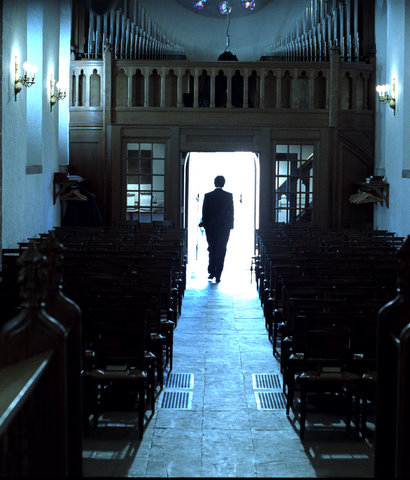 After nearly a year of going back to church (although I guess I’ve been a part of “the Church” all along), I still find it hard to break into the church. Break into the church? I mean I still lack the ability to take on traditionally Christian concepts and doctrines with any amount of ease. I question everything. Everything seems strange or at least unanticipated. Is it just my ignorance of the Bible and how to interpret it, or has the Church become so comfortable with its historic perspectives that it has lost the ability (or the will) to ask itself if it could possibly be wrong?
I’m going to have to “cut and paste” everything the Bible says about the future Messianic age together on one page to even begin to make sense of it. Is there any hope of reconciling the prophesies of the Jewish Messiah in the Tanakh with the prophesies about the risen Christ in the New Testament?
“Every day people are straying away from the church and going back to God.”












 Morning Meditations