Tag Archives: church

Why I Go To Church

afraid-of-churchI’m actually enjoying going to church. When I came to that realization last Sunday, no one was more surprised than I was.

Wait! Let me explain.

Starting last October, I created a “Days” series that was a countdown to the end of the year. I was planning to make a decision, both about whether or not to go back to church and whether or not to continue to blog in the “Christian” or “Messianic” or “religious” space, given the endless contention occurring in the blogosphere. I started at 78 days and worked my way down to zero. It should be obvious that I continued blogging after January 1st, and I not only continued to go to church regularly, but frequently meet with the Head Pastor.

Eleven months to the day before I published “Day Zero,” I wrote and published an article called Why I Don’t Go To Church. This was in response to both my internal angst (my favorite theme) and to Pastor Jacob Fronczak’s blog post Why I Go To Church. Even back then, I had returning to church in mind, but was undergoing what I’d consider classic approach-avoidance conflict (I was a psychotherapist and family counselor back in the day).

I’ve overcome my “fear of flying,” so to speak, but I was afraid that once I started attending church, I’d find not “niche” of my own and end up being bored. While it’s true, I don’t go to my particular church for the music, I am experiencing many other benefits and even on some small level, beginning to give back just a tad. What added momentum to my journey happened just five days before my countdown was to end. I was reminded that seeking fellowship with God’s people is seeking an encounter with God.

And in church, I have encountered Him.

Today, I did something I shouldn’t have done. There’s a “community” within Google+ called “Messianic Judaism” (for all I know, there could be more than one, but this is the one I belong to). Access is by invitation only, so posting a link to it wouldn’t let you see inside, but someone in the community posted a link to a book review and asked for opinions. Unfortunately, it struck a nerve, and even though I had already determined I wouldn’t address the review and what I believe it represents, I shot off my big mouth (figuratively speaking) and now I’m regretting it.

But the transaction had an interesting side effect. It (or rather someone) challenged my going back to church and further, criticized the church in a manner that resulted in my feeling defensive. Me? Really?

I’ve maintained a relationship with blogger Judah Himango for the past few years, and that relationship has, on occasion, been quite stormy. We still talk online periodically, and today was one of those “talks.” But what he said got under my skin. Here’s part of what he posted to me.

My concerns with Tent of David are that it purports to “heal the vision of the Messianic gentile” by sending them back to the church, which will inevitably lead to assimilation.

I asked, “assimilation into what?” and he responded:

Assimilation into the doctrines of the Church. Sabbath is done away with, the Church has replaced Israel, any non-moral mitzvah is no longer applicable to anyone.

Unfortunately (mea culpa) I missed a part of what Judah had said before I rapidly posted my reply (I think I need to switch to decaf):

There are indeed folks called to the church. But for many others, we’re called to Hebraic Roots congregations or Messianic congregations.

I certainly don’t advocate compelling people to “go to church” if they feel called elsewhere, but on the other hand, I do object to the church being seen as “inferior” or “anti-Biblical” compared to non-Jewish Christians who feel called to worship within a more “Jewish” framework. I’ve been one of those people before and for reasons too lengthy to relate here, I needed to seek my community of faith elsewhere.

Why do I go to church?

First of all, thanks to Boaz Michael and (my advanced reading of) his book Tent of David (TOD) and other influences, not the least of which is my Mom, I summoned the courage to overcome my own personal prejudices and start attending church again.

communityI was welcomed by lots and lots of people, but you’d kind of expect that in an authentic Christian setting. But what happened next, was unanticipated…I started making connections. I’ve had several interesting and compelling conversations with the Head Pastor and just last Sunday, I spent an hour talking to one of the Associate Pastors (when I should have been in Sunday School) in the church library. Not only that, but a number of people actually seem authentically glad to see me, not just because I’m a warm body showing up a church, but because of me as the person I am (or at least as they perceive me to be). In fact, I’m stunned that some of these connections have occurred so quickly and that I’m now even feeling a sense of belonging.

People have offered to pray for me. I’ve seen genuine caring and concern for the hungry, the sick, and the dying. They offer tangible, material support for the needy and for missionaries in many countries. There is a genuine heart for Israel and a desire for her posterity. It’s not just the occasional person, but to the best of my ability to tell, the human community within the church’s walls does look to Christ as Messiah and Israel’s King for salvation and sustenance.

In my talks with Pastor Randy (and they’re really quite candid), we don’t always see eye to eye, but you can’t believe what an incredible pleasure it is, even to disagree with someone and still have the encounter be illuminating, positive, refreshing, and friendly. Try doing that on the Internet!

I don’t know where all this is going to lead me, but for the first time in a long time, I not only have hope that I will find a place in the church and among the community of believers, but that the church itself is turning in a direction that will indeed be part of the healing between the Jewish and non-Jewish disciples of the Master.

I feel that I’ve failed in my comments on Google+ today and allowed my emotions to overcome my common sense. I could delete my comments, but they’ve already been read and responded to, so I might as well leave them up. In any event, God knows what I’ve said and done, so removing my annoyed comments won’t repair my relationship with Him.

But the realization, thanks to Judah’s statements (though he probably didn’t intend them the way I’ve taken them), that there really is hope for Christianity and a way forward in being part of “rebuilding David’s fallen tabernacle” is encouraging. It’s even better now that I realize it’s possible for me to have a small part in that “project” within the community of Christianity.

I don’t particularly mind if people don’t agree with my going back to church, and I understand that whenever you write and publish a book (such as Boaz Michael has), especially in such an emotionally explosive realm as religion, people are going to write critical book reviews. The only thing I mind about some of the criticism being leveled against Tent of David (and yes, I’ve read the reviews), is that it simply misses the overall vision Boaz is trying to communicate. I can appreciate people who have an eye for detail, and who may feel certain specific terms or other content wasn’t used with as much accuracy as they could have been, but look at the big picture.

In between the Gentile Christians going to church and those who have found a home in either a Hebrew Roots or Messianic Jewish congregation are just tons and tons and tons of people with little or no fellowship at all. Maybe they attend small home Bible studies or maybe they just worship with their families. Some, like me, may even seek fellowship over the Internet (which is problematic at best). But remember, seeking fellowship is seeking an encounter with God, and in my experience, many people who think of themselves as “Messianic Gentiles” are disconnected and isolated from other believers and, Heaven forbid, from the God who loves their souls.

symmes_chapel_churchThrough bad teaching, bad leadership, or bad experiences, they’ve become convinced that “the Church” (whatever you imagine the term to mean) is bad, evil, awful, pagan, lost, apostate, anti-Law, and so on…I mean all Christian churches everywhere. And, for whatever reasons, they haven’t found an alternative or the alternative that they’ve found may be a group that defines itself solely on being “anti-Christian,” as opposed to a community dedicated to discipleship under Jesus Christ and a sincere desire to meet with God.

If even some of those people can find in Tent of David what I have, then maybe they don’t have to be alone, either. I don’t think you have to agree with each and every thing Boaz set forth in TOD, but you can embrace the vision and let it take you where God wants you to go.

I am beginning to “fit in” with this church. I probably wouldn’t fit in at most other churches in my area. The fact that a set of unlikely occurences led me to this church as the first stop in my search for community I believe indicates the hand of God at work in my life.

You don’t have to like the fact that I go to church. You don’t have to go to church if you don’t want to. Really, no one is holding a gun to your head. However, I’d like you to consider two things. The first is that there might be a reason God wants me to go to church. The second is that God might have a plan for you that you don’t agree with Him about. That was me once upon a time. Could it be you, too?

That’s not all about why I go to church…but it’s a start.

Struggling to Touch the Essence

Talmud StudyDuring the centuries following the completion of the Mishnah, the chain of transmission of the Oral law was further weakened by a number of factors: Economic hardship and increased persecution of the Jewish community in Israel caused many Jews, including many rabbis, to flee the country. Many of these rabbis emigrated to Babylon in the Persian Empire. The role of the rabbis of Israel as the sole central authority of the Jewish people was coming to an end.

This decentralization of Torah authority and lack of consensus among the rabbis led to further weakening of the transmission process. It became clear to the sages of this period that the Mishnah alone was no longer clear enough to fully explain the Oral Law. It was written in shorthand fashion and in places was cryptic. This is because it was very concise, written on the assumption that the person reading it was already well-acquainted with the subject matter.

So they began to have discussions about it and to write down the substance of these discussions…

…When you look at the page of the Babylonian Talmud today, you will find the Hebrew text of the Mishnah is featured in the middle of the page. Interspersed between the Hebrew of the Mishnah are explanations in both Hebrew and Aramaic which are called the Gemara.

The Aramaic word Gemara means “tradition.” In Hebrew, the word Gemara means “completion.” Indeed, the Gemara is a compilation of the various rabbinic discussions on the Mishnah, and as such completes the understanding of the Mishnah.

The texts of the Mishnah and Gemara are then surrounded by other layers of text and commentaries from a later period.

-Rabbi Ken Spiro
“History Crash Course #39: The Talmud”
Aish.com

My conversations with Pastor Randy are always very rewarding. We’ve taken to meeting somewhat regularly to discuss matters of mutual interest and specifically the world of believing Jews called “Messianic Judaism.” He lived in Israel for fifteen years and has many Israeli Jewish friends. He is well-versed in Biblical Hebrew and Greek, and his mind and heart are very open to Israel and the Jewish people.

But in our talks, it’s difficult to address how or if modern Messianic Jews are obligated to Torah, what exactly is meant by “Torah,” and the role of Talmud (Mishnah and Gemara) in the life of an observant Messianic Jew. For a Jew, including one in Messiah, is it even possible to comprehend a passage in Torah without Talmud?

I admit, I have few answers.

But since we both have questions, I thought this was the perfect topic to expose to the blogosphere and to present to my readership (and anyone else my readership wants to share a link to this blog post with minus a few “nudniks”). If the bottom line is the Word of God and the revealed Messiah, how can we say that the word of the Sages go beyond them? I disagree that history was frozen after the destruction of Herod’s Temple and I know that Judaism and Christianity continued to move forward and develop. If I may be allowed a conceit, I believe errors entered both Judaism and Christianity in the past 2,000 years that caused both (although Christianity began as a wholly Jewish sect known as “the Way”) religious traditions to “stray” from the intent of God and the footsteps of the Messiah to some degree (probably a really large degree).

And yet, we cannot recapture first century Christianity as Paul understood it and how it was expressed and lived within both Jewish and Gentile cultural contexts. We can only look at where we’re at now and attempt to return to the scriptures to “observe, interpret, and then apply” what we discover there (to quote Pastor Randy).

ruins
But if the Bible is the final word, what do we do with 2,000 years of Jewish history, law, discussion, and interpretation…just wad it up and toss it in the nearest (very large) trash can?  Do we have a right to take everything that it means to be a Jew and to lay it to waste, leaving behind only ruins?

Absolutely not! I don’t believe Messiah will do this upon his return (although, of course, this is just my opinion). Do we say that Jesus will wholeheartedly accept each and every judgement and ruling made by the sages without question? I don’t know if that’s true either, if for no other reason than because the discussion between the ancient sages that spans the centuries, does not come to a final agreement on many practical and legal matters.

And not all Jews and not all Jewish traditions follow the same interpretations. Which one do you choose, and having made a choice, do you realize that it is a human decision and not God’s decision? How can we reconcile this?

My wife told me something interesting just the other day. She told me that the local Chabad Rabbi and the local Reform Rabbi study Talmud together. That’s kind of surprising, and in a community with a large Jewish population, that wouldn’t happen. Chabad (Orthodox) and Reform Rabbis view the traditions and Talmud from very different perspectives. But in this little corner of Idaho, there just aren’t that many Jews and there are even fewer Jewish Rabbis. That fact acts as a bridge for these two gentlemen to meet and share what they have in common as well as their differences.

However, a much greater bridge is required to link a Messianic Jew to any other observant Jew, particularly an Orthodox scholar, although this too has recently occurred. But what is the relationship between a Messianic Jew “keeping Torah,” a state of righteousness before God, and faith in Yeshua (Jesus) as the Jewish Messiah King? Can a Messianic Jew choose how to keep Torah within a particular traditional framework of halachah? Upon making such a choice, whose choice is it, the person’s or God’s?

Torah is not to be regarded, however, as an academic field of study. It is meant to be applied to all aspects of our everyday life – speech, food, prayer, etc. Over the centuries great rabbis have compiled summaries of practical law from the Talmud. Landmark works include: “Mishneh Torah” by Maimonides (12th century Egypt); “Shulchan Aruch” by Rabbi Yosef Karo (16th century Israel); “Mishnah Berurah” by the Chafetz Chaim (20th century Poland).

“Torah versus Talmud?”
-from “Ask the Rabbi”
Aish.com

Torah is meant to be applied, but how it is applied in the life of an observant Jew is very much dependent on that person’s tradition and the branch of Judaism to which they are attached. I heard a story of a Reform Rabbi who made aliyah. According to the storyteller, when a religious Jew makes aliyah and enters the Land, they either become more religious or become secular. In this case, the Rabbi began studying to become an Orthodox Rabbi.

The differences in halachah between a Reform and Orthodox lifestyle must be enormous. I say this because the Rabbi once had a conversation with the storyteller expressing his frustration at attempting to live out the Torah according to Orthodox halachah. He cried out that he sometimes gets so confused that he doesn’t know which foot to step out of bed with in the morning as a proper way of getting up.

I don’t have a lived Jewish experience to which to compare that statement, especially within the Orthodox, so I don’t know how to respond. I don’t know how to respond when applying all that to the words of James, the brother of the Master:

For whoever keeps the whole law but fails in one point has become accountable for all of it.

James 2:10 (ESV)

Granted, breaking one of the mitzvot does not invalidate the entire Torah nor does it make a Torah lifestyle futile and meaningless, but then what does it mean? A traditional Christian interpretation won’t be revealing here. Is the Jewish person guilty? If he or she is Messianic, what is the role of grace? For that matter, if he or she isn’t Messianic, what is the role of grace?

I know of no Messianic Jew who believes they are made righteous and “saved by the Law.” Messiah is the “way, the truth, and the life” (John 14:6). It isn’t enough for Messianic Jews to say “we have the Torah and the Gentile believers don’t” (and that is a gross oversimplification to be sure). Messiah is the bridge that not only links the Messianic Jew to his Jewish brothers and sisters but to the Gentile believers as well. As Boaz Michael once said, “Yeshua is the boss.” If Messiah isn’t the center of all things, the focal point, the goal of Torah and of the will of God for the redemption of the world, then what do we have?

These are the questions that my conversation with my Pastor brought into view last night. We spoke until there was no one left in the church but us. All the lights were out except for those in the Pastor’s office. All the doors were locked. If we had allowed it, our talk could easily have taken us into the middle of the night as we explored not only these questions, but everything else.

touch-the-essenceI don’t know what the answers are. I don’t know that there is any one answer. There really isn’t any one “Messianic Judaism” even as there isn’t any one “Christianity,” where a single set of interpretations and applications defines the entire group. But I believe the questions are important. I believe that discussion between all of the relevant parties is important, not because Christian Gentiles should have anything to do with defining Judaism, but for the sake of our mutual faith in Messiah.

Who is the Christian and the Messianic Jew when they each stand apart and who are we when we stand side-by-side? How are we to understand one another and in the light of scripture, how are we to understand ourselves?

The Master once said, “for where two or three are gathered in my name, there am I among them.” (Matthew 18:20) Granted, his audience at that moment was a Jewish audience, but I don’t discount the possibility that he will also be among two or three Gentile Christians when we gather in our Bible studies and in prayer. I long for the day when two or three (or more…many more) Jewish and Gentile believers in Messiah gather together (Matthew 8:11) and we can talk about all these things. I long for the presence of Messiah among us, that he may teach wisdom and reveal understanding.

The angels are jealous of the one who struggles in darkness. They have light, but we touch the Essence.

-Rabbi Tzvi Freeman
“Jealous Angels”
Based on letters and talks of the Rebbe
Rabbi M. M. Schneerson
Chabad.org

I struggle in darkness to touch the Essence of Light.

Collision and Recoil, Part 1

ancient-torahFor some days he was with the disciples at Damascus. And immediately he proclaimed Jesus in the synagogues, saying, “He is the Son of God.” And all who heard him were amazed and said, “Is not this the man who made havoc in Jerusalem of those who called upon this name? And has he not come here for this purpose, to bring them bound before the chief priests?” But Saul increased all the more in strength, and confounded the Jews who lived in Damascus by proving that Jesus was the Christ.

When many days had passed, the Jews plotted to kill him, but their plot became known to Saul. They were watching the gates day and night in order to kill him, but his disciples took him by night and let him down through an opening in the wall, lowering him in a basket.

Acts 9:19-25 (ESV)

And when the Gentiles heard this, they began rejoicing and glorifying the word of the Lord, and as many as were appointed to eternal life believed. And the word of the Lord was spreading throughout the whole region. But the Jews incited the devout women of high standing and the leading men of the city, stirred up persecution against Paul and Barnabas, and drove them out of their district.

Acts 13:48-50 (ESV)

This becomes a familiar refrain in Paul’s life. Always someone is condemning him for his message or what it implies in their lives. As you may recall from yesterday’s “morning meditation,” when, in Acts 9:23, it says that “the Jews plotted to kill him,” the word we read in English as “Jews” in Greek is “Ioudaioi,” which specifically refers to the Jewish religious leaders and those who support them, not the Jewish people in general (according to the commentary in my ESV Bible, anyway). We see the same word used in Acts 13:50 when it also says, “But the Jews incited the devout women of high standing and the leading men of the city, stirred up persecution against Paul and Barnabas…”

I’ve been reading D. Thomas Lancaster’s Torah Club 6: Chronicles of the Apostles, specifically his commentary on Acts 13 (pp 379-405) which is intended to be read during the week that Torah Portion Bo (“Come”) is studied. I really wish that all of you reading this blog (and everyone else) could read this particular lesson on chapter 13 of Acts, because it is illuminating in many ways, presenting the message of salvation to Jews, Jewish converts, and everyone else in such a clear manner. Space on this blog prevents me from replicating Lancaster’s arguments in full and besides, if I simply “copied and pasted” the lesson here, I would be depriving you of the pleasure of studying from the Torah Club.

Nevertheless, there is some important territory to cover. For instance, why does Chapter 13 end with the Jewish religious leaders of Antioch (and according to Lancaster,“thanks to the Seleucid dynasty, more than fifteen cities in the Roman world bore the name Antioch”), conspiring with “a few prominent, God-fearing, Gentile women who were friendly with the Jewish community” to drive Paul and Barnabas out of their area? I mean, the whole thing started out so well. After Paul’s brilliant teaching as we read in Acts 13:16-41.

When they went out [from the synagogue] they requested of them to speak these things to them the following Shabbat. When the assembly was dismissed, many individuals from the Yehudim and righteous converts followed Polos and Bar Nabba, who spoke to their heartfelt need and warned them to stand in the kindness of God

Ma’asei HaShlichim 13:42-43 (As quoted from Torah Club, vol 6, pg 393)

The above version of Acts 13:42-43 is taken from an unpublished translation based upon the work of the nineteenth-century Christian scholar Franz Delitzsch (a translation of the Gospels based on Delitzsch’s work is currently available). Let me present the same verses in a form that might be more familiar to you.

As they went out, the people begged that these things might be told them the next Sabbath. And after the meeting of the synagogue broke up, many Jews and devout converts to Judaism followed Paul and Barnabas, who, as they spoke with them, urged them to continue in the grace of God.

Acts 13:42-43 (ESV)

Now, according to Lancaster, here’s the Jewish reaction to what Paul had taught the Jews, converts, and Gentile God-fearers about the risen Messiah:

The synagogue of Pisidian Antioch received Paul’s message enthusiastically. The synagogue heads asked Paul and Barnabas to return the following Sabbath and present more teaching about the man from Nazareth, His messianic claims, His resurrection from the dead, and the evidence from the prophets. After the Sabbath services concluded, an excited group of Jewish people (both Jews and proselytes) gathered around Paul and Barnabas. They followed them back to where they were staying and asked for more teaching and stories about the Master. The apostles spent the remainder of the Sabbath instructing them further in the message of the gospel and the teaching of Yeshua. They “were urging them to continue the grace of God.”

-Lancaster, pp 393-4

I’m not sure where Lancaster found that level of detail about what happened between the Jewish and proselytes from the synagogue and Paul for the rest of the Shabbat, but I can see how it could be true. Certainly it is evident that Paul’s message sparked a tremendous amount of excitement from his audience, it was received enthusiastically, and they couldn’t wait to hear more. This hardly seems like the sort of atmosphere that would abruptly turn to the local Jews experiencing “the offense of the cross” as some modern Christians might put it.

What happened?

Well, let’s back up a little bit.

Brothers, sons of the family of Abraham, and those among you who fear God, to us has been sent the message of this salvation.

Acts 13:26 (ESV)

Before proceeding, let me present the same verse from the Delitzsch translation to give it a more Judaic context:

Men, brothers, sons of Avraham’s family and God-fearers who are among you: to [us] this word of salvation was sent.

Ma’asei HaShlichim 13:26

synagogueAnd now Lancaster’s explanation:

Paul finished his historical review with the prophecies of John the Immerser. Before going on to present the story of Yeshua, his suffering, and resurrection, he stopped to appeal directly to the people present in the synagogue. He declared, “To us the message of this salvation has been sent.”

Paul’s first person, plural pronoun “us” included all three types of people he addressed that day in the synagogue: “Brethren, sons of Abraham’s family, and those among you who fear God” (Acts 13:26). “Brethren” referred to his fellow Jews. “Sons of Abraham” referred to proselytes. (Proselytes take the patronymic “son of Abraham” at the time of their conversion.) “You who fear God” referred to the God-fearing Gentiles present that day in the synagogue. The God-fearing Gentiles were not accustomed to being acknowledged in such addresses, and they had never been included in the promises of Messianic redemption or covenant privilege.

-Lancaster, pg 390

That’s absolutely true. God-fearers, such as the Roman Centurion Cornelius and his household who we met in Acts 10, acknowledged the sole sovereignty of the God of Israel and denied all other Gods, but they had no covenant status to connect them to God as did the Jews. There was only the covenant God made with Abraham, but it was unrealized as far as the Jews and God-fearers who were listening to Paul knew.

I will bless those who bless you, and him who dishonors you I will curse, and in you all the families of the earth shall be blessed.” So Abram went, as the Lord had told him, and Lot went with him. Abram was seventy-five years old when he departed from Haran. And Abram took Sarai his wife, and Lot his brother’s son, and all their possessions that they had gathered, and the people that they had acquired in Haran, and they set out to go to the land of Canaan. When they came to the land of Canaan, Abram passed through the land to the place at Shechem, to the oak of Moreh. At that time the Canaanites were in the land. Then the Lord appeared to Abram and said, “To your offspring I will give this land.” So he built there an altar to the Lord, who had appeared to him.

Genesis 12:3-7 (ESV)

Now the promises were made to Abraham and to his offspring. It does not say, “And to offsprings,” referring to many, but referring to one, “And to your offspring,” who is Christ.

Galatians 3:16 (ESV)

For the first time, as Paul addressed all those present at that synagogue in Antioch, he “hot wired” the connection between the Abrahamic covenant and the Jewish Messiah who he revealed was Yeshua of Nazareth, Son of David, who was born, died, and resurrected, and who carried the promise of salvation to the Jew, the Jewish convert, and yes, even to the Gentiles of the nations who feared God.

We’ve already seen how the Jews and proselytes reacted with great joy, but what was the response of the Gentiles who heard this message?

We’ll pick up with the answer to that question and more in Part 2 presented in tomorrow’s “morning meditation.”

Sunday School Homework: Acts 9:1-31

paul-on-the-road-to-damascusBut Saul, still breathing threats and murder against the disciples of the Lord, went to the high priest and asked him for letters to the synagogues at Damascus, so that if he found any belonging to the Way, men or women, he might bring them bound to Jerusalem. Now as he went on his way, he approached Damascus, and suddenly a light from heaven shone around him. And falling to the ground he heard a voice saying to him, “Saul, Saul, why are you persecuting me?” And he said, “Who are you, Lord?” And he said, “I am Jesus, whom you are persecuting. But rise and enter the city, and you will be told what you are to do.” The men who were traveling with him stood speechless, hearing the voice but seeing no one. Saul rose from the ground, and although his eyes were opened, he saw nothing. So they led him by the hand and brought him into Damascus. And for three days he was without sight, and neither ate nor drank.

Acts 9:1-9 (ESV)

This is part of the book of Acts generally referred to as “the Conversion of Saul,” and from a traditional Christian point of view, records the event of the Jewish Pharisee Saul, hater of all Christians and followers of Jesus, converting and becoming Paul the Christian, and Apostle to the Gentiles in the diaspora.

If you’ve been reading my blog for very long, you know that I’m not likely to accept the exact understanding most Christians have of this event, but I must say things have been illuminating. A new teacher is taking over the Sunday school class I’m attending and he’s coming in with a different style. It’s not particularly unusual, though. He assigns “homework” for the upcoming Sunday school class, in this case on the aforementioned Acts 9, and presents a series of questions that we students are supposed to research (he provides the relevant scriptures) and answer, and then bring our answers to the next class, which for me, is later today.

I debated within myself (and with God) whether or not I should even write about my Sunday school assignment. After all, my first impression upon receiving my assignment by mail several days ago and taking a look at it, was that it’s rather traditional Christian fare in terms of its content and perspective. I was wondering if there was anything I could learn from it (I know that sounds arrogant on my part, but I’m pretty familiar with how Christian tradition views Saul/Paul). I was also wondering what the rest of the class could learn, since the lesson seems relatively elementary, and I recently discovered that several members of the class are on the church’s board of elders, and thus are likely long-term Christians, well established in their faith and knowledge of the Bible.

I can’t speak for them of course, but I learned a few things.

I tend to think and write thematically, and while I am detail oriented, some of the finer points of scripture escape me at times, or at least don’t make it from short-term to long-term memory. According to Galatians 1:16-19, after Paul’s “conversion,” having his sight restored, and his escape from Damascus (Acts 9:23-25), Paul spent three years in Arabia (presumably it was Arabia) before going to Jerusalem. According to Galatians 1:18-19, once Paul returned from Arabia and journeyed to Jerusalem, he spent fifteen days in the Holy City (Acts 9:26-30) before leaving again (apparently in haste to escape the “Greek-speaking Jews” who were trying to kill him).

paul-damascus-basketI’m not sure those details are important, but they were recorded by Luke and Paul so I suppose I should acknowledge them.

I did find it ironic that Paul most likely discovered that the shoe was on the other foot as he found himself being lowered in a basket, through an opening in the exterior wall of Damascus to escape those trying to kill him.

For some days he was with the disciples at Damascus. And immediately he proclaimed Jesus in the synagogues, saying, “He is the Son of God.” And all who heard him were amazed and said, “Is not this the man who made havoc in Jerusalem of those who called upon this name? And has he not come here for this purpose, to bring them bound before the chief priests?” But Saul increased all the more in strength, and confounded the Jews who lived in Damascus by proving that Jesus was the Christ.

When many days had passed, the Jews plotted to kill him, but their plot became known to Saul. They were watching the gates day and night in order to kill him, but his disciples took him by night and let him down through an opening in the wall, lowering him in a basket.

Acts 9:19-25 (ESV)

Compare that to what we read here:

But Saul, still breathing threats and murder against the disciples of the Lord, went to the high priest and asked him for letters to the synagogues at Damascus, so that if he found any belonging to the Way, men or women, he might bring them bound to Jerusalem.

Acts 1:1-2 (ESV)

In Acts 9:23, when it says the Jews plotted to kill him, the word translated into English as “Jews” is the Greek word “Ioudaioi,” which specifically refers to the Jewish religious leaders and their supporters, not all Jewish people in general. Paul was a representative of the Jewish authorities in Jerusalem, and only a short time before, he was the one who was seeking to imprison and kill the Jewish believers belonging to “the Way.” Now, he was in the exact position of those he formerly sought to harm, and his opponents were the ones who only a tiny march of days before, would have been his allies. It must have been like facing a reflection of his former self as he was before encountering the Master on the road to Damascus. His “Damascus experience” had changed and completely reversed itself from what he thought it was to be when he originally left Jerusalem.

Jesus, it seems, is not without a sense of irony.

And when he had come to Jerusalem, he attempted to join the disciples. And they were all afraid of him, for they did not believe that he was a disciple. But Barnabas took him and brought him to the apostles and declared to them how on the road he had seen the Lord, who spoke to him, and how at Damascus he had preached boldly in the name of Jesus. So he went in and out among them at Jerusalem, preaching boldly in the name of the Lord. And he spoke and disputed against the Hellenists. But they were seeking to kill him. And when the brothers learned this, they brought him down to Caesarea and sent him off to Tarsus.

Acts 9:26-30

OK, let me get this straight. After an absence “off the grid” of three years, Paul returns to Jerusalem and attempts to make contact with the Apostles. They are naturally dubious, since the last time they heard about Paul, he was an enemy of the Way and had made it his “mission” to persecute the movement and eradicate its followers. Now he’s claiming to be one of them, to have had a vision of the Master himself, and that Jesus had given Paul a completely different mission, one of announcing the good news of Messiah to the Gentiles of the nations. It sounds like a bad joke.

PaulFortunately, Barnabas was there to back Paul up and to verify everything Paul was saying. Scripture doesn’t record how the Apostles reacted, but I guess it was favorably enough to allow Paul to go “in and out among them at Jerusalem” and to preach “boldly in the name of the Lord.” However, for whatever reason, Paul found it necessary to speak and dispute against the Hellenists (Greek-speaking Jews) in Jerusalem, which resulted in said-Hellenists wanting to kill him. Again, we don’t have the details, but commentary suggests that these Hellenistic Jews were not believers (as were the “Hellenists” we find in Acts 6:1), however, they may have been some of these guys.

And Stephen, full of grace and power, was doing great wonders and signs among the people. Then some of those who belonged to the synagogue of the Freedmen (as it was called), and of the Cyrenians, and of the Alexandrians, and of those from Cilicia and Asia, rose up and disputed with Stephen. But they could not withstand the wisdom and the Spirit with which he was speaking. Then they secretly instigated men who said, “We have heard him speak blasphemous words against Moses and God.” And they stirred up the people and the elders and the scribes, and they came upon him and seized him and brought him before the council, and they set up false witnesses who said, “This man never ceases to speak words against this holy place and the law, for we have heard him say that this Jesus of Nazareth will destroy this place and will change the customs that Moses delivered to us.”

Acts 6:8-14 (ESV)

That’s just speculation and the interpretation I found in my ESV Bible, but it’s as good as anything, lacking further information. All this does suggest something though.

The main understanding I’ve gained here is that not all Jews were against Paul, against following Jesus as the Messiah, or against the Way. There were obviously believers in Damascus, and Ananias, who was directed by Jesus to restore Paul’s sight (Acts 9:10-16) is thought by Christian tradition to have been the leader of the Jewish believers in that city. It is in the same city after his sight was restored, that Paul (amazingly, given who he was just a few days before) began to proclaim the Master in the local synagogues (Acts 9:19-22) and he did so for “many days” (v 23), and only when the non-believing Jewish religious leaders (as opposed to the Damascus Jews in general) tried to kill Paul (presumably for reasons similar to why Stephen was stoned in Acts 6), that he had to leave in secret.

Similarly, after his three-year absence, Paul returned to Jerusalem to find Jews who were Apostles and followers of Jesus and Jews who were not. The believing Jewish Apostles cautiously supported him (small wonder, given his former reputation) while other Jews, because he spoke against them (the reasons aren’t clear), opposed him and wanted to kill him (a recurring theme in Paul’s life).

prince-of-peaceThe upshot is that “the Jews” as a people and a nation, did not “reject Jesus.” Opinions between Jewish sects varied widely on theological grounds, but the most likely reason why the “official” (that is, established and supported by Rome) Jewish religious leaders wanted to kill Paul (and other members of the Way) was because they were rocking the political boat and upsetting the status quo of a corrupt and invalid leadership that was firmly in Rome’s back pocket.

Even studying for Sunday school, using a traditional Christian Bible and only consulting accepted Christian commentary, I still find that many, many Jews, including one of the (former) chief opponents of the Way, firmly accepted the Gospel message and were loyal and devoted disciples and Apostles of Jesus Christ of Nazareth. Yes, other Jewish sects had reasons not only to disbelieve Jesus was Messiah but to passionately oppose the Jewish sect of the Way, but they didn’t represent all Jews everywhere. Paul spent “many days” in Damascus preaching the message of Messiah among all of the local synagogues (not just those belonging to Christ’s Jewish followers), so obviously he had a Jewish audience who wanted to repeatedly hear what he had to say (we see this again in the latter part of Acts 13 which I’ll introduce tomorrow).

Paul only spent fifteen days in Jerusalem before some of the Jewish believers heard of the plot to kill Paul and helped him escape (Acts 9:30), but he continued to speak boldly in the Master’s name. And even after leaving Jerusalem, we can see the effect of his subsequent journey.

So the church throughout all Judea and Galilee and Samaria had peace and was being built up. And walking in the fear of the Lord and in the comfort of the Holy Spirit, it multiplied.

Acts 9:31 (ESV)

While this translation of the Bible speaks of “the church” throughout all Judea and the Galilee and Samaria, who were the believers living in those regions? Jews and Samaritans. Probably lots of Jews and Samaritans. The first Gentile we know who became a disciple of Jesus was Cornelius, and Peter had yet to encounter him (see Acts 10). The Jews and Samaritans were not Christ’s enemies, at least not all of them. Many desired to hear the message of hope and they believed. Luke’s chronicle in the early chapters of Acts records this clearly. Those Christians who doubt this because of our own traditions may want to re-examine the scriptures with open eyes and see what is actually there.

christian-coffee-cultureJesus said, “salvation is from the Jews.” (John 4:22 ESV). Paul said, “first for the Jew, then for the Gentile.” (Romans 1:16, 2:10 ESV). If we in the church ignore or worse, cut off our root, we separate ourselves from the only source of our faith, our hope, and our salvation.

Oh, one more thing.

And falling to the ground he heard a voice saying to him, “Saul, Saul, why are you persecuting me?” And he said, “Who are you, Lord?” And he said, “I am Jesus, whom you are persecuting.

Acts 9:4-5 (ESV)

I knew of the extremely close association between Jesus and his people Israel and particularly his Jewish disciples, but I didn’t know it was also revealed here. Jesus didn’t ask, “Why are you persecuting my people” or “my disciples” but “Why are you persecuting me.” The better part of a year ago, I painted similar portraits of the Master as the Son of Israel in Minister of Peace and Gift of the Firstborn of Israel. Jesus revealed this part of his nature to Paul as well, and I hadn’t even realized it.

Now I wonder how much of this I should share in Sunday school?

Articulating an Encounter with God

saul-on-the-roadNow there was a disciple at Damascus named Ananias. The Lord said to him in a vision, “Ananias.” And he said, “Here I am, Lord.” And the Lord said to him, “Rise and go to the street called Straight, and at the house of Judas look for a man of Tarsus named Saul, for behold, he is praying, and he has seen in a vision a man named Ananias come in and lay his hands on him so that he might regain his sight.” But Ananias answered, “Lord, I have heard from many about this man, how much evil he has done to your saints at Jerusalem. And here he has authority from the chief priests to bind all who call on your name.” But the Lord said to him, “Go, for he is a chosen instrument of mine to carry my name before the Gentiles and kings and the children of Israel.

Acts 9:10-15 (ESV)

This is part of the section of Acts 9 Christians typically call “the Conversion of Saul” (Acts 9:1-19). It is what Pastor Randy’s message was about during last Sunday’s sermon, and it is what Charlie taught to the Sunday school class I attended after the worship service.

There’s just tons and tons and tons I could comment on, especially regarding the material and discussion in Charlie’s class, but I’m going to address almost none of it in this week’s “church report.” If I did, I’d probably start more of a messy debate than I really want to deal with. But rather than talk about the things I don’t always agree with the church about, I want to talk about something that actually “clicked” for me.

In fact, when I heard some of the folks in class mention this, I practically wanted to jump for joy. I’d never heard Christians talk like this before. It was as if they were reading my mind.

Let me explain.

Have you ever heard any Christian say something like, “And then the Lord told me to do such-and-thus?” How about this one: “I felt that it was a calling from the Lord for me to do such-and-thus?”

I’ve heard those phrases from time to time and I’ve always wondered about how those Christians could know that what they were experiencing was from God vs. a “message” they were telling themselves based on what they wanted to hear from God. When I’ve made such a statement before, I’ve usually been criticized for not understanding how the Holy Spirit moves in people’s lives. But get this…the members of my class who were vocal about it agreed with my assessment. One gentleman even said it gives him goosebumps in a “creepy” way when people talk like that.

Wow!

I even felt comfortable enough to weigh in with my own opinion.

Now just to be clear, no one was saying that God doesn’t work in our lives, direct us in our actions, and require that we serve Him.

It’s just not based on a “calling” such as we see in Paul’s encounter with Jesus in Acts 9. An interesting opinion that’s been coming out of the church I attend for the past several weeks is that Acts is a “transitional” book and doesn’t describe what we can typically expect in a Christian life. We can’t expect to have a “Paul on the road to Damascus” encounter with Christ. We aren’t going to (probably) see a blinding white light or hear a Bat Kol from Heaven. And we aren’t going to receive an amazingly clear-cut calling to perform a specific set of actions from Jesus the way Paul received it.

Or for that matter, we won’t have an experience like this one, either.

Now there was a disciple at Damascus named Ananias. The Lord said to him in a vision, “Ananias.” And he said, “Here I am, Lord.” And the Lord said to him, “Rise and go to the street called Straight, and at the house of Judas look for a man of Tarsus named Saul, for behold, he is praying, and he has seen in a vision a man named Ananias come in and lay his hands on him so that he might regain his sight.” But Ananias answered, “Lord, I have heard from many about this man, how much evil he has done to your saints at Jerusalem. And here he has authority from the chief priests to bind all who call on your name.” But the Lord said to him, “Go, for he is a chosen instrument of mine to carry my name before the Gentiles and kings and the children of Israel. For I will show him how much he must suffer for the sake of my name.” So Ananias departed and entered the house. And laying his hands on him he said, “Brother Saul, the Lord Jesus who appeared to you on the road by which you came has sent me so that you may regain your sight and be filled with the Holy Spirit.” And immediately something like scales fell from his eyes, and he regained his sight. Then he rose and was baptized; and taking food, he was strengthened.

Acts 9:10-19 (ESV)

covering-eyesDon’t get me wrong. It would be great for Christ to talk to us and we could talk back, just like the conversation Ananias had with the Master, but such is not to be (to the best of my knowledge). It would be great if we could receive such specific information and even better if, like Ananias in verses 13 and 14, we could respond back, even questioning our instructions. Of course, that sort of communication presupposes that, again like Ananias, we would then respond in obedience, even if it was against our better (human) judgment, and do what we were told to do, That sort of communication presupposes that we would even act in obedience to restore the sight of someone who, up until a few days ago, had been a bitter enemy bent on imprisoning us and even killing us. It would mean we would have to obey the Lord and learn to address our enemy sincerely and with compassion as “brother.”

That doesn’t happen too often.

It must have been a difficult thing for Ananias to do, but he did it because he was a Jew and a disciple of the Master who was obedient to God.

But that doesn’t particularly mean what Paul and Ananias experienced transfers in any way to what we experience. Paul heard a voice from Heaven. When a modern-day Christian says, “the Lord spoke to me,” what do they “hear” if anything at all? We are not Paul. We are not Ananias. There’s no real evidence in New Testament scripture of Christians receiving a “calling” as many believers use the expression. I think the best we can hope for is this.

Now there are varieties of gifts, but the same Spirit; and there are varieties of service, but the same Lord; and there are varieties of activities, but it is the same God who empowers them all in everyone. To each is given the manifestation of the Spirit for the common good. For to one is given through the Spirit the utterance of wisdom, and to another the utterance of knowledge according to the same Spirit, to another faith by the same Spirit, to another gifts of healing by the one Spirit, to another the working of miracles, to another prophecy, to another the ability to distinguish between spirits, to another various kinds of tongues, to another the interpretation of tongues. All these are empowered by one and the same Spirit, who apportions to each one individually as he wills.

1 Corinthians 12:1-11 (ESV)

The entire chapter of 1 Corinthians 12 describes how we are all different and all possess varying skill sets within the body of believers, but our gifts originate from a single Spirit and we serve One God.

I’m sure you have noticed what you’re good at and what you’re not so good at. I’m sure you have been in situations where what you’re good at can (and hopefully has) been applied to serving other people and serving God. Beyond specific skills, anyone can donate a can of food to their local foodbank. Anyone can visit a sick friend in the hospital. Anyone can listen to a friend who is going through a tough time tell you their troubles for an hour or so just because you don’t want them to feel alone.

But it doesn’t mean that God has “called” you to do this or that or such or thus.

So the question came up, how do you know you are where you are and doing what God wants you to do?

That’s a tough one. It really is. We tossed that one around in class for a bit. Some folks think that if they’re in a situation and there’s no adversity, then that’s where God wants them to be. Problem is, sometimes God puts you in a spot where you’re going to experience adversity, such as what Christian missionaries face in certain African countries. Just because there are problems doesn’t mean you’re in the wrong place to serve God.

My own litmus test (and this is just me) is that when I find myself doing something I never would have chosen for myself in a million years and it is something that is helping other people and serving God, then that’s where God wants me to be.

walking-side-by-sideNo, it’s not like God always puts me in uncomfortable and even miserable situations. In fact, on Saturday, I had a meeting with Pastor Randy to discuss some work I wanted to do for the congregation (yes, I met with him on Shabbos…if that bothers you, then you’re going to have to get past it). We ended up talking about a great many topics near and dear to my heart. I discovered that we have many attitudes and opinions in common and I even managed to bring up subjects with him that I thought might be premature, given how little time we’ve had to get to know one another.

I’ve had my doubts in the recent past that this church was where God wanted me to be. No, I haven’t heard even a single audible word from God for or against my being at this church, but the way things seem to be presenting themselves, I can see that there’s a fit between this church and me (no one was more surprised than I was).

Am I being “called?” Nah, probably not. But God does work in our lives in ways we can’t always explain or even understand. Beyond what I’m saying in today’s “church report,” I can’t really articulate the experience. I just know that like my bi-monthly coffee companion said not to long ago, I have encountered God in church.

Imagine that.

Va’eira: Is This Egypt?

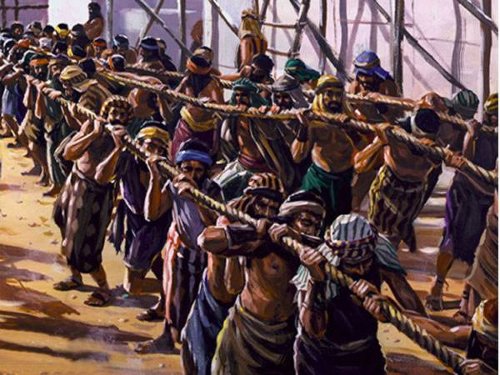
hebrew_slaves_egyptSay, therefore, to the Israelite people: I am the Lord. I will free you from the labors of the Egyptians and deliver you from their bondage. I will redeem you with an outstretched arm and through extraordinary chastisements. And I will take you to be My people, and I will be your God. And you shall know that I, the Lord, am your God who freed you from the labors of the Egyptians.

Exodus 6:6-7 (JPS Tanakh)

G‑d reveals Himself to Moses. Employing the “four expressions of redemption,” He promises to take out the Children of Israel from Egypt, deliver them from their enslavement, redeem them, and acquire them as His own chosen people at Mount Sinai; He will then bring them to the land He promised to the Patriarchs as their eternal heritage.

from “Va’eira in a Nutshell”
Commentary on Torah Portion “Va’eira
Chabad.org

I had coffee with a friend after work on Wednesday. We see each other irregularly these days, but our conversations are always good. The main reason we met was because he wanted to borrow my copy of Boaz Michael’s book Tent of David: Healing the Vision of the Messianic Gentile. This, of course, was also one of the primary topics of our talk as I sipped my coffee and he sampled his tea.

One of the things I value about our relationship is that we don’t always see eye-to-eye. We never argue and conversations never become heated, but we do see things from different points of view. I think he’s interested if not intrigued about my return to church (although this could be projection on my part) and he struggles with the implications of going back into the church after having been “redeemed” from it. It’s an interesting metaphor.

In our discussion, he likened leaving the church to the Children of Israel leaving Egypt. It’s not a complementary picture of the church that he’s painting, but it’s one that I’ve encountered on numerous occasions during my sojourn in the Hebrew Roots movement. Egypt represents nothing good spiritually and morally and leaving Egypt is always seen as a positive action on the part of God toward the Israelites. But can non-Jewish believers leaving the church be seen in the same way? If the church equals Egypt, torment, and slavery, and being released from all that means coming closer to God, then when a Christian leaves church, where do they (we) go that is better and what do they (we) do when they get there?

Let’s back up a minute. In Judaism the process of God rescuing the ancient Hebrews from their slave status in Egypt and bringing them to Himself at Sinai involves what is called the “four expressions of redemption” based on the above-quoted Exodus 6:6-7. But what are these four expressions and what do they mean?

According to the Ask the Rabbi column at Ohr Somayach, they are:

  1. “I will take you out from under Egypt’s burdens – Vehotzeiti
  2. “And I will save you from their servitude – Vehitzalti
  3. “And I will redeem you – Vega’alti
  4. “And I will take you as My nation – Velakachti

This is actually a commentary on the four cups we see during a traditional Passover seder. The Ohr Somayach Rabbi further states:

We didn’t go from a slave nation to being the Chosen People at Mount Sinai overnight. There were different stages of redemption. The above phrases described these different stages. Each cup of wine represents one of these levels.

leaving_egyptThat’s fine as far as it goes, but to me, it’s not very revealing, especially if we are trying to compare these four expressions to how we might view a non-Jewish Christian leaving the church (which is being equated to Egypt).

OU.org expands on the meaning of the four expressions thus:

According to R. Bachya (Spain, 1263-1340), the explanations of the Four Expressions are as follows:

  1. “I will take you out” – Hashem would remove the slavery even before the Jews left Egypt, from all the Tribes of Israel, because of the growing perception by Egypt of Hashem, the G-d of Israel, as the One Almighty G-d.
  2. “I shall save you” – Hashem would take the Jews out of Egypt with plagues visited upon the Egyptians, their Pharaoh and their gods, “with a strong hand and an outstretched arm.”
  3. “I shall redeem you” – Hashem would perform the miracle of “Kriat Yam Suf,” the Splitting of the waters of the “Yam Suf,” and the creation of a dry path for the Children of Israel to walk upon as they crossed the Sea of Reeds. Then Hashem caused the piled-high waters to descend in a tidal wave upon the Egyptian Army, to permanently crush the World-dominating power of Egypt.
  4. “I shall take you” – Hashem took the Jewish People to Himself as a Kingdom of Priests and a Holy Nation. This was the spiritual component of the Redemption from Egypt. In fact, the spiritual Redemption was the Reason for the Physical Redemption.

The fifth expression, “I shall bring you to the land,” refers, of course, to the Land of Israel…

I must admit, I’m having a tough time mapping what I’ve been quoting from above to any image of why Christians should leave the church and where they are supposed to go. On the other hand, I’m kind of biased and truth be told, it wasn’t that many years ago that I might have accepted my friend’s metaphor relative to the Hebrew Roots movement.

But consider this. If Hebrew Roots is supposed to be the “Sinai” for Christians leaving the church, is it an attainable goal and is it right and accurate to say the church is Egypt in a spiritual (or any other) sense?

The Christians who, throughout the ages, have propagated this message and tried to soothe the hurting, feed the hungry, and speak to social injustice have been keeping the weightier matters of the Torah. Both Yeshua (Mark 12:31) and the Sages (Rabbi Hillel in b.Shabbat 31a and Rabbi Akiva in Sifra, Kedoshim 4:12) taught that love of neighbor is the essence of Torah. These are non-trivial accomplishments which speak to the robust, biblical ethical system which many devout Christians have embraced.

-Boaz Michael
“Chapter One: The Church is Good,” pg 49
Tent of David: Healing the Vision of the Messianic Gentile

You’ll have to read all of Boaz’s book to get the full flavor of why the church is good, but I believe he paints a very convincing picture of the modern “body of Christ” as it lives and breathes within the multitude of churches in our communities and around the world. Even today in the lives of people I know, Christians are doing wonderful acts of kindness in the name and spirit of Messiah.

We are seriously getting love aimed at us by a little church nearby. Out of the blue, the pastor had contacted me wanting to know if some of their members could do anything for us and he wouldn’t take no for an answer unless it really was no.

Today some amazingly nice folks showed up and hauled off to the dump our junk too big for our own vehicle, in one of the guy’s large truck.

Meanwhile, the ladies scoot in to do some cleaning while visiting with Heidi.

And meanwhile another great guy is walking me around our deck, explaining to me how he is going to prep the bannister and then paint it for us.

And they’re coming back tomorrow!

-Joe Hendricks

I originally quoted Joe in a blog I published last June. Sadly, since that time, Joe’s wife Heidi passed on, but the church he mentions continues to be a support in his life as he grieves and as he yet looks to the future by the grace of Christ.

afraid-of-churchThe church isn’t perfect. In fact, It’s taken quite awhile for me to overcome my own misgivings about going back to church (which can be reviewed in all their glorious details in my recent “Days” series, which culminated at Day Zero). In fact, I still periodically have to review Pastor Jacob Fronczak’s blog post Why I Go to Church to remind myself that a community can be imperfect and still be the will of God for the good.

So if the church isn’t Egypt, then do we have to be delivered from it? Is there someplace better to go to and what do we call it?

I can’t answer for every person out there who has once been in the church and, for whatever reasons, left it, either for some other religious organization or to pursue God as a solidary individual or family. I can only speak for myself and how I express my evolving understanding of God’s will for my life.

I don’t think we can get back to the “root” of our faith. I know that’s disappointing and maybe some of you disagree with me, but hear me out. At some point about 2,000 years ago, a sect  called “the Way” rose among the other movements in Judaism in the late Second Temple period. The Jewish disciples were devoted to a “dead Rebbe” rather than a living teacher, one who they said not only died, but rose again. He is the Mashiach, the Son of the Living God (Matthew 16:16), who sits at the right hand of the Father (Psalm 16:8, Psalm 110:1, Acts 2:33), and who is the High Priest in the Court of Heaven (Hebrews 4:14).

The “Christianity” of that moment in history was a wholly Jewish religious movement and it co-existed with numerous other Jewish movements in Roman occupied “Palestine” in those days. Acts 10 shows the first non-Jew who came into discipleship under Messiah within this sect without converting to Judaism, and the “ministry” of Paul, who as an emissary to the Gentiles, preached a Gospel not given by men but by Jesus Christ (Galatians 1:11-12). As more and more Gentiles in the diaspora began to hear the “good news” of the Jewish Messiah and apply it to their lives, slowly the Gentiles and Jews within the “Jesus movement” began to trace somewhat divergent trajectories. Those slight deviations in trajectory would later lead them on completely different paths through the progression of history, and for centuries now, they have both identified themselves as two completely different religions that once shared a common point.

Should Christians seek to leave the church and travel backward across the timeline, trying to recapture whatever idealized or “perfected” Christianity that may (or may not) have existed somewhere around the mid 40s CE? Is it even possible?

Or does the path that God has set before us lead forward into the future…a future that will summon the risen Messiah to come out of the sky in the clouds (Revelation 1:7), who will redeem his people Israel, and who will also gather his disciples from the nations? If this future-oriented path is the true one, then perhaps there is no “perfect Christianity” to go back into upon “leaving the church.” Regardless of whatever Christian or Jewish worship venue to which you are attached (including any form of Hebrew Roots or Messianic Judaism), chances are, you don’t belong to a perfect community. Chances are people in your congregation make mistakes. Chances are, when scrutinized by the King of All Glory, your theology may not be absolutely and totally 100% “kosher.”

Chances are, there is no perfect church, synagogue, community, or congregation for you or for any of us to join upon leaving “church.” Face it. All congregations that involve human beings and human relationships are “messy.” We have to start with where we are, not where we’d like to be.

Yes, the church could be improved. That’s the other very valuable (to me) chapter in Boaz’s book, “Chapter 2: The Church Needs to Change.” Frankly, we could also probably say, relative to God’s perfect understanding, that the synagogue needs to change as well. A better way to say it is that we all need to change, to be better, to draw nearer to God, to refine our understanding of who He is and who we are in Him, Jew and Christian alike. We travel upon our divergent trajectories but we have one Shepherd and one King, and God is One. Not that our ultimate unity under Him as His “peoples” means uniformity, but it does mean unity of devotion and fealty.

The Messiah will come. He will return Israel to its place as the head of all the nations, rebuild the Temple, defeat evil, and establish a reign of peace and tranquility for all peoples of the earth. All the Jewish people will be gathered unto him in their nation Israel, and we believers who reside across the four corners of the Earth will bow our knees to him and call him Lord over all (Romans 14:11, Philippians 2:10). That is our future.

But we’re not there yet.

two-roads-joinWe have to start where we are. If we are non-Jewish Christians in church, we should stay in church. We should bring our understanding of the Jewish Messiah King to where we are, not remove it from our fellow believers and hoard it for ourselves. If we are Gentiles in a Messianic community, then we should stay there (though there may be exceptions who will also attend a church) and use other platforms for communicating our understanding to the Christians we know or will come to know (compare to 1 Corinthians 7:18). For myself, I go to church not to change anything but to encounter God and His purpose for me, whatever it may be.

We may not always see the good in the church but it’s there. We may not see it because when we were introduced to the Hebrew Roots movement (for those of you reading this who are or were involved in Hebrew Roots), we were told the “church is Egypt.” However, if it’s been awhile since you’ve taken a look at the church, at the Christians in your community, at the believers you work with, live near, and consider friends, maybe it’s time you took another look. There are indeed two paths involved, but they’re not the two you have been imagining.

There are two paths:

One: Everything is for the good. Perhaps not immediately, but eventually good will come out from it.

The other: Everything is truly good—because there is nothing else but He who is Good. It’s just a matter of holding firm a little longer, unperturbed by the phantoms of our limited vision, unimpressed by the paper tiger that calls itself a world, and eventually we will be granted a heart to understand and eyes to see.

Eventually, it will become obvious good in our world as well.

-Rabbi Tzvi Freeman
“Believing in G-d”
Based on letters and talks of the Rebbe
Rabbi M. M. Schneerson
Chabad.org

To modify Rabbi Freeman’s commentary slightly, everything we encounter is for the good, and eventually good will be demonstrated by the church. We must be patient and help as we can. Also, everything in church is truly good because nothing else exists in our world but God who is Good (Mark 10:18). It’s just a matter of us holding on a little longer where we are, not allowing our limited vision of how we see Christianity to limit God’s work in the church.

Eventually, the good of God and of the body of Christ in our world will become obvious to us as the time for the return of our Master draws near.

Good Shabbos.