Tag Archives: church

What I Learned in Church Today: Christianity is Jewish

Get past the title. Get past the title. Just keep reading.

Is Christianity a Judaism? I think most Christians and most Jews would say “no,” but last Sunday morning in church, Pastor Randy said it was. In fact, it was the second Sunday he’s said such a thing.

Christianity is a Judaism?

I was kind of surprised that he said that. He also said that when Jesus returns, it will be as a Jewish King, the Messiah and he will still be Jewish.

You might be thinking “oh duh, of course he’ll be Jewish,” but there are a lot of Christians out there who believe his being Jewish died on the cross with him and that Jesus was resurrected as someone more “generic” in terms of ethnicity.

The last few times when Pastor has spoken with me at church, practically the first words out of his mouth as we’re shaking hands is, “I’ve been reading your blog.” He hasn’t said much else to me lately, so I’ve tended to take that as a message meaning he’s not really happy about what I’ve been writing. But now I wonder.

I’ve certainly been hammering away at the Jewishness of the ekklesia of the Messiah and how the Christian Church, as it exists today, won’t be what the ekklesia will be like in Messianic days.

As I was quickly taking notes on the sermon (Acts 25:23-26:32), I continued to reflect on the implications of Pastor’s words. Although I have no problem with any of the statements he made, I wondered how the rest of the congregation was taking it. No one mentioned it in Sunday school, although we were studying Ephesians 4 rather than Pastor’s message, so there wasn’t a natural opportunity to bring up the subject.

In speaking on Acts 26:4-18, Pastor referred to it as “A Conversion Story” but oddly enough, he defined “conversion” as making a “u-turn,” turning away from darkness and turning to light, to God.

That sounds more like teshuvah than conversion and in any event, as Dr. Larry Hurtado mentioned in a comment to me on his blog:

In any case, Paul didn’t undergo a “conversion” to “Christianity.” He refers to his experience as a prophet-like “calling” (e.g., Gal. 1:13-15), and there was no “Christianity” (as a separate religion) to which he could “convert” as a Jew. We could describe the former “pagans” (gentiles) that formed his churches as “converting” from the worship of their various ancestral deities to the God of the Bible/Israel.

paul-on-the-road-to-damascusSo Dr. Hurtado would call it “A Prophet-Like Calling Story” while using Pastor’s own definition, I could call the Acts 9 event “A Teshuvah Story”.

No, Paul wasn’t repenting of being Jewish or of practicing Judaism. Far from it. However, we could say that he had to make teshuvah relative to his disbelief in Yeshua as the Messiah and opposing God’s plan of using the ekklesia of “the Way” to bring Jews and Gentiles to Hashem and inaugurate the New Covenant in our world.

“So then, all Jews know my manner of life from my youth up, which from the beginning was spent among my own nation and at Jerusalem; since they have known about me for a long time, if they are willing to testify, that I lived as a Pharisee according to the strictest sect of our religion. And now I am standing trial for the hope of the promise made by God to our fathers; the promise to which our twelve tribes hope to attain, as they earnestly serve God night and day. And for this hope, O King, I am being accused by Jews. Why is it considered incredible among you people if God does raise the dead?”

Acts 26:4-8 (NASB)

I’m pulling a lot of my interpretation of this section of scripture, not only from D. Thomas Lancaster’s lectures on the New Covenant, but his sermon series The Holy Epistle to the Hebrews.

Paul continues to identify himself as a Pharisee, living in the strictest sense of that stream of Judaism, and that he has the “hope of the promise made by God to” his “fathers”, the hope of the resurrection, of life from the dead. He even asks his Roman audience as well as King Agrippa why they should find it so difficult to believe that the God who created the universe could also raise the dead back to life, thus extending the promise beyond just the Jewish people and making it a hope for all human beings.

Apostle Paul preachingIt may have seemed that Paul was the prisoner, but he appears to have made a captive audience of his jailers and accusers in delivering the message of the Good News.

I did have the opportunity to discuss part of Pastor’s sermon with one young fellow in Sunday school. After class let out, he had some questions about a part of Ephesians he’d been studying and thought for some reason I could help answer his queries.

In the course of our conversation, I realized part of the problem many late second temple period Jewish groups had with accepting Yeshua (Jesus) as the Messiah.

So when they had come together, they were asking Him, saying, “Lord, is it at this time You are restoring the kingdom to Israel?” He said to them, “It is not for you to know times or epochs which the Father has fixed by His own authority; but you will receive power when the Holy Spirit has come upon you; and you shall be My witnesses both in Jerusalem, and in all Judea and Samaria, and even to the remotest part of the earth.”

Acts 1:6-8 (NASB)

Even Yeshua’s disciples believed that the Messiah would first raise Israel as the head of all the nations, defeat her enemies, and ascend the Throne of David, and only afterward reconcile the Gentiles to God. Saying that the Messiah died, was resurrected, and ascended into Heaven to sit at the Father’s right hand and that before he returned to take the throne, the Gentiles would be brought alongside Israel in the worship of Hashem was reversing the expected order of things.

For a lot of Jews, it must have seemed pretty bogus to say that Gentiles could be brought into the ekkelsia, into a Jewish community and worship space, as equal co-participants while the Messiah was not yet physically ruling as King over Israel and over the rest of the world.

Paul knew the truth but he had a special insight. He had received two visions of the Messiah (Acts 9:3-8, Acts 22:17-22) and was caught up to the third heaven (2 Corinthians 12:2-4) and taught inexpressible words that he was not permitted to speak. For those Jews and Gentiles who believed, they did so from a profound sense of faith, since even though Paul could be persuasive, his words were not always convincing to every one who listened.

King Agrippa, do you believe the Prophets? I know that you do.” Agrippa replied to Paul, “In a short time you will persuade me to become a Christian.” And Paul said, “I would wish to God, that whether in a short or long time, not only you, but also all who hear me this day, might become such as I am, except for these chains.”

Acts 26:27-29 (NASB)

When Agrippa said “become a Christian,” the term “Christian” was not used in the same sense as we understand it today, because, as I’ve mentioned on numerous previous occasions, faith in Messiah Yeshua was not a religious stream distinct from Judaism at that point in history. Agrippa might have just as well said “make me a disciple of the Way”. And it was well-known that Agrippa was hardly devout and pious though he doubtless had some education in the traditions of his fathers (for Paul knew Agrippa believed the Prophets).

The Jewish PaulDoes that bring us back to thinking of Christianity as a Judaism, or am I the one getting things reversed?

During his lifetime, Paul obviously considered faith in Yeshua as Messiah King to be the next, natural, logical extension in the development of God’s plan for Israel. Yeshua was and is the beginning of God’s starting to fulfill the New Covenant promises to Israel, but those promises include bringing the Gentiles into worship of Hashem by coming along side Israel and becoming attached to her. Messiah was the doorway for the Gentiles to enter that forward-progressing stream of God’s plan for Israel, not by making Gentiles into Jews through the proselyte rite, but allowing them (us) to remain of the nations and yet, as was prophesied, enjoying the blessings of the spirit and the hope of the resurrection into the age of peace and tranquility.

I’d like to believe that some of the things I’ve written lately have been positively received by Pastor Randy, but that’s probably arrogant presumption on my part. However, his sermon last Sunday did seem to speak to many of the themes I write about on my blog. I not only found myself in general agreement with Pastor’s sermon but found myself learning some things I hadn’t noticed before in my reading of this part of Luke’s “Acts”.

Is Christianity a Judaism? In its current form, we can say that it owes a great deal to its Hebrew or Jewish roots, but there’s a lot about that “Judaism” the Church as left by the wayside. But as Pastor said, the return of Jesus is the return of the Jewish Messiah King to the Throne of David in the City of David.

With Jewish devotees cheering and Gentile disciples alongside them crying out in joyous approval, Messiah will raise Israel up as the most exalted of all nations, rebuild the Temple, return the Jewish exiles to their Land, rule the world with a rod of iron, and bring peace to all peoples.

What will the ekklesia be then? It will be Jewish, but it should be remembered that “every knee shall bow” (Isaiah 45:23, Romans 14:11), not just of the Jews but of everyone, the whole world.

When Jesus Returns, Will We Go To Church?

Let us rejoice and be glad and give the glory to Him, for the marriage of the Lamb has come and His bride has made herself ready.” It was given to her to clothe herself in fine linen, bright and clean; for the fine linen is the righteous acts of the saints.

Revelation 19:7-8 (NASB)

Who or what exactly is the “bride” of “the Lamb”? It’s presumed to be “the Church,” that is, the collection of individual Jews and Gentiles who came to faith in Jesus (i.e. converted to Christianity) prior to the great tribulation and the rapture to Heaven. Under this presumption, anyone converting to Christianity after the rapture is considered a believer, but not part of the Church. They can never be part of the Church. Only the Church goes up to Heaven with Jesus and only the Church returns with him.

And I saw heaven opened, and behold, a white horse, and He who sat on it is called Faithful and True, and in righteousness He judges and wages war. His eyes are a flame of fire, and on His head are many diadems; and He has a name written on Him which no one knows except Himself. He is clothed with a robe dipped in blood, and His name is called The Word of God. And the armies which are in heaven, clothed in fine linen, white and clean, were following Him on white horses.

Revelation 19:11-14 (NASB)

According to Pastor Randy, the head Pastor at the church I attend (and if I’m remembering this wrong, I hope he’ll let me know), the “armies” returning with Jesus is the Church, who becomes the bride of Christ (“the Lamb”).

The idea of “the Church” has bothered me for quite some time. I finally gave my concerns a voice last April in a “meditation” called Notes on the Church from an Insomniac and followed it up with When is Church not Church, based on D. Thomas Lancaster’s article “Before the Church Was Called the Church”, published in the Spring 2014 issue of Messiah Magazine.

In the first century CE, faith in and worship of Jesus of Nazareth, Yeshua ben Yosef, HaMoshiach, was a fully recognized branch of Judaism along with other branches such as the Pharisees, Sadducees, Essenes, and so forth (although “the Way” was most closely related to Pharisaism, and except for the realization of Yeshua as Messiah and it’s rather liberal attitude toward admitting Gentiles, was likely indistinguishable from Pharisaism).

Obviously, much has changed in the intervening twenty centuries or so, especially starting in the second century when Gentile Jesus-believers radically separated from their Jewish mentors and any Jewish practice, in order to form a completely divergent religion for Gentiles called “Christianity”.

But now that the Church has been created, has it replaced Judaism in all of the New Covenant promises God made with Israel (for instance, in Jeremiah 31:27-40)? With the Church as the “Bride of Christ,” what becomes of Israel and the Jewish people?

Let’s take a giant step backward. First of all, the concept of “the Church” isn’t presupposed in the Bible. Did I just shock you? What about all of those references to “the Church” in the New Testament? Did I just miss all of the times the word “church” is printed (in English) in my Bible?

synagogue_arkAs I’ve mentioned before, the Greek word “ekklesia” cannot directly be translated as “church”. In fact, the word “church” didn’t really come into being until many centuries after the New Testament canonization. Generations of Jesus-believers lived and died before anyone actually thought of or said the word “church”.

So, does “ekklesia” mean the same thing theologically and conceptually as “church”? That’s the $64,000 question and the answer might not be in the New Testament.

Thus says the Lord,
“Preserve justice and do righteousness,
For My salvation is about to come
And My righteousness to be revealed.
“How blessed is the man who does this,
And the son of man who takes hold of it;
Who keeps from profaning the sabbath,
And keeps his hand from doing any evil.”
Let not the foreigner who has joined himself to the Lord say,
“The Lord will surely separate me from His people.”
Nor let the eunuch say, “Behold, I am a dry tree.”
For thus says the Lord,

“To the eunuchs who keep My sabbaths,
And choose what pleases Me,
And hold fast My covenant,
To them I will give in My house and within My walls a memorial,
And a name better than that of sons and daughters;
I will give them an everlasting name which will not be cut off.
“Also the foreigners who join themselves to the Lord,
To minister to Him, and to love the name of the Lord,
To be His servants, every one who keeps from profaning the sabbath
And holds fast My covenant;
Even those I will bring to My holy mountain
And make them joyful in My house of prayer.
Their burnt offerings and their sacrifices will be acceptable on My altar;
For My house will be called a house of prayer for all the peoples.”
The Lord God, who gathers the dispersed of Israel, declares,
“Yet others I will gather to them, to those already gathered.”

Isaiah 56:1-8 (NASB)

“For I know their works and their thoughts; the time is coming to gather all nations and tongues. And they shall come and see My glory. I will set a sign among them and will send survivors from them to the nations: Tarshish, Put, Lud, Meshech, Tubal and Javan, to the distant coastlands that have neither heard My fame nor seen My glory. And they will declare My glory among the nations. Then they shall bring all your brethren from all the nations as a grain offering to the Lord, on horses, in chariots, in litters, on mules and on camels, to My holy mountain Jerusalem,” says the Lord, “just as the sons of Israel bring their grain offering in a clean vessel to the house of the Lord. I will also take some of them for priests and for Levites,” says the Lord.

Isaiah 66:18-21 (NASB)

“Thus says the Lord of hosts, ‘It will yet be that peoples will come, even the inhabitants of many cities. The inhabitants of one will go to another, saying, “Let us go at once to entreat the favor of the Lord, and to seek the Lord of hosts; I will also go.” So many peoples and mighty nations will come to seek the Lord of hosts in Jerusalem and to entreat the favor of the Lord.’ Thus says the Lord of hosts, ‘In those days ten men from all the nations will grasp the garment of a Jew, saying, “Let us go with you, for we have heard that God is with you.”’”

Zechariah 8:20-23 (NASB)

Then it will come about that any who are left of all the nations that went against Jerusalem will go up from year to year to worship the King, the Lord of hosts, and to celebrate the Feast of Booths. And it will be that whichever of the families of the earth does not go up to Jerusalem to worship the King, the Lord of hosts, there will be no rain on them. If the family of Egypt does not go up or enter, then no rain will fall on them; it will be the plague with which the Lord smites the nations who do not go up to celebrate the Feast of Booths. This will be the punishment of Egypt, and the punishment of all the nations who do not go up to celebrate the Feast of Booths.

Zechariah 14:16-19 (NASB)

“It will come about after this
That I will pour out My Spirit on all mankind;
And your sons and daughters will prophesy,
Your old men will dream dreams,
Your young men will see visions.
“Even on the male and female servants
I will pour out My Spirit in those days.

“I will display wonders in the sky and on the earth,
Blood, fire and columns of smoke.
“The sun will be turned into darkness
And the moon into blood
Before the great and awesome day of the Lord comes.
“And it will come about that whoever calls on the name of the Lord
Will be delivered;
For on Mount Zion and in Jerusalem
There will be those who escape,
As the Lord has said,
Even among the survivors whom the Lord calls.”

Joel 2:28-32 (NASB)

Sorry for the lengthy series of quotes. I wanted to present a representative collection of scriptures (though hardly exhaustive) illustrating how the Old Testament depicts Gentile involvement in the “end times” and/or Messianic Age, coming alongside Israel and turning toward God.

RestorationIf I were to set aside the New Testament and concentrate on the scriptures in the Prophets, the image of Gentile worship of God becomes radically different from what we’ve been typically taught by the Church. There are a number of references to “survivors” of the Gentile nations who went up against Israel and who were defeated. There’s at least the suggestion of some sort of judgment against these Gentile nations and consequences for their behavior.

We also see Gentiles being gathered to witness the glory God bestows upon Israel and particularly Jerusalem, as well as statements illustrating Gentile observance of a weekly Shabbat, New Moon Festivals, and the Moadim (appointed times, sometimes referred to as the “Jewish festivals”) for those of us who have held tightly to His Covenant.

But where is “the Church?”

The Christian theology of Progressive Revelation states that from the past to the future in Biblical history, God revealed progressively more about Himself. This means the newer sections of the Bible contain much more information about God and His plan for Israel and humanity than earlier sections. This would lead most of us to conclude that we can “trust” the New Testament more than the Old, thus as Christians, our primary source of information about what to expect from God in the present and future should be the apostolic scriptures.

And yet, just yesterday, I reviewed an article written by Paul Meier called “Christian Theology and the Old Testament” published in Messiah Journal which solemnly described the severe dangers of taking a low view of the Old Testament and relying on the New Testament as our primary source for theology and doctrine. A low view of the Old Testament results in a low view of the Jewish people and the Jewish nation, Israel.

And yet, we rely a great deal on the New Testament to help us interpret and clarify many things we don’t understand about the Old Testament, including our understanding of how the New Covenant is being and will be applied to Israel and the nations. But are the New Testament scriptures really the problem, or is it merely how we choose to treat them relative to the Old Testament and the overarching message of the entire, unified Bible?

Progressive revelation teaches us that later parts of the Bible are more important, clearer, and better than the Older scriptures, but they are all Hebrew scriptures and the later parts cannot stand alone. They must be supported on the foundation of the earlier scriptures and later writings cannot and must not contradict earlier parts.

That’s where we have our problem.

The Old Testament is unequivocally clear that God has had a covenant relationship with Israel for many thousands of years and never has intended to abrogate that relationship. God may discipline Israel from time to time for disobedience, but the New Covenant language is extremely plain in its intent to create an environment within the Jewish heart and spirit that will result in individual Jews and corporate Israel being able to perfectly obey God through the Torah mitzvot and to know God, from the lowest to the highest Jewish person, in the manner of the Biblical prophets.

Unless God changed His mind or He’s a duplicitous liar (and God doesn’t change and doesn’t lie for He is truth), then anything in the New Testament that contradicts what I said in the previous paragraph must be erroneous interpretation on the part of the Church.

prayingSo what do we have? In the Old Testament, we have many, many examples of Gentiles from the nations choosing to join alongside Israel to go up to Jerusalem because the Jewish people are well-known to be close to God. Therefore, a Gentile can also become close to God by attaching themselves to Israel (which makes us “attached” or “grafted in” but not Israel itself).

But how do we do that and why does it work?

We know that based on one particular aspect of the Abrahamic covenant (Genesis 12:1-3, Galatians 3:15-16, Ephesians 3:1-13), by faith in the “seed of Abraham,” that is Messiah, Son of David, the people of the nations can also benefit from the New Covenant blessings (holding fast to the Covenant), and through adoption, be called “Sons”, and enjoy forgiveness of sins, redemption, salvation, entrance into the Kingdom of God, resurrection, and life-everlasting in the World to Come at the end of all things.

That’s pretty terrific.

However, if you’re a Christian, there’s a problem. Where does “the Church” come in?

What is the Church, or more to the point, what is the ekklesia of Messiah? In the first century, it was a Jewish religious stream whereby, through the inauguration of the New Covenant era by the death (blood) and resurrection of Jesus (Yeshua), as a promise of things to come, Gentiles who came to faith in the God of Israel through discipleship in Messiah, were able to receive the Spirit of God (starting in Acts 10) as did the Jewish disciples and apostles (Acts 2), receive legal standing as equal co-participants in the Jewish stream of “the Way” (Acts 15) and in this ekklesia, form “one new man” (Ephesians 2) made up of Israel, the Jewish people, and the “people of the nations who are called by My name” (Amos 9:12).

It is said that in Messianic days, God will establish a reign of peace and that the whole world will be united together, Jew and Gentile alike (Micah 4:1-5, Isaiah 11:1-10). I see the ekklesia of Messiah, especially in the first century, as an example of that Kingdom of unity and peace in microcosm. The so-called “Church” was supposed to be an example, a picture, and foretelling of what is to come in the Age of Messiah, when Jews and Gentiles really will have peace with one another under the rule of King Messiah, with Israel as the head of all the nations, and Jerusalem as the Holy City, raised high above all other cities and nations (so imagine how I see true Messianic Jewish synagogues, such as Beth Immanuel, with Jewish and Gentile members worshiping together, relative to a prophetic, Messianic future).

Thus the first century ekklesia wasn’t just another Judaism or some sort of expression of a new theology, it was, and I think will be again, the ultimate realization of God’s overarching plan for Israel and the entire world, to return the planet and everyone and everything on it to complete obedience and consistency with the nature and character of the God of Creation, the way it was in Gan Eden (the Garden of Eden) before the fall.

That means it is impossible for “the Church” to represent a subset of humanity all sanitized of their distinctions, especially distinctions that define Jewish Israel, because in the end, there will only be one body of people: Jews and Gentiles, one-hundred percent of humanity, all devoted to God.

But wait a minute. What about “survivors” and those people who went up against Israel and God, who are to be judged, and who will have consequences delivered upon them? That hardly describes “one humanity” under God.

True. There will be many, many Gentiles (or maybe just a few considering they’re called “survivors”) who up until the point where Messiah and Israel win and the rest of the world is subjugated under an Israel ruled by Messiah, are not of God’s people. They have chosen to be apart. But does that mean they can never join the ekklesia, the vast collection of Jews (Israel) and Gentiles (the rest of the nations everywhere on Earth)?

Why would it mean that? Is teshuvah limited? Under Messiah’s rule, can no one repent? Is that the hard line in the sand?

praying at the kotelAnd what will that world-wide ekklesia look like? It makes sense, based on more prophecies in the Tanakh than I can count, that the Jewish people still in exile will all be returned to and live in the physical nation of Israel. The majority of the human race who are also part of the ekklesia, the vassal nations all aligned with Israel as their head, will periodically go up to Jerusalem for festivals, to pay homage to the King, to pray at the Temple, but we’ll still live in our homes in the nations of the world.

How many religions will there be? If it’s still possible for people to willfully disobey God, there could still be a lot of religions and a lot of denominations within individual religious, but there will be one and only one way to worship God. It is said that one of the things Messiah will do in the Messianic Age is to teach the correct interpretation of Torah and even teach the hidden things of Torah, that which we cannot perceive or understand in the present age. I conclude based on that understanding, that Messiah will show Jews and Gentiles the proper way of prayer, worship, and devotion for Jews and for Gentiles.

I imagine there’ll be a lot of overlap between those two general populations who are under Israel’s God, but I also imagine that there will be distinctions, not the least of which is the fact that Israel will finally, truly be a wholly Jewish nation.

What will that body or religion (or will the term “religion” have much meaning when Messiah is King and we all “know God” because the Spirit has been fully “poured out on all flesh”?) look like? My personal opinion is that it will not be called “Church,” crosses will no longer be prominently displayed by Gentile devotees of God, Sunday will no longer be the primary day of worship, and if I read the Tanakh correctly, pork and shellfish will no longer be on our menus, we all will rest on Shabbos, observe New Moon festivals, and plan our vacations around the Moadim so we can present sacrifices and pray at the Temple in Jerusalem.

That sounds a lot more like a Judaism than any form of Christianity.

I’ve been planning on writing something like this for quite some time, but got a little push yesterday (today, as I write this), by reading an article written by Caleb Hegg at the TorahResource Blog and reblogged by Judah Himango at Kineti L’Tziyon called “Is Messianic Judaism Really a Part of Modern Judaism?”

I tend to take a different view on things than Mr. Hegg, and although I don’t possess the same background as he does, I must disagree regarding whether or not Messianic Judaism can be qualified as a modern Judaism. I know. A lot of people, both Christians like Mr. Hegg and most Jewish people, religious and otherwise, disagree with me. That’s to be expected. I haven’t done much in the way of research on this topic, so I can only guess folks will come along and attempt to poke holes in my arguments.
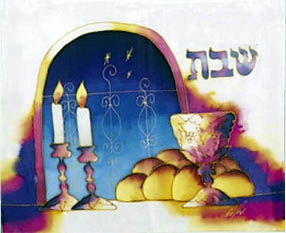
shabbosBut I’ve written not of what Messianic Judaism is today, but what I believe the world-wide, multi-national ekklesia will be in the days of King Messiah. As I mentioned above, if you have to assign a “religious” designation to that future ekklesia, given the Biblical prophetic record of the Messianic Age and the realization of the New Covenant as it reaches fruition, it will not be the Church. If we have to call it anything at all, it will be a Judaism.

The word “Messianic” is not simply a Hebrew-based way to say “Christian.” Messianic Judaism is the Judaism of the Messianic Era, practiced today.

-Aaron Eby
as quoted from Facebook

As a non-Jewish member of the ekklesia of Messiah, and summoning the future Kingdom of God, at least a little bit, into our present world, I wish you all a Good Shabbos, which also foreshadows the Kingdom to come.

Addendum: A few months ago, I wrote a blog post somewhat similar to this one called The Church When Jesus Returns, but I didn’t take my point as far as I have on the current “meditation.” I still think they “fit” together, though.

What Would You Do If Your Child Was Gay?

John MacArthur was recently asked by a reader how they should respond to an adult child who has acknowledged they are gay. His parenting advice?

Alienate them.

Separate them.

Isolate them.

Refuse to have a meal with them.

Turn them over to Satan.

-Benjamin L. Corey
“John MacArthur on Having Gay Children: Alienate Them & Turn Them Over to Satan”
from “Formerly Fundie: The Official Blog of Benjamin L. Corey”
patheos.com

“Formerly Fundie” is listed as a “Progressive Christian Channel” at Patheos, so chances are Corey and I don’t have a lot in common, since I’m pretty socially and politically conservative. I don’t know who this gentleman is or why he needs an “official blog” for himself and his name (and based on many of the comments on his blog, I’m glad I don’t have his readership), but a link to his blog post was inserted into Facebook by a Facebook “friend” who is about as progressive as it gets (I have a wide variety of friends, virtual and otherwise).

If you are a regular reader of my blog, you know I almost universally disagree with just about everything Pastor MacArthur teaches, preaches, writes, and broadcasts. I found his treatment of Pentecostals at his Strange Fire conference to be typical of his highly confrontational style, and his perspectives on both ancient and modern Judaism, including Messianic Judaism, show, in my opinion, an extremely poor insight into the actual late second temple Jewish and apostolic cultural, religious, educational, and spiritual environment. He “Christianizes” every bit of scripture he touches as if he imagines Jesus and the twelve were good Baptist Preachers from the church right across the street in “Hometown, U.S.A.”

OK, that last bit might be something of an exaggeration, but you get the idea.

There’s a YouTube video of MacArthur that goes along with Corey’s article. I’ll post it at the bottom of today’s “meditation” so you can actually hear what MacArthur says. I was surprised that the tone of his voice was calm, soft, and almost friendly. MacArthur isn’t quite as harsh in his language (and possibly intent) as Corey makes him out to be. But that doesn’t disguise the massive disconnect I think MacArthur is trying to sell to Christian parents of gay children.

Matthew Vines
Matthew Vines

In case you haven’t read them, I’ve written numerous posts on the LGBT community within both Christianity and Judaism, the latest (before this one) missive being my review of Matthew Vines’ recent book God and the Gay Christian. I also commented on Dennis Prager’s understanding on why Judaism rejected homosexuality as well as on a number of other related topics.

Am I advocating for marriage equality in the church? No, I don’t think there’s a Biblical presupposition for it. But there’s a lot going on in this dialogue that we simply cannot ignore or dismiss.

Many of you may have read about Danny Cortez, a Pastor of a Southern Baptist church in La Mirada, California, who, after his fifteen year old son came out, decided to change his theological stance on homosexuality and became gay affirming, leading his church to officially become affirming of gays within their community as well.

Naturally, Christians on both sides of the issue made highly emotional pronouncements either supporting Pastor Cortez and his church or condemning them.

But what do you do when it’s your child? What happens if you’re a Christian and it’s your son or daughter who tearfully, painfully, comes out to you because he or she can’t stand holding it inside anymore, can’t stand lying, can’t stand hiding their feelings? What happens after they tell you and then they just stand there looking at you expectantly, fearing your anger but praying for your acceptance?

One of my sons has two male friends who came out within the last several years, and one of those young men comes from an Evangelical family.

What do you do?

At the church I attend, in Sunday school probably a year or more ago, the question came up of what the church would do if two lesbians came in and wanted to worship. A fellow, who is a member of the Board of Elders, responded, “Love ’em and learn ’em.” I don’t think that was overall support for acceptance of lesbian relationships in the church. He was likely communicating the idea that by welcoming them into the church community, over time, they would be influenced and understand the nature of homosexuality related to the expectations of God, as this church understands God and expectations.

women holding handsThe understanding, and I’m projecting my own conclusions into this scenario, is if this hypothetical lesbian couple chose not to accept the church’s interpretation of scripture in terms of their relationship and their lives, they’d be free to leave and seek a more accepting church or other house of worship.

But you can’t exactly do that with your kids…or can you? The quote from MacArthur above says that’s exactly what you have to do. If your gay kid won’t repent and continues to sin (presumably by just being gay), then you must do the whole Matthew 18:15-18 thing with them, confronting your child individually, and then with two or three other witnesses, and then finally in front of the whole church (I’ve heard of one set of parents who really did this). This is actually bad exegesis on MacArthur’s part, since the child, by being gay, doesn’t directly sin against his or her parents.

I don’t think I could stand to do that with any of my kids. Maybe I’m just a bad Christian. I’m sure John MacArthur would think so.

Of course, none of my children are religious let alone Christians, and from MacArthur’s point of view, if any of them were gay, they’d be sinners just like the rest of the secular world.

A church can make whatever official, doctrinal statement it wants relative to homosexuality in the covenant community and they’re within their rights to do so. I draw the line at being compelled to accept John MacArthur’s advice on how I should relate to my children and I imagine a lot of Christian parents feel similarly.

No, none of my kids are gay, but I’ve run that scenario through my head more than a few times. What if…

MacArthur made the video supposedly in response to a parent whose adult offspring did come out, and asked MacArthur what they should do, so in this case, MacArthur is responding to a real request for information. However, he felt it necessary to make a video and then to put it on YouTube, so his opinion entered the public realm and became fodder for response and reaction.

I can’t render a theological opinion but I can give you one based on my being a father and grandfather. I can’t “unlove” my children. Sure, they’ve each done things to make me pretty unhappy at different times over the years, but none of that made me want to stop being their Dad, to stop loving them, and certainly I never had any desire to “turn them over to Satan.”

in-the-dark2-blueResponding to a gay child by alienating them, separating from them, isolating them from family, and refusing even to eat with them won’t motivate them to “repent,” it will motivate them to never have a relationship with you again and to take their own course absent of your love, caring, compassion, and consultation. MacArthur’s advice is an iron-clad guarantee that even if the child somehow desired to “repent of being gay,” they would never do so. What’s their motivation? The (so called) love of Christ according to the “gospel” of MacArthur?

Even when Israel sinned grievously against God, God may have turned His face away for an instant, but He always, always took them back and He never, ever permanently abandoned or forsake them.

I know MacArthur feels he’s giving sound doctrinal advice based on scripture, but somehow he never factored in his own experience as a parent (and I imagine a grandparent, given his age) and how he would face his own children. Sadly, my experience (such as it is) with MacArthur is that he is so dogmatic and rigid, he very well could and would take his own advice and feed any child of his who came out as gay to the (proverbial) wolves.

If any of my kids (or my grandson someday) came out as gay, I’d end up having a very long talk with God about what this was supposed to mean for my relationship with the Almighty. What does God expect me to do, reject the very child He created to be a joy in my life? I couldn’t do that. Does that make me a bad Christian? I imagine a lot of people reading this will think so. Some of you may even condemn me (even if it’s within the privacy of your own hearts) for merely entertaining such an attitude.

But what would you do if it were your own son or daughter. Imagine your little boy or girl telling you they’re gay, scared to death of what it will mean, and wondering if you’ll stop loving them in the next ten seconds or so. Imagine that this is really happening. What would you do, not just your immediate reaction, but for the long run? How’s your moral certitude doing now?

I know I said in Is It For His Glory to avoid needless arguments (though I also quoted Pastor Michael Hidalgo as saying Christians need to get out of their protected enclaves and into the real world…perhaps good advice for John MacArthur), but I also said there are times to take a stand. I believe this is one of those times.

Here’s the video of MacArthur’s response to the Christian parent who asked what to do now that their child has come out as gay:

Believe in people and you will influence them to believe in themselves.

Your belief needs to be based on reality — so develop an eye for noticing sparks of potential in others. Be enthusiastic in selling a person to himself.

-Rabbi Zelig Pliskin
“Believe in People”
Aish.com

Addendum: June 19, 2013: Today I received an email from a person named Dennis who informed me of an error I made regarding my mention of Pastor Danny Cortez. According to Dennis, the news article states that Pastor Cortez changed his theological stance to be affirming of gays in the Church before his son came out. This change in Pastor Cortez allowed his son to feel safer in coming out to his father. I apologize for misreading the news article and hope this correction clears things up.

Putting a New Face on Sunday School

In verses 22-23 of Acts 22, Give the details of the “hissy fit” Paul’s Jewish audience threw when he used the “G” word.

Have you or I ever felt or expressed similar emotions when we didn’t get out way in church? (The “no” word) How does submission allow the Lord to bring about spiritual growth in our worthy walk with Him?

-from the Sunday school study notes
on Acts 22:22-29 for June 8th

My Sunday school teacher has a tendency to compare apples with oranges and believe he is actually comparing apples to apples. For instance:

“And He said to me, ‘Go! For I will send you far away to the Gentiles.’”

They listened to him up to this statement, and then they raised their voices and said, “Away with such a fellow from the earth, for he should not be allowed to live!” And as they were crying out and throwing off their cloaks and tossing dust into the air, the commander ordered him to be brought into the barracks, stating that he should be examined by scourging so that he might find out the reason why they were shouting against him that way.

Acts 22:21-24 (NASB)

Teacher was comparing a near-riot situation not only to a “hissy fit” (which Urban Dictionary defines as a “sudden outburst of temper, often used to describe female anger at something trivial”) but to any relatively minor situation a person might experience in church that would cause them unhappiness or displeasure.

Either he thinks people’s problems in church border on crowd violence or he grossly minimizes the angst, frustration, fear, pain, and anger of the Jewish people whose land has been occupied by a pagan foreign army and who were highly sensitized to any offense by Gentiles during a moed such as Shavuot.

Since I published my previous blog post which merely anticipated last Sunday’s class, people have been asking me how class actually went. This is the answer.

Apostle Paul preachingI decided I could not remain completely silent and let what I considered to be unfair or inaccurate statements about Paul’s situation in particular or Christianity’s attitude about Judaism and Jewish people in general go unanswered. While I chose to ignore the “hissy fit” comment (though I was surprised at the number of people in class who agreed that the Jews in the above-quoted passage were merely “throwing a childish fit”), I did zero in on the humanity and the group dynamics of the situation.

I pointed out that presumably, some “Jews from Asia” (Acts 21:27) had been spreading rumors in Jerusalem that Paul had been “teaching all the Jews who are among the Gentiles to forsake Moses, telling them not to circumcise their children nor to walk according to the customs” (Acts 21:21), and also that he had “even brought Greeks into the temple and [had] defiled [the] holy place.”

It only takes a few agitators to stir up a large crowd and start a riot. Jerusalem’s population had swelled to millions of Jews in preparation of Shavuot, and it was always during the moadim that emotions ran especially high. Any upset or offense at all, particularly the thought that a pagan Gentile would be taken into the Temple by a Jew who was presumed to be sympathetic to pagans if not a Roman collaborator, would be cause enough for disaster.

Now the Passover and Unleavened Bread were two days away; and the chief priests and the scribes were seeking how to seize Him by stealth and kill Him; for they were saying, “Not during the festival, otherwise there might be a riot of the people.”

Mark 14:1-2 (NASB)

We see even the Romans (not to mention the chief priests and scribes) could not execute the Master with impunity for fear of the crowds. In fact, in Acts 22, the Roman military authorities are doing all they can to prevent such a mass disturbance.

riotingSince none of that qualifies as a “hissy fit,” I decided to toss my two cents into the hat, so to speak, and explain all of this to the class. My teacher was in totally agreement and no one spoke up to suggest otherwise, though I can’t possibly know what anyone was thinking. My one regret was that the individual who previously made the Anti-Gentilism remark wasn’t present to either respond or not respond. But that was probably for the best since I can be more sure that my motivations were clear of the desire to make my own “response” to this person.

Earlier that morning, Pastor was extremely careful to point out that Paul’s troubles weren’t what we might consider in modern times to be “Jews persecuting a Christian.” At that moment in history, in Jerusalem, all of the people involved, apart from the Romans, are Jesus-believing Jews and Jews from other religious streams. The most accurate picture, in my personal opinion, we can paint, is that differing or opposing Jewish religious sects were engaged in “passionate” disagreement up to and including violent outbursts.

But perceiving that one group were Sadducees and the other Pharisees, Paul began crying out in the Council, “Brethren, I am a Pharisee, a son of Pharisees; I am on trial for the hope and resurrection of the dead!” As he said this, there occurred a dissension between the Pharisees and Sadducees, and the assembly was divided. For the Sadducees say that there is no resurrection, nor an angel, nor a spirit, but the Pharisees acknowledge them all. And there occurred a great uproar; and some of the scribes of the Pharisaic party stood up and began to argue heatedly, saying, “We find nothing wrong with this man; suppose a spirit or an angel has spoken to him?” And as a great dissension was developing, the commander was afraid Paul would be torn to pieces by them and ordered the troops to go down and take him away from them by force, and bring him into the barracks.

Acts 23:6-10 (NASB)

Last week in one of my reviews of D. Thomas Lancaster’s Holy Epistle to the Hebrews sermon series, I wrote that Lancaster taught that the Pharisees and the Messianic Jewish believers all had virtually identical theology and doctrine. They both believed in the world to come, they both believed that God rewarded good and punished evil, both in this world and the world to come, they both believed in the resurrection of the dead, and they both believed in the Holy Spirit and in angelic beings.

But the Sadducees believed in none of that, which is what, according to Lancaster, resulted in the Sadducees barring the Messianic believers from the Temple prompting the Hebrews letter-writer to pen his epistle, and why the Sadducees and Pharisees sitting on the Sanhedrin argued so strenuously, putting Paul’s safety and even his life in danger.

That’s not the same as one religion persecuting another, dissimilar religion.

The Jewish PaulIn fact, in verse 6, Paul said, I am a Pharisee, a son of Pharisees…,” and Pastor pointed this out, not I was a Pharisee. There was nothing inconsistent with being a Pharisee and coming to the realization that Yeshua was the Messiah, Son of God. Yeshua-devotion seems to have been the natural, logical, Biblical extension of Pharisaism in late second-Temple Judaism.

So we might even say (though I could be stepping out on a limb here), that modern Messianic Judaism, in some sense, is the inheritor of first century Pharisaic/Messianic Judaism.

As Sunday school class ended, a gentleman who looked familiar to me, but not in that context, approached me and introduced himself. Actually, he reminded me that he’s the father of my son Michael’s best friend. Apparently, he and his wife had attended this church some years back but left to plant another church in the community. They’ve returned, presumably for some time, so it’s become a more interesting situation.

I recall the few times I’ve spoken with this person before. He’s always been personable and interactive. Very much a “traditional Christian” but willing to listen and discuss my “Jewish” ideas.

No one else in class (or in church) has any connection to my family or my family’s history (my son has known this gentleman and his family for well over a decade, though I’ve only met them just a few times over the years) so I wonder how or if this will affect my future contributions? The situation certainly puts a new face on Sunday school.

One more thing. Pastor did talk about Christians who are being persecuted in the world today, and specifically Pastor Sergey Kosyak of Donetsk in the Ukraine. Please pray for him and for all the Christians who are authentically in danger, being injured, being incarcerated, being murdered for the sake of their faith in Jesus Christ. May God be with them and protect them all.

Does Unity Always Demand Passivity?

Therefore I, the prisoner of the Lord, implore you to walk in a manner worthy of the calling with which you have been called, with all humility and gentleness, with patience, showing tolerance for one another in love, being diligent to preserve the unity of the Spirit in the bond of peace.

Ephesians 4:1-3 (NASB)

How is it pleasing to the Lord when hungry believers with different backgrounds and viewpoints, come together in a spirit of unity to study and apply His Word? What Christ-honoring qualities, in Ephesians 4:1-3, do we need to embrace in order for this to happen?

-from the Sunday school study notes for June 8th

I know I’ve accused myself (and been accused by my wife) of collapsing the Tent of David because of my arrogant presumption, which has subsequently caused me to question my role in the church (if any, beyond being a pew-warmer in services and a silent witness in Sunday school), but I’ve got just one question: are we supposed to “dumb down” the Bible and ignore blatant error for the sake of unity among believers?

I’m really tempted to ask my Sunday school teacher that question, but I know it would just stir up hard feelings (and I’ve done that before).

We’re studying Acts 22:22-29 and somehow my Sunday school teacher has gotten the impression that Paul became all humble, meek, and mild for the sake of Jesus Christ. Really, the last thing I imagine Paul to be in the face of adversity is meek and mild. I also think Christians largely misunderstand humility, especially in leadership.

Moses’s humility was a function of his greatness. Penetrating more deeply into the unfathomable mystery of things than anyone before or since, he was more acutely aware of his ignorance. As the Torah relates at Mount Sinai: “Moses approached the thick cloud where God was” (Exodus 20:18).

-Ismar Schorsch
Commentary on Torah Portion Beha’alotekha
“The Inscription on My Father’s Tombstone,” pg 498,
May 28, 1994
Canon Without Closure: Torah Commentaries

To make his point, he recast a verse in which Moses declares: “It is not because you are the most numerous of peoples that the Lord set His heart on you and chose you — indeed, you are the smallest of peoples” (Deut. 7:17). Nevertheless, the midrash continues, “the Holy One Praised Be He told Israel that I love you because each time I bestow greatness upon you, you shrink yourself before Me. I bestowed greatness upon Abraham and he said to Me: ‘I am but dust and ashes’ (Gen. 18:27). Upon Moses and Aaron and they said: ‘who are we?’ (Ex. 16:7) Upon David and he said: ‘I am a worm, less than human'” (Psalm 22:7).

-ibid,
“The Humblest of Men,” pg 513, June 5, 2004

Reb Yakov Kamenetzky

And from another source:

Rabbi Yaakov Kamenetzky was about to take his place at the end of a long line waiting to board a bus, when someone in the front of the line who knew him called out, “Rebbe, you can come here in front of me!”

“I’m not permitted to,” replied Rav Yaakov. “It would be stealing.”

“I give you permission. I don’t mind.”

“But what about everybody else behind you?” said the Rosh Hayeshiva. “I would be stealing their time and choice of seat by moving them back one. Who says they allow me to?”

-Rabbi Zelig Pliskin
Commentary on Torah Portion Beha’alotekha
“Even when traveling be careful to observe Torah values,” pg 320
Quoting The Jewish Observer, Nov., 1985
Growth Through Torah

Here we see that humility is a reflection of strength of character and the upholding of Torah values (or Biblical values if you prefer), and is not the result of a person willing to sacrifice those values for the sake of unity, peace, or to prevent a “spirited debate.”

Certainly no one could accuse Abraham, Moses, Aaron, or David of being “meek and mild” and unable or unwilling to take a strong personal stand for what is right just to avoid an argument or to dodge a disagreement.

That said, we can also see from Rav Kamenetzky’s example that it is also required to sacrifice personal convenience for the sake of said-values, and from that, I derive the principle that you don’t enter into a debate, even if you think you’re correct, just for the sake of being right and proving the other person or people wrong.

I continually struggle with that last bit, even as I compose this blog post and anticipate (as I write this) Sunday school tomorrow morning (yesterday as you read this).

And as compelling as the examples I’ve already presented may be, there’s one more that should “seal the deal” so to speak:

When the ten heard this, they began to be upset with Ya’akov and Yochanan. Yeshua called to them and said to them, “You know that those who are considered rulers over the Gentiles are the ones who oppress them, and their great ones dominate them. But it is not to be that way among you. Rather, one who desires to be great among you is to be as a servant to you, and the one who desires to be the head will be a slave to all. For even the son of man did not come in order to be served, but rather to serve and to give his life as a ransom for many.

Mark 10:41-45 (DHE Gospels)

It is true, and Chancellor Schorsch supports this in his commentary, that people operating outside of the Covenant community (Gentiles, in Schorsch’s as well as Jesus’ case) have leaders who feed off of power and self-glorification, while leaders in Judaism, at least in the ideal, become more humble as God heaps greatness upon them.

Ismar Schorsch
Ismar Schorsch

But as I said, this doesn’t mean humility equals passivity.

In the Temple he found merchants of cattle, flocks, and young doves and those who give change for money sitting there. He took cords, twisted them into a whip, and drove all of them out of the Temple, along with the flocks and cattle. He scattered the coins of the money changers and overturned their tables. To the dove merchants he said, “Take these out of here, and do not make my Father’s House into a marketplace!” His disciples remembered the passage, “For the zeal of your House has consumed me.”

John 2:14-17 (DHE Gospels)

Of course, that hardly gives me license to make a whip and go charging into Sunday school, even metaphorically, for the sake of making a theological point. On the other hand, if unity were the single, overriding priority in the community of faith, then we would never see any Jewish leader, including Jesus, take a strong, personal stand for the sake of Heaven.

There is a line in the sand that, once crossed, must provoke a response. So on the one hand, I could have been wrong to remain silent in Sunday school class when I felt that line had been crossed. On the other hand, I need to choose my battles. I usually do that in class, selecting only one or two points in the class notes to address openly, but even then, it doesn’t always work out.

How do I tell my Sunday school teacher (or do I tell him at all) that unity is not the be all and end all of communal life in the congregation of Christ?

Be careful not to become involved in quarrels with your friends. Arguments will only create distance between you and others.

The most effective approach to avoid needless arguments is to master the ability to remain silent. You don’t have to say everything you think of saying. At times there is an actual need to clarify a specific point and it’s appropriate to speak up. But a large percentage of arguments come from making comments that don’t need to be made.

-Rabbi Zelig Pliskin
quoted at Aish.com

By the time you read this (Monday morning), I might have the answer.

Addendum: It’s Sunday afternoon and Sunday school class actually worked out better than I thought it would. I’ll write more about this later.

What is it to be in a Community of Faith?

Being ignored is very dismissive and disrespectful, especially if you claim to have a relationship. I think all of us desire to be understood and that our contributions are useful, not just feigned interest when your real intent is to build a relationship only for the purpose of setting the other person straight. Yes, the Christian need to maintain a semblance of agreement and avoid conflict and the hashing things out that might be useful is discomforting, but that is the way it is.

-chaya1957
from a comment on What I Learned in Church Today: Anti-Gentilism and Crypto-Supersessionism

This speaks to the theme I was discussing on that particular blog post as well as on Old Wine Made New, which is a continuation of my exploration of my role in the church and more fundamentally, who am I?

As much as I’d like to think that I’ve backed off of being arrogant or even disingenuous in my rationale for returning to church, I don’t think I’ve progressed very far. In reading Chaya’s comment though, I realized (or was reminded) that in my case, there are three possible motivations for being in church (although they can certainly overlap):

  1. Seeking community with fellow believers.
  2. Seeking an encounter with God.
  3. Seeking to share my unique perspectives with other believers.

Number three is the one I tend to lead with and the one that has gotten me in plenty of trouble. It’s this part of what I refer to as the Tent of David process that is the most difficult to implement. Actually, the toughest part is to find the right balance between competing priorities in being at church, and I think the balancing point is in a different place for each person.

As I’ve learned before, it’s important to establish yourself as a member of the community, otherwise, no one will take you seriously. I’ve been “standoffish” as far as becoming a community member goes, especially if it requires formally joining the local church. I realize that Pastor Randy has privately taken me through the curriculum he presents in his “new member” classes. Needless to say, I don’t agree with not of the “particulars” of the Baptist or Fundamentalist Church, so I could hardly become a member in good faith.

But being a committed member of the community is a basic requirement that must be fulfilled prior to offering anything in the way of a perspective on a theology or doctrine that differs from the Evangelical Christian norm. Certainly a Messianic Jewish viewpoint on theology and doctrine can be considered quite outside the traditional Christian norm.

But then, I’ve been cheating myself, since one of my major issues, at least within my own mind and heart, is how I lack “like-minded community” in my little corner of Southwestern Idaho. By not joining community, I’ve been denying myself community and thus remaining isolated, at least in terms of face-to-face transactions from fellow believers. Sure, I can show up at church, participate in the worship services, and go to Sunday school afterward, but that’s not community, it’s attendance.

I go out of a sense of obligation, out of a sense that this church is where God wants me to be for some reason, as if I may still have a purpose there, but then, I can’t tell what that purpose might be. For about the first year give or take a month or two, I thought I had a purpose. I spent a lot of face time with the head Pastor and I thought we were building a dialog that could result in at least the introduction of some material from a Messianic point of view.

But it didn’t work out that way. Periodically, someone will pull me aside to ask a few questions or complement me on my participation in Sunday school, but that’s pretty hit and miss.

All of these musings are against the backdrop of First Fruits of Zion’s (FFOZ) Annual Shavuot Conference at Beth Immanuel Sabbath Fellowship in Hudson, Wisconsin which, as you read this, has just ended. While I’ve struggled with my participation at the conference in the past, in my heart, Beth Immanuel or some place like it is more who I am than a Fundamentalist or Evangelical Christian church.

This isn’t to say that going to church for a Christian is bad, it just isn’t really “me.” And even then, if being a square peg in a church of round holes had some purpose or meaning, then being different would be OK, especially if, among all the differences, I could find a common “meeting place” with the other people in the church community.

Sometimes I feel like the character “Uncle Martin” in the old TV show My Favorite Martian (1963-1966). I look like everyone else, but the internal differences are remarkable.

I recently read an article at the Rosh Pina Project called The mature Messianic Jewish believer is also a disciple. Writer Dror discussed the variability of Jews in the Messianic Jewish movement who nevertheless, should be considered part of the community. The issue revolved around Jewish Torah observance:

There is a school of thought within Messianic Judaism that teaches that Messianic Jews can only truly be “Messianic” if they are also Torah observant. A sharp divide is made between Messianic Jews who do keep Torah, and those who don’t – with those who don’t even compared to Bin Laden!

Rebbe
Rabbi M.M Schneerson, the Rebbe

I’ve been reading Sue Fishkoff’s book The Rebbe’s Army, which is about the history, development, and activities of the Chabad in connecting with largely secular Jewish people and bringing them closer to the Torah through performance of mitzvot and association in Jewish community. Regardless of what you may think of the Chabad and what they do, they have a single-mindedness of purpose and are remarkably inclusive of Jewish people, regardless of background or knowledge.

Messianic Judaism struggles with this issue because, in my opinion, at the same time it is attempting to present Yeshua as the Messiah to non-Jesus believing Jews, it is also trying to establish itself as a Judaism, observant in the mitzvot, knowledgable in Talmud, and everything that every other religious, ethnic, and cultural Judaism is.

I can understand why Messianic Jews want to be taken seriously as a “Judaism”, alongside the other accepted Jewish religious movements. Some Messianic Jews seek to shore up the boundaries of Messianic Judaism by explicitly stating that practitioners must keep Torah. They go too far. People can get carried away with an idealistic vision of a religion accepted even by the Orthodox world, and end up using harsh language against secular Messianic Jews.

Yet only perhaps 13% of Jews worldwide could really be described as Torah-observant, which leaves the 87% of non-observant Jews whom Yeshua still loves. I would imagine that at least 87% of Messianic Jews are not Torah-observant, and it would be weird to have a Messianic Judaism that pretends this huge non-observant majority does not exist or is somehow worth dismissing.

This struggle isn’t my struggle to the degree that I’m not Jewish and have no meaningful input in the Jewish world, Messianic or otherwise, but it does define a parallel issue among the Gentiles involved in the Messianic Jewish movement (who are the majority of members in the movement, at least in western nations).

While many aspects of Torah are found in messianic Judaism as a unique expression of our Jewish faith in the Messiah, we do not believe that the Gentile church, or Gentile Christians universally, are called to the same expression as us. In fact, it is the unity of Jew and Gentile in Messiah, in spite of our cultural diversity, which glorifies God in the body of the Lord, via the one new man. (Eph. 2:15). In our view, therefore, it is wrong to admonish Gentile believers universally to think that they need to observe the Torah. It is clear, furthermore, that the Apostles dealt with this precise question of Gentile Torah observance and answered it on point in Acts 15. All of this will be discussed further in this paper.

-from “One Law, Two Sticks, A Critical Look at the Hebrew Roots Movement,” pg 4
A position paper of the International Alliance of Messianic Congregations and Synagogues (IAMCS) Steering Committee, January 15, 2014

The reception of such a statement among non-Jews involved in some aspect of the Hebrew Roots movement is generally not accepted very well and is often understood as the Torah being completely applied only to the Jewish people and having no relevancy for non-Jewish disciples of Yeshua (Jesus) at all. This is a basic misunderstanding as the above-quoted paper states:

At times, this can be rather ambiguous, as the term “Torah” (law), of course, has different meanings depending on context….

Generically, the term “Torah” is often thought of as a set of laws providing a moral code for right living. Although there are such commandments in the Torah, the moral law is a very limited part of Torah, and is not a good basis for understanding what Torah is. While the Torah does contain certain moral laws given to Israel, it was not in fact, given in order to be the ultimate moral statement and standard of God to humanity for ethics and basic right v. wrong living. The Torah does not purport to be such a statement. While there clearly are universal moral laws in the Torah, there are many aspects of the Torah that have nothing to do with morality, and which therefore are not intended to be universal. For example, the commandment to Israel to wear tzitzit (Num. 15:38), or to be circumcised (Lev. 12:3).

The Torah does not approach being an exhaustive, all-encompassing, moral code. In fact, Paul’s assertion in Romans 2:14 states:

“Indeed, when Gentiles, who do not have the law, do by nature things required by the law, they are a law for themselves, even though they do not have the law.”

-ibid, pg 5

In fact, much of the Torah applies to all of humanity but the Torah uniquely applies to the Jewish people, the descendants of the ancient Israelites who received the Torah from God through Moses as Sinai as the conditions of the Mosaic Covenant between God and Israel.

God gave the law at Sinai, creating a unique nation. There are things given in the Torah which are unique to Israel. Above all, the actual revelation at Sinai was not the law, but rather, the lawgiver. In fact, God not only gave the law at Sinai, but God revealed Himself unto the people Israel. (See Ex. 19 and 20). The Jews from the most ancient times have understood this.

-ibid, pg 6

Mount SinaiA Gentile believer’s obligation to the Torah is more involved and complicated than it would seem on the surface, especially when accessing an Evangelical Christian (low) view of “the Law”. Nevertheless, no one is trying to minimize or marginalize the Gentile participants in Messianic Judaism or those who have discovered the “Hebrew Roots” of the Christian faith.

But what does this have to do with my sense of Christian community or lack thereof? Plenty. Actually, it has more to do with my sense of community within the Messianic Jewish movement, even though that community is remote.

In reading Fishkoff’s book about the Chabad, I came across a bit of dialog attributed to an older Jewish gentleman, a businessman, who had become involved in Chabad activities and who had been encouraged to perform some of the mitzvot, including laying Tefillin. He found it compelling to increase his observance, at least to some degree, but he admitted, “I still work on Shabbos.”

I’ve read in any number of Jewish sources, that Judaism relative to the mitzvot is not an absolute. In Christianity, we are taught that Judaism is an “all or nothing” religion. Either you perform all of the mitzvot and perform them perfectly, or you are condemned by God. It’s the rationalization for us to say that Jews cannot keep the Law perfectly (who could?) and therefore, they need to abandon the Law entirely and accept the free gift of grace and salvation from Jesus Christ.

But that’s not how observant Jews see themselves, and certainly not within the Chabad framework. In fact, Jews who have grown up in other branches of Orthodox Judaism complain, according to Fishkoff, that Chabad services are too elementary and that the Chabad siddur (prayer book) is laced with English translations of the Hebrew and Hebrew transliterations for Jews unfamiliar with Jewish worship. That’s great if you’ve been a secular Jew all of your life and are uninitiated in the synagogue service, but if you have been raised an Orthodox Jew, it’s bound to be slow and frustrating.

But all of these people along the scale of observance and familiarity with Torah and Talmud are Jewish and all of them are universally in covenant with God. That needs to be understood by the rest of us (Gentile Christianity). The expectation is to strive to be better without necessarily ever becoming perfect. In Judaism, God is a gracious and forgiving God, not a harsh taskmaster.

Evangelical Christianity, for its part, is also lenient relative to any expectation of “performance” by its constituency, but there are expectations nonetheless, though they tend to center around things like church activities, tithing and other giving activities, church and classroom attendance, and so on. Ironically, Evangelicals, at least some of them, perform more “Torah” than you might imagine, such as visiting the sick, giving to charity, donating food items to the hungry and those organizations that feed them, praying for the well-being of others, both in the church and beyond, and so on.

churchBut what about me? That is, what about the “Messianic Gentile” or one who self-identifies as such? I work on Shabbos, not at my job, but I typically do my lawn work. I try to spend as much of Saturday as possible reading the Bible and studying, but my wife, who is in fact Jewish, does work on Saturday. So does my Jewish daughter. And I’m likely to have some sort of “honey do” list to complete on Saturdays.

My wife will light the Shabbos candles for Erev Shabbat but typically she doesn’t invite me to be a part of the event. We eat “Leviticus 11 kosher” or as the local Chabad Rabbi calls it, “kosher-style,” but we’ve never kashered our kitchen. My wife doesn’t always fast for Yom Kippur. She rarely attends Shabbat services.

Neither one of us lead what you might call an “observant” lifestyle. Now how that works in my wife’s Jewish experience is between her and God and I will not question how she chooses to live out a Jewish life.

But identifying as a “Messianic Gentile,” what does Messianic Judaism expect of me? Some have said that Gentiles are “invited” to extend their observance beyond the minimum required by the Acts 15 ruling, but depending on who you talk to, some people in Messianic Judaism (more of the Gentiles than the Jews) are a little stiff about what you do and don’t do.

It gets even worse in some (but not all) Hebrew Roots communities to the point of “legalism,” and as we saw from the Rosa Pina Project quote above, if you’re a Messianic Jew and you aren’t scrupulous in your observance, you can be open for some harsh criticism.

I say all this to illustrate the challenges in establishing and maintaining community, regardless of what that religious community might be. While I find that I missed attending this year’s Shavuot Conference at Beth Immanuel, some part of being there is intimidating. I worry about fitting in sort of the way I worry about fitting in at church. The theology and doctrine taught at Beth Immanuel is more in line with my personal beliefs, but what about my practice? And at church, although my practice isn’t much of an issue, what about my theology and doctrine?

A believer is someone who believes Yeshua is the Messiah.

A disciple is someone who believes Yeshua is the Messiah, and is making a serious attempt (although it will be weak and flawed in many ways) to conform his life to the ways and teachings of Yeshua. As well as his behaviour and attitudes changing, his conceptualising of faith will change and he will begin to understand concepts which were initially tricky, like Yeshua died in our place, Yeshua is divine, and we need to work on our hearts to produce spiritual fruit.

See the difference?

Mature disciples who meet regularly with other disciples will strengthen their faith, and may or may not choose to observe Torah in order to supplement and enhance this spiritual journey. Yet at its core, this is a personal choice.

-Rosh Pina Project

Regardless of who you are, Jew or Gentile, as a believer in and disciple of Yeshua (Jesus), it ultimately is less about what you do as who you are in relationship to God through Messiah. The relationship, the walk, the interaction, is where it all starts. Performance of the mitzvot, however you want to define that, is the outgrowth, the expression, the fruit of that relationship in faith, but how many of the mitzvot you perform and how well you perform them doesn’t define you as a disciple, since each person negotiates his or her relationship with God.

I’m convinced that people of faith are far more judgmental of other people of faith than is God.

But that doesn’t solve the problem of community, it only gives us the means to dodge the judgmentalism of other people in our community (or sometimes outside of it).

I suppose part of my issue of community within the church is my own judgmentalism, how I view Christian viewpoints on Israel and Judaism and why they don’t conform to my own. As I’ve said several times before, it is arrogant presumption to believe Evangelical Christians would have any desire whatsoever for some outsider to breeze into their church and tell them what’s what. How dare I judge their theology and doctrine and yet bristle when they judge mine?

coastI feel caught in the middle, between my struggles with Christian theology and Messianic practice. But those are community issues. The real issue is whether or not I’m a believer or a disciple. If the former, then it’s all about what I know about God and if the latter, then my heartfelt desire should be to know God. If I am truly seeking to know God, then everything should flow out of that pursuit and whatever community of faith I find myself in should judge me, for good or for ill, on that basis.

In turn, I should judge myself on what my goals really are. They should never be about changing anyone’s mind for only God does that. If I am a disciple, my single goal should be to draw nearer to God through Messiah Yeshua (Christ Jesus). From that, everything else will come.