Viktor Frankl, a Jewish physician who spent the years of the Second World War in the concentration camps at Auschwitz and Dachau, related, “I remember my dilemma in a concentration camp when faced with a man and a woman who were close to suicide; both had told me that they expected nothing more from life. I asked both my fellow prisoners whether the question was really what we expected from life. Was it not, rather, what life was expecting from us? I suggested that life was awaiting something from them.”
The person who feels despair and discouragement is asking the wrong question. He asks what the world is giving him. As soon as he changes his question to what is the good that he can do, he will always be able to find an answer.
(Gateway to Happiness, p.374)
-Rabbi Zelig Pliskin
“What Does Life Want From You?”
Daily Lift #260 Aish.com
Recently, blogger Judah Gabriel Himango wrote an insightful article called Stop your religious whining! (Lighten up, we live in an amazing time!) He addressed what I’d call “the petty (religious) slights of the hyper-sensitive” and his blog post encourages us to appreciate all that God has provided to us personally and in the world around us.
This got me to thinking about all the complaining I tend to do and what’s really supposed to be important.
Messianic Jewish community is problematic on a number of levels. One of the “problem” issues is the matter of including Gentiles in Messianic Jewish religious and community space. How many Gentiles do you allow into a Jewish space before it ceases to be Jewish? How can the Jewishness of Messianic Judaism be protected? How can Messiah remain central in the minds, hearts, and faith of the Jewish and Gentile believer and still have Messianic Judaism emphasize the centrality of Jewish identity in Jewish community?
I don’t have answers to any of those questions, and they are questions that Messianic Judaism and the various individuals and organizations involved continue to struggle with.
However, there’s another important community issue Messianic Judaism faces: isolation.
Face it, depending on how you define an authentic Messianic Jewish synagogue, such communities are few and far between. I can think of three or four off the top of my head, but at least one of them, Beth Immanuel Sabbath Fellowship, is lead primarily by non-Jews, although there are some Jews who are members (If I’ve gotten this wrong, please feel free to correct me).
One of the things it says on the Beth Immanuel website is that it provides “Messianic Judaism for the Nations”. It is a community that strongly adheres to traditional synagogue practices and halachah (to the best of my ability to assess such things) and yet is inclusive of the Gentiles in Messiah who regularly or occasionally worship there.
I’ve attended events at Beth Immanuel exactly twice, but since Hudson, Wisconsin is quite a distance from Idaho, I only rarely have the opportunity to make the trip over there.
I think the closest authentic Messianic Jewish synagogue is located in the Puget Sound area and beyond that, I know of one in Virginia and another in Massachusetts.
I’ve listened to quite a few of D. Thomas Lancaster’s sermons on the Beth Immanuel audio page and one of the things said on the recordings when introducing each lesson, is for the listener to consider donating to their congregation as a “virtual member.”
What is it to be a virtual member? I don’t know that there’s anything formal about it except donating and consuming audio and video teachings streamed over the Internet. In fact, on Beth Immanuel’s Community page, it says:
Beth Immanuel is not a building, it is people. We are a community of disciples seeking to care for and nurture one another as our lives intersect on the common path of discipleship.
Because the Torah cannot be functionally lived outside of a community context, we are mutually dependent upon one another. This means learning to get along with each other even when we don’t always agree on every point. Community means working through the difficulties and acknowledging that, in the end, we really are family.
At Beth Immanuel, we are dedicated to making community happen. Several families live within walking distance of the congregation building. We regularly host one another in our homes on Friday evenings to welcome the Sabbath. On Saturdays, we share a community meal after service. We keep the building open until after sunset so that we can enjoy common fellowship, prayer and study throughout the Sabbath day.
We desire to be known as disciples of Yeshua of Nazareth by our love for one another.
That would seem to preclude even the concept of being a “virtual member,” since community is defined by the direct contact of the people involved in their congregation. Community is particularly identified as those families who live within walking distance of Beth Immanuel, and families who host each other in their homes on Erev Shabbat. That’s pretty hard to do over the Internet, even with webcams and Skype.
Beth Immanuel provides a venue of worship and a community of support for Jewish and Gentile believers alike. We are here for those drawn to practice Messianic Judaism–the historical mode of Christian faith. We are dedicated to teaching and living out the Jewish Roots of our faith in Messiah.
Again, that “venue of worship and a community of support” requires a physical rather than a virtual presence.
Several months ago, I was offered the opportunity to contact the Rabbi at a Messianic Jewish synagogue (located thousands of miles away) and initiate a process that would admit me as a virtual member. I was assured that it would be very interactive and beneficial and I have no reason to doubt the word of the person who kindly contacted me with this suggestion.
This occurred last year right before the High Holidays and I decided to wait until after they were over, figuring the Rabbi and his synagogue would be very busy preparing for and conducting services for the Days of Awe.
And after they were over, I waited some more, turning things over in my head and trying to figure out what my needs really are and what’s important to me.
Which leads me back to the quote from Rabbi Zelig Pliskin I placed at the top of this missive.
It occurred to me that my own sense of isolation isn’t really as important as I’ve imagined it to be. Certainly, there are many Messianic Gentiles who live great distances from any community that could adequately serve their needs. And more importantly, there are many Messianic Jews who live very far from communities which could fully serve their needs. Some live in areas of the country that have little or no Jewish community at all, let alone Messianic Jewish community.
If Messianic Jewish community exists primarily to serve Jews, who am I to complain because I, as a Gentile, live nowhere near such a shul.
My primary role as a Messianic Gentile isn’t to get my “fix” of “Jewish stuff,” but rather, to do what I can to promote Jewish observance of Torah, particularly among (but not exclusive to) Messianic Jews. I’m well pleased that my wife, who is Jewish and not at all Messianic, is taking Hebrew classes at the local Chabad synagogue and attending other Jewish community events (and she’s even studying Tanya). This is as it should be, and if I can’t participate, the least I can do is stay out of her way and let her continue to explore her own Jewish identity and practice.
I’ve decided that the best thing for me to do is to open my hand and let go my “need” for community. I left church after a two-year sojourn because of the extreme dissonance between their core doctrines and mine, and I knew I couldn’t meekly sit by Sunday after Sunday, and listen to teachings that I believe are detached from what God’s true intent is for the Jewish people and national Israel, even though this church and its staff and members were doing many other fine acts of tzedakah (charity, justice).
I can’t imagine a church environment that would have me let alone serve my needs, but remember, it’s not about serving my needs, but rather, finding what good I can do in the world. I don’t have to belong to a church or synagogue to do that. It’s a mission that we all share as disciples of the Master.
We are only isolated to the degree that we isolate ourselves from God and the performance of deeds of kindness and compassion. It’s almost never about what you can get from another person or any particular community or institution. It’s about what you can give back. That’s not virtual, it’s real.
It is prohibited for a gentile to study Torah, and if he does so, he is [deserving of death] (see Sanhedrin 59a). A Jew is not allowed to teach him Torah, so as not to be the vehicle by which the gentile sins. What, then, is being added to this ruling in our Gemara from the verse in Tehillim?
According to ” ז ט we can say that the study of Torah which is prohibited for a gentile is the in-depth and careful study of its profundities. This includes the intricate aspects of Torah taught by Moshe to the Jewish people. However, the study of a simple listing of guidelines of Jewish law and general halachos would not cause a gentile to be liable for death. A Jew is, therefore, not in violation of עור לפני for exposing a gentile to such information. Our Gemara teaches that this is still prohibited, nevertheless, based upon the verse in Tehillim.
“Teaching Torah to a gentile”
from “Distinctive Insight” for Ghagiga 13
Daf Yomi Digest for September 21, 2014
Published by the Chicago Center for Torah and Chesed
Disclaimer: I suspect I may be misunderstanding the above-quoted text and it’s source. If anyone can offer clarification, I’d appreciate it. I can only base the following on my current understanding.
I suppose I take it for granted that I can read and study my Bible. I also take it for granted that all of the contents of the Bible, including the Apostolic Scriptures, are Jewish books, written by Jewish authors for Jewish readers. It was only with the advent of the New Covenant era which has yet to actually arrive, that large numbers of Gentiles were taught the Jewish scriptures as part of the grafted-in population of non-Jews into the First Century C.E. Jewish religious stream originally known as “the Way”.
Of course the prohibition cited in the above-quoted text didn’t exist at that time, at least not in a formal or written manner (and probably not at all as far as I know) and in fact, we see there was some expectation that the Gentile disciples of the Master were expected to learn and study Torah under the authority of Jewish teachers:
For Moses from ancient generations has in every city those who preach him, since he is read in the synagogues every Sabbath.”
–Acts 15:21 (NASB)
I interpret this rather cryptic verse to mean that the Gentiles, though by legal decision (Acts 15) obligated to observe only a subset of the full yoke of Torah incumbent on a Jewish disciple, were nevertheless to hear Torah read in the synagogue on Shabbat and most likely to learn and study Torah with their Jewish teachers and mentors. Such an informational background would be absolutely necessary if the Gentiles, especially those recently having been pagans (as opposed to the God-fearing Gentiles who regularly attended shul) were to make any sense at all of the teachings of the Master and to comprehend how the New Covenant blessings allow for the redemption of the people of the nations through God’s redemption of all of Israel.
But of course something happened between then and now. Gentile Christianity was formed out of the bosom of the early Jewish Messianic movement and proceeded, due to many events and circumstances, to remove itself from having anything to do with Judaism. I’ve said before that the actions and mistakes made by the first Gentile Christians in the Second and Third Centuries have been carried down in some manner or fashion into the current Church such that “studying Torah” is not on any believer’s radar (although there are exceptions which I will address presently).
No doubt a great deal of apprehension and even fear among Jewish people has been inspired by the decidedly nasty behavior of the Church toward the Synagogue over the long centuries, and has only been softened quite recently due to Hitler’s Holocaust.
About 350 years ago, someone asked Rav Avraham Amigo, zt”l, an interesting question. “A notzri who is connected to the authorities has been buying our books in an effort to complete a library of all the basic Torah texts. He has also offered to pay a certain Jew to teach him Torah. It is not clear whether this is preparatory to conversion or because he is seeking a way to undermine the Jewish community. Is it permissible to teach him or sell him seforim?”
The Gadol responded, “It is prohibited to teach him, as we find in the Gemara in Chagiga 13a. However, if there is a potential threat to Jewish life involved, it is definitely permitted to teach him, as we learn from the Gemara in Bava Kama 38b. If it does not appear that there is an element of danger in this case, I forbid teaching him or selling him books. Whether he truly intends to convert is difficult to ascertain because he could endanger himself by showing an interest in Judaism as the citizen of a Catholic country. In any case, the Gemara in Gittin 85a states that conversion is not likely, and we also find many references in Shas that prove that heretics often try to capitalize on whatever little learning they do have to defame the sages and undermine the Jewish community.”
The Rav continued, “In any event, we must guard against the possibility that he will travel where he is unknown and get the confidence of a Jew on the road. The Jew will trust him because he is learned. Once he wins his confidence he may very well kill him. This is the logic of the Gemara in Menachos 43a regarding the prohibition to sell a non-Jew techeiles. If he was wearing techeiles, he could easily fool a Jew on the road and kill him for his possessions!”
“The Torah of the Jewish People”
from “Stories off the Daf” for Chagiga 13
Daf Yomi Digest
When I first read this story I thought it seemed ridiculous that homicide would be the only or primary motivation of a Gentile to desire Jewish learning. But apparently the fear originated somewhere and resulted in essentially blocking off any non-Jews from more than a superficial level of Torah study unless that Gentile person’s intent was to convert to Judaism.
This doesn’t seem very applicable today, though. I can go online and order any Jewish book that’s available for purchase from any number of Jewish or non-Jewish sellers. I can even order all manner of Judaica online including tefillin and a tallit and no one is going to require that I prove that I’m Jewish (which I’m not). Of course, accessing a knowledgable and authentic Torah scholar from which to learn and study might be a bit of a chore, especially within Orthodox Judaism, but on the other hand, I could take online classes through organizations such as the Messianic Jewish Theological Institute, and as far as I know, there’s no restriction on any class based solely on being Jewish or Gentile.
I really doubt there’s much of a chance that someone like me studying Torah, in whatever manner I’m able, will result in any physical (or any other kind of) harm coming to a Jewish person.
But notice something else.
“If he was wearing techeiles, he could easily fool a Jew on the road and kill him for his possessions!”
This statement assumes that the hypothetical homicidal Gentile being discussed not only appeared learned in Torah but that, based on a different Gemara, he could be mistaken for a Jew because he was wearing “techeiles” (which is the blue coloring originally commanded [Numbers 15:37-41] that Bnei Yisrael wear as a thread among the tzitzit on the four corners of their clothing). I have to assume that “techeiles” is another way of saying tzitzit in this instance, thus it is not only forbidden to teach a Gentile Torah but to sell him tzitzit (in modern times, probably a tallit with the tzitzit attached) as well for the sake of Jewish safety.
While in the modern era, it seems highly improbable that a Gentile would study Torah and wear tzitzit for the express purpose of waylaying and murdering a Jew for his possessions, that fear originated somewhere at some time in the past and I don’t doubt that such an apprehension “echoes” across the corridors of history and into the present day.
Ten years ago, I was sitting in our local Conservative/Reform synagogue on Shabbat. Mel Gibson’s film Passion of the Christ (2004) was about to be released in theaters across the U.S., and in the discussion was a very real fear of the consequences. Historically, after every passion play, there is a pogrom, and although our little corner of Idaho generally doesn’t see a great deal of anti-Semitism, a shared cultural and genetic fear rapidly filled the room.
While at least locally, nothing happened and the film came and went, that fear comes from somewhere and it persists.
Ever since there have been Jews or Israelites or Hebrews, the rest of the world has been trying to kill them. Two-thousand years ago, the Apostle Paul was actively recruiting Gentiles to enter into and participate in Jewish communal and religious space as co-equals and participants in the benefits of the New Covenant blessings, however, he received a great deal of pushback from Jewish communities and community leaders, even to the point of Paul suffering injury and risking death.
And yet, there were synagogues from Syrian Antioch to Rome where Jews and Gentiles co-mingled in relative peace, studying, worshiping, and associating together, and at least for at time, it seemed to work out.
But not in the long run.
The history would take too long to relate, but the net result is that Jews learned to distrust the Gentile Christians along with all of the other Gentiles in the diaspora, and Gentile Christians for their (our) part, learned to distrust Jewish people.
Hence rulings were issued such as it being forbidden to sell Jewish books and to teach Torah to a Gentile, and the seemingly irrational fear that a Gentile would leverage Jewish learning and a Jewish appearance to do harm to a Jew.
But now we have something interesting going on.
A significant minority population of Gentile Christians are experiencing a renewed interest in Judaism, specifically Messianic Judaism. On the surface, the Messianic Jewish movement seems to be an attempt to do what Paul was trying to do; to bring Gentiles into Jewish community for the mutual study of Torah and the mutual worship of God through faith in the work of Messiah Yeshua (Christ Jesus).
But that’s not exactly what’s happening. In the days of Paul, the Way was one of many Judaisms in ancient Judea and the diaspora nations, and if Gentiles wanted to join, they had to accept Jewish authority in the synagogue. Gentiles, by definition, were the learners since all knowledge of Messiah was Jewish knowledge. Gentiles were present in Jewish community by the invitation of the Jewish community, and that community defined Gentile legal status and all of the requirements for Gentile entry and participation.
Modern Messianic Judaism, given the past two-thousand years, is not an attempt to re-create the “churches” of Paul. Gentiles have plenty of Christian Churches and a long and rich tradition to draw from. Jewish people discovering the revelation of the identity of Messiah are attempting to maintain Jewish space and community and to carve out a niche for themselves in larger Jewry, one that allows for a fully experienced and realized Jewish lifestyle that acknowledges Messiah as mediator of the New Covenant God (Hebrews 9:15) made with the House of Israel and the House of Judah (Jeremiah 31:31).
And as I said above, a significant portion of Gentiles are leaving churches and are fascinated with a wholly culturally and religious Jewish take on who Jesus is and what it really means to be a disciple of the King of the Jews.
Do you see how confusing this could get (and has gotten)? Jews who don’t want to convert to Christianity and abandon what it is to be a Jew are attempting to develop Jewish communities for Jews in Messiah, but the Gentiles are knocking at the door asking (and sometimes demanding) to be let in and to study Torah. At some visceral level, I can see the old fears kicking in among the Messianic Jews. Can they be a Jewish community if Gentiles are present? What other motivation could some of these Gentiles have for wanting entry?
Even if those fears don’t appear rational to the rest of us, it’s possible the fear, or at least some degree of apprehension, is still there and feels very real.
I don’t know any of this as absolute fact, but I find myself wondering if Jewish opposition to Gentile participation in the larger body of the mitzvot up to and including donning a tallit, laying tefillin, davening with a siddur, and the rest of those behaviors that make a person look “Jewish” (whether they are or not), might have something to do with the same spirit that inspired Chagiga 13?
I don’t know. But if there’s even a hint of that historical fear incorporated in the desire for modern Messianic Jews to have exclusively Jewish community, then we “Messianic Gentiles” might want to take another look at what we’re doing and why we’re doing it.
I’m not saying it should be forbidden for Gentiles to study Torah. Far from it. I’m not saying that all Gentiles should be forbidden from having community with Messianic Jews. Far from it. I’m just saying that we should wait for an invitation to enter someone else’s house.
And He began speaking a parable to the invited guests when He noticed how they had been picking out the places of honor at the table, saying to them, “When you are invited by someone to a wedding feast, do not take the place of honor, for someone more distinguished than you may have been invited by him, and he who invited you both will come and say to you, ‘Give your place to this man,’ and then in disgrace you proceed to occupy the last place. But when you are invited, go and recline at the last place, so that when the one who has invited you comes, he may say to you, ‘Friend, move up higher’; then you will have honor in the sight of all who are at the table with you. For everyone who exalts himself will be humbled, and he who humbles himself will be exalted.”
–Luke 14:7-11
You’re probably reading this “meditation” in the “space” between Rosh Hashanah and Yom Kippur, that very critical ten day period in Judaism when many observant Jews are attempting to shift the scales of God’s justice toward mercy. It’s also the time when the new year is unfolded before us all shiny, new, and full of potential. After Yom Kippur is Sukkot, then Shmini Atzeret, Simchat Torah, and a new Torah cycle begins on October 18th.
There have been a number of changes in my life that occurred rather abruptly and I’m looking forward to pursuing my studies with renewed zeal and anticipation. Who I study with and how we pursue the Bible and the presence of God, I don’t know yet (as I write this). As with the other changes I’ve experienced like this one, I’ll wait and see what God has in mind.
Secular sources view history in perspectives of their own, predicated on economic, social, and political principals. By contrast, the Torah directs us to view history as the unfolding of the Divine Plan. History is the metamorphosis of man through the stages of destruction and redemption, continuing towards his final redemption in the days of Moshiach. And all such events, the redemptions and destructions, are perceived as fundamental testimony to the presence of the Almighty in this world, and are understood as experiential units in hashgachah pratis, the active force of the Hand of the Almighty. (Rabbi Mordechai Gifter; “Torah Perspectives,” pp.103-4)
-Rabbi Zelig Pliskin
from his commentary on Torah Portion Ha’azinu, pp.466-7 Growth Through Torah
Addendum: Having written all this, I find that Rabbi Dr. Stuart Dauermann’s FAQ called Responding to Some Questions About Messianic Jews and Torah does an excellent job of addressing matters of Torah for the Messianic Jew. I highly recommend it.
There is a lot of confusion about tithing among believers today. Are we required to tithe? Does the Torah obligate us to give 10 percent of our incomes? If so, to whom should we be tithing? At First Fruits of Zion, we get these kinds of questions about tithing all the time. It’s one of the frequently asked questions we see most often.
I started reading Toby’s book with the idea of writing a review (which I will soon), but for some reason, I found my thoughts distracted by a topic I periodically visit on my blog: the state of those of us who are called Messianic Gentiles and our relationship with Jews who live halachically Jewish lives in the acknowledgement of the revelation of Yeshua the Messiah.
The following quote from one of the comments made by Rabbi Russ Resnik crystallizes the matter at hand:
As a non-Israeli, I won’t comment on the state of Messianic Judaism there. I represent a group of congregations mostly in the USA, but worldwide as well, working to sustain a genuinely Jewish Messianic Judaism. Here’s how we define it: “The Union of Messianic Jewish Congregations (UMJC) envisions Messianic Judaism as a movement of Jewish congregations and groups committed to Yeshua the Messiah that embrace the covenantal responsibility of Jewish life and identity rooted in Torah, expressed in tradition, and renewed and applied in the context of the New Covenant. Messianic Jewish groups may also include those from non-Jewish backgrounds who have a confirmed call to participate fully in the life and destiny of the Jewish people. We are committed to embodying this definition in our constituent congregations and in our shared institutions.”
Traditionally in the Church, when we receive a Jewish person who has confessed Jesus as Messiah (in “Christianese” as “Lord and Savior”), we tend to retrofit modern Christian theology, doctrine, and practice into their lives. Even under the most benign circumstances when we “allow” the “Jewish Christian” to continue to voluntarily observe some Jewish practices such as lighting the Shabbat candles and celebrating events such as Chanukah and Passover, we really expect them to become full-fledged, card-carrying “Gentile” Christians and assimilate into our culture.
But that’s not what Rabbi Resnik is talking about and certainly not what blog author Simon Ben David is advocating. To the best I can understand their (the Messianic Judaism described by R. Resnik) position, it would seem that they desire to create an environment of Jewish people living a fully developed religious and cultural Jewish lifestyle integrated with the revelation of Yeshua HaMashiach within Judaism. Devotion to Messiah then becomes a fully lived Jewish experience completely consistent with every other aspect of Jewish life, whether one lives in Israel or any other part of the world.
Given the history of Messianic Judaism during the last thirty to forty years, that’s not going to be an easy task. Modern Messianic Judaism emerged from within Evangelical Christianity and it has been difficult to cast off that cloak and to reinvent itself as a wholly experiential Judaism, particularly with all of “Christiandom” and not a few “Hebrew Christians” perceiving Rabbinic Judaism (is there any other kind) to be alien if not antithetical to Christian theology and doctrine.
I’ve argued in support of exclusive Messianic Jewish community in the past and continue to advocate for its necessity, at least for some groups of Jewish people in Messiah, but that’s obviously a controversial subject. Where there are a number of authentically (in my opinion) Messianic synagogues in the U.S. that also admit Gentile members and attendees, this doesn’t really solve the problem of what it is to create an actual Jewish community and environment that is designed to serve Jews and that preserves Jewish people and Judaism within the Messianic context. It has been argued that admitting even a small minority of Gentiles (apart from intermarried couples) “breaks” the Jewishness of the community.
I could say that this dilemma wasn’t one that Paul worried overly much about, although we see in his Epistle to the Romans that he had a terrific time mediating between Jews and Gentiles within the synagogue, at least if my reflection of Romans 9 is any indication.
But if “Judaically-aware” Gentile believers like me want to honor the necessity of exclusive Jewish community for Messianic Jews, what happens to us?
In reading Toby’s book, one of the points he makes is that none of the Torah commandments related to tithing particularly apply to Gentiles and, in reading how the Apostolic Scriptures, including Paul’s letters to the Gentiles, treat the subject, there’s no clear “smoking gun” that directly impresses Torah mitzvot upon Gentile minds and hearts (you’ll have to wait until I write my book review to see how all that finally worked out).
So even in Jewish community within the ekklesia of Messiah, Jews are Jews and Gentiles are Gentiles. There are areas where God does treat both groups impartially, specifically in receiving the Holy Spirit, the promise of the resurrection, and a life in the world to come for the faithful, but in the nuts and bolts of day-to-day living, we are sometimes light-years apart.
I know one of the proposed solutions is for Messianic Jews to maintain exclusively Jewish communities and for “Messianic Gentiles” to maintain exclusively Gentile communities, separate but equal, so to speak. The latter Gentile communities are readily available in just about any part of the world. They’re called churches. But “church” is almost a “dirty word” to many Gentiles who align with the Messianic movement and almost certainly with all or almost all non-Jews within what has been called “Hebrew Roots” or “Jewish Roots” which encompasses sub-groups such as “One Law,” “One Torah,” “Two-House,” and “Sacred Name.”
I’ve defended identifying myself as a Messianic Gentile based on how I conceptualize Bible study and particularly how I operationalize the New Covenant, and it’s that “mindset” that largely separates me from the vast majority of Evangelical (and just about any other kind of) Christians in existence past and present. So while it’s technically correct to call me a “Christian,” I actually don’t see key portions of my faith in the same way as the folks I go to Sunday school with.
One of the things I took away from Toby’s book is that the practice of tithing has become adaptive over time, especially after the destruction of Herod’s Temple in 70 C.E., and yet tithing has continued. Reading the Didache which Toby also cites, shows us how this particular Torah principle was modified and presented in the teachings of the novice Gentiles training to be disciples into the 2nd century and beyond.
In fact, Toby quoted D.T. Lancaster’s “Torah Club: Unrolling the Scroll” (Marshfield, MO: First Fruits of Zion, 2007), p. 598, saying:
The early believers were Torah keepers, and they wanted to continue keeping the commandment…
-Janicki, p. 49
Defining what I think Toby meant by identifying Gentiles as “Torah keepers” is outside the scope of this essay, but suffice it to say that the principles of ethical monotheism enshrined in the Torah were adapted on various levels to apply to the legal status of the Gentiles who were operating as equal co-participants in the Jewish religious and communal space of “the Way”.
We aren’t removed from the principles of “the Law,” and Gentile believers were never to be considered “lawless,” but even nearly two-thousand years ago, integration of Gentiles within a Judaism was problematic at best, and the sociological and historic reality is that the relationship ended in a messy divorce.
So are we (Gentile) Christians or Messianic Gentiles or what the heck are we?
As individuals or Gentile groups of believers, I think we end up having to define ourselves by our theology, doctrine, and preferred associations, but in relation to Messianic Judaism it becomes a bigger issue. I know I’ve opened up this can of worms before and closing it again is never easy. But if you go to the Rosh Pina Project blog, read the blog post in question and particularly some of the more emotionally charged comments, you’ll see there’s another side to the coin besides the Gentile side.
I don’t think it’s selfish, and as I mentioned quite recently, I find it quite necessary for both Jews and Gentiles to recognize the distinctions between our roles and identities in Messiah:
When writing on Deuteronomy 22:7 and 22:10, R. Pliskin crafted commentaries called Even when engaged in a mitzvah be sensitive to the feelings of others andBe careful not to cause others to envy. The underlying principles being expressed here are applicable both to Jewish people observing the mitzvot and Gentiles who think they should do so in the manner the Jews are commanded.
One of the things I must (sorry to say this) criticize J.K. McKee for was a statement he made in his book One Law for All: From the Mosaic Texts to the Work of the Holy Spirit about the issue of Jewish distinctiveness in the Messianic community of believers. I don’t recall the exact quote, but he made what I consider to be some rather snarky remarks about these Jewish people being exclusivist and even petty in desiring to have their covenant role as Jews recognized and respected.
And yet we see there’s a principle in Torah observance that recognizes distinctiveness of roles and even that a person whose role does not include the performance of particular mitzvot can actually hurt or inflict pain upon others. While we Gentiles may believe Jews are deliberately provoking us to envy because of their status before God, we, for our part, when we claim mitzvot that are not consistent with our role, are being injurious to the very people and nation we claim to love.
Sorry to “butt heads” with Mr. McKee again, but the quote was required to illustrate my point.
I still don’t have an answer to this conundrum because one doesn’t exist yet. Paul never solved this problem. I think he saw it coming and was helpless to stop it, even though his letter to the Romans was an impassioned plea urging Gentile respect and even submissiveness to the Jewish synagogue authorities for the sake of not being a stumbling block for those Jews still struggling with faith.
Twenty centuries ago, Jewish believers were at least a little hesitant to absorb large numbers of non-Jews, particularly those recently coming out of paganism, without having them undergo the proselyte rite, converting to Judaism, and integrating into Jewish community as Jews. The last two-thousand years or so have given world Jewry many good reasons to be leery of Christianity, both in its emphasis in attempting to remove Jews from Judaism and assimilate them into a wholly Gentile lived identity, and in the perception from other Jews that any Jew who associates with Gentile believers has turned against their people, their heritage, and the Torah and have become aliens and Christians.
Messianic Judaism as a movement is a diamond in the rough, a work in progress, certainly a work of art, but the paint is only partially applied to the canvas and the artist is still considering His brushes and His color palette in anticipation of continuing to create His Masterpiece, which I believe will only be finished with the coming (return) of Messiah Ben David.
But if that makes you Messianic Gentiles uncomfortable, remember that Messianic Jews are in no less an uncertain state as the aforementioned guest blog post by Simon Ben David attests. Standing aside and not debating the wisdom of Jews establishing Jewish communities for the Jews in Messiah may be the best thing we can do as non-Jewish believers to serve the work of the Kingdom. Rather than require that Jews abandon their covenant responsibilities to God by abandoning the Torah or inappropriately “shoehorning” our Gentile selves into those Jewish obligations, the path of charity, kindness, compassion and, if you must think of it as such, self-sacrifice for the sake of your Jewish brothers and sisters in the ekklesia, may in the end be the best way we can serve the redemptive plan of God for Israel and ultimately, for the world.
Oh, I’m including one more thing I think is relevant to the topic:
I have a few Jewish friends who wear kippahs and sometimes when I’m hanging out with them I feel out of place. Even though I am not Jewish, would there be any problem with me wearing a kippah, too?
The Aish Rabbi Replies:
Well, on one hand, the Pope wears a kippah.
But on the other hand, a non-Jew should not wear a kippah, since that might deceive others into thinking that he is Jewish.
In practice, non-Jews will sometimes wear a kippah while attending a Jewish religious function (many world leaders have been photographed at the Western Wall wearing a kippah), but in general a non-Jew should not wear one, due to the confusion it may cause.
However, since the idea of a kippah is to have the head covered as a reminder of God, you could certainly use some other head covering, like a cap, to serve that purpose.
I can identify with the sense of need for a coherent and authoritative model, especially in these times when so much controversy surrounds these issues. If I were in your shoes, I would be looking for a model, too. Or a congregation that is healthy and embodies the practices and values I believe in so strongly.(Good luck with that – I haven’t found one in my area, either.)
(BTW, over the years I”ve spoken to far to many Messianic Jews who feel disenfranchised in their own formerly Jewish congregations.So both Jew and Gentile are suffering.)
I don’t see any way around the truth that a Jewish community must be built and sustained by Jews.. (This is not an ideological statement: I’d say that same for any other type of community.space.) The catch-22 is that if that community welcomes Gentiles who are looking for Jewish space, it will end up experiencing the same loss of Jewish identity seen elsewhere in the Messianic movement.What do you have then? A community made up mostly of Gentiles who wanted to live in Jewish space.
I don’t see any bad people in this scenario, just some Jews and Gentiles who come face to face with demographic reality: most Jewish believers are in the Church and all it take is a minuscule percentage of Gentile believers to dramatically change the make-up of a Messianic Jewish congregation.
So at this point in time, I don’t see any viable way to build clearly Jewish Messianic communities (which I believe are essential to God’s purposes) that maintain an open door policy for all comers.
I’ve gone on record advocating for the absolute necessity of Messianic Jewish community created by Jews and for Jews. But while such communities do exist in Israel, they are rare or even non-existent in the U.S. and other western nations. Even the most “Messianic Jewish” synagogue in the United States is still populated mostly by non-Jews.
I suspect that Dr. Mark Nanos would consider those Gentiles to be acting jewishly but not Jewish, however that is small consolation to people like R. Kinbar who greatly desires to daven in a minyan with other Jews like him in a setting that is both wholly Jewish and wholly Messianic.
Whenever I advocate for that position, someone usually “pushes back” and tells me that other streams of Judaism aren’t nearly so “threatened” by the presence of Gentiles, even self-professed “Messianics”. But in those other synagogues, no one ever questions whether or not it is a Jewish community. Identity issues are secure. For Messianic Jews, the long shadow of Jewish conversion to Christianity (voluntary and otherwise) and being ostracized from Jewish community and family life always looms like the spectre of death. The very presence of a majority (or perhaps even a minority) Gentile population in supposed Messianic Jewish space renders it, if not tumah, then at least much closer to Christian and that much farther away from anything truly Jewish.
I know a lot of (Gentile) people are going to complain because they see such a desire on the part of Messianic Jews as being “exclusive,” “cliquish,” and “exclusionary,” but then again, these critics are viewing the situation based on their own personal and corporate needs and wants rather than the needs of the Jews in community with Messiah.
I’ve always considered the song Me and Jesus to be kind of self-centered, but we Gentiles have been brought up in Christianity (at least in America) to think of our own needs first, rather than what we’d sacrifice for the sake of someone else, especially the needs of the Jewish people. It’s all about “me and Jesus.”
OK, that was pretty unkind, but try for a few minutes to look at things from Carl’s point of view.
All that said, I admit that the first thing I felt in reading Carl’s words was a sense of loss and even a tinge of rejection, though that certainly wasn’t his intent. What anchors me in my church attendance and participation is my ability to communicate with the other side of the aisle, so to speak, to be able to access and consume Jewish and Messianic Jewish resources including relationships with Messianic Jewish (and Gentile) people. But that becomes more difficult if one of your personal ideals is not to interfere with Messianic Jewish community.
My response to Carl was this:
Well, in my particular case, I’m attending a small Baptist church and even if there were an appropriate (Messianic) Jewish congregation in my area that welcomed non-Jews, I would choose not to attend for personal (marital) reasons. Given my current situation, if for some reason, my relationships at church should fall apart, rather than going through the grisly task of “church shopping” all over again, I’d probably just bag it and do my own thing. The religious blogosphere is enough of a minefield without having to experience “live fire” from face-to-face interactions as well. God was gracious in directing me to a church that at least tolerates my “oddness” but I always feel like I’m on the edge of falling out of favor, even though I restrict my personal opinions most of the time.
I guess that means I don’t know how to build Messianic Jewish communities except to stay out of the way.
But staying out of the way sounds particularly lonely and even pathetic.
I am a non-Jewish Messianic Believer, and have been told that my calling as a “Messianic Gentile” is to go back to a church, and not become Torah observant. I am told that I must follow “Paul’s rule,” and that seeking to live more like Yeshua and His Apostles would violate both it and my distinct “calling,” and likely nullify God’s special calling on the Jewish people. I should instead simply help Christians in church, not too interested in their Hebrew Roots, be more favorable to Israel and Jewish issues. Can you please help me?
This is the lead-in for a twenty page paper authored by McKee analyzing the 1 Corinthians 7:17-24 passage in a manner that differs from how it is apparently used by other theologians.
But if you look at R. Kinbar’s comments, my own angst when I feel the loss of relationships with the congregation of Jews in Messiah (or that little portion with whom I’m acquainted), and the cry for help from the supposed questioner at the top of McKee’s paper, there is a common theme: community.
Actually the theme is more “the community I want and need.”
I can’t speak for Carl and I can’t speak for the person posing the question in McKee’s paper, but I can speak for me. I couldn’t sleep the other night and allowed myself to turn the whole issue of community this way and that, upside down and inside out, and for me, the answer is so simple. Worse, it’s an answer I already know, so why was I complaining?
“One who romanticizes over Judaism and loses focus of the kingdom of Heaven can be compared to a carpenter who is infatuated with the hammer, rather than the house it was meant to build.”
-Troy Mitchell
“Don’t seek Christianity and don’t seek Judaism. Seek an encounter with God.”
If a Holy Spirit indwelt person were stranded on a desert island with nothing but the Bible for ten years, would he come off that island with sound doctrine?
I believe he would.
Church tradition, although a helpful thing at times, is not necessary for sound doctrine.
The gist of his message is all you need for sound doctrine and a relationship with God is the Holy Spirit and your Bible. I imagined myself on the stereotypical deserted tropical island you see in so many comic strips. It’s just a small piece of sand in the middle of a vast ocean. There’s only a single tree in the middle, but somehow I’ve got sufficient food and water and amazingly, a laptop and satellite link to the Internet.
Oh, I’ve also got the Holy Spirit and a Bible.
What would it be like to smash the laptop into a thousand pieces and to completely destroy the satellite link hardware, making it impossible for me to have contact with the rest of the world? It really would be me, the Holy Spirit, and the Bible.
That’s how I felt when Carl suggested effectively making sure Gentiles did not enter Messianic Jewish community space in order to preserve Messianic Jewish community space as Jewish. I felt cut off. I felt isolated. And in spite of what Rabbi Dr. Stuart Dauermann wrote recently, I really did feel “second class”.
It’s funny what your emotions can do to you in spite of your best efforts to maintain an internal balance.
If one of my highly esteemed ideals is to preserve Messianic Jewish community and my presence in said-community inhibits achieving that ideal, then logically my recourse is to remove myself from that community and have nothing to do with it. That doesn’t mean I can’t study on my own, and I suppose (hopefully) it doesn’t mean I can’t have Messianic Jewish friends (although I can understand when some Messianic Jews don’t want to have close association with me), but it does mean there are communities that I must not intrude upon for the sake of Hashem’s plan for His people Israel…
…even if that doesn’t make sense to you.
Some of us are so enamored with Judaism that we violate the principle spoken in the above quoted phrase uttered by Troy. And I’ve been guilty of violating Tom’s maxim:
“Don’t seek Christianity and don’t seek Judaism. Seek an encounter with God.”
What is my goal? To seek a type of faith community that serves my every need? Did God say this journey of faith was about serving my every need? Did He say it was about serving any of my needs at all?
Look at the life of the Apostle Paul. Did God first and foremost serve Paul’s needs and then Paul got around to serving God and his fellow human beings? Heck no! Paul almost died on numerous occasions and I don’t think anyone would characterize his life after becoming an emissary of Messiah as comfortable. If it were up to Paul, I imagine he’d have stayed in the synagogue studying with the other learned men, praying at the Temple with the other disciples, discussing matters of halachah with the sages, and living the life of an intelligent, contemplative Jew.
But God had other plans for Paul, none of which served Paul’s wants, needs, and desires.
So where do I come off whining that God isn’t serving my needs? God owes me nothing at all and my friends, He owes you nothing as well.
This isn’t to say that God is not gracious and compassionate. This isn’t to say that God does not meet our needs and even our wants. It is to say that He doesn’t have to, and even when He does, He doesn’t have to meet us on our own terms.
“When you are invited by someone to a wedding feast, do not take the place of honor, for someone more distinguished than you may have been invited by him, and he who invited you both will come and say to you, ‘Give your place to this man,’ and then in disgrace you proceed to occupy the last place. But when you are invited, go and recline at the last place, so that when the one who has invited you comes, he may say to you, ‘Friend, move up higher’; then you will have honor in the sight of all who are at the table with you. For everyone who exalts himself will be humbled, and he who humbles himself will be exalted.”
–Luke 14:8-11 (NASB)
It’s funny when people like me start complaining about our wants, our needs, and even our rights, we don’t quote from this passage of scripture. I wonder how Mr. McKee would analyze it in light of the person who was questioning him about where he should or wants to have community.
Where do we encounter God, only in places where we feel comfortable? Do we only encounter God when our needs are met? Does God only meet with us when we are allowed to worship whenever we want, wherever we want, and however we want? Does that sound even remotely Biblical or even sane?
Without a computer and an Internet connection on my mythical deserted island, I would still have food, water, my Bible, and God. Nothing prevents my encounter with God at all and in fact sometimes it’s the Internet that I let get in the way.
Because that’s the goal…to encounter God. He is our greatest need and He should be our greatest want, regardless of our circumstances. Sure, it’s good when we have community with others like us and people we can learn from, and I think community is important, but God places us where He wills. Even Jesus facing the hideous death on the cross in just a few hours, after begging God to take that cup from him said, “Not my will but by yours,” (Luke 22:42).
Who am I to fail to follow my Master’s voice? Not by my will, but yours be done, Father.
If you want something very, very badly, let it go free. If it comes back to you, it’s yours forever. If it doesn’t, it was never yours to begin with.
Thanks Carl for reminding me of something I should already know so well. May God open His hand and satisfy your every desire as He does all living things.
I can do all things through Him who strengthens me.
–Philippians 4:13 (NASB)
For if you remain silent at this time, relief and deliverance will arise for the Jews from another place and you and your father’s house will perish. And who knows whether you have not attained royalty for such a time as this?”
Being ignored is very dismissive and disrespectful, especially if you claim to have a relationship. I think all of us desire to be understood and that our contributions are useful, not just feigned interest when your real intent is to build a relationship only for the purpose of setting the other person straight. Yes, the Christian need to maintain a semblance of agreement and avoid conflict and the hashing things out that might be useful is discomforting, but that is the way it is.
This speaks to the theme I was discussing on that particular blog post as well as on Old Wine Made New, which is a continuation of my exploration of my role in the church and more fundamentally, who am I?
As much as I’d like to think that I’ve backed off of being arrogant or even disingenuous in my rationale for returning to church, I don’t think I’ve progressed very far. In reading Chaya’s comment though, I realized (or was reminded) that in my case, there are three possible motivations for being in church (although they can certainly overlap):
Seeking community with fellow believers.
Seeking an encounter with God.
Seeking to share my unique perspectives with other believers.
Number three is the one I tend to lead with and the one that has gotten me in plenty of trouble. It’s this part of what I refer to as the Tent of David process that is the most difficult to implement. Actually, the toughest part is to find the right balance between competing priorities in being at church, and I think the balancing point is in a different place for each person.
As I’ve learned before, it’s important to establish yourself as a member of the community, otherwise, no one will take you seriously. I’ve been “standoffish” as far as becoming a community member goes, especially if it requires formally joining the local church. I realize that Pastor Randy has privately taken me through the curriculum he presents in his “new member” classes. Needless to say, I don’t agree with not of the “particulars” of the Baptist or Fundamentalist Church, so I could hardly become a member in good faith.
But being a committed member of the community is a basic requirement that must be fulfilled prior to offering anything in the way of a perspective on a theology or doctrine that differs from the Evangelical Christian norm. Certainly a Messianic Jewish viewpoint on theology and doctrine can be considered quite outside the traditional Christian norm.
But then, I’ve been cheating myself, since one of my major issues, at least within my own mind and heart, is how I lack “like-minded community” in my little corner of Southwestern Idaho. By not joining community, I’ve been denying myself community and thus remaining isolated, at least in terms of face-to-face transactions from fellow believers. Sure, I can show up at church, participate in the worship services, and go to Sunday school afterward, but that’s not community, it’s attendance.
I go out of a sense of obligation, out of a sense that this church is where God wants me to be for some reason, as if I may still have a purpose there, but then, I can’t tell what that purpose might be. For about the first year give or take a month or two, I thought I had a purpose. I spent a lot of face time with the head Pastor and I thought we were building a dialog that could result in at least the introduction of some material from a Messianic point of view.
But it didn’t work out that way. Periodically, someone will pull me aside to ask a few questions or complement me on my participation in Sunday school, but that’s pretty hit and miss.
All of these musings are against the backdrop of First Fruits of Zion’s (FFOZ) Annual Shavuot Conference at Beth Immanuel Sabbath Fellowship in Hudson, Wisconsin which, as you read this, has just ended. While I’ve struggled with my participation at the conference in the past, in my heart, Beth Immanuel or some place like it is more who I am than a Fundamentalist or Evangelical Christian church.
This isn’t to say that going to church for a Christian is bad, it just isn’t really “me.” And even then, if being a square peg in a church of round holes had some purpose or meaning, then being different would be OK, especially if, among all the differences, I could find a common “meeting place” with the other people in the church community.
Sometimes I feel like the character “Uncle Martin” in the old TV show My Favorite Martian (1963-1966). I look like everyone else, but the internal differences are remarkable.
I recently read an article at the Rosh Pina Project called The mature Messianic Jewish believer is also a disciple. Writer Dror discussed the variability of Jews in the Messianic Jewish movement who nevertheless, should be considered part of the community. The issue revolved around Jewish Torah observance:
There is a school of thought within Messianic Judaism that teaches that Messianic Jews can only truly be “Messianic” if they are also Torah observant. A sharp divide is made between Messianic Jews who do keep Torah, and those who don’t – with those who don’t even compared to Bin Laden!
Rabbi M.M Schneerson, the Rebbe
I’ve been reading Sue Fishkoff’s book The Rebbe’s Army, which is about the history, development, and activities of the Chabad in connecting with largely secular Jewish people and bringing them closer to the Torah through performance of mitzvot and association in Jewish community. Regardless of what you may think of the Chabad and what they do, they have a single-mindedness of purpose and are remarkably inclusive of Jewish people, regardless of background or knowledge.
Messianic Judaism struggles with this issue because, in my opinion, at the same time it is attempting to present Yeshua as the Messiah to non-Jesus believing Jews, it is also trying to establish itself as a Judaism, observant in the mitzvot, knowledgable in Talmud, and everything that every other religious, ethnic, and cultural Judaism is.
I can understand why Messianic Jews want to be taken seriously as a “Judaism”, alongside the other accepted Jewish religious movements. Some Messianic Jews seek to shore up the boundaries of Messianic Judaism by explicitly stating that practitioners must keep Torah. They go too far. People can get carried away with an idealistic vision of a religion accepted even by the Orthodox world, and end up using harsh language against secular Messianic Jews.
Yet only perhaps 13% of Jews worldwide could really be described as Torah-observant, which leaves the 87% of non-observant Jews whom Yeshua still loves. I would imagine that at least 87% of Messianic Jews are not Torah-observant, and it would be weird to have a Messianic Judaism that pretends this huge non-observant majority does not exist or is somehow worth dismissing.
This struggle isn’t my struggle to the degree that I’m not Jewish and have no meaningful input in the Jewish world, Messianic or otherwise, but it does define a parallel issue among the Gentiles involved in the Messianic Jewish movement (who are the majority of members in the movement, at least in western nations).
While many aspects of Torah are found in messianic Judaism as a unique expression of our Jewish faith in the Messiah, we do not believe that the Gentile church, or Gentile Christians universally, are called to the same expression as us. In fact, it is the unity of Jew and Gentile in Messiah, in spite of our cultural diversity, which glorifies God in the body of the Lord, via the one new man. (Eph. 2:15). In our view, therefore, it is wrong to admonish Gentile believers universally to think that they need to observe the Torah. It is clear, furthermore, that the Apostles dealt with this precise question of Gentile Torah observance and answered it on point in Acts 15. All of this will be discussed further in this paper.
-from “One Law, Two Sticks, A Critical Look at the Hebrew Roots Movement,” pg 4
A position paper of the International Alliance of Messianic Congregations and Synagogues (IAMCS) Steering Committee, January 15, 2014
The reception of such a statement among non-Jews involved in some aspect of the Hebrew Roots movement is generally not accepted very well and is often understood as the Torah being completely applied only to the Jewish people and having no relevancy for non-Jewish disciples of Yeshua (Jesus) at all. This is a basic misunderstanding as the above-quoted paper states:
At times, this can be rather ambiguous, as the term “Torah” (law), of course, has different meanings depending on context….
Generically, the term “Torah” is often thought of as a set of laws providing a moral code for right living. Although there are such commandments in the Torah, the moral law is a very limited part of Torah, and is not a good basis for understanding what Torah is. While the Torah does contain certain moral laws given to Israel, it was not in fact, given in order to be the ultimate moral statement and standard of God to humanity for ethics and basic right v. wrong living. The Torah does not purport to be such a statement. While there clearly are universal moral laws in the Torah, there are many aspects of the Torah that have nothing to do with morality, and which therefore are not intended to be universal. For example, the commandment to Israel to wear tzitzit (Num. 15:38), or to be circumcised (Lev. 12:3).
The Torah does not approach being an exhaustive, all-encompassing, moral code. In fact, Paul’s assertion in Romans 2:14 states:
“Indeed, when Gentiles, who do not have the law, do by nature things required by the law, they are a law for themselves, even though they do not have the law.”
-ibid, pg 5
In fact, much of the Torah applies to all of humanity but the Torah uniquely applies to the Jewish people, the descendants of the ancient Israelites who received the Torah from God through Moses as Sinai as the conditions of the Mosaic Covenant between God and Israel.
God gave the law at Sinai, creating a unique nation. There are things given in the Torah which are unique to Israel. Above all, the actual revelation at Sinai was not the law, but rather, the lawgiver. In fact, God not only gave the law at Sinai, but God revealed Himself unto the people Israel. (See Ex. 19 and 20). The Jews from the most ancient times have understood this.
-ibid, pg 6
A Gentile believer’s obligation to the Torah is more involved and complicated than it would seem on the surface, especially when accessing an Evangelical Christian (low) view of “the Law”. Nevertheless, no one is trying to minimize or marginalize the Gentile participants in Messianic Judaism or those who have discovered the “Hebrew Roots” of the Christian faith.
But what does this have to do with my sense of Christian community or lack thereof? Plenty. Actually, it has more to do with my sense of community within the Messianic Jewish movement, even though that community is remote.
In reading Fishkoff’s book about the Chabad, I came across a bit of dialog attributed to an older Jewish gentleman, a businessman, who had become involved in Chabad activities and who had been encouraged to perform some of the mitzvot, including laying Tefillin. He found it compelling to increase his observance, at least to some degree, but he admitted, “I still work on Shabbos.”
I’ve read in any number of Jewish sources, that Judaism relative to the mitzvot is not an absolute. In Christianity, we are taught that Judaism is an “all or nothing” religion. Either you perform all of the mitzvot and perform them perfectly, or you are condemned by God. It’s the rationalization for us to say that Jews cannot keep the Law perfectly (who could?) and therefore, they need to abandon the Law entirely and accept the free gift of grace and salvation from Jesus Christ.
But that’s not how observant Jews see themselves, and certainly not within the Chabad framework. In fact, Jews who have grown up in other branches of Orthodox Judaism complain, according to Fishkoff, that Chabad services are too elementary and that the Chabad siddur (prayer book) is laced with English translations of the Hebrew and Hebrew transliterations for Jews unfamiliar with Jewish worship. That’s great if you’ve been a secular Jew all of your life and are uninitiated in the synagogue service, but if you have been raised an Orthodox Jew, it’s bound to be slow and frustrating.
But all of these people along the scale of observance and familiarity with Torah and Talmud are Jewish and all of them are universally in covenant with God. That needs to be understood by the rest of us (Gentile Christianity). The expectation is to strive to be better without necessarily ever becoming perfect. In Judaism, God is a gracious and forgiving God, not a harsh taskmaster.
Evangelical Christianity, for its part, is also lenient relative to any expectation of “performance” by its constituency, but there are expectations nonetheless, though they tend to center around things like church activities, tithing and other giving activities, church and classroom attendance, and so on. Ironically, Evangelicals, at least some of them, perform more “Torah” than you might imagine, such as visiting the sick, giving to charity, donating food items to the hungry and those organizations that feed them, praying for the well-being of others, both in the church and beyond, and so on.
But what about me? That is, what about the “Messianic Gentile” or one who self-identifies as such? I work on Shabbos, not at my job, but I typically do my lawn work. I try to spend as much of Saturday as possible reading the Bible and studying, but my wife, who is in fact Jewish, does work on Saturday. So does my Jewish daughter. And I’m likely to have some sort of “honey do” list to complete on Saturdays.
My wife will light the Shabbos candles for Erev Shabbat but typically she doesn’t invite me to be a part of the event. We eat “Leviticus 11 kosher” or as the local Chabad Rabbi calls it, “kosher-style,” but we’ve never kashered our kitchen. My wife doesn’t always fast for Yom Kippur. She rarely attends Shabbat services.
Neither one of us lead what you might call an “observant” lifestyle. Now how that works in my wife’s Jewish experience is between her and God and I will not question how she chooses to live out a Jewish life.
But identifying as a “Messianic Gentile,” what does Messianic Judaism expect of me? Some have said that Gentiles are “invited” to extend their observance beyond the minimum required by the Acts 15 ruling, but depending on who you talk to, some people in Messianic Judaism (more of the Gentiles than the Jews) are a little stiff about what you do and don’t do.
It gets even worse in some (but not all) Hebrew Roots communities to the point of “legalism,” and as we saw from the Rosa Pina Project quote above, if you’re a Messianic Jew and you aren’t scrupulous in your observance, you can be open for some harsh criticism.
I say all this to illustrate the challenges in establishing and maintaining community, regardless of what that religious community might be. While I find that I missed attending this year’s Shavuot Conference at Beth Immanuel, some part of being there is intimidating. I worry about fitting in sort of the way I worry about fitting in at church. The theology and doctrine taught at Beth Immanuel is more in line with my personal beliefs, but what about my practice? And at church, although my practice isn’t much of an issue, what about my theology and doctrine?
A believer is someone who believes Yeshua is the Messiah.
A disciple is someone who believes Yeshua is the Messiah, and is making a serious attempt (although it will be weak and flawed in many ways) to conform his life to the ways and teachings of Yeshua. As well as his behaviour and attitudes changing, his conceptualising of faith will change and he will begin to understand concepts which were initially tricky, like Yeshua died in our place, Yeshua is divine, and we need to work on our hearts to produce spiritual fruit.
See the difference?
Mature disciples who meet regularly with other disciples will strengthen their faith, and may or may not choose to observe Torah in order to supplement and enhance this spiritual journey. Yet at its core, this is a personal choice.
-Rosh Pina Project
Regardless of who you are, Jew or Gentile, as a believer in and disciple of Yeshua (Jesus), it ultimately is less about what you do as who you are in relationship to God through Messiah. The relationship, the walk, the interaction, is where it all starts. Performance of the mitzvot, however you want to define that, is the outgrowth, the expression, the fruit of that relationship in faith, but how many of the mitzvot you perform and how well you perform them doesn’t define you as a disciple, since each person negotiates his or her relationship with God.
I’m convinced that people of faith are far more judgmental of other people of faith than is God.
But that doesn’t solve the problem of community, it only gives us the means to dodge the judgmentalism of other people in our community (or sometimes outside of it).
I suppose part of my issue of community within the church is my own judgmentalism, how I view Christian viewpoints on Israel and Judaism and why they don’t conform to my own. As I’ve said several times before, it is arrogant presumption to believe Evangelical Christians would have any desire whatsoever for some outsider to breeze into their church and tell them what’s what. How dare I judge their theology and doctrine and yet bristle when they judge mine?
I feel caught in the middle, between my struggles with Christian theology and Messianic practice. But those are community issues. The real issue is whether or not I’m a believer or a disciple. If the former, then it’s all about what I know about God and if the latter, then my heartfelt desire should be to know God. If I am truly seeking to know God, then everything should flow out of that pursuit and whatever community of faith I find myself in should judge me, for good or for ill, on that basis.
In turn, I should judge myself on what my goals really are. They should never be about changing anyone’s mind for only God does that. If I am a disciple, my single goal should be to draw nearer to God through Messiah Yeshua (Christ Jesus). From that, everything else will come.
It is a sad fact that our knowledge of the Judaism of the first century CE is rather limited. It is true that we know quite a lot about the ideology of different Jewish groups. The pioneering works of C.G. Montefiore, G.F. Moore, R.T. Herford, J. Parkes, and W.D. Davies, for instance, culminating in that of E.P. Sanders, have been of tremendous importance in showing that ancient Judaism was not a legalistic religion in which salvation was earned by merit, but a living religion of grace and forgiveness.
I wish Pastors preached sermons based on the latest research performed by New Testament theologians and historians. What we hear from the pulpit, more often than not, is doctrine that is decades if not centuries (or longer) old, the same standard preaching that declares Judaism of ancient and modern times as a “religion of dead works.” Even in the church I attend, which has a very pro-Jewish perspective, Jewish people and national Israel are loved, but the Christians are very happy that the old Law is dead and replaced by grace. Jews are loved but Judaism is not, even the (Pharisaic) Judaism practiced by Paul and by Jesus and by all the apostles.
Zetterholm’s book seeks to understand and explain the early schism between the Judaism once called “the Way” and the emergent religious form adopted by Gentile believers known as “Christianity” from a sociological rather than a theological point of view. Of course, it’s impossible to keep theology completely at bay, but Zetterholm, who doubts the accuracy of certain sections of Luke’s Book of Acts and any part of the Bible that speaks of miracles, does his best.
That said, I find his research compelling because he doesn’t have a doctrinal ax to grind and he does establish and confirm certain things about Judaism as practiced by the believing Jews in first century CE Syrian Antioch.
It is generally accepted that the Judaism of the first century CE was not homogeneous but a complex, diversified phenomenon. At the same time these somewhat different realizations of Jewish life had something in common. E.P. Sanders has referred to what he calls “common Judaism” as “what the priest and the people agreed on.”
-ibid, pp 55-6
This isn’t the first time I’ve heard of this concept. Nearly a year ago, Rabbi Dr. Carl Kinbar had this to say in different comments on one of my blog posts:
The situation today is very different. There is no common Judaism or commitment to Torah that is shared by the streams of Judaism and, especially, by individual Jews. Second Temple Judaism varied from one form of Torah observance to another. Today’s diversity is from ultra-orthodoxy to atheism.
To avoid misunderstanding, let me put it this way: common Judaism had a core of practices that all communities of any size considered mandatory while also having a diversity of practice in other matters. Diversity does not mean that some Jews ate pork and did not daven.
That is, unless the Jerusalem leadership objected to the common Judaism of their time. If they did object, they may have engaged in the project of bringing about uniformity. Again, there’s no direct evidence one way or the other. However, there’s some indirect support that they did not teach or enforce uniformity — there is no record that they directed Paul (or anyone, for that matter) to teach or enforce uniformity of practice. There is also nothing in the apostolic letters to indicate that the Jerusalem leadership or other apostles mandated uniformity. If they practiced uniformly in Jerusalem, why would they be indifferent to the lack of uniformity elsewhere?
The Jewish people (in the Land of Israel in particular – I’m not as familiar with the rest) actually did quite well during the time of common Judaism (from late Second Temple times to at least 400 CE). (emph. mine)
In another portion of his book, Zetterholm explains that while each synagogue adhered to a core of common Judaism, they also diverged in meeting the various needs of their differing populations, as R. Kinbar described above.
Antioch was religiously a highly pluralistic milieu. Even though the “zeal for the law” also influenced the Jewish communities in the Diaspora, Judaism was but one of many religions practiced contemporaneously at Antioch.
-ibid, pg 65
.
The various Jewish communities in Antioch had to exist perhaps in some sort of “tension” between each other, depending of their differences, but they also had to exist in a wider environment of many other religious entities, many or most of which would have opposed monotheistic Judaism, which I can only believe was one of the core beliefs of the common Judaism these synagogues shared.
This speaks to me somewhat of the struggle of Messianic Judaism today. Messianic Judaism isn’t a single, monolithic unit that has a definition easily applied to all Messianic Jewish groups (and I define the different streams of Messianic Judaism as an overarching entity distinct from any of the expressions of Hebrew Roots, even though some [many…most] Hebrew Roots congregations define themselves as “Messianic Judaism”) and there is some variability between the different synagogues (in the U.S.) of which I am aware.
Messianic Judaism is trying to relate within it’s various groups as a Judaism as well as relating to the larger Jewish community (and the rest of the world) as a Judaism, all within a diaspora (again, I’m speaking of U.S. congregations) that is poly-religious and areligious.
Rabbi Carl Kinbar
I say all this acknowledging Rabbi Kinbar’s statement above that the modern Judaisms of today cannot be directly compared to the Judaisms of the first century because they lack a commonly held core set of convictions related to Torah . Nevertheless, I can see connecting threads, especially between modern, western Messianic Judaism and the Judaisms in first century Antioch.
A number of critics of modern Messianic Judaism emphasizing itself as a Judaism, complain that this emphasis bumps Messiah Yeshua (Christ Jesus) to the back of the bus if not off the bus altogether. Normative Christianity stresses that Judaism was indeed (they claim) replaced by a more generalized and generic faith in Jesus without tradition or ritual, and modern Hebrew Roots proposes that modern Rabbinic Judaism is adopted by Messianic Judaism in place of “Biblical Judaism” which was (they claim) practiced by both Gentiles and Jews in the first century Messianic community.
Their sons will, furthermore, be subject to compulsive epispasm since they will be “cut by physicians to bring forward their foreskins.” In 1 Corinthians 7:18, Paul admonishes the circumcised Jesus-believing Jews against having this operation performed.
-ibid, pg 72
Zetterholm goes on in pages 76 through 79 to provide numerous examples of what we may not get from just reading the Bible…the fact that Jews in the diaspora, perhaps many, many Jews, struggled with or just plain left the Jewish community, attempted to cover up the signs of their Judaism (males), and assimilated socially and religiously into Greek culture.
Do we have that today?
How many Jews have converted to Christianity and exist and worship as “Hebrew Christians” within the Church, having abandoned any and all practices of Judaism and Jewish identity and adopted living as “Goyishe Christians?” Even the observant Jews within Messianic Judaism are considered by most other Jewish communities (i.e. not Messianic) as “Jews for Jesus,” as converts to Christianity who have abandoned their own people and left Israel. To resist this impression as well as to resist the draw from the Church that says if you believe in Jesus, even as a Jewish disciple of the Jewish Messiah, you are a Christian and are “free from the Law,” the Messianic Jew must strictly adhere to a Jewish lifestyle, including observance of the mitzvot and the traditions.
…that most Jews, in Palestine as well as in the Diaspora, worshiped daily and weekly, kept the Sabbath, circumcised their sons, observed certain purity regulations and supported the temple. Despite mixed opinions on how this obedience would be realized, we can safely assume that the majority of the Antiochean Jews intended to live their lives obeying the torah.
-ibid pg 80
The Jewish communities in the diaspora including Antioch were at risk of assimilation and absorption into the wider Greek culture and religious milieu. The barrier to stave off this threat for Jewish communities was Jewish observance and adherence to Jewish identity as distinct and unique among the myriad people groups and religions existing in the galut.
Magnus Zetterholm
Zetterholm cited (pp 83-4) the practice of Jews in Antioch refusing to use Greek-produced oil, but believes that it was more an indication of Jewish identity rather than outright devotion to the Jerusalem Temple. Nevertheless, this still indicates that these diaspora Jews were highly aware of the necessity to keep separate from the surrounding culture, even to the point of being selective about which source of oil they used.
Further, Zetterholm citing Sanders says:
Antioch was thus located in an area almost regarded as part of the Land of Israel, and there is evidence of a particularly strong connection between some Antiochean Jews at least and the temple in Jerusalem.
-ibid, pg 85
Zetterholm’s opinion isn’t quite in line with Sanders’, though.
I would therefore conclude that we may cautiously assume the existence of a group more strongly committed to Jewish life than the main body of Antiochean Jews…
-ibid, pg 86
While Zetterholm doesn’t give much credence to the Book of Acts as an accurate model for Jewish/Gentile interactions of the first century Jewish history in Antioch, he nevertheless states:
…we may assume that there was no intermarriage between Jesus-believing Jews and Jesus-believing Gentiles, because the Jesus movement was a completely Jewish one with an unusual openness towards Gentiles.
-ibid, pg 89
And…
While Antiochus had clearly left Judaism, most Jews who were interested in Hellenism and wanted to create a Hellenistic Judaism were at the same time concerned with the preservation of a Jewish identity and had no intention of ceasing to be Jewish.
-ibid, pg 90
If, as Zetterholm says, the first century “Church” was a wholly Jewish movement, albeit with a high tolerance for Gentiles in the community, then even if this represented a Judaism that was “open,” to some degree, to Hellenistic influences (though this is very dicey material to seriously consider), the “Jesus-movement” had no interest in abandoning Judaism and Jewish practice for something foreign to them or more in line with the religious practices of the Greeks. Paul, as we saw above, was not convincing Jews to give up Judaism. Quite the opposite. Zetterholm’s research and the sources he cites do not support at all the creation of an alien Gentile religion out of the teachings of a rural Jewish Rav who was known by his Jewish followers to be Moshiach.
Zetterholm covers the diversity of Antioch’s synagogues (pp 90-91), including (as I stated above) how they served diverse Jewish populations, and it seems likely that the synagogue Paul and his companions used as their “home church” throughout Paul’s three “missionary journeys” was one of the (perhaps) thirteen synagogues in Antioch. In fact, he says of the Jewish Jesus-believers:
…it is highly unlikely that the Jesus-believing Jews in Antioch were organized in any other way than the synagogue.
-ibid, pg 93
Zetterholm cites Mark Nanos (The Mystery of Romans: The Jewish Context of Paul’s Letters, pp 289-336) as well as a wide selection of scriptures from the Book of Acts, to support this position. This includes the most likely common usage of “ekklesia” to mean “synagogue.” Additionally, Zetterholm references James 2:2 and James 5:14 as evidence that James the Just, brother of the Master, considered the “assembly” and “community” of Jesus-believers to be the synagogue:
We can thus conclude that the terminology does not speak against the view that the Jesus movement in Antioch was originally a synagogue consisting of Jesus-believing Jews, and that the Jesus-believing Gentiles related to this synagogue as any Gentiles related to any Jewish community. (emph. mine)
-ibid, pg 94
What might we conclude from all of this?
Judaism in the first century CE (and in my opinion, much of Judaism today) was not a “works-based religion” but rather a vibrant, faith-based practice of devotion to God. While there were many variations of Judaism practiced in that day, there was a core or common Judaism that served to define and identify all communities of Jews as Jewish and those who worshiped the God of Israel. This would have included the Judaism then known as “the Way.”
Jewish identity, performance of the Torah mitzvot, and devotion to the Temple services were among the common qualities of the Jewish community, both in Roman-occupied Judah and in the diaspora. Jews in the diaspora were at risk of assimilation and absorption into Greek culture, even to the point of attempting to cover the marks of circumcision. There was likely little to no intermarriage between Jewish and Gentile believers and if intermarriage occurred, Jewish identity would be staunchly adhered to by the Jewish spouse. If not, it was more likely that the Jew would undergo apostasy and assimilate into Greek religious and social culture.
Paul was very much opposed to Jews in the community of believers undergoing the medical procedure to restore their foreskin (males) and continued to encourage and support the Torah observance of the Jewish believers. There is no evidence, based on Zetterholm’s research, that the combined community of Jewish and Gentile believers left the synagogue or that they left Jewish practice and formed a new religion that was opposed to the other Judaisms and core Jewish practice. The Way remained a Judaism that was distinguished only by its unusual acceptance of large numbers of Gentiles who were identified neither as proselytes or God-fearers but had a different legal status allowing them to remain Gentiles and equal co-participants in the community (It should be noted that the Way wasn’t the only Jewish community that has ever claimed to follow the Messiah, so Messianic claims are not all that distinguishing).
Many of these conclusions can be applied to Messianic Judaism (and to a degree, larger Judaism) today. My experience with Messianic Judaism is within the confines of the United States, so I’ll restrict my opinions to that population. Messianic Judaism, existing in the diaspora amid a nation of religious plurality including a strong emphasis of no religion at all, faces some of the same risks as its ancient counterpart in Antioch. There is a strong pull, especially for Jews who are believers in Jesus as the Messiah, to apostate from a Jewish faith in Moshiach and “convert” to Christianity, effectively becoming Gentile believers with Jewish DNA.
Intermarriage, although exceptionally common within Messianic Judaism and relatively rampant within all of the other Judaisms (with the likely exception of Orthodox Judaism) presents a risk or at least a challenge to the Messianic Jewish spouse to remain Messianic and Jewish in his/her observance of Torah and overall lifestyle. If this isn’t supported by the non-Jewish spouse, it could spell trouble for the marriage and/or the Jewish identity of the Jewish spouse. How the children are to be raised and their identity as Jewish vs. Gentile is also a serious consideration.
For these reasons, I reaffirm my previous assertion that a strong Messianic Jewish community be available, both for Jewish and for intermarried families who identify as Messianic. Furthermore, the Jewish Messianics should be allowed and encouraged to maintain and embrace a Jewish identity, and to consider themselves and the Messianic synagogues as part of larger Jewry. The continued effort by Messianic Gentiles and Hebrew Roots Gentiles (and some Hebrew Roots Jews), as well as the overall normative Christian community to demean any Jew in Messiah who continues to live a halachically Jewish life, and who further demands that Messianic Jews abandon Judaism as a practice, or observe some unobservable entity as “Biblical Judaism” vs “Rabbinic Judaism” must cease. Don’t argue.
It’s not our place as Gentiles within or outside the Messianic Jewish movement to dictate terms relative to how a Jew should or shouldn’t live as a Jew. A Jew’s relationship is and always has been with God.
No, I’m not throwing Jesus off the back of the bus and in fact, he’s at the center of all of this. Who lived a perfectly Jewish, halachically correct, completely Torah observant life as evidenced by the Gospels and the rest of the Biblical narrative? Only Yeshua Ben Yosef of Nazareth. Only he was born a Jew, of observant Jewish parents, within the borders of the Land of Promise, faithfully studying the scriptures and performing the mitzvot, and yet he was without sin and totally obedient to God.
What a role model for the apostles, all of the Jewish disciples, and for Messianic Jews today. Could anybody be more Jewish and live a more Jewish life than Messiah, Son of David? Will anyone live a more Jewish life in the Messianic Kingdom than the King of the Jews upon his return?
Zetterholm’s book has certainly confirmed a few things for me and opened up other doors. When next I revisit the pages of his book on this blog, I’ll further examine the relationship between Jews and Gentiles in the Messianic community in Syrian Antioch as Zetterholm’s research reveals it to us.
"When you awake in the morning, learn something to inspire you and mediate upon it, then plunge forward full of light with which to illuminate the darkness." -Rabbi Tzvi Freeman


 I’ve listened to quite a few of D. Thomas Lancaster’s sermons on the Beth Immanuel audio page and one of the things said on the recordings when introducing each lesson, is for the listener to consider donating to their congregation as a “virtual member.”
 I’ve decided that the best thing for me to do is to open my hand and let go my “need” for community. I left church after a two-year sojourn because of the extreme dissonance between their core doctrines and mine, and I knew I couldn’t meekly sit by Sunday after Sunday, and listen to teachings that I believe are detached from what God’s true intent is for the Jewish people and national Israel, even though this church and its staff and members were doing many other fine acts of tzedakah (charity, justice).










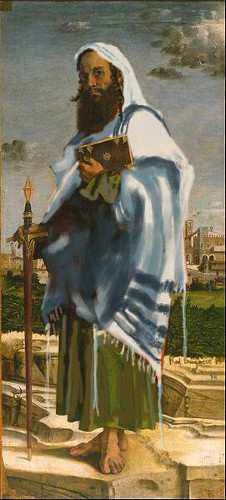
 Morning Meditations