Tag Archives: community

Passover, Messianic Judaism, and Mutual Inclusiveness

Jewish wealth is not houses and gold. The everlasting Jewish wealth is: Being Jews who keep Torah and Mitzvot, and bringing into the world children and grandchildren who keep Torah and Mitzvot.

-from “Today’s Day” for Nissan 9 5703
Compiled and arranged by the Lubavitcher Rebbe, Rabbi Menachem Mendel Schneerson, of righteous memory, in 5703 (1943) from the talks and letters of the sixth Chabad Rebbe, Rabbi Yosef Yitzchak Schneersohn, of righteous memory.
Chabad.org

“The older I get, the more I realize how different it is to be a Jew in a Jewish place as opposed to a Jew in a non-Jewish place. It’s definitely a different feeling in terms of how freely you can be yourself and celebrate your culture and religion.”

-Natalie Portman

I have tried to pull back from my formerly self-imposed obligation of writing and posting a “morning meditation” each day (except for Shabbos). I typically plan to write only one or two blog posts each week. But I realize that, perhaps below the level of conscious thought, I’m actually leaving room in my schedule for those things I write spontaneously when I come across a compelling topic…

…like Jewish identity.

Jewish identity and the approach of Pesach (Passover). What do they have in common besides the obvious?

Our Sages assert that the Israelites in Egypt were on the lowest level of spiritual impurity. They worshipped idols. They were debauched and dissolute. So how did they merit the grand and miraculous redemption?

They had only three things going for them: They kept their Hebrew names, their Hebrew language, and their distinctive Hebrew dress. In other words, they retained their Jewish identity.

Wait a second! Didn’t you cringe when you found out that the biggest Ponzi scheme in history had been perpetuated by someone with a distinctly Jewish name? Wouldn’t we have preferred that instead of retaining his Jewish identity he had changed his name to Christopher Johnson?

What is the redemptive value of Jewish identity?

-Sara Yoheved Rigler
“Jewish Identity: Are You In or Out?”
Aish.com

In Christianity, one is redeemed by God due to faith in Jesus Christ. It’s not who we are, for Christ accepts everyone, regardless of heritage, background, nationality, language, walk of life, and so on. You aren’t saved by who you are but by what you believe, almost regardless of what you do about it (though to be fair, I know Christians who expect believers to live a transformed life in response to their faith).

But what Sara Yoheved Rigler is suggesting, is that Jews are redeemed by who they are, particularly in their outward appearance. What redeemed the ancient Israelites (according to the Sages) is that, regardless of worshiping idols and being enslaved, they retained an obvious Jewish identity.

Seems crazy, huh?

But according to Ms. Rigler, this isn’t just an issue for the Jews of antiquity, but it is a critical question for modern Judaism.

The question assumes particular importance in our generation. Indeed, the rates of adultery, domestic violence, addiction to drugs and porn, and murder for reasons as trifling as being cut off in traffic have skyrocketed in this generation. An objective look at our moral standing would produce a grim assessment.

Judaism promulgates a teleological worldview – that history is moving toward a specific goal, namely, the Redemption, or the Messianic era. So how can a generation as dissolute as ours be redeemed?

jewish-davening-by-waterI’ve written before about the necessity of a Jewish community for Messianic Jews and that one of the critical purposes of Jewish community for Jews in Messiah is to prevent them from being cut off from the world-wide community of Jews. But no matter how much or how well I think I’ve made my point, it’s one that is difficult for many others, including some Messianic Jews, to accept.

What many people read and hear is that I’m replacing Messiah with Judaism, as if Messiah and Judaism are mutually exclusive terms. Certainly the Chabad don’t think that, although they’d certainly disagree with me about the identity, function, and to a degree, purpose of the Messiah. On the other hand, they certainly expect him to arrive and don’t consider the desire for the coming of Messiah to eliminate their Jewish identity.

So where do we get the idea that Jews must stop being Jewish and stop having community with other Jews when they come to faith in Yeshua of Nazareth as Messiah?

From Christianity and Judaism, historically.

For nearly two-thousand years, any Jew who has realized that Jesus (Yeshua) is indeed the Messiah and desired to worship him and honor him has been required, by the Church (in its many and various forms) to renounce Jewish identity and Jewish practices and convert to (Gentile) Christianity. In its darkest days, the Church has resorted to various sanctions, torture, and even the threat of death to “convert” Jews to Christians. For Christianity, being Jewish and being a Christian are mutually exclusive terms.

To be fair, this is also considered true by most Jewish people. I’ve heard stories that in Orthodox Judaism, a friend or family member is mourned as if they died if they should become a Christian (I don’t know how true this is but I can see the point). Messianic Jews, that is, halachically Jewish people who come to faith in Yeshua as Messiah and yet retain their Jewish identity, continue to perform the mitzvot, and in all other ways, live a completely consistent Jewish life are still thought of as “Jews for Jesus” and tend to be shunned by secular and religious Jews alike.

In the Fall 2013 issue of Messiah Journal, Rabbi Stuart Dauermann wrote an impassioned plea that all Jews in Messiah must consider the Jewish people as Us, not Them, meaning that faith in Messiah should not and must not stand in between a Jew and all other Jews.

And many centuries ago, another Jew made a similar plea:

I am telling the truth in Christ, I am not lying, my conscience testifies with me in the Holy Spirit, that I have great sorrow and unceasing grief in my heart. For I could wish that I myself were accursed, separated from Christ for the sake of my brethren, my kinsmen according to the flesh, who are Israelites, to whom belongs the adoption as sons, and the glory and the covenants and the giving of the Law and the temple service and the promises, whose are the fathers, and from whom is the Christ according to the flesh, who is over all, God blessed forever. Amen.

Romans 9:1-5 (NASB)

The Jewish PaulIn his faith in Messiah, Paul did not see himself as separated from the larger Jewish world or from other religious streams of Judaism. In fact, his love for his fellow (unbelieving) Jews was so great that he would have willingly become accursed and separated from the Messiah for the sake of other Jewish people, that they might see and accept Messiah as Paul did.

For Paul, the Jewish people, all of them, were “us” not “them.” Jewish identity and faith in Messiah were never at odds for Paul. Faith in Messiah was the natural extension of his being a ”Hebrew of Hebrews; as to the Law, a Pharisee…as to the righteousness which is in the Law, found blameless” (Philippians 3:5-6). It’s thought by many Christians that Paul was talking about his past, before “conversion,” since he mentioned his persecuting the church, yet he was speaking in the present tense when he said:

I am a Jew, born in Tarsus of Cilicia, but brought up in this city, educated under Gamaliel, strictly according to the law of our fathers, being zealous for God just as you all are today.

Acts 22:3 (NASB)

”Being zealous for God just as you all are today.” Paul was talking to a crowd of Jewish people. True, they were calling for his death, but that wasn’t because Paul surrendered his Jewish identity and was encouraging other Jews to do likewise, as the false allegations suggested. He remained a devout and faithful Jew and zealous for the Torah. His only “crime” was his fervent desire to also include Gentiles among the community of the redeemed.

Maimonides, in his code of Jewish Law, makes a startling pronouncement. He writes that a Jew who lives in isolation from the Jewish community, even if he keeps all the commandments, is considered a kofer b’ikar, a heretic. The implication is that identifying with the Jewish community is a basic value that underlies all the commandments.

Living among so many Gentiles for so much of his life must have taken a toll on Paul. I don’t know if the concept of kofer b’ikar existed in first century Judaism, but if it did, it may have been another reason the Jewish crowds in Acts 21-22 were so angry at Paul. He was a Jew who, because of his unique mission as an emissary to the Gentiles, didn’t spend a great deal of time in Jewish community. Yes, he went first to the Jew and then also to the Greek, but by the end of his third missionary journey, many Jewish communities in the diaspora were incensed with Paul because of the issue of the Gentiles.

This is a huge issue in Messianic Judaism today. This is one of the vital reasons why Messianic Jews must consider themselves as part of a larger Jewish community, not just a Messianic Jewish synagogue, but the overarching world of Jewry and affiliation and allegiance to national Israel. Even if a Messianic Jew is scrupulous in observing the Torah and faultless in performance of the mitzvot, outside of Jewish community, or more to the point, buried neck-deep in a community of Gentile believers, whether Messianic Gentiles or Evangelical Christians, the very real threat of kofer b’ikar and kareth exists.

Sara Yocheved Rigler

I’m not suggesting that all Messianic Jews abandon their relationship with non-Jewish believers or stop associating with non-Jews in Messianic Jewish religious spaces, but first and foremost, a Messianic Jew must continually grasp tightly to the fact that he or she is a Jew and part of the Jewish people, all of them, everywhere.

In her article, Ms. Rigler goes on to describe the different critical points in history when Jews could and often did renounce their Jewish identity through forced or voluntary conversion to Christianity or to blend in with American culture when emigrating to this country.

That’s why alarm bells rang a couple years ago when a study revealed that 50% of American Jews under the age of 35 would not consider it “a personal tragedy if the State of Israel ceased to exist.” Two months ago an American Congresswoman declared that the Jews of America had sold out Israel in their support of Obama’s diplomatic surrender to Iran’s nuclear program.

Today, the community of Jews in the diaspora and particularly in western nations, could easily be extinguished through assimilation. I don’t believe that’s what God wants but I do believe it’s what most Christians want as long as said-assimilated Jews assimilated into the Church.

But unlike why I, or rather Ms. Rigler said above, it’s not just about appearing Jewish:

Let’s be clear here. God wants the maximum from us Jews: love your neighbor as yourself; keep Shabbos; don’t speak lashon hara; keep kosher – the whole nine yards. But the minimum requirement to be redeemed is to identify as a Jew.

Jewish identity is where you start, not where you finish. Particularly for Jews in Messiah, it must be abundantly clear to all other Jews as well as to everyone else, that the Jewish person in Messiah is Jewish. That’s why it’s (in my opinion) not optional for a Jew in Messiah to observe the mitzvot. While the minimum requirement to identify as a Jew is good, it is much better to go the whole nine yards, so to speak, and to live a life indistinguishable from other religious Jews, regardless if the standard of observance is Orthodox, Conservative, or Reform.

Jewish identity is what prompted Kirk Douglas to fast every Yom Kippur. As he proudly stated, “I might be making a film, but I fasted.”

Jewish identity is what prompted Supreme Court Justice Ruth Bader Ginsburg to post a large silver mezuzah on the doorpost of her Supreme Court chambers.

Jewish identity is what prompted movie star Scarlet Johansson to stand up for Israel at the cost of her prestige as an Oxfam ambassador.

schiffman
R. Michael Schiffman

This morning, Rabbi Michael Schiffman, who grew up in Jericho, NY in a traditional Jewish family, wrote a simple and heartwarming blog post called Finding Yeshua. No, being a Jewish believer and living a life consistent with Judaism, Jewish identity, and affiliation with Jewish community does not replace or reduce Messiah. It simply puts everything in perspective.

Ms. Rigler ends her article this way:

The Passover Seder speaks about four sons. Only one of them is cast as “wicked.” As the Hagaddah states: “The wicked son, what does he say? ‘What is this service to you?’ ‘To you,’ but not to him. Because he excludes himself from the community, he is a heretic. … Say to him, ‘Because of what God did for me when I went out of Egypt.’ For me, but not for him, because if he would have been there, he would not have been redeemed.”

The first Passover marked the birth of the Jewish nation. Every Passover since poses the challenge to every Jew: Are you in or are you out?

If you are Jewish and you are a believer, how do you answer this question? Since I’m not Jewish, it’s not a question directed at me, but as a Messianic Gentile, I believe it is my duty to encourage believing Jews to answer “in.”

The Necessity of Messianic Jewish Community

Orthodox Judaism is the approach to religious Judaism which adheres to the interpretation and application of the laws and ethics of the Torah as legislated in the Talmudic texts by the Tanaim and Amoraim and subsequently developed and applied by the later authorities known as the Gaonim, Rishonim, and Acharonim.

-from the Wikipedia page on Orthodox Judaism

Orthodox Judaism is not a unified movement with a single governing body, but many different movements adhering to common principles. All of the Orthodox movements are very similar in their observance and beliefs, differing only in the details that are emphasized. They also differ in their attitudes toward modern culture and the state of Israel. They all share one key feature: a dedication to Torah, both Written and Oral.

-from Jewish Virtual Library

Note that the image above and all other images of Jewish people in this blog post are not specifically Messianic Jews. I say this so there will be no mistaken attributions assumed.

There have been some conversations going in the discussion sections of a number of my blog posts. They’re too numerous to reference here, but the general themes have to do with Messianic Jewish community, the role of Gentiles within a Messianic Jewish community space, Bilateral Ecclesiology, and just how “Jewish” Messianic Judaism should be.

Opinions span a broad spectrum as the Messianic Judaism and Hebrew Roots movements do themselves, but this morning, I read a rather interesting article that got my attention:

The Orthodox Jewish community has a certain mystique.

Whether it’s because we look, act or believe differently, people are intrigued by stories about the Orthodox Jewish community. Media outlets often oblige but whenever I read these stories, they don’t quite resonate with me. They don’t look like the Orthodox community I know. So I’d like to share a few things that happened to me over the last year that give a more accurate insight into the real Orthodox Jewish community.

My wife and I have experienced fertility problems. We thankfully had been blessed with two children but as they grew older we had been trying for some time to have another child to no avail. One day I was speaking with my rabbi about our situation and I conveyed to him that my wife and I wanted to pursue fertility treatments but because of the steep cost, we were having second thoughts. A few days later my rabbi said that he spoke with an anonymous individual with means in the Jewish community who had agreed to sponsor fertility treatment for young Jewish couples if they could not afford it. He would not know who we were and we would not know who he was. He was motivated purely out of a sense of loyalty to the continuity of the Jewish People.

That’s the Orthodox community I know.

-Shimon Rosenberg
“The Orthodox Community I Know”
Aish.com

As I read through Mr. Rosenberg’s story about “the Orthodox Community I know,” I was struck by how different this would probably seem to most people who aren’t part of this community, and especially to Christians. Even those Christians who are supportive of the Jewish people and of Israel, don’t always understand (how could they?) Orthodox Judaism in general and the devotion of individual people in Orthodox Judaism to their community, lifestyle, and commitments in specific. And even most Jewish people who are not Orthodox don’t always understand the Orthodox.

Seven years ago, had I encountered the woman I am today, I would have pitied her: long sleeves and an ankle-length skirt in the middle of summer; no driving, writing, talking on the phone or cooking from sundown Friday until sundown Saturday; recently married to a man she’d never touched — not so much as a peck on the cheek — until after the wedding. I’d have cringed and dismissed this woman as a Repressed Religious Nut. Now my pity — or at least a patient smile — is for that self-certain Southern California girl I was at 25.

-Andrea Kahn
“What’s a Nice Cosmo Girl Like You Doing With An Orthodox Husband?”
Aish.com

See what I mean?

Christians especially see Orthodox Jews as rule-bound, rigid, odd (to say the least), and on a path that will certainly lead them to Hell. After all, no one can be made righteous through their own acts as we see here:

For all of us have become like one who is unclean, And all our righteous deeds are like a filthy garment; And all of us wither like a leaf, And our iniquities, like the wind, take us away.

Isaiah 64:6 (NASB)

Derek Leman
Derek Leman

On that point, Derek Leman recently wrote a blog post called Our Deeds Are Not Filthy Rags which illuminates this matter and adds quite a wrinkle to the traditional Christian interpretation of the Isaiah verse. Also, Jacob Fronczak’s article “Sola Fide” in the latest issue of Messiah Journal deepens the exploration into this important topic.

I’m not trying to create a commentary on the nature of “salvation” and the differences between Christianity and Judaism, I’m just saying that we can’t automatically dismiss how Orthodox Jewish people (or any Jewish community) see their own relationship with God.

My friend Gene Shlomovich made a similar observation today on his blog:

So, the reason G-d chose Israel is because He already loved them and has promised their forefathers that He will take care of them. Does it make Jews somehow better than any other people? Not at all and it’s not the reason behind G-d’s love for Israel. After all, one parent’s child is not inherently better than a child of another parent. Your child is no more deserving of love than someone else’ – she is just yours. G-d loves Israel not because He has some grand plan and purpose for Israel (even though He does) or because Israel will proclaim her G-d and His Torah to all nations (which she certainly will). Neither did G-d set His affections on Israel because, as Christianity claims, “Israel was chosen to give birth to Jesus” and “to give nations the Gospel”, a useful tool that can be discarded once the chief purpose has been accomplished. No, these are all conditional reasons. G-d didn’t set His love on Israel because Israel was somehow capable of earning G-d’s love by her performance. Instead, G-d loves Israel because He loves Israel – that’s all there’s to it.

Depending on which denomination of Christianity you belong to or to which Christian doctrine concerning the Jewish people and Israel you adhere, you may actually believe that God still loves Israel and has future plans for her, but it’s really all about “the Church.” God may still use Israel, but their relationship isn’t what it once was, and God really loves the Church best.

I’m oversimplifying that viewpoint of course. I don’t have time to go into all of the details and you don’t want to read a ten-thousand word blog post.

But look at this:

Nine months later we gave birth to a beautiful baby girl.

The excitement began early Friday morning and as the day progressed I started thinking about Shabbat. What would we eat? How would I recite Kiddush? Light candles? I remembered hearing about an organization called Bikkur Cholim which means “visiting the sick.” It’s a volunteer-driven charity that looks after the needs of people in hospital. I called them and within a couple of hours someone came to our hospital room with literally bags of food, grape juice for Kiddush, electric candles to serve as Shabbat candles, even spices for havdallah. The food is free and the person delivering it is a volunteer. In the few moments I had to speak with him I learned that he was just a regular guy — an accountant — who takes off Fridays from work to volunteer for Bikkur Cholim. I asked him why he does it and he replied simply that it’s what God wants of us.

That’s the Orthodox community I know.

-Rosenberg

I’m talking about not just God’s love for Israel, but within the Orthodox Jewish community, one Jew’s love for another as well as the community’s love for one Jewish family.

I asked him why he does it and he replied simply that it’s what God wants of us.

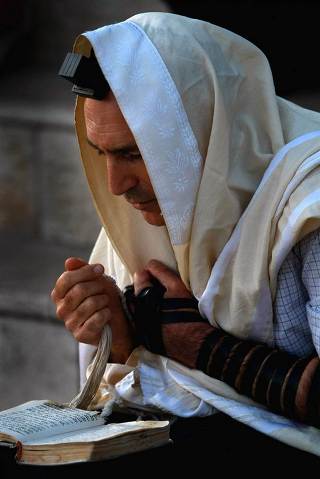
Jewish Man PrayingThat’s the Orthodox Jewish community most of us, particularly in the Church, don’t see.

No, I’m not saying Orthodox Judaism as a practice or a community is perfect. The fact that it contains human beings means it will, by definition, be imperfect, just as any other form of Judaism will be imperfect, just as any of the estimated 41,000 Christian denominations and their members will be imperfect, just as any human community anywhere across time and space was, is, and will be imperfect.

Jews don’t need to be perfect for G-d to be on their side – G-d already loves them as His own people and nothing can ever change it. No doubt, He has disciplined us when we sinned, and He did that many times. However, at the same time, He’s very merciful. He promised that He will not be angry with us forever (Isaiah 57:16). As that Deuteronomy prophecy promised us G-d Himself will “circumcise” the hearts of all Israel after He brings them to the Land. When He does, all Jews will be Torah-observant, to the last one.

-Shlomovich

The statement that Jews don’t need to be perfect for God to love them, particularly in Orthodox Judaism, might take some Christians by surprise. It is generally thought by some of the Christians I know that Jews believe they have to perform the mitzvot perfectly in order to please God.

Again, I’m steering clear of the whole “salvation” issue, and I’m instead talking about love. Please don’t try to “bust my chops” about Christians being saved and Jewish people not being saved. It’s not what I’m writing about and I won’t approve any comments on the topic.

But what does all this have to do with Messianic Judaism?

It has been argued by many non-Jews affiliated in one way or another with Messianic Judaism or Hebrew Roots, that the “Jewishness” of Messianic Judaism should be toned down a bit. Those Jewish people in the Messianic movement who advocate for wholly Jewish communities for disciples of Yeshua as Messiah are putting Judaism first and Messiah second. I myself have quoted Troy Mitchell of Beth Immanuel Sabbath Fellowship as saying:

“One who romanticizes over Judaism and loses focus of the kingdom of Heaven can be compared to a carpenter who is infatuated with the hammer, rather than the house it was meant to build.”

Of course, I usually aim that quote at non-Jews who are so enamored with Jewish practices that they leave faith in Jesus entirely and convert to Judaism, usually Orthodox Judaism. You’d think, given that, I wouldn’t be trying to paint such a rosy picture of Orthodox Judaism here.

But, on the outside looking in, we often criticize things we don’t understand. It’s easy for Christians or just about anyone else to be critical of Orthodox Judaism because we are outsiders. We aren’t like them. We’ve been taught that we should never be like them, and if we tried (by converting or otherwise affiliating with the Jewish community), we would lose our salvation and God’s love.

From an Orthodox Jewish point of view (not that I have that point of view, I just quote articles), God loves Orthodox Jews and, referencing Shimon Rosenberg, Orthodox Jews love each other.

Applied to the Jewish people within the various circles of Messianic Judaism, they are also loved by God and they are also Jews who love each other, both within their specific Jewish communities, and identifying with larger and even worldwide Jewry. That doesn’t mean Yeshua plays second-fiddle to Messianic Judaism anymore than Hashem plays second-fiddle to Orthodox Judaism. From an outsider’s point of view, it seems like an Orthodox Jew’s devotion is to the “rules” first and the will of God second, but as I quoted above:

I asked him why he does it and he replied simply that it’s what God wants of us.

The mitzvot, especially those that are performed for the well-being of other people, are done because ”it’s what God wants of us.”

JewishMost non-Jews in Messianic Judaism and Hebrew Roots, and probably not a few Jewish people in those groups believe that it’s unBiblical, racist, and just plain wrong for Jews in Messianic Judaism to desire a community that is primarily or exclusively Jewish. The fact that Gentiles are “grafted-in” to the Jewish community, once called “the Way” and are considered equal co-participants in God’s love make it almost unthinkable that God would still reserve a “specialness” for the Jewish people and that God would not only tolerate but expect that Jews feel a “specialness” for each other.

Gentiles feel excluded by this sentiment among believing Jews. They (we) feel like we are rejected, inferior, second-class citizens, and “back of the bus” riders traveling on the road to the Kingdom.

To counter this, I can see at some point, a Messianic Jewish writer composing and publishing a small article called ”The Messianic Jewish Community I Know,” describing why it is important to have such a Jewish community for Messianic Jews. Granted, the uniqueness of Messianic Judaism when compared to the other Judaisms in our day (or historically), makes it more difficult to operationalize Jewish community within the larger community of disciples of Messiah, and I think we’re still working that out.

But the consequences of failing to support Jewish community within Messianic Judaism can be (and have been) disastrous.

Now I am speaking to you Gentiles. Inasmuch then as I am an apostle to the Gentiles, I glorify my ministry in order to make my own people jealous, and thus save some of them. For if their rejection is the reconciliation of the world, what will their acceptance be but life from the dead! If the part of the dough offered as first fruits is holy, then the whole batch is holy; and if the root is holy, then the branches also are holy.

Romans 11:13-16 (NRSV)

According to Mark Nanos in his classic text The Mystery of Romans, the problem Paul was addressing in his letter were Gentiles who were flaunting their “freedom” (not being obligated to Torah observance to the level of the Jews) to the Messianic and non-Messianic Jewish populations of local synagogues in Rome, acting as a “stumbling block,” especially for the non-believing Jews who, because of Gentile arrogance, were inhibited from considering, let alone accepting, faith in Yeshua.

While the Nanos view would be considered controversial by many Christians, it does explain Paul’s rather harsh rebuke or even threat (Romans 11:21) to the “grafted in” branches. Paul was passionate for his people, the Jewish people, even his opponents, and Paul said he would surrender his own salvation if it would save some of them (Romans 9:3).

The Jewish PaulPaul never abandoned his people and God never abandoned Israel. We, as non-Jews, may not understand Jewish “choseness” but it exists. We, as non-Jews may not understand the need for Jewish people to have community specifically within a wholly Jewish context, but it exists. I live it out. I live with a Jewish wife. She needs to be a part of our local Jewish community and even though it is sometimes uncomfortable for me, she needs for me to not be a part of that community.

Admittedly, other intermarried couples share synagogue life, even within Orthodox Judaism (look at Chabad), but given my background in Hebrew Roots and my current relationships within different aspects of Messianic Judaism and normative Christianity (and the fact that our little corner of Idaho makes it difficult to be anonymous), it’s best for her that we have a clean line separating me from that part of her life.

I think it’s because I can see that line on a highly personal level and that I’ve gone through the struggle of making it OK for that line to exist and even to be necessary for my Jewish wife, that I can see the necessity for an exclusively Jewish community within the body of Messiah, too.

Humanity, when completely unbound by G-d’s Laws, when unrestrained by fear of Him, when viewing their fellow human beings not as created in G-d’s image but as an unprofitable animals to be destroyed is at its absolute worst. Unshackled from the divine, humanity is driven to satisfy the desires of its lower, animalistic nature. In such a state, human beings have the capacity to do much evil in their rebellion against the Almighty. Since there’s nothing they can do to G-d Himself, evil people can only resort to rejecting, despising and destroying everything that G-d loves and holds dear. This is why, I believe, Jews have suffered so much during the Holocaust and have been an object of hatred everywhere they went and to this very day. Their identification as the people loved and chosen by G-d has made them the perennial target for the worst humanity has to offer.

-Shlomovich

Gene wrote that in response to the question, ”If G-d is with Jews, why did the Holocaust happen?” Maybe I’m being extreme applying it to the current context, but I believe just because we don’t always understand the relationship God has with the Jewish people and that the Jewish people have with each other, we shouldn’t discount it, either. And as Christians, we absolutely should do nothing to destroy Jewish people and Jewish community. We have been warned.

In Jeremiah 31:3, God said to Israel ”I have loved you with an everlasting love,” and in John 13:34, Jesus gave his Jewish disciples a new commandment to love one another as he loved them. Christians generally apply that “new” commandment to themselves (ourselves), the commandment of self-sacrificial love, but I don’t want to set aside the immediate context in which Jesus uttered these words. He was talking to Jewish disciples within his Jewish community. He knew each and every one of them would suffer and all but John would die in excruciating ways for the sake of Heaven. That’s the kind of love the Jewish Messiah and Rabbi from Nazareth wanted each member of his Jewish community to have for all the other Jewish members.

Again, that doesn’t mean this commandment doesn’t have wider implications, but even Paul, the emissary to the Gentiles went ”first to the Jew” (Romans 1:16 for instance), because the Gospel message, the “good news” of the Kingdom of God, belongs first to the Jew and then also to the rest of the world.

In a comment on one of Derek Leman’s blog posts, I said:

That gets back to the one statement you made among your list of questions: “Maybe what they were impassioned about was the hereafter, the blessed age to come, not so much the Messiah.” In my opinion, the focus really wasn’t so much about the afterlife or eternity, but the restoration of Israel under the Messianic King, who would return the exiles, rebuild the Temple, teach Torah, and bring peace to all the nations of the world, with Israel as the head.

That’s something to be impassioned about in my humble opinion.

Christian and JewishIt’s not comfortable to belong to a group where certain members are more special than you are, especially if their being special has to do with an inborn trait such as, in this case, being Jewish. There’s no way to acquire being Jewish except through conversion, so we can never attain that particular position of being special. We can never fully belong to that group in a way that is identical to what the members of that group have between each other.

We Christians balk at that, in part, because anyone can become a Christian and Jewish Christians in the church (as opposed to Jews in Messianic Judaism) are just like everyone else, identical in role, function, and identity. That’s actually not a good thing, and I have had more than one Jewish person tell me that Jewish conversion to Christianity is just finishing the Holocaust that Hitler started.

Which is a really good reason why Messianic Jewish communities for Messianic Jews is so important and so necessary.

I have no desire to participate in any attempt to remove Jewish people as a distinctive people and community from the face of the Earth. That would be like wanting to remove the Jewish identities and specialness of my wife and three children, and frankly, I wish they were more observant and more mindful of their distinctiveness as Jews. This isn’t to say that I don’t want them to also embrace Messiah, but that’s out of my hands for lots and lots of reasons. I must trust in God that He loves my wife and children, not just because He loves human beings, but because He loves Jews.

Paul said “all Israel will be saved” (Romans 11:26). He also said ”If the part of the dough offered as first fruits is holy, then the whole batch is holy; and if the root is holy, then the branches also are holy” (Romans 11:16), meaning (I believe) if the first fruits, that is, the first Jews to come to faith in Yeshua are holy, all Jewish people, all the branches, are holy. While the Church struggles with the plain meaning of that text, I find it gives me some strength and assurance that God won’t throw the Jewish people in general and my Jewish family in specific under some cosmic bus just for giggles. I trust the Apostle Paul that he was using those words to caution arrogant Gentile believers in the Jewish synagogues in Rome that the calluses on the Jewish heart for Messiah will one day be made smooth and they will be healed.

In the end, all I have is my faith in God that, for the sake of the Jewish people, my Jewish people, my family, they will also be healed and saved.

In the meantime, I accept that there are some places my wife must go that I cannot and should not follow. And as objectionable and offensive as some members of my readership (and beyond) find the term “bilateral ecclesiology” and the concepts behind it, I ask that you try to see Jewish people and Jewish community requirements from my point of view, even if you can’t see it from theirs.

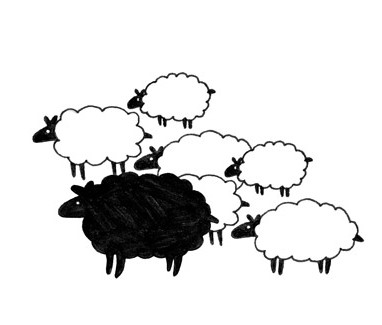
One of These Things is Not Like the Others

One of these things is not like the othersCommunity. It’s that thing, the way of life, that we all want but we’re just not quite sure how to pull it off successfully. It’s that tantalizing concept that promises so much reward, and yet it seems so elusive. Its promise sometimes causes us to cut ties where we are and move somewhere else where we hope to find greener pastures, better friends, and/or become part of a different community. Then when we do get a taste of real community, it’s only a matter of time before our hearts are stunned with hurt or insult. But a lack of community causes us to feel despondent, alone, and often times as if we’re missing out on something significant that was intended for us all along. This community thing can really be disappointing!

-Lisa
“Community Disappointment”
Following the Ancient Paths

I wrote a lengthy response to this blog post, but when I pushed “Post Comment,” I received an error message and my comment was lost forever. It was a rather lengthy comment (go figure) and I suspect the blog application was complaining to me about it. I thought about re-writing the comment but decided to blog instead.

Lisa’s blog post addresses what we should already know. Being part of any group or community is hard work. It’s hard to join, it’s hard to sustain, it’s hard to adapt over time. This includes families, employers, and Lisa’s specific topic, religious organizations.

I can sympathize. A little over a year ago I “went back to church” and in that time have had many interesting, educational, and dismaying “adventures.” But as Lisa’s blog post suggests, this is to be expected. No group that involves multiple human beings is always going to run smoothly.

Over a year apart, I wrote the blog posts Why I Don’t Go to Church and Why I Go to Church, chronicling my internal struggle, the same one Lisa seems to be describing.

We live in a world that seems to praise isolationism, yet we instinctively know that we weren’t created to be loaners (sic). Somehow it’s considered a good thing when we can handle things alone, when we can appear stand tall with a backbreaking burden strapped to our backs, when we live such private lives that nobody knows what is really going on with us. Deep inside we know that it isn’t right to go through life all alone. We wrestle with wanting something yet not wanting the very same thing, pursuing it and rejecting it all at the same time.

-Lisa

As Lisa says, we want to go it alone to avoid all of the messiness of being part of a community, but when alone, we know that being isolated from community isn’t right, either. Sort of a “can’t live with ’em, can’t live without ’em” situation.

The main point of my lost comment was the issue of competing interests. Affiliation with one community may conflict with another affiliation. In my case, I’m a Christian living with Jewish family members while attending a Christian church. How does that work?

Another set of competing interests has to do with entering into and finding a niche within a community. I recently declared that I’m a Christian who studies Messianic Judaism, and yet I attend a very fundamentalist Baptist church in Southwestern Idaho. If you’ve read any of my blog posts about my conversations with my Pastor, you know that although we get along, we disagree on a number of fundamental (no pun intended) elements of what faith in Messiah means, particularly to the Jewish people.

Can a square peg successfully integrate into a church of round holes? Good question.

I recently finished the book Life of Pi by Yann Martel. It tells the story of Pi, born and raised in India, from childhood to adulthood through a series of flashbacks, with the main action taking place aboard a lifeboat shortly after Pi’s family died in a shipwreck in the middle of the Pacific Ocean. Pi is the only human survivor, but finds that he must share the lifeboat with an injured Zebra, an Orangutan, a Hyena, and a 450 pound, male adult Bengal Tiger named Richard Parker (Pi’s father was a zookeeper and they were transporting a number of their animals from India to their new home in Canada).

life_of_pi_by_megatruh-d5noigdThe other interesting thing besides how Pi manages to survive seven months adrift at sea sharing a lifeboat with a Tiger (the other animals didn’t make it), is that as a child, Pi adopted three religious traditions, first Hinduism, then Christianity (Catholicism), and finally Islam. Pi practiced all three religions simultaneously, ignoring the basic tenet of each that these religions are exclusivist. That is, if you belong to one, you cannot also belong to any other religion.

Pi managed to observe each religious tradition in parallel without arousing suspicion for a while, but eventually it caught up with him, and he was finally confronted by all three congregational leaders at the same time in a public place in front of his parents.

When questioned about why he thought he could be a Hindu, a Christian, and a Muslim all at the same time, he responds by saying that he “just wants to love God.” (Martel, pg 69)

The book follows Pi’s life into adulthood and middle age where he is married with two children and a small dog and living in Toronto. He still practices all three religions, with no mention of any conflict in his family or in any of the involved congregations, but “Life of Pi” is a work of fiction and operates often at the level of religious allegory (I still haven’t figured out what the carnivorous island is supposed to mean).

In real life, Pi would never be able to successfully manage practicing all three religions, not only because of the conflicts between those communities, but the likely conflict with his own family, particularly his wife, who almost certainly had formed her religious or irreligious affiliations before she ever met and married Pi.

I have to admit, when I read about the sheer audacity and innocence of Pi’s devotion to three different religious branches, cherishing the best in all three, I felt a moment of admiration and even envy. What would it be like to open your arms wide and to take in and accept humanity’s vast range of traditions in worshiping God just for the sheer love of God?

It isn’t practical, which I suspect is one of the reasons why Martel’s novel is called a fantasy.

But Interfaith communities aren’t unheard of in our world. Author Susan Katz Miller maintains the On Being Both blog which celebrates a variety of interfaith families and communities, but such celebrations aside, one does not easily navigate the stormy seas that occur when theologies, doctrines, and dogmas clash in the narrow straits between one religion and another.

The solution in my own family, as it stands now, is something of a compartmentalization of each religion. In my home, Christianity and Judaism exist in separate silos, rarely communicating across the gap between them for the sake of peace. I do occasionally get emails from my wife containing links to news or information items on Israel or Judaism but I’m very careful not to bring up Christianity.

The ugly times is where our communities can grow stronger, more dedicated to one another, where each member grows in righteousness and in the image of our Master. The challenge is on the table. Are we ready to accept it?

-Lisa

Sesame StreetIt is true that adversity can produce stronger communities, but there’s a line that, if crossed, means that adversity has exceeded manageable limits and is destructive, not constructive. Sort of like lifting weights at a gym to build strength but overtraining resulting in injury, sometimes serious injury.

The television show “Sesame Street” sometimes has a lesson in the form of a song called One of these things is not like the others and I know what that experience is like in spades. There are interfaith communities that (seemingly) successfully co-exist within the same larger group, and there are interfaith families that are created and thrive for decades (such as my own), but that doesn’t mean it’s easy (which is what Lisa’s blog is all about).

But beyond being “not easy,” there are times when “not easy” becomes impossible or at least highly improbable, like a fourteen-year old boy from India who is a practicing Hindu, Christian, and Muslim, or the same boy two years later who manages to survive for seven months in the Pacific Ocean sharing a lifeboat with a large Bengal Tiger. How long can such a relationship between communities last before something gives?

Christmas at Arm’s Length

Interfaith and InclusiveAs always, as an interfaith community, our aim is not to meld, mash-up, mix, water-down or confuse our two religions. Instead, we strive to celebrate each holiday, whether Jewish or Christian, with full respect and all the trimmings. So how and why are these celebrations different from those you would find in any church or synagogue? Often, we begin and end a celebration by reciting our interfaith responsive reading, which is not a statement of creed, but a recognition that some of us are Jews, some of us are Christians, some of us have interfaith identities, and we are all equal members of this community. For me, simply knowing that we are an interfaith community changes my perception of any event: ancient rituals, songs and prayers, shimmer with the newness of radical inclusivity.

-Susan Katz Miller
“Lessons and Carols: Interfaith Community”
On Being Both

It’s Sunday morning as I write this and I’m avoiding church until January. Why? Because of Christmas.

Wait! Let me explain.

While Susan Katz Miller belongs to a community that can honor the different religious observances of its members, I’ve been attending a more traditional Baptist church. I remember hearing about how some of the church members participated in an anti-abortion rally at a new Planned Parenthood building some months back. Among the protesters were people from local Mormon and Catholic churches. My Pastor spoke of the event, but I don’t recall if it was from the pulpit or in a personal conversation with me. He said that a Catholic Priest was one of the speakers at the event and the Priest addressed the group with words something like, “We are all believers” or “We are all Christians.”

The point my Pastor had to make, representing the general perspective of our church, is that, because of the significant theological differences involved, he doesn’t consider Catholics and Mormons as “fellow believers” but rather, as those who are outside the Christian “camp.” Sure, they all came together at the event because of a common purpose, but the barriers constructed between those different faith communities, as far as he was concerned, were firm and inviolate.

I don’t say this to speak poorly about my Pastor or the church I attend. I consider him and the people I worship with to be truly devoted to God and desiring to serve Him in all that they do. However, there are distinct boundaries that contain the church and one may cross those barriers only at their own risk.

Almost a month ago, I called myself a Christian who studies Messianic Judaism. What that means in a nutshell, is that I am a non-Jewish believer in Jesus as the Jewish Messiah, and that I choose to study the Bible within a framework that takes into account the Jewish environment, perspectives, customs, and culture in which the Bible was authored, using that as a lens in filtering my view of Jesus.

As you might imagine, that somewhat crosses one or more of the barriers that contains my church’s theology and doctrine. My periodic meetings and conversations with my Pastor attest to the differences between us, and we’ve been honest that we are both trying to convince the other of our individual points of view.

I must say, I’m learning a lot, not only about church history and the development of fundamentalism in Christianity, but about my own opinions and where they come from. You never learn more about what you believe and why than when you are required to defend it.

Children's Christmas PageantPastor and his wife are spending the rest of the month (or most of it) in Florida to celebrate Christmas with his family. It will certainly be warmer than the December I’ve been experiencing here in Idaho. But that leaves behind Christmas at the church and today (as I write this) there won’t even be Sunday School.

There will be the Children’s Christmas Pageant. The kids have been practicing for about a month and I’m sure they’re looking forward to their big moment.

But that was several days ago as you read this, even though as I am writing, it is still before dawn on Sunday morning.

My family and I left Christmas behind about ten years or so ago and we’ve never looked back. That’s pretty much a given for my wife and kids since they’re Jewish. My married son’s wife is very much into Christmas and while my son doesn’t resist her efforts to put up a tree, lights, and decorations, he doesn’t participate either. The rest of my family just tries to ignore the season, although one of my sister-in-laws has been sending email Christmas cards of a humorous nature to the missus.

I quoted Miller’s blog post because it is a portrait of not blending together different faith traditions into a mixing bowl, but rather, interfaith families choosing to honor each other’s traditions and celebrations without having to surrender anything about their own.

Another member of our community confessed to me this week that he had bought his wife a Christmas present for the first time, after decades of marriage. A most loving and supportive husband, as a Jew he just had not been able to transcend the bitter history of religious conflict and wrap his head around the idea of a Christmas gift. He credited our interfaith community with his shift in thinking, and his ability to finally arrive, bearing a gift from afar.

I never said it was easy, but apparently, it’s possible. It requires a certain amount of willingness and a great deal of courage to overcome the fears and inhibitions of a lifetime. I don’t have a community like that either in my family or corporately, and even if I had access to a corporate community, attendance would conflict with my home life. I’m not even sure how my family tolerates my attending an “ordinary” church.

I’ve chosen a path that I believe is right and that I believe is right for me. In doing so, I have to walk away from all other paths. I suppose, from an outside observer’s point of view, it must look like I’m trying to walk both sides of the street, Christianity and Judaism. This actually isn’t the case. My wife and any Jewish person I’ve ever encountered, consider me a Christian, and so I am. A Christian is simply a person (typically non-Jewish) who has faith that the Jesus Christ of the Bible is the promised Savior and Messiah and the one who will return as the King of Israel and the world.

The only difference, and it’s a big one, is that my perspective of how I perceive God, Messiah, the Bible, and everything all that means, is substantially different from most of the traditional Church (big “C”). Most religious communities permit little or no permeability of their distinctive boundaries and barriers that contain who they are and keep out everyone else. The price of admission is to adopt the theologies, doctrines, and dogmas within their specific container and disavow everything else.

But my container is somewhat unique. Oh sure, a lot of other people occupy my container (more or less) but my container is virtual. It exists “in the cloud,” so to speak. The people who share a large portion of my understanding exist all over the world, but few, if any, are right here in “River City.” And as I said, even if we did get together, it would violate certain family requirements for me to participate in any significant or regular way.

Blogging is about as close as it gets and even that’s dicey sometimes.

One of the requirements contained within the church I attend is Christmas. It’s the day the vast majority of Christians choose to honor the birth of Jesus, and a great deal of custom, tradition, and fanfare surround not only that day, but the entire month in which it occurs.

But it’s not “me.” I don’t resonate with Christmas as a Christian. Watching everyone at church get really excited about Christmas (my Pastor was listening to Christmas music in his office even before Thanksgiving) just accentuates my sense of alienation, my “not-belongingness.”

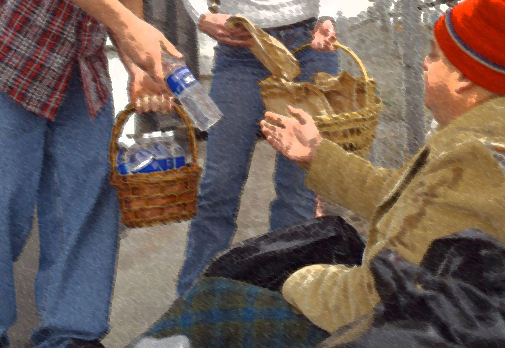
Helping the HomelessI don’t disdain those who choose to celebrate Christmas. In fact, some Christians use this time of year to exceptionally demonstrate their desire to serve God by behaving more “Christ-like” in giving to charity and showing kindness to others. If Christmas is their inspiration for doing good, who am I to argue?

Unlike Miller, I’m not “both,” I’m just “me,” whatever “me” is. Actually, I’m getting a better and clearer picture of what “me” is all the time. The mist is dissipating and the sun is beginning to shine on the path I have selected from all of the paths I’ve considered.

It’s just a path that doesn’t hold very many fellow travelers. And almost none of them celebrate Christmas. I’ll see what church is like after the lights and decorations have come down next month.

Addendum: I just wanted to add that some traditional Christians also don’t celebrate Christmas for a variety of reasons, I for one am not avoiding it out of some sense of paganoia (a term coined by First Fruits of Zion teacher and author Toby Janicki) or the irrational fear that celebrating Christmas automatically makes you an idol worshiper. It’s a matter of personal conviction and taking on board a more Judaic view of the Messiah. It’s as simple as that.

Where Does Faith Go When It Is Lost?

strange-landWhat happens when one day a rabbi discovers that he has lost his faith? Dr. Paul Shrell-Fox, a clinical psychologist and researcher asked himself that question – which turned into to a fascinating study.

Seven rabbis agreed to “talk about it” – three Conservative community rabbis in the United States, and four strictly Orthodox rabbis who live in Israel and have a double identity: Secretly atheists, and rabbis and believers openly.

-Tali Farkash
“Atheists in closet: Rabbis who lost God”
Published 07.28.13, 11:13, ynetnews.com

Over a year ago, I published a blog post on a very similar topic called When We’re Left Behind. It was based on an article written by Barbara Bradley Hagerty for NPR.org called “From Minister to Atheist: A Story of Losing Faith”.

How crushing would it be to love your Pastor or Rabbi, having attended his (or her) congregation for years and growing close to him (or her) as a model of faith, and then to discover that this “Holy person” has no faith in God at all and in fact is an atheist? What would that do you your faith (or mine)?

I don’t want to recycle something I’ve written before, but this brings up some new questions about the nature of religion (as opposed to faith) and how we live it out in our lives. While I certainly can’t deny the social role of church for Christians, we lack (in most cases) the connection to our religious community based on ethnicity, culture, and sometimes race. It is true there are churches that have such a basis, such as African-American churches and Korean churches, but for the most part, the Church as a social entity is just a group of people who (in theory) share the same theology and doctrine about God but who otherwise come from a wide spectrum of social, economic, educational, and employment backgrounds (this probably isn’t true in an absolute sense, but I’ll use it as a general principle for the sake of this essay).

Jewish synagogue life is a different thing because what is being shared is a lot of cultural, ethnic, traditional, religious, and even national and DNA components. It goes back to the difference between “What is a Jew?” and “What is a Christian?” You can’t just say people who have different religions. Being Jewish is enormously more complicated and in some ways, elusive in definition.

So I can see a Rabbi who becomes an atheist having a tougher time in leaving his/her community than a Pastor in the same situation (not that it wouldn’t be really hard on the Pastor as well). From a Rabbi’s point of view, if you are leading a shul in a small community, leaving the synagogue would be leaving behind your entire social, friendship, and possibly family circles. Your entire life, or most of it, probably flows through synagogue life. I suppose something similar could be said of a Pastor as well, but perhaps not quite to the same depth.

How about extending the topic beyond Rabbis and Pastors? My wife says that at our local Reform/Conservative synagogue, the Friday night service is aimed at more secular Jews who connect socially and through traditions, while the Saturday Shabbat service is more for “religious Jews.” The missus even says that some of the synagogue members wish that the current Rabbi would retire/move on (he’s still in his 40s, so is nowhere near retirement age) because he’s “too religious.”

At the opposite religious extreme are the Ultra-Orthodox or the Haredim, who seem to take the slightest infraction of the mitzvot, even among those Jewish people who are not Haredi, so, so seriously, to the point of being abusive and assaultive. It seems like something has gone horribly wrong in certain corners religious Judaism where, on the one extreme, God is all but ignored, and on the other, God is exceptionally tightfisted and punitive, and adherents experience no problem in actually attacking other human beings.

I don’t know if you get that exactly in Christianity, although to be sure, we have churches that are so extremely liberal that God seems like an afterthought and Biblical standards are as fluid as quicksand. We also have churches and groups so hyper-conservative that they too don’t care who they hurt or what damage they do to other human beings, even desecrating the funerals of military men and women for the sake of their distorted theology and need to push their weight around. I’d call that going horribly wrong, too.

It’s enough to make me lose my faith in religious people.

Waiting to danceBut what makes a person lose their faith in God? Of some of the folks and groups I’ve just mentioned, they probably didn’t have faith as such to begin with. Their religious venues are more a tradition-based, cultural, and social outlet, as opposed to a gathering where an encounter with God is sought. At the opposite extreme, it may not be God that anyone is looking for, but the need to impose internal punitive, restrictive, and ultra-conservative standards on the entire environment of human beings. As far as I can tell, God’s chosen method of operation isn’t to either ignore His standards or massively exaggerate them and then force them on others without so much as a by your leave.

I know my Pastor will disagree with me, but I believe we have a choice. I believe we have lots of choices in life, the first or at least the most important being whether or not we are going to have a relationship with God. After that, other choices follow. I believe God is like a Father or teacher (sometimes the roles overlap). Certainly if we act foolishly, we should fear Him, but fear isn’t the primary foundation upon which our relationship is built. Neither is hate. Neither is casualness and pandering to social agendas.

Once we have faith in God, and more importantly, trust, how can we lose that? Some folks say you can’t unless you never had it in the first place:

My sheep hear My voice, and I know them, and they follow Me; and I give eternal life to them, and they will never perish; and no one will snatch them out of My hand. My Father, who has given them to Me, is greater than all; and no one is able to snatch them out of the Father’s hand. I and the Father are one.”

John 10:27-30 (NASB)

That creates a problem because here we see people, Pastors and Rabbis, who have lost their faith (although Jews, because they are born into covenant, are accountable whether they have faith or not). Did they have it in the first place or did something else happen? What if they actually have faith somewhere at their core, faith in God that is, but lost something else instead? What if they lost their faith in religious people or the mechanics of religion?

I don’t think I could lose faith in God but there are days I’d throw religion and religious people out the window, slam it shut, lock it, and never look out again. A life in community, whether in person or online, can be really frustrating at times. We have all of these high ideals about love, companionship, worship, and holiness, but our real lives are so messy by comparison. We don’t always treat each other well, even when we intend to.

Some people are cranky by their nature or because they have adopted a victim stance and out of that, are perpetually defensive (I know bloggers who write out of that position pretty much all the time). Some people are generally OK until you hit one of their “hot button topics,” and then watch out (I wonder if that’s how I’m going to be next week in Sunday school?). Being in community with religious people is like walking through a mine field or living in an alcoholic family. You never know when the peace will be shattered by an abrupt and devastating explosion.

If I ever lost my faith, it wouldn’t be in God, it would be in human beings.

“You must not lose faith in humanity. Humanity is an ocean; if a few drops of the ocean are dirty, the ocean does not become dirty.”

-Mahatma Gandhi

There are times when I think it’s the ocean that’s dirty and only a few drops are clean.

Until you can see the good within a person, you are incapable of helping him.

-Rabbi Tzvi Freeman
“Helping”
Based on letters and talks of the Rebbe, Rabbi M. M. Schneerson
Chabad.org

desert-islandAnd sometimes that’s an amazingly difficult thing to do. Reading quotes from Gandhi and Rabbi Freeman present a very pleasant picture, but life in the trenches of religion is anything but, at least for those folks who are struggling with faith (and don’t we all at some point).

I know why a Rabbi and Pastor (or probably just ordinary people) would stay in their religious communities after they’d lost faith in God…because of the continued social rewards. Most people who lose faith in people but not God would just leave the community and either try to find another or bail on community life entirely. But what if community life fails you but you still find God is present within the synagogue or church? What do you do then? Are you even aware that it’s God who’s holding you there? Maybe what feels like losing faith in God is just a protracted silence? God doesn’t always talk. But we’re supposed to have faith in the desert too.

I don’t have all the answers. Sometimes I don’t even know the right questions to ask. I just know that this religious life that is supposed to bring us closer to God isn’t pain-free, and it seems for some folks that the pain increases exponentially as we strive to approach Holiness. Maybe that’s why most religious people hit a comfortable plateau and just stay there, neither being too hot or too cold in their spirituality, but only lukewarm. Maybe that’s why some people quit completely, because being numb is better than being set on fire and writhing in the flames.

Where are the Gandhis and the Freemans with their soothing, supportive words? Where is the so called “community of faith?” Where is God?

The fault, dear Brutus, is not in our stars, but in ourselves…

-William Shakespeare
“Julius Caesar (I, ii, 140-141)”

The First and Second Shema

Jewish_men_praying2The most obvious difference between the two sections is that the first simply instructs the Jew to pursue his or her relationship with G‑d, without promising reward or threatening punishment. The second section, while enjoining us to do the very same things as the first, informs us of the benefits of doing so (“I will give the rain of your land in its due season . . . and you shall eat and be sated”; “In order that your days be multiplied . . . upon the land”) and warns us of the consequences of transgression (“He will stop up the heavens”; “You will soon perish from the good land”). Other than that, however, the second section seems a repetition of the first, with only minor differences in wording and syntax.

Rashi, in his commentary on these verses, cites several further examples of how the second section introduces a concept or injunction not included in the first.

In the second section, the commandment to love G‑d is given in the plural (“with all your hearts and with all your souls”) rather than the singular (“with all your heart, with all your soul”) employed by the first section. The first section, explains Rashi, is an injunction to the individual, while the second is an injunction to the community. (This difference is repeated throughout the two sections. The Hebrew language distinguishes between second-person singular and second-person plural, as Old English does with “thou” and “you.” The entire first section speaks in second-person singular, the second section in second-person plural.)

-Rabbi Yanki Tauber
“The Second Chapter of the Shema”
Based on the teachings of the Lubavitcher Rebbe, Rabbi Menachem Mendel Schneerson
Chabad.org

According to this commentary, a Jew is obligated to recite the Shema each morning and each evening of his life. Accepting that, why am I writing about the Shema? For that matter, as a Christian, why am I writing about the Torah and Judaism? Derek Leman recently wrote a blog post emphasizing lengthy and careful Torah study for Christians which I also commented upon. Nothing in the Bible is irrelevant, although some portions cannot be acted upon today by any Jewish person (or anyone else) and some portions can only be acted upon by Jewish people.

I’m also interested in the Torah pursuant to my desire to answer my Pastor’s question what is the purpose of the Torah, especially for Messianic Jews?

Reading Rabbi Tauber’s commentary, I was provided with a few clues about the application of the Shema and thus the Torah in the lives of observant Jewish people.

This isn’t going to be a scientific or academic response. I lack the educational “chops” for such an analysis and frankly, as I write this, I’m pretty tired, not having gotten enough sleep last night. My brain is foggy. Don’t expect a lot. I suppose I should delay in writing this, but the drive inside me has other ideas.

Rabbi Tauber lists many different ways to interpret the first and second sections of the Shema, but I want to focus on the emphasis between the text being directed at the individual Jewish person vs. the Jewish community.

Jewish individual vs. community devotion to God and observance of the mitzvot is a unique concept. Christianity doesn’t really have such a viewpoint. Oh sure, there’s the concept of what we do as individual Christians as opposed to Christian community activity, but it just doesn’t “feel” the same. Christianity doesn’t convey the same cohesive identity that Judaism does. Further, we don’t have a focused set of commandments that delineate the duties of individuals in the church in contrast to the body of believers as a whole.

According to Rabbi Tauber, there is such a thing for Jews and Judaism.

The most obvious difference between the two sections is that the first simply instructs the Jew to pursue his or her relationship with G‑d, without promising reward or threatening punishment.

The directive to the individual Jewish person relative to the Shema and the Torah is an instruction to pursue a relationship with God. Period. No mention of punishments or rewards. Is that supposed to tell us something about how God responds to the virtues or the failures of an individual Jewish person? Maybe not, but keep that in mind.

The second section, while enjoining us to do the very same things as the first, informs us of the benefits of doing so (“I will give the rain of your land in its due season . . . and you shall eat and be sated”; “In order that your days be multiplied . . . upon the land”) and warns us of the consequences of transgression (“He will stop up the heavens”; “You will soon perish from the good land”).

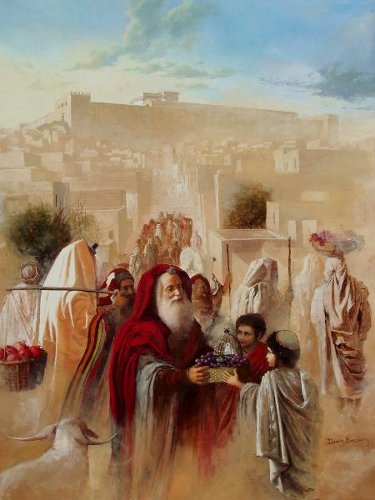
ancient_jerusalemThe second section seems to say more or less the same as the first except that it’s directed at the community of Israel as a whole and that it includes rewards and punishments for obedience or failure to obey (for length, I’m not quoting everything from the article that supports my points, so you’ll need to read the source to “fill in the blanks”).

The story of the Bible does mention individual Jewish people such as Abraham, Isaac, Jacob, Joseph, Moses, Aaron, and so on, but the grand, overarching epic is really the story of collective Israel. It’s Israel that is blessed by God, or Israel that is sent into exile. Solomon builds the Temple for Israel, or the Temple is destroyed to punish Israel. Individuals play their parts and individuals are blessed or suffer, but it’s really the consequences to the nation, for good or for ill, that are at stake.

Why?

In the second section, the commandments to don tefillin, study and teach Torah and affix mezuzot immediately follow the warning that “you will swiftly perish from the good land that G‑d is giving you.” This, says Rashi (citing Sifri), is to teach us that also after you are exiled, you must distinguish yourselves with the mitzvot: put on tefillin, make mezuzot, so that these not be new to you when you return.

Taken on its own, the first section implies a connection to G‑d only through the Torah and its mitzvot as observed in the Holy Land. We need the second section to tell that all this is equally applicable in exile.

The first section describes a relationship whose relevance we can assume only under conditions of closeness to G‑d: when we dwell secure in the land that “G‑d’s eyes are constantly upon,” and when He manifests His presence amongst us in His holy home in Jerusalem. But when He hides His face from us and banishes us like children exiled from their father’s table, our ability to love Him, to comprehend His truth and to implement His will can be questioned. Indeed, we cannot even assume that these precepts are meant to apply to such conditions of spiritual darkness.

Not so the second section. Because the relationship is one of our making, because it stems from within, it becomes ingrained in our very essence. Integrally us, it persists wherever and whenever we persist.

There seems to be differences in application between the first and second section of the Shema based on whether or not Israel, collective Israel, is in exile. To be sure, there is no collective Israel if there isn’t a response from the many, many individual Jewish people, but it’s Israel in exile. Some individual Jews have it better and some worse in the diaspora. Look at the differences in life for Jews in America vs. in the Arab nations or some European countries.

My Pastor lived in Israel for fifteen years and in his experience, when Jews made aliyah, they had one or two responses: either they became more religious or they stopped being religious completely. In Israel, as a Jew, you don’t have anything to prove. Of course you’re Jewish. You made aliyah. You live in Israel.

But the instruction from the Shema for Jews in exile is another thing.

In the second section, the commandments to don tefillin, study and teach Torah and affix mezuzot immediately follow the warning that “you will swiftly perish from the good land that G‑d is giving you.” This, says Rashi (citing Sifri), is to teach us that also after you are exiled, you must distinguish yourselves with the mitzvot: put on tefillin, make mezuzot, so that these not be new to you when you return.

daven-tefillin-siddurWhat has helped the Jewish people survive as the Jewish people throughout each long exile from their Land? For the last nearly two-thousand years, it’s been obedience to the mitzvot; carving out a uniquely Jewish lifestyle that separates them from the peoples of the nations. This may be one of the reasons why halachically Jewish people, particularly those who were born and raised in observant Jewish households, and who have the benefit of a Jewish education, object to non-Jews taking on behaviors reflective of the Jewish sign commandments (wearing tzitzit publicly and so on) and engaging in what one Christian blogger has referred to as Evangelical Jewish Cosplay.

“Messing around” with someone else’s survival mechanism is likely to result in a very strong and unpleasant response.

Which is what we often see in clashes between Jewish Messianic Judaism and Gentile Hebrew Roots. Often non-Jewish people fail to appreciate the collective historical “consciousness” of the Jewish people. I remember sitting in the local Reform synagogue around the time the film The Passion of the Christ (2004) was released. There was tremendous fear in that room about how the local Christian community, not to mention the worldwide Christian community, would respond to that film, particularly in their (our) interactions with Jews.

You wouldn’t imagine that one film would inspire so much anxiety, but historically, after every passion play, there has been a pogrom. It was as if their grandfathers and great-grandfathers and the elders of Israel were whispering in the ears of every Jewish person in shul that morning, telling them of the horrors they had experienced in decades and centuries past. “They’ll watch this film, then something terrible will happen,” they might have been saying to their grandchildren. “I’ve been through this before. I know,” said the plaintive voice.

There’s something woven into the subconscious and in the marrow of every Jew that responds to what has threatened the community of Jews across the ages.

The Torah and the collective lifestyle of Judaism has preserved individual Jews and the Jewish community for untold centuries all over the world. At the core, you can’t really completely separate a Jew from the Torah, anymore than you could take away a person’s eye color or blood type.

There’s a reason why Jews are obligated to recite the Shema twice daily. There’s a reason why there’s a tremendous amount of repetition built into Jewish observance of Torah and of prayer.

If you were to observe large numbers of individual Jewish people in their lives, you would see the scale of religious observance run the gamut from no observance at all as an atheist to an extreme attention to every tiny facet of halachah in Orthodox Jewish life.

That’s the life of an individual Jew as addressed by the first section of the Shema. Individual Jewish people can be observant to one degree or another or completely unobservant. They’re born into covenant, like it or not, but they make choices just like everybody makes choices. An individual Jew may live or die, old or young.

shoahBut collective Jewry has always survived perhaps because, especially at “crunch time,” when the world is doing its best to exterminate all Jews from the face of the earth, Jews rally, the Jewish community unites, they seek distinction and uniqueness, because being Jewish together insures that Judaism will survive, even if some individual Jewish people reject their heritage. Even if individual Jews die Jewish people and Judaism continue.

In Israel, a Jew may not have so much to prove because they are Jewish in the Jewish homeland, but everywhere else, in order to be Jewish, they must not take being Jewish for granted. Every time that’s happened, bad things have resulted.

If you want to see just how “Jewish” a Jewish person is, try to take that Jewishness away from them or claim it for your own as a non-Jew. What God built into the Jewish people from the beginning will erupt. Sometimes, such as when assimilation threatens, that’s not only a good thing, but it’s necessary for survival.

And God intends that Judaism should survive. If you want to know one of the purposes of the Torah and particularly the Shema, that’s a really being one.