Tag Archives: D Thomas Lancaster

Sermon Review of the Holy Epistle to the Hebrews: Ten Testimonies

In the first two chapters of the Epistle to the Hebrews, the writer of the epistle employs ten proof texts drawn from the Torah, the Prophets, and the Writings to make his case that Messiah is more exalted than angels. In this teaching, D. Thomas Lancaster connects the dots between the ten passages to reveal the larger message. A fun exploration of apostolic methods of Bible interpretation.

-D. Thomas Lancaster
Sermon Six: Ten Testimonies
Originally presented on February 2, 2013
from the Holy Epistle to the Hebrews sermon series

Each of Lancaster’s sermons about Hebrews seems to have a different emphasis, sometimes radically different. Last week, we focused on a Judaic study of Christology, if we can say there is such a thing. This week, we use the “midrashic method of Bible study,” as Lancaster says, to prove a simple statement: Messiah is greater than the angels.

Actually, Lancaster’s explanation for the distinction between how Christians do Bible study and how Rabbinic Judaism approaches the same task is worth the price of admission alone. It’s the reason (or one of them) why I’m doing a review on the Meaning of Midrash, humble though it may be, based on a series written by Rabbi Tzvi Freeman. It’s not just the way religious Jewish people study the Bible, it is, according to Lancaster, the way the Bible was studied in the Apostolic era; it’s the way that the writer of the Book of Hebrews wrote the Book of Hebrews.

Thus, in order to understand the Book of Hebrews, we need not only to understand something about midrashic Bible study, but we need to apply that method when we read the Book of Hebrews. Otherwise, we’re going to sail right past the meaning and come up with (probably) some pretty goofy conclusions.

This is also why many, many Christians Pastors and scholars, people who are very smart, well-educated, and well-read can be firmly convinced, based on educated and rational grounds, that they know what the Book of Hebrews is saying and yet still (probably) be very, very wrong.

I should note at this point that the very first person to comment on part one of my “Reviewing the Meaning of Midrash” blog post took Christianity/Messianic Judaism to task, rather severely so, for our use of Rabbinic commentary to “prove” Yeshua was Messiah and that Messiah was/is Divine. I can only conclude that any further mention of Midrash from a Christian (me) is going to be viewed unfavorably among Jewish people. I mean no offense, though I understand (to the best of my ability) why you experience offense from me. However, this is the only way I can say what I’m trying to say right now.

Be that as it may…

This kind of goes back to what I said in The Two-Thousand Year Old Christian Mistake. If the most fundamental foundation by which we understand the Bible and our Christian faith is in error, then our theological and doctrinal conclusions are also very likely to be in error. In fact, it’s by the grace of God and the Holy Spirit that the Christian Church continues to serve God just as, I believe, observant Judaism continues to serve God, even though most Jewish people do not currently recognize the Messiah’s face or voice.

So what is the “midrashic method of Bible study” according to Lancaster?

    1. A Rabbinic dissertation or midrash attempts to solve some sort of identified “problem” or topic in the Bible.
    2. The solution is stated and then a series of proof texts are presented to support the solution.
    3. The proof text references assume that the audience has memorized large portions of the Bible, since typically only a short phrase or sentence from each proof text is presented.
    4. Keyword associations are used to link the proof texts whereby portions of scripture are deconstructed and then reconstructed to create new meanings (which can be terrifically unsafe).

And this is how Lancaster says that the Bible was studied in Apostolic times. If he’s right, then the traditional methods of Bible study we employ in our churches are nowhere near what is required to understand the apostolic texts including the Book of Hebrews.

Some of you think that’s a big “if.”
Talmud Study by LamplightLancaster presented ten proof texts along with their explanations and yes, they’re very involved. It would make a very long blog post if I were to try to replicate his commentary here, plus it would be very unfair, since such a detailed review might make it unnecessary for you to actually listen to his sermon.

Here’s the goal of these proof texts again: To prove the Son, that is Messiah, is superior to the angels…not necessarily in the world today, but in the world to come.

…having become as much better than the angels, as He has inherited a more excellent name than they.

Hebrews 1:4 (NASB)

You’re probably thinking of Philippians 2:9-10 where it says, “God highly exalted Him, and bestowed on Him the name which is above every name, so that at the name of Jesus every knee will bow,” but according to Lancaster, you’d be wrong. The inherited name is the “Son of God.”

How do we know this? Start in Psalm 2.

Like I said, it would take a lot of space and be very complicated to go through all of these connections and compress a nearly fifty minute sermon into a few paragraphs (OK, more than “a few”).

But Lancaster uses the Rabbinic associative method to link Psalm 2 to 2 Samuel 7 where it speaks both literally of Solomon and prophetically of Messiah, Son of David, building a house, which can be both a house and a family or congregation.

The linkage got kind of tricky when we arrived at the third text Deuteronomy 32:43, because the writer of Hebrews used an alternate version found only in the Septuagint, and almost all of our Bibles use the Masoretic text. However, the quote references the joy of both the Jewish people and the Gentiles, which is important later in the study and important in general.

D. Thomas LancasterIt also speaks of the angels worshiping Messiah, which connects to the fourth text, Psalm 104 quoted in Hebrews 1:6. Lancaster was speaking fast and furious, so it was tough to take notes on everything he said (his speaking notes would be a great download to offer with the recording for people like me). This point goes back to point two when it speaks of a Throne and a Kingdom forever and is echoed in text five, which is Psalm 45, Solomon’s wedding song. This is also a Messianic prophesy since it addresses the Son of David. It also speaks of the Throne and the Scepter.

An apparent contradiction is revealed since Hebrews 1:10-11 states everything that God has made, both Heaven and Earth, will be destroyed so that only God remains, but the sixth proof text, Psalm 102 tells us that Hashem’s Throne will last forever, even when everything else perishes, as is stated in verse 12. Verse 18 of this Psalm says the words were recorded for a future generation, which Lancaster says is us, we who are servants and children who will also be eternal with God.

Proof text seven is Psalm 110 and the key in this scripture is not just that Messiah is sitting at God’s right hand but that the Throne we have been referencing is God’s Throne and is also the Throne of Messiah, which is how Messiah’s Throne can be forever.

The next referenced text is Psalm 8 which is quoted in Hebrews 2:5 and speaks of all things subjugated to the Son, but this is not apparent now because we are reading about the age to come.

Text nine is Psalm 22 which is the classic prophesy of the suffering and crucifixion of the Son. Verse 22 says the Son has brothers and verse 23 identifies some of those brothers, the congregation as “you who fear the Lord,” which is taken to mean God-fearing Gentiles. Verse 24 follows up with identifying the offspring of Jacob, the Jewish people also as that congregation.

While Psalm 22 says that God has not hidden his face from Messiah, the tenth proof text, Isaiah 8 says God has hidden his face, in this case, speaking of the current exile of the Jewish people…but the exile will not last forever.

The conclusion of the lesson ties everything up, but you need to listen to the sermon to get Lancaster’s summarized points in his own voice along with all of the details I had to leave out of my review. However, the big point, like in the last couple of sermons, is that the original audience of Hebrews as well as we modern readers, should place our hope and faith in Messiah, so that we will become part of the body of his servants, of his children, his congregation, and be built up into a house for Hashem.

What Did I Learn?

As I mentioned above, it wasn’t just Lancaster’s whirlwind tour of the Bible that I found illuminating, it especially was the method he used to open up the scriptures. I won’t pretend that there aren’t a lot of pitfalls, trap doors, and sinkholes in employing this method, especially when traveling at rocket-like speed through different parts of the Bible, but if indeed we can say this replicates how the apostles and disciples would have understood the New Testament (or all scriptures) in general and Hebrews in specific, then there are also many definite advantages.

Glasses on Open BibleAs I’ve said previously, this isn’t going to sit well with people who are used to studying the Bible through normative Christian processes. It’s not that Christians don’t have a rich and well-defined scholarly approach to Bible study, but the premise upon which Christianity builds that study may not lead down the path of the original author’s intent and what the original audience, especially a first century Greek-speaking Jewish audience, would have heard.

But what about the guidance of the Holy Spirit? I’ve said before that the Holy Spirit can guide us, but I don’t think He will overwrite our free will. If we are determined not to see a particular perspective, even if the Spirit is pointing our nose right at it, then we won’t see it. We have the Bible and we have the Holy Spirit, but we also have free will and the desire to confirm what we think we already know, rather than (sometimes) learn what God really has to say to us, especially if it is unexpected or contrary to long held belief and tradition.

As I also said above, this re-enforces my desire and intent to review the Midrashic approach to scripture as presented by Rabbi Tzvi Freeman and Chabad.org. That doesn’t mean that everything R. Freeman teaches and everything the Chabad believes completely or even greatly meshes with the study on Hebrews, but at least gaining some additional familiarity with how Rabbinic interpretation works, especially if indeed this is how Hebrews is written, may well give those of us who don’t have the benefit of a classic Jewish education a bit of a leg up.

What Galatians Means to Christians Today

Some men came down from Judea and began teaching the brethren, “Unless you are circumcised according to the custom of Moses, you cannot be saved.”

Acts 15:1 (NASB)

Also, in the eyes of most Jews, the statement of Acts 15:1 seemed incredibly obvious. One does not come to Hashem except through Judaism.

-from Book Review: The Irony of Galatians

Even after I publish a particular blog post, I tend to obsess over it a little bit, searching for typos, finding a sentence that could be improved, that sort of thing. I try to do all this editing beforehand, but sometimes things slip by.

That includes the above-quoted statement. Today, religious Judaism is adamant that of the three monotheistic faiths in existence, they do not require others to convert to their religion in order to merit a place in the world to come. You can be a righteous Gentile and in obedience to the Noahide laws, you can have a place in the coming Kingdom. No need to actually convert to Judaism at all.

I realized that even in the days of the Apostle Paul, this was also true in some sense. It’s been suggested that some version or variation of what we call the “Noahide laws” today existed back then and was the operational guide for God-fearing Gentiles who populated the diaspora synagogues alongside the Jews and proselytes.

But I can only imagine that being a first-century God-fearer and seeing the awesome beauty of the Torah, watching Jewish men davening in a minyan, experiencing the joy of just hearing the prayers in Hebrew, contemplating the amazing link that each Jewish person had to thousands of years of the history of God’s interaction with Israel all the way back to Moses must have been an incredible lure. How many God-fearing Gentiles in response to their time in the synagogue started down the road of the proselyte ritual that culminated in converting to Judaism, so that they could say “My Fathers” rather than “their Fathers?”

I’ve been looking at Mark Nanos’ book The Irony of Galatians as it impacts my view of the actual epistle written by Paul and its intent toward the believing populations in the area of Galatia in that day. But what impact does it have on Gentile believers who worship among Jews today?

I’m specifically thinking of Messianic Jewish congregations, those few of which I’m aware that are “owned and operated” so to speak, by halakhic and observant Jewish people who are disciples of Yeshua as Messiah. What is it like to be a Gentile, a fully equal co-participant in Jewish worship and community life, and yet not to be Jewish?

For that matter, what is it like to be a Gentile believer in one of the variations of Hebrew Roots community life, be attracted to Jewish practice and the Torah, but find that the vast majority of people around you only have a so-so understanding of what that means and especially how to properly practice a Judaism (this isn’t absolutely true of all Hebrew Roots groups, but it is true of the majority of those I’ve personally experienced)?

A non-trivial percentage of those Gentiles have left either Messianic Judaism or Hebrew Roots and like some of the first century God-fearing Gentiles, proceeded with the proselyte ritual, usually within Orthodox Judaism, and converted to that identity and that faith.

They too have missed the warning that Paul was issuing to his Gentile addressees in his letter to the Galatians and allowed themselves to “desert Him who called them by the grace of Christ for a different gospel, which is really not another gospel at all.”

In a Jewish or Jewish-like worship venue, especially with the involvement of traditional Jewish worship, study, and community practices, it can be easy for some folks to confuse Judaism for faith.

That was the point of Paul saying in Galatians 2:3 that Titus, a Greek who came to faith in Yeshua, specifically wasn’t compelled to be circumcised (convert to Judaism). It’s why Paul cited Genesis 15:6 as recorded in Galatians 3:6 that it was by Abraham’s faith God reckoned to him as righteousness before Abraham was circumcised.

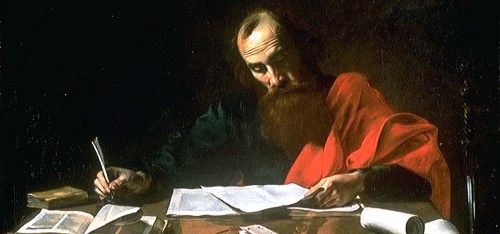
PaulAccording to most New Testament scholars, Paul likely wrote his letter to the Galatians before the events recorded in Acts 15 so it could appear that Paul was very much “shooting from the hip,” because the formal halakhic ruling regarding the legal status of Gentile Yeshua-believers within the Jewish worship and community context of “the Way” had not yet been issued. But Paul’s authority and assignment as the emissary to the Gentiles came directly from Messiah in a vision as we have preserved for us in Acts 9. If we can depend upon anyone to understand who the Gentiles were to be as worshipers of Messiah among the Jews, it is Paul.

His letter was a response to the confusion and dissonance that was occurring between believing Gentiles and non-believing Jews (this is according to Nanos in his “Irony” book) in the Jewish communities in the region of Galatia. The synagogue was the only proper setting for the new Gentile believers to learn Torah and thus begin to understand the teachings of the Master, and this decision was eventually confirmed in the words of Acts 15:21. But while being a Gentile God-fearer was most likely a reasonably well-defined role, being a Gentile believer of the Jewish Messiah was not, especially to those Jews who did not share in that faith and quite possibly for some who did (see Acts 15:1).

Several of D. Thomas Lancaster’s sermons in the Holy Epistle to the Hebrews series address a very simple message of the writer of Hebrews to his Jewish audience in Jerusalem. The message says to pay attention to what we have learned and not to drift away from our faith in Messiah, lest we grow cold in faith and distant from the lover of our souls. That distance can make us mistake who really loves us and like the addressees of Paul’s letter to the Galatians, we may think Judaism is our goal rather than Messiah, the living Word of God.

The traditional Christian interpretation of Galatians (I know I’m over-simplifying it) is that Paul was attempting to convince both believing Gentiles and believing Jews that the “Law was dead” and replaced for everybody by only faith in Christ Jesus, inventing a new identity in the Jewish Messiah for one and all, and eliminating Jewish identity for Jews entirely. That’s very much like throwing out the baby with the bath water.

Looking at the letter as Nanos sees it, it’s a cautionary tale specifically to the Gentiles not to confuse Jewish Torah observance and community life for the practices that accompany a Gentile faith in Messiah. Yes, many of the blessings and observances are identical for Jewish and Gentile disciples of the Master, but the identities are not. This is a warning we can heed today, especially those of us who though not Jews are still attracted to Jewish studies, the Torah, the Talmud, and the wisdom of the sages.

The main reason Nanos wrote his book was to publicize an apprehension of Paul’s “voice” that did not give rise to anti-Jewish, anti-Judaism, and anti-Torah sentiments, that enhanced the relationship between Christians and Jews rather than divide them, and in honor of all the Jewish people across the long centuries who have suffered and died because (directly and indirectly) of the historical and traditional interpretation of Paul’s letters by the Church.

Even as Nanos attempts to penetrate Christian history and tradition through scholarly means in order to contribute to righting many terrible wrongs, Boaz Michael, President and Founder of the educational ministry First Fruits of Zion (FFOZ) approaches the same goal through a more “grassroots” method as he writes in his book Tent of David. This sends people back into the church with the same message, that we have been misreading Paul for a very long time and the result has been disastrous on an epic scale.

leaving-the-churchWe can correct the course of history by the grace of God, but we need to be willing to change. We need to be willing to see Paul in a radically different way as compared to Church history and tradition. We need to grant ourselves the ability to set aside our long-held preconceptions about what the Bible is saying and we need to resist two things: the desire to stay “safe” by digging in our heels and not even considering that Christian interpretive traditions could be wrong and, for those Gentiles attracted to Judaism in some manner or fashion, to resist the desire to abandon the Church, Christianity, and even Christ and embrace a fully Jewish identity through conversion.

Neither option is correct. We cannot summon the Messianic future by holding on to an interpretive tradition that was born out of supersessionism and anti-Semitism, nor can we do so by exiting Christianity and the nations entirely and converting to Judaism as our only way of serving God.

I’ve referenced Rabbi David Rudolph in a number of blog posts including An Exercise in Wholeness, Twoness and Oneness: From Sermons by David Rudolph, and Oneness, Twoness and Three Converts to describe how observant Jews, particularly in the Messianic framework, and Christians, both within the Messianic community and in the local church need each other in order to fulfill prophesy and prepare the way for the return of the King.

In my opinion, no other avenue is going to work or is in accordance with the plan of God as we see, or as I see, in the Bible.

If you are a Gentile Christian in a church and you have an awareness of the Messianic plan as I often describe on this blog, you have an opportunity to help raise awareness among other Christians. It’s not easy as I can personally attest, and most of the time, people in the local church will not want to hear your/my message. Still, the effort must be made, for who can say that by starting the process, even if you don’t see its completion, that what you began was not effective?

If you are a Gentile believer in a Messianic Jewish or Hebrew Roots community, you do not have to apprehend Jewish identity in order to be an active and vital part of God’s plan. In fact, your Gentile identity is essential to bringing that plan to fruition. If the world was populated only with Jewish people (and that may seem attractive to many Jewish people), then the prophesies we have in our Bible about our role in bringing about the Messianic Age would be impossible to accomplish. Gentiles are absolutely needed, even as Jews are needed to be part of all that God said He would do.

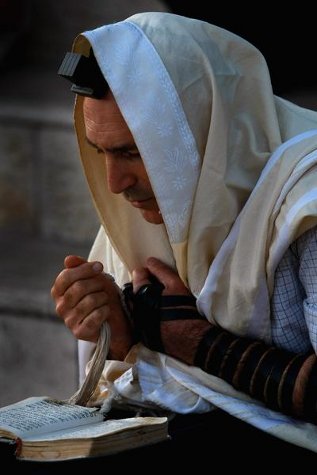
jewish-prayer_daveningPaul didn’t go anywhere near what I’m saying in the Galatians letter, but as I continue to ponder this epistle and the book that Mark Nanos wrote about it, the implications are there. Paul was addressing Gentile believers existing and worshiping in a Jewish religious and community space. After a long absence, we are beginning to see that process and those relationships begin anew. The Apostolic Scriptures don’t paint a very plain portrait of how those relationships should work in an ideal manner. We only have examples of the struggle to find balance and harmony, which was probably never accomplished in Paul’s lifetime and which completely disintegrated in the decades and centuries after the Fall of Jerusalem.

Whether you are Jewish or Gentile, Messiah does not require that you give up who you are and become something you are not. Jewish believers make a mistake by “converting” to Christianity and assimilating into the Gentile mainstream because God never intended “the Church” to finish the job of eliminating the presence of Jews on our planet that Hitler’s Holocaust started (I know that sounds harsh, but that’s how some Jewish people see assimilation, especially into a normative Gentile Christian identity). Jewish believers serve God by retaining a lived Jewish identity, by observing the mitzvot, by davening with other Jews, by being who God made them to be.

Gentile believers make a mistake by thinking that being a member of the nations who are called by His Name means they/we aren’t good enough for God or somehow that status makes them/us insignificant in God’s plan. If you abandon your fellow Gentile believers and especially if you abandon Messiah and convert to Judaism, you defy one of the primary reasons for your existence. God has made all of the Jews He intends to make. For some few, conversion to Judaism may be valid, but for the majority of us, the only thing we’re trying to satisfy through conversion is our own desires or to smother feelings of inadequacy.

Only, as the Lord has assigned to each one, as God has called each, in this manner let him walk. And so I direct in all the churches. Was any man called when he was already circumcised? He is not to become uncircumcised. Has anyone been called in uncircumcision? He is not to be circumcised. Circumcision is nothing, and uncircumcision is nothing, but what matters is the keeping of the commandments of God. Each man must remain in that condition in which he was called.

Were you called while a slave? Do not worry about it; but if you are able also to become free, rather do that. For he who was called in the Lord while a slave, is the Lord’s freedman; likewise he who was called while free, is Christ’s slave. You were bought with a price; do not become slaves of men. Brethren, each one is to remain with God in that condition in which he was called.

1 Corinthians 7:17-24 (NASB)

Whoever you are, don’t give up who you are, because God created you and the roles you fill for a reason, even if you can’t see what that reason is right now. Paul may have written his letter to a group of people who lived halfway around the world two-thousand years ago, but in this case, I can perceive very clearly how his “ironic rebuke” is addressed to us today. Perhaps you can hear this message, too.

Sermon Review of the Holy Epistle to the Hebrews: Radiance of Glory

A quick immersion into the Christology of the apostles and the writer of the book of Hebrews based on Hebrews 1:2-3: “… His Son, whom he appointed the heir of all things, through whom also he created the world. He is the radiance of the glory of God and the exact imprint of his nature.”

What role in the creation of all things did the Son play? From where did the apostles derive their high view of Messiah in His divinity?

-D. Thomas Lancaster
Sermon Five: Radiance of Glory
Originally presented on January 26, 2013
from the Holy Epistle to the Hebrews sermon series

Lancaster starts his message by taking his audience through a brief summary of last week’s sermon focusing on his conclusions. Those conclusions are going to be important in just a few moments, and again at the end of this review.

This week, the topic is Christology or the study of Christ and particularly his Divine nature. This is something not really (or at all) studied in the Church because it’s pretty much assumed (God the Father, God the Son, God the Holy Spirit, three in one). People pray directly to Jesus, people interchange the Father and the Son, even in song lyrics with statements like, “thank you God for dying on the cross for me.” I personally have always been bothered by how most Christians treat the three persons of the Trinity (and remember, the word “Trinity” never shows up in the Bible) as if they’re interchangeable units, like spark plugs or kitchen knives. One’s just as good as the other, one’s exactly the same as the other.

Lots and lots of what Lancaster calls “Father-Son confusion.”

Lancaster manages to compress a lot of complex concepts into his almost forty-four minute sermon which is reflective of how densely packed he says is Hebrews 1:1-4:

God, after He spoke long ago to the fathers in the prophets in many portions and in many ways, in these last days has spoken to us in His Son, whom He appointed heir of all things, through whom also He made the world. And He is the radiance of His glory and the exact representation of His nature, and upholds all things by the word of His power. When He had made purification of sins, He sat down at the right hand of the Majesty on high, having become as much better than the angels, as He has inherited a more excellent name than they.

Remember from last week, Lancaster said the first few sentences in Hebrews 1 were the premise of the writer of Hebrews, and now that writer has to spend the rest of the chapter and into Chapter 2 to support this thesis, that Messiah is higher and more exalted than Abraham, Moses, the Prophets, and even the Angels.

The question of Christology is summarized by Lancaster in a question asked of him by one of his sons:

“How can Jesus be God if he’s the Son of God?”

Oh, is that all?

Lancaster spends the rest of his sermon trying to answer this question and with the goal of being able to read Hebrews, as well as the rest of the apostolic scriptures, with the same understanding as the apostles and early disciples. This has the benefit, from my point of view, of not having to wade through nearly two-thousand years of subsequent anti-Jewish, anti-Judaism, anti-Torah, and anti-Temple theology and doctrine that was spawned from the early centuries of Church history by the so-called “Church fathers” and certainly cemented in place five-hundred years or so ago by the authors of the Reformation (who are by and large the authors of the Christianity we have today).

…in these last days has spoken to us in His Son, whom He appointed heir of all things…

Hebrews 1:2 (NASB)

When all things are subjected to Him, then the Son Himself also will be subjected to the One who subjected all things to Him, so that God may be all in all.

1 Corinthians 15:28 (NASB)

Here’s where we start getting into “deep stuff” about Messiah. We’re talking about Fathers and Sons and Sons as heirs and all that’s supposed to mean. We’re also starting to decouple our brains from the literal meaning of these ideas because the world of mysticism speaks in metaphor and in symbols. Literal access to scripture is no help in comprehending the Divine nature of Messiah. To do that, we have to travel much more dangerous roads.

In the beginning God created the heavens and the earth.

Genesis 1:1 (NASB)

In the beginning was the Word, and the Word was with God, and the Word was God. He was in the beginning with God. All things came into being through Him, and apart from Him nothing came into being that has come into being.

John 1:1-3 (NASB)

CreationPrepositions play a part in Lancaster’s narrative as he tries to weave together the role of Father and Son in Creation. Was the world created “through,” “by,” “in” the Word, the Son, the Word made flesh? Not very much help, according to Lancaster. It doesn’t sound very Jewish.

Next he takes us into a Rabbinic argument (words are flying past much too quickly for me to pick up all of the references) where the sages are debating on what basis did God create the world.

Was it for the sake of Abraham? No? For the sake of David? For the sake of Moses? No? How about for the sake of Messiah? Saying the world was created for the sake of someone is another way of saying that such a person is highly exalted. For the sake of Messiah was the world created. Don’t worry if these abstract mystical concepts are beginning to give you a headache. They affect me the same way.

Plunging deeper into the wine dark waters of mysticism, the sages teach that God created the world through the agency of wisdom, as if wisdom was a separate being from God, an agent where God was the owner of the plan but giving the plans to wisdom, she (yes, wisdom is a “she”) executed those plans by being the agency of creation.

Proverbs 3:19 and 8:22-23 give us a portrait of wisdom as creator but let’s not be too literal. We are talking about God’s wisdom, and here’s the important part when considering Messiah…wisdom is an attribute which does not encompass the totality of God’s transcendent being, but neither is wisdom not God.

This is wisdom “talking:”

The Lord possessed me at the beginning of His way, before His works of old.

Proverbs 8:22 (NASB)

Lancaster links various texts such as the one above with the Targums in terms of “Beresheet” or “In the Beginning,” the creation narrative and the agency of creation. Is it IN the beginning or BY the beginning or something else? Some examples are:

From the beginning with wisdom God created and perfected the heavens and the earth.

Or how about…

In wisdom the Lord created the heavens and the earth.

According to Lancaster, THIS is how the apostles learned the Torah, not how we are taught the Bible in the Church today, and it explains John’s highly mystical introduction to his gospel, “In the beginning was the Word, and the Word was with God, and…”

…but to those who are the called, both Jews and Greeks, Christ the power of God and the wisdom of God.

1 Corinthians 1:24 (NASB)

…but we speak God’s wisdom in a mystery, the hidden wisdom which God predestined before the ages to our glory…

1 Corinthians 2:7 (NASB)

Tree of LifeI realize there’s a lot of connections happening here and again, it’s important to look at all this in a somewhat fluid manner, not trying to understand a literal reality here, since we have definitely crossed over, not really into the Twilight Zone, but into a metaphysical realm where mere human beings, even being apostles, are trying to relate in human language, explaining their Christology to us across the long march of post-apostolic history.

Lancaster takes this even further and references something called “The Wisdom of Solomon” contained in a book called the Catholic Published Bible. “The Wisdom of Solomon” was supposedly written by King Solomon and existed about a century before the earthly ministry of the Master, thus we know the apostles would have had access to this material. I won’t go into everything Lancaster cited, but he did produce a nice, numbered list of attributes of wisdom we can make use of:

  1. Wisdom is the worker of all things.
  2. Wisdom passes through all things holding everything together.
  3. Wisdom is the breath of the power of God.
  4. Wisdom is the expression of God’s Glory.
  5. Wisdom is the brightness of everlasting light.
  6. Wisdom is the image of God’s goodness.
  7. Wisdom makes all things new.

And now back to the text for today:

He is the radiance of His glory and the exact representation of His nature, and upholds all things by the word of His power.

Hebrews 1:3 (NASB)

From Lancaster’s perspective, it’s as if the writer of the book of Hebrews is stating that what was said of wisdom is true of the Son — the Divine wisdom is within him.

And if that isn’t enough, how about Paul’s Christology?

He is the image of the invisible God, the firstborn of all creation. For by Him all things were created, both in the heavens and on earth, visible and invisible, whether thrones or dominions or rulers or authorities—all things have been created through Him and for Him. He is before all things, and in Him all things hold together.

Colossians 1:15-16 (NASB)

Hopefully you are starting to see the connections. Anti-missionaries jump on the word “image” in terms of the Torah prohibition to not worship an “image,” but again, we’re not talking about a stone statue or a painting and the word “image” isn’t quite literal. Adam was created IN the image of God but the Divine Messiah is THE image of the invisible God. Take the mystic concept of the image of the Heavenly Adam, the Divine Messiah, the agency of creation, God’s powerful Word, and unite it with the earthly Adam, human nature, human beings and we have the person of Messiah, Yeshua of Nazareth.

Lancaster quoted someone saying of a Maggid (I didn’t catch the specific reference because I can’t write that fast) that he taught Hassidism as if it were Mussar, that is, he taught mysticism as if it had life applications. Often teachings such as these, while intellectually fascinating (for me, anyway), don’t really do much to change our day-to-day lives, but Lancaster said something that impacted mine. It’s what I learned for today.

Caveat

Before I go on, I must respond to what should be a natural objection of most Christians (and I’ve mentioned this before). Lancaster is crafting the apostolic Jewish understanding of scriptures in general and Hebrews in specific based on Talmud and various mystic writings in Judaism that were authored (for the most part) after the apostolic era, sometimes many centuries after. Is it valid for Lancaster to construct an ancient Jewish perspective of Hebrews and the related Biblical texts based on subsequent Jewish perspectives? That’s the $64,000 question. I think (but this is an assumption on my part), that Lancaster believes the concepts and ideas contained in these later writings, existed in oral form or in some earlier but now lost documents during or before the apostolic era, and thus are valid material to project into an apostolic Jewish framework. If that assumption is wrong, then it’s quite possible some or all of the elements of Lancaster’s premise and thus his conclusions are wrong. But, on the other hand, Christianity bases it’s interpretations of the Biblical texts entirely on material, commentary, and tradition created after the close of Biblical canon, by many hundreds if not thousands of years, so we might as well say that Christian Biblical understanding is just as “anachronistic” as Lancaster’s “Messianic” perspective. Lancaster’s assumptions at least have the benefit of possibly really existing during the time of the apostles. I don’t have the same confidence in the Gentile Church Fathers, those involved with the various Church Councils, the Reformationists of five centuries ago, and the Fundamentalists of a century ago to be able to represent the thoughts, comprehension, and intent of the original apostolic writers of what we now call the New Testament. Now on with the show.

What Did I Learn?

waking-up-happyLancaster said that the only practical application some of these lessons seem to have is only relevant to hating on people who don’t have the same interpretation as we do.

That immediately reminded me of this incident and all of the other similar situations I’ve managed to get myself into. I didn’t create this blog with the idea of tilting at windmills or “going after” people who disagreed with me. I didn’t even create this blog with the idea of having to defend myself from the attacks of people who don’t agree with me. Nevertheless, reading back over the last several blog posts, I seem to be repeatedly taking the adversarial role. It’s a role that’s very seductive and also very undesirable.

Lancaster said that it’s the job of every disciple to internalize the teachings of his or her Master, to eat of the bread, so to speak, and drink of the Spiritual water, to incorporate our Master’s lessons into our very flesh and blood and being. Then, if we consider ourselves a Tabernacle, we bring the Divine wisdom into ourselves and into our families, and into our communities, and finally into the world, which is the lived expression of praying “Thy Kingdom Come!”

Pay attention. To what? The teachings of our Master? Why? Lest we drift away from him.

Sermon Review of the Holy Epistle to the Hebrews: Sundry Times and Divers Manners

Our fourth teaching on the book of Hebrews considers the first two verses of the epistle:

“God, who at sundry times and in divers manners spake in time past unto the fathers by the prophets, hath in these last days spoken unto us by his Son.” (Hebrews 1:1-2)

How does Yeshua and the message of Messiah stack up against the patriarchs and the prophets?

The thesis statement behind the book of Hebrews with reference to Yalkut Shimoni and Midrash Tanchuma on Isaiah 52:13.

-D. Thomas Lancaster
Sermon Four: Sundry Times and Divers Manners
Originally presented on January 19, 2013
from the Holy Epistle to the Hebrews sermon series

After my significant goof up in my review of last week’s session, I’m a little hesitant to write another review, but hopefully, I’ll be more mindful of my notes if not my memory.

Today’s the day. It’s the day Lancaster actually starts delving into the book of Hebrews, well the first couple of verses in the first chapter, anyway. However, there’s a lot to cover in this thirty-five minute sermon. Let’s get going.

The first thing a traditional Christian Bible student should know is that Lancaster thinks the Book of Hebrews reads like Midrash Rabbah, other Talmudic portions, and even the Zohar. That’s because the sermon/letter seems so Jewish. That isn’t going to make a lot of Christians happy because they (we) have been taught some pretty negative things about Talmud and especially about Zohar (most Christians have probably heard of the Talmud but how many teachers and Pastors even breathe the word “Zohar”?).

Lancaster says he feels pretty comfortable with Talmudic literature, at least in English, but he rather feels sorry for the innocent and unsuspecting Christian Bible student who stumbles into Hebrews without that background. The implication is that without familiarity with Rabbinic commentary, most Christians are going to come away from Hebrews with an inaccurate interpretation of what the anonymous author was trying to say.

Lancaster says the experience of an uninitiated Christian facing Talmudic writings encounters the intellectual and perhaps spiritual equivalent of stepping on a rake. I assume he means the “business end” of the rake and not the handle.

God, after He spoke long ago to the fathers in the prophets in many portions and in many ways, in these last days has spoken to us in His Son, whom He appointed heir of all things, through whom also He made the world.

Hebrews 1:1-2 (NASB)

What does this mean?

It’s actually pretty straightforward. In ancient days, God spoke to “the fathers in the prophets”. Who are they? Prophets include Abraham, Isaac, Jacob, and especially Moses. They also include anyone of the Judges as well as prophets like Samuel, Isaiah, Ezekiel, Jeremiah, and any of the so-called “minor prophets” who, in Hebrew Bibles, are called the “later prophets.” No prophet of God is “minor.”

We also see prophetic words from God in the writings such as the Psalms and Proverbs, so God spoke to all of the writers of all of the books of what Christians refer to as the “Old Testament” and what Jews call the Tanakh (Torah or Law, Nevu’im or Prophets, and Ketuvim or Writings).

We call all of this put together the “Old Testament,” but for Jews in the Apostolic Era, it was just The Testament or The Scriptures.

Verse one testifies that God inspired all of the writers of all of those writings speaking through them and to them. These were the men of God of the past and God spoke to ALL of them. Thus, what they wrote is ALL the Word of God. God spoke in many diverse ways to the prophets:

He said, “Hear now My words: If there is a prophet among you, I, the Lord, shall make Myself known to him in a vision. I shall speak with him in a dream.

“Not so, with My servant Moses, He is faithful in all My household; With him I speak mouth to mouth…”

Numbers 12:6-8 (NASB)

God spoke through the other prophets in many and different ways but only with Moses did God speak “face-to-face” (lit. mouth-to-mouth). The message of the prophets was to all of Israel and ultimately, to all the world.

However in the last days, God spoke through His Son.

What last days? While the apostles and early disciples may have thought they were living in the last days, they must have been wrong, because almost two-thousand years have passed and the “days” haven’t ended yet.

But were they wrong? They were living in the last days of the Apostolic Era. They were living in the last days of the Holy Temple. They were living in the last days of Jerusalem, the last days before the Jewish people would be exiled from their Land to wander the diaspora for nearly twenty desperate centuries.

Thy Kingdom ComeThe First Fruits of Zion (FFOZ) television show A Promise of What is to Come produced a number of episodes describing how the coming of the Messianic Kingdom was upon us and that time wasn’t the relevant factor in summoning the Kingdom. Episodes such as Seek First the Kingdom, Thy Kingdom Come, and Keys to the Kingdom all speak of this.

Lancaster characterized the imminent coming of the Kingdom as a clock that is stuck at one minute to midnight, sort of how the Doomsday Clock is used to show the imminence of Nuclear War.

The men and women of the Apostolic Era were living in the “end times” no more or less than we. The stage has been set, the actors have taken their places, now all that is left is for the curtain to go up, the house lights to go down, and for the play to begin. However, the audience and the actors haven’t been told exactly when the curtain will rise and to a large degree it is they who will determine the moment, not the director.

Truly I say to you, this generation will not pass away until all things take place.

Luke 21:32 (NASB)

But this interpretation makes me consider that “this generation” isn’t meant to be taken literally.

…in these last days has spoken to us in His Son.

Hebrews 1:2 (NASB)

This speaks more than I could have possibly known before hearing this sermon.

Lancaster invoked my English 101 class which I took the first time I attended university. In an English Composition class, you’re taught to begin a paper with a thesis statement, a declaration of the topic and purpose of the paper, then you spend the rest of the time writing documentation supporting your thesis.

That’s how Hebrews begins.

Lancaster took a moment to explain that the New Testament is NOT just commentary on the Torah, which may come as a surprise to some Messianic Jewish and Hebrew Roots people who have been taught to focus on the Torah and almost nothing else.

The thesis of the writer of Hebrews is that in ancient days, God spoke through and to the Prophets of old and what they spoke and wrote was and is the Word of God. But in the End Times, God spoke through his Son, Moshiach, and what Moshiach spoke is recorded in the Gospels.

We take all this for granted as Christians in the twenty-first century. After all, we have our Bibles, they include the Old Testament and the New Testament, and the New Testament includes the Gospels, so of course what Jesus said was and is the Word of God, but that was a revolutionary concept in the early 60s CE. The Jewish believers as well as all other Jewish people understood that the Hebrew Scriptures were the Word of God, but could Jesus of Nazareth also speak God’s Word (not to mention his apostles, but we won’t address that today)?

Was/is Jesus greater than the Prophets? The answer is of course, “yes,” but what did the original readers of Hebrews believe? Was Jesus greater and better than angels (see Hebrews 1:4)?

The writer of Hebrews had to establish this as his thesis and then spend the rest of the sermon/letter defending and supporting that thesis.

Behold, My servant will prosper, He will be high and lifted up and greatly exalted.

Isaiah 52:13 (NASB)

Delitzsch BibleThis is the beginning of the Song of the Exalted Servant. Traditional, normative Judaism considers the Exalted or Suffering Servant to be the people and nation of Israel, while Christians believe it is Messiah, it’s Jesus.

Lancaster began to establish that the Servant must be Messiah based on a variety of Jewish sources, such as Targum Jonathan and too many others for me to write down and thus record here. He mentioned again that the Zohar is one of those sources, but it should be noted that most if not all of the supportive Jewish writings were authored well after the Apostolic Era.

Lancaster wants to show his audience that his interpretation is correct but that it must be understood and supported by Jewish sources. The question, and it’s an important one, is if the audience of the sermon/letter to the Hebrews would have understood this document through the Jewish documentation and commentary they had access to in or around the year 62 CE.

The most reliable estimates regarding the Zohar say it was written in about the 12th century and the Talmud wasn’t authored for centuries after the apostles died. We can accept some of Lancaster’s argument if we believe the information later recorded in Rabbinic writings already existed, probably in oral form, during Apostolic days. But for many Christians, that’s quite a leap.

What Lancaster is trying to establish is that the writer of Hebrews was declaring, and again, this would be controversial and even revolutionary in the mid-first century, that Yeshua of Nazareth was not only equal to the Prophets and Judges and even Angels, but that he was superior to them all as Messiah and as the Son of God. The audience of Hebrews was to understand that the words of Jesus were indeed also the Word of God, which Christians accept today without question but the original readers of Hebrews still needed to comprehend.

And He is the radiance of His glory and the exact representation of His nature, and upholds all things by the word of His power. When He had made purification of sins, He sat down at the right hand of the Majesty on high…

Hebrews 1:3 (NASB)

For He has been counted worthy of more glory than Moses, by just so much as the builder of the house has more honor than the house.

Hebrews 3:3 (NASB)

Jesus is worthy. He sits at the right hand of the Father. He is the radiance of God’s glory, an exact representation of God’s nature. Messiah upholds all things by his word, which is the Word of God because Messiah is greater, more glorious, more worthy than any of the prophets, including Moses and even more so than the Angels.

Now here’s the important part for today.

For this reason we must pay much closer attention to what we have heard, so that we do not drift away from it.

Hebrews 2:1 (NASB)

Read the entire first chapter of Hebrews and then read the first verse of the second chapter. What were the readers of this sermon/letter (and what are we) supposed to pay much closer attention to?” The Word of God as spoken by Messiah. Why? So they wouldn’t drift away.

life_of_pi_by_megatruh-d5noigdRemember, that according to previous sermons, the writer of the Book of Hebrews was deeply concerned that his audience, because they were denied access to the Temple in Jerusalem, were tempted to “drift away” from their faith in Messiah, all for love of and devotion to Temple worship.

Christians believe that Hebrews was a warning to Jews not to abandon Jesus and “backslide” into Jewish practices including the Temple sacrifices, but according to Lancaster, it was a warning to not forget priorities.

Lancaster used a number of metaphors to get his point across but I’ll choose just one. How many couples do you know have gotten a divorce? Maybe you are divorced. Maybe you have friends who are, or maybe your parents are.

Sometimes, when describing the process that lead up to divorcing, men and women will say that they drifted away from each other over time. This rather contradicts a sudden trauma such as being abruptly denied access to Temple worship and suggests a gradual cooling of faith.

Faith and devotion to the Master are there, but for a variety of reasons, they can begin to become less important over weeks, months, and even years. Christians are taught in Church that only one thing matters: Jesus. It’s pretty easy to lock onto Jesus and not let go because he is all anyone ever talks about.

But the Messianic Jewish and Hebrew Roots movement are sometimes so devoted to Torah, to Talmud, to Shabbat, to a thousand other things, that Jesus gets lost in the shuffle. I think that’s why some Gentile Messianic believers convert to normative Judaism, usually Orthodox, because the things of Judaism become more attractive and they slowly drift away from Yeshua.

Hebrew Roots people accuse Messianic Jewish adherents of promoting this kind of apostasy all the time, but here we have D. Thomas Lancaster, no small voice in the realm of Messianic Jewish teachings and writings, offering the same cautionary tale based on the warning of whoever wrote the Book of Hebrews.

What Did I Learn?

I’ve been bending my brain around what Lancaster has been teaching and filtering it through some of the comments of people who have been reading my reviews.

broken-crossCould the Book of Hebrews been written after the Temple’s destruction and the writer was trying to encourage his Jewish readers that the quintessential Temple continued to exist in Heaven with Messiah as its Kohen Gadol?

Regardless of differences in interpretation, the main point of Lancaster’s sermon was what hit home the most, especially in the face of recent failures and my continued struggle with the rigidity of certain Christians and their commentaries.

For this reason we must pay much closer attention to what we have heard, so that we do not drift away from it. For if the word spoken through angels proved unalterable, and every transgression and disobedience received a just penalty, how will we escape if we neglect so great a salvation?

Hebrews 2:1-3 (NASB)

We must…I must pay attention to what I have heard so that I do not drift way from it, for if the Word spoken by angels at Sinai to Moses, the Torah, proved unalterable, how can I escape if I neglect so great a salvation as the Word uttered by the Master?

Sermon Review of the Holy Epistle to the Hebrews: Solomon’s Porch

At the hands of the apostles many signs and wonders were taking place among the people; and they were all with one accord in Solomon’s portico.

Acts 5:12 (NASB)

Sermon Three: Solomon’s Porch
from the Holy Epistle to the Hebrews sermon series

In this third sermon on the Epistle to the Hebrews, Beth Immanuel Sabbath Fellowship teacher D. Thomas Lancaster expands on why the writer of the Book of Hebrews constructed this word of exhortation to the letter’s recipients and further identifies them as Jewish disciples of Messiah living in or around Jerusalem sometime in the early 60s CE (common era).

Where did the first Christians go to church?

This is how Lancaster started his sermon. He says the question is nonsensical because the first Christians were actually Jews. They didn’t go to church because the modern concept of “church” didn’t exist. Neither did the modern concept of “Christianity.” The first Christians were Jews and they practiced Judaism. As you saw in the quote at the top of the page, the first Jewish believers commonly met in an area on the east side of the Temple called Solomon’s Colonnade.

Lancaster speculates that, because of the prophesy in Zechariah, saying the Messiah would descend upon the Mount of Olives and enter the Temple through the eastern gate, the disciples met there in anticipation, since the Mount of Olives was plainly visible from Solomon’s Colonnade.

Then Lancaster diverted his sermon, taking the audience back in time twenty years or so, recalling a conversation he had with his Father who had been a Baptist minister. Somehow, they got to talking about the Book of Hebrews and his Father, remember, this was twenty years ago, twenty years before Lancaster thought of producing this sermon series on Hebrews, commented on Hebrews 13:22:

But I urge you, brethren, bear with this word of exhortation, for I have written to you briefly.

Thirteen chapters is hardly brief and in fact, Hebrews is one of the longest epistles in the New Testament. Lancaster’s father suggested that Hebrews was originally written in two parts: a longer sermon intended to be delivered to a Jewish audience and a shorter letter accompanying the sermon as an explanation.

That’s pretty much was Lancaster suggested in last week’s sermon.

Lancaster’s father said something else rather interesting. He said he thought that Hebrews was written to a group of believing Jews who had been kicked out of the Temple and who didn’t know what to do next. This was a group of Jews who, if they renounced Yeshua (Jesus) as Messiah, would be allowed to return to the Temple. Hebrews then, was a letter and a word of consolation to those Jews to not give up their faith but to hold fast to their devotion to Messiah.

Traditional Christian teaching about the Book of Hebrews states that the epistle was a warning to believing Jews to not “backslide” into Judaism and return to Temple worship, so the senior Lancaster’s suggestion was the exact opposite of how most of the Church understands the meaning of Hebrews.

But Lancaster’s Dad’s interpretation has several advantages, according to the younger Lancaster:

    1. It doesn’t anachronistically require a fully-developed Christian identity that is separated from the normative Judaisms of the mid-first century CE.
    2. It doesn’t require that Jesus abolish the Torah or the Levitical system.
    3. It better explains the arguments within Hebrews (which will be covered in subsequent sermons).
    4. It fits much better with what we know about the early Jewish believers and their relationship with the Temple.

The Early Jewish Believers and the Temple

This part of the sermon fits within the realm of established fact as we see in the scriptures and doesn’t require any speculation. It does require setting aside traditional Christian doctrine about the early “Jewish Christians” and taking the scriptural text, primarily in Acts, at face value.

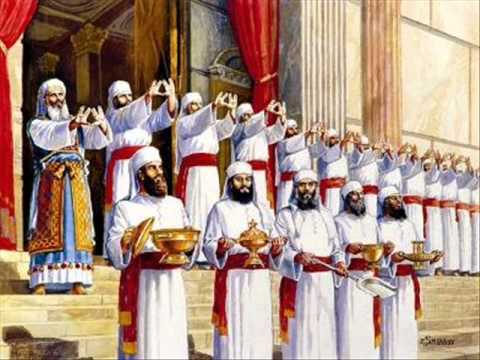
levites-aaronic-blessingWhat was the relationship of the early believing Jews to the Temple? They revered it, just as their Master Jesus revered the Temple.

Lancaster covered those portions of the Gospels that demonstrated Jesus’ devotion to the Temple, his first recorded appearance there as a boy to debate the scholars, evicting the moneychangers, calling the Temple “my Father’s house,” and so on. You can listen to the recording to get the details, including how Jesus, when he returns, will rebuild the Temple and reinstitute the Temple services.

After the ascension, the disciples returned to the Temple. They may have received the Spirit while praying at the Temple (Acts2). Acts 2:46 mentions their presence at the Temple. Acts 3:1-3 speaks of the disciples participating in prayer services at the Temple. And Acts 5:42 asserts that the disciples were in the Temple daily teaching and preaching of the Messiah.

It is strongly believed in normative Christianity that the disciples must have given up the Temple sacrifices since Jesus fulfilled them all, and yet Acts also speaks of many Priests in the Temple coming to faith in Messiah because of the devotion of the disciples. According to Lancaster, these Priests didn’t give up their jobs and stop administering the sacrifices, but rather, found greater meaning in their Priestly duties, seeing Messiah’s blood in each of their services.

In fact, the only occasions on which the disciples were accused of speaking against the Temple, were when they were accused by false witnesses. The trial of Stephen before the Sanhedrin is an example, and Stephen took a full chapter in Acts to deny and refute the false accusations.

Lancaster also points out that the Bible never, ever says that the disciples stopped offering the sacrifices. This would have been a big deal and if it were so, you’d think Luke would have mentioned it. It’s assumed by most Christians that the Jewish disciples stopped offering Temple sacrifices based on doctrines that were much later established by the Christian church, not because it says so in the Bible.

If we look at Acts 24:17 and the surrounding text, we can see how, thirty years later after the crucifixion, resurrection, and ascension of the Master, Paul was encouraged to offer sacrifices at the Temple to show many other believing Jews that the accusations stating Paul was teaching against Torah and against the Temple were utterly false.

Maybe you can accuse Paul of vainly clinging to obsolete Jewish customs by offering sacrifices but what about James, brother to Jesus, steward of the Throne of David, head of the apostolic community? If anyone should have known the truth about the teachings of Jesus, it should have been James. If Jesus had taught against the Temple and abolished the sacrifices, James should have known about it and advocated for that position. Obviously, he didn’t.

A plain reading of the relevant passages, without being filtered through Christian anti-Torah, anti-Jewish, anti-Temple bias reveals this. Except as viewed through the heavily-colored filter of Christian tradition, there’s nothing in the Bible that says the Torah, including the Temple sacrifices, were ever to be abolished. If you want more information about this, watch the First Fruits of Zion television episode The Torah is Not Canceled. It’s only thirty minutes long and well worth your time.

History records the death of James the Just, the brother of Messiah, the leader of the Council of Apostles and head of the entire body of believers, as happening in 62 CE. Lancaster dates the Book of Hebrews at just a few years later. According to Lancaster, this was also about the time issues came to a head between the disciples in Jerusalem and their arch foes, the Essenes, the group of corrupt Rome-collaborators who illegally had control of the Temple. The Essenes wanted the disciples out of the Temple and wanted them to renounce their faith in Jesus as Messiah.

Speculation

This next part can’t be firmly established through scripture or historical texts and is extrapolated from Lancaster’s understanding of the content in Hebrews. He believes that after the death of James, the Essenes held their own Sanhedrin, leaving out the Pharisees, and forbade the Jewish believers from Temple participation, cutting them off (“Koret”) until such time as they renounced Yeshua.

The Master even predicted this would happen in John 16:2. And this was the purpose of the sermon and letter of Hebrews: to encourage and support the Jewish believers in Jerusalem who had been removed forcefully from Temple participation to keep the faith, keep faith in Yeshua, and not to break faith, even for the sake of returning to the Temple.

MessiahYes, Temple devotion was appropriate and desired. Every year during the pilgrim festivals thousands upon thousands of Jews from all over ancient Palestine and the diaspora nations would converge on Jerusalem to offer sacrifices at the Temple in obedience to the commandments.

But devotion to Moshiach and devotion to the Temple were not to be considered mutually exclusive and the writer of Hebrews was earnestly imploring the Jews in Jerusalem to not forsake Messiah in the face of being removed from the Temple.

For even if removed, and even after the Temple was destroyed, it has been promised in Messianic Days that the Temple will be rebuilt and Jews as well as many, many people from all the nations will go up to the Mountain of the Lord and the House of the God of Jacob and worship Him there in Jerusalem.

What Did I Learn?

Well, again, quite a lot. I was wondering how Lancaster was going to firm up his suppositions from last week and I admit he did a pretty good job of it in this sermon. His point kind of wavers when he suggests last week that the disciples were Greek speaking Jews and this week they seemed more likely to be Jews who were native to the Land, but I suppose it could go either way, or even involve a more general population of Jewish believers.

I’m certainly getting a very different picture of the Book of Hebrews than I imagined, and indeed, one more consistent with my understanding of the over all message of the “good news” to the Jewish people.

At the very end of this sermon, Lancaster said he was finally finished setting up the required background and that in next week’s sermon, we’ll begin to actually study the Epistle to the Hebrews. I know that I’ve been turning some of the more difficult passages of this part of scripture over in my head and wondering how they can be seen as consistent with the overarching message Lancaster is presenting. Can all of the book of Hebrews, even the “pesky” parts, really be interpreted as an encouragement for believing Jews in Jerusalem to keep the faith in Messiah, even though denied access to the Temple, which both they and the Master revered? In my next review, we’ll begin to discover the answer.

Edit: Where it says above that the “Essenes” were involved in the death of James and in opposition to the believing Jews in Jerusalem, it should read “Sadducees”.  I apparently misunderstood what was said on the recording and apologize for the error.

How Far Can We Explore the Bible?

The Bible is not a book but a library. It abounds with a spectrum of complementary, contrasting, and conflicting views, preserved by different sources and traditions. Diversity is not anathema. The Talmud records that books like Ezekiel, Proverbs, Song of Songs, Ecclesiastes, and Esther made it into the canon of Hebrew Scripture after much dispute, because they often contain often large chunks of theologically objectionable material. The editors did not put a premium on consistency and uniformity, but rather on assembling clashing voices driven by a hunger for the holy. A tolerance for diverse opinion and practice is imbedded in the foundation text of Judaism and in the vast exegetical literature that it inspired.

-Ismar Schorsch
“Conceiving of God,” February 13, 1999
Commentary on Torah Portion Mishpatim
Canon Without Closure: Torah Commentaries

Sounds kind of like how I relate to the Book of Hebrews and why I feel is it so problematic, but Schorsch’s commentary on the “theologically objectionable material” and its “clashing voices” in the “foundation text of Judaism” speaks to me of the whole Bible and especially those portions, like Hebrews, that “clash” with other portions. Perhaps that “clash” is deliberate (at least on God’s part) and exists not just to inform us, but to challenge us.

I must admit to being bothered by John MacArthur (yes, him again) and the Sufficiency of Scripture crew, because for them (as least as I read them), the Bible is to Christians what an auto repair manual is to a car mechanic.

You’ve probably heard of the “Bible” described by the acronym Basic Instructions Before Leaving Earth. Cute. There’s even a song with that title.

But it’s incredibly reductionistic and highly limiting of the power and the depth of the Word of God, as if the record of God’s interaction with man is just a history book, as if God were describing the workings of an internal combustion engine, which a sufficiently skilled human being can completely disassemble, describe the role and function of each and every part, and then reassemble and start-up with relatively no creative effort at all.

God is just a machine and the Bible is the instruction manual.

OK, it’s probably kind of unfair of me to say that, but there seems to be so much more “encoded” in the Bible, not necessarily though some arcane mystic means by which we must enter into an extraordinary metaphysical process to pry loose, but that requires we look at the scriptures as more than a book and even more than a library. If we believe that “all scripture is God-breathed,” (2 Timothy 3:16) then we must allow for the “breath of God” to be experienced as we open its pages and immerse in its waters. In other words, there’s a lot more to the Bible than meets the eye.

Even MacArthur’s commentary on scriptural sufficiency heavily, actually almost exclusively, references Psalm 19 and Psalm 119, both lyrical monuments to the glory, wisdom, and righteousness of the Torah of Moses. MacArthur just removes these passages from their original context and reforms them to suit his purposes.

This is probably why I have problems sometimes in Sunday school class. I expect to dive into a bottomless ocean of Biblical mystery and find myself wading in the shallow end of a swimming pool.

I’m being unfair again, but frankly, the Bible can take us just as far as we want to go and then, even farther. But just how far is that?

You’ll get a good idea of what I’m talking about if you’ll read Part 1 and Part 2 of my review on Boaz Michael’s lecture Moses in Matthew:

The two-hour seminar introduced many of the typologies throughout Matthew to Yeshua’s “Moses-like” fulfillment. The Gospels are composed in a thoroughly Jewish manner and need to be understood within that context to fully see what and why things take place and are said. The Moses in Matthew seminars are currently being offered at various locations and if you have the opportunity to attend one of these seminars, definitely do it! I found myself not only intellectually engaged and enlightened, but spiritually encouraged by this discussion.

-Rabbi Joshua Brumbach
“Moses in Matthew”
Yinon Blog

Gateway to EdenI’ve written before about the implications of treating Matthew and the other gospels as Jewish literature rather than Christian documents about Jesus and admittedly, the former is where my heart lies. It’s also where my head goes when I want to know more, learn more, see more clearly the path of God as He walks (metaphorically speaking) from Gan Eden (Garden of Eden) across early creation, on the road down to Egypt with Jacob, on the road up to Sinai with Moses, across the path of the Judges and the Prophets, and into the time of the apostles and beyond.

Why should God be so “Jewish” up until the end of the “Old Testament” (Tanakh, Jewish Scriptures) and then abruptly exchange His tefillin (and in Jewish legend even Hashem lays tefillin) for a cross around His neck (again speaking metaphorically)? Why would God set fire to the Torah scroll and when the flames have died out and the embers have cooled, sweep away the ashes and set a good ol’ King James Bible on the bema…uh, pulpit in front of Him to read to the Christian faithful as He evicts the Jews not only out of paradise but out of significance, love, hope, mercy, and completely off of the path of eschatology?

You think I’m kidding?

When Jesus came, everything changed, everything changed.… He didn’t just want to clean up the people’s attitudes as they gave their sacrifices, He obliterated the sacrificial system because He brought an end to Judaism with all its ceremonies, all its rituals, all its sacrifices, all of its external trappings, the Temple, the Holy of Holies, all of it.

-John MacArthur
“Understanding the Sabbath”
Grace to You

In other words, according to MacArthur and Protestant tradition, God destroyed everything that made the Jewish people Jewish, the Temple, the Torah, everything that defines Judaism, everything that sustains Jews. If you destroy what gives a people their life, don’t you destroy the people too?

My Pastor encouraged me to listen to some Christian sermons, probably since so much of my information comes from Jewish sources. I’m not sure that was such a good idea and the experience doesn’t seem to be producing the result I think he hoped for.

Why am I rehashing stuff I’ve rehashed and reheated many times before? What new information can I hope to produce? What new insights do I think will appear?

I suppose it’s one way to continue on the journey I declared couple of months ago. Challenged to stop sitting on the fence, I decided to hop off but not on the side I think my Pastor and the Church desired of me.

I’ve also been meaning to write some sort of commentary on Tzvi Freeman’s and Yehuda Shurpin’s series Is Midrash for Real?.

MidrashNow I’ve done it. I bet I’ve crossed somebody’s line in the sand. On the other hand, how do you get further into understanding the meaning of creation unless you break a few barriers and blow past a few “Do Not Enter” signs?

In a comment on one of my blog posts, I quoted from an article written by Adrian Kent called Our quantum reality problem or When the deepest theory we have seems to undermine science itself, some kind of collapse looks inevitable. I did this to illustrate how difficult it is for us to quantify and operationalize our observations of the universe. Shouldn’t our exploration into the deepest parts of a Spiritually inspired Bible, a Bible that was just as much authored by the finger of God as the pen of man contain just as much, if not more, difficulty and even “bizarreness?”

If God is truly infinite and unknowable in an absolute sense and even a created universe is only explained (and still imperfectly explained) by the shifting colors and currents described by quantum mechanics, how can we expect to experience the Bible as merely equivalent to the owner’s manual of a 1964 Volkswagen Beetle?

I’m not necessarily advocating for treating midrash as in any way the same as the Bible, but I am saying that we need to stop limiting ourselves by limiting the Word of God and thus limiting God. We must be willing to admit that God is God and He is not quantifiable. Even referring to God as “He” is a convention, just as the Bible describes God as having arms, or as walking. These are just literary devices to allow us to conceptualize the unimaginable.

“To claim absolute knowledge is to become monstrous. Knowledge is an unending adventure at the edge of uncertainty.”

-Leto, pg 275
Children of Dune by Frank Herbert (1976)

The Bible, among its other functions, sets up a basic framework for our faith. The framework exists as an environment in which to explore what that faith means, to discover our identity as God has given it to us, and what that identity means in relation to other people and in a relationship between the created and the Creator.

pathThe danger in this exploration is to read into the Bible what God did not put there, but there’s an equal danger in believing we have already discovered everything God breathed into the scriptures. Oversimplifying the matter, Christianity seems to be in danger of doing the latter and Judaism risks the former, at least in their most extreme expressions.

Somewhere there is a middle ground, a straddling path, a place where we can tether one foot in the pages of paper and ink and let the other one begin to stride among clouds. Even commentaries such as D. Thomas Lancaster’s Holy Epistle to the Hebrews sermon series (now, as I write this, at thirty-nine recordings and still counting) is just slightly slipping away from the Bible as a repair manual and entering the Bible as the barest beginning of an exploration into the hem of the garments of God.

For though by this time you ought to be teachers, you have need again for someone to teach you the elementary principles of the oracles of God, and you have come to need milk and not solid food.

Hebrews 5:12 (NASB)

If you think you have attained absolute knowledge of God and His Word, interestingly enough, you may still be dining on Gerber’s and have missed a few other culinary opportunities. The Bible contains an unending adventure of epicurean delights at the edge of uncertainty and I intend on tasting some delicacies.

“There is always an easy solution to every human problem — neat, plausible, and wrong.” -H.L. Mencken