

Orthodox Judaism is the approach to religious Judaism which adheres to the interpretation and application of the laws and ethics of the Torah as legislated in the Talmudic texts by the Tanaim and Amoraim and subsequently developed and applied by the later authorities known as the Gaonim, Rishonim, and Acharonim.
-from the Wikipedia page on Orthodox Judaism
Orthodox Judaism is not a unified movement with a single governing body, but many different movements adhering to common principles. All of the Orthodox movements are very similar in their observance and beliefs, differing only in the details that are emphasized. They also differ in their attitudes toward modern culture and the state of Israel. They all share one key feature: a dedication to Torah, both Written and Oral.
-from Jewish Virtual Library
Note that the image above and all other images of Jewish people in this blog post are not specifically Messianic Jews. I say this so there will be no mistaken attributions assumed.
There have been some conversations going in the discussion sections of a number of my blog posts. They’re too numerous to reference here, but the general themes have to do with Messianic Jewish community, the role of Gentiles within a Messianic Jewish community space, Bilateral Ecclesiology, and just how “Jewish” Messianic Judaism should be.
Opinions span a broad spectrum as the Messianic Judaism and Hebrew Roots movements do themselves, but this morning, I read a rather interesting article that got my attention:
The Orthodox Jewish community has a certain mystique.
Whether it’s because we look, act or believe differently, people are intrigued by stories about the Orthodox Jewish community. Media outlets often oblige but whenever I read these stories, they don’t quite resonate with me. They don’t look like the Orthodox community I know. So I’d like to share a few things that happened to me over the last year that give a more accurate insight into the real Orthodox Jewish community.
My wife and I have experienced fertility problems. We thankfully had been blessed with two children but as they grew older we had been trying for some time to have another child to no avail. One day I was speaking with my rabbi about our situation and I conveyed to him that my wife and I wanted to pursue fertility treatments but because of the steep cost, we were having second thoughts. A few days later my rabbi said that he spoke with an anonymous individual with means in the Jewish community who had agreed to sponsor fertility treatment for young Jewish couples if they could not afford it. He would not know who we were and we would not know who he was. He was motivated purely out of a sense of loyalty to the continuity of the Jewish People.
That’s the Orthodox community I know.
-Shimon Rosenberg
“The Orthodox Community I Know”
Aish.com
As I read through Mr. Rosenberg’s story about “the Orthodox Community I know,” I was struck by how different this would probably seem to most people who aren’t part of this community, and especially to Christians. Even those Christians who are supportive of the Jewish people and of Israel, don’t always understand (how could they?) Orthodox Judaism in general and the devotion of individual people in Orthodox Judaism to their community, lifestyle, and commitments in specific. And even most Jewish people who are not Orthodox don’t always understand the Orthodox.
Seven years ago, had I encountered the woman I am today, I would have pitied her: long sleeves and an ankle-length skirt in the middle of summer; no driving, writing, talking on the phone or cooking from sundown Friday until sundown Saturday; recently married to a man she’d never touched — not so much as a peck on the cheek — until after the wedding. I’d have cringed and dismissed this woman as a Repressed Religious Nut. Now my pity — or at least a patient smile — is for that self-certain Southern California girl I was at 25.
-Andrea Kahn
“What’s a Nice Cosmo Girl Like You Doing With An Orthodox Husband?”
Aish.com
See what I mean?
Christians especially see Orthodox Jews as rule-bound, rigid, odd (to say the least), and on a path that will certainly lead them to Hell. After all, no one can be made righteous through their own acts as we see here:
For all of us have become like one who is unclean, And all our righteous deeds are like a filthy garment; And all of us wither like a leaf, And our iniquities, like the wind, take us away.
–Isaiah 64:6 (NASB)

On that point, Derek Leman recently wrote a blog post called Our Deeds Are Not Filthy Rags which illuminates this matter and adds quite a wrinkle to the traditional Christian interpretation of the Isaiah verse. Also, Jacob Fronczak’s article “Sola Fide” in the latest issue of Messiah Journal deepens the exploration into this important topic.
I’m not trying to create a commentary on the nature of “salvation” and the differences between Christianity and Judaism, I’m just saying that we can’t automatically dismiss how Orthodox Jewish people (or any Jewish community) see their own relationship with God.
My friend Gene Shlomovich made a similar observation today on his blog:
So, the reason G-d chose Israel is because He already loved them and has promised their forefathers that He will take care of them. Does it make Jews somehow better than any other people? Not at all and it’s not the reason behind G-d’s love for Israel. After all, one parent’s child is not inherently better than a child of another parent. Your child is no more deserving of love than someone else’ – she is just yours. G-d loves Israel not because He has some grand plan and purpose for Israel (even though He does) or because Israel will proclaim her G-d and His Torah to all nations (which she certainly will). Neither did G-d set His affections on Israel because, as Christianity claims, “Israel was chosen to give birth to Jesus” and “to give nations the Gospel”, a useful tool that can be discarded once the chief purpose has been accomplished. No, these are all conditional reasons. G-d didn’t set His love on Israel because Israel was somehow capable of earning G-d’s love by her performance. Instead, G-d loves Israel because He loves Israel – that’s all there’s to it.
Depending on which denomination of Christianity you belong to or to which Christian doctrine concerning the Jewish people and Israel you adhere, you may actually believe that God still loves Israel and has future plans for her, but it’s really all about “the Church.” God may still use Israel, but their relationship isn’t what it once was, and God really loves the Church best.
I’m oversimplifying that viewpoint of course. I don’t have time to go into all of the details and you don’t want to read a ten-thousand word blog post.
But look at this:
Nine months later we gave birth to a beautiful baby girl.
The excitement began early Friday morning and as the day progressed I started thinking about Shabbat. What would we eat? How would I recite Kiddush? Light candles? I remembered hearing about an organization called Bikkur Cholim which means “visiting the sick.” It’s a volunteer-driven charity that looks after the needs of people in hospital. I called them and within a couple of hours someone came to our hospital room with literally bags of food, grape juice for Kiddush, electric candles to serve as Shabbat candles, even spices for havdallah. The food is free and the person delivering it is a volunteer. In the few moments I had to speak with him I learned that he was just a regular guy — an accountant — who takes off Fridays from work to volunteer for Bikkur Cholim. I asked him why he does it and he replied simply that it’s what God wants of us.
That’s the Orthodox community I know.
-Rosenberg
I’m talking about not just God’s love for Israel, but within the Orthodox Jewish community, one Jew’s love for another as well as the community’s love for one Jewish family.
I asked him why he does it and he replied simply that it’s what God wants of us.
 That’s the Orthodox Jewish community most of us, particularly in the Church, don’t see.
No, I’m not saying Orthodox Judaism as a practice or a community is perfect. The fact that it contains human beings means it will, by definition, be imperfect, just as any other form of Judaism will be imperfect, just as any of the estimated 41,000 Christian denominations and their members will be imperfect, just as any human community anywhere across time and space was, is, and will be imperfect.
Jews don’t need to be perfect for G-d to be on their side – G-d already loves them as His own people and nothing can ever change it. No doubt, He has disciplined us when we sinned, and He did that many times. However, at the same time, He’s very merciful. He promised that He will not be angry with us forever (Isaiah 57:16). As that Deuteronomy prophecy promised us G-d Himself will “circumcise” the hearts of all Israel after He brings them to the Land. When He does, all Jews will be Torah-observant, to the last one.
-Shlomovich
The statement that Jews don’t need to be perfect for God to love them, particularly in Orthodox Judaism, might take some Christians by surprise. It is generally thought by some of the Christians I know that Jews believe they have to perform the mitzvot perfectly in order to please God.
Again, I’m steering clear of the whole “salvation” issue, and I’m instead talking about love. Please don’t try to “bust my chops” about Christians being saved and Jewish people not being saved. It’s not what I’m writing about and I won’t approve any comments on the topic.
But what does all this have to do with Messianic Judaism?
It has been argued by many non-Jews affiliated in one way or another with Messianic Judaism or Hebrew Roots, that the “Jewishness” of Messianic Judaism should be toned down a bit. Those Jewish people in the Messianic movement who advocate for wholly Jewish communities for disciples of Yeshua as Messiah are putting Judaism first and Messiah second. I myself have quoted Troy Mitchell of Beth Immanuel Sabbath Fellowship as saying:
“One who romanticizes over Judaism and loses focus of the kingdom of Heaven can be compared to a carpenter who is infatuated with the hammer, rather than the house it was meant to build.”
Of course, I usually aim that quote at non-Jews who are so enamored with Jewish practices that they leave faith in Jesus entirely and convert to Judaism, usually Orthodox Judaism. You’d think, given that, I wouldn’t be trying to paint such a rosy picture of Orthodox Judaism here.
But, on the outside looking in, we often criticize things we don’t understand. It’s easy for Christians or just about anyone else to be critical of Orthodox Judaism because we are outsiders. We aren’t like them. We’ve been taught that we should never be like them, and if we tried (by converting or otherwise affiliating with the Jewish community), we would lose our salvation and God’s love.
From an Orthodox Jewish point of view (not that I have that point of view, I just quote articles), God loves Orthodox Jews and, referencing Shimon Rosenberg, Orthodox Jews love each other.
Applied to the Jewish people within the various circles of Messianic Judaism, they are also loved by God and they are also Jews who love each other, both within their specific Jewish communities, and identifying with larger and even worldwide Jewry. That doesn’t mean Yeshua plays second-fiddle to Messianic Judaism anymore than Hashem plays second-fiddle to Orthodox Judaism. From an outsider’s point of view, it seems like an Orthodox Jew’s devotion is to the “rules” first and the will of God second, but as I quoted above:
I asked him why he does it and he replied simply that it’s what God wants of us.
The mitzvot, especially those that are performed for the well-being of other people, are done because ”it’s what God wants of us.”
 Most non-Jews in Messianic Judaism and Hebrew Roots, and probably not a few Jewish people in those groups believe that it’s unBiblical, racist, and just plain wrong for Jews in Messianic Judaism to desire a community that is primarily or exclusively Jewish. The fact that Gentiles are “grafted-in” to the Jewish community, once called “the Way” and are considered equal co-participants in God’s love make it almost unthinkable that God would still reserve a “specialness” for the Jewish people and that God would not only tolerate but expect that Jews feel a “specialness” for each other.
Gentiles feel excluded by this sentiment among believing Jews. They (we) feel like we are rejected, inferior, second-class citizens, and “back of the bus” riders traveling on the road to the Kingdom.
To counter this, I can see at some point, a Messianic Jewish writer composing and publishing a small article called ”The Messianic Jewish Community I Know,” describing why it is important to have such a Jewish community for Messianic Jews. Granted, the uniqueness of Messianic Judaism when compared to the other Judaisms in our day (or historically), makes it more difficult to operationalize Jewish community within the larger community of disciples of Messiah, and I think we’re still working that out.
But the consequences of failing to support Jewish community within Messianic Judaism can be (and have been) disastrous.
Now I am speaking to you Gentiles. Inasmuch then as I am an apostle to the Gentiles, I glorify my ministry in order to make my own people jealous, and thus save some of them. For if their rejection is the reconciliation of the world, what will their acceptance be but life from the dead! If the part of the dough offered as first fruits is holy, then the whole batch is holy; and if the root is holy, then the branches also are holy.
–Romans 11:13-16 (NRSV)
According to Mark Nanos in his classic text The Mystery of Romans, the problem Paul was addressing in his letter were Gentiles who were flaunting their “freedom” (not being obligated to Torah observance to the level of the Jews) to the Messianic and non-Messianic Jewish populations of local synagogues in Rome, acting as a “stumbling block,” especially for the non-believing Jews who, because of Gentile arrogance, were inhibited from considering, let alone accepting, faith in Yeshua.
While the Nanos view would be considered controversial by many Christians, it does explain Paul’s rather harsh rebuke or even threat (Romans 11:21) to the “grafted in” branches. Paul was passionate for his people, the Jewish people, even his opponents, and Paul said he would surrender his own salvation if it would save some of them (Romans 9:3).
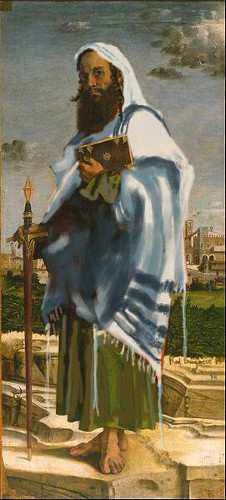 Paul never abandoned his people and God never abandoned Israel. We, as non-Jews, may not understand Jewish “choseness” but it exists. We, as non-Jews may not understand the need for Jewish people to have community specifically within a wholly Jewish context, but it exists. I live it out. I live with a Jewish wife. She needs to be a part of our local Jewish community and even though it is sometimes uncomfortable for me, she needs for me to not be a part of that community.
Admittedly, other intermarried couples share synagogue life, even within Orthodox Judaism (look at Chabad), but given my background in Hebrew Roots and my current relationships within different aspects of Messianic Judaism and normative Christianity (and the fact that our little corner of Idaho makes it difficult to be anonymous), it’s best for her that we have a clean line separating me from that part of her life.
I think it’s because I can see that line on a highly personal level and that I’ve gone through the struggle of making it OK for that line to exist and even to be necessary for my Jewish wife, that I can see the necessity for an exclusively Jewish community within the body of Messiah, too.
Humanity, when completely unbound by G-d’s Laws, when unrestrained by fear of Him, when viewing their fellow human beings not as created in G-d’s image but as an unprofitable animals to be destroyed is at its absolute worst. Unshackled from the divine, humanity is driven to satisfy the desires of its lower, animalistic nature. In such a state, human beings have the capacity to do much evil in their rebellion against the Almighty. Since there’s nothing they can do to G-d Himself, evil people can only resort to rejecting, despising and destroying everything that G-d loves and holds dear. This is why, I believe, Jews have suffered so much during the Holocaust and have been an object of hatred everywhere they went and to this very day. Their identification as the people loved and chosen by G-d has made them the perennial target for the worst humanity has to offer.
-Shlomovich
Gene wrote that in response to the question, ”If G-d is with Jews, why did the Holocaust happen?” Maybe I’m being extreme applying it to the current context, but I believe just because we don’t always understand the relationship God has with the Jewish people and that the Jewish people have with each other, we shouldn’t discount it, either. And as Christians, we absolutely should do nothing to destroy Jewish people and Jewish community. We have been warned.
In Jeremiah 31:3, God said to Israel ”I have loved you with an everlasting love,” and in John 13:34, Jesus gave his Jewish disciples a new commandment to love one another as he loved them. Christians generally apply that “new” commandment to themselves (ourselves), the commandment of self-sacrificial love, but I don’t want to set aside the immediate context in which Jesus uttered these words. He was talking to Jewish disciples within his Jewish community. He knew each and every one of them would suffer and all but John would die in excruciating ways for the sake of Heaven. That’s the kind of love the Jewish Messiah and Rabbi from Nazareth wanted each member of his Jewish community to have for all the other Jewish members.
Again, that doesn’t mean this commandment doesn’t have wider implications, but even Paul, the emissary to the Gentiles went ”first to the Jew” (Romans 1:16 for instance), because the Gospel message, the “good news” of the Kingdom of God, belongs first to the Jew and then also to the rest of the world.
In a comment on one of Derek Leman’s blog posts, I said:
That gets back to the one statement you made among your list of questions: “Maybe what they were impassioned about was the hereafter, the blessed age to come, not so much the Messiah.” In my opinion, the focus really wasn’t so much about the afterlife or eternity, but the restoration of Israel under the Messianic King, who would return the exiles, rebuild the Temple, teach Torah, and bring peace to all the nations of the world, with Israel as the head.
That’s something to be impassioned about in my humble opinion.
 It’s not comfortable to belong to a group where certain members are more special than you are, especially if their being special has to do with an inborn trait such as, in this case, being Jewish. There’s no way to acquire being Jewish except through conversion, so we can never attain that particular position of being special. We can never fully belong to that group in a way that is identical to what the members of that group have between each other.
We Christians balk at that, in part, because anyone can become a Christian and Jewish Christians in the church (as opposed to Jews in Messianic Judaism) are just like everyone else, identical in role, function, and identity. That’s actually not a good thing, and I have had more than one Jewish person tell me that Jewish conversion to Christianity is just finishing the Holocaust that Hitler started.
Which is a really good reason why Messianic Jewish communities for Messianic Jews is so important and so necessary.
I have no desire to participate in any attempt to remove Jewish people as a distinctive people and community from the face of the Earth. That would be like wanting to remove the Jewish identities and specialness of my wife and three children, and frankly, I wish they were more observant and more mindful of their distinctiveness as Jews. This isn’t to say that I don’t want them to also embrace Messiah, but that’s out of my hands for lots and lots of reasons. I must trust in God that He loves my wife and children, not just because He loves human beings, but because He loves Jews.
Paul said “all Israel will be saved” (Romans 11:26). He also said ”If the part of the dough offered as first fruits is holy, then the whole batch is holy; and if the root is holy, then the branches also are holy” (Romans 11:16), meaning (I believe) if the first fruits, that is, the first Jews to come to faith in Yeshua are holy, all Jewish people, all the branches, are holy. While the Church struggles with the plain meaning of that text, I find it gives me some strength and assurance that God won’t throw the Jewish people in general and my Jewish family in specific under some cosmic bus just for giggles. I trust the Apostle Paul that he was using those words to caution arrogant Gentile believers in the Jewish synagogues in Rome that the calluses on the Jewish heart for Messiah will one day be made smooth and they will be healed.
In the end, all I have is my faith in God that, for the sake of the Jewish people, my Jewish people, my family, they will also be healed and saved.
In the meantime, I accept that there are some places my wife must go that I cannot and should not follow. And as objectionable and offensive as some members of my readership (and beyond) find the term “bilateral ecclesiology” and the concepts behind it, I ask that you try to see Jewish people and Jewish community requirements from my point of view, even if you can’t see it from theirs.
















 Morning Meditations