Tag Archives: FFOZ

A Christian at Shauvot

the-joy-of-torahLast week, I had the opportunity to speak with a visitor to our website, a woman in her mid-50s. Sarah* was baptized as a child and grew up “in the church,” but always felt an affinity to the Jewish People. She even recalls mentioning to her parents that she wished she were Jewish, which they dismissed despite her maternal grandparents’ very Jewish-sounding last name.

Later in life, she developed an interest in genealogy, and began to research her family tree. Slowly but surely, the evidence became incontrovertible: she was, in fact, a Jew all along. It turned out that her grandparents had barely escaped the Holocaust, and with her parents had conspired to hide their Jewish identity from her siblings and cousins.

What is most remarkable about this story is not merely her discovery, but that her desire to learn more about Judaism had in fact preceded it. Now it is truly a journey of self-discovery as well. Her Jewish soul was calling to her, and over time it became impossible to ignore.

In just a week’s time, we will celebrate the holiday of Shavuos, which commemorates the giving of the Torah. But because Judaism teaches that the spiritual energies of each holiday return to the world each year at that time, it is by no means merely a commemoration, but a time uniquely appropriate for receiving the Torah, for increasing our knowledge and understanding.

-Rabbi Yaakov Menken
“Is it Time for More?”
ProjectGenesis.org

In less than a week, I’ll be attending the First Fruits of Zion 2012 Shavuot Conference in Hudson, WI. In my case, it will be an interesting experience but not one like the situation described by Rabbi Menken. It is true that I am “attracted” to Judaism, its customs and traditions, its teachings and philosophy, but at the same time, I’m very conscious of how “alien” an environment it is. While I “borrow” a great deal of my source material from Chabad.org, I am aware, primarily through my wife, of how much of a “goy” I am, particularly in relation with my brief, periodic contacts with our local Chabad community.

So what am I doing here?

Believe it or not, I ask myself that question a lot. The simple and straightforward answer is that I have no where else to go. When I stop for a moment on my particular journey, and take stock of how far I’ve come and where I am now, I find that I’m swimming in some strange lagoon or tide pool off to the side of traditional Christianity and Judaism. Though you may not believe it, in many ways that body of water is fed more by Christianity, at least culturally, than by Judaism.

I was made particularly aware of that this morning when I read the part of Rabbi Menken’s missive that said:

So please take this as an invitation. The reason why we have these chat and e-mail services are so that people in distant locations, and people who are not ready to walk into a class, can make contact and get some guidance as to the next steps they might take. Rather than replying to this email, the best ways to reach us are via chat on Torah.org, or a question on JewishAnswers.org… or perhaps a comment, which you can tell us is not to be published!

I’ve met more than a few non-Jewish people in the Hebrew Roots movement who felt that their story was, or should be like, the one described by Rabbi Menken and, the fact that they were attracted to Judaism meant that they were some sort of “crypto-Jew” with hidden Jewish relatives lurking somewhere in their distant history. For the woman Rabbi Menken describes, this was actually true, but for most of us who lean more toward Jewish educational resources than the latest devotionals found in the local Christian bookstore, it is not.

So what’s the story for the rest of us?

I have no idea.

Oh, I can weave theories and engage in guesswork, but that’s all it is…theories and guesswork.

As I was reading this morning, I imagined that at the upcoming Shavuot conference, I would be doing this with the others in attendance:

Give thanks to Hashem, declare His Name, make His acts known among the peoples. Sing to Him, make music to Him, speak of all His wonders. Glory in His Holy Name, may the heart of those who seek Hashem be glad. Search out Hashem and His might, seek His Presence always. –Psalm 105:1-4 (Stone Edition Tanakh)

And yet given the mixed crowd of Jews and non-Jews present to give honor and glory to the Jewish Messiah, I wondered if the following was also part of the reason for me being there:

Thus said Hashem, Master of Legions; In those days, it will happen that ten men, of all the [different] languages of the nations, will take hold, they will take hold of the corner of the garment of a Jewish man, saying, “Let us go with you, for we have heard that God is with you.” –Zechariah 8:23 (Stone Edition Tanakh)

I’ve recently written on more than one occasion that “salvation is from the Jews” (John 4:22), which are the Master’s own words. Given the amount of “push back” that I’ve received from the traditional Christian perspective, it’s hard to imagine a time when the prophesy of Zechariah 8:23 will come to pass, unless none of those ten men are Christian.

On the other hand, the prophet may have been speaking of a time when we will all realize that Christianity can no longer afford to be divorced from Judaism, and that Jews and Gentiles who are devoted to God and particularly those who are disciples of the Master, must find times to join together and “give thanks to Hashem, declare His Name, (and) make His acts known among the peoples.”

ShavuotAs for now, there are still many barriers between human beings and this kind of unity and peace. We should take advantage or those rare times when we, who have different backgrounds and traditions, can join together “in spirit and in truth” and give thanks to the glory of God together. I join my Jewish brothers and sisters, along with many other believing Gentiles on Shavuot, not to seek my Jewish soul or to imagine I’m someone that I’m not, but to summon some slender thread at the corner of the garment of Zechariah’s prophesy, take hold of it, and to allow the barriers that separate us to become the walls of the corridors that lead us all to Messianic peace and fellowship.

Nothing limits you, no force that holds you captive—other than a fiction of your imagination.

So you will say, “What, then, of the forces of nature? Of the constraints of a human body? Of the hard reality that slams against me when I attempt to stride through the barriers of life?”

Yes, they are there. But they are not what they seem to be.

They are not there to oppose you, but to carry you. As your soul pulls forward, those barriers force her inward, towards her deepest, strongest self.

-Rabbi Tzvi Freeman
“Pushed From Behind”
Based on letters and talks of the Rebbe
Rabbi M. M. Schneerson
Chabad.org

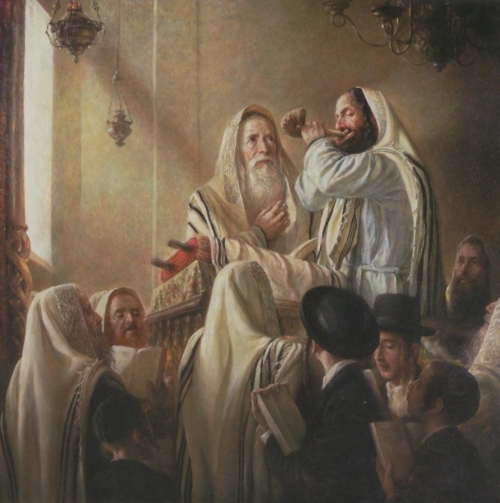
Shavuot Fellowship in Wisconsin

Twenty-years ago the spirit of the Lord kindled something new, and the ministry of first fruits of Zion was born. With the teachings of First Fruits of Zion, Christians and Messianic Jews began to rediscover the Torah.

Two decades later, First Fruits of Zion and the Messianic Jewish movement still lives, breathes, and is ready to thrive. At Shavuot 2012, First Fruits of Zion breaks new ground as we present our game plan for the future of Messianic Judaism, for Jewish believers in Yeshua, and for Messianic Gentiles from all nations. Come and hear the vision, become a solid member for change—be inspired to kick-start a fresh revolution by learning practical ways to facilitate study groups, Torah studies, and other outreach efforts.

from the Shavuot Conference 2012 webpage
First Fruits of Zion (FFOZ)

I have to admit to being a little nervous about attending this conference. Oh, I’m also really excited. I’ll get to see some old friends that I don’t get “face time” with very often, and actually meet people I’ve only communicated with over the web. But like some “fine wines” (yeah, that’s a joke), I don’t really travel well, I like to get to bed early, and I don’t enjoy large crowds. I don’t really thrive in a large conference environment.

But more to the point, I haven’t been to anything like this for a number of years and as an “unaffiliated Christian” in a world of Messianic Jews, Messianic Gentiles, and others who don’t traditionally identify with the mainstream church, I’m not sure what to expect or how I’ll be viewed by everyone (not that I should care, I suppose).

For one thing, the tallit and tefillin are staying at home (I’ll still bring a kippah). When I backed away from the One Law position (the basic Idea that all of the 613 commandments or mitzvot that observant Jews believe apply to them also applies to all non-Jewish Christians by virtue of being “grafted in”), I backed away from just about everything that had an outward Jewish religious practice. I started to imagine (not that she’d say anything) what my (non-Messianic) Jewish wife might be thinking every time I put on a tallit and laid phylacteries to pray. For me, it was easier to come to peace with the direct interfaith part of our marriage if I didn’t try to “walk her side of the street” so to speak. I put most of the religious items I used in “Messianic worship” in a box and there they’ll stay until I have a good reason to bring them out again.

So I don’t consider myself “Messianic” in the sense that most (probably) of the attendees at the Shavuot conference consider themselves Messianic (the non-Jews, that is).

There’s another issue here though. This whole classification of Christian vs. Messianic among non-Jews is just a little crazy. I know that it’s meant to differentiate between traditional Sunday Christians and those who have become more aware of the Hebraic origins of our faith, but it’s gotten to the point where we’re almost acting like we have two different religions.

I’m not OK with this. If Jesus was and is King of the Jews for Messianics, then he was and is King of the Jews for more traditional Christians. Recognizing the Jewishness of Jesus and then encasing that fact with a Messianic “bubble” only isolates that information and the truths it contains from all other Christians everywhere. Rather than focusing on the differences between how many non-Jews in the Messianic movement see things and how most other Christians see things, maybe we need to spend more time paying attention to how we’re alike.

I know a number of non-Jews who self-identify as “Messianic” visit and read my blog posts. If that’s you, I want you to practice something in the privacy of your own homes when you’re all alone. I want you to say out loud, “I’m a Christian.” Repeat it a few times. C’mon, don’t whisper. Really belt it out. “I’m a Christian.”

“I’m a Christian.”

Was that awkward? For some of you, it probably was. No, I’m not making fun of you or trying to be mean. My point is that whether you consider yourself a “Messianic Gentile” and pray wearing tzitzit and tefillin or you think of yourself as a Christian and feel no need to adopt any Jewish customs or commandments in your prayer and worship life, God is One. He’s the same God. Jesus is Jesus. He’s the Messiah, the Lord, the Savior, the Christ.

He’s the same guy for Messianics and Christians. We just picture him differently.

But how does he picture himself?

We don’t really know, but it wouldn’t hurt to stretch ourselves a little and try to see Jesus from a Jewish point of view and within a functional Jewish context. That’s probably a picture closer to his reality than many in the mainstream church see him.

However, you may be very comfortable with the division between Messianics and Christians. You may be asking yourself why you’d want to go through all that trouble and mess up your comfort. Because he is the Christ and we are Christians. He is the Master and we are his disciples. Jesus didn’t ask us to stand apart from each other, he asked us to be a united body and to work together like the different parts in your body.

I’m not a typical Christian. I don’t go to church. I have particular standards regarding food items that most Christians don’t observe. I have certain other convictions and perspectives that you won’t find in most churches. But I’m still going to be a really different “breed of cat” than most of the other conference attendees when I get there in a few weeks. In some ways, I’ll be just as nervous attending the conference as I would be if I decided to visit a church next Sunday morning.

But the point is, I shouldn’t have to feel that way. I probably wouldn’t if I got my wish (and my prayer). My wish and my prayer is that all believers come together in unity and truth, regardless of how different we are, and recognize our mutual fellowship and discipleship as followers of the Messiah King, who came once for the salvation of souls and who will come again to repair the world.

My wish and my prayer is that we who are grafted in realize that we are all Christians.

When you think of yourself and what you believe and then think of other believers and how different they are from you, try to consider how much you have in common with each other. That’s what I’m going to be doing on May 24th at Beth Immanuel.

And if you happen to be planning on attending FFOZ’s Shavuot Conference 2012, post a comment and let me know. I’d love to meet you when we’re together in Hudson, Wisconsin…and meeting in spirit and in truth.

Blessings.

Shemini: Ordinary Miracles

These concepts are reflected in this week’s Torah reading, Parshas Shemini. Shemini means “the eighth.” It refers to the first of Nissan, the day on which the Sanctuary was established. It is called “the eighth day” because it was preceded by seven days of dedication, during which Moshe erected and took down the Sanctuary each day, and taught Aharon and his sons the order of sacrificial worship…The Torah relates (Leviticus 10:1-2) that they brought an unauthorized incense offering and as a result, “Fire came forth from G-d and consumed them.”

Many explanations are offered as to why the brothers were punished by death. From a mystical perspective, it is said (Or HaChayim, commenting on Leviticus 16:1) that they died because their souls soared to such heights that they could no longer remain in their bodies. Nevertheless, their conduct is judged unfavorably because their spiritual quest ran contrary to G-d’s intent in creation: the establishment of a dwelling for Himself amidst the day-to-day realities of our existence. (See Midrash Tanchuma, Parshas Bechukosai) Their deaths show that our spiritual quest should not be directed towards the attainment of lofty rapture, but instead should remain firmly grounded in our actual lives.

This theme is also reflected in the conclusion of the Torah reading, which focuses on kosher food. For the establishment of a dietary code indicates that Judaism’s conception of Divine service involves living within the world.

-Rabbi Eli Touger
“Transcendence and Immanence”
In the Garden of Torah”
Adapted from
Likkutei Sichos, Vol. III, p. 973ff;
Vol. XVII, p. 92ff;
Sefer HaSichos 5749, p. 475ff
Commentary on Torah Portion Shemini
Chabad.org

All that walk on four… (11:21)

When Rabbi Shmuel of Lubavitch was a child of seven, he asked his father: Why does man walk upright, while animals walk on all fours? Rabbi Menachem Mendel replied: “This is a kindness from G-d to man: although man treads upon the material earth, he sees the sublime heaven. Not so those that crawl on four, who see only the mundane.”

-Rabbi Yanki Tauber
“The Rebbe’s New Clothes”
Once Upon a Chasid
Commentary on Torah Portion Shemini
Chabad.org

I suppose I’m being unfair when I accuse Christianity of focusing on the Heavenly at the expense of the here-and-now. After all, Christians perform many wonderful services of charity and kindness to those around them and to those in far-flung corners of the world. But as I recall my past when I used to sit in a pew in a church sanctuary on Sunday morning, it seems as if a great deal of time was spent touting the advantages of a “personal relationship with Jesus Christ” and that it’s all about “me and Jesus.” How many prayers have I heard offered up to the ceiling of the Sunday school classroom, asking for “a closer walk with thee” and thanking Jesus for the personal gift of grace and salvation?

There’s nothing wrong with any of that, of course, but now that our “ticket to Heaven” has been “punched,” so to speak, what are we supposed to do with the rest of our lives?

The commentaries I quoted from above may seem alien to most of you, but they do aptly illustrate the necessity of balancing the secular with the Divine. So many of the commandments given to the Israelites at Sinai were related to the world in which we live. There are commandments about food, commandments about clothing, commandments about marriage, commandments about farming, commandments about helping your neighbor, even if you don’t like him very much, commandments about…well, you get the idea.

Sure, there are also a lot of commandments about God, services of holiness, and acts of the Spirit, but there is an inseperable link between loving God and loving human beings (See Matthew 22:36-40). As far as I can tell, most or all of the commandments we see in the Torah that have to do with visiting the sick and feeding the hungry apply just as much to the Christian as they do to the Jew. That’s what I see in the Master’s teachings, anyway.

But many Christians still have this funny idea that we are only really serving God if we have some sort of formal “ministry” within the church, even as a lay teacher. Yet we see countless examples in the Bible of ordinary people who were devoted to God and who lived day-to-day lives that included acts of kindness and compassion to whomever they encountered who needed it.

Giving a jump start to the car of a guy who’s late for a job interview is just as holy as helping to build a new church on a mission trip to a foreign country. Where did we get the idea that we had to do something unusual and extraordinary; something way outside the normal boundries of our lives, in order to serve God and to obey the teachings of Jesus? As an “ordinary” person, you may be capable of committing more acts of holiness than even the greatest televangelist or Pastor of a “megachurch” you see on TV ( I suppose I’m employing more than a little tongue-in-cheek here).

And perhaps you are capable of even much greater miracles than these.

“Truly, truly, I say to you, whoever believes in me will also do the works that I do; and greater works than these will he do… –John 14:12 (ESV)

Miracles, by the way, don’t always have to be violations of the laws of physics. Sometimes, offering a momentary smile to a person who looks sad, or helping a lost person find the right address can be a miracle as great as moving a mountain.

Reading the Bible, praying, meditating on the acts of God, and worshiping with your fellows are all absolutely necessary acts of holiness and they bring much joy to God and to your own heart. But they are no more or less vital than helping change a flat tire for someone, donating a can of soup to your local food bank, or spending time with a neighbor who is in the hospital after surgery.

Today (as I write this), I’m going to take my son to work, deliver a Bible and some other books to a Chaplin who is going to deliver them to a sick and elderly Jewish gentleman who has just discovered the Messiah in Yeshua, and spend some time over coffee studying the Word of God with a friend. I don’t say these things because I think it makes me a better or special person. I say them because I’m an ordinary person doing ordinary things. But the ordinary and the holy are all intermixed in everything we do. We have our feet on the ground, but our eyes turned to Heaven.

And of all the ordinary things you and I are going to do today, who knows which one of them is a miracle?

Whatever we “offer” to God and to human beings, let it be who we are and not some “strange fire” we think we need to burn with in our hearts. God made us perfect as the people we are meant to be.

Good Shabbos.

The Radiance of the Light of Messiah

By day we take care to follow this order: Make Kiddush, then daven Mincha, and after that eat the festive yom tov meal.

The Baal Shem Tov used to eat three festival meals on Acharon Shel Pesach.

The Baal Shem Tov called the (third) meal of this day Mashiach’s s’uda (the “festival meal of Mashiach”). Acharon Shel Pesach is the day for Mashiach’s s’uda because on this day the radiance of the light of Mashiach shines openly.

In 5666 (1906) a new procedure was adopted for Pesach in the Yeshiva Tomchei  T’mimim in Lubavitch: The students ate the Pesach meals all together, in the study hall. There were 310 students present seated at eighteen tables. My father the Rebbe ate the festive meal of Acharon Shel Pesach with the yeshiva students. He ordered that four cups of wine be given each student, and then declared, “this is Mashiach’s s’uda.”

-Compiled and arranged by the Lubavitcher Rebbe
Rabbi Menachem Mendel Schneerson, of righteous memory, in 5703 (1943)
from the talks and letters of the sixth Chabad Rebbe
Rabbi Yosef Yitzchak Schneersohn, of righteous memory.
Translated by Yitschak Meir Kagan

In the seventeenth century the founder of the Chassidic movement, Rabbi Israel ben Eliezer (the Baal Shem Tov) instituted a new custom for the last day of Passover. He called it the Meal of Messiah (Seudat Mashiach). It consisted of a special, additional meal on the afternoon of the last day of Passover, paralleling the traditional third meal of Shabbat. The Baal Shem Tov emphasized that the main component of the meal was matzah. After all, it was the last meal on the last day of Chag HaMatzot, the feast of Unleavened Bread. A few generations later, the Rebbe Rashab (1860-1920) added the custom of four cups of wine, mirroring the seder of the first night. Some Chassidic Jews still celebrate this special Messiah seder on the last day of the festival. They gather together to end the festival with matzah, four cups of wine, and a special focus on the Messiah.

The entire theme of the meal focuses on the coming of Messiah and the final redemption. The meal is festive in spirit. Everyone wishes one another “L’chayim! (to life!)” while discussing their insights into Messiah and their dreams and hopes for the Messianic Era. The meal concludes with fervent singing and dancing in joyous elation over the promise of the Messianic redemption.

-Boaz Michael
“What is the Meal of Messiah? Part 2 of 3”
First Fruits of Zion

I’m sure that especially at this time of year with the Passover having just ended, we are all familiar with the redemption of Israel from their slavery in Egypt by the God of their fathers. Yet, redemption doesn’t always occur at a single point in history or in a single moment in time. Though the bodies of the Israelites were free, the minds and spirits of that first generation remained enslaved. In fact, almost none of that first generation, ironically including Miriam, Aaron, and Moses, would live to see the crossing of the Jordan and the fulfillment of the promise by inhabiting the land of Canaan.

One way we can look at the Meal of the Messiah, as instituted by the Baal Shem Tov and further described by Boaz Michael, is the further redemption of Israel and the celebration of that generation who would truly inhabit the land promised to Abraham, Isaac, and Jacob; the Land of Israel.

Walking TogetherBut what about those of us who are not their descendants? What of we, among the nations, who through our discipleship to the Master, we have become attached to the God is the Israelites? Does the Meal of the Messiah mean anything to us?

When they ate, Yeshua took the bread, made a brachah, broke it, and gave it to his disciples saying, “Take and eat it; this is my body.” He took the cup, made a brachah, and gave it to them saying, “Drink from this, all of you, for this is my blood, the blood of the new covenant, which is poured out on behalf of many for the forgiveness of sin.” –Matthew 26:26-28 (DHE Gospels)

Chassidim who keep the custom of celebrating the Meal of Messiah on the last day believe that by eating the matzah and drinking the wine, they are connecting with Messiah in both a tangible and spiritual way. God created us with our five senses, and he desires to bind us to him through our senses. To me, the parallels between this concept and the Master’s words at his last seder are astounding. It brings to my mind the Master’s words of “Take, eat; this is my body” and “Drink of it, all of you, for this is my blood.” Chassidim actually believe that when matzah is eaten at Passover that “we are eating G-dliness.” In fact:

Through eating at the time of … Moshiach’s Seudah we connect them with the physical world. In this manner, we create “a dwelling place” for G-d on the material plane. (Schneerson, Sichos in English, 3:20, 22-23)

-Boaz Michael, What is the Meal of Messiah? Part 2

Through the witness of the Master’s own words in Matthew’s Gospel, we can make a link between the imagery of the Chassidim and the Messiah’s final meal among his closest disciples. Through the words of the Master, we can also make a connection to us. Although we Gentile disciples cannot consider ourselves as having stood at the foot of Sinai or having crossed the Jordan into Canaan, on the final day of the Feast of Unleavened bread, we can partake of the bread of Jesus Christ, the bread of life.

Jesus said to them, “I am the bread of life; whoever comes to me shall not hunger, and whoever believes in me shall never thirst. –John 6:35 (ESV)

In fact, from ancient Jewish sources, “Bread” is one of the names of the Messiah:

Concerning the meaning of “in the sweat of your face you shall eat bread” (Genesis 3:19), the following explanation is given: “This hints about the Torah which is called bread, as it says, ‘Come, eat of my bread’ (Proverbs 9:5). Because of Adam’s sin, the Torah could not be fully explained until the days of Messiah” (Panim Yafot, Breshit 3). Accordingly, it is only Messiah who is able to reveal the full and complete meaning of the Torah, which gives life. In other words, inability to understand the Law brings about spiritual starvation. The perfect food, the “bread” of Messiah, therefore, is that which is able to ensure life.

-Tsvi Sadan
Lechem (Bread) pg 136
The Concealed Light: Names of Messiah in Jewish Sources

And yet, if the full yoke of the Law is not meant for the nations, but only the offspring of Jacob, what can this mean to us? Sadan continues (pp 136-7):

The “sign” performed inside the bodies of the people of Israel, according to Rabbi Shimon bar Yochai, was the nourishment of the manna. “How do we know that [this bread] did not come out of them [as excrement]? Because instead of reading ‘man ate of the bread of the angels [abbirim]’ (Psalm 78:24 ESV), you should read ‘man ate of the bread of the limbs [evarim]’ – bread that completely melts in the limbs” (Numbers Rabbah 7:4).

With this explanation, it is easy to see why the people of Israel were encouraged to eat from this Bread, as it says, “Oh, taste and see that the LORD is good” (Psalm 34:8). Wondering what the people should taste, Rashi concluded that Israel should taste the “Word” (Rashi to Psalm 34:9). For Rashi “Word” meant Law, but according to another explanation, “Word” is also the Messiah…

And we Christians also know this as it says:

And the Word became flesh and dwelt among us, and we have seen his glory, glory as of the only Son from the Father, full of grace and truth. –John 1:14 (ESV)

As you may know, my family’s Passover seder last week was something less than inspired. Also, it has never been our tradition to have a second meal at the end of the week of unleavened bread, so we have good reasons to not “tempt God” by trying to fulfill this custom.

But as we exit the week of matzah, we re-enter a life filled with the world in all it’s glories and disappointments. May God grant that we retain something of the radiance of the light of Mashiach, as we continue to progress in a world of darkness, with our path illuminated only by His Lamp.

Your word is a lamp for my feet and a light for my path. -Psalm 119:105 (Stone Edition Tanakh)

Find out more about the Meal of the Messiah at FFOZ.org.

Nothing’s Perfect

You have to begin with the knowledge that there is nothing perfect in this world.

Our job is not to hunt down perfection and live within it. It is to take whatever broken pieces we have found and sew them together as best we can.

—the Rebbe’s response to a girl who wanted to leave her school for what she thought to be a better one.
as related by Rabbi Tzvi Freeman
Chabad.org

Oh, duh! No, that’s not my Homer Simpson imitation, it’s my “light dawns on marble head” moment and the reason I’m writing this “extra meditation.” I’m going to use the above quoted phrase for tomorrow’s “morning meditation,” but as I was doing one of my obsessive reviews of tomorrow’s blog, trying to find all the typos I will invariably miss, it hit me.

Life isn’t perfect.

I suppose that’s obvious to you and really, it’s obvious to me too, but I spontaneously applied it to something specific in my own context and everything suddenly made sense. Let me explain.

I periodically kvetch about how hard it is to find other people who see things in the world of faith that are even remotely similar to how I see them (although my “morning meditation” for today has attracted some very nice comments). I also complain about my desire for a sense of community, particularly with my wife, and how frustrated I am that what I planned (boy, God must be having a good chuckle right now) doesn’t seem to be working out.

But what did I expect?

It’s not so much the statement that the Rebbe made above (as related by Rabbi Freeman), it’s the circumstances around the statement that made something “click” inside of me.

…the Rebbe’s response to a girl who wanted to leave her school for what she thought to be a better one.

I’ve probably said some variation of this a thousand times to relatives and friends when they’ve told me how life isn’t perfect for them, either. I just find it funny that God chose here and now to give me my “light bulb moment.”

It should have come sooner but I wasn’t paying attention.

I was having a conversation with the Missus the other day, again talking about the possibility of taking a class or two with her at one of the synagogues here in town. Somehow, we got on the topic of intermarried couples and, since she knows I’m reading Rabbi Boteach’s book Kosher Jesus, we talked about the very distinct differences in how Christians and Jews see the world, the Bible, the Messiah, and God. As we were talking, I was reflecting to myself on how one of the reasons I left the “Messianic” movement, at least in terms of physical worship and self-identification, was because I perceived it as a barrier to my joining her in a Jewish worship and study context.

I mentioned to her in our conversation, that I know there are plenty of intermarried couples in both the Reform shul and Chabad communities, and then she said something that stopped me cold. She said those couples were all comprised of one Jewish spouse and one non-religious (specifically non-Christian) spouse. They’re all Jew/Gentile intermarried, but not “mixed-religious couples”.

I see.

I suddenly realized where the barrier is located in my wife getting comfortable including me in her Jewish community. It’s located squarely at the intersection of “Jesus Street” and “Christian Avenue”. In other words (taking my tongue out of my cheek), she really doesn’t want to take her Christian husband into a Jewish synagogue to interact with her Jewish community. The real problem wasn’t just the negative perception many Jews have about Messianics. That’s why my leaving the Messianic community didn’t produce the desired result. My being a Christian is the real problem.

Oh.

Did you ever play “Battleship” when you were a kid? Ever have your fleet sunk? Mine ended up soundly torpedoed and sent swiftly to the bottom of the cold, cold Atlantic.

I was pretty grumpy about it initially. In fact, I’ve been pretty grumpy about it until about thirty minutes ago (as I write this). Then I re-read the Rebbe’s words and the context in which he said them, and realized that if I thought I was going to get my way, I was sadly mistaken. I won’t even say that “life’s not fair,” because I don’t think fairness has anything to do with it. It’s not like I have some sort of “right” here. It was more of a desire to join with my wife at the level of worship and perhaps to take my meager level of Jewish learning up a notch.

That’s not going to happen now. Of course, it’s not like it was owed to me or something. Sure, it would have been nice, but it’s not my right to enter into someone else’s world if I don’t belong there. It’s not so much that I wanted in the Jewish world. I wanted in the Jewish world so I could share my wife’s world with her.

But life’s not perfect. In fact, life has never been perfect, even among those who have served God with outstanding faithfulness, which doesn’t exactly describe me. No perfect life. No perfect people.

The king’s primary function is to dispense justice and righteousness in Israel. Second Samuel 8:15 tells us, “David reigned over all Israel; and David administered justice and righteousness for all his people.” The Psalmist says, “The strength of the King loves justice; You have established equity; You have executed justice and righteousness in Jacob.” (Psalm 99:4) When Israel practiced justice and righteousness, she was blessed, but when she strayed from justice and righteousness under the influence of wicked kings, the prophets rebuked her. “I will make justice the measuring line and righteousness the level,” (Isaiah 28:17) the LORD declares through the prophet Isaiah. The Psalmist prays for the Davidic King, saying, “Give the king Your judgments (mishpatim), O God, and Your righteousness to the king’s son. May he judge Your people with righteousness and Your afflicted with justice.” (Psalm 72:1-2)

“Righteousness and Justice”
Weekly eDrash
Commentary on Torah Portion Mishpatim
First Fruits of Zion

Israel was the only nation specifically established by God, and given a personal and corporate set of laws and ordinances by which the Hebrews were supposed to obey their Creator as a people. If any country was to have operated with flawless perfection, it should have been Israel, and yet even a casual reading of the Tanakh (Old Testament) tells us that they experienced dramatic swings, from amazing prosperity to bitter and total defeat…and back again. Life wasn’t perfect for the Children of Israel and it isn’t perfect for the Jewish people today. Life isn’t perfect for the church, and certainly it hasn’t been perfect over the past 2,000 years of Christian history.

Why should even this one thing that I ask for be perfect for me? There’s no reason it should be.

Oh, I know the Christian platitudes: “Go bathe it in prayer” and such, but frankly, I’ve seen some of the most faithful people I know end up disappointed in so many ways and still maintain their faith and trust.

I’m not going to “win” this one, but I guess I can’t say that I mind all that much (well, I mind a little). There’s so much else that is going right. My wife and I are together after almost 29 years of marriage. We both are reasonably healthy, we have three children and one grandson. We are fed, and clothed, and housed. We are gainfully employed and are able to meet our needs and a number of our wants. Life isn’t perfect, but it isn’t horrible, either.

Most of all, both my wife and I are relating to God, each in our own way and in our own manner, as Jew and Christian. I’m a really unconventional Christian and she’s not always the typical Jew, but we get by.

Now that this realization has happened, I don’t know what comes next. I don’t have “a plan” anymore. Maybe I’ll finish out my year long experiment here and then “sink” this blog along with my hopes or maybe I won’t. I’ll have to wait and see if God decides to fill in the blanks in my life with something I haven’t anticipated, or if He’ll just let me have blanks in my life for a day, or a week, or a month, or a year or ten.

Right now, I guess I’ll take the Rebbe’s advice, try to find whatever broken pieces of my aspirations that God has left lying around and see if I can patch them together into something that makes some sort of sense.

I’ll let you know how it goes.

Debating Fulfillment Theology

This “logic” is plainly presented in Galatians 3. God had a very good reason to institute the Law of Moses and it has nothing to with “bait and switch.” It had to do with point and lead until the fulfillment of its goal. The emphasis of the salvation that was to come for all of mankind goes back to the promise made to Abraham.

-Eugene Adkins
in his January 27 comment on my blog post
The Lord’s Sabbath

This understanding of the function of a paidagogos clears up Galatians 3:23, where Paul says, “Now before faith came, we were held captive under the law, imprisoned until the coming faith would be revealed” (Galatians 3:23). The paidagogos was the child’s guardian, not his jailer. When we understand that the paidagogos was responsible for protecting, supervising, and directing a child, then we have a better understanding of how the Greek text of Galatians 3:23 should be rendered in English. The Greek word which the English Standard Version translates as “held captive” has a different connotation. It can also be rendered as “protected,” “kept safe,” or “guarded.” The word should be understood as speaking about how a pedagogue kept a child safe and out of trouble. Similarly, the Greek word which the ESV translates as “imprisoned” (the same word appears in 3:22) can be rendered as “kept in” or “enclosed” in a positive sense. The word should be understood as speaking about how a pedagogue kept a child inside for his school lessons. He did not allow the child to run off and follow his friends into trouble. He kept him shut up inside for the purpose of education and protection.

-D. Thomas Lancaster
“Sermon Eighteen: The Pedagogue (Galatians 3:19-26), pg 182
The Holy Epistle to the Galatians
First Fruits of Zion
August 2011

Ziesler, “Role of the Tenth Commandment,” p. 50, makes the important observation in Rom. 8:4 of the use of the singular…(“requirement”) in Paul’s conclusion: “having talked in 7.1-6 about dying to the Law, Paul now in a notably bald statement appears to bring us back to life again in relation to the Law, if not under it. We died to the Law in order to keep it better.” He further suggests that this singular reference keeps the singular sin of covetousness in perspective (pp.50-51).

Snodgrass, “Spheres of Influence,” p. 107 states: “If the law is not involved in salvation, then sin is a victor because it defeated God’s law which was for life (7.12.10). But now the law is placed within the sphere of the Spirit (cf. 8.4), where it belongs (7.14). The law in the right sphere frees us from the tyranny of the law in the sphere of sin. I do not think we can ignore a reference to the OT law. It is through the law that Paul died to the law.”

Footnotes 55 and 56
from “Summary and Appendix I,” pp 365-66
in the Mark D. Nanos book
The Mystery of the Romans
Fortress Press (1996)

Important Note! Please read the first comment made by Eugene Adkins below, as he corrects some mistakes I made about his background and role. I apologize to Eugene and to everyone reading this for my errors.

I’ve been debating with Pastor Eugene Adkins in the comments section of my blog post The Lord’s Sabbath regarding what he refers to as “fulfillment theology” and what I consider supersessionism or “replacement theology” (see our series of comments on the aforementioned blog post for full details of this discussion and specifically Pastor Adkins’ comments submitted on Jan 27, 2012 @ 17:31 hours).

In response to some of Pastor Atkins’ points, I’ve quoted from both Lancaster’s recent Galatians book and the classic Nanos tome on Romans (or rather, some footnotes contained within the Nanos book). I’m doing this for several reasons. The first is that, unlike Pastor Adkins, I do not have a post-graduate degree in any form of religious studies (I assume as a Pastor that Adkins is so educated) and thus do not have skill sets equal to his own as far as debating the scriptures. In order to support my arguments, I must rely on the scholarship of external sources, namely the previously mentioned Lancaster and Nanos books.

Secondly, I want to introduce valid and scholarly sources that refute or at least bring into question the traditional Christian view that the Torah was only temporary for the Jewish people (and I have never said that the Law was intended to apply equally to the Jewish and Gentile disciples of Jesus in any equal fashion) and that once Christ lived, died, was resurrected, and ascended, that the Law became null and void (or “fulfilled” in the sense that its temporary purpose as completely satisfied and then ended), and wholly replaced by what Pastor Adkins refers to as Christ’s “international covenant” that applies uniformly to Jewish and non-Jewish disciples of Jesus. I’m trying to point out here that perhaps Pastor Adkins’ interpretation of scripture (which seems to be the interpretation of the church in general) is not the only possible way to understand what Paul was saying to the congregations of Rome and Galatia.

Finally, I want to be fair. There is a tremendous tendency for me to simply dig in my heels, say “you’re wrong,” and base my subsequent responses on my emotional states, particularly those that have to do with Christian supersessionism and its terrible (and often fatal) effect upon the Jewish people across 2,000 years of church history. But that’s not the right thing to do. I want to respond based not only on my spiritual “understanding” of God’s relationship with both Jews and Gentiles (which is completely subjective and therefore, unable to be objectively demonstrated) but on Biblical scholarship as well. The problem here is that I’m like Woody Allen trying to go a few rounds in the ring with Mike Tyson as far as our relative educational backgrounds go (well, probably not that bad).

I have two undergraduate degrees and a post-grad degree, but none of them are in subjects relevant to this conversation. Given my job, my book writing, and my family commitments, I don’t have the time or other resources to go back to school and take another degree, or to perform the necessary research to adequately respond to all of the specific points being brought up in this discussion in order to sufficiently represent my point of view. I believe I’m right based on everything I’ve learned thus far, but belief isn’t enough. I must have proof beyond what I have already demonstrated, both online and in print. Also, assuming that I can be wrong (and I know I can be), I need to either confirm or refute my current belief system using concrete evidence (or as “concrete” as anything gets in theological debates).

That’s where you, dear readers, come in. I’m calling for backup. Or I’m willing to be presented with irrefutable proof that the New Testament writings can be interpreted in one and only one, single manner, and that the one and only interpretation is held under lock and key by the 21st century evangelical Christian church. I personally don’t think it is, but like I said, I want to be fair.

I want to say to you personally Eugene, that I’m not writing this to try and be mean or unfeeling or offensive in any way. I know you are sincere and are representing the truth based on everything you’ve been taught and everything you believe, both intellectually and through your faith. I don’t have a problem with any of that. None of this is motivated by any dislike of or anger toward you. I respect your service to God and thank you for continuing to participate in our dialog rather than summarily “writing me off” as some sort of “religious nut.”

My problem with the traditional Christian position on supersessionism is that, even clothed in a pleasing and benign exterior, this “fulfillment theology” is a nearly 2,000 year old artifact that was first created when the schism between Jewish and non-Jewish believers began to develop and then exploded across the early history of the church, in order to artificially justify the ascension of the Gentiles over the Jews in Messiah, and to literally re-write the nature and character of Christian vs. Jewish “Messianism,” as we see in part here:

The destruction of the Second Temple in 70 CE and the subsequent expulsion of the majority of Jews from what would be called Palestine marked a disastrous shift in the Jewish authority over the Messianic community. Up until that time, the head of the Jerusalem leadership of the Messianic community, otherwise referred to as “the bishop of the church”, had always been Jewish. Once the Jews were expelled from Jerusalem by Hadrian, for the first time a Gentile had to be elected into the role. As events moved forward from that point in time, the Gentile presence in the Messianic community grew dramatically while the Jewish leaders and worshipers of Yeshua struggled under the heartbreak of the loss of the Temple and the ejection from their land. Scant decades later, the failure of the Gentile “church” to support the Jewish revolt of Bar Koshba drove another significant wedge between the Jewish Messianic community and the body of Gentile believers.

With the Jewish population now scattered, humiliated, and fearing destruction at the hands of the Romans, the Gentile Messianics continued to secure their dominance and control of the worship of Yeshua. The self-identity of the Gentile Christians shifted from grafted-in to the root of Judaism through Abrahamic faith to the new inheritors of the Messiah, replacing Israel on a spiritual level. Origin of Alexandria and Justin Martyr were the earliest authors of this tradition and among the first to declare that the church had superseded Israel. Attached to this belief was the rise of Christian blame against the Jews for the murder of Jesus. The Jews became unworthy of their own Messiah and were pushed out of the worship of Yeshua by the Gentile disciples they had once taught and nurtured.

-James Pyles
Excerpt from “Origins of Supersessionism in the Church” (pp. 33-34)
Messiah Journal
Issue 109/Winter 2012

I previously said that I don’t have an advanced degree in religious studies, but as a published author, I do know how to do research, including delving into the history of how “the Way,” which started as a sect of Judaism inclusive of non-Jews but administered and guided by Jewish mentors who understood God and Messiah in a completely Jewish religious framework, into a newly created non-Jewish religion which found it necessary to eliminate any aspects of Judaism from its background.  In my review of the early church, I could see the early “church fathers” virtually reframe the letters of the early Jewish disciples, principally written by Paul, into words that would ultimately be used to discount and eventually all but exterminate the Jewish people.

I’m opening this blog post up for debate on the pros and cons of “fulfillment theology” and asking for those who are far wiser and much better educated and I in religious subjects to enter into the conversation. I do insist however, that this conversation remain polite and respectful. Disagreement is absolutely no excuse for undue emotionalism or any personalizing of conflict. Any apparent “attacks” on someone who differs from your point of view will not be tolerated and I, as the blog owner, reserve the right to edit or delete any offensive comments at my discretion.

This debate is specifically focused on the pros and cons of “supersessionism,” “replacement theology,” “fulfillment theology,” or whatever else you want to call it. It is NOT about One Law or Two House perspectives, so I am not inviting statements on those viewpoints to be presented here. If you find it necessary to disregard my wishes in this, your comments will be removed. Thank you.

With those disclaimers out of the way, please feel free to refer back to the full stream of comments on the “Sabbath” blog post, then return here and discuss how you support or refute my statements and Pastor Adkins’s statements. Please cite specific Biblical or other sources to support your arguments. I am asking for information, not unbridled passion.

One last thing before we begin. Eugene, you previously said:

How is lighting candles a confirmation of Jesus’ grace if that person doesn’t believe in Jesus to begin with?

Shabbat candlesI do have faith in Jesus, as you do Eugene. Watching the lighting the Shabbos candles is a beautiful and unique way of inviting him into my home and to experience something of a preview of his return to us, may it be soon and in our days. If perhaps, your comment were meant as a remark toward my wife who is Jewish but not a believer, I can only ask that you try to consider her with the same compassion and love that God has toward His am segulah; His “wondrous and treasured people” (Exodus 19:5). I can’t tell your attitude toward Jews and thus toward my wife and children through our “text-only” conversation, but if you cannot see them with the same compassion as God does, and believe God has discounted if not completely destroyed them, then I suppose my argument has already been made for me.

With that, I look forward to everyone’s contribution now and in the days ahead. I hope to learn a lot.