Tag Archives: FFOZ

Don’t Argue

“What is the point of arguing with a Jew? Every Jew has a mitzvah with which he feels an affinity. Find that mitzvah and assist him with it.”

-Rabbi Tzvi Freeman
“Each One’s Mitzvah”
Chabad.org

I know that Rabbi Freeman was addressing a Jewish audience when he wrote this, encouraging one Jewish person to help other Jewish people with their special mitzvot, but consider this.

In her article for Messiah Journal, First Fruits of Zion (FFOZ) contributor and translator Jordan Levi referred to the Gentiles who help Jewish people find and assist with their mitzvot as “the Crowning Jewels of the Nations.” If I take the thoughts of Rabbi Freeman and Jordan Levi and put them together, then the Rabbi’s message is just as appropriately addressed to Gentile believers, that is, Christians, as it is to Jewish people.

Am I crazy? Christians helping Jews to find and perform their special mitzvot? Christians don’t even believe in mitzvot because the vast majority of them believe the “Law” is dead as a doornail, killed when the church was born in Acts 2

If you’ve been reading my blog for any period of time, you know I don’t believe that last part for even a second. I believe that we non-Jewish believers have a special duty, assigned to us by God, to be part of the restoration of Israel by helping Israel raise David’s fallen tent (Amos 9:11-12). We people of the nations are to be drawn to the Jewish people because they are close to God (Zechariah 8:23), and we desire to go up with them to the Temple of God in Jerusalem because we know it is the House of Prayer for all peoples (Isaiah 56:7, Micah 4:2).

I recently posted two articles on my blog about the Gentile relationship to Messianic Judaism, specifically within the Messianic Jewish worship context, Twoness and Oneness: From the Sermons of David Rudolph and Oneness, Twoness, and Three Converts. This was an attempt on my part to describe what it is to be a member of the “crowning jewels of the nations” “on the ground,” so to speak, worshiping and associating among believing and observant Jews.

As you might imagine, my commentaries were not well received within certain venues, specifically some Hebrew Roots groups where the message of Gentiles having a critical role in uplifting and supporting a return to Torah for the Jewish people without usurping the Jewish role for ourselves is not well understood or perhaps simply considered unacceptable.

But then I read Rabbi Freeman’s brief missive from this morning and the message clicked into place again. “What is the point of arguing with a Jew?” That’s what I’d like to ask some of these folks. And yet they insist on arguing with Jewish people over ownership of the Torah of Sinai rather than getting on with the job we were assigned by Hashem. “Find that mitzvah a Jew feels an affinity for and assist him with it.”

Let me spell it out to you again in case you’ve missed this message in previous blog posts. We have a duty to provoke the Jewish people to Zealousness for the Torah (see the link I just provided for the details). By doing so, we bring the time of Messiah’s return that much closer, summoning the Messianic Age, which is the true gospel message of the Bible.

The FFOZ television series episode The Good News which I reviewed last summer, also illustrates that the gospel message of Jesus is far, far more than a simple plan of personal salvation.

Why are there non-Jewish believers in Messiah Yeshua worshiping alongside Jewish believers in Messianic Jewish synagogues? Why are there individuals or small groups of Christians who self-identify as “Messianic Gentiles” in traditional churches attempting to softly, gently deliver an understanding that the greatest part of the gospel message is our role in assisting Israel to bring about the future Messianic Age?

Rabbi Tzvi FreemanRabbi Freeman answered the first question in the quote at the top of the page. Boaz Michael, in his book Tent of David, answered the second question by stating we must help the Church to realize its true role in Israel’s future redemptive history, pointing them to the small lesson that Rabbi Freeman presented so succinctly.

When men like Pastor John MacArthur say that “In the character of the book of Acts, the church is born, and Judaism in God’s eyes is a dead issue…,” he is not only saying something terribly wrong about God’s intent toward Israel, he’s directly denying the Church’s role to assist Israel in bringing the return of Jesus Christ through the process of the Church coming alongside Israel as a partner, standing ready to restore David’s fallen sukkah.

“What is the point of arguing with a Jew? Every Jew has a mitzvah with which he feels an affinity. Find that mitzvah and assist him with it.”

Until we, the people of the nations who are called by God’s Name, we Christians are willing to put our traditions, our egos, and our fear of change aside, and do what God commands us to do, the Church and any other groups of Christians, including Hebrew Roots groups, are going to be highly limited in our service to God.

Until we stop either dismissing the Torah as yesterday’s trash or coveting the Jewish role in Torah observance for ourselves, we may still “win souls for Christ,” but we will be stifling the fulfillment of the greatest revelation of God to the world, the return of the Messiah King, the establishment of his rule on the Throne of David in Jerusalem, and the establishment of a reign of peace for all the world, so that everyone “will sit under his vine And under his fig tree, With no one to make them afraid, For the mouth of the LORD of hosts has spoken,” (Micah 4:4).

Sampling Tent Builders

The church is supposed to be a partner with Israel. If it doesn’t see this then it’s not fulfilling it’s function.

-Boaz Michael
“Envision the Ideal Church” session
Tent Builders presentation

I mentioned a few days ago that I’d received a DVD in the mail from First Fruits of Zion (FFOZ) providing an eighty-two minute “sampler” of the day-long conference called “Tent Builders” which is meant to accompany and augment the message in FFOZ President Boaz Michael’s book Tent of David: Healing the Vision of the Messianic Gentile.

I’ve read Boaz’s book more than once but never had any of the education or training that is supposed to equip the target audience on methods of approaching the Church with the Messianic message of just how Jewish the Jewish Messiah is and what it means to “partner” the Church with Israel.

The sampler DVD is divided into four portions:

  1. Envision the Ideal Church
  2. The Strategic Mission
  3. Interview with Boaz’s Pastor
  4. About the Book Tent of David

This review focuses on the first two portions which were taken from a presentation Boaz gave in Atlanta, Georgia. I won’t try to dissect everything Boaz taught and certain sections of his teaching came, more or less, out of the book, so if you’ve read “Tent of David,” you already have some familiarity with the message. The sampler disc contains excerpts of what I imagine is supposed to be a DVD containing the entire conference sessions, so that people who weren’t able to attend the in-person conferences, could still benefit from everything that was taught. It’s also meant to be accompanied by a workbook and presumes that the audience has already read “Tent of David.”

The goal of the conference and of participation is to become a “sent out one” or an emissary into the Church, to share the wonderful message we as “Messianic Gentiles” were given in order to assist the Church in ceasing to be the stumbling block standing in the way of Israel seeing the truth of Messiah. One of Boaz’s key phrases is that we must change the Church for the sake of Israel.

This was actually born out of Boaz’s own experience at a small Baptist church in Marshfield, Missouri where he and his family have been living. He actually began attending this church almost by accident, thanks to a visit to Marshfield by Rabbi and Messianic blogger Derek Leman. It was out of the development of the relationship between Boaz and his wife with the members of their local church that Boaz realized this “model” could be replicated “on the ground” so to speak, by many, many other Christians across the country.

For over two decades, FFOZ has been producing books, magazines, seminars, and many other educational materials trying to get its message out, but in spite of the expectation that at any minute, the floodgates would open and the Christian Church as an entire unit across the world would “see the light,” nothing happened. Groups of Christians would leave the Church disillusioned by shallow teachings and Christian disdain for Israel, and they would join small groups of like-minded Gentile believers, but over the years and decades, these groups didn’t grow, didn’t show fruit, and nothing happened. The Church certainly didn’t change and most of these small groups stayed small groups, generally spinning their wheels and sometimes complaining about “Christians.”

BoazOccasionally, through his contacts, Boaz would know of a motivated family of Gentiles who were “Messianically” minded and know of a willing and open Pastor in the same community. He’d put them together and the combination would result in change in the local church. Boaz and his wife Tikvah in their own local church had the same experience. It seemed like something that could be replicated on a large-scale, but at the grass-roots level.

But it’s not that easy. It wasn’t easy for Boaz and Tikvah and it isn’t easy for anyone else. While some churches have managed to change trajectories away for teaching supersessionism and toward an enlightened view of the Jewish Messiah (which is a lot more than just saying “Jesus was Jewish”) and the significance of Israel and Torah, it required tremendous sacrifices in time, money, and participation in portions of church teachings that are not always spiritually enlightening. It also isn’t always accepted and Boaz even said that it’s a message the Church usually doesn’t want to hear.

Boaz challenged his audience in the first session to envision the ideal church, write down their description, and then participate in making that ideal church happen at the local level.

I have a vision about what an “ideal church” would look like too, but I haven’t the faintest idea how to make it happen, especially all by myself. But as I listened to Boaz, I began to feel guilty because he described many Messianic Gentiles as either complainers or just people who wanted others to do the work of changing the Church for the sake of Israel. Am I a bad, complaining, lazy person for feeling discouraged?

Moving to the “Strategic Mission” session, Boaz expanded on what was needed. He used to think that having a good message was enough, but that hasn’t worked for the past twenty years. He finally discovered, though a gentle rebuke by someone he trusted, that without the involvement in the Holy Spirit and without relationship and familiarity, the message was never going to be successfully delivered.

The core of “Tent of David” is derived from a passage in Amos 9:11-12 that’s quoted by James in Acts 15:16-18. You can look up the text, but it paints portrait and prophesy of a time when the people of the nations will partner with Israel in rebuilding the fallen tent of David and restore Israel in the Messianic Age. James, leader of the Apostolic Council in Jerusalem saw the participation of the first Gentile disciples in the Jewish movement of “the Way” as the beginning of the fulfillment of that prophesy. The prophesy of Gentiles coming alongside Israel to strive for a mutual goal without requiring that those Gentiles convert to Judaism and take on the full yoke of Torah. In fact, the prophesy can’t be fulfilled if Gentiles convert to Judaism or otherwise are circumcised to become “pseudo-converts” with the belief that they are obligated to the full yoke of the mitzvot in the manner of the Jewish people. Jews and Gentiles must continue distinct roles and identities within the body of Messiah and become interdependent elements in the creation of the Messianic future.

ChurchIs this how the Church sees its role in relation to Christ? In most cases, probably not. In fact, the apostles including Paul, would not even recognize what most Churches teach today as having much or anything to do with the original gospel message they transmitted to Jews and Gentiles in the first decades after the resurrection and ascension of the Master. The Church, for the most part, thinks the greatest revelation and the only revelation of Jesus has already happened: the message of Salvation through the life, death, and resurrection of Christ.

Of course that is amazingly good news, but the story doesn’t stop there and in fact, according to Boaz, the best part is yet to come…the establishment of the Messianic Kingdom with Jesus on the Throne of David in Jerusalem, raising Israel to the head of all the nations, returning all the exiled Jews to their Land, and establishing a reign of world-wide peace. It’s the promise of what is yet to come.

And the Church has missed it. Oh sure, churches talk all the time about the “end times” and the “return of Jesus” and how “the Church” will be the thing that’s elevated and glorified, but at the end, people go up to Heaven as opposed to what it actually says in the Bible of God coming to earth and living among His people as He once did in Eden.

Boaz unpackaged the message that he believes the “grass-roots tent builders” need to be taking back into their local churches. I won’t go into all of his points, but I want to cover the one that I think is most important but also the message that the Church will find most difficult. The centrality of Israel. What does that mean?

The Church believes that it’s all about “the Church.” The Church will be raptured to Heaven, the Church will return with Jesus, the Church will rule and reign.

In reading the Bible, if I substitute the Greek word “ekklesia” for “church,” and I realize that generically “ekklesia” just means an assembly of people gathered for a common purpose, the “magical significance” of the word “church” is taken down a peg or two. When Jesus speaks of his “church” he is speaking of an assembly of human beings gathered together to begin to fulfill the prophesy of Amos (and many other prophesies) to establish the first fruits of a partnership of Jews and Gentiles together in the body of Messiah, to ultimately summon the coming Messianic Age which will see Jesus as the King of Israel who will bring total peace to humanity.

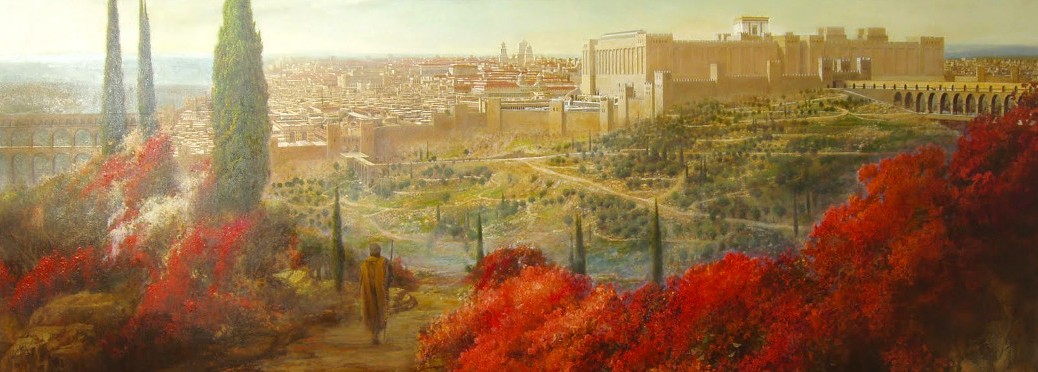
ancient_jerusalemBut this requires we realize that in all of the ancient prophesies and how they were understood by the apostles and first century Jewish and Gentile disciples, it was always Israel that was restored, and Israel that was central to God’s entire redemptive and restorative plan, and Israel that was the center and lynchpin of the entire Biblical message and the good news of Messiah. This is not the message Christianity has promoted and instead, they have caused the basic concept of “ekklesia” to evolve, morph, and develop into a separate and self-defined entity known as “the Church,” which across Christian history and into modern times has wholly separated from Israel, from its original purpose and mission, and has watered down the gospel message into “merely” one of personal salvation, denying the vast, panoramic scope of the Messianic Kingdom to come that we must all strive to bring to fruition.

As Boaz continued to lay out everything involved in this grand plan, I started to feel overwhelmed. Every time he said something meant to inspire his audience to greatness, I compared it to my actual experience in my local church. Boaz sees success in the Tent of David plan because it puts together enthusiastic Messianics with Pastors in local churches who are at least receptive to relationship and partnering, but what if the local church leaders are so assured of their theology and doctrine that they see the relationship as one where the church needs to convince the intelligent but misguided Messianic that Church tradition based on the Reformation, Calvinism, and Dispensationalism (none of which existed in the time of the apostles) is actually the true message of Jesus Christ?

So my primary take away as I ejected the DVD from my computer and prepared for bed was a combination of guilt and feeling overwhelmed with more than a hint of failure added to the mix.

Boaz ended his “Strategic Mission” session with a story about his daughter who is currently serving with the IDF. I don’t know how much I should reveal about her, even though she has been uncompromising in her devotion to Messiah and has not hidden this from anyone who knows her in Israel. Also, as Boaz said, he’s a public figure, so it wouldn’t be hard to find out who his daughter is and what her family believes.

It’s actually an amazing story. I knew some of it just because I’ve briefly spoken with Shayna a few times and am her “friend” on Facebook, but Boaz filled in the details as only a very proud father can. Boaz and Tikvah raised all their children with a strong sense of mission. I guess growing up within the context of the development and progression of First Fruits of Zion’s mission must have had a strong impact.

Boaz laid that sense of mission and dynamic struggle squarely at the feet of his audience. Of course, I only got to see a small portion of the conference and nothing at all about how the students received the message or interacted with Boaz and each other. I have absolutely no idea at all how this is actually playing out in churches across America and I don’t know anyone else who is a “Tent of David” graduate and how they have met with success, failure, or anything else.

Boaz in churchBoaz said that in the church he attends, two HaYesod classes had been taught, one Torah Club cycle had been completed, and there was a group viewing the various episodes of FFOZ’s television series A Promise of What is to Come and using them as topics of discussion.

I won’t lie. That really sounds wonderful, but in my current context, none of that will ever be received. I previously mentioned that having Tent Builders graduates attempt to go into some place like Pastor John MacArthur’s congregation would likely result in a less than enthusiastic reception. It is true that time, relationship, and familiarity helps the “Messianic Gentile” in church gain credibility and even a minority voice in Sunday school discussions, but there will always be churches that will listen and decide that they see and hear nothing that should deter them from what they have always believed to be true about the Bible, about Jesus, and about God, Judaism and Israel notwithstanding.

I’m enjoying D. Thomas Lancaster’s sermon series Holy Epistle to the Hebrews and recently I discovered the sermons of Rabbi David Rudolph. I can “feed my head” all I want and struggle in my personal relationship with God and what all this is supposed to mean, but except for how some people see my blog as a positive or even inspirational influence, that still has little or no effect at the level of the local church, and it certainly isn’t a testimony to changing the Church for the sake of Israel.

Do I think the “Tent Builders” mission is good? Yes, of course I do. You may be surprised to read that sentence after everything else I’ve said, but I still think it’s essentially sound. The thing that Boaz didn’t say in the DVD sampler though he mentions it in his book, is that the mission isn’t for everyone. He also doesn’t mention, though it should be obvious (it certainly is to me) that not only does the Church not want this message, but in some cases (how many, I don’t know), the message will be continually resisted, regardless of relationship, and ultimately rejected.

The Messianic Gentile can then decide (assuming he or she hasn’t been ejected from the local church) to either continue going for the sake of fellowship (which Boaz recommends) and perhaps with hope beyond hope that eventually some people will be more accepting of the paradigm shift Boaz suggests, or that Messianic person can leave.

I don’t know if there’s a “plan B” built into the Tent Builder’s mission profile. Try again at another church after months or years at the first? Try a less formal venue such as a local Bible study or home fellowship? Retire into the world of virtual study and quiet contemplation? Boaz maps out a highly public, visible, dynamic mission of reaching out to the local church, all of the local churches with the Tent Builders message built on relationship and familiarity, inspired and supported by the Holy Spirit, with the ultimate end goal to show the Church their true priority and purpose in partnering with Israel to bring the time of the return of the Messiah.

a-better-placeI suspect that it is not going to come very quickly. Conferences aside, it’s like the ads for going back to the gym that are popular right after New Years when people are feeling the remorse of eating too much during the holidays. People get pumped up and excited and join a gym, but I can tell you from personal experience that after the enthusiasm wanes or, in this case, the conference is over and months have passed, there’s only you and the weights. You either show up each morning and start working, or you stay home and get fat.

This metaphor breaks down when you realize that exercising is between you and the exercise machines. All you need is motivation and the will to carry on over the long haul. In the local church, what people think about you, about your message, about Jews, about Judaism, and about the very real threat that change represents makes a huge difference, and you have control over none of that. You can do everything “right” and still fall flat on your face.

There are no “magic” answers. Win, lose, or draw, there is only God.

Good Shabbos.

A Brief Introduction to Tent Builders

The church is the biggest stumbling block for the people of Israel to see the true message, the redemptive message of the Messiah.

The church is fundamentally good but the church needs to change.

-Boaz Michael
from a short video introducing his
Tent Builders Seminar

I have inserted the link to the YouTube video at the bottom of this page, so you can see Boaz’s entire presentation below. It’s not quite seven minutes long, so it won’t take much of your time to review.

I’m writing this for a couple of reasons. The first is that I received a DVD in the mail from First Fruits of Zion (FFOZ) that contains an eighty-two minute “sampler” of Boaz’s eight-hour Tent Builders Conference, which he presented in various venues across North America (registration is now closed so I assume there’ll be no additional conferences).

This is, or was, the training companion piece to Boaz’s book Tent of David: Healing the Vision of the Messianic Gentile, which I most recently reviewed last October 6th and October 10th.

I haven’t had a chance to view the DVD yet, but I feel it’s necessary because in spite of all of my efforts and my reading and re-reading of Boaz’s book, something’s still wrong.

I’ve gotten this sense of “wrongness” most recently from writing the first part of my review on MacArthur’s sermon series From Judaism to Jesus. If you’ve read that review, you know that I’m appalled and dismayed at MacArthur’s approach not only to the early Messianic Jews of the apostolic era, but to their modern-day counterparts, the Messianic Jews of the twenty-first century.

Boaz MichaelI’ve already read the second part of MacArthur’s three-part series and have written the review (it will appear online next Sunday morning). I can’t say my opinion of John MacArthur or any of his perspectives on Judaism has improved. More’s the pity, because Pastor MacArthur is one of the significant voices if not “the voice” of the modern Evangelical Fundamentalist movement in Christianity today. He’s been writing and preaching for over forty years and even though I had never heard of him before  last year, his name is practically a household word among the members of many churches.

I wanted to view the Tent Builders DVD sampler but only have the ability to currently hear Boaz’s brief introductory video on YouTube. He describes Tent Builders as a missionary effort which provides a purpose in which each Christian can participate. The “mission field,” so to speak, is the Church. Christians in the church or “Messianic Gentiles” who have left the church, can find in Tent Builders, a path back, a path that can lead to teaching that the church must see itself in partnership with Israel, not in competition with or as a replacement for Israel.

Another question that comes in…in relationship to something that’s happening in our current church scene today is explain why we have Messianic Jewish temples. What is the need for them? Are you familiar with this? Recently, there has been a…a…a surge of Messianic Jewish temples.

But what’s happened is, I think that many well-meaning Christian people, evangelical people, are catering more to a sociological minority movement than they are to the Word of God. Because the Bible would never tolerate a Jewish church and a Gentile church.That is the one thing that the Apostle Paul spent the last months of his ministry trying to resolve…

Dr. Feinberg said to me one day, he says, “I don’t know why everybody thinks because we’re Jewish Christians, we’re something special. We’re not.” Something special to God. Something marvelous to be Jewish, but not something for which you deserve an entire church all to yourselves. And now they have Christian bar mitzvahs. What is a Christian bar mitzvah?…You know, there were some people who filled out applications to go to Talbot Seminary, and they applied because they wanted to become Christian rabbis. Dr. Feinberg said to me, “What is a Christian rabbi?” They’re out of their mind. They think a church wants a Christian rabbi? They think a synagogue wants a Christian rabbi? No, neither want either.

So you know what they do? They start their own Messianic temple. Some of these dear people really mean well; and I…I pray God that they’ll win people to Christ; but that isn’t what it’s all about.That’s, in a sense, Judaizing. I don’t see any need for that at all. I praise God for the Jewish people in our…in our church. All you have to do is read Acts chapter 13, and you read about the five pastors there. Some of ’em were Jews. Some of ’em were Gentiles. Some of ’em were white. Some of ’em were black. Read it, Acts 13. They all pastor the same church. We don’t have the Grace Community Irish-American Church. Don’t see the point.

-John MacArthur
“Bible Questions and Answers, Part 5”
Grace to You: Unleashing God’s Truth One Verse at a Time
scribd.com

Well, tact isn’t exactly one of MacArthur’s strong suits but beyond that, he obviously has definite, though incredibly uninformed opinions about Messianic Judaism. Do you think a few Tent Builders graduates in his church are going to make much headway?

In the video I’m referencing, Boaz does say that the goal is to find receptive churches who may have never considered the Messianic perspective on the good news of Jesus Christ and help them understand what it is to partner with Israel. The implication is that not all churches are going to be receptive based on a variety of factors, not the least of which is the doctrine of the church and how married they are, especially the Pastoral staff and Board of Directors, to said-doctrine.

Boaz says it’s important, even vital to change the church for the sake of Israel.

But what can one person do?

Tent BuildersYes, I did hear Boaz’s “pep talk” in the brief video, how easy it is to get discouraged, how we can be part of the hope for the future in summoning the Messianic Age.

Either God introduced me to a brick wall I’m incapable of breaching in any respect, or He put me in a situation I should be very capable of managing, but instead, I’ve managed to fail.

True, I’m not in John MacArthur’s congregation, but his thoughts, opinions, and presence are written all over the walls of the church I do attend.

How important is it to you that your children follow in your footsteps as Jews and that they marry Jews? If it is important, then you have to realize that you are their role model. Your love of Judaism and things Jewish is what will communicate to your children. You can’t legislate feelings — they are felt and internalized. When Jews came to America and found the difficulties facing them in living Jewishly, the lament was often heard, “Oy, it’s tough to be a Jew!” If it’s tough to be a Jew, then why would your child want to be Jewish? You have to feel the joy, the meaning, the beauty in being a Jew — it’s GREAT to be a Jew! Then you have hope with your kids.

-Rabbi Kalman Packouz
“Shabbat Shalom Weekly”
Aish.com

MacArthur would never understand in a million years that even as a Christian husband and father, it is very important for me that my Children live as Jews. I’ve really dropped the ball on this one, especially when my kids were growing up. If I knew twenty-five years ago what I know now, the course of my life and their lives would be very different, but in a universe created by God, you don’t get “do overs”. There are no time machines, and I can’t send radio waves back to the past to talk to my younger self.

Boaz called the church “the biggest stumbling block for the people of Israel to see the true message, the redemptive message of the Messiah,” but the church, or at least MacArthur’s version of it, is also a stumbling block for me. If he were the only example of what it is to be a Christian when I was about to come to faith nearly twenty years ago, I’d have dropped Christianity like an angry rattlesnake.

Boaz said that if there is not a healthy Messianic community available to a “Messianic Gentile,” they should join a church for the sake of fellowship. After all, the mission of Tent Builders only works in the context of relationship.

But given men like MacArthur and the Calvinistic and supersessionistic shroud he has cast over church worship and teaching, what am I supposed to do with that relationship now? I’m hoping Boaz’s DVD has some answers.

Gifts of the Spirit in Review, Part 1

D. Thomas LancasterOn the last, great day of the festival, Yeshua stood and called out, saying “If anyone thirsts, let him come to me and drink. One who believes in me, as the word is written, from his belly will flow rivers of living water.” He said this about the spirit that those who believe in him would receive, because the Holy Spirit was not given before Yeshua was glorified.”

John 7:37-39 (DHE Gospels)

We confuse ourselves regarding the giving of the Holy Spirit when we assume that, prior to the Shavu’ot event described in Acts 2, Jewish people did not have the Holy Spirit. That assumption also leads us to believe that non-Messianic religious Jews after that could not possibly receive inspiration from the Holy Spirit, act in any capacity of the Holy Spirit, or perform miracles by the Holy Spirit. These assumptions, I believe, are based squarely upon a misunderstanding of John 7:39 where it says, “He said this about the spirit that those who believe in him would receive, because the Holy Spirit was not given before Yeshua was glorified.”

-D. Thomas Lancaster
“Chapter 3: A Pledge of What is to Come,” pg 39
Gifts of the Spirit

I so agreed with Lancaster’s statements in the third chapter of this book, and as originally presented at the First Fruits of Zion (FFOZ) Shavuot Conference “Gifts of the Spirit” last May at Beth Immanuel Sabbath Fellowship in Hudson, Wisconsin, that as I was mentally planning to write this blog post, I couldn’t imagine it being something that John MacArthur and the other presenters at last October’s Strange Fire conference would criticize. Then I re-read the opening of the chapter again and realized they would not only be dismayed, they would be startled. I mean, how could any “normative” Christian believe that “non-Christian” Jewish people would have any access at all to the Holy Spirit post-Acts 2?

But what I was considering was that Lancaster didn’t offer any commentary on the “gifts of the spirit” as being apprehended by the faithful in the modern era. His entire talk centered about “the ministry of Jesus” and the Messianic promises presented in the gospels and other areas of the Bible that involve the Spirit of God.

Consider Ezekiel 45:4-5 and the filling of the Third Temple by the Divine Presence, or Joel 2:28 where God’s Spirit will be “poured out on all flesh.”

But there is no Third Temple containing the Shechinah, and the Holy Spirit has yet to be poured out on all living beings of flesh, so obviously, the work of the Spirit and of Messiah is not complete. Not by a long shot. In fact, Lancaster considers the giving of the Spirit as we see it in Acts 2 and subsequently in the New Testament as a down payment on the future, and a promise of what is to come.

Where both Boaz Michael and Rabbi Carl Kinbar linked the Holy Spirit with the Torah, Lancaster associates the Spirit with the Temple.

The whole structure, being joined together, grows into a holy Temple of the Lord. In him you are also being built together into a dwelling place for God by the Spirit. (emph. Lancaster)

Ephesians 2:21-22

Lancaster employs a play on the words “mishkan” and “mashkon”, but for the sake of brevity, I’ll have to refer you to the book for the details.

When we think of gifts of the Spirit, our mental image naturally reflects Pentecostal Christianity, since this is the denomination and movement that sought to restore the spiritual gifts of the church. And as we in the Messianic Jewish movement seek to objectively analyze and possibly incorporate the gifts of the Spirit, it is natural that we would begin by looking at Pentecostalism. But we should at least understand what Pentecostalism is and the mind-set that results in the outward expressions that we associate with the gifts of the Spirit. If we accurately understand Pentecostalism’s attitude toward the implementation of the gifts, then we can evaluate that viewpoint fairly and can determine which aspects of it are in line with a Messianic Jewish worldview and which are not.

-Aaron Eby
“Chapter 4: The Pentecostal Experience,” pg 53
Gifts of the Spirit

The first sentence Aaron uttered when he began this presentation was, “I spent most of my childhood years and my early adulthood in an Assemblies of God church.” Aaron brought a wealth of history and personal experience in describing how the “gifts of the Spirit” were practiced within his early church experience and then offered the counterpoint from a Messianic Jewish perspective. He was fair and honest in his appraisal of both without at any time denigrating or belittling anyone else’s religious orientation or perspective.

He did have this to say, which I tend to apply to the aforementioned “Strange Fire” conference, even though the “Gifts of the Spirit” Shavuot conference occurred a full five months before MacArthur’s gathering:

I saw another category of responders to Pentecostalism as well: the detractors, who thought we were either insane, demonic, or charlatans. That mind-set always offended me, and it still offends me to hear people speak of charismatics that way. There are probably all three kinds of people in the charismatic movement, but in my experience most of us were sincere, intelligent, sane, and spiritually healthy people who loved God.

-Eby, pg 54

To which any “Strange Fire” speaker would probably add, “…and you were also wrong.”

Aaron EbyI think what I took away from reading Aaron’s presentation and the very well-balanced nature of it, was how the focus between “Gifts of the Spirit” and “Strange Fire” were so different. Basically, they were addressing the same topic: the nature of the work of the Holy Spirit in our world today, but while MacArthur and Strange Fire defined itself as who and what they were against, FFOZ and Gifts of the Spirit defined themselves by who and what they were for.

That didn’t mean they didn’t tell the truth or watered down criticism. It meant that they did what Aaron said he wanted to do. They were fair.

I find that’s what attracts me to FFOZ and certain other individuals, organizations, and books: the desire to be fair and to be defined by what they believe in rather than who their “enemies” or “opponents” are. I can only imagine that if I were a Pentecostal sitting in a pew at Beth Immanuel and listening to these presentations (and I know some Pentecostals were present), I would be more inclined to listen and take note of what was being said, even when it contradicted my stated beliefs, than if I attended or listened to the podcasts of the Strange Fire conference.

Wearing a bow tie and jacket that clearly indicated that he was channeling his inner “Dr. Who,” Jacob Fronczak began his presentation “The Historical Context of Pentecostalism” (Chapter 5) with the words, “I love history.”

Though actually a Pastor, Jacob looks the part of the young history instructor at a liberal arts college who has just started teaching after receiving his degree. He did take the historical approach to Pentecostalism by way of nineteenth-century evangelicalism, enlightenment and post-enlightenment, heresy trials, modernism, fundamentalism, and finally, “Azusa Street.”

The “Strange Fire” conference also provided a historical approach, specifically with Steve Lawson’s presentation on Charismatic Calvinists, as well as Lawson’s commentary on Puritans vs. Quakers, but the difference was that Fronczak refused to take any sides, presenting history as history, a series of influential events that shape our understanding of both the past and the present, in an attempt to discover why “do some (churches) believe that these gifts were temporary means to grow the church in the first century while others believe that they are valid expressions of faith today” (pg 76).

There was also a more pointed reason for Fronczak reviewing the history as he did (pg 89):

Understanding how and why these movements came to be is a prerequisite to fully understanding their traditions — why their adherents practice the way they do. Once they are understood, these traditions can be analyzed, sorted through, and brought into line with the Scripture and with the emerging Messianic Jewish corpus of tradition.

He further said that we “must have a balanced, historical perspective on our own faith as well as on the faith of those who do not share our convictions.” Yet another piece of evidence that trying to authentically understand even those with whom we do not agree is a better and more noble road to communication and promoting healthy change (in my opinion, anyway) than wholesale “demonizing” of Pentecostals and Charismatics.

Aaron Eby returned to the podium for his presentation “The Miracles of Yeshua” (Chapter 6) to explain the relationship between Jesus and the Holy Spirit relative to the miracles of Christ.

John MacArthurThat Jesus had the Holy Spirit rest upon him is not in dispute (Matthew 3:16, Luke 3:22) as well as the fact that he performed many miracles in the three years of his ministry, but the question Aaron raised at the conference and in the pages of this chapter is the purpose of those miracles.

Somewhere in my “Challies Chronicles” notes, there is a reference to one presenter (it may have even been John MacArthur) stating that miracles were to validate the message of the gospel and that the speaker was an apostle (this also presumably applies to validating Jesus as “the Christ”). Once that need was fulfilled, according to cessationists, the “gifts of the spirit” stopped.

Aaron disputes that the miracles of Jesus were to validate the authenticity of his teachings or his identity as Messiah or Divine.

If a prophet or a dreamer of dreams arises among you and gives you a sign or a wonder, and the sign or the wonder that he tells you comes to pass, and if he says, “Let us go after other gods,” which you have not known, “and let us serve them,” you shall not listen to the words of that prophet or that dreamer of dreams.

Deuteronomy 13:1-3

The Bible is replete with tales of prophets and magicians who did not serve God and who were able to perform miraculous signs and wonders, so the fact that someone can perform miracles is no indication at all that they must be a servant of God. So much for the cessationist rationale for the purpose of miracles in the New Testament.

There were a number of episodes in the FFOZ television series A Promise of What is to Come that touched on what the miracles of Jesus and the apostles were supposed to communicate: the Gospel message of the coming Kingdom of God. If you followed my reviews of the show, you’ll likely see the connection.

That said, Aaron concluded (pg 110):

There are a few things that we can take away from this. First of all, miracles and signs should not be our primary focus. If they are, we place the cart before the horse, since miracles are simply the byproduct of the nearness of the kingdom. It is not for us to decide whether or not miracles should be happening in our day and age. Our particular beliefs on the matter do not dictate to God whether he will or will not do miracles for us. Rather, our Master taught us, “But seek first the kingdom of God and his righteousness, and all these things will be added to you” (Matthew 6:33). Thus, our goal should be to bring the kingdom nearer and to bring ourselves nearer to the kingdom.

What we believe, the theology to which we cling, and the doctrine we espouse, does not define God to God, it only helps define God to flawed and imperfect human beings.

In “Chapter 7, The Age of Miracles,” Toby Janicki asks if the age of miracles ended with the closure of canon or the death of the last apostle. And if miracles are happening today, where are they? Why don’t we see them?

Toby didn’t use the terms “cessationist” or “continualist” but he did say that the proponents of the end of the age of miracles often use 1 Corinthians 13:8-10 to justify their point of view. The problem is that “when the perfect comes” is up for grabs. How could “the perfect” be the death of the last apostle or the canonization of scripture (it wasn’t finally canonized for several centuries after John, the last of original apostles, died)?

From Toby’s point of view, “the perfect” can only mean the Messianic Age (see Jeremiah 31:34 and Joel 2:28-29 for instance).

Cessationists say that miracles were only to get the Church “off the ground,” so to speak. If that’s true, what about all of the miracles in the Old Testament (Tanakh)?

toby_janicki_vimeoOf course, it depends on what you define as a miracle. I just read about a miraculous healing of a Christian woman being treated for a cancerous tumor in Israel in the Israel Today online magazine. No special “faith healer” was involved, nor did anyone claim they utilized a “gift of the spirit” in her healing. It was just God. Her doctors had no explanation for why her tumor so dramatically reduced in size.

Toby says that a miracle doesn’t have to break the laws of physics. First off, our physical laws just describe what we observe about the usual behavior of the universe, it’s not a law code like the Torah. Toby pointed out that famed Christian theologian C.S. Lewis had much to say about miracles and their continuation in our world.

Of course, we’re not apostles, who were unique witnesses to Messiah, and so we shouldn’t expect to operate at their lofty spiritual level, but that doesn’t prohibit God from acting supernaturally, even today. In fact, if the Holy Spirit wasn’t active, no one would ever come to faith, which I consider a miracle. Toby also mentioned, that it doesn’t matter what a person does or doesn’t believe (relative to cessationism or continualism), since God acts according to His own will, not ours.

He made a number of other good points (buy the book if you want to find out what they are) but I thought this part of his conclusion was important (pg 131-2):

Miracles, as we have said, are not an end in themselves; they are not the goal for which the disciple labors. They are evidence of the Holy Spirit working among us, and they should, as they did with the apostles in Acts, instill in us the fear of the Lord. Miracles should cause us to tremble as we realize that God is among us and we become aware of his presence.

If the goal of our faith is receiving spiritual gifts of supernatural powers for healing or whatever, then we are nothing more than “spiritual thrillseekers.” Toby’s right. Seek first the Kingdom of God. God will take care of the rest.

There are four more chapters in this book and for the sake of length, I’ll cover them in Part 2 of this review.

Christianity’s Love for Israel and Other Pretty Lies

Christians love IsraelI just read a profound essay on the relations between Christians and Jews in America, Why Don’t Jews Like the Christians Who Like Them? by James Q. Wilson. It’s deep, thoughtful, intriguing and asks a very legitimate, even existential question.

Wilson, who passed away in 2012, was a favorite of American conservatives, especially since he is considered the father of the “broken windows theory.” On the unusual relationship between evangelicals and Jews he wrote:

Evangelical Christians have a high opinion not just of the Jewish state but of Jews as people. That Jewish voters are overwhelmingly liberal doesn’t seem to bother evangelicals, despite their own conservative politics. Yet Jews don’t return the favor: in one Pew survey, 42 percent of Jewish respondents expressed hostility to evangelicals and fundamentalists. As two scholars from Baruch College have shown, a much smaller fraction—about 16 percent—of the American public has similarly antagonistic feelings toward Christian fundamentalists.

While conceding that “it is quite possible that Orthodox Jews welcome evangelical support while Reform and secular ones oppose it,” Wilson nevertheless tries to explain this phenomenon from conservative eyes…

-Yori Hanover
“Must Jews Dislike the Christians who like Them?”
JewishPress.com, Originally published Jan. 7, 2014

I read this article with interest mixed with a dash of dismay. It’s the Jewish voice saying to evangelicals, “Yes, like us, love us, just keep your Christianity to yourselves.” That’s actually a reasonable request from a Jewish point of view. To punctuate that statement, here’s more of Hanover’s commentary:

As an observant Jew, I endorse all the facts in Wilson’s article, and offer an honest, heartfelt response. Accounting only for my own feelings, but certain they are common to many Jews like myself, I must tell Evangelicals: You annoy the goal post hockey stick hockey stick out of us.

For a Christian, to love someone is inseparable from sharing with that person (or group) the gospel message of Jesus Christ, the message of personal salvation, the invitation to convert to Christianity and to share the blessings of a risen Jesus.

But for nearly two thousand years, that invitation of Christians to Jews has been seen by Jewish populations as an extreme threat, in many cases resulting in pogroms, torture, maimings, and murder. While such violent means are not currently employed against Jews (and others) by “the Church,” the “racial memory” in Jewry is long and intransigent. Most Christians are so inured, so hopelessly devoted to the system of the “salvation plan” for everyone (especially Jews), that they can’t see why Jewish people feel so threatened by the “love” of Jesus Christ.

Hanover goes on to say:

I have no problem with your discovering Jesus and embracing Jesus and putting your faith in Jesus – I actually support that.

But why can’t you keep it to yourselves? Why must you insist that I, too, reject my grandfather’s Torah, stop praying the way my family has done since the minus fifteen hundreds, and accept your Jesus, and in my heart, no less?

I suppose I could invoke the modern Messianic Jewish movement and the Messianic Jewish luminaries of the 19th century, but it would still be difficult to break through the preconceptions most Jewish people have about Jews who actually have come to faith in Jesus as the Messiah, as Hanover describes:

The majority of you don’t speak Hebrew well enough to even understand my Bible, never mind assert foolish things about prophecies predicting Jesus. And those of you who do have a half decent command of Biblical Hebrew either lack the scholarship to understand why those “proofs” are idiotic, or are outright swindlers, looking to mislead innocent, ignorant Jews.

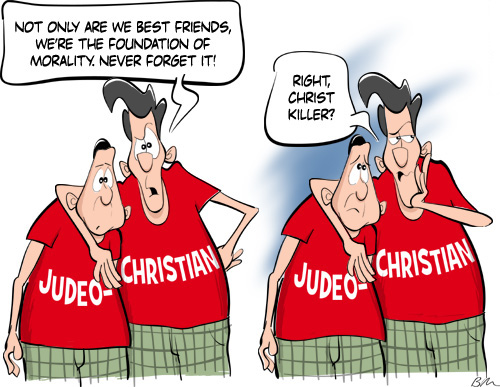
judeo-christianFrom necessity, normative religious Jews must believe that any Jewish person who has converted to Christianity is ignorant of the truth of the Jewish scriptures, and thus easily swayed by the inaccurate Christian interpretation of said-scriptures. Worse, some Christians are characterized as “outright swindlers,” wolves in sheep’s clothing, out to do what the Holocaust started, destroy Jews and Judaism, not by murdering Jewish people in gas chambers, but turning them from Jews into Goyishe Christians, effectively reducing or eliminating the remaining Jewish population of our planet.

In other words, while I and my fellow faithful Jews like the fact that the next pogrom will not come from an Evangelical torch and pitchfork crowd, we still don’t trust you. You can’t say you love me for who I am, because who I am includes a thorough rejection of the essence of your ideology, all of it, completely, I hold that there’s no truth to it whatsoever.

I’m sure it must be painful for many Christians who authentically love Israel and the Jewish people to discover that you (we) are not trusted by the objects of your (our) love for the reasons I’ve stated above and for the reasons Hanover outlines.

And this is an amazing follow-up question:

Now do you love me? Do you love me in a future in which Jesus doesn’t come, and you continue to hold on to your faith, and I to mine?

Christianity, and I include the Hebrew Roots movement and all of its divisions here, loves the Jewish people only as long as the Jewish people are Christians/Messianics. We talk about love of Jews but those are only the Jewish people we know and who we imagine believe and think about God, Messiah, and the Bible the same way we do.

But what if they don’t or worse, what if Jewish people who were once Christians or Messianics leave the fold?

I previously wrote a blog post on this topic called Apostasy, Pentecostalism, and Other Things That Go “Bump” in the Night that took heavy criticism in multiple arenas of the “believing” world. One reason I was criticized was because the author of a blog significantly disapproving of Jewish “apostates” (from Christianity) said he was only looking “at several examples of apostasy among friends and family, and what steps we can take to strengthen faith.”

However, that can be taken as, “I love the Jewish people and Israel only as long as they profess faith in Jesus Christ, and the minute they undergo a crisis of faith, and for any reason whatsoever leave the faith (in Christ), I will publicly brand them with a scarlet letter ‘A’ and make an already agonizing personal and spiritual situation and decision more difficult and embarrassing for each and every one of them.”

I included commentary on John MacArthur and his Strange Fire conference in my previous blog post because I believe MacArthur’s approach to Charismatics/Pentecostals was in the same vein, as if he were saying, “I love you but if you fail to accept my interpretation of your religious practices, I will ‘demonize’ the whole lot of you as publicly as possible.”

I consider the conference and book, Gifts of the Spirit produced by First Fruits of Zion to be a much more measured and reasonable approach to the issues raised in an examination of those “gifts of the spirit,” but where is the more reasonable Christian/Hebrew Roots approach to the world of non-Messianic Jews?

Stuart DauermannDo we love those Jewish people and that Israel? Is our “love” so conditional that we automatically condemn and defame the majority of Jewish people living on the earth? Do we defame and humiliate their ancestors, from the great Rabbinic sages to the lowly Jewish farmers or shepherds who were struggling to barely support their families in some part of Eastern Europe or Russia while, Tevye-like, they all opened their hearts to the God of their fathers?

I previously reviewed Dr. Stuart Dauermann’s article “The Jewish People are Us — not Them,” written for the Fall 2013 issue of Messiah Journal where part of this concern is addressed.

It’s tragic to imagine that Jews who have come to faith in Jesus within a traditional Evangelical or Pentecostal framework assign the identity of “otherness” to their Jewish brothers and sisters who are not Christian/Messianic. It’s as if, even from a believing Jewish perspective, faith in Jesus Christ separates a Jew from the larger Jewish community and Judaism rather than expressing the height of what it is to be a Jew.

Of course, Christianity and Judaism have traveled wildly differing trajectories over the past twenty centuries or so, but if Gentile and Jewish disciples of the Jewish Messiah are ever to experience any unity before the throne of the King of the Jews in the Messianic Era, then those trajectories must be reunited.

In reading Hanover’s article, I couldn’t help but be reminded of the different spiritual trajectories traveled by me, a Christian husband, and my spouse, a Jewish wife. For her, like Hanover, any overt “Christianity” must “annoy the goal post hockey stick hockey stick out of” her.

If it were just a matter of me being “annoying” to Jewish people because I’m a Christian, I could cure that in an instant by withdrawing from any contact with the Jewish community (although I must say that currently, I am not involved in any sense), but this is personal and this is family.

To be fair, my wife accepts and shares my viewpoint on supporting Israel and sends me emails and even the occasional religious/rabbinic commentary if she thinks I’ll find it interesting. But I can’t get past the idea that she must think she’s “sleeping with the enemy,” so to speak.

I don’t know. My faith says that I must share the truth of the good news of the Messiah with everyone. Further, as I’ve stated many times on this blog, I believe the good news is actually good news to the Jews first, and then also to the Gentiles (though “the Church” has this completely backward).

If I were to follow the “apostasy police” model, I’d have to offer my wife a divorce since she refused to “convert to Christianity,” as well and embarrass her in as public a manner as possible, all for the sake of “love” and “strengthening the faith” of my fellow Gentile and Jewish believers.

But I’m not going to do that, not to Jewish friends and absolutely not to my Jewish family. I’ve already said that if the Apostle Paul never abandoned his unbelieving brothers and sisters, I certainly don’t think God left them in the dust either:

I am telling the truth in Christ, I am not lying, my conscience testifies with me in the Holy Spirit, that I have great sorrow and unceasing grief in my heart. For I could wish that I myself were accursed, separated from Christ for the sake of my brethren, my kinsmen according to the flesh, who are Israelites, to whom belongs the adoption as sons, and the glory and the covenants and the giving of the Law and the temple service and the promises, whose are the fathers, and from whom is the Christ according to the flesh, who is over all, God blessed forever. Amen.

Romans 9:1-5 (NASB)

But intermarriage, just like an “interfaith” community, doesn’t come without strings attached, as Hanover concludes:

But you must keep your missionary urges to yourselves. You can even lie to me and say you don’t have them – I’ll accept it. I’ll lie to you in return and say that my tradition says your teachings have value. We can co-exist this way for generations, bettering our societies and contributing good to the world. (emph. mine)

Just do something about your impulse to convert me.

In 1970, singer Joni Mitchell wrote a song called The Last Time I Saw Richard which includes the lyrics:

You like roses and kisses and pretty men to tell you
All those pretty lies pretty lies

Joni MitchellI can’t stop being who I am and that’s a disciple of the Master, King of the Jews, and I can’t stop walking the path that the Master has set before me, but I won’t let that path take me into the fork in the road that leads to “crypto-anti-Semitism,” either. So what’s left? Unlike the person in Mitchell’s song, I can’t shut out reality and listen to “pretty lies” about the peaceful co-existence between Christians and Jews, and I do believe there will be a co-participation between Jews and Gentiles in the future Messianic Kingdom (and if it be Hashem’s will, before).

Maybe the modern Messianic Jewish movement is the “first fruits” of that “re-unity,” but I have to believe that, both personally and corporately, we still have a long way to go before the love of many Christian/Hebrew Roots folks for the Jewish people and Israel is more than just a “pretty lie” with strings attached.

I know this all sounds very cynical, but if you are a non-Jewish believer who says you love the Jewish people and Israel, remember that for the most part, those people and that nation may not love you in return and may never desire to hear the “good news of Jesus Christ.”

Tell me, do you still love them? Do you still accept them unconditionally as who they are, knowing they believe that Jesus could never, ever be the Messiah?

I didn’t plan on writing this “meditation.” I didn’t want to open up wounds that never seem to quite heal, especially in public. But the scabs keep getting picked at whether I want them to be or not.

Gifts of the Spirit in Balance

Carl KinbarMany years ago — it seems as if it was another lifetime — I was a Jewish Christian attending a very large charismatic conference. In the midst of literally thousands of worshiping men and women, I stood that day enraptured with the presence of God. Then, bowed by his majesty, I prostrated myself on the floor as the singing continued. Suddenly, I felt a hand on my shoulder. I did not look up. After a few moments, a man spoke these words to me: “You will feed on the inheritance of your father Jacob.” I waited for more, but that was it. “You will feed on the inheritance of your father Jacob.” When I finally glanced over my shoulder, the man was already walking away.

-Rabbi Carl Kinbar
“For the Common Good,” pg 19
Gifts of the Spirit

I really didn’t want to review this book chapter by chapter, but sometimes I have difficulty distancing myself far enough from a creative work to take it all in. Each chapter, such as this presentation by Rabbi Kinbar, packs in a great deal of information that is hard to ignore or dilute.

I remember Carl saying those words (the quote above) when I attended the First Fruits of Zion (FFOZ) Shavuot Conference “Gifts of the Spirit” last May at Beth Immanuel Sabbath Fellowship in Hudson, Wisconsin. I was taking notes as fast as I could and probably got some things wrong in what he and the other presenters said, which is why I’m grateful for this book.

I’m also grateful for this book because it arrived after my multiple commentaries on Pastor John MacArthur’s own conference addressing “gifts of the spirit,” which he called Strange Fire (thanks to the liveblogging of Pastor Tim Challies I was able to sample each presentation without wading through days of audio recordings).

I’ll try not to review each chapter of the “Gifts” book, especially as it would fly in the face of my previously stated intent to blog less often, but we’ll see what happens.

Going back to the above-quoted comment of Rabbi Kinbar with which he opened his “For the Common Good” presentation, Carl had no idea what had happened after his unusual encounter so many years ago, or what “the inheritance of your father Jacob” meant. Carl supposed the unknown speaker knew he was Jewish and chose the phrase “father Jacob” from that knowledge.

Ultimately, Carl learned that “the inheritance of your father Jacob” references Isaiah 58 and the various fasts. It also has “something to do with the land of Israel, the vision of Jacob’s ladder, and what God had promised to Jacob and his descendants.” (Kinbar, pg 20)

A few sentences later, Carl referred to the words he heard from that mysterious gentleman as a “prophesy.” As it turns out, the usage of that word seems appropriate.

Since I’m filtering “Gifts of the Spirit” through “Strange Fire,” I suppose I should mention that referring to the experience as a “prophesy” would no doubt make the “Strange Fire” folks a little uncomfortable. I didn’t think much of it at the time when I was listening to Carl at the conference, but I too must admit to always being at least a little skeptical about supernatural occurrences intruding on “real life”.

Nevertheless, Carl is one of the most theologically grounded and realistic people I know (and also a kind and gentle person). He’s the one who is likely to email me or comment on my blog when he thinks I’ve gone too far in making a connection between midrash and scripture. He’s never impressed me as someone who leads with his feelings at the expense of his intellect, and I consider him highly intelligent, very well-educated, and certainly well read. Hardly someone who experiences God on a purely visceral level.

I’m reminded of a rather interesting (though minor) experience of my own in church some months ago. I was sitting in Sunday school class waiting for the socializing to die down and the actual teaching to begin. I was feeling gloomy and discouraged. My presence in church wasn’t what I thought it would be and I was pondering how long I would last before someone would suggest I leave for “heretical” beliefs (such as the idea that the Torah mitzvot continues to be in force for all believing and unbelieving Jewish people) or that I’d just stop going.

Then a woman who I had never seen before approached me, smiled, and said “Shalom Aleichem.” I was momentarily startled by this greeting in such a Christian context. I assumed she knew my wife was Jewish and chose her words accordingly. After chatting with her for a few minutes, I asked why she had greeted me that way. As it turns out, she had no idea my wife was Jewish and couldn’t really articulate why she said “Shalom Aleichem.”

I was grateful anyway, and it did brighten my mood. It seems God knows who and what to send into your life at certain necessary points. Not quite what Carl experienced, which ultimately led him into Messianic Jewish studies and practice, but it will do.

In going over this chapter, I was taken with how Carl, who had spent the better part of forty years as a Jewish Christian in a Charismatic church, characterized the experience. He said they emphasized “worship and teaching” and I didn’t get the idea that anyone checked their brains at the door as they entered.

Charismatic prayerCarl said later in his presentation, that he didn’t believe that the gifts of the spirit were the same now as in the days of Paul, due to the change in purpose and context. He even admitted that there were times when he felt that some “spiritual healings” were not really on the up and up. He did also say that he has witnessed at least one authentic spiritual healing. On that occasion, he so inspired by the event that he kept the crutches of the healed woman (as she no longer needed them) in his office.

I got to thinking about one of the criticisms of the Charismatic movement by MacArthur and company was that these “gifts” were not consistent, while in the Bible, they never seemed to fail or to work only intermittently.

Except that’s not quite true:

When they came to the crowd, a man came up to Jesus, falling on his knees before Him and saying, “Lord, have mercy on my son, for he is a lunatic and is very ill; for he often falls into the fire and often into the water. I brought him to Your disciples, and they could not cure him.” And Jesus answered and said, “You unbelieving and perverted generation, how long shall I be with you? How long shall I put up with you? Bring him here to Me.” And Jesus rebuked him, and the demon came out of him, and the boy was cured at once.

Then the disciples came to Jesus privately and said, “Why could we not drive it out?” And He said to them, “Because of the littleness of your faith; for truly I say to you, if you have faith the size of a mustard seed, you will say to this mountain, ‘Move from here to there,’ and it will move; and nothing will be impossible to you.”

Matthew 17:14-20 (NASB)

It seems sufficient faith is required of the one attempting to exercise a spiritual gift and possibly the one who is the recipient. I don’t think such a thing can be reduced to a formula and in any event, the source of such gifts is God and if healing, casting out demons, or whatever, is not in His plan or for His glory, He will not empower the individuals involved with such gifts. I should say that while I can’t discount the existence and workings of the Holy Spirit as He empowers individual human beings on certain occasions, I consider them rare and I believe many of us can go though our entire lives and not demonstrate any such gifts.

For that matter, in the New Testament, and particularly in the Gospels, demon-possessed people seemed to be extremely common, but I can’t say I’ve ever seen one. If demon possession continues to exist in our world, then it must be as rare as dramatic spiritual gifts.

In my previous commentary on the “Gifts of the Spirit” book, I said that Boaz Michael described Torah and the Spirit as completely inseparable. Carl, in his presentation, linked Christ crucified, the Spirit, and the Torah together.

For I determined to know nothing among you except Jesus Christ, and Him crucified.

1 Corinthians 2:2 (NASB)

Paul was a well-educated man in the tradition of the Pharisees, so it’s unlike him to go into a situation armed with only the knowledge of “Jesus Christ, and Him crucified,” yet, according to Carl, this is the crux of the matter for all of us. If we don’t fully apprehend why Jesus had to die as a sinless man, and then be resurrected, giving us all the promise of eternal life, then our faith is in vain (see my review of the FFOZ TV series episode Resurrection for details).

According to Carl, Spiritual gifts, particularly verbal gifts, are to impart wisdom. After all, we cannot understand the Word of God, the Bible, at all apart from the help of the Spirit of God. This was one of the reasons, perhaps one of the most important ones, why Messiah had to depart from us.

“But now I am going to Him who sent Me; and none of you asks Me, ‘Where are You going?’ But because I have said these things to you, sorrow has filled your heart. But I tell you the truth, it is to your advantage that I go away; for if I do not go away, the Helper will not come to you; but if I go, I will send Him to you. And He, when He comes, will convict the world concerning sin and righteousness and judgment; concerning sin, because they do not believe in Me; and concerning righteousness, because I go to the Father and you no longer see Me; and concerning judgment, because the ruler of this world has been judged.

“I have many more things to say to you, but you cannot bear them now. But when He, the Spirit of truth, comes, He will guide you into all the truth; for He will not speak on His own initiative, but whatever He hears, He will speak; and He will disclose to you what is to come. He will glorify Me, for He will take of Mine and will disclose it to you.”

John 16:5-14 (NASB)

We have the Spirit with us as a helper, speaking not on his own behest but only the words from God, and it seems that Messiah’s intent was that the Spirit would continue to help us until his return (or perhaps even beyond that).

MysteryAnd the Spirit is supposed to impart wisdom about the Word for the purpose of drawing us nearer to God, not just as individuals (for Carl’s own experience was personal) but for the common good of the body of Messiah.

That’s why I can’t see the “gifts of the spirit” being authentic if they in any way distract us from God and who He is as well as Messiah, and him crucified. If spiritual gifts lead in a different direction, then they can’t be from the Spirit of God, which may account for some of the abuses attributed to the Charismatic movement.

Carl cited Isaiah 53:4-6 as a strong description of the knowledge of a crucified Messiah, which the Spirit points to, as well as this:

For to us God revealed them through the Spirit; for the Spirit searches all things, even the depths of God. For who among men knows the thoughts of a man except the spirit of the man which is in him? Even so the thoughts of God no one knows except the Spirit of God. Now we have received, not the spirit of the world, but the Spirit who is from God, so that we may know the things freely given to us by God, which things we also speak, not in words taught by human wisdom, but in those taught by the Spirit, combining spiritual thoughts with spiritual words.

1 Corinthians 2:10-13 (NASB)

Let’s look at part of that again:

…for the Spirit searches all things, even the depths of God. For who among men knows the thoughts of a man except the spirit of the man which is in him?

Trying to visualize the Spirit of God searching the depths of God borders on the mystic. What does it mean except that the Spirit of God acts as a portal to all knowledge of God, not that human beings could access even the tiniest fraction of that infinite storehouse. The Spirit of God is the gateway into spiritual thought for people. Without that gateway, we would be locked outside in the secular world, with no way to know God or to even believe He exists.

Paul’s reason for emphasizing the verbal gifts was not that he thought healing and miracles are unimportant…

In 1 Corinthians, chapter 2, “wisdom” words appear nine times and “knowledge” words five times…

-Kinbar, pp 27 and 28

Paul was a scholar and a teacher. For him, spiritual gifts were God’s means to illuminate people with the knowledge of God and the crucified Christ, not to put on some sort of “magic show” or to elevate the possessors of said-gifts to some exalted status. If the manifestation of the Spirit does not reveal God, the Messiah, and the Word of God, then it is not from God, for that is the purpose (in my own opinion) of the Spirit in our world today.

Carl quoted the following to show the connection between Messiah and the Spirit, substituting “HaShem” for “the Lord”:

Then a shoot will spring from the stem of Jesse,
And a branch from his roots will bear fruit.
The Spirit of [HaShem] will rest on Him,
The spirit of wisdom and understanding,
The spirit of counsel and strength,
The spirit of knowledge and the fear of [HaShem].
And He will delight in the fear of the [HaShem].

Isaiah 11:1-3 (NASB)

The connection between the Torah and wisdom can be found in these verses:

See, I have taught you statutes and judgments just as HaShem my God commanded me, so that you should do them in the land which you are entering to possess it. So guard them and do them, for that is your wisdom and your understanding in the sight of the peoples who will hear all these statues and say, “Surely this great nation is a wise and understanding people.”

Deuteronomy 4:5-6 (Kinbar’s translation)

Carl goes on to say that the “relationship between the Spirit of God and the Torah is seen even more vividly in Ezekiel 36, in which God promises to bring back the exiles of Israel to their land:”

For I will take you from the nations, gather you from all the lands and bring you into your own land. Then I will sprinkle clean water on you, and you will be clean; I will cleanse you from all your filthiness and from all your idols. Moreover, I will give you a new heart and put a new spirit within you; and I will remove the heart of stone from your flesh and give you a heart of flesh.

Ezekiel 36:24-26 (NASB)

That one threw me a little, since Ezekiel is describing a situation that has yet to occur, but it does serve to remind us that we cannot bifurcate the Spirit of God from anything else about God, such as Himself, His Word, and the Messiah.

While the Torah, Messiah, and the Spirit can be spoken about separately at times, they cannot be separated in reality. When Paul wrote about the spiritual gifts in 1 Corinthians, he did not mention the Torah because of the specific circumstances in Corinth, but neither did he nor God ever intend for Torah to be left out of the picture permanently.

-Kinbar, pg 36

It’s difficult for me to compress Carl’s points in this blog post and still trace the path of logic adequately so if you think something’s been left out, I encourage you to get a copy of Gifts of the Spirit and read the entire article.

Carl did say one more thing I want to point out.

But the traditional charismatic framework is not adequate for a fully Messianic Jewish expression of the gifts of the Spirit.

-ibid

Carl, and the other presenters at the “Gifts of the Spirit” conference, by necessity, must refactor the charismatic movement and that understanding of the “gifts of the spirit” into a form that is more appropriate for a Jewish and Messianic Jewish context.
A Promise of What is to ComeI’ve mentioned before, citing the FFOZ TV series A Promise of What is to Come, that by viewing scripture including the New Testament writings through a Messianic Jewish lens, we can capture a perspective that has been lost to the Church since the days of the apostles. This includes an understanding of the process of the Holy Spirit, how He worked in the past and how He is working today.

As I’ve already mentioned, I’m something of a skeptic. Except for a few minor, transitory experiences, I can’t say that I’ve witnessed a demonstration of the power of the Holy Spirit, and certainly not “spiritual gifts” in or around my own personal world of faith. Like I said, if they exist, they must be pretty rare or poorly advertised. I also think that enough charlatans have exploited the fertile spiritual soil so as to make the rest of us feel that anyone who claims “miraculous gifts” must be a rip-off artist.

It makes it difficult for me and people like me to listen objectively when someone talks about what they experience as an authentic spiritual occurrence.

Does the Holy Spirit work in our world today? Absolutely, otherwise, no one would come to faith and the Bible would seem like foolishness to all of us. Who was that man who touched Carl Kinbar on the shoulder so many years ago, and spoke of Carl’s feeding “on the inheritance of your father Jacob”? A prophet? An angel? I have no idea.

I do know, and I’ve said this before, that the FFOZ Book “Gifts of the Spirit” offers us an opportunity to read a counterpoint to John MacArthur’s “Strange Fire” conference and to see for ourselves the differing perspectives of dedicated and devout men and women, all of whom, in all their different religious “camps,” are seeking to know God and to balance our understanding of Creator, Spirit, Torah, and Messiah.