Tag Archives: First Fruits of Zion

Twelve Gates: Where Do the Nations Enter, A Book Review

The book of Revelation describes New Jerusalem as having twelve gates named after the twelve tribes of Israel. Through which gate will you enter?

The Two-House movement teaches that many modern Christians are in reality descendants of the ten lost tribes. Its followers consider themselves ethnic Israelites. The idea that anyone might be the biological descendant of Abraham, Isaac, and Jacob, and therefore entitled to the promises of God, is inherently attractive. The emotional and apocalyptic appeal of Two-House theology is obvious.

Boaz Michael, a leading voice in Messianic Judaism, looks at the history of the movement and examines the key biblical texts under dispute. Using the most recent scholarship about Gentile identity in apostolic theology, his book introduces a balanced alternative to Two-House theology. Twelve Gates welcomes Gentiles into the commonwealth of Israel, the New Jerusalem, and the Messianic Jewish movement.

from the promotional page for the book
Twelve Gates: Where Do the Nations Enter?
First Fruits of Zion

This is one of the “secret, unpublished books” I quoted from but couldn’t talk about before. Now I can, so I’m publishing my review. This book is really interesting, but probably not for the reason you think it is.

First off, the book was written by Boaz Michael, the Founder and President of First Fruits of Zion (FFOZ). I’m only drawing attention to this fact to say that I will not accept any comments made on this blog post that are for the specific purpose of “Boaz bashing.” If you want to comment about my review and the potential implications of this book, please be thoughtful and respectful. As the blog owner, I will remove any comment I deem offensive. Thank you.

On the surface, this is a book providing a critical analysis of the foundations of the two-house movement. For those of you unfamiliar with this perspective, here’s what Wikipedia has to say about it:

Two House Theology comes from the idea that the “House of Judah” in scripture refers to Jews, and the “House of Israel” refers to the Ten Lost Tribes of Israel, or Ephraim. Where scripture states the House of Israel and Judah will again be “one stick” (Ezekiel 37:15–23), it is believed to be referring to the End Times, right before Jesus returns, that many of those descended from Israel will come back to Israel. This theology postulates that the reason why so many so-called gentiles are coming into Messianic Judaism is that the vast majority of them are really Israelites and just don’t know it yet. They believe a majority of the people who considered themselves as gentiles coming into Messianic Judaism are those of the Lost Ten Tribes of Israel. Like One Law groups, the Two House movement appears at first glance to have much in common with Messianic Judaism because of their belief in the ongoing validity of the Mosaic Covenant. While much of the Two House teaching is based on interpretations of Biblical prophecy, the biggest disagreements are due to inability to identify the genealogy of the ten lost tribes.

What I really love about this book though, isn’t its coverage of the two-house movement, but its treatment of a topic near and dear to my heart: the identity of non-Jews in discipleship to the Jewish Messiah. In other words, “me,” or to be more complete, everyone out there who is like me, Non-Jewish people who are drawn not only toward the God of Israel, but the perspective of Israel on God. This is crystallized in the conclusion of Boaz’s book:

The prophets of Israel recognized that when the Gentiles began to attach themselves to Israel and to Israel’s God, not as members of Israel or usurpers of Israel’s destiny but as sympathetic worshippers of the God of Abraham, it was a sign of the coming redemption (Zechariah 8). It was a boon for the Jewish people. Paul understood that if he was successful in his ministry to the Gentiles, it would cause the Jews to see his ministry in this light, and they would, as a result, accept Jesus as the Messiah of Israel and initiate the resurrection from the dead (Romans 11:12, 15). Paul could taste the closeness, the imminence of this event even in his day; how much more should it ignite our hearts with passion today!

Messianic Jews and Christians who are sensitive to their Jewish roots stand at two ends of a great bridge across which Christians receive the greatness of the Torah and the centrality of the Jewish people in God’s redemptive plan, and across which the Jewish people can see, for the first time in untold centuries, Jesus as a legitimate Messianic candidate. When everyone on both sides of the bridge understands their role and the eschatological significance of their very existence, this interchange can benefit everyone.

The majority of Twelve Gates is devoted, not to the two-house perspective a such, but to the matter of Gentile identity. To the casual reader, it may seem as if the book is unbalanced and loses its focus halfway through its own narrative, but I know from talking to Boaz that the emphasis on Gentile identity is deliberate. It’s impossible to talk about two-house without addressing the Gentile identity issues because, if we non-Jews who are drawn to the Torah and Judaism are not “the lost ten tribes,” then who are we and why are we swimming against the current of traditional Christianity?

Boaz’s answer is simple, elegant, and thoroughly satisfying, at least to me. No, I won’t reveal it here, but instead, I encourage you to purchase this book and discover it for yourself. It surprised me that Boaz took this particular direction in his writing and addressing two-house, and I’m very glad he did, because it quiets some of the disturbing voices I’ve been hearing about who I can and can’t be in relation to the King of the Jews and to God.

For those of you who support or are sympathetic to the two-house movement, rest assured that this isn’t a “two-house bashing” book. Knowing Boaz as I do, I didn’t think he would write it that way, but I’m sure there are a few folks who are thinking that Twelve Gates is just a way for FFOZ to discount and disrespect the sincere beliefs of those Gentiles out there who claim the spiritual and ethnic inheritance of Ephraim and Manasseh.

That’s not to say what Boaz writes will be popular among two-house proponents. Certainly, there will be those who will deny Boaz’s assertions and people who will feel wounded by this book, even though its approach is quite gentle.

But if you’re looking for a straightforward and honest treatment of two-house from a “Messianic Jewish” perspective, I really think you should read Twelve Gates. As I said before though, for me, the two-house content is secondary to what the book really says to me.

The Bible teaches that in Jesus, “the Gentiles are fellow heirs, members of the same body” with the Jewish people (Ephesians 3:6), and “fellow heirs with Christ” Himself (Romans 8:17). The point of the vision of the New Jerusalem is not to exclude the non-Jews from the city; rather the gates of Israel stand open to the Gentiles, beckoning them to enter into the eternal reward that God has prepared for His people. The vision of New Jerusalem is not one of exclusion but inclusion, as it says, “the kings of the earth will bring their glory into it, and its gates will never be shut by day…They will bring into it the glory and the honor of the Gentiles.”

It says that though we are not all the same in function and purpose, we will all walk into New Jerusalem together as fellow disciples of the Master and fellow heirs of the Kingdom of God. It’s a book carrying the message, not of division, but of unity and the love of God. I said before that Boaz’s book pleasantly surprised me. Maybe it will surprise you, too.

Shavuot Fellowship in Wisconsin

Twenty-years ago the spirit of the Lord kindled something new, and the ministry of first fruits of Zion was born. With the teachings of First Fruits of Zion, Christians and Messianic Jews began to rediscover the Torah.

Two decades later, First Fruits of Zion and the Messianic Jewish movement still lives, breathes, and is ready to thrive. At Shavuot 2012, First Fruits of Zion breaks new ground as we present our game plan for the future of Messianic Judaism, for Jewish believers in Yeshua, and for Messianic Gentiles from all nations. Come and hear the vision, become a solid member for change—be inspired to kick-start a fresh revolution by learning practical ways to facilitate study groups, Torah studies, and other outreach efforts.

from the Shavuot Conference 2012 webpage
First Fruits of Zion (FFOZ)

I have to admit to being a little nervous about attending this conference. Oh, I’m also really excited. I’ll get to see some old friends that I don’t get “face time” with very often, and actually meet people I’ve only communicated with over the web. But like some “fine wines” (yeah, that’s a joke), I don’t really travel well, I like to get to bed early, and I don’t enjoy large crowds. I don’t really thrive in a large conference environment.

But more to the point, I haven’t been to anything like this for a number of years and as an “unaffiliated Christian” in a world of Messianic Jews, Messianic Gentiles, and others who don’t traditionally identify with the mainstream church, I’m not sure what to expect or how I’ll be viewed by everyone (not that I should care, I suppose).

For one thing, the tallit and tefillin are staying at home (I’ll still bring a kippah). When I backed away from the One Law position (the basic Idea that all of the 613 commandments or mitzvot that observant Jews believe apply to them also applies to all non-Jewish Christians by virtue of being “grafted in”), I backed away from just about everything that had an outward Jewish religious practice. I started to imagine (not that she’d say anything) what my (non-Messianic) Jewish wife might be thinking every time I put on a tallit and laid phylacteries to pray. For me, it was easier to come to peace with the direct interfaith part of our marriage if I didn’t try to “walk her side of the street” so to speak. I put most of the religious items I used in “Messianic worship” in a box and there they’ll stay until I have a good reason to bring them out again.

So I don’t consider myself “Messianic” in the sense that most (probably) of the attendees at the Shavuot conference consider themselves Messianic (the non-Jews, that is).

There’s another issue here though. This whole classification of Christian vs. Messianic among non-Jews is just a little crazy. I know that it’s meant to differentiate between traditional Sunday Christians and those who have become more aware of the Hebraic origins of our faith, but it’s gotten to the point where we’re almost acting like we have two different religions.

I’m not OK with this. If Jesus was and is King of the Jews for Messianics, then he was and is King of the Jews for more traditional Christians. Recognizing the Jewishness of Jesus and then encasing that fact with a Messianic “bubble” only isolates that information and the truths it contains from all other Christians everywhere. Rather than focusing on the differences between how many non-Jews in the Messianic movement see things and how most other Christians see things, maybe we need to spend more time paying attention to how we’re alike.

I know a number of non-Jews who self-identify as “Messianic” visit and read my blog posts. If that’s you, I want you to practice something in the privacy of your own homes when you’re all alone. I want you to say out loud, “I’m a Christian.” Repeat it a few times. C’mon, don’t whisper. Really belt it out. “I’m a Christian.”

“I’m a Christian.”

Was that awkward? For some of you, it probably was. No, I’m not making fun of you or trying to be mean. My point is that whether you consider yourself a “Messianic Gentile” and pray wearing tzitzit and tefillin or you think of yourself as a Christian and feel no need to adopt any Jewish customs or commandments in your prayer and worship life, God is One. He’s the same God. Jesus is Jesus. He’s the Messiah, the Lord, the Savior, the Christ.

He’s the same guy for Messianics and Christians. We just picture him differently.

But how does he picture himself?

We don’t really know, but it wouldn’t hurt to stretch ourselves a little and try to see Jesus from a Jewish point of view and within a functional Jewish context. That’s probably a picture closer to his reality than many in the mainstream church see him.

However, you may be very comfortable with the division between Messianics and Christians. You may be asking yourself why you’d want to go through all that trouble and mess up your comfort. Because he is the Christ and we are Christians. He is the Master and we are his disciples. Jesus didn’t ask us to stand apart from each other, he asked us to be a united body and to work together like the different parts in your body.

I’m not a typical Christian. I don’t go to church. I have particular standards regarding food items that most Christians don’t observe. I have certain other convictions and perspectives that you won’t find in most churches. But I’m still going to be a really different “breed of cat” than most of the other conference attendees when I get there in a few weeks. In some ways, I’ll be just as nervous attending the conference as I would be if I decided to visit a church next Sunday morning.

But the point is, I shouldn’t have to feel that way. I probably wouldn’t if I got my wish (and my prayer). My wish and my prayer is that all believers come together in unity and truth, regardless of how different we are, and recognize our mutual fellowship and discipleship as followers of the Messiah King, who came once for the salvation of souls and who will come again to repair the world.

My wish and my prayer is that we who are grafted in realize that we are all Christians.

When you think of yourself and what you believe and then think of other believers and how different they are from you, try to consider how much you have in common with each other. That’s what I’m going to be doing on May 24th at Beth Immanuel.

And if you happen to be planning on attending FFOZ’s Shavuot Conference 2012, post a comment and let me know. I’d love to meet you when we’re together in Hudson, Wisconsin…and meeting in spirit and in truth.

Blessings.

Nothing’s Perfect

You have to begin with the knowledge that there is nothing perfect in this world.

Our job is not to hunt down perfection and live within it. It is to take whatever broken pieces we have found and sew them together as best we can.

—the Rebbe’s response to a girl who wanted to leave her school for what she thought to be a better one.
as related by Rabbi Tzvi Freeman
Chabad.org

Oh, duh! No, that’s not my Homer Simpson imitation, it’s my “light dawns on marble head” moment and the reason I’m writing this “extra meditation.” I’m going to use the above quoted phrase for tomorrow’s “morning meditation,” but as I was doing one of my obsessive reviews of tomorrow’s blog, trying to find all the typos I will invariably miss, it hit me.

Life isn’t perfect.

I suppose that’s obvious to you and really, it’s obvious to me too, but I spontaneously applied it to something specific in my own context and everything suddenly made sense. Let me explain.

I periodically kvetch about how hard it is to find other people who see things in the world of faith that are even remotely similar to how I see them (although my “morning meditation” for today has attracted some very nice comments). I also complain about my desire for a sense of community, particularly with my wife, and how frustrated I am that what I planned (boy, God must be having a good chuckle right now) doesn’t seem to be working out.

But what did I expect?

It’s not so much the statement that the Rebbe made above (as related by Rabbi Freeman), it’s the circumstances around the statement that made something “click” inside of me.

…the Rebbe’s response to a girl who wanted to leave her school for what she thought to be a better one.

I’ve probably said some variation of this a thousand times to relatives and friends when they’ve told me how life isn’t perfect for them, either. I just find it funny that God chose here and now to give me my “light bulb moment.”

It should have come sooner but I wasn’t paying attention.

I was having a conversation with the Missus the other day, again talking about the possibility of taking a class or two with her at one of the synagogues here in town. Somehow, we got on the topic of intermarried couples and, since she knows I’m reading Rabbi Boteach’s book Kosher Jesus, we talked about the very distinct differences in how Christians and Jews see the world, the Bible, the Messiah, and God. As we were talking, I was reflecting to myself on how one of the reasons I left the “Messianic” movement, at least in terms of physical worship and self-identification, was because I perceived it as a barrier to my joining her in a Jewish worship and study context.

I mentioned to her in our conversation, that I know there are plenty of intermarried couples in both the Reform shul and Chabad communities, and then she said something that stopped me cold. She said those couples were all comprised of one Jewish spouse and one non-religious (specifically non-Christian) spouse. They’re all Jew/Gentile intermarried, but not “mixed-religious couples”.

I see.

I suddenly realized where the barrier is located in my wife getting comfortable including me in her Jewish community. It’s located squarely at the intersection of “Jesus Street” and “Christian Avenue”. In other words (taking my tongue out of my cheek), she really doesn’t want to take her Christian husband into a Jewish synagogue to interact with her Jewish community. The real problem wasn’t just the negative perception many Jews have about Messianics. That’s why my leaving the Messianic community didn’t produce the desired result. My being a Christian is the real problem.

Oh.

Did you ever play “Battleship” when you were a kid? Ever have your fleet sunk? Mine ended up soundly torpedoed and sent swiftly to the bottom of the cold, cold Atlantic.

I was pretty grumpy about it initially. In fact, I’ve been pretty grumpy about it until about thirty minutes ago (as I write this). Then I re-read the Rebbe’s words and the context in which he said them, and realized that if I thought I was going to get my way, I was sadly mistaken. I won’t even say that “life’s not fair,” because I don’t think fairness has anything to do with it. It’s not like I have some sort of “right” here. It was more of a desire to join with my wife at the level of worship and perhaps to take my meager level of Jewish learning up a notch.

That’s not going to happen now. Of course, it’s not like it was owed to me or something. Sure, it would have been nice, but it’s not my right to enter into someone else’s world if I don’t belong there. It’s not so much that I wanted in the Jewish world. I wanted in the Jewish world so I could share my wife’s world with her.

But life’s not perfect. In fact, life has never been perfect, even among those who have served God with outstanding faithfulness, which doesn’t exactly describe me. No perfect life. No perfect people.

The king’s primary function is to dispense justice and righteousness in Israel. Second Samuel 8:15 tells us, “David reigned over all Israel; and David administered justice and righteousness for all his people.” The Psalmist says, “The strength of the King loves justice; You have established equity; You have executed justice and righteousness in Jacob.” (Psalm 99:4) When Israel practiced justice and righteousness, she was blessed, but when she strayed from justice and righteousness under the influence of wicked kings, the prophets rebuked her. “I will make justice the measuring line and righteousness the level,” (Isaiah 28:17) the LORD declares through the prophet Isaiah. The Psalmist prays for the Davidic King, saying, “Give the king Your judgments (mishpatim), O God, and Your righteousness to the king’s son. May he judge Your people with righteousness and Your afflicted with justice.” (Psalm 72:1-2)

“Righteousness and Justice”
Weekly eDrash
Commentary on Torah Portion Mishpatim
First Fruits of Zion

Israel was the only nation specifically established by God, and given a personal and corporate set of laws and ordinances by which the Hebrews were supposed to obey their Creator as a people. If any country was to have operated with flawless perfection, it should have been Israel, and yet even a casual reading of the Tanakh (Old Testament) tells us that they experienced dramatic swings, from amazing prosperity to bitter and total defeat…and back again. Life wasn’t perfect for the Children of Israel and it isn’t perfect for the Jewish people today. Life isn’t perfect for the church, and certainly it hasn’t been perfect over the past 2,000 years of Christian history.

Why should even this one thing that I ask for be perfect for me? There’s no reason it should be.

Oh, I know the Christian platitudes: “Go bathe it in prayer” and such, but frankly, I’ve seen some of the most faithful people I know end up disappointed in so many ways and still maintain their faith and trust.

I’m not going to “win” this one, but I guess I can’t say that I mind all that much (well, I mind a little). There’s so much else that is going right. My wife and I are together after almost 29 years of marriage. We both are reasonably healthy, we have three children and one grandson. We are fed, and clothed, and housed. We are gainfully employed and are able to meet our needs and a number of our wants. Life isn’t perfect, but it isn’t horrible, either.

Most of all, both my wife and I are relating to God, each in our own way and in our own manner, as Jew and Christian. I’m a really unconventional Christian and she’s not always the typical Jew, but we get by.

Now that this realization has happened, I don’t know what comes next. I don’t have “a plan” anymore. Maybe I’ll finish out my year long experiment here and then “sink” this blog along with my hopes or maybe I won’t. I’ll have to wait and see if God decides to fill in the blanks in my life with something I haven’t anticipated, or if He’ll just let me have blanks in my life for a day, or a week, or a month, or a year or ten.

Right now, I guess I’ll take the Rebbe’s advice, try to find whatever broken pieces of my aspirations that God has left lying around and see if I can patch them together into something that makes some sort of sense.

I’ll let you know how it goes.

Debating Fulfillment Theology

This “logic” is plainly presented in Galatians 3. God had a very good reason to institute the Law of Moses and it has nothing to with “bait and switch.” It had to do with point and lead until the fulfillment of its goal. The emphasis of the salvation that was to come for all of mankind goes back to the promise made to Abraham.

-Eugene Adkins
in his January 27 comment on my blog post
The Lord’s Sabbath

This understanding of the function of a paidagogos clears up Galatians 3:23, where Paul says, “Now before faith came, we were held captive under the law, imprisoned until the coming faith would be revealed” (Galatians 3:23). The paidagogos was the child’s guardian, not his jailer. When we understand that the paidagogos was responsible for protecting, supervising, and directing a child, then we have a better understanding of how the Greek text of Galatians 3:23 should be rendered in English. The Greek word which the English Standard Version translates as “held captive” has a different connotation. It can also be rendered as “protected,” “kept safe,” or “guarded.” The word should be understood as speaking about how a pedagogue kept a child safe and out of trouble. Similarly, the Greek word which the ESV translates as “imprisoned” (the same word appears in 3:22) can be rendered as “kept in” or “enclosed” in a positive sense. The word should be understood as speaking about how a pedagogue kept a child inside for his school lessons. He did not allow the child to run off and follow his friends into trouble. He kept him shut up inside for the purpose of education and protection.

-D. Thomas Lancaster
“Sermon Eighteen: The Pedagogue (Galatians 3:19-26), pg 182
The Holy Epistle to the Galatians
First Fruits of Zion
August 2011

Ziesler, “Role of the Tenth Commandment,” p. 50, makes the important observation in Rom. 8:4 of the use of the singular…(“requirement”) in Paul’s conclusion: “having talked in 7.1-6 about dying to the Law, Paul now in a notably bald statement appears to bring us back to life again in relation to the Law, if not under it. We died to the Law in order to keep it better.” He further suggests that this singular reference keeps the singular sin of covetousness in perspective (pp.50-51).

Snodgrass, “Spheres of Influence,” p. 107 states: “If the law is not involved in salvation, then sin is a victor because it defeated God’s law which was for life (7.12.10). But now the law is placed within the sphere of the Spirit (cf. 8.4), where it belongs (7.14). The law in the right sphere frees us from the tyranny of the law in the sphere of sin. I do not think we can ignore a reference to the OT law. It is through the law that Paul died to the law.”

Footnotes 55 and 56
from “Summary and Appendix I,” pp 365-66
in the Mark D. Nanos book
The Mystery of the Romans
Fortress Press (1996)

Important Note! Please read the first comment made by Eugene Adkins below, as he corrects some mistakes I made about his background and role. I apologize to Eugene and to everyone reading this for my errors.

I’ve been debating with Pastor Eugene Adkins in the comments section of my blog post The Lord’s Sabbath regarding what he refers to as “fulfillment theology” and what I consider supersessionism or “replacement theology” (see our series of comments on the aforementioned blog post for full details of this discussion and specifically Pastor Adkins’ comments submitted on Jan 27, 2012 @ 17:31 hours).

In response to some of Pastor Atkins’ points, I’ve quoted from both Lancaster’s recent Galatians book and the classic Nanos tome on Romans (or rather, some footnotes contained within the Nanos book). I’m doing this for several reasons. The first is that, unlike Pastor Adkins, I do not have a post-graduate degree in any form of religious studies (I assume as a Pastor that Adkins is so educated) and thus do not have skill sets equal to his own as far as debating the scriptures. In order to support my arguments, I must rely on the scholarship of external sources, namely the previously mentioned Lancaster and Nanos books.

Secondly, I want to introduce valid and scholarly sources that refute or at least bring into question the traditional Christian view that the Torah was only temporary for the Jewish people (and I have never said that the Law was intended to apply equally to the Jewish and Gentile disciples of Jesus in any equal fashion) and that once Christ lived, died, was resurrected, and ascended, that the Law became null and void (or “fulfilled” in the sense that its temporary purpose as completely satisfied and then ended), and wholly replaced by what Pastor Adkins refers to as Christ’s “international covenant” that applies uniformly to Jewish and non-Jewish disciples of Jesus. I’m trying to point out here that perhaps Pastor Adkins’ interpretation of scripture (which seems to be the interpretation of the church in general) is not the only possible way to understand what Paul was saying to the congregations of Rome and Galatia.

Finally, I want to be fair. There is a tremendous tendency for me to simply dig in my heels, say “you’re wrong,” and base my subsequent responses on my emotional states, particularly those that have to do with Christian supersessionism and its terrible (and often fatal) effect upon the Jewish people across 2,000 years of church history. But that’s not the right thing to do. I want to respond based not only on my spiritual “understanding” of God’s relationship with both Jews and Gentiles (which is completely subjective and therefore, unable to be objectively demonstrated) but on Biblical scholarship as well. The problem here is that I’m like Woody Allen trying to go a few rounds in the ring with Mike Tyson as far as our relative educational backgrounds go (well, probably not that bad).

I have two undergraduate degrees and a post-grad degree, but none of them are in subjects relevant to this conversation. Given my job, my book writing, and my family commitments, I don’t have the time or other resources to go back to school and take another degree, or to perform the necessary research to adequately respond to all of the specific points being brought up in this discussion in order to sufficiently represent my point of view. I believe I’m right based on everything I’ve learned thus far, but belief isn’t enough. I must have proof beyond what I have already demonstrated, both online and in print. Also, assuming that I can be wrong (and I know I can be), I need to either confirm or refute my current belief system using concrete evidence (or as “concrete” as anything gets in theological debates).

That’s where you, dear readers, come in. I’m calling for backup. Or I’m willing to be presented with irrefutable proof that the New Testament writings can be interpreted in one and only one, single manner, and that the one and only interpretation is held under lock and key by the 21st century evangelical Christian church. I personally don’t think it is, but like I said, I want to be fair.

I want to say to you personally Eugene, that I’m not writing this to try and be mean or unfeeling or offensive in any way. I know you are sincere and are representing the truth based on everything you’ve been taught and everything you believe, both intellectually and through your faith. I don’t have a problem with any of that. None of this is motivated by any dislike of or anger toward you. I respect your service to God and thank you for continuing to participate in our dialog rather than summarily “writing me off” as some sort of “religious nut.”

My problem with the traditional Christian position on supersessionism is that, even clothed in a pleasing and benign exterior, this “fulfillment theology” is a nearly 2,000 year old artifact that was first created when the schism between Jewish and non-Jewish believers began to develop and then exploded across the early history of the church, in order to artificially justify the ascension of the Gentiles over the Jews in Messiah, and to literally re-write the nature and character of Christian vs. Jewish “Messianism,” as we see in part here:

The destruction of the Second Temple in 70 CE and the subsequent expulsion of the majority of Jews from what would be called Palestine marked a disastrous shift in the Jewish authority over the Messianic community. Up until that time, the head of the Jerusalem leadership of the Messianic community, otherwise referred to as “the bishop of the church”, had always been Jewish. Once the Jews were expelled from Jerusalem by Hadrian, for the first time a Gentile had to be elected into the role. As events moved forward from that point in time, the Gentile presence in the Messianic community grew dramatically while the Jewish leaders and worshipers of Yeshua struggled under the heartbreak of the loss of the Temple and the ejection from their land. Scant decades later, the failure of the Gentile “church” to support the Jewish revolt of Bar Koshba drove another significant wedge between the Jewish Messianic community and the body of Gentile believers.

With the Jewish population now scattered, humiliated, and fearing destruction at the hands of the Romans, the Gentile Messianics continued to secure their dominance and control of the worship of Yeshua. The self-identity of the Gentile Christians shifted from grafted-in to the root of Judaism through Abrahamic faith to the new inheritors of the Messiah, replacing Israel on a spiritual level. Origin of Alexandria and Justin Martyr were the earliest authors of this tradition and among the first to declare that the church had superseded Israel. Attached to this belief was the rise of Christian blame against the Jews for the murder of Jesus. The Jews became unworthy of their own Messiah and were pushed out of the worship of Yeshua by the Gentile disciples they had once taught and nurtured.

-James Pyles
Excerpt from “Origins of Supersessionism in the Church” (pp. 33-34)
Messiah Journal
Issue 109/Winter 2012

I previously said that I don’t have an advanced degree in religious studies, but as a published author, I do know how to do research, including delving into the history of how “the Way,” which started as a sect of Judaism inclusive of non-Jews but administered and guided by Jewish mentors who understood God and Messiah in a completely Jewish religious framework, into a newly created non-Jewish religion which found it necessary to eliminate any aspects of Judaism from its background.  In my review of the early church, I could see the early “church fathers” virtually reframe the letters of the early Jewish disciples, principally written by Paul, into words that would ultimately be used to discount and eventually all but exterminate the Jewish people.

I’m opening this blog post up for debate on the pros and cons of “fulfillment theology” and asking for those who are far wiser and much better educated and I in religious subjects to enter into the conversation. I do insist however, that this conversation remain polite and respectful. Disagreement is absolutely no excuse for undue emotionalism or any personalizing of conflict. Any apparent “attacks” on someone who differs from your point of view will not be tolerated and I, as the blog owner, reserve the right to edit or delete any offensive comments at my discretion.

This debate is specifically focused on the pros and cons of “supersessionism,” “replacement theology,” “fulfillment theology,” or whatever else you want to call it. It is NOT about One Law or Two House perspectives, so I am not inviting statements on those viewpoints to be presented here. If you find it necessary to disregard my wishes in this, your comments will be removed. Thank you.

With those disclaimers out of the way, please feel free to refer back to the full stream of comments on the “Sabbath” blog post, then return here and discuss how you support or refute my statements and Pastor Adkins’s statements. Please cite specific Biblical or other sources to support your arguments. I am asking for information, not unbridled passion.

One last thing before we begin. Eugene, you previously said:

How is lighting candles a confirmation of Jesus’ grace if that person doesn’t believe in Jesus to begin with?

Shabbat candlesI do have faith in Jesus, as you do Eugene. Watching the lighting the Shabbos candles is a beautiful and unique way of inviting him into my home and to experience something of a preview of his return to us, may it be soon and in our days. If perhaps, your comment were meant as a remark toward my wife who is Jewish but not a believer, I can only ask that you try to consider her with the same compassion and love that God has toward His am segulah; His “wondrous and treasured people” (Exodus 19:5). I can’t tell your attitude toward Jews and thus toward my wife and children through our “text-only” conversation, but if you cannot see them with the same compassion as God does, and believe God has discounted if not completely destroyed them, then I suppose my argument has already been made for me.

With that, I look forward to everyone’s contribution now and in the days ahead. I hope to learn a lot.

Review of “The Gentile Believer’s Obligation to the Torah of Moses”

At the same time, believers sometimes assume that HaShem’s Torah applies only to Jews and not to Gentile disciples at all. Nothing could be further from the truth. Despite the fact that the apostles “loosed” the Gentiles from these sign commandments, for the most part they are bound to the rest of the Torah’s mitzvot. It should be emphasized that Gentiles in Messiah have a status in the people of God and a responsibility to the Torah that far exceeds that of the God-fearer of the ancient synagogue and that of the modern-day Noachide (Son of Noah). Through Yeshua, believing Gentiles are been (sic) grafted in to the people of God and become members of the commonwealth of Israel. While membership has its privileges, it also has its obligations.

-by Toby Janicki
“The Gentile Believer’s Obligation to the Torah of Moses”
Messiah Journal
Issue 109/Winter 2012, pg 45
First Fruits of Zion (FFOZ)

Excuse me. What did you say?

A few days ago when I received the latest issue of Messiah Journal (MJ) in the mail, I commented that was looking forward to reading Toby’s article, but I wondered if what he was addressing was just a rehash of previous write ups on the same topic.

No, it’s not.

Toby does something I’ve never seen done before (not that somebody else couldn’t have written about this and I’m just not aware of it). He takes the four basic prohibitions outlined in the Acts 15 “Jerusalem Letter” and deconstructs them, expanding the specific details underlying the directives of James and the Council, and then tying them all back into the relevant portions of the traditional 613 commandments. Basically, Toby uses Acts 15 as the jumping off point to explain the nature and character of a non-Jewish disciple’s obligations (yes, I said “obligations”) to the Torah given at Sinai.

I did something similar over a year ago, but my jumping off point was Matthew 28:18-20, which is commonly referred to as “the Great Commission.”

To get the true flavor of what Toby is suggesting, let’s review the basics of “the letter:”

For it has seemed good to the Holy Spirit and to us to lay on you no greater burden than these requirements: that you abstain from what has been sacrificed to idols, and from blood, and from what has been strangled, and from sexual immorality. If you keep yourselves from these, you will do well. –Acts 15:28-29

As Toby points out, on the surface, it seems as if the Gentile disciples of Jesus had very few responsibilities to God, but this is deceiving. As he points out in the subsequent pages of his article, each of these prohibitions has an amazing depth all its own that isn’t apparent until you dig into it. This is, as Toby muses, probably why James also said “from ancient generations Moses has had in every city those who proclaim him, for he is read every Sabbath in the synagogues” (Acts 15:21). The Gentile disciples would need to attend the synagogues to learn and understand the many and subtle details involved in just complying with their responsibilities to these “simple” prohibitions.

I won’t go into those details because then, I’d have to recreate large portions of Toby’s article (and you’d be better off getting a copy of MJ 109 and reading the whole thing for yourself). However, Toby doesn’t limit himself to the “Jerusalem Letter.” He responds to some of the criticisms about Christians being limited to “the letter” by explaining some of the more obvious prohibitions against murder, theft, and coveting, which were not written down and were considered “Duh…obvious commandments” (quoting D. Thomas Lancaster from his book The Holy Epistle to the Galatians [pp 252-253]). These “Oh duh” commandments also include loving your neighbor, although I notice Toby did not cite the most apparent example found in the Master’s own teachings:

But when the Pharisees heard that he had silenced the Sadducees, they gathered together. And one of them, a lawyer, asked him a question to test him. “Teacher, which is the great commandment in the Law?” And he said to him, “You shall love the Lord your God with all your heart and with all your soul and with all your mind. This is the great and first commandment. And a second is like it: You shall love your neighbor as yourself. On these two commandments depend all the Law and the Prophets.” –Matthew 22:34-40

Beyond that, Toby digs further and presents some commandments that apply to the Gentile disciples that are not “Oh duh” and not found in Acts 15:

They can rather be derived from a careful reading of the Apostolic Writings in light of Jewish thought. One such set of mitzvot is the Gentile’s responsibility of honoring the Temple.

-Janicki, pg 53

What? The Temple? Most people don’t realize that during the Second Temple period, a non-Jew actually could bring an acceptable sacrifice to Herod’s Temple and expect that it would be received.

While Gentiles were not to bring certain offerings at certain times such as guilt..or sin..offerings, they were permitted and encouraged to bring burnt (olah) and peace (shelamin) offerings. The priest would attend to these offerings just as if an Israelite offered them up, and Gentiles were required to follow the same standard requirements for the sacrifices, e.g., their sacrifices were to be unblemished (Leviticus 22:21) and from an animal seven days or older (Leviticus 22:27).

-Janicki pg 54

Toby goes on to describe how the laws regarding ritual purity relate to the Gentile, as well as the application of set times for prayer (see my article The Prayer of Cornelius for additional details) and mealtime blessings.

Toby’s article does restrict certain of the mitzvot to the descendents of the Hebrews such as the mitzvah of circumcision (brit milah). I had a brief phone conversation with Boaz Michael (founder of FFOZ) yesterday, and he mentioned how the picture of circumcision in Paul’s letters seems like such an obvious demarcation line in terms of those who are fully under the Torah’s yoke, with Titus and Timothy cited as the clearest examples. Yet even in this, Toby said something very surprising:

Gentiles are specifically enjoined not to be circumcised for the ritual covenantal status. We can assume that, like Maimonidies, the apostles would have no problem with Gentiles voluntarily being circumcised for the sake of the mitzvah, but to do so complete with expectation of covenantal status as Jews would be to “seek circumcision” in the Pauline sense.

-Janicki pg 58

I must admit that a lot of this took me by surprise. As I mentioned earlier, I’ve never seen the prohibitions in the Acts 15 letter expanded in terms of their scope and tied back into the Torah. I have seen the Seven Noahide Laws expanded into between 80 or 90 different sub-commandments, but traditional Judaism doesn’t generally connect these sub-commandments to the Torah of Sinai (even though they have many thematic and operational similarities). I have seen traditional Judaism confirm that, at least in the time of the Third Temple, that sacrifices of the Gentiles would be accepted, so that part wasn’t a stretch for me.

Has FFOZ changed it’s stance regarding Gentiles and the Torah? I’m not sure (I didn’t specifically query Toby before writing this review). On the one hand, it isn’t quite the same position as the viewpoint FFOZ has previously referred to as “Divine Invitation”. Being “invited” to take on board additional mitzvot beyond a Gentile’s obligation is voluntary and pretty much a “take it or leave it” approach. On the other hand, this article states that a significant portion of what we refer to as “Torah commandments” are obligations the Gentile disciples (Christians) must perform and to fail to do so constitutes a sin against God. It seems (and this is just a guess) that FFOZ is doing what I’m doing: continuing to explore and investigate God, the Bible, and a life of faith and allowing their understanding of each of these to evolve progressively.

Wow!

There are a couple of obvious concerns.

The first is that other Messianic Jewish organizations, such as the Union of Messianic Jewish Congregations (UMJC) may take exception to the idea that Gentiles have a greater Torah obligation than previously advertised. UMJC and similar “Jewish-oriented” groups, tend to take a more definitive stance on Gentile vs. Jewish distinctiveness in worship of the Messiah, with advocates such as Tsvi Sadan proposing a complete separation between Messianic Jewish and Christian/Gentile worship of the Jewish Messiah. The content of Mark Kinzer’s book Postmissionary Messianic Judaism: Redefining Christian Engagement with the Jewish People, which has gained a “foundational” status in the modern Messianic Jewish movement, likely operates in less then perfect accord to many of the points in Toby’s article as well.

The other concern is how all this applies to the church. It’s one thing to say that the Gentile Christian is “allowed but not commanded” to pray at fixed times (as Cornelius did), keep a “sort of” Shabbat,” and refrain from sexual relations with their wives during their menstrual periods, and another thing entirely to say these are all obligations. Once FFOZ states that there are aspects of the Acts 15 directives and other portions of the New Testament that actually obligate the Gentile believers to specific parts of Torah obedience, then we come to the realization that a very large part of the Christian world is (unknowingly) disobeying God.

OK, maybe I’m overstating the point, but Toby’s article seems to open up that can of worms and it also takes the One Law vs. Messianic Judaism debate to a whole new level. I’ve been actively participating in that debate (again) on this blog for the past several days (and I have the headaches to prove it) and I must admit, Toby’s article tosses some of the arguments presented into a cocked hat, so to speak.

As far as the debate regarding Gentile Christians, the Acts 15 letter, and the refactoring of Christian obligations to the Law are concerned (traditional Christians reading this blog cannot fail to be intrigued and maybe dismayed at this point), Toby Janicki’s article “The Gentile Believer’s Obligation to the Torah of Moses” may have put us into a whole new ballgame (please forgive the mixed metaphors). I highly recommend that you buy a copy of Messiah Journal, issue 109 for this article alone. Toby’s article is nothing less than landmark.

Messiah Journal: Excerpt from “Origins of Supersessionism in the Church”

Yeshua not only defined himself as the gateway to salvation, but commanded his Jewish disciples to do something that had never been done before. Yeshua commanded his Jewish disciples to make non-Jewish people disciples in a Jewish sect that followed the Messiah and worshiped the God of Israel. Yeshua identifies his Jewish disciple Peter as the rock upon which he will build the Messianic community (Matthew 16:18). Acts 4 shows us that thousands of Jews came to faith in the Messiah well before the time when Paul began to actively seek non-Jewish disciples. We also see in Acts 15 that the Jewish Jerusalem council exercised authority over the Gentile assembly of the Messiah. With the foundation of the early Messianic community being so thoroughly Jewish, how did a concept like supersessionism even come into being? Actually, the seeds of this rather ugly plant began to sprout early.

Excerpt from the article
“Origins of Supersessionism in the Church”
by James Pyles
Messiah Journal
Issue 109/Winter 2012

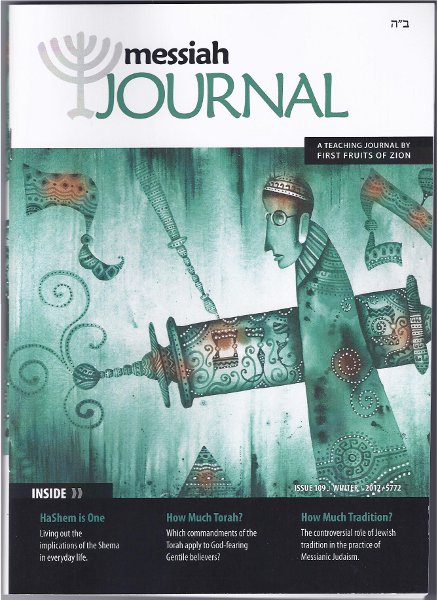
I just received my advance copy of the latest edition of Messiah Journal (MJ) and of course, as it contains my first article published in religious literature, I’m more than thrilled. I showed my wife and she said that she will have to read it, which is even more intriguing (as surprising as it may sound, she doesn’t often read my material). I hate to admit this, but like many authors, I really enjoy seeing my work in print. I suppose it is the same feeling a painter has when he or she sees their work on display in an art gallery.

But I shouldn’t forget everything else this issue of MJ has to offer. I haven’t had the opportunity to read it yet (so I can’t review its contents), but I’ve looked through this issue and there are definitely some submissions I’m anxious to dig into.

There’s an article written by Tsvi Sadan called “Halachic Authority in the Life of the Messianic Community”. Apparently, it was delivered as a lecture to Messianic leaders in Israel in September of 2008 as the “final chord of a debate between those Messianic Jews who teach to live according to Jewish tradition and those who view this tradition as ‘the leaven of the Pharisees and Sadducees.'” This discussion has taken place in the Messianic blogosphere fairly recently, such as in Judah Himango’s blog post Kosher Jell-O, and whether Messiah’s disciples need our own ruling body, as well as on my own blog in the write up Tradition! (and as always, some of the most interesting parts are in the comments sections).

I must admit, I will probably dive into Sadan’s article first, but I also want to read Russ Resnik’s “Shema: Living the Great Commmandment” (Part 1). I’m also very interested in Toby Janicki’s article “The Gentile Believer’s Obligation to the Torah of Moses”, which is also a topic of great interest among non-Jews who are attracted to Jewish religious lifestyle and worship. I believe MJ has had similar articles in the past and want to find out if this is just a reworking of material with which I’m already familiar or something entirely new. I know I’ve been challenged on this topic by comments made on my own blog very recently, both in Defining Judaism: A Simple Commentary and The Focus and the Lens, so I’m hoping for some “re-enforcement” to augment my own knowledge in this area.

For tomorrow’s “morning meditation,” I’m posting a blog on Gentiles and the Shabbat, and Aaron Eby has an article in the current issue of MJ called “Fire by Night: Lighting the Shabbat Candles” which (you should pardon the pun) should prove illuminating. That’s not all of the contents of issue 109 of MJ but those are the highlights. Of course, if you find all of that tantalizing, don’t forget my own article on the origins of supersessionism in the church, how the seeds were first planted, who the major players were, and how the history points to modern times.

If you don’t already regularly receive issues of Messiah Journal, go to the First Fruits of Zion (FFOZ) website and order issue 109 today. I’m really looking forward to reading it myself.