Tag Archives: First Fruits of Zion

The Unchanging Changing God

Leah and RachelSo Jacob did so and he completed the week for her; and he gave him Rachel his daughter to him as a wife. And Laban gave Rachel his daughter Bilhah his maidservant — to her as a maidservant. He consorted also with Rachel and loved Rachel even more than Leah; and he worked for him another seven years.

Jacob’s anger flared up at Rachel, and he said, “Am I instead of God Who has withheld from you fruit of the womb?” She said, “Here is my maid Bilhah, consort with her, that she may bear upon my knees and I too may be built up through her.”

When Jacob came from the field in the evening, Leah went out to meet him and said, “It is to me that you must come for I have clearly hired you with my son’s dudaim.” So he lay with her that night.

Genesis 29:28-30, 30:2-3, 16 (Stone Edition Chumash)

So Jacob marries two women, and sisters no less, and “consorts,” not only with his two wives, but with both of their maidservants as well. By today’s standards, even in progressive, secular society, this is beyond scandalous. And yet, in the ancient near east, what Jacob was going and how he was building up a family was considered perfectly acceptable.

But we don’t consider that acceptable today, and certainly not in the Christian church. Did Jacob deviate from God’s plan? Did he commit some horrible sin, some dire mistake as did his grandfather Abraham when Abraham “consorted” with Sarah’s slave Hagar (Genesis 16:1-4)? Ishmael went on to father the Arab nations, who have been a thorn in Israel’s side across history and into the present day. Did Jacob’s actions with his wives and concubines represent the same error?

Apparently not, since without the children produced by all four of these women, there would be no twelve tribes of Israel and their descendants, the Jewish people.

But how is this possible? If God is eternal and His morality is eternal and unchanging, then how can the relationship Jacob had with two wives and two concubines be approved of by God and yet be considered morally wrong and sinful today?

He answered them, Have you not read that from the beginning the Maker “created them male and female,” and it says, “Therefore a man shall leave his father and mother and cling to his wife, and the two will become one flesh”? If so, they are not two any longer, but one flesh. Thus, what God has joined, man must not divide.

Matthew 19:4-6 (DHE Gospels)

One FleshJesus quotes from an even older story in the Bible to define what is marriage (and what is divorce) to the questioning Pharisees, but conspicuous in his answer is the absence of Jacob, his two wives, and his two concubines. Certainly, every Jewish person hearing the words of the Master and even Jesus himself, owed their very existence to Jacob and his offspring who he sired with four women, only two of whom he had formally married. But what about “two becoming one flesh?”

And what about this?

And it was when about three months had passed, that Judah was told, “Your daughter-in-law Tamar has committed harlotry, and moreover, she has conceived by harlotry.”

Judah said, “Take her out and let her be burned.”

As she was taken out, she sent word to her father-in-law, saying, “By the man to whom these belong I am with child.” And she said, “Identify, if you please, whose are this signet, this wrap, and this staff.”

Judah recognized; and he said, “She is right; it is from me, inasmuch as I did not give her to Shelah my son,” and he was not intimate with her anymore.

Genesis 38:24-26 (Stone Edition Chumash)

If not for this rather scandalous act on both the part of Tamar and Judah, she would not have given birth to the twins Perez and Zerah, and Perez is an ancestor of the Messiah.

How ironic that the one son of Jacob who found his wife among the Canaanite inhabitants of the land was none other than Judah, whose name would eventually denote the progeny of Jacob that survives. In the phrase “About that time Judah left his brothers,” the verb “left” suggests not only a physical departure, but also a violation of family mores (see Genesis 38:1-2).

-Ismar Schorsch
Commentary on Torah Portion Vayetze
“Setting Aside Our Abhorrence of Canaanites,” pg 105
Canon Without Closure: Torah Commentaries

All of this suggests, even if we agree God’s morality and ethics are eternal and unchanging, that He is willing to “work with” our current traditions and customs as a means of accomplishing His plan. Otherwise, how can we explain such apparently outrageous behavior by some of the greatest men in the Bible?

Later in the same commentary, Schorsch goes on to say:

The language implies an expansion of the notion of excluded nations. It is not ethnicity that defines the seven original settler nations of Israel, but cultural mores.

-ibid, pg 106
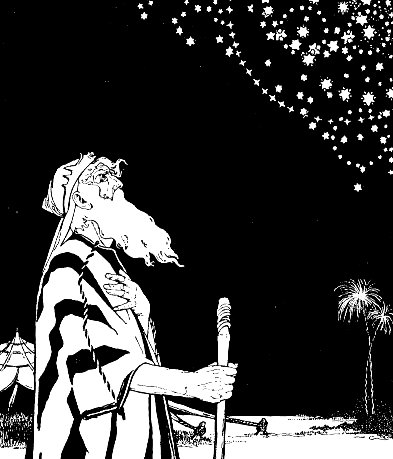
abraham1This makes a great deal of sense, especially in the case of Abraham, who was distinguished from even his close relatives in his homeland, not by ethnicity or genetics, but by a moral and ethical code received from God as the result of “faith counted as righteousness” (Genesis 15:6).

As the family of Abraham progressed forward in time, it began to be distinguished and then defined by families, clans, and tribes descended from the twelve sons of Israel. Who Israel was to each other and to God was set against the national backdrop of the people groups surrounding them. But then, time continues to pass and circumstances radically change.

By the time the Pharisees and Rabbis, Ezra’s spiritual heirs, came to power after the destruction of the Second Temple, Judaism had become a missionizing world religion, constituting as much as one-tenth of the population of the Roman Empire. To maintain the deuteronomic legacy, especially in Palestine, would have severely impeded access to Judaism for prospective converts in a world turned cosmopolitan. Who could be sure that an interested gentile was not a descendant of one of the proscribed nations?

-ibid

I know people in the community of Jesus faith who discount the validity of conversion to Judaism because it is not presupposed in the Torah, as if closure of Torah canon constitutes closure of the will of God. My recent commentaries on Pastor John MacArthur’s Strange Fire Conference have shown me (not that I was unsure of MacArthur’s opinions before this) that he closes Biblical canon with a bang at the end of the Book of Revelation and declares that the Holy Spirit isn’t in the business of working miracles or even talking to people anymore.

And yet, even within the Biblical canon, we see time and time again how God, unchanging and eternal God, seems willing to adapt how He interacts with human beings across the varied mosaic of history in order to accomplish His ultimate goal of reconciling man to Himself and ushering in the Messianic age.

I’ve been struggling more than a little with trying to reconcile the Jewish Torah, Prophets, and Writings, which Christians call collectively, the “Old Testament,” with the later Christian scriptures or the “New Testament.” Even though the books of the Tanakh represent a widely diverse set of writing styles and writers, it yet preserves an overall Jewish “flow” of prophesy aimed at the national redemption of Israel, and the restoration of God’s physical rule on Earth and among all the nations. The Christian interpretation of the later writings shifts the focus away from national Israel and the Jewishness of Yeshua faith, and makes it all a story about God’s plan for personal salvation of all people in a single, homogenized group called “the Church.”

But “the Church” is never mentioned in the Tanakh. If the Bible is supposed to be a unified document, Torah, Prophets, Writings, Gospels, Epistles, Apocrypha, then I would expect that overarching Jewish flow of prophesy to be seamless and unbroken across the “Testaments.”

But it isn’t.

DHE Gospel of MarkHowever, is the fault the document we have that we call the Bible, or is it how different groups interpret it? Certainly Christians see the “Old Testament” in a radically different light than Jews see the Tanakh.

Is my search for Biblical reconciliation and the face of the One, Living God across all history doomed to failure? Is there no way to understand an adaptive God and yet find Him eternal and unchanging in all of the pages of the Bible?

Frankly, one of the only places I’ve been gaining traction so far in my quest is by watching and reviewing the different episodes of First Fruits of Zion’s (FFOZ) television series (available for free viewing online) A Promise of What is to Come. That’s because this program is written and formatted to present familiar concepts in Christianity, such as the Gospel Message, the meaning of the title “Messiah,” repentance, and the parables of Jesus, all from an exclusively Jewish perspective.

The key to understanding the Bible, all of it, is to put yourself in the place of the original writers and especially of the original audience. What were the first century Jewish readers of Matthew’s Gospel supposed to take away from his message? What is “the Good News” from an ancient Jewish point of view? Is the Jesus Christ of the Christian Church really the Jewish Messiah, Son of David we see prophesied by Isaiah, Ezekiel, and Zechariah? Is there some way to make sense of how God seems to change His methods and motives based on changes in ancient (and modern?) cultural mores, and still to recognize that He is One God, a single, unified, creative, entity?

In an ultimate sense, the great Ein Sof God of the Universe is entirely unknowable. How can the small and finite know the limitless infinity?

And yet, God gave us a Bible written in human languages by inspired human beings to other human beings in need of inspiration so that we can know Him. God wants us to know Him and to draw close to Him. We read how Abraham drew close to God. We read how the God of his father became the “Dread” of Isaac. We can see how God turned the fugitive son Jacob into Israel, the father of an empire.

And we can read how one, lone, itinerant teacher changed the course of the world through his teachings, his death, his resurrection, and his ascension to the right hand of Glory.

walkingThe search for God is not a search for an ultimate answer that once we possess it, we may rest in our knowledge and sit assured in our complacency. It is a never-ending process, a trail winding through the mountains, a sea without a shore, a lifelong journey of ever greater discoveries and an ever closer walk with our God.

There is an answer, just as there is a final peace, where each man will sit under his vine and under his fig tree, and no one will make him afraid (Micah 4:4). But that time has yet to come. And until he comes again, we remain a traveler without a home, a bird without a nest, eternally walking, eternally in flight, until home comes to us in the Kingdom of God.

May Messiah come soon and in our day.

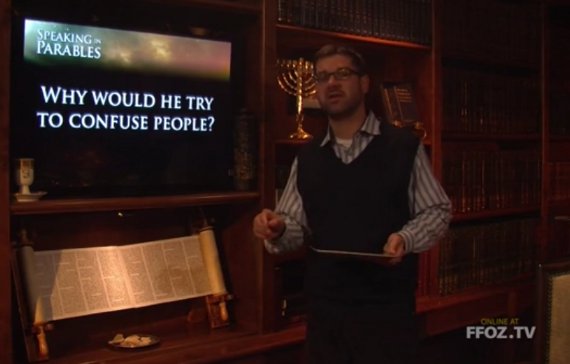
FFOZ TV Review: Speaking in Parables

ffoz_tv18_mainEpisode 18: It may be surprising to many Christians that the use of parables was not unique to Jesus but was rather a Jewish literary art form that had been developed over centuries. Viewers will learn in episode eighteen that Jesus used parables not as riddles but stories to help clarify his points. Jesus’ parables attempted to make it easier for his listeners to grasp his words. Like the other rabbis of his day, Messiah used parables to serve as simple explanations and illustrations to help us understand his message about the kingdom.

-from the Introduction to FFOZ TV: The Promise of What is to Come
Episode 18: Speaking in Parables

The Lesson: The Mystery of Speaking in Parables

This is another First Fruits of Zion (FFOZ) perspective on a common “attribute” of Jesus, in this case, how he taught using parables, that for me, revealed more about how Christians think than about the topic itself. I always assumed that the parables of Jesus were metaphors designed to communicate complex concepts and ideas in a simple manner. This is probably because in my previous career as a psychotherapist, using metaphors was a common method I employed to accomplish the same thing.

But apparently, it’s generally understood in the Church that Jesus used parables to confuse his listeners and to hide the truth from the Jewish people. He spoke in riddles in order to prevent the Jews from repenting and returning to God, which, if repentance had occurred, would have resulted in Israel entering the Messianic Age.

According to FFOZ teacher and author Toby Janicki, it’s easy to understand why modern Christians might get that idea:

His disciples approached him and said, “Why is it that you speak to them in parables?” He answered them and said, “Because to you it is given to know the secrets of the kingdom of Heaven, but to them it is not given. For to one who has, it will surely be given, and he will have extra, but for one who does not have, even what he does have will be taken away from him. That is why I speak to them in parables. For in their seeing they will not see, and in their hearing they will not hear, nor do they even understand.

In them is fulfilled the prophecy of Yeshayah that says,

‘Listen well, but you will not understand. Look closely, but you will not know. Fatten the heart of this nation, and make its ears heavy and seal its eyes, so that it will not see with its eyes or hear with its ears or understand with its heart or repent and be healed’.”

Matthew 13:10-15 (DHE Gospels)

ffoz_tv18tobyThis seems to be another case of misunderstanding what appears to be a plain message because we are not approaching the words of the Master using a historical, cultural, and Rabbinic Jewish lens. Toby used to introduce himself in earlier episodes by saying he is a Gentile who is practicing Messianic Judaism, but in the past few episodes, he has described himself as a Gentile who studies Messianic Judaism. I’m becoming increasingly convinced that such a framework is truly required by Gentile Christians if we’re ever to get past our own cultural and historic misconceptions of the Gospels and hear and understand what Jesus is actually saying to his original audience and to us. Maybe we could use a few parables to get that message through our own “thick skulls.”

Toby said the way to understand Matthew 13:10-15 is to go to the section of the Book of Isaiah from which Jesus was quoting:

He said, “Go and say to this people, ‘Surely you will hear, but you do not comprehend; and surely you see, but you fail to know. This people is fattening its heart, hardening its ears, and sealing its eyes, lest it see with its eyes, hear with its ears, and understand with its heart, so that it will repent and be healed’.”

Isaiah 6:9-10 (Stone Edition Tanakh)

Toby told his audience that the conjunction “but” as in “but you do not understand” would better be rendered as “and”. If we substituted the word “and” for “but” in the scripture from Isaiah 6, it would read more like God telling Isaiah that He wants the prophet to relate a message of repentance, but that the people are not going to listen to him.

Otherwise, it looks like God is saying, through Isaiah, that He wants the people to repent, but He also is making it impossible for them to hear the message and obey. Sort of a cosmic “bait and switch,” with God playing the role of the infinite trickster in relation to Israel. This is very reminiscent of how some Christians say God only gave the Torah (Law) to Israel to prove to them that it was impossible to obey, setting them up to understand why they needed grace and Jesus Christ in order to be saved; setting them up to realize that the Torah was never, ever meant to be a permanent lifestyle for the Jewish people, even though the Torah, Prophets, and Writings are replete with messages indicating that both the Torah and the Jewish people would forever exist before God.

Jesus quoted Isaiah 6:9-10 in order to explain that he was like Isaiah, a prophet preaching repentance to an Israel that was already spiritually blind and deaf, unable to see or hear or understand in order to repent and be healed (although in a Jewish context, being healed wasn’t just individual salvation, but the healing and restoration of the entire nation of Israel).

We have arrived at the first clue:

Clue 1: Jesus did not use parables to blind eyes or deafen ears.

ffoz_tv18_aaronIn fact, the opposite seems true. Jesus knew his audience was already spiritually blind and deaf, and maybe he thought using simple parables instead of complex theological arguments would make the message of repentance and restoration easier to understand.

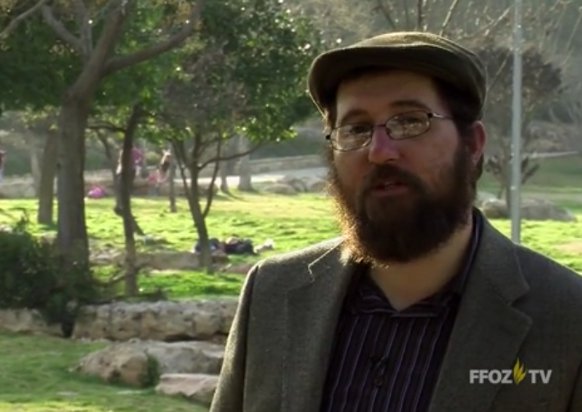
But what exactly is a parable and who typically uses it as a teaching method? For the answer to that question, the scene shifts to Israel and FFOZ teacher and translator Aaron Eby.

Aaron said that parables were used long before Jesus as a common teaching tool by prophets and even by other Rabbis who were contemporaries of the Master. Aaron quotes Ezekiel 17:12 and the parable of the eagle that plucks off a treetop (watch the episode to hear Aaron’s explanation of the parable) to make his point.

Aaron related that the word for parable in Hebrew is mashal, and that the Sages often used a mashal to explain something that was highly conceptual and difficult to understand. Aaron, like Toby, told his listeners that a mashal was designed to make something easier to understand, not take a plain idea and turn it into a riddle. In fact, in the day of Jesus, it was completely normal and expected for a Rabbi to teach using parables, so the disciples and followers of Christ expected it.

We return to Toby in the studio and come to the second clue:

Clue 2: Parables were a common teaching device used to simplify complex concepts.

Toby takes us to another Gospel scripture to further explain why Jesus taught in parables:

With many parables like these, he spoke to them the word according to what they were able to hear. Other than with a parable, he did not speak to them. But when his disciples were with him and no one else was with him, he would explain everything to them.

Mark 4:33-34 (DHE Gospels)

This still seems like Jesus is using parables to obscure the truth but explaining everything to his disciples privately, however Toby said we need to consider another perspective. One that, once I heard it, I realized I’d been taught before.

The Rabbis of that time taught using a dual teaching method. They taught the common people, the simple farmers and shepherds, using parables in order to make difficult theological issues better understood. However to the disciples who continually studied under their Rabbinic Master, the teacher would relate these same concepts in a more formal and legal manner, since they were better equipped, being the Master’s students, to understand in greater depth.

Clue 3: Jesus taught the common people as they were able to hear him.

Remember that Mark describes Christ’s use of parables as, “he spoke to them the word according to what they were able to hear.” He used parables because that’s what the people were able to hear. They wouldn’t have understood a more detailed and technical explanation in the same way the disciples understood.

What Did I Learn?

ffoz_tv18_dhe_markosI had a basic understanding that parables were metaphors in the purpose of their use, but this episode presented parables and their nature in greater detail than I had access to previously. It’s also another example (for me) that God does not desire to hide information, to trick people, to be an agent of confusion, but rather, He wants us to understand, to trust, to believe, and to realize that a Sovereign God is a just and honest God. Sovereignty doesn’t mean God will pull a “bait and switch” just because He’s entitled to as Creator of the Universe.

I also saw again how in lacking a proper Jewish contextual, legal, historical, and cultural framework when we read the Apostolic Scriptures or any other part of the Bible, we will misunderstand, sometimes tremendously misunderstand, who Yeshua is, what he taught, and why he taught it. The Messianic “good news” will be tinted an alien shade of “Gentile,” resulting in a “Goyim-friendly” New Testament that is required to remove continual Jewish Torah covenant obligation so that it can be replaced with something newer and “better.”

As I said before, when Toby introduced himself as a Gentile who studies Messianic Judaism, it revealed something about me and how I approach my faith. I really do believe and accept the FFOZ premise that Messianic Judaism is a method by which non-Jewish believers can and must study in order to comprehend God, the Messiah, the Bible, our Jewish companions in the faith (and outside the faith), and ourselves better. Otherwise, we’re missing out on a great deal of understanding and truth.

I don’t think anyone intended this part of the episode to be adapted in this way, but I wonder if when Jesus (and Isaiah before him) said that “this nation, and make its ears heavy and seal its eyes, so that it will not see with its eyes or hear with its ears or understand with its heart or repent and be healed,” they realized these words could possibly be applied to much of the Christian church today?

Oh, one more thing. The top image on each of these FFOZ TV reviews is just a screenshot, not an embedded link to the video. The link to the video is just under the italicized introduction to the review as the title of episode, such as in today’s case, Episode 18: Speaking in Parables.

The Jewish People are Us — not Them: Commentary on Dauermann in Messiah Journal 114

stuart_dauermannSecond, I will briefly outline the biblical concept of Achdut Yisra’el — the unity of the Jewish people — and explain theologically why the Jewish people are “us,” not “them.” Third, I will seek to establish the connection between Achdut Yisra’el and Ahavat Yisra’el — love for one’s fellow Jew.

-Stuart Dauermann, PhD
“The Jewish People are Us — not Them,” pg 55
Messiah Journal Issue 114/Fall 2013

I previously said this was one of the Messiah Journal (MJ) articles I wanted to address in more detail and I’ve finally been able to delve into it.

I won’t dissect the entire write up, but there was a section that especially got my attention: A Biblical and Theological Basis for the Jewish People Being “Us,” not “Them”. Critics of Messianic Judaism in general and what Haim Ben Haim called Postmissionary Messianic Judaism (PMJ) in his article (referencing Mark Kinzer’s book, Postmissionary Messianic Judaism: Redefining Christian Engagement with the Jewish People) in particular say, that Messianic Jews put their ethnicity above the Bible, the Messiah, and God. They say that Messianic Judaism places Jewish tradition and commentary above the authority of the inspired Word of God, and that the Bible is less important to them than the Mishnah.

So naturally, I was curious as to how Dr. Dauermann was going to present the Biblical basis for Messianic Jews being part and parcel of the larger Jewish world and of Israel. However, to comprehend this, we have to back up a bit in Dauermann’s article to understand more about where he’s coming from.

On page 57 of his rather ample essay, Dauermann quotes Tsvi Sadan’s paper “Keruv as Guiding Principle for Proclamation of the Good News,” presented at the Borough Park Symposium, East Elmhurst, NY, 8-10 October 2007:

I started to see the world as divided into two groups of people: the good guys — the “believers” — and the bad guys — the “non-believers.” Among the “bad guys” were, of course, the Catholics and … Protestant denominations that did not cater to my newly acquired Evangelical mindset. In this tightly knit scheme I viewed the “non-believing” Jews in the same way I viewed any other infidel, be they Muslims, Presbyterians, or Buddhists.

Dauermann comments on Sadan’s statement, also on page 57:

How tragic and shameful that a Sabra like Tsvi came to view his fellow Israeli Jews as “other,” believing that only a very narrow band of Christians, defined in a sectarian manner, deserved the status of “us.”

I read a terrible irony in Dr. Dauermann’s words because there are so many Gentile Christians in the world (including, strangely enough, those in the Hebrew Roots and Messianic Jewish movements) who look at non-believing Jews not only as “other,” but as “bad guys,” quite the contrary to what God said to Abraham:

And I will bless those who bless you, and the one who curses you I will curse.

Genesis 12:3

The term “am echad” appears four times in the Tanach, providing a cluster of insights foundational to our concept of Achdut Yisra’el.

-Dauermann, pg 57

Unity of the Jewish people. The first time in the Tanakh we see “am echad,” according to Dauermann, was in reference to the people building the Tower of Babel. In Genesis 34:16, we see the term in reference to the people of Shechem having their men circumcised and becoming “one people” with Jacob’s family.

It is crucial to see here that brit milah is not simply a covenant with HaShem. It also makes us am echad with all others in that covenant. We tend to miss this in Scripture, even though it is there. Conditioned by post-Enlightenment presuppositions, we miss the horizontal nature of the covenant that binds us together as one people…

-ibid, pg 58

Dauermann is establishing linkage that should be obvious but isn’t, relative to Yeshua-faith. Jewish people are the only population born into a covenant relationship with God and with each other. Regardless of the circumstances and beliefs of any individual Jewish person, that person can never become “unJewish,” and can never surrender their connection to other Jewish people and to God, even if they sincerely want to. And yet, for nearly two-thousand years, the Christian Church has demanded that Jewish believers in Jesus do just that if they want to join the community of faith. If God were capable of being confused, I could imagine Him being confused by watching Jewish people claim a covenant connection with him through Christ while disengaging themselves from the Mosaic covenant and from almost all there Jewish communities on earth. Paul didn’t have to do that. Why should any other believing Jew?

In this section of his argument for the Messianic Jewish people considering larger Judaism as “us,” Dauermann provides a handy bullet point list illustrating “am echad:”

  • A family
  • In covenant with God
  • In covenant with each other
  • Sharing a unique body of laws, and thus strengthened by common obedience
  • Sharing a common language, and thus strengthened by good communication
  • Sharing a homeland where they either live, or from which they are dispersed
  • Empowered by unity, weakened by division

rashiI’d have to say this is “am echad” in its ideal sense. Although the covenant blessings and responsibilities in the first two points exist, not all Jewish people, Messianic or otherwise, acknowledge these relationships. That certainly would affect the third bullet point as well. Not all Jews share Hebrew (or Yiddish) as a common language, but I will admit that when a Jew beings to engage the larger community, language is one of the first things they address. I know I’ve seen The Joys of Yiddish sitting by my wife’s chair in the living room from time to time.

The homeland exists, but many Jewish people are quite comfortable in the diaspora and both they and the Land of Israel itself will remain in exile until Messiah comes and brings all of his people, the Jewish people, back to their home.

And yes, Jewish people everywhere are weakened when lack of unity exists.

Rashi infers that at Sinai, Israel was “ke’ish echad blev echad/like one person with one heart.” By this comment, he bears witness to the centrality of unity as a core value of Jewish community, and furthermore, that this unity arises from our covenantal relationship with HaShem and therefore with each other. The ideal of Jewish life is that all Jews should live “ke’ish echad blev echad.”

-ibid, 58-9

The connection of the Jewish people to each other is tied to the connection the Jewish people have with God. The two relationships are inseparable and, if you are born Jewish, inescapable.

And He said to him, “‘You shall love the Lord your God with all your heart, and with all your soul, and with all your mind.’ This is the great and foremost commandment. The second is like it, ‘You shall love your neighbor as yourself.’ On these two commandments depend the whole Law and the Prophets.”

Matthew 22:37-40 (NASB)

The Master makes a parallel statement using the same linkage. One does not love God without loving his fellow, which in the case of the Jewish community, is your fellow Jew, “Ahavat Yisra’el.”

Adonai said, “Should I hide from Avraham what I am about to do, inasmuch as Avraham is sure to become a great and strong nation, and all the nations of the earth will be blessed by him? For I have made myself known to him, so that he will give orders to his children and to his household after him to keep the way of Adonai and to do what is right and just, so that Adonai may bring about for Avraham what he has promised him.” (emph. added)

Genesis 18:17-19 (CJB)

Dauermann inserted this quote into his article to establish another, very vital point to his argument.

Here already, in Genesis, Torah theologizes that this “am echad” will be characterized by obedience to the body of law. Furthermore, in chapter 26, HaShem tells Yitzchak (Isaac) that he will multiply his descendants and give all these lands to those descendants “because Avraham heeded what I said and did what I told him to do: he followed my mitzvot, my regulations and teachings” (Genesis 26:5 CJB). Here again we see, even in a foreshadowing of that other basis of Achdut Yisra’el, the covenant with our people at Sinai.

-Dauermann, pg 59

I know you might be thinking that Dauermann is stretching his point, since the Torah had yet to be given, but he continues:

In parashat Nitzavim (Deuteronomy 29:9-30:20), HaShem confirms the Mosaic (or Sinaitic) Covenant, stating, “But I am not making this covenant and this oath only with you. Rather, I am making it both with him who is standing here with us today before Adonai our God and also with him who is not here with us today.” (Deuteronomy 29:14-15 [13-14], CJB).

-ibid

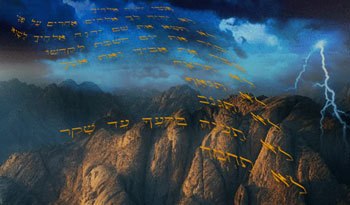
Torah at SinaiNot only covenant belonging and covenant relationship, but covenant obedience are the “common currency” among the Jewish people, at least in the idealized expression of God’s intent for Israel.

I’ve said before that it was always God’s intent to carry the covenant forward, not just in the immediate sense of Sinai, but extending into future history, across all of the unborn generations of Jewish people down the timeline, everywhere, including every Jewish person alive today.

Dauermann continues with this thought invoking Jewish tradition which says, “All Israel is responsible for one another” — kol Yisra’el averim zeh bazeh. He goes on to say:

Because we have been brought into covenant with God, we are therefore inescapably in covenant with one another, and as such, we are each and all responsible for one another. For this reason, even if for no others, the Jewish people are “us,” and not — no, never — “them.”

-ibid

I know what you’re thinking. Well, no I don’t, but I can imagine. I can imagine someone reading this will say that they’ve read stories of terrific conflicts between secular Jews and the Ultra-Orthodox in Israel and elsewhere. Dauermann spends some time going into this, addressing even the worst of these conflicts as “family fights.” Sometimes families fight terribly, even to the point of violence, but they are still family.

But the one thing that can separate Jewish people the most is faith in Jesus:

Tsvi Sadan as well as the Hashivenu leadership group and many others have been conditioned to think of our fellow Jews as strangers, and “them,” as no longer fully our brothers and sisters. Messianic Jews are conditioned to think of other Jews as simply “unsaved Jews” who remain familiar strangers to us unless and until they accept Christ.

-ibid, pg 60

At this point, although the overriding emphasis of Dauermann’s article was on Jewish interrelationships, being Messianic notwithstanding, I started to wonder how all of this would affect the bond between Messianic Jew and believing Gentile, the bond we should also share as disciples of Moshiach and co-participants in the blessings (and there’s always the competing dynamic created between focus on Judaism and Jewish belonging vs. focus on Messiah as the very core of Jewish and Gentile faith).

Dauermann continued in his article discussing how the Jews in the Messianic community needed to return to being “ke-ish echad blev echad” — one person with one heart — with the larger Jewish community. He cited Jeremiah 32:39 in describing how God would give Israel “one heart,” and Ezekiel 36:26 in saying God would put a new spirit within Israel and give them a “heart of flesh.” Even Acts 4:32 speaks of the Jewish believers having “one heart and soul.”

Dauermann built up such a strong interconnection between and within the Jewish community, across all belief systems and lifestyles, that even I started stumbling over the following:

Therefore remember that formerly you, the Gentiles in the flesh, who are called “Uncircumcision” by the so-called “Circumcision,” which is performed in the flesh by human hands—remember that you were at that time separate from Christ, excluded from the commonwealth of Israel, and strangers to the covenants of promise, having no hope and without God in the world. But now in Christ Jesus you who formerly were far off have been brought near by the blood of Christ. For He Himself is our peace, who made both groups into one and broke down the barrier of the dividing wall, by abolishing in His flesh the enmity, which is the Law of commandments contained in ordinances, so that in Himself He might make the two into one new man, thus establishing peace, and might reconcile them both in one body to God through the cross, by it having put to death the enmity.

Ephesians 2:11-16 (NASB)

The linkage goes both directions. Yes, I believe that Jews in Messiah are still Jews, not just in terms of a string of DNA, but in terms of covenant connectedness to God and to all other Jewish people, but that doesn’t mean the body of Messiah, which contains both Jews and Gentiles, is so much chopped liver. Dauermann’s article doesn’t bring this issue up at all, probably because it is out of the scope of his topic, but ultimately, you can’t establish Jewish “Us-ness” between Messianic and all other Jews without also explaining how the body of Messiah is supposed to work.

That, I suppose, is yet to come.

At this point, although Dauermann is still writing within the “Biblical” section of his article, he seems to depart from it quite a bit, although I can see his point:

Often such a cry for being “biblical and nothing but biblical” is code language for eagerness to reject tradition. But every community has its traditions, even those that imagine themselves to be based on nothing but the Bible. And the traditions of men are not wrong except when they are used to displace or annul the commandments of God. Yeshua himself urged keeping of Jewish traditions when he urged the scribes and Pharisees as a class to remember the centrality of justice, mercy, and faith without neglecting their extra-biblical traditions (tithing mint, dill, and cumin, something never commanded in the Torah) (from Matthew 23:23).

-ibid, pp 61-2

jewish-traditionI know what my Pastor would say, but I have to agree with Dauermann. Even in Fundamentalist Christianity, there are many traditions, including those that say there are no traditions, and those that say Biblical interpretation is based on the Bible alone without an intervening historical and traditional lens being employed.

Still the path will feel “dangerous” for a lot of Christians who have had it drilled into their heads that Jewish traditions, the “traditions of men,” are bad, bad, bad.

The last, or almost the last, Biblical reference Dauermann makes is this:

“Do not think that I came to abolish the Law or the Prophets; I did not come to abolish but to fulfill. For truly I say to you, until heaven and earth pass away, not the smallest letter or stroke shall pass from the Law until all is accomplished. Whoever then annuls one of the least of these commandments, and teaches others to do the same, shall be called least in the kingdom of heaven; but whoever keeps and teaches them, he shall be called great in the kingdom of heaven.

Matthew 5:17-19 (NASB)

This is Dauermann telling us that even Messiah did not call for an end to the Torah until heaven and earth pass away. I know that many Christians, including my Pastor still can’t accept this, so I’ll point all interested parties to the First Fruits of Zion television program and specifically to the episode The Torah is Not Canceled, rather than try to include all of the article’s supporting points here.

The very last point Dauermann made was this:

If someone says, “I love God,” and hates his brother, he is a liar; for the one who does not love his brother whom he has seen, cannot love God whom he has not seen.

1 John 4:20 (NASB)

In context, a Jewish believer cannot say he loves God if he hates his fellow (non-believing) Jew. This, of course, takes us back all the way to the Torah again:

…you shall love your neighbor as yourself; I am the Lord.

Leviticus 19:18 (NASB)

Was Dr. Dauermann successful in establishing that the Jewish community is to be considered as “Us” among Messianic Jews and not “Them” as a founded in the Bible? I’m not sure. I can see the trail of Dauermann’s logic, but it doesn’t lead just through the Bible. There’s a realm you enter that encompasses all things Jewish and Judaism that leaves the existence of tangible things and becomes spiritual and metaphysical. I can’t go very far into that realm because I’m not Jewish, but even I, a Goy, can see the shimmering threads of covenant and community linking one Jew to another. Some Jews may choose to disregard those threads, but they exist anyway, even if only in the will of God rather than the vision of men.

Fundamentalists are uncomfortable with spirituality except on its most surface levels, but where, after all, does God exist? Where, after all, does “the Church” expect to be “raptured?” How can fundamentalist Christianity deny something upon which they depend so much, even if only in a dim, Messianic future.

Being Jewish (I can only imagine) is a lived, experiential existence. Certainly Jews all over the world don’t experience the same Jewish life, but that’s why it will be necessary for Messiah to gather in all the exiles, physical, emotional, intellectual, and spiritual, of Israel, give them one heart and one spirit, and remind them of who they are. Scripture even says that one of the jobs of the Gentile nations will be to convey and escort the exiled Jews back to Israel.

There’s something in Dr. Dauermann’s article that serves as a reminder for the Messianic Jewish community, to remember who they are, to remember that they are first and foremost Jews. They chose the path of Messiah, but they are still Jews and the path of Messiah is a Jewish path. Messianic Jews are just as much a Jewish people as those who have not (as yet) seen that Yeshua is indeed the Son of David and the firstborn of Israel.

But once a Jewish Messianic comes to this realization, how does he relate to Gentile believers, or does he? This is a question that remains. Maybe it’s important for modern Messianic Jews to re-capture what Paul experienced in his journey within and between Jewish and Gentile worlds. Paul was a zealous Jew, “circumcised the eighth day, of the nation of Israel, of the tribe of Benjamin, a Hebrew of Hebrews; as to the Law, a Pharisee; as to zeal, a persecutor of the church; as to the righteousness which is in the Law, found blameless” (Philippians 3:5-6).

And on his path, whether among his fellow Jews or among the Goyim, the central focus of Paul’s entire life and ministry was not on either tradition or lifestyle, but above all else, on Messiah…on Yeshua.

Once modern Messianic Jews within a Postmissionary Messianic Jewish (PMJ) framework arrive at where Paul was, maybe how Paul managed to also negotiate the world of Gentile believers while fully retaining his identity as a Jew and as Israel will become apparent.

FFOZ TV Review: Binding and Loosing

FFOZ Bind and LooseEpisode 17: Over the years numerous explanations have been given for what Jesus meant when he talked about binding and loosing, not the least of which is that it refers to restraining demons. In episode seventeen viewers will discover that the context of Jesus’ words is that of a legal nature. When the Jewish background to the terms “bind” and “loose” is examined, Christians can get a clearer understanding of what Messiah was teaching about. Binding and loosing in actuality refers to legal rulings in regards to the Scriptures and not spiritual warfare.

-from the Introduction to FFOZ TV: The Promise of What is to Come
Episode 17: Binding and Loosing

The Lesson: The Mystery of Binding and Loosing

I haven’t given much thought to the traditional Christian understanding of the concepts of “binding” and “loosing” since I only looked at them from a Hebrew Roots/Messianic Jewish driven perspective, however, First Fruits of Zion author and teacher Toby Janicki started with the Christian viewpoint of these ideas. He described a prayer meeting he attended when he was young where the following passage from scripture was read:

Truly, I say to you, whatever you bind on earth shall be bound in heaven, and whatever you loose on earth shall be loosed in heaven.

Matthew 18:18 (ESV)

Toby told his audience that immediately after this verse was read, the people began to pray, “We bind you Satan in the name of Jesus,” suggesting that Matthew 18:18 was a description of Jesus giving the disciples the power to “bind Satan.” I immediately thought of my recent commentary on John MacArthur as well as my conversation with my Pastor on the matter, and how both seem to take the point of view that people can’t really summon the power of the Holy Spirit to make any effective spiritual or physical changes in our world.

the mystery of binding and loosingToby brought up an interesting and useful point to this issue. If Jesus gave his disciples (i.e. “us”) the power to “bind Satan,” why would he give us the power to “loose” him as well? It doesn’t make sense.

Invoking “context is king,” Toby reads from the larger selection of scripture containing the key verse:

“If your brother sins against you, go and tell him his fault, between you and him alone. If he listens to you, you have gained your brother. But if he does not listen, take one or two others along with you, that every charge may be established by the evidence of two or three witnesses. If he refuses to listen to them, tell it to the church. And if he refuses to listen even to the church, let him be to you as a Gentile and a tax collector. Truly, I say to you, whatever you bind on earth shall be bound in heaven, and whatever you loose on earth shall be loosed in heaven. Again I say to you, if two of you agree on earth about anything they ask, it will be done for them by my Father in heaven. For where two or three are gathered in my name, there am I among them.”

Matthew 18:15-20 (ESV)

I’ve accused Christian Bible studies before about “cherry picking” specific verses in the Bible to create a particular picture or doctrine and Toby showed us how true this can be. He deconstructed this passage to show us what really seems to be happening here.

  1. “If a brother sins against you” indicates that an infraction has occurred within the congregational body, committed by an individual.
  2. The procedure of adjudicating the infraction is outlined in first the direct witness approaching the sinner, then with several witnesses, and finally the entire congregation.
  3. If the sinner continues to refuse to repent through each stage of adjudication, the congregational leaders have the authority to remove the sinner from their midst.

It’s no coincidence that it requires two or three witnesses to perform this function:

A single witness shall not stand up against any man for any iniquity or for any error, regarding any sin that he may commit; according to two witnesses or according to three witnesses shall the matter be confirmed.

Deuteronomy 19:15 (Stone Edition Tanakh)

The sequence of events described in Matthew 18:15-20 references a legal proceeding. If an infraction, error, or sin is committed, a set of legal steps is set in motion. First the individual who was offended may attempt to settle it privately, but if that isn’t effective, then two or three witnesses are brought in. Finally, if the matter cannot be settled, the entire congregation makes a decision to set the sinner out.

The two or three witnesses, according to Toby, are actually the authorities within the community who are acting as judges. Of three witnesses, at least two or all three must agree for any legal decision to be binding. This is how a Beit Din of Jewish Rabbinic court operates today. Jesus was giving his disciples the authority to make binding legal decisions for the Messianic community of “the Way.” This is also mirrored today in more than one Christian church system where the board of deacons, elders, or directors make authoritative decisions for the entire church.

Here we have the first clue:

Clue 1: Jesus’s words about “binding” and “loosing” occur in a legal context.

binding and loosing language lessonI was (again) struck by the fact that the church can (quite often) misunderstand the Bible in general and the New Testament writings in particular by ignoring the Jewish cultural, historical, and legal context of scripture. Even fundamentalist and literalist Christians will miss important and even critical details by failing to take the “Jewishness” of the Jewish scriptures (i.e. the Bible) into account.

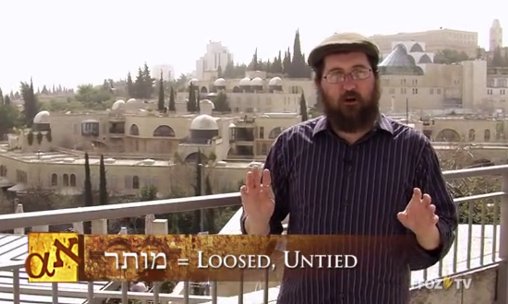
The scene shifts to FFOZ teacher and translator Aaron Eby in Israel in search of our second clue. He takes us through a small vocabulary lesson about the Hebrew words for “loose” and “loosed” as well as “bind” and “bound.” The Hebrew words for “loose” and “loosed” are understood as “prohibit” and “prohibited.” The Hebrew words for “loose” and “loosed” correspond to “permit” and “permitted” (Aaron’s actual description is more detailed and you’ll have to watch the episode to get all the information).

For instance, an Israeli “No smoking” sign in Hebrew can be literally translated as “Smoking is bound” or “prohibited.” Aaron also tells us that in religious Judaism, a particular Rabbi can prohibit or “bind” a particular activity as well as “loose” or permit an activity. A Jewish person unfamiliar with the rulings on a specific topic can consult a Rabbinic sage and receive a judgment on whether it is bound or loosed (prohibited or permitted) but it is bound (prohibited) to go from Rabbi to Rabbi in search of a favorable legal opinion.

While Toby used the English Standard Version of the Bible (purposely) from which to quote scriptures, Aaron backs up his point by referencing the Delitzsch Hebrew Gospels to read from Matthew 16:19 (a scripture we looked at just last week):

I will give you the keys of the kingdom of Heaven, and all that you forbid on earth will be forbidden in heaven, and all that you permit on earth will be permitted in heaven.

Back with Toby in the studio, he reads from the DHE Gospels, as Aaron did, but quotes Matthew 18:18 again:

Amen, I say to you, all that you forbid on the earth will be forbidden in heaven and all that you permit on earth will be permitted in heaven.

If a matter is legally decided by two or three judges or authorities within the congregation on earth, then it will be supported by the Heavenly authority as well (which makes me wonder how all that works today with so many different and contradictory Christian and Jewish groups, each issuing authoritative legal rulings for their congregations…which one(s) does/do Heaven support?).

We now have the second clue for this program:

Clue 2: “Bind” and “Loose” are figures of speech in the Hebrew.

I probably would have said that “Bind” and “Loose” are legal terms in ancient and modern religious Judaism, but you get the idea.

I was wondering why Toby needed a third clue since it seemed to me the point was well made, but he continued by quoting from the Mishnah an example of a legal ruling about fruit grown in Israel, which needs to be tithed, or grown outside Israel, which does not need to be tithed. I’ll skip the details because you will want to watch this episode without knowing everything it teaches ahead of time.

Toby also referenced Acts 15 where the Messianic community exercised their authority to bind or loose in relation to the question of whether or not Gentiles could be allowed into the community without converting to Judaism. Should Gentiles by bound or prohibited from formal entry until they legally converted, or should they be loosed or permitted to join without such a conversion?

An examination of the Acts 15 process (and remember, Luke only recorded a small summary of what was assuredly a much longer and involved proceeding) illustrates the matter of deliberations by those who possessed the authority given them by the Master, and the ultimate decision was to loose the Gentiles from conversion and full Torah obligation, although they were bound to what we refer to as the “four essentials” in order to enter (as an interesting exercise, you can try reading Acts 15 and see if you can determine the actual authorities involved [two or more judges] in making the legal ruling about the Gentiles).

Toby didn’t put it into these terms, but the Council of Apostles and Elders in Acts 15 established halachah or a legal ruling about the procedure of Gentile admittance into “the Way.”

Clue 3: Examples from Rabbinic literature and the New Testament support the two previous clues and their conclusion.

Toby further references Isaiah 11:3-4 to establish that Messiah will also “bind” and “loose” during his reign as King and Judge, as well as Isaiah 2:3-4 to make a similar illustration.

At the end of the episode, Toby made a point of trying to “smooth things over” for whoever in his traditional Christian audience might be disappointed that they didn’t really have the power to “bind Satan” based on Matthew 18:18. He reminded everyone that elsewhere in scripture, Jesus gave the disciples the power to cast out demons, and in Revelation 20:1-2, Satan will be literally bound. I again thought of MacArthur and my Pastor, both of whom probably never believed that Christians have had the power to bind or cast out demons after the close of Biblical canon.

What Did I Learn?

ancient_beit_dinI was again taken by the fact that without an understanding of the first century Jewish Rabbinic, legal, and religious context and comprehension of the words of Jesus, it is quite possible and likely that the Church misunderstands large portions of the Biblical text. This supports my ongoing discussion with my Pastor that we grossly misunderstand Paul in those sections of scripture where he seems to denigrate the Torah and call for its practice to be abolished or “put on hold” by Jewish and Gentile disciples (not that the Gentile disciples were ever “bound” to Torah in the manner the Jewish people were).

Without the Mishnah as well as a historical understanding of how Jesus’s immediate Jewish audience and the Jewish readers of Matthew’s gospel would have comprehended these words, we will fail to learn what Jesus (or any of his apostles or disciples) are trying to teach us today. We will anachronistically read the text and make it say what translates from the Greek to the English to support erroneous doctrine. We’ve seen over the majority of the Church’s supersessionistic history how making such errors has led to Christianity as a whole committing heinous atrocities, all in the “name of Christ.”

I also saw a minor but interesting point in Isaiah 2:3:

Many peoples will go and say, “Come, let us go up to the Mountain of Hashem, to the Temple of the God of Jacob, and He will teach us of His ways and we will walk in His paths. (emph. mine)

Since the word “halachah” refers to a way of walking, this also seems to link up to learning the legally binding methods of behaving in worship and devotion to the God of Jacob. In Messianic days, we, the “many peoples” from the nations, will go up to the “Mountain of Hashem,” the Holy Temple in Jerusalem, and learn the Torah of God from Messiah.

I’ve mentioned before that I believe the Acts 15 halachic decision binds Gentiles differently to the Torah than it does Jews, but it will be interesting to see how or if any of that changes once Messiah is ruling from the Throne of David in Jerusalem. I can’t wait to find out.


Fidelity: Commentary on Haim and Dauermann in Messiah Journal 114

mj114Some years ago Dr. Mark S. Kinzer coined a term for the new and revolutionary approach that many Jewish followers of Yeshua have adopted in regard to their relationship with Judaism. The term “post missionary Messianic Judaism” (PMJ) initially caused ripples that have grown into waves and that we are bringing about a paradigm shift among Messianic Jews. The PMJ paradigm sets a new trajectory for the community of Jewish followers of Yeshua, establishing its role within Judaism and its partnership with the faithful among the nations. In this article, I will attempt to convey my understanding of PMJ, its crucial role, and its ramifications or the Messianic movement.

-Haim Ben Haim
“Postmissionary Messianic Judaism in Practice,” pg 42
Messiah Journal Issue 114/Fall 2013

The Jewish people are “us,” not “them.”

-Dr. Stuart Dauermann
“The Jewish People are Us — not Them,” pg 55
Messiah Journal Issue 114/Fall 2013

Both Haim and Dauermann have written long and densely packed articles on interlocking topics for First Fruits of Zion’s (FFOZ) current issue of their landmark periodical, Messiah Journal. I have to admit that with my busy work, writing, and reading schedule this past week, I’ve only had the opportunity to scan their write ups. I’m looking forward to giving them the attention they deserve and perhaps even composing a more detailed review.

However, I noted that Haim provided something that may be useful in my weekly meetings with My Pastor. Pastor has repeatedly asked what the current function and use of the Torah is in the lives of the Jewish people, particularly Messianic Jews. It is his opinion that the Torah, however it may be defined, has limited to no use in the current age thanks to the classic Christian interpretation of key passages in the letters of Paul.

Not being Jewish and certainly not being a Torah observant Messianic Jew, it’s difficult for me to articulate the lived experience between the Jewish people and the mitzvot. Pastor lived in Israel for fifteen years, so if either one of us should have the experience of observing the relationship between the Torah and the descendants of the children of Israel, it should be him. However, Orthodox Judaism and the myriad complexities of modern Torah observance, have become a major stumbling block. It’s time to make things a little more manageable.

The implementation of PMJ involves all parts of Jewish life. By way of example, we will briefly consider a few of those institutions that comprise the life of a healthy, vibrant Jewish community: Shabbat observance, festivals, kashrut, traditional prayer, the Torah service, gemilut chasidim, tikkun olam, solidarity within modern Israel, the bar/bat mitzvah ceremony, outreach, and Jewish education.

-Haim, ibid pg 48

In a nutshell, this list is a very good place to start in explaining the role of Torah in the life of a Messianic Jew who is facing his faith in Messiah as a Judaism rather than a Christianity.

jewish-christian-intermarriageI won’t attempt to replicate all of the details regarding each of these institutions and elements of Jewish life and community and encourage you to get a hold of a copy of Messiah Journal and pour over these intricacies yourself. Two-thousand years of Gentile Christianity in all of its forms have cemented the idea that the worship of the God of Israel and having faith in the Jewish Messiah King are completely non-Jewish for both Gentiles and the Jewish people, thus any Jewish disciple of the Jewish Messiah must, by (Christian) definition, renounce all of Judaism and being Jewish (with perhaps some lip service relative to being a “Hebrew Christian”) and emulate the Goyim.

This is not the way it was prior to the destruction of Herod’s Temple and it is my firm belief it will not be that way when Messiah returns. Christians will have much to repent of on the day Moshiach ascends the throne of David in Jerusalem.

To put a different slant on the topic, Dr. Dauermann (pp 55-6) offers seven core values designed to shape a mature Messianic Judaism:

  1. Messianic Judaism is a Judaism and not a cosmetically altered “Jewish-style” version of what is extant in the wider Christian community.
  2. God’s particular relationship with Israel is expressed in the Torah, God’s unique covenant with the Jewish people.
  3. Yeshua is the fullness of Torah.
  4. The Jewish people are “us,” not “them.”
  5. The richness of the rabbinic tradition is a valuable part of our heritage as Jewish people.
  6. Because all people are created in the image of God, how we treat them is a reflection of our respect and love for him. Therefore, true piety cannot exist apart from human decency.
  7. Maturation requires a humble openness to new ideas within the context of firmly held convictions.

Although Dr. Dauermann’s article focuses on the fourth principle in his list, I want to touch briefly on the third element: Yeshua (Jesus) is the fullness of Torah.

When My Pastor hears that Jesus fulfilled the Torah, he understands that to mean once Jesus arrived, the Torah was no longer necessary and thus was rendered inert, at least until such time as Ezekiel’s Temple is rebuilt and the numerous prophecies in the Tanakh require all of Israel to resume the Temple service and most if not all of the other mitzvot.

I’ve tried in different ways (unsuccessfully) to reframe “fulfilled” in this context, but the other night, unable to sleep, inspiration seized me.

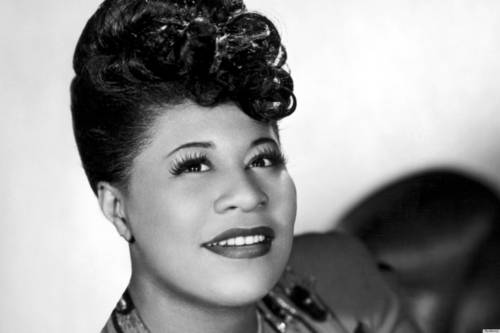
You may not be old enough to remember a television commercial for Memorex tape cassettes featuring the wonderful Ella Fitzgerald. The commercial played part of a song recorded by Ms. Fitzgerald and then the artist herself singing the same notes (I’m writing this from decades old memory and only later did I insert the link below to the actual video), apparently shuttering a glass in the process. The idea was to show that the fidelity of the recording was so near the original (Ms. Fitzgerald’s actual voice) that it too could shatter glass. The tagline for the commercial was, Is it live or is it Memorex (link to YouTube video).

If the recording of Ms. Fitzgerald singing is high fidelity, it is still not her. It is as if the recording “points” to her, the perfect original. In singing live, you might say Ms. Fitzgerald “fulfills” the recording, since she is the perfect and absolute embodiment of what was recorded on tape.

ella_fitzgeraldThis doesn’t render the recording useless and inert. After all, how many of us could simply accompany Ms. Fitzgerald around all of the time in the hopes she would burst into song? However, we can carry around a recording of her music so that we can access and enjoy her singing at will.

Like Ms. Fitzgerald (in a sense), Yeshua is the original, the perfect observer of Torah, the absolute firstborn Son of Israel, the goal all other Jewish believers aim toward in their lives, their righteousness, and their observance of the mitzvot. Like Memorex, no Jewish person is quite like the original, but the goal is to achieve as high a fidelity to that original as possible.

I like to compare our work at First Fruits of Zion and Vine of David to that of carpenters building a home. After all, we are disciples of a carpenter.

Our work can be compared to a building contractor who builds a “Spec” home. A “Spec” home is built on “speculation.” In other words, a builder builds a home with the features he believes will eventually appeal to buyers, but he has no guarantee of a sale. Years ago, on a conference call, my colleague D.T. Lancaster encouraged our staff to take a high view of Messianic Judaism. It is easy to get discouraged with the circus of mayhem and competing religious ideologies that calls itself Messianic Judaism. My colleague said, “When we speak of Messianic Judaism we always speak of the ideal — the way it should be. When we create our resources we create materials for a community that does not yet exist — but the materials will help to bring it into existence.”

-Boaz Michael from the Director’s Letter
“Unless the LORD Builds the House”
Messiah Journal 114, pg 8

When I speak in glowing terms of Messianic Judaism, either online or in person, I am sometimes accused of speaking to a fantasy rather than the lived reality we currently experience. This is not quite true however. I take some solace in Boaz’s words that in my attempting to uplift both the principles and practice of Messianic Judaism for Jewish believers, I am in some manner, summoning the future while living in the present. I am addressing the ideal as it will be when Messiah returns, rather than the imperfection we see in the world today.

But I have to start somewhere.

You’re on the right path. Dividing a mitzvah into small steps makes the goal much more attainable. Taking things slowly also adds the important element of stability to your journey towards living a Torah lifestyle.

But don’t look at it as a compromise. Here’s why:

Suppose an adult wishes to learn a new language. Would he be compromising his mission by beginning with basic simple words? What about a child beginning the study of math. Is he compromising by starting with simple arithmetic?

Of course not. It is quite clear that neither “c‑a‑t spells cat” nor 2 + 2 = 4 is the ultimate goal. But they are necessary steps in the right direction.

Mitzvahs are no different.

Regarding mitzvahs, there’s an additional component: Torah is not all or nothing. Each mitzvah is a full-blown relationship with the One Above. Each time we eat kosher, each time we put on tefillin, each time we observe Shabbat, something extraordinary occurs.

-Rabbi Yisroel Cotlar
“Can I Go Kosher at My Own Pace?”
Chabad.org

going_kosherI can only imagine that it may be rather daunting for a Jewish person attempting to improve his or her observance of the mitzvot. If you didn’t grow up in an observant home but you want to live a lifestyle more consistent with the Torah, how do you approach it? If you want to start keeping kosher, do you have to rush out and buy all new pots, pans, and dishes, learn the procedure for kashering your kitchen, and make an immediate and 100% transition between one day and the next?

Rabbi Cotlar’s advice is plain and comforting and it speaks of a Jewish believer’s approach to Messianic Judaism. You have to start somewhere. You don’t have to have perfect or even high fidelity to the original right away.

While Haim, Dauerman, and Boaz (and Rabbi Cotlar) are speaking to a primarily Jewish audience, I want to speak to the Christians (including those in the various branches of the Hebrew Roots movement) who have been critical of Messianic Judaism in general and the PMJ approach in particular. That Jewish people in the Messianic movement aren’t “perfect” in their observance is no grounds for throwing the baby out with the bath water, so to speak.

The Torah isn’t all or nothing (and I know someone is going to erroneously reference James 2:10 which only applies if you are attempting to justify yourself before God by your Torah observance, not if you are observing the mitzvot already “saved by faith”). Children growing up in a Jewish home are not expected to master all of the mitzvot by the time they’re toilet trained. Any learning is a slow, developmental progression.

And yet Christianity criticizes and judges Messianic Judaism for an imperfect Jewish lifestyle and thus deems the Torah obsolete, as if we have the right to make such a decision.

Twenty centuries ago, the Jewish religious stream of “the Way,” at the direction of Messiah and by approval of the Holy Spirit, commanded the Jewish disciples to do something that had never been done before. For the first time in history, Gentiles were allowed entry into a Jewish religious stream without having to convert to Judaism and accept the same Torah obligations as the Jewish disciples. Christianity wasn’t “Christianity,” it was one among many Jewish religious streams operating in Israel and the diaspora.

The Jewish disciples of the Master were Jewish and part of Israel. They related to other Jews as “us” not as “them.” The real challenge was to figure out how to bring the Gentiles, the “them” in the community, into salvation alongside the Jewish members of the body of Messiah. Ultimately, the fabric within the community of “the Way” frayed and unraveled, separating into the Christian “us” and the Jewish “them.” The Gentiles rewrote the rules in their (our) own image, only allowing Jews back into the worship of Messiah if they stopped being Jewish.

And here we are today.

up_to_jerusalem

But this is not the ideal, as Boaz points out. This is not where we’ll be tomorrow. Tomorrow, Messiah, Son of David, will take his place on the Throne in Jerusalem. He will redeem his people, the Jewish people. He will redeem his nation, the Jewish nation of Israel. And once again, our positions will be defined as they were before. Gentiles will be allowed to join the Jewish religious stream of the body of Messiah without having to convert to Judaism.

The Body of Messiah is the quintessential Israel, the original, the highest fidelity to the original: Messiah. Prophesy tells us that many Jews and many people from the nations will stream to Jerusalem and to the Mountain of the Lord to learn of Jacob’s ways and to walk his paths. In that day, the ideal being presented by Haim, Dauermann, and Boaz will be reality, and we will worship our fulfillment in the Holy City, and every knee shall bow to the King of the Jews.

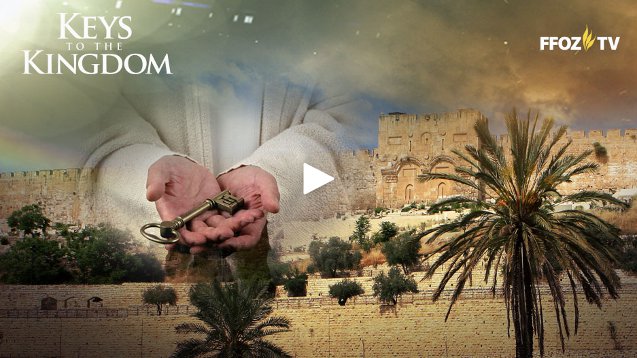
FFOZ TV Review: Keys to the Kingdom

ffoz_tv16startEpisode 16: Jesus tells Peter that he gives him the keys to the kingdom of heaven. These words of Messiah have caused confusion and debate for almost two thousand years. Episode sixteen seeks to bring clarity to this controversy by examining the keys to the kingdom within their proper Jewish context. Viewers will discover that the keys to the kingdom are Jesus’ teachings about entering the kingdom and the revelation that he is the messiah. With these keys we can begin not only to prepare for the coming Messianic Era but we can begin walking in that kingdom right now.

-from the Introduction to FFOZ TV: The Promise of What is to Come
Episode 16: Keys to the Kingdom

The Lesson: The Mystery of The Keys to the Kingdom

Like many people addressing a large audience, First Fruits of Zion teacher and author Toby Janicki starts out with a joke. Actually, in this case, he starts out by describing a joke: the classic joke we see in many comics of a person who has just died standing at the gates of Heaven waiting for “Saint Peter” to use his keys to open up the gates…or not.

Interestingly enough, and you may already know this, the basis for this type of joke is actually in scripture:

And I also say to you that you are Petros, and upon this rock I will build my community, and the gates of she’ol will not overpower it. I will give you the keys of the kingdom of Heaven, and all that you forbid on earth will be forbidden in heaven and all that you will permit on earth will be permitted in heaven.

Matthew 16:18-19 (DHE Gospels)

Before going on to discover what the “Kings of the Kingdom” are, Toby tells us why Jesus gave them to Peter.

Shim’on Petros answered and said, “You are the Mashiach, the son of the living God!”

Matthew 16:16 (DHE Gospels)

It was because Peter was the one who correctly identified Jesus as the Messiah that Jesus gave Peter the Keys to the Kingdom. But what are these keys or for that matter, what is The Kingdom of Heaven?

Toby has told us in more than one prior episode that the phrases “Kingdom of Heaven” and “Kingdom of God” really mean the Messianic Age, the period of time when Messiah will rule, not only in Israel, but over the whole world. This is also our first clue.

Clue 1: Kingdom of Heaven does not mean “Heaven.”

The scene quickly shifts to teacher and translator Aaron Eby in Israel who tells us about the word “Heaven” in Hebrew: Shamayim. It took me a few moments to realize that this segment has been in a previous episode of FFOZ TV. Aaron gave us this “word study” before. I can only guess that someone at FFOZ made the decision that repurposing the “Shamayim segment” fit the requirements for this episode as well as a past one, or something else happened that prevented a unique segment of Aaron teaching from Israel to be videotaped.

The folks at FFOZ may also not be assuming everyone will be watching the episodes in order, and so all of the material that for me seems repeated or that comes across as a review, will be completely fresh and new to others. If Aaron’s teaching on “Shamayim” meaning “Heaven” and “Malkhut Shamayim” meaning “Kingdom of Heaven” is unfamiliar to you, watch the episode to get all of the details.

Back in the studio with Toby, we continue to get a review of the meaning of Kingdom of Heaven meaning God’s reign on earth, as opposed to Heaven as God’s supernatural realm or the court of Heaven.

ffoz_tv16_tobySo if the Keys to the Kingdom mean the keys to the Messianic Age, is it possible to be “locked out,” so to speak and to need a set of keys in some sense in order to gain entry? In previous episodes such as Seek First the Kingdom, Toby certainly gave the impression that even those people who are saved by grace can be locked out of entrance to the Kingdom, though I still don’t quite understand how that would work.

But in this case, that’s not what Toby’s talking about. The Keys to the Messianic Age, the keys that Jesus gave Peter, was the power and authority to pass on the teachings of Jesus to others, including subsequent generations. This dovetails into the central message of Jesus which is “repent, for the Kingdom of Heaven is at hand” and the core teachings of a number of other recent FFOZ TV episodes. You won’t really understand a lot of what Toby teaches unless you’ve seen those shows.

Up until now, I experienced almost everything in the episode as repeated information or a quick review of what has been taught before, but with the second clue, the show took on a very different direction.

Clue 2: The Key of David.

The key of what?

“And to the angel of the church in Philadelphia write:

He who is holy, who is true, who has the key of David, who opens and no one will shut, and who shuts and no one opens, says this:

‘I know your deeds. Behold, I have put before you an open door which no one can shut, because you have a little power, and have kept My word, and have not denied My name. (emph. mine)

Revelation 3:7-8 (NASB)

I’ve read the Book of Revelation just recently, but I never picked up on the key of David and certainly never made the connection to the Keys of the Kingdom. As Toby was talking, I thought again about where these connections in scripture come from. How do Toby and the other teachers at FFOZ arrive at some of their conclusions and associations? It would be helpful to have that information on tap, especially in order to study more in-depth.

But this isn’t enough to understand what these keys are supposed to be, especially relative to the second clue. To drill down further, Toby says we need to consult the ancient Jewish sages, something most Christians aren’t comfortable in doing. On the other hand, this is the third and final clue:

Clue 3: The traditional Jewish interpretation of Isaiah 22:22.

But what does this scripture say?

I will place the key to the House of David on his shoulder; he will open and no one will close, he will close and no one will open.

Isaiah 22:22 (Stone Edition Tanakh)

ffoz_tv16_aaronSo in Revelation 3:7-8, Jesus is quoting what Isaiah had to say about the Messiah and the Keys of David. In my Tanakh, there’s a note about this verse that simply says, “i.e. the affairs of the royal house will be arranged through him.” However, Toby cites a thousand-year old Jewish commentary (which he doesn’t specifically name, unfortunately) that reveals other details:

A teacher opens a discussion of scripture to fulfill that which is said in Isaiah 22:22.

This is interpreted to mean that the keys of the House of David are actually the power to teach God’s Word with authority, something that Jesus did and it was noticed more than once:

When Yeshua finished saying these words, the crowd was astonished by his teaching, for he was teaching them as a man of authority, and not like the scholars.

Matthew 7:28-29 (DHE Gospels)

Apparently, it was Jesus’s desire to pass that authority along to one of his disciples, Peter. That actually makes sense. In first century Judaism, the primary job of a disciple was to memorize the teachings of his Master in order to pass them along to the next generation and beyond. This job was specifically given to Peter, although all of the Master’s disciples would share in the responsibility.

How did Peter fulfill this task and wield the Keys of the Kingdom?

The most noteworthy answer is that Peter’s disciple John Mark wrote down everything Peter had to say about the teachings of Jesus. This is what comes down to us as the Gospel of Mark, which some Christian scholars say was the first Gospel written and the source for the Gospels of Matthew and Luke. Peter also used the Keys in other important ways:

  1. To be the first to preach the Gospel to Jews (Acts 2).
  2. To be the first to preach the Gospel to Gentiles (Acts 10).
  3. To participate in making important decisions for the body of believers (Acts 15).

Peter isn’t a gatekeeper passing in or locking out people from the Messianic Age. He was the first one responsible for passing on the teachings of Jesus. He was given power and authority to perform this task by receiving the Keys of the Kingdom from Jesus. It’s a task, Toby tells us, that all of us as believers must share; to learn, memorize, and teach what Jesus taught. Through the Holy Spirit, we too have been given power and authority…and responsibility.

What Did I Learn?

Pretty much everything from the second clue on was news to me. I’d have never made the association between Matthew 16:18-19, Revelation 3:7-8, and Isaiah 22:22. I also wouldn’t have known about the traditional Jewish interpretation of Isaiah 22:22 that folds back into what Jesus said to Peter and then later to John in Revelation.

I never thought of Peter as the major player in the New Testament much beyond the Gospels. Paul figures so prominently in so much of the Apostolic Scriptures, that the other apostles and disciples almost pale by comparison. Pretty much after his involvement in Acts 10 and Acts 15, Peter fades from the scene and Paul dominates the “passing on” of the teachings of Jesus, acting very much like he is the one to possess the Keys of the Kingdom of Heaven. Also, Paul’s rebuke of Peter recorded in Galatians 2:11-21 seems to even elevate Paul above Peter, at least in terms of an understanding of how the Gentiles were to integrate into the Jewish religious movement of “the Way.”

Toby showed me how important Peter’s early contributions were in setting the stage for everything that followed.

heurmenutic-keySomething else was made apparent to me (though of course, I always suspected it) in this episode as evidenced by the third clue. In using the traditional Rabbinic Jewish interpretation of Isaiah 22:22 (as opposed to the plain reading of the verse), part of what I think FFOZ is saying is that, in order to understand the Jewish perspective on the teachings of Jesus, the New Testament, as well as the rest of scripture, we have to be willing not only to look through that Jewish lens and accept what we see as accurate, we also must be willing to accept the whole of Judaism as a valid perspective in a Christian understanding of the Bible.

I know that would probably get the attention of my Pastor, and not in a positive way. He has a deep respect for the place of the Jewish people in history, prophesy, and in the future age of Messiah and beyond, but not necessarily modern Judaism with layer upon layer of Rabbinic custom, interpretation, and practice that seem, from his Christian point of view, to stray far and wide away from the text of the Bible. He believes the actual scriptures are the final authority as we can understand them through accepted exegesis, but factoring in traditional Judaism and it’s interpretation of that text by the Rabbis may be too far for him, and many Fundamentalists and Evangelicals to go.

I am drawn to and even fascinated by the Rabbinic sages and find many of their commentaries to be compelling guides to understanding God and a life of Holiness, but I will also be the first to urge caution in accepting all Rabbinic commentary as being unerring in its understanding and presentation of God and human beings.

It has been said to me before not to seek Christianity and not to seek Judaism, but to seek an encounter with God. It is with God that all truth resides. It is because human beings see so imperfectly that we require various lenses in order to examine God’s truth and God’s Word. I very much enjoy and appreciate looking through a Jewish lens in order to view Messiah better, but I will still use critical judgment in examining anyone’s commentary on Messiah and God, including the revered Jewish sages.