Tag Archives: God

When the Jewish People are One

Rabbi Mendel TeldonI am not Orthodox.

There. I said it.

Yes, I look like I am. I have a full beard, I am the rabbi of a traditional synagogue and don’t eat anything not kosher. But I am finally comfortable enough with myself and my Judaism to come out and say what has been lying underneath the surface for so many years.

I just can’t classify myself anymore as an Orthodox Jew.

Truth be told, as I look at the membership list of my congregation here in suburban Long Island I feel that none of my community is really Orthodox either.

Please allow me to describe to you my journey on how I reached this conclusion.

-Rabbi Mendel Teldon
“I Am Not Orthodox”
Opinion piece written for
The Jewish Week

And so begins the (you should pardon the expression) “unorthodox” commentary of Rabbi Teldon about Jewish identity from his particular perspective. I must admit, when I read this article, the first thing I thought of was Rabbi Dr. Stuart Dauermann’s article in the most recent issue of Messiah Journal called “The Jewish People are Us – not Them” (read my review of the article for more details).

As his story progresses, Rabbi Teldon relates how, during one Erev Shabbat meal in his home, he asked his (Jewish) guests, “Do you consider yourself Conservative, Reform, Orthodox, None of the above or Other?”

The first guest thought for a few moments and said “I’m not sure. My parents were Conservative, we were married by an Orthodox rabbi, but our kids went to a Reform temple for nursery. I didn’t fast on this past Yom Kippur but my daughter’s upcoming Bat mitzvah is going to be done by an Orthodox rabbi.”

The next guy said he is Reform since currently he is not a member at any temple but he takes his family to a Reform temple in Westchester every year for the high holidays. Since his parents are on the board of directors they get a good price on tickets so it is worth the schlep. Also, while he hadn’t studied much lately, he feels that his beliefs are more in tune with the Reform movements ideas of Tikun Olam.

The third scratched his head and said, “My friends ask me this same question when they hear I am a member at an Orthodox congregation. My response is “Other” since I don’t fall into any of those categories.”

Not being Jewish, I have no real basis for evaluating the question much less the answer, except in relationship (perhaps) with Dr. Dauermann’s article. Dauermann also discusses the nature of Jewish identity and the vital necessity of Messianic Jews to relate first and foremost as Jews. That point dovetails quite nicely with what Rabbi Teldon says next:

That is when it suddenly hit me.

I am not Orthodox since there is no such thing as an Orthodox Jew. As there is no such thing as a Reform Jew or Conservative Jew.

These terms are artificial lines dividing Jews into classes and sub-classes ignoring the most important thing about us all. We share one and the same Torah given by the One and same God.

That is, from my point of view, the essence of what Rabbi Dauermann was communicating in his article. Jewish identity is more than just a label, it’s more than just whether or not you were Bar Mitzvahed by an Orthodox Rabbi, attend the High Holy Days in a Reform shul, and have your kids go to Hebrew school at a Conservative synagogue. Jewish identity is transcendent across all of these “labels.”

Of course, the Jewish people sharing affiliation across those different Jewish institutions or religious streams might have a problem with a Messianic Jew attempting to enter their spectrum of Jewish experience (and I just violated Rabbi Dauermann’s “Us, not them” emphasis).

I was also reminded of this:

We are on more solid ground if we attempt to define the term “Messianic Jew” – a Messianic Jew is simply a Jewish person who believes in Yeshua. Messianic Jews have all sorts of theological views, ranging from attending shul weekly and treasuring Yeshua in their hearts as a crypto-faith and living out a more Orthoprax Judaism, to attending a Pentecostal church every week, and simply maintaining an awareness of their Jewish identity.

-Dror
“The shape of the Messianic Jewish movement”
rosh pina project

IntermarriageBut all this introduces a level of complexity into the equation of Jewish identity and Jewish community. When trying to explain these concepts to my Pastor a few weeks ago, he asked me if Messianic Jews had more in common with Judaism or Christianity. He was getting at the idea that in Christ, we are all “one new man” (Ephesians 2:15) and are saved through Jesus on the cross, while most streams of Judaism deny Christ as Messiah and as the Son of God.

I don’t think I can adequately answer such a question without being Jewish. I don’t have a lived Jewish experience and a unique identity as a part of Israel. In Christianity, we are taught to revere Jesus above all else and our culture and identity is defined by our beliefs.

Jewish identity and covenant relationship with God is established at birth (with the exception of those who convert to Judaism, “Jews by choice”) and, as Rabbi Teldon said, are defined by the Torah and by God. Any Gentile can enter or leave Christianity, but a Jew is born a Jew and even if they reject that heritage, they can never leave and become an “unJew”.

Historically, as Rabbi Dauermann brought out in his article, Jews have always been required to make a choice when coming to faith in Yeshua as Messiah. Either surrender all Jewish identity, practice, and culture, or forget about becoming a disciple of Jesus and lose (or never attain) your salvation.

I seriously doubt that any Christian past or present has any idea what they were asking of Jewish people who desired to have a relationship with the Jewish Messiah. How can you ask a Jew to leave his covenant people in order to honor the capstone of Jewish history, the Messiah, Son of David, who is utterly devoted to his covenant people Israel?

Then we come to a recent debate in the blogosphere on Jewish apostasy, and by that, I mean Jews who previously were believers within a Messianic Jewish context, denouncing Jesus and re-entering another Jewish religious community. General Christian and Hebrew Roots consensus says that any Messianic Jew who desires to live a completely Jewish lifestyle in honor of his fathers, in honor of the Torah, and in honor of Messiah significantly risks leaving Yeshua-faith because, somehow, living as a completely observant Jew among completely observant Jews and focusing on Messiah are mutually exclusive experiences.

Rabbi Teldon’s commentary may seem heartwarming when applied to any other Jewish population, but Christians consider having Messianic Jews making transitions across multiple corridors of (non-Messianic) Judaism as a severe threat which will result in those Jews leaving Yeshua-faith for “dead” Jewish worship. Even many Gentiles in the Hebrew Roots movement who believe as non-Jews, they are obligated to “observe” Torah, are at least hesitant about if not actively critical of Jews in Messiah who want to actually live as Jews and among Jews. Go figure.

I wrote a review a few days ago on one of John MacArthur’s presentations at his Strange Fire conference, and at the end of my review, I brought into question who Christians should be focusing upon, God the Father, Jesus the Son, or the Holy Spirit? Christianity, including Hebrew Roots, insists that the only valid focus of Christian faith must be Jesus Christ, but if that’s true, do we simply disregard the God of Genesis, the God of Abraham,  the God of Jacob, and the God of Moses? Even at the end of all things, the Bible specifically mentions only “the throne of God and of the Lamb” (Revelation 22:3).

I don’t see how it can be reasonable to ask a Jew to stop being Jewish in order to worship the God of Israel and Messiah, Son of David, King of the Jews. What are Jewish families in Messiah supposed to do, shop at the mall on Saturday afternoon and serve shrimp at their daughter’s wedding?

Oh, not everyone thought Rabbi Teldon’s article was heartwarming. Here are a couple of comments from the blog post:

Dear Rabbi Mendel,

Will you daven in a shul that is not Orthodox? Will you sit next to a woman who is also davening, and consider yourself yotse? Will you pray in any shul, regardless of denomination? Do you recognize those with non-Orthodox smicha as rabbis? Do you count women in a minyan? Will you daven, in tefilla b’tzibur, if there are women forming the minyan of ten? Will you share a pulpit with a woman who is a Rabbi in doing a wedding, or leading a service? I imagine that you would say yes to all of the above, since you have publicly claimed you are not an Orthodox Rabbi. If you cannot say yes to all of the above, I encourage you to publish an apology and a detraction of your public statement about being not being an Orthodox Rabbi. If you cannot say yes to all of the above, to claim one is not Orthodox is both disingenuous and inaccurate.

Thank you.

And another comment…

What do you expect? He’s a Lubavitcher. For Lubavitchers, every other Jew from unaffiliated to Satmar is classified as either Lubavitcher or not-yet-Lubavitcher. Everyone is conversion fodder to them. If one regards O/C/R as affiliations, he’s not affiliated with any of the other Orthodox orgnaizations – Lubavitch institutionally does not join with other Jewish institutions.

Except that Orthodoxy, according to R’ Micha Berger, is not a movement, but an attribute a movement can have. OU, Agudah, Lubavitch organizations, they’re all Orthodox because of their adherence to certain ideas. IOW, this is a marketing move. Since R’ Teldon finds that his congregants eschew labels, he’ll eschew labels too. Doesn’t change what he believes.

judaismIn the Messianic Jewish and Hebrew Roots movements, the concept of Jewish identity is fiercely discussed, but it’s obviously a matter of concern among all of the other Judaisms as well.

I think Rabbi Teldon has the right idea. I think that the core of being Jewish must cut through all other distinctions. When the Nazis came for the Jews, it didn’t matter what the synagogue affiliation (if any) of their victims were. Jews were simply herded into cattle cars and taken away as slave labor or to the gas chambers.

While there may be some “bumps in the road” between different Jewish streams regarding who is or isn’t considered Jewish, no other form of Judaism attracts masses of non-Jews like Messianic Judaism. This has been a really BIG “bump in the road” for Jewish Messianics who desire a truly Jewish life and worship experience.

Derek Leman, who like many other congregation leaders in the Messianic movement, oversees a congregation of mostly non-Jews, and yet he also sees the need for “Jewish” Messianic Judaism, as he blogged recently. Naturally, his blog post generated a lot of discussion in the comments section, since many non-Jews associated with the movement and certainly most traditional Christians, are at least confused about why Judaism is such a big deal, to outright offended at the suggestion that Jews converting to Christianity is not God’s real plan for them.

Gentile involvement in Messianic Judaism, although well established historically, results in an interruption of Jewish community that Rabbi Teldon and those at his Shabbos table couldn’t possibly imagine. And yet, without Gentile Christian involvement and support, the vast majority of Messianic Jewish communities would not be able to exist. On top of that, most Jewish people I know in the Messianic movement originally came to faith within a Christian church context. It would seem that continued Christian Gentile involvement or crossover into Messianic Judaism is inevitable, regardless of the other problems this raises.

But God, one by one, calls back each of His Jewish children to stand before Him at Sinai and to recall the Torah of their fathers. God speaks to each Jewish person, reminding them of who He is and who they are in Him.

The apostle Paul probably understood this dilemma best. He was a Jew, a Pharisee, of the tribe of Benjamin, circumcised on the eighth day, zealous for the Torah, the Messiah, the Temple, and Hashem. And yet, he associated with many, many Gentiles. Yes, he always went to the synagogue first whenever he entered a town in the diaspora, and he told of the good news of Moshiach to the Jews first, and also to the Gentiles.

And yet, the Biblical record testifies that as Paul lived and eventually died among the Gentiles, he never compromised who he was as a Jew, nor was he required to make such a heinous compromise by Messiah in order to be an emissary to the Gentiles. If anything, Paul’s Jewish “credentials” underwent the most strenuous scrutiny and the apostle clung to who he was as a Jew with outstanding fidelity (see Acts 21 and subsequent chapters for multiple examples).

It was a difficult road to walk, and it is no wonder that Jews in the Messianic movement today struggle to find a path. If only it could be as Rabbi Teldon relates. If only the binding link between all Jews could be Hashem, and Torah, and the promise of Messiah, who is realized among Messianic Jews. A Messianic Jew living as a Jew among other observant Jews should never violate zealousness for Moshiach at all. It never once dimmed Paul, the Jewish emissary to the Gentile’s vision of the Messiah King.

I know both Christians and Jews will disagree with me in all that I’ve said. But when I read the Bible and factor in the historical, cultural, linguistic, and yes, Rabbinic (proto-Rabbinic) context of Paul’s world, that’s how I see him. I see Paul as a shining example that a Jew who is zealous for Torah does not have to compromise his observance or his Messianic faith in order to honor the King and to worship Hashem.

Messiah is the lynchpin, the capstone that holds all believers together, Jewish and Gentile alike, but there is a dimension possessed by Jews in Messiah that we non-Jewish disciples, by definition, cannot apprehend. God created at Sinai an identity and an experience of what it is to be Jewish in community with other Jews that is unique to the living descendants of Jacob. The Messiah means a great deal to Christians, and we would be hopelessly lost and separated from God without him. But he is even more than all that to the Jewish disciples.

Messiah is the culmination of the prophesies from the Tanakh which all speak of the personal, community, and national redemption of all Jews and of Israel. Messiah is the link that allows the people of the nations to come alongside Israel and share in the prophetic blessings. To demand that a Jew in Messiah stop being Jewish and stop participating in Judaism is to deny Biblical prophesy, deny God’s sovereign plan for Israel and the world, and frankly, when we are dumb enough to make such a silly demand, we Gentiles are shooting ourselves in the foot (remember, the Jews would offer sacrifices to God for the atonement of the nations of the Earth, and the Romans destroyed that atonement in 70 C.E.). Without Jewish Israel and Judaism, what links us to Messiah and to salvation at all?

Capstone archSomeday, Messiah will be the capstone, not only for the (mixed) body of Messiah, but for all Jews everywhere, as they flock to Jerusalem to celebrate the return of the King. We Gentile believers will also celebrate, but it is our job to help conduct the exiles back to their Torah and their Land in accordance to the will of our Master and the will of Hashem.

The party will be first and foremost for the Jewish people, the nation of Israel, the Holy people of God who He gathered to Himself at Sinai. We of the nations who are called by His Name are grafted in by a faith learned from Abraham and through the grace of Messiah and the providence of God.

Rabbi Teldon ended his article with these words:

When we are able to focus on the fact that while we have differences but a family truly remains connected eternally, it will reconfirm what we already knew: Am Yisroel Chai!

There must be a way for this to be accomplished also for Messianic Jews, because they too are part of the family, regardless of other differences. Paul is part of that family, as are James, Peter, John, and for that matter, Abraham, Isaac, and Jacob. Messiah is part of that family, and he leads that family and that nation, for he is, first and foremost, the Jewish King.

How can Gentile believers in the Church not understand that being Jewish is a gift and demand that Jews return that gift to their Father in Heaven in exchange for Gentile Christianity? Someday what Rabbi Teldon describes will become an overwhelming reality in a way we cannot possibly imagine. Someday Messiah will bring all of his people, all of Israel home. And on that day, I and my other non-Jewish brothers and sisters will line the highway leading up to Jerusalem and loudly, jubilantly applaud the return of the lost remnant of Judaism, and cheer in joy and gratitude that the will of God has finally come to pass…

…and  we will bless God that we among the nations were allowed to humbly be a part of it all.

Vayeshev: The Blessing and the Curse of the Presence of God

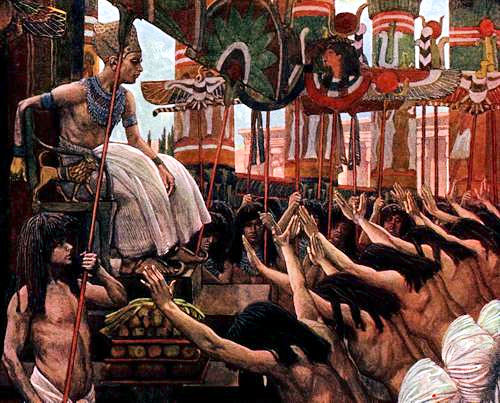
Joseph in prison“And it happened after these things that the cupbearer of the king of Egypt and the baker transgressed against their master, the king of Egypt.”

Genesis 40:1

“I have set God before me always…”

Psalm 16:8

Rashi brings the Midrash that the cupbearer was imprisoned because a fly was found in Pharaoh’s goblet of wine; the baker was imprisoned because a small pebble was found in the king’s bread.

Our tzaddikim (righteous ones) never lost sight of being in God’s presence. Everything that transpired was contemplated as to how it applied to their service of God. The story is told of one such tzadik, the Alter (Elder) of Kelm who once found a small chip of wood in his bread. This immediately brought to mind the story of the king of Egypt’s baker who was imprisoned for allowing a pebble to be in the king’s bread. The Alter cogitated, “A defect in a person’s bread is hardly grounds for so severe a punishment. No one will be punished for this chip of wood in the bread, especially since it was totally accidental. Why, then, was the king’s baker punished so harshly?”

Dvar Torah on Vayeshev
based on Twerski on Chumash
by Rabbi Abraham J. Twerski
quoted by Rabbi Kalman Packouz at Aish.com

A tzaddik is a holy or righteous person who, as Rabbi Packouz states, does not lose sight of being in the presence of God. There’s a reason most of us aren’t tzaddikim or “righteous ones.” It is extremely difficult (forgive me for saying this) to keep our thoughts on being in the presence of God every waking hour. Even if it is our most heartfelt desire, sooner or later our concentration will waver, our mind will wander, and we’ll start thinking and then doing things without an awareness that God is also present with us.

This is what separates someone like Joseph from you and me. Even when he was alone and knew he would not be caught, he still refused to take advantage of very appealing opportunities. For even if his human master was away, he was always in the presence of the Master of the Universe.

After a time, his master’s wife cast her eyes upon Joseph and said, “Lie with me.” But he refused. He said to his master’s wife, “Look, with me here, my master gives no thought to anything in this house, and all that he owns he has placed in my hands. He wields no more authority in this house than I, and he has withheld nothing from me except yourself, since you are his wife. How then could I do this most wicked thing, and sin before God?” And much as she coaxed Joseph day after day, he did not yield to her request to lie beside her, to be with her.

One such day, he came into the house to do his work. None of the household being there inside, she caught hold of him by his garment and said, “Lie with me!” But he left his garment in her hand and got away and fled outside. When she saw that he had left it in her hand and had fled outside, she called out to her servants and said to them, “Look, he had to bring us a Hebrew to dally with us! This one came to lie with me; but I screamed loud. And when he heard me screaming at the top of my voice, he left his garment with me and got away and fled outside.” She kept his garment beside her, until his master came home. Then she told him the same story, saying, “The Hebrew slave whom you brought into our house came to me to dally with me; but when I screamed at the top of my voice, he left his garment with me and fled outside.”

Genesis 39:7-18 (JPS Tanakh)

Of course, Joseph wasn’t always a tzaddik.

At seventeen years of age, Joseph tended the flocks with his brothers, as a helper to the sons of his father’s wives Bilhah and Zilpah. And Joseph brought bad reports of them to their father.

Genesis 37:2 (JPS Tanakh)

DescendingAs his father’s favorite son, Joseph could get away with almost anything, so much so, that his brothers learned to hate him and finally conspired to kill him. Thus began the long descent of Joseph from favored son to slave and the finally to prisoner in Egypt.

It is said in some circles of Judaism:

Before a person experiences a miracle – נס – , he is given a trial – ניסיון. There is no ascent (aliyah) without a prior descent (yeridah). The lower the descent, the higher the potential ascent.

And so it was for Joseph.

But what about you and me? Remember, while we have more than a few Biblical examples of people who started out in difficult circumstances only to rise mightily by the hand of God, there is also a certain amount of midrash involved in the commentaries I’m using. Can we say that for every difficulty or misfortune we encounter, we will ultimately spring back with the same force or greater, ascending exalted heights for the glory of God?

Probably not. The apostle Paul, while a highly respected Rav and tzaddik in his own right, died a cruel and unrecorded death among pagan Gentiles in Rome at the hand of Caesar. How many righteous ones, both Jewish and Christian, have suffered and died with no reward in this world? How many never thought of a reward in this present life, but only looked to Heaven?

For I am already being poured out as a drink offering, and the time of my departure has come. I have fought the good fight, I have finished the course, I have kept the faith; in the future there is laid up for me the crown of righteousness, which the Lord, the righteous Judge, will award to me on that day; and not only to me, but also to all who have loved His appearing.

2 Timothy 4:6-8 (NASB)

Paul too was a man who was always aware of being in the presence of God, standing before the Throne of the Master of the Universe. It was being in His Presence that was most rewarding to the apostle, much more than any reward he could ever receive in mortal life. His crowns are in Heaven.

Rabbi Packouz concludes his commentary like this:

The Alter concluded, “It was because when one serves or relates to the king, the standard of perfection is much greater than when relating to other people. One must exercise much greater caution to prevent any defects. In serving the king, even a small defect is a major offense!”

“I am in the service of the King of kings,” continued the Alter. “Is my behavior before Him without defect? Have I been cautious enough to avoid even accidental infractions?”

On the surface, we might wish always to be in the presence of God, but consider this. God watches every move and every mood. You cannot so much as twitch without God noticing. Then too, if you are always in His presence, that includes when you drive to work, when you discipline your children, when you talk to your neighbor, when you talk about your neighbor behind their back, and particularly when you are alone, for no one displays more of who they really are than when they’re alone and they think no one is watching.

The only difference between a tzaddik and the rest of us is that the tzaddik knows he or she is in the presence of God constantly. The rest of us are also constantly in God’s presence, but we aren’t always aware of that fact, or we don’t want to always be aware of it.

Joseph of EgyptJoseph became Prince of Egypt, second only to Pharaoh in power and majesty in that ancient land. But this was only after suffering great trials, and in those trials, always being aware he was in God’s presence. Only when he didn’t succumb to the temptations of lust, anger, and despair was he elevated to great heights, but even then, only for the glory of God and to serve the desperate and the starving…and only to ensure the continuation of Jacob and the Children of Israel.

Nearly two years ago, for Torah Portion Vayigash. I wrote something similar as related to our Master, to Messiah. Jesus also suffered many trials in his mortal lifetime as a humble teacher who could have risen to King, but in the presence of God, allowed himself to be degraded, crucified, and murdered.

But he rose to the most exalted place at the right hand of the Father, to be glorified and with the promise of one day returning as King to defeat Israel’s enemies, restore the Holy Land to glory, return the exiles to their nation, and to rule us all in justice and peace.

Any one of us may be called upon to serve the King at any moment, not in exalted glory, but as a humble and even humiliated servant. How we respond to suffering, hardship, and shame in the presence of God may determine how we will be allowed to continue to serve Him…or if we will be allowed to do so.

When you believe you are living inside of an unobserved and unguarded moment, that is the time to realize the truth. You are never alone. God is always there. You are always before the Throne. That can either be a blessing or a curse, depending on how you choose to use that moment.

Good Shabbos.

The Challies Chronicles: John MacArthur Tests the Spirits

john-macarthurThe second day of the Strange Fire conference began with John MacArthur preaching a message titled “Testing the Spirits.” It was based on 1 John 4: “Beloved, do not believe every spirit, but test the spirits to see whether they are from God…”

-Pastor Tim Challies
“Strange Fire Conference: John MacArthur Tests the Spirits,” October 17, 2013
Challies.com

This is a continuation of my Challies Chronicles series, reviewing the live blogging of Pastor Tim Challies on John MacArthur’s Strange Fire conference. Based on a conversation I had last week with my Pastor and what I wrote in a previous blog post, I’ll try to exercise more restraint or at least be a little more even-handed in my responses to this topic.

As far as the above-quoted statement goes, I couldn’t agree more. I’ve seen more than few people in church (not necessarily the one I go to now) attribute their emotional states to an influence of the Holy Spirit. Typically, if a person is facing a tough decision and they pray about it, and then, when they consider one of their options and they experience “a peace” about it, they say that was confirmation from the Spirit that it’s the right decision.

Well, maybe.

And maybe the person just feels at peace with the decision they’d prefer to make, not whether or not it is in the will of God. After all, who says God is in the business of always making us feel good or giving us our heart’s desire constantly. From my experience, God tends to guide people into areas of challenge and difficulty, not on board the gravy train to Heaven.

But let’s see what else Pastor Challies has to say about this presentation by MacArthur.

There are many places in the New Testament where we are told to test all things and this is critical because Satan and his demons exist and because they operate a kingdom of lies that dominates the world. Satan has been allowed to run loose in this world and he and his agents are disguised as angels of light. We should not be surprised that Satan operates 99% of the time in false religion, in lies and deception. He is not the one behind the corruption in sinful society—the flesh takes care of that. He is behind the false systems of belief that pervade this world.

MacArthur said that many Christians get spiritual warfare all wrong and turned briefly to 2 Corinthians 10:3ff where we see that the weapons of our warfare are not human and that we cannot rely on anything concocted by man. Our weapons must be divinely powerful. Why? Because we must be engaged in the destruction of fortresses. The picture here is that human weapons are no match for a huge and impregnable fortress. We are assaulting formidable edifices and cannot use pea-shooters. These fortresses are speculations, ideas, psychologies, and religions. Spiritual warfare is not about running off demons, but battling for the mind.

I have to admit that I am confused about to what extent MacArthur believes the Spirit of God intervenes in our world? How much of what goes on around us can we attribute to God vs. other influences, most of all being human influences, including our personal, internal states?

Calvin and Hobbes discuss evil

MacArthur seems to imbue evil spirits with a great deal of power on the surface, but then he says, “These fortresses are speculations, ideas, psychologies, and religions. Spiritual warfare is not about running off demons, but battling for the mind.”

So really then, “spiritual warfare” isn’t actually battling in a supernatural realm, but dealing with our own thoughts and feelings as well as the stuff that goes on around us in the world every day like cults, new age philosophies, and other institutions. OK, I get that you can’t trust politicians or Scientology. Of course, since he mentioned it, MacArthur’s track record dealing with psychology is pretty sketchy from my point of view.

He is also an advocate of Nouthetic Counseling, which stresses the Bible as a sufficient tool for counseling people with mental illnesses such as depression and anxiety. MacArthur does not reject all forms of psychological theories and techniques, though he considers some psychology and psychiatry as contrary to the Bible.

MacArthur has argued that “True psychology (i.e. “the study of the soul”) can be done only by Christians, since only Christians have the resources for understanding and transforming the soul. The secular discipline of psychology is based on godless assumptions and evolutionary foundations and is capable of dealing with people only superficially and only on the temporal level… Psychology is no more a science than the atheistic evolutionary theory upon which it is based. Like theistic evolution, Christian psychology is an attempt to harmonize two inherently contradictory systems of thought. Modern psychology and the Bible cannot be blended without serious compromise to or utter abandonment of the principle of Scripture’s sufficiency….

Wikipedia on MacArthur

By the way, that point of view of mine comes from a Bachelor’s degree in Psychology, a Master’s degree in Counseling Psychology, and fifteen years of post-graduate practice, so it’s not like I don’t have a basis for my opinion. I don’t think counseling psychological disorders absolutely requires that the therapist be a Christian or that the counseling techniques be strictly based on the Bible.

CounselingSure, MacArthur isn’t specifically referencing Nouthetic counseling but since he brought the topic up, I think the it becomes relevant to the current discussion.

But I do believe that people more often than not, create their own problems. They don’t need to look to a supernatural cause right away. When any of us have some sort of difficulty in our lives, the first person we should consider is the one we see in the bathroom mirror every morning.

The architect of it all is Satan, the arch-deceiver.

On the other hand, MacArthur is saying that all of these human caused problems have a supernatural source.

And his solution?

What is our responsibility as Christians? It is to smash these ideologies, to crush these fortifications, and to take every thought captive to the obedience of Christ. Once again, we need to remember that we are engaged in a battle for how people think. (emph. mine)

Sorry. Got caught up in the martial language there for a minute.

I’m OK with “obedience to Christ,” but I’m a little worried about “a battle for how people think.” Who is supposed to control my thinking, the Jesus of the Bible, or a particular movement in Christianity? I would prefer the former and turn myself over to God than to man, but that may not mean I’ll always agree with MacArthur or others like him on everything. If I don’t, would he think I was being influenced by Satan? I don’t know. I’ve recently called myself a Christian who studies Messianic Judaism, so I imagine he’d have an opinion on that.

When the Great Awakening broke out, there was much debate about what was and what was not a true work of the Spirit. Jonathan Edwards went to 1 John 4 and MacArthur closely followed Edwards’ The Distinguishing Marks of a Work of the Spirit of God…

We are all responsible to assess anything and everything that is claimed to be a work of the Holy Spirit. These are timeless tests for all movements, all preaching, and all preachers. What is truly of the Holy Spirit will conform to these marks.

MacArthur lost me at the Great Awakening. My primary orientation when trying to understand God is the Bible. I’ve recently been chastised by a good friend for not knowing Christian history, but how much authority should I insert into particular events in the history of Christianity vs. the Bible in trying to understand the work of the Holy Spirit?

This is one of those times when my not being a “typical Christian” doesn’t work out so well.

The context for this passage is the work of the Spirit (see 3:24). While the working of the Holy Spirit is invisible, the manifestations of his work are visible. We know Christ abides in us because the Spirit he has given is manifested in us. What is the Spirit doing in us? MacArthur provided a long list. The Spirit creates a desire for repentance, a hatred of sin, a belief in the gospel, a love for Christ, a desire to be a slave of Christ, a delight in Scripture, a longing for obedience, joy in trials, love of other believers, desire for fellowship, illumination of Scripture, a heart of praise, worship as a way of life, increasing Christ-likeness and much more besides.

I’m reassured a bit since MacArthur does believe that the Holy Spirit does have an influence and a tangible impact on our day-to-day lives, prompting us to repentance, inspiring love of Messiah, supporting us in our trials, and so forth.

His major critique of the charismatic movement is that it focuses undue attention on the Holy Spirit and does so at the expense of Christ. Any true preacher will be Christ-dominated and present him in an accurate and exalting way. It is a matter of sound theology and also a matter of preeminence. Where you see any deficiency in the nature and preeminence of Christ, this is not the work of the Holy Spirit. The Holy Spirit’s ministry is always to point you to Jesus Christ. Anyone who pollutes the gospel or distracts from the Son to the Spirit is not operating in the Spirit.

The devil would never want men to have more honorable thoughts of Christ and for that reason loves to draw attention away from Christ to a false image of the Holy Spirit. And all the while he pretends to draw attention to Jesus. A true work of the Spirit exalts the true Christ. If the charismatic movement was a movement of the Spirit, it would be Christ-dominated and everyone in the movement would be bowing the knee to the true Christ in belief of the true gospel.

According to leading charismatics, a distinctiveness of the charismatic movement is the preeminence of the Holy Spirit. They have a passion to experience the Spirit’s presence and power. But if the Spirit is the person sought, his work has been rejected. In this movement Christ is obscured, Scripture is depreciated, and a preoccupation with experience is elevated.

Off balanceSorry for the numerous and lengthy quotes, but there’s a lot going on here. I know time and again, I’ve been told to focus on Jesus, only Jesus. I can see that if, as a believer, I want the Holy Spirit to do this dramatic thing or that dramatic thing, or some other dramatic thing, that I’m probably caught up in a religion of sensation and that I’m way off-balance. I get that.

But when told to only, only, only focus on Jesus, I wonder where did God the Father run off to? I mean, MacArthur and a lot of other Christians talk about the Holy Spirit, and they talk lots and lots about Jesus, but where is God? I know. In a trinitarian view, all of them are God, but if that’s true, doesn’t focusing on any one aspect of the trinity make us unbalanced? If it’s possible to focus too much on the Spirit, is it also possible to focus too much on the Son?

I almost never, ever hear anything spoken among Christians about God the Father or, as He would be expressed in the Tanakh (older Jewish scriptures known in Christianity as the “Old Testament”), Hashem. But Jesus talked about Him all the time.

Therefore Jesus answered and was saying to them, “Truly, truly, I say to you, the Son can do nothing of Himself, unless it is something He sees the Father doing; for whatever the Father does, these things the Son also does in like manner.”

John 5:19 (NASB)

In that day you will not question Me about anything. Truly, truly, I say to you, if you ask the Father for anything in My name, He will give it to you.

John 16:23 (NASB)

Jesus spoke these things; and lifting up His eyes to heaven, He said, “Father, the hour has come; glorify Your Son, that the Son may glorify You…”

John 17:1 (NASB)

I’m saying all this not to be a theological pain in the neck, but to point out that Jesus always re-directed the attention of his disciples to the Father.

The charismatic movement fails this test of exalting Christ above all. MacArthur said, Show me a person obsessed with the Holy Spirit and I’ll show you a person not filled by the Spirit. Show me a person obsessed with Jesus Christ and I’ll show you a Spirit-filled person.

I learned in the Bible to always pray to God in the name of the Messiah. Am I wrong? Am I supposed to pray to Jesus? Am I supposed to be “obsessed” with Jesus so I can “prove” that I’m filled with the Spirit? MacArthur said to “exalt Jesus above all.” I can’t believe he means to exalt the Son over the Father, does he?

Coffee and BibleI agree we need to be mindful of anything we consider a supernatural experience or a “movement of the Spirit.” I’m not much of a spiritualist and I’m certainly not a mystic (although the writings of the mystics make wonderful metaphors). I like reading and I like studying. I think I’m “wired” to go in that direction. But I’m also wired to pay attention to what I read, which most certainly includes the Bible.

I know MacArthur is trying to make a point and the scope of his presentation, his conference, and his book probably don’t allow for answering more broad-based questions, but inadvertently, he brought this subject up so now I think he should have to deal with it.

The Bible doesn’t elevate Jesus above God the Father just as it doesn’t elevate the Spirit above the Father. MacArthur says that overindulging in the Spirit of God to the detriment of everything else God is leads to error, and I completely believe it. But how does MacArthur avoid the same problem when he demands that we should obsess on Jesus to the exclusion of God the Father?

Vayishlach: The Good Fight

wrestlingIn this week’s parsha, our father Yaakov, fresh from his successful escape from Lavan, prepares to encounter his brother and sworn enemy, Eisav. He sends malachim to deal with Eisav before he will actually meet with him face to face. The word malachim signifies two different meanings. One is that it means agents, messengers, human beings who were sent on a particular mission to do Yaakov’s bidding. The other meaning is that the world malachim signifies angels, supernatural messengers of God who were sent to Yaakov to help him in his fateful encounter with his brother.

Rashi cites both possible interpretations in his commentary. When Rashi does so, he is teaching us that both interpretations are correct at differing levels of understanding the verse involved.

-Rabbi Berel Wein
“Human Effort and Supernatural Help”
Commentary on Torah Portion Vayishlach
Torah.org

A plain reading of the text suggests (at least to me) that Jacob sent human beings as messengers to his brother Esau rather than supernatural angels. It makes the most sense given the context. However, there is another encounter Jacob has with the supernatural that bears scrutiny.

Jacob was left alone. And a man wrestled with him until the break of dawn. When he saw that he had not prevailed against him, he wrenched Jacob’s hip at its socket, so that the socket of his hip was strained as he wrestled with him. Then he said, “Let me go, for dawn is breaking.” But he answered, “I will not let you go, unless you bless me.” Said the other, “What is your name?” He replied, “Jacob.” Said he, “Your name shall no longer be Jacob, but Israel, for you have striven with beings divine and human, and have prevailed.” Jacob asked, “Pray tell me your name.” But he said, “You must not ask my name!” And he took leave of him there. So Jacob named the place Peniel, meaning, “I have seen a divine being face to face, yet my life has been preserved.” The sun rose upon him as he passed Penuel, limping on his hip. That is why the children of Israel to this day do not eat the thigh muscle that is on the socket of the hip, since Jacob’s hip socket was wrenched at the thigh muscle.

Genesis 32:25-33 (JPS Tanakh)

A man comes out of nowhere in the middle of the night, encounters Jacob and starts wrestling with him. Amazingly, both fighters have the strength and stamina to sustain their combat for many hours until dawn nears. The intruder then pleads with Jacob to release him because the sun is coming up, but rather than demanding who the person is and why he attacked him, Jacob asks his fellow combatant to bless him.

At least from this translation, we only learn that the “person” who attacked Jacob was supernatural when we arrive at verse 31:

So Jacob named the place Peniel, meaning, “I have seen a divine being face to face, yet my life has been preserved.”

It is commonly believed that Jacob wrestled with an angel of God, but some believe is was some form of incarnate God Himself, while others believe it may have been a “pre-incarnate Jesus.”

Who knows?

But from Rabbi Wein’s commentary, we can assume, at least on the surface, that the mysterious fellow could either have been human or an angel.

Who was Jacob wrestling with? If it was an angel, why couldn’t the angel defeat a mere moral? When the attacker couldn’t defeat Jacob, why did he injure Jacob’s hip? Why did the “angel” attack Jacob in the first place?

Our problem is that if Jacob is truly alone, who can be wrestling with him? One possible answer is — no one! Jacob is actually wrestling with himself. This would explain the ambiguity in the passage. However, by solving the textual problem (if indeed we are correct), we have raised an even greater problem: Why would a sane man wrestle with himself? A careful reading of the text may give us some insight.

The “man” is referred to in Hebrew as an ish. And we find another verse — a great deal less enigmatic — in which it is apparent that the ish is clearly Jacob.

-Rabbi Ari Kahn
“Vayishlach: The Struggle of Jacob”
from M’oray Ha’Aish: Advanced-level Commentaries on the Weekly Parasha
Aish.com

OK, you’re probably not buying that, but I think the interpretation has merit, even as a metaphor. However, this isn’t the only way to look at this encounter:

Who is this man with whom Jacob wrestled? According to the Sages, he is the “angel of Esau,” and their struggle, which “raised dust up to the Supernal Throne,” is the cosmic struggle between two nations and two worlds — the spirituality of Israel and the materiality of Edom (Rome). The night through which they wrestled is the long and dark galut (“exile”), in the course of which Jacob’s descendants suffer bodily harm and spiritual anguish, but emerge victorious.

-Rabbi Yanki Tauber
“Wrestling with Angels”
Chabad.org

shoahSo, in this interpretation, the guardian angel of Esau attacks Jacob but is unable to defeat him, presumably because of the blessings of God that rest upon Jacob but not Esau.

I suppose it makes more sense, especially when considering that Jacob realized he had been wrestling with a divine being. This operates as another metaphor and even on a prophetic level. The descendants of Jacob will be attacked by the descendants of Esau and although the Children of Israel, the Jewish people, will be injured, sometimes terribly, and carry the marks of their injury forward through history, they will ultimately prevail.

But let’s get back to the immediate situation Jacob was facing:

The messengers returned to Jacob, saying, “We came to your brother Esau; he himself is coming to meet you, and there are four hundred men with him.” Jacob was greatly frightened; in his anxiety, he divided the people with him, and the flocks and herds and camels, into two camps

Genesis 32:7-8 (JPS Tanakh)

Courage is resistance to fear, mastery of fear — not absence of fear.

-Mark Twain (Samuel Clemens)

Fictional heroes may face danger and death without fear, but real men and women are afraid all the time. Jacob had a lot of good reasons to be afraid. In fact, fear was one of his primary motivations for leaving his home in Canaan and seeking refuge, such as it was, in the home of his kinsman Laban.

For twenty years, Jacob labored under extremely difficult conditions, married, raised a family, went from being in poverty to becoming very wealthy. He, his family, his servants, and his livestock had all just survived the pursuit and threat of destruction represented by Laban, but now Jacob must face his oldest foe and his greatest adversary: his brother Esau.

Jacob's-Ladder1Jacob had done everything he could think of, everything humanly possible to appease Esau and to create a circumstance between them that wouldn’t immediately result in armed conflict when they finally met, but Jacob had a bigger enemy than Esau: this own fear and perhaps even guilt.

No matter which way you look at it, Jacob not only removed Esau’s birthright and blessing from him, on both occasions, he had done so by guile and trickery, even to the point of deceiving his own father Isaac. Such a thing for the grandson of the sage and tzaddik Abraham to do. One dream about angels at his exit from Canaan, and he’s gone.

What results from Jacob’s fight with the stranger in the dark?

  • Jacob is permanently disabled, walking with a limp for the rest of his days.
  • Jacob is blessed with the name “Israel” because he combatted with the divine and was victorious.
  • Jacob not only survived the encounter with Esau, but was welcomed by his brother back into Canaan.

And [Esau] said, “Let us start on our journey, and I will proceed at your pace.” But he said to him, “My lord knows that the children are frail and that the flocks and herds, which are nursing, are a care to me; if they are driven hard a single day, all the flocks will die. Let my lord go on ahead of his servant, while I travel slowly, at the pace of the cattle before me and at the pace of the children, until I come to my lord in Seir.”

Then Esau said, “Let me assign to you some of the men who are with me.” But he said, “Oh no, my lord is too kind to me!” So Esau started back that day on his way to Seir. But Jacob journeyed on to Succoth, and built a house for himself and made stalls for his cattle; that is why the place was called Succoth.

Genesis 33:12-17 (JPS Tanakh)

Alright, Jacob also didn’t trust his brother Esau as far as he could throw him, so he lied. Instead of following Esau at a slower pace, he detoured to Succoth, avoiding any future meeting with his brother.

All night long, Jacob struggles with his success. His spiritual self and his physical self collide as he tries to determine his true identity. But Jacob is unable to resolve this conflict.

In the resolution that is finally achieved, the physical realm is forced to yield. Laws, like that of the hip tendon, Gid HaNashe, will create spiritual boundaries within physical experience, making possible the elevation of the physical world to a spiritual plane.

-Rabbi Ari Kahn

Rabbi Kahn sees the struggle as the conflict between the physical and spiritual forces within Jacob. Would he join with his brother Esau and combine wealth, denying his spiritual destiny as the inheritor of Abraham and Isaac, or would he defeat his baser self, and become the true father of Israel?

Kahn says the outcome is obvious and reflected in Jacob’s refusal to accompany Esau and rather, to pursue a higher destiny.

Rabbi Tauber sees the victory a little bit differently:

It is a long and difficult struggle till dawn. But in the end we triumph over men and prevail over the divine as well. For this is the essence of Israel.

Rabbi Tauber sees Jacob defeating both the forces of evil that Esau’s angel represents and the divine itself, illustrating that it will always be Israel’s destiny to contend, even with God. This may sound like a bad thing, but it has merits.

A relationship with God always involves struggle. The worst thing a person of faith can do, even worse than becoming an apostate, is to take faith for granted and become apathetic.

I know your deeds, that you are neither cold nor hot; I wish that you were cold or hot. So because you are lukewarm, and neither hot nor cold, I will spit you out of My mouth. Because you say, “I am rich, and have become wealthy, and have need of nothing,” and you do not know that you are wretched and miserable and poor and blind and naked, I advise you to buy from Me gold refined by fire so that you may become rich, and white garments so that you may clothe yourself, and that the shame of your nakedness will not be revealed; and eye salve to anoint your eyes so that you may see.

Revelation 3:15-18 (NASB)

coastSometimes it takes a crisis to shake us out of apathy. Like the church at Laodicea, Jacob had become rich. He was in danger of taking God’s blessings for granted. The angel of Jacob delivered the same message as the angel to the church in Laodicea (although the message of the Master may have been delivered by a human messenger rather than an angelic being). Do not be lukewarm. It would be better if you were cold than lukewarm. Do not let your material wealth fool you. You are miserable, poor, blind, and naked. Only through God can you be rich with true riches.

So what was the ultimate achievement attained by Israel’s struggle with God?

God appeared again to Jacob on his arrival from Paddan-aram, and He blessed him. God said to him, “You whose name is Jacob, you shall be called Jacob no more, but Israel shall be your name.”

Thus He named him Israel.

And God said to him, “I am El Shaddai. Be fertile and increase; a nation, yea an assembly of nations, shall descend from you. Kings shall issue from your loins. The land that I assigned to Abraham and Isaac I assign to you; and to your offspring to come will I assign the land.”

Genesis 35:9-12 (JPS Tanakh)

It may seem disrespectful and even dangerous to struggle against or contend with God, but remember, in the example we have with Jacob, God started it. Jacob was alone in the dark. He was afraid. He was uncertain. He did everything humanly possible to deal with his fears and to protect his family, but he didn’t know what was going to happen.

God knew all of this and challenged Jacob. It doesn’t look like Jacob had much of a choice. He could either fight off his attacker or surrender. Jacob chose to fight. He couldn’t afford to be “lukewarm” in this situation. He fought back and he won, not because he literally defeated God, but he defeated the challenge God set before him, the one Jacob had to defeat in order to overcome his fears; in order to become Israel, father of a nation, patriarch of an empire.

poured_outMost of us aren’t going to be the father or mother of a nation, but that doesn’t mean we don’t have challenges we must overcome in order to advance God’s plan and to grow spiritually. We can take from Jacob’s example that our challenges aren’t always easy. We can also see that God doesn’t always step in and overwhelm our challenges for us and in fact, sometimes He is the challenge, and we must contend against Him.

Even when we don’t escape such struggles unscathed, in the end, if we persevere, the injuries are worth the blessing.

For I am already being poured out as a drink offering, and the time of my departure has come. I have fought the good fight, I have finished the course, I have kept the faith; in the future there is laid up for me the crown of righteousness, which the Lord, the righteous Judge, will award to me on that day; and not only to me, but also to all who have loved His appearing.

2 Timothy 4:6-8 (NASB)

Good Shabbos.

God’s Shadow

love-in-lightsGod is your shadow at your right hand.

Psalms 121:5

The Baal Shem Tov taught that God acts toward individuals accordingly as they act toward other people. Thus, if people are willing to forgive those who have offended them, God will similarly overlook their misdeeds. If a person is very judgmental and reacts with anger to any offense, God will be equally strict. The meaning of, God is your shadow, is that a person’s shadow mimics his or her every action.

At a therapy session for family members of recovering alcoholics, one woman told the group that she had experienced frustration from many years of infertility and tremendous joy when she finally conceived. Her many expectations were shattered, however, when the child was born with Down’s syndrome.

“I came to love that child dearly,” she said, “but the greatest thing that child has done for me is to make me realize that if I can love him so in spite of his imperfections, then God can love me in spite of my many imperfections.”

If we wish to know how God will relate to us, the answer is simple: exactly in the same way we relate to others. If we demand perfection from others, He will demand it of us. If we can love others even though they do not measure up to our standards and expectations, then He will love us in spite of our shortcomings.

Today I shall…

…try to relate to people in the same manner I would wish God to relate to me.

-Rabbi Abraham J. Twerski
“Growing Each Day, Kislev 3”
Aish.com

I just reviewed the First Fruits of Zion television program episode The Golden Rule, which illustrates that principle of “do unto others” from a first century Jewish perspective.

I’ve also been reviewing a series of blog posts written by Pastor Tim Challies recording his impressions of John MacArthur’s Strange Fire conference, which is MacArthur’s commentary and warning about Pentecostalism and the Charismatic movement.

In reading the concluding summary (yes, I read ahead), it wasn’t the information or the scriptures presented by MacArthur and company that bothered me. I didn’t feel the real argument was about whether Pentecostalism was better or Reformed theology was better. For me, the issue was whether or not God would have handled the situation the same way MacArthur did.

Who knows, maybe He would have (and you may also believe that MacArthur is God’s tool to do just that).

Then I read messages like the one I quoted from Rabbi Twerski. I guess I’m just a soft and “mushy” inspirational Christian as opposed to one who sees God as perpetually wielding a club and who is ready to bludgeon us the minute we get out of line.

God knows we’re imperfect. God knows we’re messed up. God knows that, all things being equal, we’d mess up a free lunch…which is what most of us have done with the blessings and gifts He’s provided us.

“I came to love that child dearly,” she said, “but the greatest thing that child has done for me is to make me realize that if I can love him so in spite of his imperfections, then God can love me in spite of my many imperfections.”

I know the hardcore “justice” fans on the blogosphere will say that’s no excuse for not standing up to error and proceeding forward with the sword of truth to smite everyone who has drifted from the “true” path…uh, but doing it in “love,” of course.

If all you are as a person of faith is someone who has to fix the mistakes or others, the errors in theology and doctrine (or at least those things you perceive as errors), then you’re basically a mechanic who is always using a wrench and a hammer to hunt down that funny noise the car’s engine makes periodically.

Or, like the woman Rabbi Twerski talks about, we can be like a mother of a child who will always be imperfect, but not beyond improving. We don’t beat such a child, we shouldn’t beat any child, just because they’re imperfect. We influence and promote change by loving, not condemning.

Before we relate to any other human being regardless of the experience, if we could imagine how we would want God to relate to us under similar circumstances, maybe we’d be better people of faith. If we want God’s love and forgiveness, we have to be loving and forgiving. If we are harsh and judgmental, even if we’re being technically and scripturally correct, how will God judge us? How will God treat us?

Forgive us as we forgive others.

Matthew 6:12 (God’s Word Translation)

By the standard we use to treat others…that is the standard God will use on us.

The Unchanging Changing God

Leah and RachelSo Jacob did so and he completed the week for her; and he gave him Rachel his daughter to him as a wife. And Laban gave Rachel his daughter Bilhah his maidservant — to her as a maidservant. He consorted also with Rachel and loved Rachel even more than Leah; and he worked for him another seven years.

Jacob’s anger flared up at Rachel, and he said, “Am I instead of God Who has withheld from you fruit of the womb?” She said, “Here is my maid Bilhah, consort with her, that she may bear upon my knees and I too may be built up through her.”

When Jacob came from the field in the evening, Leah went out to meet him and said, “It is to me that you must come for I have clearly hired you with my son’s dudaim.” So he lay with her that night.

Genesis 29:28-30, 30:2-3, 16 (Stone Edition Chumash)

So Jacob marries two women, and sisters no less, and “consorts,” not only with his two wives, but with both of their maidservants as well. By today’s standards, even in progressive, secular society, this is beyond scandalous. And yet, in the ancient near east, what Jacob was going and how he was building up a family was considered perfectly acceptable.

But we don’t consider that acceptable today, and certainly not in the Christian church. Did Jacob deviate from God’s plan? Did he commit some horrible sin, some dire mistake as did his grandfather Abraham when Abraham “consorted” with Sarah’s slave Hagar (Genesis 16:1-4)? Ishmael went on to father the Arab nations, who have been a thorn in Israel’s side across history and into the present day. Did Jacob’s actions with his wives and concubines represent the same error?

Apparently not, since without the children produced by all four of these women, there would be no twelve tribes of Israel and their descendants, the Jewish people.

But how is this possible? If God is eternal and His morality is eternal and unchanging, then how can the relationship Jacob had with two wives and two concubines be approved of by God and yet be considered morally wrong and sinful today?

He answered them, Have you not read that from the beginning the Maker “created them male and female,” and it says, “Therefore a man shall leave his father and mother and cling to his wife, and the two will become one flesh”? If so, they are not two any longer, but one flesh. Thus, what God has joined, man must not divide.

Matthew 19:4-6 (DHE Gospels)

One FleshJesus quotes from an even older story in the Bible to define what is marriage (and what is divorce) to the questioning Pharisees, but conspicuous in his answer is the absence of Jacob, his two wives, and his two concubines. Certainly, every Jewish person hearing the words of the Master and even Jesus himself, owed their very existence to Jacob and his offspring who he sired with four women, only two of whom he had formally married. But what about “two becoming one flesh?”

And what about this?

And it was when about three months had passed, that Judah was told, “Your daughter-in-law Tamar has committed harlotry, and moreover, she has conceived by harlotry.”

Judah said, “Take her out and let her be burned.”

As she was taken out, she sent word to her father-in-law, saying, “By the man to whom these belong I am with child.” And she said, “Identify, if you please, whose are this signet, this wrap, and this staff.”

Judah recognized; and he said, “She is right; it is from me, inasmuch as I did not give her to Shelah my son,” and he was not intimate with her anymore.

Genesis 38:24-26 (Stone Edition Chumash)

If not for this rather scandalous act on both the part of Tamar and Judah, she would not have given birth to the twins Perez and Zerah, and Perez is an ancestor of the Messiah.

How ironic that the one son of Jacob who found his wife among the Canaanite inhabitants of the land was none other than Judah, whose name would eventually denote the progeny of Jacob that survives. In the phrase “About that time Judah left his brothers,” the verb “left” suggests not only a physical departure, but also a violation of family mores (see Genesis 38:1-2).

-Ismar Schorsch
Commentary on Torah Portion Vayetze
“Setting Aside Our Abhorrence of Canaanites,” pg 105
Canon Without Closure: Torah Commentaries

All of this suggests, even if we agree God’s morality and ethics are eternal and unchanging, that He is willing to “work with” our current traditions and customs as a means of accomplishing His plan. Otherwise, how can we explain such apparently outrageous behavior by some of the greatest men in the Bible?

Later in the same commentary, Schorsch goes on to say:

The language implies an expansion of the notion of excluded nations. It is not ethnicity that defines the seven original settler nations of Israel, but cultural mores.

-ibid, pg 106

abraham1This makes a great deal of sense, especially in the case of Abraham, who was distinguished from even his close relatives in his homeland, not by ethnicity or genetics, but by a moral and ethical code received from God as the result of “faith counted as righteousness” (Genesis 15:6).

As the family of Abraham progressed forward in time, it began to be distinguished and then defined by families, clans, and tribes descended from the twelve sons of Israel. Who Israel was to each other and to God was set against the national backdrop of the people groups surrounding them. But then, time continues to pass and circumstances radically change.

By the time the Pharisees and Rabbis, Ezra’s spiritual heirs, came to power after the destruction of the Second Temple, Judaism had become a missionizing world religion, constituting as much as one-tenth of the population of the Roman Empire. To maintain the deuteronomic legacy, especially in Palestine, would have severely impeded access to Judaism for prospective converts in a world turned cosmopolitan. Who could be sure that an interested gentile was not a descendant of one of the proscribed nations?

-ibid

I know people in the community of Jesus faith who discount the validity of conversion to Judaism because it is not presupposed in the Torah, as if closure of Torah canon constitutes closure of the will of God. My recent commentaries on Pastor John MacArthur’s Strange Fire Conference have shown me (not that I was unsure of MacArthur’s opinions before this) that he closes Biblical canon with a bang at the end of the Book of Revelation and declares that the Holy Spirit isn’t in the business of working miracles or even talking to people anymore.

And yet, even within the Biblical canon, we see time and time again how God, unchanging and eternal God, seems willing to adapt how He interacts with human beings across the varied mosaic of history in order to accomplish His ultimate goal of reconciling man to Himself and ushering in the Messianic age.

I’ve been struggling more than a little with trying to reconcile the Jewish Torah, Prophets, and Writings, which Christians call collectively, the “Old Testament,” with the later Christian scriptures or the “New Testament.” Even though the books of the Tanakh represent a widely diverse set of writing styles and writers, it yet preserves an overall Jewish “flow” of prophesy aimed at the national redemption of Israel, and the restoration of God’s physical rule on Earth and among all the nations. The Christian interpretation of the later writings shifts the focus away from national Israel and the Jewishness of Yeshua faith, and makes it all a story about God’s plan for personal salvation of all people in a single, homogenized group called “the Church.”

But “the Church” is never mentioned in the Tanakh. If the Bible is supposed to be a unified document, Torah, Prophets, Writings, Gospels, Epistles, Apocrypha, then I would expect that overarching Jewish flow of prophesy to be seamless and unbroken across the “Testaments.”

But it isn’t.

DHE Gospel of MarkHowever, is the fault the document we have that we call the Bible, or is it how different groups interpret it? Certainly Christians see the “Old Testament” in a radically different light than Jews see the Tanakh.

Is my search for Biblical reconciliation and the face of the One, Living God across all history doomed to failure? Is there no way to understand an adaptive God and yet find Him eternal and unchanging in all of the pages of the Bible?

Frankly, one of the only places I’ve been gaining traction so far in my quest is by watching and reviewing the different episodes of First Fruits of Zion’s (FFOZ) television series (available for free viewing online) A Promise of What is to Come. That’s because this program is written and formatted to present familiar concepts in Christianity, such as the Gospel Message, the meaning of the title “Messiah,” repentance, and the parables of Jesus, all from an exclusively Jewish perspective.

The key to understanding the Bible, all of it, is to put yourself in the place of the original writers and especially of the original audience. What were the first century Jewish readers of Matthew’s Gospel supposed to take away from his message? What is “the Good News” from an ancient Jewish point of view? Is the Jesus Christ of the Christian Church really the Jewish Messiah, Son of David we see prophesied by Isaiah, Ezekiel, and Zechariah? Is there some way to make sense of how God seems to change His methods and motives based on changes in ancient (and modern?) cultural mores, and still to recognize that He is One God, a single, unified, creative, entity?

In an ultimate sense, the great Ein Sof God of the Universe is entirely unknowable. How can the small and finite know the limitless infinity?

And yet, God gave us a Bible written in human languages by inspired human beings to other human beings in need of inspiration so that we can know Him. God wants us to know Him and to draw close to Him. We read how Abraham drew close to God. We read how the God of his father became the “Dread” of Isaac. We can see how God turned the fugitive son Jacob into Israel, the father of an empire.

And we can read how one, lone, itinerant teacher changed the course of the world through his teachings, his death, his resurrection, and his ascension to the right hand of Glory.

walkingThe search for God is not a search for an ultimate answer that once we possess it, we may rest in our knowledge and sit assured in our complacency. It is a never-ending process, a trail winding through the mountains, a sea without a shore, a lifelong journey of ever greater discoveries and an ever closer walk with our God.

There is an answer, just as there is a final peace, where each man will sit under his vine and under his fig tree, and no one will make him afraid (Micah 4:4). But that time has yet to come. And until he comes again, we remain a traveler without a home, a bird without a nest, eternally walking, eternally in flight, until home comes to us in the Kingdom of God.

May Messiah come soon and in our day.