Tag Archives: God

Seeking Korach’s Peace, Part 2

homogenizedKorach apparently desired to bring “peace” by homogenizing all of the Levites with the Kohenim (Priests). However there were two things wrong with that plan. The first is that God did not desire to remove the distinctions between the Kohenim and the Levites. The second was the Korach’s motives were less than pure, both according to Midrash and by how God “reacted” to Korach and the other rebels.

This is the second part of this two-part series. If you haven’t done so already, please read Part 1 and then continue here.

Rabbi Yanki Tauber and Rabbinic commentary states that Korach and his co-conspirators objected to mattanot kehunah, or the “gifts to the Kohanim,” the giving to the Priests of a portion of each Israelite’s crop or the “first shearings” of his flock, as well as the other gifts. Korach felt that all the Levites should be included, and attempted to elevate himself and the rest of the Levites to a level that was never intended for them. While it is noble for anyone to desire to be elevated spiritually, we must do so within the plan of God for our lives. God determined that certain of the mitzvot, the wearing of tzitzit and tefillin, were signs for the Jewish people, so my performing those mitzvot as a non-Jewish Christian, even out of the desire to draw closer to God, won’t do me any good. In fact, if I do so out of ego and the desire to exalt myself before others, I am opposing the plan of God.

Rabbi Tauber continues:

Korach was right: our involvement with the material can be no less G-dly an endeavor than the most transcendent flights of spirit. Indeed, our sages consider man’s sanctification of material life the ultimate objective of creation. “G-d desired a dwelling in the lowly realms,” states the Midrash; “This,” writes Rabbi Schneur Zalman of Liadi in his Tanya, “is what man is all about; [this is] the purpose of his creation, and the creation of all worlds, supernal and terrestrial.” But Korach erred in his understanding of the nature of this “dwelling in the lowly realms” that G-d desires, and the manner in which man can indeed fashion a divine home out of his material self and world.

unworthyKorach’s underlying motivation was a feeling of inferiority and his response to that experience was to lead a “bloodless coup” (though eventually his own blood would be shed) against the Kohenim and against Moses (and against God) by artificially raising himself and the two-hundred and fifty rebels to a level they did not merit. But is it a bad thing to be “lowly?” In Jewish mystic thought, God actually desires to dwell among the lowly. There is no one so insignificant and so humble that God does not desire to dwell with them.

And the Master also taught humility:

“When you are invited by someone to a wedding feast, do not take the place of honor, for someone more distinguished than you may have been invited by him, and he who invited you both will come and say to you, ‘Give your place to this man,’ and then in disgrace you proceed to occupy the last place. But when you are invited, go and recline at the last place, so that when the one who has invited you comes, he may say to you, ‘Friend, move up higher’; then you will have honor in the sight of all who are at the table with you. For everyone who exalts himself will be humbled, and he who humbles himself will be exalted.”

Luke 14:8-11 (NASB)

Imagine if I, as a Christian, attempted to adopt a role that God had never designed for me. How humiliating it would be for me to be chastised by the Master of the banquet, Messiah himself, and be told to take a lesser seat. Better that I should seek the most humble and unassuming place at the table and if he so desires, the King can invite me to a better place.

And it’s not like the King was not willing to humble himself. Messiah humbled himself in becoming an ordinary human being.

Do nothing from selfishness or empty conceit, but with humility of mind regard one another as more important than yourselves; do not merely look out for your own personal interests, but also for the interests of others. Have this attitude in yourselves which was also in Christ Jesus, who, although He existed in the form of God, did not regard equality with God a thing to be grasped, but emptied Himself, taking the form of a bond-servant, and being made in the likeness of men.

Philippians 2:3-7 (NASB)

For even the Son of Man did not come to be served, but to serve, and to give His life a ransom for many.”

Mark 10:45 (NASB)

servingThe King came to serve his subjects, even to the point of death. He left Heaven and became a poor human being, wearing flesh and blood rather than his rightful Divinity, even as the Divine Presence descended from Heaven to occupy an “ordinary” tent of earthly materials. It is said that even the Torah is Divine and must wear “garments” in order to become accessible to human beings.

Rabbi Tauber’s commentary says that, unlike modern progressive and inclusionist thought, spirituality within the human population and within the individual human being does take the form of a hierarchy of sorts. The Kohen Gadol (High Priest) does have duties that place him in closer proximity with the Holy, closer than the other members of the tribe of Levi or the rest of the Jewish people. So it is between the Jewish disciples of Messiah and the Gentile followers. No, it doesn’t mean that Jewish people are “better” or “more loved” by God than Gentile Christians, just that their “duties” are such that they have unique opportunities to perform Holiness by certain of the mitzvot that are not offered to the people of the nations who are called by Messiah’s name.

Conversely, as commentary has previously stated, God desires to dwell in the “lowly realm” and thus among the lowest levels of Creation. In that act, God descends to us, and in that very act, God allows us to ascend toward Him, particularly without requiring that we usurp mitzvot that are not our own.

Korach attempted to reverse the order by elevating himself first, imagining that such an act would “force” the Almighty to descend to him. The opposite happened and God “lowered” Korach quite literally into the earth, burying him alive. Whatever peace Korach had hoped to achieve by his defiance was a pipe dream, and whatever peace he had already been granted by God was buried with him.

Ironically, Korach, as a Levite, already possessed a special and “vertical” role as ordained by God, but that wasn’t good enough for him. Christians too have a special and ordained role but we must be diligent to fulfill that role, lest we also lose everything God has given us. If we can’t take care of even a little, how will we be granted greater blessings. Indeed, we’ll lose even what we’ve got.

“And the one also who had received the one talent came up and said, ‘Master, I knew you to be a hard man, reaping where you did not sow and gathering where you scattered no seed. And I was afraid, and went away and hid your talent in the ground. See, you have what is yours.’

“But his master answered and said to him, ‘You wicked, lazy slave, you knew that I reap where I did not sow and gather where I scattered no seed. Then you ought to have put my money in the bank, and on my arrival I would have received my money back with interest. Therefore take away the talent from him, and give it to the one who has the ten talents.’

“For to everyone who has, more shall be given, and he will have an abundance; but from the one who does not have, even what he does have shall be taken away. Throw out the worthless slave into the outer darkness; in that place there will be weeping and gnashing of teeth.

Matthew 25:24-30 (NASB)

I’ve written on numerous occasions, including in Provoking Zealousness, about the special role we Christians have in relation to the Jewish people, to Israel, and to God. A role that no one else can fulfill. A role that is different from the Jewish believers, but one vital to them and to us. Rather than, like Korach, demanding a role that is not ours, we must give it back, take up our own “cross,” and follow the Master of our lives.

returning-the-torahWhen a Christian demands that a believing Jew give up a Jewish lifestyle, give up the Torah of Moses, and give up the mitzvot, it is as if Korach demanded that Moses and Aaron surrender their roles as Prophet and High Priest and join the other Levites or the other Jewish people in the “mundane”. When a Hebrew Roots person demands that they take possession of the specific “sign” mitzvot that uniquely identify the Jewish people as distinct from the rest of the nations, it is as if Korach demanded to become Prophet and High Priest, elevating himself to a level not given to him by God.

In either case, they are violating the purpose of Torah that provides for harmony between different and distinct groups of people while maintaining distinctions.

I know that the Pirkei Avot, the body of Midrash, and the Tayna are not likely to be viewed as having any authority in relation to the lives of Christians and Christian Hebrew Roots followers, but these sources illustrate important principles. We all travel on trails of spiritual enlightenment, following a path carved out for us by God, striving to become better today than we were the day before. This is praiseworthy and desirable, but we must remember that it is God who creates and defines the universe and everything in it, not us. We work in partnership with God but we are definitely junior partners. When we decide to elevate ourselves outside the plan of the Almighty, not only are we trying to become more important than other human beings, but to take the role of God as well.

Nor does Torah endeavor to create a uniform world society: its detailed laws delineate the many different roles (man and woman, Jew and non-Jew, Israelite, Levite and Kohen, full-time Torah scholar and layman, etc.) to comprise the overall mission of humanity.

-Rabbi Yanki Tauber

We are commanded to love the Lord our God with everything we’ve got and to love our neighbor as ourselves. To obey that Torah, we must be humble and servile to our fellows and particularly to our Creator. Everyone who seeks to exalt himself will be lowered, like Korach, and the most humble, like Moses, will be elevated.

Seeking Korach’s Peace, Part 1

korahs-rebellionWhich is a dispute that is not for the sake of Heaven? The dispute of Korach and all his company.

-Ethics of the Fathers, 5:17

But the Torah did not come to blur the distinction between the heaven and earth. In fact, its self-proclaimed task is “To differentiate between the holy and the mundane, between the pure and the impure” (Leviticus 10:10). Nor does Torah endeavor to create a uniform world society: its detailed laws delineate the many different roles (man and woman, Jew and non-Jew, Israelite, Levite and Kohen, full-time Torah scholar and layman, etc.) to comprise the overall mission of humanity.

Indeed, a uniform world could no more represent a harmonious state than a single-hued painting or a symphony composed entirely of identical notes could be said to be a harmonious creation. Like the third day’s “work of the waters” that harmonizes the divisiveness of the second day by means of further delineation, the Torah makes peace in the world — peace between the conflicting drives within the heart of man, peace between individuals, peace between peoples, and peace between the creation and its Creator — by defining and differentiating, rather than by blending and homogenizing.

-Rabbi Yanki Tauber
“Who Was Korach?”
Based on the teachings of the Lubavitcher Rebbe
Chabad.org

I continue to be reminded of several things based on my studies, my transactions on the Internet, and my conversations with my Pastor. The question of the purpose of Torah stands out because it has no simple answer. The Bible is a multi-layered, densely packed container of the wisdom of God as expressed in partnership with human beings. It functions on many levels, most of which are not obvious by a casual reading and often, not even by repeated readings.

For instance, one function of the Torah, according to Rabbi Tauber’s commentary, is to create harmony and peace between those things that are not alike in our world. As stated above, this includes:

…peace between the conflicting drives within the heart of man, peace between individuals, peace between peoples, and peace between the creation and its Creator — by defining and differentiating, rather than by blending and homogenizing.

This takes me to a blog post of Derek Leman’s which I’ve mentioned before: Torah and Non-Jews: A Practical Primer. I’ve already commented on this, but when studying a commentary on Pirkei Avot (Ethics of the Fathers) Chapter 5, the issue of the purpose of Torah for Jewish and non-Jewish believers came up again, and rather forcefully. It would seem that the commentary on the Korach Rebellion (see Numbers 16) is a prime example of one of the purposes of Torah.

I’m a rather unusual Christian, which you know if you’ve been reading my blog for any length of time. I don’t believe that the Torah was done away with for Jews after Jesus and I do believe that Torah applies to Christians, but only in a specific sense, not in the manner it applies to the Jewish people. In my beliefs, I’m standing between to opposing opinions. Christianity believes (in general, there are exceptions) that the grace of Jesus Christ replaced the Law and that all believers in Jesus, Jews and Gentiles alike, are uniform in grace and no one is required to keep the commandments of the Law. Hebrew Roots believes that the Torah was never replaced by the grace of Messiah and that all disciples of the Master, Jews and Gentiles alike, are uniform in the Torah and everyone is required to keep the commandments of the Law in an identical manner (there are numerous variations to Hebrew Roots beliefs and what I am saying here is meant to be the most generalized expression).

I believe, as Rabbi Tauber states, that the Torah supports the promotion of peace between divergent people groups. In my case, it is intended to develop peace between Jewish and non-Jewish disciples of Messiah Yeshua (Christ Jesus) by defining and differentiating, rather than by blending and homogenizing.

communityIn the “philosophy” of the United States of America, the principle of everyone having equal access to opportunities has been morphed into “equal achievement and acquisition.” That is, everyone should have all of the same stuff and live identical lives at the top of the economic and social status pile, so to speak, regardless of who you are, what you do, how hard you work, and so on.

That’s not realistic.

Neither is it realistic, or in my opinion, Biblical, to expect Jewish and non-Jewish believers in Christ to hop into a metaphorical mixing bowl and have a Sunbeam 12-speed mixmaster applied to their bodies and their identities so that once the mixing is done, everyone is the same, bloody, smooth, creamy consistency. Jews and Gentiles were differentiated by God and we are meant to stay differentiated.

Rabbi Tauber says:

What is peace?

Our Sages have said: “Just as their faces are not alike, so, too, their minds and characters are not alike.” Such is the nature of the human race: individuals and peoples differ from each other in outlook, personality, talents, and the many other distinctions, great and small, which set them apart from each other.

It is only natural to expect these differences to give rise to animosity and conflict. And yet, at the core of the human soul is the yearning for peace. We intuitively sense that despite the tremendous (and apparently inherent) differences between us, a state of universal harmony is both desirable and attainable.

But what exactly is peace? Is peace the obliteration of the differences between individuals and nations? Is it the creation of a “separate but equal” society in which differences are preserved but without any distinctions of “superior” and “inferior”? Or is it neither of the above?

It’s neither. We don’t blend and blur Gentile and Jew and we don’t create individual silos of “separate but equal”. But then what do we have left? Rabbi Tauber leverages the Creation story (another recent favorite of mine) to explain the answer.

This is why, explain the Chassidic masters, the Torah is associated with the third day and the third millennium. The number “1”, connoting a single entity or collection of identical entities, can spell unanimity but not peace. If “1” represents singularity and “2” represents divisiveness, then “3” expresses the concept of peace: the existence of two different or even polar entities, but with the addition of a third, unifying element that embraces and pervades them both, bringing them in harmony with each other by defining their common essence and goal, but also their respective roles in the actualization of this essence and the attainment of this goal — and thus their relationship with each other.

So the “third day” does not undo the divisions of the second. Rather, it introduces a “third” all-transcendent element which these divisions serve. And it is this dynamic of harmony by diversity that “completes” their differences and renders them “good.”

In the Genesis account, God ends a “day” by saying “it was good” … except on the second day? Why the second day?

Because on that day divisiveness was created; as it is written `it shall divide between water and water.'” However, the Midrash then goes on to point out that on the third day the Torah says, “it was good” twice, because then “the work of the waters,” begun on the second day, was completed. In other words, the division effected on the second day was a less than desirable phenomenon, but only because it was not yet complete; on the third day, this divisiveness itself is deemed “good.”

creation2On the second day, God introduced disharmony and divisiveness and then on the third day, he inserted a new element which then created an overarching unity that embraces and pervades the two diverse roles bringing them into harmony without homogenizing them. They remain distinct, and they are bought into peace. And that is good.

Rabbi Tauber likens all this to Korach and the two-hundred and fifty leaders in Israel who rebelled against the authority of Moses.

They combined against Moses and Aaron and said to them, “You have gone too far! For all the community are holy, all of them, and the Lord is in their midst. Why then do you raise yourselves above the Lord’s congregation?”

Numbers 16:3 (JPS Tanakh)

Korach apparently desired to bring “peace” by homogenizing all of the Levites with the Kohenim (Priests). However there were two things wrong with that plan. The first was that God did not desire to remove the distinctions between the Kohenim and the Levites. The second was the Korach’s motives were less than pure, both according to Midrash and according to the Torah record.

According to Midrash:

What exactly did Korach want? His arguments against Moses and Aaron seem fraught with contradiction. On the one hand, he seems to challenge the very institution of the priesthood (kehunah), maintaining that “as the entire community is holy, and G d is within them, why do you raise yourselves over the congregation of G d?” But from Moses’ response we see that Korach actually desired the office of the Kohen Gadol for himself!

And according to Scripture:

And Moses said, “By this you shall know that it was the Lord who sent me to do all these things; that they are not of my own devising: if these men die as all men do, if their lot be the common fate of all mankind, it was not the Lord who sent me. But if the Lord brings about something unheard-of, so that the ground opens its mouth and swallows them up with all that belongs to them, and they go down alive into Sheol, you shall know that these men have spurned the Lord.” Scarcely had he finished speaking all these words when the ground under them burst asunder, and the earth opened its mouth and swallowed them up with their households, all Korah’s people and all their possessions. They went down alive into Sheol, with all that belonged to them; the earth closed over them and they vanished from the midst of the congregation.

Numbers 16:28-33 (JPS Tanakh)

I wrote this commentary as a single blog post but it exceeded 3300 words, so I decided to break it in half. Part 2 will be published in tomorrow’s “morning meditation.”

Overcoming Life

Malala-YousafzaiThe scene took place last week at the United Nations. In attendance were nearly 1000 young students from around the world at a specially convened Youth Assembly in the presence of UN Secretary-General Ban Ki-moon as well as Gordon Brown, Britain’s former Prime Minister.

The guest of honor was a young girl celebrating her 16th birthday. It was a day that the Taliban, many months ago, cruelly sought to prevent her from living to see. Her name is Malala Yousafzai, a Pakistani whose crime was that she wanted to go to school to get an education. So, last October, when she was on a school bus in Pakistan, a man with a gun got on and said, “Where is Malala?” He shot her in the face at point-blank range. The bullet entered near an eye and ended up near her left shoulder, but miraculously she survived.

The Taliban proudly claimed responsibility. They called her efforts pro-Western. They feared she might set an example to other women. Education is their enemy. They desperately wanted Malala dead. But Malala refused to be intimidated.

-Rabbi Benjamin Blech
“Malala at the United Nations”
Aish.com

A great percentage of many people’s suffering is based on illusion. People feel they have problems and difficulties, when in reality the problem exists solely in their minds.

When you have a problem, ask yourself, “How would I view this problem if someone else were in this situation? Would I consider this a valid problem or not?” This can help you gain a more objective perspective.

-Rabbi Zelig Pliskin
“Today’s Daily Lift #892 – Put Troubles in Perspective”
Aish.com

We’re used to thinking that our problems are the worst problems to have. We tend to believe that no one could really understand what we’re going through and how bad we can feel sometimes. Of course, when we actually try to explain to someone else what’s going on with us, we’re likely to get a response that others have it a lot worse. That usually doesn’t help, because then, on top of whatever emotional pain we’re experiencing, we also feel guilty for hurting our own hurts when other people are suffering so much more. Further, we’re liable to also feel shame when we realize that people with greater hurts are handling (at least in public) their problems so much more gracefully and courageously than we are.

There’s no way to win.

Well, that’s not true. Sometimes the trap is to compare who we are and where we are with others and naturally, we can’t ever measure up. Rabbi Pliskin has sage advice in that area, too. Don’t compare situations.

Waitaminute. What about all those motivational books and blogs pointing to people who suffer with grace and humility and keep on cranking along? Aren’t we supposed to be inspired by them? Why do those stories seem so depressing instead? Because we are violating Rabbi Pliskin’s advice not to compare our current situation with others?

It is said that you are what you think (no, I haven’t read that book) and that attitude is everything (no, I haven’t read that book, either). But I think it may be possible to stress if not overwhelm a “positive attitude.”

In 2001, an Arab terrorist detonated a guitar case filled with explosives in Sbarro’s pizzeria at the corner of King George Street and Jaffa Road, the busiest area of downtown Jerusalem. The heinous attack killed 16 people and wounded 100. Among the dead were five members of the Schijveschuurder family, and Shoshana Greenbaum, an American who was pregnant with her first child. A few months later, Al-Najah University in Nablus opened a public exhibition, a gruesome reenactment of the Sbarro bombing, strewn with fake blood and body parts.

Day in Jewish History, Av 20
Aish.com

kerry-netanyahu-israelThere has been much ado about the so-called Israel-Palestine Peace Process lately, and for those of us who are Biblical, conservative, and pro-Israel, seems like just another round in a long list of futile and frustrating efforts to pander to the “two-state solution.”

Human beings struggle against injustice and many are willing to fight and even to die for our beliefs, and yet the soul that God created within us also desires peace. Watching the world around me, and especially Israel, it is difficult to imagine the Messiah’s return and his redemption and restoration of the Jewish homeland. There is so many people and nations against Israel and against what I consider to be justice.

Tishah B’av has passed, and we have now entered the seven weeks of consolation, seven weeks in which God is viewed as comforting us for our losses, both on the personal and the collective levels. People have different reactions and different ways to relate with calamity. Following the Torah’s inner dimension, we can identify four such ways, which in turn correspond to the four letters of God’s essential Name, Havayah (yud, hei, vav, and hei). We will consider them in reverse order (from the final hei, to the vav, to the higher hei, to the yud). Contemplating these will also give us deeper insight into the suffering that the Jewish people have endured throughout their history, up to and even including the Holocaust.

-Rabbi Yitzchak Ginsburgh
“The true meaning behind our sorrows”
Wonders from Your Torah

Rabbi Ginsburgh goes on in his article to describe the four different levels of how we can perceive difficult and even horrific events in our lives and in the world. We can get angry at God. We can believe that bad things happen because we sin. We can see God’s compassion in times of trouble.

And then there’s this:

The fourth and highest level (corresponding to the yud of Havayah) is to understand that God sends us woes in order to bring us to a higher level of consciousness. To better understand what it means that God seems to be absent for our own benefit, Rebbe Hillel of Paritsch offers an insightful parable involving a Rabbi and his beloved student. In the course of teaching his student Torah, the Rabbi suddenly falls silent. From the student’s point of view, it appears that his teacher is angry with him because of something he did wrong. The student’s point of view is reinforced when suddenly his teacher walks out of the room and does not return. However, Rebbe Hillel explains that the truth is that the teacher is not angry with his student but is preoccupied with a sudden spark of new insight he has received. Since the nature of such sparks of insight is to fade away back into the super-conscious and disappear altogether if they are not captured immediately and meditated upon, the teacher is forced to ignore his student for a time, forsake the current lesson, all in order to capture the insight. Actually, the Rabbi has his student in mind when doing so, since his ultimate intent is to pass the new teaching on to his beloved student. God too has acted in this way, says Rebbe Hillel. In those times when He seems to be absent from our lives, in truth, He is actually preparing a new light for us to enjoy.

sbarro_bombingYou say something to your spouse or loved one and he or she is silent in response. Are they angry? Did you say or do something wrong? If you respond from those assumptions by becoming defensive, angry, or sad, you may miss the point. Perhaps he or she didn’t hear you or was contemplating something else entirely. As the saying goes, “it’s not all about you.”

In 2001, a terrorist explodes a bomb in a popular pizza store and kills and maims innocent people. Later, the terrible scene is re-enacted as a tribute in a Palestinian controlled part of Israel.

One young, defiant, teenage girl is shot in the face by Taliban terrorists just because she wants what we take for granted in the United States: an education. She goes on to speak courageously in front of the United Nations about how education and not warfare, is our most powerful weapon.

One who is full of himself fills all the space around him. There is no room left for anyone else. Therefore, he despises another person by virtue of the space that other person consumes. He may give reasons for his disdain, but the reasons are secondary.

This is called wanton hatred. It is the reason given for our exile. It is the core of all evil. It is balanced and cured by wanton acts of love and kindness.

-Rabbi Tzvi Freeman
“Wanton Love”
Based on letters and talks of the Rebbe, Rabbi M. M. Schneerson
Chabad.org

How do we combat our personal struggles when contrasted against the world-wide stage of tragedy? How do we fight our own small battles that always seem to beat us down, when even young girls rise with amazing courage after horrible trauma and injury?

I know how to get along with humble means, and I also know how to live in prosperity; in any and every circumstance I have learned the secret of being filled and going hungry, both of having abundance and suffering need. I can do all things through Him who strengthens me.

Philippians 4:12-13 (NASB)

The Lord is my shepherd, I shall not want. He makes me lie down in green pastures; He leads me beside quiet waters. He restores my soul; He guides me in the paths of righteousness For His name’s sake.

Psalm 23:1-3 (NASB)

looking-at-heavenThere is a place we can go. There is someone who loves our very soul. Even the strongest among us sometimes feels defeated. Look at a powerful warrior such as King David. Look at the immense sufferings of Paul the Apostle. Yes, they were extraordinary human beings, but they were human nonetheless. You and I may not be extraordinary, but we have the same source of strength. Even when depressed, injured, beaten down, crippled, wounded, dying, He is there. He comforts us. Surely goodness and kindness will follow us all the days of our lives.

And we can immerse ourselves in goodness and kindness, letting God restore our souls. Then we can share goodness in an evil world.

“But if your enemy is hungry, feed him, and if he is thirsty, give him a drink; for in so doing you will heap burning coals on his head.” Do not be overcome by evil, but overcome evil with good.

Romans 12:20-21 (NASB)

You can sit in sorrow or you can make a difference in the world. You can become Partners in Kindness.

“People grow through experience if they meet life honestly and courageously.”

-Eleanor Roosevelt

Peace.

Ekev: Christians Clinging to Torah

clinging_to_torahAnd if you do obey these rules and observe them carefully, the Lord your God will maintain faithfully for you the covenant that He made on oath with your fathers: He will favor you and bless you and multiply you; He will bless the issue of your womb and the produce of your soil, your new grain and wine and oil, the calving of your herd and the lambing of your flock, in the land that He swore to your fathers to assign to you. You shall be blessed above all other peoples…

Deuteronomy 7:12-14 (JPS Tanakh)

If, then, you faithfully keep all this Instruction that I command you, loving the Lord your God, walking in all His ways, and holding fast to Him…

Deuteronomy 11:22 (JPS Tanakh)

God made great promises to the Children of Israel in the Torah which were contingent upon the Israelites obeying “these rules”, “loving the Lord your God, walking in all His ways.” But it can become very confusing about how or if that has any sort of impact on Christians or what it even means for Jewish people today? What does it mean to “hold fast” or to “cleave” to God, and what does that have to do with Torah?

What does it mean “to cleave to the Almighty”? The Almighty has no body or corporeality to hold on to.

Rabbi Meir Simcha HaCohen comments that this verse is the commandment to trust in the Almighty. Cleaving, clinging to the Almighty means that we trust in him like a king’s son who relies on his father. His father loves him and, being a king, has the ability to supply him with all his needs. This is our relationship with the Almighty. He is our King and our Father. We must make our efforts, but understand that success is ultimately a gift from the Almighty.

Cleaving to the Almighty means living with this awareness. The immediate benefit to a person who internalizes this attribute is an inner feeling of peace and serenity.

Dvar Torah for Torah Portion Ekev
Based on Growth Through Torah by Rabbi Zelig Pliskin
as adapted by Rabbi Kalman Packouz
Aish.com

According to the commentary by Rabbi Shlomo Katz at Torah.org, it would be impossible to literally cling to God, who is an all-consuming fire. The sages say one “clings” to the Almighty through Torah study and performance of the mitzvot. In the Siddur, the phrase “You who cling to HaShem, your G-d, you are all alive today” is part of the Torah service, thus clinging to God and the reading, studying and performance of Torah are associated if not equivalent acts.

This could sound very attractive to some Christians. After all, why wouldn’t we want to “cling” to God? What do we have to do? Read, study, and observe the Torah? Cool? How do we do that?

Several days ago on his blog, Derek Leman wrote an article called Torah and Non-Jews: A Practical Primer. It might have better been called “What Does Torah Mean to Jews and What Should Christians Do About It”. I’ve long since set aside my illusions that I have to look and act “pseudo-Jewish” in order to obey God’s will for my life, but over the past several months, I have been attempting to defend Jewish Torah observance, especially among Messianic Jews, in conversations with my Pastor. However, one of the sticking points is trying to define just what “Torah” is.

Of course I wrote a blog series on the purpose of Torah for Messianic Jews, but it never quite satisfied me as a unified and complete answer to Pastor’s query.

In Leman’s response to some Christian questions about the Torah, he disassembled the Torah commandments in what I thought was a useful way:

There are a lot of differences and categories we could note in the commandments in the Torah. First, there are positive (“remember the Sabbath,” “you shall love”) and negative (“you may not eat,” “you shall not”) commands. Second, since Torah is an actual constitution for people living in the Iron Age in the ancient Middle East, it has criminal and societal laws which cannot be applied directly. It assumes a theocracy with the actual Presence of God guiding the king and priests. Do not think that stoning people is part of Torah practice now! Third, it permits some things from ancient culture which are no longer permitted (owning a slave, taking a war bride, practicing blood vengeance). Fourth, it contains some things which are the highest expressions of love, justice, and faithfulness. The concern in Torah for the defenseless and needy, the insistence on truth in justice for the powerful and powerless, the provisions of generosity, these things are the height of Torah. This list is not as detailed as it could be, but the point is, Torah requires long, habitual, careful study.

torah-what-isThat isn’t exactly an “in a nutshell” lesson on Torah, but it does communicate the level of complexity for someone approaching Torah with the intension of becoming “Torah-compliant” or “Torah-observant” or “Torah-submissive.” However, the upshot of Leman’s article is that it takes a lifetime of study to approach and refine one’s understanding and observance of Torah. It is true that, for practical purposes, observant Jews operate in a set daily pattern relative to their responsibilities to the mitzvot, but it’s also true that with continuing study and understanding, that observance evolves and deepens, not only on the level of behavior and cognition, but particularly (ideally) in devotion to God. Remember, we are discussing the relationship between Torah and “cleaving” to God.

Most people would comprehend why an observant Jewish person would study the Torah in order to understand and perform the mitzvot in the appropriate manner, but Christians may not be aware that we need to study and understand Torah as well.

But, why? Even if you don’t believe that Christ’s grace replaced the Torah for the Jews, most Christians believe the Law has nothing to do with them.

Therefore it is my judgment that we do not trouble those who are turning to God from among the Gentiles, but that we write to them that they abstain from things contaminated by idols and from fornication and from what is strangled and from blood. For Moses from ancient generations has in every city those who preach him, since he is read in the synagogues every Sabbath.”

Acts 15:19-21 (NASB)

Most Christians believe that this is the pronouncement of James and the Council of Apostles replacing the Law with grace for the believers, Jewish and Gentile alike. Some believe that James and the rest of the Jewish disciples of Messiah continued to apply Torah observance to their lives but removed such obligations from the lives of the newly-minted Gentile disciples since, as Peter said, “why do you put God to the test by placing upon the neck of the disciples a yoke which neither our fathers nor we have been able to bear?”

Torah observance isn’t required for salvation for Gentile or Jew, but from a Jewish point of view, the Torah defines the identity and lifestyle of the descendants of those who stood at Sinai and “as one man” who agreed to do all that Hashem their God commanded.

But does this mean Gentile disciples (Christians) have no obligation to Torah at all? Certainly not. Leman continues:

If you are not Jewish, God was not speaking directly to you when he gave Torah. Read Exodus 19. You can learn about God, about holiness, about love and the ways of God for people to live in the Torah. But it requires translating and interpreting it from one context (Israel’s constitution) to another (how you, as a Messiah-follower, should live your life). Even for the Jewish people translation and interpretation is required from one context (Israel in the Iron Age when it was a theocracy with God present in the sanctuary) to another (Israel in the long exile without the direct Presence of God in the sanctuary). Look to Torah as a late arrival at the party. Israel is already there and you are a guest. What can you learn from God’s instructions to this people? What in these instructions and teachings apply to you as someone outside of the specific group? The truth is, most of what is here has meaning for you, but interpretation and integration of multiple ideas will be required.

torah_up_closeIn a very real way, the Torah is Israel’s story, even as the Gospel message of Messiah is the story of good news to Israel, but it doesn’t mean the rest of us aren’t involved. I wrote extensively on this topic in a multi-part series called Return to Jerusalem, which is an analysis of Acts 15 based on the commentaries of D. Thomas Lancaster in the Torah Club, Vol. 6: Chronicles of the Apostles.

For Christians, Torah study is exceptionally important because Torah does apply to us, but it doesn’t apply in a manner identical to the Jewish people. We can’t simply put on a tallit gadol, avoid bacon and shellfish, and call ourselves “Torah-submissive kosher.” If it requires a lifetime of study for a Jewish person to live out the Torah and to draw closer and to cling to God, it should require the same for Christians.

As Leman states:

There is a community that has been studying Torah for millennia. Many Torah-keeping non-Jews retain from their church life a prejudice against things Jewish. The rabbis don’t believe in Jesus, so they must not know anything! Never mind that God promised his Spirit would never depart from Israel (Isa 59:21). Never mind that God established in Israel judges and priests to know the Torah and teach it (Deut 17:8-13) and that the rabbis have come to occupy that place during the two-thousand year exile. Studying what Judaism teaches about the Torah is not easy. FFOZ (First Fruits of Zion) makes it easy through their Torah Club volumes. If you really want to know Torah and how to practice it, Torah Club Volume 5 is for you. Meanwhile, you cannot keep Torah and ignore what Jewish tradition says about it.

Torah study for Christians is Bible study, but it’s Bible study from a perspective that rejects supersessionism, anti-Judaism, and anti-Israel mindsets. As Leman says, you cannot divorce the Torah (or the Bible as a whole) from Israel and Judaism since the Bible is specifically the story of God’s involvement with Israel (with applications for the rest of us). Gentile Christians have gotten all too comfortable thinking the Gospel message is “all about us because we have Jesus,” but “Jesus” is Yeshua, the Messiah God sent to redeem first and foremost Israel and also the nations of the world. We can no longer afford to be arrogant lest Messiah humble us severely upon his return.

We also can’t afford to ignore that Jewish people including Messianic Jewish people, have a special relationship with God, even above the Gentiles who are called by His Name, and a special relationship with Torah, whereby additional commandments apply to them that don’t apply to Gentile Christians. Beyond that, studying Torah and the rest of the Bible should reveal that the Torah never “expired” for the Jewish people and indeed, it tells the story of future restoration of Israel:

“So it shall be when all of these things have come upon you, the blessing and the curse which I have set before you, and you call them to mind in all nations where the Lord your God has banished you, and you return to the Lord your God and obey Him with all your heart and soul according to all that I command you today, you and your sons, then the Lord your God will restore you from captivity, and have compassion on you, and will gather you again from all the peoples where the Lord your God has scattered you. If your outcasts are at the ends of the earth, from there the Lord your God will gather you, and from there He will bring you back. The Lord your God will bring you into the land which your fathers possessed, and you shall possess it; and He will prosper you and multiply you more than your fathers.

“Moreover the Lord your God will circumcise your heart and the heart of your descendants, to love the Lord your God with all your heart and with all your soul, so that you may live. The Lord your God will inflict all these curses on your enemies and on those who hate you, who persecuted you. And you shall again obey the Lord, and observe all His commandments which I command you today. Then the Lord your God will prosper you abundantly in all the work of your hand, in the offspring of your body and in the offspring of your cattle and in the produce of your ground, for the Lord will again rejoice over you for good, just as He rejoiced over your fathers; if you obey the Lord your God to keep His commandments and His statutes which are written in this book of the law, if you turn to the Lord your God with all your heart and soul.

“For this commandment which I command you today is not too difficult for you, nor is it out of reach. It is not in heaven, that you should say, ‘Who will go up to heaven for us to get it for us and make us hear it, that we may observe it?’ Nor is it beyond the sea, that you should say, ‘Who will cross the sea for us to get it for us and make us hear it, that we may observe it?’ But the word is very near you, in your mouth and in your heart, that you may observe it.

Deuteronomy 30:1-14 (NASB)

resources-studyI could do a study just on these verses as far as how the words of Moses apply to the restoration of future Israel, the New Covenant for Israel, and the accessibility of Torah for the Jewish people, including how God completely and honestly intended Israel to observe the commandments. He didn’t just give the Torah to Israel to prove a point about how hard it is to obey God and then pull a bait and switch, inserting Jesus and grace in its stead.

If God had annulled the Torah, then not only would He have eliminated everything that Jesus taught, but He would have destroyed any possible access to God for the Gentiles, since it is through the promises God made to Abraham about Messiah, which are contained in Torah, that the Gentiles are saved at all.

Yes, Christians. Study the Torah. Learn. Comprehend. Obey as the mitzvot apply to you. Live out the Word and Will of God. Just don’t assume that it’s easy. Please believe that it will take the rest of your life to even scratch the surface. Start one day at a time. Start now.

If you’re a Christian who is at all interested in the Torah and how it applies to a life of faith in Jesus (and believe me, a lot of it applies), you can also read Torah Study for Christians to get an introduction and find a starting point on your path.

Addendum: I know one of the complains against arguments like mine from some folks in Hebrew Roots (and for that matter, traditional Christianity) is that those of us who support a Messianic perspective don’t account for non-Jewish covenant connection with God. I used to wonder how we were connected to God through Messiah myself, but frankly, once you know where to look, it’s incredibly obvious: Abraham. Read Abraham, Jews, and Christians and Sharing with Abraham to put the covenant connection of believing Gentiles to God in proper perspective. I’ll be talking more on this subject in Sunday’s and Monday’s “morning meditation.”

Good Shabbos.

61 days.

Revisiting Calvin and the Gift of Choice

infinite_pathsHe predestined us to adoption as sons through Jesus Christ to Himself, according to the kind intention of His will…

Ephesians 1:5 (NASB)

Therefore, beloved, since you look for these things, be diligent to be found by Him in peace, spotless and blameless, and regard the patience of our Lord as salvation; just as also our beloved brother Paul, according to the wisdom given him, wrote to you, as also in all his letters, speaking in them of these things, in which are some things hard to understand, which the untaught and unstable distort, as they do also the rest of the Scriptures, to their own destruction. You therefore, beloved, knowing this beforehand, be on your guard so that you are not carried away by the error of unprincipled men and fall from your own steadfastness, but grow in the grace and knowledge of our Lord and Savior Jesus Christ. To Him be the glory, both now and to the day of eternity. Amen.

2 Peter 3:14-18 (NASB)

I thought I was through addressing the Arminianism vs. Calvinism debate, having explored it extensively in my multi-part blog series and topping it off with the rather metaphysical Schrödinger’s Free Will and God’s Sovereignty. Then we had a guest speaker give the sermon at church last Sunday. He covered the first eighteen verses of Ephesians 1 and spent considerable time supporting his belief in the Calvinistic argument. He had to make God subject to linear time to do it, and otherwise said pretty much what I’ve heard before.

Then, in Sunday school class, we studied part of 2 Peter 3 including the above-quoted verses and I started to wonder. If the names of those chosen by God for salvation are written in the Lamb’s Book of Life and we have no choice in the matter, then why did Peter write what he wrote? He’s encouraging believers (supposedly people already chosen and “sealed”) to be “diligent…spotless and blameless.” He also cautions his readers to “be on your guard so that you are not carried away by the error of unprincipled men and fall from your own steadfastness.”

What? How is that possible. I thought once chosen, no one could “fall” from “steadfastness.”

My sheep hear My voice, and I know them, and they follow Me; and I give eternal life to them, and they will never perish; and no one will snatch them out of My hand. My Father, who has given them to Me, is greater than all; and no one is able to snatch them out of the Father’s hand.

John 10:27-29 (NASB)

Can you have it both ways? Can you be “unsnatchable,” so to speak, and still be able to fall from steadfastness?

Actually, during the sermon, I thought about the whole idea of being chosen. Israel was chosen as a nation. God chose corporate, national Israel, not each individual Israelites.

Moses went up to God, and the Lord called to him from the mountain, saying, “Thus you shall say to the house of Jacob and tell the sons of Israel: ‘You yourselves have seen what I did to the Egyptians, and how I bore you on eagles’ wings, and brought you to Myself. Now then, if you will indeed obey My voice and keep My covenant, then you shall be My own possession among all the peoples, for all the earth is Mine; and you shall be to Me a kingdom of priests and a holy nation.’ These are the words that you shall speak to the sons of Israel.”

Exodus 19:3-6 (NASB)

But now listen, O Jacob, My servant, And Israel, whom I have chosen: Thus says the Lord who made you And formed you from the womb, who will help you, ‘Do not fear, O Jacob My servant; And you Jeshurun whom I have chosen.

Isaiah 44:1-2 (NASB)

I don’t think anyone can argue that the act of God choosing Israel and Israel’s acceptance of God’s choosing involved corporate Israel, not each individual Israelite. That means all of the Israelites present at Sinai and all of their descendents were and are chosen by God and members of the covenant beyond any “unchoosing.”

Well, of course, there is this:

For whoever eats the fat of the animal from which an offering by fire is offered to the Lord, even the person who eats shall be cut off from his people. You are not to eat any blood, either of bird or animal, in any of your dwellings. Any person who eats any blood, even that person shall be cut off from his people.

Leviticus 7:25-27 (NASB)

DespairNo one is exactly sure what it meant for an Israelite to be “cut off from his people,” but I found an interesting discussion on the topic at Biblical Hermeneutics. It may not mean that the guilty individual would be removed from the covenant. According to Jewish Virtual Library, it could mean a premature death “at the hand if heaven” (Rashi, Ket. 30b, et al.), however there are other opinions. The upshot, as I understand it though, is that even the Israelite who has committed a sin so severe as to be “cut off” is still, on some level, accountable for the conditions of the covenant, including the curses, just because that person is an Israelite.

Ancient Israelites and modern Jewish people are born into the covenant and are responsible to God whether they want to be or not. They have been chosen because they belong to a group. That seems to be a permanent condition, as I read the Bible:

Do not think that I came to abolish the Law or the Prophets; I did not come to abolish but to fulfill. For truly I say to you, until heaven and earth pass away, not the smallest letter or stroke shall pass from the Law until all is accomplished.

Matthew 5:17-18 (NASB)

And as you may have noticed, heaven and earth are still here, so the Torah is still in force for the Jewish people…all of them.

But what about us? What about the Gentiles who are called by His Name? If Israel was chosen corporately, why, according to Calvinism, are we chosen individually?

One reason might be the vast number of nations on the earth. Could God choose some nations (besides Israel) and not others? I suppose, but by what criteria would He choose? Of course, we can ask the same question about why He would choose one individual and not another. It’s certainly not by merit or anything we have done or could do. That’s the same for Israel, as I understand it. Midrash aside, God did not choose Israel because of her merit, either:

The Lord did not set His love on you nor choose you because you were more in number than any of the peoples, for you were the fewest of all peoples, but because the Lord loved you and kept the oath which He swore to your forefathers, the Lord brought you out by a mighty hand and redeemed you from the house of slavery, from the hand of Pharaoh king of Egypt.

Deuteronomy 7:7-8 (NASB)

God didn’t choose Israel because of her merit but in order to keep His promises. What promises?

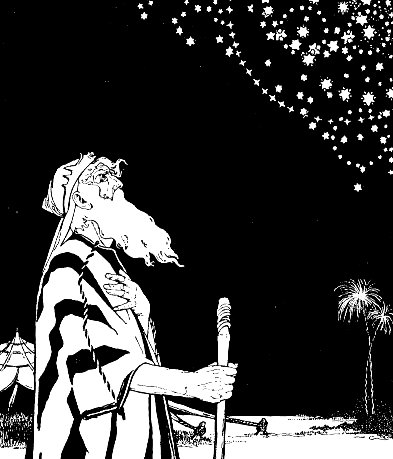
Then behold, the word of the Lord came to him, saying, “This man will not be your heir; but one who will come forth from your own body, he shall be your heir.” And He took him outside and said, “Now look toward the heavens, and count the stars, if you are able to count them.” And He said to him, “So shall your descendants be.” Then he believed in the Lord; and He reckoned it to him as righteousness.

Genesis 15:4-6 (NASB)

God made His promise to Abram (Abraham) in a vision after the encounter with the Priest-King of Salem, Melchizedek (see Genesis 14:17-20, though in actuality, God first directly interacted with Abram and promised to make him a great nation at the beginning of Genesis 12). The text seems to indicate that it was Abram’s faith that was the key factor in God making a covenant with him, but if we accept that as fact, then we have to admit that Abram had a part in his being chosen by God. If that’s so, following the inevitable logic, then God renewed His promises to Isaac, and then to Jacob, and then to the Children of Israel through Moses, all of which culminated at Sinai.

abraham1This choosing echoes down through history and will ripple even further and into the Messianic Age (all this is summarized in The Jesus Covenant: Building My Model). I can’t seem to find a way to pry the Jewish people or even one single, individual Jewish person out of the covenant promises that started with Abraham, continued into Sinai, and that were renewed for the future in Jeremiah 31 and Ezekiel 36.

Non-Jewish believers are attached as one of the conditions of the Abrahamic Covenant (but only one, not the whole thing), which, if we were to apply the same “logic” to us as we do to how the Israelites were “chosen” by God, seems to indicate that faith is also the “glue” connects us to God.

But how does God choosing Abraham filter down to God choosing Gentiles?

… and after he brought them out, he said, “Sirs, what must I do to be saved?” They said, “Believe in the Lord Jesus, and you will be saved, you and your household.” And they spoke the word of the Lord to him together with all who were in his house. And he took them that very hour of the night and washed their wounds, and immediately he was baptized, he and all his household. And he brought them into his house and set food before them, and rejoiced greatly, having believed in God with his whole household.

Acts 16:30-34 (NASB)

That seems pretty simple. But if the jailer and his household were “pre-chosen,” so to speak, why would he even ask that question? He’s been pre-selected. He has just come to the point where he has realized it. What if he wasn’t one of the chosen and he asked that question? Would Paul have said, “Sorry, pal. You aren’t one of the elect. You are out of luck”?

Probably not, but then I don’t think we have an example in the Bible of a person asking how to be saved who wasn’t going to be saved. Oh wait!

And someone came to Him and said, “Teacher, what good thing shall I do that I may obtain eternal life?” And He said to him, “Why are you asking Me about what is good? There is only One who is good; but if you wish to enter into life, keep the commandments.” Then he *said to Him, “Which ones?” And Jesus said, “You shall not commit murder; You shall not commit adultery; You shall not steal; You shall not bear false witness; Honor your father and mother; and You shall love your neighbor as yourself.” The young man *said to Him, “All these things I have kept; what am I still lacking?” Jesus said to him, “If you wish to be complete, go and sell your possessions and give to the poor, and you will have treasure in heaven; and come, follow Me.” But when the young man heard this statement, he went away grieving; for he was one who owned much property.

Matthew 19:16-22 (NASB)

But then again, the rich young ruler was Jewish and was already chosen by God because of Sinai. I’m not even sure how that’s supposed to work relative to the Jewish Messiah except that anyone who would come to the Father has to go through the Son. Did the young fellow lose salvation because his wealth meant more to him than obedience?

terror-keepers-of-the-faithQuestions remain. First of all, the idea of being chosen is rather “mushy.” Why was Israel chosen corporately but the rest of us must be chosen individually? Can any Israelite lose their chosenness? Evidence seems to say not, but my exploration of that area was hardly exhaustive. If a non-Jew is chosen can he or she lose that chosen status? Depending on which verses you read in the New Testament, the answer varies. What was the mechanism or process by which God chose Abraham and does that process apply to Gentiles since it is through Abraham that we are attached to the Messiah and thus to God?

Faith seems to play a part in both the choosing of Abraham and of the rest of us.

…and being fully assured that what God had promised, He was able also to perform. Therefore it was also credited to him as righteousness. Now not for his sake only was it written that it was credited to him, but for our sake also, to whom it will be credited, as those who believe in Him who raised Jesus our Lord from the dead, He who was delivered over because of our transgressions, and was raised because of our justification.

Romans 4:21-25 (NASB)

Ephesians 2:8 says that even faith is a gift from God, so we can’t say that our faith is what we bring to the table, so to speak. God gives us the faith we need in order to be chosen by Him. But then, I found a counter-argument to this point at faithalone.org:

From a cursory reading of this verse, it appears that the relative pronoun that (v 8b) has faith (v 8a) as its grammatical antecedent. However, in its Greek construction that is a demonstrative pronoun with adverbial force used in an explanatory phrase. This particular construction uses a fixed neuter singular pronoun (that) which refers neither to faith, which is feminine in Greek, nor to any immediate word which follows. (See Blass, Debrunner, Funk, 132, 2.) What all this means is that the little phrase and that (kai touto in Greek) explains that salvation is of God’s grace and not of human effort. Understood accordingly, Ephesians 2:8 could well be translated: “For by grace you have been saved through faith, that is to say, not of yourselves, it is the gift of God.”

Moreover, there is a parallelism between not of yourselves in v 8b and not of works in v 9. This parallelism serves as a commentary to v 8a (“For by grace you have been saved through faith”) which speaks of salvation in its entirety. It is difficult to see how faith, if it is the gift of God, harmonizes with not of works of v 9. We must conclude, then, that in Ephesians 2:8 salvation is the gift of God.

You can click the link I provided above to read the entire explanation, but if this analysis holds water, then I can say that faith is what we bring to the table. Salvation is the gift which we cannot earn through works so we cannot boast.

I know that nothing I’ve said here will convince a hard-core Calvinist that the whole “election” thing is wrong, but I think, once again, I’ve thrown enough monkey wrenches into the machine to keep Calvin and his supporters from thinking they’ve made a “slam dunk” with their arguments. Yes, the guest speaker at my church last Sunday provided a number of Bible verses that seem to support the “divine election” position, but there are just as many other parts of the Bible that support the idea that God, in His sovereignty, mercy, and love, has allowed human beings to participate in their own salvation by faith (or lack thereof, sadly).

schrodingers-cat-in-a-boxGod chose Abraham for a wonderful destiny, both as an individual and as the Father of the Hebrews. That promise passed down to Isaac, to Jacob, to Jacob’s twelve sons, to the twelve tribes, and ultimately to the Jewish people corporately. Non-Jews are grafted into a single condition, the promise of the Messiah, in the Abrahamic covenant, through faith, just as Abraham had faith, and that is our link to being chosen.

We’re chosen because of faith. Salvation is the resulting gift. I believe God loves human beings in a unique way, and out of that love, He chooses to allow us room in the universe to make independent decisions, much like a father will allow a child to make choices, even when the father knows some of those choices won’t be for the good.

There are times when love can kill. There are times when you love someone so much, you cannot allow him to breathe. He must do things the way you understand is best for him—because you cannot bear that one you love so much should be in any way distant from the truth as you know it.

“After all,” you imagine, “I must do for him what I would have done for myself!”

But true love makes room for the one you love.

-Rabbi Tzvi Freeman
“Love in Not Doing”
Based on letters and talks of the Rebbe, Rabbi M. M. Schneerson
Chabad.org

As for how God can write names in a book “before” Creation if both the book and God exist outside Creation and thus outside of time, you’ll have to see a certain cat in a box for the paradoxical answer.

I’m Not Who I Was

changing-courseDo not be dismayed by the hypocrisy of others, nor by your own inconsistencies. Our lives are all journeys through hills and valleys—no person’s spiritual standing is a static affair.

But the good each person achieves is eternal, as he connects to the Source of All Good, Who is infinite and everlasting. The failures, on the other hand, are transient and superficial, fleeting shadows of clouds, as stains in a garment to be washed away.

-Rabbi Tzvi Freeman
“Hypocrisy”
Based on letters and talks of the Rebbe, Rabbi M. M. Schneerson
Chabad.org

I’ve written over 900 blog posts for “morning meditations” and 214 for my previous blog (which stopped being active in 2011) called Searching for the Light on the Path. That’s over 1100 blog posts that record my progressive journey of faith, attempting to discover my position along the trail that leads to God.

In all that time and in all those blog posts, my opinions and beliefs have shifted a bit; perhaps more than just a bit in some areas. I’ve explored and opened myself up to some concepts and investigated and shut down others. Some people who were my friends or who were at least friendly to me have dropped me like a hot rock as I’ve developed my understanding of God, the Messiah, and the Bible in directions that oppose their belief systems. Other people have opened up to me and shared their highly valuable insights when seeing that I am not trying to impose my will on others, but seeking to discover God’s will for me and the world around me.

I suppose that last part sounds a bit narcissistic but then again, no one blogs except from their own perspective and as a means of presenting that perspective to anyone with Internet access.

I haven’t been directly accused of this, but I remember one blogger accusing another of hypocrisy based on the changing of the second blogger’s perspectives over time.

But aren’t we supposed to change? Aren’t we supposed to grow? What would happen if you learned basic arithmetic but never progressed beyond that point? What would have happened if no one anywhere across history ever developed algebra, calculus, or trigonometry? What would have happened if the best telescope we had in the world was still on the level of the one created by Galileo? What if our best medical technology for curing fevers and multiple other ailments was to apply leaches to human beings?

Are you a hypocrite if you learn something new and it changes how you see things and how you think?

As Rabbi Freeman said above, “Our lives are all journeys through hills and valleys—no person’s spiritual standing is a static affair.”

It’s interesting that a religious person should be the one to say that because, at least in Christianity, after achieving a certain level of knowledge, the expectation (this is just my opinion, of course) is that we should stay “static” with “the truth.” I’m not denying that there is Divine and eternal truth in our universe. Our universe was created by such truth. But that hardly means we know everything that there is to know about God or faith or that we even know enough. Is it enough to answer some altar call or to raise your hand in church as a profession of your faith in Jesus Christ? Is it enough to be saved?

It seems that a lot of Christian Bible studies and Sunday school classes aren’t really designed to teach people new ideas or to help people explore uncharted territory in theology, but to continue confirming what everyone already knows. Earlier today, I reviewed a television episode produced by First Fruits of Zion describing the meaning behind the name “Jesus.” However, the information presented, though very basic from my point of view, was designed to be new and even a tad bit “revolutionary” to the traditional conservative Christian audience targeted by these programs.

iam-not-a-numberIf someone who had been raised and educated spiritually in a “typical,” “ordinary” American church saw this or some other episode of FFOZ TV, they would very likely encounter what for them would be brand new information about topics they thought they knew completely.

I recently reviewed Scot McKnight’s book The King Jesus Gospel: The Original Good News Revisited. In the book, McKnight recounts a conversation he had with another Pastor about the meaning of the gospel. That Pastor too had stopped learning a long time ago and if he was studying at all, it was for the purpose of maintaining the pattern and level of knowledge he already possessed:

I replied, “A book about the meaning of gospel.”

“That’s easy,” he said, “justification by faith.” After hearing that quick-and-easy answer, I decided to push further, so I asked him Piper’s question: “Did Jesus preach the gospel?”

His answer made me gulp. “Nope,” he said, “Jesus couldn’t have. No one understood the gospel until Paul. No one could understand the gospel until after the cross and resurrection and Pentecost.” “Not even Jesus?” I asked.

“Nope. Not possible,” he affirmed. I wanted to add an old cheeky line I’ve often used: “Poor Jesus, born on the wrong side of the cross, didn’t get to preach the gospel.”

In my weekly conversations with my Pastor, I find myself challenged by a person who does study a great deal and who presents me with information I don’t possess which, in my case, is how traditional Christian theology, doctrine, and dogma works. For a Christian, I don’t know very much about how the formal “church” conceptualizes things. I often reference Jewish sources for my studies, both because I’m drawn to them and because they challenge my “Gentile” way of understanding God and faith. Both my Pastor and my studying help me grow, at least a little bit at a time.

We’re supposed to grow and we’re supposed to help other people grow. In the church (and in other Gentile-driven religious contexts based on the Bible), we have adopted a philosophy, not of growth, but of comfort. We want to be comfortable in what we think, feel, and believe. We don’t want to be challenged. Our day-to-day lives are challenging enough. We want to spend our Sunday services and Bible studies with people who think just like us, discussing things that we all understand in exactly the same way.

I know that sounds cynical, but it’s actually very human. All people who identify with a group that thinks, feels, and acts in a particular way relative to the larger environment want that. Christians want that, and religious Jews want that, and Hebrew Roots people want that, and progressives want that, and atheists want that, and everyone else wants that, too.

God is transcendent. He doesn’t fit in the little boxes we try to put Him in (if we are people who believe that God exists at all). Our hope, our goal, our journey should all be pointed in the direction of transcendence. We can never completely know the infinite God all in all, but we are tasked with approaching Him as closely as we can, knowing that it won’t be incredibly close.

Instead, we’ve reached an area of comfortable equilibrium and there we stay. It’s like two married people who behave more like roommates, including sleeping in separate bedrooms. It may be comfortable, but you’ll never experience passion that way.

The Rebbe would sit down with his students and say, time and time again:

The Baal Shem Tov taught that from every thing a person hears or sees in this world he must find a teaching in how Man should serve G‑d. In truth, this is the whole meaning of service of G‑d.

-Rabbi Tzvi Freeman
“All the World is My Teacher”
Based on letters and talks of the Rebbe, Rabbi M. M. Schneerson
Chabad.org

icarus-seeking-lightIn Greek mythology, the wings of Icarus melted when he flew too close to the Sun and he fell, but we will freeze into complete inaction and be totally ineffectual if we stay away from the flames of wisdom and knowledge. Challenge involves risk and risk feels dangerous. Sometimes we accept a challenge and the danger and then we (seemingly) fail and fall, ending up not getting what we want. Moses accepted the challenge of leading the Jewish people through a desert for forty years at the behest of God, and in the end, he was denied entry into Israel. He failed the challenge.

Or was it a failure?

Chassidic teaching explains that this is the deeper reason why Moses was not allowed to enter the Land of Israel. If Moses would have settled us in the Land, we could never have been exiled from it. If Moses would have built the Holy Temple, it could never had been destroyed. If Moses would have established the people of Israel in their homeland as a “light unto the nations,” that light could never have been dimmed.

If Moses would have crossed the Jordan, that would have been the end: the end of the struggle, the end of history.

G-d wasn’t ready for the end yet. So He decreed that Moses remain in the desert. But He did allow him to see the Land. And because Moses saw it, and because the effect of everything Moses did is everlasting, we, too, can see it.

At all times, and under all conditions, we have the power to ascend a summit within us and see the Promised Land. No matter how distant the end-goal of creation may seem, we have the power to see its reality, to know its truth with absolute clarity and absolute conviction.

We are still in the midst of the struggle. It is a difficult, oft-times painful struggle; but it is not a blind struggle. Moses has seen to that.

-Rabbi Yanki Tauber
“Land and See”
Based on letters and talks of the Rebbe, Rabbi M. M. Schneerson
Chabad.org

building-the-templeAll that isn’t in the Bible, but let’s go with it for now. If Moses had entered the Land, would the Messiah have come? What would have happened to the people of the nations of the world? Would we all have been drawn to the light of Israel in the days of Moses? What would that have meant? Becoming gerim, “resident aliens” and then having our descendants being assimilated and absorbed into tribal Israel? That would mean anyone outside of the original Israelites and their descendants would have had to ultimately become part of tribal Israel to become Holy unto God. But what about the rest of us?

God wasn’t ready for the end, perhaps not because of what it would have meant for Israel but because of what it would have meant for the majority of the world. All those things midrash says Moses would have done will actually be performed by Messiah, Son of David. But Israel had to suffer because Moses didn’t enter the Land and instead died in the desert. That’s a horrible realization; not comfortable at all.

We won’t come to learn the reality of our existence in a world created by God if we allow ourselves to remain in a comfortable place. Moses died, and Joshua was challenged with conquering a nation. David founded Jerusalem but the task of building the Temple was left to Solomon. Israel fell into exile on multiple occasions, her Temple destroyed, her Land lost for centuries. The Messiah came and died. Then he rose. Then he ascended. And then he didn’t come back. Human history has been spinning out of control ever since, or so it appears.

What can we do? We can stop being comfortable. “Comfortable” is not the condition of our current world. We need to read, to study, to challenge ourselves, to change as we encounter each new spark of the Divine that has been left here for us by the Source of that fire. We’re meant to grow, to develop, and to act. How else can we prepare the way for the return of the King?