Tag Archives: God

Incinerating

onfire.jpgWhen dross is removed from silver, the vessel can emerge for the refiner; when an evildoer is removed from the king, his throne is established in righteousness. Do not glorify yourself in the presence of the king, and do not stand in the place of the great, for it is better that it should be said to you, “Come up here,” than that you be demoted before the prince, as your eyes have seen [happen to others].

Proverbs 25:4-7 (Stone Edition Tanakh)

If a man invites you to his wedding celebration, do not recline at the head or else someone else more honored than you may also be invited there. The host will come to you and him and tell you, “Clear a place for him.” Then you will get up ashamedly to sit at the place at the end. But if you are invited, sit in the place at the end so that the host will come and say to you, “My friend, move up higher than this!” It will bring you honor before those reclining with you. Everyone who lifts himself up will be brought low, but everyone who lowers himself will be lifted up.

Luke 14:7-11 (DHE Gospels)

No, this isn’t another rant about people in the religious world putting on airs and telling the rest of us what is or isn’t right about Christianity and the Bible and such. It’s about something far more serious than that. It’s about ultimate consequences.

“And to the angel of the church in Thyatira write: ‘The words of the Son of God, who has eyes like a flame of fire, and whose feet are like burnished bronze.

“‘I know your works, your love and faith and service and patient endurance, and that your latter works exceed the first. But I have this against you, that you tolerate that woman Jezebel, who calls herself a prophetess and is teaching and seducing my servants to practice sexual immorality and to eat food sacrificed to idols. I gave her time to repent, but she refuses to repent of her sexual immorality. Behold, I will throw her onto a sickbed, and those who commit adultery with her I will throw into great tribulation, unless they repent of her works, and I will strike her children dead. And all the churches will know that I am he who searches mind and heart, and I will give to each of you according to your works. But to the rest of you in Thyatira, who do not hold this teaching, who have not learned what some call the deep things of Satan, to you I say, I do not lay on you any other burden. Only hold fast what you have until I come. The one who conquers and who keeps my works until the end, to him I will give authority over the nations, and he will rule them with a rod of iron, as when earthen pots are broken in pieces, even as I myself have received authority from my Father. And I will give him the morning star. He who has an ear, let him hear what the Spirit says to the churches.’”

Revelation 2:18-29 (ESV)

Please don’t take that quote as if I’m aiming it at you personally. I’m not. I’m just trying to communicate something that I don’t think we always understand. No matter how much we think we’re doing to build up the Kingdom of God, to help other human beings, to study the Bible and learn God’s ways for our lives; no matter how much we believe our acts of righteousness and the faith and zealousness that burns in our hearts means to God, perhaps all that we believe we’ve accomplished doesn’t matter as much as we think. Maybe the Christ, the Jewish Messiah King, who came once and who will return again in glory and in awesome, majestic power, has something against us, just had he had against the church at Thyatira (or the churches of Ephesus, Pergamum, Sardis, Laodicea, and so on).

In my conversation with Pastor Randy last week, we were talking about righteousness (no small subject, that), particularly what we human believers think righteousness is compared to the standards of the Master. Human beings, even the best of us, have a tendency to be a little self-deluding. We like to think things around us and things about ourselves are a little better than they really are. I think that helps us not dwell on futility so much, and keeps us from being depressed, not that we have reason to be if we are disciples of Christ. Nevertheless, most of us go around most of the time thinking we’re a lot “cooler” and more in tune with God than we probably really are.

Pastor Randy and I were discussing what an actual encounter with Jesus would be like. A lot of Christians imagine meeting Jesus to be a very peaceful and comfortable event, like visiting your favorite uncle when you were a child, and you could just hop up on his lap so he could read to you from your favorite story book. Most of us don’t envision such a meeting going like the one John writes of here:

I was in the Spirit on the Lord’s day, and I heard behind me a loud voice like a trumpet saying, “Write what you see in a book and send it to the seven churches, to Ephesus and to Smyrna and to Pergamum and to Thyatira and to Sardis and to Philadelphia and to Laodicea.”

Then I turned to see the voice that was speaking to me, and on turning I saw seven golden lampstands, and in the midst of the lampstands one like a son of man, clothed with a long robe and with a golden sash around his chest. The hairs of his head were white, like white wool, like snow. His eyes were like a flame of fire, his feet were like burnished bronze, refined in a furnace, and his voice was like the roar of many waters. In his right hand he held seven stars, from his mouth came a sharp two-edged sword, and his face was like the sun shining in full strength.

When I saw him, I fell at his feet as though dead.

Revelation 1:10-17 (ESV)

Under heavenNo one wants to visit a “favorite uncle” if he’s so awesome and terrifying that a mere glimpse of him makes us fall down and think we’re going to be incinerated in the next half-second. On the other hand, that seems to be exactly how John experienced his encounter with the risen and living Christ, even though decades before, John had walked in the presence of Jesus and knew no fear. It is no small thing to face the King of Kings and the Lord of Lords and to realize what it is to stare into the eyes of true righteousness. Maybe we have something to be afraid of after all.

“Then he will say to those on his left, ‘Depart from me, you cursed, into the eternal fire prepared for the devil and his angels. For I was hungry and you gave me no food, I was thirsty and you gave me no drink, I was a stranger and you did not welcome me, naked and you did not clothe me, sick and in prison and you did not visit me.’ Then they also will answer, saying, ‘Lord, when did we see you hungry or thirsty or a stranger or naked or sick or in prison, and did not minister to you?’ Then he will answer them, saying, ‘Truly, I say to you, as you did not do it to one of the least of these, you did not do it to me.’ And these will go away into eternal punishment…

Matthew 25:41-46 (ESV)

I’m not saying that a life of faith is futile and that we have to second guess God and wonder at our relationship with Him…not if we’re willing to be really honest with ourselves. I’m saying that no matter what we’ve done and how well we think we’ve served God, we probably aren’t the really big deal we think we are (if that’s what we’re thinking). Imagine meeting the Master is like precious metal being refined. Imagine he can see through all the dross with a gaze that emits a raging fire and burns it all away, revealing the tiny bits and minute portions of what is truly of value hidden deep inside of us.

We have all become like one who is unclean, and all our righteous deeds are like a polluted garment. We all fade like a leaf, and our iniquities, like the wind, take us away.

Isaiah 64:6 (ESV)

…as it is written: “None is righteous, no, not one; no one understands; no one seeks for God. All have turned aside; together they have become worthless; no one does good, not even one.”

Romans 3:10-12 (ESV)

And with all that we think is worthy but is actually worthless is burned away under the Master’s flaming gaze, what will be left of us? We can only hope and pray that he will find some small gem of faith within us that will save us from wrath and destruction.

I’m not trying to depress you, but I am introducing a particularly serious and frightening note to our conversation. Especially in the religious blogosphere and in the Christian discussion boards, we have a tendency to argue points of this and that as if such debates were the most important thing we could be doing for Christ with our entire lives. We appear to believe that Jesus will read our blogs and say something like, “Well written, good and faithful servant,” and then sprinkle a couple of dozen gold crowns upon our noble heads.

Are we really that delusional?

Make every effort to live in peace with everyone and to be holy; without holiness no one will see the Lord. See to it that no one falls short of the grace of God and that no bitter root grows up to cause trouble and defile many. See that no one is sexually immoral, or is godless like Esau, who for a single meal sold his inheritance rights as the oldest son. Afterward, as you know, when he wanted to inherit this blessing, he was rejected. Even though he sought the blessing with tears, he could not change what he had done.

Hebrews 12:14-17 (ESV)

A life of holiness is no small thing. On the one hand, the requirements of a holy life couldn’t be more simple, but on the other hand, living them out is the most difficult thing we can ever attempt. To do so, we must “deny ourselves, pick up our crosses, and follow our Master.” (Matthew 16:24)

No one lives a life of holiness alone. Yes, God sent the Holy Spirit to strengthen, to enable, and to encourage us, but he also sent other believers and a community of fellowship within which we are to learn and to be supported.

You shall know this day and consider it within your heart.

Deuteronomy 4:39

Business people who are involved in many transactions employ accountants to analyze their operations and to determine whether or not they are profitable. They may also seek the help of experts to determine which products are making money and which are losing. Such studies allow them to maximize their profits and minimize their losses. Without such data, they might be doing a great deal of business, but discover at the end of the year that their expenditures exceeded their earnings.

Sensible people give at least as much thought to the quality and achievement of their lives as they do to their businesses. Each asks himself, “Where am I going with my life? What am I doing that is of value? In what ways am I gaining and improving? And which practices should I increase, and which should I eliminate?”

Few people make such reckonings. Many of those that do, do so on their own, without consulting an expert’s opinion. These same people would not think of being their own business analysts and accountants, and they readily pay large sums of money to engage highly qualified experts in these fields.

Jewish ethical works urge us to regularly undergo cheshbon hanefesh, a personal accounting. We would be foolish to approach this accounting of our very lives with any less seriousness than we do our business affairs. We should seek out the “spiritual C.P.A.s,” those who have expertise in spiritual guidance, to help us in our analyses.

Today I shall…

…look for competent guidance in doing a personal moral inventory and in planning my future.

-Rabbi Abraham J. Twerski
“Growing Each Day, Adar 3”
Aish.com

icarus-seeking-lightSome people have criticized my return to church as a kind of “falling away” from what they consider a “better truth” back into what they believe is a corrupt and apostate Christianity. Others applaud my attending church, not for the virtues possessed by a Christian walk, but because they believe I can’t “handle the truth” about God, the Torah, and the particular vision they hold dear to themselves.

I guess you can’t please everyone, but then again, I’m not trying to.

On the other hand, I see in my conversations with Pastor Randy and in what he teaches from the pulpit as what you have just read in Rabbi Twerski’s commentary. While our discussions aren’t specifically about me and my personal future, any interaction involving God, the Bible, and faith can’t fail to have an impact are every individual participating. Whenever two or three of us gather together, Jesus is there with us (Matthew 18:20).

There’s a corresponding message in the Mishnah:

But three who ate at one table and said upon it words of Torah are considered to have eaten from the table of the Omnipresent, as it is written: “And he said to me ‘This is the table which is in the presence of G-d’.”

-quoted from Torah.org

If we are to be consumed, let it be by the Word of God and by the company of people who speak of righteousness, not for their own sakes but for God’s…lest we be consumed by another fire, endure the searing pain of having our “dross” burned away like a bundle of straw in a blast furnace, and be humbled or even humiliated before God and before all other people.

If we have no peace, it is because we have forgotten that we belong to each other. Not all of us can do great things but we can do small things with great love. Every time you smile at someone, it is an action of love, a gift to that person, a beautiful thing.

-Mother Teresa


Terumah: Why Do You Do Good?

menorah“Take for Me an offering from everyone whose heart impels him to give.”

Exodus 25:2

Rashi, the great commentator, tells us that “Take for Me” means that all donations for the Tabernacle should be given for the sake of the Almighty. The question: What difference does it make what a person’s intentions are as long as he does a good deed?

Rabbi Yehuda Leib Chasman clarifies the role of intentions with an illustration. Suppose there is a man who wants to ensure that every child in the community has wholesome milk for breakfast. Rain or shine he delivers milk every morning. What would you say about that man? Likely you would count him amongst the great tzadikim, righteous people, a person of great kindness.

However, what would be your opinion of the man if you knew he delivered the milk only because he was getting paid? No longer is he a great tzadik, now he is just a plain milkman.

Similarly, in everything we do. If we keep in mind that we are fulfilling the Almighty’s command to do kindness, even the mundane interactions at work can be elevated to a higher spiritual level. The bus driver is no longer just driving the bus, he is helping people get to work or to shop for their families. The deed may be a good deed with or without one’s intention, but our growth in character and spirituality depend on our intentions!

-Rabbi Kalman Packouz
“Shabbat Shalom Weekly”
Commentary on Torah Portion Terumah
Aish.com

I suppose you could link this back to commentary on last week’s last week’s Torah portion. In the Aish.com commentary for that week, we looked at the story of a young Jewish woman who was seeking spirituality and felt actually insulted that her Jewish teachers suggested she could find it in “the (Torah) laws regarding returning a lost item.” She abandoned her pursuit of spirituality within the context of Torah and Judaism and proceeded to India. But she found that the behavior of her guru in response to his finding a lost wallet containing a large sum of money showed her that spirituality, responsibility, justice, and mercy must all go together.

In this week’s commentary, we see that even doing what is good may not be enough if the motivation of the person performing the action is less than stellar.

But let’s take two people performing an identical mitzvah. Say both of our hypothetical people are donating food to a local food bank. They both give abundantly in money and goods and many people are fed through their efforts. The first man is primarily motivated by the desire to do good to the people of his community and to serve God. The second man is primarily motivated by the tax break he’ll receive and the recognition he’ll get from his friends and family as a “good guy.”

Which one would you say is the more “spiritual” man? Obviously the first one. But regardless of motivation, people are still fed. Even the man whose motivation is only for his self-interest is doing better to serve others than the person who has “nice, warm, fuzzy” spiritual feelings toward his neighbor but donates not even a single hour, dollar, or can of chicken soup to the food bank (or any other mitzvah).

So speak and so act as those who are to be judged under the law of liberty. For judgment is without mercy to one who has shown no mercy. Mercy triumphs over judgment.

What good is it, my brothers, if someone says he has faith but does not have works? Can that faith save him? If a brother or sister is poorly clothed and lacking in daily food, and one of you says to them, “Go in peace, be warmed and filled,” without giving them the things needed for the body, what good is that? So also faith by itself, if it does not have works, is dead.

But someone will say, “You have faith and I have works.” Show me your faith apart from your works, and I will show you my faith by my works. You believe that God is one; you do well. Even the demons believe—and shudder! Do you want to be shown, you foolish person, that faith apart from works is useless? Was not Abraham our father justified by works when he offered up his son Isaac on the altar? You see that faith was active along with his works, and faith was completed by his works; and the Scripture was fulfilled that says, “Abraham believed God, and it was counted to him as righteousness”—and he was called a friend of God. You see that a person is justified by works and not by faith alone. And in the same way was not also Rahab the prostitute justified by works when she received the messengers and sent them out by another way? For as the body apart from the spirit is dead, so also faith apart from works is dead.

James 2:12-26 (ESV)

charity-tzedakahJesus said that you shall know a tree by its fruit (Matthew 7:20) and every tree that does not bear good fruits will be cut down and thrown in a fire (v19). James, the brother of the Master, connects faith with actions, the latter arising from the former. Jesus tells us that our very nature is revealed by our behavior. In this week’s Torah reading, God commands Moses to “accept gifts for Me from every person whose heart so moves him,” (Exodus 25:2) connecting the nature and amount of the gift with the nature of the giver. Rabbi Packouz says that regardless of motivation, an act that helps others is still of value to those being helped, “but our growth in character and spirituality depend on our intentions!”

If all we want is a tax break and to look good to others, we can perform acts of charity and help many people…as long as we are unconcerned about our relationship with God and growing within that relationship spiritually. On the other hand, if we are trying to take our relationship with God seriously, it’s not just what we do but why we do it that matters. Human beings can only see our behavior but God sees the heart.

This should be a no-brainer, but I find that in the community of faith, we are just as vulnerable to bad motivations, bad attitudes, the desire for self-righteousness rather than God’s righteousness, and the need to “be right,” as anyone operating in the secular world. Just look at the various religious blogs and discussion boards on the web and you’ll see what I mean.

Even a casual reading of the New Testament should tell any Christian who is having trouble with this concept of what to do and why to do it. It really isn’t hard to pick a mitzvah representing “the weightier matters of the Torah,” such as donating a couple of cans of soup of chili to the food bank, shoveling snow off your neighbor’s driveway and sidewalk, or holding the door open for someone who is entering the same place right behind you because it’s what Jesus has commanded us to do.

If you find yourself paying more attention to a belief that certain “ceremonial” mitzvot are your “right” while neglecting matters of “justice and mercy and faithfulness,” (Matthew 23:23), or worse, performing no acts of charity and kindness at all thinking your “faith” is all the covering you’ll need, then you might earn the same ire from the Master as did the scribes and Pharisees Jesus was originally addressing.

There is much in the Torah of Moses for everyone and it acts as the rock upon which the Prophets, the Writings, and the Apostolic Scriptures firmly rest. However, as we see, application isn’t meaningful in a spiritual sense unless we are actually using what we know to do good to others and for the right reasons.

The words of Torah should be as fresh to you as if you first heard them today.

-Rashi, Deuteronomy 11:13

Excitement often comes from novelty, but novelty is exciting only as long as it is new. Someone who buys a car fully loaded with options may feel an emotional high, but after several weeks, the novelty wears off and it is just another vehicle.

Spirituality, too, suffers from routine. Human beings may do all that is required of them as moral people and observe all the Torah’s demands in terms of the performance of commandments, yet their lives may be insipid and unexciting because their actions have become rote, simply a matter of habit. The prophet Isaiah criticizes this when he says, “Their reverence of Me has become a matter of routine” (Isaiah 29:13). Reverence must be an emotional experience. A reverence that is routine and devoid of emotion is really no reverence at all.

Path of TorahThus, the excitement that is essential for true observance of Torah depends upon novelty, upon having both an understanding of Torah today that we did not have yesterday and a perception of our relationship to God that is deeper than the one we had yesterday. Only through constantly learning and increasing our knowledge and awareness of Torah and Godliness can we achieve this excitement. Life is growth. Since stagnation is the antithesis of growth, it is also the antithesis of life. We can exist without growth, but such an existence lacks true life.

Today I shall…

…try to discover new things in the Torah and in my relationship to God.

-Rabbi Abraham J. Twerski
“Growing Each Day, Adar 4”
Aish.com

“And in the end, the love you take is equal to the love you make.”

-Lennon/McCartney
The End (from the Abbey Road album)

Good Shabbos.

Beckoning the God of Peace

in-the-face-of-the-stormPrepare yourself with this meditation, and when you feel anger overcoming you, run through it in your mind:

Know that all that befalls you comes from a single Source, that there is nothing outside of that Oneness to be blamed for any event in the universe.

And although this person who insulted you, or hurt you, or damaged your property, is granted free choice and is held culpable for his decision to do wrong — that is his problem. That it had to happen to you — that is between you and the One Above.

-Rabbi Tzvi Freeman
“Advice on Anger”
Based on letters and talks of the Rebbe
Rabbi M. M. Schneerson
Chabad.org

I’ve spent the past several days monitoring some disturbing and less than “Godly” attitudes on the Internet (No Judah, your not one of them). I suppose it’s obvious that hostile and critical people and organizations should express themselves in an environment as open as the World Wide Web, but it’s always disappointing when the sources of such poor behavior are those who claim the cause of Christ (though they may not call him by that title). I won’t give honor to either of the two specific sites/blogs to which I’m referring by linking to them on my blog, but suffice it to say that they both (apparently) desire to denigrate Jews and Judaism in general, and specific individuals in the Messianic Jewish movement in particular.

There’s more than a little irony happening here. First off, both of the sources I am speaking of advertise themselves as being educated and scholarly, in addition to being holy and honorable. And yet, how can what they say about themselves be true when the results of their “scholarship” and “reviews” are a widespread (relative to the scope of the Internet but perhaps not their readership) reiteration of classic hatred of Jews, a further expression Christian supersessionism, and a great outpouring of comments about individuals bordering on character assassination?

After Shabbat had ended on Saturday night, in a fit of pique, I wrote this on Facebook:

There’s so much injustice masquerading as scholarship and that reduces the history of Jewish people to a subject that’s examined under a microscope. How far do I go to challenge people who think they are defending the cause of Christ but who actually are walking in the footsteps of everyone who has authored a pogrom and constructed a holocaust?

I found myself sorely tempted to respond to the sources of my frustration via email, blog comments, and twitter, basically to (proverbially) give them a piece of my mind. Fortunately, I stopped myself. It’s hardly taking the moral high road when another can provoke you to descend to their level. On the other hand, is this blog post any better?

In all my days I have never had to look behind me before saying anything.

-Shabbos 118b

Lashon hara (gossip or slander) is not necessarily untruthful. The Torah forbids saying something derogatory about a person even if it is completely true.

One of the best guidelines to decide what you should or should not say is to ask: “Does it make a difference who might overhear it?” If it is something that you would rather someone not overhear, it is best left unsaid.

Sometimes the information need not be derogatory. A secret may not be saying anything bad about anyone, but if someone has entrusted you with confidential information, and you have this tremendous urge to share the privileged communication with someone else, you should ask yourself: “Would I reveal this if the person who trusted me with this information were present?”

Sometimes people want to boast. They may even fabricate their story to those who have no way of knowing that it may not be true. Still, they would be ashamed to boast in the presence of someone who knew that their statement was false.

Volumes have been written about what is proper speech and about what constitutes an abuse of this unique capacity to verbalize with which man was endowed. But even if one does not have time to master all of the scholarly works on the subject, a reliable rule of thumb is to ask, “Do I need to look behind me before I say it?” If the answer is yes, do not say it.

Today I shall…

…monitor my speech carefully, and not say anything that I would not wish someone to overhear.

-Rabbi Abraham J. Twerski
“Growing Each Day, Shevat 30”
Aish.com

Let’s look at the first two sentences of Rabbi Twerski’s commentary on “lashon hara” again:

Lashon hara (gossip or slander) is not necessarily untruthful. The Torah forbids saying something derogatory about a person even if it is completely true.

That’s very difficult for most of us to do, especially when we have free access to the Internet and the ability to create and edit websites and blogs we have created or to make comments on the blogs and discussion boards of others. The web is full of harsh criticisms aimed at others and yes, some of those criticisms are true. And yet, and this is especially focused at those folks who claim to observe the Torah of Moses whoever they may be…to publish comments regarding specific individuals for the express purpose of destroying their reputation or causing them personal and emotional harm, cannot be construed in any manner as actually serving God.

peace-of-mind1I’m not unmindful that such individuals are responding in anger, and that they even feel justified due to the belief that they are fighting against what they see as some sort of “injustice” they think was perpetrated against them or their own cause or tradition, but is such a response really the right thing to do? I know that I’m struggling with my own anger at such behavior, but in doing so and in writing this blog post, I’m walking the edge of the very abyss I believe they have already fallen into.

But what is Rabbi Freeman’s advice on anger? If anyone has insulted you or done you wrong, it is a problem that they possess. It’s only the problem of the person insulted (in this case, me) if they (I) allow the insult to affect them (me). Thus, the individuals who are behaving rather poorly on the web are only a problem to me if I let them affect me. That I’m even writing this “meditation” means I must confess that I have allowed this to happen. In that case, my conversation must not engage those who have behaved in an insulting matter, but to the degree that they have entered my life with their discordant behavior, I must take the matter to God. How I feel and how I must respond is between Him and me alone.

To apply Rabbi Twerski’s commentary on what I’ve been saying, in addition, I must monitor my own “speech,” which includes anything I post online. I’m glad I didn’t give in to temptation last Saturday, otherwise I would have failed in that area as well.

(Unfortunately, I did give in to temptation on Google+ Monday morning and I am now living with that regret. The resulting comments on my recent Return to Jerusalem blog post were actually stimulating, but the “comments storm” that occurred on my Why I Go to Church missive were troubling and disappointing for the most part..though thankfully only from a single individual.)

Where do I go from here?

We cannot think two thoughts at the same time. Consequently, when negative thoughts arise, you do not need to fight them. Make an effort to think positive thoughts, and the negative thoughts will disappear.

(see Rabbi Nachman of Breslov; Likutai Aitzos: machshovos, no.11)

-Rabbi Zelig Pliskin
Daily Lift #727
“Fill Your Mind with Positive Thoughts”
Aish.com

There is a much older “midrash” on this topic in which I can also take comfort.

Finally, brothers, whatever is true, whatever is honorable, whatever is just, whatever is pure, whatever is lovely, whatever is commendable, if there is any excellence, if there is anything worthy of praise, think about these things. What you have learned and received and heard and seen in me — practice these things, and the God of peace will be with you.

Philippians 4:8-9 (ESV)

Not only think of what is honorable, just, pure, lovely, and commendable, but practice these things, and the God of peace will be with you.

candleIt is not unexpected that we in the body of faith at one time or another, will turn to God in our anguish and ask Him to quiet our minds and our lives, to shield us from the turmoil that comes from the world and from inside of ourselves. And yet, if we want the “God of peace” to reside with us, Paul says that we must choose to focus our thoughts on peace and then to practice peace.

As Rabbi Twerski might say:

Today I shall…

…strive to practice peace by embracing peace within my thoughts, so that the God of peace will be with me and guide me in His ways, and so that no other person may suffer for anything I say or do.

“The only man I know who behaves sensibly is my tailor; he takes my measurements anew each time he sees me. … The rest go on with their old measurements and expect me to fit them.”

-George Bernard Shaw, Irish playwright

Why I Go To Church

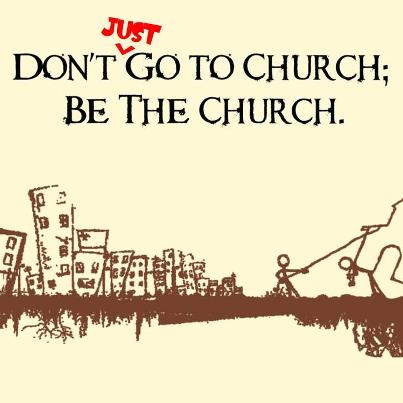
afraid-of-churchI’m actually enjoying going to church. When I came to that realization last Sunday, no one was more surprised than I was.

Wait! Let me explain.

Starting last October, I created a “Days” series that was a countdown to the end of the year. I was planning to make a decision, both about whether or not to go back to church and whether or not to continue to blog in the “Christian” or “Messianic” or “religious” space, given the endless contention occurring in the blogosphere. I started at 78 days and worked my way down to zero. It should be obvious that I continued blogging after January 1st, and I not only continued to go to church regularly, but frequently meet with the Head Pastor.

Eleven months to the day before I published “Day Zero,” I wrote and published an article called Why I Don’t Go To Church. This was in response to both my internal angst (my favorite theme) and to Pastor Jacob Fronczak’s blog post Why I Go To Church. Even back then, I had returning to church in mind, but was undergoing what I’d consider classic approach-avoidance conflict (I was a psychotherapist and family counselor back in the day).

I’ve overcome my “fear of flying,” so to speak, but I was afraid that once I started attending church, I’d find not “niche” of my own and end up being bored. While it’s true, I don’t go to my particular church for the music, I am experiencing many other benefits and even on some small level, beginning to give back just a tad. What added momentum to my journey happened just five days before my countdown was to end. I was reminded that seeking fellowship with God’s people is seeking an encounter with God.

And in church, I have encountered Him.

Today, I did something I shouldn’t have done. There’s a “community” within Google+ called “Messianic Judaism” (for all I know, there could be more than one, but this is the one I belong to). Access is by invitation only, so posting a link to it wouldn’t let you see inside, but someone in the community posted a link to a book review and asked for opinions. Unfortunately, it struck a nerve, and even though I had already determined I wouldn’t address the review and what I believe it represents, I shot off my big mouth (figuratively speaking) and now I’m regretting it.

But the transaction had an interesting side effect. It (or rather someone) challenged my going back to church and further, criticized the church in a manner that resulted in my feeling defensive. Me? Really?

I’ve maintained a relationship with blogger Judah Himango for the past few years, and that relationship has, on occasion, been quite stormy. We still talk online periodically, and today was one of those “talks.” But what he said got under my skin. Here’s part of what he posted to me.

My concerns with Tent of David are that it purports to “heal the vision of the Messianic gentile” by sending them back to the church, which will inevitably lead to assimilation.

I asked, “assimilation into what?” and he responded:

Assimilation into the doctrines of the Church. Sabbath is done away with, the Church has replaced Israel, any non-moral mitzvah is no longer applicable to anyone.

Unfortunately (mea culpa) I missed a part of what Judah had said before I rapidly posted my reply (I think I need to switch to decaf):

There are indeed folks called to the church. But for many others, we’re called to Hebraic Roots congregations or Messianic congregations.

I certainly don’t advocate compelling people to “go to church” if they feel called elsewhere, but on the other hand, I do object to the church being seen as “inferior” or “anti-Biblical” compared to non-Jewish Christians who feel called to worship within a more “Jewish” framework. I’ve been one of those people before and for reasons too lengthy to relate here, I needed to seek my community of faith elsewhere.

Why do I go to church?

First of all, thanks to Boaz Michael and (my advanced reading of) his book Tent of David (TOD) and other influences, not the least of which is my Mom, I summoned the courage to overcome my own personal prejudices and start attending church again.

communityI was welcomed by lots and lots of people, but you’d kind of expect that in an authentic Christian setting. But what happened next, was unanticipated…I started making connections. I’ve had several interesting and compelling conversations with the Head Pastor and just last Sunday, I spent an hour talking to one of the Associate Pastors (when I should have been in Sunday School) in the church library. Not only that, but a number of people actually seem authentically glad to see me, not just because I’m a warm body showing up a church, but because of me as the person I am (or at least as they perceive me to be). In fact, I’m stunned that some of these connections have occurred so quickly and that I’m now even feeling a sense of belonging.

People have offered to pray for me. I’ve seen genuine caring and concern for the hungry, the sick, and the dying. They offer tangible, material support for the needy and for missionaries in many countries. There is a genuine heart for Israel and a desire for her posterity. It’s not just the occasional person, but to the best of my ability to tell, the human community within the church’s walls does look to Christ as Messiah and Israel’s King for salvation and sustenance.

In my talks with Pastor Randy (and they’re really quite candid), we don’t always see eye to eye, but you can’t believe what an incredible pleasure it is, even to disagree with someone and still have the encounter be illuminating, positive, refreshing, and friendly. Try doing that on the Internet!

I don’t know where all this is going to lead me, but for the first time in a long time, I not only have hope that I will find a place in the church and among the community of believers, but that the church itself is turning in a direction that will indeed be part of the healing between the Jewish and non-Jewish disciples of the Master.

I feel that I’ve failed in my comments on Google+ today and allowed my emotions to overcome my common sense. I could delete my comments, but they’ve already been read and responded to, so I might as well leave them up. In any event, God knows what I’ve said and done, so removing my annoyed comments won’t repair my relationship with Him.

But the realization, thanks to Judah’s statements (though he probably didn’t intend them the way I’ve taken them), that there really is hope for Christianity and a way forward in being part of “rebuilding David’s fallen tabernacle” is encouraging. It’s even better now that I realize it’s possible for me to have a small part in that “project” within the community of Christianity.

I don’t particularly mind if people don’t agree with my going back to church, and I understand that whenever you write and publish a book (such as Boaz Michael has), especially in such an emotionally explosive realm as religion, people are going to write critical book reviews. The only thing I mind about some of the criticism being leveled against Tent of David (and yes, I’ve read the reviews), is that it simply misses the overall vision Boaz is trying to communicate. I can appreciate people who have an eye for detail, and who may feel certain specific terms or other content wasn’t used with as much accuracy as they could have been, but look at the big picture.

In between the Gentile Christians going to church and those who have found a home in either a Hebrew Roots or Messianic Jewish congregation are just tons and tons and tons of people with little or no fellowship at all. Maybe they attend small home Bible studies or maybe they just worship with their families. Some, like me, may even seek fellowship over the Internet (which is problematic at best). But remember, seeking fellowship is seeking an encounter with God, and in my experience, many people who think of themselves as “Messianic Gentiles” are disconnected and isolated from other believers and, Heaven forbid, from the God who loves their souls.

symmes_chapel_churchThrough bad teaching, bad leadership, or bad experiences, they’ve become convinced that “the Church” (whatever you imagine the term to mean) is bad, evil, awful, pagan, lost, apostate, anti-Law, and so on…I mean all Christian churches everywhere. And, for whatever reasons, they haven’t found an alternative or the alternative that they’ve found may be a group that defines itself solely on being “anti-Christian,” as opposed to a community dedicated to discipleship under Jesus Christ and a sincere desire to meet with God.

If even some of those people can find in Tent of David what I have, then maybe they don’t have to be alone, either. I don’t think you have to agree with each and every thing Boaz set forth in TOD, but you can embrace the vision and let it take you where God wants you to go.

I am beginning to “fit in” with this church. I probably wouldn’t fit in at most other churches in my area. The fact that a set of unlikely occurences led me to this church as the first stop in my search for community I believe indicates the hand of God at work in my life.

You don’t have to like the fact that I go to church. You don’t have to go to church if you don’t want to. Really, no one is holding a gun to your head. However, I’d like you to consider two things. The first is that there might be a reason God wants me to go to church. The second is that God might have a plan for you that you don’t agree with Him about. That was me once upon a time. Could it be you, too?

That’s not all about why I go to church…but it’s a start.

A Transformational Life

collapsingSo anyone who hears these words of mine and does them, I will compare to a wise man who built his house on a rock. The rain fell, the streams flooded, the winds blew, and they touched that house, but it did not fall, because it was founded upon the rock. But whoever hears these words of mine but does not do them, I will compare to a foolish man who built his house upon sand. The rain fell, the streams flooded, the winds blew, and they encountered that house. It fell, and its collapse was great.

Matthew 7:24-27 (DHE Gospels)

I was reading the various portions of the Bible related to Torah Portion Yitro on Shabbos and the recommended reading (from First Fruits of Zion/FFOZ) for the Gospels was Matthew 7:1 – 8:1. I’m not going to copy and paste or manually type the text for such a large portion of scripture into this “meditation” (you can click the link I provided and read it yourself), but I must say that as I finished reading it, I realized that this section of Matthew could actually be expressing a single thought. If you haven’t done so already, please read that particular part of scripture now and then continue reading here. It’s OK. I’ll wait.

Finished? Good.

Do you see what I mean? Look at what the Master is teaching.

Jesus starts off by telling his disciples and anyone else who was listening how to do tzedakah or charity, mainly in secret rather than making a big show of it for others to see. He delivers the same message about praying and gives us a simple model of a prayer. Again, he says the same thing about how to fast and reminds us of where our true wealth lies. Speaking of treasure, he defines the relationship between a believer and money and also how we need to trust God for our needs. Interestingly enough, in the DHE translation, Matthew 6:33 goes like this:

But seek first the kingdom of God and his tzedakah, and all these things will be added to you.

Tzedakah isn’t just giving to charity. The underlying sense of this Hebrew word communicates performing acts of justice and righteousness…in other words, doing good for other, which is much more than just donating money or goods.

He instructs his audience not to judge and connects how we judge others with how we’ll be judged by God (and that should be a frightening thought to many of you…it is to me). He talks about answers to prayer and trusting God. He gives us a basic rule about how to treat others using how we treat ourselves as a guide. He warns us about false prophets, and I’m sure you realize there are plenty of those in the Christian world today. Then he says something amazing and more than a little terrifying:

Not everyone who says to me, “My master! My master!” will enter the kingdom of Heaven, but rather, the one who does the will of my Father who is in heaven. It will be that on that day many will say to me, “My master, my master, did we not prophesy in your name and in your name drive out demons and in your name do many wonders?” Then I will answer them, saying, “I have never known you. Depart from me, workers of evil!”

Matthew 7:21-23 (DHE Gospels)

Recently, someone commented on one of my blog posts that, “Christianity is not about right belief or right thinking or even right behavior; Christianity is about right relationship…” I’m sure the people who the Master says he will send away will also think they had a “right relationship” with Jesus and will be absolutely shocked to find that they were wrong. But what happened? I mean, these people, according to what Jesus says, were prophesying in Christ’s name, driving out demon’s in his name, and performing many wonders in his name. How could they do all that and still have the Master say to them, “I have never known you. Depart from me, workers of evil?”

I’ve had several conversations with my Pastor and one of the things we’ve discussed is salvation, which shouldn’t be much of a surprise. What may surprise you is that he believes that not everybody in the church should be considered a Christian or “saved.” It makes more than simply raising your hand when asked if you will allow Jesus to enter your life or answering an altar call to really make you a disciple of the Master. If your life isn’t transformed as a result, then nothing has changed and you are still in exactly the same state you were in before you “accepted Christ” as your Lord.

So if just saying “yes” and just “believing” doesn’t do it, what does transform you? Actually, the better question is, how do you know you’re transformed?

fruit-treeGo and read Matthew 7:1 – 8:1 again. Jesus is describing a transformed life or maybe it’s more accurate to say, a “transformational life.” We don’t just change once and then get stuck, like flipping a light switch from off to on. We are, or should be, constantly changing and growing in wisdom and in the Spirit.

In Matthew 7:15-20, the Master teaches on how to spot a false prophet by the fruits he produces, but I think his advice works in spotting a false believer too, even if we happen to be one of them. Remember, some believers are going to be surprised and dismayed that the Master sends them away and even calls them (us?) “workers of evil.” I think that even though some people will be capable of performing wonderful acts of goodness, kindness, generosity, and even some miracles, that they won’t really have a living, growing, connected relationship with God. Maybe they think that “doing” is all that’s required or more than likely, maybe they’ll believe that believing is enough.

But someone will say, “You have faith and I have works.” Show me your faith apart from your works, and I will show you my faith by my works. You believe that God is one; you do well. Even the demons believe—and shudder! Do you want to be shown, you foolish person, that faith apart from works is useless?

James 2:18-20 (ESV)

It looks like a transformational life requires both faith and “walking the walk.”

A number of changes have been going on with me lately and I can only conclude that God is trying to get my attention. He’s got it. I realize that my own life hasn’t really been very “transformational.” Like I said, I don’t think such a life is either there or not all the time like an on/off switch, but I do think, to extend the metaphor, that my light has been pretty dim, or at least not as bright as God intends it to be. I’m not going to outline some multi-step plan of mine for letting my light shine brighter, but within my thoughts and feelings and actions, I am starting some changes.

I haven’t set much time aside for prayer, which I think makes a difference. Also, I haven’t been as dedicated to acts of tzedakah as I know I should be. If there is something transformational going on with me, it needs to be more visible, especially to me.

Rabbi Abraham Twerski has this to say on such a life.

“Master of the world, Who reigned before anything was created.”

-Siddur

The prayer Adon Olam is the opening prayer of the morning service; some congregations also recite it at the close of the evening service. It is also included in the extended version of the prayer upon retiring.

Adon Olam’s being both the opening and closing prayer is similar to the practice of beginning the reading of Genesis on Simchas Torah immediately after concluding the last chapter of Deuteronomy. There, we indicate that Torah is infinite; like a circle, it has no beginning or end. So it is with prayer, which represents our relationship with God. Since God is infinite, we never reach a finite goal in relating to Him.

Indeed, the cyclical natures of prayer and Torah not only indicate that there is no end, but also that there is no beginning. Secular studies have levels of graduation which indicate that one has completed a certain level. In Torah studies, we do not complete anything. Indeed, each volume of the Talmud begins with page two rather than page one, to teach us that we have not even begun, let alone ever finish.

Growth in spirituality has no limits. The symbolism in the cyclical format of Torah and prayer is that we cannot say that we have even reached the halfway mark in spiritual growth, much less the end. This realization should excite us, not depress us, because our potential is infinite.

Today I shall…

try to understand that regardless of how much I think I may have advanced in spirituality, I have hardly even made a beginning.

lightThere may be a very fine line between being a sheep or a goat and I don’t want to find myself on the wrong side of the line. It’s not that I’m just being selfish (but yes, I am thinking about myself), but that I really do what to serve God and live out my high-sounding ideals. I’ve said that a life of faith isn’t like a light switch but there definitely is an “on” and an “off” involved. Ultimately, like sheep and goats, you are either one or the other, you are either a disciple of the Master in a lived, experiential way, or you are a poser.

To borrow a line from Rabbi Twerski, today I shall…

…start to live a more transformational life and bear the type of fruit that gives evidence to me and to the world that I am following in the footsteps of my Master.

Shepherd, Pens, and Flock, Part 2

rabbis-talmud-debateThe reason for any lack of “overarching standards” for halakhah is that the rabbinical system was designed to be more flexible than that, and dependent on each generation of rabbis to apply a set of common standards from common principles. That having been said, the standards are a bit less ambiguous in the orthodox realm, which is still the standard by which other modern streams of Judaism must measure themselves even insofar as they wish to diverge from them to accommodate some perceived modern situation. I will refrain from offering any comment about how well or poorly they may achieve their goals, and I will offer the observation that Judaism has preserved in its literature numerous behaviors that may be deemed more or less applicable or enforceable in any given generation but that may be revived when appropriate. I have the greatest sympathy for the Jewish Christians in your church, though I would try to persuade them that the Hebrew-Christian model developed a century ago was a temporary accommodation whose purpose has passed, and that their well-being as Jews and contributors to the Jewish enterprise would be better served otherwise. History has shown that they will not survive as Jews in a Christian environment, certainly their children or grandchildren will not, and that they are contributing to the alienation of their Jewish families from the Messiah. If they have been mis-taught that these considerations are unimportant, I can only lament their loss.

The modern Reform and Conservative streams (not to neglect Reconstructionism and others) were formulated in response to historical circumstances, and modern MJ is still grappling with a selection of halakhot that meets its needs. One of these needs or desires is to somehow reclaim a first- or second-century CE outlook, while recognizing all the subsequent influences that have affected halakhic development so as to integrate as much of Jewish tradition as may be possible and applicable into our current circumstances. I suppose that characterizes them somewhere within the Conservative spectrum. At issue is not a “doing of religion” so much as the development of a lifestyle that incorporates and illustrates millennia of Jewish civilization. It is a practical corporate educational exercise that promotes the preservation of the Jewish people and our characteristic knowledge base that is still indispensible to understanding Rav Yeshua’s and Rav Shaul’s teachings. It remains to be seen whether the modern streams of Judaism will also become increasingly anachronistic, or if some of their insights may continue to be preserved. What is currently called Reform Judaism has become quite different from its origins, especially since the Holocaust and the resurgence of Israel, though it has not yet embraced halakhah. Conservative Judaism has always applied halakhah, though it tries to adjust it to modern circumstances. On the other hand, so does modern Orthodoxy, though with a stronger emphasis on maintaining historical connectivity.

Acts 15 is quite clear that the full body of Torah mitzvot is not incumbent upon non-Jews, though it was still recommended that they learn Torah in synagogues each Shabbat. This does carry some implications about what may be permitted for the more mature non-Jew to do voluntarily and without obligation, for all the extra merit that the rabbis assigned to non-Jews who pursue Torah even though it is not their obligation (based on Is.56, among other passages). Of course, Rav Shaul re-inforced en-passant in Gal.5:3 his view that Torah is fully binding upon Jews and circumcised proselytes (i.e., converts). In his time it was also especially important to emphasize to non-Jews not to allow coercive social forces to deprive them of that potential for extra merit by becoming circumcised, which is how the Acts 15 halakhah came to be formulated.

-ProclaimLiberty, 1/27/2013
as quoted from a comment in Love and Commentary

I know it’s a long quote but I just loved the “in-a-nutshell” summation ProclaimLiberty (PL) offered in reply to my blog post and my subsequent comments on the topic (and as a counterpoint to the topics I discuss in Part 1 of this article). Not only does PL succinctly describe the history and development of Jewish halachah over the centuries, but also brings in the issue of Gentile disciples as they entered “the Way” in the late Second Temple era and the Apostolic response to their presence. In reading the original comment, I felt as if a clear vision of a valid Jewish viewpoint in relation to how tradition and Torah obedience interrelate were presented to me. It’s difficult to work through a large set of tomes addressing my questions,  and a few paragraphs that can reduce the arguments down to their basic essence is incredibly welcome.

praying_at_masadaI’m not saying there isn’t any possible rebuttal from Christianity or the other “Judaisms,” but at least we have a firm starting point as to how (and why) Messianic Jews must continue to live as observant Jews, and how halachah can be appropriately part of the modern expression of “the Way” within Jewish communities. It seems like there’s a certain amount of latitude regarding how each Jewish tradition (including the modern Messianic tradition) may select halakhot (although as PL says below, a great deal of selection may not be required) that meets its needs without running roughshod over the authority of the written Bible.

But PL has more to say:

Halakhah is the human response in the conversation with HaShem that begins with His Torah instructions. It is a re-iterated conversation that continues throughout our generations, so of course it is varied and flexible. Judaism is not constrained by a concept of “the Bible as the final sovereign word of G-d”. We view a hierarchy that begins with the Torah above all, followed by the authoritative interpretations of Torah from Israel’s appointed leaders and teachers, in the Torah-defined role of the “shoftim v’shotrim” (judges and magistrates). The Prophets decry failures to live up to the standards of Torah, but they do not contribute to any new interpretation of it. The Writings provide additional illustrations of how this plays out in history or even in hypothetical scenarios (as some might view some of the literature). The inter-testamental apocryphal writings take that farther, including some material that could be viewed virtually as “fantasy” (since it was a bit too early in history to consider science fiction), though even that period included historical records such as the Maccabbean revolt and the miracle of Hanukah. Subsequent to that we have a variety of Rabbinic literature and Responsa, of which the Rav Yeshua messianic writings are a fitting example, though a bit earlier than other Rabbinic codifications. So MJ is not required to choose a particular stream of tradition, though most of its current contributors to halakhic formulation have been influenced by the Conservative movement and its particular flexibility. The only “complication” for messianists is the desire to integrate the views of Rav Yeshua and Rav Shaul into their compilation of halakhah for a Jewish community that honors them at least as well as other rabbinic views are honored. Since there is not really any incompatibility here for the discerning halakhist, that need not present difficulty or disconnection from other halakhic compilations in other Jewish streams.

As to the difficulty of recapturing the 1rst-2nd-century worldview, more data seems to become available continually, but it is fair to say that MJ has devoted more attention to this than any other form of Judaism has done, because of its need to understand the teaching context of its primary rabbis. But from a modern halakhic standpoint, the issue is somewhat moot because of all that has happened in the past two millennia. So “… when [he] comes, will he find faith in the earth? (Luke 18:8). The linguistics of this also allow a more narrow colloquial reading asking whether he will find those who trust him in the land of Israel. Will he have any difficulty recognizing his sheep, either because of their halakhah or in spite of it? As long as MJ halakhists keep this question in mind, I’m reasonably confident of a positive response.

There is a midrash that depicts Moshe Rabbeinu as being carried by an angel across time and space to visit the Jewish Talmudic Academy of Babylon. He is terribly perplexed by the argumentation, of which he cannot make any sense. He is then consoled by its reference to the Mishnah and its quotation of the words of Torah from the mouth of Moshe. Now, while we know nothing of the conversation that occurred on the “Mount of Transfiguration” between Rav Yeshua, Moshe, and Eliahu, in some future midrashic conversation Moshe might council Rav Yeshua to be patient with his modern disciples for exactly similar reasons. And we would be similarly well advised.

-PL, 1/28/2013

jewish-handsI apologize for inserting large blocks of copied and pasted text, but the alternative would be for me to rework what PL has written and present those ideas in my words, and really, what’s the point? Better that you read what was presented in the original comments rather than risk my messing up the meaning or intent. All I really want to present are these ideas and my impressions of them.

Part 1 of this article was my continued understanding of how Torah does and doesn’t apply to Gentile Christians, including Jewish halachah. In this second part of my missive, I’m trying to show the opposite side of the coin, not so much about why Torah applies to Jews, because by definition, the entire body of Torah must apply, but how we can see the rulings and traditions of the sages as a natural extension of Torah, which includes the authority of the accepted teachers in Judaism to make such rulings.

I view Judaism as we know it today as valid and authoritative for the Jewish people. I also agree with Yeshua own words (in Matthew 23:3) that whatever (“everything”) those sitting in the seat of Moses (Jewish leaders) bid Jews to observe is bound on all Jews. He didn’t make an exception for Jewish disciples of Yeshua, but in fact was speaking to them when he said those words. He believed in the leadership of Israel, even if he condemned those who were hypocrites.

-Gene Shlomovich, 1/28/2013
as quoted from his comment in The Jewish Girl Who Saved Her Children

I’ve spent a great deal of time attempting to establish and confirm the validity and the authority of the ancient and more modern Jewish sages to establish halachah in Judaism including Messianic Judaism, such as in my recent blog post The Moshiach and the Rabbis, so I won’t go into a long tirade and repeat myself again at length, but I do want to try and tie together as many loose threads as possible.

If God is God over all and Jesus is the Jewish Messiah King and the Divine in the flesh who dwelt among us and who will do so again, then what are we to do with the post-Second Temple sages and the ancient and modern Jewish traditions and interpretations? Apparently, if you’re a Gentile Christian, you don’t have to do anything with them. As I have said on numerous occasions over the past few years, a Christian, in my opinion, is free to observe a wide variety of the mitzvot on a voluntary basis as a personal conviction and in solidarity with his or her Jewish fellows, as long as issues of Jewish identity don’t get stepped on, let alone walked all over. Saying all that, we don’t have to perform those mitzvot in obligatory obedience.

Since it’s impossible to observe the kosher laws, wear tzitzit, lay tefillin, or even daven from a siddur without encountering the sages and their judgments, any Gentile Christian who chooses to go down that path will have to make decisions about tradition as well (should I bind my tefillin by the Ashkenazi or Sefard tradition, or use the Chabad or another method?) Halachah, in this case, is unavoidable, even for the Gentile.

But for the observant Jew, it’s not a matter of whether or not to walk the steps of halachah, but to “grapple with a selection of halakhot that meets his or her needs.” God’s Word, in the final analysis, is absolute, but not necessarily halachah (of course, if you ask an Orthodox Jew about it, you might get a different answer).

Pastor Randy asked me recently if I thought it was possible for anyone to observe Torah perfectly? No, I sincerely doubt it, only because we human beings are bound to make mistakes sooner or later. So if Jews can’t keep the Torah perfectly, what’s the point of keeping it at all (James 2:10)? That’s like asking a Christian if he were to find himself looking at a woman in lust even on a single occasion, should he give up on remaining faithful to his wife, throw the Bible to the winds, and let himself be consumed by his desires for other women. It’s not about having perfect behavior, since no person is perfect, it’s about “perfecting” ourselves, continually turning away from sin, and turning more completely to God.

white-pigeon-kotelFor a Jew, that includes striving to become more spiritually elevated by correcting transgressions and continuing to master the mitzvot one at a time in order to honor God as a Jew and to sustain a Jewish presence and identity today and for future generations.

I hope this makes some sort of sense to both my Jewish and my Christian readers. I don’t have a Jewish lived experience, so I suppose I’ve made a thousand mistakes and if so, I trust I’ll be gently corrected. As far as my Christian readers go, I don’t doubt you will have many points of disagreement, if only because especially in Protestantism, tradition and Bible generally don’t mix. But we aren’t looking at how Christians walk as disciples of the Jewish Messiah, we’re looking at how Jews walk as disciples, and if we are to honor the uniqueness of their relationship with HaShem, then we must also honor how Jews are to be Jews, both in their communities, and in the presence of God.

The Lord is my shepherd; I shall not want.
He makes me lie down in green pastures.
He leads me beside waters of rest.
He restores my soul.
He leads me in right paths for his name’s sake.
Even though I walk through the valley of deep darkness,
I will fear no evil, for you are with me;
your rod and your staff, they comfort me.
You prepare a table before me in the presence of my enemies;
you anoint my head with oil; my cup overflows.
Only goodness and steadfast love shall follow me all the days of my life,
and I return to dwell in the house of the Lord for length of days.

Psalm 23 (ESV)

This conversation will continue in an “extra mediation” later today, based on some correspondence with PL whose insights I’m learning to appreciate. I hope I’ve laid a sufficient foundation upon which to base a dialog on these matters. The sheep are out of the pens and gathering together as a flock in the green meadow with our Good Shepherd. It is his voice we must listen to, and if we are his, we will follow where he leads.

One last thing I’d like to add is a short video made of Boaz Michael presenting the Gospels as the oldest written record of some of the Jewish oral traditions. I hope you’ll find this information as compelling as I do.