Tag Archives: God

How To Choose Life Over Death

The other day I read an article written by Rabbi Noah Weinberg of blessed memory called “Free Will – Our Greatest Power” originally published over 15 years ago at Aish.com. I only casually mentioned it on this blog post, and thought Rabbi Weinberg’s understanding of free will was worth sharing more in detail.

“How precious is man, created in the image of God.”

Talmud – Avot 3:18

What does it mean to be created in the image of God?

Unlike other creations, the human being has free will. Within this divine spark lies our potential to shape and change the world.

Proper use of free will beautifies and perfects. Misuse of free will plunders and destroys.

It is a uniquely human endeavor to learn how to use free will properly.

-Rabbi Weinberg

I know that R. Weinberg was writing for a Jewish publication, envisioning a primarily Jewish readership, and probably not considering non-Jewish readers at all, but it does say man (humanity) was created in God’s image, not just the Jewish people and not just Israel, so this should apply to the rest of us too, right?

Actually, according to the article, God did us two favors, not just one. He gave us free will and He told us what He did. That is, we are aware we have free will and can exercise it.

This is somewhat different from what you’ll hear in certain Christian circles, especially those that favor Calvinism (for the record, I don’t subscribe to either Calvinism or Arminianism, because I think this false dichotomy was constructed by people who didn’t interpret the Bible very well). Supposedly we have no free will or only a very limited form of it, because we cannot have consciously chosen God. Only God can choose us. If we had free will, say the Calvinists, it would undermine God’s total sovereignty over the entire universe.

Baloney.

So let’s cut to the chase. What is free will? R. Weinberg tells us:

It is a sweltering summer day. You trudge past the ice cream parlor. Wow – 10 new flavors! Special of the day! Frozen yogurt, too! You go inside and proclaim: “I’ll have double-fudge chocolate, please.”

Is picking chocolate over the vast array of other flavors a “free will choice?” No. It is simply the exercise of a preference, just as a cow chooses to eat hay instead of grass.

“Free will” refers to the type of decision which is uniquely human: a moral choice.

But don’t mistakenly think that morality is the choice between “good and evil.” Everyone chooses to be “good” – even the most evil, immoral people. Hitler rationalized that the Jews were the enemies of the world, so in his mind he justified that as doing “good.”

Rather, free will is the choice between life and death. As the Torah says: “I have put before you, life and death… Choose life so that you may live.” (Deut. 30:19)

Now before we go crazy making all kinds of assumptions, let’s take a look at Deuteronomy 30:19 in context.

“See, I have set before you today life and prosperity, and death and adversity; in that I command you today to love the Lord your God, to walk in His ways and to keep His commandments and His statutes and His judgments, that you may live and multiply, and that the Lord your God may bless you in the land where you are entering to possess it. But if your heart turns away and you will not obey, but are drawn away and worship other gods and serve them, I declare to you today that you shall surely perish. You will not prolong your days in the land where you are crossing the Jordan to enter and possess it. I call heaven and earth to witness against you today, that I have set before you life and death, the blessing and the curse. So choose life in order that you may live, you and your descendants, by loving the Lord your God, by obeying His voice, and by holding fast to Him; for this is your life and the length of your days, that you may live in the land which the Lord swore to your fathers, to Abraham, Isaac, and Jacob, to give them.”

Deuteronomy 30:15-20 (NASB)

So who’s speaking? Moses. Who’s he addressing? The Children of Israel. Is anyone else there? Arguably, there’s a mixed multitude of non-Israelites, Egyptians and people from other nations who left Egypt with Moses and the Children of Israel.

So, to whom do these verses apply? In their original context, they apply only to the people present and their descendants, but let’s drill down into that a little bit.

Some would argue that because of the (supposed) presence of a “mixed multitude” who had attached themselves to Israel, that the words of Moses, along with the Torah of Moses, is as appropriately accessed by the non-Jew as the Jew, particularly the non-Jew who is a disciple of Rav Yeshua (Jesus), that very specific population I sometimes call Talmidei Yeshua.

But is this so?

Probably not. Here’s why.

Whatever happened to the mixed multitude? If you clicked the link I posted above and read the blog post, you have your answer. It was always understood that the non-Israelites would fully assimilate into Israel by the third generation. The words of Moses applied to these non-Israelites because they had made a multi-generational commitment to attach to Israel and for their grandchildren and great-grandchildren to intermarry and become part of the tribes.

In other words, there were no Gentiles who intended for their descendants to remain Gentiles, though attached to Israel in some matter, resident aliens perhaps, who bore the same covenant obligations to Hashem as did the Children of Israel.

However, when Rav Weinberg cites Deut. 30:19 as the definition of free will, the choice between life and death, does that apply, not only to Jews, and not only to Christians, but to all human beings across time?

Everyone who has ever been born, lived, and died will one day stand before God to be judged. Both Christians and Jews believe this. So it would seem that all of us, each and every one, must have free will because we were all created in the image of God and because, based on the fact that we will one day be judged, we all have the ability to consciously choose between life and death.

Yes, the situation we see in Deut. 30 is a specific case and it attached highly specific covenant responsibilities onto Israel (or rather it re-states those commitments as they were originally given at Sinai), but in a much broader sense, Israel and the nations choose between life and death all the time.

Does anyone really choose death over life?!

We all want to be great. But achieving our goals takes a lot of effort. So we get distracted and take the easy route instead. The escape route.

I agree. No one would deliberately, meaningfully choose death instead of life. Rav Weinberg says that even Hitler believed in his own twisted mind that he was doing good and choosing life. He just (grossly) misunderstood what good and life happen to be.

So how do we choose death? Hint: we do it all the time, most of us, anyway.

It’s Sunday afternoon. You’re bored. You grab the remote and slump down into the couch. You could be using your time to learn and grow. But instead you choose the easier option of painlessly passing the afternoon… escaping into the world of TV.

Each day we are confronted with many escape routes. Daydreaming, drugs, checking our email for the seventh time this hour…

Killing time is suicide on the installment plan. And suicide is the most drastic and final form of escape.

Basically, any decision that takes us away from God and puts our personal desires ahead of Him is a form of choosing death, and as R. Weinberg put it, every time we choose death, we’re committing suicide an inch at a time.

Whenever we consider our pain or our desires or our cravings first and then act upon them, we are choosing death.

So just how does one live a life that is flawlessly pious? I mean, it sounds really difficult, and probably pretty boring, right?

R. Weinberg believed he had the answers in five stages.

Stage One: Self-Awareness

You aren’t going to be able to correctly choose life over death unless you start becoming aware of the decisions you’re making and why you’re making them. Choosing to watch a football game over studying the Bible isn’t an accident. It’s a decision. Start monitoring each decision you make. Start watching yourself exercise free will.

Stage Two: Be Your Own Person

What does that mean? I’m “me,” right? Well, maybe. R. Weinberg wrote:

Don’t accept society’s beliefs as your own unless you’ve thought them through and agree with them. Live for yourself, not for society.

Oh man, I could really go off here. I recently quoted Israeli writer Naomi Ragen when she said:

I suddenly remembered something my Harvard-educated son recently told me: “Many American Jews will blindly follow any agenda created by the Liberal establishment because it makes them feel virtuous and like part of the in-crowd.”

Also, in the past several months, the news and social media have been highlighting groups of college and university students who are apparently “majoring in the minors” by complaining about everything from the potential for offensive Halloween costumes to culturally insensitive food on campus.

As Dr. Everett Piper, President of Oklahoma Wesleyan University quipped, This is not a day care, it’s a university.

I know I’m hammering away pretty hard on political and social liberals, and especially very young ones, but I must admit that putting your own wants first isn’t just a liberal trait. It’s a human trait, and one we are all very capable of exercising, every single one of us.

I don’t object to someone being liberal, or conservative, or Christian, or an atheist, or any other alignment or orientation. I object to people selecting an orientation or alignment without thinking it through and making a conscious and informed decision.

So many people simply follow the herd because it’s the path of least resistance (and because they think it makes them virtuous, part of the in-crowd, and “cool”). I think that’s what R. Weinberg is talking about.

Check your assumptions and make sure that they are really yours and not someone else’s. Don’t be a puppet of society.

Stage Three: Distinguish Between Body and Soul

Weinberg calls this a “raging battle”:

BODY: Gravitates toward transitory comforts and sensual pleasures. Desires to quit, to dream, to drown in passions, to procrastinate. Says: “Give me some food, warmth, a pillow – and let me take life easy.” Looks for the escape of sleep… slipping away into death

SOUL: Seeks understanding, meaning, productivity, accomplishment, permanence, greatness. Confronts challenges. Embraces reality and truth.

Which plays out as:

Soul: “Let’s set some goals.”
Body: “Leave me alone, I’d rather sleep.”
Soul: “Come on, let’s be great!”
Body: “Relax, what’s the big deal if we wait til tomorrow?”

Do you ever feel like this? I do all the time. One example is when I realize I have to get up by 4 a.m. to make it to the gym when it opens at five so I can work out. This is the only time during the weekday I can do this, and I think particularly because it’s winter and cold and dark, I don’t want to do it.

I make myself but it’s never easy. Once I get to the gym and get moving, I’m OK, but that five or ten minutes when I first wake up, I’m arguing with myself about getting up vs. staying in bed and taking a “rest day”.

That plays into the next level.

Stage Four: Identify With Your Soul

This is sort of like saying I’m a soul that has a body rather than a body that has a soul. Instead of saying, “I’m hungry,” realize the soul means “My body needs food.” I know. It’s not that easy. That’s why using your free will to choose life takes discipline and practice, like learning to play a musical instrument (although this also takes innate talent) or working out at a gym.

In his article, R. Weinberg outlines specific strategies for how to train yourself to favor the viewpoint of the soul over the body and thus to more consistently choose life over death.

However, the final battle isn’t between your body and your soul.

Level Five: Make Your Will God’s Will

Weinberg wraps up his missive by stating:

The highest stage of free will is not when you ask yourself, “What does my soul want?” It’s when you ask yourself, “What does God want?” When that is your prime interest, you will have achieved the highest form of living. You are using your free will to merge with the most meaningful and powerful force in the universe: the transcendental.

Free will is the choice between life and death. Attach yourself to God and you will be attached to eternity – the ultimate form of life itself.

Make your will His will. If you do, you’ll be a little less than God Himself. Partners in changing the world.

The final battle is won (or continually being won) when you choose God’s will over your own day after day. As Weinberg said, it’s the highest form of exercising free will and choosing life. You are consciously, deliberately choosing God and life in abundance.

Once you embrace and fully integrate God’s will into your own, any concerns about life being difficult and boring seem rather silly.

Yes, and I will rejoice, for I know that this will turn out for my deliverance through your prayers and the provision of the Spirit of Jesus Christ, according to my earnest expectation and hope, that I will not be put to shame in anything, but that with all boldness, Christ will even now, as always, be exalted in my body, whether by life or by death.

For to me, to live is Christ and to die is gain.

Philippians 1:18-21

Non-Jews have no covenant standing before God, except perhaps the covenant God made with Moses. However, through the mediator of the New Covenant, through Rav Yeshua and through God’s infinite mercy and grace, we have been permitted to partake in the blessings of the New Covenant, even though only Judah and Israel are named participants.

Hence our devotion to our Rav.

Every Jewish person is born into a covenant relationship with God whether they want to be or not. Yet they all still have to make a conscious decision to choose life or death. No one else has ever been born into such a relationship with God, and yet we are still given the option to choose life over death by choosing to make God’s will our will.

It is said that no one comes to the Father except through the Son (which takes a bit of explaining which is why I’m linking to another blog post), and if we believe that, particularly as non-Jews, then choosing to become disciples of Rav Yeshua, whether you call that being a Christian or a Talmid Yeshua, is making that choice.

Every morning when we wake up, that choice is before us. “So choose life in order that you may live.”

When you awake in the morning, learn something to inspire you and mediate upon it, then plunge forward full of light with which to illuminate the darkness.

-Rabbi Tzvi Freeman

The Lessons of Failure

Few of us like tests. However, what if your child comes home from school and tells you that he has the greatest science teacher this year — he’s too busy to grade tests, so there won’t be any tests the whole year! Likely, you’d be heading for the phone to call the principal. Why? Tests ensure that your child pays attention to the material, does the assignments and achieves the ultimate that he can achieve in the subject. No tests, the child will likely slack off and learn little.

However, when WE get a test in life — be it health, economic, interpersonal — we ask “Why is this happening to me?” Why does the Almighty send us a test? Because He loves us and He wants us to get the most out of life, to develop ourselves and our character, to have the greatest life possible and to achieve our potential. The Talmud tells us that the Almighty does not send us a test that we cannot handle.

-Rabbi Kalman Packouz
from the Shabbat Shalom Weekly commentary on Torah Portion Ve’eira (Exodus 6:2-9:35)
Aish.com

So the Talmud says that the Almighty does not send a test the person being tested cannot handle. I’ve heard something similar in Christian circles and I’m not sure I agree with either source. I think there are plenty of Christians and Jews (and lots of others) who have encountered horrifying experiences that completely overwhelmed them.

How many Jews didn’t survive the Holocaust, and even of those who lived, how many did not survive with their emotional and physical health intact?

While I don’t believe Christians are persecuted in the United States, there are plenty in other countries run by oppressive and anti-Christian regimes where Christians are beaten, tortured, raped, and murdered for their faith. Sure, just like in examples of Holocaust survivors, we hear miraculous testimonies from Christians who have been terrifically brutalized, but who endured nonetheless with their faith and other facilities remaining whole.

But what about the stories we’ll never hear because they’re unpopular, of Jews and Christians who were totally broken by these tests and trials, those who never recovered, those who lost faith?

What about things that we don’t see as persecution? What of the Christian father who loses his five-year old little girl in a car accident and turns to alcohol instead of God? What about the Jewish mother whose baby boy dies of SIDS and she responds by ceasing to ever again speak to Hashem in prayer?

God provides the tests, but their’s no guarantee we’ll pass.

failureWhat happens when we fail? I don’t think Rabbi Packouz’s commentary is very helpful here:

How do you know it’s a test? If it’s hard. Test are tailored made for each individual. It may be hard for one person, but not for another. Know that the choice you make will determine whether you get closer to reaching your potential or further away. Think back to a difficult situation. Beforehand you might have thought that you couldn’t handle it, yet you did — and you grew tremendously from it. We only grow from that which is difficult and challenging. We draw upon something inside of us that we didn’t know we had.

That’s assuming we have whatever it takes inside in the first place. But then there’s this:

People think that they are being punished with bad things. The Torah teaches us that ultimate reward and punishment are not in this world, but in the next world, the World to Come (Mesilat Yesharim, Path of the Just, ch.1). In this world, it is not punishment; He’s teaching you a lesson, giving you a message. If you gave tzedakah (charity) and your stocks went up — it’s not a reward, but a message that you are using your money properly and here’s more to use wisely. Likewise, if you misused your wealth and your stocks declined.

It is important to understand that what happens to you may be bitter, painful, but it is not necessarily bad. It depends on how you view what happens and how you respond to it. Bad is what takes you away from a connection with the Almighty.

The flip side is what happens when something good happens to us, something really good? Imagine you win the lottery and win big. Suddenly, you’re set for life. You now can devote much more time and resources to charity, prayer, and Bible study because you don’t have to work, you can hire others to clean your house and take care of your yard, and free you from all the “ordinary” tasks in life.

Just like “bad” tests, “good” tests don’t always have the desired result.

“But Jeshurun grew fat and kicked—
You are grown fat, thick, and sleek—
Then he forsook God who made him,
And scorned the Rock of his salvation.

“They made Him jealous with strange gods;
With abominations they provoked Him to anger.

“They sacrificed to demons who were not God,
To gods whom they have not known,
New gods who came lately,
Whom your fathers did not dread.

“You neglected the Rock who begot you,
And forgot the God who gave you birth.”

Deuteronomy 32:15-18 (NASB)

moses mount neboJust as in difficult tests, there’s no promise we will respond as God desires when He makes life easier for us, there’s no guarantee we’ll come closer to Him either.

I hate tests. I’m not very good at them, at least the ones Hashem provides. It’s disappointing. I sometimes wish for things that would make my life easier, at least from my point of view, rather than having to endure all of God’s “tests.” All this occurred to me again as I was pouring a cup of coffee this morning in an effort to wake up my brain.

It also occurred to me that, just like the test a young student has to take in school, what I receive or don’t receive from God is for my own (ultimate) good, even if I don’t see it that way. If I don’t win the lottery, for example, while that means I still have to work and struggle to save for an eventual retirement, there is something “good” about that. I don’t know what it is, but God must.

And of all the tests Hashem puts in my path that I find uncomfortable or even downright painful, even though I don’t see the “good” in them, it must be there. I have to believe that if I have faith and trust in God. Otherwise, life is just random and meaningless and we have no support from God when we suffer…we simply suffer.

How empty and vain a life is that?

But it’s not easy. Rabbi Packouz teaches us what we learn when we pass a test, but what do we learn when we fail?

Every adversity, every failure, every heartache carries with it the seed of an equal or greater benefit.

-Napoleon Hill

Our best successes often come after our greatest disappointments.

-Henry Ward Beecher

Far better is it to dare mighty things, to win glorious triumphs, even though checkered by failure… than to rank with those poor spirits who neither enjoy nor suffer much, because they live in a gray twilight that knows not victory nor defeat.

-Theodore Roosevelt

You can Google “failure quotes” and find a seemingly endless supply of inspirational statements about learning from failure. Of course, the quotes of famous people don’t necessarily reflect the viewpoint of God on the matter.

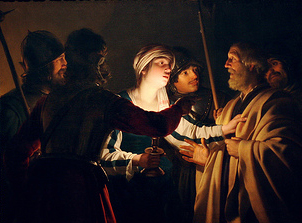
Having arrested Him, they led Him away and brought Him to the house of the high priest; but Peter was following at a distance. After they had kindled a fire in the middle of the courtyard and had sat down together, Peter was sitting among them. And a servant-girl, seeing him as he sat in the firelight and looking intently at him, said, “This man was with Him too.” But he denied it, saying, “Woman, I do not know Him.” A little later, another saw him and said, “You are one of them too!” But Peter said, “Man, I am not!” After about an hour had passed, another man began to insist, saying, “Certainly this man also was with Him, for he is a Galilean too.” But Peter said, “Man, I do not know what you are talking about.” Immediately, while he was still speaking, a rooster crowed. The Lord turned and looked at Peter. And Peter remembered the word of the Lord, how He had told him, “Before a rooster crows today, you will deny Me three times.” And he went out and wept bitterly.

Luke 22:54-62

peters-denialPeter’s failure. But it wasn’t the end, even though the failure was great.

So when they had finished breakfast, Jesus said to Simon Peter, “Simon, son of John, do you love Me more than these?” He said to Him, “Yes, Lord; You know that I love You.” He said to him, “Tend My lambs.”  He said to him again a second time, “Simon, son of John, do you love Me?” He said to Him, “Yes, Lord; You know that I love You.” He said to him, “Shepherd My sheep.” He said to him the third time, “Simon, son of John, do you love Me?” Peter was grieved because He said to him the third time, “Do you love Me?” And he said to Him, “Lord, You know all things; You know that I love You.” Jesus said to him, “Tend My sheep.

John 21:15-17

Rav Yeshua gave Peter (Kefa) another chance to show how he loved his Master. Peter recovered from his failure and recovered well.

But Peter, along with John, fixed his gaze on him and said, “Look at us!” And he began to give them his attention, expecting to receive something from them. But Peter said, “I do not possess silver and gold, but what I do have I give to you: In the name of Jesus Christ the Nazarene—walk!” And seizing him by the right hand, he raised him up; and immediately his feet and his ankles were strengthened. With a leap he stood upright and began to walk; and he entered the temple with them, walking and leaping and praising God. And all the people saw him walking and praising God; and they were taking note of him as being the one who used to sit at the Beautiful Gate of the temple to beg alms, and they were filled with wonder and amazement at what had happened to him.

Acts 3:4-10

This is just one small example of Peter the empowered Apostle and the result of his recovery from failure. He’d never be perfect and sometimes he’d make mistakes, but he never denied his Master again.

But what about us? We could attribute Peter’s boldness to his having received the Holy Spirit in the Acts 2 as opposed to his deliberately choosing to pass God’s tests rather than fail them. He was an Apostle full of the Holy Spirit of God. What about us? What about we poor, dim, ordinary human beings?

As Acts 10 attests, we Gentile Yeshua Talmidei are also supposed to possess the Spirit of the Almighty. Where is our greatness? Why aren’t we like the Apostles? What’s the difference between them and us?

Why do we continue to fail, what does that mean, and what do we learn, if anything at all?

The Torah states:

“And Pharaoh sent word and summoned Moses and Aaron. He said to them, ‘I have sinned this time. The Almighty is righteous. I and my people are wicked! … I will let you leave. You will not be delayed again.’ ”

Shortly thereafter, Pharaoh refused to let them leave.

Why did Pharaoh change his mind once the pressure of the plague was removed? Rabbi Noson Tzvi Finkel of the Mir Yeshiva explained that Pharaoh viewed suffering as a punishment. That is why he said, “The Almighty is a righteous judge and His punishment is fair because I have done evil.”

The reality is that there is a strong element of kindness in the suffering that the Almighty sends to us. In part, it is a divine message that we have something to improve. The goal of suffering is to motivate a person to improve his behavior. Pharaoh viewed suffering only as a punishment. Therefore, as soon as the punishment was over, he changed his mind and refused to let them leave.

Our lesson: View suffering as a means to elevate yourself and you will find meaning in your suffering. Try to accept it with love and appreciation. Even though there is still pain involved, it is much easier to cope. Whenever you find yourself suffering, ask yourself, “How can I use this as a tool for self-improvement?”

-Rabbi Zelig Pliskin
Commentary on Torah Portion Va’eira
from Growth Through Torah

runI think that’s what we learn from failure. If we see our failures as a punishment from God or some sort of inherent quality in ourselves we can never overcome, we will continue to fail. If, however, we choose to consider our failures as tests, they point to the areas in our lives where we need to improve. They show us a target to aim at, a goal to achieve, they illuminate a sort of “finish line” in a race.

Therefore, since we have so great a cloud of witnesses surrounding us, let us also lay aside every encumbrance and the sin which so easily entangles us, and let us run with endurance the race that is set before us, fixing our eyes on Jesus, the author and perfecter of faith, who for the joy set before Him endured the cross, despising the shame, and has sat down at the right hand of the throne of God.

For consider Him who has endured such hostility by sinners against Himself, so that you will not grow weary and lose heart.

Hebrews 12:1-3

We fail, but as long as we persevere and do not give up, we will never be defeated.

I know, easier said than done, but as people of faith, every time we are knocked down, we must either get up again, dust ourselves off, and keep moving forward, or we surrender our faith, give up on God, and go off in our own direction, becoming truly lost.

Passing God’s tests strengthens us, brings us closer to God, and shows us that God has built within us more persistence and empowerment than we realized we had. In fact, without tests, we’d never know just who God has made us to be. Even if we fail and fail often, as long as we keep trying, we never lose our way or step off the path God has placed before us.

Even in abject failure, abandoned by everyone we ever thought loved us, we are never alone.

When you have nothing left but God, you become aware that God is enough.

―A. Maude Royden

May this always be true of each of us.

Our Hope This Chanukah: “I Got You”

As bullets rained down during the San Bernardino shooting rampage, Shannon Johnson, 45, wrapped his left arm around 27-year-old Denise Peraza and held her close.

“I got you,” Johnson told her.

Peraza was shot once in the back and survived.

Johnson died.

Peraza, who is recovering from her injuries, shared her story of survival Saturday with reporters to honor Johnson.

-Sarah Parvini and Cindy Carcamo
“‘I got you’ are man’s last words to co-worker as bullets fly in San Bernardino rampage”
The Los Angeles Times

Johnson and Peraza
Photo: L.A. Times: Shannon Johnson, 45, left, and Denise Peraza, 27, right.

I suppose a lot of you reading this have heard the story, either in the news or through social media. Shannon Johnson’s photo has been all over Facebook and probably twitter and other media outlets as well. It should be.

I know that in a week, everyone will forget about Mr. Johnson, about Denise Peraza, the young woman whose life he saved, and (tragically) even about the terrorist massacre which took the lives 14 innocent people.

That’s human nature in the digital age. Our attention and even our compassion in fleeting. Once the event has passed, we crave another thrill served up for us by CNN or MSNBC.

More’s the pity.

But what’s worse than forgetting the victims is vilifying them. You can click the link to see the details. This man’s life and the fact that he wasn’t Jewish (although the news media misidentified him as such) has brought all of the Internet trolls out in force, including people I have known (via the web) personally. People who are otherwise decent human beings who find it necessary to desecrate the dead.

And on top of all that, the so-called press, if you can imagine a person like Linda Stasi qualifying as an “unbiased” reporter, are playing the blame the victim game from a different direction.

Every time someone says it was the victim’s fault he/she was shot, killed, raped, maimed because of their politics, their religion, their gender, or anything else, when they were, by definition, not the aggressor but the target of aggression, not only do we excuse the person or people or groups who/that were actually responsible for the attack, relieving them of any blame for their actions, we reveal ourselves to be, at best, morally and ethically confused, and at worst, cowards.

HopeThis is a season of hope, or it’s supposed to be. Chanukah is a reminder that even in the face of overwhelming odds, God will help His people not only survive, but prevail against armies and evil.

Another such “morally confused” individual who also happens to “report” on television news media has expressed concern that Americans pray to an anti-Muslim God. I’ll let you readers decide how you want to interpret that sentiment, but I don’t think it’s wrong to pray, not only for mercy, but for justice. God can decide what is just, and it shouldn’t be too hard for those of us who have been studying the Bible for a while to have some idea of what Hashem considers just in the affairs of the human race.

I could go on and on quoting people I find enormously misguided and yet who much of the public seems to hang by their every word, but I came to give hope, not despair.

More than that, I came to talk about how all of us can give hope, using Chanukah as our basic template, whether we’re Jewish or not (and I’m not).

Sara Debbie Gutfreund wrote a small article for Aish called 8 Ways to Turn Darkness into Light. I’m sure we have been staring into the darkness a great deal lately. There is much darkness in the world.

Whoever fights monsters should see to it that in the process he does not become a monster. And if you gaze long enough into an abyss, the abyss will gaze back into you.

-Friedrich Nietzsche

Often, we respond to tragedy and despair with anger and outrage, and while this is perfectly understandable, it’s not always helpful.

Ms. Gutfreund’s list of eight items are:

  • Practice kindness
  • Reframe your goals
  • Living “as if”
  • Thinking creatively
  • Look through a spiritual lens
  • Embrace change
  • Connect to God
  • Love challenge

You can read her article to get the specifics, but it comes down to you and me having a personal responsibility to be the light that illuminates the darkness, to be a beacon of hope sweeping away heartache and grief.

lampThis is the same message Rabbi Benjamin Blech was explaining and why Chanukah is so important.

Not only that, our Rav taught his disciples something similar:

“No one, after lighting a lamp, puts it away in a cellar nor under a basket, but on the lampstand, so that those who enter may see the light. The eye is the lamp of your body; when your eye is clear, your whole body also is full of light; but when it is bad, your body also is full of darkness. Then watch out that the light in you is not darkness. If therefore your whole body is full of light, with no dark part in it, it will be wholly illumined, as when the lamp illumines you with its rays.”

Luke 11:33-36 (NASB)

We have a very simple choice before us…simple to understand, but not always simple to perform. We have to choose if we want to be light or darkness. Which do you want to be and moreover, which one are you, based on your words (spoken and printed) and actions (the latter being more relevant than just what you want)?

Of course, often the people who embrace darkness imagine that they are actually representatives of the light. They’re sincere about it, too. No amount of talking, convincing, or arguing will change their minds or let them see themselves as the darkness desperately in need of light.

If some of them come along (and they have visited me here before), I know I won’t be able to convince them. Hopefully, they will show themselves wise and just hold their tongues (fingertips in the case of keyboarding).

Better to remain silent and be thought a fool than to speak out and remove all doubt.

-Abraham Lincoln

Even a fool, when he keeps silent, is considered wise; When he closes his lips, he is considered prudent.

Proverbs 17:28 (NASB)

Maybe that makes me a fool for even writing all this.

Johnson was identified as “a Christian who…dabbled in Hinduism,” whatever that might mean to you who are reading this.

But this is who he was to the woman he saved, Denise Peraza:

“This amazing, selfless man who always brought a smile to everyone’s face in the office … this is Shannon Johnson, who will be deeply missed by all … my friend, my hero.”

I’ve referenced a few people who represent the darkness but I won’t name the main participants, the terrorists. They’ve received enough recognition and I won’t give them more.

Alone in silenceIf I do want to preserve a single memory of this horrible event, I want it to be of Shannon Johnson who, while probably not a perfect person, and maybe you’d disagree with is religion or something else about his life, spent the last few moments of his life being the light. He wrapped his arms about Peraza and said, “I got you.”

These were his last words before his life but not his light went out of this world.

If he was and is a light, if, as disciples of our Rav, we also are to be lights, and if our Rav is a light, He is also the Light Who made it possible for one day’s supply of oil to burn for eight, purifying the defiled, returning the Holy Temple in Jerusalem to Hashem’s service.

It’s as if He said to the aged priest Matisyahu and his five sons, “I got you.”

Is it such a leap to believe, that when our own light is being threatened by the darkness, it can be reignited by those same words spoken to us?

When we cry, when our hearts are crushed, when we are overwhelmed by this nightmarish world, by overt evil that shoots a gun, and covert evil that kills with words, God whispers to each one of us out of the darkness, “I got you.”

Let your flame illuminate the abyss, banish the demons, and declare righteousness and justice for the oppressed and the grieving.

“Blessed are the poor in spirit, for theirs is the kingdom of heaven.

“Blessed are those who mourn, for they shall be comforted.

“Blessed are the gentle, for they shall inherit the earth.

“Blessed are those who hunger and thirst for righteousness, for they shall be satisfied.

“Blessed are the merciful, for they shall receive mercy.

“Blessed are the pure in heart, for they shall see God.

“Blessed are the peacemakers, for they shall be called sons of God.

“Blessed are those who have been persecuted for the sake of righteousness, for theirs is the kingdom of heaven.

light“Blessed are you when people insult you and persecute you, and falsely say all kinds of evil against you because of Me. Rejoice and be glad, for your reward in heaven is great; for in the same way they persecuted the prophets who were before you.”

Matthew 5:3-12 (NASB)

“When you awake in the morning, learn something to inspire you and mediate upon it, then plunge forward full of light with which to illuminate the darkness.”

-Rabbi Tzvi Freeman

Living With God Everyday

What we are talking about here is developing Messianic Jewish Household Spirituality. At Intefaithfulness we are doing this through an initiative called HaB’er (“The Well”). As resources of time, finances, and personnel allow, we will be providing materials, instruction and encouragement to Jewish and Intermarried households who recognize the priority of developing “The Three-Stranded Cord” of ever-deepening engagement with Jewish life, Yeshua-faith, and with God’s Presence. Our mission statement is “Living well at home in Jewish life with the Messiah.”

-Rabbi Stuart Dauermann
“Toward a New Solution to Current Problems in the Messianic Jewish Religious World”
Interfaithfulness.org

In Christianity, the main location for worship and prayer is the Church. In Judaism, it’s the home. Rabbi Dauermann points out in his article that, for Yeshua-believing Jews, whether they are in the Church or in the Messianic Jewish synagogue, they were “shaped” by American evangelicalism and thus, tend to be institution-oriented rather than home-oriented as are other religious Jews.

I’m not writing to comment on Jewish religious praxis, whether in the Messianic arena or otherwise. I’m here to write about the rest of us.

Actually, I can’t count myself as one of the Gentiles I want to discuss since, for a lot of reasons, the “practice” of my faith in the home is affected by the presence of my Jewish wife and children, none of whom are “Messianic”.

But I think the points Rabbi Dauermann brings up about the Messianic Jewish movement could be adapted to Jesus-following non-Jews, whether we call ourselves Christians, believers, “Messianic Gentiles,” or anything else.

churchFor a lot of us, our faith consists of going to church on Sunday, which includes the worship service, the sermon, and Sunday school. Then, if we’re really ambitious, there are programs, usually offered on Wednesday evening, in which we can participate.

But what about the rest of the time? What about our day-to-day lives?

In this, I think particularly an Orthodox or perhaps Conservative Jew might have an advantage.

Oh, Christians wouldn’t consider it such. I recall being in a Sunday school class a few years ago and hearing the teacher remark how we are so fortunate not to be “under the law” anymore (not that we ever were), and having been freed by the grace of Jesus Christ.

But free to do what? Play a few holes of golf after leaving church services and going out to lunch? How many Christians even say grace before eating if they’re in a public place?

Jewish practice may seem cumbersome to many non-Jews, but it has the advantage of continually reminding the Jewish person that God is always present. If you wear a kippah in acknowledgement of God being above you, your awareness is a persistent as your apparel.

Add to this all of the blessings to be said on a wide variety of occasions. If you were raised in an observant Jewish home, you started learning this practice in childhood, but for a Jew who was raised secular and became religious as an adult, there is probably something of a learning curve. Nevertheless, the message seems to be that a Jew is always obligated to acknowledge God in everything.

An observant Jewish life doesn’t occur just on certain days of the week or only between the hours of such and thus, it occurs from the moment you wake up until you go to bed at night.

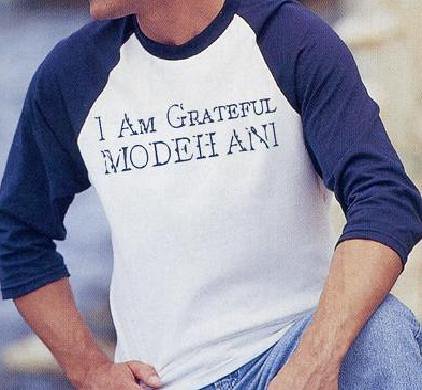
Modeh AniAbout the only thing I’ve allowed myself to carry over from my past is reciting the Modeh Ani (in English) when I discover I’m awake in the morning and about to get out of bed. It’s a basic confirmation that I owe each day of my life to God.

The day-to-day religious practice of a Christian or otherwise religious non-Jew is not well-defined. We don’t have the rich history of tradition of the Jewish people to draw upon. Sure, some non-Jews have chosen to adapt bits and pieces of those traditions in their lives, but we don’t share Jewish history and, in most cases, Jewish community, so it seems at least a bit out-of-place.

I should say at this point that I’ve met Christians who have fully-realized and completely integrated lives of faith. Every thought and action is directed to the service of Christ and to people around them. However, I wouldn’t consider this a very common practice, more’s the pity.

But returning to practical praxis, among the very first non-Jewish Yeshua-followers who had learned from Jewish mentors, such as the Apostle Paul, their day-by-day behavior probably looked pretty “Jewish,” since it was the only model they had available, but nearly twenty centuries have passed and that connection has long since been lost.

Some congregations and other collections of Jews and Gentiles who are devoted to Yeshua as Messiah are attempting to reinvent that relationship, but it’s pretty inconsistent. I think I recently mentioned how fragmented the body of Messiah happens to be, and I don’t see it becoming any more unified in the near future.

But regardless of our religious orientation and our access to community of any kind, we still, as individuals, have a responsibility to not only maintain our awareness of the God above our heads day-by-day, hour-by-hour, but to act out of that awareness. For the non-Jewish believer, as I’ve already said, there isn’t a well-defined set of behaviors and traditions for us to draw upon. Nevertheless, we can do something. We just need to be more deliberate and maybe more creative about it.

followIf we are walking in the dust of the footsteps of our Rav, so to speak, what should we do?

“Then the King will say to those on His right, ‘Come, you who are blessed of My Father, inherit the kingdom prepared for you from the foundation of the world. For I was hungry, and you gave Me something to eat; I was thirsty, and you gave Me something to drink; I was a stranger, and you invited Me in; naked, and you clothed Me; I was sick, and you visited Me; I was in prison, and you came to Me.’ Then the righteous will answer Him, ‘Lord, when did we see You hungry, and feed You, or thirsty, and give You something to drink? And when did we see You a stranger, and invite You in, or naked, and clothe You? When did we see You sick, or in prison, and come to You?’ The King will answer and say to them, ‘Truly I say to you, to the extent that you did it to one of these brothers of Mine, even the least of them, you did it to Me.’”

Matthew 25:34-40 (NASB)

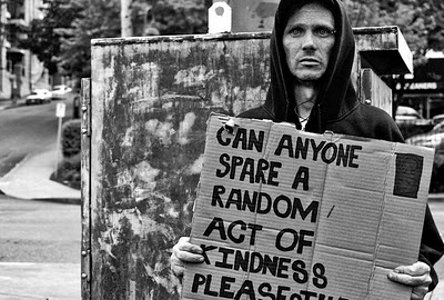
Do kindness everyday. No, you don’t have to save the world every hour on the hour, but you can take advantage of your opportunities, even in very tiny ways. Pick up a bit of litter and throw it in the trash. Hold the door open for someone. At this time of year, there are plenty of people ringing bells in front of stores taking in donations. Drop your loose change into the bucket. The next time someone cuts you off in traffic, instead of getting mad at them or competing with them on the road, let them have their way. Maybe they have a really good reason for being in a hurry.

A few days ago, I came across a news story about a homeless Jesus statue that is being erected in numerous communities. The concept and application are controversial, and while I agree that $40,000 per statue could be better spent actually sheltering the homeless, feeding them, and clothing them, the symbolism invoked, for me, the quote from Matthew 25.

homeless Jesus
Photo: Kelly Wilkinson / The Star

Jesus is already homeless, and poor, and hungry, and needy. He is because we have homeless, poor, hungry, and needy people in our communities. If we wish to serve our Rav and to “do what Jesus would do,” then the Bible makes it abundantly clear how to respond.

But what about this?

If the world of Messianic Jewish believers is to be established, sustained, renewed and passed on from generation to generation, the efforts of religious school, seminary and congregation will fail unless we begin at the center: the home. It is for this reason that Jewish religious discourse terms the home a Mikdash M’at, a little holy sanctuary. This is the center. This is the microcosm from which blessing proceeds to the macrocosm of life, and socially, this is the seed from which the Kingdom of God will grow in the Messianic Jewish context, or not. Similarly, we find in Scripture that it is at the center, the Holy of Holies, where holiness is most concentrated and from which it radiates out into the community of the people of God and to the wider world. Think of the design of the tabernacle in the wilderness and each of the First and Second Temples, each termed a “Beit Mikdash.” In Jewish life the home, the mikdash m’at, is the Holy of Holies from which spiritual identity and vitality radiates out into the world and daily life. Apart from this center, all is empty religious noise and clamor, gongs and cymbals, and too often, as we will admit if we are honest, smoke and mirrors.

This is how Rabbi Dauermann ended his essay, with a plea to re-establish Messianic Jewish homes as Jewish homes, making them the “Holy of Holies.”

I’m not sure how this is done in non-Jewish homes. I’ve known a few Christians who make a little “altar” in their homes, putting a cross, a Bible, and other religious objects on a table to be the center of family prayer.

I’m not particularly keen on building “altars,” but the idea of family prayer and family Bible study time seems to be a good start.

Moon and StarsI don’t have any practical suggestions beyond what I just mentioned, and as I’ve already said, this isn’t an option for me personally, but if somehow it were possible to treat our own homes as sacred places, to realize that God dwells among us as we eat dinner, watch TV, help our kids with their homework, read our Bibles, read anything else, surf the web, answer text messages, then maybe, just maybe we’d act differently in our own homes…and everyplace else.

A little bit of light pushes away a lot of darkness.

-Jewish proverb

The Simplicity of a Life of Holiness

On the heels of writing yesterday afternoon’s meditation, I realized this whole “Judaicly aware Gentile on a deserted island in search of God” thing is really quite overblown.

That I have a relationship with God as an individual non-Jew is hardwired into every human being including me. It’s a matter of making teshuvah continually, repeatedly or constantly turning back to God, and then pursuing that relationship in whatever flawed and imperfect way I can, day by day, for the rest of my life.

There’s no complex praxis or ritual involved. We know that the Centurion Cornelius (Acts 10) prayed at the set times of prayer, which likely means he prayed three times a day. He also gave much charity to the Jewish people. His prayers and acts of charity were recognized by God, much as Abraham’s faith in Hashem was considered to him as righteousness.

Having a relationship with God, for anyone, is a matter of allowing your day-to-day life to reflect righteousness and holiness. How? It’s not that complicated. Do good things to other people.

Pick up a piece of litter. Hold a door open for someone trying to enter a building behind you. Be kind to everyone you meet. Give to charity. Volunteer to help others in some capacity, such as at a food bank.

Give thanks to God for all you have, whether in plenty or poverty. Be content with everything that comes to you, for it’s all from the hand of God.

As far as it’s up to you, live at peace with everyone.

kindnessReally, if you can’t figure out what you can do to be a good person and a good servant to people in your family, people in your community, and a good servant to God, you haven’t been paying attention to your faith.

This is what I mean about the practices of Messianic Judaism sometimes being a distraction to those non-Jews involved. Admittedly, Hebrew prayers spoken and sung by people who are fluent (and musical) sound incredibly beautiful to me…and are far beyond my linguistic and tonal abilities.

But will God not hear my prayers if they aren’t in Hebrew or if I can’t carry a tune in a paper sack?

Admittedly, many parts of the prayer service and Torah service on Shabbat appeal to me, but let’s face it. I’m not Jewish. As far as I know, there’s no commandment for the goyim to daven in a minyan. If I pray alone, in English, is God going to ignore me? He didn’t ignore Cornelius.

So many “Judaicly aware” Gentiles are worried about how to perform this mitzvah or that, but they are (and I have in the past) making their lives so much more complicated than they have to be.

If you don’t have your hands full just resisting your evil inclination and striving to follow your good inclination, then either you are a bonafide saint or you’re delusional.

But I’ve been casting myself as outside of community, just me, a Bible, and God. What if I should find myself in a church or synagogue (or where ever) on occasion?

No problem. Do what the locals do. Stand up when the congregation stands up, sing when they sing (or sing softly if you have a voice like mine), if some part of the service is in Hebrew and you don’t know Hebrew, don’t say or do anything.

loveIn Sunday school or some other social gathering, be polite and friendly, but don’t offer any opinions or otherwise shoot your big mouth off (this is one of the reasons I don’t belong in community, because I can’t keep my mouth shut).

The principles behind living a life of holiness before God as a Gentile aren’t particularly hard. The only really hard thing is actually living up to that life of holiness. That takes a lifetime of practice, and no one gets to be perfect at it…

…least of all, me.

Returning to God in Time for Sukkot

If Yom Kippur can also be a time of repentance and mourning for non-Jewish disciples of Yeshua (Jesus), then I suppose I’m late.

On the other hand, as PL recently commented:

That having been said, Sukkot is coming up, and you should probably give some consideration to how much you are willing to pursue practical enactments of the anticipated messianic era in which Zachariah envisioned the requirement for gentiles to celebrate Sukkot and the aspects of it that imply redemption for the nations. The above essay seems to indicate that you’ve pulled away too far, and perhaps that you’ve begun to acknowledge it.

I heard somewhere (I can’t recall the source thanks to my leaky memory) that if Rosh Hashanah and Yom Kippur can mark a season of repentance and renewal for the Jewish people, then maybe Sukkot serves that purpose for the nations.

No, I’m not attempting to reintroduce myself into Jewish space, but I can’t ignore the (Biblical) fact that God also wants to include the Gentiles in the Kingdom of Heaven, that is, the Messianic Kingdom of redemption of the world. And while we are not nor shall we ever be Israel, there has to be a way to return to God that is appropriate for the non-Jew and that doesn’t involve directly (or maybe even indirectly, if such a thing is possible) using any form of Judaism as the Gentile’s conduit to repentance and reconciliation with God.

But where to begin?

Actually, I did begin and then stopped. I thought about looking at the practices of Yeshua and how he related to the Father as well as what Paul taught the Gentiles of his day, thinking this could provide some sort of baseline for the 21st century non-Jewish disciple of Rav Yeshua.

followBut while more traditional Christians have no trouble conceptualizing how to follow in the footsteps of Jesus, the fact remains that the Master almost never interacted with non-Jews and when he did, he wasn’t always civil about it. Yeshua was (and is) a Jewish teacher who gathered a Jewish following in the first century of the common era, in the then Roman-occupied Holy Land. He came, at that place and time, for the lost sheep of Israel, not the lost sheep of the nations.

For the nations, Yeshua never came directly. For us, he sent Paul instead (Acts 9).

So what did Paul teach? The answer to that question would fill a book, probably many books, and many books have been written with Paul as their subject, some complementary (Christian) and some with disdain (Jewish). And almost certainly, the vast majority of those books got Paul and how he related to Jewish people, Judaism, and his Gentile pupils all wrong.

Probably one of the very few books that may have gotten Paul right, or at least come as close as we can given the Apostle lived and died nearly two-thousand years ago, was the Nanos and Zetterholm volume Paul Within Judaism (and I still owe Mark Nanos a book review on Amazon).

Don’t think that my returning here to write, even occasionally, means that I think myself worthy of being read. It absolutely doesn’t mean I think myself a teacher. But PL is right. In pulling away from the inevitable strife caused by the presence of a non-Jew (and particularly me) in Jewish space, specifically Messianic Jewish space, I’ve also pulled away from paying much attention to God.

In attempting to hack my 61-year-old body to perform younger at the gym and in more practical physical applications, I’ve used that effort to insulate me from “hacking” my relationship with God, particularly continual repentance and reconciliation.

At this late date in the Jewish High Holidays, there’s no way I can even beg the forgiveness of all those I’ve upset and offended online and in person, but I’ll take this opportunity to humble myself before all of you anyway.

I’m still covered in “filthy rags” as it were. Still in need of a lot of work. I’ve always known that, but the issues over a busted computer (long story) and various other stressors this weekend have brought that realization to the forefront.

I know now that as flawed and imperfect as I am, what kept me moving forward or at least prevented me from moving backward, was writing this blog. Even as I kept falling on my face time after time, each new blog post was my effort to pull myself back up and keep on running the race (with apologies to the writer of Hebrews 12:1-3).

unworthySo I’m telling you that I’m not a better person, at least not better than I was a month, two months, or six months ago. I’ve taken some steps to cull a few of the more negative influences I’ve encountered in the blogosphere and in social media, if for no other reason, than to reduce the level of conflict I experience, but I don’t think I’ve benefited significantly from that as yet.

So where does that leave me?

Non-Jewish disciples of Jesus find their home (this is a generalization, not an absolute statement) in more or less one of two places: Most of them find a home in some sort of Christian church. No surprise there. A significant minority find their home in either an expression of Messianic Judaism or in some version of Hebrew Roots.

None of that helps me.

What’s left?

Well, even if I found myself on a deserted island somewhere thousands of miles from anyone else, there would still be God.

Assuming in a communal and spiritual sense, that’s actually my situation, what’s to be done?

The answer returns me to the Apostle Paul and what he taught. If Jewish avenues of connection aren’t available to me in forging a relationship with God, then Paul certainly must have taught his Gentile students how they could turn to Hashem.

How did they?

Here’s what little I have so far. I put this together a few months ago:

What Did Paul Teach?

What we do/don’t do:

  • Gentiles weren’t to be circumcised.
  • Gentiles weren’t to convert to Judaism.
  • Cornelius prayed at the set times of prayer.
  • Cornelius gave charity to the Jewish people.
  • Paul preached that the Gentiles owed charity to the poor of Israel.
  • Pray for Jerusalem.
  • The Jewish PaulExamples 1 Cor 5:11 and 13. Purge evil from among you and no slander or backbiting.
  • Practice repairing the world a little every day.
  • Restore Jesus and Paul and their teachings to their original Jewish context.
  • Teach the centrality of Israel in the restoration of the world.

Who we are:

  • Gentiles can call Abraham their Father (Rom. 4:11).
  • [Many of the contributors of the Nanos/Zetterholm volume say that Gentile believers had an “anomalous identity” and “occupied a social and religious no-man’s land”. Gentile identity defies classification.]
  • Gentile believers are neither proselytes nor God-fearers.
  • Like converts, we make an exclusive commitment to the God of Israel, but unlike converts, we do not take on Jewish ancestral practices (kosher food, shabbat, circumcision, and so on).
  • While we retain our native ethnic identities, we no longer worship our native gods.
  • Paul saw us as part of Abraham’s seed (Gen. 17:4-5, Gal. 3:29, Rom. 4:13-18), and yet Israel is also Abraham’s seed.
  • Nanos says we are not guests nor proselytes but full members alongside the Jews (members in what…the Kingdom of Heaven probably).

All this is pretty disorganized and needs a lots of fleshing out.

While I’ve missed the boat as far as Rosh Hashanah and Yom Kippur are concerned, it’s still not too late to at least get back on the road in time for Sukkot (what most Christians think of as the “Festival of Booths”).

I apologize for involving Jewish online resources, but in a lot of cases, I have no choice since Paul operated on this calendar and, as PL pointed out in the above-quoted statement, even we Gentiles will be operating within such a calendar or observance in Messianic Days.

walking outPreviously, I’ve drawn some ire, both in blog comments and via email, by citing or quoting from specific Messianic Jewish resources that were written for a non-Jewish audience in mind, so I’m going to do my best to avoid mentioning them as I chronicle my journey of return.

That’s regrettable, since a lot of how I understand my relationship with God, Paul, Yeshua, and the centrality of Israel (and not the Church) in national Israel’s redemption and the redemption of the world through her, is from those resources.

But one of my goals for this blog (it always has been actually) is to not promote conflict. Sometimes the only way to avoid conflict is to avoid interacting with some people and groups who, unfortunately, I have a tendency to irritate and provoke (and I apologize and ask forgiveness of all those folks too, but even if they forgive me, repentance and forgiveness don’t automatically mean reconciliation…sometimes, you just can’t go home).

I don’t want “morning meditations” to be like so many other blogs in the online religious space that go out of their way to generate conflict, disagreement, and even raw hostility.

I’m not teaching, declaring, or demanding. I’m just sharing my personal and spiritual experiences (such as they are) day by day (or perhaps more periodically).

What did Paul teach his Gentile disciples and how can I apply (if it’s possible) that to my own life? What can I learn from those few other non-Jews, such as Cornelius, who worshiped God outside of Judaism and within their own non-Jewish households?

Since the Jewish Messiah and becoming his disciple (through the teachings of Paul) is at the core of this exploration, I don’t know that any examples of non-Jews we see in the Tanakh (what Christians call the Old Testament) are relevant or even appropriate.

NoahOne notable example might be Noah, since he preceded any notion of Judaism and was considered “a righteous man, blameless in his time,” and “Noah walked with God” (Genesis 6:9 NASB).

Noah prayed to God, God spoke with Noah, Noah obeyed God, and Noah sacrificed to God, so what he did (apart from building an Ark and gathering a bunch of animals together) isn’t entirely out of the ballpark.

But for the most part, I’ll be spending my time in the Apostolic Scriptures, hoping some vestige of these ancient trails can point me to my way home as well.