Tag Archives: God

Joy

Do you remember the thrill of hitting a home run? Getting out on the last day of school? Riding your new bicycle? You jump with joy. Fantastic!

Joy gives you energy and makes you feel great. You can achieve all kinds of things that otherwise may seem too difficult to attempt. With joy, you’re not afraid to talk to the guy sitting next to you on the plane. No problem! You’ve got energy, buoyancy. You’re alive!

True joy comes from the pleasure of growth and self-actualization – when we conquer a difficult challenge, or experience a moment of clarity.

When your team wins the World Series, or when you win the lottery, the joy is a delusion. Why? Because you did not change or grow.

Joy cannot result from events, from “good things happening to you.” Joy is solely the result of your reaction to life, your commitment to turning every moment into a growth experience. A new baby means you have to extend yourself at all hours of the day and night. That’s not easy. But if you focus – even at 3 a.m. – you’ll recognize this as real joy.

Do significant things and you will have more joy. If you are fighting for a cause, you are making an impact on the world. You are heavy. You are eternal.

-Rabbi Noah Weinberg
“Way #8, Constant Joy”
48 Ways to Wisdom
Aish.com

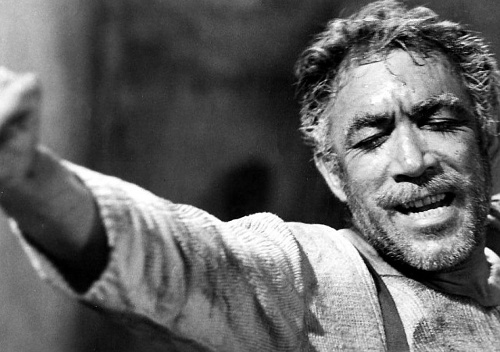
“Oh well,” he said after a moment. “Then I’ll dance, boss. Sit further away, so I don’t barge into you.”

He made a leap, rushed out of the hut, cast off his shoes, his coat, his vest, rolled his trousers up to his knees, and started dancing. His face was still black with coal. The whites of his eyes gleamed.

He threw himself into the dance, clapping his hands, leaping and pirouetting in the air, falling on to his knees, leaping again with his legs tucked up – it was as if he were made of rubber. He suddenly made tremendous bounds in to the air, as if he wished to conquer the laws of nature and fly away. One felt that in this old body of his there was a soul struggling to carry away this flesh and cast itself like a meteor into the darkness. It shook the body which fell back to earth, since it could not stay very long in the air; it shot it again pitilessly, this time a little higher, but the poor body fell again, breathless.

-Nikos Kazantzakis
Zorba the Greek (1946)

Joy is usually an occasional or even rare event in our lives, not a constant companion. But then, how many of us could endure a constant state of joy, as if we were old Zorba, pushing our bodies to the limit, dancing and leaping and trying to defy gravity until we finally collapse on the ground exhausted?

Actually, this sounds like another “unlikely sage” I described last spring; Moshe the Shepherd, who also expressed unbounded joy with almost limitless energy.

Then he got up and said, “Master of the world, I’m just a simple shepherd; I don’t know any Torah, and I don’t know how to pray. What can I do for You? The only thing I know is to sing shepherds’ songs!” He then began to sing loudly and fervently with all his strength until, again, he fell to the earth, exhausted, without an ounce of energy.

-Yitzchak Buxbaum
“The Shepherd”
from his book, Light and Fire of the Baal Shem Tov
quoted from Chabad.org

It’s the day after Yom Kippur. Either you feel elated or depressed. Like Elaina Cline said, “I used to hate Yom Kippur. Every year, as we blew the shofar and rushed home to eat, I would secretly breathe a huge sigh of relief. It was finally over – all the misery, the moroseness, the fear – until next year.”

You can hate Yom Kippur. You can dread confronting the darkest side of your soul. Or you can take joy in the opportunity to realize that what is worst about you is not who you really are. You are really a soul full of joy, singing, leaping, striving to reach your Creator, and to dance with God.

God does not desire that we remain in our pit of mud, sorrow, and regret. He didn’t create us to simply suffer and cry. We must have joy; we must take joy in Him, in all that He’s done for us, for creating our life, for giving us ambition and purpose, for granting us wings so that we can fly.

What is G‑d’s ultimate delight?

That a human soul will build portals of light so that the Creator’s presence may shine into His creation.

That a breath from His essence will pull herself out from the mud and turn to Him in love.

That a child of His being, exiled to the shadows of a physical world, will discover that the darkness is nothing more than Father hiding, waiting for His child to discover Him there.

But none of these can reach to the essence of all delights, the origin of all things, the hidden pleasure beyond all pleasures: The delight that this breath, this soul, this child did it all on its own.

-Rabbi Tzvi Freeman
“The Ultimate Delight”
Based on letters and talks of the Rebbe
Rabbi M. M. Schneerson
Chabad.org

Sukkah in the rainSukkot is coming soon; a time to build and decorate, a time to eat, drink, and celebrate. Who better to invite to the party than God. How shall we call out to Him and express our joy?

“And my tongue will express Your charity. Your praise all day long.”

Psalms 35:28

The charity that King David was referring to was the kindness and charity that the Almighty bestowed on him. Out of gratitude and appreciation for this, King David would praise Hashem all day long.

Fulfillment of this one verse would guarantee a person a life of happiness and gratitude – an elevated and spiritual life.

-Rabbi Zelig Pliskin
“A Guarantee of Happiness”
Daily Lift #587
Aish.com

Oh come, let us sing to the Lord;
let us make a joyful noise to the rock of our salvation!
Let us come into his presence with thanksgiving;
let us make a joyful noise to him with songs of praise!
For the Lord is a great God,
and a great King above all gods.
In his hand are the depths of the earth;
the heights of the mountains are his also.
The sea is his, for he made it,
and his hands formed the dry land.
Oh come, let us worship and bow down;
let us kneel before the Lord, our Maker!

Psalm 95:1-6 (ESV)

Although life is no bed of roses and we face our burdens and struggles every day, God is with us. He cares about us, and makes the way clear for us to approach Him, from the greatest to the smallest, all of His creatures. Do not be afraid. Do not be discouraged. Even in the midst of your troubles, count it all joy.

Shavua Tov, chodesh tov, and shana tova!

Jesus, Halakhah, and the Evolution of Judaism, Part 3

The title I have chosen for this study is a “tongue-in-cheek” attempt to highlight something that seems to be missed by many, namely, that the Mishnah did not exist as a written document in the pre-destruction era, so it is quite obvious that no one, including Paul, could have possibly read what is known in our day as the Mishanh (sic). In fact, as we shall see, the Mishnah was not widely read by Jewish communities in the centuries immediately following the destruction of the Temple (70 CE) either, for the Mishnah was not “published” as a written document until much later.

Along the same lines, it is a methodological error to speak of “1st Century Judaism,” for no such monolithic Judaism existed. We must rather speak of “Judaisms” (plural) in the pre-destruction era. Granted that a variety of Judaisms extant in the 1st Century surely had some things in common (Shabbat, circumcision, Tanach, etc.), it was nonetheless their clear and (in some cases) radical differences that produced the variegated Judaisms of that era.

Unfortunately, the presupposition of some in the Messianic movement is that the later corpus of rabbinic literature presents a monolithic, historically accurate description of “the Judaism” practiced by Yeshua and His disciples.

-Tim Hegg
from the Introduction (pg. 1) of
“What Version of the Mishnah did Paul Read?” (2012)
TorahResource.com

Since writing Part 2 of this series, I’ve been pondering how to proceed, since, as I’m sure you’ve gathered if you read the questions I’ve been posing, the scope of my inquiry is rather ambitious. Then the answer landed firmly in my lap. I’m indebted to Peter at Orthodox Messianic Judaism (something of a misnomer given the theological nature of his blog) for providing a link to Tim Hegg’s article. I read it through once, meaning to go over it again and eventually write something about it, but as I was getting into the shower, I had an “epiphany” and quickly rushed to my computer (I put a robe on first) to compose the paragraphs that are the heart of this missive (we’ll get to those by the by).

I should say at this point that I like Tim Hegg. He has been very gracious to me. I’ve spent Erev Shabbat in his home, I’ve been treated well by his family and his congregation, and I admire and respect him as a leader and a scholar. All of which added to my surprise when I realized in reading the Introduction to the above-quoted paper, that he had made some glaring and erroneous assumptions.

I can’t think of anyone in Messianic Judaism who believes that the Mishnah we have today is a direct reflection of how Judaism (or “Judaisms”) functioned back in the late Second Temple period, when Jesus walked among his people Israel. I have no idea, even after reading Tim’s paper in full, where he got that idea. Certainly my drive to investigate the evolution of Judaism as it relates, both to the ongoing authority of Judaism to define itself across time, and whether or not First Century halakhah and modern halakhah can be considered equally valid for the Judaism of their times, doesn’t assume a fixed, static, and non-adaptive set of applications of Torah over a 2,000 year span.

Also, his point that in the day of Jesus, that there were multiple “Judaisms” (Pharisees, Essenes, Sadducees, and so on) is hardly a revelation. Again, I don’t know anyone in the Messianic Jewish movement who would deny the “multi-sect” nature of First Century Judaism. On the other hand, if we look at modern Judaism or modern Christianity, we could say the same thing. If there was no, one unified “Judaism” in the day of Jesus, there must certainly be no one, monolithic, unified modern Christianity either. The fact that the Christian church exists as perhaps hundreds of denominational models and their variants, (including One Law or, if you will, “One Torah”) establishes this firmly. Nevertheless, no one balks at talking about “Christianity” or “Judaism” in the 21st Century as if they were specific, unified entities, since at their cores within each individual religion, they contain a basic, common set of theologies, doctrines, dogma, and the like that identify them as either “Christian” or “Jewish.”

It’s as if Tim constructed a very well written and organized paper based on faulty assumptions about Messianic Judaism. It’s never been about the Judaism of late Second Temple times being one unified entity, and it certainly has nothing to do with the belief that the Talmud, (which is comprised of Mishnah, Baraita, Gemara, Halakhah, and Aggadah) as we understand it, having existed as the same body of information in the days of Jesus and the Apostles as it does today.

(The evolution of the Oral Torah and halakhah of Christ’s day into what eventually became known as the Talmud is well beyond the scope of this article, but the seeds of what became Talmud certainly must have existed in some form in the Second Temple period and before. What we know of Hillel and Shammai is recorded in Pirkei Avot, which is the “ethical teachings and maxims of the Rabbis of the Mishnaic period,” and yet both Hillel and Shammai pre-dated Jesus by a generation, and the formalization of Mishnah by centuries.)

In the Conclusions section of Tim’s paper (pg. 23, point 5), he states:

We see, then, that there is no historical nor biblical case for accepting oral Torah as divinely sanctioned. Even the suggestion itself is ill-founded, for it both presumes a monolithic “oral Torah” and that the rabbinic authorities who formulated and compiled the current corpus of rabbinic literature did so by the leading of God.

Point 7 of his Conclusions (pp 23-4) states:

As we avail ourselves of the wealth of rabbinic literature and gain value from the study of it, we must also keep in mind that it is the product of men and not that of divine revelation. It does not come to us with any sense of divine imprimatur nor should the rabbinic literature be considered as having sacred value greater than the works of non-rabbinic authors or sources. All the writings of men must be equally scrutinized in the light of the eternal word of God, the Bible.

There’s a certain irony in Tim’s statements if you fix your gaze, not on the Rabbinic writings that are encapsulated in Talmud, but on another “Rabbi’s” writings, which we find in “the light of the eternal word of God, the Bible.”

We take it on faith that the Bible, the Holy Scriptures of God, are Divinely inspired and not merely the writings of human beings, but even then, most of us don’t believe that God simply dictated the Bible to myriads of human beings over several thousand years of history, and that the authors involved were only human word processors. In fact, how much of the personalities and viewpoints of all of these authors made their way into our Holy Scriptures is a hotly debated point among religious scholars and worshipers.

Add to that the suggestion that the New Testament Epistles, which make up the majority of the Christian texts, were actually letters written mostly by Paul, with smaller contributions by a handful of others, to various early Christian churches, and you begin to wonder about the nature of “Divine inspiration.” More than one source has said that the New Testament letters could be of a “lesser authority” than the Torah, for example, and may indeed be Paul’s midrashim or commentaries on Torah, the Messiah, and on the Abrahamic, Mosaic, and New Covenants. If this is true, then the barrier between “Divine authority” and “human agency” in many of our holy writings is a lot thinner than most Christians (perhaps including Tim Hegg) would be comfortable with.

What if there’s merit to the idea that the Talmudic writings and subsequent commentaries, judgments, and rulings have a “Divine authority” involved, at least to a degree? If we can say that Paul’s letters are “Divine” in some manner or fashion, and yet were written by Paul with his mind and emotions fully engaged, (and who knows how “Divine inspiration” does and doesn’t work) then in Galatians, Ephesians, or Colossians, where does Paul leave off and God begin? There’s no way to know. Maybe God just “wired” Paul’s brain to write letters in a way that reflected His will and intent within the context of Paul’s personality, the place and time in which Paul was writing, who he was writing to, and the issues at hand that prompted the letter in the first place.

How is that different from the acknowledged and legitimate Rabbinic authorities issuing rulings, based on and extrapolating from Torah ideals and principles, and then applying them to their local populations?

Who can say if the Mishnaic Rabbis were Divinely inspired or not. How do you measure “Divine inspiration?” I suppose you can, as Tim says at one point, compare the Rabbinic rulings to the canon of Scripture and where they agree, you can say the Rabbis have produced value. Where they disagree, you can say they produced error. Detractors of the Talmud, as applied to Messianic Judaism, say that since “Rabbinic Judaism” does not recognize Yeshua (Jesus) as the Jewish Messiah, it invalidates everything produced by that “Judaism” including the Talmud as a whole (as far as Messianic Jews are concerned, anyway). On the other hand, as my friend Gene Shlomovich said recently in this blog comment:

If you want to believe, as much of Christianity and Islam does, that G-d has virtually abandoned the Jewish people by leaving them to fend for themselves without authoritative leaders and teachers because “they rejected Jesus”, that the Jewish people corrupted the interpretation of scriptures and have lost their right to interpret them, that G-d has removed his Spirit from my people, it’s your prerogative. You would not be the first or the last.

Traditional supersessionism states that God withdrew His Spirit from the Jewish people and transferred it to “the Church” because Judaism rejected the Messianic claims of Jesus. Not only do I believe that theology represents a tremendous error in thinking, but it is a gross simplification of a very complex set of events that occurred over decades and even centuries.

The paper Matthew 23:2-4: Does Jesus Recognize the Authority of the Pharisees and Does He Endorse their Halakhah? written by Noel Rabbinowitz, which I introduced in Part 1 of this series, suggests that not only did Jesus acknowledge the legitimate authority of the Pharisees, but also of the scribes, who, as Carl Kinbar explains, were:

…an independent group affiliated not only with the Pharisees, but also with the Sadducees, Chief Priests, and elders. In fact, in Matthew, a quick check shows that 10 references to the scribes relate them to the Pharisees and 10 to other groups!

As soon as we grant the scribes the same place that Yeshua does in Mt. 23:2, it seems that Yeshua was not promoting the idea that one group should be in control of the halakhic process. Rather, he acknowledges the vital role of Torah teachers but criticizes them as part of his teaching on humility (read to verse 12).

In essence, it seems Jesus, to some degree, acknowledged the legitimate authority of the religious leaders in the various “Judaisms” of his day to have the right to establish halakhah for their communities. Of course the Mishnah as we have it today didn’t exist when the events in Matthew 23 were happening and later recorded, but if Jesus could recognize (and still criticize) Jewish religious leaders as having the right to establish religious practice for the First Century Judaisms, and if that authority was maintained across time as granted by God (I know…a big “if) and perhaps even as a function of an evolutionary process occurring within global Judaism and the local “Judaisms,” then maybe we can say that Jewish authority to legitimately define itself and it’s practice didn’t come to an abrupt end when it was “nailed to the cross with Jesus.”

No one is saying that the Mishnah existed in the days of Jesus, Peter, and Paul. But even Tim Hegg must acknowledge that some sort of halakhah did exist as established by the Pharisees and scribes. Factor in Rabbinowitz, and you have established that Jesus agreed in principle, that the Jewish religious authorities were legitimate and he acknowledged much of their halakhah. We can build on this to explore the possibility that God did not turn His back on all of His people Israel across the last twenty centuries, and that He maintained His presence among them. If God abandoned Judaism totally, and completely “threw in” with Christianity, then whatever the Rabbis came up with was inspired by human imagination alone. But if God is with all of His people, those of the Covenant of Abraham and Sinai, as well as those of us who benefit from some of the blessings of the New Covenant, then both Christianity and Judaism have a place in God’s heart and in God’s plan.

Have God’s blessings continued to be with the Jews as well as the Christians? Considering the fact that Jews even exist today, let alone retain the faith, practices, and traditions of their Fathers, with some teachings stretching back over 3,300 years, it would seem the answer is “yes.” Has He let them spin out of control, creating laws, rules, and statutes that are made up of wishful thinking and pipe dreams, while only showering His “Divine inspiration” on the laws, rules, and statutes of the unified Christian church (I hope you’re picking up on my attempt to be ironic)? I seriously doubt it.

Tim Hegg, in point 6 of his Conclusions (pg. 23) states:

Our conclusion is that, while rabbinic literature does have much value, it is not to be received as having divine authority in matters of our faith and halachah.

Tim may esteem Rabbinic literature in terms of its historic value, as well as for its insights into “the perspectives, beliefs, and worldview of modern Judaisms,” which “aids Messianic believers in appreciating and understanding the religious perspectives of observant Jews in our own day,” but for those “observant Jews,” Messianic and otherwise, the meaning of Mishnah is a great deal more. It doesn’t have to mean the same thing to us, including me or Tim, as it does to observant Jews, since the vast majority halakhah does not apply to Christianity.

Will Jesus Christ, upon his return and when he establishes his reign over the earth and his throne in Holy Jerusalem, recognize the authority of the Jews of that day as he recognized the authority of the Jews of 2,000 years ago? I don’t know for sure. But as we’ve seen, Jesus didn’t reject the Jewish authorities of ancient days out of hand, though he didn’t completely agree with them, either. Perhaps we shouldn’t dismiss the possibility of Jesus seeing modern Judaism in the same light, particularly because God doesn’t seem to have dismissed His Jewish people…ever.

Part 4 in this series will examine another aspect of the authority of the Talmudic sages and of modern Judaism. Does Judaism have the right to define itself, including Messianic Judaism? Find out in tomorrow’s “morning meditation.”

Jesus, Halakhah, and the Evolution of Judaism, Part 2

Who were the Jewish followers of Jesus?

The members of the Jesus sect were clearly religious Jews who believed that Jesus was the Messiah. They could not have believed that Jesus was “god” and remained Jewish, as such a belief would have been complete idolatry in Jewish eyes and would have appeared closer to the Greco-Roman pagan beliefs where gods took on human form and had relations with humans.

At any rate, the Jesus sect, like numerous other sects in the Land of Israel, would certainly have died out even if its members had survived the revolts against Rome in the first and second centuries. (The Pharisees survived in part due to the vision of their leader, Rabbi Yochanan ben Zakkai)

So where did all the Christians comes from? Indeed, where did Christianity come from?

For the answer, we must look at another colorful personality who appeared on the scene after the death of Jesus, and who is given the credit by virtually every historian of Christianity for spreading the message of Jesus worldwide, if not fashioning Christianity for the consumption of the pagan world.

He was a Jew—originally known as Saul—who became famous in Christianity as “Saint Paul.”

Rabbi Ken Shiro
“Seeds of Christianity”
#40 in the “Crash Course in Jewish History” series
Judaism Online: SimpleToRemember.com

Do religions evolve? That is, can we believe that it is reasonable and expected for any given religious structure to evolve over time in order to adapt to changes in the environment that affect the requirements of the religion’s followers? I asked that question in Part 1 of this series and it stands before me, taunting me, and perhaps even haunting me.

Among people of faith, Christians particularly tend to believe that the truths we possess about God and who we are in Christ are fixed, immutable, unchangeable information that exists and is applied universally in the same manner as when Jesus walked the earth.

That’s not actually true, of course. Over the past 2,000 or so, the Christian faith has metamorphosed tremendously. It’s extremely unlikely that the Apostle Paul, walking into a modern Baptist church, would recognize anything as familiar, even understanding that the church was for only Gentiles and that no observant Jews would be present. What would Paul make of Constantine? How would he perceive the ancient Holy Roman Catholic church? And what about Martin Luther and the reformation? How would Paul look at a 19th century American “fire and brimstone” preacher leading a tent revival meeting somewhere just outside of Tulsa, Oklahoma?

(If you want to get a sort of “snapshot” of the changes that Christianity has undergone over the long centuries, visit Wikipedia’s History of Christianity page)

Wait a minute. Doesn’t the title of this series say “the Evolution of Judaism?” Yes, it does. However, in trying to figure out how to write Part 2 of this series, it was easier for me to approach the evolutionary progression of Judaism by way of Christianity. After all Christianity started out as a small sect of Judaism and, through an extraordinary process, spread like wildfire through the Gentile diaspora world of the First and Second Centuries C.E. Since a large part of the audience for this series are both Jews who have come to faith in Yeshua (Jesus) as the Messiah, and non-Jews who worship Jesus and yet, in some manner or fashion, are attracted to Judaism, my decision to access Judaism by accessing Christianity makes sense to me (though you may not agree).

While the changes that have occurred within Christianity and it’s somewhat fragmented nature in the early 21st century are undeniable, are these changes actual developmental or evolutionary stages that are required of this, or any religion, in order to survive? After all, like many species of plants and animals, over the long centuries many religions and faith groups have died out. They existed once, even flourished for a time, but are no more.

I can’t say that they ceased to exist because they failed to adapt, although that’s certainly an interesting thought. I can’t really find much (at least that’s readily available online) to support what I’m trying to say, but a site called TED.com (Technology, Entertainment, Design: a nonprofit devoted to Ideas Worth Spreading), presents the following questions:

Have religious belief systems evolved over time?

While many religious believers do not accept the theory of evolution in regards to the development of life, from a historical perspective it seems religious and spiritual belief systems themselves have evolved and developed over time.

From the earliest Venus figurines, cave paintings, early burial sites, naturel and ancestor spirits, polytheistic beliefs to the monotheistic, to deist and others.

Do the strongest survive? Do they adapt? Do they interbreed and influence each other? Do they go extinct? Is there some natural selection process that passes on religious ideas memes, and sees others become extinct?

What properties help a religion survive and thrive? Invisible gods perhaps. Evangelical rather than hereditary. Religions linked to economically and militarily strong cultures perhaps. Do religions have a symbiotic relationship with their host cultures – making them stronger and more united supporting development and progress and hence protecting the religion itself.

What are the greatest challenges to the survival of different religions today, and what will help them survive and thrive?

from “Do religions evolve?”
TED.com

I could probably study for years and eventually write a paper trying to answer those questions. But maybe the seeds of the answer are found in Judaism:

“I think sometimes Christians read the Bible and think, ‘Oh, this is what Judaism is,’” he says. “Judaism is a living tradition that continues to grow and adapt and change well beyond the Biblical age.”

-Greg Johnson quoting
Rabbi Mike Uram, director of Penn Hillel
“Tracing the Talmud’s journey”
upenn.edu

Rabbi Uram is describing the point that I’m trying to make: that religions, particularly Judaism, aren’t fixed and static entities with wholly unchanging rules, commandments, and practices that are frozen across history, geography, and culture. The Talmud and how it is studied and understood in Judaism helps us (well, it helps me) comprehend how religious structures can purposefully adapt and change over time and across sub-groups of the religion, in order to better serve the needs of each generation of followers.

PogromNaturally, I can’t say that all changes across Christianity and Judaism have always been beneficial and productive. Certainly the schism between the church and the synagogue that occurred in the early centuries of the common era has resulted in tremendous harm to the Jewish people. The church is guilty of a long list of crimes against the Jews, including the pogroms, the inquisitions, the burning of synagogues, the destruction of Torah scrolls and volumes of Talmud, and quite horribly, the wholesale slaughter of Jewish men, women, and children. All committed in the name of Christ.

But all of that is rapidly (relative to the speed of history) changing. There is more interfaith cooperation between many Christians and religious Jews. It is common to find Christians supporting Israel and Jewish Israeli causes. If the church is currently evolving, it definitely does seem beneficial in terms of its current viewpoint toward Judaism.

The dark side of suggesting that religions evolve is that such change may be at the cost of the enduring truths of the Bible and the will of God. Such change may be solely for the purpose of fitting in with the surrounding culture, while throwing principles, morals, and ethics under a bus.

I can’t say that hasn’t happened in either Christianity or Judaism.

But I can’t say that all change is bad, either. It seems, especially in the case of Judaism, that a fine balance must take place between adapting to environmental changes and protecting the inner core of the faith. I believe that, more than anything, that is exactly the function of the Talmud in Judaism. In spite of overwhelmingly hostile attempts to eradicate Judaism and exterminate anything that might appear distinctively Jewish (including the people), not only do Jews remain in the world today, but a significant portion of the practices established in the Torah 3,300 years ago continue to be performed in some manner.

Jewish men still wear fringes on their clothing. The Shabbat rest is still observed. Prayers are still offered while facing Jerusalem. Meats are still slaughtered in the customary fashion, and prepared in accordance to the traditions. Men still daven in minyans and their prayers are spoken in Hebrew and Aramaic.

Why am I writing this? I live in the world today, so why should I be concerned about whether or not the church has evolved? The church is what it is today and I live in today, so why does it matter? Here’s what I said in Part 1 that’s relevant to these questions.

Now that we’ve seen evidence that it is reasonable to believe Jesus could have accepted Pharisaic authority to establish ancient halakhah and that he not only upheld portions of that halakhah but practiced it as well, (see the full text of Rabbinowitz for details) Part 2 (although I’m not sure when I’ll write it) will examine the “reasonableness” of Christianity and Judaism evolving or developing from ancient to modern forms. After examining that point, we shall try to see if it is even possible for a returning Jewish Messiah King to accept the halakhah that will exist on the day of his return to Jerusalem.

I have no way to really prove that religions evolve or develop forward in time in a productive and beneficial manner. There are hints that how Talmud and tradition is applied in Judaism is both adaptive and stabilizing, and that this is what has enabled religious Judaism and Jews as a people to be preserved throughout their history.

But what does God think about it all?

I have no idea and I don’t believe anyone can know.

But we can speculate (and speculate and speculate, the blogosphere is full of speculation). In Part 1, I presented some information that seems to support how Jesus upheld the authority of the Pharisees (and the larger structure of religious Judaism) to establish and apply halakhah, and how Jesus even advised his Jewish disciples to follow the halakhah of the Pharisees.

But the Rabbinowitz paper (PDF) also said that the authority of the Pharisees was destined to pass away. Eventually, it would no longer be valid. So what would replace it, not just among the small sect of Jewish “Nazarenes” who followed Jesus, but for all of Judaism in its various divisions, both during the life of Jesus and well beyond?

If Jesus established a distinctive halakhah for his Jewish disciples, it died with the passing of ancient “Messianic Judaism”. The Gentile church moved far, far away from anything even remotely Jewish, so they wouldn’t have carried his halakhah forward, and the descendants of the Jews who were disciples of Jesus fell away in only a few centuries or less. After that, only a Judaism that did not recognize Jesus as Messiah remained to establish law, interpretation, tradition, and halakhah for the Jewish people.

the-teacher2All we have of the teachings of Jesus are what is recorded in the Gospels. The early days of the First Century church are seen mainly through the eyes of Paul and a small group of other disciples. We aren’t even sure of who really wrote most of the New Testament, but if there was a “halakhah of Jesus” that deviated from the halakhah established by Second Temple period normative Judaism, only tiny bits and pieces survived in what became canonized into our Bibles.

I’m not proposing any answers today. I just need to throw some large, sweeping concepts out into the open, because I can see them better there than inside the swirling maelstrom of my thoughts.

Ultimately, the questions are:

  • Do religions naturally evolve in productive ways, both to preserve the core faith and to adapt to external changes in history, geography, and culture?
  • Can we see and trace the evolutionary mechanisms and stages in order to differentiate between productive, expected changes and developmental dead ends?
  • Has Christianity evolved in a productive manner and can we identify the benefits (local or global) of that evolutionary process today in the church?
  • Has Judaism evolved in a productive manner and can we identify the benefits (local or global) of that evolutionary process today in the synagogue?
  • At the coming/return of the Messiah (your specific viewpoint on this depends on whether you’re a normative Jew, Messianic, or a Christian), how might the Messiah view and judge Christianity and Judaism relative to how they have changed in the past 2,000 years?

I guess I should have added one last question: “Do I have a prayer of even beginning to answer those questions in a meaningful way?

Probably not, but as I’m fond of saying, this blog is more about chronicling whatever I’m thinking about at any given point in time than actually doling out satisfying answers to complicated questions.

That said, Part 3 of this series, which will be tomorrow’s “morning meditation,” takes an extremely interesting direction, leveraging the opinions of a particular and well-known (in some circles) “One Torah” scholar who believes that Mishnah and “Divine authority” have nothing to do with each other.

Vayeilech and Yom Kippur: Seeking the Hidden God

I shall hide my face from them…

Deuteronomy 31:17

Rabbi Avraham ‘the Angel’ was the only son of Rabbi DovBer, the Maggid of Mezeritch. When Rabbi Avraham was a young child, he once came weeping to his father: He had been playing hide and seek with a friend, sobbed the child, but the friend had lost interest and had run off to some new amusement, leaving little Avraham all alone in his hiding place, waiting in vain to be searched out.

Rabbi DovBer lifted his eyes to heaven and cried: “You, too, have hidden Your face from us only because You want us to seek You. But Your children have tired of the game and have run off…”

-Rabbi Yanki Tauber
“The Cop-Out”
from the “Once Upon a Chasid” series
Commentary on Torah Portion Vayeilech
Chabad.org

This may seem a little obscure compared to my usual Torah Portion “meditation,” but bear with me. As we are deeply immersed in the days of repentance between Rosh Hashanah and Yom Kippur, the struggle between man and God is especially acute. While it is normal for observant Jews to seek particular closeness with Hashem at this time, I can only imagine that there’s some frustration going on, too.

I used to hate Yom Kippur. Every year, as we blew the shofar and rushed home to eat, I would secretly breathe a huge sigh of relief. It was finally over – all the misery, the moroseness, the fear – until next year. And as Passover would pass, I would start counting down to the dreaded day which was hovering just beyond the horizon.

I hated Yom Kippur because it made me feel like a fraud. I would bang away at my chest all day, enumerating all my sins, promising I was repentant. But in my heart I knew that I would return to my mean self the moment the fast was over. I didn’t believe I could ever change, that I was really worthy of life and that I would ever be able to redeem myself. So I would go through the day anxious for it to be over, hating myself for being such a big, fat fraud.

-Elaina Cline
“Why I Hated Yom Kippur”
Aish.com

I know exactly how she feels. This isn’t something most people admit to, but there’s this horrible fear that when I repent of something, it will come back to haunt me in the not-so-near or even the near future. When repentance is linked to a specific date on the calendar and for a month or more, you’ve been building up to an august, awesome, humbling, and overwhelming encounter with God, there’s this little voice in the back of your head (OK, in the back of my head) that says, “The balloon is going to pop as soon as the Yom Kippur fast is over, and you’re going to go back to business as usual.”

Yuk. What a horrible thought. What a depressing feeling.

Although this wasn’t the same matter that Moses was facing at the end of his life as recorded in this week’s Torah reading, I can see how he’d be just as depressed and even frustrated with God.

When Moses had put down in writing the words of this Teaching to the very end, Moses charged the Levites who carried the Ark of the Covenant of the Lord, saying: Take this book of Teaching and place it beside the Ark of the Covenant of the Lord your God, and let it remain there as a witness against you. Well I know how defiant and stiffnecked you are: even now, while I am still alive in your midst, you have been defiant toward the Lord; how much more, then, when I am dead! Gather to me all the elders of your tribes and your officials, that I may speak all these words to them and that I may call heaven and earth to witness against them. For I know that, when I am dead, you will act wickedly and turn away from the path that I enjoined upon you, and that in time to come misfortune will befall you for having done evil in the sight of the Lord and vexed Him by your deeds. –Deuteronomy 31:24-29 (JPS Tanakh)

It wasn’t a matter of if the Children of Israel would sin and rebel against God, only when. After forty years of struggling with two generations of Israelites, of struggling with God, of struggling with his own humanity, Moses’ life ends on a down note.

Kind of like how we might end Yom Kippur on a down note. The balloon pops. The piousness wears off. We dig into the first yummy meal after the long fast, and do whatever we were doing before the High Holidays for this year entered our spiritual awareness.

Christians out there might say that they’re immune to this sort of spiritual let down because they can repent anytime they (we) want to, but frankly, so can any Jewish person. Imagine though, how you might experience yourself one way as you are preparing to “cleanse your soul” before Easter, and then what you might think, feel, and do the Monday after it’s all over. I think that’s the closest we non-Jewish Christians can come to the sort of Yom Kippur letdown Cline was talking about.

Rabbi Tauber talked about this same sort of frustration in his commentary. God withdraws from us so that we might look for Him, but when we look and look and do not find, like the child in the story, we abandon out “playmate” and seek other games. I’ve been tempted to do that on more than one occasion, particularly at the frustration of seeking but not finding my way to the New Covenant connection between Christians and God.

Cline continues her analysis of Yom Kippur and her self-analysis:

And I have seen my smallness, too. I have seen my propensity to be critical, cold and judgmental. I have seen my ability to be harsh and cruel. And I have seen the pain I have inflicted on others and myself in these states – the sadness, the depression, the hostility. I have seen my lethargy, my disconnection and my self-pity.

But this year, my darkness is juxtaposed with my light. I realize that change is actually possible. I am not doomed to isolation, meanness and small mindedness.

This Yom Kippur, I can feel the pain of not being in a state of connection and own the consequences of my choices. I can say to God, “This is not me,” and mean it. I feel repentant, not from fear – but from a genuine desire for connection, love and transcendence. Getting in touch with my higher self that yearns to be good has enabled me to sense the sadness of my past choices.

What is frustration and a sense of separation from God juxtaposed with? Not necessarily satisfaction and closeness, but the realization is that a life of faith is not as hopeless as it sometimes seems. Neither is a human life, which is fraught with mistakes, carelessness, thoughtlessness, stumbling, and disappointment. Where is the path of devotion I’m supposed to be walking on?

Remember us for life, O King Who desires life, and inscribe us in the book of life, for Your sake, O living God.

-Amidah, Ten Days of Penitence

What is the meaning of “for Your sake?” How can the extension of life to a person be for the sake of God?

We might read the verse a bit differently. “Inscribe us into the book of a life that is lived for Your sake.” In other words, we pray not only for life, but for a quality of life that is meaningful and purposeful, one that will be lived for the greater glory of God.

Some people find life boring, and it is little wonder that such people seek escape from its boredom. Some turn to intoxicating chemicals, and others to a quest for thrills and entertaining pastimes which, while not destructive, have no purpose except an escape.

But why should there be a need to escape? Why should life ever be boring? A person whose goal is to amass great wealth never tires of adding more to his already sizable fortune. If we have the kind of goal in life that allows us to add to it continually, we will never be bored.

Of course, we wish to be inscribed in the book of life, but it should be a life that we wish to be in rather than one that we seek to escape from.

Today I shall…

try to enrich my life by living it according to the Divine will, bringing greater glory to His Name – and therefore greater meaning to my life.

-Rabbi Abraham J. Twerski
“Growing Each DAy, Tishrei 4”
Aish.com

Getting sick and tired and frustrated with God and toddling off to play with other toys is the same as trying to escape from our own lives. Our lives are lived, whether we choose to be aware of it or not, for the sake of God. He created us. He fashioned us in the “hidden places” of our mothers’ wombs. He molded us to fit the purpose of our lives. We will truly never discover who we are and what we’re doing here until we live our lives for the sake of our Creator.

Standing before GodYom Kippur isn’t just about repenting of sin and being inscribed in the Book of Life for another year. It’s about living a life that is realized in the existence of God. The day when we permanently stop seeking God’s hidden face, we stop seeking ourselves and we completely lose our way. Our true purpose becomes an unattainable goal, and frustration and futility become our constant companions.

When Moses died, the bitterness of knowing that the Children of Israel would reject the God of Sinai was balanced by the very Presence of God in his life and after his life. If the Jewish people failed, they also succeeded and even today, are with us in the world, continuing to point us to the path of devotion, particularly though Israel’s “first-born son,” Jesus Christ.

In frustration and even despair, we still can choose to fly with broken wings. Even bearing the weight of the chains of a thousand sins, by continuing to seek God and His purpose for our lives, we can soar with eagles.

Giving glory to the Name of God gives us the power to overcome and to stay the course. He is the path and He is our companion. Walk with Him. Take flight with Him. Even laugh with God on Yom Kippur.

One of my favorite stories is of the house painter who deeply regretted stealing from his clients by diluting the paint, but charging full price. He poured out his heart on Yom Kippur hoping for Divine direction. A booming voice comes from Heaven and decrees, “Repaint, repaint … and thin no more!” Yom Kippur begins Tuesday evening, September 25th.

Rabbi Kalman Packouz

Good Shabbos.

My Strength

Do you want to enhance your life? Keep repeating throughout the day, “I love you, Hashem, my strength.” As you repeat this a number of times each day, you will feel yourself being strengthened spiritually and emotionally. You will be able to remember that Hashem is your Rock, your Fortress, and your Rescuer (Psalms 18:2,3). Hashem is the source of your strength. Recognizing this, gives you an inner strength that will sustain you on a high level each and every day.

-Rabbi Zelig Pliskin
“Sustaining Inner Strength, Daily Lift #581”
Aish.com

As I write this, it is the morning of the last day of Rosh Hashanah as it is traditionally celebrated. Yom Kippur is yet to come but it is fast approaching. Many Jews around the world are rapt in solemn awe of God and praying, repenting and seeking forgiveness and redemption for themselves, their loved ones, the state of world Jewry, and the state of the world.

I said not too long ago that it’s important to take care of yourself. Letting yourself get beaten up too much, even for the sake of Heaven, could inhibit you from performing those tasks that God set before you for the sake of Heaven. While it is important and sometimes even vital to “fight the good fight,” it is also said that you should “choose your battles.” Remember, especially in the blogosphere, there are many, many people who argue for the sake of arguing, though they will always tell you that they have a more noble point to make. I suppose it should be easy to pick out the toxic people who blog or worse, who are part of your face-to-face life, and then avoid them, but engaging such people and trying to “debate” them is like staring at the aftermath of a terrible auto accident. It’s horrible to watch, but you can’t turn away.

But that’s not the point of life nor is it the reason God caused each of us to come into existence.

As young boys, Abaye and Rava were sitting in front of Rabbah, when Rabbah asked them, “To whom do we speak when we are saying a brachah?”

-Berachos 48a

Abaye and Rava both said that it is to ‫ – רחמנא‬the Merciful One— that we daven. When Rabbah asked them where ‫ רחמנא‬is found, Rava pointed toward the beams of the roof, and Abaye walked outside and pointed to the sky. Rabbah declared, “You are both destined to be great Rabbis! This is what is meant when people say that large squash plants can be detected from when they are already just blossoming.”

We often find Hashem referred to as “‫ – רחמנא‬The Merciful One”. This is rooted in our belief that everything Hashem does is only for our benefit. Hashem is infinitely compassionate, and He is merciful and kind in all His ways. When we recite blessings before we eat, it is an expression of our belief in Hashem’s precise supervision and specific care of all aspects of the world. Our proclaiming a brachah inspires an influence of holiness upon the world, and all spiritual entities associated with this food and the process involved in its preparation are activated.

Daf Yomi Digest
Gemara Gem
“Making of a Gadol”
Berachos 48

That’s closer to the point. “This is rooted in our belief that everything Hashem does is only for our benefit. Hashem is infinitely compassionate, and He is merciful and kind in all His ways.”

For some people, the solemn, august ceremony of Yom Kippur may not particularly emphasize God’s compassion and mercy. Particularly for non-Jews or Jews who were not raised in a religious home, encountering Yom Kippur “abruptly” in the middle of your life may seem not just humbling, but humiliating. You have sinned. You have failed everyone who depends on you, and you have failed God. How is it possible to approach the Throne and beg for another chance, another year, another life? After all, you’ve failed so often and so severely. People don’t change. People can’t change (or can we?).

Last year at this time, I wrote a blog post called Dancing with God on Yom Kippur. Seems like a rather odd image, but actually, it’s more appropriate than you might imagine. God is all about second chances. God, of course, knows how frail and error-prone we human beings are, and how easily we are lead astray, most often by our own delusions and desires. We think God wants us to talk incessantly when He really wants us to be quiet. We think God wants us to be a warrior, battling everyone who has a different theological bent than we do, but He really just wants us to be lovers of peace.

All things being equal, human beings would mess up a free lunch. We are the only elements in all of God’s Creation who don’t understand how to fit in and live our lives purposefully.

It takes great strength to face the worst aspects of who you are. It takes enormous courage to say, “I’m wrong” and “Will you forgive me?” not just to God, but to other people you or I or anyone has hurt. Most people don’t have that kind of strength and courage without humbling themselves before God. Most people defend themselves by becoming defensive and never imagine that they have made mistakes. Well, perhaps in their heart of hearts they do, but they fear the sense of self-humiliation that they think will accompany apologizing and making amends. They think it will trap them in a downward spiral of depression but in fact, it is ultimately liberating.

Remember what Rabbi Pliskin advised: “Keep repeating throughout the day, ‘I love you, Hashem, my strength.’ As you repeat this a number of times each day, you will feel yourself being strengthened spiritually and emotionally.”

The Lord is my light and my salvation;
whom shall I fear?
The Lord is the stronghold of my life;
of whom shall I be afraid?

Psalm 27:1 (ESV)

It may seem like a strange paradox, but in order to gain the strength we need to serve God in the coming year, we must become the least of all people, humbling ourselves even though we are terrified of feeling humiliation. We must become the least of all creatures, smaller and more helpless than even an infant. In humility, as children of God, we have the right to ask for His mercy. It is in our weakness that we are strong.

And calling to him a child, he put him in the midst of them and said, “Truly, I say to you, unless you turn and become like children, you will never enter the kingdom of heaven. Whoever humbles himself like this child is the greatest in the kingdom of heaven. –Matthew 18:2-4 (ESV)

For the sake of Christ, then, I am content with weaknesses, insults, hardships, persecutions, and calamities. For when I am weak, then I am strong. –2 Corinthians 12:10 (ESV)

I love you, Hashem, my strength.

When I Was Foolish…

When I was young, and foolish I used to argue with Christian missionaries (I later graduated to arguing with OJ fundies, and have since realized that is foolish, too.)

-DovBear
“Matthew and midrash?”
dovbear.blogspot.com

Well, I’m not young but I guess I’m guilty of being foolish. I’ve been accused of being too “thin-skinned” before, but I seriously don’t believe that God intended our primary means of communication to be arguing and bickering. Recently, I was (again) told that I don’t understand the educational value of discussing disagreements. In fact, I do. I just don’t understand personalizing conflicts. I’ve recently dismissed the idea that we can engage in any sort of Chavruta debate on the web, and fortunately, since I wrote that blog post, no one has tried to challenge me on it…exactly.

I know that in the controversial world of religion, and particularly the variants of Christianity that we find in Hebrew Roots, there is a lot of disagreement. That’s not really a problem as such, but when people are called out by name in the title of blog posts, or “Anonymous” commenters feel free to use profanity in referring to a fellow brother in Christ, then there is a problem. The problem gets worse when blog owners are confronted and yet deny that there is any sort of difficulty with the management of their blog or with their own ideas about what constitutes treating a fellow believer (let alone, any human being) in a respectful and loving way.

Telling me, “I’m saying it all in love,” doesn’t really cut it, since anyone can scream, and carry on, and spout the most disagreeable accusations and assumptions about another’s character and then say, “but I’m saying it (sometimes “it” is in ALL CAPS, which is really screaming “it”) all in love.”

My calendar says it’s day 28 (out of 40) of repentance. Elul ends at sundown on Sunday, and I feel in no way ready to encounter God, Tishei, or Rosh Hashanah (and certainly not Yom Kippur). Not that I really have to I suppose, since of everything I just mentioned, only God appears on the typical Christian landscape, and the concepts of confession, repentance, and renewal aren’t (for the most part) tied to a particular time of year.

Nevertheless, the habit of considering the High Holidays and living with a Jewish wife make the days of repentance impossible to ignore, and if I feel the need to write a third “meditation” in one day, then obviously I’ve got some last-minute house cleaning to do.

I’m a really big fan of forgiveness, but I seem to have forgotten recently that one can forgive a difficult and unrepentant person and still not reconcile with them. I’ve been trying engage such a person, not with the idea of ever-changing what we disagree over, but with the hope of improving the process of our communication.

It didn’t work.

How can I maintain even a tenuous fellowship with someone who, although nowhere near perfect, continues to behave as if every conflict and disagreement they encounter is caused outside of themselves, and without recognizing that they too contribute to disagreement and discord?

I can’t. More to the point, I really don’t have the time or inclination to, in essence, beat my head against a stone wall. For the most part, I’ve already given up going to specific websites or blogs that I know will just raise my blood pressure and yield no positive fruit. I had hopes for one, but now I realize that seeking peace with God and with my fellow human being isn’t going to be accomplished by continuing to pursue what is, by definition, an individual with an adversarial (at least online) personality.

I’m not saying that people can’t post a comment on my blog and disagree with me. Far from it. I welcome differing points of view. I do draw the line at personalizing disagreements and certainly “name calling” is way over the line. However that doesn’t mean I have to go “looking for trouble” either. In Matthew 6:34, Jesus said, “Therefore do not be anxious about tomorrow, for tomorrow will be anxious for itself. Sufficient for the day is its own trouble.” I think I’m going to take the Master’s advice and let trouble take care of itself. It doesn’t need my help.

I’ll certainly continue to visit and comment on blogs that I find uplifting and informative, but there’s enough craziness that happens in life just because it happens without me pursuing it and letting it aggravate me over what one of my instructors in Graduate school used to call “OPPs” (other people’s priorities).

If the High Holidays are for repairing and renewing relationships with God and other people, one of those relationships has to be with me. I think I’ll feel better about living in my own skin and be a better companion with everyone I connect with, if I follow a couple of pieces of advice from a sage advisor:

Let no corrupting talk come out of your mouths, but only such as is good for building up, as fits the occasion, that it may give grace to those who hear. And do not grieve the Holy Spirit of God, by whom you were sealed for the day of redemption. Let all bitterness and wrath and anger and clamor and slander be put away from you, along with all malice. Be kind to one another, tenderhearted, forgiving one another, as God in Christ forgave you. –Ephesians 4:29-32 (ESV)

Finally, brothers, whatever is true, whatever is honorable, whatever is just, whatever is pure, whatever is lovely, whatever is commendable, if there is any excellence, if there is anything worthy of praise, think about these things. What you have learned and received and heard and seen in me—practice these things, and the God of peace will be with you. –Philippians 4:8-9 (ESV)

The phrase “Charity begins at home” originated with Sir Thomas Browne but has been echoed by many others, including John Wycliff and Charles Dickens. In the same vein, I think peace, and particularly peace of mind begins “at home.” Sorry if this sounds a tad self-serving, but I’m going to focus on my peace of mind by thinking about things and associating with people who are honorable, lovely, commendable, excellent, and worthy of praise.” I think I’ll be a nicer person and more like the person God wants me to be if I pursue that course.

As DovBear might say, “when I was young (though not actually young) and foolish, I used to argue with people who argued for its own sake.” By God’s grace, I’m not going to do that anymore.

Please feel free to visit my blog and if you disagree with me (and I don’t really mind), it’s OK to talk about it with me. Just keep personalities out of it. However, I’m no longer going to visit places in the blogosphere that forsake the ways of peace because they absolutely need to answer the clarion call, someone is wrong on the Internet.

Nitai the Arbelite would say: Distance yourself from a bad neighbor, and do not cleave to a wicked person.

– Ethics of our Fathers, 1:7

Peace.