Tag Archives: God

The Inaccessible Interface

the-joy-of-torahTorah is the interface between the Infinite and creation. On the outside, it speaks the language of humankind. On the inside, it is depth without end.

Grasp either end and you have nothing.

Grasp both and you have G-d Himself.

-Rabbi Tzvi Freeman
“Interface”
Based on letters and talks of the Rebbe
Rabbi M. M. Schneerson of blessed memory
Chabad.org

In yesterday’s morning meditation, I suggested that the Torah functioned as a ketubah or “marriage contract” between God and the Children of Israel. This brings up many “uncomfortable” ideas if we consider that God is still “married” to the Jewish people and that the church is the “bride of Christ.”

But I’m not going to talk about that today.

I’ve previously said that religion and ritual serve as an interface between people and God. Human beings cannot directly access God, at least not most of the time, so we have a set of conditions, or faith statements, or in the case of the Jews, mitzvot that allow us to have some sort of connection to God based on what we do to worship Him. According to Rabbi Freeman, the Torah is an interface specific to the Jewish people and their interaction with the Creator. The Torah is considered to be made up of 613 individual commandments and has a sort of mystic life of its own, since the sages say it existed before creation and it was used to make the universe. This makes Torah more than a document and it becomes a sort of “force” or even a “personality.” In certain theological circles, we sometimes call Jesus “our living Torah” since nothing was made without him and he is “the Word made flesh” who once upon a time lived among his people.

But if the Torah is an interface allowing Jews access to God, what does that make Jesus? An interface allowing everyone to access God?

That could be a little confusing if the Torah is supposed to be only for the Jews but Messiah is for everyone. Or is it that Messiah is for the Jews and Jesus is for everyone? It depends on who you ask. If you believe that God doesn’t intend on abandoning anyone based on ethnicity or the exclusivity of the Sinai relationship, then somehow, He has to reconcile “the rest of us” to Him. Christianity has no problem with this part, but they experience difficulty in allowing Jews to keep their original Abrahamic and Mosaic interfaces, demanding that the Jewish people “ashcan” what they have that is special to them, and substitute it with a “one size fits all” interface. It’s sort of like asking people who habitually use a Mac to switch to a Windows PC. Just try it and see the reaction you get.

I’m not saying there’s anything wrong with Windows when compared to a Mac (although Mac users might have a comment or two on the subject), but they are different interfaces. They present a different user experience to Mac and Windows people, even as they both allow the two different user types to perform the same tasks (writing documents, surfing the web, sending emails, and so on). Maybe that’s how we can look at the two separate interfaces used by Jews and Christians.

Or we can continue to push at each other and then push back and then push again. This happens particularly between Christians and some parts of the Messianic Jewish world (including those parts that aren’t really “Jewish” such as One Law, Two House, and Hebrew Roots). Each group says they have a better interface than all the other groups, and some people in the debate may secretly suspect that the other group’s interface works better, resulting in jealousy and a “put up your dukes” response.

So much for peace and unity within the body of Christ. I guess that’s why I’m inspired (if I’m inspired by very much anymore) by some of the Rabbinic tales.

On today’s amud we find the halachos regarding replacing the sefer Torah to the aron hakodesh.

During his last years, the Tchebiner Rav lived in Shaarei Chessed. At that time, there was a certain very broken, lonely man who would collect tzedakah in the neighborhood shuls. This person was well known—if not well liked—by all on account of his bizarre dress and strange behavior. He had his own unusual way to sing when the Torah was being replaced into the aron kodesh. Since his voice was cracked and he could not hold a tune, this was very annoying to the other people in shul. Nevertheless, if there was a chosson, he would always belt out his tune, often accompanied by bored children who immediately flocked to him and did their utmost to “help him along.”

Once, when this man was collecting in the Tchebiner Rav’s minyan, the Tchebiner Rav gave him a princely donation before they had replaced the Torah into the ark. “I am not giving you this merely as a gift,” he proclaimed. “I give this to you on condition that you make the minyan happy with your unique tune.”

The man was thrilled to his core and began to sing his special tune. But this time, since the Rav had asked for it, everyone joined him and it was actually a fitting way to replace the Torah. The broken man was overjoyed at his triumph and would tell everyone he knew about the admiration for him that the Tchebiner Rav had for him. Not only had he given him a big sum of money, he had even asked for his special nigun!

Mishna Berura Yomi Digest
Stories to Share
“How to Empathize”
Siman 148, Seif 1-4

Here, even the “oddball” in the community is given honors in spite of how most of the community doesn’t really understand him. I suppose that the church has many such heartwarming stories, but my experience with organized religion…anyone’s organized religion lately…is that even well-meaning oddballs aren’t particularly tolerated, and you either need to blend in or get out.

For the Christian, Jesus is the interface that allows us to access God. You can be an oddball and still God loves you. He even sent His only begotten Son for you…even if you’re a oddball. Jesus is the interface that provides access to God

People and religious congregations, as an interface for access to community however, are another matter.

Is God Remarried?

Our Sages identify the festival of Shavuot with the Revelation; it was at this time that the Torah was given to the people of Israel at Sinai. In our prayers, we therefore refer to Shavuot as “the season of the giving of the Torah zman matan Toratenu.” This is the source of the joy of this festival.

And Moshe brought the people out towards God from the camp, and they stood at the bottom of the mountain (Shemot 19:17).

-Rabbi Avraham Fischer
Torah Insights
“Second Day of Shavuot”
OU.org

The Talmud describes Shavuot, the day marking the giving of the Torah, as the wedding day between the Almighty and the Jewish people. The nation standing at the foot of Mount Sinai represents the couple standing under the canopy, while God’s giving the Torah to the nation represents the groom placing the ring on his bride’s finger.

What exactly is the parallel between the wedding and the giving of the Law?

Shavuot, too, marks a total commitment; the commitment between God and the Jewish people. The nation’s declaration of “Na’asaeh V’Nishma,” — “We will do and we will understand,” was a promise to follow the law under all circumstances, just as the bride pledges her faithfulness to her beloved under all circumstances. And in the same manner as the groom who accepts upon himself to love and cherish his bride forever, God committed himself not to forsake the Jewish people for all times.

-Rabbi Ephraim Nisenbaum
“Renewing your nuptial vows this Shavuot”
Aish.com

I know this is an old argument, but I don’t think it’s ever been answered, at least to my satisfaction, which is why I’ve turned it into a “meditation”. Let’s see where it leads.

According to Jewish wisdom, the giving of the Torah at Sinai to the Children of Israel is compared to a wedding ceremony between the Israelites and God. The Torah then, is compared to a ketubah or “wedding contract” which traditionally outlines the rights and responsibilities of each marriage partner. More specifically, the ketubah is “a one-way contract that formalizes the various requirements by Halakha (Jewish law) of a Jewish husband vis à vis his wife.” Applied to the Sinai event, this places the greater responsibility on fulfilling the contract on the husband; on God. Yet we see in Exodus 20 and beyond a rather lengthy set of conditions in the Torah that require compliance by the bride; by Israel.

History and the writings of the Prophets shows us that Israel was not always faithful and describes God, the “jealous husband” who responds to His bride’s infidelity by rejecting Israel.

For they have committed adultery, and blood is on their hands. With their idols they have committed adultery, and they have even offered up to them for food the children whom they had borne to me. Moreover, this they have done to me: they have defiled my sanctuary on the same day and profaned my Sabbaths. –Ezekiel 23:37-38

God tried, on numerous occasions, to “reason” with His “straying” wife, but to no avail.

“Come now, let us reason together, says the LORD:
though your sins are like scarlet,
they shall be as white as snow;
though they are red like crimson,
they shall become like wool.
If you are willing and obedient,
you shall eat the good of the land;
but if you refuse and rebel,
you shall be eaten by the sword;
for the mouth of the LORD has spoken.” –Isaiah 1:18-20

So did God “divorce” Israel because she had repeatedly violated the “marriage covenant” of Torah between them? It would appear so. From a traditional Christian viewpoint, God then “remarried” the Christian church through the (apparently) much less demanding “ketubah” of the Messianic covenant.

Matthew 9:15, Mark 2:19 and Luke 5:34 all speak of Jesus as the “bridegroom” and describe his Jewish followers as the bride:

And Jesus said to them, “Can the wedding guests mourn as long as the bridegroom is with them? The days will come when the bridegroom is taken away from them, and then they will fast. –Matthew 9:15

While it’s interesting that no where in the New Testament does it explicitly say that the Christian church is the “bride of Christ,” there are a number of “marriage metaphors” that can be found which allude to this conclusion. About the closest we come to illustrating that the church is “married” to Jesus is here.

Wives, submit to your own husbands, as to the Lord. For the husband is the head of the wife even as Christ is the head of the church, his body, and is himself its Savior. Now as the church submits to Christ, so also wives should submit in everything to their husbands.

Husbands, love your wives, as Christ loved the church and gave himself up for her, that he might sanctify her, having cleansed her by the washing of water with the word, so that he might present the church to himself in splendor, without spot or wrinkle or any such thing, that she might be holy and without blemish. In the same way husbands should love their wives as their own bodies. He who loves his wife loves himself. For no one ever hated his own flesh, but nourishes and cherishes it, just as Christ does the church, because we are members of his body. “Therefore a man shall leave his father and mother and hold fast to his wife, and the two shall become one flesh.” This mystery is profound, and I am saying that it refers to Christ and the church. However, let each one of you love his wife as himself, and let the wife see that she respects her husband. –Ephesians 5:22-33

But if we say that God divorced Israel and married the church, then we are saying a couple of things. We are saying that the church does not contain anything of Israel, since Israel and God are completely divorced, and we are saying that God has been married twice. He’s working on His second marriage. But did God really divorce Israel?

For his anger is but for a moment, and his favor is for a lifetime. Weeping may tarry for the night, but joy comes with the morning. –Psalm 30:5

“Fear not, for you will not be ashamed;
be not confounded, for you will not be disgraced;
for you will forget the shame of your youth,
and the reproach of your widowhood you will remember no more.
For your Maker is your husband,
the LORD of hosts is his name;
and the Holy One of Israel is your Redeemer,
the God of the whole earth he is called.
For the LORD has called you
like a wife deserted and grieved in spirit,
like a wife of youth when she is cast off,
says your God.
For a brief moment I deserted you,
but with great compassion I will gather you.
In overflowing anger for a moment
I hid my face from you,
but with everlasting love I will have compassion on you,”
says the LORD, your Redeemer. –Isaiah 54:4-8

That certainly sounds like any “divorce” between God and Israel was “for a brief moment” but then that God returned to Israel “with everlasting love.”

OK, so no permanent divorce between God and Israel, and they are still married as they were at Sinai, and Shavuot is still considered their “wedding anniversary.” But where does that leave the “bride of Christ”; the church? If God didn’t divorce Israel so He could marry the Christian church, then does He have two brides? Is God a “bigamist?”

I know a supersessionist point of view would be quick to dispose of the body of the first wife and have the second move in to the “marriage bed”, taking possession of the first wife’s clothes, shoes, linens, and everything else she used to own, but then how does Judaism see this? Jews do not consider themselves “divorced” from God and Judaism sees Christianity as a “wannabe” bride with no actual claim to God. God married Israel, temporarily abandoned her to teach her a lesson about faithlessness, and then returned to her and remains bonded to her.

ShekhinahIf God didn’t replace Israel with the church and God doesn’t have two wives, is there a third alternative? I suppose we could use the “one new man” argument (Ephesians 2:15) to say there is only one “Israel” and thus only one wife, but that means we have to “fuse” Israel and the church into one new element and destroy any distinctiveness between Jews and Gentiles. Is that the only answer? In Galatians 3:28, Paul said there was “neither Jew nor Greek” but he also said there was neither “male nor female”. We know for a fact that men and women didn’t stop being literally different from each other and that the “male nor female” part refers to equality in access to God and God’s love, so can we apply the same thought to the “sameness” and “differentness” between Jew and Gentile?

In other words, is there a way to see Jews and Gentiles together as a single “bride” and still see them as two distinct covenant groups?

I don’t know. The language is ambiguous. I am not writing this “meditation” to provide answers. I’m just asking questions. If you think you’ve got answers, ones that will address all of the inconsistencies and brain puzzles the Bible seems to be throwing at this issue, I’d like to hear them.

Grounded Prayers

The Chozeh of Lublin, zt”l, writes that prayer—even when it is thoughtless or lackluster—always has value. “In Arachin 23 we find that according to Beis Shammai— which is the way that things will be in the ultimate future—if something is declared hekdesh mistakenly, it is nevertheless consecrated. This alludes to the person who prays without any kavanah, whose mouth intones certain words but whose thoughts have boarded a very different train of thought. While prayer is compared to a sacrifice, this can be considered like sanctifying a sacrifice accidentally. In the future world, hekdesh declared erroneously is still holy. Despite its lack of perfection, it will still be precious when it is finally elevated on high.”

Nevertheless, prayers that are intoned without proper focus can sometimes take a very long time to ascend. The Baal Shem Tov, zt”l, once entered a shul with his disciples and immediately left. When asked why he refused to pray there, he gave a very strange explanation. “That shul is full of prayers.”

When he noticed that those with him were very confused by this reply he explained. “A shul should not be filled with Torah and tefilah, since these should ascend on high. It is only if the prayers were said in a very inferior manner that they remain below waiting for someone to elevate them.

On another occasion the Baal Shem Tov said, “Today I elevated prayers that have waited below for eighty years!”

The Tiferes Shlomo, zt”l, uses this story to explain another statement on today’s daf. “This is the deeper meaning of the statement of our sages that one who elevates his property is allowed to keep his tefillin. The word for tefillin…can also refer to prayers. The tefillos of one who sanctifies his property— meaning, one who nullifies himself and stops thinking about business during prayer—are elevated. This person who works to nullify himself as well as he can will be elevated.”

Daf Yomi Digest
Stories Off the Daf
“Accidental Hekdesh”
Arachin 23

I’ve talked about kavanah before. I’ve talked about what we bring to prayer and our struggles in prayer before. Yet this is something that I think is a common problem for many Christians and Jews. It’s difficult to disengage from our daily lives and to focus on being alone with God. Often, during prayer, I find that my thoughts have wandered and I am not so much praying to God as conducting an inventory the recent events in my life. I wonder if this is why the Master instructed his disciples to pray such a short prayer (Matthew 6:5-15). I can’t imagine there’d be much time in “the Lord’s prayer” to lose oneself in thought. But that’s just my opinion, of course.

However, we see from the Daf of Arachin 23 that perhaps even those prayers that are rooted in the mundane still have value and worth to God. I know this probably won’t make much sense to the Christians reading this “morning meditation” since Christianity doesn’t have such an elaborate set of thoughts and ideas woven around the concept of praying to God. For most people in the church, you pray in the name of Jesus, your prayer is heard by God, and that is that. In Judaism, the individual has a much more active and responsible role in prayer as part of the intricate and sometimes delicate relationship between a Jew and his Creator. I think that’s what attracts me to Jewish worship and study; the requirement that a person must be fully engaged and that what you do in worship and even in prayer matters. You’re not allowed to go on “automatic pilot” and expect that it doesn’t make a difference.

Are prayers grounded on earth when the proper kavanah is not attached and did men such as the Baal Shem Tov have the ability to release those prayers to Heaven after their lengthy “waiting period” in our realm? My tendency is to say “no”, but since the experience is subjective and completely mystical, there’s no way for me to know for sure. And yet, I find I don’t have to take a Hasidic Tale at face value and consider it a literal event in order to find value in its telling. Perhaps this story of the Baal Shem Tov and of synagogues already filled with “unascended” prayers can tell us something about our own prayers.

PleadI believe that God is aware of us in a very detailed and exquisite manner. I believe He is with us all of the time, not just with the human race as a whole and not even just with Christians or Jews as people groups and religious congregations as a whole, but with each and every one of us as individuals. How that works, I cannot say, but I believe it is true. God attended individually to such people as Noah, Abraham, Moses, and Peter (and of course to Jesus, but that goes without saying). Why can’t He attend to you and me? That’s why we pray, isn’t it…so that God will hear us…you and me…as individuals?

We see in the Daf that while any prayer has value, the prayer that is directed with kavanah has greater value and it ascends to God. What this tale teaches me is that prayer is not only a mitzvah but a discipline. It isn’t just sitting around with a cup of coffee at the kitchen table “talking” to God, although that has value too, but it is a personal struggle with God as (and I’ve said this before) Jacob struggled with the angel (Genesis 32:22-32). If you enter a wrestling match or any “martial” encounter with another person and you are not completely focused on the “fight”, you will end up with your opponent handing your head to you. You will be battered and knocked to the mat with nothing but your bruises to show for the effort. While it is true that Jacob also came away from such an encounter with an injury, he also received a blessing. But he had to be fulling involved with the angel as we must be fully involved with God in prayer.

Prayer is a comfort and a mitzvah but it is also a discipline. Prayer can come in many forms including liturgical, spontaneous, and even hitbodeut. Prayer can even be a violent encounter with God but that encounter can show us so much, and in our encounter, our prayers can soar to the heights of Heaven. Or, if we let it, prayer can be passive and rote and leave a puddle of thoughts and feelings on the ground like the remains of yesterday’s rain. If we want our “rain” to ascend, we must provide the kavanah and give our prayer wings.

Who Am I Now?

At the event I took the opportunity to ask Rabbi Boteach a question having to do with historical context. I challenged him over his claim that Christians seeing the Jewish Jesus would lead to a more human understanding of Jesus, which in turn would lead to a more tolerant Christianity. My problem with such a claim is that we have ample historical precedent from the history of Jewish-Christian relations that an emphasis on the humanity of Jesus does not necessarily lead to greater tolerance of Jews. On the contrary, it can lead to anti-Semitism by focusing attention on the cause of Jesus’ suffering. This was the case during the high Middle-Ages. Christians “discovered” the humanity of Jesus. This led to a plethora of artwork showing Mary with baby Jesus actually drawn with baby features and gave us the Christmas creche we have today. This also led to an emphasis on Jesus’ physical suffering on the cross. The divine Jesus could never possibly feel pain; only the human Jesus could suffer. Rabbi Boteach response was that the Jews were not responsible for the death of Jesus, the Roman were. This is in fact a major point of his book. While this answers the question whether Christian readers will take Rabbi Boteach’s arguments to anti-Semitic conclusions, it does not answer the question I was asking of why we should be willing to draw a straight line between a human Jesus and a tolerant Christianity when historically this has not necessarily been the case.

“Kosher Jesus’ Lack of Historical Context”
Book review of Rabbi Shmuley Boteach’s Kosher Jesus
from Izgad

This isn’t a review of Boteach’s book Kosher Jesus from a Christian point of view, but reading it did make me start to think about the “Christian point of view” and whether or not I actually have one. I don’t. I realized in reading this blog post that I haven’t the faintest idea how “traditional Christians” see the world, at least from an actual “lived” experience, even though I call myself a Christian.

So why do I call myself a “Christian?”

Frankly, for lack of any other way to describe myself as a person of faith. My wife, who is Jewish, considers me a Christian. Everyone who I know who is Jewish considers me a Christian. Ironically, many of the Christians I know call me a “Messianic Jew.” I find this last part rather surprising (and uncomfortable) since, not being Jewish, I can’t be any sort of “Jew,” Messianic or otherwise. According to many Messianic Jews I know, I can’t be “Messianic” either, since being “Messianic” is considered a Jewish designation. Technically, as far as it’s been explained to me, the Gentiles cannot have a “Messiah” as such. We can have a Savior, or Lord, or Prince of Peace, but the Messiah came for “the lost sheep of Israel.”

I call myself a “Christian” to try and avoid any confusion about who I am. I am not a Jew so calling me a “Messianic Jew” is completely inappropriate. Calling myself a Christian announces that I am a Gentile who believes in Jesus Christ, just as millions and millions of Gentiles have been Christian across the vast expanse of history. Since I”m also vehemently non-supersessionist, I am also at odds with some and perhaps many other Christians, which is one of the reasons why I don’t go to church.

Even though some Jewish people consider me “Judaically-oriented” or having a heart and mind for Judaism, it has occurred to me lately (and again, referring back to the Izgad review of Kosher Jesus), that I might not fit all that well into a Jewish setting, either. It’s one thing to read and study Jewish commentary and studious texts and another thing entirely to be part of a community. It occurs to me that when my wife says the Rabbis at the local Reform and Chabad synagogues “tolerate” the presence of Christians in their midst (as long as they don’t try and proselytize the Jews at shul), that “tolerate” may be in the sense of tolerating a splinter under your fingernail or the discomfort caused by a repetative motion injury. You can handle it being around, but it’s not exactly enjoyable…and it would be a relief when the thing you are “tolerating” is finally gone.

That’s my projection, of course, but I think it’s reasonable. In reading Jacob Fronczak’s blog post Why I Go to Church, part of what he is saying is that he must “tolerate” some aspects of church communal life. It’s not perfect and it’s not going to be. That would be true for me as well if I were to attend a church (though I suppose they’d have to learn to “tolerate” me if I ever chose to actually open my mouth and say what I was thinking). To emphasize my “differentness” from how “regular” Christians think, I have to say I’ve received my first criticism on my recent article Origins of Supersessionism in the Church. My critic, a Christian, and a person I have no reason to believe is anything but honest, sincere, and well-grounded in the faith, states that many of the historical wounds between Messianic Judaism and the church are well on their way to healing at this point in our relationship, but the tone and attitude of my article, has resulted in ripping open some of the scars and pouring salt into the reopened injuries. I don’t seem to be doing “Christian” very well.

So if I’m a Christian, it’s because the label is the closest and most accurate approximation that represents my faith, but I’m a Christian who would not easily fit into either a church or synagogue setting. I’m nearly nine months into my current “experiment,” the primary goal of which was to join with my wife and, as a married couple, worship together within a Jewish context. It hasn’t worked out well thus far. With just a little more than three months left before I decide to continue toward my goal or to pull the plug for good on my hopes, it has become increasingly unlikely that I will achieve anything I started out aiming for.

I don’t actually have to confront the “where do I go from here” question until the end of May or perhaps early June (and keep in mind these time frames are completely arbitrary and self-assigned), but it’s not too early to start thinking about the question. If I had to frame an answer today, I would have to say that there are no options for community that meet my requirements. Facing that would mean facing the consequence of having no tangible faith community for the long term and possibly for the rest of my life.

I don’t fit in. Even if I did find a community where I personally fit in, chances are very high that my wife wouldn’t, and one of the primary requirements for achieving my goal is to worship with my wife. If someone were to offer me a practical option for community that fit me personally “hand in glove,” it would still be lacking if it didn’t fit my spouse as well.

So, who am I? I’m a Christian who doesn’t think very much like a Christian but to be honest, I don’t think very much like a Jew either. I’m the fish in the game Marco Polo who is always “out of water”. If I can’t say that I’m a “freak of nature” I have to say that I’m probably a “freak of faith.” I’m not trying to sound pathetic, but this blog is centered on my “experiment” so it represents, among other things, a chronicle of my progress or lack thereof.

Oh, interesting thing about the reviews of the Boteach book. I’ve found numerous Jewish and Messianic Jewish book reviews, but I have yet to find even one single review written by a Christian. If Rabbi Boteach had hoped to reach not only the Jewish community, but the church with his book, he doesn’t seem to have achieved his goal either, at least up until now.

At the Table of Abraham, Isaac, and Jacob

On today’s amud we find that seeming to prefer one sefer Torah over the other is like besmirching the other sefer Torah.

Honoring the sefer Torah is a great mitzvah. Some people even purchase a special silver crown for the Torah to show honor and respect for it. In one shul they had several sifrei Torah but only one crown. Usually this was sufficient, since on most weekdays and Shabbosim only one sefer is removed from the aron hakodesh. But on days when more than one sefer was removed, they would put the crown on only one of the seforim—what choice did they have?

One talmid chacham pointed out that this may be a lack of honor to the second sefer. “The Chazon Ish told Rav Simchah Kaplan, the rav of Tzfas, that he should not allow them to make a special monument in the cemetery there for a certain tzaddik since this besmirches the many other great tzaddikim interred there. Presumably the same is true in our situation and we must either purchase another crown or refrain from putting the crown on either sefer?”

They agreed to ask Rav Chaim Kanievsky, shlit”a, and he ruled in his usual brief and to-the-point manner: “They can put the crown on whichever Torah they want.”

When this question and answer reached the author of Doleh Umashkeh, shlit”a, he explained why there is no proof from the Chazon Ish’s ruling regarding a memorial in the cemetery in Tzfas. “A special monument is a permanent way of distinguishing one tzaddik over the others, while a crown on a Torah is only worn for a short time.”

Mishna Berura Yomi Digest
Stories to Share
“The Torah’s Honor”
Siman 144, Seif 4

You may be wondering what this has to do with anything, but when I read this commentary, I couldn’t help but think of the conversation that’s been going on in another one of my “meditations” for the past week about debating fulfillment theology. Let me explain.

One of the issues regarding how we consider the “specialness” of the Jewish disciples of Jesus (or Jews in general) relative to the Gentile disciples is the concern that Gentiles will become “second-class citizens” of the Kingdom if Jews are viewed as having a different covenant relationship with God. My proposition has been that the Messianic or Davidic covenant which was initiated by the birth, death, resurrection, and ascension of Jesus Christ, did not overwrite or eliminate either the Abrahamic or Mosaic covenants that came before it, but rather, the Messianic covenant ratified the previous two covenants even as the Mosaic ratified but did not eliminate the Abrahamic covenant.

The first two covenants apply only to the Children of Israel but the third applies to Israel and to the nations. I know this is pretty confusing, and it’s probably easier for most Christians to do away with the complex nature of treaty and covenant relationships as they were understood in the ancient near east, by simply doing away with all but the most recent covenant, but that wouldn’t be accurate, fair, or Biblically honest. Yet, like the crown we see that can only be applied to a single Torah scroll, it seems as if only one scroll receives the highest honors with the other scrolls being subordinate. Just as with the concerns expressed in the commentary above, the Gentile disciples of Jesus (i.e. Christians) do not think it’s fair for the Jews to be crowned with a higher honor than the Gentiles and thus, one of the motivations for supersessionism is born. Instead of the Jews being ascendant over the Christians, the Christians become ascendant over the Jews. Using another Daf commentary, he’s a metaphor of how Christians see the Jews and the Torah.

Shulchan Aruch rules that a rented property that is used for a Beis HaKnesses does not have the sanctity of a Beis HaKnesses. The reason, explains Levush, is that although for the duration of the lease the property will be used for a Beis HaKnesses it is still considered only temporary since today or tomorrow the owner will take back the property. Only when a building was constructed in the first place to be a Beis HaKnesses or if it was purchased to be used as a Beis HaKnesses does it attain the sanctity of a Beis HaKnesses. Teshuvas Ravaz suggests that Shulchan Aruch is basing his ruling on our Gemara which states that a tenant cannot sanctify the rented property since it is not his. The rationale, suggests Teshuvas Ravaz, is that we do not find precedent that property could become sanctified for a limited period of time and then have the sanctity dissipate into nothing upon the end of the lease. As such one could assert that just as a tenant cannot sanctify the property that he is renting to the Beis HaMikdash, so too, he cannot sanctify rental property as a Beis HaKnesses for a limited period of time and then have that sanctity dissipate upon the end of the lease.

Beiur Halacha cites earlier authorities who maintain that Shulchan Aruch’s ruling is limited to the circumstances of Mahari ben Chaviv whose words are the source for Shulchan Aruch’s ruling. In the time of Mahari ben Chaviv the government did not allow property to be rented out to serve as a Beis HaKnesses. For that reason the rental of a property for a Beis HaKnesses was by nature very temporary since at any time the owner could contact the renters and inform them that they had to leave the premises. As such a property rented to be a Beis HaKnesses did not attain the sanctity of a Beis HaKnesses. In our times when it is acceptable for property to be used as a Beis HaKnesses and the owner cannot terminate the lease early a Beis HaKnesses that rents space does attain the sanctity of a Beis HaKnesses with all the halachos that go together with that.

Daf Yomi Digest
Halacha Highlight
“The sanctity of a Beis HaKnesess on leased property”
Arachin 21

The Mosaic covenant, the Torah which details its conditions, and the people who have been subject to that covenant, are all considered temporary or “placeholders” until the arrival of the Messiah. According to supersessionist thought, the Jewish people have no intrinsic value in and of themselves, to God or to the world. The Jews, the Torah, and the Mosaic covenant only existed to point to the Messiah and perhaps just to “fill up space” until Jesus was born.

Once the Messiah arrived and “completed” the work of the Law, the temporary covenant expired, according to supersessionism, and the Messianic covenant permanently replaced the Mosaic covenant, the conditions of the Torah for the Children of Israel, and the descendents of Israel, the Jewish people, forever. Any “sanctity” that the Jews possessed, like a Beis HaKnesses that is rented property, is considered temporary and perishable. In contrast, the Messianic covenant and the Gentile Christians (and any Jews who might choose to surrender their Jewish identity and succumb to becoming a Gentile by converting) rise to become the permanent inheritors of all the covenant promises God made and that were contained in the Abrahamic covenant, with the conditions of the Mosaic covenant (with minor exceptions) being swept away as inferior and even repulsive (which is probably where many Christians over the past 2,000 years got the idea that the Jews themselves were inferior and repulsive).

But is this really so? The two commentaries above do not have direct applications to the answer and I’m using them only as imperfect metaphors, but I think they’re very good imperfect metaphors. Let’s consider the “temporary” nature of Jesus Christ.

And the Word became flesh and dwelt among us… –John 1:14 (ESV)

And the Word became flesh, and did tabernacle among us… –John 1:14 (Young’s Literal Translation)

Most common English translations of John 1:14 say that the Word “dwelt among us” or “made his dwelling among us” or “lived among us”. Young’s translation implies that the “living among us” was temporary, because a tabernacle or a “tent” is not considered a permanent home (although it can be used over an extended period of time, even decades, as we see in the example of the wanderings of the Children of Israel in the wilderness). The Weymouth New Testament translates the same words as “and lived for a time in our midst”, which also emphasizes that Jesus was among us only temporarily.
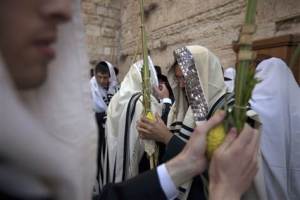
Jesus, the Word, lived among human beings but only temporarily. Did that make him any less sanctified before God? Perhaps we shouldn’t be so quick to discard things we consider temporary. They could have a much longer “shelf life” than we might imagine.

“I will make with them a covenant of peace and banish wild beasts from the land, so that they may dwell securely in the wilderness and sleep in the woods. And I will make them and the places all around my hill a blessing, and I will send down the showers in their season; they shall be showers of blessing. And the trees of the field shall yield their fruit, and the earth shall yield its increase, and they shall be secure in their land. And they shall know that I am the LORD, when I break the bars of their yoke, and deliver them from the hand of those who enslaved them. They shall no more be a prey to the nations, nor shall the beasts of the land devour them. They shall dwell securely, and none shall make them afraid. And I will provide for them renowned plantations so that they shall no more be consumed with hunger in the land, and no longer suffer the reproach of the nations. And they shall know that I am the LORD their God with them, and that they, the house of Israel, are my people, declares the Lord GOD. And you are my sheep, human sheep of my pasture, and I am your God, declares the Lord GOD.” –Ezekiel 34:25-31 (ESV)

“For behold, in those days and at that time, when I restore the fortunes of Judah and Jerusalem, I will gather all the nations and bring them down to the Valley of Jehoshaphat. And I will enter into judgment with them there, on behalf of my people and my heritage Israel, because they have scattered them among the nations and have divided up my land, and have cast lots for my people, and have traded a boy for a prostitute, and have sold a girl for wine and have drunk it. –Joel 3:1-3 (ESV)

Lest you be wise in your own sight, I do not want you to be unaware of this mystery, brothers: a partial hardening has come upon Israel, until the fullness of the Gentiles has come in. And in this way all Israel will be saved, as it is written,

“The Deliverer will come from Zion,
he will banish ungodliness from Jacob”;
“and this will be my covenant with them
when I take away their sins.” –Romans 11:25-27 (ESV)

Unless God was leaving out some important details, He never seemed to indicate that the Children of Israel would be a people before Him only up to a certain time, and then He’d toss them aside like a bowl of hummus that had been left out in the sun too long. In fact, it seems as if He plans to judge all of the nations that have treated His people Israel poorly, so perhaps the rest of us should be a little cautious when we casually claim that we have replaced “the apple of His eye.” For those Christians who are reading this who are still convinced that Jews and Judaism are “dead” in the eyes of God and as seen through the lens of the Davidic covenant, remember that God can resurrect human beings and even a nation of “dry bones” (Ezekiel 37:1-14). Israel is not “cut off.” Israel has hope. God will place flesh upon all of Israel and Israel will be restored. In fact, God is restoring Israel right now, before our very eyes.

We have a picture, based on John 1 of the Messiah temporarily dwelling among his people Israel and then leaving again. We have a picture of the Jewish people, based on Romans 11 temporarily being “hardened” against the Messiah. We also have this.

And I heard the number of the sealed, 144,000, sealed from every tribe of the sons of Israel… After this I looked, and behold, a great multitude that no one could number, from every nation, from all tribes and peoples and languages, standing before the throne and before the Lamb, clothed in white robes, with palm branches in their hands, and crying out with a loud voice, “Salvation belongs to our God who sits on the throne, and to the Lamb!” –Revelation 7:4,9-10 (ESV)

Then the angel showed me the river of the water of life, bright as crystal, flowing from the throne of God and of the Lamb through the middle of the street of the city; also, on either side of the river, the tree of life with its twelve kinds of fruit, yielding its fruit each month. The leaves of the tree were for the healing of the nations. No longer will there be anything accursed, but the throne of God and of the Lamb will be in it, and his servants will worship him. They will see his face, and his name will be on their foreheads. And night will be no more. They will need no light of lamp or sun, for the Lord God will be their light, and they will reign forever and ever. –Revelation 22:1-5 (ESV)

Here we see that the “temporary” Lamb is now permanent and the “temporary” tribes of Israel are now permanent, and we also see that “a great multitude…from every nation, from all tribes and peoples and languages” will be “standing before the throne and before the Lamb.” Jesus is permanent though he was once temporarily on the Earth. The tribes of Israel are permanent though they temporarily were hardened to the Messiah for the sake of the Gentiles. The Gentiles are there with the tribes of Israel and with the Lamb, not as second-class citizens, but co-citizens with Israel in the Kingdom, and the Lamb is the Lamb for us all.

One God, One Lamb, One throne, One Kingdom. One shepherd over two folds in one pen.

I am the good shepherd. I know my own and my own know me, just as the Father knows me and I know the Father; and I lay down my life for the sheep. And I have other sheep that are not of this fold. I must bring them also, and they will listen to my voice. So there will be one flock, one shepherd. –John 10:14-16

I don’t know how it all works or how it will all work out, but I trust that it will all work out between God and His people Israel, and we Gentile Christians, His people who were placed in His hand by Jesus. And in the end, we will all be seated together at the feast of Abraham, Isaac, and Jacob (Matthew 8:11) and we will all be at peace and none will make us afraid (Micah 4:4) “for the mouth of the LORD of hosts has spoken.”

Beshalach: Waiting for the Bread of Heaven

The purpose of the manna was to uplift those who ate it and heighten their spiritual consciousness. As a result of this spiritual boost, the Jews were able to “follow My teaching”—to receive the Torah, as it is indeed stated in the Midrash: (Mechilta ad loc) “The Torah could only have been given to those who had partaken of the manna.” (Sefer HaMa’amarim Melukat, vol. 1, pp. 238-239.)

-From the Kehot Chumash
Chassidic Insights for Parshah Beshalach
Chapter 16
Based on the works of the Lubavitcher Rebbe
Rabbi Menachem Mendel Schneerson, of righteous memory
Chabad.org

And he humbled you and let you hunger and fed you with manna, which you did not know, nor did your fathers know, that he might make you know that man does not live by bread alone, but man lives by every word that comes from the mouth of the LORD. Deuteronomy 8:3 (ESV)

And the tempter came and said to him, “If you are the Son of God, command these stones to become loaves of bread.” But he answered, “It is written,
“‘Man shall not live by bread alone,
but by every word that comes from the mouth of God.’”
Matthew 4:3-4 (ESV)

It may be strange to think of us today as waiting for our bread from Heaven, but I think that’s exactly what we do at times. Think about what it meant to the Children of Israel in the wilderness to wait on God for their bread. Although they had vast herds of livestock with them, they still have no reliable source of “daily bread,” especially enough to feed millions of people, morning, noon, and night. In this, they were completely reliant on God for their food and drink and without Him, they could do nothing.

As slaves, the Israelites depended on the Egyptians for their food and drink (and housing and everything else), and even though life was hard and often brutal, they were used to it, as a convict becomes used to a long term in prison. There was a routine. There were expectations that were fulfilled day in and day out. Breakfast would come tomorrow from the Egyptians because it came yesterday, and the day before, and last year, and in the days of their fathers and grandfathers.

But they weren’t used to waiting on God. They were together as a people, but they felt alone. They were free, but they were in a strange and unpredictable environment. The Egyptians were men and the Israelites understood how men could provide bread, but God is not a man and who can possibly understand manna?

So they were afraid, and they doubted, and they complained, and they tested God. This was a mistake, but it was a completely understandable one. But did God understand?

“You shall not put the LORD your God to the test, as you tested him at Massah. –Deuteronomy 6:16 (ESV)

Jesus said to him, “Again it is written, ‘You shall not put the Lord your God to the test.’” –Matthew 4:7 (ESV)

It certainly doesn’t sound that way, but then again, how could God possibly misunderstand His creations? How can He possibly misunderstand us, when we too are waiting for our “bread from Heaven” and we feel alone, and afraid, and uncertain?

It’s even more confusing when God sets up a schedule and then creates an exception:

Interestingly, Moses does not tell the Jews that the manna will not be in the field, but only that they will not find it there. And indeed, the manna was esoterically present on the Sabbath as well. The Sabbath is the source of all blessings, including those of material sustenance. In this sense, the manna of the other six days descended as a result of the “spiritual manna” that was produced on the Sabbath. (Zohar 2:63b, 88a.)

The physical manna gathered during the week “materialized” out of this spiritual manna. It therefore had to be acquired through physical effort: it had to be gathered, cooked, and so on. In contrast, the Sabbath manna was not manifested physically and therefore could not be “accessed” by any physical means.

Similarly, our physical livelihood is spiritually “produced” by our observance of the Sabbath. During the ensuing week, we have to gather the material blessings of the Sabbath by engaging in our weekday work. But on the Sabbath itself, we must refrain even from thinking about our livelihood. (Likutei Sichot, vol. 16, pp. 181-182.)

-Chassidic Insights commentary continued

This is certainly a very mystic interpretation, but it teaches us something beyond the literal telling of the tale of manna in the desert. Whether we believe we provide for ourselves through the work of our hands and our minds, in reality, everything we think belongs to us was produced by and belongs to God. Beyond that, it shows us that in some manner or fashion, the Shabbat rest results in producing what we need from God and ourselves for the other six days of the week. That’s why we give thanks to Him for everything.

But what about when we ask and we don’t receive, at least right away? But what about when we ask and we don’t receive, at least in the manner we expected to receive? But what about when we ask for a fish and God gives us (seemingly) a snake instead?

“Ask, and it will be given to you; seek, and you will find; knock, and it will be opened to you. For everyone who asks receives, and the one who seeks finds, and to the one who knocks it will be opened. For which one of you, if his son asks him for bread, will give him a stone? Or if he asks for a fish, will give him a serpent? If you then, who are evil, know how to give good gifts to your children, how much more will your Father who is in heaven give good things to those who ask him! –Matthew 7:7-11 (ESV)

There’s a difference between what we need and what we want. God knows what we need, even as He knew what the Israelites in the desert needed. They didn’t ask for manna, but God knew they needed it. At first, they didn’t even know what to do with the manna, but God told Moses and Moses told the people. Eventually, the people got sick and tired of eating manna every single day, but God knew they still needed it on a regular basis and the gift that God gave continued to be His gift, regardless of whether or not it was received with gratitude.

We know that our purpose in a life created by God is not to be served but to serve. Jesus illustrated this very clearly here:

When he had washed their feet and put on his outer garments and resumed his place, he said to them, “Do you understand what I have done to you? You call me Teacher and Lord, and you are right, for so I am. If I then, your Lord and Teacher, have washed your feet, you also ought to wash one another’s feet. For I have given you an example, that you also should do just as I have done to you. Truly, truly, I say to you, a servant is not greater than his master, nor is a messenger greater than the one who sent him. If you know these things, blessed are you if you do them. –John 13:12-17

And yet, we are weak, and we need so much, and we depend on God, or we try to. There are times when we must act in order to receive from God, but there are other times when we are utterly helpless, and we can do nothing but wait.

And waiting on God to deliver His bread from Heaven is very hard. Even when it arrives, we may not recognize it for what it is, since His blessings may not come in a form we will understand. Even when we realize He has delivered His blessings, because they are not as we wanted them to be, we may be ungrateful, or hurt, or even feel betrayed that God didn’t give us what we wanted, when we wanted it, in exactly the way, shape, and form we asked for. But as difficult as it is for us, we must strive to trust God and not to question our Sovereign.

But Moses said to the people, “Have no fear! Stand by, and witness the deliverance which the Lord will work for you today; for the Egyptians whom you see today you will never see again. The Lord will battle for you; you hold your peace!” –Exodus 14:13-14 (JPS Tanakh)

“Be still, and know that I am God.
I will be exalted among the nations,
I will be exalted in the earth!” –Psalm 46:10 (ESV)

We can trust in God, if only we will wait.

You open your hand; you satisfy the desire of every living thing. –Psalm 145:16 (ESV)

His hand is opening. He’s about to help you. Wait.

Good Shabbos.