Tag Archives: halachah

Best Viewed Through a Long Telescope

phariseesThe Jewish-Christian schism in Late Antiquity has been studied from numerous points of view. This paper will approach these events by investigating the manner in which halakhic issues (questions of Jewish law) motivated the approach of the early Rabbis to the rise of the new faith, and the manner in which Rabbinic legal enactments expressed that approach as well. The eventual conclusion of the Rabbis and the Jewish community that Christianity was a separate religion and that Christians were not Jews, was intimately bound up with the Jewish laws and traditions governing personal status in the Jewish community, both for Jews by birth and proselytes. These laws, as known today, were already in full effect by the rise of Christianity. In the eyes of the Rabbis, the evolution of Christianity from a group of Jews holding heretical beliefs into a group whose members lacked the legal status of Jewish identity and, hence, constituted a separate religious community, brought about further legal rulings which were intended to separate the Christians from the Jewish community.

-Prof. Lawrence H. Schiffman
“The Halakhic Response of the Rabbis to the Rise of Christianity”
lawrenceschiffman.com

Yahnatan Lasko at the Gathering Sparks blog sent me the link to Professor Schiffman’s brief article (and with a title like that, I was surprised it was so short) with the idea that I might want to write something in response (and I’m not the only blogger in the “Messianic space” Yahnatan notified). I emailed him back with my immediate thoughts:

Schiffman seems to be saying that prior to the destruction of the Temple, he believes that Jews who believed Yeshua was the Messiah and even Divine wouldn’t have caused any sort of rejection from the larger Jewish population or authority structures since there were multiple streams of Judaism in operation, with the general expectation that they were going to disagree with each other. The destruction of the Temple was the catalyst for many things, including Jewish dispersal, the apprehension of Gentile leadership of “the Way” for the first time, the power surge of Gentiles entering that Judaism, all resulting in the shift from Messiah worship as a Jewish religion to Christ worship as a Gentile faith. As Schiffman said, the Pharisees were the only Jewish stream to remain intact after the Temple’s fall and while “the Way” also survived, it took a divergent trajectory, leading it away from Judaism, so by default, the Pharisees became the foundation for later Rabbinic Judaism.

Schiffman is being very “gentle” in his treatment of this topic. I can see a blog post coming out of this in the semi-near future. Thanks for sending the link.

Of course, Schiffman also said that Jews who had faith in Yeshua (Jesus) as Messiah were holding “heretical beliefs,” so I guess he wasn’t all that gentle, but he still seems to be treating the topic with a lighter touch than you’d expect.

I was somewhat reminded of Talmudic scholar Daniel Boyarin’s treatment of “the story of Jesus Christ” in his book The Jewish Gospels (a book I extensively reviewed in The Unmixing Bowl, The Son of Man – The Son of God, and Jesus the Traditionalist Jew).

Boyarin, of course, didn’t express personal faith in Yeshua as Messiah or assign any credibility, from his perspective, that modern Judaism could consider Jesus as Moshiach, but he is another Jewish voice saying that, given the understanding of the Torah and the Prophets in the late Second Temple period, it was certainly reasonable and credible to expect that some Jews, perhaps a large number of Jews, would have accepted Yeshua’s Messianic claim and even his Divinity.

mens-service-jewish-synagogueToday, for the vast majority of Jewish people, such thoughts are outrageous and offensive, but unwinding Jewish history and the development of Rabbinic thought back nearly twenty centuries, we encounter a different set of Judaisms than we observe in the modern era. We can’t really retrofit modern Jewish perspectives into the time of Jesus, Peter, and James anymore than the modern Church can insert post-Reformation and post-modern Christian theology and doctrine backward in time and into the original intent of the Gospel and Epistle writers, particularly Paul. Both inject massive doses of anachronism into the ancient Jewish streams of life when the Temple still stood in Jerusalem.

Today, it takes a tremendous amount of courage for any Jewish person, under any set of circumstances, to say anything even mildly complementary about the ancient Jewish stream of “the Way” and that it might be reasonable to believe that in that cultural and chronological context, Jewish people, from fishermen to scribes, might see the Messiah looking at them from the eyes of Jesus.

While our sources point to general adherence to Jewish law and practice by the earliest Christians, we must also remember that some deviation from the norms of the tannaim must have occurred already at the earliest period. Indeed, the sayings attributed by the Gospels to Jesus would lead us to believe that he may have taken a view of the halakhah that was different from that of the Pharisees,. Nonetheless, from the point of view of the halakhic standards, the early Rabbis did not see the earliest Christians as constituting a separate religious community.

-Schiffman

A number of months ago, Rabbi Dr. Carl Kinbar made a statement that I think speaks to the above-quoted comment of Professor Schiffman:

But, to complicate matters, different social groups and congregations often have their own versions of Torah that they enforce in these ways. Obviously, this situation is far from ideal.

Fortunately, God is (in my considered opinion) not a perfectionist. Even as he calls us to holiness, he understands the limitations that surround us. For the most part, then, Torah observance is essentially voluntary and variable rather than compulsory and uniform. In fact, this is exactly the situation that existed in Yeshua’s, when the vast majority of synagogues were “unaffiliated” and most Jews practiced what has been called “common Judaism.” In common Judaism, Jews kept the basics of Torah observance according to their customs but did not acknowledge the authority of the sects (including the Pharisees) to impose additional laws.
ancient-rabbi-teachingMy understanding of what Rabbi Kinbar said was that while there was a basic or core set of standards and halachah that defined Judaism as an overarching identity and practice, not only were there multiple streams of Judaism (Pharisees, Essences, and so on), but significant variations of how Torah observance was defined among “different social groups and congregations” (and I apologize to Rabbi Kinbar in advance if I’ve misunderstood anything he’s said).

What this means for us as we’re gazing into the time of the apostles, is that there were many different expressions of what we call “Judaism” back in the day, but in spite of all the distinctions, including one group who paid homage to a lowly Jewish teacher from the Galilee as the Messiah and Divine Son of God, they were all accepted as Jewish people practicing valid Judaisms.

This situation changed with the destruction of the Temple. Divisions within the people, after all, had made the orderly prosecution of the war against the Romans and the defense of the Holy City impossible. The Temple had fallen as a result. Only in unity could the people and the land be rebuilt. It was only a question of which of the sects would unify the populace.

-Schiffman

Holding all of this diversity together in a Jewish land occupied by the Roman empire was difficult enough, and more so for Jewish communities in the diaspora, but the Temple was the common denominator (even if you lived so far away that you could only afford to make the pilgrimage rarely) that defined all Jewish people everywhere. The Temple was always the center, the resting place of the Divine Presence, the only place on earth where once a year atonement was made for all of Israel.

And then it was gone.

As Schiffman points out, with their power base destroyed, the Sadducees where scattered to the winds. It could be argued that the Way, the ancient movement of Messiah worshipers, was a Pharisaic extension. We have indications that the apostle Paul not only did not abandon Jewish practice but remained Pharisaic throughout his life. Many of Yeshua’s teachings most closely fit the theology of the Pharisees. Even my Pastor said that if we lived in ancient Israel (and we were Jewish), we’d be Pharisees, because they were the “fundamentalists” of their day, the populist movement among the common Jewish people, Am Yisrael.

But the split would inevitably occur, perhaps not so much because one splinter group among the Pharisees, the Way, believed they had identified a Divine Messiah, but because a mass movement of Gentiles was entering that particular Jewish sect and, by definition, re-writing the nature of the movement as the majority Gentile membership achieved ascendency and as the Jewish membership were forced into exile, grieving a Temple and a Jerusalem left in ruins.

Of the vast numbers of Greco-Roman non-Jews who were attracted to Christianity, only a small number ever became proselytes to Judaism. The new Christianity was primarily Gentile, for it did not require its adherents to become circumcised and convert to Judaism or to observe the Law. Yet at the same time, Christianity in the Holy Land was still strongly Jewish.

As the destruction of the Temple was nearing, the differences between Judaism and Christianity were widening. By the time the Temple was destroyed, the Jewish Christians were a minority among the total number of Christians, and it was becoming clear that the future of the new religion would be dominated by Gentile Christians. Nevertheless, the tannaim still came into contact primarily with Jewish Christians and so continued to regard the Christians as Jews who had gone astray by following the teachings of Jesus.

-Schiffman

Long telescopeAccording to Schiffman’s commentary, as long as the “Christian” movement was largely controlled by Jews, it was a Judaism and Jewish people who believed that a Jewish Rabbi was actually the Messiah were still Jewish. In fact, in that time and place, it was probably a no-brainer. No one would have even questioned that any Jewish adherent to the Way wasn’t Jewish, anymore than any Jewish person today would question the “Jewishness” of a Chabad adherent believing their beloved Rebbe will one day be resurrected as the Messiah.

Schiffman said that other Jewish streams would have considered Jewish Yeshua-believers as misguided but Jewish, much as other Jewish streams might consider the Chabad and their attitude about the Rebbe today.

If today’s Jewish people (or for that matter, today’s Christians) could look through that long telescope back to the world of Peter, James, and Paul, they might gain a vision that would help them see what I see in today’s Messianic Jewish movement; a perspective that illuminates the “Jewishness” of those men and women who are observant Jews and who have put their hope in the Messiah, who once walked among his people Israel as a teacher from the Galilee who went about gathering disciples, and ended up revolutionizing the world.

FFOZ TV Review: Binding and Loosing

FFOZ Bind and LooseEpisode 17: Over the years numerous explanations have been given for what Jesus meant when he talked about binding and loosing, not the least of which is that it refers to restraining demons. In episode seventeen viewers will discover that the context of Jesus’ words is that of a legal nature. When the Jewish background to the terms “bind” and “loose” is examined, Christians can get a clearer understanding of what Messiah was teaching about. Binding and loosing in actuality refers to legal rulings in regards to the Scriptures and not spiritual warfare.

-from the Introduction to FFOZ TV: The Promise of What is to Come
Episode 17: Binding and Loosing

The Lesson: The Mystery of Binding and Loosing

I haven’t given much thought to the traditional Christian understanding of the concepts of “binding” and “loosing” since I only looked at them from a Hebrew Roots/Messianic Jewish driven perspective, however, First Fruits of Zion author and teacher Toby Janicki started with the Christian viewpoint of these ideas. He described a prayer meeting he attended when he was young where the following passage from scripture was read:

Truly, I say to you, whatever you bind on earth shall be bound in heaven, and whatever you loose on earth shall be loosed in heaven.

Matthew 18:18 (ESV)

Toby told his audience that immediately after this verse was read, the people began to pray, “We bind you Satan in the name of Jesus,” suggesting that Matthew 18:18 was a description of Jesus giving the disciples the power to “bind Satan.” I immediately thought of my recent commentary on John MacArthur as well as my conversation with my Pastor on the matter, and how both seem to take the point of view that people can’t really summon the power of the Holy Spirit to make any effective spiritual or physical changes in our world.

the mystery of binding and loosingToby brought up an interesting and useful point to this issue. If Jesus gave his disciples (i.e. “us”) the power to “bind Satan,” why would he give us the power to “loose” him as well? It doesn’t make sense.

Invoking “context is king,” Toby reads from the larger selection of scripture containing the key verse:

“If your brother sins against you, go and tell him his fault, between you and him alone. If he listens to you, you have gained your brother. But if he does not listen, take one or two others along with you, that every charge may be established by the evidence of two or three witnesses. If he refuses to listen to them, tell it to the church. And if he refuses to listen even to the church, let him be to you as a Gentile and a tax collector. Truly, I say to you, whatever you bind on earth shall be bound in heaven, and whatever you loose on earth shall be loosed in heaven. Again I say to you, if two of you agree on earth about anything they ask, it will be done for them by my Father in heaven. For where two or three are gathered in my name, there am I among them.”

Matthew 18:15-20 (ESV)

I’ve accused Christian Bible studies before about “cherry picking” specific verses in the Bible to create a particular picture or doctrine and Toby showed us how true this can be. He deconstructed this passage to show us what really seems to be happening here.

  1. “If a brother sins against you” indicates that an infraction has occurred within the congregational body, committed by an individual.
  2. The procedure of adjudicating the infraction is outlined in first the direct witness approaching the sinner, then with several witnesses, and finally the entire congregation.
  3. If the sinner continues to refuse to repent through each stage of adjudication, the congregational leaders have the authority to remove the sinner from their midst.

It’s no coincidence that it requires two or three witnesses to perform this function:

A single witness shall not stand up against any man for any iniquity or for any error, regarding any sin that he may commit; according to two witnesses or according to three witnesses shall the matter be confirmed.

Deuteronomy 19:15 (Stone Edition Tanakh)

The sequence of events described in Matthew 18:15-20 references a legal proceeding. If an infraction, error, or sin is committed, a set of legal steps is set in motion. First the individual who was offended may attempt to settle it privately, but if that isn’t effective, then two or three witnesses are brought in. Finally, if the matter cannot be settled, the entire congregation makes a decision to set the sinner out.

The two or three witnesses, according to Toby, are actually the authorities within the community who are acting as judges. Of three witnesses, at least two or all three must agree for any legal decision to be binding. This is how a Beit Din of Jewish Rabbinic court operates today. Jesus was giving his disciples the authority to make binding legal decisions for the Messianic community of “the Way.” This is also mirrored today in more than one Christian church system where the board of deacons, elders, or directors make authoritative decisions for the entire church.

Here we have the first clue:

Clue 1: Jesus’s words about “binding” and “loosing” occur in a legal context.

binding and loosing language lessonI was (again) struck by the fact that the church can (quite often) misunderstand the Bible in general and the New Testament writings in particular by ignoring the Jewish cultural, historical, and legal context of scripture. Even fundamentalist and literalist Christians will miss important and even critical details by failing to take the “Jewishness” of the Jewish scriptures (i.e. the Bible) into account.

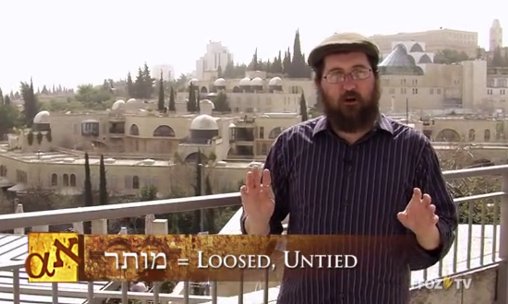
The scene shifts to FFOZ teacher and translator Aaron Eby in Israel in search of our second clue. He takes us through a small vocabulary lesson about the Hebrew words for “loose” and “loosed” as well as “bind” and “bound.” The Hebrew words for “loose” and “loosed” are understood as “prohibit” and “prohibited.” The Hebrew words for “loose” and “loosed” correspond to “permit” and “permitted” (Aaron’s actual description is more detailed and you’ll have to watch the episode to get all the information).

For instance, an Israeli “No smoking” sign in Hebrew can be literally translated as “Smoking is bound” or “prohibited.” Aaron also tells us that in religious Judaism, a particular Rabbi can prohibit or “bind” a particular activity as well as “loose” or permit an activity. A Jewish person unfamiliar with the rulings on a specific topic can consult a Rabbinic sage and receive a judgment on whether it is bound or loosed (prohibited or permitted) but it is bound (prohibited) to go from Rabbi to Rabbi in search of a favorable legal opinion.

While Toby used the English Standard Version of the Bible (purposely) from which to quote scriptures, Aaron backs up his point by referencing the Delitzsch Hebrew Gospels to read from Matthew 16:19 (a scripture we looked at just last week):

I will give you the keys of the kingdom of Heaven, and all that you forbid on earth will be forbidden in heaven, and all that you permit on earth will be permitted in heaven.

Back with Toby in the studio, he reads from the DHE Gospels, as Aaron did, but quotes Matthew 18:18 again:

Amen, I say to you, all that you forbid on the earth will be forbidden in heaven and all that you permit on earth will be permitted in heaven.

If a matter is legally decided by two or three judges or authorities within the congregation on earth, then it will be supported by the Heavenly authority as well (which makes me wonder how all that works today with so many different and contradictory Christian and Jewish groups, each issuing authoritative legal rulings for their congregations…which one(s) does/do Heaven support?).

We now have the second clue for this program:

Clue 2: “Bind” and “Loose” are figures of speech in the Hebrew.

I probably would have said that “Bind” and “Loose” are legal terms in ancient and modern religious Judaism, but you get the idea.

I was wondering why Toby needed a third clue since it seemed to me the point was well made, but he continued by quoting from the Mishnah an example of a legal ruling about fruit grown in Israel, which needs to be tithed, or grown outside Israel, which does not need to be tithed. I’ll skip the details because you will want to watch this episode without knowing everything it teaches ahead of time.

Toby also referenced Acts 15 where the Messianic community exercised their authority to bind or loose in relation to the question of whether or not Gentiles could be allowed into the community without converting to Judaism. Should Gentiles by bound or prohibited from formal entry until they legally converted, or should they be loosed or permitted to join without such a conversion?

An examination of the Acts 15 process (and remember, Luke only recorded a small summary of what was assuredly a much longer and involved proceeding) illustrates the matter of deliberations by those who possessed the authority given them by the Master, and the ultimate decision was to loose the Gentiles from conversion and full Torah obligation, although they were bound to what we refer to as the “four essentials” in order to enter (as an interesting exercise, you can try reading Acts 15 and see if you can determine the actual authorities involved [two or more judges] in making the legal ruling about the Gentiles).

Toby didn’t put it into these terms, but the Council of Apostles and Elders in Acts 15 established halachah or a legal ruling about the procedure of Gentile admittance into “the Way.”

Clue 3: Examples from Rabbinic literature and the New Testament support the two previous clues and their conclusion.

Toby further references Isaiah 11:3-4 to establish that Messiah will also “bind” and “loose” during his reign as King and Judge, as well as Isaiah 2:3-4 to make a similar illustration.

At the end of the episode, Toby made a point of trying to “smooth things over” for whoever in his traditional Christian audience might be disappointed that they didn’t really have the power to “bind Satan” based on Matthew 18:18. He reminded everyone that elsewhere in scripture, Jesus gave the disciples the power to cast out demons, and in Revelation 20:1-2, Satan will be literally bound. I again thought of MacArthur and my Pastor, both of whom probably never believed that Christians have had the power to bind or cast out demons after the close of Biblical canon.

What Did I Learn?

ancient_beit_dinI was again taken by the fact that without an understanding of the first century Jewish Rabbinic, legal, and religious context and comprehension of the words of Jesus, it is quite possible and likely that the Church misunderstands large portions of the Biblical text. This supports my ongoing discussion with my Pastor that we grossly misunderstand Paul in those sections of scripture where he seems to denigrate the Torah and call for its practice to be abolished or “put on hold” by Jewish and Gentile disciples (not that the Gentile disciples were ever “bound” to Torah in the manner the Jewish people were).

Without the Mishnah as well as a historical understanding of how Jesus’s immediate Jewish audience and the Jewish readers of Matthew’s gospel would have comprehended these words, we will fail to learn what Jesus (or any of his apostles or disciples) are trying to teach us today. We will anachronistically read the text and make it say what translates from the Greek to the English to support erroneous doctrine. We’ve seen over the majority of the Church’s supersessionistic history how making such errors has led to Christianity as a whole committing heinous atrocities, all in the “name of Christ.”

I also saw a minor but interesting point in Isaiah 2:3:

Many peoples will go and say, “Come, let us go up to the Mountain of Hashem, to the Temple of the God of Jacob, and He will teach us of His ways and we will walk in His paths. (emph. mine)

Since the word “halachah” refers to a way of walking, this also seems to link up to learning the legally binding methods of behaving in worship and devotion to the God of Jacob. In Messianic days, we, the “many peoples” from the nations, will go up to the “Mountain of Hashem,” the Holy Temple in Jerusalem, and learn the Torah of God from Messiah.

I’ve mentioned before that I believe the Acts 15 halachic decision binds Gentiles differently to the Torah than it does Jews, but it will be interesting to see how or if any of that changes once Messiah is ruling from the Throne of David in Jerusalem. I can’t wait to find out.


Moshiach Rabbeinu

rabbeinu1Believe it or not, this week’s message was not inspired by the fact that the Catholic Church has chosen a new Pope; it just offers a convenient contrast. As you probably know, there is, in their beliefs, a doctrine of papal infallibility. When the Pope teaches the rules, he is always right.

It is natural to assume that Judaism has something similar. This is especially true, given the Torah’s demand that we listen to the Rabbis and Judges, and not deviate “right or left” [Deut. 17:11] from what they say.

-Rabbi Yaakov Menken
“Everyone Makes Mistakes”
Commentary on Torah Portion Vayikra
Project Genesis

I’ve been hesitating about writing this particular “meditation” because it has the potential to be rather controversial. As part of my conversations with Pastor Randy, we’ve been discussing what is Torah? That’s an amazingly difficult question to answer. It’s not just the Five Books of Moses, and I believe that it should be at least the entire Tanakh (Old Testament). I believe a great deal of the New Testament and certainly the epistles of Paul should be considered midrash on Torah, specifically in relation to the teachings of Messiah.

As I’ve said before (and will say again when I publish “Four Questions, Part 4” tomorrow), Pastor Randy believes that the Torah is too difficult to observe perfectly and in fact, has always been too difficult to observe. This is pretty much what most of Christianity believes, and along with that, the church sees the primary purpose of Torah as always pointing to Jesus. Once Jesus came, the purpose of Torah expired and grace was substituted.

I don’t happen to believe this, and my understanding is that Jewish people, including those who are disciples of the Master, remain obligated to the Torah of Moses.

But I’m not here to talk about the Torah as such (I’ll do that tomorrow), but rather how it is applied through Rabbinic interpretation and authority. This is the really touchy part. As Rabbi Menken writes, there’s a tendency to view the sages in a manner similar to how Catholics view the Pope, as infallible and that all Rabbinic rulings are automatically correct. But is that really true? Rabbi Menken continues.

We see from this week’s reading, though, that this is definitely not the case. The Torah prescribes special atonement for when the High Priest, the King, or the Sanhedrin [Lev. 4: 13-21], the High Rabbinical Court, makes a mistake. In other words, the Torah highlights for us that it is possible for the Sanhedrin to be mistaken.

This is not about a small matter, either. The commentaries say that the mistake described here is one in which the Sanhedrin teaches that it is permitted to do something, and the Sanhedrin later realizes that the behavior is prohibited — so much so that a person committing the act deliberately would suffer the punishment of Kares, spiritual excision [the exact definition of this is disputed, but severe]. Even in matters of religious law, where the Sanhedrin’s supreme authority is undisputed — even there, they could make a mistake.

So why, then, does the Torah tell us to listen to them? They could, after all, be leading us in the wrong direction!

That is an extraordinarily good question. It’s also the question that comes to the minds of just about all Christians, including many people in the Hebrew Roots movement who believe that the Bible contains everything necessary for a Jew to observe Torah without relying on external interpretation or additional instructions.

Based upon a proof from a Baraisa, the Gemara had concluded that a lechi post is not valid if it is not recognizable from the inside, although it is visible from the outside. Yet, the Gemara proceeds to inform us that the halachah is that such a lechi is valid. Immediately, the Gemara asks, “We have disproven the validity of such a lechi, and yet the halachah rules that it is valid?!”

The Gemara continues to resolve this halachic conclusion, based upon yet another Baraisa which validates such a lechi.

This give and take, where the Gemara proves one point of view, and then immediately concludes the halachah according to the opposite opinion is relatively uncommon. A computer check reveals that it appears only five times in Shas (here, Kesuvos 41b-twice, Bava Kamma 15b-twice, Bava Metzia 22b).

Daf Yomi Digest
Distinctive Insight
“It is disproved – but yet it is the Halachah!”
Eruvin 10

That didn’t help. I admit, the complexities of Talmud escape me most of the time and yet religious Judaism in all of its variants, depends on these rulings, laws, and judgments for so very much.

My question is basic. Is literally every single ruling, judgment, halachah, and word of every sage everywhere across time valid and binding in religious Judiasm, or is it possible that at some point, the sages have gone too far?

Kapparot is a custom in which the sins of a person are symbolically transferred to a fowl. It is practiced by some Jews shortly before Yom Kippur. First, selections from Isaiah 11:9, Psalms 107:10, 14, and 17-21, and Job 33:23-24 are recited; then a rooster (for a male) or a hen (for a female) is held above the person’s head and swung in a circle three times, while the following is spoken: “This is my exchange, my substitute, my atonement; this rooster (or hen) shall go to its death, but I shall go to a good, long life, and to peace.” The hope is that the fowl, which is then donated to the poor for food, will take on any misfortune that might otherwise occur to the one who has taken part in the ritual, in punishment for his or her sins.

-Richard Schwartz, Ph.D.
“The Custom of Kapparot in the Jewish Tradition”
JewishVirtualLibrary.org

Solomons-TempleThe Torah, particularly the book of Leviticus, provides an extremely detailed description of the various sacrifices to be given at the Temple in Holy Jerusalem, and under what circumstances a Jew must present said-sacrifices. To the best of my knowledge, none of them involve the use of a chicken as described by the modern rite of kapparot. Dr. Schwartz details some of the Jewish objections to this practice.

Some Jewish leaders felt that people would misunderstand the significance of the ritual. The belief that the ceremony of kapparot can transfer a person’s sins to a bird, and that his or her sins would then be completely eradicated, is contrary to Jewish teachings. For, if the ritual could remove a person’s sins, what would be the need for Yom Kippur, the Day of Atonement?

The Mishneh Brurah, an eminent contemporary commentary on Rabbi Joseph Caro’s classical codification of Jewish law, explains the significance of the ritual. Judaism stresses that a person can’t obtain purity from sin, and thus obtain higher levels of perfection, without repenting. Through God’s mercy, we are given the Divine gift of repentance, so that we might abandon our corrupt ways, thereby being spared from the death that we deserve for our violation of the Divine law. By substituting the death of a fowl, one will (hopefully) appreciate G-d’s mercy and be stirred to repentance. By no means, however, does the ritual and the slaughter of the bird eradicate one’s misdeeds, even though the bird is donated to the poor.

If a Jewish person is a disciple of the Master and has studied and accepted the teachings in the Apostolic Scriptures, he or she understands that this particular ritual is not meaningful or necessary. The sins of anyone, Jew or Gentile, who has accepted Jesus (Hebrew: Yeshua) as Savior, Lord, and Messiah, have been forgiven. He died, paying the price for our sin as the ultimate atonement, and when we repent (and we must repent) of our own sins, turning away from them, and turning to God, we are forgiven once and for all without the need for further sacrifices.

So how are we to reconcile the rulings of the sages in relation to the kapparot involving chickens during Yom Kippur and the reality of the Messiah? The better question is, how are Messianic Jews to reconcile this along with any other Jewish practices that seem to contradict the teachings and life of the Master?

The Messianic Jewish Rabbinical Council has established official halachah for its member synagogues and individual members, but that’s hardly a universal standard. On the other hand, how halachah is applied across the rest of the religious Jewish landscape is not entirely consistent either. For example, we can point to the radically extreme differences between how the Haridim vs. Reform Judaism live out Jewish lives they believe are consistent with observing Torah.

It’s obvious that Messianic Judaism has to make a few “adjustments” to how some of the Rabbinic rulings are applied, but even given that, are we to understand that all of the remaining body of Mishnah is fully correct and fully valid? If we accept that the Torah doesn’t change (and there are those who debate even that), can we accept that Jewish interpretation is adaptive and evolutionary across time and culture? I had a recent Facebook conversation that included the following:

There are enduring realities in the Torah…the Shema is one…The pursuit of Justice is another…however there are changes in the way Torah is embraced…David recognizes that G-d wants a contrite and broken heart, not burnt offerings (Psalm 51) Micah gives the same notion (Micah 6)…so there is an evolutionary understanding of the nature and character of G-d that takes place…

David is specific…”burnt offerings you do not desire”…but a contrite broken heart….quite removed from the harsh Levitical code of bloody sacrifices…and those scriptures reflect evolving understanding of the nature and character of G-d…Jesus in the John 8 narrative lays aside the penalty that the Torah prescribes and challenges the lack of personal holiness/integrity of the woman’s accusers…

Part of the problem is that we can “interpret” the Bible to mean just about anything. If we give the Rabbinic sages (or anyone) carte blanche to establish binding interpretations and halachah for their specific streams of Judaism, are they always consistent with God’s intent for the Jewish observance of Torah?

There’s no way to know for sure. Well, there’s one.

Then Jesus said to the crowds and to his disciples, “The scribes and the Pharisees sit on Moses’ seat, so do and observe whatever they tell you, but not the works they do. For they preach, but do not practice. They tie up heavy burdens, hard to bear, and lay them on people’s shoulders, but they themselves are not willing to move them with their finger.

Matthew 23:1-4 (ESV)

phariseesEven as Jesus confirmed that the scribes and Pharisees did indeed have the authority to create binding halachah upon the Jewish people of his day (see the paper Matthew 23:2–4: Does Jesus Recognize the Authority of the Pharisses and Does He Endorse their Halakhah? (PDF) by Noel S. Rabbinowitz, JETS 46/3 (September 2003) 423-47 for details), he also criticized them for failing to follow their own rules. However, he didn’t agree with each and every one of their rulings.

Again he entered the synagogue, and a man was there with a withered hand. And they watched Jesus, to see whether he would heal him on the Sabbath, so that they might accuse him. And he said to the man with the withered hand, “Come here.” And he said to them, “Is it lawful on the Sabbath to do good or to do harm, to save life or to kill?” But they were silent. And he looked around at them with anger, grieved at their hardness of heart, and said to the man, “Stretch out your hand.” He stretched it out, and his hand was restored.

Mark 3:1-5 (ESV)

Now when the Pharisees gathered to him, with some of the scribes who had come from Jerusalem, they saw that some of his disciples ate with hands that were defiled, that is, unwashed. (For the Pharisees and all the Jews do not eat unless they wash their hands properly, holding to the tradition of the elders, and when they come from the marketplace, they do not eat unless they wash. And there are many other traditions that they observe, such as the washing of cups and pots and copper vessels and dining couches.) And the Pharisees and the scribes asked him, “Why do your disciples not walk according to the tradition of the elders, but eat with defiled hands?” And he said to them, “Well did Isaiah prophesy of you hypocrites, as it is written,

“‘This people honors me with their lips,
but their heart is far from me;
in vain do they worship me,
teaching as doctrines the commandments of men.’

You leave the commandment of God and hold to the tradition of men.”

Mark 7:1-8 (ESV)

So what does all this mean?

  • There are some modern Jewish rituals and customs that contradict the reality of the risen Messiah.
  • Jewish ritual and tradition is not applied with universal consistency across all religious Jewish communities and across time.
  • Historically, Jesus affirmed the right of the ancient Pharisees and scribes to establish binding halachah for Jews.
  • Historically, Jesus refuted some of the halakhic rulings by the Pharisees and scribes and offered correction and criticism when necessary.
  • At least one modern Messianic Jewish body has offered an adaptation to Jewish halachah that is more consistent with the reality of the risen Messiah.

Oh. We know one more thing:

The nations will send their emissaries to the King Messiah, and the King Messiah will teach the world how to live in peace, and how to want to live in peace. Then, everyone in the world will enjoy eternal peace, for as long as this world will last. The great Rabbi, Rav Shlomoh Freifeld, of blessed memory, said in a talk he once gave that I attended that the Messiah will be a great teacher.

-from “What is the Messiah Supposed to Do”
BeingJewish.com

He will restore the religious court system of Israel and establish Jewish law as the law of the land (Jeremiah 33:15).

-from “Mashiach: The Messiah”
Judaism 101

It is my understanding that one of the things many Jewish people believe the Messiah will do is to teach Torah, to teach the correct interpretation of Torah and how it is to be lived out. According to BeingJewish.com, as we saw above, he will even teach the Gentiles peace.

So what am I getting at?

This is Rabbi Menken’s solution to understanding the puzzle.

One answer has to do with the power of unity. Different customs and practices are wonderful, but there has to be underlying agreement on “the basics.” One of the problems with calling different Chassidic groups “sects” is that a sect is “a dissenting or schismatic religious body.” Chassidic groups may be led by different Rebbes, but they don’t rewrite the rules. The disagreements of today are disagreements about shapes of branches on individual trees within a massive, unified forest.

And there is another answer, which requires still more humility. It is all well and good to say that everyone is fallible — but who is more likely to be making a mistake? The Torah gives leadership to people who dedicate themselves completely to Torah study, to learning the Torah’s “way of thinking.” Such people are inherently less biased by the latest news reports and the wise opinions of the chattering class, as we are. We recognize that it is much less likely that they will make a mistake, and that is why we trust their guidance.

torah-tree-of-lifeIs there a “unified forest” of Torah? I think there must be, otherwise there is nothing for Jews to observe except traditions (the shapes of branches on the individual trees); there is no root, no foundation, no sense of an absolute God who has core standards that are as unchanging as He is. Beyond a certain point, we can’t simply re-invent the Bible to fit our modern sensibilities so that they agree with whatever “politically correct” causes that may be popular this week, this month, or this year. If we did, our faith (and our God) would be no more consistent or eternal than the shifting viewpoints of a political party or social agenda.

Rabbi Maurice Lamm says in “What is Torah” published at Aish.com:

In fact, far from being enslaved by the law, Jews were enamored of it. We cannot take our leave of the subject of Torah without expressing this most characteristic sentiment of Jewish literature – the love of Torah.

You may ask: can a people “love” a law? Yet, that is the exquisite paradox inherent in the concept of Torah – it is respected and studied and feared, while it is loved and embraced and kissed. All at once. There is no good in this world – no ideal, no blessing, no perfection, no glory – unless it is associated with the law.

To Jews, the Torah is “light”; it is the “glory of the sons of man”; it is the energizing sap of life for “the dry bones” (Ezekiel 37:4) which symbolize the “people in whom there is not the sap of the commandment.”

To Jews, the law is mayim chayim, refreshing, life-restoring, living waters to Jews; the sweetness of honey and milk, the joy and strength of wine, and the healing power of oil. It is an “elixir of life” that brings healing to all.

In Acts 15, Peter called the Law a burden but in Acts 21, Paul defended his observance of the Law. We also see in that same chapter that many of the Jews in Messiah were zealous for the Law.

And God, through Moses, said this about the Torah.

“For this commandment that I command you today is not too hard for you, neither is it far off. It is not in heaven, that you should say, ‘Who will ascend to heaven for us and bring it to us, that we may hear it and do it?’ Neither is it beyond the sea, that you should say, ‘Who will go over the sea for us and bring it to us, that we may hear it and do it?’ But the word is very near you. It is in your mouth and in your heart, so that you can do it.”

Deuteronomy 30:11-14

I think that for the Jewish people, there is an “ideal” Torah, a Torah that God intends for His people Israel. As we’ve seen in the record of the Bible, all things being equal, human beings will mess up a free lunch. We take everything God gives us and turn it on its side, we fold, spindle, or mutilate it, drag it through the mud, drag it through our biases, prejudices, and personalities, drag it through our theologies, our doctrines, our translations, and eventually on the other side, we come out with some approximation of what God wants us to say, do, and be.

How close are all of our approximations to the desires of God, how near is our fidelity to the original? Opinions vary widely. It’s not that we are dishonest and it’s not that we don’t want to do His will as opposed to our will (most of the time, anyway), but we are human beings. Everything we are as flawed, mortal beings gets in the way of everything He is as a perfect, immortal God.

That’s where Messiah comes in. Being human and divine, he can provide (and has provided) the correct “interface” for us. He is a teacher. When he comes, whatever we’ve gotten wrong, he’ll help us understand correctly.

If there’s an answer to how the Law is infinitely accessible, and a delight, and a light, and to be loved by those who have received it from Him, that answer comes on the clouds with Messiah. God is a teacher.

Shammai, Peter, and Cornelius

hillel_shammaiShammai’s school of thought became known as the House of Shammai (Hebrew: Beth Shammai‎), as Hillel’s was known as the House of Hillel (Beit Hillel). After Menahem the Essene had resigned the office of Av Beit Din (or vice-president) of the Sanhedrin, Shammai was elected to it, Hillel being at the time president. After Hillel died, circa 20 CE, Shammai took his place as president but no vice-president from the minority was elected so that the school of Shammai attained complete ascendancy, during which Shammai passed “18 ordinances” in conformity with his ideas. The Talmud states that when he passed one of the ordinances, contrary to the opinion of Hillel, the day “was as grievous to Israel as the day when the [golden] calf was made” (Shabbat, 17a). The exact content of the ordinances is not known, but they seem to have been designed to strengthen Jewish identity by insisting on stringent separation between Jews and gentiles, an approach that was regarded as divisive and misanthropic by Shammai’s opponents.

Wikipedia

And he said to them, “You yourselves know how unlawful it is for a Jew to associate with or to visit anyone of another nation, but God has shown me that I should not call any person common or unclean.”

Acts 10:28 (ESV)

I suppose I could have called this blog post, “Things I Learned in Church Today,” but then, I’d have a lot of blog posts with the same title. I recently came across a “statistic” on a blog (it’s not based on any real data) that said the vast majority of Christianity, something like “99.99999999999%” is “anti-Judaic.” I’ll agree that the church has a rather poor track record relative to Jews, Judaism, and Israel, but that’s changing. I know because the church I attend is very pro Jews, Judaism, and Israel. It’s not just the Pastoral staff but the regular members, too. In my Sunday school class, the teacher, who by trade is an electrical contractor, opined on how much we Christians owe the Jewish people at the very start of class.

But what did I learn in church about Jews, Judaism, and Acts 10? I learned about something called the “18 measures.” Apparently, this was something debated between Hillel and Shammai and while the specifics of these “measures” crafted by Shammai are no longer known, two of them were said to be “anti-Gentile.” Pastor Randy came to speak with me right before services began and shared what he had found out during his research. He said that one of the measures of Shammai stated that it was “unlawful” for a Jew to enter a Gentile’s home because it would be possible for a corpse to be present without the Jew’s knowledge (resulting in ritual defilement: see Num. 19:11-16). This could include a dead person buried under the house, since it seems it was the custom in some households to bury the family patriarch under the structure.

Or was Shammai looking for excuses to keep Jews and Gentiles apart? After all, Israel was occupied by Gentile forces and the Romans never went out of their way to be friendly or courteous to the Jewish population. Quite the opposite in fact. The Jews had good reason to want to avoid Gentiles and particularly Roman soldiers.

Was this part of what Peter was thinking of when he was confronted by God with the news that he was to visit the household of a Roman Centurion? In the above-quoted passage from Acts 10, the greek word translated as “unlawful” as in “how unlawful it is for a Jew to associate…” isn’t the word for “Law,” but the word for “tradition.” Basically, Peter was telling Cornelius that it was against halakhah for a Jew to enter the home of a Gentile because the Jew might well become ritualistically “unclean.” God showed Peter the contradiction (in this case) between the prevailing halakhah of his day and the teachings of God that no human being is “unclean.”

I don’t know if Peter was specifically thinking of Shammai during this whole transaction, but it’s certainly within the realm of possibility.

But am I being too hard on Shammai?

Shammai is a much misunderstood character and you malign him with your words…. according to the Mishnah in Treatise Avot, one of Shammai’s favourite sayings was “Always receive all men with a cheerful expression on your face!” (Avot, chapter 1, para. 15)

-ProfBenTziyyon, 18 Jan 09
http://messiahtruth.yuku.com

I’m not trying to be hard on Shammai or for that matter, on Peter. I did think this was an interesting detail that works to “flesh out” the humanity and the lived context for Peter as he was faced with doing a very hard thing. About fifteen years earlier, Jesus gave his Jewish disciples the “commission” to make disciples out of the Gentiles, but as far as we know, that command received no attention until the Master spurred Peter into action using a vision (Acts 10:9-16).

In this case however, if Peter has responded to halakhah rather than God, the good news of Christ would never have come to Cornelius and his household and arguably the rest of us would have suffered the same fate. Or God would have chosen a different messenger, but He chose Peter. It was Peter who had to grow beyond his prejudices and perhaps only a Jewish apostle could deliver the Gospel to the Gentiles. I mean, the angel (Acts 10:3-6) could have told Cornelius everything he needed to know, but it was more than just information that needed to be delivered, it was the forging of new connections and relationships. While Cornelius, a Roman Centurion, was a “God-fearing man, who is well spoken of by the whole Jewish nation,” God had a far better destiny for him as one of first Gentiles to ever receive the Holy Spirit and be reconciled to God. Peter, for his part, and his Jewish companions needed to be witnesses and to see for themselves that “God shows no partiality, but in every nation anyone who fears him and does what is right is acceptable to him.” They needed to see that even the Gentiles could receive the Spirit and be saved, even as the Jews had done.

This, as much as anything else in the Bible, was an incredible miracle, because God so loved the world.

What biases and prejudices prevent you and me from doing the will of God?

According to the Traditions: A Primer for Christians

paul-edited

In his letters to the Thessalonians, Paul frequently referred back to the teaching he passed on to them. For example, he wrote, “Now we command you, brethren, in the name of our Lord Yeshua the Messiah, that you keep away from every brother who leads an unruly life and not according to the traditions (paradosis) which you received from us.” (2 Thessalonians 3:6). In the New Testament, the Greek word “paradosis” refers to Jewish oral tradition. The gospels of Matthew and Mark use the same word to describe Jewish traditions such as washing hands before eating bread and so forth. Paul also used the word in the context of Pharisaic traditions.
Nevertheless, the “paradosis” Paul and Silas imparted to the Thessalonians did not consist of the type of halachic teachings that characterize the legal wrangling of Mishnaic law. Paul and Silas delivered to the community specific commandments in the name of the Master:

We request and exhort you in the Master Yeshua, that as you received from us instruction as to how you ought to walk and please God (just as you actually do walk), that you excel still more. For you know what commandments we gave you by the authority of the Master Yeshua.

1 Thessalonians 4:1-2

What commandments did they transmit in the name and authority of the Master Yeshua?

-D. Thomas Lancaster
Torah Club, Volume 6: Chronicles of the Apostles
from First Fruits of Zion (FFOZ)
Torah Portion Terumah (“Heave Offering”) pg 496
Commentary on Acts 15:36-17:14

I’ve been spending a lot of time this week (and previously) discussing the important role halachah plays in Jewish religious observance, including in the practice of Messianic Judaism. I thought it only fair to give some time to the other side of the coin. What was halachah like for the non-Jewish believers in the Jewish Messiah?

In my Return to Jerusalem series, I spent some time going over Lancaster’s Torah Club commentary on Acts 15 and particularly on the halachah James and the Council of Apostles issued on behalf of the new Gentile disciples. James started with the “four prohibitions” (Acts 15:19-20) and added what some consider a rather cryptic comment that “from ancient generations Moses has had in every city those who proclaim him, for he is read every Sabbath in the synagogues” (v.21), likely indicating that the details or foundations of what the Gentile disciples needed to know would be learned in a more lengthy manner by hearing and studying the Torah as it applied to them (and applies to us today).

Just as a refresher, let’s recall the moment when Jesus gave the apostles the authority to issue binding legal rulings on earth for the community of Jewish and non-Jewish believers:

Truly, I say to you, whatever you bind on earth shall be bound in heaven, and whatever you loose on earth shall be loosed in heaven. Again I say to you, if two of you agree on earth about anything they ask, it will be done for them by my Father in heaven.

Matthew 18:18-19 (ESV)

Thus, just as other Rabbis did for their disciples, allowing them to issue and adapt halachah in order to “operationalize” Torah observance, Jesus issued such authority to his apostles, the difference being that the Messiah’s authority extends infinitely beyond any earthly teacher.

rabbinBut then we are left with the question about just exactly what was the halachah for the Gentile disciples relative to obedience to God? Often, the “four prohibitions” are criticized for being rather anemic about details and obviously lacking in addressing the “obvious” commandments, such as those involving murder, theft, coveting, and so on. Some Christians have suggested that, because of the lack of detail, the intent was for the Gentile disciples to observe the Torah and halachah in an identical manner to the Jewish disciples. On the other hand, we see in the words of Paul to the Thessalonians and in Lancaster’s take on them, that Paul (and presumably the other apostles who were ministering to the non-Jewish disciples) where issuing instructions to the Gentiles both in terms of general teachings and as particular situations came up.

I borrowed a quickie explanation of the role of halachah that should help us from someone on Facebook:

In every branch of Judaism you have set guidelines that those who are under that group agree to, at least on the face, but how and where they are applied varies. As to the rabbis giving rulings here are a few things to remember; 1) halakah is always being reviewed as times change to see the best way to apply the basics, 2) those who establish the halakah are usually well versed in the issues so they can make wise decisions. Think of it this way. Its like a Jewish supreme court. The principles remain the same. The rulings affect the community at large, and just like any court system, there will be times when we need to ‘ go back to the books” In this case Torah and rabbinic writings. For example; the basic halakah for observing Shabbat is to do no normal work that day. However, if your job is being a firefighter, policeman, etc. then what? The answer is that since saving a life outweighs all else working is not only ok but actually a mitzva.

So halachah isn’t necessarily supposed to be “timeless truth” that is immutable across all of history. It’s supposed to be a method of living out the commandments of Torah that are specific to a time, place, culture, and so on. Halachah can’t contradict the words of Torah but it can shape the nature of how to apply a commandment given some specific detail (should one drive their car to Shabbat services, for instance).

As Lancaster points out in his commentary, the Gospels hadn’t yet been written, so the teachings of the Master as we have them today did not exist in a documented form. If some missionaries were “planting a church” in a foreign land today and they were about to depart, the missionaries could leave copies of the Bible behind, including the Gospels, but that wasn’t possible in the days of Paul and Silas. Thus, from Paul’s perspective, the teachings of Jesus were considered paradosis, the operationalization of how to obey God and applied to a local community’s situation or circumstances.

In 1 Thessalonians 4:3-12, Paul mentioned the prohibition on sexual immorality, and he contrasted the standards of “the Gentiles who do not know God” against the sexual purity he expected from believers. He cited prohibitions on defrauding a brother and warned against moral impurity. He reminded the disciples about the commandment to love one’s neighbor as oneself.

Paul boasted, “You also became imitators of us and of the Master” (1 Thessalonians 1:6). In his second epistle to Thessalonica, he encouraged the disciples to “stand firm and hold to the paradosis which you were taught, whether by word of mouth or by letter from us” (2 Thessalonians 2:15).

-Lancaster, pg 497

ancient-rabbi-teachingSo according to Lancaster, we can reasonably believe that Paul was issuing rulings of halachah to the newly minted Gentile disciples (both those who had been former God-fearers and those who had only recently been worshiping in pagan temples) based on the teachings of Jesus and adapted to the local communities he was addressing. I say “adapted” not to say that the teachings were changed, just “contextualized” for those receiving his message. For instance, Paul might take a specific teaching such as the prohibition against looking at a woman with lust (Matthew 5:27-28) and applied it to a community where a problem with extramarital affairs was apparent, citing circumstances that were specific to that community. That “halachah” may not necessarily apply in the same way to other communities or even to the same community in the future, assuming circumstances change.

It’s kind of a difficult thing to get your brain around if you are not used to thinking in these terms, but Paul had quite a job to do in educating the various non-Jewish “churches” on ethical monotheism, the teachings of the Master, their basis in Torah, and the Apostolic decree from Jerusalem.

And in looking back across history at all of this, we have a problem.

While reading the narrative in the Acts of the Apostles or the content of Paul’s epistles to his congregations, readers should keep in mind that we are without the vast body of the paradosis that Paul passed on to his communities. In general, his writings express concern only with issues which had arisen as problems within the communities or his perspectives that contradicted those other teachers. That narrow expression sometimes creates the false impression that Paul was at odds with Judaism in general and with the rest of the apostles specifically. The reader should remember that the larger body of unrecorded paradosis taught by Paul was consistent with the teaching of Yeshua, the twelve, the rest of the apostles, and the Jewish community.

-Lancaster, ibid

If someone could have pinned Paul down and had him write a book compiling all of the paradosis he taught and then we inserted that book into our Bibles, we might have a far different impression of what it is to be a Christian than we do today, and history between the Jewish and non-Jewish disciples might have charted a different course (well, probably not, but I can dream). But it didn’t happen that way, so it looks like we must exist with gaps in our knowledge, and experience an uncomfortable tension between who we are today in the church and how the first Gentile Christians in Paul’s communities understood who they were.

Originally, the Jewish Council of Apostles and their emissaries, which included Paul, were charged with guiding the Gentile disciples in the teachings of the Messiah including issuing halachah that had general scope across the entire body of believers, and sometimes a more specific scope within a particular community. But only Acts and Paul’s letters stand as witnesses to what that was and what it all meant. But if we have faith not only in God but in the Word that He left for us, then we must believe that the Bible is sufficient for our needs. I’ve heard some people weave this sort of “conspiracy theory” or that about how the Bible’s canon was manipulated to drive Gentile Christianity away from its “Hebrew roots,” but we can’t rewrite nearly 2,000 years of history.

two-roads-joinWe can however, chart a course into the future. I continue to maintain that relationships between believing Jews and believing Gentiles are slowly improving. Part of what contributes to that effort is the struggle to understand where we came from and what that means for us today. Christianity must look beyond its traditional doctrine and dogma and try to see the looming shadow of the Jewish Messiah King as he dons his sword, readies his steed, and prepares to return to the world we all live in. If we ever hope to truly understand the Messiah and King we call “Savior” and “Lord,” then we must try to understand not only the “Jewish Jesus,” but the apostles and emissaries he left to guide the first Gentile disciples into “Christianity.”

I’m not writing all this to answer questions but to pose possibilities. If there is halachot that applies to Jewish practice today, then there is something corresponding that applies to the church as well. We can’t fully recover everything Paul taught but we can acknowledge that the traditions regarding how the Jewish disciples understood the process of teaching and applying commandments aren’t so different after all, from what was taught to the non-Jewish disciples. I don’t intend to delete distinctions between Jewish and Gentile disciples, either historically or as they exist today. I only want to say that we may also have a few things in common. We share the same God. We share the same Messiah. And back in the day, we shared the same teachers who all taught application of commandments in terms of paradosis, according to the traditions.

If I Should Ever Forget Your Torah

Rescuing_torah_scroll_Beth_IsraelRashi on the Chumash (Devarim 31:21) comments and says that this verse serves as a promise that the Torah will never be forgotten from the Jewish people totally – ‫.לגמרי‬

There is a discussion among the commentators how to interpret the meaning of this promise. When the verse says that “Torah” will not be forgotten, Rashi understands that we are assured that the song of Ha’azinu will never be forgotten. This song will remain as testimony for the Jewish people for all generations, and its lesson of the trials and tribulations of the nation and its destiny will accompany them on their trek through history. However, there never was a promise that the rest of the Torah would be remembered forever. This, then, is what Rashi alludes to when he comments that the Torah will never be forgotten “totally”, because the song of Ha’azinu will always remain. This is also how Maharsha understands the statement of Rebbe Shimon ben Yochai in our Gemara.

Maharshal understands that the promise in the verse refers to the written Torah. However, it is the oral teachings that are vulnerable, and there is a danger of their possibly being forgotten. This explanation fits into the narrative of the Gemara, where we find that the day will come when a woman will take a loaf of bread and circulate among the shuls and batei midrash to find out if the loaf is tamei or tahor, but no one will be able to answer her question. The Gemara then asks how this can be so, for the halachah of tum’ah of bread is explicit in the verse (Vayikra 11:34)! Now, if the written Torah itself is not guaranteed to be intact and remembered, it would still be possible for the explicit information of the verses to be forgotten. It must be, explains Maharshal, that the Gemara knows that the written Torah will always be remembered.

Yet even according to Rashi, although the promise of continuity was only made in reference to the song of Ha’azinu, the halachah is that this shira cannot be written by itself (Rambam, Hilchos Sefer Torah 7:1). Therefore, if the song of Ha’azinu will remain forever, it will necessarily require that the rest of the written Torah accompany it in the same scroll. Therefore, the promise of Ha’azinu never being forgotten automatically indicates that the rest of the written Torah, as well, will never be lost.

Daf Yomi Digest
Gemara Gem
“The Torah will never be forgotten”
Shabbos 138

My father writes in one of his letters: A single act is better than a thousand groans. Our G-d lives, and Torah and mitzvot are eternal; quit the groaning and work hard in actual avoda, and G-d will be gracious to you.

“Today’s Day”
Monday, Adar Sheini 8, 5703
Compiled by the Lubavitcher Rebbe
Translated by Yitschak Meir Kagan
Chabad.org

For the vast majority of Christians, reading what I’ve just quoted above won’t make a great deal of sense, especially when we focus on the sure promises we have through salvation in Jesus Christ, but since I’ve been talking about Jewish identity in the body of Messiah lately, I thought those words applied. More specifically, I think it’s important for we in the church to try to comprehend what a sense of identity as a Jew means to many Jewish people, including those who have accepted Jesus (Yeshua) as the Jewish Messiah. Most of Christian history has created a sort of “reflexive expectation” in the church that results in our anticipating that Jewish believers should look and act like the Gentile believers, and that the things of Judaism (lighting candles on Erev Shabbat, davening with a siddur while wearing a tallit gadol and laying tefillin, keeping glatt kosher, and so forth) should simply go “bye-bye.”

This is at the heart of much of the debate between the halachically Jewish members of Messianic Judaism, and the Christians in the church, as well as many Christians attending Hebrew Roots groups. We non-Jews keep asking ourselves and the Jews who revere the Master what’s the big rip-roaring deal about remaining distinctively Jewish? Didn’t Paul say it was no big deal for him?

If anyone else thinks he has reason for confidence in the flesh, I have more: circumcised on the eighth day, of the people of Israel, of the tribe of Benjamin, a Hebrew of Hebrews; as to the law, a Pharisee; as to zeal, a persecutor of the church; as to righteousness under the law, blameless. But whatever gain I had, I counted as loss for the sake of Christ. Indeed, I count everything as loss because of the surpassing worth of knowing Christ Jesus my Lord. For his sake I have suffered the loss of all things and count them as rubbish, in order that I may gain Christ and be found in him, not having a righteousness of my own that comes from the law, but that which comes through faith in Christ, the righteousness from God that depends on faith—that I may know him and the power of his resurrection, and may share his sufferings, becoming like him in his death, that by any means possible I may attain the resurrection from the dead.

Philippians 3:4-11 (ESV)

paul-editedOK, Paul wasn’t saying that he exchanged his Judaism for his faith in Jesus Christ, since they are hardly mutually exclusive. He was saying that being Jewish, in and of itself, didn’t make him a “big deal” and didn’t hold a candle to everything he had gained since he had come to knowledge and faith in the Jewish Messiah. The Messiah is the goal, he opens all the doors, he holds all the keys, and compared to that, no matter who you are, it doesn’t mean as much as everything Messiah means.

But it also doesn’t mean that Paul thought being Jewish was nothing, either. He never stopped being Jewish, never stopped acting Jewish, never stopped eating, sleeping, walking, and breathing Jewish until the day he died.

And for nearly 2,000 years, the vast, vast majority of Christianity has required, demanded, insisted, and red-in-the-face screamed at the Jewish people desiring to come to Messiah to stop being Jewish as a condition of becoming a “Christian.” (and I put that word in quotes because of how it has been used against the Jewish people who are just as Jewish as their King). If we demand that they forget the Torah, that they set aside their halachah, that they extinguish their Shabbos candles for the sake of Moshiach, how are we any different from all those generations of Christians who came before us and demanded the same things or worse?

But there’s something more to consider.

Sitting at a table in a non-kosher restaurant is a problem of “marit ayin,” which means that we have a responsibility to avoid creating a situation where others may draw the wrong conclusion – i.e. a passerby might see you and think that the restaurant is really kosher and it’s okay to eat there. Or others might think that since you (who purports to keep kosher) are lax in observance, then somehow it’s okay for them, too.

-From Ask the Rabbi
“Eating in Non-Kosher Restaurant”
Aish.com

Sounds a little bit like this sort of problem…that is, if the Jewish person in question was a believer.

But when Cephas came to Antioch, I opposed him to his face, because he stood condemned. For before certain men came from James, he was eating with the Gentiles; but when they came he drew back and separated himself, fearing the circumcision party. And the rest of the Jews acted hypocritically along with him, so that even Barnabas was led astray by their hypocrisy.

Galatians 2:11-13 (ESV)

You’d think that Peter would have gotten past this problem after his staying in the household of the Roman Cornelius back in Acts 10, but he still seemed to be worried about what some important Jewish men from James might think if they saw him eating with the non-Jewish brothers of the faith. Was it because Peter was enjoying a nice, big, juicy cut of pork or maybe a steaming hot bowl of prawns? Probably not, but that’s just a guess because the Bible doesn’t say what was on the menu. It’s more likely though, that whatever was being eaten was acceptable under the laws and accepted halachah involving kashrut, even if Peter was just having a salad, and he thought not all of the emissaries from James were totally on board with this whole “It’s OK to have table fellowship with the Gentile believers” thing.

kosher-in-los-angelesPaul, for his part, was completely OK with it and the fact that these were supposed to be “important men” cut no ice with him at all (v. 6). As the Aish “Ask the Rabbi” writer says, Peter may have been concerned with “a problem of marit ayin.”

I recently read David H. Stern’s book Restoring the Jewishness of the Gospel (2nd ed.) and one of the points Stern made was that a Jewish believer must continue to observe the mitzvot including the accepted halachah. Another of his points was that Jewish reluctance to share a meal with a Christian must not stand in the way of unity in the larger body of Messiah which includes both Jewish and non-Jewish “body parts.”

That’s a tough one, especially depending on the level of kashrut the Jewish believers are observing (I’ve seen some variability). Of course, it also depends on the level of kashrut being observed by the Gentile believers, but keeping kosher (in my opinion) is optional for non-Jews but (again, in my opinion) mandatory for Jews (particularly Jews considering themselves observant within the Messianic framework).

I should say at this point that it’s pretty cheeky of me to even suggest that I know what observant Messianic Jews should or shouldn’t do, except that I’ve been told on numerous occasions by a number of Jewish Messianic believers that this is how they think about kashrut as well.

In this particular blog post, I’m not going into what I think are the specific differences between how Torah should be applied to believing Jews vs. believing Gentiles, but I do want to suggest (again) that we Christians cannot expect or demand that Jews stop being observant Jews because we may not know how to operationalize “kosher” (for instance) or that we have issues with some of the halachah involved in kosher (or many other Jewish practices). Jews should be allowed to observe halachah as long as such practices don’t fly completely in the face of how the Bible describes the proper behavior for a disciples of Christ (and I realize I’m opening the door to various interpretations of “Biblically proper” here).

At this juncture, I can’t help but be reminded of this, particularly since it’s part of the blessings associated with the Birkat HaMazon.

If I forget you, O Jerusalem, let my right hand forget its skill! Let my tongue stick to the roof of my mouth, if I do not remember you, if I do not set Jerusalem above my highest joy!

Psalm 137:5-6 (ESV)

And then, there’s this particular mitzvah.

In order that you remember and perform all My commandments.

Numbers 15:40

Now we’re right back where we started: the commandment for the Jewish people not to forget the Torah. Of course, it’s not as if there haven’t been gaps when the Torah was not remembered let alone studied.

And when the king heard the words of the Law, he tore his clothes. And the king commanded Hilkiah, Ahikam the son of Shaphan, Abdon the son of Micah, Shaphan the secretary, and Asaiah the king’s servant, saying, “Go, inquire of the Lord for me and for those who are left in Israel and in Judah, concerning the words of the book that has been found. For great is the wrath of the Lord that is poured out on us, because our fathers have not kept the word of the Lord, to do according to all that is written in this book.”

2 Chronicles 34:19-21 (ESV)

But then again, it’s always been rediscovered, and Israel has always repented and returned to God and the Torah.

Rolling the Torah ScrollWhether we Christians always understand it or not, there is a bond between God, the Torah, and the Jewish people. That bond has existed for thousands of years, in spite of every effort of the nations opposing Israel and those persecuting the Jewish people to destroy that bond (often by burning synagogues, Torah scrolls, volumes of Talmud, and sometimes Jewish people). So when we Christians attempt to loosen the bond between Jew and Torah, which includes halachah, we can expect to see some resistance and even some push back. Expecting a Jew to forget Torah, at least because we’ve said they should, is like expecting a mother to forget her only child.

Memory is a unique Divine gift. Indeed, to this very day, neuropsychologists have not discovered the secret of exactly how memory operates. The turnover of the chemicals in our bodies is such that after a period of time not a single atom remains in the brain that was there several months earlier, yet a person’s brain retains memories for years, decades, a lifetime.

This unique gift should not be abused. Many times the Torah tells us what we should remember and cautions us against forgetting. The concepts and events that we must retain are goals that are vital to our spiritual well-being. Most siddurim list six verses of the Torah that we should recite each day to remind us of who we are and to caution us against idolatry and lashon hara (harmful talk).

However, if we use this wonderful gift to remember those who have offended us and to harbor grudges against them, or if we remember the favors we have done for others and expect them to be beholden to us, we are abusing this Divine gift.

The key to discerning what we should remember and what we should forget is contained in the above verse: “In order that you remember and perform all My commandments.” Any memory that does not assist us in working toward the ultimate goal of serving God does not deserve being retained.

Today I shall…

…try to retain in my mind only those things that contribute to my devotion to God, and dismiss those things that may deter me therefrom.

-Rabbi Abraham J. Twerski
“Growing Each Day, Adar 8”
Aish.com

I know someone out there is going to tell me how unfaithful the Jewish people have been to God throughout their history. I know someone is going to tell me that the majority of the world’s Jewish population is completely secular. Be that as it may, that doesn’t justify Christians requiring the believing Jews in our midst to also forget the Torah when they believe with great zeal that God has called them to always remember the mitzvot, to love God, and to obey Him, as He has long since taught His people Israel to do.