Tag Archives: Hebrew Roots

Va’eira: Is This Egypt?

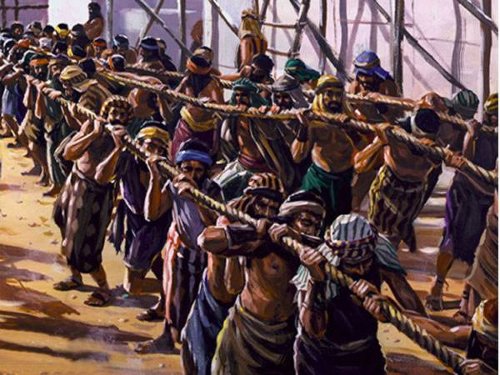
hebrew_slaves_egyptSay, therefore, to the Israelite people: I am the Lord. I will free you from the labors of the Egyptians and deliver you from their bondage. I will redeem you with an outstretched arm and through extraordinary chastisements. And I will take you to be My people, and I will be your God. And you shall know that I, the Lord, am your God who freed you from the labors of the Egyptians.

Exodus 6:6-7 (JPS Tanakh)

G‑d reveals Himself to Moses. Employing the “four expressions of redemption,” He promises to take out the Children of Israel from Egypt, deliver them from their enslavement, redeem them, and acquire them as His own chosen people at Mount Sinai; He will then bring them to the land He promised to the Patriarchs as their eternal heritage.

from “Va’eira in a Nutshell”
Commentary on Torah Portion “Va’eira
Chabad.org

I had coffee with a friend after work on Wednesday. We see each other irregularly these days, but our conversations are always good. The main reason we met was because he wanted to borrow my copy of Boaz Michael’s book Tent of David: Healing the Vision of the Messianic Gentile. This, of course, was also one of the primary topics of our talk as I sipped my coffee and he sampled his tea.

One of the things I value about our relationship is that we don’t always see eye-to-eye. We never argue and conversations never become heated, but we do see things from different points of view. I think he’s interested if not intrigued about my return to church (although this could be projection on my part) and he struggles with the implications of going back into the church after having been “redeemed” from it. It’s an interesting metaphor.

In our discussion, he likened leaving the church to the Children of Israel leaving Egypt. It’s not a complementary picture of the church that he’s painting, but it’s one that I’ve encountered on numerous occasions during my sojourn in the Hebrew Roots movement. Egypt represents nothing good spiritually and morally and leaving Egypt is always seen as a positive action on the part of God toward the Israelites. But can non-Jewish believers leaving the church be seen in the same way? If the church equals Egypt, torment, and slavery, and being released from all that means coming closer to God, then when a Christian leaves church, where do they (we) go that is better and what do they (we) do when they get there?

Let’s back up a minute. In Judaism the process of God rescuing the ancient Hebrews from their slave status in Egypt and bringing them to Himself at Sinai involves what is called the “four expressions of redemption” based on the above-quoted Exodus 6:6-7. But what are these four expressions and what do they mean?

According to the Ask the Rabbi column at Ohr Somayach, they are:

  1. “I will take you out from under Egypt’s burdens – Vehotzeiti
  2. “And I will save you from their servitude – Vehitzalti
  3. “And I will redeem you – Vega’alti
  4. “And I will take you as My nation – Velakachti

This is actually a commentary on the four cups we see during a traditional Passover seder. The Ohr Somayach Rabbi further states:

We didn’t go from a slave nation to being the Chosen People at Mount Sinai overnight. There were different stages of redemption. The above phrases described these different stages. Each cup of wine represents one of these levels.

leaving_egyptThat’s fine as far as it goes, but to me, it’s not very revealing, especially if we are trying to compare these four expressions to how we might view a non-Jewish Christian leaving the church (which is being equated to Egypt).

OU.org expands on the meaning of the four expressions thus:

According to R. Bachya (Spain, 1263-1340), the explanations of the Four Expressions are as follows:

  1. “I will take you out” – Hashem would remove the slavery even before the Jews left Egypt, from all the Tribes of Israel, because of the growing perception by Egypt of Hashem, the G-d of Israel, as the One Almighty G-d.
  2. “I shall save you” – Hashem would take the Jews out of Egypt with plagues visited upon the Egyptians, their Pharaoh and their gods, “with a strong hand and an outstretched arm.”
  3. “I shall redeem you” – Hashem would perform the miracle of “Kriat Yam Suf,” the Splitting of the waters of the “Yam Suf,” and the creation of a dry path for the Children of Israel to walk upon as they crossed the Sea of Reeds. Then Hashem caused the piled-high waters to descend in a tidal wave upon the Egyptian Army, to permanently crush the World-dominating power of Egypt.
  4. “I shall take you” – Hashem took the Jewish People to Himself as a Kingdom of Priests and a Holy Nation. This was the spiritual component of the Redemption from Egypt. In fact, the spiritual Redemption was the Reason for the Physical Redemption.

The fifth expression, “I shall bring you to the land,” refers, of course, to the Land of Israel…

I must admit, I’m having a tough time mapping what I’ve been quoting from above to any image of why Christians should leave the church and where they are supposed to go. On the other hand, I’m kind of biased and truth be told, it wasn’t that many years ago that I might have accepted my friend’s metaphor relative to the Hebrew Roots movement.

But consider this. If Hebrew Roots is supposed to be the “Sinai” for Christians leaving the church, is it an attainable goal and is it right and accurate to say the church is Egypt in a spiritual (or any other) sense?

The Christians who, throughout the ages, have propagated this message and tried to soothe the hurting, feed the hungry, and speak to social injustice have been keeping the weightier matters of the Torah. Both Yeshua (Mark 12:31) and the Sages (Rabbi Hillel in b.Shabbat 31a and Rabbi Akiva in Sifra, Kedoshim 4:12) taught that love of neighbor is the essence of Torah. These are non-trivial accomplishments which speak to the robust, biblical ethical system which many devout Christians have embraced.

-Boaz Michael
“Chapter One: The Church is Good,” pg 49
Tent of David: Healing the Vision of the Messianic Gentile

You’ll have to read all of Boaz’s book to get the full flavor of why the church is good, but I believe he paints a very convincing picture of the modern “body of Christ” as it lives and breathes within the multitude of churches in our communities and around the world. Even today in the lives of people I know, Christians are doing wonderful acts of kindness in the name and spirit of Messiah.

We are seriously getting love aimed at us by a little church nearby. Out of the blue, the pastor had contacted me wanting to know if some of their members could do anything for us and he wouldn’t take no for an answer unless it really was no.

Today some amazingly nice folks showed up and hauled off to the dump our junk too big for our own vehicle, in one of the guy’s large truck.

Meanwhile, the ladies scoot in to do some cleaning while visiting with Heidi.

And meanwhile another great guy is walking me around our deck, explaining to me how he is going to prep the bannister and then paint it for us.

And they’re coming back tomorrow!

-Joe Hendricks

I originally quoted Joe in a blog I published last June. Sadly, since that time, Joe’s wife Heidi passed on, but the church he mentions continues to be a support in his life as he grieves and as he yet looks to the future by the grace of Christ.
afraid-of-churchThe church isn’t perfect. In fact, It’s taken quite awhile for me to overcome my own misgivings about going back to church (which can be reviewed in all their glorious details in my recent “Days” series, which culminated at Day Zero). In fact, I still periodically have to review Pastor Jacob Fronczak’s blog post Why I Go to Church to remind myself that a community can be imperfect and still be the will of God for the good.

So if the church isn’t Egypt, then do we have to be delivered from it? Is there someplace better to go to and what do we call it?

I can’t answer for every person out there who has once been in the church and, for whatever reasons, left it, either for some other religious organization or to pursue God as a solidary individual or family. I can only speak for myself and how I express my evolving understanding of God’s will for my life.

I don’t think we can get back to the “root” of our faith. I know that’s disappointing and maybe some of you disagree with me, but hear me out. At some point about 2,000 years ago, a sect  called “the Way” rose among the other movements in Judaism in the late Second Temple period. The Jewish disciples were devoted to a “dead Rebbe” rather than a living teacher, one who they said not only died, but rose again. He is the Mashiach, the Son of the Living God (Matthew 16:16), who sits at the right hand of the Father (Psalm 16:8, Psalm 110:1, Acts 2:33), and who is the High Priest in the Court of Heaven (Hebrews 4:14).

The “Christianity” of that moment in history was a wholly Jewish religious movement and it co-existed with numerous other Jewish movements in Roman occupied “Palestine” in those days. Acts 10 shows the first non-Jew who came into discipleship under Messiah within this sect without converting to Judaism, and the “ministry” of Paul, who as an emissary to the Gentiles, preached a Gospel not given by men but by Jesus Christ (Galatians 1:11-12). As more and more Gentiles in the diaspora began to hear the “good news” of the Jewish Messiah and apply it to their lives, slowly the Gentiles and Jews within the “Jesus movement” began to trace somewhat divergent trajectories. Those slight deviations in trajectory would later lead them on completely different paths through the progression of history, and for centuries now, they have both identified themselves as two completely different religions that once shared a common point.

Should Christians seek to leave the church and travel backward across the timeline, trying to recapture whatever idealized or “perfected” Christianity that may (or may not) have existed somewhere around the mid 40s CE? Is it even possible?

Or does the path that God has set before us lead forward into the future…a future that will summon the risen Messiah to come out of the sky in the clouds (Revelation 1:7), who will redeem his people Israel, and who will also gather his disciples from the nations? If this future-oriented path is the true one, then perhaps there is no “perfect Christianity” to go back into upon “leaving the church.” Regardless of whatever Christian or Jewish worship venue to which you are attached (including any form of Hebrew Roots or Messianic Judaism), chances are, you don’t belong to a perfect community. Chances are people in your congregation make mistakes. Chances are, when scrutinized by the King of All Glory, your theology may not be absolutely and totally 100% “kosher.”

Chances are, there is no perfect church, synagogue, community, or congregation for you or for any of us to join upon leaving “church.” Face it. All congregations that involve human beings and human relationships are “messy.” We have to start with where we are, not where we’d like to be.

Yes, the church could be improved. That’s the other very valuable (to me) chapter in Boaz’s book, “Chapter 2: The Church Needs to Change.” Frankly, we could also probably say, relative to God’s perfect understanding, that the synagogue needs to change as well. A better way to say it is that we all need to change, to be better, to draw nearer to God, to refine our understanding of who He is and who we are in Him, Jew and Christian alike. We travel upon our divergent trajectories but we have one Shepherd and one King, and God is One. Not that our ultimate unity under Him as His “peoples” means uniformity, but it does mean unity of devotion and fealty.

The Messiah will come. He will return Israel to its place as the head of all the nations, rebuild the Temple, defeat evil, and establish a reign of peace and tranquility for all peoples of the earth. All the Jewish people will be gathered unto him in their nation Israel, and we believers who reside across the four corners of the Earth will bow our knees to him and call him Lord over all (Romans 14:11, Philippians 2:10). That is our future.

But we’re not there yet.

two-roads-joinWe have to start where we are. If we are non-Jewish Christians in church, we should stay in church. We should bring our understanding of the Jewish Messiah King to where we are, not remove it from our fellow believers and hoard it for ourselves. If we are Gentiles in a Messianic community, then we should stay there (though there may be exceptions who will also attend a church) and use other platforms for communicating our understanding to the Christians we know or will come to know (compare to 1 Corinthians 7:18). For myself, I go to church not to change anything but to encounter God and His purpose for me, whatever it may be.

We may not always see the good in the church but it’s there. We may not see it because when we were introduced to the Hebrew Roots movement (for those of you reading this who are or were involved in Hebrew Roots), we were told the “church is Egypt.” However, if it’s been awhile since you’ve taken a look at the church, at the Christians in your community, at the believers you work with, live near, and consider friends, maybe it’s time you took another look. There are indeed two paths involved, but they’re not the two you have been imagining.

There are two paths:

One: Everything is for the good. Perhaps not immediately, but eventually good will come out from it.

The other: Everything is truly good—because there is nothing else but He who is Good. It’s just a matter of holding firm a little longer, unperturbed by the phantoms of our limited vision, unimpressed by the paper tiger that calls itself a world, and eventually we will be granted a heart to understand and eyes to see.

Eventually, it will become obvious good in our world as well.

-Rabbi Tzvi Freeman
“Believing in G-d”
Based on letters and talks of the Rebbe
Rabbi M. M. Schneerson
Chabad.org

To modify Rabbi Freeman’s commentary slightly, everything we encounter is for the good, and eventually good will be demonstrated by the church. We must be patient and help as we can. Also, everything in church is truly good because nothing else exists in our world but God who is Good (Mark 10:18). It’s just a matter of us holding on a little longer where we are, not allowing our limited vision of how we see Christianity to limit God’s work in the church.

Eventually, the good of God and of the body of Christ in our world will become obvious to us as the time for the return of our Master draws near.

Good Shabbos.

Bless Someone Today

ancient_journeyAnd there arose on that day a great persecution against the church in Jerusalem, and they were all scattered throughout the regions of Judea and Samaria, except the apostles. Devout men buried Stephen and made great lamentation over him. But Saul was ravaging the church, and entering house after house, he dragged off men and women and committed them to prison.

Now those who were scattered went about preaching the word. Philip went down to the city of Samaria and proclaimed to them the Christ. And the crowds with one accord paid attention to what was being said by Philip when they heard him and saw the signs that he did. For unclean spirits, crying out with a loud voice, came out of many who had them, and many who were paralyzed or lame were healed. So there was much joy in that city.

Acts 8:1-8

As I mentioned in yesterday’s extra meditation, the theme of last Sunday’s sermon and Sunday school teaching, based on the above-quoted scripture, was evangelism; the declaring of the Good News of Jesus Christ to the world around us. This is a significant mission among most churches and is carried out to one degree or another by Christians around the world. Not every Christian stands on a street corner with a Bible in one hand and a bunch of leaflets in another preaching to everyone who passes by, but based on the Master’s initial directive in Matthew 28:18-20, all believers understand that we have a mandate to, in one way or another, announce the Gospel to people in our world.

As I mentioned, this is a significant mission among the church, but there are bodies of believers where this mission isn’t apparently being enacted.

If you’ve been reading my blog for very long, you know I separate Messianic Judaism and Hebrew Roots (One Law, Two House, Sacred Name) as distinctly different religious traditions, although they have some superficial areas of overlap. And yet, these two movements seem to talk to each other quite a lot, if the blogosphere is any evidence, while all but ignoring (with certain exceptions I’ll explain in a moment) the much larger body of believers that exist on the earth today: Christians.

Beyond this, (although there may also be exceptions) there is another large population of human beings both of these movements fail to engage: everybody else.

I’ve mentioned in prior blog posts an article written by Tsvi Sadan for Messiah Journal called “You Have Not Obeyed Me in Proclaiming Liberty.” In his write up, Sadan provides a small history of how Israeli Jews have come to faith in Yeshua (Jesus) as the Messiah through the Evangelical church. That process is changing and more recently, other Messianic Jews are spreading the message of the Messiah to their fellow Jews in the Land, but these Jews continue to operate largely from an “evangelical” mindset. This has resulted in what we see described in a recent news article for the Atlantic as “Messianic Jews…assiduously attempting to, essentially, redeem Israel from its Jewishness.”

The “good news” of Jesus Christ is being preached to the Jews but with the Jewishness of their faith omitted or significantly watered down.

Fortunately, Sadan offers an alternative as I recently mentioned but that doesn’t address the issue of Gentiles. Then again, in today’s age, are Messianic Jews obligated to spread the “good news” to the nations as a duty with which they were charged in ancient days?

I asked that question, perhaps as long as two years ago, and received an answer that, in terms of the dynamics of the different believing communities today, the most reasonable response is “no.” Given Sadan’s article, I can see that it might be a better idea to allow actual Messianic Jews who live a completely halakhic, ethnic, and religious Jewish lifestyle to employ keruv as the method of bringing Jews near to the Moshiach. Does that mean only the church speaks to the Gentile unbelievers?

jewsI mentioned Hebrew Roots before, which is primarily a Christian/Gentile owned and operated movement within larger Christianity (although many Hebrew Roots congregations refuse to claim the church as their own and prefer to bill themselves as “Messianic Judaism,” though most of their groups cannot be defined as “Jewish” by any reasonable halakhic standard). Who do they talk to? Besides the inevitable debates between Hebrew Roots and Messianic Judaism, Hebrew Roots rarely if ever engages in what we would typically think of as “evangelism.”

This was a source of frustration to me when I was involved in the One Law movement, but the whole system of One Law seems to be designed to approach people who are already Christians and who are, in one way or another, disillusioned with their churches. Once accessed, One Law proceeds to convince these Christians that they must take on board the total mitzvot of Torah and redefine themselves as “Messianic.” If anything, One Law, Two House, Sacred Name, and so on, are dedicated to “evangelizing” Christians to “convert” to their particular variation of “Christianity,” rather than performing the task Jesus commissioned his Jewish disciples with in Matthew 28:18-20 and doing what the Jewish disciples were doing in Acts 8:4-8.

It’s not like this hasn’t occurred to me before and it’s not like this topic hasn’t been discussed in the blogosphere before, so why am I bringing it up now?

In my Sunday school class, we talked about the general reluctance of Christians to fulfill the evangelical mission in their (our) personal lives. Sure, not all of us are going to go into the “foreign mission field” and preach the Gospel in places like the Congo, but we all live in the world, and the world is filled with people who, while they’ve heard of Jesus Christ, do not honor God and have no real awareness of His Presence. A traditional Christian might say, the world is full of “unsaved” people, but to me, salvation is just the beginning of the journey, not the whole point of existence.

If I can accept that Messianic Jews have a specific mission to address Jewish people and not the general population, and if I can accept that the church has a specific mission to address the general population, what mission does Hebrew Roots have? Do they just “feed” their own internal desires and consume their own theology and doctrine, or should they be reaching out as well? I don’t mean necessarily reaching out to take traditional Christians and recreate them in their own image, but to actually try to communicate the core message of the Gospel (Torah or non-Torah observance aside), and to “make souls for the Kingdom,” so to speak (if you can excuse the “churchy” language here).

As much as many Hebrew Roots groups denigrate and disdain the church, they seem to have left it to the church to do the “heavy lifting” of spreading the Gospel message. After all, how many One Law or Two House groups send missionaries into the Congo, to Tonga, to the Philippines, or anywhere else? How many Hebrew Roots congregations and organizations sent relief teams to Haiti after their devastating earthquake?

OK, I understand that Hebrew Roots groups are rather small and resources are limited. For that matter, the same can be said for Messianic Jewish groups. The traditional church as a whole is much larger, more organized, and better designed to render the sorts of assistance I’m talking about. I’m sure you must also be aware that Israel traditionally renders aid to other nations when disasters occur and Jewish groups provide tzedakah as a matter of course.

making_ripplesBut rather than pick on any one religious group (as I have been up until now), I’d like to suggest that whoever you are reading this and whatever sort of context you worship in, what are you actually doing for people, both in the area of giving aid and charity, and in sharing your faith with those who have no faith and hope in the world? The church sends the members of its body to visit the sick, provide clothing, medical supplies, and food to the needy and the suffering, and to spread the good news of Jesus Christ to the four corners of the earth. Are your groups and your people doing that too? If not, why not?

Rabbi Noson Tzvi Finkel of Slobodka would sometimes sit near the window of his house and quietly bestow blessings and prayers on all those who passed by.

Once when Rabbi Finkel was walking down the street, he turned toward a house and said, “Good morning.” Rabbi Finkel explained: “Most people only wish someone a good morning when they see them face to face. But even when we do not see them, we should still develop good will toward them.”

-Rabbi Zelig Pliskin
“Daily Lift #663, Bless Others”
Aish.com

I’ve mentioned many times before that I believe we Christians have a specific responsibility to bless the Jewish people. However, I also believe that all of us are duty and honor bound to bless the world.

Bless others. Bless someone today.

The Early Christian According to Cohen

In order to maintain their distinctiveness and identity, most Jews of the ancient world sought to separate themselves from their gentile neighbors. In the cities of the East, they formed their own autonomous ethnic communities, each with its own officers, institutions, and regulations. Some cities, notably Alexandria and Rome, had neighborhoods inhabited mostly by Jews. (These were not “ghettos” but “ethnic neighborhoods.”) Following the lead of Ezra, the Jews of the Second Temple period grew more and more intolerant of marriages with foreigners.

Shaye J.D. Cohen
Chapter 2: Jews and Gentiles
Social: Jews and Gentiles, pg 37
from the book
From the Maccabees to the Mishnah, 2nd Ed

I quoted this portion of Cohen’s book in a recent extra meditation and I want to continue discussing the theme of early Jewish and Christian (and Gentile) identity as we can apply it to today’s community of Jewish and Gentile believers. As I also mentioned in my previous missive, there is a group within Hebrew Roots that is invested in believing that for a time, both the Jewish disciples of the Messiah and the non-Jewish disciples brought into the faith, primarily by Paul, were completely of one accord and shared a completely uniform identity as “Messianics,” being “neither Jew nor Greek” (Galatians 3:28), but rather “one new man” (Ephesians 2:15) in Christ, with all distinctions of cultural, ethnic, national, and covenant identity as established by God, completely obliterated.

In traditional (supersessionist) Christianity, this takes on the form of Jews no longer being Jews but rather, “converting” to Christianity. Anyone who has read this blog for any length of time knows that I reject this suggestion and I do not believe it can be sustained from even a casual reading of the Bible. The chronicles of the Jewish disciples recorded in the early chapters of the book of Acts clearly shows them continuing to live lifestyles completely consistent with the other Judaisms of their day. There is nothing to say that Peter, James, or Paul ever surrendered being Jewish and while the Temple stood, ever forsake the festivals or the sacrifices.

However, the aforementioned movement within Hebrew Roots, sometimes referred to as “One Law” takes the same approach from the opposite end of the spectrum. Instead of demanding that Jews stop being Jews, they demand that Gentiles have the right and obligation to be “Jews” in all but name (sometimes referring to themselves as “Israel” or “Spiritual Judaism”). They cite a number of passages in the Bible to support their claim, primarily the “one law for the Jew and the Stranger” in various parts of the Torah (for example, see Leviticus 24:22, Numbers 15:16, and Numbers 15:29) as well as Acts 15:21 to establish the suggestion that God and the Jerusalem Council required the Gentile disciples to more or less “convert” to a form of Judaism without actually converting to Judaism. Further, assuming these suppositions are correct, they state that this practice must be carried forward and established among Gentile Christians today, using the modern synagogue worship model as the template for Gentile practice of what they refer to as “Messianic Judaism.”

In reading Cohen, I’ve become more convinced than ever that the foundation upon which One Law is built is a soggy sandcastle rather than a rock. One Law, by definition, must require the ancient Israelite to share national and tribal identity with the (non-Israelite) “ger” (stranger, alien, sometimes convert) among them and also, that the Second Temple era Jews must surrender their halakhic, ethnic, cultural, national, and covenant identity to the Gentile disciple due to their grafted in (see Romans 11) status. In both cases, the unique people group established by God must become “un-unique.” For this to be true, it must mean that God lied to the Jewish people when He established them as His splendorous treasured people (Exodus 19:5) among all the nations of the earth.

I know there’s a danger is relying on a single source of information (Cohen) for doing any sort of research, so I’ll say right now that my conclusions can’t be considered definitive. On the other hand, I think Cohen’s work does indicate that a number of historical factors related to the ancient Israelites and the Second Temple era Jews have been ignored by One Law proponents and I’d like to briefly bring some of those factors into the forefront.

Let’s take ancient Israel and the status of the “ger” first. According to One Law supporters, the various “one law for the native, etc…” passages indicate that God originally intended for Israelites and non-Israelites (who have attached themselves to the God of Abraham) to operate identically in terms of covenant and identity.

When discussing Conversation to Judaism in Chapter 2 of his book, Cohen states:

In preexilic times, conversion to Judaism did not yet exist because birth is immutable. An Ammonite or an Aramean could no more become an Israelite in preexilic times than an American can become a citizen of Liechtenstein in our own. Mere residency in the land does not confer citizenship, and a social system that defines a citizen solely as a child of a citizen has no legal mechanism by which to assimilate a foreigner.

This seems to support the general supposition of One Law, that Gentiles did not “convert” to Judaism in preexilic times (before the Babylonian exile), and if taken out of context, may be construed as meaning that Gentiles who lived in the land would be under the same law (Torah) and have the same legal status as the native of the land…even though they didn’t have citizenship. But does that make sense?

Biblical law frequently refers to the “resident alien” (ger in Hebrew) who is grouped with the widow, the orphan, and the Levite. All of these are landless and powerless, and all are the potential victims of abuse. (An American analogy to the ger is the Chicano (specifically, undocumented alien) farmworker; a European analogy is the Turkish laborer in Germany.) The Bible nowhere states how a ger might ameliorate his status and become equal to the native born, because there was no legal institution by which a foreigner could be absorbed by a tribal society living on its ancestral land. Resident aliens in the cities of pre-Hellenistic Greece fared no better.

Cohen soundly torpedoes the suggestion that “one law” gerim were equal to the native Israelites in the Land in all aspects of Torah and other covenant status. There was no legal avenue that would allow a non-member of an Israelite tribe to enter into a tribal society that was established by heredity and covenant. There was no way for the ger to become equal to the Israelite in terms of the Mosaic covenant, at least according to Cohen. Any legal requirement for the ger to become circumcised or to not eat from an animal killed by a wild creature was not an indication that the ger was in anyway equal to the native of the land in covenant status, anymore than an undocumented immigrant in the U.S. shares equal status to  U.S citizens.

After the exile of 587 BCE, the Israelite tribal structure was eliminated and the Jews who returned to Judea from Babylon were organized as clans, according to Cohen, not tribes. The ritual organization was specifically “Priest,” “Levite,” and “Israelite.” Further, it became possible to consider the idea that foreigners could somehow be “joined” to Israel and to God. Cohen continues:

But these centuries saw the creation of an institutionalized method for the admixture of gentiles. Ezra was still unfamiliar with the notion of “conversion,” but some of his contemporaries were discussing the idea. One prophet assured the “foreigners who join themselves to the LORD, to minister to him, to love the name of the LORD, and to be his servants” that they would not be excluded from the rebuilt temple but would be gathered to God’s people (Isa. 56:6-8). Several prophets predicted that in the end of days foreigners would join in the worship of the true God in Jerusalem, either as servants of the Israelites or as independent worshipers.”

The mechanism by which all this would occur was not spelled out as far as Cohen is concerned, but Christians believe that it is through our being brought into the New Covenant through faith in the Messiah, Jesus Christ, that we are joined to the God of Israel. Of course, that still doesn’t mean we become identical to the Jewish people in every conceivable detail, particularly if, as we’ve already seen, Gentile residents of ancient, tribal Israel were not included equally in citizenship or covenant, but rather, relegated to the status of alien residents with few, if any rights.

However, as the history of Israel progressed, the concept of conversation to Judaism for the Gentile began to become more formalized. Cohen cites three essential elements of conversion to Judaism: belief in God, circumcision, and joining the house of Israel. Again, this is a definition of a convert to Judaism, not conditions required for the Gentile to join “the Way” as disciples of Christ. Cohen even references the difference:

For Paul, circumcision represents subjugation to the demands of the Torah (Gal. 3-5).

In other words, while Paul did not see circumcision and thus full obedience to the mitzvot as a requirement for the Gentile Christians, he did see it as a necessary step for full conversion to Judaism. The natural conclusion then is that a Gentile becoming a disciple of the Jewish Messiah in the time of Paul was not the same as a Gentile converting to Judaism.

If we take the message of the Book of Galatians as a unit, then we must conclude that Paul is arguing for the sufficiency of faith in Christ for the Gentile. The non-Jew does not have to convert to Judaism in order to be justified before God.

We tend to take the concept of God-fearers as they existed in the late Second Temple era as a sort of stepping stone between Gentile paganism and Christianity, but according to Cohen, these Gentiles were just as likely to be attracted to another form of Judaism (one without the involvement of the Messiah) and perhaps to even convert to one of the many Judaisms of the day.

Even more numerous, however, were those gentiles who accepted certain aspects of Judaism but did not convert to it. In polytheistic fashion, they added the God of Israel to their pantheon and did not deny the pagan gods…In the city of Rome, many gentiles observed the Sabbath, the fasts, and the food laws; in Asia Minor, many gentiles attended synagogue on the Sabbath. Although these gentiles observed any number of Jewish practices and venerated in one form or another the God of the Jews, they did not see themselves as Jews and were not seen by others as Jews.

Cohen does not specifically state that any of these God-fearers were associated with “the Way” nor do we have any indication that the Gentile God-fearers saw themselves as obligated to the Torah or having “rights” of observance. Just as they would have observed any number of other religious practices associated with other “gods,” these God-fearers also observed a number of religious practices associated with the God of Israel. Cohen goes on:

They resemble the polytheists of the preexilic period who feared the Lord but who never changed their identity.

For One Law proponents, the good news is that there is a record of early first century C.E. gentiles observing some of the mitzvot. The bad news is that they were polytheists who did not truly “convert” to any form of Judaism (or necessarily what we now think of as “early Christianity”) nor did they forsake polytheism, which is in direct opposition to fiercely monotheistic Judaism.

Cohen does reference the New Testament (specifically sections of Acts) in further describing these God-fearers.

The book of Acts calls these people “those who fear” (phoboumenoi) or “those who venerate” (sebomenoi) the Lord (Acts 13:16, 26; 16:14; 17:4, 17; 18:7). Modern scholars call them “sympathizers” or “semi-proselytes,” but these terms lack ancient attestation…After all, how can a gentile become a “little bit Jewish?” And why would he want to?

The explanation goes back to Cohen’s description of God-fearers as polytheists who considered the God of Israel as “just another god.” But there may have been other reasons.

Rather than look upon God-fearers as gentiles interested in Judaism, perhaps we should see in the phenomenon the contribution of Judaism to the cultural mix we call Hellenistic. Greco-Roman culture provides various analogies to Jewish ideas and practices.

In other words, gentile interest in Judaism was not for Judaism’s sake per se, but for the sake of multi-culturalism within Greek society, the way that many different religious and cultural practices are integrated into modern Japanese life. My daughter lived in Japan for almost a year with a Japanese family. At one point, she attended the wedding of a Japanese couple who practiced Buddhism but who were married by a Swedish Catholic Priest. When my daughter tried to find out the reason for such an interesting mix, about the best answer she could get was, “In Japan, it’s all good.” Maybe that was also true in some corners of Greek society.

Continuing to read Cohen, I began to wonder if, from the Gentile point of view, converting to Christianity was viewed in the same light as how Gentiles were converting to other forms of Judaism.

Josephus insists that Judaism has no mysteries, no secrets that it keeps hidden from curious observers. This claim may not be entirely true (note, for example, how secretive Jesus is according to the Gospel of Mark), but it is essentially correct. Some Jews even engaged in missionary work. The Pharisees travel about land and the sea in order to make even one proselyte (the Greek word for convert to Judaism; Matt. 23:15). Josephus narrates that in the middle of the first century CE, the royal house of the kingdom of Adiabene became Jewish under the tutelage of itinerant Jewish merchants…

Some scholars have suggested that much of the Jewish literature written in Greek had as its goal the propagation of Judaism among the gentiles, since the literature often emphasizes those elements of Judaism that would make it attractive to outsiders.

Seen from this perspective, Paul and his mission to convert the Gentiles to faith in the Jewish Messiah may have well been just one Jew among many who were attempting to mine the same population of Gentiles and convert them to one of the various forms of Judaism that existed in that era. So it wouldn’t be unusual at all for “Christian” Gentiles to practice various Jewish religious and cultural behaviors in the same manner as other “converts” to Judaism, although as I previously stated, a Gentile converting to Christianity was not converting to Judaism. But at that point in history, the “Judaism” we consider “early Christianity” was considered a Judaism and it had not yet adopted a trajectory that caused it to deviate from Jewish practice and finally to not be considered a Judaism at all.

Apparently that took some time.

Many Christians, generally called “Judaizers” by modern scholarship, were drawn to Jewish practices. For some of these Christians, Judaism was attractive because of Christianity. Through Christianity they learned the Jewish scriptures and became familiar with Jewish observances. Many Christian groups, for example, insisted that Easter must coincide with the Jewish Passover and that it be celebrated with rites similar to those of the Jewish Passover.

It’s interesting that Cohen, although acknowledging a close Christian association with Judaism, continues to differentiate between the Gentile Christians and the Jewish people, presumably even those Jews who followed Jesus as Messiah. Note that early on, the concept of Easter was born and was to be treated in a similar manner to the Passover, but not as if they were the exact same festival or celebration. Nevertheless, according to Cohen, the Jewish-Christian connection endured for a number of centuries, even through the schism began most likely within the lifetime of Paul and John.

In Antioch in the late fourth century, John Chrysostom was shocked that many Christians were doing what pagan God-fearers had been doing in other parts of the empire three centuries previously: they were attending synagogues and observing the Jewish festivals.

It seems as though Christianity and Judaism maintained a “mix” for hundreds of years after the fall of Jerusalem but were never quite “in synch,” making Christianity a unique experience for the Gentile disciples, since they never adopted an actual Jewish identity the way that other proselytes did when they completed an actual conversion to one of the other Judaisms. This seems to indicate a bond between Gentile and Jewish disciples of the Master but not a fused cultural, national, or ethnic identity.

What may have driven a further wedge between Gentile Christianity and the Jewish “Messiah” movement was this:

What did change after 70 CE was that Jews, or at least the rabbis, were no longer as eager to sell their spiritual wares to the gentiles.

There is also some indication that post-Second Temple, Gentile Christianity began to gain some traction independent of the other Judaisms, possibly including the Judaism of “the Way.”

Perhaps (and this is the common explanation) the rabbis saw the growing power of Christianity and decided not to try to compete with it. Outside of rabbinic circles, perhaps some Jews still actively attempted to interest gentiles, especially Christians, in Judaism, but the evidence for this activity is minimal.

The picture Cohen paints of Gentiles in relation to the Judaism most of us call “Christianity” is incomplete, but we can draw some conclusions. First, the historical figure of the “ger” in ancient, preexilic times, is not a model for modern One Law Christians in adopting equality with Messianic (or any other sort of) Jews. The ger’s observance of Torah was for the purpose of having them obey “the law of the land” the way that even an undocumented alien worker would obey some or most of the laws in the U.S., but it didn’t make them citizens of a tribal nation nor did it confer anything even approaching equality between the gerim and the native-born Israelite. There were laws to protect the gerim in the manner of widows or orphans, but they were most definitely “second-class inhabitants” in Israel. The final blow to the “gerim” argument of One Law is that in post-exilic times, the status of the ger ceased to exist because Israel had shifted from a tribal-driven to a clan-driven society.

We see that in the time of Jesus and following, God-fearers were in evidence and they did practice synagogue worship and a number of the other mitzvot but primarily in the manner of polytheists who practiced the religions of multiple Gods. They did not forsake all other gods for the sake of the One God or become equal to the Jewish people in any covenant sense. As far as a Gentile converting to “Christianity” goes, they were not actually converts to Judaism in that they did not enjoy the full covenant benefits of converts to the other Judaisms and full obligation to Torah (which required circumcision as a covenant sign). It is acknowledged that the Gentile disciples of the Way did practice many of the Jewish religious customs including Shabbat and the festivals, even into the fourth century C.E., but the Roman authority never recognized these “Christians” as having legitimate legal rights to these observances the way that the Jews did and Cohen indicates that Gentile observance, particularly of Easter, was similar to but not identical with Passover.

And as the centuries passed, the trajectories of Christianity and Judaism continued to diverge until any “quasi-Jewish” observance by Gentile Christians simply ceased to exist.

Today, Christianity can be said to have its origins in Judaism but it has not been even remotely associated with Judaism for nearly 2,000 years.

I am not saying that there are not Christians today who maintain an attraction to Jewish practices, theology, and philosophy, but there is nothing that we can pull forward across from the time of Paul, and absolutely nothing we can draw forth from the time of Moses, that would suggest that a Gentile Christian today has any right or obligation whatsoever to observance of any aspect of the Jewish Torah mitzvot, except perhaps those that are common with kindness, compassion, and decency toward other human beings (feeding the hungry, and so forth).

While Cohen cannot be considered the final word in the history of Gentiles in the early movement of “the Way,” he certainly gives us a perspective we must pay attention to, and he helps us to realize that whatever the early Christians were in the days of Peter, Paul, and John, we are not the same as they were. They never were Jewish and neither are we.

Learning the Traditions of Our Fathers

Talmudic Rabbis“We keep the customs of our forefathers.”

Shabbos 35b

The Gemara here notes that we keep the customs of our forefathers, even when the rationale behind the custom no longer applies. One such custom is the recitation of Kedushah in U’va LeTzion. Why do we repeat Kedushah if it has already been recited during Birkas Kri’as Shema and Chazaras HaShatz?

The origin of this recitation is recorded in Shibolei HaLeket (ch. 44). There was a time when the gentiles banned the Jews from reciting Kedushah and would send a representative to sit in shul through Chazaras HaShatz to guarantee that it was not recited. Once Chazaras HaShatz was completed, the representative felt confident that his job was finished and he would leave. Only later, when the gentiles left, were the Jews able to say Kedushah. They therefore inserted Kedushah into U’va Letzion, in Hebrew and Aramiac, to replace the two times they were not able to say Kedushah, in Birkas Kri’as Shema and Chazaras HaShatz. Although we are now able to say Kedushah without fear of being harmed by gentiles, we continue to recite Kedushah in U’va Letzion based upon the principle of “Minhag Avoseinu Biyadeinu” — “The custom of our forefathers remains in our hands.”

Daf Yomi Digest
Stories Off the Daf
“Keeping the customs of our fathers”
Commentary on Shabbos 35b

All denominations or sects of Christianity of which I’m aware have a problem with the relationship between religious Judaism and its traditions and customs. As we see from a Christian point of view, the function of traditions in Judaism seems to exceed what we would consider practical utility and common sense. Certainly all cultures and groups engage in various traditions and as such, there’s no problem in this, but why participate in a custom or tradition that has outlived its usefulness and may well (though not in this case) contradict the Word of God?

Christianity, and particularly the Protestant church, sees itself as relying solely on the Word of God as we have it in the Bible without the “traditions of men” getting in the way (Sola scriptura), while we tend to see Judaism as relying primarily on their traditions (which we see growing and growing, even when some of them have outlived their original purpose) as equal or even superior in authority to what God has said to Israel. But does that really reflect the reality of what we do (and you probably know where I’m going with this)?

To define sola scriptura without academic terminology might sound something like this: The Bible is the only authority in the believer’s life; it is never wrong about anything; it touches on every aspect of life; it needs no outside help to be correctly interpreted; it never disagrees with itself; it can be understood by anyone of average intelligence; and it applies to everyone in every situation.

I only use the example of translations to illustrate the fact that in a very practical sense, the Scriptures in their original languages are, for most Christians, not enough – tools such as translations, concordances, the Masoretic vowel points, and commentaries are required in order to understand the text. Of course, the goal is to understand the original text, which in itself is not an objection to the doctrine of sola scriptura – until one realizes that every translation, every commentary, and even the textual tradition itself are all based on traditions along with the divine written revelation. It is simply impossible to get away from these traditions and study the Bible in isolation.

-Jacob Fronczak
“The Five Solas: Sola Scriptura”
Messiah Journal, Issue 111 (pp 47, 52)

If you read my recent blog post, Chayei Sarah: Oil for the Lamp, you recognize the quotes from Pastor Fronczak. You also remember the meaning behind those words: that Catholic and Protestant Christianity does not understand what the Bible is saying apart from our own traditions. That is to say, no one of us has raw, unfiltered, unmediated, uncommentaried access to anything the Bible is telling us. We all read the Bible while wearing the moral and intellectual equivalent of “rose-colored glasses.”

Not only do we find that we must accept the wisdom of the “traditions of the Christian elders,” but we must also accept the wisdom of the “traditions of the Jewish elders.” Why?

Consider the Old Testament. About two-thirds of the Christian Bible is made up of the Old Testament. Who wrote the Old Testament? Jews (It’s important to realize that Jews also wrote the New Testament, but that’s a discussion for another time).

The organization of books, chapters, verses, and insertion of vowels and punctuation all come from Jewish sources, and have been altered very little if at all by Christian translators in most cases. Without realizing it, the vast majority of Christians, when reading nearly any part of the Old Testament, are tacitly accepting Jewish tradition in how it is translated and presented to us.

Right now, you might be saying, “So what. I still believe the Bible is the highest written authority and no Rabbi, Pastor, or scholar is going to have an opinion or judgment that overrides scripture.” Well, that’s not exactly true.

Translating dead languages (ancient Hebrew, Aramaic, and Greek are all dead languages and only somewhat associated with the modern-day “living” counterparts) into the land of the living so that English speakers (for example) can read the Bible is no small thing and it’s hardly an exact science. The art of Biblical analysis and translation is highly specialized and it’s not a matter of simply saying, Word A in Hebrew means word B in English.

Even with the Masoretic traditions, though, many English readings of the Scripture can be divined from a single Hebrew text. Translation committees have to pick one. Many times readings are chosen to emphasize some Messianic prophecy which appears to point to Jesus Christ, while a Jewish translation committee might choose a different readings for the exact opposite reason. Both readings might be technically correct. However doctrinal presuppositions dictate which reading is chosen. In effect, then, when Christians have only an English Bible and no other tools, they are completely unable to interact with the Scripture – the original Greek and Hebrew texts. They are completely dependent on the work of the translator.

-Fronczak (pg 52)

Let’s go through that again. Two separate translations of the Hebrew (or Greek) text can both be technically correct, but actually render opposite meanings, depending on the doctrinal presuppositions of the translation committees involved.

I’d love to just copy and paste the entire text of Fronczak’s article into this blog post because I think every Christian (and Jew) should read it, but that’s highly impractical. You’ll just have to purchase a copy of Messiah Journal to read all of his write up (and even if you disagree with Fronczak, you’ll still have to read the complete content in order to craft a rebuttal that contains any validity at all).

But beyond apparently trying to shoot down the doctrine of sola scriptura, why am I bothering to write this and why should you care?

The vast majority of Christians do not interact with the rabbinic tradition at all. As a consequence, it is poorly understood and even attacked. Modern Jews have not forgotten the Christians who burned copies of the Talmud in Europe. Even many in the Hebrew roots movement disparage the teachings of the rabbis and ancient sages, without realizing that in many ways, we rely on these very teachings in order to interpret the Bible.

First Fruits of Zion has been vehemently attacked for this very reason – we rely on rabbinic traditions and other extra-biblical literature to illuminate and explain the text of the Scripture. Like any reputable translation committee or research institution would do, we consider a lot of evidence before coming to a conclusion on what a Bible passage means. Unfortunately, people who do not understand the importance and usefulness of this literature continue to disparage the ministry of First Fruits of Zion, even though they, as explained above, are equally reliant on traditions and extra-biblical evidence for their own interpretations of the Scripture. The continuing attacks on traditional Jewish literature such as the Talmud and Zohar betray anti-Judaic and perhaps even an anti-Semitic spirit on the part of many of our detractors.

-Fronczak (pg 53)

The focus of my point for this blog post and for the existence of my blog in general, overlaps Fronczak’s and First Fruits of Zion’s (FFOZ’s) message, but my overall scope is beyond the confines of Messianic Judaism and Hebrew Roots (and all of the variants those two groups contain). This is a message that should concern every Christian and every church, regardless of denomination or affiliation. We all share a common Bible (relative to translation), a common Jesus, and a common God. The origin of the core faith in Christ of the church can be traced directly back to ancient Israel and the Second Temple period, and the origin of everything Jesus taught as we have it recorded in the New Testament, every bit of it, travels deeply back into the Old Testament, to David, to Moses, to Jacob, Issac, and Abraham, and indeed, back to before Adam and the creation of the world by God. Not one word of what Jesus said wasn’t Jewish, nor was any of it disconnected from the Jewish reality of the Bible.

Add to that the fact that we in the church rely just as much on our traditions (and some Jewish traditions) to understand all of what God is saying, and we have a very poor case for tearing apart Jewish reliance upon tradition to understand themselves and God.

It is really, really important to view the struggle of Christianity trying to comprehend Judaism as not a specialized or niche perspective or movement. It’s not just for those few people who are affiliated with those entities we call “Messianic Judaism” or “Hebrew Roots.” This is the struggle, the mission, the challenge for everyone who calls themselves a Christian.

If the church has any hope of understanding itself, it (we) must come to terms with not only where we came from, but the people and nation God granted the ability to give us life in Him, the Jews. We cannot afford to keep living in an isolated silo pretending that those connections are forever severed or relating to our “Jewish roots” as if the last 2,000 years of Jewish and Christian history, culture, custom, and tradition simply never happened.

Not long ago, I wrote another blog post called Intersection. There are a small group of Christians and Jews who are approaching a point of intersection where we going to realize we are, in some mysterious or even mystic way, interdependent on one another for the sake of the Kingdom of Heaven (which has nothing to do with “going to Heaven” and everything to do with enacting and progressing God’s plan for humanity on Earth). What may now appear as minority religious groups, variant Christian and Jewish sects, and even (Heaven forbid) cults, may well actually be part of the resurgence, the restoration, and the re-establishment of God’s intentions and design for His people Israel and the other nations of the Earth.

I believe when those Jewish and Christian people arrive at the intersection, this will happen.

“Thus says the Lord of hosts: Peoples shall yet come, even the inhabitants of many cities. The inhabitants of one city shall go to another, saying, ‘Let us go at once to entreat the favor of the Lord and to seek the Lord of hosts; I myself am going.’ Many peoples and strong nations shall come to seek the Lord of hosts in Jerusalem and to entreat the favor of the Lord. Thus says the Lord of hosts: In those days ten men from the nations of every tongue shall take hold of the robe of a Jew, saying, ‘Let us go with you, for we have heard that God is with you.’”

Zechariah 8:20-23

No, I don’t believe Christians will be turned into Jews or Jews will be turned into Christians (and a Jew being Messianic is not the same as being “Christian” as we comprehend the concepts and lifestyles), but we will all flow to “the mountain of the house of the Lord” and the people of many nations will say, “Come, let us go up to the mountain of the Lord, to the house of the God of Jacob, that he may teach us his ways and that we may walk in his paths.” (see Micah 4:1-2)

Many Christians, including those in the Hebrew Roots movement, are fond of quoting from Ephesians 2 (particularly verse 15) and saying that differences and distinctions between Jews and Christians were all obliterated (along with the Torah, Talmud, shabbat, Passover, and anything even remotely referring to a Jewish identity and life) in Christ, “nailed to the cross,” so to speak.

And yet the unity that we see described in Zechariah 8 and Micah 4 requires no melding into uniformity between Gentile and Jew in order to achieve the prophesied unity between Israel and the nations. What is required is a sense of humility and recognition, the humility to “take hold” of the tzitzit on the tallit of a Jew, and to ask him to guide us to the mountain of the house of the Lord, the holy Temple in Jerusalem (which apparently will exist again) so that even we non-Jewish disciples of the Jewish Messiah King may be taught his ways and walk in his paths. (Zechariah 8:23 “says take hold of the robe of a Jew.” Is that any Jew or only one, the firstborn son of Israel…Moshiach?)

We’re all doing our best right now to do that; to walk in his paths. But we can do better. We must do better. Let us hurry to the intersection and meet together, Christian and Jew, we who share the Messiah and honor the One God. Time is short. There’s a lot of work to be done, starting with learning how to listen to one another, and comprehend the wisdom of the customs of our fathers, both the Jewish and Christian fathers.

Do Christians Practice Judaism?

You probably think I’m crazy even asking if Christians practice any form of Judaism. The vast, vast majority of both Christians and Jews would answer a resounding “no.” Only a tiny population of Jews and non-Jews in what is referred to as the Messianic Jewish and Hebrew Roots movements (they overlap somewhat but are hardly the same thing) even ask such a question. Moreover, only some of the people inside of those movements are considering or confused by the answer.

But why even ask such a ridiculous question? First of all, I recently read such a question as it was floating by in the blogoverse and was intrigued by its audacity. One such church-going (non-Jewish) Christian says he regularly tells other people in his church that he practices “Messianic Judaism”. This is just a hair off from his possibly telling other Christians that he’s a “Messianic Jew”. I don’t want to be unfair or inaccurate, and this person did not refer to himself as a Jew, Messianic or any other kind.

But as you know if you’ve been reading my blog for very long, I have a very definite perspective on What is Messianic Judaism. If you click that link, you’ll see that I don’t think it’s possible for a non-Jew and particularly for a Christian to actually “practice Judaism,” but apparently the question requires more attention.

There’s a conversation going on in Facebook currently (you may need to be logged into Facebook to see it) that was started by Boaz Michael, President and Founder of the educational ministry First Fruits of Zion (FFOZ). He asks:

A good benchmark for the Nations? The seven laws of Noach are all things that can be derived from one place or another in the Bible, if not directly from Genesis 9. They form a sort of minimalist approach to ethical monotheism: believe in God, be a decent person, be kind to animals, and settle your disputes in court.

Now to be fair, when I queried Boaz on the differences between how Noahides are viewed in Judaism and the blessings of being a Christian, he replied:

Yes, I think that for believers there are additional standards and expectations. After all, the God-fearing Gentile believers were not just “sons of Noah.” Through Paul’s gospel, they considered themselves co-heirs to the messianic promises and spiritual members of the people of Israel. They fellowshipped with the Jewish believers, shared meals with them, and worshipped in their synagogues. They considered themselves spiritual sons of Abraham.

Which brings us to a relevant point: Did Gentiles ever practice Judaism?

The complete answer would probably turn into a book or at least a doctoral thesis on the subject, neither of which I have time for. The short answer is a kind of “maybe” as I see it (well, not really, but I’ll get to that). It all hinges on whether or not you believe that Gentles imitated literally every behavior of their Jewish mentors when learning to become disciples of the Jewish Messiah, and even if they did, what that behavior meant to both the Jews and non-Jewish believers involved.

We see in Acts 10 that the Roman God-fearer Cornelius (who didn’t become a “Christian” as far as receiving the Spirit and water baptism until the end of the chapter) most likely prayed the daily prayers in the same pattern as the Jew.

…Four days ago, about this hour, I was praying in my house at the ninth hour…

Acts 10:30 (ESV)

The ninth hour is about 3 p.m. which would be the proper time to pray the mincha or afternoon prayers. As Boaz said, the early non-Jewish disciples also very likely shared meals with their Jewish counterparts, which would have required that they keep a kosher diet, at least during those shared meals, and if, as Boaz said, they also worshipped in Jewish synagogues, then they would have prayed the same prayers (which were said from memory rather than through use of a siddur) and gone through the same “order of service” as the Jews. In fact, it’s likely that significant portions of the lifestyle of an “early Christian” would have been substantially similar to that of a Jewish person (disciples of the Jewish Messiah, or otherwise).

This may have contributed to some of the confusion we see among a number of the Gentles, as recorded both in Galatians, where Paul admonishes the Galatian church goers, saying they do not have to convert to Judaism and keep the full yoke of Torah (see Galatians 5:3) in order to be justified, and in Romans where Paul goes to great lengths (see Romans 11) to explain to the Gentile disciples that their entry into covenant with God did not cause them to supersede the Jewish “branches.”

No wonder now that Jews are rediscovering Jesus as the Jewish Messiah and Christians are rediscovering their “Jewish roots,” that we are also reviving something of that confusion in the present day (I’m speaking with some poetic license, since I don’t know if or to what extent Gentiles in the early church experienced any sort of “identity crisis” the way we see it in certain corners of the modern Hebrew Roots movement). I want to make it clear that many Gentiles in Hebrew Roots do not think they are Jews, nor do they intend on practicing any form of Judaism, so those who are “confused” represent a very small minority in Hebrew Roots.

So, I’ll ask it point-blank. Did early Christians practice Judaism? In terms of actual worship and significant lifestyle behaviors, it probably looked that way to an objective observer (though we lack a lot of information about how early Christianity really worked relative to Judaism). They might have been mistaken by some for people undergoing the process of converting to Judaism. The Roman empire recognized Judaism as a valid religion and would allow Jews to cease work during the Shabbat and so forth, but “the Way” as it was practiced among the non-Jewish disciples, was not a legal religion in the empire, and it would have been extremely difficult for diaspora Gentiles to keep Shabbat as did the Jews, and probably observe many of the other obviously Jewish mitzvot as well, such as eating kosher and praying shacharit and mincha, if it meant ceasing work during the morning and afternoon prayers.

Of course, after the destruction of the Temple and the exile of the vast majority of the Jewish population from Israel (renamed “Palestine” by the Romans), the first non-Jewish “bishop of the church” (certainly those exact words weren’t used to define the “office” of the head of the “Jerusalem Council” in those days) had to be elected. That, and many more events, resulted in the non-Jews taking administrative control over “the church of Jesus Christ” and within a few centuries (exactly how many centuries is up for grabs), the schism between what became Christianity and any form of Judaism was complete. At that point, no Christian was practicing any form of Judaism and any Jews who may have still, even secretly, acknowledged Yeshua as Messiah, would have done so as part of a completely Jewish religious life, isolated in the extreme from the Gentile Christian.

As part of the research (such as it is) I did for writing this “extra meditation,” I read articles such as Who is a Jew and Definition of a Jew, but they don’t really respond to the question I’m asking. First of all, there may be a difference between being Jewish and practicing Judaism, though I’m sure the distinction is very fine and difficult to identify. Then there’s the idea that we have post-modern Jews defining themselves without the “benefit” of the New Testament, thus they do not take into account any Apostolic material that might modify such definitions (and please keep in mind that Jews have every right to define who is a Jew and what is Judaism).

I tried to see if there was any way of answering the question, “Do Noahides Practice Judaism,” but other than finding a rather interesting article written by Rabbi Shraga Simmons about his brief interview with Noahide Jim Long, I came up dry. Certainly a Noahide would have no other place to go to worship and find community except a synagogue, thus he would be singing, praying, and worshiping alongside Jews on every Shabbat and holiday, but does that mean gentlemen like Mr. Long, a Gentile Noahide, are “practicing Judaism?”

The Gentiles in Hebrew Roots or worshiping in authentic Messianic Jewish communities seem to think they are the only non-Jews who have been attracted to and captivated by the Torah, but reading some of the comments in Rabbi Simmons’ article, I see that there is a significant number of us who have chosen the Noahide route and set aside Christianity/Hebrew Roots and Messianic Judaism as viable options.

What is Judaism? Since Judaism is a people, a nation, and a religion, it’s difficult to say that just “behaving” like a Jew means you’re practicing Judaism. You, as a non-Jewish Christian or Noahide, may be worshiping alongside Jews in a synagogue setting, sharing their fellowship, and breaking bread with them, but it might be a bit of a stretch to say you are practicing Judaism in precisely the same sense as the Jew davening next to you. If a Jew, for example, were to visit a Christian church (say he was married to a Christian wife but maintained a Jewish cultural, ethnic, and religious identity), and prayed and worshiped God within that context, we wouldn’t say he was “practicing Christianity.” Of course, he wouldn’t be acknowledging Jesus as Messiah and Savior, either.

What about the “Messianic Jew” who maintains a Jewish cultural, ethnic, and religious identity but acknowledges Jesus as Messiah? Does he practice Christianity? Some “Jewish Christians” do, but they have voluntarily left a Jewish religious and (to some degree) cultural context to worship and identify primarily as a Christian, but one of Jewish heritage. If you are a Jew who is Messianic and maintains that Jewish cultural, ethnic, and religious identity, it’s easier and clearer to say that you are “practicing (Messianic) Judaism.” A Messianic Jew in a church isn’t practicing Christianity, but worshiping alongside their Christian brothers and sisters. (Dr. Michael Schhiffman commented about this significantly on his own blog recently)

I suppose on that basis, regardless of how we see those early, ancient Christians and what they were practicing in the synagogue, today, we Christians, even those of us who daven in the presence of our Jewish fellows in a (Messianic) Jewish synagogue, are not practicing Judaism, but worshiping God with the Jewish people who, in this case, have the same God as we do, and know the same Messiah as we do.

I realize my little missive is not perfect, but I think I have made a reasonably good case for my point of view. Last spring during Shavuot, I worshiped in a completely Jewish synagogue context at Beth Immanuel Sabbath Fellowship. But even though the prayers were in Hebrew, even though we davened using a siddur, even though the Torah was read, and even through we all ate kosher meals prepared in a kosher kitchen, that doesn’t mean I was “practicing Judaism.” I was a Christian worshiping with other Christians and a good many Jews in a place where we were all welcome to share fellowship in love and peace, each of us just as who we were created to be by God.

What’s Important Now?

When you try to help others and they don’t listen to you, you have a choice. You can say “it’s impossible to help them” and blame them for not being more open. Or you can view the situation as your own lack of proficiency at influencing and motivating others.

A blame-free attitude is the best path to choose. This can motivate you to develop your skills and talents on how to persuade, influence, and motivate. It could be that what you said is exactly what this person needs. As you enhance your presentation skills, in the future you will influence others to follow your beneficial suggestions.

-Rabbi Zelig Pliskin
“Develop your Motivational Skills”
Daily Lift #570
Aish.com

Oh my! This could be applied to every blogger who has ever tried to convince (often in vain) an audience why their point of view is correct and why his/her audience should change their minds and adopt the blogger’s perspective/belief/faith/whatever.

Really, how many blogs and how many comments on those blogs are specifically dedicated to the blogger blaming the audience (or at least those people in the audience who disagree with him/her) for being blockheaded, stubborn, ignorant, and “impossible to help?”

More than I can count, I’m sure.

So what should we do with this piece of advice? Should we redouble our efforts as bloggers, assume that our presentation skills are lacking somehow, and focus on how better to “influence others to follow our beneficial suggestions” in future blog posts?

Is Rabbi Pliskin’s advice here the answer?

A person who feels joy when performing mitzvahs will forget all his suffering and misfortunes. In comparison to becoming closer to the Almighty, of what import is pettiness and trivialities?

A person who experiences joy in doing good deeds will feel greater joy than a person who finds a large sum of money. Why should a person expend his efforts trying to find happiness in areas where the basis is transient and ultimately meaningless, when he has a far better alternative?

I suspect it is the answer, if we were to take Rabbi Pliskin seriously and actually apply his suggestion to our lives in a consistent manner. Unfortunately, we who continue to participate in the blogosphere, either as active bloggers or the observers who don’t blog but who frequently comment on the blogs of others, take ourselves way too seriously (me included). This is true in spite of the fact that there are probably well over 181 million blogs in the world right now. As far as U.S. bloggers are concerned, our “right” to have our say and express our opinion seems to have reached crazy, chaotic, out-of-control proportions, thanks to cheap, high-speed Internet access and the ability to create a blog for absolutely no cost in just a few minutes.

So what’s the answer, what’s the answer, what’s the answer?

I’d like to say “turn it all off,” but I know how difficult that would be in my own case, so I can hardly make that suggestion to others. But Rabbi Noah Weinberg, of blessed memory, makes that exact suggestion, at least in part.

Imagine someone calling you an idiot. Or that you’re stuck in traffic. Or that the boss is hassling you.

When this happens, you can become angry and caught up in the pettiness of life.

The remedy? Take a moment to go outside and walk under the stars. When you witness the vastness of the universe, it puts things into perspective. When you come back inside, you won’t be starry-eyed. You’ll be energized. You’ll say, I’m sorry. Let’s forget it and move on.

Awe helps release you from the limits of the body. You are suddenly in a world of different dimensions, transported into the eternity of beauty, power, majesty. You’ve got an expanded perspective. It’s no longer me versus you. We’re all one. So why be aggravated?

Awe carries us beyond ourselves. In times of war and tragedy – as well as prosperity and joy – people get “bigger.” They treat each other nicer. Pettiness is forgotten.

Anytime you’re in a rut, blast yourself out. Take a walk under the stars. This will unleash the power. You cannot be bored or petty when you are in awe.

The ultimate source of awe is, of course, God. Since we often can’t directly experience God, we usually must “settle” for experiencing the reminders of Him that He has left for us; that is, His universe, His creation.

It’s ironic that when we compare ourselves to the vastness of God and His Glory, we feel very small, and humbled, and yet at the same time, grateful and even exhilarated. We don’t feel jealous that God is so big and we are so tiny. We don’t resent God for being omnipotent while we are so powerless.

And yet let another human being or another group of people claim some heritage, some experience, some relationship that we ourselves don’t have access to, and suddenly we’re deeply envious, hurt, and outraged. We feel victimized. We feel as if our “rights” have been violated. Why can’t we have the same access to what “those people” claim is uniquely theirs?

Yes, of course I’m talking about the current (and seemingly endless) debate between certain corners of Christianity which can be thought of as “Hebrew Roots” or more specifically “One Law” and the various Judaisms, including “Messianic Judaism.”  The struggle is fueled by those who find in the Bible the justification for “One Law” Christians to have the “right” to everything that God granted Israel as a perpetual gift at Sinai, which is the heritage of every Jew on earth today. Naturally, when Jewish people hear such rhetoric, they tend to “push back.”

I suppose this too is an “issue” that we people who were born and raised in the West and specifically in the U.S. have to deal with, since “our rights” are all we tend to think about (or is that “our entitlements?”) relative to what other people have that we want.

But what should we have learned by now as people of faith? What did Jesus teach? To claim our rights? To take what wasn’t given to us? What did he teach that we seem to be forgetting?

“When the Son of Man comes in his glory, and all the angels with him, then he will sit on his glorious throne. Before him will be gathered all the nations, and he will separate people one from another as a shepherd separates the sheep from the goats. And he will place the sheep on his right, but the goats on the left. Then the King will say to those on his right, ‘Come, you who are blessed by my Father, inherit the kingdom prepared for you from the foundation of the world. For I was hungry and you gave me food, I was thirsty and you gave me drink, I was a stranger and you welcomed me, I was naked and you clothed me, I was sick and you visited me, I was in prison and you came to me.’ Then the righteous will answer him, saying, ‘Lord, when did we see you hungry and feed you, or thirsty and give you drink? And when did we see you a stranger and welcome you, or naked and clothe you? And when did we see you sick or in prison and visit you?’ And the King will answer them, ‘Truly, I say to you, as you did it to one of the least of these my brothers, you did it to me.’ –Matthew 25:31-40 (ESV)

Did Jesus “teach Torah?” Absolutely! What else would a Second Temple period itinerant Rabbi teach to the “lost sheep of Israel?” Did he expect his disciples to take his teachings and pass them on through imitation and active “preaching?” Absolutely! That’s what disciples do. Do we see Jesus overtly teaching Jewish covenant signs and identity markers to his Jewish audience? Not as such, since each Jew in Roman-occupied “Palestine” would have been raised from birth to know all these things. In other words, for a Jew in that place at that time,  knowing how to tie tzitzit would have been a “no-brainer.”

So what did he teach and what did he expect his Jewish disciples to pass on to the disciples from the nations? (Matthew 28:18-20) What were his most important commandments?

A new commandment I give to you, that you love one another: just as I have loved you, you also are to love one another. –John 13:34 (ESV)

Jesus replied: “‘Love the Lord your God with all your heart and with all your soul and with all your mind.’ This is the first and greatest commandment. And the second is like it: ‘Love your neighbor as yourself.’ All the Law and the Prophets hang on these two commandments.” –Matthew 22:37-40 (ESV)

That takes us right back to what Rabbi Pliskin said earlier:

A person who feels joy when performing mitzvahs will forget all his suffering and misfortunes. In comparison to becoming closer to the Almighty, of what import is pettiness and trivialities?

It’s pointless to fuss and argue over God and His special relationship with the Jewish people. After all, God gave the nations of the world the most precious gift possible; the life of His one and only son, the unique one, the Messiah, who died so that our sins could be forgiven and who lived so that we could have eternal life with the Father as His own sons and daughters.

The next time someone says something outrageous about religion (or anything else) on the Internet and you want to fight back and stand up for your rights, step away from the keyboard. Go outside. Experience the awesomeness of a thunderstorm or the magnificence of the starry, starry night. Perform a mitzvah such as visiting a sick friend in the hospital or donating a few canned goods to your local food bank. Retire into a quiet place and pray, turning your heart away from your own small concerns or hurt feelings and turning your spirit toward God.

After you have done that, ask yourself, “What’s important now?”

Do I need to take my own advice? Yes. Fortunately, Shabbat is coming up. When sundown approaches, I can put away the Internet and return my heart and spirit more fully to the God of all creation, may His Name be blessed eternally and without end.