Tag Archives: Hebrew Roots

Book Review of J.K McKee’s “One Law for All,” Part 1

When I write a book review, I normally start at the beginning of the book and move through to the end. I don’t know why. I guess I’m just kind of linear that way. But J.K. McKee’s book One Law for All: From the Mosaic Texts to the Work of the Holy Spirit was organized in such a way that I decided to start in the middle and work my way out from there.

A little background. McKee in the center of his work, is comparing what has been called “Divine Invitation” (which is an unfortunate label for reasons I’ll address later in this review) with “Covenant Obligation”. These are difficult issues to discuss with a general audience since they require a great deal of specialized knowledge and tend to apply to only very small subgroups within both Christianity and Judaism, specifically movements called Hebrew Roots and Messianic Judaism.

The question, within those particular contexts, is whether non-Jewish believers in Jesus as the Jewish Messiah, are allowed to observe some, most, or even all of the commandments in the Five Books of Moses, also known as the Pentateuch in Christianity and the Torah in Judaism, or if Christians are actually under a covenant obligation to observe all of these commandments exactly or at least more or less like religious Jewish people?

I should say that even addressing what this sort of observance looks like, regardless of it being voluntary or mandatory, is highly variable. How the mitzvot (commandments) are to be observed aren’t always agreed upon even between different branches of Judaism. And particularly in Hebrew Roots, there’s a tendency to believe one can disregard any Jewish authority or opinion regarding how one is to perform a mitzvah and choose your own method based on whatever reason you want as long as you deem it “Biblical.”

In the introduction to the book (p. x), McKee states:

It can be definitely said that a ministry like Outreach Israel and TNN Online adheres to a One Law position, after a fashion.

Here’s where things start to get interesting. Unless otherwise stated, all emphasis in a quote from the “One Law” book belong to McKee.

A question that I have been asked by more than a few people is which option they are to choose: Is the Torah a Divine Invitation to non-Jewish Believers, or is it a Covenant Obligation upon non-Jewish believers? Is the Torah mandatory for Jews to follow, and an option for non-Jews to follow? Or is the Torah something mandatory for all of God’s people to follow?

-McKee, p. 83

First Fruits of Zion (FFOZ) Founder and President Boaz Michael coined the phrase “Divine Invitation” some years ago in explaining how FFOZ had shifted its theological stance from supporting a single standard of observance for both Jewish and Gentile Messianic believers to a viewpoint that advocated Jewish distinctiveness and the understanding that certain of the mitzvot are exclusively reserved for the Jewish people. He never intended it to become a theology all its own but unfortunately, the label stuck. The idea is better expressed as Gentiles in Messiah indeed being obligated, but to a certain subset of the Torah commandments (see Toby Janicki’s article “The Gentile Believer’s Obligation to the Torah of Moses” in the Winter 2012 issue of Messiah Journal for a detailed discussion on this matter) as opposed to a single, uniform application of the mitzvot for all human beings.

McKee’s commentary seems to assume that a Gentile is obligated to exactly zero Torah commandments or all of them, with no variability based on covenant role, identity, nationality, gender, geolocation, and so on.

McKee opposes the position of “divine invitation” which I expected, stating that it is bound to be confusing to non-Jewish Messianics relative to which parts of the invitation to accept, which parts to turn down, and just how one accepts the various invitations (do Gentiles have to perform an accepted mitzvah in exactly the same way as a Jewish person?). At one point in his criticism of this “theology,” he seems to attack Jewish Torah observance as well, replacing it with a more “Christian” concept of “Jewish identity”:

More importantly, though, if there is anything seriously being overlooked about the unique distinctiveness of Jewish people, it is that “salvation is from the Jews” (John 4:22), with Yeshua the Messiah Himself being the quintessential Jew. This is far more significant than Torah-keeping being what apparently makes the Jewish people distinct.

-ibid, p.85

Just a few paragraphs later however, he surprises me by saying something I more or less agree with.

For Messianic Believers today, our family has always emphasized the need to love people into this — rather than issue condemning and mean-spirited words. Much of the “pagan” rhetoric that one sees in fringe parts of the Messianic world has significantly impeded progress for the Kingdom of God, and is a major blight that is not spoken against enough. Yet at the same time, if Divine Invitation presents Shabbat, the appointed times, or kosher eating as entirely optional, what is keeping someone from turning it down?

-p. 86

one law bookThe only parts I didn’t agree with were McKee’s identifying the “pagan rhetoric” against the Christian Church as originating in the “Messianic world”. I organize Messianic Judaism and Hebrew Roots (One Law is a subset group within larger Hebrew Roots) as two separate movements with only a superficial overlap, usually at the level of the non-Jewish believer who is attracted to Judaism to some degree. I don’t typically hear Messianic Jews or Gentiles denigrate Christianity and find the “pagan rhetoric” confined to certain circles within Hebrew Roots (although, to be fair, as McKee said, they are “fringe parts” of the movement or even “fringe individuals”).

The other part I question is if something is considered an option, then there’s nothing preventing a person from saying, “No, I don’t feel led to do that.” That’s what optional means. You don’t have to. McKee’s commentary about Christians and Torah observance becomes confusing and even mysterious just a few pages later.

But before that, in addressing Covenant Obligation, McKee says:

If Believers are “obligated” to “keep Torah,” then this can quite easily lead to a few people thinking that their Torah-keeping will earn them their salvation, and can manifest itself in rather rigid and legalistic assemblies forming.

-ibid

Born again Believers are not required to keep God’s Torah as though it were some kind of debt or obligation (cf. Galatians 5:3); on the contrary, we are told, “Owe nothing to anyone except to love one another; for he who loves his neighbor has fulfilled the law” (Romans 13:8).

-p. 87

On the one hand, I was pleasantly surprised to see a supposed One Law proponent recognize some difficult truths about the movement, but on the other hand, he had to denigrate all Torah observance, even for Jewish believers, by saying loving one’s neighbor fulfills (abrogates, demolishes, deletes) the law. McKee seems to miss the nuances Paul is injecting into Romans 13 and how they connect back to what Jesus calls “the Two Greatest Commandments” (Matt. 22:35-40; Mark 12:28-31; Luke 10:25-28 citing Deut. 6:4-5 and Lev. 19:18).

But that can’t possibly be what McKee’s saying because of the major theme of the book, which is to advocate for Torah observance for Gentiles. I find this author to be a sometimes confusing blend of One Law and Wesleyan perspectives (McKee states that he had a Wesleyan upbringing to which he apparently still adheres) and as I was reading through the rest of this section, I started to think of him as a “One Law Wesleyan.”

McKee continued to defend the Church and to criticize One Law adherents for throwing Christianity under the bus, so to speak:

I have constantly asked various individuals who are “One Law” why they criticize elements of today’s Church who follow well over ninety-percent of the Torah that can be followed today, and why they treat our Christian brothers and sisters as some kind of perpetual “enemy.”

-p. 88

This is one of McKee’s confusing messages. He defends the Church as it is and states they are already observing most of the mitzvot, and yet he is pushing (apparently) for greater “jewishly” Torah observance by (One Law) Christians.

Further…

Our ministry has never advocated that today’s evangelical Christianity is some kind of illegitimate impostor religion, more in touch with accomplishing the objectives of the Adversary than in achieving the mission of God. We have advocated that the Church has flaws to be certain, but that it is the responsibility of Messianic Believers to build on a positive legacy of faithful Christian men and women who have preceded us in the faith…

p. 93

The last paragraph I quoted was startling to me because it reminded me of what Boaz Michael wrote in his book Tent of David: Healing the Vision of the Messianic Gentile:

The church is good but the church needs to change.
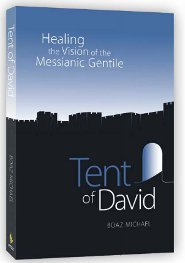
Tent of DavidI’ve written a number of different commentaries on his book including this one, and acknowledge that what Boaz produced challenged me personally to set aside my discomfort about going back to church and to “take the plunge,” which was nearly two years ago. Boaz was instrumental in getting me to see what is good in the Church, which is the same message McKee is delivering.

I applaud McKee for maintaining a high view of Christianity and the faithful men and women in the Church, which he acknowledges is practically unknown within One Law communities, but if he does not advocate for One Law anymore than “divine invitation,” and he apparently does not identify with mainstream Christian assembly (although he protects and defends Christians), what else is there that could be considered “One Law”?

As it turns out, McKee’s third viable option is:

Obeying the Lord is neither an optional invitation nor a mandated obligation, it is a supernatural compulsion enacted by the perfecting activity of the Holy Spirit on the human soul.

p.91

I’m disappointed. I expected a much stronger approach to his application of One Law. But this is like just redressing the One Law argument in spiritual rather than covenantal language. The Holy Spirit (supposedly) compels the individual to desire to observe the 613 commandments or something like them, give or take your opinion on the halachah established by the various Rabbinic sages in the numerous streams of Judaism across thousands of years of history.

Actually, I know where he’s getting this:

“Behold, days are coming,” declares the Lord, “when I will make a new covenant with the house of Israel and with the house of Judah, not like the covenant which I made with their fathers in the day I took them by the hand to bring them out of the land of Egypt, My covenant which they broke, although I was a husband to them,” declares the Lord. “But this is the covenant which I will make with the house of Israel after those days,” declares the Lord, “I will put My law within them and on their heart I will write it; and I will be their God, and they shall be My people. They will not teach again, each man his neighbor and each man his brother, saying, ‘Know the Lord,’ for they will all know Me, from the least of them to the greatest of them,” declares the Lord, “for I will forgive their iniquity, and their sin I will remember no more.”

Jeremiah 31:31-34 (NASB)

Unfortunately, McKee has a couple of problems. The first is that the New Covenant was made exclusively with the House of Judah and the House of Israel and does not presuppose any other nations or people groups at all (least of all he and me). Yes, there is a New Covenant application for Gentiles which I summarized here, but up to this point in the book, while McKee mentions various aspects of the New Covenant, he jumps from Jeremiah 31 straight to the Last Supper (Matt. 26:17-30; Mark 14:12-26; Luke 22:7-39; and John 13:1-17:26) without making the connection explicit. I know how it works (and it took me months of study to figure it out) but chances are many of McKee’s readers don’t (or they don’t understand it correctly).

The other major problem is that the New Covenant hasn’t been fully enacted yet. It’s not here. Jesus inaugurated it with his life, death, and resurrection, but until his return, we are only living in what you might consider the leading edge of the Messianic Age. What that means is until the resurrection and until Messiah returns to us here on Earth and ascends the Throne of David in Holy Jerusalem, we are still living in Old (Sinai) Covenant times!

So we don’t have the Torah supernaturally written on our hearts yet and thus, neither Jews and certainly not Gentiles have the Holy Spirit granted ability to naturally obey God and never sin, which is what the New Covenant is all about…the forgiveness of all sins and the ability to never sin again and obey God’s law (as it applies to each individual and each people group).

And yet he says:

A position of Supernatural Compulsion does advocate that a Torah obedient walk of faith is expected of all God’s people but it is to be found as an individual grows in holiness and spiritual maturity…

-McKee, ibid

While “expected” and “obligated” sound really similar to me, I like that, at least, McKee is acknowledging not everyone is going to adopt the various mitzvot at the same rate or to the same degree. It’s a matter of spiritual growth and maturity. Interestingly enough, I’ve heard many stories of secular Jews who became “religious” and this is more or less how they approach the vast body of mitzvot, taking a mitzvah at a time and growing into it.

But for a Christian, there are additional roadblocks, such as a lifetime of being taught that the law is dead.
ChurchMcKee said in his book that he advocates for a gentle, educational approach rather than going into a church and beating Christians over the head with a Torah scroll. In some sense, this is reminiscent of my own Tent of David experience. It’s sort of like evangelizing the church by encouraging them to consider a more Messianic perspective on the Bible, but where I desire to educate about how the New Covenant works and thus alter Christian perceptions on the primacy of national Israel and the Jewish people in the age to come, McKee is hoping to encourage more “Torah observant” behavior in normalized Christianity.

This is still refreshing because a lot of One Law people I’ve encountered in person and online hate the Church, call it “Babylon,” “pagan,” and “apostate,” and encourage Christians to abandon the Church. His attitudes about the Church are very similar to mine.

But here’s one more surprise I didn’t see coming:

Does a ministry like Outreach Israel and TNN Online think the Torah is for everyone? Yes. Does this include things like Shabbat, the appointed times, and kosher? Yes. But such an affirmative also needs to be tempered with another question: Are these aspects of God’s Torah for everyone right now in the 2010s? This is something that only God, in His plans for an individual’s or a family’s life, especially evangelical Christians, knows for sure — and I cannot fully answer.

-p.93

As I am reading McKee, I think he’s saying that believing non-Jews can and should observe the mitzvot in a more or less “Jewish” manner and to the same degree as Jewish believers (and Jewish unbelievers), but that such standards cannot be imposed from the outside by human agency. Even if one worships with other One Law advocates, that community has no right to direct a person or a family to observe this or that mitzvah. Such a directive will only come from the Holy Spirit and only in the way God’s plan is designed for the individual or family and through the process of spiritual growth and maturity.

I’m a little uncomfortable saying that Christians who don’t have a One Law or even a Messianic Gentile perspective are spiritually immature. I happen to know some people at the church I attend who are models of spiritual maturity and who I admire greatly. Just associating with such people is an honor. From a Jewish perspective, they could be referred to as tzaddikim (“righteous ones”). A Christian would say “saints”.

In the first century C.E. before the destruction of the Temple and the exile of the Jewish people from Israel, Paul’s Gentile disciples in Syrian Antioch and the various communities he established in the diaspora probably behaved in a distinctively Jewish manner, much more so than Christians would consider “normal” today, even acknowledging the “Jewish roots of the faith.” In those days there was no such thing as “the Church” or “Christianity,” there was only the Jewish movement of “the Way,” the “Ekklesia of Messiah” which included Jewish and Gentile members.

I suspect that after the resurrection and in the reign of King Messiah, we will have something similar, not a Church and then a Judaism but rather an Ekklesia with two distinct populations: Israel or the Jewish people, and the people of the nations who are called by His Name. This isn’t exactly what McKee is advocating because he believes Jesus-worshiping Jews and Gentiles are all citizens of Israel, but it’s kind of similar.

What McKee may be shooting all around but not quite hitting is the fact that the New Covenant age has yet to arrive (although we’re currently experiencing a foretaste of the promises yet to come) and that the Torah will only be written on our hearts in the future. While some non-Jews will acquire an apprehension of the centrality of the Jewish people in God’s redemptive plan prior to that time, many others, and probably most Christians, won’t.
white-pigeon-kotelI think the reason McKee can’t answer the question about when or how Gentile Christians will be drawn to naturally obey God is because it’s not going to happen until after we are resurrected and perfected in Messiah by the power of the Holy Spirit and in accordance to God’s New Covenant promises.

With the center of McKee’s book laid as a foundation, I’ll use it to build my review of the first and last parts of his text in part 2 of my “meditation” on One Law for All.

Addendum: My partner in this endeavor, Pete Rambo, just published Part 1 of his own review of McKee’s book.

Acting Jewishly But Not Jewish, Part 2

First things first. Mark Nanos graciously contacted me to let me know I didn’t quite grasp everything he was saying in his paper ‘Paul’s Non-Jews Do Not Become “Jews,” But Do They Become “Jewish”?: Reading Romans 2:25-29 Within Judaism, Alongside Josephus,’ which I highlighted in Part 1 of this two-part series.

Two clarifications:

  1. While many do hold that the Jews were expelled from Rome in mass or entirely, in the appendix to The Mystery of Romans Nanos explains why that is almost certainly mistaken historically, and not helpful for explaining Romans.
  2. More importantly, Nanos does not argue that Paul was actually criticizing Jews in Rome for being hypocritical; rather, he was using the ideal of Jews not being hypocritical as the backdrop for developing a diatribal character, not a real one or even a real accusation as if it is happening, but what it would be like and how obviously hypocritical if so, that one who would call himself a Jew would seek to teach non-Jews Torah if not also committed to keeping Torah, or to get circumcised if not living as one who is circumcised is, dedicated in heart to doing what one separated to God should do regardless of whatever anyone else does or thinks about him and what he does or does not do. That hypothetical character is used to challenge any incipient pride or temptation to judge or behave hypocritically among the non-Jews he addresses directly by way of this diatribal fiction.

I appreciate Dr. Nanos bringing this to my attention and correcting my misreading of his paper where I thought he was saying that Paul was criticizing the Jews in Rome for hypocrisy (and it should be obvious that I’m leveraging Nanos’s words in the numbered list above).

To quote Lt. Cmdr Data, “It is clear that I have much to learn.”

In reporting my impressions on Nanos’ paper last time, I deliberately left out some significant portions for the sake of space. I’m including them here for further discussion.

There are many striking elements in Josephus’s account about Izates, the king of the Parthian client territory of Adiabene, and his mother, Helena, who were not born Jews and ruled a non-Jewish/non-Judean people (Ant. 20.17-96). The events overlap with Paul’s ministry in the 40s and 50s CE (20.15-17), and include interesting parallels to elements of Paul’s approach to and instructions for non-Jews in the Roman Empire. Several scenes warrant discussion.

-Nanos, p. 13

Nanos relates the story of Izates who prior to being crowned King, was sent to Charax Spasini for his own protection. There, Izates encountered the Jewish merchant Ananias. Ananias had been teaching Jewish traditions and customs to several women in the royal family and Izates also became his student.

Or to quote Nanos:

…who taught several women of the royal family with whom Izates was staying to “worship God [the Deity] according to the Jewish ancestral traditions…” (20.34).

-ibid, p. 14

HelenaIt is doubtful there was a Jewish community or synagogue present in Adiabene and questionable if Izates and the “women of the royal family” were undergoing this training as part of the proselyte rite (at least at this point in the process), nevertheless, we have several Gentiles being taught to worship the God of Israel “according to the Jewish ancestral traditions.” This at least suggests that said-Gentiles were A) worshiping the God of Israel, and B) doing so “jewishly,” that is, employing Jewish traditions and methods in worshiping Hashem.

While it’s tempting to think that the Ananias in question is the same person who the Master sent to Paul to relieve him of his blindness (Acts 9:9-19) and thus believe that Izates and the “royal women” were being taught Judaism within the Messianic faith, there’s no evidence to support such a theory (see First Fruits of Zion’s Torah Club volume 6: Chronicles of the Apostles for a further discussion of Izates and Ananias in light of Acts 9).

By an amazing “coincidence,” when Izates returned home to assume the throne after the death of his father, he discovered in his absence, his mother had also been studying Judaism.

…he learned his mother had simultaneously begun to observe certain Jewish customs under the direction of a different Jew, who remains unnamed (20.35-38). Izates is described as becoming aware of Helena’s “rejoicing in the Jews’ customs,” (20.38), referred to also as “their laws/conventions” (20.35).

-ibid

It was at this point that Izates decided to extend his Jewish studies and undergo the proselyte rite, converting to Judaism. Here’s where it gets interesting.

It remains unclear whether Izates supposed heretofore that he had become a Jew, or if he was simply unaware of the distinction between adopting (some) Jewish behavior, most likely adding such behavior to the rest of the customs and cult practices of his people as well as those of the people among whom he was residing, and becoming a Jew. Since the matter of circumcision with its signification of identity transformation does not pertain to Helena, it is also unclear if she is still a non-Jew or is recognized to have become a Jew.

-ibid, p. 15

The Jewish PaulFrom Paul’s point of view relative to his teaching Jewish practices to Gentiles within the context of Messiah worship, the distinction between Jew and non-Jew in Messiah was clearer, at least to him. But from an outside observer’s perspective, would Paul’s disciples have been seen acting any differently than Izates and Helena? How closely can the two cases be compared, particularly when we realize that nothing called “Christianity” existed in those days as a stand-alone religious entity? Paul’s disciples and Izates and Helena as disciples of other Jewish teachers may have had a great deal in common in acting “jewishly” but not being Jewish (maybe).

Ananias strongly discouraged Izates from converting because of how he thought his non-Jewish royal subjects would react to being ruled by a Jew. But while both Ananias and Helena opposed Izates’ conversion, they “did not, however, oppose him observing certain Jewish beliefs and behavior!”

Tweaking that last statement just slightly, could I call Izates a (somewhat) Torah-observant non-Jew? Nanos asks a similar question:

…it is worth pausing to ask whether Helena and Izates at this point represent jewish non-Jews? They are behaving jewishly, and their jewishness is observably different from that of other nobles and their subjects…

Much of the Apostolic Scriptures record the struggle Paul had in integrating Gentile Jesus-believers into Jewish religious and community space as co-equal participants with the Jewish occupants, particularly in defining how unconverted Gentiles could still receive the covenant blessings that were promised by God to Israel alone. And yet in Paul’s conceptualization, he seemingly had a clear vision of who the Gentiles in Christ were relative to Jews in Messiah (and the wider body of Jewish people).

But in the persons of Helena and particularly Izates, we have a greater degree of ambiguity. Was Izates what we would call a God-fearing Gentile, was he a proselyte, or was he something in-between? He was certainly a Gentile (up to the point when he finally converted) who was practicing at least some aspects of Judaism. How far was he allowed to go?

If Paul’s Gentile disciples had a less ambiguous status in terms of Jewish practices and Judaism than Izates, how do we answer the same questions on their behalf? Can we, as Nanos asks regarding Izates and Helena (p. 17), consider them “jewish” Non-Jews who were gathering in Jewish assemblies or synagogues?

I’ve avoided asking the obvious question so far, but how does any of this apply to Gentile Christianity today, particularly to those of us who call ourselves Messianic Gentiles? Twenty centuries ago or close to it, we have a record of many non-Jewish people co-mingling with Jews within Jewish assemblies and communities and being treated as near-equals or equals in social and even covenant standing. The Gentiles were largely, and some probably fully entrenched in Jewish cultural practices. What does that say about Gentiles interacting and worshiping with Jewish Jesus-believers (Messianic Jews) in Jewish community space today?

Goyish is not bad. Goyish is good. It may not be good for Jews, but if you’re a Gentile—goy is good! It is what God made you. ENJOY!!! And realize that salvation has come to the Gentiles as Gentiles. You don’t have to discover your Jewish roots. You should not abandon or disparage the churches from which you came or where you still live, and move, and have your being. You should enrich them through engagement with the Bible, through discovering and expressing your spiritual gifts, and through your whole-hearted participation, but please please please: Don’t despise your roots or imagine that you have to abandon them to find God. God has come to find you and your people just as you are and where you are.

-Dr. Rabbi Stuart Dauermann
“The Problem With Hebrew Roots, or, It’s Good to be a Goy”
Interfaithfulness.org

Up to JerusalemThis might almost be seen as the same view from the opposite end of the telescope. It’s an expression (if I’m reading this right) of how the Gentile Jesus-believers do not have to adopt Jewish cultural traits and practices in order to be faithful Jesus-believers and benefit from the Jewish covenant blessings of salvation, justification, and the resurrection to come.

In Paul’s day, there was no template for integrating faith in the Jewish Messiah within the various Gentile cultures, so it was probably easier to bring the Gentiles into Jewish culture. Paul probably wouldn’t have known how to teach about Messiah and the God of Israel in any other way. But two-thousand years later, Christianity has a rich (and sometimes dark) history and culture of its own. Each church could be said to be its own cultural milieu with its traditions and mores and very little if any of it looks at all Jewish.

Some Gentile believers feel kind of ripped off by the Church, especially when they learn to read the Bible, and particularly the Apostolic Scriptures, as God encountering man within Jewish culture and community. It seems inviting to witness the first Gentile believers being taught by Paul and Barnabas at the “Synagogue of the Way” in Syrian Antioch (see Acts 11).

But can or should a Gentile’s faith in the Jewish Messiah be expressed within a Jewish community and cultural context today? From the above-quoted blog post of R. Dauermann, in answer to a comment, he replies:

Yes, right Chris, learning about the Jewish/Hebrew roots of what CHristians believe is instructive and helpful, but not when a Gentile is erroneously steered in the direction of seeking to establish their *own* alleged Jewish roots as a passport to greater spiritual authenticity. As I said above, “It is true that Christianity at its inception had Jewish roots, but this is not Not NOT and never to be understood as recommending that Christians think they have Jewish roots or that they need to find those roots in order to legitimize themselves and their faith.”

From my point of view, I think there are circumstances when Gentile believers can and even should appropriately express their faith within a Jewish cultural context. In fact, at least in the United States, most authentically Messianic Jewish synagogues contain a significant if not majority population of Gentiles in their membership. Like Izates, there will always be Gentiles who are inexorably drawn to Judaism for whatever reason and they will find their way into Jewish community. Further, there are numerous intermarried couples who would benefit from the Jewish spouse participating in Messianic Jewish community along with the Gentile spouse. This is particularly important if they have Jewish children who need to learn and preserve what it is to be Jewish and to be Messianic.

But I was thinking in church last Sunday about Christians (which I suppose isn’t surprising). What do we do about them?

The first thing to consider is that most Christians are more than overjoyed to be in their churches and couldn’t imagine any other venue for their worship of and devotion to Jesus Christ. From their viewpoint, they neither want nor need to engage Jesus within a Jewish cultural context and doing so would just make them feel uncomfortable if not downright alienated.

But that’s not to say that the Church is perfect nor that they cannot learn from what Messianic Jews and Gentiles teach. I was talking to a young fellow after Sunday school class the other day about Jewish traditions and the benefits they possess. We talked about the set times of prayer and the abundance of blessings a Jew recites on various occasions. I also told him that a Christian does not specifically have to adopt Jewish practices in order to gain the benefits of the values that lie behind the traditions.

ShabbatOn Erev Shabbat for example, it is traditional for Jewish parents to bless their children in a specifically proscribed manner. I told my young friend that he and his wife could also chose to bless their children, but they didn’t have to do it “jewishly”. The values behind Jewish traditions and culture provide context, identity, and meaning to Jewish families, and I think Christians can and sometimes do employ similar practices for the same reasons and can get similar results.

Two-thousand years of history have separated most Christians from even the idea that we could act “jewishly” and for most Christians, it would drive them crazy even to consider the possibility. But if someone like me, who has a few “jewish” ideas to relate to my Christian counterparts, can communicate those concepts in the Church, maybe it will build a bridge between the two worlds.

For those Christians who are drawn to a more “jewish” lifestyle, many of them either come from family and culture that melds into behaving more “jewishly” or they learn to do so through marriage or some other process.

The main takeaway for me is that it’s not a “have to,” that is, I don’t feel compelled by God that I must live “jewishly” and that it’s a sin not to. It may well have been acceptable for Izates and Helena to live “jewishly” and never to convert to Judaism, at least in a formalized manner. Certainly Paul’s Gentile disciples lived “jewishly” probably by default, since there was no other cultural pattern one could employ for a Gentile to live as a disciple of a Jewish teacher.

But that was then, and this is now. While some Gentiles elect to live “jewishly” as an expression of their faith, it doesn’t seem absolutely necessary, at least in the current age. I’ve seen some Christians in the Church observe more of the weightier matters of Torah than I have some Hebrew Roots Gentiles in One Law gatherings.

It isn’t the cultural or religious context that makes the person of faith, it’s the heart. One circumcised heart is worth ten-thousand kippot and tallitot wearing people with uncircumcised hearts (not that you can’t be a kippah and tallit wearing Gentile with a circumcised heart, of course).

To love him with all your heart, with all your understanding and with all your strength, and to love your neighbor as yourself is more important than all burnt offerings and sacrifices.”

Mark 12:33 (NASB)

A friend of mine said it best: Don’t seek Christianity and don’t seek Judaism. Seek an encounter with God.

Acting Jewishly But Not Jewish, Part 1

Paul’s “Jewish Assemblies” rather than “Paul’s Gentile Churches”? “Paul’s Jewish non-Jews” instead of “Paul’s Christian Gentiles?”? Paul bringing Non-Jews into “Judaism” rather than into “Christianity”? Am I really going to argue that these are more accurate labels for discussing the non-Jews who Paul brought to faith in Jesus Christ and the gatherings of them with Jews sharing that conviction, as well as the communal ways of life into which Paul sought to enculturate them? “Yes” — and “No.”

Dr. Mark D. Nanos
‘Paul’s Non-Jews Do Not Become “Jews,” But Do They Become “Jewish”?: Reading Romans 2:25-29 Within Judaism, Alongside Josephus,’ p.1
forthcoming in The Journal of the Jesus Movement in its Jewish Setting (2014)
and presented as a paper at the SBL Annual Meeting in 2013, Baltimore, MD.

Since this cites a portion of Romans 2, it would be prudent to review that part of scripture before proceeding:

For indeed circumcision is of value if you practice the Law; but if you are a transgressor of the Law, your circumcision has become uncircumcision. So if the uncircumcised man keeps the requirements of the Law, will not his uncircumcision be regarded as circumcision? And he who is physically uncircumcised, if he keeps the Law, will he not judge you who though having the letter of the Law and circumcision are a transgressor of the Law? For he is not a Jew who is one outwardly, nor is circumcision that which is outward in the flesh. But he is a Jew who is one inwardly; and circumcision is that which is of the heart, by the Spirit, not by the letter; and his praise is not from men, but from God.

Romans 2:25-29 (NASB)

How did the Apostle Paul see the distinction between Jesus-believing Jews and Gentiles in Jewish worship and community space? I’ve written on this topic numerous times, often utilizing the research and publications of both Mark Nanos and Magnus Zetterholm in such “meditations” as Nanos, Paul, and the Consequences of Jewish Identity in Messiah, Nanos, Ancient Antioch, and the Problem with Peter, and Zetterholm, Nanos, Ancient Antioch, and Some Implications. In this more recent paper by Nanos, one that should be published later this year, we see an interesting development in how Nanos presents Paul relative to Romans. Did Paul see the non-Jewish disciples of the Jewish Messiah as practicing Judaism or behaving “jewishly” without converting to Judaism or taking on identical obligations and roles with the Jews?

Being identified as a Jew and behaving like a Jew are readily recognized to represent two related yet not identical matters (p.2).

This behavior can be referred to by the adverb “jewishly,” and as the expression “jewishness.” In colloquial terms, one who practices a Jewish way of life according to the ancestral customs of the Jews, which is also referred to as practicing “Judaism”… (p.3).

Mark Nanos
Mark Nanos

Nanos distinguishes between being born ethnically Jewish and (as a male) being circumcised on the eighth day and acting “jewishly” (the lower-case “j” is used deliberately by Nanos), as having significant overlap, but not precisely being same. Even a Jewish person born of two Jewish parents and circumcised may choose not to observe any of the mitzvot and nevertheless will be considered Jewish, albeit apostate.

A Gentile who chooses to observe some or even all of the Jewish behaviors associated with the mitzvot can be said to be acting “jewishly” or practicing “Judaism,” but that does not mean the person is actually considered Jewish.

But where is the dividing line? How far could a Gentile Jesus-believer go in Paul’s time, and how far can a Gentile Jesus-believer go in our time in “acting Jewishly” without actually being Jewish? Can we use Paul to establish any rules or guidelines for Gentile Christians today who are attracted to Jewish practices or learning and yet do not desire to convert to Judaism because of their Christian faith?

Because ethnic identity (Jew/s) and ethnic thinking and behavior (Jewish / jewishly / jewishness / Judaism) are clearly related, but not synonymous, interchangeable terms, an interesting phenomenon arises when seeking to describe groups as Jewish. Although “Jewish” can be and is most often used to refer to Jews specifically, and thus gatherings of Jews: they are Jewish, the Jewish people, a Jewish service, and so on, as we will see, “Jewish” can also refer to groups or activities that include non-Jews: that group is Jewish, although it includes non-Jews who appear to think and behave like Jews (p. 6).

Nanos could easily be describing almost any synagogue I’ve ever been in. I’m a Christian married to a Jew. It’s very common to find a mixed Jewish/Gentile group in our local Reform/Conservative synagogue and of course at the Chabad, a number of intermarried couples attend, and yet both venues are undeniably Jewish. The same may be said for some Messianic Jewish synagogues that have at least a core population and leadership of Jews but that also houses a large number of Gentiles who are involved in Jewish practices, such as listening to the Torah readings, davening from a siddur, praying in Hebrew, and so forth.

In all of the contexts listed in the above paragraph, the participating Gentiles can be considered as acting “jewishly” within a Jewish community while remaining fully Gentile. But as I said before, how far can we take the concept of “Gentile jewishness” and consider it a valid method of “practicing Judaism?”

orthodox-talmud-studyAlmost two years ago, I stopped searching for an identity and declared myself a Gentile who studies Messianic Judaism. While my practice isn’t all too “Jewish” (or “jewish”), my thought processes, study materials, and some of my study methods borrow heavily from traditional Judaism.

Of course, I can be a Gentile studying Judaism in the same sense as a 21st century American studying 16th century Greek cuisine. I don’t have to be the thing that I’m studying. Learning the typical dishes of Greece of the 1700s doesn’t require that I be Greek.

But it’s a little different in the world of religion and religious lifestyle. I could study Torah as an abstract collection of knowledge the way some people study the Bible as literature or as history, but the Bible is unique and the Torah is designed to change lives. To be a Gentile student of Messianic Judaism involves not only specific study methods and materials but the required context in which to live it all out.

To continue from Nanos:

What if a group mostly made up of non-Jews with some Jews in leadership behaves jewishly? What if it is made up exclusively of non-Jews yet founded or advised by Jews? What if it consists of only non-Jews and functions independent of any Jews and yet bases its thinking and behavior on Jewish Scriptures, traditions and ways of life? (pp. 6-7)

As I read these passages from the Nanos paper, I can’t help but see a progression from Messianic Judaism (MJ) into Hebrew Roots (HR). The closer the Gentile is to the MJ side of the scale, in a mixed group of Jews and Gentiles to a group of Gentiles with a core leadership of Jews or even arguably, a group of only Gentiles that is advised and guided by Jewish mentors, that group is or could be considered “Jewish” or at least perceived correctly as acting “jewishly”.

However, once to you approach the opposite side of the scale, which would be defined by a group made up exclusively of Gentiles with only Gentiles in leadership, even if they are using Jewish educational materials and religious artifacts (siddurs, kippahs, Tallits, the Chumash, and so on), that group may still appear to be acting “jewishly,” but they are not a Jewish group. They can study Judaism, but they aren’t a Judaism, thus a group made up exclusively of Gentiles with no ties to Jewish oversight cannot, in this paradigm, call itself “Messianic Judaism” and is better defined as “Hebrew Roots” or by some other label.

This directly reflects back to the communities Paul established or in which he was involved such as the “synagogue of the Way” in Syrian Antioch (see Zetterholm’s The Formation of Christianity in Antioch as well as Nanos’ The Mystery of Romans).

The level of “jewishness” practiced by Gentile disciples of the Master may have been in direct proportion to the involvement and influence of Jesus-believing Jews operating in the same religious and social community. The less influence exerted by Jewish mentors on the Gentiles, the less “jewish” were the behaviors and lifestyles of the Gentiles.

The Jewish PaulWe see something of this in Paul’s Epistle to the Romans. Historically, we know that for a time, Jews were banned from Rome. Prior to that event, there were both Gentiles and Jews who co-mingled as disciples of Jesus. Once the Jews were banned and (presumably) Rome was without a Jewish population, the Gentiles became solely in charge of their own social and religious dynamic, including how “jewishly” they chose to behave. When the Jews were allowed to return and attempted to resume their prior relationship with the Gentiles in Messiah, they discovered the Gentiles were riding on their “high horses,” so to speak, pushing back against Jewish synagogue authority and even criticizing the Jews for lack of strict adherence to Jewish Torah practice.

The chapter (Romans 2) within which this text appears begins with a challenge to anyone judging others, based on the argument that the very act of knowing there is a standard to which the other is held logically involves knowing that one has also failed to achieve it. Realizing that God is the judge who is fully aware of both one’s own intentions and actions as well as that of one’s neighbors, the message Paul drives home is to focus on one’s own responsibilities to do what is required of one, to judge oneself and leave the judging of others to the Judge… (p.19)

And again, Nanos states:

Paul’s argument is constructed to encourage non-Jews to avoid making the same mistake they are quick to recognize in this diatribal caricature. Paul calls them to concentrate on being faithful to what they are responsible to do in service instead of judgment toward the other, including the one who may be judging them… (p. 31)

Nanos is specifically referencing Romans 2:25-29 which I quoted at the top of this blog post, and is saying that those Gentiles who were choosing to judge their Jewish counterparts for any errors or lapses in Torah observance would be better advised to pay attention to their own responsibilities and let the Righteous Judge of Israel judge Israel.

Which, given the current conversation, begs the question of what behaviors of theirs should the Gentiles in Rome have been attending to? Put another way, should the Roman Gentile disciples have been paying attention to the proper execution of their “jewish” behaviors? What does it mean to “concentrate on being faithful to what they are responsible to do?”

Paul argued that these uncircumcised non-Jews were full and equal members of the family of God alongside of the Jewish members, indeed, equally children of Abraham and co-heirs of the promises made to him and his seed, not simply welcome guests (p. 7).

That sounds good but it doesn’t complete the picture.

In the next argument, vv. 12-16, Paul makes it plain that God judges according to the faithful behavior, which is not expected to represent precisely the same standards for Jews and non-Jews; indeed, each is held to the standard of what they know to be proper behavior (p. 19). (emph. mine)

studying_tanakh_messiahSeveral chapters in Romans seem to toggle back and forth between the responsibilities of Jews and Gentiles relative to God and the potential for hypocrisy among the Jews who claim the advantages of being Jewish but who, while teaching the Gentiles what is proper for God (for Gentiles), fail themselves to perform what is proper before God (for Jews). It should have been fairly clear to the Jewish people involved what their roles and responsibilities were, but were the Gentiles just supposed to “wing it,” hoping to know what is right and wrong?

We know that Paul had certain expectations of the Gentiles. Although he opposed Gentiles in Christ from undergoing the proselyte rite, he also discouraged them from continuing any idolatrous practices (Rom 3:29–4:25; 6; 1 Cor 7:17-22; Gal 4:8-10; 1 Thess 1:9-10).

Of the Gentiles taught by Paul, Nanos says:

Paul was exhorting non-Jews turning to God in Christ to seek to discover within themselves the noble values of jewishness, what being a Jew ideally signifies. They should learn to internalize jewishness as the highest value for themselves, albeit remaining non-Jews… (p. 32). (emph. mine)

But here’s a strong caveat:

His letters consist precisely of instruction in the Jewish way of life for non-Jews who turn to Israel’s God as the One God of all the nations; he enculturates them into God’s Guidance (Torah) without bringing them under Torah technically, since they do not become Jews/Israel. They are non-Jews who are learning, by way of Paul’s instructions, to practice Judaism! (p. 33) (emph. mine)

I can see where you might think all this is as clear as mud.

How can Gentiles learn to draw their values from Judaism and even practice Judaism to the degree that outside observers would say the Gentiles are acting “jewishly” and yet still operate under an overlapping but distinct set of standards from the Jews, not be considered under the Torah, and not be considered either Jews or Israel?

From the Didache (6:2), it is said:

For, on the one hand, if you are able to bear
the whole yoke of the Lord, you will be perfect;
but if, on the other hand, you are not able,
that which you are able, do this.

quoted from The Didache: Text, Translation, Analysis, and Commentary, pg 19
by Aaron Milavec

The Didache is considered a set of formalized instructions for Gentile initiates who were seeking to become disciples of Jesus. The document is traced to the second century C.E. and probably represents an earlier form of oral instructions and traditions, possibly originating with the Apostles or their immediate disciples. These standards would have been the basis Jewish mentors used to train the Gentile initiates in preparing them to become baptized and enter into their role as disciples.

beth immanuelFrom here we see that it is likely the Gentiles were encouraged to bear “the whole yoke of the Lord” Torah, in order to be “perfect,” but if they were not able, it was allowable that they should perform whatever was within their capacity. Again, please keep in mind, that a Gentile acting “jewishly” was both voluntary and was designed to occur within a Jewish communal context.

Given space limitations and the patience of those of you reading this, I’m going to stop here and pick it up in a subsequent blog post. There’s still much to explore about a Gentile acting “jewishly” in ancient times and what happens when he or she is outside a Jewish space. Also, what are the implications for those of us today who are Gentiles who study Messianic Judaism, both inside a Jewish context and outside?

Addendum: I’ve published the second part of this two-part series including a correction to some mistakes I’ve made in part one. I want to thank Dr. Mark Nanos for bringing what I’ve misunderstood about his paper to my attention and allowing me the opportunity to fix my mistakes.

A Book Review By Invitation

My recent post/review of Boaz Michael’s Tent of David has really fostered some good discussion. Probably one of the longest and best discussion thread on any post on this blog. At times it has been spirited, but peace and grace have been the general tenor. Thank you!!

Leaders in the discussion have been bloggers James Pyles of “My Morning Meditations” and Ruth of Sojourning With Jews. Both are friends I have gotten to know over the last year in the blogosphere and though we do not see eye to eye on all things Messianic, we all desire truth and enjoy the pursuit thereof. Each of us has publicly wrestled with thoughts and understandings as we search the Scriptures (though I envy both for being more open with their hearts than I have been…).

-Pete Rambo
“You are invited….”
natsab.com

Hebrew Roots (HR) blogger Pete Rambo has issued a challenge to me (Ruth had to back out) to read one or more leading HR books (since Pete and I have already discussed Boaz’s book Tent of David: Healing the Vision of the Messianic Gentile in the comments section of his review) and to “co-review” the book, he with his perspective on his blog and me on mine.

Pete generously sent me two books to choose from, both written by a gentleman named J.K. McKee who maintains a personal/professional website called TNN Online (Theology News Network Online). McKee’s rather lengthy Statement of Faith is also available on his site, so in addition to his About page, you should be able to find out all you need to know about him.

As far as Pete goes, he describes himself as a “46 [year old] recovering seminary trained pastor.” He also says:

During most of my life I have had a particular interest in eschatology (end times events/prophecy) and in understanding truth. (I used to be a conspiracy theorist… now, I am a conspiracy factualist… ) In my quest, I began to run into pieces of information that challenged my very conservative traditional Christian religious perspectives. Only when I began to pray earnestly for Yahweh to show me TRUTH did He move my focus from geopolitical events and onto a close scrutiny of what I now call ‘Churchianity.’ As I learned how far the Church had moved from the simplicity of the Book of Acts and the clear teaching of the Word, I became convicted of the need for a personal reformation.

Tent of DavidTo “bottom line” it, my understanding (and please correct me if I get this wrong, Pete) is that both Pete and Mr. McKee would fall into the theological/doctrinal category within Hebrew Roots of being One Law (and I’ve linked to a set of definitions created by Rabbi David Rudolph from his website MessianicGentiles.com).

The book Pete and I agreed upon (via email) to review first is McKee’s One Law for All: From the Mosaic Texts to the Work of the Holy Spirit. The book is about two-years old and so far has rather stellar reviews on Amazon with a total of nine reviews as I write this. Either the book is incredibly good, or the deck is stacked, or both.

Let me explain.

Since I’m also published author, though not in the religious or theological space, the publishers I’ve written for typically send me anywhere from five to ten “review copies” of my books once they go to market so I can pass them out to family and friends, asking them to write and publish reviews on Amazon.

This is a traditional marketing technique and the assumption is that the author’s family and friends or perhaps “fans” of his/her work will be more likely to write favorable reviews, elevating the book’s ranking at Amazon. Of course, at least from my experience, every time I’ve sent out review copies of one of my books and asked people I know to review it, it’s always a tad risky, since I want the reviewers to be honest and sincere, and there’s always a chance they’ll take exception to some portion of what I’ve written (if not the whole book). On the other hand, I don’t want anyone to be dishonest in writing their opinion of something I’ve created. If one of my books is to be praised, I want that praise to be authentic.

I say all this with the idea that the individuals who have reviewed McKee’s “One Law” book at Amazon may be those people who are already predisposed to like the content of McKee’s book (and his general theological bent) and thus write positive reviews.

I know one of the reasons I reviewed Matthew Vines’ book God and the Gay Christian: The Biblical Case in Support of Same-Sex Relationships is because I knew it would draw exactly two audiences: those who automatically supported his platform and those who automatically opposed it. I wondered if Mr. Vines would ever get a truly objective review of his work, so I made it my “mission,” so to speak, to do just that, setting aside as much of my own personal bias as was possible.

I intend to do the same thing here with the caveat (please pay attention to this part) that I am theologically and doctrinally opposed to the position that there is One Law, that is, a single and unified application of the Torah mitzvot that applies to all disciples of Jesus Christ (Yeshua HaMoshiach) whether they be Jewish or Gentile (that application would ultimately be applied to all human beings since the Bible refers to how “every knee will bow, see Romans 14:11; Philippians 2:10).

I have a history in “One Law,” and after coming to faith within the context of a Christian church nearly twenty years ago, I swiftly (long story) transitioned into a Hebrew Roots/One Law congregation (which billed itself as “Messianic Judaism”) and learned my basic understanding of the Bible and my faith there.

Without going into a long explanation, after some years, I finally was prompted to question all of the assumptions I naively accepted back in the day and spent nearly a year publicly exploring said-assumptions on my previous blog spot (to which I no longer contribute).

In the spirit of friendship and learning, I have agreed to Pete’s proposal but I could be considered what trial attorneys call a hostile witness in that my attitudes and beliefs regarding “One Law” are not supportive of the theological presuppositions it entails.

one law bookThe goal is as Pete states on his own blog:

In the process of our discussion, I mentioned to James via email that we ought to read and review/discuss a book at the same time…

One point to stress for all of us from the outset: the goal here is to learn and grow. We may be challenged, but we want to plan on good vigorous discussion that at the same time is peaceful and displays the fruit of the Spirit!!

That is, Pete and I will read McKee’s book and each of us will post our impressions/reviews on our respective blogs (and I also intend to post a review on Amazon). We will insert McKee’s book into a crucible and attempt, through our differing viewpoints, to tease out the essence of what’s been written, then present those findings to whoever chooses to read our blogs.

As Pete says, we both want to show that two people can discuss differing theological perspectives in a peaceful and cooperative manner, and avoid those emotional meltdowns that we all frequently have witnessed in the religious blogosphere. We aren’t (necessarily) trying to convince the other to change his mind, but rather are trying to provide clarity of thought and expression of our respective points of view.

I hope you will follow along on our two blogs and feel free to join in (politely and respectfully) on our discussions.

When Christians Aren’t Israel

In writing the review, I mentioned that I had gone back to J.K.McKee‘s A Part of Israel? as a resource for scholarly exposition of Scripture related to the place of non-Jews who come to Messiah. You’ll remember I lamented not having reviewed the book… Well, I started reading it again and couldn’t put it down! ‘Nuff said?

He is gracious in doing so, but is clear to demonstrate where there is error in various understandings of what the Kingdom of Israel looks like and who is in it! Example passages would be 30 pages dedicated to the predictably selected Ephesians 2:11-13 passage. He specifically addresses politeia, a Greek word we have looked at before, however, he understandably takes a much more coy approach as to whether non-Jews will have an inheritance in the land.

-Pete Rambo
from portions of his review of
JK McKee’s ‘Are Non-Jewish Believers Really A Part Of Israel?

I normally ignore these sorts of topics since historically in the blogosphere, debating the issues involved in Jewish/Gentile relationships in modern Messianic Judaism and/or the ancient ekklesia of “the Way” have, at best, proven unfruitful, and at worst, hostile and abusive.

But I’ve always had good, civil, and friendly conversations with Pete, including in the comments section on another of his blog posts,. So when I read his review, I was prompted to consider responding. After all, the legal and community status of the ancient Gentile disciples of the Jewish Messiah King relative to the synagogue, Jewish co-participants, and ultimately national Israel not only have applications in modern Christianity, but ultimately will be realized in the Messianic Kingdom when the New Covenant Age comes toward completion.

I requested a review copy of McKee’s book from the publisher and received a very nice and prompt reply stating that they do not honor such requests. Fair enough, since self-publication does not usually allow for such an option.

When I read Pete’s review last night, I got stuck on a single word: politeia. My commentary rather narrowly focuses on this word and how it is used since I can’t comment more generally on what McKee has written.

The word “politeia” is used in the following passages of scripture:

Then the commander said, “I had to pay a lot of money for my citizenship.”

Acts 22:28 (NASB)

…remember that at that time you were separate from Christ, excluded from citizenship in Israel and foreigners to the covenants of the promise, without hope and without God in the world.

Ephesians 2:12 (NASB)

I’ve bolded the English word corresponding to the Greek word “politeia” which is rendered as “citizenship” in both cases in the NASB translation.

However, this creates a number of questions.

  • Is Paul telling us (or his readers) that non-Jewish members of the Messianic ekklesia are now legally citizens of national Israel by faith in Messiah?
  • If so, then does such citizenship automatically require that the Gentile disciples adhere to, by obligation, the same Torah mitzvot in the same manner as the Jewish disciples/citizens?
  • Can “politeia” be translated in any other way besides “citizenship” and if so, what are the implications for the relationship of Gentiles and Jews belonging to Messiah in relationship to national Israel?

politeiaAs you can see from my source material, depending on the translation and in which part of scripture the word occurs, it can be translated differently. In Acts 22:28 using the KJV translation, it is rendered “freedom,” while in Ephesians 2:12, the NAS, KJV, and INT translations all present the word as “commonwealth”.

In fact, “citizenship” is only one of three major ways to translate”politeia”:

  1. the administration of civil affairs (Xenophon, mem. 3, 9, 15; Aristophanes, Aeschines, Demosthenes (others)).
  2. a state, commonwealth (2 Macc. 4:11 2Macc. 8:17 2Macc. 13:14; Xenophon, Plato, Thucydides (others)): with a genitive of the possessor, τοῦ Ἰσραήλ, spoken of the theocratic or divine commonwealth, Ephesians 2:12.
  3. citizenship, the rights of a citizen (some make this sense the primary one): Acts 22:28 (3Macc. 3:21, 23; Herodotus 9, 34; Xenophon, Hell. 1, 1, 26; 1, 2, 10; (4, 4, 6, etc.); Demosthenes, Polybius, Diodorus, Josephus, others).

I’m not a linguistic scholar, but I’ve known enough of them to understand that any sort of translation from one language to another is much more complicated than saying a particular word in language A always means another particular word in language B, especially when those languages are separated by nearly two-thousand years of history.

I am absolutely not saying McKee is making such a “rookie error,” but I will say that we all read and translate the Bible from a particular perspective, usually one that supports our own biases (everyone has biases, it’s not a dirty word). And yes, it’s easy to read those two verses in the New Testament and conclude that Paul must be making Israeli citizens out of Gentile believers in Jesus.

Tel Aviv
Tel Aviv

A lot of Evangelical Christians believe we’re “spiritual” citizens of Israel too, and expect to take over physical, national Israel when Jesus comes back. Naturally, Jewish people object to being kicked out of their own Land (even by allegory) and those teachers in Messianic Judaism who I follow do not believe we Gentiles will be moving to Jerusalem, or Tel Aviv, or Haifa once Messiah ascends the Davidic throne.

So where does that leave us? What’s the “differential diagnoses?”

If indeed it is the case that in Christ these Gentiles have a portion in [Israel’s covenant membership and national eschatology], i.e. that they are saved as Gentiles, then it suffices to apply to them the same ethical principles that would in any case apply to righteous Gentiles living with the people of Israel, i.e. resident aliens.

-Markus Bockmuehl
“Jewish Law in Gentile Churches:
Halakhah and the Beginning of Christian Public Ethics”
(Grand Rapids, MI: Baker Academic, 2000), 165

While the gerim in the days of Moses were not Israelites as such and did not obtain full membership status in the nation due to lack of tribal affiliation, they did observe a large number (majority? nearly-full obligation?) of the Torah mitzvot in the days of Moses and beyond. The argument of some branches of the Hebrew Roots movement is that the gerim status can be wholly transferred to the Gentile disciples of Jesus and be used to justify Gentile Christian obligation to the full yoke of Torah. Lancaster has spent considerable effort in his commentary to illustrate how James and the Council exempted the Gentiles from the full yoke of Torah because they were not born Jews or converts. Now, he apparently brings in an element in explaining the four prohibitions that could reverse his argument.

-from my blog post Return to Jerusalem, Part 6
based on my reviews of First Fruits of Zion’s (FFOZ) Torah Club series Chronicles of the Apostles

Up to JerusalemThe key to all this is in understanding what sort of decision the Council of Apostles and Elders made in Jerusalem about the legal status of Gentiles in “the Way”. The question was brought up (Acts 15:1-2) and after much debate, Paul and his detractors couldn’t make any headway toward a solution, so they took it to a higher authority in Jerusalem. After much deliberation, the Council rendered what amounts to a binding legal decision and issued halachah specific to the communal role and responsibilities of Gentile disciples of the Master. Did they have to undergo the proselyte rite and become wholly obligated to the Torah mitzvot? If not, how could they be included as equal co-participants in Jewish worship and community and yet not be Jewish? How could they be included in covenant?

How do we resolve the matter of the ancient Ger as applied to the late Second Temple Gentile God-fearing disciple? Lancaster doesn’t make that clear, but based on my own reading, particularly of Cohen, the full role of a Ger as it existed in the days of Moses was to allow a non-Israelite to live among the people of God as permanent resident aliens without being able to formally become national citizens due to lack of tribal affiliation. After the Babylonian exile, a tribal basis for Israelite society was lost and affiliation by clan was emphasized. By the time of Jesus, this clan affiliation basis was too lost, and thus the rationale for the status of Ger as it was originally applied no longer was valid. A Gentile in the days of Jesus or later, who wanted to join the community of Israel, in most cases, would convert to Judaism, since becoming a Ger was not an option.

-from my aforementioned blog post

To further cite Shaye J.D. Cohen:

Biblical law frequently refers to the “resident alien” (ger in Hebrew) who is grouped with the widow, the orphan, and the Levite. All of these are landless and powerless, and all are the potential victims of abuse. (An American analogy to the ger is the Chicano (specifically, undocumented alien) farmworker; a European analogy is the Turkish laborer in Germany.) The Bible nowhere states how a ger might ameliorate his status and become equal to the native born, because there was no legal institution by which a foreigner could be absorbed by a tribal society living on its ancestral land. Resident aliens in the cities of pre-Hellenistic Greece fared no better.

But there’s another authoritative source that should be considered:

and in order that the Gentiles might glorify God for his mercy. As it is written,

“Therefore I will confess you among the Gentiles,
and sing praises to your name”;
and again he says,

“Rejoice, O Gentiles, with his people”;
and again,

“Praise the Lord, all you Gentiles,
and let all the peoples praise him”;
and again Isaiah says,

“The root of Jesse shall come,
the one who rises to rule the Gentiles;
in him the Gentiles shall hope.”

Romans 15:9-12 (NASB)

To which Nanos responds:

Christian gentiles worshiping the One God in the midst of the congregation of Israel — my point exactly! (emph. mine)

-Mark D. Nanos
Chapter 6: Romans 13:1-7: Christian Obedience to Synagogue Authority, pg 326
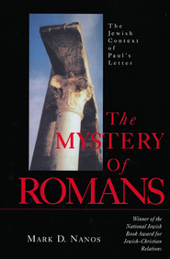
The Mystery of Romans: The Jewish Context of Paul’s Letters

Paul is urging the Gentile believers to take note of their position, their role, and their halachic status as “resident aliens” within the midst of corporate Israel, which here is the synagogue context in Rome.

-from my review of Nanos’s book

The Mystery of RomansThe alternative explanation, based Bockmuehl, Cohen, Lancaster, and Nanos, is that the Gentiles were included in the commonwealth of Israel but not as equal national citizens. It would be as if my wife, as a Jew, decided to make aliyah, become an Israeli citizen and live in Israel. As her husband, even though I’m not Jewish, I would be allowed a permanent status as a resident in Israel as well, but I do not have an automatic right to become a citizen, as does my wife, because I am not Jewish.

I would still have most or all of the same rights as Jewish Israelis and I would have most or all of the same obligations as Jewish Israelis, but none of that would make me Jewish, nor would the Chief Rabbis of Israel or any other Jewish religious authority expect me to observe Torah as they proscribe because I’m not Jewish.

I know you’re going to say that’s all secular law (with the exception of the authority of the Chief Rabbis) and has little or nothing to do with how God sees things, but I’m using the above example by way of analogy. When James and the Council issued their decision, it wasn’t some magical, spiritual event, it was a legal ruling on the same order as the authorities among the Pharisees made, and was binding halachah upon the community.

However, there is another citizenship I have and one in which I’m looking forward to living out in the age to come. It’s a status I currently possess since according to at least one interpretation of the New Covenant, I need to start living my life as if the world were already fully under the rule of Messiah, Son of David, as he is seated on his Throne in Jerusalem.

I consider myself a citizen of the worldwide Messianic Kingdom to come and many wonderful blessings come from this status. I will be resurrected from dead flesh and made immortal (assuming I die before Messiah’s return). I will have my sins fully, permanently cleansed from me. I will have the Holy Spirit poured into me to such fullness that I will have an apprehension of God in the same or even greater manner than the prophets of old. I will have my heart of stone turned to a heart of flesh and God will write His Word upon it so that it will be my natural inclination to always obey Him and not return to sin.

And as a Gentile of the nations, I will reside in a country that is a vassal state to national Israel, subservient to Israel which will be the head of all nations, and ultimately I and my nation of residence will be accountable to the King of Israel, Moshiach. I expect that I and everyone else like me will be planning our vacations around the festivals and making regular pilgrimages to Jerusalem to spend time with family and friends and pay homage and honor to our King.

The goyishness of Christianity is a sign of its success, not its failure!

-Rabbi Dr. Stuart Dauermann
“The Problem With Hebrew Roots, or, It’s Good to be a Goy”
Interfaithfulness.org

Stuart Dauermann
Rabbi Dr. Stuart Dauermann

R. Dauermann makes a compelling argument that Gentiles who attach themselves to the God of Israel are intended by God to remain Gentiles. The prophets of the Tanakh who spoke of the Messianic Age all seemed to share that belief. I’ll only quote two of them:

And foreigners who bind themselves to the Lord
to minister to him,
to love the name of the Lord,
and to be his servants,
all who keep the Sabbath without desecrating it
and who hold fast to my covenant—
these I will bring to my holy mountain
and give them joy in my house of prayer.
Their burnt offerings and sacrifices
will be accepted on my altar;
for my house will be called
a house of prayer for all nations.”

Isaiah 56:6-7 (NASB)

“In that day

“I will restore David’s fallen shelter—
I will repair its broken walls
and restore its ruins—
and will rebuild it as it used to be,
so that they may possess the remnant of Edom
and all the nations that bear my name,”
declares the Lord, who will do these things. (emph. mine)

Amos 9:11-12 (NASB)

And to quote verse 14:

and I will bring my people Israel back from exile. (emph. mine)

which can also be interpreted as:

will restore the fortunes of my people Israel. (emph. mine)

In both of these prophetic examples describing Jews and Gentiles in the Messianic Age, it is clear that Gentiles will become attached to the God of Jacob as Gentiles and as citizens of the nations. While Isaiah paints for us a portrait of Gentiles offering sacrifices at the Temple of God (something which was allowed during the time of Herod’s Temple), Amos 9:14 makes a clear distinction between the Gentiles of the nations who “bear my name” and Israel!

It is true that Isaiah describes Gentiles keeping to the covenant, but after all, we will receive blessings because of our Abrahamic faith under the New Covenant, and in Messianic Days, I expect it will be more common for even the citizens of vassal nations to have laws and observances that more closely mirror national Israel’s including Sabbath keeping.

I’m not even saying (with apologies to R. Dauermann) that Gentiles in Messiah shouldn’t observe Sabbath in the present age. I’ve met many who do.

What I am saying is that none of what I see in the Bible, particularly the use of a single Greek word, absolutely mandates that all non-Jewish people who are disciples of Jesus be made into citizens of Israel, either in the present age or in the Messianic future.

God made a covenant with Abraham that was specifically and narrowly passed down to Abraham’s son Isaac (but not to Ishmael or any of Abraham’s subsequent children) and then to Isaac’s son Jacob (but not to Esau) and then to Jacob’s twelve sons who became the heads of the twelve tribes, who became the nation of Israel (but not to any other people group or nations).

That Abraham would also become the father of many nations and that through his seed (singular) Messiah, the nations would be blessed, does not abrogate the part of the covenant that specifically promises Israel only to the direct biological offspring of Abraham, and Isaac, and Jacob.

Having not read his book, I can’t say for sure, but if  McKee comes to a different conclusion in his writing, then in spite of his stated education and scholarship, I’m forced to disagree with him.

I don’t write this against Pete or anyone else who holds to his views of scripture, but rather to illustrate that there are other valid and educated views of the Bible that come to other valid and educated conclusions.

I considered just making a few comments on Pete’s blog but as you see, the response requires a lot of words and it’s easier to write out my thoughts here and then just to share a link to my blog with him (and anyone else who is interested).

Beth Immanuel ShavuotConsidering all of the different viewpoints involved in this sort of discussion, I see the position of One Law/One Torah (OL/OT) as existing at one end of a continuum and what’s been called Bilateral Ecclesiology (BE) positioned at the opposite end. While I obviously am leaning closer to the BE end of the scale, I’m not sitting right on top of it.

Of those congregations I am aware of that I consider authentic Messianic Jewish synagogues, including Beth Immanuel, Tikvat Israel, and Ahavat Zion, they all have a majority membership/attendance of non-Jewish people worshiping the God of Israel and giving honor and glory to Yeshua HaMoshiach (Jesus Christ), with a smaller membership and usually leadership of Jews. In fact, the primary teacher at Beth Immanuel is a Gentile: D. Thomas Lancaster. And yet Beth Immanuel is a Jewish community and worship venue that adheres to specific standards of established halachah.

From my perspective, that’s the current state of Messianic Judaism, or at least those portions I know about in my little corner of the world.

That I don’t consider non-Jewish disciples to be literally citizens of national Israel does not exclude us from many incredible blessings or from association with our Jewish brothers and sisters in Messiah. I am quite comfortable inside of my own skin, so to speak, being a person among the nations who is called by His Name. Being married to a Jewish wife, I am content to recognize that she is among her people Israel and I’m dedicated to supporting her, and all other Jewish people I’m associated with, being and becoming closer to the God of Jacob as HIs people Israel through the mitzvot and within their unique community and nation which was established forever by Hashem.

Chukat: The Last Question of the Disciple of Peace

When all the congregation saw that Aaron had died, all the house of Israel wept for Aaron thirty days.

Numbers 20:29

Hillel and Shammai received from them. Hillel would say: Be of the disciples of Aaron—a lover of peace, a pursuer of peace, one who loves the creatures and draws them close to Torah.

-Pirkei Avot 1:12

Note: This was written before my blog post The Broken Saint.

Last week, I started something of a minor storm in my little corner of the blogosphere by writing a blog post (actually, a series of them) based on Fruit Fruits of Zion‘s (FFOZ) commentary on Torah Portion Shelach. This week, I thought I’d try something different, using FFOZ’s commentary on Torah Portion Chukat to set a more gentle tone.

Why did Israel weep for Aaron thirty days? Aaron was 123 years old when he died, a ripe old age, full of years, yet all Israel wept for Aaron thirty days. Thirty days is the customary term of mourning for a close relative, and Aaron, as high priest over the congregation, was like a close relative to all Israel. According to Jewish tradition, Aaron was especially beloved by all Israel because he was known as a peacemaker.

-FFOZ Torah Commentary

There were thousands in Israel who were called by the name of Aaron, for if not for Aaron, they would not have come into the world. Aaron made peace between husband and wife so that they came together, and they named the child that was born after him.

-Avot d’Rabbi Nattan

Perhaps you are not a fan of midrash and don’t consider Rabbinic commentary to be a valid method of relating to the Bible. Nevertheless, I believe these statements can say a great deal about who we are as disciples of the Master today, or at least they can say something about me.

“They went down to the pit alive” (Numbers 16:30) – even in the grave they think they are alive. There is a blessing contained in “They went down to the pit alive,” as with “the sons of Korach did not die,” (ibid. 26:11) – “a place was established for them (Gehinom; see Megilla 14a) and they repented.” For teshuva, repentance, is effective only while one is still alive. This, then, is the blessing – that even in the pit they will live, and they will be able to effect teshuva.

-from “Today’s Day”
Tuesday, Sivan 26, 5703
Compiled by the Lubavitcher Rebbe; Translated by Yitschack Meir Kagan
Chabad.org

This refers to last week’s Torah portion and is a midrash on the fate of Korach and the others who went down into the pit with him. We know that Korach’s sons survived, and we see here the Rabbinic commentary on how they did so (though I do not take this as literal fact).

But the midrash provides encouragement that even when we have descended so low that everything seems totally hopeless, God will still find a way to redeem us if we repent, if we make teshuvah, if we turn away from our sin and back to Him…perhaps by becoming a peacemaker.

Aaron said to them, “Tear off the gold rings which are in the ears of your wives, your sons, and your daughters, and bring them to me.” Then all the people tore off the gold rings which were in their ears and brought them to Aaron. He took this from their hand, and fashioned it with a graving tool and made it into a molten calf; and they said, “This is your god, O Israel, who brought you up from the land of Egypt.” Now when Aaron saw this, he built an altar before it; and Aaron made a proclamation and said, “Tomorrow shall be a feast to the Lord.”

Then Moses said to Aaron, “What did this people do to you, that you have brought such great sin upon them?” Aaron said, “Do not let the anger of my lord burn; you know the people yourself, that they are prone to evil. For they said to me, ‘Make a god for us who will go before us; for this Moses, the man who brought us up from the land of Egypt, we do not know what has become of him.’ I said to them, ‘Whoever has any gold, let them tear it off.’ So they gave it to me, and I threw it into the fire, and out came this calf.”

Exodus 32:2-5, 21-24

golden calfThe incident of the Golden Calf was perhaps Aaron’s greatest failure, but as we see in this week’s Torah portion, by the time of his death, he was beloved and mourned as one mourns for a father as the commentary said above, Israel mourned Aaron like a close relative.

Redemption is possible, even when everything seems hopeless and everyone is against you…everyone.

Frankfurt, Germany is closed down on Christmas, and I took the opportunity to visit Heidelberg, an hour away by rail. I walked through the train looking for a window seat where, guidebooks in hand, I could follow all the storied towns along the way. My eyes fell upon a young man wearing a black skullcap. An Orthodox Jew, I thought. Despite the pallid face of a yeshiva bocher, and the yarmulke clasped to his hair in traditional style, there was something troubling about the identification.

“Funny, you don’t look Jewish.” The punch line from a joke about Chinese Hebrews tickled my mind. The face looked German and the hair in careful, casual wisps gently falling over the forehead suggested mod or punk rock.

-Burton Caine
“Strangers on a Train in Germany”
Aish.com

Caine’s chance encounter with another Jew on a train from Frankfurt initially seemed a little odd but the mystery deepened considerably as their conversation progressed. Caine’s traveling companion was a German, born of German parents, and except for a few years of study in Israel, the young gentleman had lived all his life in his native country.

Caine inquired and found the fellow studied Bible, Talmud, and Hebrew in West Berlin, even though opportunities to do are not common there. He was traveling to Darmstadt, the place of origin of the famous 15th century manuscript of the Haggadah.

But why was Caine so bothered by the other man’s appearance. He didn’t look Jewish. Do all Jews necessarily look “Jewish”? What cues was Caine picking up on that told him there was a lot more to this person’s story?

The train was slowing down now and time was running out. Had I missed every clue? Calm down, I whispered to myself; not every Jew in Germany has a saga. He bent down to put his books into his bag, and the black skullcap now confronted me as a blatant proclamation of his orthodoxy. Why that suggested to me the key question, I cannot imagine, but I blurted it out.

“How do your parents react to your piety?”

“Badly,” he said with a wan smile as he buttoned his coat. “They are very hostile.” He spared me the final question. The train stopped; we had reached Darmstadt. He turned to go and paused only to add, “They were Nazis and are bitter anti-Semites. I converted to Judaism,” which he repeated in English as if he was not sure of the Hebrew word.

“They never forgave me. I am going home to visit them on Christmas.”

This story was originally published in the Christian Science Monitor in 1987 and the dating of the original encounter seems like it should be years before that.

Man alone in a caveOne young man’s answer to the Holocaust, to his parents being Nazis and bitter anti-Semites, was to convert to Judaism. Perhaps that was the only way he could atone and make teshuvah. Who is to say (according to midrash) how the sons of Korach made teshuvah in the pit, suspended between life and death, and thus were saved? Was this one person’s way to become a peacemaker, by turning away from the path of his parents and turning toward the world of their victims?

Imagine, a Jew going home to visit his anti-Semitic parents for Christmas in the heart of Germany. How much more alone could he possibly feel?

Although (hopefully), the religious blogosphere isn’t as hostile as I imagine it was for a Jewish convert visiting his ex-Nazi parents for Christmas, it isn’t always a friendly place, either. It seems as if there’s an endless series of taunts and barbs being tossed back and forth, either as an active “dialog” or, as I recently discovered, “covert” blog posts based on private email exchanges. It seems that you can’t say anything, publicly or privately, without it becoming grist for the mill.

Not only that, but even within the same, basic theological construct, interpretations and opinions vary widely and each side holds fast to their position, defending it vigorously, taking no prisoners.

Who wants to be a part of that? If this is the “Church” established by Jesus Christ, the “ekklesia” of Messiah for his disciples and the worshipers of the God of Israel, why would I want to be a member of such a divisive “club”?

I periodically think of quitting. As I write this, I haven’t been to church in a couple of weeks. Once was because it was Father’s Day and I used that as a justification for “taking it easy” at home. Last Sunday, I was just tired, I had done my Sunday school homework, it wasn’t particularly stimulating, and I felt I could get more mileage out of just studying at home.

But if I am committed to worshiping with a community, then it’s not right to “dodge” them. I did have coffee with a good friend that afternoon, a devout believer for over forty years. We periodically toss about the idea of starting a small Torah study, but who would we invite who would (or could) be interested and illuminated by such an endeavor?

And then there’s the online religious world. There are days I could drop the whole thing like a hot rock. I know it seems odd for me to say that, since I’m such a prolific blogger, even when I try not to be. But who needs opponents and “frienemies” taking pot shots at you, while people you thought were your friends don’t say anything at all?

But then, on Rabbi Packouz’s Torah commentary, I found this:

Failure is when one stops trying, not when one doesn’t succeed.

-Anonymous

There are times when I don’t even know what I’m trying to succeed at but I know that whatever I’m doing, if I quit, I’ve failed.

Meriam Ibrahim
Daniel Wani and Meriam Ibrahim

This probably comes under the heading of first world problems since none of my “religious issues” (and recently, I was confronted on exactly that) even come close to the persecution Christians experience around the world, not the least of which is the plight of Pastor Saeed Abedini and his family or Miriam Ibrahim’s struggles, though praise God, she was released from prison and no longer faces the death penalty (but then I recently heard she was re-arrested trying to leave the country).

Christian persecution always has external sources, people, other religious groups, nations, who are against the disciples of Christ. But Christianity is also its own worst enemy (and for the sake of this one blog post, I’ll toss the Hebrew Roots and Messianic Jewish movements and their many variants into the mix). We’re always worse off when the world doesn’t attack us because then we attack each other. So much for “blessed are the peacemakers” (Matthew 5:9).

Which brings us back to Aaron and this week’s Torah Portion. As the first High Priest of God and brother to Moses, Aaron lived a larger-than-life existence. Just being among that first generation of Israelites that left Egypt, to see all they had seen would have been marvelous and terrifying.

But Aaron also lived a very human existence, he was flawed and he struggled, in some ways, just like the rest of us. But it’s not always just about what you’ve left behind, but how you’ve lived, and Aaron lived before God, presided in the Tabernacle as Kohen Gadol, provided atonement for all of Israel in the Most Holy Place once a year.

And yet, Hillel and Shammai remembered him first and foremost as a maker of peace, and adjured others to be like Aaron’s disciples.

What is it to be like Messiah’s disciples? What are we to do in the face of an imperfect life, existing within an imperfect “Church” (and I use the term in the widest possible sense), filled with imperfect people?

I wish I had an answer to give you. I’d love to have that answer myself. But the only thing I keep returning to is not how to succeed but how to avoid failure. As much as I sometimes want to, I can’t give up. It’s not that I’m some sort of guru or wise man (or wise guy) or visionary. I’m only me. One ordinary human being who happens to worship the God of Abraham, Isaac, and Jacob and who is constantly challenged by the enormity of that role (and make no mistake, you’re in the same boat I am…being an “ordinary” believer doesn’t mean fading into the woodwork).

I have no long-term plans. I live in a world where God can turn human plans on their ear in a heartbeat. In such a place, I simply stand before God and ask, “Here I am, God. What do I do now?” I think the answer God gave Aaron was, “live, serve, and die, and after that, continue to live before God”. Regardless of the paths we each travel along in our faith, that’s probably the only answer any of us will receive.

He said, “Naked I came from my mother’s womb, and naked I shall return. The Lord gave and the Lord has taken away. Blessed be the name of the Lord.”

Job 1:21

“The opposite of defeat is hope.”

-Anonymous