Tag Archives: Hebrew Roots

Transmissions from Church: The Missionaries

acts_isaac_maryAfter some days Paul said to Barnabas, “Let us return and visit the brethren in every city in which we proclaimed the word of the Lord, and see how they are.” Barnabas wanted to take John, called Mark, along with them also. But Paul kept insisting that they should not take him along who had deserted them in Pamphylia and had not gone with them to the work. And there occurred such a sharp disagreement that they separated from one another, and Barnabas took Mark with him and sailed away to Cyprus. But Paul chose Silas and left, being committed by the brethren to the grace of the Lord. And he was traveling through Syria and Cilicia, strengthening the churches.

Acts 15:36-41 (NASB)

I’m debating about whether or not to make “Transmissions from Church” a series, basically my “voice” about my experiences in Church worship and Bible study. I’ll make up my mind by the by, I suppose.

The above-quoted scripture was the basis for Pastor’s sermon last Sunday and the teaching in Sunday school. It’s always very interesting to me to see how Pastor can take a few verses that don’t seem to communicate a great deal theologically, and speak on them for ninety minutes.

But the sermon isn’t the first thing that happened in church last Sunday. The first thing that happened “officially” at the start of the announcements was an update about a missionary family that’s been serving in Papua New Guinea (PNG). What got my attention the most was the interaction the missionary had with one of the local Pastors, a man with only an elementary school education who on one Sunday, baptized twenty-two people. This Pastor lived and served in the mountains, a two-day walk from the nearest town. More than anything, he asked and even begged for more missionaries and more Pastors to speak the word of Christ to those people in the remotest parts of PNG who had never heard of Jesus.

I believe the Pastor’s name was David Livingston Tila. He was a man of great Spirit but his valiant heart was weak and he died not to long ago at too young an age.

I sometimes live in a very sheltered world in terms of my faith, and especially in terms of my theology and doctrine. I have a very narrow focus as far as what the Bible is trying to say, the identity of the Messiah, and how what God is trying to pass along to us may best be comprehended when viewed through a Jewish lens.

I was reminded recently that one of the primary functions of a disciple is to memorize the teachings of his Master and then pass those teachings along to the next generation, usually when that disciple has started to make his own disciples.

That’s also what missionaries do. They pass along the teachings of Jesus Christ to people who have never heard of Jesus before.

acts_messiah_ferret_visit_05Who are the missionaries? Except for A.C.T.S. for Messiah, the vast, vast majority of them are traditionally Christian Pastors and teachers, sent out by traditionally Christian churches and other organizations.

Within my own small set of connections across the blogosphere and occasionally in person, we debate about how movements such as Hebrew Roots and Messianic Judaism see things like the “message of salvation,” the identity of the Jewish Messiah, and what life will be like when the Son of David once again rules in Jerusalem.

I promise you that on a planetary scale, most people are not learning those things in the way Hebrew Roots and Messianic Judaism teaches them. They are learning those things the way the Church (big “C”) teaches them.

If you’re involved in Hebrew Roots or Messianic Judaism, that should make you feel kind of small.

Well, maybe not. I know that First Fruits of Zion (FFOZ) manages to get around, not only in the United States, but in the Middle East and South Africa (and probably other places I don’t know about). The most recent eye-opening announcement from FFOZ is that they will soon be going to Hong Kong. Bet you didn’t see that one coming. I know I didn’t.

My opinion is that stuff like this happens when Messianic Judaism approaches the Christian Church with an olive branch and an offer to partner on the mutual imperative (since we all serve one Messiah, and One God) to tell the world of the Messiah and make disciples of all nations.

But we have a long way to go.

Going back to last Sunday’s sermon, Pastor said that “the Church” in Antioch commended Paul and Sirus on their trip back to the churches in Galatia (no, there was no such thing as a “church” yet as we think of it in modern times). In Sunday school, it was noted that at one point Paul referred to himself as a “Father” to some of his disciples, and also that Peter called Mark his “son.” While everyone felt this expressed the love that Paul and Peter had for the “churches” and “Christians” they made, I reflected (silently) that it is common for a Rabbi to be considered the father of his disciples.
churchesA few weeks back, I wrote a blog post called The Christianization of Acts 15. I haven’t been to church again since I wrote that blog post until last Sunday. I had a legitimate reason on one Sunday, but on the other, I was just tired and I needed a break. I was even a little nervous about going back, but it all worked out. I even saw someone I hadn’t visited with in a long time. He was only there for that Sunday and I would have missed him if I hadn’t decided to go to services.

And I was reminded that the Church is still in charge of the Gospel of Jesus Christ, no matter what the Hebrew Roots and Messianic Jewish movements may think about that. As I write this, it is quite possible that Pastor David’s plea for Pastors and missionaries to be sent to the remote areas of PNG is being fulfilled by the Holy Spirit, and that men and women living in these areas, who have little education and who live very hard lives, are being taught about Jesus for the very first time. You and I can walk down any street in America and we can ask anyone we meet if they know who Jesus was and what a Christian is. Even if they are atheists, they’ll be able to give us an answer.

In PNG and many places on Earth like it, Pastors and missionaries are talking to people who have no idea who Jesus is but are more than eager to learn.

Pastor David baptized twenty-two people on a single Sunday. They worship in a church with no walls and they use wooden boards to sit on. Their biggest need until recently, was building materials so they could make a roof to keep out the rain.

In Acts 15:36-41, Paul and Barnabas, men who were friends and who had served God together for years, came to sharp disagreement, a violent argument, over whether or not Barnabas’s nephew John Mark should accompany them. The argument had an explosive ending when Paul chose Silas to go with him in his return trip to Galatia and Barnabas left with Mark for Cyprus.

Who was right and who was wrong? The “Church” in Antioch commended Paul and Silas, not Barnabas and Mark. Paul was always the point man for the mission to take the Gospel to the Gentiles, the function of any good disciple. Barnabas was in the background, supporting and encouraging Paul in his trials. Here, he supported Mark and the result was a splitting with Paul.

But something about that situation must have worked out. We learn later that Paul amended his opinion of Mark and considered him a valuable co-worker, helpful, and a comfort (Col. 4:10-11, 2 Tim 4:11, Philemon 1:24). Mark became Peter’s disciple and Peter (1 Peter 5:13) called Mark his “son.” And as Peter’s disciple, it was Mark’s responsibility to memorize everything Peter said about the teachings of Jesus (since Peter had been Messiah’s disciple), and he wrote everything down, which is where we get the Gospel of Mark.

We see that even situational arguments that seemingly end in disaster can have a good end, in part perhaps because of the situational arguments and other disasters.

broken-crossHow too is the body of Messiah currently carved up like a turkey on Thanksgiving, dark meat and light, giblets and gravy, drumsticks and wings, so many parts. On the one hand, we’re arguing and disagreeing on what we think the Bible is telling us and emphasizing why we’re right and the other folks are wrong (regardless of who “we” are and who the “other folks” are). On the other hand, we can see from Acts 15:36-41 and from the other scriptures I mined from my “church experience” last Sunday, that things didn’t turn out so bad for Mark down the road. Sure, he was accused of deserting Paul (in Acts 13:13) but for reasons we do not know, was able to restore himself in the community of “the Way” and specifically with Paul.

In the end for us, I don’t doubt that those problems we now have with each other, that we view as insurmountable barriers, will be smoothed down (or violently torn down) in Messiah’s reign, and every knee will bow to the King.

Some of those knees currently belong to people who live in the most remote areas of Papua New Guinea, who were brought to Christ as disciples by the now deceased Pastor David Livingston Tila, who are hungry to hear any Word of the Lord from whoever is willing to come as missionary or Pastor. The Master said, “the harvest is plentiful, but the workers are few.” (Matthew 9:37). That’s because too many workers are still arguing with each other over theologies and doctrines instead of actually working.

The Fundamental Platform

Large crowd of people watching concert or sport eventWe talked denominations last Wednesday night.

Pastor Randy has a wonderful grasp of the historical development of Fundamentalism (which in its original incarnation, isn’t as scary as it seems today). Wikipedia provides this handy summary:

Christian fundamentalism, also known as fundamentalist Christianity, or simply fundamentalism, refers to a movement begun in the late 19th and early 20th century British and American Protestant denominations among evangelicals who reacted energetically against theological and cultural modernism. Fundamentalists argued that 19th century modernist theologians had misinterpreted or rejected certain doctrines, especially biblical inerrancy, which evangelicals viewed as the fundamentals of Christian faith. A few scholars regard Catholics who reject modern theology in favor of more traditional doctrines as fundamentalists. Scholars debate how much the terms “evangelical” and “fundamentalist” are synonymous.

Fundamentalism is a movement manifested in various denominations with various theologies, rather than a single denomination or systematic theology. It became active in the 1910s after the release of the Fundamentals, a ten-volume set of essays, apologetic and polemic written by conservative Protestant theologians to defend what they saw as Protestant orthodoxy. The movement became more organized in the 1920s within U.S. Protestant churches, especially Baptist and Presbyterian. Many such churches adopted a “fighting style” and combined Princeton theology with Dispensationalism. Since 1930, many fundamentalist churches in North America and around the world have been represented by the Independent Fundamental Churches of America (renamed IFCA International in 1996), which holds to biblical inerrancy, the Virgin birth of Jesus, substitutionary atonement, the literal resurrection of Christ, and the Second Coming of Christ, among other doctrines.

Really, all a fundamentalist was in its original meaning, was a person who adhered to the core fundamentals of their faith. The fundamentalist movement was born out of a desire to establish or re-establish just what was and is fundamental about being a Christian. We have all kinds of denominations and theologies and doctrines. What is the bare minimum core set of beliefs that are necessary for a person to authentically be a Christian?

The paragraph above lists all but one of them. I’ll put the complete list in bullet point form to make the information easier to read.

  • Biblical inerrancy
  • Deity of Jesus
  • Virgin birth of Jesus
  • Substitutionary atonement
  • The literal resurrection of Christ
  • The Second Coming of Christ

Believe it or not, in the late 19th century in America and Canada (and probably Europe), These core beliefs weren’t automatically adopted and shared between Christians. I had thought the Deity of Christ had been settled by the third or fourth century, but apparently a great deal came into question in about the mid-19th century, and a series of conferences were held to settle the issue (though in the realm of human beliefs, nothing is ever finally settled).

This is all going to seem pretty dry compared to what I usually write, but I know so little about how denominations formed and what makes them different from one another, that I need to put it down in some semi-stable place as a reference. I didn’t take notes during our conversation, so I’ll have to work from memory and the charts Pastor gave me, one of which I’m including here (click to enlarge).

f-m-theological-spectrum

As Pastor was talking, I recalled my blog post What Good is There in the Hebrew Roots Movement, where I attempted to illustrate what Christianity, Messianic Judaism, and Hebrew Roots have certain things in common. I think we need to expand that idea a bit to include what we all agree upon as disciples of the Jewish Messiah. I know, for instance, that there are a few Messianic Jewish individuals and groups who claim Yeshua as Messiah but deny his Deity. They may be “Messianic,” but if we’re operating from the diagram inserted above, they can’t be included in the list of people/groups who share a fundamental set of core beliefs about Jesus.

I think such a discussion is important if, for no other reason, than to manage the “dizzyingly” confusing collection of different denominations, movements, and groups in our world. Pastor was able to place himself on the different charts he gave me, but I was just baffled where I would fit in. Where does Messianic Judaism find itself in these spectrums or is it such a diverse movement that different Messianic groups would land on different points along the scale?

I found out that Pastor has started reading Rudolph’s and Willitts’s book Introduction to Messianic Judaism. He seems to have thrown himself into the content, but where he finds himself cheering in some chapters, he disagrees strongly with others. I can’t wait to get a more detailed report from him.

I mention this because I think his mixed reaction indeed describes the larger experience within the overall Messianic Jewish movement. The movement is still in a formation stage and is trying to define itself. Contrary to what many people may believe, Messianic Judaism isn’t a single, unified entity. In many ways, it is going through the evolutionary process that mainstream Christianity has experienced and continues to go through. That’s why discovering a fundamental set of core beliefs that can be shared by all disciples of Messiah/Christ is really important. Whatever differences exist that may separate us, at least we’ll know what we all have in common.

How will that work in terms of bilateral ecclesiology as defined in Mark Kinzer’s book Post-Missionary Messianic Judaism? I don’t know. As I recall from reading the book several years ago, Rabbi Dr. Kinzer draws a pretty hard and firm line in the sand between Messianic Jewish practice and identity and any non-Jewish worship and following of the Jewish Messiah. Separate but equal silos.

But as I’ve said, Messianic Judaism itself exists on a spectrum and the portion of the movement that expresses bilateral ecclesiology in its purest form (if it exists in actual practice) represents one line along the graph.

Well over two-and-a-half years ago, I wrote a blog post called Gears, Wires, and Batteries where I proposed to take all of the assumptions I’d made during my time in the Hebrew Roots movement and strip them down to nothing, then rebuild my theology from scratch.

I didn’t get it all down quite to zero, but the result is a movement away from Hebrew Roots and more toward Christianity with a “Messianic” twist. Pastor described the life of a gentleman whose name I can’t remember, a person who was instrumental in defining and then fulfilling the evangelical needs of a post-World War II Europe. This amazing person, at one point, experienced a severe crisis of faith and had to stop all external activities in order to re-discover exactly what he believed.

interfaithI suppose I’ve been “leaking” similar thoughts on my blog lately. I’m trying to discover and re-discover where I fit in. My position continues to waver a bit, especially since I’ve been attending church and Sunday school for the better part of a year.

Pastor said he wasn’t trying to convince me to become a Baptist and that although he agrees with much or all of the doctrines of the Standard Baptist Church, he’s not married to the name. I don’t know if I’ll ever become a Baptist. I suspect not, since I feel more like the wildcard in the deck. On the other hand, when God sent Pastor to live in Israel for fifteen years and then brought him back and made him a Pastor, I think God added a bit of a wildcard to Pastor’s deck, too. Although he’s more “standard” than I am as a Christian, we each have our “peculiarities”.

There’s a reason our conversations are just between the two of us. Most believers can’t tolerate the dynamic tension involved in being suspended between categories, labels, and pigeon-holes.

I don’t know where this is all going to lead for me personally, but I suspect it’s another step along the path that God has set before me. As far as all of the groups, movements, organizations, and individuals who, on some level, acknowledge that Jesus or Yeshua is the Christ or Messiah, there must be some ground-level, foundational set of beliefs that we all have in common. I know that especially in Messianic Judaism, it’s important to draw identity distinctions in order to avoid the pitfalls of assimilation into Christian culture and identity, but below that layer should exist a platform where we can all stand together and say, “this is what we believe, no matter how different we are otherwise.”

Where do all Christians, all Messianic Jewish people and affiliated Gentiles, and all Hebrew Roots Gentiles and affiliated Jews stand and make that statement? Have we ever tried to do that?

What God Wants

the-divine-torahIf one wishes to add on more restrictions than the law requires, one may do so for oneself, but not [make such demands] of others.

-Shulchan Aruch

Some people employ a double standard. One set of rules applies to themselves, and another to everyone else. The Shulchan Aruch, the standard authoritative compilation of Jewish law, accepts this policy – but on one condition: the more restrictive set of rules must apply to oneself, and the more lenient apply to other people.

Guidelines exist for many things, such as the percentage of income that one should give for tzedakah. Many tzaddikim, righteous people, retained only the barest minimum of their income for themselves, just enough to provide for their families, and gave everything else to the poor. However, they would never expect anyone else to follow their example, and some even forbade it.

Our minds are ingenious in concocting self-serving rationalizations. Sometimes we may have excellent reasons not to give more liberally to tzedakah, even if it is within the required amount. We may project into the future, worry about our economic security, and conclude that we should put more money away for a rainy day. Yet we often criticize people who we feel do not give enough to tzedakah.

We should be aware of such rationalizations and remember that the more demanding rules should apply to ourselves. If we are going to rationalize, let us rationalize in a way that gives the benefit of doubt to others.

Today I shall…

…remember to be more demanding of myself than I am of others.

-Rabbi Abraham J. Twerski
“Growing Each Day, Elul 5”
Aish.com

I know that between Christianity, Judaism, Messianic Judaism, and Hebrew Roots (and their various streams and branches), there is quite a bit of difference in understanding what God wants from us. How do we serve Him in holiness and righteousness? There is some common ground. Generally performing acts of kindness and charity are involved. We can all agree that giving food to the hungry is the right thing to do. But we also have lots and lots of traditions, doctrines, dogmas, and theologies that only sort of match up with the other groups or that don’t even come close.

Most Christians believe that Jesus replaced the Law with Grace, while observant Jews believe the Torah continues to be in force upon the Jewish people, as interpreted and operationalized by the sages. Within Messianic Judaism, there are different opinions about Torah and how it applies to Jewish and Gentile believers, and Hebrew Roots is so diverse a population, that opinions about Torah span a very wide spectrum.

I can’t tell you what to believe and how to live your life. If you’ve been reading my blog for any length of time, you know that I’m continuously working on how to live my own life in accordance with my beliefs. I thought I’d reached a state of equilibrium, but recent questions have made me take another look at a few things. Also, as my relationship with different people change, I’m forced to evaluate the meaning of those relationships and how they impact my understanding of faith and God.

And there are no end of opinions on the Internet, and no end of people who are more than happy to tell you what to do, where to go, and especially what you’re doing wrong. If my hair were long enough, I’d want to tear it out, at least sometimes.

Some people accomplish a great deal, yet they are unhappy because they keep thinking that “somewhere else” they might be able to accomplish more. They live their lives with the general feeling that whatever they are engaged in at the moment is nothing compared to what they might possibly do.

This feeling is a poison that destroys joy and happiness in life. While you should try to accomplish as much as you can, it is often an illusion that you are missing out by not being “somewhere else.”

-Rabbi Zelig Pliskin
“Daily Lift #908, Make the Most of the Here and Now”
Aish.com

approaching-GodI sometimes feel this way about those believers who seem obsessed with “the end times” and spend unceasing hours and effort exploring every possible conspiracy theory as if they were investigating a spiritual X-Files. But Rabbi Pliskin’s statement is also well applied to understanding the purpose of our lives in general. What does God want from us? How are we to live? How stringent are “the rules” and are “the rules” the same for everyone, or do they differ for differing populations? What does God want of us?

He has told you, O man, what is good; And what does the LORD require of you But to do justice, to love kindness, And to walk humbly with your God?

Micah 6:8 (NASB)

That seems like a good start but is it a good finish as well? I don’t know. I do know that any life of faith has to stand on something solid. If it doesn’t, it becomes too easy for someone else to come along and knock your faith down, like a shoddy sand castle on some forlorn beach.

In Christianity, it’s all about what you believe. In Judaism, it’s all about what you do because of what you believe (that last part isn’t exactly correct, but I’m choosing to express it as such).

Never underestimate the power of a simple, pure deed done from the heart.

The world is not changed by men who move mountains, nor by those who lead the revolutions, nor by those whose purse strings tie up the world.

Dictators are deposed, oppression is dissolved, entire nations are transformed by a few precious acts of beauty performed by a handful of unknown soldiers.

As Maimonides wrote in his code of law, “Each person must see himself as though the entire world were held in balance and any deed he may do could tip the scales.”

-Rabbi Tzvi Freeman
“Powerful Beauty”
Based on letters and talks of the Rebbe, Rabbi M. M. Schneerson
Chabad.org

God is here. He is listening. I sometimes forget until He reminds me, that He fulfills my every need, even when I don’t ask Him to. When I “see” Him doing that, it’s His reminder to me that He’s there and He’s real and He cares.

I can’t let anyone try to take that away from me. I pray to God that He continually shares His Presence with me. What does God want? For me to wait for Him, watch for Him, and when He reveals Himself to me, to respond to Him with acts of righteousness, kindness, compassion, and justice. What do those things mean? I’ll spend the rest of my life finding out, but I know I’m not alone on the journey. I’m walking humbly with my God.

What Good is There in the Hebrew Roots Movement?

rootsNOTE: I wrote this commentary a few days before my recent blog post, Can Jesus Inherit Lineage from his Adoptive Father Joseph?.

I’ve heard it said that there are two kinds of people in the world: those who define themselves by what they’re for, and those who define themselves by what they’re against. I know it’s really more complicated than that, but if you’ve spent any amount of time in the blogosphere, it might seem just that simple. I sometimes get the feeling that the Internet was created to assist the latter sort of person to quickly, easily, and sometimes anonymously express their opinions about who and what they oppose.

I try to define myself by what I am for and generally post blogs on whatever happens to be rolling around inside my skull at any given point in time. I also have participated in debates about the relative merits of Christianity, Judaism, Messianic Judaism, and Hebrew Roots (I’m using these terms in the most general way possible). I want to talk about some of the differences between certain groups, primarily Messianic Judaism and Hebrew Roots but first, I’d like to provide some links that quickly define Christianity and Judaism just to be able to set them to one side.

The next set of definitions are based on well over a decade of experience in the Hebrew Roots movement. Not everyone is going to agree with me, but as I’ve suggested, that’s the nature of the blogosphere and probably human nature as well.

Nearly a year ago, I wrote a blog post called What is Messianic Judaism, so you can refer back to that for additional details, but as far as a thumbnail sketch goes, the following should serve fairly well.

Messianic Judaism, in its ideal form, is a stream of Judaism that operates alongside the other branches of Judaism such as Orthodox, Conservative, Reform, and so on. It’s principle difference is the belief by the Jewish adherents within that stream that Yeshua (Jesus) of Nazareth, as we see him in the Apostolic Scriptures, is the prophesied Messiah, who came once to redeem humanity from sin, and who will come again to liberate Israel, restore the captives to their Land, and usher in an era of worldwide peace.

In its current form (again, I’m speaking generally), the majority of members of Messianic Jewish congregations are non-Jews who have chosen to come alongside the Jewish believers while maintaining the distinction between Jews and Gentiles worshiping within a Jewish context. Messianic Jewish groups are led by the Jewish membership, and established by and for Jews in Messiah. Additionally, like other Jewish streams, many traditional and cultural practices are upheld, such as common halachah observed by many religious Jews. Both Torah and Talmud are studied, the traditional festivals are observed, observance of a Saturday Shabbat is practiced, and worship services are what would be found in any synagogue setting.

Hebrew Roots is a general umbrella term defining groups of primarily non-Jewish believers in Yeshua (Jesus) who adopt some Jewish/Hebraic religious practices and traditions to varying degrees. There are a number of sub-sets within Hebrew Roots, the two primary groups being:

  • One Law: This group tends to practice what they call “Messianic Judaism” and believes that the New Testament supports Jewish and non-Jewish believers having no distinctions in identity and practice. In the ideal sense, it makes no difference if the groups are organized and operated by Jews or Gentiles, although the vast majority of One-Law groups are almost always Gentile driven. One Law groups distinguish themselves from Messianic Judaism and the other Judaisms by a general dislike if not disdain of anything that isn’t “written Torah,” although it is impossible for them to practice any religious, synagogue-like service without borrowing heavily from Jewish tradition. One Law groups also tend to dislike if not disdain the traditional Christian church and claims that Christians are universally “anti-Judaic” and even apostate.
  • Two House: This group tends to believe that non-Jewish people who are attracted to Judaism and the Torah are the descendants of the “lost ten tribes” of Israel and that God has supernaturally inspired them to return to a Jewish/Hebraic worship practice and lifestyle. They do not believe that non-Jewish Christians have the same obligation to the Torah as Jewish people do, but they believe that, because they are “Israelites,” they are not truly non-Jewish, and therefore are part of the modern Jewish people. A different stream of two-house doesn’t literally believe that they are the biological descendants of Israel, but that they are spiritual descendants and thus not really Gentiles.

many people

I want to make clear that my definitions are extremely general and within those two groups, there are multiple (probably hundreds) variations of belief and practice. Also, “Hebrew Roots” can include any congregation of Christians (though most won’t claim that particular label), that incorporate some “Jewishness” in their religious lives. This could include church services that use certain Hebrew words, keeping a “kosher-style” diet based on Leviticus 11, wearing kippot and tallitot during services, but not necessarily believing that the full yoke of Torah is incumbent upon them, let alone any significant number of traditions. The one element that unifies all Hebrew Roots groups is the belief that something went wrong in traditional Christianity, usually its historic rejection of the Jewish/Hebrew identity of Jesus and his teachings. The label “Hebrew Roots” is used to separate this group of non-Jewish believers from what they see as the flawed theological, doctrinal, and cultural identity typically associated with the “Christianity” label.
Just to give you an idea of how some Hebrew Roots groups define themselves, I culled the following comments from a One Law blogspot:

As for Seventh-Day Adventists…don’t know much about them except they are Christian and, therefore, anti-Judaic.

In short, the Christian message to Jews is anti-Judaic: “Stop practicing Judaism!”

Yeshua kept the Law, but not any form of Judaism.

Christians believe that the Sinaitic Torah has been abolished; Messianics believe it is valid. Christians believe that the New Testament is anti-Judaic; Messianics believe that the Apostolic Writings are pro-Judaic. And there are divisions with the system of Christianities and also within the Messianic movement. These are all caused by certain convictions.

Are these convictions worth dividing over?

I believe so. We can’t build Messianic communities in the same way that Christians build their communities.

Admittedly, these comments were taken out of context (I added the emphasis because it was apparently missed before), but as you can see, they communicate a less than complementary attitude toward any form of Christianity and sometimes Judaism (although arguably, each and every one of the non-Jewish followers in this movement are Christian by definition).

To be fair, I should mention that at times, there is a positive and supportive connection between Hebrew Roots and the Christian church.

Now that I’ve got all that out of the way, what good can I say about Hebrew Roots? It’s not a matter of whether or not I agree with their basic doctrines. What we all share is faith in Jesus Christ. In that sense, Christianity, Messianic Judaism, and Hebrew Roots have a common Messiah and thus a common bond. Where we differ is how we conceptualize the meaning of the Messiah in our lives and what we believe our response should be to him and to the human beings around us. Probably thousands if not tens of thousands (or more) books, blogs, and websites have been created and dedicated to waging the “war” between Messianic Judaism vs. Hebrew Roots, or Hebrew Roots vs. Christianity, or Christianity vs. Messianic Judaism. I don’t want this to be another blog post carrying on the battle.

I’m not saying I won’t complain again, but I want to take this opportunity to say that in spite of our different outlooks, we must admit that we have things in common as well…all of us who claim the name of Christ, though others call him Messiah.

We believe in the God of the Bible. We believe that all of the Bible is “inspired by God and profitable for teaching, for reproof, for correction, for training in righteousness” (2 Timothy 3:16). We believe that Jesus (Yeshua) is the Messiah spoken of in the Jewish prophesies, that it was necessary for him to come once to redeem us from sin, and that he’ll come a second time to establish the Messianic Kingdom and bring world-wide peace. We believe that Jesus taught from the Torah and the Prophets, and that we all have a responsibility to follow teachings such as feeding the hungry, clothing the unclothed, visiting the sick, comforting the grieving, and performing many other acts of kindness as “the weightier matters of the Torah.”

Hebrew Roots folks also uphold the “Jewishness” of Jesus and his Apostles, the continued authority of Torah, the continued Jewish practice of Paul, of Paul not teaching against Torah, the continued vital importance of the Jewish people and Israel in God’s plan. Traditional Christianity isn’t as good at recognizing this and although some of the details between Messianic Judaism and Hebrew Roots differ, we all should recognize what we hold as common beliefs.

more-silosBut as long as we continue to define ourselves by who we oppose, we will always be stuck inside our little silos and the only people we will ever talk to is ourselves. One of the reasons I chose to return to a church worship setting is that I didn’t want to get stuck in a silo. I wanted to talk to people who didn’t always think like me, in order to build bridges, share information, and contribute to mutual learning “across the aisle.”

Given my regular meetings with my Pastor and some other relationships I’m nurturing within the church I attend, I think I’m headed in the right direction. Nothing is perfect, and sometimes I become frustrated and discouraged, but overall, I’ve been able to express a number of my opinions and beliefs and not only have I not been given the boot yet, but some people seem authentically interested in continuing our dialog.

That wouldn’t be possible if I took the attitude that anyone who isn’t like me or who doesn’t think or believe as I do must be “bad.”

I once heard President and Founder of First Fruits of Zion (FFOZ) Boaz Michael say (this isn’t an exact quote) that hitting someone over the head with a Torah scroll won’t give them a different insight into the Torah. We can’t just beat people up with our beliefs. Plenty of atheists complain that Christians are hitting them with their Bibles in their evangelical efforts and guess what? Hostile or aggressive behavior doesn’t change people. You can’t yell at someone as an effective method of convincing them your position has merit. You certainly can’t inspire someone to listen to you if you call them names and denigrate their faith and their worship context.

But we all do that all the time.

While I agree there are some lines in the sand I am not willing to cross, I also must admit that it is important to acknowledge good in someone when you see it, even if you don’t agree with that person on other occasions. In the blogosphere, we all get caught up too much in being theology police. Building the road to accepting each other as members of the body of Messiah requires a willingness to talk to people who are different than you, and to listen to them as well. You may never come to a place where you will always agree on everything, but you may build a place where two people who both love Messiah can get together and share who they are with each other. Once you do that, who knows what you could end up learning and building upon the foundation you’ve started?

Every person you meet has a wellspring deep inside.

If you can’t find it, your own wellspring needs clearing.
Remove the rust from your shovel, sharpen its blade, and dig harder and deeper.

-Rabbi Tzvi Freeman
“Dig Deeper”
Based on letters and talks of the Rebbe, Rabbi M. M. Schneerson
Chabad.org

Addendum: August 8, 1:15 p.m. Mountain Time: Peter, the person who commented below, chose to take our conversation back to his blog. To be fair, I thought it was important to display the continued results of our dialog which can be found in the comments section. I see we have a long way to go.

The Gentile Believer’s Obligation to the Torah of Moses Revisited

Apostle-Paul-PreachesAt the same time, believers sometimes assume that HaShem’s Torah applies only to Jews and not to Gentile disciples at all. Nothing could be further from the truth. Despite the fact that the apostles “loosed” the Gentiles from these sign commandments, for the most part they are bound to the rest of the Torah’s mitzvot. It should be emphasized that Gentiles in Messiah have a status in the people of God and a responsibility to the Torah that far exceeds that of the God-fearer of the ancient synagogue and that of the modern-day Noachide (Son of Noah). Through Yeshua, believing Gentiles have been grafted in to the people of God and become members of the commonwealth of Israel. While membership has its privileges, it also has its obligations.

-by Toby Janicki
“The Gentile Believer’s Obligation to the Torah of Moses”
Messiah Journal
Issue 109/Winter 2012, pg 45
First Fruits of Zion (FFOZ)

That’s how I started my previous review of Toby’s article eighteen months ago. I mentioned on Friday that I would be “re-reviewing” Toby’s write-up on non-Jewish obligation to the Torah. This is also something of a consequence of my review of Boaz Michael’s “Moses in Matthew” seminar (I didn’t attend the 2011 event, but I did listen to an audio recording on CD). Boaz very aptly presented the Bible, specifically the Gospel of Matthew, as a densely packed document that contains far more information than what a surface reading of the text would suggest.

That’s how I feel about the entire Bible including the Torah, and specifically that’s how I feel about this:

“Since we have heard that some of our number to whom we gave no instruction have disturbed you with their words, unsettling your souls, it seemed good to us, having become of one mind, to select men to send to you with our beloved Barnabas and Paul, men who have risked their lives for the name of our Lord Jesus Christ. “Therefore we have sent Judas and Silas, who themselves will also report the same things by word of mouth. “For it seemed good to the Holy Spirit and to us to lay upon you no greater burden than these essentials: that you abstain from things sacrificed to idols and from blood and from things strangled and from fornication; if you keep yourselves free from such things, you will do well. Farewell.”

Acts 15:24-29 (NASB)

This is generally known as the “Jerusalem Letter” which contains what we call “the Four Prohibitions:”

  1. Things Contaminated by Idols
  2. Sexual Immorality
  3. Things Strangled
  4. Blood

Seems like a pretty anemic list. I won’t go into the whole process of James and the Apostolic Council issuing the halakhic ruling regarding the admission of Gentiles in to the Jewish movement of “the Way.” I already covered that in some detail in my six-part series Return to Jerusalem. I do want to communicate why I think studying the Torah is as vital to Christians as it is to Jewish people.

For Moses from ancient generations has in every city those who preach him, since he is read in the synagogues every Sabbath.”

Acts 15:21 (NASB)

This is probably one of the most deeply misunderstood sentences in the entire Bible, especially by those in the Hebrew/Jewish Roots movement. Even I used to believe that this single string of words provided not only permission but the commandment for Gentile believers to learn and observe the Torah of Moses in a manner identical to the Jewish people (nevermind that even observant Jews don’t always agree with each other about how to observe the mitzvot).

Actually, the sentence doesn’t directly say that Gentiles must attend synagogue and learn Torah but it’s heavily implied. Here’s Toby’s explanation for this.

At first glance it appears that the Gentiles have very few commandments to deal with, but upon closer examination each of these four prohibitions becomes, in a sense, an overarching category which contains many sub-category commandments. This may be one of the reasons the Apostle James adds the phrase about Moses being read in the Synagogue every Sabbath. The new Gentile believer would need to attend the local synagogue to learn how each of these four prohibitions plays out practically in everyday life.

-Janicki, pg 46

jews-and-gentilesActually, those Gentiles we call “God-fearers” were already attending the synagogue and were indeed learning Torah. We see an example of such a synagogue of born-Jews, righteous converts, and God-fearing Gentiles in Pisidian Antioch as recorded by Luke in Acts 13:16-52. However, as the Messianic gospel message continued to reverberate outward from Jerusalem and into the furthest corners of the diaspora, an increasing number of pagan Gentiles would hear the message and turn to the Messiah. These pagans, like the men and women we read about in Acts 14:8-18, would have no knowledge of Torah, Judaism, or ethical monotheism, and the message of the good news that makes so much sense to modern Christians (though most get only a truncated version) would likely be completely misunderstood without a basic knowledge of the teachings of Torah to provide context. New Gentile believers, having just recently been worshiping in pagan temples, would not only miss the meaning of the lessons of Jesus, but they would have no idea how to lead a Holy life or why they should even do so.

As far as the Four Prohibitions are concerned, many have suggested that these are just starting points for new Gentile believers, designed to facilitate “table fellowship” with Jews until the Gentiles learned the full extent of the mitzvot and how to become completely observant. Except that describes a Gentile on the fast track to converting to Judaism, not a God-fearer or (recently) former pagan transitioning into becoming a Gentile disciple of the Jewish Messiah.

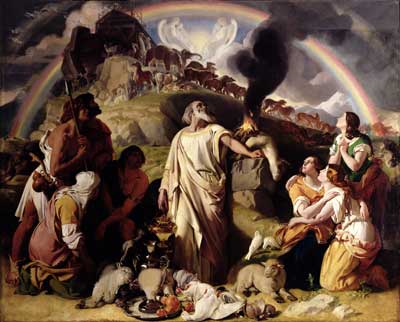
The “unpacking” of the Four Prohibitions can be compared to the “unpacking” of what is known as the Seven Noahide Laws. These laws, as we understand them today, didn’t exist in Paul’s day (though it is debatable if some version or versions were being circulated even then) but they are derived from Genesis 9 and the covenant God made with Noah:

Every moving thing that is alive shall be food for you; I give all to you, as I gave the green plant. Only you shall not eat flesh with its life, that is, its blood. Surely I will require your lifeblood; from every beast I will require it. And from every man, from every man’s brother I will require the life of man.

“Whoever sheds man’s blood,
By man his blood shall be shed,
For in the image of God
He made man.

“As for you, be fruitful and multiply;
Populate the earth abundantly and multiply in it.”
Then God spoke to Noah and to his sons with him, saying, “Now behold, I Myself do establish My covenant with you, and with your descendants after you; and with every living creature that is with you, the birds, the cattle, and every beast of the earth with you; of all that comes out of the ark, even every beast of the earth. I establish My covenant with you; and all flesh shall never again be cut off by the water of the flood, neither shall there again be a flood to destroy the earth.”

Genesis 9:3-11 (NASB)

Only seven laws were extracted from the text but again, that number is deceptively small. The link I provided above from auburn.edu/ actually extracts a longer list of laws from each individual prohibition. A total of sixty-seven laws are presented at this particular source and I’ve heard of other sources that have created even longer lists based on the so-called “seven laws.”

The website AskNoah.org is dedicated to providing information and services to modern “Noahides” who worship alongside observant Jews in Orthodox synagogues.

noah-rainbowI don’t say all this to directly compare Noahides with non-Jewish disciples of Messiah. Far from it. I only bring this up to say that, just as the Seven Noahide Laws actually make up a much longer and more complex list of mitzvot, so too, do the Four Prohibitions of Acts 15. That’s Toby’s whole point. He wrote fifteen heavily footnoted pages in a magazine format to just scratch the surface of the meaning of the Jerusalem Letter and to unpack its contents so we could understand that who we are as Christians is so much more than a four bullet point list of “Torah” directives and tons and tons of “grace.”

In January of 2012, I was caught off guard by the article and started wondering if some change in philosophy had come over FFOZ. Boaz graciously commented on my original review to say that nothing had changed in their intent.

On the contrary, from the outset (Messiah Journal 101), we made it clear that the “invitation” and non-obligatory type of language applies only to the specific sign-commandments and markers of Jewish identity: “specifically to aspects of the Torah which comprise Jewish identity: circumcision, dietary standards, festivals, calendar, Sabbath, etc.”

Toby’s article simply continues the process of fleshing out and defining the apostolic position regarding Gentiles and Torah. The only new material here involves the logical application of Acts 15 which is where we have been pointing people all along. Toby already presented some of this material in HaYesod.

A lot of this was just starting to gel after I attended FFOZ’s 2012 Shavuot Conference in Hudson, Wisconsin and it’s been steadily percolating within me for the past fifteen months or so. I realize that just as Boaz said his ministry has progressively been “fleshing out and defining the apostolic position regarding Gentiles and Torah,” this type of steady progression is what I’ve been going through as well, within my thoughts, spiritual development, and self-study.

I’m not writing this to re-review the actual content of Toby’s article, but rather how I am receiving its meaning, comparing the person I was a year-and-a-half ago to who I am now. As I said nearly two weeks ago, I’m Not Who I Was. Hopefully, none of us are. Hopefully, we are all striving to move forward, to learn, to experience, to draw nearer to God by the study of His Word.

Bible scholarship is always moving forward. Like any other type of academic endeavour, research and investigation never stops. Theologians, linguists, historians, archaeologists, and other professionals in their fields continually produce new insights into our understanding of God’s Word and how it is to be applied in our lives. As believers, we have a responsibility to also continue to study, to learn, to strive for a more refined understanding of the available information as guided by the Holy Spirit.

Luke only gives us a summary of the Acts of the Apostles, so while the Bible may be sufficient, that doesn’t mean it’s exquisitely complete. We can’t simply read Acts 15 once and say we understand it. We can’t read our favorite interpretation of the meaning of Acts 15 a month ago, a year ago, or a decade ago, and say we are sticking with that understanding, ignoring newer information that might modify our comprehension in important ways. The original text is unchanging, but how we read and understand it isn’t.

Who am IWho are we in Christ? What was the original intent and impact of the letter sent out to the believing Gentiles by James and the Council of the Apostles? How does that affect our lives as Christians today? What is a Gentile believer’s obligation to Torah? What does “Torah” even mean in our modern lives?

I can’t definitively answer all of those questions for you, but if you start by downloading and reading Toby’s article and continuing to unpack and unfold the text and your understanding of it, I’m hoping and praying you’ll find out. I pray we all discover who we really are in the pages of God’s Word and then live out the lives God intends for us.

Re’eh: Seeing to Learn

gerizim_ebalSee, this day I set before you blessing and curse: blessing, if you obey the commandments of the Lord your God that I enjoin upon you this day; and curse, if you do not obey the commandments of the Lord your God, but turn away from the path that I enjoin upon you this day and follow other gods, whom you have not experienced. When the Lord your God brings you into the land that you are about to enter and possess, you shall pronounce the blessing at Mount Gerizim and the curse at Mount Ebal.

Deuteronomy 11:26-29 (JPS Tanakh)

These words are spoken to the entire Nation of Israel, at the very end of a forty-year term in the desert. Two distinct mountains were on open display. Mount Grizim is plush, rich, and flowering with the promise of life. Mount Eivil in stark contrast is conspicuously barren and empty. This visual aid is employed to etch into the psyche of the assembled the lesson of remaining loyal to the task and mission of Torah and Mitzvos. In the recording of the event Moshe refers to that day as- “today”. What’s so special about that day? Every day he spoke was also a “today”. Why was that day worthy of a title for all time “today”?

The Ohr HaChaim answers that that day they were capable of understanding his lesson based on the statement of the sages, “A person does not stand on (truly grasp) the knowledge- opinion of his teacher until after forty years” (Avodah Zara 5B).

That means that now after forty years they can begin to truly comprehend what Moshe had told them back then. Why does it take forty years? Were these not brilliant people?

-Rabbi Label Lam
“See What Can Be Seen”
Commentary on Torah Portion Re’eh
Torah.org

Nearly a year and a half ago, I reviewed Toby Janicki’s article “The Gentile Believer’s Obligation to the Torah of Moses,” published in Messiah Journal #109/Winter 2012. I remember at the time being a little surprised at even the title, since my understanding back then was Messianic Judaism was striving for pretty much total isolation between Messianic Jewish and Christian/Messianic Gentile religious practice, at least publicly.

I happened to recall my review the other day when I noticed in the analytics for this blog that someone had viewed it.

I went through the original review and realized that my perspectives have changed in the last eighteen months or so. My fuzzy understanding of the Torah of Moses and its connection to the Gentile believers in Messiah is a little bit clearer. This isn’t to say I have everything “dialed,” so to speak, about the Bible and how it works, but I think it’s fair to say that I’m capable of learning and growing intellectually and spiritually.

While the quote from the Ohr HaChaim speaks to the necessity of the passage of time for learning, I’m not going to take it too literally (in forty years, I’ll either be nearly 100 years old or dead). But I am inspired to re-read Toby’s article and to re-review it as processed through the brain I have now vs. the one I had at the beginning of 2012 (I can only imagine that Toby will chuckle because I continue to wrestle with something he understands so clearly).

There has been a tremendous struggle between Messianic Judaism and Hebrew Roots relative to who “owns” the Torah. That’s an overly simplistic statement, of course, but the surface perception is that the Jews in Messiah get to keep the Torah for themselves while the Hebrew Roots people want them to share. On top of that, traditional Christianity says that we don’t need the Torah at all, just the grace of Jesus Christ.

Like I said, I’m being overly simplistic, so don’t take what I’ve just said too literally.

simhat-torahThe truth of the matter is that we all need the Torah. Even before the Christian Era, I believe that the Jewish people saw themselves as a “light to the nations” (Isaiah 49:6) and that we would all learn from the Torah as “the Law went forth from Zion.” (Isaiah 2:3). How does one learn the ethical, moral, and holiness standards of God apart from the Torah, the teachings of God? We don’t.

However, that concept has been misunderstood to mean (at least in certain circles), that we Christians must learn and observe every single mitzvot in the Torah (or at least the ones that can be observed without the existence of the Temple, the Priesthood, and the Sanhedrin) in exactly the same way as the Jewish people.

Acts 15 shoots that concept down in flames (I know this is debatable but then again, everything is) as I painstakingly chronicled in my review of D. Thomas Lancaster’s commentary on the matter, but Toby Janicki picks out of the ashes, the “phoenix” of Torah that applies to the non-Jewish believers.

And it’s a lot.

I don’t think we ever got a chance to really see the results of the Jerusalem Letter in action. We don’t see a detailed report in the New Testament of how those declarations were understood and practiced in early Christian congregations, the ones that would have existed during Paul’s lifetime and soon after. More’s the pity, because a document providing such details would answer a lot of questions and solve a lot of problems.

Once you rocket through history much past Paul’s death, the wedge between believing Jews and Gentiles was already being pounded into place, and by the time we get to the third and fourth centuries CE, we’ve been split apart and any recognizable form of “Torah practice” among non-Jewish believers had gone the way of the Dodo bird (I’m not quite sure how much help the Didache would be since it’s dated to the late first or early second centuries, but I guess I could buy a copy and find out).

What all this means is that you can expect my review of Toby’s 2012 article sometime next week. If anyone can suggest which copy of the Didache I should purchase from the list presented at the above-link, that would help, too.

In a way, I don’t really blame Hebrew Roots folks for finding the Torah beautiful, praiseworthy, and desirable in study and practice. I’m attracted to it as well. I really don’t understand Christian aversion to “the Law” as something horrible, and awful, and too terrible to even consider but then again, that’s what most churches teach. It isn’t that I think Christians should don tallitot and lay tefillin and try to look like Jews, far from it. But we should admit that we need the Torah for two basic reasons: The first is that it defines our relationship with Jesus and with God the Father through the Abrahamic covenant. The second is that every ethical, moral, and spiritual principle that we live by as Christians is found in the Torah. The Torah was taught by Jesus. Without an understanding of the Torah and the Prophets (and this should be huge in Christianity), we have no hope of understanding anything Jesus ever taught!

torah-what-isThat’s actually true of Paul and any of the other Apostles, so in my opinion, the first class that any newbie Christian should ever attend is Torah 101. Starting new Christians in the Gospels and the Epistles sounds nice but it’s almost next to useless. It’s like trying to teach a four-year old Calculus before they’ve even learned how to count to ten. It’s why I think First Fruits of Zion’s (FFOZ) Torah Club volumes are tremendously important. Not only do they teach Torah, but in a way that is very “Christian friendly.”

From all those who have taught me I have gained wisdom.

Psalms 119:99

The Psalmist is telling us that he learned from everyone, that everyone was his teacher. From some, he learned what to do; from others, what not to do.

If we learn from others’ mistakes, we need not make our own.

Just as we can learn from every person, we can learn from every event. Positive experiences are obvious sources of learning, because each positive act we do adds to our character and prepares us to better face the next challenge in life. Negative experiences can be valuable, too, but only if we are sufficiently alert to learn from them.

The list of lessons that we have learned the hard way may be long, but each one has taught us what not to do and thereby it becomes a positive experience. Indeed, the Talmud states that when people sincerely regret their mistakes and change themselves for the better, the wrongs that they did become actual merits (Yoma 86b). Only when we fail to learn from our mistakes and, rationalizing and justifying, obstinately insist that we were right, do our misdeeds remain deficits.

We have the capacity to make life itself a tremendous learning and growth experience.

Today I shall…

…try to look for lessons from everyone and everything, whether my teacher is positive or negative.

-Rabbi Abraham J. Twerski
“Growing Each Day, Kislev 17”
Aish.com

I don’t think the problem is dealing with positive vs. negative teachers but just with “unanticipated” teachers. For traditional Christians, I think Jewish teachers or teachers very familiar with the Jewish (especially Messianic) perspective on Torah and Messiah are important. Jewish teachers aren’t necessarily a problem for Hebrew Roots people, but often, Christian teachers are. Many people in Hebrew Roots no longer see themselves as affiliated with anything called “Christianity” and sometimes they even define themselves by a completely new religious identity in order to separate themselves from the “crimes of the church,” real and imagined. “The church” is something they’ve “come out of,” like a Jew might have escaped the Soviet Union in the 1960s or one “comes out of pagan Babylon,” a den of iniquity and sin.

Oy.

I’m hardly what you would call a traditional Christian, but I must say that I’ve learned a tremendous amount in my conversations with my Pastor. For Hebrew Roots folks, at least some of you, it might not hurt to find a Christian to connect to and even “embrace” on some level if, for no other reason, than to overcome what for davening_morningsome people I’ve personally met, is a phobic response to Christians and Christianity. Really, we’re not all that bad and in my time in church (in spite of my meditation of yesterday morning), I’ve met a few very kind, gentile, and Holy people.

Remember what Rabbi Twerski said about everyone being a teacher? That means Everyone, not just the people you are attracted to as teachers.

Whether you call yourself a Christian, a Hebrew Roots person, or something else, you…we all have a blessing and a curse set before us as well. We can accept the blessing and choose to learn the Torah as it was intended for us and to take upon ourselves teachers we never thought we’d share a classroom or corner of the blogosphere with, or we can choose to isolate ourselves in our own comfortable little silos, and learn only what we want to learn, which means in that case, very little and nothing new and illuminating.

It may take some time before it all begins to sink in. Like me, you might have to wait awhile and then rediscover something that didn’t quite make sense before but comes into crystal clarity now. That’s OK, too. Just as long as you’re willing to open your eyes and see what God has set before you this day.

Good Shabbos.

54 days.