
 The fact that experienced readers of the New Testament come away with diametrically opposed interpretations of the same text is today perhaps one of the few universally recognized results of modern historical critical scholarship.
-Joel Willitts
“Chapter 23: The Bride of Messiah and the Israel-ness of the New Heavens and New Earth” (pg 245)
Introduction to Messianic Judaism: Its Ecclesial Context and Biblical Foundations
Brother, you said a mouthful.
I was pretty frustrated when I went to bed last night (as I write this on Tuesday morning). I had a rather busy day on several of my blog posts with various comments, usually related to something I said about the Rudolph/Willitts book. But as I was reading the above referenced chapter in bed, a number of thoughts came to me that weren’t particularly connected to the material I was perusing. I kept going back to what I said a month ago about the problem with religious people. They always think they’re right, they always think their interpretation of the Bible is the only interpretation of the Bible, and they always think that everyone they talk to and disagree with should immediately see the devastating logic of their arguments and then completely roll over to their point of view.
And when you don’t, they get a little cranky.
So when I read the opening sentence in Willitts’ chapter, it was wonderfully confirming.
But there’s still a problem.
Furthermore, softening the logical link between 5:18a and 5:18b lessens the rhetorical force of the statement. What was likely intended to be a ringing affirmation of the Spirit’s ability to release one from being under law (cf. 5:16) comes out sounding, at least practically speaking, more like a piece of encouraging advice to dispense with the need for law observance. Yet this construal is necessary for the viability of the reading proposed by the majority of Galatians commentators, who must assume the mutual compatibility of the leading of the Spirit and existence “under law”; otherwise the point of Paul’s statement would be altogether lost. For this reading to succeed, then, one must downplay both the implicit logic and the rhetorical force of 5:18.
-Todd A. Wilson
“Chapter 22: The Supersession and Superfluity of the Law? Another Look at Galatians” (pg 239)
Introduction to Messianic Judaism
Ah Galatians, my old nemesis. How I have missed thee…not.
Pastor Randy has been away in Brazil for most of the month of April so naturally, we’ve had to suspend our Wednesday evening meetings until his return. He returned on Tuesday (today, as I write this) but didn’t want to “push it” by trying to return to our regular meetings the day after he got back. He’s got a lot of catch up work to do, so I’ll see him next week, and we’ll pick up where we left off with our discussions on D. Thomas Lancaster’s Galatians book.
I enjoy my conversations with Pastor Randy, but I sometimes anticipate them with some degree of “dread.” As I was trying to puzzle my way through Wilson’s brief analysis of that same epistle with an eye on the Messianic Jewish perspective, I became totally lost. I also became kind of skeptical as a result of being lost. If I can’t understand this and it doesn’t make sense to me, does it make sense at all? Is Wilson trying to push the text too far into a particular viewpoint or interpretive model? Is he pushing Paul into an area where Paul never intended to go? And how can I tell?
One thing Pastor Randy has said to me on numerous occasions is that when studying the Bible, the best place to start is with the literal meaning of the text in its original language and context. In reading Wilson and phrases such as “softening the logical link between 5:18a and 5:18b,” I started wondering what Paul would make of all this and how he would see Wilson’s treatment of his letter.
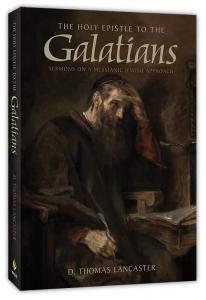 Of course, you can’t take Galatians in isolation. You have to look at it within the larger context of Paul’s other writings and the events of the New Testament times in general (not to mention the rest of the Bible). You also have to look at the chronology of these writings, with Galatians being one of Paul’s earlier letters, written even before the events we’ve read in Acts 15.
Justin Hardin’s Chapter 21: Equality in the Church,” was easier to digest, but he took a much smaller portion of Galatians to examine (specifically Galatians 3:28) and was more successful at relating how Paul was not attempting to “support a collapse of ethnicity any more than [he] supports the collapse of the male and female genders.” (pp 224-5). On page 226, Hardin tries to explain that the tutor (pedagogue) function of the Law we find in Galatians 3:23-24 is indeed only one of a number of functions of the Torah for the Jewish people. Only that function went away when Messiah came to show us the perfect model of “Torah living,” but that didn’t eliminate the Jewish requirement to observe Torah for other reasons (national identity, covenant obedience, eschatological linkage to the Messianic age, and so forth).
But how am I supposed to gain an understanding of Galatians that comes anywhere near to Hardin’s or Wilson’s, or even Lancaster’s when I meet Pastor Randy again? I can’t keep these fellows in my pocket and bring them out to present their wares at a critical moment in our dialog, but since Galatians is obviously far more complex than meets the eye, how can I defend a position on this puzzling epistle that I don’t fully understand? (And by the way, like Lancaster, Hardin believes Paul wrote the Galatians letter only to the Gentile population of the churches in that region, not to their Jewish counterparts.)
Like most of the chapters in this book, Willitts’ essay and analysis of “the Bride” imagery (in the aforementioned Chapter 23) in Revelation 19 and 21 is dense with footnotes and scholarly references. In order to present a respectable argument regarding Galatians (or anything else from the Bible), I’d have to be far better read than I am and then somehow have the ability to recall all of that information at a moment’s notice at it is required for a certain topic brought up in my Pastor Randy Galatians discussions.
I need a bigger brain.
With the Scripture as a background, we can now clarify John’s use of the bride imagery in Revelation 19-22. First, since for John the Lamb is divine, it presents little problem for him to correlate Israel’s God with the Lamb — what was attributed to the God of Israel in Isaiah is now associated with the Lamb. Thus, what was once God’s bride is now the bride of Messiah.
The Lamb’s bride is the New Jerusalem, both the people of Israel and the place where God will dwell. Israel, who was unfaithful, now is not. At the end of the age, the Lamb will remarry his bride; he will fulfill his promise. The divine Messiah will redeem his people from captivity and clothe them with righteous deeds because they will be “taught by the Lord” (Isa. 54:13).
-Willitts, pp 252-3
That quote will no doubt shock most Christians and probably more than a few Jewish believers. In the church, I was always taught that “the church” was the bride of Christ, which usually means Gentile Christians. Here, Willitts completely reverses identities, saying that both Israel as a place and as a people/nation are the Divine Messiah’s bride. What I didn’t quote was how Willitts states that the nations (believing Gentile Christians) are the wedding guests! We’re not the bride at all but we are on hand to celebrate at the “wedding reception,” so to speak.
That’s going to ruffle a few feathers.
But…
 …but Willitts isn’t presenting the conclusions in his brief article as if they were absolute fact or as if they were the only possible interpretation of the text. He deliberately is framing his interpretation within a Messianic Jewish context in order to show an alternate point of view, a different perspective for his readers, probably to make us think and to help us question our assumptions. I can relate to that, since I often write from that perspective myself.
Now look at this comment made on one of my blog posts in response to my question about whether the commentor thinks Christians sin by not observing the Torah in the same manner as the Jews:
Some Jews may be accepting of Christian Torah observances that make them look Jewish, but in my experience, it can’t be that many. And have you told other Christians you associate with about them being obligated (rather than them having a choice) to Torah observance to a level that will make them look Jewish too?
Yes, I have, I argue for covenant obligation, are you in covenant with God, then you have an obligation
“Zion” is well-meaning and a decent human being, but we often come to loggerheads because he believes that Gentiles in Messiah are directly linked into the covenants rather than receiving them through Israel, and as such, we covenant members are “grafted in” to the full 613 Torah mitzvot and are required to observe them, not in the manner of modern “Rabbinic Jews,” but from a Biblical model (nevermind that we have no idea how to observe the Torah without Rabbinic interpretation).
I disagree and believe we Gentile disciples of the Messiah receive certain blessings from the covenants God made with Israel thanks to the linkage between Abraham’s faith and our faith in Messiah, but that doesn’t include turning us into “Israelites,” nor does it mean we have an identical Torah obligation with the Jewish people.
So we have a difference of opinion. That brings us back to the Willitts quote I inserted at the top of this blog post.
I don’t mind disagreements. I really don’t. I do mind being backed into a corner by folks who believe that it’s their way or the highway. My point of view is one point of view. There are aspects of the Bible I don’t understand. Galatians is a frustrating mystery to me. Even when someone tries to explain it, such as Wilson, the explanation is a frustrating mystery to me. There are days when I want to pack it in and give up on religion. I don’t fit. I don’t understand. I am really annoyed with the dissonance between different Bible interpretations, and I am really, really annoyed with people who think that they and only they (or their group) are the sole possessors of God’s truth about the Bible.
To me, being a believer and studying the Bible is like being an explorer. As a person of faith, I’m on a journey of discovery. Such journeys are rarely straightforward and often involve going in the wrong direction, backtracking, retracing steps, and sometimes using a machete to hack through thick underbrush, like an adventurer-archaeologist on his way to the next big find. But as Dr. Henry Jones Jr. once said, “seventy percent of all archaeology is done in the library.” It requires painstaking, laborious study, not dramatic arguments by people who are all too sure of themselves. Archaeology is also a science of patience. At a dig, you must be slow and deliberate in attempting anything. It might be today, tomorrow, ten years from now, or never, before you uncover anything of even the remotest significance at all.
 Jesus is like a companion on a long journey who helps to guide us but who will not override our decisions, even if we should take the wrong path. He’ll advise us, prod us, give us hints, and occasionally berate us as we find we’ve stepped into a pool of quicksand, but he won’t just lead us by the hand so we can passively follow where he has gone before us.
I’m nearly done reading the articles in Rudolph’s and Willitts’ book. I’m hoping to get through all of them and finish taking my notes before I have to return the book to the library. But once I have, I’ll move on to another book. While I’ve found Introduction to Messianic Judaism to be an excellent survey of the perspectives on different aspects of theology and doctrine from a Messianic Jewish perspective, it’s still only one book. To the degree that the twenty-six contributors reference countless other sources, then countless other sources are required to help understand the Bible and thus a life of faith.
I can’t stop now, though one day, I may completely withdraw from the public realm and conduct my search privately, but a life of encountering God requires a lifetime. I can’t simply accept one religious person’s statement that they’re “right” and blindly consume their declarations.
I’ve got to keep going. Will I ever arrive at a destination? Probably not this side of paradise.
153 days.










 Morning Meditations