Tag Archives: Israel

The Jesus Covenant, Part 10: Hebrews and the Covenant Mediator

rabbi_child_and_sefer_torahThere still seems to be some confusion between the Torah delivered at Mt. Sinai and the covenant made with Israel.

The Torah is not to be surrendered by anyone who is born of the Ruach and is now a child of YHWH through faith in Messiah Yeshua. I’ve not said that and I haven’t read here where anyone else has made that assertion either.

As far as following through on “their end of the bargain”, they, Israel, didn’t. Which is why a new covenant was promised to be cut with both houses of Israel. And holding onto a covenant which cannot be accomplished due to the weakness of the flesh while trying to affirm the operational specifics of the current covenant would cause some tension to say the least.

Maybe someone could provide a detailed explanation of what a child of YHWH should look and act like so we can all see what it means to be a son or a daughter of our Father in Heaven. Perhaps then we could cease from making so much noise about who is pretending to be a part of one culture group or another.

And by the way it was not “their covenant with God”. It was His covenant with them. His terms His conditions. I did not say that He replaced that covenant, He did. I’m just agreeing with the text of scripture. Now if someone wants to seek their justification through that covenant they are welcome to do so. But they will come up empty. Of course, if someone was trying establish something else through that covenant I would have to wonder what their motive might be. And what their ultimate objective was.

-Russ
from a comment on one of my blog posts

This is the tenth part of my series on trying to understand what the “New Covenant” is, how it relates to the previous covenants we see God making with humanity (and specifically with the Children of Israel) in the Bible, and what it’s supposed to mean today.

I’ve neglected this series terribly, mainly because it’s so hard to write. Part 9: The Mysterious 2 Corinthians 3 was published last October which will give you some idea of how long I have left this one alone. It’s not that I’ve come to any satisfactory resolution to my problem. It’s just that sometimes trying to understand all this has the same effect as repeatedly smashing my forehead against a brick wall.

But then Russ’s comment reminded me that the New Covenant is still sitting out there taunting me; daring me to try to comprehend it. Russ seems fully convinced that he understands its meaning and that it must mean something about creating a people who are born of the Spirit and (perhaps) relegating Jewish identity to that of a “culture group”.

Did God obliterate all His previous covenants with His people Israel because they were unfaithful? That sort of sounds like God tried plans A, B, and C and they didn’t work out, and then he devised Plan D: writing it on their hearts, which couldn’t fail. If covenants are replaced because covenant members are defective (which God should have known all along) and God has to (finally) create a covenant they can’t because it’s written on the heart, why couldn’t He have started out with the unbreakable covenant and avoided a lot of pain and anguish?

I don’t know, but it sounds like a set up for God to make a covenant with Israel at Sinai knowing that they were going to break it, and knowing that the consequences for breaking it was forfeiting their unique relationship with God as a distinct people and nation.

Oh, if you haven’t read through the “Jesus Covenant” series or you haven’t read through it in a while, it might be a good idea to at least scan through it again, starting with Part 1: The Foundation, just to get up to speed.

But as it is, Christ has obtained a ministry that is as much more excellent than the old as the covenant he mediates is better, since it is enacted on better promises. For if that first covenant had been faultless, there would have been no occasion to look for a second.

Hebrews 8:6-7 (ESV)

Therefore he is the mediator of a new covenant, so that those who are called may receive the promised eternal inheritance, since a death has occurred that redeems them from the transgressions committed under the first covenant. For where a will is involved, the death of the one who made it must be established. For a will takes effect only at death, since it is not in force as long as the one who made it is alive. Therefore not even the first covenant was inaugurated without blood. For when every commandment of the law had been declared by Moses to all the people, he took the blood of calves and goats, with water and scarlet wool and hyssop, and sprinkled both the book itself and all the people, saying, “This is the blood of the covenant that God commanded for you.” And in the same way he sprinkled with the blood both the tent and all the vessels used in worship. Indeed, under the law almost everything is purified with blood, and without the shedding of blood there is no forgiveness of sins.

Hebrews 9:15-22 (ESV)

shekhinaThis is where I left off last time. These verses were to be the last step in my investigation into the New Covenant. I seriously doubt that I’m going to reach any useful conclusion here, but at least I’m continuing on the trail.

In reading these verses from Hebrews, it certainly seems as if God has tossed the Covenant He made with Israel into the trash can (and Israel along with it) and created a New Covenant replacing the Old using the blood of Jesus Christ. Of course, I can’t read Biblical Greek, so the mystery of what the oldest texts from Hebrews is trying to tell me remains a mystery. I can of course read the various commentaries on Hebrews 8:6 when I scroll down the page, but there’s not exactly a cohesive explanation telling me what I need to know.

But Gill’s Exposition of the Entire Bible for this verses does say something interesting:

…which was established upon better promises; which are not now delivered out as before, under the figure of earthly and temporal things; nor under a condition to be performed nor confined to a particular people and nation…

I can accept the fact that the Sinai covenant was made specifically between the God and the Children of Israel and that the New Covenant has provisions that include all of humanity through Christ. If the New Covenant didn’t function in such a manner, then no one outside of Israel could be saved. I can accept the fact that the blood of animals could never take away sins (Hebrews 10:4) and that salvation for all human beings must be through Messiah.

But where does it say that the Jews as a people must surrender being Jews in order to enter into the New Covenant? Sorry, but whenever I hear “the Old Covenant has been replaced” language, I wonder how do you do that and still keep the people who were attached to it as a people?

The days are coming,” declares the Lord, when I will make a new covenant with the people of Israel and with the people of Judah.

Jeremiah 31:31 (ESV)

Waitaminute! God is saying He will one day make a New Covenant with the people of Israel and the people of Judah. Doesn’t say anything about the people from the nations who are gathered together and called by His Name through the Messiah. Of course, there are a lot of Christians who see themselves as the new “spiritual Israel” and so they write themselves into the script that way. Others believe that the Jewish people are “Judah” and that in some manner or fashion, the Gentiles who are attracted to God, the Torah, or Christ become (or in some fashion are) the lost tribes of Israel (see the book Twelve Gates: Where Do the Nations Enter for the much more likely explanation that representatives of “the lost ten tribes” actually did return, intermarried, and were eventually assimilated into Judah and Benjamin…thus, modern day Jews contain the descendants of all the Tribes of Israel).

Now try to understand the following within that context.

Therefore say to the house of Israel, Thus says the Lord God: It is not for your sake, O house of Israel, that I am about to act, but for the sake of my holy name, which you have profaned among the nations to which you came. And I will vindicate the holiness of my great name, which has been profaned among the nations, and which you have profaned among them. And the nations will know that I am the Lord, declares the Lord God, when through you I vindicate my holiness before their eyes.

Ezekiel 36:22-23 (ESV)

In that sense, it’s easy to see that Israel: the Jewish people, are very much written into God’s plan for the future and they have not been discarded and dissolved as a people or a nation by God. The mystery that I was trying to investigate when I started this series was not what happens to Israel, which seems a given, but how in the world do we from among the nations get added in to this covenant? Certainly, the Abrahamic Covenant includes the nations, but we are not mentioned again in subsequent covenants until the New Covenant, and our inclusion isn’t made clear until we see Paul make his commentaries on the meaning of Messiah for the rest of us (remember, the oldest texts we have of Jesus and the “Last Supper” don’t include the word “new” when he talks about the covenant in this body and blood…we have to assume that’s what he means).

Throne of GodBut the passages I quoted from Hebrews do give the impression that what was old is being replaced with what is new. Is that a completed act, though? I don’t know. Messiah has yet to return. He has not yet completed his work. There is no new Temple built by him. There is no worldwide peace as far as I can tell. Israel is not at the head of the nations yet and she is still being threatened on all sides by numerous adversaries.

We know that the New Covenant is inexorably tied to the Jewish Messiah and he is the inescapable mediator and motive force of the New Covenant with Judah and Israel and even with the nations. All I can suggest at this point is that the New Covenant hasn’t simply been flipped on like a light switch if, for no other reason, than we aren’t really acting like the Word is written on our hearts. If it were, would we in the body of believers still be so defective, and cranky, and flawed? What if the enactment of the New Covenant is a long process, not a sudden event? After all, the many and numerous conditions and enactments of the Sinai covenant weren’t “turned on” all at once, probably because many of those conditions required the Israelites to live in the Land, and for forty years, they were wandering in the desert.

And what about this?

And I saw no temple in the city, for its temple is the Lord God the Almighty and the Lamb. And the city has no need of sun or moon to shine on it, for the glory of God gives it light, and its lamp is the Lamb. By its light will the nations walk, and the kings of the earth will bring their glory into it, and its gates will never be shut by day—and there will be no night there.

Revelation 21:22-25 (ESV)

I’ll be the first one to admit that I don’t understand what’s going on and how all this is supposed to work, but it seems like there’s a sequence of events that have not yet been completed. Will the Law, what defines the significantly unique relationship God has with Israel, the “Jewishness” of Jewish people, and the holiness of Jerusalem be eliminated from existence or meaningfulness until everything that God has said He will do has been accomplished?

I seriously doubt it but the secrets of the Bible continue to elude me. This doesn’t preclude my pursuit of a holy and meaningful life, but it does make it difficult to respond to anyone who wants the New Covenant to land on the Jewish people like a ton of lead, mashing them flat, and leaving a completely new “product” in their place.

I don’t know if I’m going to write a “Part 11: Conclusions” blog post, at least not right way. There’s still so much more to try to comprehend. But as my friend Carl said, maybe it’s the struggle that matters, not what we may come up with as a result.

I am not suggesting that there is a chaos of interpretation and no absolute truth, but that interpretation is part of the human condition, our relationship with all texts (and people, for that matter). The Holy Spirit helps us but it does not erase our humanity. In fact, your blog can be considered in large part a struggle to find an interpretive approach to the Bible that is coherent, satisfying, and works for you.

TrustI wish we could all dial things down just a bit concerning truth-claims. We have been told that love endures but knowledge is partial. That would include my knowledge (or interpretation) of the Bible. I hold a certain interpretive approach to the Bible (in common with a number of others) that I believe to be coherent and satisfying even though I know that it is limited and hope to learn from other approaches until the day I die..

I guess what I am saying is that “we know in part . . . but when the perfect comes, the partial will be done away.” Since we are finite and the perfect is infinite, it makes sense that our knowing is partial until will are face to face.

Finally though, we can’t ignore this:

I will never break my covenant with you.

Judges 2:1 (ESV)

Israel may have been unfaithful on many occasions, but God never let them go. Instead, He made it possible for others to come to Him as well, all through His son.

Yitro: Walking with Israel

Har_SinaiOn the third new moon after the Israelites had gone forth from the land of Egypt, on that very day, they entered the wilderness of Sinai. Having journeyed from Rephidim, they entered the wilderness of Sinai and encamped in the wilderness. Israel encamped there in front of the mountain, and Moses went up to God. The Lord called to him from the mountain, saying, “Thus shall you say to the house of Jacob and declare to the children of Israel: ‘You have seen what I did to the Egyptians, how I bore you on eagles’ wings and brought you to Me. Now then, if you will obey Me faithfully and keep My covenant, you shall be My treasured possession among all the peoples. Indeed, all the earth is Mine, but you shall be to Me a kingdom of priests and a holy nation.’ These are the words that you shall speak to the children of Israel.” Moses came and summoned the elders of the people and put before them all that the Lord had commanded him. All the people answered as one, saying, “All that the Lord has spoken we will do!” And Moses brought back the people’s words to the Lord.

Exodus 19:1-8 (JPS Tanakh)

Did you ever get angry about what someone did and say, “I would have never done that if I were him!”? Probably most of us have said that one time or another.

I’ve got news for you! You would have done EXACTLY what he did if you were him. If you had his genes, his upbringing, his education and philosophy on life along with his desires and attitudes … you would have done precisely what he did. The proof is … that’s what HE did! The difference is that you are not him and you think that with all that you are, that you would have acted differently. Hopefully, if you were in his situation, you would not do what he did.

What we have here is a failure to judge our fellow human being favorably.

-Rabbi Kalman Packouz
“Shabbat Shalom Weekly”
Commentary on Torah Portion Yitro
Aish.com

This week’s Torah Portion is kind of a big deal. It’s the parashah where we see the Children of Israel “as one man” receiving the Torah from God! This is the defining moment when Israel truly becomes a nation before God and it also is what, more than any other single event, defines the Jewish people today, in spite of what some people may say about Jews, Judaism, and Israel.

But we have a problem, at least on the surface. The Children of Israel stood before Moses and before God and said as a single group, as a nation, that “All that the Lord has spoken we will do!” That response is not only the agreement of all the people who were actually there, but for all of their descendants across the ages as well. Israel said that they would do everything that God had spoken, all of His laws, all of His ordinances, everything.

Did they? Do they?

I won’t go through a lengthy list of quotes from the Tanakh, but the simple answer is “no.” That first generation out of Israel did not enter the Land and take it at the command of God. Forty years of wandering in the wilderness was also forty years of struggling with God as well as Moses and Aaron struggling with God to preserve the People from their own disobedience and grumbling.

Even after Joshua led the next generation to take the Land (and Moses was also disobedient and as a consequence, was not allowed to enter Israel), there were problems. In fact, reading through the Tanakh reveals a significant history of Israel and her Kings, even David and Solomon, disobeying God and failing to do all that the Lord had said.

joshua-in-israelNo, I’m not going out of my way to “Jew bash,” simply stating what we all know. Does that mean the Torah is useless, the Israelites weak and disobedient, and the modern Jewish people are followers of a “dead religion?”

Absolutely not. What it means is that they are human.

I’ve sat in a Bible study in church (not the church I go to now…this was many years ago) and heard a man, a retired Pastor (normally a very nice guy) say point-blank that “we Christians” would never disobey God the way the Israelites did.

Oh really?

Remember what Rabbi Packouz said above?

If we were living in those days, had experienced what they experienced, had lived through slavery, were suddenly thrust into a brand new world, even experienced the amazing, awesome, unimaginable presence of God among us, yes we too would have said and done all the things the Children of Israel did.

Sorry to say.

There is a saying in Pirke Avos 2:5 (“Ethics of the Fathers”), “Hillel says, ‘Don’t judge your fellow human being until you have been in his place.” It is upon us to try to put ourselves in someone else’s situation before passing judgment.

Also in Pirke Avos 4:3, Ben Azai says, “Do not scorn any person, nor be disdainful of any thing for there is no person who does not have his hour and no thing which does not have its place.”

The Torah source for this mitzvah, commandment, is “You shall judge your fellow human being with righteousness” (Leviticus 19:15). This verse obligates us to give someone the benefit of the doubt when we see him performing an action that could be interpreted in his favor.

The Torah also teaches us, “Love your fellow human being as yourself …” (Leviticus 19:18). The Baal Shem Tov used to say, “Love others as yourself. You know that you have many faults, nevertheless, you still love yourself. That is how you should feel toward your friend. Despite his faults, love him” (Likutai Abraham, p. 221).

Setting aside Rabbi Packouz, what can we learn from another “Rav” with whom we Christians might be more familiar?

“Judge not, that you be not judged. For with the judgment you pronounce you will be judged, and with the measure you use it will be measured to you. Why do you see the speck that is in your brother’s eye, but do not notice the log that is in your own eye? Or how can you say to your brother, ‘Let me take the speck out of your eye,’ when there is the log in your own eye? You hypocrite, first take the log out of your own eye, and then you will see clearly to take the speck out of your brother’s eye.

Matthew 7:1-5 (ESV)

old-city-jerusalemAll week long, I’ve been writing blog post after blog post presenting some rather unusual ideas about the Torah, the instructions to the Israelites from God, and how it is lived out in Judaism and sometimes within Christianity. My friend Boaz Michael says that the weightier matters of the Torah are also taught in church, such as love of kindness, feeding the hungry, compassion for the widow, and so on. Granted when we get into the area of halachah and how the Jewish community will walk before God, things become complicated, but lately, I’ve been encouraged to see halachah as the communal conversation and response of the Jewish people to the Torah and to God. It’s a living, interactive process by which Jews seek to obey God and live their lives before God as Jews. By definition, Christians, who are taught to conceptualize God and the Bible in fundamentally different ways, are going to have a tough time with this (even some Jewish people have a tough time with this).

But do we judge the ancient Israelites, the more recent Jewish population who lived in the days of Jesus, Peter, and Paul, and the modern Jewish community, particularly those in the Messianic space, by our own Gentile Christian standards, given that those standards do not have much of a basis in common with Judaism? Have we walked a mile in the shoes of a Jew?

Even if you are a Christian who has spent a lot of time with the Jewish community, either here in the U.S. or even in Israel, while you may have some insights into Jews and Judaism that many Christians lack, there’s still a long road between living with Jews and being Jewish. Even converts to Judaism will struggle to make up the distance, the lack of a Jewish childhood, the lack of Jewish parents and growing up in a Jewish community.

There’s a lot of judgement and disdain of Jews by Christians, including those in the Hebrew Roots community, but upon what is it based? It is especially surprising and disappointing that a Gentile Christian can say they are “observing Torah,” wear a kippah and tallit katan in their daily lives, daven with a siddur while wearing a tallit gadol and laying tefillin, keep Leviticus 11 “kosher,” and claim to love Israel and the Jewish people, and yet still judge and reject everything it is to be Jewish and to live as a Jew. Sometimes, I think it’s even worse for some of those same Gentiles who style themselves as “academic” or “resource institute” experts to treat the Jewish people as a “thing” or an “object” for study (and it’s easier to throw away an object than a human being), rather than as living, breathing, people.

You don’t have to agree with how Jewish people conceptualize their world, but then again, you don’t have to attempt to live as a Jew either, if that is your opinion.

It’s been a busy and difficult week in this little corner of the blogosphere. I don’t usually spend so much time and effort on a single topic across an entire week, but this theme took over my thoughts and emotions and I had to write (and write and write) about it.

I don’t claim to bear any great wisdom or insights, but writing is what I do when I want to explore and I’m trying to understand. Blog comment contributor “ProclaimLiberty” has suggested that halachah is akin to the Jewish communal conversation with God and the sages. Writing is part of what I do as an individual when I’m trying to talk to God. I just share the conversation (my end of it, anyway) with the Internet.

PleadThe Children of Israel failed God because we all fail God! If God’s grace wasn’t with humanity from the very beginning, we never would have survived, and there would be no human population in the world today. God is gracious and we know this, but we cannot even begin to comprehend the extent, scope, and vastness of His graciousness to us all, and especially to Israel, the apple of His eye, His treasured, splendorous people.

The Lord said to Moses: Thus shall you say to the Israelites: You yourselves saw that I spoke to you from the very heavens…

Exodus 20:19 (JPS Tanakh)

And Jesus said, “Father, forgive them, for they know not what they do.”

Luke 23:34 (ESV)

God speaks to us all but we don’t always understand. It would have been amazing if we could have been there among Israel to actually see and hear God speak from the very heavens, but God gives us enough. And yet we don’t always know what we’re doing, including when we curse rather than bless Israel. We should try to understand Israel and understand God.

The first positive mitzva is, in the words of Rambam, (Maimonides: Mishneh Torah, Yesodei haTorah 1:1.) “To know that there is a First Being, who caused the existence of all beings…The knowledge of this principle is a positive command, as it is said, I am the Eternal your G-d.”

This is a Mitzva relating to mind and intellect. True, every one of Israel believes in G-d with a simple faith, and his heart is whole with G-d; still it is the duty of the mind and intellect to bring this faith to a level of knowledge and comprehension. This is the meaning of “To know that there is a First Being;” the Mitzva specifies comprehension and intellectual grasp, as written in Torah: “Know the G-d of your father and serve Him with a whole heart” (Divrei Hayamim I, 28:9.) and it is also written, “know this day etc.” (Devarim 4:9.)

“Today’s Day”
Monday, Sh’vat 19, 5703
Compiled by the Lubavitcher Rebbe
Translated by Yitschak Meir Kagan
Chabad.org

If we don’t understand Israel perhaps it is because we don’t really understand God, and we should spend some time in Jewish shoes; standing in their place. Failing that, we should seek God’s wisdom and particularly, we should repent and seek His forgiveness.

Erev Shabbat is coming. This would be a good time.

Good Shabbos.

Struggling to Touch the Essence

Talmud StudyDuring the centuries following the completion of the Mishnah, the chain of transmission of the Oral law was further weakened by a number of factors: Economic hardship and increased persecution of the Jewish community in Israel caused many Jews, including many rabbis, to flee the country. Many of these rabbis emigrated to Babylon in the Persian Empire. The role of the rabbis of Israel as the sole central authority of the Jewish people was coming to an end.

This decentralization of Torah authority and lack of consensus among the rabbis led to further weakening of the transmission process. It became clear to the sages of this period that the Mishnah alone was no longer clear enough to fully explain the Oral Law. It was written in shorthand fashion and in places was cryptic. This is because it was very concise, written on the assumption that the person reading it was already well-acquainted with the subject matter.

So they began to have discussions about it and to write down the substance of these discussions…

…When you look at the page of the Babylonian Talmud today, you will find the Hebrew text of the Mishnah is featured in the middle of the page. Interspersed between the Hebrew of the Mishnah are explanations in both Hebrew and Aramaic which are called the Gemara.

The Aramaic word Gemara means “tradition.” In Hebrew, the word Gemara means “completion.” Indeed, the Gemara is a compilation of the various rabbinic discussions on the Mishnah, and as such completes the understanding of the Mishnah.

The texts of the Mishnah and Gemara are then surrounded by other layers of text and commentaries from a later period.

-Rabbi Ken Spiro
“History Crash Course #39: The Talmud”
Aish.com

My conversations with Pastor Randy are always very rewarding. We’ve taken to meeting somewhat regularly to discuss matters of mutual interest and specifically the world of believing Jews called “Messianic Judaism.” He lived in Israel for fifteen years and has many Israeli Jewish friends. He is well-versed in Biblical Hebrew and Greek, and his mind and heart are very open to Israel and the Jewish people.

But in our talks, it’s difficult to address how or if modern Messianic Jews are obligated to Torah, what exactly is meant by “Torah,” and the role of Talmud (Mishnah and Gemara) in the life of an observant Messianic Jew. For a Jew, including one in Messiah, is it even possible to comprehend a passage in Torah without Talmud?

I admit, I have few answers.

But since we both have questions, I thought this was the perfect topic to expose to the blogosphere and to present to my readership (and anyone else my readership wants to share a link to this blog post with minus a few “nudniks”). If the bottom line is the Word of God and the revealed Messiah, how can we say that the word of the Sages go beyond them? I disagree that history was frozen after the destruction of Herod’s Temple and I know that Judaism and Christianity continued to move forward and develop. If I may be allowed a conceit, I believe errors entered both Judaism and Christianity in the past 2,000 years that caused both (although Christianity began as a wholly Jewish sect known as “the Way”) religious traditions to “stray” from the intent of God and the footsteps of the Messiah to some degree (probably a really large degree).

And yet, we cannot recapture first century Christianity as Paul understood it and how it was expressed and lived within both Jewish and Gentile cultural contexts. We can only look at where we’re at now and attempt to return to the scriptures to “observe, interpret, and then apply” what we discover there (to quote Pastor Randy).

ruins
But if the Bible is the final word, what do we do with 2,000 years of Jewish history, law, discussion, and interpretation…just wad it up and toss it in the nearest (very large) trash can?  Do we have a right to take everything that it means to be a Jew and to lay it to waste, leaving behind only ruins?

Absolutely not! I don’t believe Messiah will do this upon his return (although, of course, this is just my opinion). Do we say that Jesus will wholeheartedly accept each and every judgement and ruling made by the sages without question? I don’t know if that’s true either, if for no other reason than because the discussion between the ancient sages that spans the centuries, does not come to a final agreement on many practical and legal matters.

And not all Jews and not all Jewish traditions follow the same interpretations. Which one do you choose, and having made a choice, do you realize that it is a human decision and not God’s decision? How can we reconcile this?

My wife told me something interesting just the other day. She told me that the local Chabad Rabbi and the local Reform Rabbi study Talmud together. That’s kind of surprising, and in a community with a large Jewish population, that wouldn’t happen. Chabad (Orthodox) and Reform Rabbis view the traditions and Talmud from very different perspectives. But in this little corner of Idaho, there just aren’t that many Jews and there are even fewer Jewish Rabbis. That fact acts as a bridge for these two gentlemen to meet and share what they have in common as well as their differences.

However, a much greater bridge is required to link a Messianic Jew to any other observant Jew, particularly an Orthodox scholar, although this too has recently occurred. But what is the relationship between a Messianic Jew “keeping Torah,” a state of righteousness before God, and faith in Yeshua (Jesus) as the Jewish Messiah King? Can a Messianic Jew choose how to keep Torah within a particular traditional framework of halachah? Upon making such a choice, whose choice is it, the person’s or God’s?

Torah is not to be regarded, however, as an academic field of study. It is meant to be applied to all aspects of our everyday life – speech, food, prayer, etc. Over the centuries great rabbis have compiled summaries of practical law from the Talmud. Landmark works include: “Mishneh Torah” by Maimonides (12th century Egypt); “Shulchan Aruch” by Rabbi Yosef Karo (16th century Israel); “Mishnah Berurah” by the Chafetz Chaim (20th century Poland).

“Torah versus Talmud?”
-from “Ask the Rabbi”
Aish.com

Torah is meant to be applied, but how it is applied in the life of an observant Jew is very much dependent on that person’s tradition and the branch of Judaism to which they are attached. I heard a story of a Reform Rabbi who made aliyah. According to the storyteller, when a religious Jew makes aliyah and enters the Land, they either become more religious or become secular. In this case, the Rabbi began studying to become an Orthodox Rabbi.

The differences in halachah between a Reform and Orthodox lifestyle must be enormous. I say this because the Rabbi once had a conversation with the storyteller expressing his frustration at attempting to live out the Torah according to Orthodox halachah. He cried out that he sometimes gets so confused that he doesn’t know which foot to step out of bed with in the morning as a proper way of getting up.

I don’t have a lived Jewish experience to which to compare that statement, especially within the Orthodox, so I don’t know how to respond. I don’t know how to respond when applying all that to the words of James, the brother of the Master:

For whoever keeps the whole law but fails in one point has become accountable for all of it.

James 2:10 (ESV)

Granted, breaking one of the mitzvot does not invalidate the entire Torah nor does it make a Torah lifestyle futile and meaningless, but then what does it mean? A traditional Christian interpretation won’t be revealing here. Is the Jewish person guilty? If he or she is Messianic, what is the role of grace? For that matter, if he or she isn’t Messianic, what is the role of grace?

I know of no Messianic Jew who believes they are made righteous and “saved by the Law.” Messiah is the “way, the truth, and the life” (John 14:6). It isn’t enough for Messianic Jews to say “we have the Torah and the Gentile believers don’t” (and that is a gross oversimplification to be sure). Messiah is the bridge that not only links the Messianic Jew to his Jewish brothers and sisters but to the Gentile believers as well. As Boaz Michael once said, “Yeshua is the boss.” If Messiah isn’t the center of all things, the focal point, the goal of Torah and of the will of God for the redemption of the world, then what do we have?

These are the questions that my conversation with my Pastor brought into view last night. We spoke until there was no one left in the church but us. All the lights were out except for those in the Pastor’s office. All the doors were locked. If we had allowed it, our talk could easily have taken us into the middle of the night as we explored not only these questions, but everything else.

touch-the-essenceI don’t know what the answers are. I don’t know that there is any one answer. There really isn’t any one “Messianic Judaism” even as there isn’t any one “Christianity,” where a single set of interpretations and applications defines the entire group. But I believe the questions are important. I believe that discussion between all of the relevant parties is important, not because Christian Gentiles should have anything to do with defining Judaism, but for the sake of our mutual faith in Messiah.

Who is the Christian and the Messianic Jew when they each stand apart and who are we when we stand side-by-side? How are we to understand one another and in the light of scripture, how are we to understand ourselves?

The Master once said, “for where two or three are gathered in my name, there am I among them.” (Matthew 18:20) Granted, his audience at that moment was a Jewish audience, but I don’t discount the possibility that he will also be among two or three Gentile Christians when we gather in our Bible studies and in prayer. I long for the day when two or three (or more…many more) Jewish and Gentile believers in Messiah gather together (Matthew 8:11) and we can talk about all these things. I long for the presence of Messiah among us, that he may teach wisdom and reveal understanding.

The angels are jealous of the one who struggles in darkness. They have light, but we touch the Essence.

-Rabbi Tzvi Freeman
“Jealous Angels”
Based on letters and talks of the Rebbe
Rabbi M. M. Schneerson
Chabad.org

I struggle in darkness to touch the Essence of Light.

Remembering Jerusalem

poor-israel…and when James and Cephas and John, who seemed to be pillars, perceived the grace that was given to me, they gave the right hand of fellowship to Barnabas and me, that we should go to the Gentiles and they to the circumcised. Only, they asked us to remember the poor, the very thing I was eager to do.

Galatians 2:9-10 (ESV)

James, Peter, and John gave Saul and Barnabas “the right hand of fellowship.” They commissioned them to go to the Gentiles while they themselves continued to witness Messiah to the Jewish people. Saul says, “They only asked us to remember the poor – the very thing I also was eager to do” (Galatians 2:10). How should this single caveat be understood?

It does not mean the apostles laid upon the Gentile believers no greater obligation to Torah than the commandment of giving charity generously to the poor. Saul did not say, “Only they asked the Gentiles to give charity to the poor.” He said, “Only they asked us to remember the poor.” In this context, “us” must be Saul and Barnabas.

In his commentary on Galatians, Richard Longenecker identifies “the Poor” in Galatians 2:10 as a shorthand abbreviation for the longer title that Paul gives them in Romans 15:26, where he refers to them as “the poor among the saints at Jerusalem…” Saul and Barnabas were to remember the Poor Ones of the apostolic assembly of believers in Jerusalem: the pillars, the elders, the assembly of James and the apostles.

D. Thomas Lancaster
Torah Club, Volume 6: Chronicles of the Apostles
from First Fruits of Zion (FFOZ)
Torah Portion Va’era (“and I appeared”) (pp 362-3)
Commentary on Galatians 2:1-18, Acts 12:25

I’ve talked about charity very recently. It was less than two months ago that I discovered that some folks at the church I attend believe that Christians have a special duty to support the poor of Israel based on the following:

Then the righteous will answer him, saying, ‘Lord, when did we see you hungry and feed you, or thirsty and give you drink? And when did we see you a stranger and welcome you, or naked and clothe you? And when did we see you sick or in prison and visit you?’ And the King will answer them, ‘Truly, I say to you, as you did it to one of the least of these my brothers, you did it to me.’

Matthew 25:37-40 (ESV)

I was trying to describe this to my (Jewish) wife just the other day, but I’m not sure she believed me. It’s not typical behavior from many churches. On the other hand, as we see from Lancaster’s teaching on Galatians 2, there is a rather clear Biblical precedent for the Gentile believers to “remember” the poor of Israel.

OK, I know that according to Lancaster, James and the Apostolic council was telling Saul (Paul) and Barnabas to remember the poor of Israel, but look at the context. On the very heels of the council validating Paul’s mission to the Gentiles to bring them to covenant relationship with God through Messiah without requiring that the Gentiles convert to Judaism, and sending Paul and Barnabas back to the Goyim with their good graces, James, Peter (Cephas), and John added the caveat to remember the poor. How could that message then not be transmitted by Paul from the Apostolic council to the Gentiles in the diaspora?

Still don’t believe me?

Now concerning the collection for the saints: as I directed the churches of Galatia, so you also are to do. On the first day of every week, each of you is to put something aside and store it up, as he may prosper, so that there will be no collecting when I come. And when I arrive, I will send those whom you accredit by letter to carry your gift to Jerusalem.

1 Corinthians 16:1-3 (ESV)

We want you to know, brothers, about the grace of God that has been given among the churches of Macedonia, for in a severe test of affliction, their abundance of joy and their extreme poverty have overflowed in a wealth of generosity on their part. For they gave according to their means, as I can testify, and beyond their means, of their own accord, begging us earnestly for the favor of taking part in the relief of the saints…

2 Corinthians 8:1-4 (ESV)

Which “saints” do you think Paul was taking about?

It sure looks like Paul was imploring, directing, even commanding the Gentile churches in the diaspora to take up a collection to be used as a donation to the poor among the Apostolic community in Jerusalem, even from the poor among the Gentile churches.

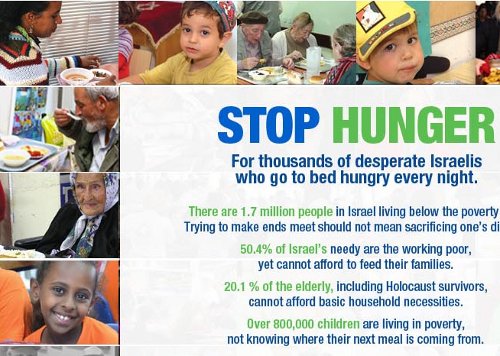
poor-israel2I’m not trying to beat a dead horse, I’m trying to inspire some life in the one we have, but the one we often ignore, most likely through ignorance. I said just yesterday that we translate and interpret the Bible based on our traditions and theologies. The obligation of the Christian church to support the poor among Israel has fallen through the cracks of our creaky theology for nearly twenty centuries. It’s time to fix the floorboards, firm up the foundation, and take back the responsibility that we were given by the first Apostles and the men who walked with Christ.

This does not absolve us of our responsibility to the poor of the nations, the poor of our country, our city, within our neighborhoods and our own churches. But it opens the door in our lives and in our spirits to remember Jerusalem, to remember Israel, and God’s special covenant people, our mentors, and the root of our salvation.

If I forget you, O Jerusalem, let my right hand forget its skill! Let my tongue stick to the roof of my mouth, if I do not remember you, if I do not set Jerusalem above my highest joy!

Psalm 137:5-6 (ESV)

If you’re hard pressed to know where to begin, then consider visiting meirpanim.net, colelchabad.org, or chevrahumanitarian.org. That’s just for starters.

Vayigash: Settling Into Prosperity and Captivity

jewish-handsIn 468 CE, Rabbi Amemar, Rabbi Mesharsheya and Rabbi Huna, the heads of Babylonian Jewry, were arrested and executed 11 days later. The Jewish community of Babylon had existed for 900 years, ever since Nebuchadnezzar had conquered Israel, destroyed the Holy Temple, and exiled the Jews to Babylon. Seventy years later, when the Jews were permitted to return to Israel, a large percentage remained in Babylon — and this eventually became the center of Jewish rabbinic authority. Things began to worsen in the 5th century, when the Persian priests, fighting against encroaching Christian missionaries, unleashed anti-Christian persecutions which caught the Jews of Babylonia in its wake. Eventually the situation improved, and Babylon remained as the center of Jewish life for another 500 years.

-Rabbi Shraga Simmons
“Today in Jewish History, 7 Tevet”
Aish.com

Thus Israel settled in the country of Egypt, in the region of Goshen; they acquired holdings in it, and were fertile and increased greatly.

Genesis 47:27 (JPS Tanakh)

It’s hard not to compare these two events. Both of them describe different points in the process of the Jewish people going down into a land not their own and then making themselves comfortable there and thriving. As we see in the Babylonian example, the “good times” don’t last forever, but from Jacob’s point of view, this isn’t readily apparent. In fact, he had assurances that dwelling in Egypt was the right thing to do.

So Israel set out with all that was his, and he came to Beer-sheba, where he offered sacrifices to the God of his father Isaac. God called to Israel in a vision by night: “Jacob! Jacob!” He answered, “Here.” And He said, “I am God, the God of your father. Fear not to go down to Egypt, for I will make you there into a great nation. I Myself will go down with you to Egypt, and I Myself will also bring you back; and Joseph’s hand shall close your eyes.”

So Jacob set out from Beer-sheba. The sons of Israel put their father Jacob and their children and their wives in the wagons that Pharaoh had sent to transport him; and they took along their livestock and the wealth that they had amassed in the land of Canaan. Thus Jacob and all his offspring with him came to Egypt: he brought with him to Egypt his sons and grandsons, his daughters and granddaughters — all his offspring.

Genesis 46:1-7 (JPS Tanakh)

God’s blessing upon Jacob as we see above, is the beginning of the process of Israel dwelling in Egypt, multiplying greatly, and thriving there. However, the other end of the story is hardly so pleasant.

A new king arose over Egypt who did not know Joseph. And he said to his people, “Look, the Israelite people are much too numerous for us. Let us deal shrewdly with them, so that they may not increase; otherwise in the event of war they may join our enemies in fighting against us and rise from the ground.” So they set taskmasters over them to oppress them with forced labor; and they built garrison cities for Pharaoh: Pithom and Raamses. But the more they were oppressed, the more they increased and spread out, so that the [Egyptians] came to dread the Israelites.

The Egyptians ruthlessly imposed upon the Israelites the various labors that they made them perform. Ruthlessly they made life bitter for them with harsh labor at mortar and bricks and with all sorts of tasks in the field.

The king of Egypt spoke to the Hebrew midwives, one of whom was named Shiphrah and the other Puah, saying, “When you deliver the Hebrew women, look at the birthstool: if it is a boy, kill him; if it is a girl, let her live.”

Exodus 1:8-16 (JPS Tanakh)

rabbi-prayingThe irony in making the above comparisons, is that the Fast of the Tenth of Tevet is just a few days away.

The Fast of the Tenth of Teves marks the day that Nevuzadran, the Babylonian general, laid siege to Jerusalem prior to the destruction of the first Holy Temple. The siege lasted almost three years until the city walls were breached and the Temple was destroyed. This was the beginning of a long line of disasters on the Jewish people, including the first exile, and the destruction of the second Temple.

This day is commemorated by refraining from eating or drinking from sunrise to nightfall.

While the last sentence of this week’s Torah portion is one of hope and prosperity for the Children of Israel, it is ominously foreshadowed by what we know will occur after the death of Joseph and his brothers. This is the fate of the Jewish people that we’ve seen enacted again and again across history since the destruction of Herod’s Temple in 70 CE and to this very day, when the Jews settle in an area, develop a robust and prolific community, and then are persecuted, robbed, maligned, murdered, and exiled.

On his blog, my friend Gene Shlomovich posted an extremely telling example of how Christianity in the “bad old days” expected and enforced Jewish conversion to Christianity. I invite you to click the link I just provided and read the whole story. It’s not a pretty picture, and many Jews chose to be tortured and die rather than to abandon the God of their Fathers and the Torah of Truth, and replace them with the “lure” of the “Goyishe Jesus.”

What am I saying here? That Christians are perpetually bad and that Jews should do anything in their power to blame the church for the hideous way it has historically treated Jewish people? Is that what the upcoming fast is all about? Not according to Rabbi Raymond Beyda

The purpose of fasting almost 2500 years after the events of the destruction took place is to awaken our hearts today to repentance. Our sages teach that anyone who lives at a time when there is no Bet Hamikdash must realize that had he or she lived when the Temple stood that his or her behavior would contribute to its destruction. Should we mend our ways and remove from our lives the behavior that brings destruction we will bring about the construction of the third Temple — the one that will never be destroyed — and the coming of Mashiah speedily in our days. May we all spend the day productively contributing to that end — Amen.

This is not to excuse the church for its crimes or to pardon any of the peoples and nations who have harassed and abused the Jewish people over the long centuries, but we must separate history from current events. Yes, hatred of Jews and hatred of Israel is still rampant in our world and there are many accounts in the media that indicate it is on the upswing. However, there are also many churches that have significantly revised and improved their (our) understanding of Jews and Judaism, and they (we) have repented and seek to understand our “Jewish roots,” while also honoring that God created a unique covenant people and nation in Israel who remain unique and special to the current day.

But the Jewish people have only one nation, Israel. While, in most parts of the world, Jews are welcome, and flourish, and are fully integrated within the countries and societies where they dwell, we see from history that there is such a thing as being too integrated, and certainly assimilation takes Jews to the point of no longer being recognizably Jewish. What the ancient church attempted and failed to do by force is now being accomplished voluntarily.

Judaism is being destroyed by assimilation and integration, which in effect, means Jews are, without realizing it, renouncing all that it is to be a Jew for the sake of national, social, and cultural belonging. But for those Jews who fully retain their unique ethnic, covenant, and halakhic identity as Jews, the danger they face living in the nations is the same danger the Jews faced in 468 CE in Babylon, and the same danger they faced in the 1930s in Germany.

joseph_egyptAnd it’s the same danger we find them facing this week as Jacob and his family settle comfortably in Goshen, which is in Egypt, and ruled by Pharaoh. Today, as we read Vayigash, Pharoah, King of Egypt knows Joseph and seeks to continue the profitable relationship between Egypt and Jacob’s family. Tomorrow, a new Pharoah will arise who does not know Joseph. That’s the way it’s always happened. Jews believe it will happen again.

According to the Talmud, as the Messianic era approaches, the world will experience greater and greater turmoil: Vast economic fluctuations, social rebellion, and widespread despair. The culmination will be a world war of immense proportion led by King Gog from the land of Magog. This will be a war the likes of which have not been seen before. This will be the ultimate war of good against evil, in which evil will be entirely obliterated. (Ezekiel ch. 38, 39; Zechariah 21:2, 14:23; Talmud – Sukkah 52, Sanhedrin 97, Sotah 49)

What is the nature of this cataclysmic war? Traditional Jewish sources state that the nations of the world will descend against the Jews and Jerusalem. The Crusades, Pogroms and Arab Terrorism will pale in comparison. Eventually, when all the dust settles, the Jews will be defeated and led out in chains. The Torah will be proclaimed a falsehood.

“End of Days”
from the “Ask the Rabbi” series
Aish.com

Israel and her people, the Jewish people, will be rescued when Moshiach comes. But until then, we in the church have a responsibility to make sure the Holocaust or anything like it does not happen again in our towns, in our cities, and in our nations. In solidarity, we can also fast on the Tenth of Tevet, which this year is on Sunday, December 23rd.

Peace be upon Jerusalem and may the Messiah come soon and in our day.

Good Shabbos.

43 Days: Dust and Ashes in My Own Universe

I am but dust and ashes.

Genesis 18:27

Everyone must say, “The world was created for my sake.”

-Sanhedrin 37a

Rabbi Bunim of Pshis’cha said that everyone should have two pockets; one to contain, “I am but dust and ashes,” and the other to contain, “The world was created for my sake.” At certain times, we must reach into one pocket; at other times, into the other. The secret of correct living comes from knowing when to reach into which.

Humility is the finest of all virtues and is the source of all admirable character traits. Yet, if a person considers himself to be utterly insignificant, he may not care about his actions. He may think, “What is so important about what I do? It makes no difference, so long as I do not harm anyone.” Such feelings of insignificance can cause immoral behavior.

When a person does not feel that his actions are significant, he either allows impulses to dominate his behavior or slouches into inactivity. At such a time, he must reach into the pocket of personal grandeur and read: “I am specially created by God. He has a mission for me, that only I can achieve. Since this is a Divine mission, the entire universe was created solely to enable me to accomplish this particular assignment.”

When presidents and premiers delegate missions to their officials, those officials feel a profound sense of responsibility to carry out the mission in the best possible manner. How much more so when we are commissioned by God!

Today I shall…

keep in mind both the humbleness and the grandeur of the human being.

-Rabbi Abraham J. Twerski
“Growing Each Day, Kislev 1”
Aish.com

I guess that answer a query I made recently.

Is it arrogant and self-centered to believe that God has a plan for my one, small, individual life? After all, there are billions of people who live on Earth today. Untold trillions and trillions of human beings have been born, lived, and died all throughout the history of the human race. Only a tiny, tiny fraction of them have been mentioned in the Bible (or any other holy book), and of those people, we sometimes don’t know which ones we can take as literally being real humans who lived real lives, vs. some unknown scribe somewhere writing an allegory about someone named “Job” to make a moral point.

Not only is it incorrect to consider ourselves to be insignificant as individuals, it could actually be sinful. Faith and trust in God includes the belief that we are not only significant, but possibly very important since we have been commissioned to perform deeds in the plan of God.

There’s a certain amount of “mysticism” in the statement, “[s]ince this is a Divine mission, the entire universe was created solely to enable me to accomplish this particular assignment.” At least from a human point of view, it is extraordinarily unlikely that the entire universe was created just for me to do whatever God put me here to do. I suppose if we start winding down the road of some serious metaphysics, it might be seen otherwise, but I don’t think my brain can bend in that direction.

So here we are (I am) performing a balancing act, again. Running on the edge of a razor blade, trying to keep my balance and avoid being sliced to ribbons (by concepts, consciousness, or other people). Is that too dramatic? Maybe not, if I’m trying to assess and moderate equal portions of humility and being an agent on a “Divine mission.”

But that may explain our different experiences when at times, nothing seems to go right, and at others, when nothing seems to go wrong. Paul’s infamous “thorn” in his side (2 Corinthians 12:7) was what balanced him out and we know that he really did have a Divine mission (see Acts 9). We have the Bible to tell us all about the details Paul’s mission and for a Christian, it’s almost “old news.” However, for the rest of us, our particular “mission” can seem like something of a mystery.

Oh, it gets worse.

How many Christians “feel” as if they have a mission. A lot of the time, it’s to go into the ministry. We Christians sometimes get this weird idea that only Ministers can minister. But what do we do that doesn’t minister if we’re doing God’s will?

Well, right now I know why I’m doing this. I’m doing this because enough people have told me it matters to them that I do this. If that’s also the voice of God, I’m fine with that, too.

That’s how I summed up my response to the question I asked myself the other day: “Why am I doing this?”

I suppose I could just need constant reassurance that I’m doing the right thing, but that’s no way to run a “ministry” let alone a life. There will always be times when there will be no reassurance, when it seems as if the whole world is against your (and my) Christian faith, and you (I) have to depend on whatever internal moral compass God has provided to continue the journey so that we are (I am) walking in the right direction.

Not that the right direction is always easy.

In 2008, Rabbi Gavriel and Rivkah Holtzberg were among 200 people killed when terrorists attacked Mumbai, India. The Holtzbergs selflessly ran the Chabad house, a beacon of hope and kindness in a city filled with poverty and despair.

Day in Jewish History: Kislev 1
Aish.com

Most of us won’t have to face death in the service of God. Most of us won’t have to face the death of loved ones in the service of God. Most of us won’t have to raise grandchildren because our children died in the service of God.

But it does give you pause. I mean, there’s no promise intrinsic to our faith and trust that limits how much God will ask of you (or me). Especially in the western nations, people of faith aren’t used to working really, really hard in the service of God, at least not most of the time. Sure, we may go on the occasional mission trip to a “third world country” and for a week or two, live in conditions that are a far cry from our comfortable homes in our middle-class suburbs.

But as you may have noticed recently, just being a Jew and living in or visiting Israel can be very dangerous. One of the horrible ironies of this latest terrorist attack was this:

The names of the three people who were killed Thursday by a rocket attack in Kiryat Malachi have been published, and one of whom, it was just discovered, was an emissary of Chabad involved in outreach in India, and was in Israel on a short visit in order to give birth and pay respects to the Chabad victims of the Mumbai terror attack in 2008.

Mirah (nee Cohen) Scharf, the 26-year-old victim of today’s attack, was a “shlucha (female emissary)” to New Dehli, India, visiting Israel for the memorial service of Gabi and Rivka Holtzberg, the Chabad emissaries who were victims of the Mumbai terror attack. The Hebrew anniversary of their brutal murder is today.

-Annie Lubin
“Mirah Scharf, Killed by Missile, Laid to Rest”
IsraelNationalNews.com

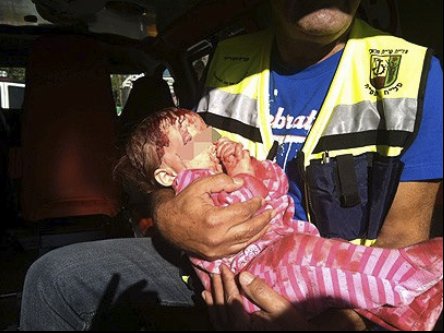
God, please be merciful to the injured and dying of your people Israel. Be merciful to those who live in harm’s way. Be merciful to the children who wake up every morning wondering if today they will be killed, and go to sleep each night fearing that they will be murdered in their sleep.

There were periods of time when R. Yekusiel Liepler, a chassid of the Alter Rebbe, davened Shacharit, Mincha and Maariv one right after the other; there was no time for intervals.

“Today’s Day”
Sunday, Kislev 1, Rosh Chodesh, 5704
Compiled by the Lubavitcher Rebbe
Translated by Yitschak Meir Kagan
Chabad.org

Compared to that, the uncertainty in attending a local church and sometimes being criticized for it doesn’t seem so intimidating.

Blessings upon Israel and her people, the children of Abraham, and of Issac, and of Jacob.

If I forget you, O Jerusalem, let my right hand forget its skill. Let my tongue adhere to my palate, if I fail to elevate Jerusalem above my foremost joy.

Psalm 137:5-6 (Stone Edition Tanakh)