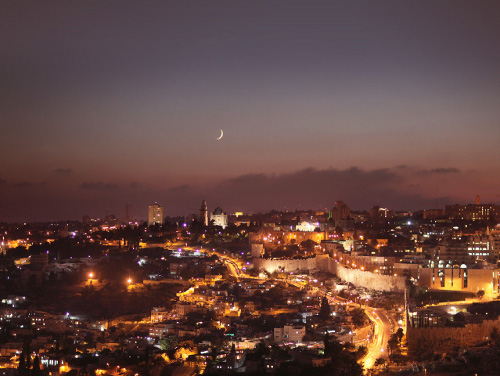
Tag Archives: Jerusalem

Praying Where God Has Placed His Name

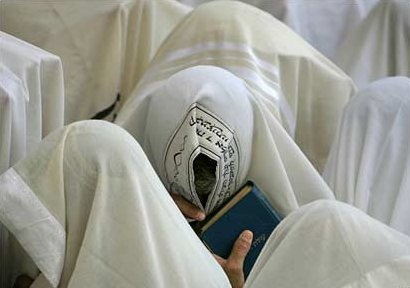
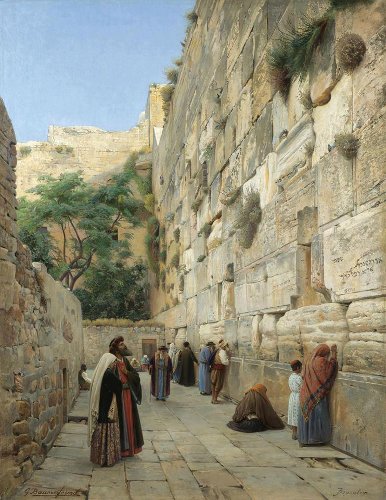
ancient-kotel-prayersWhen responding to the question, “Why do Jews pray at the Western Wall in Jerusalem,” Rabbi Tzvi Freeman had this to say.

I think what you’re really asking is: If G‑d is everywhere, why should prayer be more effective in one place than another? In truth, the same can be asked regarding praying in a synagogue vs. praying at home.

The question has been asked many times before in classical Jewish literature. Since this is a Chabad site, I’ll provide the answer given by Rabbi Schneur Zalman of Liadi (1745–1812), the first rebbe of Chabad.

The essence of his answer is that although G‑d is everywhere, His light shines stronger in some places than in others. He compares this to the human body: You are everywhere in your body, yet you are far more conscious of your mind than of your toes. So too, in the universe that G‑d created, there are places, times and states of being where we are able to be more aware of Him—and it is from those places/times/states that our prayers can fly best.

Any person is able to create for himself a time of day and a special place from which he or she reaches out to G‑d. And we all should—somewhere in our homes or gardens, set aside a place of prayer and meditation, along with a time of day or week that we sit there and connect. Even more special is a place that was chosen not just by us, but by G‑d as well. And that is the Temple Mount, which G‑d chose as His dwelling place in the time of King David.

Ever since then, that specialness has never left the Western Wall, the only remnant left standing.

The Talmud tells us that every synagogue is a “minor Holy Temple.” Thus the above also applies—in smaller measure—to any location designated to be a house of worship for G‑d.

I’ve probably mentioned this before, but one item on my bucket list (not that I have a well-defined bucket list) is to pray at the Kotel, otherwise called the Western Wall. I’m not even entirely sure that, from a Jewish point of view, it would be considered appropriate for a Christian to pray at the Kotel. After all, there is a certain controversy associated with some Jewish women davening at the Kotel, and I’m not even Jewish.

On the other hand, American Presidents and Catholic Popes have prayed at the Kotel, so I suppose it could be permissible for me to do so as well.

Why do I want to?

The Jewish person querying Rabbi Freeman was confused by the significance of even Jews davening at the Kotel. What’s the difference between praying there, in synagogue, at home, or, for a Christian, in church?

Rabbi Freeman answered the question from a Jewish point of view, but can any of that be applied to someone like me?

I think so.

So Abraham rose early in the morning and saddled his donkey, and took two of his young men with him and Isaac his son; and he split wood for the burnt offering, and arose and went to the place of which God had told him. On the third day Abraham raised his eyes and saw the place from a distance.

Genesis 22:3-4 (NASB)

So Jacob rose early in the morning, and took the stone that he had put under his head and set it up as a pillar and poured oil on its top. He called the name of that place Bethel; however, previously the name of the city had been Luz.

Genesis 28:18-19 (NASB)

But you shall seek the Lord at the place which the Lord your God will choose from all your tribes, to establish His name there for His dwelling, and there you shall come. There you shall bring your burnt offerings, your sacrifices, your tithes, the contribution of your hand, your votive offerings, your freewill offerings, and the firstborn of your herd and of your flock. There also you and your households shall eat before the Lord your God, and rejoice in all your undertakings in which the Lord your God has blessed you.

Deuteronomy 12:5-7 (NASB)

And every day, in the temple and from house to house, they kept right on teaching and preaching Jesus as the Christ.

Acts 5:42 (NASB)

Jacobs_LadderIt is said in midrash that the place where the Akedah (binding of Isaac) occurred was at the future Temple Mount in what would be Jerusalem. This is also supposed to be the identical site where Jacob experienced God at Beth El (literally, “House of God” in Hebrew). We also know from the Torah, that God intended to place His Name in a specific geographic location, which is also understood as the Temple Mount. Further, we see that the early Apostles of Messiah regularly taught and prayed at the Temple, specifically at Solomon’s portico (see Acts 3:11).

All of this seems to indicate that not only Jerusalem, but the site of the Temple, has a special significance to God. Yes, God is everywhere and we are not inhibited from praying to God anywhere, but no other place on Earth seems to hold the presence of God in such a way as Jerusalem and the Holy Temple.

And the Kotel is all that is left of the Temple, at least for now.

Also, if it is true that the Temple will be rebuilt and especially if Messiah, Son of David, will rule from Jerusalem and that his throne will be placed there, then any disciple of the Master should be drawn to the Holy City and to the location where Hashem’s Temple has and will once again be established.

Christians have to be careful though, because any attachment we show to Jerusalem and the Kotel can easily be misunderstood by Jewish people as our “taking over” Jewish Holy sites. The church as a long history of supersessionism, so it’s important to respect the overwhelming Jewish history and ownership of Jerusalem and Israel. However, many religious Jews believe that the people of the nations will one day be drawn to Messiah and worship God in Jerusalem, so in that context, we can present ourselves as desiring to honor Hashem at the Kotel. Even Solomon understood this from days of old.

“Also concerning the foreigner who is not of Your people Israel, when he comes from a far country for Your name’s sake (for they will hear of Your great name and Your mighty hand, and of Your outstretched arm); when he comes and prays toward this house, hear in heaven Your dwelling place, and do according to all for which the foreigner calls to You, in order that all the peoples of the earth may know Your name, to fear You, as do Your people Israel, and that they may know that this house which I have built is called by Your name.”

1 Kings 8:41-43 (NASB)

In desiring to pray at the Kotel, I am only responding to the prayers of the King.

I was glad when they said to me, “Let us go to the house of the Lord.”

Psalm 122:1 (NASB)

But again, Christians must not forget that it is Jewish eyes that are constantly looking toward Jerusalem and Jewish hearts that “sigh” for Messiah.

“Notwithstanding all this, the Jew … has his heart fixed upon Jerusalem, praying and sighing a waiting, and longing for the coming of the Messiah King, the promised Redeemer of the House of David.”
Rabbi Isaac Lichtenstein

Beyond Tisha B’Av

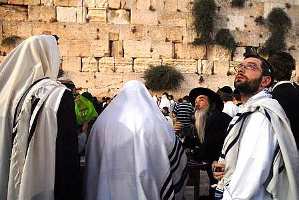
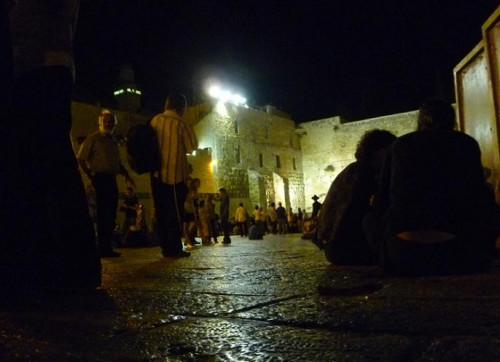
Tisha b'Av at the Kotel 2007In the fourth year of Jehoiakim the son of Josiah, king of Judah, this word came to Jeremiah from the Lord, saying, “Take a scroll and write on it all the words which I have spoken to you concerning Israel and concerning Judah, and concerning all the nations, from the day I first spoke to you, from the days of Josiah, even to this day. Perhaps the house of Judah will hear all the calamity which I plan to bring on them, in order that every man will turn from his evil way; then I will forgive their iniquity and their sin.”

Now in the fifth year of Jehoiakim the son of Josiah, king of Judah, in the ninth month, all the people in Jerusalem and all the people who came from the cities of Judah to Jerusalem proclaimed a fast before the Lord. Then Baruch read from the book the words of Jeremiah in the house of the Lord in the chamber of Gemariah the son of Shaphan the scribe, in the upper court, at the entry of the New Gate of the Lord’s house, to all the people.

Jeremiah 36:1-3, 9-10 (NASB)

For this our heart has become faint, for these things our eyes have grown dim. For Mount Zion, which has become desolate; foxes prowl over it. But You, O G‑d, remain forever; Your throne endures throughout the generations. Why do You forget us forever, forsake us so long? Restore us to You, O G‑d, that we may be restored! Renew our days as of old.

Lamentations 5:17-21 (Tanakh)

This year, the 9th of Av or Tisha B’Av begins at sundown on Monday, July 15th and ends on sundown on Tuesday the 16th. There is no more tragic day in the history of the Jewish people than Tisha B’Av. You can click the link I provided above to read the chronicles of this day of mourning for Israel, but I wanted to provide an additional perspective.

“But when you see Jerusalem surrounded by armies, then recognize that her desolation is near. Then those who are in Judea must flee to the mountains, and those who are in the midst of the city must leave, and those who are in the country must not enter the city; because these are days of vengeance, so that all things which are written will be fulfilled. Woe to those who are pregnant and to those who are nursing babies in those days; for there will be great distress upon the land and wrath to this people; and they will fall by the edge of the sword, and will be led captive into all the nations; and Jerusalem will be trampled under foot by the Gentiles until the times of the Gentiles are fulfilled.

Luke 21:20-24 (NASB)

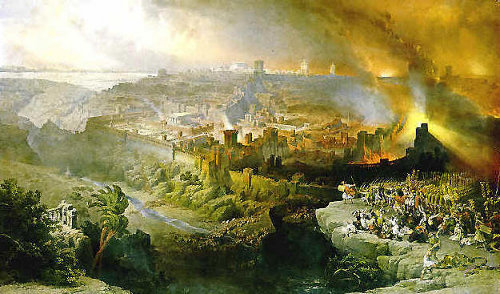
When the Romans laid siege upon Jerusalem, when they breached her walls, when they utterly destroyed the Holy Temple, how many remembered these words Jesus spoke some forty years before? How many bewailed the tremendous loss, even as Jews all over the world have mourned for their losses since that time? What does the Kotel mean for millions of Jews today? And of the disciples of the Master who lived in the days of destruction, what happened next?

At its height, the Jerusalem community of disciples numbered around ten thousand. Several thousand of these spent the war years in Pella. Their migration back to Jerusalem probably did not happen all at once…

-D. Thomas Lancaster
from Torah Club Volume 6, Chronicles of the Apostles, pg 1135
read with Torah Portion Devarim
published by First Fruits of Zion

There is a three-week period of preparation for commemorating Tisha B’Av but what happens after the fast is over? Go on with regular life? Prepare for the coming week’s Torah reading? Anticipate the Days of Awe and the return of autumn?

After each tragedy, there is a long period of mourning and slow recovery. In the case of the vast majority of Jews after the destruction of Herod’s Temple, they must have struggled to understand how life could go on? How could they make the sacrifices commanded according to Torah? How could they worship God?

As Jewish history continued to unravel forward in time, almost all of the Jewish people were exiled from their land. Holy Jerusalem was renamed by the Romans “Aeilia Capitolina” as yet another insult to the Jews. Only a tiny remnant of Jewish people clung to life within the borders of Israel. According to Lancaster’s commentary, this included Jewish disciples of the Master.

Jewish disciples of our Master continued to live in Pella and the surrounding area at least into the fourth century. In his fourth-century treatise against heresies, Epiphanius complains about the Nazarene “heresy” which he describes as Jewish believers in Yeshua “who remain wholly Jewish and nothing else.”

-ibid

Tisha b'Av at the Kotel 2011Tragedy. Loss. Mourning. Adjustment. Hope.

But much past the fourth century, we must concede that the number of Jewish disciples of Jesus dwindled to few and then none. Like the Temple, Jerusalem, Israel and the Jewish people, Jewish faith in Yeshua of Nazareth as the Messiah went into a long exile and seemed completely lost forever.

But God is gracious. Nearly two years ago, on his blog, Rabbi Joshua Brumbach published a history of Jewish Rabbis who lived during the past several centuries who were also believers, and “who remained wholly Jewish and nothing else.” Both the first and second parts of Rabbis Who Thought For Themselves provide the beginning flickers of illumination after great darkness. Gentile Christianity has flourished in the centuries between the Temple’s destruction and the modern era and Judaism, though suffering greatly, continues to survive and even to thrive in various areas of our world.

But there has always been an enormous disconnect between the two.

That wound is very slowly healing.

In a very real way, Christians and devout Jews are all waiting for the same thing: the coming (or return) of the Jewish Messiah King. Our “visions” of just who is coming (or coming back) and what he will do are quite different, but the Messiah exists as an objective fact, regardless of our beliefs and dreams.

The world herself has been grieving for nearly two-thousand years awaiting the return of the Prince of Peace and the King of Righteousness to stop the bleeding, cease the wars, feed the hungry, and to bring repair and shalom to this broken planet…

…and to her broken people.

Thus said Cyrus king of Persia: Hashem, God of Heaven, has given to me all the kingdoms of the earth, and He has commanded me to build Him a Temple in Jerusalem, which is in Judah. Whoever there is among you of His entire people — may Hashem his God be with him, and let him go up!

2 Chronicles 36:23 (Stone Edition Tanakh)

He who testifies to these things says, “Yes, I am coming quickly.” Amen. Come, Lord Jesus. The grace of the Lord Jesus be with all.

Revelation 22:20-21 (NASB)

May Messiah come soon and in our day, and may he heal the broken and the broken-hearted.

Amen.

Healing the Gaps in the Wall

destruction_of_the_templeThe next Sabbath nearly the whole city assembled to hear the word of the Lord. But when the Jews saw the crowds, they were filled with jealousy and began contradicting the things spoken by Paul, and were blaspheming. Paul and Barnabas spoke out boldly and said, “It was necessary that the word of God be spoken to you first; since you repudiate it and judge yourselves unworthy of eternal life, behold, we are turning to the Gentiles.

But the Jews incited the devout women of prominence and the leading men of the city, and instigated a persecution against Paul and Barnabas, and drove them out of their district. But they shook off the dust of their feet in protest against them and went to Iconium.

Acts 13:44-46, 50-51

Are believers who live under the law generally joyful people?

Instead of God’s truth, with what did Satan fill the hearts of those who believed that justification before God could only come through keeping the law of Moses? Do you think that they were sensing a loss of influence and control?

-Questions in the Bible Study Class notes from last Sunday

Last Sunday at church, Pastor Randy preached from Acts 13:42-52. I was impressed that Pastor was able to give a sermon on such a potentially inflammatory set of verses in a way that expressed great sensitivity for the Jewish people, and correctly identified (in my opinion) the source of the “irritation” expressed by some of the Jewish leadership in the Pisidian Antioch synagogue upon witnessing vast crowds of pagan, idol-worshiping Gentiles flood into shul to hear Paul speak.

My Sunday School class discusses Pastor’s sermon after services (the church offers multiple classes on Sunday on a variety of subjects, but I chose this one since for me, the highlight of going to church is the sermon), and in going over my study notes the day before, I knew there could potentially be some problems. I wasn’t looking forward to class and once it started, I didn’t know exactly what I was going to say.

Fortunately, although the notes could have been worded a bit better, the attitudes expressed didn’t reflect any negative attitudes toward “the Jews” …

… exactly

No, no one spoke against the Jewish people, but the language of Christians talking about “the Jews” has been crafted over many centuries and there seemed to be an echo of that language in my study notes. If I hadn’t known better, I probably would have been concerned a time or two in class.

Actually, I did become concerned, since the teacher inserted the assumption that part of the reason “the Jews” in Antioch became upset, was because Paul was teaching that the grace of Christ replaces a life “under the Law” for Jewish believers.

As the time to go to class approached, I was still uncertain how or if I was going to respond to this assumption, but when the moment arrived and I heard “the Law” being (apparently) dissed, I asked to read from Psalm 19. I had the ESV Bible with me, but below, I’m quoting from the Stone Edition Tanakh (note that the verse numbers are slightly different between the Christian and the Jewish Bible):

The Torah of Hashem is perfect, restoring the soul; the testimony of Hashem is trustworthy, making the simple one wise, the orders of Hashem are upright, gladdening the heart; the command of Hashem is clear, enlightening the eyes.

Psalm 19:8-9 (Stone Edition Tanakh)

Does that sound like the Psalmist thought the Torah was a burden? That’s the question I asked the class. Pastor, in his sermon, bent over backwards to illustrate that saying “the Jews” in this context, would be highly insulting and would not accurately reflect what was happening in the Antioch synagogue. Not literally every Jewish person turned against Paul and Barnabas and no, Paul did not permanently turn away from bringing the good news of Messiah to Jewish people and take it only to the Gentiles from that moment on. And there’s nothing in the text of Acts 13 that tells us Paul spoke against the Torah.

It’s sections of scripture like this one that have been used by the church to berate, denigrate, harass, and persecute the Jewish people for centuries. Although I didn’t get any push back at all in class as I made my points, I had to be sure that the people I’ve been studying with for over half a year weren’t misunderstanding this portion of Acts 13 based on long-standing Christian tradition (yes, Christians can interpret scripture based on tradition, too).

I don’t believe they were, but it was one of those moments in church that helps me realize we have a long way to go in healing the rift between traditional Christianity and the Jewish people.

I probably wouldn’t have written about this at all except when I got home from church, I went online and read the following:

We are now entering the Three Weeks, the time between the 17th of Tamuz (observed Tuesday, June 25th) and the 9th of Av (starting Monday day night, July 15th). This is a period when many tragedies happened to the Jewish people. Why do we mourn the loss of the Temple after so many years? What did and does it mean to us?

The 17th of Tamuz is a fast day. The fast begins approximately an hour before sunrise and continuing until about an hour after sunset. The purpose of the fast is to awaken our hearts to repentance through recalling our forefathers’ misdeeds which led to tragedies and our repetition of those mistakes. The fasting is a preparation for repentance — to break the body’s dominance over a person’s spiritual side. One should engage in self-examination and undertake to correct mistakes in his relationship with God, his fellow man and with himself.

-Rabbi Kalman Packouz
“Shabbat Shalom Weekly”
Commentary for Torah Portion Pinchas (Numbers 25:10-30:1)
Aish.com

yom-kippur-kotelYou might think I’m being overly sensitive about all this. I suppose some of the people in Sunday School class might think that of me. I couldn’t see all the faces around the room as I was speaking, so I can’t gauge how each person was responding. I can only tell you that no one disagreed with me out loud, and in fact, a few people spoke up in support of my statements.

Rabbi Packouz, while reminding me of the terrible tragedies and losses that have befallen the Jewish people and how Israel is once again entering a time of national mourning, also helped me realize that for every descent, there is an ascent, and every wound offers an opportunity for healing.

The story is told of Napoleon walking through the streets of Paris one Tisha B’av (the 9th day of the Hebrew month of Av, a day of fasting and mourning for the destruction of the two Temples). As his entourage passed a synagogue he heard wailing and crying coming from within; he sent an aide to inquire as to what had happened. The aide returned and told Napoleon that the Jews were in mourning over the loss of their Temple. Napoleon was indignant! “Why wasn’t I informed? When did this happen? Which Temple?” The aide responded, “They lost their Temple in Jerusalem on this date 1700 years ago.” Napoleon stood in silence and then said, “Certainly a people which has mourned the loss of their Temple for so long will survive to see it rebuilt!”

If we know our history and understand it, then we can put our life in perspective. We can understand ourselves, our people, our goals, our values. We will know the direction of our lives, what we want to accomplish with our lives and what we are willing to bear in order to fulfill our destiny. Friedrich Nietzsche put it well, “If you have a ‘why’ to live for, you can bear with any ‘how’.”

Sara Debbie Gutfreund also wrote about the 17th of Tammuz but from a much more personal perspective.

A few years ago my grandfather passed away right before the 17th of Tammuz. On the fast day I was helping my mother as she sat shiva and an old family friend offered me a drink.

“No thanks, I’m fasting.” I said.

“What are you fasting for?” he asked. So I explained that it was the 17th of Tammuz, and we were mourning the day that the walls of Jerusalem were breached before the Second Temple was destroyed.

“I never heard of this fast day. But you know what’s even sadder? Last year my wife and I visited Israel for the first time. We went on a tour of the Old City and the tour guide points out the Temple Mount. And all we could see was this huge mosque and then the tour guide points out the Western Wall. And I couldn’t believe it. That’s it? That’s all that’s left of the Temple? One wall? So I think I know why there’s a fast. There’s so little we have left.”

-from “Filling the Crevices of the Wall”
Aish.com

So where is the uplifting part of the story. I promise you that there is one.

Last night, my son, who is named after my grandfather, was standing with me on the deck.

“Why is the world so big?” he asked me as we gazed up at the towering trees and the endless stretch of star-studded sky.

“I don’t know,” I answered. “Maybe because we need room to grow.”

And as the fireflies began to light up the dark corners of the yard, I thought that it must be true. The darkness is here for us to create light. The brokenness is here for us to learn how to make ourselves whole. And the Western Wall – all that’s left – is so much more than just a remnant of our past. It’s there to remind us to rebuild. It’s there to hold our crumpled notes and dreams. It’s a gift. Like the gap between the waves that pulled me in and brought me back to shore. Like the saltwater that poured down my face and the sand that blurred my eyes. Like the silence that gives us a chance to find our own words. Like the hugeness of the world that makes room for us to grow. Like the man who put down his drink and said. “I think I know why there’s a fast.” There’s a gap. In our hearts. In the crevices of the Wall.

But the gap is the gift. And all that’s left is the extraordinary opportunity to fill it.

I amazes me that a people and a nation who have suffered so much can continue to bounce back and not only to survive, but to live, and grow, and embrace the God of Jacob wholeheartedly. As Napoleon was supposed to have said, “Certainly a people which has mourned the loss of their Temple for so long will survive to see it rebuilt!” Nietzsche’s statement “If you have a ‘why’ to live for, you can bear with any ‘how'” is well and appropriately applied to the history of the Jewish people. The Kotel or what some people refer to as “the Wailing Wall,” is all that there is left of the Temple at present and in the crevices, people insert written prayers to God. The Jewish people fill the gaps in their existence with their faith that one day, God will answer their prayers and send His Messiah to restore them as a people in their Land, to redeem Israel, to raise her up, to give her a King who will bring peace to all the world.

temple-prayersThe gap between Christianity and Judaism gives me the opportunity to help fill it with who I am as a believer and what the Jewish Messiah King means to me. I can fill the gap as a Christian man who has been married to a Jewish wife for over three decades, who has raised three Jewish children, and who is sensitive to what Christians have traditionally said and believed about the Jewish people based on some misunderstood portions of the scriptures.

Not something to dread, but an opportunity to help educate and to introduce a balance (though it probably wasn’t needed much in this case).

But like many Jewish people are doing right now, part of me grieves the losses, even as I know there are gains. It’s going to get worse for our world before it gets better. There will be battles. There will be heartache. There will be a need for courage.

We will need to fill the gaps that God has left us because that is helping to repair the world, tikkun olam. That is part of bringing the return of the Messiah. Part of the gospel message is the promise of personal salvation for anyone who believes. But the especially good news for the Jewish people is that when Messiah returns, he will redeem and restore national Israel, rebuild the walls of David’s fallen sukkah, and bring peace between the Jewish people and the people of the nations who are called by his name.

And beyond what Rabbi Packouz and Ms. Gutfreund reminded me of, I remembered Boaz Michael’s message in his book Tent of David. It is true that, as my friend Tom once said, I’m ultimately seeking not Christianity or Judaism, but an encounter with God by returning to church, but I am also seeking the vision of Boaz Michael in healing the “crevices in the wall” between what Christianity has largely become, and what Messiah truly wants us to be.

Gifts of the Spirit: Building God’s Dwelling Place, Part 1

creation2And there was evening and morning: one day.

Genesis 1;5

R. Samuel b. Ammi said: From the beginning of the world’s creation the Holy One, blessed be He, longed to enter into partnership with human beings… When did the Holy One, blessed be He, compensate them [those below for not partnering with them at that time] there? At the erection of the Tabernacle, as it says, “And he that presented his offering the first day” (Num. 7:12), meaning, the first of the world’s creation, for God said, “It is as though on that day I created My world.”

-Genesis Rabbah 3.9

Rabbi Carl Kinbar’s notes for his teaching “For God’s Dwelling Place” presented at the First Fruits of Zion Shavuot conference at Beth Immanuel Sabbath Fellowship in Hudson, Wisconsin begin this way. It’s really a two-part lesson that Rabbi Kinbar managed to offer to us in a single session on Shabbat (I’ll write it as a “two-parter” presenting the second part tomorrow).

You may be put off by the Talmudic references and I’ve been avoiding them until now, knowing how Christian audiences sometimes react to the teachings of the Rabbinic sages. On the other hand, it is sometimes helpful to access Jewish commentary on the Word of God and the Spirit of God in order to re-insert what we are learning back into it’s “natural Jewish habitat” (as D.T. Lancaster puts it).

But what does the act of creating the world and building the Mishkan (Tabernacle) in the desert have to do with “gifts of the spirit?”

Then Moses went up on the mountain, and the cloud covered the mountain. The glory of the Lord settled on Mount Sinai, and the cloud covered it for six days; on the seventh day he called to Moses out of the cloud. Now the appearance of the glory of the Lord was like a devouring fire on the top of the mountain in the sight of the people of Israel. Moses entered the cloud, and went up on the mountain. Moses was on the mountain for forty days and forty nights.

Exodus 24:15-18 (NRSV)

Rabbi Kinbar told a story about how this verse was once taught in a class. One woman in the class responded that it must have been incredibly boring for Moses to sit up on that mountain for forty days and forty nights with nothing to do.

When I heard him describe this woman’s comment I immediately thought, “Sure, if he were alone!” Rabbi Kinbar kindly suggested to his class, “Let’s assume that God is exactly as the Bible describes Him.” Apparently, it doesn’t occur to some folks to take the Bible at face value and to believe God is as He is described in the pages of His own Word.

But let’s “assume” that He is and that at Eden, He desired to dwell among people. In Exodus, He desires to dwell among His people.

I will meet with the Israelites there, and it shall be sanctified by my glory; I will consecrate the tent of meeting and the altar; Aaron also and his sons I will consecrate, to serve me as priests. I will dwell among the Israelites, and I will be their God. And they shall know that I am the Lord their God, who brought them out of the land of Egypt that I might dwell among them; I am the Lord their God.

Exodus 29:43-46

But it’s more than just God living in the human world. God wants something special from people, something that He doesn’t want from any other portion of creation. He wants to be partners with us. He want us to work with Him, not just for Him. He wants more than servants, He wants sons and daughters to help in building His dwelling place; building the Kingdom of God.

Once Jesus was asked by the Pharisees when the kingdom of God was coming, and he answered, “The kingdom of God is not coming with things that can be observed; nor will they say, ‘Look, here it is!’ or ‘There it is!’ For, in fact, the kingdom of God is among you.”

Luke 17:20-21

looking-at-heavenWe tend to think of the “Kingdom” as either Heaven or the future Messianic era, but Jesus is talking about it in the present tense: “…the kingdom of God is among you.” When he says it’s near, he doesn’t necessarily mean it’s right around the corner or that it’s coming soon, he means that as we pursue our partnership with God and perform the mitzvot necessary to help repair our broken world, we are drawing nearer to the Kingdom, we are building little bits and pieces of the Kingdom every time we perform an act of kindness, charity, or justice.

I don’t mean that God just wants to “dwell” with us in some abstract or metaphoric sense.

Moses did everything just as the Lord had commanded him. In the first month in the second year, on the first day of the month, the tabernacle was set up. Moses set up the tabernacle; he laid its bases, and set up its frames, and put in its poles, and raised up its pillars; and he spread the tent over the tabernacle, and put the covering of the tent over it; as the Lord had commanded Moses.

Exodus 40:16-19

As far as I know, there’s nothing in the Hebrew text that suggests Moses had help when he built the Mishkan for the first time and Midrash states that Moses built the entire structure single-handedly. Moses “partnered” with God in constructing God’s dwelling place. All of the Children of Israel who either directly participated in making the elements of the Mishkan or who donated funds and materials for the work “partnered” with God in constructing God’s dwelling place among them.

And when the Divine Presence descended upon the Mishkan so that even Moses was unable to enter the tent of meeting (Exodus 40:34-38), it was possible for the first time to make offerings to God directly in His presence and God dwelt among His people Israel. In fact, it was not possible to make sacrifices to God unless the Divine Presence was in the Mishkan. And this, according to the Sages, was God’s compensation for the lack of human participation in the creation of the world; allowing human participation in the construction of God’s Mishkan and God dwelling directly within Israel and her legions.

In the Garden, God comes down to human beings. At Sinai, when God gives the Torah, God comes down to human beings. And when the last element of the Tabernacle was constructed, God comes down to human beings.

And God came down to human beings in the form of a human being, not in the totality of all that God is (for the Divine Presence is not the totality of all that God is, for even the earth is His footstool, see Isaiah 66:1, Acts 7:49) but God came down to us and dwelt among us as living, breathing flesh.

No one has ascended into heaven except the one who descended from heaven, the Son of Man.

John 3:13

Most Christians have a difficult time understanding what the Temple means to the Jewish people. Most Christians don’t understand what the big deal is about Jews praying at the Kotel (Western Wall, Wailing Wall). Most Christians don’t get the importance of Exodus 40 because they (we) believe that now that we have the indwelling of the Holy Spirit, God lives in us more than ever, and who needs the Temple anyway?

We do.

The two aren’t mutually exclusive. I mentioned in a previous blog post about the conference, that the Holy Spirit has always been moving among humanity and particularly among Israel. The Spirit didn’t show up for the first time in Acts 2. If we can say there’s any sort of difference between the time of the Tanakh (Old Testament) and the Apostolic Era, it was that the Spirit did not previously dwell upon literally every man and woman in Israel, but after the first Shavuot post-ascension, the Spirit does dwell upon each person who has come to faith in God.

Two men, one named Eldad and the other Medad, had remained in camp; yet the spirit rested upon them — they were among those recorded, but they had not gone out to the Tent — and they spoke in ecstasy in the camp. A youth ran out and told Moses, saying, “Eldad and Medad are acting the prophet in the camp!” And Joshua son of Nun, Moses’ attendant from his youth, spoke up and said, “My lord Moses, restrain them!” But Moses said to him, “Are you wrought up on my account? Would that all the Lord’s people were prophets, that the Lord put His spirit upon them!” Moses then reentered the camp together with the elders of Israel.

Numbers 11:26-30 (JPS Tanakh)

“Would that all the Lord’s people were prophets, that the Lord put His spirit upon them!” Wow.

When the day of Pentecost had come, they were all together in one place. And suddenly from heaven there came a sound like the rush of a violent wind, and it filled the entire house where they were sitting. Divided tongues, as of fire, appeared among them, and a tongue rested on each of them. All of them were filled with the Holy Spirit and began to speak in other languages, as the Spirit gave them ability.

Acts 2:1-4

While Peter was still speaking, the Holy Spirit fell upon all who heard the word. The circumcised believers who had come with Peter were astounded that the gift of the Holy Spirit had been poured out even on the Gentiles, for they heard them speaking in tongues and extolling God.

Acts 10:44-46

Wish granted, Moses.

jewish-temple-messiahAnd even beyond that, there will still be a Third Temple in the Messianic Age, and it is in the Temple that Messiah will be enthroned as King over all.

And it will be God’s House and He will dwell among humanity again.

It’s not an either-or proposition. We can have both. We can build both in partnership with God. But we in the church must never forget that our “connectedness” to God is wholly dependent on Israel’s “connectedness” to God. We are made partners through Israel’s partnership with God.

Thus says the Lord of hosts, the God of Israel: Once more they shall use these words in the land of Judah and in its towns when I restore their fortunes:

“The Lord bless you, O abode of righteousness, O holy hill!”

No longer shall they teach one another, or say to each other, “Know the Lord,” for they shall all know me, from the least of them to the greatest, says the Lord; for I will forgive their iniquity, and remember their sin no more.

Thus says the Lord,
who gives the sun for light by day
and the fixed order of the moon and the stars for light by night,
who stirs up the sea so that its waves roar—
the Lord of hosts is his name:
If this fixed order were ever to cease
from my presence, says the Lord,
then also the offspring of Israel would cease
to be a nation before me forever.

Jeremiah 31:23, 34-36

This set of verses is meaningful in at least two ways. It teaches us that we are not “there” yet. It was quite obvious to me as I was sitting in a conference listening to a Rabbi teach me about God’s partnership with humanity that I still needed to be taught about God. Teachers were still saying “Know the Lord.” We are still in the process of building. God’s finger is still in the process of writing His Word on our hearts, of turning our hearts from stone to warm and beating flesh.

The other thing it teaches is that Israel will not cease to be a nation before God as long as there is a Sun by day and a Moon by night, as long as the waves of the sea continue to come to the shore. Only when this “fixed order” stops will the offspring of Israel stop being a nation before God.

Israel by design and the people of the nations who are called by the Lord’s Name by being grafted in have a job to do. We must continue to build God’s dwelling place among us. How do we do that? By obeying the will of God for our lives, by loving God with all of our being and loving our neighbor as ourselves. By feeding the hungry, visiting the sick, comforting the grieving. By studying His Word, by living the life that God has provided for us in accordance with His wishes. By loving and by humility.

praying-at-the-kotelThe generation of Israelites in the desert weren’t circumcised. The consequence of not obeying the commandment of the brit milah is to be cut off from among the people. This is a serious consequence. Why didn’t God cut off that entire generation that came out of Egypt?

According to Rabbi Kinbar, it was because of God’s love and humility. We don’t often think of God as being humble, but we do know that even Moses was considered the most humble of all men (Numbers 12:3). Maybe Moses, as a “disciple” of God, was imitating his Master.

I want to mention two more items before I end my “meditation” for this morning. Remember the woman Rabbi Kinbar told us about, the one who thought spending forty days and forty nights on the mountain with God would be boring? Another woman responded to her after Rabbi Kinbar suggested we could accept what the Bible tells us about God at face value. The second woman said she heard from God. It was just after her husband died and she was feeling intensely grief-stricken. The woman didn’t say what God told her, but the implication was that His presence was very comforting and very real…and not boring at all.

The last thing I want to say is that Rabbi Kinbar suggested something I hadn’t considered before. Is the Birkat Kohenim (the Priestly Blessing) a blessing for the Messianic Era?

May the LORD bless you and guard you – יְבָרֶכְךָ יהוה, וְיִשְׁמְרֶךָ
May the LORD make His face shed light upon you and be gracious unto you – יָאֵר יהוה פָּנָיו אֵלֶיךָ, וִיחֻנֶּךָּ
May the LORD lift up His face unto you and give you peace – יִשָּׂא יהוה פָּנָיו אֵלֶיךָ, וְיָשֵׂם לְךָ שָׁלוֹם

I’ll pick up Rabbi Kinbar’s lesson in Part 2 tomorrow.

120 days.

Gathering Jerusalem

paul-in-romeHe lived there two whole years at his own expense, and welcomed all who came to him, proclaiming the kingdom of God and teaching about the Lord Jesus Christ with all boldness and without hindrance.

Acts 28:30-31

So ends Luke’s chronicle on the acts of the apostles in what we know today as the Book of Acts. Paul is left in Rome as a prisoner of Caesar in a rented abode, still in chains and guarded by a member of the Praetorian guard. We have only bits and pieces from Paul’s letters and other documents to help us understand what happened to him afterward and the fate to which he finally arrived.

The abrupt end of the book leaves the reader wondering why Luke closed the narrative at that point. He does not grant any specific stories about Paul’s activities in those two years, and he does not mention the outcome of his appeal before the emperor. It seems like a strange and unsatisfying place to conclude the story.

-D Thomas Lancaster
Study for “Behar (On the Mountain)”
Commentary on Acts 28:16-31
Chronicles of the Apostles, Volume 6,  pg 837
First Fruits of Zion (FFOZ) Torah Club

This is the conclusion, as far as Luke’s narrative is concerned, of Paul’s long, dangerous, and confusing journey from Jerusalem to Rome, a journey which began under the shadow of grim prophesy.

While we were staying for many days, a prophet named Agabus came down from Judea. And coming to us, he took Paul’s belt and bound his own feet and hands and said, “Thus says the Holy Spirit, ‘This is how the Jews at Jerusalem will bind the man who owns this belt and deliver him into the hands of the Gentiles.’” When we heard this, we and the people there urged him not to go up to Jerusalem. Then Paul answered, “What are you doing, weeping and breaking my heart? For I am ready not only to be imprisoned but even to die in Jerusalem for the name of the Lord Jesus.” And since he would not be persuaded, we ceased and said, “Let the will of the Lord be done.”

After these days we got ready and went up to Jerusalem. And some of the disciples from Caesarea went with us, bringing us to the house of Mnason of Cyprus, an early disciple, with whom we should lodge.

When we had come to Jerusalem, the brothers received us gladly. On the following day Paul went in with us to James, and all the elders were present. After greeting them, he related one by one the things that God had done among the Gentiles through his ministry.

Acts 21:10-19

Even before Paul entered Jerusalem, he knew he might not be leaving the Holy City again, at least not in this life. Yet he did as a result of false accusations against him, having been accused by Jews from Asia of teaching against the Temple, against Jews keeping Torah, and even bringing a Gentile into the Temple past the court of the Gentiles.

As I said, none of it was true, but Paul defended himself as he was taken from one city to the next, from one court venue to the next. And even though he had done no wrong, because of the accusations against him and the threats against his life, Paul finally appealed to Caesar to hear his case, and his assurance of a one-way journey to Rome and the emperor was complete.

But he never saw Jerusalem again. Never saw Peter or James or the elders and apostles again. Never offered sacrifices in the Holy Temple again.

While Paul’s ultimate fate remains a mystery, what about the Council of Apostles in Jerusalem?

Last Sunday, Pastor Randy said a funny thing from the pulpit and he repeated it during last Wednesday night’s conversation with me.

Now those who were scattered because of the persecution that arose over Stephen traveled as far as Phoenicia and Cyprus and Antioch, speaking the word to no one except Jews. But there were some of them, men of Cyprus and Cyrene, who on coming to Antioch spoke to the Hellenists also, preaching the Lord Jesus. And the hand of the Lord was with them, and a great number who believed turned to the Lord.

Acts 11:19-21

Apostle-Paul-PreachesPastor said this was the beginning of the process of transferring authority from Jerusalem to Syrian Antioch. What? Transferring authority? I’d never heard of such a thing. How could any city but Jerusalem be the geographic and spiritual center of our faith? I had always believed that the ultimate authority over the “church” was always wielded from Jerusalem, that is until 70 CE when the Romans leveled the Temple, razed Jerusalem, and sent the vast majority of the Jewish population into the diaspora. Only then was authority transferred from the Jewish apostolic council to the Gentiles, and this by force.

But according to Pastor Randy, once the original apostles, those who walked with Jesus and who witnessed the resurrection, died…their authority was not automatically passed down to others, either their heirs or any other appointed elders. There is only one record of an apostle being replaced and that was long before the trials of Paul.

So one of the men who have accompanied us during all the time that the Lord Jesus went in and out among us, beginning from the baptism of John until the day when he was taken up from us—one of these men must become with us a witness to his resurrection.” And they put forward two, Joseph called Barsabbas, who was also called Justus, and Matthias. And they prayed and said, “You, Lord, who know the hearts of all, show which one of these two you have chosen to take the place in this ministry and apostleship from which Judas turned aside to go to his own place.” And they cast lots for them, and the lot fell on Matthias, and he was numbered with the eleven apostles.

Acts 1:21-26

Protestantism tends to discourage the idea of a more permanent intent for the Council of Apostles because it smacks of the authority of Rome in Catholicism and other Ecumenical Councils who exercise authority over the faithful, many times to the detriment of the faithful. So Pastor’s thoughts could be a reflection of his perspective and education.

Be that as it may, the Council of Apostles disappears from Jerusalem and from history, certainly by 70 CE if not before.

But what about the centrality of Jerusalem? If you believe there will be a Third Temple (as I do) from where Messiah will reign in Jerusalem, then you cannot dispense with Jerusalem. If you believe that each year the Gentile nations must send representatives to Jerusalem to celebrate Sukkot (Zechariah 14:16-19), then you cannot dispense with Jerusalem. Jerusalem is the focus, the nexus for all of our prophetic hopes in the return of the Messiah. If the apostles and the council vanished from Jerusalem with no successors, did “authority” shift to Antioch?

Now there were in the church at Antioch prophets and teachers, Barnabas, Simeon who was called Niger, Lucius of Cyrene, Manaen a lifelong friend of Herod the tetrarch, and Saul. While they were worshiping the Lord and fasting, the Holy Spirit said, “Set apart for me Barnabas and Saul for the work to which I have called them.” Then after fasting and praying they laid their hands on them and sent them off.

Acts 13:1-3

It certainly seems so, but let’s think about this. The first large group of Gentiles to become disciples of the Master and to receive and extensive education in his teachings and (very likely) in the Torah were the Antioch Gentile God-fearing believers. Antioch also became a good “jumping off place” for Paul and his fellow apostles to go to the Gentiles in the diaspora with the good news of the Messiah (but going to the Jews first, of course). And while Antioch seems to have been a major center of Jewish/Gentile Messianic worship and evangelism, Paul continued to return to Jerusalem (Acts 15 and 21) to receive authoritative rulings on difficult matters and to bring donations for support of the Jewish “saints” in Israel.

fall-of-jerusalemAntioch may have been the center of the Jewish/Gentile interface of the Way, but Jerusalem was the heart, soul, and final authority over the movement.

But when there were no more living apostles in Jerusalem, did God close the door on Jewish authority over the Way, even over the Jewish members?

Lest you be wise in your own sight, I do not want you to be unaware of this mystery, brothers: a partial hardening has come upon Israel, until the fullness of the Gentiles has come in. And in this way all Israel will be saved…

Romans 11:25-26

This and other references of Paul’s, indicate that whatever separation there may be between the Jewish people and King Messiah is only temporary, which includes the separation between the King and Jerusalem. The “authority” left Jerusalem temporarily, but the Throne of the King has always been in the City of David.

The Lord swore to David a sure oath from which he will not turn back: “One of the sons of your body I will set on your throne.

Psalm 132:11

When Jesus returns as Lord of Israel and Lord of all, the authority will return to Jerusalem again. I don’t think even Protestant resistance to “apostolic authority” can deny that we all have one King and he is the authority and author of our lives.

“Jerusalem, Jerusalem, who kills the prophets and stones those who are sent to her! How often I wanted to gather your children together, the way a hen gathers her chicks under her wings, and you were unwilling. Behold, your house is being left to you desolate! For I say to you, from now on you will not see Me until you say, ‘Blessed is He who comes in the name of the Lord!’”

Matthew 23:37-39 (NASB)

Good Shabbos.

145 days.

Four Questions, Part 3

fall-of-jerusalemThis is a continuation on the topic I started discussing in Lancaster’s Galatians: Introduction, Audience, and What Happened to the Torah? and continued in Broad Strokes. I asked the first two of these four questions in Part 1 and Part 2 of this series. Part 3 presents the third question. Hopefully, the answer will be illuminating.

Just a reminder, all quotes from scripture will be from the ESV Bible unless otherwise stated.

Were the Jewish Apostles of Jesus Supposed to Remain in Jerusalem During the Fall?

History records that the Romans destroyed Herod’s Temple and exiled the Jews from Israel in the year 70 of the Common Era (CE). Israel was renamed “Palestine” by the Romans as in insult to the Jews. We also know that there was always a small remnant of Jewish people in “Palestine” from that time until the formation of the modern state of Israel in 1948. But of those who remained in Jerusalem and in the Land during and just after the destruction of the Temple, how many were disciples of the Master?

The destruction of the Second Temple in 70 CE and the subsequent expulsion of the majority of Jews from what would be called Palestine marked a disastrous shift in the Jewish authority over the Messianic community. Up until that time, the head of the Jerusalem leadership of the Messianic community, otherwise referred to as “the bishop of the church”, had always been Jewish. Once the Jews were expelled from Jerusalem by Hadrian, for the first time a Gentile had to be elected into the role. As events moved forward from that point in time, the Gentile presence in the Messianic community grew dramatically while the Jewish leaders and worshipers of Yeshua struggled under the heartbreak of the loss of the Temple and the ejection from their land.

-James Pyles
“Origins of Supersessionism in the Church”
Part one in a four-part series
published in Messiah Journal
Issue 109/Winter 2012

I bring all this up because one of the topics Pastor Randy and I discussed was whether or not the Jewish disciples of the Way “abandoned ship,” so to speak, when the rest of the Jews were expelled from Israel at this point in history. It’s Pastor’s opinion that they did and that it was definitely the wrong thing for them to do. In his opinion, they should have stayed.

Should they have fought the Romans like the zealots? Should they have died like the Jews at Masada?

I don’t know if Pastor is suggesting such a thing. Dying, down to the last man as martyrs, may have been a dramatic move and even a faithful one, but it would not have allowed the apostles to survive and to spread the word of Moshiach to the Jews and Gentiles of the diaspora.

I remember when Pastor was delivering a sermon on the death of Stephen (see Acts 7:54-60) and the consequences that followed his demise.

And there arose on that day a great persecution against the church in Jerusalem, and they were all scattered throughout the regions of Judea and Samaria, except the apostles.

Acts 8:1

According to Pastor, one of the effects of the scattering of devout Jewish believers away from Jerusalem was to allow the spreading of the gospel message throughout Judea and Samaria. This is how I see one of the results of the destruction of Jerusalem and the great exile of the Jews to the diaspora. Not that Paul had been unsuccessful in taking the message of the Messiah to much of the then civilized world, but this “allowed” (though it was a terrible thing) all or most of the believing Jews in the Land to take who they were and extend that into the galut to other Jewish and probably Gentile communities.

That’s one thought, anyway.

Did Jesus ask or require the believing Jews to stay in Jerusalem during this time of great tragedy?

“But when you see Jerusalem surrounded by armies, then know that its desolation has come near. Then let those who are in Judea flee to the mountains, and let those who are inside the city depart, and let not those who are out in the country enter it, for these are days of vengeance, to fulfill all that is written. Alas for women who are pregnant and for those who are nursing infants in those days! For there will be great distress upon the earth and wrath against this people. They will fall by the edge of the sword and be led captive among all nations, and Jerusalem will be trampled underfoot by the Gentiles, until the times of the Gentiles are fulfilled.

Luke 21:20-24

It seems clear that Jesus was telling those who are in Judea to flee to the mountains. Also, those who are inside the city depart, and let not those who are out in the country enter it. He knew that many [would] fall by the edge of the sword and be led captive among all nations. Nowhere in that short narrative do I hear the Master telling anyone to stay and die. In fact, it was necessary for Jerusalem to be trampled underfoot by the Gentiles, until the times of the Gentiles [were] fulfilled.

I don’t know if the times of the Gentiles are fulfilled yet, but the modern nation of Israel has been in existence for over sixty years now, so if our time isn’t yet up, it soon will be.

I mentioned before, in quoting from my “supersessionism” article, that up until the destruction of Jerusalem, every leader of the Council of Apostles had been Jewish. When the Jews were expelled, the first “bishop of the church” had to be a non-Jew since at that time, they were “flying below the radar” of the Romans, so to speak. It’s not unlike the situation with Lydia and the devout God-fearing women in Philippi.

So, setting sail from Troas, we made a direct voyage to Samothrace, and the following day to Neapolis, and from there to Philippi, which is a leading city of the district of Macedonia and a Roman colony. We remained in this city some days. And on the Sabbath day we went outside the gate to the riverside, where we supposed there was a place of prayer, and we sat down and spoke to the women who had come together. One who heard us was a woman named Lydia, from the city of Thyatira, a seller of purple goods, who was a worshiper of God. The Lord opened her heart to pay attention to what was said by Paul. And after she was baptized, and her household as well, she urged us, saying, “If you have judged me to be faithful to the Lord, come to my house and stay.” And she prevailed upon us.

Acts 16:11-15

jerusalem-at-nightThe Jewish population in that area had been expelled at some earlier point, but the God-fearing Gentiles were “under the radar,” and not included in the exile from Philippi because they had not been counted as Jews, even through they had been worshipping in the synagogue with Jews, praying with Jews, discussing Torah with Jews, and otherwise having fellowship with Jews. When Paul and his party came upon Lydia and her companions by the river, he must have understood that these Gentile women were all who were left of those devoted to Hashem to keep the worship of the God of Israel alive in that community. Perhaps the same can be said of the Gentile believers in Jerusalem after 70 CE, but it’s hard to tell.

There has always been a Jewish remnant in Israel for the past 2,000 years. When the Temple was utterly destroyed, when the golden menorah melted and flowed like water, when Jerusalem herself moaned in agony like a woman in hard labor, after all these things, who is to say if, among the Jewish remnant, there were followers of Yeshua HaMashiach or not. There’s no way to know.

I don’t think the Messianic Jews had a specific mandate to stay and endure the incredible suffering of Israel’s downfall under the Romans. If some did stay, so much the better, but I believe what happened was supposed to happen. I think God knew. I think the words of Jesus tell us that he expected it and expected those who listened to him to flee. The time of the Gentiles was upon them.

But that time is running out fast.

Only one more question left. Be here for Part 4 in the conclusion of this series in tomorrow’s “morning meditation.