Tag Archives: Jesus

Review: John MacArthur on Judaism, Part 3

We were sitting in the State Dining Room just to the left of George Healy’s arresting portrait of Abraham Lincoln, seated forward and listening intently. I couldn’t help recalling the stinging words from his Second Inaugural Address: “Both [North and South] read the same Bible, and pray to the same God; and each invokes His aid against the other.

-Ismar Schorsch
“Jewish and Catholic Views on Abortion,” pg 264 – Jan. 28, 1995
Commentary on Torah Portion Mishpatim
Canon Without Closure: Torah Commentaries

Through Grace Church we ought to probably say for our first time guests we believe in two things that make the church what it ought to be. One is love. And that’s an honest kind of biblical love. The other is sound doctrine. And so our commitment is not only to love the brothers and exercise the ministry of spiritual gifts and the responsibilities of fellowship to one another, but it is also to systematically verse by verse teach the Bible. Believing that if we protect the saints, the saints will do the work of the ministry.

And so in our study of the Scripture, we find ourselves in the book of Acts which is the historical record of the early church from the day of Pentecost through those early years. And we have come in our study to the 18th chapter and really begun what is one message in three parts as often we find is the case. We’re studying the subject generally from Judaism to Jesus. And beginning in 18:18 the Holy Spirit gives us three incidents or three little experiences that illustrate to us the transition that was taking place from Judaism to Jesus.

-Pastor John MacArthur
“From Judaism to Jesus, Part 3: Have you Received the Holy Spirit?”
Commentary on Acts 19:1-7, Jan. 27, 1974
GTY.org

This is continued from Part Two of my review and is the third and final offering in MacArthur’s “From Judaism to Jesus” series and thus my third and final review of the material. I thought I was through with MacArthur when I finished my reviews of the various sessions of his Strange Fire conference, but he keeps popping up on my radar screen. Hopefully, this last review of his sermons will put all the “demons” surrounding my dubious interest in this Pastor to rest.

When Christianity was established and a new covenant was introduced, there were many Jews who found it very difficult to make all of the transition very rapidly. And so there were people in the midst of transition, coming to Jesus Christ from Judaism and caught somewhere in the transition.

And we come in to this study to the third section of our transitional study, verses 1 to 7 of chapter 19 and we meet a group of 12 men who also are in transition. Now remember this, that the whole of Judaism pervaded all of these people’s lives, Christianity came in and it took a while for all of the adjustments to take place. In some cases like Paul, he couldn’t let go of some old patterns. Like Apollus (sic) he just didn’t know the whole Gospel.

Paul personally had two extraordinary visions of the Master, was hand-picked by the exalted Jesus to be God’s emissary to the Gentiles and to take the Gospel message to the then-civilized world, and yet MacArthur has the bald-faced chutzpah to say that Paul couldn’t let go of Judaism because “he just didn’t know the whole gospel.” Amazing.
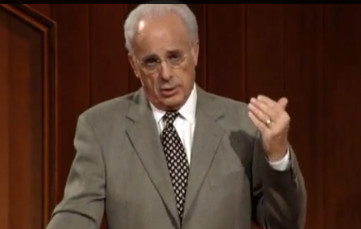
John MacArthurI think MacArthur, like many Christians, believes that the gospel or “good news” is a New Testament invention of Jesus rather than one that is more expansive, dates back much farther in Jewish history than Jesus, and is not simply defined by the textual contents of Matthew, Mark, Luke, and John. If you’d like (or maybe need) a primer on what “gospel” and “the gospel message” means, please see the thirty-minute episode The Gospel Message of the First Fruits of Zion (FFOZ) television series A Promise of What is to Come.

At this point, it might be good to have a look at the scripture MacArthur is referencing:

It happened that while Apollos was at Corinth, Paul passed through the upper country and came to Ephesus, and found some disciples. He said to them, “Did you receive the Holy Spirit when you believed?” And they said to him, “No, we have not even heard whether there is a Holy Spirit.” And he said, “Into what then were you baptized?” And they said, “Into John’s baptism.” Paul said, “John baptized with the baptism of repentance, telling the people to believe in Him who was coming after him, that is, in Jesus.” When they heard this, they were baptized in the name of the Lord Jesus. And when Paul had laid his hands upon them, the Holy Spirit came on them, and they began speaking with tongues and prophesying. There were in all about twelve men.

Acts 19:1-7 (NASB)

Now remember, MacArthur is teaching that this passage indicates a transition is taking place in the lives of Jewish believers “from Judaism to Jesus.” In reading the text, I’m not seeing immediate signs of any difficulty with Judaism, struggle in transition, or some sort of apparent conflict between Judaism and Jesus. What does MacArthur have to say (besides, quite a lot)?

Now that question posed in 19:2, “have you received the Holy Spirit since you believed” has become the favorite question of a modern movement in Christianity. And it’s not that I am here for the purpose of having a fight with any other Christians or egoistically declaring my own theology or trying to convince myself and you that I’m right and they’re wrong. The point of view that I take here is simply the exposition of the text. But I want to approach it in the light of a current movement because then I think you can see its significance.

We live in a day when the movement that we know of is Pentecostalism or if you will the later movement begun in 1960 called the charismatic movement has posed this question as the question to ask Christians. “Have you received the Holy Spirit since you believed?” The view that they take is that you can be a Christian and not possess the Holy Spirit. And at some point after your salvation you then by a certain activity allowed through certain information to come to the knowledge of the fact that the Spirit is available to you and that you can receive the Holy Spirit in certain ways.

Strange FireRemember, MacArthur originally delivered this sermon in January 1974, nearly forty years before his controversial Strange Fire conference. And yet, he approaches the issue of Pentecostalism in basically the same manner four decades ago as he did just four months ago, and anticipates the response to his message in the words, “And it’s not that I am here for the purpose of having a fight with any other Christians or egoistically declaring my own theology or trying to convince myself and you that I’m right and they’re wrong,” knowing his message would sound like he was looking for a fight and to define right and wrong by his standards. When he says his point of view “is simply the exposition of the text,” he creates the illusion that he is only reporting the facts with no filters in place and no embellishment of the Biblical text. As we’ve seen time and again in analyzing his messages (and in examining just about anyone’s theological bent), there are always interpretive filters in place. The Bible can’t be understood without interpretation, even with the assistance of the Holy Spirit.

Here, in the guise of an analysis of Acts 19 and even a replacement theory viewpoint of “from Judaism to Jesus,” MacArthur takes a stab at the Pentecostal church.

And we’re going to approach this question to try to show that the Christian, whoever he is, receives the Holy Spirit in full permanent, personal in dwelling from the moment of salvation. And this is an important question. I couldn’t tell you how many times I’ve been asked this. People say to me, “Have you received the Holy Spirit?” And I say, “Of course.” And one fellow said, “Oh, I didn’t realize. You’re one of us.” I said, “Well I don’t know about that, I might be one of you, what are you?”

It’s actually an interesting situation. Some people who were believers received the Holy Spirit and some didn’t know that they were supposed to. I don’t think that Cornelius and his household (see Acts 10) expected to receive the Holy Spirit. They just did. For that matter, did the apostles in Acts 2 really expect to receive the Spirit as “tongues of fire” or did it just happen to them without any expectation?

Are you only a believer if you receive the Holy Spirit in an Acts 2 and Acts 10 way? I don’t recall any “tongues of fire” and speaking foreign languages or prophesying when I became a believer. Maybe I’m the same boat as the disciples in Ephesus who received John’s baptism but not the Spirit. For that matter, Acts 8 records the Ethiopian becoming a believer during his conversation with Philip but is conspicuous in that he did not receive the Spirit. He was just baptised in water and went on his merry way back home. Did Philip not know about the Spirit? Did he not receive it in Acts 2?

I wonder what MacArthur would think about all these monkey wrenches in the machine? When he became a believer, did he see tongues of fire, speak in foreign languages and speak prophesies? If not, why not? Is that one of the “gifts of the Spirit” we don’t experience today? Do we just presume that the Spirit inhabits us when we declare our faith in Messiah?

If you make the book of Acts the norm, then you got tremendous problems. You’re going to have to allow for revelation current today. You’re going to have to allow for Apostles today. You’re going to have to allow for all of the signs and wonders and miracles that accompanied the early church and the various manifestations. Not just in some segments of Christianity, but throughout unqualified. There are many problems.

Charismatic prayerMacArthur spends quite some time going over various arguments he has with Pentecostals, which isn’t what I expected to read about and isn’t the focus of my interest in this sermon series. He does seem to say that we can’t expect to receive the Holy Spirit as believers in the manner commonly observed in the Book of Acts, so I guess that covers those of us who didn’t have a “tongues of fire” experience. Actually in this, I tend to agree more with MacArthur than some of his opponents. We don’t seem to find the same experiences when we become believers as the apostles and early disciples did.

So now we’re back to MacArthur the Supersessionist:

So as we see in the book of Acts is a transition. The new covenant comes, the old covenant has died and as the book of Hebrews says, “It fades away, it decays and grows old.” But as the new covenant arrives, the people come to Christ which is a momentary miracle; they still find it difficult to make the full transition. And so in the book of Acts, there are various transitional things occurring. There are some old things that just kind of die slowly. Some old forms like for example, the early church met in the synagogue.

Again, this is straight replacement theology, with the New Covenant directly replacing the Old Covenant rather than, as we see in Jeremiah and Ezekiel, the New Covenant restating and reasserting the conditions of the previous covenants for Israel. In fact, only one condition in the Abrahamic Covenant can be directly applied to Gentiles having a binding relationship with God, and that’s only through faith as Abraham had faith. And it’s only because that one condition in the Abrahamic covenant is carried over and restated in the New Covenant that Gentiles have access to reconciliation with God through faith.

In other words, there’s no provision in the covenantal structure for new to replace old. New simply ratifies older and re-emphasizes it. It took me a long time to figure this out, about eleven blog posts worth, starting with this one. The revelation in my self-education is why I can’t swallow the traditional Christian replacement theology model. The Bible, and particularly the language around the New Covenant, just doesn’t support it.

“Paul after this charity good while in Corinth and then he took his leave of the brothern, (sic) sailed from there to Syria, with him Priscilla and Aquila. Paul having cut his hair in Cenchrea for he had a vow.” And that tells us he was in transition, he was still making vows on an Old Testament basis, Nazarite vow and he did it in thanks to God for delivering him from Gallio and from those Jews in Corinth who wanted to take his life.

No, Pastor MacArthur, that tells us Paul took a Nazarite vow in accordance to Numbers 6. There’s nothing in the text that says anything about a transition. Please stop reading into the text.

Now this shows you this stringent nature of Paul’s Judaism, even though he was a Christian, he still wanted to fulfill this vow in the right way and he wanted to be there for the feast which was a Judaistic feast.

MacArthur sets Christianity and Judaism in sharp contrast to one another, making them mutually exclusive. One could not practice Judaism as a Jew and at the same time pay homage to and be a disciple of the Jewish Messiah.

That is a crazy statement to make, but all too many Christians don’t see the glaring error in Biblical interpretation. If Sola Scriptura is really supposed to mean “by scripture alone,” traditional Biblical interpretation in the modern Christian church doesn’t meet this standard by a long shot. You can’t be reading the plain meaning of the text in the larger context of the book and the even larger context of all of the scriptures and come to the conclusions at which MacArthur arrives.

I was about ready to dismiss the rest of his sermon when I came across this paragraph:

Ezekiel 36:26. You don’t need to turn to it, just listen. God says, now watch this promise. “A new heart also will I give you, and a new spirit will I put within you.” verse 27. “And I will put my Spirit within you.” Now do you read any conditions there? What are the conditions for getting the Spirit? What are they? Is there an if there? Nope. God says I will do it. Now the credibility of God is at stake. If a Christian has to do something to get the Holy Spirit then in theory, there are some Christians who never do that something so they never get the Holy Spirit. Therefore the promise of God is invalidated in their behalf. No the credibility of God is at stake. And secondly the credibility of Jesus is at stake in John 14, verse 16.

MessiahI find it astonishing that MacArthur can read one of the key texts that describe the New Covenant and still not know what it means. Do we have a new heart and a new spirit yet as Christians? We do? Really? Then why do we still struggle? Why do we still sin? If we got that new heart and new spirit already, what can we look forward to in the Messianic Era when human beings are perfected and King Messiah establishes his reign of total peace and understanding of God?

I hope you understand that. And again I hope you understand that this is said with a sense of love and a sensitivity to the fact that many could construe that I am bitter towards these people (the twelve disciples Paul encounters in Acts 19:1-7). I am not; I am zealous for the glory of God. Well so we meet the third party in transition. Let me close by saying this. We met three little transitions here, didn’t we? First Paul, then Apollos, then the 12. And you know something? We’re a long way from the book of Acts. But we see these three groups still. You know that in the church of Jesus Christ we’ve got people like Paul who are saved, have come all the way to Jesus Christ, but they’re hanging on to legalism?

There’s no way to know what MacArthur really thinks and feels, so I guess I have to take it for granted that MacArthur really doesn’t have it in for the twelve presumably Jewish disciples under discussion because they had the baptism of John but not the Holy Spirit. MacArthur, referencing his first two sermons as well as this one, says that Paul, Apollos, and the twelve were all Jews in transition from Judaism to Jesus.

They’re hanging on to old patterns, traditions, even some Jewish people who find it very difficult to fully absorb themselves in the life of the church. And I say this; I praise God for Jewish Christians who function fruitfully in the ministry of the body of Christ as opposed to maintaining isolation. But you know we have many believers today in Christ who are still they’re not in yet. They’re still holding on to old things. And then we have people like Apollos, sure we have people who good people, honest people, repentive sin, they just believe in God, but they’ve never met Christ.

It seems that MacArthur is praising the Jewish people who have become believers and assimilated into the Gentile Christian Church, while “challenging” or “not praising” those Jews who are believers but who “can’t let go of the old ways” and saying they know God but haven’t met Christ. They’re “not in yet,” according to MacArthur. So much for Messianic Jews, apparently. They aren’t real believers until they set aside the mitzvot and the traditions and function just like goyim in the Church. Ham sandwich, anyone?

Maybe they think of Jesus as a wonderful teacher, a man of great ethics, they never come to the cross and the resurrection. And then we’ve got a lot of people running around who are uninstructed in the Holy Spirit. Much of it is because they don’t even know Jesus Christ. Some know Christ. And grieve the Spirit by misunderstanding His marvelous work. I hope you’re not in transition. I hope like the writer of Hebrews says, “you will come all the way to the fullness of experiencing all that God has provided for you.” Let’s pray.

Ending MacArthur seriesAnd so we come to the end of the sermon and the end of the sermon series. As far as praying goes, now that I’ve reviewed three of MacArthur’s sermons as well as writing multiple reviews of the “Strange Fire” presentations, I pray I can let go of John MacArthur. He can travel his particular trajectory and I can travel mine.

We both read the same Bible and we pray to the same God but, like Abraham Lincoln once said, in our own ways, as Messianic to supersessionistic Christian, we “each invoke God’s aid against the other.” I actually don’t want to oppose Pastor John MacArthur. I don’t want to define myself as an “anti-MacArthurite.” But I do, as I have made abundantly clear, disagree with him pretty much across the board. I think he represents everything that inhibits Boaz Michael’s vision of Gentiles partnering with Israel in rebuilding David’s fallen tent. I think MacArthur is the living embodiment of Boaz’s statement, “The church is the biggest stumbling block for the people of Israel to see the true message, the redemptive message of the Messiah.”

More’s the pity.

Addendum: Turns out my Pastor preached on this part of Acts as well recently. Tomorrow’s morning meditation will contain my Pastor’s take on some of this, which should augment and occasionally modify what MacArthur preached.

If You Could Personally Witness Just One Event in the Bible…

Have you ever read a passage of the Bible and thought, Oh, I wish I were there! I have. I have longed to be the third dude on the road to Emmaus, listening to Yeshua expound on the Messiah’s role.

And beginning with Moses and all the Prophets, he explained to them what was said in all the Scriptures concerning himself. (Lk. 23:7)

Being present on Shavuot (Pentecost) when the Holy Spirit birthed a revival in Jerusalem would have been amazing. Many would, no doubt, choose to witness the parting of the Red Sea or the crucifixion of Yeshua. As for me, I would choose something in the future. I have always been intrigued by the prophets in the eleventh chapter of Revelation. These two witness appear sometime during the Great Tribulation and proceed to prophesy for three and a half years.

-Ron Cantor
“The Cantor Comment: Fire-Breathing Prophets!”
maozblog.com

Actually, I share in Cantor’s first wish. I’ve always been slightly annoyed that Luke didn’t include what Jesus actually said when he “explained to them what was said in all the Scriptures concerning himself.” I want to know. Certain parts of my life would go a whole lot easier if we just had a detailed “map” of how Jesus saw the various portions of the Torah and the Prophets which referred to him.

Alas, such is not to be.

I was considering leaving a comment on the blog with Cantor’s article, but his story really didn’t seem to be asking the question I wanted to answer. I wanted to answer the question, If you could personally witness just one event that occurred in the Bible, which one would it be?

Here’s mine:

From it Moses and Aaron and his sons washed their hands and their feet. When they entered the tent of meeting, and when they approached the altar, they washed, just as the Lord had commanded Moses. He erected the court all around the tabernacle and the altar, and hung up the veil for the gateway of the court. Thus Moses finished the work. Then the cloud covered the tent of meeting, and the glory of the Lord filled the tabernacle. Moses was not able to enter the tent of meeting because the cloud had settled on it, and the glory of the Lord filled the tabernacle. Throughout all their journeys whenever the cloud was taken up from over the tabernacle, the sons of Israel would set out; but if the cloud was not taken up, then they did not set out until the day when it was taken up. For throughout all their journeys, the cloud of the Lord was on the tabernacle by day, and there was fire in it by night, in the sight of all the house of Israel.

Exodus 40:31-38 (NASB)

I haven’t literally dreamed of being there, but if it were possible, it would be my fervent wish. Imagine the scene. Moses has just finished erecting the Tabernacle. Millions of people are surrounding the structure, waiting in hushed anticipation, expecting a miracle, expecting God.

Torah at SinaiThen, something appears from the sky and begins its descent toward the Tabernacle. It probably looks like a big cloud, but it would be familiar to any one who had been in the company of the Israelites and who had been present at Sinai for the giving of the Torah.

The Torah text doesn’t describe it this way, but I imagine this event happens at night. The cloud is slightly illuminated from within, but when it enters the tent, the darkened structure bursts into magnificent, blazing light. Millions of people cry out as one, praising God and glorifying His Name.

This probably isn’t the typical scene most Christians would want to attend. Most believers would likely choose an event from the New Testament, being present at the Olivet Discourse, witnessing the resurrection or the ascension, perhaps accompanying Paul on one of his journeys, but for me, nothing describes the desire of God to dwell among His people quite like the end of the book of Exodus.

Now I turn it over to you. If you could be present during any event that happened in the Bible, what would it be and why?

God Was In Church Today

ChurchI went back to church today after a three-week absence. I’ll admit that I was avoiding Christmas. I’m OK with people in the general public wishing me a “Merry Christmas” but knowing the additional meaning those two words carry in Christianity, I thought it best to keep a low profile. No one mentioned my not being around and they probably just assumed I was spending the holidays out-of-town with relatives.

God reminded me that He is still in church today. No, I didn’t have a vision or hear a loud, booming voice or anything like that. Three things happened.

The first was a missionary to Ireland (I never heard of such a thing before) who was diagnosed with cancer back in August while serving on his mission, was in our church with his wife today (they attended our church until leaving for Ireland on their mission in 2005). He still walks with a limp and a cane, but the tumor was removed from the bone in his leg and the radiation treatments are done, so he’s finally beginning to heal and go into physical therapy.

I was surprised how young Dean (the missionary) was. Not a grey hair in his head. For some reason, I expected him to be older. He also was very gracious about having cancer. He said it opened up opportunities while in Ireland once word got around. People approached him with their own physical or medical difficulties or crises in relation to faith and their spiritual lives. Sure, maybe between him, his wife, and God, Dean had a lot of hurt and angry things to say, but you’d never know it by listening to him in church this Sunday.

The second thing that happened was Pastor Dave leading prayer. No, that’s not unusual of course, but he’s going in for some surgery tomorrow (three people in church are all having surgery on Monday). Dave is also a young guy, in his 40s but he looks younger to me (I guess that doesn’t hurt when you’re the youth Pastor). I didn’t write down the prayer and I don’t remember the words, but the “feeling” of graciousness is what sticks with me. I know that some people in Hebrew Roots and related movements have left “the Church” because of some harm (real or perceived) they endured at the hands of Christians, but even though I don’t always agree with the standard theology and doctrine, I will never criticize the people I worshiped with today for a lack of compassion and love of God and each other.

The third thing that happened was during the music. Pastor Bill (who is an older gentleman) sometimes leads the singing when the usual people who are more “officially” musical are unavailable. There are hymn books, but most people use the projection of the lyrics on the screen at the front of the room. At one point early in the first hymn, Pastor Bill stopped the singing. There was a lyric about surrendering everything to Jesus. He pointed out that it doesn’t mean just “Sundays” or just a few things, but everything. I wonder how many of us really, really have surrendered everything? I know I have a long way to go in working through my imperfections as a human being who purports to be a disciple of Messiah.

God was in church today.

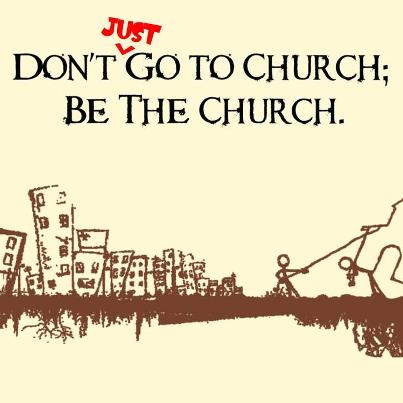
Be the ChurchTrue, I felt a few disturbing tremors in Pastor Randy’s sermon, reminding me that he still reads my blog (though I could be reading too much between the lines of his message) and doesn’t always agree with my opinions, but his grasp of history related to scripture always opens up new worlds in the Bible for me. It’s also true that when I got to the Sunday school class, it was uncharacteristically dark, with no indication that the teacher or anyone else had set the room up for us. Since we have a “guest missionary” with us today, and since plans change at church quickly sometimes, I figured we weren’t having class after all, so I turned around and headed on home. I was disappointed, but things happen.

Pastor Randy’s been out-of-town for a few weeks for a family reunion, and I just found out that he’s going to be gone in relation to his doctorate program for most of January, so I guess our conversations are on an extended hiatus. Another disappointment.

But God was in church today, so that makes up for those few things that didn’t quite work out.

I’ve been struggling with church for a while now and being out for three weeks only made it that much more difficult to go back today. But instead of focusing on the differences I experience between my viewpoint and the “official story” of doctrine and dogma, I need to look at what we all have in common and what I am learning about God, the Bible, and myself.

God was in church today. Maybe He’ll be there next Sunday, too.

FFOZ TV Review: Resurrection

FFOZ TV Episode 25Episode 25: In Jewish thought the ultimate expression of God’s power is the resurrection of the dead, and the ultimate resurrection was that of Jesus himself. In episode twenty-five viewers will discover that Jesus’ resurrection from the dead was a foreshadow of the final resurrection of the dead that was prophesied in the Hebrew Scriptures. Messiah rising from the dead was a promise, a guarantee that one day the great redemption will come, the great resurrection of the dead will take place, and the Messianic kingdom will arrive.

-from the Introduction to FFOZ TV: The Promise of What is to Come
Episode 25: Resurrection (click this link to watch video, not the image above)

The Lesson: The Mystery of the Resurrection

One of the biggest mysteries of the Christian faith is the death and resurrection of Jesus. After all, there are no explicit prophesies in the Tanakh (Jewish Bible or Old Testament) that say the Messiah must personally die and then be resurrected three days later. In Christianity, we just take it for granted because it is a central if not the central tenet of our beliefs. But looking at the resurrection from a Jewish point of view, particularly a late Second Temple Era perspective, what did the resurrection of Messiah mean?

First Fruits of Zion (FFOZ) teacher and author Toby Janicki started answering that question by reading the following:

And he began to teach that the son of man needs to suffer greatly, and the elders, the leading priests, and the scholars would reject him, and he would be killed, but at the end of three days he would surely rise. He spoke this word in the ears of all of them, and Petros took him and began to reprimand him.

Mark 8:31-32 (DHE Gospels)

Jesus himself taught that he had to die and be resurrected three days later, but the fact that at hearing this Peter took Jesus aside and rebuked him, shows us that even Peter didn’t understand the meaning of Messiah’s death and resurrection. It must not have been an obvious belief common among Jewish people of that day (and it’s also not a belief in Judaism in our age). Peter certainly knew Jesus was the Messiah (see Matthew 16:16) so it wasn’t a matter of lack of faith or lack of knowledge. Even in the days of Jesus on earth, the death and resurrection of the Messiah was a great mystery.

A mystery we are trying to solve from a Jewish perspective today in this episode.

Jesus explained the meaning, at least partially, after he was resurrected:

These are the things that I spoke to you about while I was still with you. For every scripture about me will surely be fulfilled in the Torah of Mosheh, in the Prophets, and in the Tehillim. Then he opened their hearts to understand the Scriptures. He said to them, thus it is written and decreed that the Mashiach will be afflicted and will arise from the dead on the third day…

Luke 24:44-46 (DHE Gospels)

Toby points out that Jesus says his death and resurrection are prophesied in the Torah, the Prophets and the Psalms (Tehillim). But where? There’s nothing in these ancient writings that point-blank says the Messiah must die for the sins of humanity and be raised again three days later. What does Jesus explain to them that the Bible doesn’t explain to us? Won’t the Holy Spirit open our hearts to understand the scriptures?

Because You will not abandon my soul to Hades,
Nor allow Your Holy One to undergo decay.

Acts 2:27 (NASB)

Here, Toby tells us that Peter is quoting Psalm 16:10 as proof that the Messiah would not die permanently and that God would resurrect him. This is only one of a few cryptic “proofs” in the New Testament that the Old Testament prophesies spoke, or at least hinted at, the Messiah’s resurrection.

He will swallow up death for all time,
And the Lord God will wipe tears away from all faces,
And He will remove the reproach of His people from all the earth; For the Lord has spoken.

Isaiah 25:8 (NASB)

Your dead will live;
Their corpses will rise.
You who lie in the dust, awake and shout for joy,
For your dew is as the dew of the dawn,
And the earth will give birth to the departed spirits.

Isaiah 26:19 (NASB)

ffoz_tv25_tobyToby quotes Isaiah as well as Ezekiel 37:3-6 to show that in the future Messianic Era, there will be a great resurrection of the dead, but this doesn’t specifically speak to the resurrection of the Messiah during his first advent.

There was no question among these ancient Jewish prophets that there would be a future resurrection of all the dead once the Messiah had come, and that brings us to our first clue:

1st Clue: The resurrection from the dead is a component of the Messianic Kingdom.

Toby makes a key point by saying that Jesus felt these prophesies also explained his own resurrection. But how? Is Toby employing more than a little theological sleight of hand in making such a statement?

To learn more, the scene shifts to FFOZ teacher and translator Aaron Eby in Israel for a short language lesson about the Hebrew word for “Life.”

Life, or “Chaim” is a gift from God. Aaron references the following to illustrate:

The Lord kills and makes alive;
He brings down to Sheol and raises up.

1 Samuel 2:6 (NASB)

This is part of Hannah’s prayer to God and shows us beautifully that life and death are from God and as He brings down into death, He also raises up back to life.

Today’s Orthodox Jews believe in the resurrection of the dead once the Messiah comes, even as the Pharisees did in the day of Jesus. Many Jewish dead are buried at the Mount of Olives where it is prophesied the feet of the Messiah will first touch the earth.

Three times a day, observant Jews pray for the resurrection, and the Mishnah states that if anyone does not believe the Torah speaks of the resurrection, that person forfeits their place in the world to come.

Aaron EbyAaron points out that in Acts 23:6, when Paul has been arrested in Jerusalem and brought before the Sanhedrim, he throws the whole court, which is made up of Pharisees who believed in the resurrection and Sadducees who didn’t, into an uproar by claiming that he was on trial for his belief in the resurrection. Apparently, not all Jews two-thousand years ago believed in the resurrection of the dead, but it was obviously a “hot button” topic.

The last of the Thirteen Principles of Jewish Faith established by the Rambam, the great sage Moses Maimonides in the twelfth century is a declaration of faith in the future resurrection of the dead.

Back in the studio, Toby pulls all this together to form the second clue:

Clue 2: The future resurrection of the dead is a principle of Jewish faith.

But while all this certainly establishes that religious Jews, like Christians, believe in a future resurrection, what does it have to do with the resurrection of Jesus?

According to Toby, it goes back to the debate between the Pharisees and Sadducees about whether or not there would be a future resurrection. By God resurrecting Jesus three days after he died, it was supposed to settle the argument. Jesus, the Messiah, by being resurrected, establishes a future resurrection.

But there still one more connection to make, and it comes from the apostle Paul:

Now if Christ is preached, that He has been raised from the dead, how do some among you say that there is no resurrection of the dead?

But now Christ has been raised from the dead, the first fruits of those who are asleep. For since by a man came death, by a man also came the resurrection of the dead.

1 Corinthians 15:12, 20-21 (NASB)

In verse 12, Paul directly links the resurrection of Jesus with the future resurrection of all the dead, stating that if you don’t believe in the former, you are also denying the latter. Then in verses 20 and 21, Paul says that the resurrection of Jesus was a “first fruits of those who are asleep” (dead).

The Torah commands that all Israelite farmers are required to offer the first ripe fruit of their harvest to God. This presupposes that the larger harvest of the crops is not yet ripe. The metaphor illustrates that the resurrection of the Messiah was a first fruits or a foretaste of the resurrection and when the rest of the harvest of humanity is “ripe,” the great resurrection of the dead will come. This happens in the Messianic Era.

We have arrived at the third and final clue:

Clue 3: Jesus’ resurrection is the first fruits of the final resurrection.

In other words, by the Messiah dying and then being resurrected, he was proving that all of the older prophesies about a great resurrection of the dead in the Messianic Age were valid, accurate, and will indeed occur.

What Did I Learn?

The major point I learned was how the purpose of the resurrection of Messiah was framed by Toby and Aaron. Basically, it was a theological and probably a legal proof to all of the Jewish people of that day that indeed there would be a great resurrection in the future age.

Today’s Orthodox Jews believe in that resurrection, but I’m not sure that all religious Jews everywhere do. All Christians believe not only in the resurrection of Jesus, but in the resurrection of all the dead, who will then be judged.

I don’t struggle with these concepts, but the great struggle today for non-believing Jews, just as it probably was among many of the Jewish people in the day of the apostles, was whether or not the Messiah had to die and then rise. While the focus of this episode was on the resurrection, to get a Jewish person to this point, you first have to get them past the death of Jesus, which wasn’t touched upon in this show.

I’ve tried to write to this issue using Jewish and Christian sources in blog posts such as The Death of the Tzaddik and The Sacrifice at Golgotha.

Jews, like Christians (and just about everyone else), find the idea of making a human sacrifice to God abhorrent, and from a traditional Jewish perspective, the death of Jesus to pay for our sins looks like a human sacrifice. Christians don’t consider this an issue in our faith, but from an outsider’s point of view, it’s a huge stumbling block.

tallit_templeThere are some aspects of Jewish faith that support the idea of the death of a great tzaddik or righteous one atoning for the sins of others, up to and including the sins of an entire generation of Jews. When we people of Yeshua faith attempt to cite those sources, we are sometimes accused of misreading the ancient Jewish sages for our own ends. I can see how some Jewish people would get that impression but this also illustrates that it is Jewish to believe a human death can atone for others, therefore, it’s not completely outrageous to believe that the Messiah’s death, the death of the greatest of all tzaddikim, could atone, not just for the sins of a single generation, but for the sins of all generations across time.

But I’m going off topic. Toby and Aaron were focusing on the resurrection, not the death of Messiah, and they’re addressing primarily an audience of traditional Christians, not traditional Jews. To that end, it’s almost as if Toby and Aaron were “preaching to the choir,” since the resurrection of Jesus and the future resurrection of all the dead are a “given” in the Christian faith. However, they did establish that the resurrection is not an uniquely Christian concept, but is founded strongly in Judaism and the Old Testament. They also showed, as I said above, that the resurrection proved to the Jewish people in the apostolic era, that the prophesies of a great, future resurrection would be fulfilled.

At the end of the episode, as usual, Boaz Michael, FFOZ’s President and Founder, came to announce the next and last show of this television series, which teaches the literal, physical restoration of Israel that is yet to come. This will be my last opportunity to review this television series and I will certainly miss it.

I’m not unmindful that this blog post is being published on Christmas Day. For all of my readers who celebrate Christmas, I give you warm greetings and may the Spirit of Messiah be with you on this day, inspiring love and generosity.

May the light of Messiah continue to illuminate our paths and to open our eyes to who he is and who we are in him.

Shemot: Jewish Survival and the Promise of the Torah

The death of Pharaoh's sonThen the Lord said to Moses, “You shall soon see what I will do to Pharaoh: he shall let them go because of a greater might; indeed, because of a greater might he shall drive them from his land.”

Exodus 6:1 (JPS Tanakh)

No other people have ever gone into exile and survived for thousands of years to come back to re-establish a national homeland. The return of the Jews from exile to the Land of Israel was nothing short of a miracle!

What does it all mean?

-Rabbi Kalman Packouz
“Shabbat Shalom Weekly”
Commentary on Torah Portion Shemot (Exodus)
Aish.com

If you follow the annual Torah readings as I do, you might be tempted to just blow past all of the miracles of God in the land of Egypt and the liberation of millions of Jewish slaves. After all, you know the story. Even Christians who only occasionally read the “Old Testament” are familiar, at least in general, with Moses and Aaron confronting Pharaoh, King of Egypt to demand the release of the Israelites so they may worship Hashem their God. But Shemot (Exodus) tells a very important story that is highly relevant to all of Jewish history and a story important to every Jew alive today.

It’s a story of survival against all odds, survival in the face of hardship, slavery, and even certain destruction. It’s a story of God’s extraordinary love for the Jewish people and the lengths to which the Almighty will go to rescue them from every type of harm. This doesn’t mean that individual Jewish people won’t have hardships or even that large numbers of Jews won’t suffer, but the Jewish people, Israel will survive and ultimately thrive.

The Lord will make you the head and not the tail, and you only will be above, and you will not be underneath…

Deuteronomy 28:13 (NASB)

This doesn’t mean that Israel will be the head and not the tail just within their own nation, and it doesn’t just mean Israel will be the head in their general region of the earth, it means, in the Messianic Era, when Moshiach returns all the exiles to their land and restores Israel with honor and power, the nation of Israel and the Jewish people will be ascendant over all the other nations of our planet, and Messiah will be King of all.

But what stands in the way of that accomplishment? After all, amazingly, there are Jewish people after thousands of years of concerted effort expended by various nations to exterminate them. Not only do Jewish people survive, but identifiably Jewish culture, religion, literature, art, music, and the Torah have all survived, continuing to set the descendants of the ancient Israelites apart from all the other nations and people groups in our world. God has always preserved them and He will always preserve them.

The Torah tells us, “And Joseph died, and all his brothers, and that entire generation” (Exodus 1:6). Why is it important for us to know that the whole generation has passed on?

The Ohr HaChaim explains that the enslavement of the Israelites by the Egyptians occurred in three stages: First, Joseph died and the Israelites lost their power. Second, the bothers (sic) died. As long as even one of the brothers was alive, the Egyptians still honored them. Third, everyone from that generation died. Until that happened — as long as the members of the first generation were alive — the Egyptians considered them important and were not able to treat them as slaves.

Rabbi Chaim Shmuelevitz, the Mirrer Rosh Hayeshiva, commented that there are two aspects here. One is on the side of the Egyptians. They were unable to treat the Jewish people as slaves as long as they considered them important. The other aspect is on the side of the Jewish people themselves. As long as they were considered important and worthy of respect by themselves, the Egyptians were not able to treat them in an inferior manner. Only when they personally considered themselves in a lowly manner could they be subjugated by others.

-Rabbi Zelig Pliskin
Based on Growth Through Torah

ShoahThis commentary on this week’s Torah portion also speaks to both Jewish and non-Jewish people in the present. Jewish survival is dependent upon how the Jewish people regard themselves and how the rest of the world regards them. Like Joseph and his brothers and their entire generation, as long as the rest of us understand the relationship between Israel and God and treat the Jewish people accordingly, they will continue to survive, because we can not bear to make “slaves” of such a people who have been lifted high by God. But when we denigrate the Jewish people, as we often have done across history, then we get Shoah, The Holocaust.

It takes great courage to come back and stand out after six million of your people have been starved, tortured, and exterminated. The natural tendency would be to hide, to go underground, to blend in, disappear, fade from history as a people, just in order to not be in a position where you, your children, or your grandchildren will ever again be taken from their homes and put in the camps. As Rabbi Pliskin’s commentary states, it’s not just how the rest of the world treats you, it’s how you consider yourself.

If the Jewish people don’t stand up for themselves as proudly Jewish, the rest of the world won’t respect them, and again, we get Shoah.

Am I contradicting myself? Earlier, I said that Jewish survival is dependent upon God’s great acts, and so this is true. But the Jewish people had to cry out to God, a leader had to be willing to rise up from the people to shepherd them, as Moses did. The Jewish people had to, and still have to willingly accept God, accept the fact that God chose them, that they are still chosen, and to “hear and obey” the Word of God that uniquely signifies their called out status.

When we look at Jewish history, we see a history where the Jewish people have defied the laws of nature and the laws of history! We have survived and impacted this world though we have been thrown out of our land not once, but twice! We have impacted the world perhaps more than any other people in history — the concepts of the value of human life, universal education, justice and equality, the importance of and goal of world peace (as opposed to glorifying war), the importance of a strong stable family as a basis for a moral foundation for society, individual and national responsibility for the world — though we were beaten, killed and exiled from one nation to the next. Though few in number and spread to the four corners of the earth, we survived as a people, never assimilating into anonymity. Even our land, the Land of Israel, defied the laws of nature, only fertile when the Jewish people inhabited it.

Coincidence? Good luck? A roll of the dice? Perhaps — except that each and every phenomenon was prophesied and predicted in the Torah hundreds and thousands of years before the events. Does it make you think that perhaps something is going on here? That perhaps there is a special relationship between the Almighty and the Jewish people?

The Almighty, the Jewish people and the Torah are intertwined. In the past 3,300 years there has been effort after effort — from within as well as from without — to redefine and redirect our people. Each and every one has failed. If you wonder why, then perhaps the time has come to read the Torah and find out. The Torah is not only our heritage, it is the game plan for the Jewish people and the world!

-Rabbi Packouz

rabbi_child_and_sefer_torahPeriodically, my Pastor asks what I think the role of Jewish obedience to Torah is in today’s world (although I think Rabbi Packouz answered that question very well in the above-quoted statement), especially in light of Christ and the Church. Why would a believing Jew continue to observe the mitzvot when (from his point of view) they were clearly eliminated by Jesus and they, like the rest of us, now live by the grace of Christ?

Being “Messianic” doesn’t make a Jew not a Jew. All of the conditions for survival I outlined above still apply to them, just like they apply to any other Jewish person alive today. For a Jewish person to find, recognize, and acknowledge the Messiah is the answer to a prayer and the culmination of a dream.

He said to them, “But who do you say that I am?” Simon Peter answered, “You are the Moshiach, the Son of the living God.” And Jesus said to him, “Blessed are you, Simon Bar Yonah, because flesh and blood did not reveal this to you, but My Father who is in heaven.

Matthew 16:15-17 (NASB – adjusted)

I made a few minor changes to the translation above to make it clearer that Simon Bar Yonah was a Jew realizing that his Master, the Rabbi he has been following, is indeed the Moshiach, “the Son of the living God.” Peter didn’t stop being Jewish, immediately start munching on a ham sandwich, burn a Torah scroll, and join the local Baptist church because he became a Christian. He didn’t change into something else besides being Jewish, he received a revelation that at the core, all Jewish people want and need to receive. The revelation of the arrival and presence of Messiah, Son of David, King of Israel, who will save his people, not just from their sins and certainly not from the Torah, but from the centuries and centuries of persecution, pogroms, inquisitions, and genocidal efforts of a hateful and disbelieving world.

Peter recognized Jesus as who he was and is without a New Testament in hand and especially without the last two-thousand years of Christian theology, doctrine, dogma, and history, including the reformation, muddying up the waters to the degree that neither Jew nor Gentile can recognize Jesus as Moshiach any longer.

Peter recognized the Moshiach because he was there, he knew what to look for, not in spite of the Torah but because of it.

It has been prophesied in the Torah that Jews would be exiled from the land and that they would return to the land: “And it shall come to pass when these things shall come upon you, the blessing and the curse that I have placed before you, you will take it to heart amongst all of the nations where God has scattered you; you will return to the Lord your God and you will listen to His voice according to all that I am commanding you today, you and your children with all of your heart and with all of your soul. Then the Almighty will bring back your captivity and have mercy upon you; and He will return and gather you from among all of the nations where he has dispersed you. If your dispersed ones will be even at the ends of the heavens — from there God Almighty will gather you and from there He will take you. And God your Lord will bring you to the land that your fathers inherited and you shall inherit it and He will do good for you and make you more numerous than your forefathers” (Deuteronomy 30:1-5).

-Rabbi Packouz

For a Jew, particularly a Jew in Messiah, the Torah is inescapable. When Paul called the Torah a “tutor” or “child conductor” (Galatians 3:24), we can consider the Torah as a protector, a defender, a preserver of the Jewish people pointing toward the ultimate expression of the Torah. Yes, it “points to Christ” but once a Jewish person has recognized Moshiach and turned to him, it doesn’t mean the “tutor” is useless and tossed aside. It only means that the capstone has been added to the structure to make it solid and permanent. The structure still needs all the pieces. There are many other purposes the Torah fulfills for the Jewish person besides illuminating the image of Messiah. Without the Torah, the Jewish people lose everything it is to be Jewish, to be called out, to be unique among all of God’s Creations.

Rabbi Isaac LichtensteinThis is our mistake in the Church. We demand that when a Jewish person becomes a disciple of Moshiach, they consider Paul’s words as meaning that all of the purposes of Torah have been extinguished and that the Torah is not only useless, but actually a detriment to the believing Jew. Nothing could be further from the truth.

Jewish people such as Paul Philip Levertoff and Rabbi Isaac Lichtenstein did not stop being Jewish when they discovered the identity of the Messiah. Especially in Rabbi Lichtenstein’s case, the Torah became more important, more enlightening, not less. Performing each mitzvah was given a new dimension in Messiah.

This is something the rest of us don’t understand. This is something we were not only taught to disregard, but to actually disdain. We’ve been taught to shun and even fear the Law of Moses, but we fail to understand the joy and fulfillment that an observant life can be for a Jew. For a Jew in Messiah, the meaning of a Torah observant life is amplified. Torah and Messiah are complementary, not oxymoronic.

Messiah and Torah preserve and sustain the Jewish people, for both will be present in the age to come. If they didn’t, then how could the gospel of Messiah be good news for the Jews?

Good Shabbos.

Vayigash: Will the King Show Us Mercy?

king-davidAnd Joseph said to his brothers, “I am Joseph!”

Genesis 45:3

The Chofetz Chaim comments that from the time the brothers first came to Egypt to get food — when Joseph spoke with them roughly and accused them of being spies — they were puzzled about what exactly was happening and why it was happening. In both encounters with Joseph they had many questions about their experiences. As soon as they heard the words, “I am Joseph” all their questions were answered. The difficulties they had in understanding the underlying meaning of the events — why Joseph accused them of being spies, yet treated them well, accused them of lying and stealing, but gave them a banquet, insisted on bringing the younger brother to Egypt, etc. — were now completely clarified.

Similarly, says the Chofetz Chaim, when the entire world will hear the words “I am the Almighty” at the final redemption of the Jewish people, all the questions and difficulties that people had about the history of the world with all of its suffering will be answered. The entire matter will be clarified and understood. Everyone will see how the hand of the Almighty caused everything ultimately for our benefit.

Dvar Torah for Torah Portion Vayigash based on
Growth Through Torah by Rabbi Zelig Pliskin
Referenced by Rabbi Kalman Packouz
at Aish.com

The brothers of Joseph discover a startling reality. The ruler of the Egyptians who has been treating them harshly all of this time is really their brother Joseph. In an instant, all the cruelty they showed him, including trying to murder him, must have come to the forefront of their conscience.

Before this, the Egyptian ruler had the power to do anything to them, imprison them, make them slaves, even kill them, but “it wasn’t personal.” That is, the sons of Jacob were no more or less significant to an Egyptian ruler than anyone else.

Now they not only discover that this man has the power of life and death over them, but that he is their brother, who they left for dead, who almost surely has a personal motive for seeking revenge. The brothers knew they had no right to appeal to Joseph for mercy, for they had not showed him mercy. They could only hope that in the years he ascended from slavery and imprisonment to being a viceroy of Egypt, second only to Pharaoh in power and authority, that he had learned wisdom and compassion and would be willing to offer them something they did not deserve: mercy and the continuation of their very lives.

Now look at what Rabbi Pliskin had to say from the above-quoted text:

Similarly, says the Chofetz Chaim, when the entire world will hear the words “I am the Almighty” at the final redemption of the Jewish people, all the questions and difficulties that people had about the history of the world with all of its suffering will be answered.

How much of the non-Jewish world will tremble at the feet of God when they realize the Almighty has appeared at the final redemption and that He is not at all pleased with how His people Israel have been treated?

Over the long march of centuries since Abraham, Isaac, and Jacob, since Joseph confronted his brothers, since Moses, Aaron, and Miriam liberated the Israelites from Egyptian slavery and set them before God at Sinai, and on and on across history, every people, tribe, and tongue throughout the Earth has been seeking to kill the Jewish people, God’s splendorous treasure, the apple of His eye.

This includes the Church of Jesus Christ. How confusing it will be in those days to be a Christian who has harbored hatred toward Jewish people, Judaism, and Israel, and to be confronted by an angry Jewish King. How strange it will seem to many Christians who have loved Israel but continued to deny the validity of the Torah, the Temple, and the adherence of Jewish people to a Jewish way of life for those Gentile believers to be faced with a Jewish King who upholds the “Jewishness” of his people Israel.

“Then He will also say to those on His left, ‘Depart from Me, accursed ones, into the eternal fire which has been prepared for the devil and his angels; for I was hungry, and you gave Me nothing to eat; I was thirsty, and you gave Me nothing to drink; I was a stranger, and you did not invite Me in; naked, and you did not clothe Me; sick, and in prison, and you did not visit Me.’ Then they themselves also will answer, ‘Lord, when did we see You hungry, or thirsty, or a stranger, or naked, or sick, or in prison, and did not take care of You?’ Then He will answer them, ‘Truly I say to you, to the extent that you did not do it to one of the least of these, you did not do it to Me.’ These will go away into eternal punishment, but the righteous into eternal life.”

Matthew 25:41-46 (NASB)

Woman in the darkI used to think this was an injunction for believers to show kindness and compassion for all of the needy people around us (and I still think we should), but almost a year ago, I heard a good and kind Christian man in a Sunday school class interpret this statement as the duty we Gentile believers have to take care of all the needy of Israel.

And if that statement is true, then woe be to the many, many Christians past and present who have utterly failed to do so because those needy people were “just Jews.”

In the case of the brothers of Joseph, their kinsman who was also ruler and King over them was merciful after all:

Now do not be distressed or reproach yourselves because you sold me hither; it was to save life that God sent me ahead of you. It is now two years that there has been famine in the land, and there are still five years to come in which there shall be no yield from tilling. God has sent me ahead of you to ensure Your survival on earth, and to save your lives in an extraordinary deliverance. So, it was not you who sent me here, but God; and He has made me a father to Pharaoh, lord of all his household, and ruler over the whole land of Egypt.

Genesis 45:5-8 (JPS Tanakh)

But was it for Jacob’s sake that Joseph spared his brothers? And for whose sake shall the King of Israel spare those among the nations and particularly those among the Church who have treated his little ones poorly?

…but whoever causes one of these little ones who believe in Me to stumble, it would be better for him to have a heavy millstone hung around his neck, and to be drowned in the depth of the sea.

Matthew 18:6 (NASB)

Mark Nanos in his book The Mystery of Romans defines the “weak” and “stumbling,” relative to Paul’s letter to the Romans, as the Jews in the synagogues of Rome who had not yet come to faith in Messiah. I’ll write a detailed “meditation” on this topic in a few days, but Nanos understands Paul’s admonition to the “strong,” the Gentile believers, as failing to uphold their responsibility to encourage the stumbling Jewish people, resulting in them stumbling even further away from faith. Paul never gave up on the stumbling, and he would have sacrificed everything for them.

For I could wish that I myself were accursed, separated from Christ for the sake of my brethren, my kinsmen according to the flesh, who are Israelites, to whom belongs the adoption as sons, and the glory and the covenants and the giving of the Law and the temple service and the promises, whose are the fathers, and from whom is the Christ according to the flesh, who is over all, God blessed forever. Amen.

Romans 9:3-5 (NASB)

It was the Master himself who called his people Israel “lost sheep” (Matthew 10:6, 15:24) and who are we to disdain those “sheep,” for it is obvious that even in their unbelief, God loves them with a great intensity and will violently protect them, even from those of us who are so arrogant as to believe their Father has cut them off from His care and compassion.

bk_kotelPaul says that all of Israel will be saved (Romans 11:26), though we in the Church cannot fathom this. But though the Jews have always been few in number (Deuteronomy 4:27) and suffered exile and dispersion (Leviticus 26:33), yet they shall be redeemed and live in peace (Micah 4:1-4), for God has declared that Israel shall eternally be a nation before Him (Genesis 17:7, Leviticus 26:43, Deuteronomy 4:26-27, 28:63-64).

It is within the power of the Jewish Messiah King, Yeshua, Jesus, to judge his Gentile Church and to cast out those of us who have failed in our duty to his people Israel in opposition to the prophesies and the commandments. The patriarchs were terrified of their powerful and very human brother for the vengeance he could exact upon them. How much more should we be terrified of an infinitely powerful and eternal King?

It is a terrifying thing to fall into the hands of the living God.

Hebrews 10:31 (NASB)

Tremble and sin not, reflect in your hearts while on your beds, and be utterly silent. Selah.

Psalm 4:4 (from the Siddur, nighttime blessings)

Let the world that has always hated the Jewish people learn to repent before it’s too late, and let each Christian who has hated or dismissed the Jewish people lie in his or her bed and tremble and be utterly silent before their King whose hand will always uplift Israel and whose greatest desire is to save his precious nation and redeem her as he has promised.

Good Shabbos.