
 “I didn’t know what to say, but I certainly appreciated his incredible gift. I realized that this was a Torah that had been basically homeless for the past 50 years. There was no one to read it, hold it or keep it properly, and now God gave the Torah a home, and would hopefully bring this lonely Jew back in the near future as well.
“Now, what about an ark? That’s a story of its own. I found an online ad for an old Jewish artifact, a Jewish chest. The sellers weren’t Jewish, but they had bought it from a priest who told them it was of Jewish origin.
“When I opened the online pictures of the chest, I saw before me what seemed to be a beautifully crafted ark. It was small, so it wouldn’t be able to hold a regular sized Torah, but would be perfect for the Torah we had. But when I viewed a picture of the top of the ark, I almost fainted. There was a large cross attached to it. All of a sudden, I was not at all sure that this was an item of Jewish origin.
Suddenly I noticed a small plaque at the bottom of it. I asked the sellers to send me a photo of the plaque which appeared to have Hebrew writing on it. They sent me a picture where there was a clear inscription in Hebrew that said “Behold, the guardian of Israel neither sleeps nor slumbers Psalms 121), which proved that the item must be Jewish.
-Rabbi Binyomin Pruzansky
“The Lost Torah Scroll”
Commentary on Shmini Atzeret and Simchat Torah
Aish.com
Rabbi Pruzansky tells a story about regularly hosting 30 or 40 young Jews in his home for Shabbos meals. These are young people who are Jewish but who have never experienced a Shabbat in their own homes. They would be uncomfortable in a traditional synagogue setting, but feel comfortable as guests of Rabbi Pruzansky. So he set out on a quest to acquire a Torah scroll and ark for his home to give these young Jews an opportunity to make aliyah in a Jewish environment where they could feel more at ease.
While the scroll he eventually acquired was purchased from a Jew, although one who had fallen away from practicing Judaism for many years, the ark was another story.
The cross upon closer examination, they said, was a separate piece that had been attached. I realized that the priest who bought this ark must have made that addition. I was deeply moved, and was certain that the hand of God was clearly guiding me.
“I bought the ark and had it delivered to my home. The cross was removed and I marveled at the verse that was inscribed. I have never seen this particular verse inscribed on an ark before. And I realized that there was a message here. It was as if God were saying that although this ark was lost for many years, He would never forget about it. He didn’t rest until it finally was brought home to Jewish hands.
“My dear friends, look at what we have here. A Torah that was neglected for so many years was finally given a home in an ark that had been used by a priest. Yet the message was clear that God would never give up on them. He had not forgotten about this lost ark and Torah scroll, and finally the two of them were brought together and can now be used to bring young men and woman back to their Father in Heaven as well.
 In reading Rabbi Pruznasky’s “adventure,” I couldn’t help but be reminded of another tale of the struggle to return Torah scrolls to Jewish hands:
Another thing happened as a result of Saddam’s demise. Iraqi mobs looted his crown jewel of culture, the national museum. The majestic Iraq Museum is still on Nasir Street but it’s under new management – the elected Iraqi government. A museum director, Dr. Donny George, was appointed to restore the museum in 2005.
Soon after, Canon White was invited for a private tour.
Dr. George and Canon White strolled through the grand halls. Eventually the priest was led down to the basement level. Dr. George opened the heavy doors of a vault.
Canon White couldn’t believe what he was looking it – rows and rows of Torah scrolls.
“There are 365 of them,” declared Dr. George.
Canon White’s surprise turned into horror. “The Torah scrolls were all at risk. Rats were eating some of the parchment. They were not properly preserved or displayed, just stacked up on the dirty floors,” he says.
Canon White wanted to rescue them, but he decided to try to obtain just one. He had a destination in mind.
-by Ari Werth
“Struggle for the Scrolls”
Aish.com
As I wrote in my blog post Hope and Love, “Andrew White is an Anglican priest risking his life helping Christians in Iraq. Even more dangerous, however, is what he volunteers to do – protecting the last few Iraqi Jews.”
He is also a Christian who is dedicated not just to protecting the Jews and Christians in Iraq, but to returning to the Jews that which rightfully belongs to them: the Torah scrolls held in Iraqi possession.
But there’s another way of looking at this. Although supersessionism is slowly declining in the Christian world, there is a very small subset of Christianity where a rather odd form of replacement theology is apparently on the rise. A group of non-Jewish believers holds to the theory that all of the contents and conditions of all of the covenants God made with the Children of Israel also belong to them. That means, except for a small strand of Jewish DNA, these Christians believe they are just as “Jewish” as Jewish people.
That’s an oversimplification of their beliefs, generally referred to as “One Law,” but I’m rather struck by the odd parallel (or “anti-parallel”) between their stance and the stories of Rabbi Pruzansky and Canon White. Both of these men, within their differing contexts, have worked very hard to return to the Jews something of the Torah, whether it’s hundreds of scrolls in danger of being destroyed in a sub-basement of a museum in Baghdad, or a Torah ark that had once belonged to a priest.
Traditional Christian supersessionism effectively recast the Jewish Torah into a dying or dead Law that had been replaced with Christ’s grace and “nailed to the cross”. Subsequent generations of Christians have been guilty of incinerating Torah scrolls, siddurim (Jewish prayer books), volumes of Talmud, and actual synagogue buildings.
 While thankfully, the church has abandoned such heinous acts against God’s covenant people, a very tiny group of them (us) have taken on a different tactic. The tactic is subtle and for the vast majority of “One Law believers,” it is completely unconscious and innocent, as their leaders insist to them that God wants and even requires that they possess the full yoke of the Torah mitzvot as their very own. It’s not a matter of stealing it from the Jews and saying that the Torah is now “Christian.” Rather, it’s a matter of saying (in effect) that Judaism and everything that is distinctly Jewish is completely irrelevant, because Jesus made us all exactly the same. It’s the ultimate expression of equality and political correctness as applied to this minority Christian viewpoint.
(At this point, I want to say that for many years, I was a One Law believer and in my heart of hearts, I honestly believed I was doing God’s will by (poorly, in my case) imitating Jewish religious and identity practices. I still have many “One Law” friends, both locally and on the web, and they are doing what they believe they must in obedience to God. I pray that God will show them one day that while their desire to obey God is very sincere, a course correction is required. For some One Law Christians though, in spite of being presented with evidence and arguments to the contrary, they insist, as a matter of pride, that the Torah belongs to them. More’s the pity.)
In my blog posts Redeeming the Heart of Israel, Part 1 and Part 2, I tried to describe that a large part of our duty as Christians to the Jewish people is to help them return to the Torah. To bend that last sentence to fit the theme of this “meditation,” we Christians should be returning the Torah to the Jews, not claiming it for our own.
If Jesus had intended to include the rest of the world in covenant relationship with God using all of the conditions of all of the covenants God had made with Israel, in Matthew 28:18-20, he would have just commanded his Jewish disciples to make converts of the nations, not disciples. While one possible interpretation of this command would be for the non-Jewish disciples to directly imitate their Jewish mentors in all of their behaviors, including those that uniquely identify Jewish people as Jews, we don’t actually ever see that happening.
We do see, as in the example of Cornelius in Acts 10, how we non-Jews receive the Spirit the same as the Jews, and we’re baptized in water, the same as the Jews, but while many of the “God-fearers” of Peter’s and Paul’s day did pray three times daily, keep some or all of the dietary laws, and perhaps even keep a weekly Shabbos, they likely did not see becoming carbon copies of their Jewish teachers or (at that point in history) view becoming greater than the Jewish inheritors of Sinai as the desired result of their reconciliation to God.
Jesus and his Jewish Apostles lead and the Gentile disciples followed.
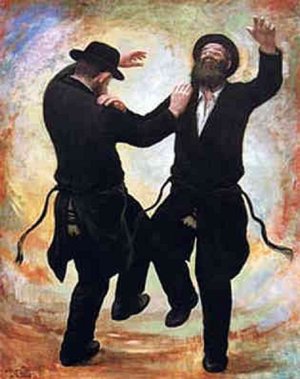 Now, we have a greater purpose. Rabbi Pruzansky’s story is just one small example of how modernity, moral relativism, intermarriage (and I say that as an intermarried Christian husband), and assimilation have grievously depleted the ranks of Jews who are culturally and religiously Jewish. There are so many people (my wife was once one of them), who are halachically Jewish but estranged from the synagogue, the siddur, and the Torah. We Christians who find ourselves drawn, often inexplicably, to Judaism have a great opportunity to, after our own fashion, do what Rabbi Pruzansky and Canon White are doing. We can return the Torah to the Jews or more accurately, we can encourage Jews to return to the Torah.
There is an idea in some corners of Judaism that says the Messiah will only come (or from a Christian point of view, “return”) when all Jews everywhere observe a single Shabbat. I don’t know if that’s true or not, but I believe that God will find favor in His Jewish people, as increasing numbers of them return to Him in obedience to the mitzvot. For a Jew, this means returning to the Torah. For a Jew, it means the Torah is returned to him. It does not mean, “the Torah is now for we Christians but we’re willing to share it with the Jew.” It does not mean, “the Torah is now for everyone and, strictly speaking, it isn’t Jewish anymore.”
Speaking to my Christian brothers and sisters who are not Jewish, whether you or I observe the Torah commandments that specifically identify Jewish people as Jews won’t make much of a difference to God, in my opinion. After all, the vast majority of the Torah speaks of those things that we Christians already do, such as feeding the hungry, visiting the sick, and comforting the grieving. We already do everything that our Master and Savior Jesus commanded his disciples to do.
But in a world that has always been opposed to the Jewish people, we can do something for them and for God. We can give them back what we have taken from them. We can allow them, without resisting any further, to be Jewish and to do Jewish. At Sinai, God created a unique and treasured nation that was never intended to be “xeroxed,” diluted, or deleted. But through repeated acts of disobedience by the Israelites, God (temporarily) dispersed that nation to the four corners of the earth.
 Now He is bringing them back to their peoplehood, to their Land, and God is bringing the Jewish people back to Himself. The mission of the Christian church is to serve God and to obey our Lord, and part of that service is to return the Torah to the Jews and to recognize that Israel will one day (I pray soon) be restored as the head of all nations.
Boaz Michael, the President and Founder of the educational ministry First Fruits of Zion (FFOZ) has written a soon-to-be published book called Tent of David (available January 2013) which outlines this mission for us from a Messianic Jewish perspective. These are exciting times for the church and we all have vital roles to play in the plan of God.
We just need to remember our roles. We just need to remember that our job is not to take, but to restore.
May the Messiah come soon and in our day.
Amen.









 Morning Meditations