Tag Archives: Jesus

The Jesus Covenant, Part 8: Abraham, Jews, and Christians

Now the Lord said to Abram, “Go from your country and your kindred and your father’s house to the land that I will show you. And I will make of you a great nation, and I will bless you and make your name great, so that you will be a blessing. I will bless those who bless you, and him who dishonors you I will curse, and in you all the families of the earth shall be blessed.”

Genesis 12:1-3 (ESV)

To give a human example, brothers: even with a man-made covenant, no one annuls it or adds to it once it has been ratified. Now the promises were made to Abraham and to his offspring. It does not say, “And to offsprings,” referring to many, but referring to one, “And to your offspring,” who is Christ.

Galatians 3:15-16 (ESV)

For the past several installments of this series including Part 7, I’ve been focusing on aspects of the New Covenant, mainly because the little bits and pieces that relate to Christianity can only be tracked down in different parts of the New Testament. However, recent conversations have shown me that I should probably return to the foundation of my understanding for a bit to illustrate its solidity, or at least describe the trail of reasoning that I’m pursuing.

As you have probably guessed, it all goes back to Abraham and the covenant God announced to him in Genesis 12. But what exactly did God promise Abraham and what does it have to do with us, that is, with Christians?

Here’s my understanding:

  1. Genesis 12:1-3 – God promises to make Abraham into great nation, bless those who bless him and curse those who curse him, and all peoples on earth would be blessed through Abraham.
  2. Genesis 15:18–21 – God promises to give Abraham’s descendants all the land from the river of Egypt to the Euphrates, and this area is later referred to as the Promised Land or the Land of Israel.
  3. Genesis 17:2–9 – God promises to make Abraham a father of many nations and of many descendants and the land of Canaan as well as other parts of Middle East will go to his descendants.
  4. Genesis 17:9-14 – God declares that circumcision is to be the sign of the covenant for Abraham and all his male descendants and that this will be an eternal covenant.

This covenant is then reaffirmed to Isaac in Genesis 21:12, and again reaffirmed to Jacob in Genesis 26:3-4. (the New Covenant as recorded in Jeremiah 31 and Ezekiel 36 affirms and expands upon this and the Mosaic covenant) God confirmed that the promise of the covenant is specifically for the descendants of Abraham, Issac, and Jacob, the Children of Israel, in many places in the Torah, not the least of which is in Deuteronomy 34:4 (ESV):

And the LORD said to him, “This is the land of which I swore to Abraham, to Isaac, and to Jacob, ‘I will give it to your offspring.’ I have let you see it with your eyes, but you shall not go over there.”

As far as the land of Israel goes, there is no provision in the covenant to give it to anyone or any other people group besides the Children of Israel and their descendants forever, the Jewish people.

That takes care of the Land. But what about us?

We learn from Galatians 3:15-16 which I quoted above, that through Abraham’s seed, through his offspring (singular) we among the nations would be blessed. Paul declares that the offspring in question is specifically the Jewish Messiah, Jesus Christ. Our blessings that issue from the Abrahamic covenant are directly transferred to us through the Messiah.

So far, of the four items in the above-referenced list, only one of them seems to apply to Christians, the blessings of the Messiah.

What else do we know about the Messianic blessings in the Abrahamic covenant?

Is this blessing then only for the circumcised, or also for the uncircumcised? For we say that faith was counted to Abraham as righteousness. How then was it counted to him? Was it before or after he had been circumcised? It was not after, but before he was circumcised. He received the sign of circumcision as a seal of the righteousness that he had by faith while he was still uncircumcised. The purpose was to make him the father of all who believe without being circumcised, so that righteousness would be counted to them as well, and to make him the father of the circumcised who are not merely circumcised but who also walk in the footsteps of the faith that our father Abraham had before he was circumcised. –Romans 4:9-12 (ESV)

We see that it was Abraham’s faith that was counted to him as righteousness, and this was before the sign of the covenant was placed upon Abraham. We too, the “uncircumcised” of the nations, are called “righteous” because of our faith. Thus Abraham Avinu is our father, according to Paul, not just the father of the Hebrews. No, that doesn’t mean we are Hebrew (Jewish) too, nor does it mean we inherit the total body of covenant blessings and responsibilities that are incumbent upon the Jews, but it does make us connected to Abraham as the father of our faith, and through his covenant and the Messiah, with God.

This is kind of a delicate trail to negotiate, and we have to be careful that we don’t slip off the path and fall into erroneous thinking. The promise of the Land, and I believe the other specific promises, including the covenantal sign of circumcision, are for the physical descendants of Abraham and of Isaac, and of Jacob. That’s not the rest of us. That’s just the Jewish people.

In other words, all of the conditions of the Abrahamic covenant, including the blessings of the Messiah, flow to the children of Abraham, Isaac, and Jacob. The single blessing that we can be attached to through the Messiah is attached to Abraham alone, as he was before his circumcision, as he was before Isaac; a man of faith and righteousness before God.

That’s the split, the demarcation line between Christian and Jew, the slender thread of “covenanthood” by which we Gentile Christians are connected to Abraham, the Abrahamic covenant, and thus, to God.

So what do we get out of it? Well, first of all, a cautionary tale:

But if some of the branches were broken off, and you, although a wild olive shoot, were grafted in among the others and now share in the nourishing root of the olive tree, do not be arrogant toward the branches. If you are, remember it is not you who support the root, but the root that supports you. Then you will say, “Branches were broken off so that I might be grafted in.” That is true. They were broken off because of their unbelief, but you stand fast through faith. So do not become proud, but fear. For if God did not spare the natural branches, neither will he spare you. Note then the kindness and the severity of God: severity toward those who have fallen, but God’s kindness to you, provided you continue in his kindness. Otherwise you too will be cut off. And even they, if they do not continue in their unbelief, will be grafted in, for God has the power to graft them in again. For if you were cut from what is by nature a wild olive tree, and grafted, contrary to nature, into a cultivated olive tree, how much more will these, the natural branches, be grafted back into their own olive tree.

Romans 11:17-24 (ESV)

Paul seems to be toggling back and forth between addressing the Jewish believers and the Gentile believers. “You wild olive branches, you Gentiles,” Paul is saying. “Don’t get cocky just because you were grafted in. Remember, it’s the root that nourishes you, not the other way around. You think you are so hot just because a few Jews were knocked off the root to make room for you Gentiles? So what,” he might be saying. “If you fall away from the kindness of the Messiah, you can be knocked off and the Jews can be put back twice as fast!”

So to the Jews, don’t be arrogant to the Gentiles because they’re “newbies.” To the Gentiles, don’t be arrogant because some Jews were removed from the root to which you are now attached. Nothing is necessarily permanent. Anyone can be “ungrafted.”

That’s a terrific lesson for many non-Jewish believers to learn because, through one process or another, we have come to feel superior to the Jewish people who God, in the end, will reattach to the root, all of them. Remember, any of you out there who are not physical descendants of Abraham, Isaac, and Jacob, (apart from legitimate converts to Judaism) don’t get cocky. God not only didn’t get rid of the Jews, it is through them that your salvation and covenant connection to God is established and nourished in the first place.

And for those of you who feel that being “grafted in” has whitewashed any physical and covenant distinctions between you and the “natural branches,” think again:

Then what advantage has the Jew? Or what is the value of circumcision? Much in every way. To begin with, the Jews were entrusted with the oracles of God. What if some were unfaithful? Does their faithlessness nullify the faithfulness of God? By no means! Let God be true though every one were a liar, as it is written,

“That you may be justified in your words, and prevail when you are judged.”

But if our unrighteousness serves to show the righteousness of God, what shall we say? That God is unrighteous to inflict wrath on us? (I speak in a human way.) By no means! For then how could God judge the world? But if through my lie God’s truth abounds to his glory, why am I still being condemned as a sinner? And why not do evil that good may come?—as some people slanderously charge us with saying. Their condemnation is just.

Romans 3:1-8 (ESV)

Being Jewish is not beside the point just because we Gentiles have been grafted in. There remains much advantage to being Jewish. Even those Jews today who do not acknowledge Christ as Messiah are not permanently condemned as many Christians seem to believe. They are not discarded and cast aside.

Israel will be saved:

Lest you be wise in your own sight, I do not want you to be unaware of this mystery, brothers:a partial hardening has come upon Israel, until the fullness of the Gentiles has come in. And in this way all Israel will be saved, as it is written,

“The Deliverer will come from Zion, he will banish ungodliness from Jacob”; “and this will be my covenant with them when I take away their sins.”

As regards the gospel, they are enemies for your sake. But as regards election, they are beloved for the sake of their forefathers. For the gifts and the calling of God are irrevocable.

Romans 11:25-29 (ESV)

I’ve probably wandered from the strictly Abrahamic path, but with good purpose. The purpose is to illustrate that just because Jews and Christians share the Messianic blessings that are part of the wider Abrahamic covenant through faith, that does not mean we share all of the blessings attached to that covenant. Paul was extremely clear that there is a distinction between Jewish (native) and Gentile (wild) olive branches. They all didn’t “morph” into a single type of branch with no way to tell them apart.

Also, Paul was extremely clear that there were many advantages to being a Jew. Further, he said that even if some of the Jews were temporarily removed from the root for the sake of we Gentile Christians, in the end, God’s promises to the Jewish people are irrevocable; they cannot be revoked!

The really interesting thing about all of this is that a Christian must choose to become part of the covenant with God through Jesus and Christians can also “unchoose” Christianity for another religion or no religion at all. Not so with the Jewish people. If you are born a Jew, you are automatically born into the covenant (actually covenants, but I’m only talking about Abraham for the moment). God has temporarily turned His face away from His people Israel in the past, and He has temporarily exiled them in the past, but as “temporarily” implies, He always takes them back and He always will take them back.

In spite of the fact that this missive is longer than I intended, I didn’t get to say everything I could have said about Christianity and the Abrahamic covenant. Hopefully, I’ve said enough for now.


Freedom

Seven days shall you dwell in boothsLeviticus 23:42

… and you shall only be rejoicingDeuteronomy 16:15

Succos is the festival designated as the season of our gladness. Yet the commentaries state that one of the symbolisms of the succah, a temporary hut, is that we dwell in it for seven days to symbolize man’s temporary sojourn on earth for his average life span of seven decades (Psalms 90:10).

Human mortality is a rather sobering thought; it is hardly conducive to rejoicing. Most often we do not think about our mortality, and when circumstances force us to face it, we quickly dismiss it from our minds and go on acting as though we will live forever.

How different Torah values are from secular values! The Torah teaches us that there is an eternal life, a wholly spiritual life, whose bliss is far greater than the human mind can imagine. We are placed on this planet for our ephemeral earthly existence only to give us an opportunity to prepare for the eternal life.

The Torah teaches us to enjoy life, and if it restricts some pleasures, it is because we should enjoy life in a manner that befits a human being. Furthermore, our joy of living should not be diminished by the awareness of our mortality, nor need we deny it. The succah – the symbol of our temporary stay on earth – is beautifully decorated, and we enjoy our festive meals therein. Even our temporary existence can be beautiful and happy, and our faith in the eternal life should enhance that happiness.

Today I shall…

try to enjoy life as befits a spiritual person, knowing that the true life of man is not the fleeting one, but that of eternity.

-Rabbi Abraham J. Twerski
“Growing Each Day, Tishrei 15”
Aish.com

Throughout life people will make you mad, disrespect you and treat you bad. Let God deal with the things they do, cause hate in your heart will consume you too.

-Will Smith, American actor

I probably take myself too seriously. Sometimes my wife tells me that. I know it’s certainly true of me in my “online persona.” I guess that comes from being a professional writer. Writing is what I do, so it’s important to me. It’s pretty much my first, best expression of who I am. Not that I’m perfect at it of course. But I don’t paint, and I don’t play music, and I’m not that good a public speaker, and I don’t dance worth anything, so I’ve got to have one way of expressing myself that’s better than all the others.

For me, that is writing. I’ve said before that writing this blog has a therapeutic aspect to it. It helps for me to pound out my thoughts and feelings, to “wear my heart on my sleeve,” so to speak. I can better describe how I feel and think about God, Jesus, Christianity, Judaism, and lots of other things when I write. Not that everyone will agree with me, but then, not everybody has to agree with me.

In this season of joy, during Sukkot, I need to be reminded about the difference between what’s real and important and what’s more or less beside the point. A lot of what happens online is beside the point. No, it’s not that I don’t take my writing seriously, and it’s not that I don’t take the people who I interact with online seriously, but beyond a certain point, I have to let things go.

Some people steal joy, as if joy were something you have and they don’t. As if joy were something they’ll never have and they can’t stand that you have some. They steal it, even if they can’t use it themselves, just so you can’t use it, either.

No one can do that to you unless you let them. In real life, it’s harder to combat, especially if the person stealing your joy is important to you, especially if it’s someone you love. While I get hurt by people I love sometimes, no one I love steals my joy. I’d probably let them if they wanted to, because I love them, but they don’t do it because they love me and they know that stealing joy is wrong.

Online, there are no end of people who steal joy. They may not think of it in those terms, but that’s the net result of their interaction with others. It’s easier to try to steal someone else’s joy online because you can’t see them and they can’t see you. You are depersonalized. They can’t see that they’re hurting you, and so, if they have no empathy, compassion, or grace, they don’t have to care if they’re hurting you. They can verbally harangue you, insult you, make fun of you, and feel well justified in doing so, because you aren’t even human to them. You’re just an anonymous “thing” that they can attack and defeat. I guess that’s what it takes to make themselves feel better.

You’d think that it would be easy to let go of someone like that online. All you have to do is pull the plug on whatever communication conduit they use to connect to you. Stop visiting their blog. Ignore or delete their comments on your blog or even block their IP address. But it’s not that easy. It’s like slamming the door in someone’s face. Even when they’re hostile, and even when they’re abusive, if you’re a decent human being, it still feels rude to (metaphorically) slam the door in their face.

Most hostile and abusive people are usually victims of some kind. Most bullies and trolls online have a history of being bullied themselves. I guess that’s why I put up with some folks as long as I do. I realize that even when they’re in your face, making demands of you, telling you what to do, that it’s really their defense against how hurt they are inside. They’ve never dealt with their pain and never resolved their conflicts. The only way they know how to live inside their own skin is to project all of their “stuff” onto others.

So I was dumb, and I was foolish. I (mentally) cut someone loose but let them back in because I thought maybe there was hope that, though we’d always disagree, we could disagree with a sense of mutual respect. I was taking a risk, but you have to do that sometimes. Sometimes it’s worth it. This time it wasn’t.

You can’t really hate a victim because in many ways, they just can’t help themselves. In order to feel powerful, they have to be hostile. These sorts of people, especially guys, mistake anger and aggressiveness for power, not realizing that true power isn’t hostile or aggressive at all. True power is love, compassion, forgiveness, mercy, graciousness, and tenderness. Some people think the only power is intelligence, education, superiority, winning the argument, devastating twists of irrefutable logic, how well they halalachally perform a mitzvot. That’s the stuff they push in your face to show you that they’re not a victim, that they’re “winning,” that they’re better than you. Then they can feel better about themselves.

But they’ve missed the point. Paul was extremely clear about which gifts are more important. In fact, there’s one gift, one attribute that we can all possess and exercise if we choose to, that trumps all the rest.

If I speak in the tongues of men and of angels, but have not love, I am a noisy gong or a clanging cymbal. And if I have prophetic powers, and understand all mysteries and all knowledge, and if I have all faith, so as to remove mountains, but have not love, I am nothing. If I give away all I have, and if I deliver up my body to be burned, but have not love, I gain nothing.

Love is patient and kind; love does not envy or boast; it is not arrogant or rude. It does not insist on its own way; it is not irritable or resentful; it does not rejoice at wrongdoing, but rejoices with the truth. Love bears all things, believes all things, hopes all things, endures all things.

Love never ends. As for prophecies, they will pass away; as for tongues, they will cease; as for knowledge, it will pass away. For we know in part and we prophesy in part, but when the perfect comes, the partial will pass away. When I was a child, I spoke like a child, I thought like a child, I reasoned like a child. When I became a man, I gave up childish ways. For now we see in a mirror dimly, but then face to face. Now I know in part; then I shall know fully, even as I have been fully known.

So now faith, hope, and love abide, these three; but the greatest of these is love.

1 Corinthians 13:1-13 (ESV)

Really. Read that again. What is Paul saying? He’s not saying that “winning” in some Charlie Sheen fashion is the whole point. He’s saying that, even if you’re fabulous in speaking tongues, are an amazing prophet, even if you have faith that literally can move mountains, but you don’t have love, you have nothing.

GardeningLove is like a small, fragile, budding plant you nurture inside of you. If you don’t take care of it, the love will wither, and you will wither along with it. Love takes a lot of special attention but if you don’t care for the love inside of you, you’ll never be able to show it to others, especially those who really need to be loved. It almost seems paradoxical to say that in order to preserve your love, there are some people you have to let go. But those are the people who suck joy directly from your soul, murdering your love, blackening your heart, and damaging, not only you, but everyone around you who needs and depends on you.

Author C. JoyBell C. said, “You will find that it is necessary to let things go; simply for the reason that they are heavy. So let them go, let go of them. I tie no weights to my ankles.” Sometimes toxic people are the weights that hold us down. And even if it feels like giving up on another human being, it’s better to let go of the weight so that you can rebound and fly, than to keep hanging onto it and letting it; letting that person drag you down into hostility, hopelessness, and despair along with them.

I hope and pray that my “toxic person” finds his way and learns to let go of his own unneeded weights, but he’ll have to learn love, the kind of love Paul was talking about, first. That’s something you can’t teach someone, especially against their will and especially if they equate humility, compassion, forgiveness, and love with being humiliated and being weak.

This is the season of joy. This is the time to rediscover love, love of your fellow person and love of God. To soar up to the source of our flame, we have to unburden ourselves sometimes. In order to fly, you have to break free from the people and things that hold you down.

“Woe to him who does not feel that this life and the next are but one!”

-Nikos Kazantzakis from his novel
“Zorba the Greek”

My Hope Comes From The Lord

Worry is self-humiliation. Trust is dignity.

To worry is to worship the world. To fall on your knees in dread and grovel before it.

To trust is to lift up your eyes and stand as tall as the heavens. To live with nothing else but the bond between G‑d above and you below.

-Rabbi Tzvi Freeman
“Just the Two of You”
Based on letters and talks of the Rebbe, Rabbi M. M. Schneerson
Chabad.org

OK, I need to review my own lessons on trust. Being human, I sometimes forget that reality exists on more than just a human level. As a person of faith, I believe in God, but it takes a person of trust to actually rely on God to do, if not the impossible, then the highly improbable. I speak of the topic I chronicled recently as Vain Hopes.

Yes, it’s no fun when your spouse tells you that the most important single aspect of your existence, your faith, is embarrassing to her, but that’s hardly something I can change. So what’s next?

Understanding. I can’t change who I am (well, I can, but that would involve not being a Christian anymore and I’m not willing to do that), but I can try to better understand who she is. Maybe that will be some comfort.

So who is she? Expanding on the question somewhat, what is being “Jewish?”

In a very real sense, I’m totally unqualified to answer that question since I’m not Jewish. Even if I received documentation tomorrow that proved beyond a shadow of a doubt that my mother was Jewish (which I’m sure would come as a complete shock to her) and that all of her ancestors were Jewish in a long line going back as far as could be recorded, thus establishing that I’m Jewish, it still wouldn’t give me something I would sorely lack: an actual, lived, experiential, Jewish life. So how can I describe something I’m not and that I have no experience in being?

Really, I can’t. You would think Jewish people could, but actually, it’s more complicated than it seems.

I’m just out of college and struggling to forge my identity. I have strong Jewish feelings, but am meeting some really nice non-Jewish women and am having trouble articulating why Judaism is so central to my identity.

Can you tell me why I should hang in there with the Jewish people?

“Why be Jewish?”
Ask the Rabbi
Aish.com

Please click the above link and read the Rabbi’s answer, but personally, I found his response rather disappointing. What the Rabbi outlines as the advantages of Judaism, living a moral life, specific Jewish values, and so on, could as well be applied to just about any person who follows the lessons of what God gave to the world, “a set of ‘instructions for living’ – the Torah.”

However, the answer to another Ask the Rabbi question may prove more illuminating.

To categorize Judaism “only” as a religion is a misunderstanding. The Jewish people are a nation, who share a common land (Israel), a common religion (Judaism) and a common history (dating back to Abraham).

What is amazing is how the Jews have maintained their distinct national identity having been scattered to the four corners of the globe. This achievement was possible only because of our adherence to the Torah, the “constitution” of the Jewish people. The Torah lays out the scope of personal rights and obligations, as well as laws covering lifecycle, business practice, medical ethics, parenting, married life, etc. Observance of the Torah was thus the thread which kept the Jewish people alive, and thriving, in every place and time.

Judaism cannot be classified as a race, because anyone can become a Jew by converting. The convert is considered a Jew in every regard, and his relationship with God is the same level as that of every other Jew. Come to Israel and you will find black Jews, oriental Jews, Indian Jews, etc.

This is what Christianity lacks. We can enter into a covenant relationship with God through Jesus Christ, and draw close to his covenant community Israel, but we don’t become what the Rabbi describes above; a nation, a people, a unified whole that transcends the boundaries of religion, and if you include those few who convert, ethnicity and race.

Well, that’s not quite true. Anyone, regardless of national origin, race, color, ethnicity, gender, or any other attribute, can come to Christ and worship the God of Israel. But we are of the many nations and the Jews, regardless of where they were born, what secular citizenship they may possess, and whether or not they were born of a Jewish mother or converted from the nations, are uniquely of Israel, and though scattered across the planet, form a united nation before God.

Chief Rabbi Lord Sacks, in his commentary on Torah Portion Nitzavim, said:

As the commentators point out, the phrase “whoever is not here” cannot refer to Israelites alive at the time who happened to be somewhere else. That cannot be since the entire nation was assembled there. It can only mean “generations not yet born.” The covenant bound all Jews from that day to this. As the Talmud says: we are all mushba ve-omed me-har Sinai, foresworn from Sinai (Yoma 73b, Nedarim 8a). By agreeing to be God’s people, subject to God’s laws, our ancestors obligated us.

Hence one of the most fundamental facts about Judaism. Converts excepted, we do not choose to be Jews. We are born as Jews. We become legal adults, subject to the commands and responsible for our actions, at the age of twelve for girls, thirteen for boys. But we are part of the covenant from birth. A bat or bar mitzvah is not a “confirmation.” It involves no voluntary acceptance of Jewish identity. That choice took place more than three thousand years ago when Moses said “It is not with you alone that I am making this sworn covenant, but with … whoever is not here with us today,” meaning all future generations including us.

But how can this be so? Surely a fundamental principle of Judaism is that there is no obligation without consent.

Please read the full commentary by clicking the link above, but the reality of the Jewish people and Judaism, is that it exists and is obligated to God beyond the simple will of the individual. When you are born a Jew, the mitzvot are yours, whether you want them or not. In the best of all possible circumstances, you are taught to live a Jewish life and you learn to love that life as a Jew before the Throne of Hashem. Judaism chooses the Jew, not the other way around (apart from converts).

In Exodus 4:22, God directly refers to Israel as “My child, my firstborn, Israel.” Whoever and whatever we are as Christians, we do not enter into the presence of God except through Israel.

You worship what you do not know; we worship what we know, for salvation is from the Jews.

John 4:22 (ESV)

If we consider the Jewish Messiah as the firstborn of Israel, this point becomes even more specific.

Jesus said to him, “I am the way, and the truth, and the life. No one comes to the Father except through me.

John 14:6 (ESV)

The irony for me is that my closest Jewish relative is my wife, and not for a split second would she consider Jesus as the Jewish Messiah, nor see herself and her people as the authors of my salvation through Christ.

More’s the pity, and I pray that it won’t always be that way.

None of this is doing a very good job of defining who a Jew is or what Judaism is, at least down to the finest details. In fact, it gets a little more confusing when you consider the Ask the Rabbi answer to Definition of a Jew:

Torah methodology is universal – for Jews and non-Jews, religious and secular, Israel and the Diaspora, left and right. The Torah is alive and relevant for today. And for the Jewish people, the ability to effectively communicate this message is our single most important undertaking.

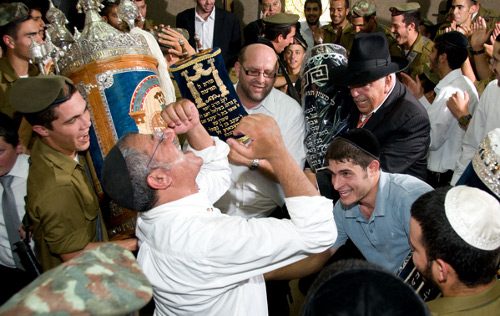
Simchat TorahThis makes it seem like what the Torah contains, at least at its core, is a set of instructions that applies to all of humanity, not just the Jewish people, but it is the responsibility of the Jews to “effectively communicate this message.” That sounds almost evangelical, until you realize the mission of Judaism isn’t to make the people of the nations into Jews, but to teach them/us about the One true God of Israel. In modern traditional Judaism, that extends no further than the level of the Noahide, but from Christianity’s point of view, we enter a whole new world when we know God by accepting Christ.

Where that world takes us is a journey beyond imagination, and one that is unique, in many ways, to each individual. In some ways, as is in my case, it actually leads somewhat away from its source; away from Judaism, at least at the personal level, since most Jews cannot tolerate a great deal of Christianity in their lives. But while faith is easy, trust comes very hard, especially in the presence of disappointment.

However, as Rabbi Freeman stated at the beginning of this “meditation,” “To trust is to lift up your eyes and stand as tall as the heavens. To live with nothing else but the bond between G‑d above and you below.”

Please forgive me if I take the liberty of applying those words of wisdom to all of us and not just to the Jewish people.

I lift up my eyes to the hills. From where does my help come? My help comes from the Lord, who made heaven and earth.

Psalm 121:1-2 (ESV)

When you’re in the middle of the journey and it all seems so futile and hopeless, then the path has reached its end, regardless of what actually lies before you. But when there is hope, when you lift your gaze out of the dust and darkness and raise your head up to see the light, the journey begins again as if you had just taken your first step.

Sukkot: The Man Who Had No Coat

There was once a man, whom we will call Andy, who was diagnosed with a rare and severe illness. Unique conditions often call for unconventional treatments, and he was advised to try psycho-physical therapy: he was told to find someone who lives in complete joy with no worries, ask him for his coat, and wear that man’s coat for seven days. Hopeful that he would soon feel healthy again, Andy embarked on his mission to find such a person. He searched everywhere, asking everyone he met if they or someone they knew was completely happy without worries. Unfortunately, after many months he still hadn’t found anyone who fit the description.

Finally, with the debilitating illness still progressing, Andy was referred to a man named Sam who, he was told, was happy and had no worries at all. It was winter, yet Andy anxiously trudged through the snow to a park bench where he was told Sam could be found. Andy sat down next to Sam and began his inquiry.

“Are you Sam, the man they say is filled with joy, who has no worries?” Andy asked.

“Yes, indeed I am,” Sam replied with a smile.

“Wonderful! May I borrow your coat for seven days? It would really mean a lot to me.”

“Of course! I would love to lend you my coat, but there’s just one problem.”

“What’s that, Sam?”

“I have no coat.”

-Rabbi Mordechai Dixler
Program Director, Project Genesis/Torah.org
“The Party That Never Ends”
ProjectGenesis.org

This lesson from Rabbi Dixler somewhat reminds me of something that the Master taught:

“Do not lay up for yourselves treasures on earth, where moth and rust destroy and where thieves break in and steal, but lay up for yourselves treasures in heaven, where neither moth nor rust destroys and where thieves do not break in and steal. For where your treasure is, there your heart will be also. –Matthew 6:19-21 (ESV)

But what does all this have to do with Sukkot? Plenty.

As Rabbi Dixler points out in his commentary, during Yom Kippur, observant Jews immerse themselves in prayer and supplication before God, turning aside from physical pleasures and imploring their Creator to help them build a new future. Immediately after such a time of plunging into the intense personal and spiritual depths, emerging after the fast and knowing that Sukkot is immediately upon them, the soul rebounds and rises into great joy.

Interestingly enough, Jews are to leave their regular dwellings and reside in “simple huts with deliberately poor roofing” for this week-long holiday, entertaining their guests including, traditionally, Abraham, Isaac, Jacob, Joseph, Moses, Aaron, and David…a different guest each night. It would be like welcoming a different king on each successive night, and entertaining them in a makeshift lean-to. After the personal deprivation of Yom Kippur, why eat and drink and sleep in, what for some of us, might be a small, damp, cold, flimsy shelter?

I think the secret is in what we read from Matthew’s account of the teachings of Jesus. With the roof of the tent purposefully incomplete, allowing in rain and letting us see the stars above us at night, we are trading our physical, secular home for one which Rabbi Dixler calls a “new spiritual home” which “serves to inject the spiritual, genuine, joy experienced on Yom Kippur into common daily activities.”

But what about Andy and Sam?

One does not need a coat to be the happiest man alive. In fact, if we rely on non-spiritual pursuits for our joy, we’ll never be satisfied. As the Sages say, “a person does not leave this world with even half of what he wanted” (Koheles Raba, 1:34). Nothing in this world can live up to our dreams, and a non-spiritual focus ultimately ends in disappointment.

The answer is not asceticism. As one of my teachers, Rabbi Berel Wein, used to say in this context, “this is not a plea for poverty, my friends!” We do learn, however, that for any material pursuit or attainment to last, it must at least be rooted in spirituality. If we buy delicious food to share with others, buy a house to raise a family and welcome guests, or pursue a lucrative career to have money to help those in need, we’ll experience the spiritual joy along with the physical joy, and then it is guaranteed to last. (Based on Nesivos Shalom)

Under the sukkahI suspect that Andy was relieved of his disorder, not by wearing Sam’s non-existent coat for the next seven days, but by understanding why he didn’t have one. Although you and I might consider spending seven days and nights living, eating, and sleeping under the clouds and the sky as a bit uncomfortable (one or two nights might seem like a camp out), there is joy in relying on God. Our immediate surroundings may seem poor, but we are inundated by the boundless treasures of Heaven. By living in a flimsy structure and yet decorating it elaborately, often with lights, trinkets, pictures and such, and then, inviting guests, from the poorest to the richest, into our hovel, and feeding them abundant food and drink, we are experiencing the reality of our existence. We live on earth and are able to enjoy all that it has to offer, but we are also dependent on the blessings of Heaven above us to shelter our heads from the harsh elements of this life.

One can take pleasure in what the world has to offer and this, God approves of. But the world will not be our lasting joy. Only God can give that.

Sukkot begins tonight, September 30th, at sundown. Here’s an infographic that will tell you everything you ever wanted to know about Sukkot.

Chag Sameach and Good Sukkos.

Jesus, Halakhah, and the Evolution of Judaism, Part 5

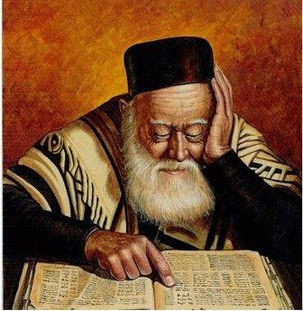
The RabbiIn addition to Tanakh, we as Messianic Jews have another authoritative source for the making of halakhic decisions: the Apostolic Writings. Yeshua himself did not act primarily as a Posek (Jewish legal authority) issuing halakhic rulings, but rather as a prophetic teacher who illumined the purpose of the Torah and the inner orientation we should have in fulfilling it. Nevertheless, his teaching about the Torah has a direct bearing on how we address particular halakhic questions. As followers of Messiah Yeshua, we look to him as the greatest Rabbi of all, and his example and his instruction are definitive for us in matters of Halakhah as in every other sphere.

In addition, the Book of Acts and the Apostolic Letters provide crucial halakhic
guidance for us in our lives as Messianic Jews. They are especially important in
showing us how the early Jewish believers in Yeshua combined a concern for
Israel’s distinctive calling according to the Torah with a recognition of the new
relationship with God and Israel available to Gentiles in the Messiah. They also
provide guidelines relevant to other areas of Messianic Jewish Halakhah, including
(but not restricted to) areas such as distinctive Messianic rites, household relationships,
and dealing with secular authorities.

-from “Standards of Observance”
Messianic Jewish Rabbinical Council (MJRC)
Section One: Halakhah and Messianic Judaism
1.1 Halakhah: Our Approach (pg. 2)
OurRabbis.org (PDF)

This series isn’t taking the direction that I thought it would. At the end of Part 4, I really thought I’d return to a high-level view of the evolution of Judaism, perhaps lightly going over the development of the Talmud. This would mean doing a bit of reading and probably delaying Part 5 (this part) of the series for a while.

Then, on a whim, I decided to read “Standards of Observance,” which is the MJRC’s treatment of “Messianic Jewish halakhah;” certainly a controversial subject given the responses I’ve been fielding in Part 3 and Part 4. Thus, another “meditation” was born.

As I’m writing this, I haven’t gotten past page 2 of the 39 page MJRC document, but when I read the portion that I quoted above, I got to thinking. I generally consider halakhah to be a matter of how Jewish people operationalize their observance of the 613 mitzvot, which is how contemporary Judaism codifies the commandments to Israel in the Torah. But if “the Book of Acts and the Apostolic Letters provide crucial halakhic guidance for…Messianic Jews,” by definition, it must also provide relevant halakhah for the non-Jewish believing community as well.

This is complicated by two potentially competing positions: the halakhah as it is presented in the New Testament (NT) Gospels, book of Acts, and Epistles, and how the MJRC chooses to conceptualize, organize, and apply that halakhah. Actually, even within the context of the New Testament, how we view the relative authority of this halakhah upon the daily lives of non-Jewish Christians depends on whether or not we see this NT halakhah as fixed, static, pronouncements that were intended to be inflexibly binding on all Christians everywhere across time, or whether at least some of this halakhah was specific to individual congregations, situations, and other contextual factors, and was meant to be adaptive across time, to the point in some cases, of not applying significantly or at all to Christianity in the 21st Century.

I’ll give you an example.

Every man who prays or prophesies with his head covered dishonors his head, but every wife who prays or prophesies with her head uncovered dishonors her head, since it is the same as if her head were shaven. For if a wife will not cover her head, then she should cut her hair short. But since it is disgraceful for a wife to cut off her hair or shave her head, let her cover her head. For a man ought not to cover his head, since he is the image and glory of God, but woman is the glory of man. –1 Corinthians 11:4-7 (ESV)

Taken literally and in its simplest form, Paul would seem to be saying that when men pray, our heads should not be covered, but when a woman prays, her head must be covered (presumably in a public setting such as communal worship). According to the notes for vv 5-13 at BibleGateway.com, “the Greek word gunē is translated wife in verses that deal with wearing a veil, a sign of being married in first-century culture.” This adds some context to what Paul is saying that we would miss by reading it in English. The head covering that is to be applied to women is specific to their marital status in specific cultures as they existed nearly 2,000  years ago. There are no immediately available notes for why a man’s head must be uncovered, but this would seem to go against the later tradition that men wear kippot when in the synagogue, although, of course, Paul is addressing non-Jewish believers in this case (keep in mind that any blanket declaration of halakhah forbidding men to cover their heads in prayer directly contradicts the modern practice of Gentile men in Messianic, One Law, and Two-House congregations to wear kippot).

My example seems to show us that it is certainly possible and likely that not every single pronouncement of halakhah that flowed from Paul’s pen was supposed to apply generally across all churches everywhere and “everywhen.” That is, we can believe that some “Messianic halakhah” as it applies to non-Jewish believers was never originally intended to be permanent, fixed, static standards of practice religious practice.

Which means we’re going to have an interesting time trying to figure out which portions of the halakhah in the NT continues to have force today and how we are to observe said-halakhah in our local communities in the present age.

I want to make certain that I communicate the following clearly. Whatever definitions that the MJRC has produced relative to “Messianic halakhah” can only apply to Messianic Jews who are members of congregations affiliated with the MJRC. This is certainly in keeping with halakhah in any other Jewish community, regardless of scope, since, for example, how halakhah is applied within the context of Chabad is most likely different from its application within Conservative or Reform Judaism. For all I know, there may be variations within specific local synagogues that are “contained” within the same sect of Judaism.

That means that not only does the MJRC understanding of halakhah not apply to wider Christianity (and you wouldn’t expect it to, since it seems to be written specifically for its Jewish members), but it doesn’t apply to any other organizations of Messianic Judaism and clearly not to any of the groups contained within “Hebrew Roots.”

(Arguably, and I haven’t read the entire MJRC document yet, any halakhah developed by the MJRC would have some sort of impact on the non-Jewish membership of each affiliated congregation, but I don’t know yet what the scope of that impact might be. However, if you are a non-Jewish believer and you choose to attend an MJRC affiliated congregation, you agree to become subject to their authority. Keep in mind that even in the most “Jewish” of Messianic Jewish congregations, the majority of members and perhaps a few folks in leadership, are non-Jews).

The next question is whether or not it is appropriate and desirable for groups of non-Jewish believers to also attempt to organize a sort of “Christian halakhah” from the NT that would apply to churches and Hebrew Roots groups.

I suppose Christians have been doing that ever since the invention of movable type and the first mass printing of the King James Version of the Bible (probably well before, but availability of the Bible prior to that time was severely limited, and the common man had no ready access to the written Word). In other words, developing “Christian halakhah” is an old story for Christianity, they (we) just don’t call it “halakhah.”

Of course, the result is what we see before us…about a billion (I’m grossly exaggerating) different Christian denominations covering the face of the earth, each with their own special take on what the Bible is trying to tell us, at least at the level of fine details of practice. Hebrew Roots organizations are no different, they just re-introduce the word “halakhah” into the mix. Viewed at in this light, it is understandable that the various Gentile expressions of Hebrew Roots including One Law/One Torah and Two-House, either formally or informally establish a set of accepted religious and lifestyle practices based on various parts of the Bible including the New Testament “halakhah.”

However, where it might get a little strange is when/if such Gentile organizations access the larger body of Jewish halakhah that extends well beyond the pages of the NT and into the writings of the Mishnaic Rabbis. While I can understand why organizations that are formed by Messianic Jews as a resource for Messianic Jews and Messianic Jewish congregations would want to delve into the accepted body of Talmudic thought, it’s puzzling why a Gentile would choose to do so. And yet, we see Gentile groups forming “Beit Dins,” wearing tzitzit and laying tefillin in accordance with traditionally accepted Jewish halakhah, and performing other Jewish religious practices that cannot be found in the NT and indeed, practices that weren’t codified (such as wearing kippot) until many centuries after the writers of the NT books and letters had died and their bones had turned to dust.

I made an observation in the previous part of this series that was never answered by any of the relevant parties:

My final note for this missive is one of irony. If written Torah, the Christian Bible, and Jesus are the only valid authorities for religious practice and lifestyle in the Hebrew Roots movement (including One Law/One Torah, and so on), then why do all of their groups and congregations follow a modern Jewish synagogue model when they worship? Why do all the men where kippot? Why do all the men wear tallit gadolim with tzitzit that are halalically correct? Why do they daven with modern Jewish siddurim? Why, in less than a week, will they construct their sukkot according to Rabbinically prescribed specifications?

It is completely understandable why any Christian church or congregation of Gentile believers in Jesus, regardless of their emphasis, should want to carefully study the NT documents and to derive whatever practical knowledge it contains for Christian religious practice in the modern era. On the other hand, it’s rather mysterious what some Hebrew Roots groups believe they will get out of studying the extra-Biblical Rabbinic texts and applying practices and concepts related to a Beit Din, Farbrengen, Ritual purity, Shmita, and so on.

If halakhah has the ability to evolve over time within the Jewish context, we can expect Jewish communities to practice one of the current forms within their local boundaries. The same can be said for Christian religious and lifestyle practice relative to the various Christian churches and denominations. I would never expect a Christian church to borrow significantly or at all from any Jewish halachic source in establishing accepted Christian religious behaviors. Why then, as I’ve asked before, should Gentile Hebrew Roots organizations desire to borrow heavily or almost exclusively from post-Biblical Jewish halachic practices, especially if said-groups only recognize the “written Torah” and New Testament as their only legitimate authoritative documents?

I know all this sounds like I’m trying to pick a fight, but given all of the “resistence” to the Talmud registered by Hebrew Roots people and how they say they don’t consider Talmud as an authoritative guide, the fact that virtually all such groups model their worship practices on modern Jewish synagogue services is truly baffling.

This series continues in the blog post: Messiah in the Jewish Writings, Part 1

Jesus, Halakhah, and the Evolution of Judaism, Part 3

The title I have chosen for this study is a “tongue-in-cheek” attempt to highlight something that seems to be missed by many, namely, that the Mishnah did not exist as a written document in the pre-destruction era, so it is quite obvious that no one, including Paul, could have possibly read what is known in our day as the Mishanh (sic). In fact, as we shall see, the Mishnah was not widely read by Jewish communities in the centuries immediately following the destruction of the Temple (70 CE) either, for the Mishnah was not “published” as a written document until much later.

Along the same lines, it is a methodological error to speak of “1st Century Judaism,” for no such monolithic Judaism existed. We must rather speak of “Judaisms” (plural) in the pre-destruction era. Granted that a variety of Judaisms extant in the 1st Century surely had some things in common (Shabbat, circumcision, Tanach, etc.), it was nonetheless their clear and (in some cases) radical differences that produced the variegated Judaisms of that era.

Unfortunately, the presupposition of some in the Messianic movement is that the later corpus of rabbinic literature presents a monolithic, historically accurate description of “the Judaism” practiced by Yeshua and His disciples.

-Tim Hegg
from the Introduction (pg. 1) of
“What Version of the Mishnah did Paul Read?” (2012)
TorahResource.com

Since writing Part 2 of this series, I’ve been pondering how to proceed, since, as I’m sure you’ve gathered if you read the questions I’ve been posing, the scope of my inquiry is rather ambitious. Then the answer landed firmly in my lap. I’m indebted to Peter at Orthodox Messianic Judaism (something of a misnomer given the theological nature of his blog) for providing a link to Tim Hegg’s article. I read it through once, meaning to go over it again and eventually write something about it, but as I was getting into the shower, I had an “epiphany” and quickly rushed to my computer (I put a robe on first) to compose the paragraphs that are the heart of this missive (we’ll get to those by the by).

I should say at this point that I like Tim Hegg. He has been very gracious to me. I’ve spent Erev Shabbat in his home, I’ve been treated well by his family and his congregation, and I admire and respect him as a leader and a scholar. All of which added to my surprise when I realized in reading the Introduction to the above-quoted paper, that he had made some glaring and erroneous assumptions.

I can’t think of anyone in Messianic Judaism who believes that the Mishnah we have today is a direct reflection of how Judaism (or “Judaisms”) functioned back in the late Second Temple period, when Jesus walked among his people Israel. I have no idea, even after reading Tim’s paper in full, where he got that idea. Certainly my drive to investigate the evolution of Judaism as it relates, both to the ongoing authority of Judaism to define itself across time, and whether or not First Century halakhah and modern halakhah can be considered equally valid for the Judaism of their times, doesn’t assume a fixed, static, and non-adaptive set of applications of Torah over a 2,000 year span.

Also, his point that in the day of Jesus, that there were multiple “Judaisms” (Pharisees, Essenes, Sadducees, and so on) is hardly a revelation. Again, I don’t know anyone in the Messianic Jewish movement who would deny the “multi-sect” nature of First Century Judaism. On the other hand, if we look at modern Judaism or modern Christianity, we could say the same thing. If there was no, one unified “Judaism” in the day of Jesus, there must certainly be no one, monolithic, unified modern Christianity either. The fact that the Christian church exists as perhaps hundreds of denominational models and their variants, (including One Law or, if you will, “One Torah”) establishes this firmly. Nevertheless, no one balks at talking about “Christianity” or “Judaism” in the 21st Century as if they were specific, unified entities, since at their cores within each individual religion, they contain a basic, common set of theologies, doctrines, dogma, and the like that identify them as either “Christian” or “Jewish.”

It’s as if Tim constructed a very well written and organized paper based on faulty assumptions about Messianic Judaism. It’s never been about the Judaism of late Second Temple times being one unified entity, and it certainly has nothing to do with the belief that the Talmud, (which is comprised of Mishnah, Baraita, Gemara, Halakhah, and Aggadah) as we understand it, having existed as the same body of information in the days of Jesus and the Apostles as it does today.

(The evolution of the Oral Torah and halakhah of Christ’s day into what eventually became known as the Talmud is well beyond the scope of this article, but the seeds of what became Talmud certainly must have existed in some form in the Second Temple period and before. What we know of Hillel and Shammai is recorded in Pirkei Avot, which is the “ethical teachings and maxims of the Rabbis of the Mishnaic period,” and yet both Hillel and Shammai pre-dated Jesus by a generation, and the formalization of Mishnah by centuries.)

In the Conclusions section of Tim’s paper (pg. 23, point 5), he states:

We see, then, that there is no historical nor biblical case for accepting oral Torah as divinely sanctioned. Even the suggestion itself is ill-founded, for it both presumes a monolithic “oral Torah” and that the rabbinic authorities who formulated and compiled the current corpus of rabbinic literature did so by the leading of God.

Point 7 of his Conclusions (pp 23-4) states:

As we avail ourselves of the wealth of rabbinic literature and gain value from the study of it, we must also keep in mind that it is the product of men and not that of divine revelation. It does not come to us with any sense of divine imprimatur nor should the rabbinic literature be considered as having sacred value greater than the works of non-rabbinic authors or sources. All the writings of men must be equally scrutinized in the light of the eternal word of God, the Bible.

There’s a certain irony in Tim’s statements if you fix your gaze, not on the Rabbinic writings that are encapsulated in Talmud, but on another “Rabbi’s” writings, which we find in “the light of the eternal word of God, the Bible.”

We take it on faith that the Bible, the Holy Scriptures of God, are Divinely inspired and not merely the writings of human beings, but even then, most of us don’t believe that God simply dictated the Bible to myriads of human beings over several thousand years of history, and that the authors involved were only human word processors. In fact, how much of the personalities and viewpoints of all of these authors made their way into our Holy Scriptures is a hotly debated point among religious scholars and worshipers.

Add to that the suggestion that the New Testament Epistles, which make up the majority of the Christian texts, were actually letters written mostly by Paul, with smaller contributions by a handful of others, to various early Christian churches, and you begin to wonder about the nature of “Divine inspiration.” More than one source has said that the New Testament letters could be of a “lesser authority” than the Torah, for example, and may indeed be Paul’s midrashim or commentaries on Torah, the Messiah, and on the Abrahamic, Mosaic, and New Covenants. If this is true, then the barrier between “Divine authority” and “human agency” in many of our holy writings is a lot thinner than most Christians (perhaps including Tim Hegg) would be comfortable with.

What if there’s merit to the idea that the Talmudic writings and subsequent commentaries, judgments, and rulings have a “Divine authority” involved, at least to a degree? If we can say that Paul’s letters are “Divine” in some manner or fashion, and yet were written by Paul with his mind and emotions fully engaged, (and who knows how “Divine inspiration” does and doesn’t work) then in Galatians, Ephesians, or Colossians, where does Paul leave off and God begin? There’s no way to know. Maybe God just “wired” Paul’s brain to write letters in a way that reflected His will and intent within the context of Paul’s personality, the place and time in which Paul was writing, who he was writing to, and the issues at hand that prompted the letter in the first place.

How is that different from the acknowledged and legitimate Rabbinic authorities issuing rulings, based on and extrapolating from Torah ideals and principles, and then applying them to their local populations?

Who can say if the Mishnaic Rabbis were Divinely inspired or not. How do you measure “Divine inspiration?” I suppose you can, as Tim says at one point, compare the Rabbinic rulings to the canon of Scripture and where they agree, you can say the Rabbis have produced value. Where they disagree, you can say they produced error. Detractors of the Talmud, as applied to Messianic Judaism, say that since “Rabbinic Judaism” does not recognize Yeshua (Jesus) as the Jewish Messiah, it invalidates everything produced by that “Judaism” including the Talmud as a whole (as far as Messianic Jews are concerned, anyway). On the other hand, as my friend Gene Shlomovich said recently in this blog comment:

If you want to believe, as much of Christianity and Islam does, that G-d has virtually abandoned the Jewish people by leaving them to fend for themselves without authoritative leaders and teachers because “they rejected Jesus”, that the Jewish people corrupted the interpretation of scriptures and have lost their right to interpret them, that G-d has removed his Spirit from my people, it’s your prerogative. You would not be the first or the last.

Traditional supersessionism states that God withdrew His Spirit from the Jewish people and transferred it to “the Church” because Judaism rejected the Messianic claims of Jesus. Not only do I believe that theology represents a tremendous error in thinking, but it is a gross simplification of a very complex set of events that occurred over decades and even centuries.

The paper Matthew 23:2-4: Does Jesus Recognize the Authority of the Pharisees and Does He Endorse their Halakhah? written by Noel Rabbinowitz, which I introduced in Part 1 of this series, suggests that not only did Jesus acknowledge the legitimate authority of the Pharisees, but also of the scribes, who, as Carl Kinbar explains, were:

…an independent group affiliated not only with the Pharisees, but also with the Sadducees, Chief Priests, and elders. In fact, in Matthew, a quick check shows that 10 references to the scribes relate them to the Pharisees and 10 to other groups!

As soon as we grant the scribes the same place that Yeshua does in Mt. 23:2, it seems that Yeshua was not promoting the idea that one group should be in control of the halakhic process. Rather, he acknowledges the vital role of Torah teachers but criticizes them as part of his teaching on humility (read to verse 12).

In essence, it seems Jesus, to some degree, acknowledged the legitimate authority of the religious leaders in the various “Judaisms” of his day to have the right to establish halakhah for their communities. Of course the Mishnah as we have it today didn’t exist when the events in Matthew 23 were happening and later recorded, but if Jesus could recognize (and still criticize) Jewish religious leaders as having the right to establish religious practice for the First Century Judaisms, and if that authority was maintained across time as granted by God (I know…a big “if) and perhaps even as a function of an evolutionary process occurring within global Judaism and the local “Judaisms,” then maybe we can say that Jewish authority to legitimately define itself and it’s practice didn’t come to an abrupt end when it was “nailed to the cross with Jesus.”

No one is saying that the Mishnah existed in the days of Jesus, Peter, and Paul. But even Tim Hegg must acknowledge that some sort of halakhah did exist as established by the Pharisees and scribes. Factor in Rabbinowitz, and you have established that Jesus agreed in principle, that the Jewish religious authorities were legitimate and he acknowledged much of their halakhah. We can build on this to explore the possibility that God did not turn His back on all of His people Israel across the last twenty centuries, and that He maintained His presence among them. If God abandoned Judaism totally, and completely “threw in” with Christianity, then whatever the Rabbis came up with was inspired by human imagination alone. But if God is with all of His people, those of the Covenant of Abraham and Sinai, as well as those of us who benefit from some of the blessings of the New Covenant, then both Christianity and Judaism have a place in God’s heart and in God’s plan.

Have God’s blessings continued to be with the Jews as well as the Christians? Considering the fact that Jews even exist today, let alone retain the faith, practices, and traditions of their Fathers, with some teachings stretching back over 3,300 years, it would seem the answer is “yes.” Has He let them spin out of control, creating laws, rules, and statutes that are made up of wishful thinking and pipe dreams, while only showering His “Divine inspiration” on the laws, rules, and statutes of the unified Christian church (I hope you’re picking up on my attempt to be ironic)? I seriously doubt it.

Tim Hegg, in point 6 of his Conclusions (pg. 23) states:

Our conclusion is that, while rabbinic literature does have much value, it is not to be received as having divine authority in matters of our faith and halachah.

Tim may esteem Rabbinic literature in terms of its historic value, as well as for its insights into “the perspectives, beliefs, and worldview of modern Judaisms,” which “aids Messianic believers in appreciating and understanding the religious perspectives of observant Jews in our own day,” but for those “observant Jews,” Messianic and otherwise, the meaning of Mishnah is a great deal more. It doesn’t have to mean the same thing to us, including me or Tim, as it does to observant Jews, since the vast majority halakhah does not apply to Christianity.

Will Jesus Christ, upon his return and when he establishes his reign over the earth and his throne in Holy Jerusalem, recognize the authority of the Jews of that day as he recognized the authority of the Jews of 2,000 years ago? I don’t know for sure. But as we’ve seen, Jesus didn’t reject the Jewish authorities of ancient days out of hand, though he didn’t completely agree with them, either. Perhaps we shouldn’t dismiss the possibility of Jesus seeing modern Judaism in the same light, particularly because God doesn’t seem to have dismissed His Jewish people…ever.

Part 4 in this series will examine another aspect of the authority of the Talmudic sages and of modern Judaism. Does Judaism have the right to define itself, including Messianic Judaism? Find out in tomorrow’s “morning meditation.”