The title of today’s little missive will probably rub at least some people the wrong way, but hear me out.
Living with a Jewish wife, a non-Messianic Jewish wife, one who shares absolutely no common theology with me, is sometimes quite illuminating. Last week, the oldest son of the local Chabad Rabbi and Rabbitzen had his Bar Mitzvah. Apparently, I’m quite ignorant about all this, since I thought it would be on Shabbos.
Not so (although there was another related event on Shabbos). It was on Thursday. There were a ton of Jews from Crown Heights (Brooklyn) who came for the affair. My wife helped cook tons and tons of kosher meals since Boise is hardly the center of a thriving Jewish community, thus Kosher is hard to come by.
My wife is very protective of her Judaism and her Jewish community. The occasional “Messianic” (Jew or Gentile, it doesn’t really matter to her) who shows up at Chabad kind of rubs her the wrong way. Fortunately, the Bar Mitzvah was by invitation only, so it was unlikely to attract the casually curious or the Messianic who wanted to dive a tad deeper into actual Jewish life.
By the way, one of the people she’s protecting the local Jewish community from is me. I’m never quite sure if my asking something like, “How did the Bar Mitzvah go” will be perceived as genuine interest or as an intrusion (fortunately the former in this case).
Processing all this over the past several days, and doing a lot of detailed lawn work while the missus was at Shabbos services (all day in this case, there was a lot of “hobnobbing” to do), I realized that maybe it’s a good thing I’m not Jewish.
Really, I can’t stand being stuck in a crowd, particularly made up of (mostly) people I don’t know, for a long period of time. If, for some strange reason, my wife had asked me to attend with her, I’d feel like the proverbial fish out of water. I’ve read some books on the Rebbe and the Chabad, but I’m sure I’d fit in at a Chabad Bar Mitzvah about as much as a Pepperoni and Canadian Bacon pizza.
The missus is about as much of an introvert as I am, so when she finally came home from Shabbos services and the subsequent activities around 5 p.m., she was wiped out. I don’t blame her.
I don’t blame her for not including me in her Jewish life, either. The more I’ve disconnected myself from any formal association with Messianic Jewish groups, the more I have begun to realize that maybe I never belonged in the first place. Of course, I belong in a church about as much as a nudist in a nunnery, so I’m not saying that traditional Christianity is an option for me either.
I am saying that a Gentile (well, me anyway) attempting to adopt Jewish practices is kind of like putting a cat in a doghouse. One of these things is not like the other.
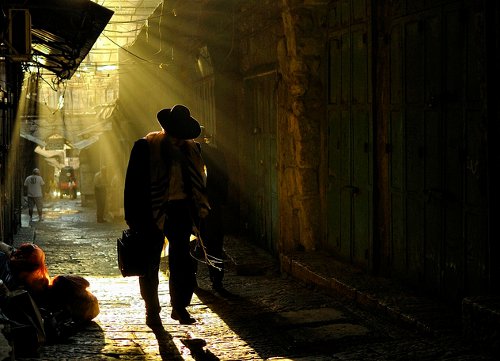
My wife showed me a photo of the Bar Mitzvah boy. Wow, what a young face. He was also wearing one of those black fedoras and a black jacket, which seemed strange on a kid that age. But then again, I’m not Chabad or even Jewish. Even if I discovered some long-lost family secret that my mother was Jewish, while halachically, that might make me Jewish, at almost 62 years of age, I would still lack a lifetime of Jewish experience.
In other words, I’d still think and feel like a Goy.
I think it’s OK for me and people like me to not pretend to be someone and something we’re not. It’s OK not to engage in what I’ve heard called “Evangelical Jewish Cosplay”.
I don’t think I have a Jewish soul, and I don’t think I’ve got long, lost Jewish ancestors, and I don’t think I’m a descendent of one of the lost tribes or any of that stuff.
I hang onto my current understanding of the Bible because it’s the one that makes the most sense. That’s why I’m about as welcome in a Christian Bible study group as a quart of Vodka at an AA meeting. Sooner or later, I’m going to say something that will be perceived as a threat.
Just showing up in a traditional Jewish venue would be enough to be looked at askance since I’m a Christian (what my wife calls me, not necessarily how I see myself).
Like I said, it’s easier and better to avoid trying to be something you’re not, especially since you’ll (I’ll) stick out like a clown at a funeral. Oh, for a time I can “blend into” a Church setting, but only until I open my mouth.
If religious community is important to you, then I hope you’ve got one where you are accepted for the person you are. I hope you fit in.
For those of you who don’t, welcome. That’s my world. That’s the world of a lot of us who hold to an alternate view of the Bible’s overarching message, particularly the actual meaning of the New Covenant. Some of you have found enough fellow “oddballs” within driving distance that you have formed your own groups. That’s good.
But we’re pretty strange ducks, and sometimes there isn’t a significant number of like-minded oddballs around to get together with.
Besides, within our own little sub-group, there are numerous sub-sub-groups who are just different enough to where we’re not going to get along for one reason or another.
Image: Cafepress.com
And then, there are those folks who are just plain “out there”.
So, if you have ever gotten that feeling that you don’t fit in, no matter how hard you try, maybe you’re trying too hard to belong in the wrong place. Instead of having that make you feel disenfranchised, maybe you should feel grateful.
Thank you God for making me who I am, even if that sort of person isn’t very common, and even if that person isn’t always easy for others to understand. The downside is you don’t have a small Bible study group to go to every Wednesday night (at least not without starting a theological “knife fight”). The upside is you don’t have to pretend to be someone you’re not. All you have to do is be the person you are.
What’s behind the whole concept of the Jews as the Chosen People? Isn’t this idea racist?
The Aish Rabbi Replies:
All human beings are God’s people, as it says that Adam and Eve were created in the image of God. Further, the great prophet Malachi said, “Have we not all one father? Has not one God created us?” (Malachi 2:10) The Talmud likewise points out that one reason the entire human race descends from a single set of parents, Adam and Eve, is so that no one would be able to claim his ancestors are greater than his fellow’s (Sanhedrin 37a). Judaism does not believe there is an inherently superior race of human beings.
I’ve been pondering the ramifications of giving up the identity crisis and becoming more comfortable with who I am. Relative to our relationship with God, there’s only really one thought to consider: you’re either Jewish or you’re not.
The Jewish people, the modern inheritors of the covenants Hashem made with the Children of Israel, are the only named participants in those covenants. For the rest of us, by attaching ourselves to the Jewish Messiah, we attach ourselves to Israel and thus by God’s grace and mercy, we are allowed to benefit from some of the blessings of the New Covenant.
But as the quote from the Aish Rabbi states, if the Jewish people are not inherently superior to the rest of humanity, and if we’re all created in the image of the Almighty, then why are there distinctions between Israel and the people of the nations at all?
Historically, however, the world slipped away from its relationship with God, and eventually the entire world was worshipping idols. Approximately 4,000 years ago, Abraham re-discovered the one God, and chose to accept the challenge of spreading the ideas of monotheism and morality to the world. Through his dedication and willingness to give up everything for God, he was chosen – and his descendants after him – to become the guardians of God’s message.
In other words, Abraham chose God, and thus God chose Abraham.
Abraham then passed this responsibility to his sons Isaac and Jacob. That mission was formalized 3,300 years ago at Mount Sinai, when God put these ideas into a written form (the Torah).
Oh, that.
Yes, Israel became the keepers of the Torah of Moses for many, many centuries as well as the only nation on the planet that paid homage to God and obeyed His laws and statutes.
Of course, in that time, there were a number of non-Jews who, seeing the wisdom and beauty of the Torah, attached themselves to Israel and eventually, after the third generation, assimilated completely into Israel, leaving behind their non-Israelite lineage.
But God didn’t desire that humanity either have to convert to Judaism (which is how modern Jews view the ancient assimilation process) or be out of relationship with Him. And while modern religious Jews believe that humankind is born into a relationship with the God of Israel through the Noahide covenant (see Genesis 9 and AskNoah.org), God had a better plan.
That plan was absolutely not to replace Israel and Judaism with Gentile Christianity. That plan was and is for the people of the nations to benefit from God’s ultimate redemption of Israel by redeeming us as well, at least those of us who accept that Moshiach is the mediator of the New Covenant, trust in him and obey God’s commandments as they apply to the Goyim.
We aren’t born into this covenant relationship, but we are grafted in essentially as “alien residents” among Israel (symbolically, since most of us don’t live among the Jewish people in national Israel) so that the barriers that previously separated us from Israel have been resolved.
Of course, this doesn’t mean that all Christians and all Jews get along. Quite the opposite in some cases. But it does mean that the Gentiles and Jews who revere Rav Yeshua (Jesus) within the context of the ekklesia (which does not mean “church”), and trust in Hashem to save, are part of a larger Messianic community that will be fully realized upon Moshiach’s return.
I’ve said all this before in one way or another, so why am I repeating myself (yet again) now?
Martin Luther King Jr. in the front line of the third march from Selma to Montgomery, Alabama with Rabbi Joshua Heschel, March 21, 1965
Because (and this is a gross oversimplification) once you learn that the only two identities you can have are “Jewish” and “Other” within the devotees to Israel’s God, there’s not much else to be concerned about.
But like I said, this is a gross oversimplification. People love labels and love to differentiate between groups by those labels and what they think those labels mean.
However, what we call ourselves and what we tell ourselves that means is probably less important than what we actually do about it. Is the non-Jew who says he or she “observes the Shabbat” any more or less loved by God or created in His image than the non-Jew who volunteers at the local food bank, donates clothing to the local homeless shelter, or who spends time with hospitalized friends and relatives because tzedakah (charity) was made part of our obedience to our Rav and thus to God?
Don’t get me wrong, I think the blessing of lighting the Shabbos candles is very beautiful, and so is inviting God into the home to share our rest, but the Shabbat is a unique sign of the Sinai covenant, a covenant Hashem made exclusively with the Children of Israel (and the mixed multitude present who would assimilate into the Israelites within three generations).
Once we acknowledge that we are either Jewish or not and we learn to be OK with that, our identity problems go away for the most part.
I am a (non-Jewish) disciple of my Rav.
Another person might say “I am a (non-Jewish) Christian,” and essentially mean the same thing.
OK, there are differences, but if I obey my Rav by donating to my local homeless shelter and the Christian obeys Jesus by donating canned goods to the local food bank, are we not both being obedient and following his commands? Are we not both being faithful in the same way to the same Master?
Sure, you might say that Christians believe in supersessionism, or deny that the Jewish people are still attached to God through the commandments and the Torah, or that they believe that Jesus “nailed the Law to the cross,” but which of us has a theology and doctrine that is 100% correct from Hashem’s point of view?
Probably no one. And yet with an imperfect understanding of the Bible, our Rav, and our God, we can still do good in His Name. That very likely describes 100% of Christians and observant Jews.
One Christian denomination rails against another spending a lot of time and resources to do so. One branch of religious Judaism rails against another spending a lot of time and resources doing so. And good grief, just look at those of us who live, study, and worship “outside the box,” so to speak. We waste a lot of time arguing about distinctions this and distinctions that.
Isn’t there a better way to use our resources and to obey our Rav?
There is once you let go.
Someone on a closed Facebook group recently asked non-Jewish group members why they became Messianic Gentiles and what was the biggest obstacle they had to overcome in entering into Messianic Jewish community.
I know these are important questions and answering them facilitates a sense of community among those who participate, at least a virtual community since these people (potentially) live all over the world, but in some ways, making that distinction also facilitates the identity crisis.
Who is a Messianic Gentile and what does that mean? What’s a Messianic Gentile’s relationship with Messianic Jewish community and how (or if) do we fit in? There are a bunch of other questions attached to those and there is no one unified answer.
But what if those aren’t the most important questions to ask and asking the right question gives us a better answer?
We are all created in the image of God. The Aish Rabbi said that the Jewish mission is to be a light to the nations. My interpretation is that Rav Yeshua is that light (John 8:12) and by becoming his disciple, we too become lights to the world (Matthew 5:14-16).
Maybe all we really have to answer is the question, “How can I better shine my light onto the world?” That’s a totally inclusive question because it applies to everyone, Jew and Gentile alike. Sure, the answer is somewhat different depending on whether you’re Jewish or not, but not as much as you think.
Both the Jew and the Gentile are commanded to do kindness and give charity. Both the Jew and the Gentile pray. Both the Jew and the Gentile give thanks to God for what He provides us from His grace, mercy, and generosity (Psalm 145:16).
I’ve stopped worrying about what to call myself (this is a lot easier for me because I’m not part of a religious community that has a label and expects that label to mean something specifically defining). I suppose there are any number of words that others use to define me. My Jewish wife for instance, considers me a Christian. From her point of view, she’s probably right.
But what about God’s point of view? Maybe the identity He assigned us, the person He created each of us to be, is based less on some theological system of belief and more on what we do about it.
If you behave like the person God created you to be, and strive each day to become a truer realization of that person, who cares what people call you? Who cares what you call yourself? It matters most of all how God sees you and your (our, my) response to Him.
Who am I? What do I call myself? Why, I’m “me”. I’m doing my best to be the person God created me to be. Or like Batman said, “It’s not who I am underneath, but what I do that defines me.”
“Every human being on earth has a personal relationship with God – whether he knows it or not. The fact that he is alive or that he/she is breathing is God’s expression of love towards that individual. Some people accept it, acknowledge it, reciprocate, but some people don’t. The Jewish people, in addition to this personal relationship, stand in a communal relationship, in a national relationship. The Jewish people stand together as a community in a relationship with God. This is an inter-generational community that has a covenantal relationship with God. When the Torah says ‘you’ it addresses this national communal entity.”
–Rabbi Yisroel Chaim Blumenthal
The other day I wrote a blog post mentioning a community of Noahides in Texas (and elsewhere) called Netiv (Hebrew for “path” or so I’ve been told). I wrote the article to highlight the differences as well as the similarities between these Noahides and those “Judaicly-aware” non-Jews I sometimes call Talmidei Yeshua (which I think is a better name for them/us than “Messianic Gentiles”).
While I was on the Netiv website, I had a look around and found a short article written by someone named Ida Blom called Pursuing Righteousness in the Nations.
The quote from Rabbi Blumenthal at the top of today’s “meditation” was taken from the opening words of Ms. Blom’s missive. In the span of a few short paragraphs (most of which I quote below), I discovered more interesting parallels between the world of Noahides and ours.
I quoted the above, to make a clear distinction between individual people (in the nations) and Israel. The individuals in the second group are part of the first group by default, but the reverse is NOT true. Looking at the first group, and focusing on the section of people in the nations who do in fact reciprocate with a deep longing to grow in righteousness and pursue this relationship, let’s focus on the ones who have taken the steps to come closer to the second group, and who desire to learn from them in how to be righteous in God’s eyes in the way that they (Israel) have been instructed by God to be a light unto these nations.
Ah, more distinctions between Israel (the Jewish people and nation) and the people of the nations who have attached themselves to Israel (Isaiah 14:1; Isaiah 56:6). These distinctions are easier to understand in the context Ms. Blom presents because it is clear that the relationship between Israel and the Noahides is distinguished by the effect of different covenants. The whole world is part of the covenant God made with Noah (Genesis 9) but only Israel is a named participant in the Sinai Covenant (Exodus 19-20), or for that matter, the New Covenant (Jeremiah 31:27).
Ms. Blom makes the point that the Jewish people are part of humanity, along with the people of the nations, but the people of the nations are not Israel. She goes on to say that we Gentiles look to Israel in order to learn the ways of righteousness. We must have a relationship with Israel to accomplish this.
Thus says the Lord of hosts, ‘In those days ten men from all the nations will grasp the garment of a Jew, saying, “Let us go with you, for we have heard that God is with you.”’
–Zechariah 8:23 (NASB)
This verse is well-known among those people like me and it seems to be lived out in the relationship between the aforementioned group of Noahides and their Jewish mentors.
But it is a relationship that is also desired by the Talmidei Yeshua, those non-Jews who choose to learn about Hashem (God), the Bible, and Rav Yeshua (Jesus) through a Judaicly oriented, Israel central lens.
Sometimes that relationship works well and at other times it doesn’t.
Actually, in quoting this article, the relationship between Gentiles and Jews doesn’t always work very well either:
And when Noahides show up at Chabad houses or synagogues, saying they want to learn Torah, they’re frequently turned away at the door.
I suppose after thousands of years of enmity between the nations of the world and the Jewish people, things are bound to remain a bit tense, at least under certain circumstances.
This next part I found to be very telling:
Why do the people in the first group, after coming out of our past religions, almost try to reverse-engineer our relationships with God in our zeal to find some identity? Because nobody but us will understand from experience, how and to what degree and price we have lost any previous identity. We are prepared to let go because of our quest for truth. True, we have to re-learn and unlearn MANY things, but there are some foundations which remain. We want to start with a new, clean slate, but by doing that, we almost throw the proverbial baby out with the bath water. We ourselves create the void and then grab onto labels like noahide or ger or alternatively remain in the non-Jewish pool, feeling rudderless.
After leaving our former identity and context within normative Christianity, these Noahides struggle to establish a new identity in somewhat foreign territory and yet sometimes they “remain in the non-Jewish pool, feeling rudderless” to dodge being lost in the “void” while scrambling for a name and a label to call their own.
Sound familiar?
This is exactly what many non-Jews experience in their attempt to establish a place of belonging within Messianic Judaism, particularly those communities that really do function as a Judaism for Jews first and only afterward, a place for non-Jews to learn and worship as well.
See? We’re not alone. Noahides go through this, too. I suspect the non-Jewish disciples of our Rav that Rav Shaul (the Apostle Paul) made may have felt like this. Not quite fitting in. Not really understanding all of the prayers, all of the ceremonies and the praxis involved in a Shabbat service.
This is probably one of the reasons it was good with the Jerusalem Council and with the Holy Spirit not to lay the “burden” of all of the 613 commandments upon the shoulders of newly minted Gentile disciples of Rav Yeshua (Acts 15:24-29). It was enough for them to learn little by little, from one Shabbat to the next, hearing the Torah of Moses read and taught in the synagogues of the diaspora (Acts 15:21).
However, Ms. Blom has some good news for Noahides, and I believe for us as well:
Let’s forget the labels for a moment and try to ignore our desire for belonging and having an identity. Why work backwards? Don’t we belong already? Think bigger! See God’s hand in your life! He brought you this far! When reading the above quote, we fall perfectly into the first group AND have been drawn by Him to reciprocate. That is a huge blessing! Did we believe in the God of the Bible, the God of Israel? YES. Of course we deviated badly along the way, but did we ever deny His existence? Did we ever deny that He is our Father? NO.
She believes the way for them/us to solve their/our “identity crisis” is not to worry about identity or belonging. We already belong. Yes, but to what or who?
To God, of course. Blom obviously “dings” Christianity in this paragraph saying that these former Christians had “deviated badly.” On the other hand, even people in the Church do not deny the existence of the Almighty and that He is our Father, the Father to all.
All we needed was a bit of a course correction, so to speak, a clearer vision of the goal we were pursuing.
According to Blom, we were loved by God and He was by our side when we were in our churches, and, again according to her, God is by the side of the Noahides as they have determined a better way of pursuing righteousness for the nations.
That might be a good lesson for we Talmidei Yeshua to learn as well, rather than banging and pounding away at the door of our identity screaming at the top of our proverbial lungs, “Let us in!”
Blom says we’re already in.
The LORD is near to all who call on Him, to all who call on Him in truth.
–Psalm 145:8
If you want to tell people the truth, make them laugh, otherwise they’ll kill you.
The Jewish people, the Almighty, the Torah and Eretz Yisroel (The Land of Israel). For more than 3,300 years we’ve been bound together. Did you ever wonder what the Sages taught us about how special is the Land of Israel? Here is a compilation from The Mitzvah to Live in Eretz Israel:
“There is no love like the love for the Land of Israel” — Bamidbar Rabba 23:7.
“There is no Torah like the Torah of the Land of Israel” — Bereshit Rabba 16,7.
“The air of the Land of Israel makes one wise” — Talmud, Bava Batra 158b.
“There are 10 portions of Torah in the world: 9 in the Land of Israel and 1 in the rest of the world” — Esther Rabba 1.
“If you desire to see the Shechina (Divine Presence) in this world, study Torah in the Land of Israel” — Midrash Tehillim 105.
“Living in the Land of Israel is the equivalent to all the mitzvot (commandments) in the Torah” — Sifrei, Parshat Re’eh, Tosefta Avoda Zara 5).
The Ramban, Nachmanides, writes that “We are commanded to take possession of the Land God gave to our forefathers, Avraham, Yitzchak and Ya’akov (Abraham, Isaac and Jacob). We must not leave it to others or in desolation, as God told them, ‘And you will take possession of the land, for I gave the Land to you to possess and you will settle the Land which I promised to your fathers’ (Deut. 17:14, 26:1).”
Israel is far more than just a country or a refuge for the Jewish people — it is an integral part of our spiritual destiny!
-Rabbi Kalman Packouz
Shabbat Shalom Weekly commentary for Torah Portion Bo (Exodus 10:1-13:16) Aish.com
It’s quite clear Rabbi Packouz is addressing a Jewish audience. After all, what other people have ever been commanded to take possession of and live in the Land of Israel? Only the Jews, the modern descendants of the ancient Hebrews, the Israelites who wandered the desert for forty years prior to coming into their inheritance.
But I know more than a few non-Jewish Talmidei Yeshua who are envious and also desire the blessings listed above (I only quoted part of Rabbi Packouz’s article, so please click the link I provided above to read the full write-up).
I suppose we should be a little envious. After all there are tremendous blessings accorded the Jewish people for living in Israel that cannot be apprehended by anyone who isn’t Jewish. Further, except for maybe some exceptional cases, in Messianic Days, Israel will be filled with all or most of the world’s Jewish population. Imagine the prophesies finally being fulfilled.
“For I am the Lord your God,
The Holy One of Israel, your Savior;
I have given Egypt as your ransom,
Cush and Seba in your place.
“Since you are precious in My sight,
Since you are honored and I love you,
I will give other men in your place and other peoples in exchange for your life.
“Do not fear, for I am with you;
I will bring your offspring from the east,
And gather you from the west.
“I will say to the north, ‘Give them up!’
And to the south, ‘Do not hold them back.’
Bring My sons from afar
And My daughters from the ends of the earth,
Everyone who is called by My name,
And whom I have created for My glory,
Whom I have formed, even whom I have made.”
The mashiach will bring about the political and spiritual redemption of the Jewish people by bringing us back to Israel and restoring Jerusalem (Isaiah 11:11-12; Jeremiah 23:8; 30:3; Hosea 3:4-5). He will establish a government in Israel that will be the center of all world government, both for Jews and gentiles (Isaiah 2:2-4; 11:10; 42:1). He will rebuild the Temple and re-establish its worship (Jeremiah 33:18). He will restore the religious court system of Israel and establish Jewish law as the law of the land (Jeremiah 33:15).
All of this is part of the Jewish argument that Jesus (Yeshua) couldn’t possibly be the Messiah because during his earthly life in the late Second Temple period, he did none of these things and then he died.
Christians believe that he was resurrected, ascended into Heaven, is our High Priest in the Heavenly Court, and in due time, will return.
Most Christians don’t believe Jesus will politically and spiritually redeem the Jewish people upon his return, although they probably would agree that if Jews converted to Christianity, they would receive spiritual redemption (I don’t think the Church would go for the idea of Israel being an actual political entity under Jesus, let alone the Kingdom that would rule all the other nations of the world, even though the Bible states this).
I know a lot of Christians who would vehemently oppose any idea that Jesus would rebuild the Temple and re-establish the Levitical priesthood and sacrifices, let alone restore the Sanhedrin court system.
But if we set aside Christianity’s traditions as they steer the Church’s doctrinal teachings, and if we accept the fact that non-Jews do not have a portion in the Land of Israel, just what do we Goyim have as far as Israel goes?
Thus says the Lord God,
“Behold, I will lift up My hand to the nations
And set up My standard to the peoples;
And they will bring your sons in their bosom,
And your daughters will be carried on their shoulders.
“Kings will be your guardians,
And their princesses your nurses.
They will bow down to you with their faces to the earth
And lick the dust of your feet;
And you will know that I am the Lord;
Those who hopefully wait for Me will not be put to shame.”
–Isaiah 49:22-23
“Arise, shine; for your light has come,
And the glory of the Lord has risen upon you.
“For behold, darkness will cover the earth
And deep darkness the peoples;
But the Lord will rise upon you
And His glory will appear upon you.
“Nations will come to your light,
And kings to the brightness of your rising.
“Lift up your eyes round about and see;
They all gather together, they come to you.
Your sons will come from afar,
And your daughters will be carried in the arms.
–Isaiah 60:1-4
New arrivals at Ben Gurion airport
It seems our job is to facilitate the return of the Jewish people to Israel, to not just “surrender” them from our lands, but to take an active part in the Messiah’s mission to return each and every Jewish man, woman, and child to the bosom of their nation Israel, for the Jews are the nation of Israel. I’ve tried looking for information regarding what, if any, inheritance Gentiles may expect regarding Israel, but there’s nothing clearcut.
Will the Gentiles who have joined themselves to the Lord be separate from His people? The God of Israel says, “No. They will be part of My household, My family.” Will the Gentiles who join themselves to the Lord be excluded from the holy place and service of the Lord? God says, “No. They will worship Me in My house, along with those of the dispersed of Israel whom I have gathered. They will be gathered to the remnant of Israel.”
“In the last days, the mountain of the house of the Lord will be established as the chief of the mountains, and will be raised above the hills: and all the goyim will stream to it. And many peoples will come and say, ‘Come, let us go up to the mountain of the Lord, to the house of the God of Jacob; that He may teach us concerning His ways, and that we may walk in His paths, for the law [Torah] will go forth from Zion, and the word of the Lord from Jerusalem.’ And He will judge between the goyim, and will render decisions for many peoples; and they will hammer their swords into plowshares, nation will not lift up sword against nation, and never again will they learn war.” (Is. 2:2-3, Mic. 4:1-3)
God gave Ezekiel visions of a time to come when living, healing water would flow out of Jerusalem. (Ezek. 47:1-12) The Lord told Ezekiel that the alien in the midst of Israel will be allotted an inheritance among the tribes of Israel. (Ezek. 47:21-23)
I should point out that from a Jewish point of view, Ezekiel 47:21-23 isn’t about giving Gentiles part of the Land of Israel.
Question: Are we as “gentile Christians” part of Israel (Rom 11:17)? Do any of the promises made to Israel as a nation apply to us, for example Deuteronomy 28 (I’ve often heard this one used by prosperity teachers although they never read past the fourteenth verse).
Answer (in part): Regarding your first question, I would say that “no” we are not “part of Israel” as gentile Christians. Both Jewish and Gentile Christians today make up the “Church” the “body of Christ” or “one new man” which Paul discusses in Ephesians 2. We, as Gentiles, were aliens from the commonwealth of Israel and strangers from the covenants of promise (Eph. 2:12), but now we have been brought near through Christ. But notice that we are not said to be “part of Israel” or a “new Israel.” Instead, both Jews and Gentiles are said to be joined into a new spiritual body, the one new man (Eph. 2:15). Another evidence that we are not “part of Israel” is found by carefully examining Paul’s use of the term “Israel” in Romans 9-11, and especially chapter 11. There, it will be found that “Israel” still refers to Jews.
Regarding your second question, “Do any of the promises made to Israel as a nation apply to us, for example Deuteronomy 28 . . .”
While there are principles in Deu. 28 which apply in general (e.g., God will bless a nation which is devoted to Him and follows His will, He will turn away from a nation—such as ours—which forsakes Him), the context of the passage is very clearly specific to the nation Israel. It includes curses which make absolutely no sense when applied to Gentiles (believers or otherwise). For example, the promise of worldwide scattering in judgment of disbelief: yet Gentiles (non-Jews) have always been scattered all over the world.
Whereas all scripture is written for our learning (Rom. 15:4), it is not all written specifically to us—and this is the case in Deuteronomy 28. Both the blessings and curses stated there apply to Israel, as the phrase “wandering Jew” and history abundantly prove.
Concerning the blessings which come to believing Gentiles, this is best understood by studying the relationship between the New Covenant (given to Israel in Jeremiah 31) and the Church.
Of course, there are a seemingly endless collection of Jewish and Christian information sources on the web, so this is only a very tiny sampling.
I couldn’t find anything at AskNoah.org about what sort of connection there could possibly be between a righteous Gentile and the Land of Israel.
Gentiles were welcomed to bring their sacrificial offerings for G-d to the First and Second Temples in Jerusalem, and they will participate even more at the Third Temple – especially during the festival of Sukkot (Zechariah 14:16).
Also…
In his commentary on the Torah section beginning with Genesis 12:1, Ramban (Nachmanides) wrote:
“Even in the time of Joshua, … the Gentiles knew that this place was the most august of all, that it was at the center of the inhabited world; and [Torah] Tradition had taught them that it corresponds in this world to the celestial Temple where Divine Majesty, called (righteousness), resides.”
And…
When the First Temple was inaugurated by King Solomon, he beseeched G-d with an eloquent prayer that included the following words (Kings I, 8:41-43) (which show that in the past, Gentiles were welcomed to the First and Second Temples, and that they will participate even more in the Third Temple)…
And finally, the article quotes from Isaiah 2:2-3 regarding the participation of Gentiles in the Temple:
“And it will come to pass at the end of days that the mountain of G-d’s House will be firmly established, even higher than the peaks, and all the peoples will flow toward it as a river. And many nations will go and will cry, ‘Let us go up toward the mountain of G-d’s House, to the House of the L-rd of Jacob, and we will learn from His ways and walk in His paths, for out of Zion goes forth Torah and the word of G-d from Jerusalem.’ “
Of course, participation in the Temple rites is not the same as having any portion in the Land. Isaiah 56 aside, I can’t find a legitimate Jewish commentary saying that any Gentiles will have a permanent home in the Land of Israel at all. It seems that we can certainly visit, and if intermarried, the Gentile would probably live in Israel with the Jewish spouse, but that’s about it.
Christian tourists in Israel
Is that such a bad thing? I know some people who operate in the Hebrew Roots space who most likely would think so. I think some of those non-Jews somehow believe they have “rights” not only to the Land of Israel, but to the Torah mitzvot as well. It’s been a long-standing argument. The relationship between Gentiles and the Land of Israel is probably something like how Jews traditionally accept Gentiles visiting the synagogue:
Non-Jews are always welcome to attend services in a synagogue, so long as they behave as proper guests. Proselytizing and “witnessing” to the congregation are not proper guest behavior.
When going to a synagogue, you should dress as you would for church: nicely, formally, and modestly. A man should wear a yarmulke (skullcap) if Jewish men in the congregation do so; yarmulkes are available at the entrance for those who do not have one. In some synagogues, married women should also wear a head covering. A piece of lace sometimes called a “chapel hat” is generally provided for this purpose in synagogues where this is required. Non-Jews should not, however, wear a tallit (prayer shawl) or tefillin, because these items are signs of our obligation to observe Jewish law.
During services, non-Jews can follow along with the English, which is normally printed side-by-side with the Hebrew in the prayerbook. You may join in with as much or as little of the prayer service as you feel comfortable participating in. You may wish to review Jewish Liturgy before attending the service, to gain a better understanding of what is going on.
Non-Jews should stand whenever the Ark is open and when the Torah is carried to or from the Ark, as a sign of respect for the Torah and for G-d. At any other time where worshippers stand, non-Jews may stand or sit.
When we non-Jews are in Israel, we are guests and we are expected to treat our hosts with proper respect, just as if we were visiting someone else’s house. You wouldn’t go into someone else’s home and act as if you lived there, would you?
One of the wonders of the future redemption is the revelation of the Divine light that will shine onto the whole world, to all humanity (Isaiah 60:3). From the power of this light, all people will recognize the true existence of the Master of the world, Who fills the whole world, as stated by the prophet Isaiah (52:8-10): “with their own eyes they will see that G-d returns to Zion. Burst out, sing glad song in unison, O ruins of Jerusalem together, for G-d will have comforted His people; He will have redeemed Jerusalem. G-d has bared His holy arm before the eyes of all the nations; all ends of the earth will see the salvation of our G-d.”
Just as Moses our teacher at Mount Sinai began to repair the world, including all the Children of Noah by giving the Seven Commandments that were commanded to them, so too, the Messiah will teach and show the world (but in a more wondrous manner) the same recognition in the truth of the Creator of the universe which began to be revealed by Moses.
It is a great merit for each and every one of us to bring himself and his community to the faith and anticipation of this future freedom for the whole world. This will be freedom from evil and falsehood, and a redemption by which we will merit to go out from darkness to a great and true light.
Certainly it seems, the righteous Gentiles are included in many of the blessings of Messiah and that both Jew and Gentile will “go out from darkness to a great and true light.”
But that’s as far as I can understand it. All of those blessings Rabbi Packouz mentions that are received by those living in the Land of Israel are only received by the Jews living in the Land of Israel. For the Gentiles, not so much.
I can only imagine that Gentiles are still blessed in some manner when they/we visit Israel, but we’re visitors and guests, not residents. We may be associated with Israel as citizens of the vassal nations, subservient to our King, and we may have been brought near to her (see Ephesians 2:13) so that there is to be peace between Israel and we people of the nations (although I suspect that peace won’t be truly realized until the Messiah establishes his reign as King in Israel over the world), but none of that means that we are Israel, nor that we have rights to any of her real estate (at least as far as I can discover).
I guess in the resurrection, just like right now, I’ll have to be satisfied with my own little corner of Idaho.
My (Jewish) wife did surprise me again the other day. Out of a proverbial “clear blue sky,” she asked me if I’d given up on any plans to visit Israel. I didn’t know what to say. One circumstance or the other has gotten in the way and I haven’t even been thinking of it lately. I also am concerned about expenses for a number of complicated (and private) reasons, so thought maybe my long-suffering wife would appreciate it if I didn’t spend thousands of dollars playing tourist in the middle east.
I don’t know.
Blogger Ro Pinto wrote multiple blog posts about her recent trip to Israel including this summary, and it is abundantly obvious that she has a tremendous love of and devotion to the God of Israel, His people, and their Land. Some of her spiritual insights border on spectacular, which is a realm that has always eluded me.
Compared to how she related to Israel during her trip, I can’t imagine achieving anywhere near such experiences and insights. I think a visit to Israel is supposed to be as much about what you bring to the table spiritually as what you expect to receive.
Visiting Israel as a Gentile is not like traveling to any other nation on Earth. Jerusalem is the only city on the planet where God has put His Holy Name. Every time I seriously think of traveling to the Holy Land, I feel humbled and chagrined. Who am I compared the men and women of the Bible who trod that ancient Land, the Prophets, the Kings, the warriors, the scholars?
Every time I read or hear from some non-Jewish person who lays claim to Israel or the Torah, I’m astonished at the “Obama-like” audacity they exhibit. The feeling of being able to do anything you want, regardless of the (in this case Biblical) Law, without so much as a “by your leave”. You can’t bypass the God of Israel with a pen and a phone.
Who among the Gentile Talmidei Yeshua hasn’t felt the call of Israel at one point of another in our lives? Who hasn’t, at some time in our existence, wanted to bathe in the glow of the blessings Rabbi Packouz outlined in his “Shabbat Shalom Weekly” article?
But it’s like being a kid and watching the boy or girl next door receive a shiny new bicycle for their birthday. Just because you want to ride on that bike too, doesn’t mean it belongs to you.
The Vatican says the Catholic Church must not try to convert Jews to Christianity.
Instead, the Catholic Church must work with Jews and Jewish institutions to further dialogue and mutually understand and fight anti-Semitism, according to the Vatican, which pledged “to do all that is possible with our Jewish friends to repel anti-Semitic tendencies.”
It [the document “The Gifts and Calling of God are Irrevocable”] added, “In concrete terms this means that the Catholic Church neither conducts nor supports any specific institutional mission work directed towards Jews.”
Goals in Jewish-Catholic dialogue, according to the document, include “joint engagement throughout the world for justice, peace, conservation of creation, and reconciliation” in a way that would make the religious contribute toward world peace. “Religious freedom guaranteed by civil authority is the prerequisite for such dialogue and peace,” it said.
“In Jewish-Christian dialogue the situation of Christian communities in the state of Israel is of great relevance, since there — as nowhere else in the world — a Christian minority faces a Jewish majority,” the document said. “Peace in the Holy Land — lacking and constantly prayed for — plays a major role in dialogue between Jews and Christians.”
from the article “Vatican Says Jews Don’t Need Christ to be Saved” VirtualJerusalem.com
Well, that’s quite the revelation.
I’m sure anti-missionary groups such as Jews for Judaism will be happy to hear they won’t have to worry about Roman Catholics trying to convert Jews anymore.
I do agree that, as much as evangelism is a priority for the Christian Church, most Christians seem to think of converting Jews in a different light than any other people group. Maybe they think they get extra “points” from God when they convert a Jew (not that most Jewish people would feel good about this).
How Jews being saved while not believing in Christ “can be possible remains an unfathomable mystery in the salvific plan of God,” they say.
I tried to find Christian reactions to this situation, but the closest thing I could find was at Rapture Forums (the name already has my spider-sense tingling).
“Jerusalem, Jerusalem, who kills the prophets and stones those who are sent to her! How often I wanted to gather your children together, the way a hen gathers her chicks under her wings, and you were unwilling.”
The news is pretty new, so a lot of folks may not have weighed in with their opinions yet.
I turned to Facebook and something called The Truth is Viral displayed the most comments of anyone posting this story, at least as far as my short search could find.
Of 27 comments, the first two that appeared were:
Ronald: The Babylon Whore that rides on the Beast and commits fornication with the kings of the Earth . The Anti-Messiah who is drunk with the blood of the saints.
Matt: There was a Twilight Zone like this, the whole world had to change and we thought it was to get along but the reality was to see who was strongest and we destroyed ourselves.
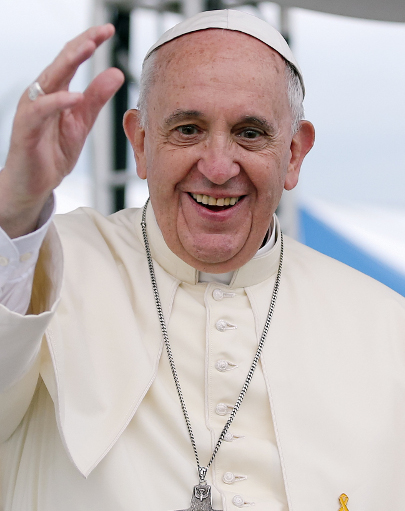
2014 Pastoral Visit of Pope Francis to Korea
Others accused the Pope of worshiping Satan, that Mohammad was a false prophet (though Mohammad and Islam have nothing to do with this as far as I can tell), and other similar statements.
I decided to return to an old source for a more sane perspective:
But the Gospel for Jews works differently. It’s the same Gospel, but because the Jews are already God’s people, the Gospel of Yeshua the Messiah comes in a different way. It is still the case that through the Messiah, and only through Him, individual Jews receive atonement and forgiveness of sin – “For there is no other name under heaven given to mankind by whom we must be saved!” (Acts 4:12). But Jews are not alienated from the commonwealth of Israel, they are the commonwealth of Israel! They already have the covenants and the promises; and therefore in a communal sense they already have hope and “have” God. Before accepting Yeshua, Jews do not “have” God and His hope in the same sense as after accepting Him. After accepting Yeshua they have hope and God in an individual, salvific sense – they have forgiveness of their sins, God sees them as righteous because of Yeshua’s atoning death, and they have the certain hope of eternal life with God. Before accepting Yeshua a Jew does not have the certain hope of eternal life with God, but he does share in the communal promises to the Jewish people as a whole – for example, a share in the Land of Israel. A Jew needs God in both the communal and individual senses because this is how God has ordained that it should be.
The Christian attitude toward the Jewish people should be, “The Jews are my home, my family.” Whether the Jewish people will accept Christians as family will depend on how the Gospel is presented to them, and it is the task of Christians and Messianic Jews to find the right way. But an essential aspect of this presentation will be defining the Gentile Christian in the way I have done – rather than in the way Christians have, by their words and deeds, defined themselves: either as enemies of the Jewish people, alienated from their national life, or as people who have no connection with the Jews and can be oblivious to them, or even as outsiders who respect and love the Jews a lot. These definitions not only contradict texts Christians claim to believe, but often foster behavior toward the Jewish people that is sinful, behavior which distances Jewish people from the Gospel and from the Gentile branch of the People of God.
Christians need to redefine who they are in relation to the Jewish people – and then act on the consequences of that redefinition with a renewed commitment to bringing the gospel to Jews. This is the biggest challenge facing the Church.
I’ve heard it said, according to a source I quoted over eighteen months ago, that one of the primary functions of Yeshua’s first coming was to provide proof that God’s New Covenant promises to the Jewish people were true.
For instance, the New Covenant (see Jeremiah 31 and Ezekiel 36) promises a universal resurrection from the dead. Yeshua was the first person resurrected from the dead, also called “the firstborn of the dead” (Colossians 1:18). He’s the first, but certainly not the last. His resurrection establishes proof that God will resurrect all of the dead in time.
The indwelling of the Holy Spirit, to the point where even the least among humanity will have an apprehension of God greater than the prophets of old, was also established, first by Yeshua (Matthew 3:13:17), then by the Jewish apostles (Acts 2:1-4), and finally even coming to the Gentiles (Acts 10:44-46).
The New Covenant states that God will forgive the sins of all Israel, which is restated in Romans 11:25-27, and Yeshua forgave the sins of many due to their faith in Hashem and his ability to do so.
Thus Yeshua made a partial delivery on God’s promises and he will complete his mission fulfilling all that Messiah is to do upon his return.
You can click this link to read my thoughts on an insightful comparison between those Jews who have accepted the revelation of Yeshua as Messiah and those who haven’t. In essence, it seems to partly agree with the Pope that the Jewish people are already born into a covenant relationship with Hashem, so that even those who reject Yeshua are not excluded from the Sinai covenant or necessarily from the New Covenant, even though Messiah is the arbiter of that covenant.
I also have to agree somewhat with this latest assessment by the Catholic Church that we do not fully understand the exact mechanism by which Hashem will accomplish all these things. We do know from the New Covenant language that He has promised to do it, and so He will.
Yeshua points Israel back to Hashem and His promises to them. For the rest of us, who were born with no covenant relationship with God whatsoever (unless you accept what is written in Genesis 9 as the Noahide covenant which is binding on us), God, through His mercy and grace, is willing to include us in many of the blessings of the New Covenant, even though we are not named participants, and for the sake of His prophets who declared that every knee will bow (Psalm 72:11; Isaiah 45:22-25; Romans 14:11).
So it’s not like Yeshua is a moot point to the Jewish people or Israel. But Israel’s status in relation to Hashem is somewhat different from that of the Gentile believers because they have a pre-established relationship with God that the rest of the world lacks. Yeshua is the lynchpin, but as Stern pointed out, that works out somewhat differently for the Jewish people than it does for everyone else.
I think I understand, at least a tiny bit, what the Pope is trying to do, relative to establishing better relations between the Catholic Church and the Jewish people, but how he delivered his information, or at least how it’s been covered in the media, is probably going to kick up a major dust storm in the Christian world, particularly with conservative Evangelicals and Fundamentalists.
Christians, in general, believe the New Covenant fully replaced all prior covenants God made, and so they believe that God’s relationship with everyone, including Jews, is identical and that the Jews have no special status. Until the Church learns to accept that Israel remains in covenant relationship with God, they will continue to woefully misunderstand the Jewish people and God’s plan of redemption.
I can only imagine that this blog post could be read with considerable “annoyance” by some Jewish people as well as some Christians, and believe me, I did not write this to offend. I did want to explain (and obviously, I’ve written on similar matters previously) that what the Pope’s comments touched upon is a highly complex situation that is poorly understood by the vast majority of believers, including Christian clergy and scholars.
For that matter, the role of Yeshua as the forerunner of the completed New Covenant promises is poorly understood by both Christians and Jews. Again, I say this not to offend, but to illustrate that what we think we know from the Bible is a highly nuanced and subtle set of messages that requires careful unpacking and analysis. This is difficult for most people because long-established traditions on both sides of the aisle have been constructed to obscure this perspective.
If anyone is tempted to complain to me about this, I ask that you first consider these words:
Instead of complaining about someone’s behavior toward you, it is more constructive to work on your own behavior toward him.
Ignore another person’s grouchiness and anger, and speak cheerfully and with compassion. If you find this difficult, pretend that you are an actor on stage. Adopting this attitude can keep people from much needless quarreling and suffering. Do it consistently and you will see major improvements in their behavior toward you.
Be flexible. People differ greatly on what they evaluate as “positive,” and it is necessary to understand the unique needs of each person you’re dealing with. If one approach is unsuccessful, try other approaches. But keep trying.
-Rabbi Zelig Pliskin
“Put On Your Best Act”
from the Rabbi’s book Gateway to Happiness, p. 137
quoted at Aish.com
As I mentioned a few days ago, in a difficult situation, it is best to seek that small encouraging light in otherwise dark and foreboding surroundings. A fitting sentiment for the current season.
I never know from day to day if I’ll ever write here again, but something just happened that caught me completely by surprise and I think it’s relevant.
My wife said she’d be going to shul tonight. I knew the High Holidays were coming up, but for the first time in a long time, I haven’t been keeping tabs on the exact dates. I don’t regularly read my email updates from Aish or Chabad anymore. And (gasp) I’ve stopped regularly reading the Torah portion.
That last part was initially because between the gym, yard work, and my “honey do” list, I didn’t have a lot of free time on Saturday, and by the time I did, my brain was too fried to really get much out of study. Also, I’ve been doing a free-lance project that I try to cram into my weekends.
Anyway, for a variety of reasons I’ve stated in previous blogs, I’ve become increasingly disconnected from the world of Messianic Judaism or any Judaism for that matter.
I wish I could say I’ve become increasingly connected with God through some other avenue, but this is not the case. My vague plans for forging a more one-on-one relationship with God haven’t come to fruition, primarily because I find other things to do with my time.
But I have, to a large degree, ceased to employ Judaism in any form to be the interface or conduit between me and God. The Church convinced me that I don’t belong within traditional Christianity and I’ve gotten a creeping suspicion over the last months or maybe even years, that I’ve been fighting a losing battle in believing that, even as a “Noahide-style” Gentile, I had a place within Messianic Jewish (online or otherwise) community.
And so I now have the proof that it is possible for me to pull away. Actually, I have two proofs. The first is the increasingly long gaps between making one blog post to another here. The second, and this is very dramatic to me, is forgetting all about Rosh Hashanah.
I wouldn’t have noticed at all if my wife hadn’t mentioned it. In fact, she just walked out the door to leave for synagogue.
So what is my morning meditation if it isn’t found in this place anymore? The very last vestige of what I’m beginning to think of as my former life is that I still mentally recite the Modeh Ani blessing when I first wake up, thanking God for returning my life to me each morning.
Gratitude to God for waking up alive each morning. A basic awareness that my life and everything in it is dependant on God’s grace and mercy.
Tonight, my Jewish wife is going to synagogue. It’s Rosh Hashanah. That’s where a Jew belongs on the Jewish New Year. May God grant her a sweet and good life in the coming year. But that doesn’t mean it signifies any sort of new beginning for me…at least not anymore.
I have to admit that it probably was arrogant presumption on my part to believe it ever did.
Tomorrow is Monday. Time to hit the gym and then go to work. The reinvention of whatever I am is going slowly.
"When you awake in the morning, learn something to inspire you and mediate upon it, then plunge forward full of light with which to illuminate the darkness." -Rabbi Tzvi Freeman


 My wife is very protective of her Judaism and her Jewish community. The occasional “Messianic” (Jew or Gentile, it doesn’t really matter to her) who shows up at Chabad kind of rubs her the wrong way. Fortunately, the Bar Mitzvah was by invitation only, so it was unlikely to attract the casually curious or the Messianic who wanted to dive a tad deeper into actual Jewish life.
 I don’t blame her for not including me in her Jewish life, either. The more I’ve disconnected myself from any formal association with Messianic Jewish groups, the more I have begun to realize that maybe I never belonged in the first place. Of course, I belong in a church about as much as a nudist in a nunnery, so I’m not saying that traditional Christianity is an option for me either.












 Morning Meditations