Tag Archives: Jewish

The Convert and the Disciple: A Shavuot Lesson

Question:

I attended synagogue services on the holiday of Shavuot morning, and we spent a half-hour reading the Book of Ruth. Is there any special connection between Ruth and Shavuot?

The Aish Rabbi Replies:

The Torah and prophetic reading on Yom Tov always relate to a deeper theme of the day.

In this case, Ruth is the ancestor of King David, who was born on Shavuot, and died on Shavuot.

Another reason is because Ruth is the quintessential Jewish convert, and on the very first Shavuot – when the Torah was given at Mount Sinai – each Israelite essentially became a “Jew by Choice.” That’s why the Talmud and Code of Jewish Law use the Sinai experience as a basis for determining the requirements of all future converts:

1) Mikveh – All converts must immerse in a Mikveh (ritual bath), as the Israelites did at Mount Sinai (Exodus 19:14, 24:8).

2) Milah – Male converts must undergo circumcision, as the Israelites did before leaving Egypt (Exodus 12:48 and Joshua 5:5).

3) Mitzvot – All converts must accept to observe all 613 mitzvot of the Torah, as the Israelites did at Mount Sinai (Exodus 24:3).

Interestingly, the Torah intimates that the souls of eventual converts were also present at Sinai, as the verse says: “I am making [the covenant] both with those here today before the Lord our God, and also with those not here today.” (Deut. 29:13)

From “Ruth and Shavuot”
the Aish Ask the Rabbi column
Aish.com

In my recent review of the Mark Nanos essay “The Question of Conceptualization: Qualifying Paul’s Position on Circumcision in Dialogue with Josephus’s Advisors to King Izates” as found in the book Paul within Judaism: Restoring the First-Century Context to the Apostle (Kindle Edition), citing Nanos, I commented that the Apostle Paul was very much against the non-Jewish disciples of Yeshua (Jesus) converting to Judaism, frankly, because it was unnecessary. In Messiah, Gentiles have an equal communal status with the Jewish disciples, the same indwelling of the Holy Spirit, and the same promise of the resurrection.

mikvahThe other major reason that Paul discouraged Gentiles from converting is that it would undermine God’s promise to Abraham that he would be the father to many nations. If we all converted to Judaism as a means of accessing a covenant relationship with God, then God’s promise that not just the Jewish people but all peoples would bow to Him, would be null and void. And as I hope you realize, it’s impossible to thwart the plans and promises of Hashem, God of Israel.

So is there any good reason for a Gentile in Messiah to convert to Judaism? There must be, because some few such converts exist (I have no statistics as to exactly how many there are or where they can be found and only personally know of one such person).

I also know that some critics of Messianic Judaism in the Hebrew Roots space believe that the practice of conversion is not presupposed in the Torah and thus is unbiblical, not to be recognized by those Gentiles who believe the Torah applies equally to all, Jew and Gentile alike.

However, as we see above, the Jewish people certainly do believe there is a precedent in the Torah that allows for ritual conversion of Gentiles, bringing them into Israel as (Jewish) children of Abraham.

Neither Christianity nor any branch of Judaism believes that Gentiles must convert to Judaism and indeed, Christianity sees converting non-believers to themselves is the desirable outcome, not becoming a member of the tribes, so to speak.

I also mentioned before that both in the late Second Temple period and today, those of us, that is, non-Jews who have some sort of connection with Judaism in general and Messianic Judaism in particular, often suffer from an identity crisis. More than once, the dissonance of who I’m supposed to be and what I’m supposed to do given my rather unique outlook on the Bible, has stirred a great desire in me to “throw in the towel” and stop associating with religious people altogether, both face-to-face and over the web.

It’s not an easy life.
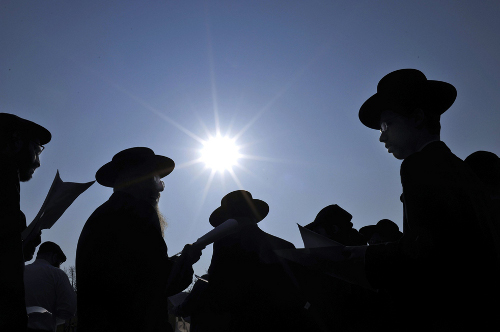
Orthodox JewsSome non-Jews entering Messianic community have shot out the other end, so to speak, and converted to (usually Orthodox) Judaism as a way to end that dissonance and secure a religiously and socially acceptable identity within Judaism. To do so however, they had to surrender all fealty to Yeshua as Messiah and King, thus, from Christianity’s point of view, becoming apostates.

I believe, both in ancient and modern times, that God gave the Jewish people the ability to be “gatekeepers” into their realm. Nanos spoke of a “chronometrical gospel”, that is, a time-related good news event or set of events, a good news that entered our world heralding the advent of the New Covenant promises with the birth, life, death, resurrection, and ascension of the Master, the Messiah.

Prior to Yeshua, there was a mechanism in place whereby Gentiles who were drawn to the God of Israel could undergo a ritual allowing them to join Israel and thereafter be considered indistinguishable from the born Israelite. It was the only real option for such Gentiles, apart from the status of God-Fearers who had no covenant status relative to God (unless you count the Noahide covenant).

The process of conversion seemed to morph over time and was likely different in some manner to the process we see Ruth undergoing to convert to Judaism and become the eventual ancestor to King David and ultimately, Yeshua.

No one should question the authenticity of David’s let alone Yeshua’s Judaism because a convert was their ancestor.

But as I said before, if converting to Judaism were the only way for Gentiles to apprehend the blessings of the New Covenant (let alone Sinai), then as I said above, God’s promise to Abraham would fail.

two pathsSo through Messiah, another avenue was created, one that does not require we convert and become Israel. We are permitted now to come alongside Israel, not being them but being at the same table with them, partaking in the same blessings without being responsible for the same obligations. This makes it possible for the whole world to come to God, to be blessed by God, to attain the companionship of the Holy Spirit of God, and to receive the promise of a life in the world to come, all without conversion and all while remaining fully Gentile citizens of the nations.

In another Aish Ask the Rabbi column, the Rabbi states in part:

Being culturally Jewish, without belief in God, is compared to a cut flower. While it still retains much of its vitality, the flower has been cut off from its source of nutrition, and within a short time will wither and die. The ideals which have kept the Jewish people alive and thriving over the millennia – despite all odds – can only be transmitted with the framework that the Torah provides.

I’ve mentioned in this blog post and several others including this one, that we “Messianic Gentiles” actually have a very specific duty, that of encouraging and supporting Jews in Messiah (any Jew we may encounter, actually) to return to Torah and to more fully observe the mitzvot.

Without Jewish devotion to Torah, as the Aish Rabbi states, what God has preserved in the Jewish people will eventually fade…and without Israel, we Gentiles have no hope, because 100% of the promised blessings we receive God made with Israel, not us!

That’s why Yeshua is the King to the Jews first and only after, the King of the nations of the world. Whether the realization is comfortable or not, Israel is the gatekeeper, it guards all the doors, it holds all the keys, all through God’s covenants with Israel, and all through the person of Israel’s King, King Messiah, Son of David.

There may well be some valid reasons for Gentiles converting to Judaism, but they are all minimized within the Messianic Jewish realm simply because, as Paul pointed out repeatedly, it’s not necessary in order for a Gentile to have an authentic relationship with God. Particularly for the Gentile but also for the Jewish people, the cornerstone, the lynchpin to that relationship is Messiah. He opened the door that let the Gentiles into a full relationship with God, and he brought the very beginnings of what will someday be the completion of God’s New Covenant promises to Israel, and only through Israel, to the world.

aloneWe non-Jews should not dismiss or denigrate converts to Judaism, regardless of which branch they convert into, but we should rest assured that it is not a requirement either. This may be confusing relative to Gentile identity in Messianic community (which is why I suspect such Gentiles either covert to Judaism, return to the Gentile Church, or just give up on religion completely), but what Jews and Gentiles don’t yet understand about the non-Jew’s role and function among Israel, is well understood by God.

If I, as a non-Jew who studies within a Messianic Jewish framework, am never accepted as who I am, either by Gentiles or Jews, I can take comfort that in the privacy of my prayers and studies, I am still accepted by God. I can be a disciple and a Goy. I can be who I am. I don’t have to become someone else or pretend to possess another’s responsibilities to stand in the presence of the Almighty.

Chag Shavuot Sameach!

She Goes to Synagogue and He Does the Lawn Work

The Jewish people in the land of Egypt had sunk to the lowest possible level of impurity — so much so that it was nearly impossible to distinguish between Jew and gentile. And then, suddenly, Hashem pulled them out from beneath all their impurity, and they were free — ready for a new beginning and spiritual greatness.

One must remember that no matter how far he has sunk, and as hopeless as his situation may seem, he has still not descended to the level of his forefathers in Egypt. His spiritual predicament cannot be worse than theirs. He must remind himself of the Exodus and internalize its meaning. He can then look toward the time when Hashem, in His mercy and in His kindness, will simply lift him up, freeing him from his seemingly hopeless state, and allowing him to begin his spiritual ascent anew.

-from “A Closer Look at the Siddur,” p.43
Thursday’s Commentary on Parashas Acharei
A Daily Dose of Torah

I know I’ve said this before, but I really enjoy studying from the Jewish texts, at least those I’m capable of comprehending. In reading the studies contained in “A Daily Dose of Torah” I find myself again drawn toward Judaism as a method of study, a way of understanding God, and even as a lifestyle. In Judaism, there seems to be such a great richness of tradition and apprehension of faith, trust, and obedience that much of Evangelical Christianity lacks.

I live with a Jew. Actually, right now, I live with three of them, but only my wife is the least bit religious. Only she regularly worships at synagogue on Shabbat, and this is as it should be because, after all, she’s Jewish. It’s a commandment from Sinai given to Israel, and as a Jew, she is part of Israel.

I, on the other hand, have great difficulty being obedient even to those commandments I know unequivocally apply to all people of the nations as well as to the non-Jewish disciples of Yeshua. How could I ever hope to attain the level of obedience and devotion expected of a Jew?

No, it’s not that Jewish people are perfectly obedient and devoted, but any Gentile aspiring to any sort of Jewish “lifestyle” might want to take stock of how they’re doing as a Gentile first before having the chutzpah to believe he or she can voluntarily take on board the much greater responsibilities and duties God requires of the Jewish people.

A Jew is born into the covenant whether he or she wants to be or not. They’re not given a choice. Any Gentile considering conversion certainly is making a choice and, like deciding to get married, cannot possibly see the long-term results and consequences of such a monumental decision.

The same goes for Gentiles who remain Gentiles but, through one thought process or another, come to believe they can or should either voluntarily take on board some, most, or all of the Torah mitzvot, or who have decided for themselves that they are (somehow) equally obligated to the mitzvot in the manner of the Jews.

Helping the HomelessReally, are you doing so well at a lesser level of obligation and obedience that you need the additional challenge in your life? Has doing charity, feeding the hungry, comforting the grieving, abstaining from even the hint of lashon hara (evil speech, gossip, denigrating another human being through words) become so humdrum and boring that you require adopting the higher standards of Torah in order to keep your life from becoming mundane?

When I take stock of my life, day by day, I realize how limited I am and how even those requirements Hashem has placed upon the people of the nations sometimes seem far beyond my abilitites. Why do I think I’d do any better in davening three times a day with a minyan, donning tzitzit, laying tefillin, observing Shabbos, keeping glatt kosher, and many of the other mitzvot of Torah?

He explains that both Shabbos and Mikdash (the Sanctuary) represent a dimension of love between Hashem and His nation, the former in time and the latter in space. On Shabbos, Hashem, as it were, invites every Jew to spend the day in His House, to live in the holiness of Hashem’s embrace and bask in his radiance. The Mikdash, too, represents this loving relationship, as symbolized by the two Cherubim that faced each other in the Sanctuary’s innermost chamber, the kodesh hakodashim.

-from “A Mussar Thought for the Day,” p.99
Thursday’s Commentary on Parashas Kedoshim
A Daily Dose of Torah

I have to recognize that, while God loves the whole world and while the Gentile disciples of Messiah are also loved and cherished by Hashem, it is Israel who receives a special love and relationship with the Almighty, and without Israel’s “chosenness,” we Gentiles would have no hope at all. Thus, God has given His people Israel, the Jewish people, special gifts as well as special obligations, in this case, Shabbat and the Holy Temple.

It’s not that we Gentile believers won’t have a role or a place in either in future Messianic Days, it’s just that we shouldn’t forget where they came from or to whom they were given.

This date marks the death of Judah P. Benjamin (1811-1884), an American-Jewish statesman. Benjamin was the second Jew to serve in the U.S. Senate, representing Louisiana. When another senator accused him of being an “Israelite in Egyptian clothing,” Benjamin, who had married into a prominent Roman Catholic family, replied: “It is true that I am a Jew, and when my ancestors were receiving their Ten Commandments from the immediate Deity, amidst the thundering and lightnings of Mount Sinai, the ancestors of my opponent were herding swine in the forests of Great Britain.”

-from “This Day in Jewish History,” Iyar 11
Aish.com

Judah Benjamin’s reply to his fellow senator is as relevant today as when he first spoke those words.

I suppose in some sense, this is why my wife goes to shul on Shabbos and I stay home, mow the yard, and try to fix the broken sprinkler system so that I can water our lawn. It’s not that I’m necessarily forbidden from worshiping with my wife. After all, there are plenty of intermarried couples, both at the Chabad, and at our local Conservative/Reform synagogue. It’s just that it’s more important for her to observe the mitzvot associated with Shabbos than it is for me, because she is a Jew and I’m not.

ShabbatEven if I somehow believed that the Shabbat is also incumbent upon me as a Gentile, the Jewish people kept and preserved the Shabbat for thousands of years, while the ancestors of every non-Jew alive today were worshiping pagan gods, consorting with heathen temple prostitutes, and in some cases, feeding their children to sacrificial fires in obscene fertility rites.

We have no worthiness or honor of our own not did our forefathers. It is only through God’s abundant mercy and kindness that He provided any way at all for the Gentile to even approach His Throne in the most humble and penitent manner.

Let us strive to improve ourselves and to become obedient to those few things God requires of the Gentile disciples. If we can master our yetzer hara and if there are more requirements and more gifts Hashem wishes to assign to us, we will receive them from the hand of Messiah in all due time.

The Consequences of Being Chosen: The Laws of Tumah

Speak to the Children of Israel and say to them: Any man who will have a discharge from his flesh, his discharge is contaminated.

Vayikra (Leviticus) 15:2

It is learned from this verse that only the Children of Israel are subject to the laws of tumah; people of other nations do not become tamei with the onset of any of the symptoms described in these laws. The severity with which the Jewish people are treated with regard to tumah is reflected in the term “speak to,” a term that implies a severe or stringent communication (see Rashi to Shemos 6:2).

A Torah Thought for the Day, p.215
Thursday’s commentary on Parashas Metzora
A Daily Dose of Torah

heal meAccording to this commentary, only the Jewish people are susceptible to what one person has called “spiritual skin disease,” not the people of the nations. We don’t have this disorder with us today to test that belief even though we know that these conditions did exist in the time of Jesus (Yeshua):

While He was on the way to Jerusalem, He was passing between Samaria and Galilee. As He entered a village, ten leprous men who stood at a distance met Him; and they raised their voices, saying, “Jesus, Master, have mercy on us!” When He saw them, He said to them, “Go and show yourselves to the priests.” And as they were going, they were cleansed. Now one of them, when he saw that he had been healed, turned back, glorifying God with a loud voice, and he fell on his face at His feet, giving thanks to Him. And he was a Samaritan. Then Jesus answered and said, “Were there not ten cleansed? But the nine—where are they? Was no one found who returned to give glory to God, except this foreigner?” And He said to him, “Stand up and go; your faith has made you well.”

Luke 17:11-19 (NASB)

Well, wait a minute. A Samaritan was among those men of Israel who were healed of tzara’at? How can this be if the commentary above states only the Children of Israel suffer from this affliction?

And this isn’t the only incident:

Now Naaman, captain of the army of the king of Aram, was a great man with his master, and highly respected, because by him the Lord had given victory to Aram. The man was also a valiant warrior, but he was a leper. Now the Arameans had gone out in bands and had taken captive a little girl from the land of Israel; and she waited on Naaman’s wife. She said to her mistress, “I wish that my master were with the prophet who is in Samaria! Then he would cure him of his leprosy.”

It happened when Elisha the man of God heard that the king of Israel had torn his clothes, that he sent word to the king, saying, “Why have you torn your clothes? Now let him come to me, and he shall know that there is a prophet in Israel.” So Naaman came with his horses and his chariots and stood at the doorway of the house of Elisha. Elisha sent a messenger to him, saying, “Go and wash in the Jordan seven times, and your flesh will be restored to you and you will be clean.” But Naaman was furious and went away and said, “Behold, I thought, ‘He will surely come out to me and stand and call on the name of the Lord his God, and wave his hand over the place and cure the leper.’ Are not Abanah and Pharpar, the rivers of Damascus, better than all the waters of Israel? Could I not wash in them and be clean?” So he turned and went away in a rage. Then his servants came near and spoke to him and said, “My father, had the prophet told you to do some great thing, would you not have done it? How much more then, when he says to you, ‘Wash, and be clean’?” So he went down and dipped himself seven times in the Jordan, according to the word of the man of God; and his flesh was restored like the flesh of a little child and he was clean.

2 Kings 5:1-4, 8-14

the leperA non-Jew, Captain of a foreign army, and a pagan was afflicted with this disease and cured by the Prophet Elisha. How can this be? Especially given the following from the same “Torah Thought for the Day:”

However the verse immediately adds [Hebrew phrase]. The root of [Hebrew word] can carry the connotation of “distinguished.” Klal Yisrael is thus told that their being subject to more tumah than others is a sign, not that they are on a lower level, but that they are being held to a higher standard. For when there is no tumah, there can be no exalted level of purity either.

As I mentioned, this condition doesn’t exist among the Jews or anyone else in the modern era, probably because the proscribed cure involved submitting one’s self to the Levitical priests, which as an organized body, are not currently present.

I can see the line of reasoning regarding only Israel being vulnerable to becoming tamei due to their special chosen status and, being given the Torah, having a much higher obligation to Hashem than the people of the nations.

But in Messianic times, upon the Temple being rebuilt and the priesthood being restored, will the laws of tumah also be re-established?

This might be the only way to test whether or not Gentile believers, disciples of the Master, Rav Yeshua, will endure such a visible indicator of their/our sins.

Of course, in the resurrection and under the New Covenant, people will possess an unparalleled apprehension of the Holy Spirit and it will become natural for them to not sin, so perhaps the whole point is moot.

The curing of Naaman by Elisha led the foreign Captain to the worship of the One true God of Israel, so his becoming tamei was ultimately for his benefit.

The Samarian who was unclean was also healed for the glory of the Almighty.

I can believe that the Jewish people are expected to exhibit a higher level of spirituality, and the consequences of failing that results in a greater level of discipline from their God than for the rest of us. However, when a Gentile comes to faith in God through the faithfulness of the Jewish Messiah, we are grafted into the blessings of the New Covenant (indwelling of the Spirit, promise of the resurrection), so who is to say that more isn’t expected of us as well, not necessarily in the manner of the Jews, but more nonetheless?

whisperIf Hashem were to reinstate this class of afflictions tomorrow, would Gentile believers be as vulnerable to them as the Jewish people and for the same reasons? Perhaps we are fortunate in never knowing for sure.

Sorry it’s taking so long to submit my next review from the Nanos and Zetterholm volume Paul within Judaism: Restoring the First-Century Context to the Apostle. I’m currently in the middle of an essay written by Mark Nanos and it’s rather verbose. Hopefully, I’ll have the article read and a review written by early next week.

Renewing Her Relationship with Shabbos and Hashem

And the Lord said to Moses: Speak to the Israelite people and say: Nevertheless, you must keep My sabbaths, for this is a sign between Me and you throughout the ages, that you may know that I the Lord have consecrated you.

Exodus 31:12-13 (JPS Tanakh)

The Talmud (Shabbos 10b) describes Shabbos as a special gift the Almighty gave to the Jewish people.

-Rabbi Zelig Pliskin
from “Observing Shabbos is a sign of your relationship with the Almighty,” p.218
Commentary on Torah Portion Ki Tisa
Growth Through Torah

My wife is continuing to renew her relationship with Hashem. Today (Shabbos, as I write this), she went to the Chabad for Shabbat services. I couldn’t be more delighted.

Why? Let me explain.

I’ve mentioned before that I believe the duty of non-Jews in Messiah and particularly those of us who identify as Messianic Gentiles, is to support, and if possible, inspire a return to greater Torah observance for Jewish people, and frankly, whether they’re disciples of Yeshua or not.

But without me doing a thing, something remarkable happened this morning. My wife (who is not Messianic in the slightest) went to Shabbat services. As I said above, I couldn’t be more delighted. She’s been lighting the Shabbos candle in our home somewhat intermittently over the past few months, but this is the first time in a long time when I’ve found her all dressed up and heading out the door to go to the Chabad to worship.

Shabbat candlesI’ve tried my hand at personal Shabbat observance and let’s say the results weren’t spectacular. Shabbat observance for anyone requires a great deal of discipline and preparation and really, I think it can only be done when it is fully integrated into your lifestyle. It would probably be best if you grew up in an observant home, but short of that, practicing and striving to observe Shabbos over the course of months, ideally with a knowledgable Jewish person guiding you, would certainly be effective.

But after my own “experiment,” and especially knowing my wife would not support me observing Shabbat (my “honey do” list has certain duties I must perform on Saturday), I decided that if it’s more important for her to observe Shabbat than it is for me, then my observing Shabbat, in the grand scheme of things, doesn’t really matter all that much. I think Rabbi Pliskin would probably agree:

The Chofetz Chayim gave two parables to illustrate how Shabbos serves as a sign of the relationship between the Jewish people and the Almighty. When two people are engaged to be married they send each other gifts. Even if difficulties arise between them, as long as they keep the gifts that they received from each other we know they still plan to get married. But if we see that they have returned the gifts, then we know that the relationship between them is over. Similarly, as long as a person observes Shabbos we see that he still has a relationship with the Almighty.

-ibid

Granted, she drove to services and it’s possible she will perform other melachah today, but this is still a powerful leap forward.

The effect of observing the Sabbath properly has another dimension. The Midrash (Shemos 25) states: R’ Levi said, “If the Jews will observe Shabbos properly, even one day, the son of David will arrive (i.e. we will return to Eretz Yisrael).” Why? For it is considered the equivalent of all the mitzvos, as the verse states (Tehillim 95:7): “For He is our God and we are the flock He pastures and the sheep in His charge — even today, if we but heed His call!”

from A Mussar Thought for the Day
Sunday’s commentary on Torah Portion Vayakhel
A Daily Dose of Torah

Yes, this is midrash so we might not be able to take it literally, but I believe there is a certain truth involved in Jews performing the mitzvot with Kavanah, the return of Messiah, and the New Covenant promises of God to Israel, the Jewish people, being realized.

Then I will sprinkle pure water upon you, that you may become cleansed; I will cleanse you from all your contamination and from all your idols. I will give you a new heart and put a new spirit within you; I will remove the heart of stone from your flesh and give you a heart of flesh. I will put My spirit within you, and I will make it so that you will follow My decrees and guard My ordinances and fulfill them. You will dwell in the land that I gave to your forefathers; you will be a people to Me, and I will be a God to you.

Ezekiel 36:25-28 (Stone Edition Tanakh)

No, I’m not discounting the Messiah, and I know that no one comes to the Father except through the Son:

I am the bread of life. Anyone who comes to me will not be hungry, and one who believes in me will not thirst again.

John 6:35 (Delitzsch Hebrew Gospels)

MessiahI don’t believe that Yeshua-devotion and the New Covenant promises of God to Israel are mutually exclusive. In fact, they are inexorably tied to one another, since Messiah is the mediator of the New Covenant and he came the first time to lay the foundation and to make the first down payment of the New Covenant.

This may be for some of you as was said in the synagogue in Kefar Nachum (John 6:59-60), “This word is difficult. Who is able to hear it?”

Rabbi Derek Leman has been spending the past several weeks on his blog laying out his theological perspective on a Jewish understanding of the Bible including the Apostolic Scriptures, as it describes Hashem’s relationship with the ancient and modern Jewish people. One of the things he said, and I agree with him, is that God didn’t abandon the Jewish people, and switch to the Christian Church at the end of the Biblical narrative. He can be found just as commonly in the Synagogue as in the Church (and having worshiped in a synagogue setting in years past, I can attest that His Presence was there).

So I don’t believe that God has abandoned my Jewish wife anymore than He has abandoned me for being a Christian (or Messianic Gentile if you prefer). I do believe that God expects my wife, as a Jew, to observe the mitzvot, including the Shabbat, since they were given specifically to the Children of Israel (as opposed to all mankind) at Sinai. The existence of a large number of “grafted in” Gentiles does not take away uniquely Jewish obligations and duties to God, and if my being a disciple of Yeshua means anything at all, then it should mean that I will do everything in my power to support and encourage my wife to observe the mitzvot associated with Shabbos.

The first of the zemiros that many people sing on Friday night begins with the words: “Whoever hallows Shabbos as befits it, whoever safeguards Shabbos according to the law [and refrains] from desecrating it, his reward is exceedingly great, in accordance with his deed.”

from A Closer Look at the Siddur
Sunday’s commentary on Torah Portion Vayakhel
A Daily Dose of Torah

So even if she didn’t light the Shabbos candles last night but she davened at shul (today) on Shabbos, then in accordance with her deeds, may Hashem reward her.

Of course, this should only be the beginning:

Rashi comments on this that rest on Shabbos should be a permanent rest and not merely a temporary rest. I heard from Rabbi Chayim Shmuelevitz the following explanation: A temporary rest means that a person has not really changed his inner traits, but he merely controls them on Shabbos. He still has a bad temper and has a tendency to engage in quarrels, but because of the elevation of Shabbos he has self-discipline and these traits are not manifest. But the ultimate in Shabbos observance is that a person should uproot those negative traits which are contradictory to peace of mind on Shabbos. One needs to uproot such traits as anger and the tendency to quarrel with others. Only then is your rest on Shabbos a complete rest.

-Rabbi Zelig Pliskin
from “To have peace of mind on Shabbos you need to have mastery over your traits,” p.220
Commentary on Torah Portion Ki Tisa
Growth Through Torah

intermarriageI’m choosing to interpret this a bit differently than I think Rashi and Rabbi Pliskin have in mind. I think that when a Jewish person observes some portion of Shabbos but not others, they are achieving a sort of temporary rest. Only when a Jewish person observes all of the aspects of Shabbos do they achieve the permanent rest they find in the complete acceptance of Hashem’s gift to Israel.

I’m keenly aware that my wife very likely sees me as an obstruction to her Shabbos observance since, after all, not only am I not a Jewish husband, I am in fact, a Christian husband, and like most Jews, she sees Christian theology, doctrine, and practice as the antithesis to religious Judaism and Torah observance.

More’s the pity.

I probably embarrassed her this morning, though I didn’t mean to. I spent about an hour and a half at the gym and when I got home covered in sweat, she was just coming out of our bedroom dressed quite nicely. I was startled and although I thought I knew the answer, I asked where she was going.

“Where do you think?” she responded.

I was thrilled she was going to services but she said I was “acting weird about it.” I guess I didn’t get my actual emotions across, but then I know she doesn’t want me to comment too much about her observance or relationship with Jewish community.

In the end, if my staying home and doing chores on Shabbat somehow frees her to go to synagogue, daven with Jewish community, and to observe more of the mitzvot, then I am content to be in that role. This is the role, at least from my tiny viewpoint, that I believe God has assigned me as a Messianic Gentile. The rest is in Hashem’s hands.

Are Messianic Jews Not Expected to Practice Judaism?

Question: Is formal conversion really necessary to be considered part of the Jewish people? After all, so many synagogues welcome non-Jewish members and so many rabbis sanction interfaith weddings.

Answer: It’s true that Jewish communities have become more inclusive of non-Jews, particularly non-Orthodox synagogues. Many Reform and some Conservative synagogues grant membership to non-Jews, Reform and Reconstructionist rabbis will officiate at interfaith weddings, and some Jewish cemeteries will grant burial rights to non-Jewish spouses.

“There are plenty of people who want to sojourn in the synagogue and not convert and still know they’re part of the Jewish family,” said the president of the Union for Reform Judaism, Rabbi Rick Jacobs. They’re “living in the Jewish community.”

-from “10 Questions About Jewish Conversion You Want to Know but are Afraid to Ask”
VirtualJerusalem.com

No, I’m not considering converting, but this particular question and answer has bearing on a theme I’ve been addressing this week. You could consider today’s “meditation” to be a “Part 3” to my Upon Reading a Rant and Diminishing blog posts.

The theme I’ve been discussing has to do with the relative roles of Jews and non-Jews within the modern Messianic Jewish (or just “Messianic”) community. As the comments section of my blog posts indicate, opinions vary widely. However, in the above-quoted question and answer, I see a sort of “marriage” between the two major viewpoints, an illustration of how a non-Jew can be part of the Jewish “family” as such.

We have to remember that this discussion or something like it, was taking place nearly two-thousand years ago. It was occurring in the synagogues and other communities established by the Apostle Paul as he endeavored to find a way for the Jewish and non-Jewish disciples of Messiah Yeshua (Christ Jesus) to co-exist in a mutually shared Jewish environment as co-equals (and please recall what I’ve said before about equality not requiring uniformity).

Jewish prayerBut there’s a distinction between the Jewish communities mentioned in the article I cited above and Messianic Judaism today. In all of the other Judaisms, it is well-known that they are first and foremost, Jewish communities, and that being a Gentile who is a participant in those communities does not automatically make the Gentile identical in form and function to the Jewish people in membership.

I only quoted part of the answer to the question above. Here’s the rest:

Indeed, surveys show that actual converts to Judaism are far outnumbered by Americans born outside the faith who consider themselves Jewish despite having never formally converted to Judaism. However, even in the most liberal Jewish communities, there is a dividing line that excludes non-Jews. Practically no synagogues allow non-Jews to be called to the Torah (unless they are accompanying a Jewish spouse at their kid’s bar mitzvah). Jews married to non-Jews are barred from admission to rabbinical school. And, of course, non-Jews can’t marry Jews under Conservative or Orthodox auspices.

Most importantly, you can call yourself whatever you want – friend of, member of, parent of. But unless you formally join, you’re no Jew.

The big issue that seemingly separates the Judaisms described above from Messianic Judaism, is the assumption by Gentile believers who are among Jews who have sworn fealty to the Moshiach, that by virtue of such a faith, all differences and distinctions between Jewish and Gentile disciples are rendered moot, and the ekklesia ceases to be a Jewish community in favor of a Messianic community, as if the two concepts are mutually exclusive.

And yet, we forget that the ekklesia of Messiah began most forcefully as a Jewish community, one in which few if any Gentiles were to be found.

So then, those [Jews] who had received his word were baptized; and that day there were added about three thousand [Jewish] souls. They were continually devoting themselves to the apostles’ teaching and to fellowship, to the breaking of bread and to the prayers.

And the Lord was adding to their number day by day those [Jews] who were being saved.

Acts 2:41-42, 47 (NASB)

“You see, brother, how many (tens of) thousands there are among the Jews of those who have believed, and they are all zealous for the Law…

Acts 21:20

All Jews, all living, working, and glorifying God together in Jewish community. No one batted an eye and in fact, the only upset occurred when Gentiles started to enter the mix in great numbers.

As Paul and Barnabas were going out, the people kept begging that these things might be spoken to them the next Sabbath. Now when the meeting of the synagogue had broken up, many of the Jews and of the God-fearing proselytes followed Paul and Barnabas, who, speaking to them, were urging them to continue in the grace of God.

The next Sabbath nearly the whole city assembled to hear the word of the Lord. But when the Jews saw the crowds, they were filled with jealousy and began contradicting the things spoken by Paul, and were slandering him. Paul and Barnabas spoke out boldly and said, “It was necessary that the word of God be spoken to you first; since you repudiate it and judge yourselves unworthy of eternal life, behold, we are turning to the Gentiles.

Acts 13:44-46

Apostle Paul preachingThe tale of Paul’s encounter at the synagogue in Pisidian Antioch is well-known, although most Christians are taught that these verses indicate Paul’s permanently turning away from the Jews to the Gentiles, which is patently untrue. Nevertheless, this is a portrait of the extreme difficulty that many Jewish communities had in understanding the New Covenant imperative of including the Gentiles in the community of Messiah without having them undergo the proselyte rite as formal initiates into Judaism.

Paul attempted to communicate that imperative to his Jewish listeners (see verse 48) by quoting Isaiah 49:6:

‘I have placed You as a light for the Gentiles,
That You may bring salvation to the end of the earth.’

(As a side note, when Paul says “I have placed You and “That You may…”, the “You” in both cases is singular in the Greek.)

In all this, I am not saying that Gentiles and Jews in Messiah cannot co-mingle and cannot share community. I am saying that it is not strange, bizarre, or even unBiblical to understand that community, the Messianic community, as distinctly Jewish.

On a previous and related blog post, Pete Rambo said:

The question Messianic Judaism has to answer is, ‘Who are they desiring to please? Abba, or Judaism?’

To quote Tony Stark by way of an answer, my response is, “Is it too much to ask for both?”

To find out more about how Jews and Gentiles in Jewish community finally didn’t work out in the late First Century CE, please read Zetterholm, Ancient Antioch, and “Honey, I Want a Divorce”.

It’s fairly easy to understand why “Messianic Gentiles” of one sort or another might object to the idea that Messianic Jews have a right to Jewish community and even a right to Jewish rituals, practices, and religious objects based on the long history between Christians and Jews, but what about Messianic Jews who object to this way of thinking?

No, I’m not talking about Messianic Jews who are willing to share their communal space with Gentiles with the understanding that Jewish and non-Jewish roles within the ekklesia are, by definition, differentiated. I’m talking about those few Jewish individuals who truly believe there is one and only one single application of the mitzvot for all populations everywhere and that Jews are not distinct in any behavioral or covenantal sense.

Question: I recently saw a “Jewish” professor speaking at an anti-Israel rally. When I voiced my disgust to a friend who knew him as a child, I learned that his parents converted to Catholicism back in Europe, he never had a circumcision or a bar mitzvah, and he is married to a non-Jewish woman. He claims in his speeches that he is a Jewish son of a Holocaust survivor. He may be the son of a survivor, but can we say once and for all that he is not Jewish?

-from “Is a Self-Hating Jew Still a Jew”
Chabad.org

self hatingThis may not seem applicable but hear me out. There are Jewish people who have come to faith in Messiah (or in Christ, as it were) who truly struggle with the apparent dissonance that results from being Jewish and being a Christian. After all, the Church generally teaches that you can’t practice Judaism and Christianity simultaneously. Actually, that part is probably true, but the underlying message is that you can’t be Jewish and be a Christian. You have to choose one. Messianic Judaism, to many Christians, seems like a messy “mash-up” of the two faiths (many Jews see it that way, too), a way to “pretend” to be one while actually being the other. But interestingly enough, Christianity was “invented” by Gentiles starting in the Second Century CE and beyond (see my aforementioned review of Zetterholm) and the original faith in Messiah has always been Jewish.

Hebrew Christians and Hebrew Roots Jewish people have the same struggle from two different directions. They both do not believe that “Judaism” has much if anything at all to do with faith in the Jewish Messiah. While they can acknowledge (and I could be stepping into deep doo doo expressing this opinion since I’m not Jewish) their Jewish ancestral and “DNA” heritage, there’s a difference (for them) between being Jewish and practicing Judaism. For them, faith in Messiah transcends Judaism and becomes something else entirely. So in this, Hebrew Roots is in agreement with traditional Christianity, though their expressions are quite different.

Chabad Rabbi Aron Moss answers the above-quoted question in part by saying:

And so, in a twisted way, he expresses his Jewishness by being the anti-Jewish Jew.

Yes, he is using his Jewishness as a weapon against Jews.

No, he should not be invited to speak at any Jewish event.

But yes, he is a Jew.

People like that can do a huge amount of damage. But the biggest damage is to themselves. Here is a Jewish soul yearning to connect to Jewishness, who has blocked his own path. Here is someone whose primary preoccupation, whose main claim to fame, is his Jewishness, but a tormented Jewishness. Rather than embrace it, he fights it. He is an accomplice in his own persecution.

While the “anti-Jewish Jew” in question doesn’t exactly fit the circumstance to which I am writing, there is an approximate match. I do not believe that you can separate being Jewish from practicing Judaism if you are at all a religious Jew in Messiah. Yeshua observed the mitzvot faithfully. So did his brother Jacob (James). So did Peter and the other apostles who walked with Yeshua. So did the later apostle Paul, emissary to the Gentiles. So did tens of thousands of other Jews in Messiah who were all zealous for the Torah of Moses (see the previously quoted Acts 21:20).

JudaismPracticing Judaism today is not like practicing Judaism in the days of the apostles. Practicing Judaism in the days of the apostles was not like how it was with the Prophet Daniel in the Babylonian exile. Practicing Judaism was also different in the days of Solomon, in the days of David, and it was different in the days of Moses.

Torah is Torah and the Word of God is permanent and inviolate, but how it is interpreted and applied across the wide tapestry of Jewish history is changeable and adaptable. The method of allowing non-Jews to join the assembly of Israel for example, has undergone much change since the days of Moses and Aaron, and it has changed again since the days of Paul, Peter, and James.

Of course, accepting the idea of the modification of the application of Torah is contingent upon the belief that God authorized or at least permitted the Jewish people to make such adaptations due to changes in circumstance and environment, particularly as related to the passage of time. Assuming this is true, then the current varieties of practicing Judaism are no less valid than they were Apostolic times. Are they all “right”? Probably, at least in the same sense that different Christian denominations are also all “right” (though it might be more accurate to say that none of them are completely right or completely wrong relative to their interpretation and application of the Bible).

I can’t throw out the baby with the bath water, though, whether it be in the case of Christianity or Judaism. Jesus taught and worked within the Judaism that existed in his day. He may have criticized specific teachings and practices, but he didn’t dismiss those Judaisms as entire ways of life with a wave of his hand. He accepted that these people were Jews and that by and large, especially when it came to the Pharisees, their overall teachings and halachah were acceptable and authoritative.

Jesus didn’t preach the destruction of Judaism with the idea of replacing it with “the Church” as Christianity teaches, nor did he believe Judaism (for Jews) should be replaced with anything else, as far as I can tell. Otherwise, he wouldn’t have operated within the normative Judaisms of the late Second Temple period nor would he have permitted the Jewish apostles to do so after his ascension to the right hand of the Father.

With all that in mind, why do both Jews and Gentiles in the Hebrew Roots system of belief insist that Jesus wants the destruction of the practice of observant Judaism among Messianic (or any other kind of) Jews now?

Upon Reading a Rant About “Messianic Jewishism”

The Rav (Abraham Kook), zt”l, spoke about Knesset Yisrael as being endowed with two covenants, the covenant of Avot, which relates to the land of Israel, and the covenant of Sinai, which relates to the people of Israel.

-Rabbi Simcha Krauss
National President, Religious Zionists of America
from the Introductory Greetings (p.ix) to
Rabbi Moshe Avigdor Amiel’s English translation of
Jews, Judaism & Genesis: Living in His Image According to the Torah

So far I’m having a blast reading Rav Amiel’s book on Genesis, but that’s not why I’m writing this missive.

I came across something on Facebook written by Rabbi Stuart Dauermann that strongly echoes (though perhaps I am actually the “echo” to Rabbi Dauermann’s “voice” in this case) a topic I’ve written on many times before: the unique role of the Jewish person in Judaism and particularly in Messianic Judaism, a role that cannot be assumed by someone who is not Jewish.

I am going to copy and paste the entire body of text authored by R. Dauermann here, since as far as I know, the only place is exists online is on Facebook and depending on the privacy settings involved, it’s possible not everyone would be able to follow a link to its source. My commentary will follow:

We pause for a rant about what I term “Messianic Jewishism.”

If we ignore Paul’s teaching in Galatians and elsewhere we can get the Bible to say what we want. But no one seems to give a damn about how the privileges God gave to Israel are just being grabbed by others on their own terms, without so much as an “Excuse me.” Paul says this for example, “They are Israelites, and to them **belong** the adoption, the glory, the covenants, the giving of the law, the worship, and the promises. To them **belong** the patriarchs, and from their race, according to the flesh, is the Christ, who is God over all, blessed forever. Amen.” (Romans 9:3-5 ESV)

The religion we see developing in some corners of the MJ movement is NOT Messianic judaism because there is NO respect for the priority of the Jewish people in His covenantal purposes for Israel. What we have is a new religion which I call Messianic Jewishism. These are congregations that practice a kind of Judaism-lite, but by design, not really a Judaism, but a community with enough Jewish religious cultural flavoring for everyone in the fellowship to embrace it, enjoy it, practice it. It’s really Protestant Christianity with a tallis, and it is not Messianic JUDAISM but rather Messianic Jewishism. Messianic Judaism requires a deeper adherence to the communal boundaries and covenantal markers *given to* and *reserved for* the Jewish people. As I said, SOME people are grabbing whatever they can on their own terms using these things as they see fit, feeling absolutely entitled on the basis of their questionable interpretations of certain Bible verses, but with NO respect for the Jewish people who have given their blood for thousands of years to protect this patrimony given them by God.

If people wanted to convert, that would be something else. There is a responsible process whereby people can take on the covenantal calling of the Jewish people irrevocably and hook line and sinker. But this does NOT involve the kind of pirating of Jewish treasures which we see all around us, and the strange distortions of Jewish life, all done with a sense of entitlement because the people in question have a BIble verse that “entitles” them. And if you say “What do you think you are doing?” you will be accused of being a bigot and anti-gentile, neither of which is true. One can be pro-Jewish without being anti-gentile.

NO ONE IS SAYING that gentiles can’t touch, handle, taste Jewish things, But there is a conspicous failure to pay due respect to the fact that such are asking to handle Jewish treasures given to the JEWS by God.

I am NOT anti-gentile, but does ANYONE understand what I am saying?

Stuart Dauermann
Rabbi Stuart Dauermann

There were a large number of responses by the time I came across these words and I didn’t have the time to read through more than a smattering, but it seemed that the people commenting generally agreed with and were supportive of R. Dauermann’s statement.

I know that a number of my regular readers (and likely some of those who happen to “surf in”) will object to what Dauermann wrote and will object to my supporting what he wrote. Doubtless, many “proof texts” could be produced in an attempt to refute the idea that Gentiles attempting to observe the entire body of Torah mitzvot in the manner of the Jews are merely engaging in what has been called Evangelical Jewish Cosplay.

I know a number of you reading this are very sincere, devoted, and dedicated disciples of the Messiah and truly, honestly believe that how you observe your faith is exactly what God not only desires, but demands of you (and by inference, all believing Jews and Gentiles everywhere). I’m sorry, because I know what R. Dauermann wrote and what I’ve written here will doubtless cause you pain as well as result in you feeling insulted and even angry. Certainly you will attempt to defend your beliefs and practices, which I completely understand.

But what if you’re wrong?

A few months back, I wrote a two-part review (which you can read in Part 1 and Part 2 of my article “Acting Jewishly But Not Jewish”) of Mark Nanos’ forthcoming paper, ‘Paul’s Non-Jews Do Not Become “Jews,” But Do They Become “Jewish”?: Reading Romans 2:25-29 Within Judaism, Alongside Josephus.’ The paper suggests that although the First Century CE Gentiles entering the Jewish religious community of “the Way,” while not actually “converting” to Judaism, nevertheless “converted” to a way of life that resulted in them acting “Jewishly”.

I received a certain amount of pushback from some Messianic Jewish people who, like R. Dauermann, sought to shield and protect the unique role and identity of Jews in Messiah. This is obviously a tender subject for many in our little corner of the religious world.

It’s apparent to me by the way Dauermann’s words are crafted (and he even said so himself) that he was “ranting,” so to speak. That is, he was speaking from the heart and quite passionately. I can almost hear a raised voice in the words, “I am NOT anti-gentile, but does ANYONE understand what I am saying?” I think he’s frustrated. I don’t blame him.

But by the same token, what am I to say for those certain numbers of Gentiles out there who choose to believe that God commanded them (you) to don a tallit, lay tefillin, and daven in Hebrew from a siddur? What am I to write about those Gentiles who say they are obligated to observe the 613 commandments of the Torah of Moses, apart from the Rabbinic interpretations and totally committed Jewish lifestyle associated with said-commandments?

The question is, if you choose just how you are supposed to observe these mitzvot, diminishing or disregarding the Jewish praxis involved as interpreted by the Rabbinic Sages over the last two-thousand years or so, is what you’re doing really a “Judaism?”

Probably not, although I suppose that conclusion rests on how you define Judaism.

beth immanuel
Beth Immanuel Sabbath Fellowship

Even for those non-Jews who identify as Messianic Gentiles, who agree with the differentiation of roles between Jews and non-Jews in Messiah and who study and behave accordingly, it is arguable as to whether or not we are actually practicing a “Judaism,” even if we worship and fellowship alongside Messianic Jews in a Messianic Jewish synagogue (such as at Rabbi David Rudolph’s shul Tikvat Israel).

I’ve argued both sides of the issue (such as in Do Christians Practice Judaism? and Practicing Messianic What?) and the debate continues to rage.

In beginning to read Rabbi Moshe Avigdor Amiel’s book, from which I quoted above, I truly realize that he conceptualizes the Torah in general and Genesis (Beresheet) in particular, in a fundamentally different way than I do. Of course, he had the benefit of being born a Jew, being raised in a Jewish community, worshiping the God of his fathers as a Jew, being educated as a Jew, and speaking and writing fluent Hebrew (the book is actually two different versions between the covers, one in English and one in Hebrew) as a Jew.

This, and my many other explorations into various Jewish texts, show me that even though I can read them in English, they were written (at least the more scholarly ones) for Jewish people who conceptualize the Bible and associated interpretations in a very different manner than I do, and there are directions in which these texts travel that my thoughts are incapable of following. As I practice my faith, even though I study from a Messianic perspective, that hardly means I’m practicing any type of Judaism as such.

It stands to reason that I don’t consider myself Jewish or even practicing “Jewishly”.

There is, however, a necessity for me to “touch, handle, [and] taste Jewish things,” as R. Dauermann states, because of the intersection between my Messianic faith and Messianic Judaism as it exists within the overarching ekklesia of Messiah, but as I’ve said many, many times before, unity does not require uniformity. It doesn’t even always require being “separate but equal,” although I have also argued for the necessity of exclusive Messianic Jewish communities, at least for some MJ synagogues.

As Gentiles in Messiah who choose the path of studying the Bible and understanding the covenants from a Messianic point of view (and keeping in mind there probably isn’t any one single “Messianic point of view”), in my way of thinking, recognizing the covenant priority of the Jewish people in God’s redemptive plan for Israel is critical to how we not only see Jewish Messianics, but how we are to understand Gentile Messianics as well.

From a rant of my own written last February, I came down to saying don’t argue, though I realize that will always be taken as “let’s argue” by most humans, since we tend to be contrary by nature. But consider that in the long history of the Christian Church, any Jew who has come to faith in Jesus (Yeshua) as the long-awaited Messiah, has been without fail required to opt out of Yiddishkeit and effectively become a Gentile. Isn’t it understandable that Jews who enter the Messianic ekklesia would desire to rectify the insults and injuries of the past by preserving who they are as Jews?

I must admit that my own journey out of “One Law” was largely (but not exclusively) motivated by watching my Jewish wife’s involvement in Jewish community and my desire to cherish her Yiddisher Neshamah. Nothing quite teaches a Gentile about a Jew’s absolute need to be Jewish, to live Jewish, to be among Jewish community like being married to a Jewish spouse. Being married to the girl with the Jewish Soul has certain advantages that many others involved in “worshiping Jewishly” may lack in abundance.

Yesterday, I published a blog post that was highly critical of Christianity, accusing the early Church of virtually “kidnapping” the Jewish scriptures, particularly the Jewish Apostolic Scriptures, and I am sure I insulted many good Christian men and women in the process. I regret any pain I may have caused, but unfortunately, there was no other way to get my point across in the required manner.

But like it or not, the Church has committed many crimes against the Jewish people and their writings and we do so again by failing to acknowledge Jewish uniqueness in covenant connection with God, whether we call ourselves “Christian,” “Messianic,” or anything else.

I know I can’t cause even one single Gentile person to reconsider their commitment to the Torah as they see it, even as I at one time reconsidered my commitment and subsequently changed my direction. It’s possible that I’m totally unique in that regard, though the Gentiles involved in the educational ministry First Fruits of Zion must have faced a similar circumstance a number of years ago when they shifted their official position from One Law to a Differentiated model. And yet, I know it’s possible because I did it.

Orthodox Jewish manI inaugurated and celebrated that change almost three-and-a-half years ago when I wrote the first post for this blog called Abundant is Your Faithfulness.

Since that time, I’ve had many adventures, went back to church, left church…I’ve thought about giving up blogging and even “religion” a number of times, usually after encountering my own severe limitations as a human being or encountering the darker side of religious people.

We have just passed through the Days of Awe, exited Rosh Hashanah and Yom Kippur, and entered a new year. Erev Sukkot begins day after tomorrow at sundown and the year stretches out before us like a road paved in gemstones. Whatever our differences, we share one Messiah and one God. Would it really hurt we Gentiles to extend courtesy and honor to the Jewish people by recognizing that they are indeed unique and set apart by Hashem, their God and ours, as a people and a nation?

Oh, by the way, you won’t be able to engage Rabbi Dauermann by commenting on my blog since it’s quite likely he may not even read my “meditations” and certainly, he has never commented here. You can only “talk” to me.

One last thing. Although I don’t agree with everything Scot McKnight wrote in his article Does Personal Bible Reading Destroy the Church?, he does make a good point about everyone interpreting the Bible willy-nilly to come up with their own conclusions. We can’t all be right.

Addendum: Please keep in mind that there will always be rather negative influences who will read a blog post like this, draw the worst possible conclusions, and then post their opinions somewhere on the web, whether it be in my own comments section (no, not Cindy or Marleen) or on their own blog or website. I regret that I gave them more fuel to add to their “fire” but the only way I could possibly quench such “flaming” sentiments would be for me to cease to exist. Nevertheless, I apologize if my comments here have resulted in provoking anyone to slander (actually in writing, it’s libel) or otherwise making statements unbefitting a disciple of the Master and a child of God.