Tag Archives: Judaism

Beshalach: Waiting for the Bread of Heaven

The purpose of the manna was to uplift those who ate it and heighten their spiritual consciousness. As a result of this spiritual boost, the Jews were able to “follow My teaching”—to receive the Torah, as it is indeed stated in the Midrash: (Mechilta ad loc) “The Torah could only have been given to those who had partaken of the manna.” (Sefer HaMa’amarim Melukat, vol. 1, pp. 238-239.)

-From the Kehot Chumash
Chassidic Insights for Parshah Beshalach
Chapter 16
Based on the works of the Lubavitcher Rebbe
Rabbi Menachem Mendel Schneerson, of righteous memory
Chabad.org

And he humbled you and let you hunger and fed you with manna, which you did not know, nor did your fathers know, that he might make you know that man does not live by bread alone, but man lives by every word that comes from the mouth of the LORD. Deuteronomy 8:3 (ESV)

And the tempter came and said to him, “If you are the Son of God, command these stones to become loaves of bread.” But he answered, “It is written,
“‘Man shall not live by bread alone,
but by every word that comes from the mouth of God.’”
Matthew 4:3-4 (ESV)

It may be strange to think of us today as waiting for our bread from Heaven, but I think that’s exactly what we do at times. Think about what it meant to the Children of Israel in the wilderness to wait on God for their bread. Although they had vast herds of livestock with them, they still have no reliable source of “daily bread,” especially enough to feed millions of people, morning, noon, and night. In this, they were completely reliant on God for their food and drink and without Him, they could do nothing.

As slaves, the Israelites depended on the Egyptians for their food and drink (and housing and everything else), and even though life was hard and often brutal, they were used to it, as a convict becomes used to a long term in prison. There was a routine. There were expectations that were fulfilled day in and day out. Breakfast would come tomorrow from the Egyptians because it came yesterday, and the day before, and last year, and in the days of their fathers and grandfathers.

But they weren’t used to waiting on God. They were together as a people, but they felt alone. They were free, but they were in a strange and unpredictable environment. The Egyptians were men and the Israelites understood how men could provide bread, but God is not a man and who can possibly understand manna?

So they were afraid, and they doubted, and they complained, and they tested God. This was a mistake, but it was a completely understandable one. But did God understand?

“You shall not put the LORD your God to the test, as you tested him at Massah. –Deuteronomy 6:16 (ESV)

Jesus said to him, “Again it is written, ‘You shall not put the Lord your God to the test.’” –Matthew 4:7 (ESV)

It certainly doesn’t sound that way, but then again, how could God possibly misunderstand His creations? How can He possibly misunderstand us, when we too are waiting for our “bread from Heaven” and we feel alone, and afraid, and uncertain?

It’s even more confusing when God sets up a schedule and then creates an exception:

Interestingly, Moses does not tell the Jews that the manna will not be in the field, but only that they will not find it there. And indeed, the manna was esoterically present on the Sabbath as well. The Sabbath is the source of all blessings, including those of material sustenance. In this sense, the manna of the other six days descended as a result of the “spiritual manna” that was produced on the Sabbath. (Zohar 2:63b, 88a.)

The physical manna gathered during the week “materialized” out of this spiritual manna. It therefore had to be acquired through physical effort: it had to be gathered, cooked, and so on. In contrast, the Sabbath manna was not manifested physically and therefore could not be “accessed” by any physical means.

Similarly, our physical livelihood is spiritually “produced” by our observance of the Sabbath. During the ensuing week, we have to gather the material blessings of the Sabbath by engaging in our weekday work. But on the Sabbath itself, we must refrain even from thinking about our livelihood. (Likutei Sichot, vol. 16, pp. 181-182.)

-Chassidic Insights commentary continued

This is certainly a very mystic interpretation, but it teaches us something beyond the literal telling of the tale of manna in the desert. Whether we believe we provide for ourselves through the work of our hands and our minds, in reality, everything we think belongs to us was produced by and belongs to God. Beyond that, it shows us that in some manner or fashion, the Shabbat rest results in producing what we need from God and ourselves for the other six days of the week. That’s why we give thanks to Him for everything.

But what about when we ask and we don’t receive, at least right away? But what about when we ask and we don’t receive, at least in the manner we expected to receive? But what about when we ask for a fish and God gives us (seemingly) a snake instead?

“Ask, and it will be given to you; seek, and you will find; knock, and it will be opened to you. For everyone who asks receives, and the one who seeks finds, and to the one who knocks it will be opened. For which one of you, if his son asks him for bread, will give him a stone? Or if he asks for a fish, will give him a serpent? If you then, who are evil, know how to give good gifts to your children, how much more will your Father who is in heaven give good things to those who ask him! –Matthew 7:7-11 (ESV)

There’s a difference between what we need and what we want. God knows what we need, even as He knew what the Israelites in the desert needed. They didn’t ask for manna, but God knew they needed it. At first, they didn’t even know what to do with the manna, but God told Moses and Moses told the people. Eventually, the people got sick and tired of eating manna every single day, but God knew they still needed it on a regular basis and the gift that God gave continued to be His gift, regardless of whether or not it was received with gratitude.

We know that our purpose in a life created by God is not to be served but to serve. Jesus illustrated this very clearly here:

When he had washed their feet and put on his outer garments and resumed his place, he said to them, “Do you understand what I have done to you? You call me Teacher and Lord, and you are right, for so I am. If I then, your Lord and Teacher, have washed your feet, you also ought to wash one another’s feet. For I have given you an example, that you also should do just as I have done to you. Truly, truly, I say to you, a servant is not greater than his master, nor is a messenger greater than the one who sent him. If you know these things, blessed are you if you do them. –John 13:12-17

And yet, we are weak, and we need so much, and we depend on God, or we try to. There are times when we must act in order to receive from God, but there are other times when we are utterly helpless, and we can do nothing but wait.

And waiting on God to deliver His bread from Heaven is very hard. Even when it arrives, we may not recognize it for what it is, since His blessings may not come in a form we will understand. Even when we realize He has delivered His blessings, because they are not as we wanted them to be, we may be ungrateful, or hurt, or even feel betrayed that God didn’t give us what we wanted, when we wanted it, in exactly the way, shape, and form we asked for. But as difficult as it is for us, we must strive to trust God and not to question our Sovereign.

But Moses said to the people, “Have no fear! Stand by, and witness the deliverance which the Lord will work for you today; for the Egyptians whom you see today you will never see again. The Lord will battle for you; you hold your peace!” –Exodus 14:13-14 (JPS Tanakh)

“Be still, and know that I am God.
I will be exalted among the nations,
I will be exalted in the earth!” –Psalm 46:10 (ESV)

We can trust in God, if only we will wait.

You open your hand; you satisfy the desire of every living thing. –Psalm 145:16 (ESV)

His hand is opening. He’s about to help you. Wait.

Good Shabbos.

The Alleyways to Eden

The objective of all man’s toil in this world is to reach higher than his own mind, higher than mind at all. Not to a place where the mind is ignored, but rather, to its essence, to the inner sense of beauty and wonder that guides it.

“A river went out from Eden to water the garden.” The garden is Mind, where all worlds begin. Eden is a place of delight beyond the garden, far beyond. Yet its river nurtures all that grows there. Adam is placed in the garden to discover the Eden flowing within.

-Rabbi Tzvi Freeman
“The River From Eden”
Based on letters and talks of the Rebbe
Rabbi M. M. Schneerson
Chabad.org

And the Lord God said, “Now that the man has become like one of us, knowing good and bad, what if he should stretch out his hand and take also from the tree of life and eat, and live forever!” So the Lord God banished him from the garden of Eden, to till the soil from which he was taken. He drove the man out, and stationed east of the garden of Eden the cherubim and the fiery ever-turning sword, to guard the way to the tree of life. Genesis 3:22-24 (JPS Tanakh)

Ever since the expulsion from Eden, man has been trying to get back to paradise and to God. We haven’t been doing a very good job along the journey and we’ve taken many detours. The idea of “paradise” means many different things to many different people. I think there’s something inside of us that “remembers” the freedom we had to explore and to master our world, and we mistakenly try to recapture that freedom along a lot of poorly chosen routes. Some of those back alleys and rough streets lead to drugs, sex, booze, money, and other activities we somehow think will give us what we once had and then lost. The irony is that we try to recover paradise by the very acts that caused us to lose Eden and to lose our intimacy with God in the first place. We try to find God by making service to self as paradise and sin as our “god.” Notice the shape the world is in. We haven’t been doing a very good job along the journey.

But with a lot of wrong decisions, we’ve also made a few right choices, or at least choices that point us in the right direction. Sometimes we do so only by stumbling along, half perceiving the light along the path that God has provided to show us the way. Most of the time, even when we see the light, we don’t really know what to do with it and how to follow where it leads. And yet, God said the answer is there.

I do not turn aside from your teachings,
for you have taught me.
How sweet are your words to my taste,
sweeter than honey to my mouth!
Through your precepts I get understanding;
therefore I hate every false way.
Your word is a lamp to my feet
and a light to my path. –Psalm 119:102-105

The way back to Eden is along the path that God has illuminated for us with the power of His Word. His Word is what we have in the Bible but He also caused His Word to “become flesh and live among us” (John 1:14) in a manner we cannot fully understand. God has provided many different ways we can become aware of Him and to come to know Him. As we become aware of God, we join with Him and put our “thumbprint” on His plan for us, in our own humanly imperfect way, declaring that we are involved with Him and with the ways of Heaven. Those of us who love God and who seek Eden have many and varied methods of revealing ourselves to the world. In walking along our different paths, we somethings encounter each other. When we do, we don’t always recognize that we are connected or if we do, we don’t always agree with how someone else is walking their own path.

Ever hear of Women of the Wall? I hadn’t either until just a few days ago. In their own words, they are…

a group of Jewish women from around the world who strive to achieve the right, as women, to wear prayer shawls, pray and read from the Torah collectively and out loud at the Western Wall (Kotel) in Jerusalem, Israel. The Western Wall is Judaism’s most sacred holy site and the principal symbol of Jewish people-hood and sovereignty and Women of the Wall works to make it a holy site where women can pray freely.

They started as seventy Jewish women who gathered at the Kotel on December 1, 1988 to pray aloud with each other, which is the first time in history this has ever happened. Later, they gathered again to read from a sefer Torah at the Kotel.

However, it’s illegal for women to pray together at the Kotel in such a manner, and Anat Hoffman, the leader of Women of the Wall, was even arrested in July 2010, according to a Haaretz.com news story.

Anat Hoffman, the women’s prayer group leader, was arrested and taken in for questioning after she was caught holding a Torah scroll in violation of a High Court ruling prohibiting women from reading the Torah at the Western Wall.

While the desire of Jewish women to pray at the Kotel wearing talitot and tefillin runs counter to the Orthodox authorities, is it really wrong for them to do so? From the point of view of the Orthodox, it may be, but in this case, I must question whether or not the intent of these women really runs counter to the desires of God. They are walking their own path, created by their awareness of God, and the path is defined by their devotion to God as Jewish women. This isn’t the first time I’ve been critical of something regarding Jewish practice, such as in the treatment of converts wishing to make aliyah to Israel or some of the barriers synagogues place in front of Jews who wish to worship on the High Holy Days.

I want to honor the right of Judaism to define itself in terms of God as well as in terms of culture, custom, and lifestyle, but I am also aware that halacha doesn’t necessarily reflect the will of God with perfect clarity (and sometimes that can be an understatement). Paul said that we see “in a mirror dimly” but someday, it will be face to face (1 Corinthians 13). Whether you think it’s right or wrong for women to pray at the Kotel, they are seeking what we are all seeking; a way to walk along the path that leads back to a “paradise lost” and to return to the “lover of our souls.” According to the vision of John, one day we will arrive at our goal.

Then the angel showed me the river of the water of life, bright as crystal, flowing from the throne of God and of the Lamb through the middle of the street of the city; also, on either side of the river, the tree of life with its twelve kinds of fruit, yielding its fruit each month. The leaves of the tree were for the healing of the nations. No longer will there be anything accursed, but the throne of God and of the Lamb will be in it, and his servants will worship him. They will see his face, and his name will be on their foreheads. And night will be no more. They will need no light of lamp or sun, for the Lord God will be their light, and they will reign forever and ever. –Revelation 22:1-5 (ESV)

Until that day, we search the free mountain trails and rough back alleys of our lives and our world for that one slender thread of light amid the darkness that guides us to an illumination beyond human expression. Day by day, we follow the thread, that lamp for our feet, and we walk the steps, which are different for each and every one of us, enduring hardships and being misunderstood. We will continue to travel until that one day when we will look up into his face, and he will wipe away our tears, and “death shall be no more, neither shall there be mourning, nor crying, nor pain anymore, for the former things have passed away” (Revelation 21:4 ESV).

Amen and amen.

Uncomfortably Serving God

No person can know his own inner motives.

He may be kind because kindness brings him pleasure.

He may be wise because wisdom is music to his soul.

He may become a martyr burned in fire because his nature is to defy, his nature is to be fire.

When can you know that your motives are sincere? Only when it is not within your nature to do this thing.

And how do you know that it is not within your nature? Only when you travel two opposite paths at once.

-Rabbi Tzvi Freeman
“Real Motives”
Based on letters and talks of the Rebbe
Rabbi M. M. Schneerson
Chabad.org

This is exactly how I can tell God is working in my life; by how uncomfortable He makes me. I’ve always found it very interesting that some Christians “confirm” the wishes of the Holy Spirit in their decision making process by how much “peace” they feel after praying about a decision. Their peaceful emotional state somehow tells them that they’ve made a decision (regardless of the situation) that is in accordance to the will of God. And yet we see from Rabbi Freeman’s statement above, that people can feel “at peace” with various decisions or actions, not because their motives are pure and perhaps not even because what they are doing lines up with God’s wishes, but just because those decisions and actions are “natural” for that person.

You could argue, probably successfully, that God created us with natures that allow us to serve Him within the activities associated with our natures, but that seems somehow limiting, especially when the needs of the world are so great and so varied.

Here’s an example.

I hate going to hospitals. They kind of creep me out (I think I’ve mentioned this somewhere before). So it’s not easy for me to go to a hospital and visit a sick person. And yet, it’s a commandment of Jesus that we visit the sick. It’s far easier for me to obey the commandment to feed the hungry, because I have no emotional resistance to donating a bunch of canned goods to my local food bank. But would I volunteer to work the kitchen at my local homeless shelter once a week? Gee, I dunno.

And that’s my point. Not that we have to make ourselves serve God only in ways that trigger our discomfort, but we also need to keep in mind that those uncomfortable opportunities God plops directly in our paths to help people, are the very ones we need to do if we want to be called disciples of Jesus (as opposed to “believers” whose only fruit is to “believe”). That makes serving God a lot less approachable for many of us. I’ve heard Christians praying to Jesus to help them be more like him and wondered what would happen if God really gave them the opportunity to do so. I’m sure some people would rise to the occasion, but how many others, when it actually happened to them, would say something like, “Hey wait! This isn’t what I had in mind!”

Sure. We all want to serve God. We just want to serve Him our way and to be really cool and comfortable while doing so.

Uh-huh. Let me know how that works out for you.

Here’s another perspective:

Teshuvas B’tzeil Hachochmah suggests that our Gemara is a proof to Gaon Chida’s position. The Mishnah teaches that one who made an erech vow while wealthy and before fulfilling his vow lost his wealth remains obligated to fulfill his vow as someone who is wealthy and he is not appraised by the kohen as one who vowed when poor whose obligation is discounted in accordance with his means. Tosafos Yom Tov asserts that they will take from the person what he has towards his vow and the remaining amount will remain a debt that he will fulfill when he acquires the necessary funds. The question is how they could collect from him only part of his obligation if it may turn out that he will never have the necessary funds to pay off this debt. If that were to happen he will have never fulfilled his pledge and there was no reason to have taken funds from him in the first place. It must be that even partial fulfillment is considered fulfillment of the mitzvah and that is why they will collect from him what they can even though they may never collect the remainder.

Daf Yomi Digest
Halacha Highlight
“Fulfilling only part of a mitzvah”
Arachin 17

OK, all that might be difficult to understand, so let me boil it down a bit. If you decided to serve God out of your strengths, such as having a lot of money, and something should happen unexpectedly to make that service a lot more difficult, are you still obligated to fulfill your commitment to God? After all, you said you’d do it and presumably, you made a commitment. Are you absolved of your commitment because you misunderstood how God wanted you to satisfy the requirements of the task or because you realized that you didn’t have enough money in your bank account to cover costs?

The Rabbinic sages debate the matter and conclude that you only have to do the best you can. If you promised to donate $1,000 to the food bank but you only have $500, then you pay the $500 and it’s as if you paid the full amount. If you promised to pray for the sick each morning without fail for the next week, but you woke up late for work two days out of seven and had to rush off without praying, then praying for the sick for only five days fulfills your promise.

Gee, you can see why Jesus said this.

“Again you have heard that it was said to those of old, ‘You shall not swear falsely, but shall perform to the Lord what you have sworn.’ But I say to you, Do not take an oath at all, either by heaven, for it is the throne of God, or by the earth, for it is his footstool, or by Jerusalem, for it is the city of the great King. And do not take an oath by your head, for you cannot make one hair white or black. Let what you say be simply ‘Yes’ or ‘No’; anything more than this comes from evil. –Matthew 5:33-37 (ESV)

Of course, that doesn’t cover those unanticipated “requests” from God to serve Him that you never saw coming across the horizon. What about those areas when you want to serve God as a “prayer warrior” for an hour each day just after lunch, but instead, on your commute into work, He wants you to help a mother trying to get her sick baby to the doctor’s office by changing her flat tire? The answer is you do the best you can, and if you can’t change a flat tire, you use your cell to call your brother-in-law who works for a tow truck company to drive over and help out.

You do the best you can, which doesn’t have to be perfect. You do the best you can, even though you are really uncomfortable doing it. You do the best you can, even though sometimes God asks you to do things that make you want to crawl out of your skin.

At least you know that when you’ve served God under those conditions, it wasn’t because you were serving yourself.

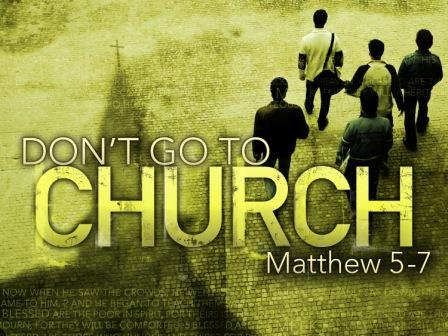
Why I Don’t Go To Church

This dialogue can happen over the Internet. God forbid that I should disparage the Internet as a means of communication; the irony would be a bit sickening. But realistically, all the activity out here is nothing – nothing! – compared to what is going on in real churches, with real people talking face to face. Real, honest dialogue with other people who bear God’s image and are trying just as hard as we are to understand and interpret the Bible.

I have seen so much good come out of the church I am in. Depending on how far you want to stretch the idiom, I have seen “the blind see, the lame walk, the lepers are cured, the deaf hear, the dead are raised to life, and the Good News is being preached to the poor.”

Have people left? Yes. Have people gotten hurt? Yes. Welcome to communal life…

-Jacob Fronczak
“Why I Go to Church”
Hope Abbey blog

For God did not appoint us to suffer wrath but to receive salvation through our Lord Jesus Christ. He died for us so that, whether we are awake or asleep, we may live together with him. Therefore encourage one another and build each other up, just as in fact you are doing.1 Thessalonians 5:9-11 (ESV)

I read Jacob’s latest blog post this morning before I went to work and responded to him that I’d probably have to write a “counter-point” blog from my perspective. I don’t write this to disagree with or to oppose Jacob. In fact, I have the greatest admiration for his writing and the message he has created for today. He’s one of the few people who blog, especially about religion, who consistently presents an attitude that is sane and calm. I always hope that I present myself as sane when I blog, but anyone who has followed my “morning meditations” for any length of time knows that I am not always calm.

Jacob makes some very good points about why a person who is aligned with the “Hebrew Roots” movement can still attend and even thrive in a traditional church setting. I’ve said this in the past and I have also said that a great deal of good is done by the church in pursuing the commandments of Jesus to feed the hungry, visit the sick, and to provide comfort to the widow. In fact, I experience that sort of lovingkindness more from the church and the traditional Jewish synagogue than I do from many of those groups who call themselves “Hebrew Roots” or “Messianic,” usually because those groups are more focused on establishing and maintaining their “rightness” than in actually doing “rightness” to others in the Messiah’s name.

On the other hand, I have reasons for not attending church. None of this is new and I’ve spread “my story” over many different blog posts and various comments in the blagonet, but after reading Jacob’s message this morning, I felt I should collect all of that here today. This also, by coincidence (if I can even believe in coincidence in a created universe), dovetails nicely into today’s morning meditation where I spend several paragraphs summarizing my “witness” or my history in the world of faith.

Up until last May, I was regularly attending and teaching at what you would call a “One Law/Messianic” congregation. I left after much prayer, study, and investigation of the assumptions that had originally attracted me to that movement because of two basic reasons: I no longer felt the One Law proposition, which states that both Jews and non-Jewish Christians are obligated to the full 613 commandment in the Torah (minus Jewish halacha and Talmudic judgments and rulings) was Biblically valid. Also, I didn’t want to worship in a religious venue in which my wife, by her very nature as a (non-Messianic) Jew, would be unable to attend, and which would prevent me, due to my “reputation” as “Messianic,” from fellowship with her communities in Reform and Chabad Judaism.

So for the past nine months, I have been unaffiliated with any specific house of worship or formal denomination or sect, and for nine months, I have not engaged in any form of communal prayer or worship.

I kind of miss it.

The idea was to join with my wife at some point, in her communal religious life, but she doesn’t really have one at this point. She very occasionally attends shul, usually for a bar or bat mitzvah, or to help in some event held at one synagogue or the other, but not for Shabbat services and not to go to any of the classes being offered. I’ve suggested that perhaps we could do something together at one of the synagogues, and after a number of conversations on the matter, she said, “we’ll see.”

So why don’t I attend a church in the meantime? One of the reasons I left “One Law” is that the Rabbis at both synagogues in town are generally “OK” with Christians visiting for worship and classes, but they have an extremely difficult time even tolerating the presence of “Messianics”. Certainly, if I attended a church, even regularly, I would be no more or less offensive to them than any other Christian who walked through their doors, and certainly there are other intermarried couples who attend both synagogues, so how out of place could I be? Church attendance shouldn’t be a barrier to synagogue worship as such.

Traffic ConesThe other reason I left “One Law” was because I didn’t want to worship alone. I don’t mean without fellowship, which I had in abundance, but without my wife. She would no more step one foot inside a church than she would inside a “Messianic” congregation and for pretty much the same reasons. I would be just as “isolated” from my wife in a church service as I ever was in a “Messianic” service. I might eventually gain fellowship with other Christians, but it would still be completely hollow without my wife.

I know what some Christians out there are probably thinking right now.

“Do not think that I have come to bring peace to the earth. I have not come to bring peace, but a sword. For I have come to set a man against his father, and a daughter against her mother, and a daughter-in-law against her mother-in-law. And a person’s enemies will be those of his own household. Whoever loves father or mother more than me is not worthy of me, and whoever loves son or daughter more than me is not worthy of me. And whoever does not take his cross and follow me is not worthy of me. Whoever finds his life will lose it, and whoever loses his life for my sake will find it. –Matthew 10:34-39 (ESV)

You could reduce that down to, “the heck with your family, Jesus is more important” or words to that effect. You could even attach my desire to attend synagogue services with my wife to what the Master said in Matthew 10:33 (ESV): but whoever denies me before men, I also will deny before my Father who is in heaven. So much for loving my wife, eh guys? But what about this?

…and said, ‘Therefore a man shall leave his father and his mother and hold fast to his wife, and the two shall become one flesh’? So they are no longer two but one flesh. What therefore God has joined together, let not man separate.” –Matthew 19:5-6 (ESV)

It’s not so easy now to simply dispense with my “other half,” even for the sake of my faith in Jesus, unless you can come up with some handy way to reconcile the dissonance created by juxtaposing those two teachings of the Master (and I’m aware that theology has come up with some rather creative ways of making discordant verses “fit” for the sake of “smoothing over” theology when rationally, they otherwise shouldn’t reconcile).

And then there’s supersessionism in the church.

I recently wrote an article for Messiah Journal called Origins of Supersessionism in the Church, which is the first of a four-part series on this topic. While I generally oppose this theology, my writing and research has made me particularly sensitive to the extraordinary harm this teaching of the church (not teaching of Jesus and Paul) has done to the Jewish people and to the worship of the Messiah within the framework of Judaism over the past 2,000 years or so. I admit to living with a certain amount of apprehension that if I ever started attending a church again, someone, a Pastor or Bible Teacher or just one of the parishioners, would spout off something about the church replacing Jews. Then I’d feel my blood pressure rise along with my temper, and I’d either just walk out, or I tell that person what I thought of their ill-considered “theology” (and then walk out or be thrown out).

Not that it would really be their fault. After all, the church has been teaching supersessionism as Biblical “fact” ever since the days of the early Gentile “church fathers.” That still doesn’t make it right nor does it mean I have to tolerate a way of understanding the New Testament that requires Judaism and every living, breathing Jew (including my wife and three children) to be deleted from religious, spiritual, and historical significance, not to mention permanently removing them from God’s love and, in at least a historical sense, removing the Jews from their very lives.

I told you I was sensitive to this stuff just now.

So that’s why I don’t go to church.

I understand what Jacob is saying and he’s right. Internet relationships are something of an illusion. I have managed to turn one or two into “real” friendships, but it always involves meeting in real life and doing stuff together. Pretty difficult for most web connections, particularly when those contacts span the globe.

Jacob ended his blog post with an invitation to those of us who are disaffected in relation to the Christian church:

If you believe in Jesus, you’re a Christian. We’re all brothers. We can be distinctive without being destructive. We can worship together. We can live together. We have to.

And maybe, just maybe, you could drop in at church sometime. We’d love to have you.

Thanks, Jacob (where ever you live…which according to his About page, is thousands of miles away from me). I’m not sure how that would ever work out, but I guess we’ll see what God has in mind.

Repairing the Turbulent Suffix

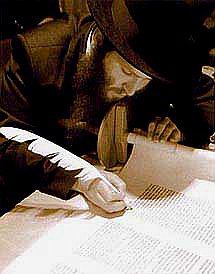
A certain sofer wrote a sefer Torah and was checking it over carefully for any possible errors, when he finally found one…Although with most errors he would only have to erase the problem and rewrite, he was unsure whether he could do so in this case. As is well known, it is forbidden to erase the Name of Hashem. In this case, the problem was not the name per se, but the suffix… Since he did not want to rewrite the entire amud, he wanted to fix the error but only if this was permitted by the halachah.

When this question reached the Taz, he ruled that the sofer could not erase the suffix…It is obvious to me that it is forbidden to erase a suffix to one of the Divine Names. Here is the proof: although we find in Maseches Sofrim that if a drop of ink fell on one of the Divine Names it is permitted to erase the ink in order to correct the blot, the Mordechai explains that this may only be permitted if letter wasn’t yet formed properly. However, if ink fell on a complete Name it would be forbidden to erase the ink. Similarly, if the letter were accidentally connected this would also be forbidden and the same is true regarding a suffix.”

When the Chut Hameshulash saw this response, he presented a different view, however. “In my opinion, although the Beis Yosef brings this Mordechai and it is l’halachah, there is room for leniency regarding a suffix. The proof to this is from Menachos 48. There we find that Rav Yochanan asks if we may do a sin in order to gain something with regard to sacrifices. From the Rambam there it is clear that we hold like the opinion of Rav Yochanan.

He concluded, “Since rectifying the shem Hashem is like saving a sacrifice, it is clear that in this case we may erase to rectify, especially since erasing a suffix is only a rabbinic prohibition.”

Mishna Berura Yomi Digest
Stories to Share
“Erasing to Rectify”
Siman 143 Seif 4(a)

I know that the information imparted in the quote above won’t make a great deal of sense to most Christians and probably even to a good many non-Jews in the “Messianic” movement. However the halacha that relates to the creation of a sefer Torah or Torah scroll is extremely specific if, for no other reason, than to avoid violating the commandment not to take the Name of God lightly or in vain (Exodus 20:7). I’m not going to attempt to provide a commentary on the ruling in this Daf, but I do want to use it as a metaphor.

A few days ago, I created a blog post called Debating Fulfillment Theology for the purpose of inviting polite debate regarding the pros and cons of the Christian theology that states the grace of Christ has wholly replaced the law of Moses. Even under the best of circumstances (and the debate is continuing as I write this “mediation,” so you are free to join it if you haven’t done so already), such dialogues rarely arrive at a unified conclusion. That is, I don’t expect that those who support fulfillment or replacement theology will “repent” and agree that it is a dangerous and unsupportable position, nor to I expect that those who disagree with replacement theology will eventually agree that the Jews must surrender their dedication to Torah and God and submit to the grace of Jesus Christ in a manner that completely denies Jews and Judaism (and I’m sure you can detect my bias based on how I worded that last sentence).

My goal for the debate is to engage in and encourage open, honest discourse with the hope of not resolving this conflict, but presenting alternate points of view. I am disturbed that the church sees replacement theology or supersessionism (though sometimes more politely cloaked as “fulfillment theology”) as concrete fact and the only possible way that the New Testament scriptures can be understood. After all, New Testament scholars have been debating for centuries (and continue to debate today) over the meaning of many portions of Paul’s letters and some of the more “difficult sayings of Jesus.” If a certain amount of scholarly disagreement remains in these interpretations, how can Christianity as a whole believe that replacement theology is such a “done deal?”

In quoting part of the Daf for Siman 143 Seif 4(a), I want to introduce an idea. I’ll use myself as an example (and I’ll try to keep this as short as possible and still form a complete picture). I was an agnostic/atheist until my early 40s as was my Jewish wife. Then I came to faith in Christ in a local Nazarene church (long story). My family and I attended for some time, but we found that many of our questions about God and Jesus weren’t being answered, especially as they related to the Jewish people.

My wife came into contact with a “Messianic/One Law” group in our community and she was immediately “hooked” (it took me a little longer to warm up to this sudden change in perspective). She strongly suggested that I attend with her and eventually, my family and I shifted our worship context from the Nazarene church to the One Law congregation. Years passed and many transitions took place. Eventually, we left the One Law congregation, and then my wife went back while the children and I attended the local Reform synagogue (another long story). Then my wife left One Law and joined the Reform shul, while I eventually went back to One Law and stayed for a number of years, proceeding from attendee to board member and teacher.

I was happy there for a time but my wife continued to explore her Judaism with the Reform synagogue and later with the Chabad and for the first time in almost 20 years of being together, we became a “mixed marriage”. My wife now identifies with the traditional Jewish community and is not “Christian” or “Messianic” in any sense.

As I watched my wife explore what it was and is for her to be a Jew within a cultural, ethnic and religious Jewish context, the basic tenants of the One Law movement seemed so discordant with what I was discovering (through my wife’s eyes) is actually Judaism (most One Law groups refer to themselves corporately as “Messianic Judaism” thus identifying themselves as a “Judaism”, even if the majority of their leaders and members are not Jews). Questions about assumptions I had made years before started coming to me and I entered into a year long investigation of who I was and what I was doing in my walk of faith (if you like reading a lot, that entire year is chronicled on my now defunct blog, Searching for Light on the Path).

Finally, I did what most religious people (or even what most people in general) don’t do. I changed my perspective, my theology, and my approach to being a disciple of the Master. In essence, I repaired what I saw as a damaged “suffix” in my understanding of God. That required great sacrifices on my part and I entered into more than one serious “crisis of faith” which resulted in quite of bit of emotional distress. These crises resolved into a new framework, the one from which I am now operating on this blog. I still take “heck” occasionally from people who don’t agree with my decision, however it’s a decision I found necessary to make for me and my relationship with God.

Why am I telling you all this and why should you care?

People can change. It’s not easy and it’s not common, but it’s possible. People can make significant and even extraordinary shifts in their theological perspectives if presented with enough evidence, but evidence is not enough. It takes the ability to admit that you can be wrong (not that God can be wrong, which would amount to actually erasing the Name of Hashem) and the courage to make changes (fix the suffix) once that admission has occurred.

No one likes change which is why a couple who is planning their wedding is stressed to the max, even though getting married is what they want to do more than anything. Any change creates stress and crisis, especially if it involves making major alterations to fundamental emotional, cognitive, and spiritual structures such as how you comprehend your trust and faith in God.

That means it is possible, however unlikely, that someone might really change as a result of this conversation. OK, I’m not holding my breath, but I am making a suggestion. As we see from the Daf above, change and correction of perceived flaws is not easy and there are times when it is necessary and times when it isn’t. Changes should be made with the utmost care and only after a great deal of deliberation, prayer, and consultation with trusted advisers.

But if change weren’t possible, no one would become a Christian in the first place, since no one is born into that state, not even people who are raised in a Christian family.

Rabbi Dr. Michael Schiffman recently made a comment on the aforementioned blog post that speaks to what I’m trying to express:

Scripture is scripture, but quoting a verse in or out of context says what the scripture says, but doesn’t tell us what you think it means. If you are going to quote scripture you have not achieved your goal until you tell us what YOU think it means. What you think it means is actually what you are basing your argument upon, so just say what you think it means or you have proven nothing.

Scripture is Scripture and the Bible is the Bible. It exists. It says what it says. But what does it mean? That depends on how we interpret it and what that interpretation means in our lives. Not everyone relates to the Bible and to God in the same way based on how we interpret the scriptures and how we interpret who we are. When presented with the challenges and crises in our life of faith and understanding, we need to keep going, no matter what the obstacles and no matter what the cost, even if the cost is that we must change or be forced to admit that we will always live a life at odds with God and in conflict with His Word.

On their exodus from Egypt, towards Mount Sinai, the Jewish people arrived at an obstacle – the Red Sea.

They divided into four parties.

One advocated mass suicide.

One said to surrender and return.

One prepared to fight.

One began to pray.

G-d spoke to Moses and said, “Why are you crying out to Me? I told you to travel straight ahead. Keep going and you will see there is no obstacle!”

The Jewish people kept going
and the obstacle became a miracle.

-Rabbi Tzvi Freeman
“Keep Going”
Based on letters and talks of the Rebbe
Rabbi M. M. Schneerson
Chabad.org

Keep going. Like Nachshon, plunge into the turbulent seas. When you find them, you can fix mistakes. Miracles are possible.

My God, guard my tongue from evil, and my lips from speaking deceitfully. And to those who curse me, let my soul be silent and let my soul be like dust to everyone. Open my heart to Your Torah, then my soul will pursue Your commandments.

-from the Elohai N’tzor

Slandering the Image of God

The Sages tell us, “What is the remedy for one who has spoken leshon hara (slanderous speech)? If he is a Torah scholar, let him engage in Torah study.” (Arachin 15b). Leshon hara defaces man’s “image of God”, and Torah study restores it.

According to the Midrash (Tanchuma, Kedoshim #13, and Nedarim 32a), Avraham was punished for his reaction to God’s promise in the Bris bein Habesarim that He would grant him possession of the land of Canaan. God told him, as it were, “You want to know? Here is something you can know (Bereshis 15:13): ‘Know with certainty that your offspring will be strangers.’”

Daf Yomi Digest
Distinctive Insight
“The power of word”
Arachin 15

There is one who speaks [harshly] like piercings of a sword, but the tongue of the wise heals. True speech is established forever, but a false tongue is only for a moment. –Proverbs 12:18-19 (Stone Edition Tanakh)

I suppose I’ve been on something of a mission lately to try and emphasize that, among people of faith and disciples of the Master, we have an obligation to treat each other with the same love and respect that Jesus has for his people, both the “lost sheep of Israel” and we non-Jews sheep who are “other sheep…not of this fold” (John 10:16). I know I’ve said this before, and blogs and sermons on the topic of “lashon hara” (the evil or slanderous tongue) are plentiful, but it is a lesson that we can’t seem to get enough of. I say this because, if we were taking this teaching to heart and incorporating it into our lives (and our speech), then there wouldn’t be so much harmful speech, insults, and character assassinations in the religious blogosphere.

And I would be writing about something else this morning.

It’s interesting what the Daf has to say about the “cure” for “evil speech”. “What is the remedy for one who has spoken leshon hara (slanderous speech)? If he is a Torah scholar, let him engage in Torah study.” Is the same remedy available for those of us who are not Torah scholars? I hope so (though I can’t speak from Jewish halacha on the matter). Where else can we find a cure for the evil that resides inside us than within the Word of God?

The commentary on the Daf tells us why speech is so important and how it can be so potentially lethal:

Rav Shach once explained that the uniqueness of man in creation — the “image of God” that was bestowed upon him—lies in the fact that he is a “living soul”, which Onkelos renders as “a speaking spirit.” It is the ability to speak that sets man apart from the beasts. The power of speech is indeed a reflection of “God’s image.” Just as God’s very word is capable of accomplishing the same as an actual deed, as it says (Tehillim 33:6): “By the word of God the Heavens were created,” so too is man’s power of speech capable of “establishing the heavens and settling a foundation for the earth” (Yeshaya 51:16). We must therefore ensure that our speech is pure and exact, in order not to corrupt the “image of God” within us.

This is why Avraham was punished for his expression, “How can I know,” although this was seemingly only a minor impropriety of speech. Similarly, Moshe was taken to task for asking God (Shemos 5:22; see Rashi ibid., 6:1), “Why have You treated this people badly?” There are many other examples of improper expressions and harsh penalties for them — all because of the fact that to misuse the gift of speech is to tarnish man’s image of God.

One way I choose to read this is that the “power” of speech comes from our being made in the “image of God” and that it defiles something about our Creator when we misuse this unique gift that he has provided only to humanity. Also, when we use this unique gift to harm another, we are injuring something of that “image” in the other person. Harmful speech damages not only that aspect of God in which we were made, but the same aspect in the other human. It is as if we are using “the power of the word” to damage or destroy “the power of His Word.” So we are hurting ourselves, hurting someone else, and “hurting” God when we commit “lashon hara”. Why is it so easy (I say this, because such speech is exceptionally common in the blog comments I read in the religious blogosphere) for us to spew our insults and harsh words on other brothers and sisters in the faith?

Haven’t we read what the Master said about this?

It is not what enters the mouth that contaminates the person, but what comes out from the mouth – that contaminates the person. –Matthew 15:11 (DHE Gospel)

Even the brother of the Master teaches this lesson.

Not many of you should become teachers, my brothers, for you know that we who teach will be judged with greater strictness. For we all stumble in many ways. And if anyone does not stumble in what he says, he is a perfect man, able also to bridle his whole body. If we put bits into the mouths of horses so that they obey us, we guide their whole bodies as well. Look at the ships also: though they are so large and are driven by strong winds, they are guided by a very small rudder wherever the will of the pilot directs. So also the tongue is a small member, yet it boasts of great things.

How great a forest is set ablaze by such a small fire! And the tongue is a fire, a world of unrighteousness. The tongue is set among our members, staining the whole body, setting on fire the entire course of life, and set on fire by hell. For every kind of beast and bird, of reptile and sea creature, can be tamed and has been tamed by mankind, but no human being can tame the tongue. It is a restless evil, full of deadly poison. With it we bless our Lord and Father, and with it we curse people who are made in the likeness of God. From the same mouth come blessing and cursing. My brothers, these things ought not to be so. Does a spring pour forth from the same opening both fresh and salt water? Can a fig tree, my brothers, bear olives, or a grapevine produce figs? Neither can a salt pond yield fresh water. –James 3:1-12 (ESV)

If you’ve been a Christian for any length of time, you already know these lessons and you know what they mean. If you then continue to deliberately use your speech (or what you write in blog comments or discussion threads on the Internet) to hurt someone else, you must realize that you are also deliberately disobeying the teachings of Jesus and spitting on the will of God. Please keep that in mind.

I am sometimes questioned about how I can use Jewish teachings to help me better focus on the lessons of Jesus (and no, I am not a “mere imitator of Judaism” in my faith or practice), but I find many seemingly associated themes. I don’t know that they are directly connected in any manner, but I find them comforting nonetheless.

Today’s daf discusses the negative consequences of speaking leshon hara.

Once a certain father heard that a child of the rebbe of Toldos Aharon, zt”l, wished to make a match with his daughter. He was overjoyed…until someone told him that the young man was not in his right mind. Obviously, the father was distressed. He was also worried about how to ascertain the truth; surely a maggid shiur or other person within the Toldos Aharon system wouldn’t say anything negative about the rebbe’s grandson.

He finally decided to ask the rebbe himself, since he was certain that the tzaddik would not deceive him. When this question was put to the rebbe he denied the claim against his grandson. “I know that child since he was born. No one has ever thought there was anything wrong with him.”

The father was very glad to hear this, but also furious at the one who had slandered the innocent bochur, and immediately blurted out, “Do you know who told me? It was…”

“Just a moment,” the rebbe firmly interrupted, “It is a question of leshon hara. Perhaps you are forbidden to tell me. Working out whether this is permitted is no simple matter. I am going on a fundraising trip for two weeks in the next few days. When I return you are welcome to come back and I will tell you the halachah.” When the rebbe was away, he learned the entire Sefer Chofetz Chaim through twice with great care. When he returned, the father of the girl—now engaged to the rebbe’s grandson—came to ask whether he was permitted to tell the rebbe who had slandered the bochur.

The Rebbe of Toldos Aharon said, “I learned the sugya very carefully while I was away and I concluded that if you don’t derive any pleasure in the telling, you are permitted to tell me who slandered the young man.”

Before the man could say a word, however, the rebbe stopped him with a motion. He astounded the man with his concluding words, “It may be permitted, but nevertheless, I do not wish to hear about it!”

Daf Yomi Digest
Stories Off the Daf
“A Question of Leshon Hara”
Arachin 15

We may not be able to prevent our brother from using harmful speech or trying to “stir the pot,” but we can certainly control our own tongues (or fingers on the keyboard). And like the Rebbe of Toldos Aharon, when someone is about to speak in such a manner, even if it is “permitted,” we can refuse to listen and refuse to respond.