Tag Archives: Judaism

Christmas is Coming! Don’t Panic!

This is the awkward time of year for Messianic believers. Many of us have opted out of Christmas, something our families and friends do not understand. It is inconceivable that anyone who professes faith in Messiah Yeshua (Jesus Christ) would not celebrate Christmas. It is inconceivable even though December 25th is most definitely not the day of Yeshua’s birth, and even though the customs observed in churches and homes have their origins in decidedly un-Christian pagan celebrations.

-from “Jesus Without Christmas”
published at The Barking Fox
Reblogged at natsab

And so it begins. The annual expression of angst at the approach of perhaps the world’s most well-known religious and secular holiday: Christmas.

I really didn’t think I was going to write about Christmas this year. Frankly, I’ve got too much else going on right now to really care and I have come to a certain peace about it all and no longer feel I have to contend with Christmas, let alone have a panic attack over it.

Yes, back when I was going to church, I’d avoid attending the Sunday services nearest to Christmas as well as all of the other Christmas programming, but that’s not because I felt I’d be tainted with “pagan influences”. After all, there’s no direct Biblical reference to Chanukah, and yet, along with many or most Jewish households, there’s a small but dedicated group of non-Jewish Christians, Messianic Gentiles, and Hebrew Roots believers who light the menorah (also not commanded in the Bible) for eight evenings in commemoration of the defeat of the Greek oppressors by the Maccabees and the rededication of the Temple, as well as to honor the “light of the world” (John 8:12).

It is true that my house is the only one on my block that is mostly dark every evening, surrounded by the more festive lights of our Christmas observing neighbors. But then again, my wife is Jewish and my feelings on the matter aside, it’s perfectly expected that the only special light visible from within our home for the next week or so (as I write this) should be that of the Chanukah candles on our menorah.

But Christmas is less evil than it is a tradition. It’s a terrifically lucrative tradition for retail outlets as events such as Black Friday and Cyber Monday indicate. If I have a major objection to Christmas, it is because the holiday has become a symbol of both personal and corporate greed and gluttony, not because I think putting lights on a natural or artificial pine tree is “pagan.”

Most Christians I know are quite aware that Jesus wasn’t born anywhere near December 25th and accept that the date they celebrate the birth of Christ was established by tradition rather than empirical fact. Nevertheless, if Christians choose to become more Christ-like, more generous, giving to the poor, kinder to their neighbor, at this time of year, who am I to complain?

I mean no disrespect to the sensitivities of the author at “The Barking Fox” or Pete at “natsab,” but I really feel the traditional response of Hebrew Roots Gentiles to the advent of Christmas (pun intended) is overblown. Sure, it took my parents a few years to adjust after my wife and I announced we were no longer celebrating Christmas, but they are now perfectly content to send Chanukah cards to us and the kids. I do have some relatives, my brother for instance, who still send Christmas cards, but no one in my family (as far as I know) complains because we don’t reciprocate.

brace yourselfI’m reminded of Toby Janicki’s blog post of four years ago called The Scoop on What About Paganism, a topic he expanded upon greatly in his lecture series “What About Paganism” (available on Audio CD and in MP3 format). Toby coined the term “paganoia” in his lectures, and I think the term is fitting.

The Jewish people I know don’t really have that much of a problem with Christmas beyond having to explain to certain people that Chanukah is not the “Jewish Christmas”. In fact, in cities with a sufficiently large Jewish population, it’s something of a tradition for Jews to go out to Chinese dinner on Christmas Day. This is based on Buddhism being the primary religious expression for many Chinese immigrants which means they aren’t celebrating on December 25th either. I wish I lived in a city that had enough Jewish and Chinese people to make observing this particular tradition practical. It sounds delicious.

Christmas is a tradition. So is Chanukah. They both have their basis in events that took place around two-thousand years ago in another country. They have both been integrated into the Christian and Jewish faiths respectively. Some small number of “Messianic Gentiles” (however you want to define the term) consider themselves caught in the middle, but we aren’t really. There’s nothing wrong with traditions. They are what we make of them.

I’ll be traveling with my parents on Christmas Day, not because it’s Christmas per se, but just because it worked out that way (long story) and Christmas is a great day to be on the road. Not many people going anywhere on December 25th because most of them are already at their destination.

The uptake on all this? Christmas is coming. Don’t panic.

Oh, and my Chanukah related blog post will publish tomorrow morning.

Addendum: I just found a reposting of last year’s blog article Let’s Not Get Strange About Christmas, Shall We? by Rabbi Stuart Dauermann and thought I should add a link to it here. He does a much better job at explaining the “paganoia” around Christmas.

Keep Practicing Repentance

I was thinking about the Parable of the Prodigal Son (Luke 15:11-32) while driving in to work this morning (Friday) and in relation to the stream of repentance, atonement, and forgiveness related blog posts I’ve been writing lately. The parable is only twenty-two verses long, just a couple of paragraphs, but if it were a true to life experience, the events being described could have taken months or even years.

A selfish son demanded of his father his inheritance, which one usually doesn’t receive until the father dies. This was a rather cold-blooded thing to ask for, but his father relented. This son, the younger of two brothers, did what most young people would do with a lot of money they didn’t have to earn by working. He blew it all on what the NASB translation calls “loose living” and ended up impoverished, that is, flat broke. All that money, presumably a sizable sum, and it’s all gone.

So he went and hired himself out to one of the citizens of that country, and he sent him into his fields to feed swine. And he would have gladly filled his stomach with the pods that the swine were eating, and no one was giving anything to him. But when he came to his senses, he said, ‘How many of my father’s hired men have more than enough bread, but I am dying here with hunger! I will get up and go to my father, and will say to him, “Father, I have sinned against heaven, and in your sight; I am no longer worthy to be called your son; make me as one of your hired men.”’

Luke 15:15-19

Like I said, it could have taken this young person months or even years to reach this dead-end in his life. What was he doing in the meantime? Apparently enjoying himself. Until the money ran out, he probably didn’t give a second thought to the cruel way he had treated his father and how he had deserted his family in pursuit of his own pleasure and enjoyment.

Once he ended up broke, we don’t really have a sense of how long he was working as a hired laborer, but if he wasn’t eating even as well as the pigs he fed, it probably wasn’t too long. Assuming he was just really hungry and not literally starving, it would have still been weeks or months before he hit that hard wall and finally overcame his pride, self-indulgence, and then shame and fear at the thought of turning back to his father.

Shame and fear?

Sure.

Look at what he did. He pretty much demanded his father (virtually) die so this kid could have whatever he would have inherited of his father’s estate upon Dad’s death. I doubt the guy was ever planning to see or speak to his father again, so after throwing the supreme insult in his Dad’s face, what was it like to even imagine being confronted by his father again? By rights, Dad should have told him to get lost and slammed the door in his face, leaving this boy homeless, abandoned, and alone. What a tremendous risk it would be, emotionally and physically, for him to walk back home and to ask to be treated, not as a son, but as a hired hand.

However, as we see in the parable, the kid had gotten to the point where he had nothing to lose. He was starving anyway. The pigs got fed but no one was giving him any food. Why not take the chance? Who knows? Maybe his father would have pity on him and at least give him a job in the fields or tending the sheep.

Joseph of EgyptI was also thinking about the story of Joseph. It’s not until Parasha Va-yiggash (Genesis 44:18-47:27) when Jacob and his family descend into Egypt and Joseph is reunited with his father. Of course, ever since being sold into slavery in Egypt, Joseph’s behavior was exemplary, first as a slave in Potiphar’s household, and then as a prisoner in the King’s prison. His wrongdoing (in spite of how the Rabbinic sages seem to explain it away) ended when his brothers threw him into a pit with the intention of killing him. Teenage arrogance was tempered by trial and suffering which ultimately turned his talents toward saving the world from famine.

But I wonder if there’s a secondary lesson in all this? Both Jacob and Joseph suffered from their long separation. Jacob thought Joseph dead for long decades, while his brothers suffered the guilt and shame of knowing they had contributed to their favored sibling’s disappearance, and then lied about it to their father. They too suffered and Joseph in testing them, delivered stern consequences upon them until they admitted their wrongdoing.

Can Joseph, certainly a Messiah-like figure, be compared to the prodigal son? Was there a lesson he had to learn before he merited reunification with his family? It seems more likely that the brothers were the prodigals and it was what they needed to learn before being reunited with Joseph and being given the relative comforts the land of Goshen had to offer.

But consider:

He had sent Judah ahead of him to Joseph, to point the way before him to Goshen. So when they came to the region of Goshen, Joseph ordered his chariot and went to Goshen to meet his father Israel; he presented himself to him and, embracing him around the neck, he wept on his neck a good while. Then Israel said to Joseph, “Now I can die, having seen for myself that you are still alive.”

Genesis 46:28-30 (JPS Tanakh)

So he got up and came to his father. But while he was still a long way off, his father saw him and felt compassion for him, and ran and embraced him and kissed him. And the son said to him, ‘Father, I have sinned against heaven and in your sight; I am no longer worthy to be called your son.’ But the father said to his slaves, ‘Quickly bring out the best robe and put it on him, and put a ring on his hand and sandals on his feet; and bring the fattened calf, kill it, and let us eat and celebrate; for this son of mine was dead and has come to life again; he was lost and has been found.’ And they began to celebrate.

Luke 15:20-24 (NASB)

Admittedly, except for the tearful reunion between father and son, there isn’t much of a comparison. Joseph is a Prince in Egypt, the most powerful man on Earth, except for Pharaoh King of Egypt, and Pharaoh denies Joseph nothing. Jacob and his family are saved from famine by going down to Egypt and accepting Pharaoh’s generosity (admittedly for the sake of Joseph who had saved Egypt). Conversely, it is the returning prodigal son who is saved by his father’s generosity, mercy, and joy.
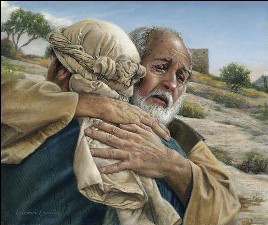
Wayward SonBut in all the years Joseph had been in Egypt, not once did he send a message to his grieving father that he was alive and well, even if he couldn’t tell him the exact circumstances for his long absence. Certainly a man of Joseph’s means could have sent a secret messenger into Canaan to let Jacob know he was alive. In this, he was like Jacob himself who, upon returning to Canaan with his family after serving Laban for twenty years and then escaping association with Esau, never let Isaac and Rebecca, who were both still alive at the time, know that he had returned. In fact, the only mention of Jacob and Isaac being together again was when Jacob and Esau buried their father upon his death (Genesis 35:28-29).

At least the prodigal son didn’t wait that long. He returned to his father while Dad was still alive. For all Joseph knew, his father could have already died, which is why he urged his brothers, when they still didn’t know who Joseph was, to tell him about Jacob and Benjamin (Genesis 45:3 for example).

There are many things that we should do, but we procrastinate. We delay taking action. Doing nothing is often much easier then taking action. What can you say to get yourself moving? You can say, “Just do it.”

Sometimes we really have a good reason or reasons for hesitating. Deep down we may feel that it’s better for us not to take the action we’re postponing. But we aren’t yet clear about the entire matter. If you have an intuitive feeling that it might be unwise to take action, then wait. Think it over some more. Consult others.

But when you know that you or others will benefit if you take action and you don’t have a valid reason for procrastinating, tell yourself, “Just do it.”

(from Rabbi Zelig Pliskin’s book: “Conversations With Yourself”, p.141) [Artscroll.com])

-Rabbi Zelig Pliskin
from Daily Lift #192 “Just Do It
Aish.com

Hillel says, “If I am not for myself, who will be for me? But if I am only for myself, who am I? If not now, when?”

-Ethics of the Fathers, 1:14

How long did it take for Joseph to call his father, brothers, and family to come and join him in the safety of Egypt during a world-wide famine? How long did it take for the prodigal son to hit rock bottom and in humiliation, return to his father?

Years. Decades.

How long will it take you and how long will it take me to finally return to our Father? What holds us back, the comfort and pleasure of the still wealthy prodigal? The power and control of Joseph, Prince of Egypt? Or the humiliation, shame, and fear of the dead broke prodigal son?

guiltyA single, impulsive act of disobedience is one thing and we can quickly apply correction and immediately repent and return. A lifetime of separation and self-indulgence isn’t swept aside so easily, and it can take time to reach the final conclusion that we have nothing left to lose and everything to gain if we turn around and go back where we came from. Even Joseph, who had every material comfort in the world, was still missing something without his family, for as a Hebrew, he was still utterly alone without his community, without his family, a servant of God amid a nation of pagans. That too is a habit difficult to break. Not that Joseph worshiped idols, but what about his wife and children? Maybe they didn’t either, but what about his in-laws? What about Pharaoh?

It took a long time before both of these men finally came to the point where they had to return to their families and become part of their community again.

Consider three things, and you will not approach sin. Know whence you came, whereto you are going, and before Whom you are destined to give an accounting.

-Ethics of the Fathers, 3:1

If we all considered these three statements with the proper gravity, we would be far less likely to sin and then keep on sinning (or sin, repent, sin, repent, sin…). But having reached a point to where you and I desire to return, these three things are dauntingly inhibiting, like staring up the summit of some great mountain that we realize we need to climb.

And being daunted and inhibited, we hesitate. Why now? Why not in a little bit? But then Hillel’s words come back to haunt us: “If not now, when?”

My rabbi once told me that even when I don’t feel like praying, I should still make an effort. Even if I feel completely disconnected from the action that I’m doing. Why? Because there will come a day when I will feel like praying, and if I haven’t been keeping my muscles in shape, I won’t be able to connect to my Creator through the vehicle of prayer. It will be so foreign to me that it will impede my attempt to connect.

By going through the motions, even in times of spiritual famine, I am keeping the lines of communication clear. I’m weeding my spiritual garden, even though I may not be harvesting any vegetables at the time.

-Rivki Silver
“Just Do It”
Aish.com

praying at masadaThe practice of Judaism really is a matter of practice. Judaism isn’t so much a matter of believing as doing. As Ms. Silver tells us in her brief article, a relationship with God is something you perform, saying the blessings and doing the mitzvot, even when you don’t feel like it, and sometimes you don’t practice at all or at least not as much as needed.

Judaism is very much a religion of practice, of doing. In the morning, I wake up and thank God for creating me and giving me another day. Then I ritually wash my hands. If I’m really on it, I’ll say my morning blessings after that (though sometimes they get said a little later).

When you do something every day, it becomes routine. And then something which is really quite sublime can become rote. And then the emotional component of spirituality which is, for many people, a big draw, can become separated from the physical component of spirituality. And then you can wake up one morning and realize that you’re just going through the motions.

I know. I’ve been there. I AM there in some areas of my practice.

Time to give up? Not so fast.

As the previous quote from Ms. Silver states, even “going through the motions” serves as a sort of “place holder” until we are ready to stop being “spiritual zombies”. Speaking of which:

This doesn’t mean that it’s okay to stay a spiritual zombie. While the reality of my morning blessings may be that I don’t have the best concentration while saying them, that doesn’t exempt me from trying to improve their quality.

We’re not perfect, and that’s okay. When Jascha Heifetz first picked up a violin, he wasn’t perfect either. It took years of practice and determination to become great.

And that’s something I find encouraging when I’m not feeling particularly “spiritual,” when doing a mitzvah might even feel like one more thing to check off my to-do list. I know that by continuing to practice, I am continually improving, much like a musician who is working on a piece of music.

Have you ever considered that true repentance takes time and practice as well? I’ve always imagined repentance to occur in an instant. Just repent of your sins to God, change your behavior, and it’s all done.

Well, no. I think that’s why so many people trying to break a long pattern of sinful behavior have such a difficult time. If you expect repentance, atonement, and forgiveness in an instant and it doesn’t actually happen in an instant, it’s demoralizing. Imagine thinking you’ve repented only to give in to the temptation to return to sin. It’s a horrible thing. What if it means repentance doesn’t work? You’re trapped.

Time to give up? Not so fast.

The “just do it” slogan made famous by Nike, doesn’t always mean do it once, do it right, and do it permanently. I’m not excusing the revolving door method of sin, repentance, sin, and so on. I’m saying that what has taken years to build up won’t always get torn down in a single day. Ever watch an old building being demolished? Sure, it doesn’t take as long to knock it down as it took to construct it, but it still takes time. Further, it takes planning, the right equipment, and the right execution. So too repentance.

father and sonThe journey from the pig farm in a foreign country to home must have taken some time, even after the prodigal son made his decision. So too with us. Maybe his trip was uneventful or maybe there were barriers along the way that Jesus (Yeshua) didn’t include in his parable. They probably weren’t relevant to the point the Master was making, but maybe they’re relevant to us.

Repentance takes practice, like a Jewish person trying to overcome being “stuck” on a particular mitzvah. But it’s like a young child learning how to walk. The would-be toddler never gives up and decides to keep crawling for the rest of his or her life. They keep at it. They’re driven to learn to walk and eventually they do. The child’s parents don’t give up on the little one for standing and falling and standing and falling and taking a step and falling. As long as the child keeps trying, there’s nothing to be concerned about and most parents are pretty patient with the whole process.

How much more so is our Heavenly Father patient with us…

…as long as we keep trying and practicing and we don’t give up.

The Reasons Saul was a Persecutor and Paul was Persecuted

In email exchanges over the last couple of weeks, Paula Fredriksen and I have been comparing views on what might have been the nature of, and cause(s) for, the “persecution” of Jewish Jesus-followers that the Apostle Paul later lamented. There have been various proposals over the years, and hers is to my knowledge the latest. With her agreement for me to do so, I publish a response in this posting.

-Larry Hurtado
‘Paul’s “Persecution” of Jewish Jesus-Followers: Nature & Cause(s)’
Larry Hurtado’s Blog

I read Dr. Larry Hurtado’s blog regularly. He’s one of the leading New Testament scholars currently doing research and publishing his findings, and although I don’t have the educational background to always grasp everything he says, I still feel I learn a lot.

The issue at hand in the above-quoted blog post has to do with the rationale for Paul being “persecuted” by Jews early in his ministry. Were the reasons for such poor treatment of Paul the same reasons Paul had previously in his life when he persecuted “Christians” (in this case, Jewish disciples of Jesus)?

Frankly, it never occurred to me to consider such a question until now. But it’s a good question.

I think the story told in most churches is that “the Jews persecuted the Christians,” indicating that the Jewish followers of Jesus (Heb. “Yeshua”), once they “converted” to “Christianity,” were no longer considered Jews, and thus, were targets for Jewish persecution because they rejected the Law and replaced it with grace.

There are a lot of problems with those assumptions, including the fact that “Christianity” wouldn’t exist as a “stand-alone” religious entity for decades, and was only created once the Gentile disciples split from their Jewish mentors and “refactored” the Bible to reject the Jewish narrative, manufacturing a new Gentile religion, the aforementioned Christianity.

The Jewish Paul
The Jewish Paul

So Jews, at best, could “convert” to a different sect or branch of Judaism, in this case the Pharisaic/Messianic sect, which was virtually identical in its beliefs and practices to the Pharisees with just a few minor adjustments, such as acknowledging the revelation of the Messiah (and following one Messiah or another is a fairly common occurrence across Jewish history), and an unusually liberal policy about admission of Gentiles into their ekklesia (assembly) as co-equal participants in Jewish social and religious space.

Returning to Hurtado and the likely reasons Paul would have been beaten by his own people on numerous occasions, he writes:

In a recent publication, she probes the matter by first addressing Paul’s references to being on the receiving end of floggings by fellow Jews (five times) in the course of his Gentile mission (2 Corinthians 11:24). Her cogent hypothesis is essentially this: Paul required his pagan converts to withdraw from worshipping the gods of the Roman world. Given the place and significance of the gods in Roman-era life, this would have generated serious tensions with the larger pagan community. As he identified himself as a Jew and linked up with Jewish communities in the various diaspora cities where he established early assemblies of Jesus-followers (ekklesias), these Jewish communities could have feared that they would bear the brunt of these tensions. So, Paul was meted out synagogue discipline in the form of the 39 lashes as punishment on several occasions (he mentions five).

I find this entirely reasonable myself. It fits the setting, Paul’s Gentile mission. It fits his own behaviour, continuing to identify himself as a member of his ancestral people all through his ministry as apostle to the Gentiles and herald of the gospel. It fits also with what we know of real and potential tensions over the matter of worship of the traditional deities (of household, city, nation, etc.).

So according to this, Paul wasn’t beaten by his fellow Jews because he had exited Judaism in any sense, was proposing a “foreign” religion, or was thought to be speaking against the Torah of Moses or the Temple. Hurtado even says Paul was “continuing to identify himself as a member of his ancestral people all through his ministry as apostle to the Gentiles.”

Larry Hurtado
Larry Hurtado

The issue, as is stated in the quote above, was more likely the tension Paul was generating among the Gentiles by requiring his non-Jewish disciples to cease participation in Roman cultic practices and to be devoted to the God of Israel alone. The synagogues in the diaspora were deeply worried that they would receive the “fallout” from the pagans among whom they lived, which was not an unreasonable fear given the long history of enmity between Jewish and Gentile communities.

But how does this reflect on Paul when he was formerly “persecuting the church,” so to speak? Was Paul (previously “Saul”) worried about pagan Gentile “fallout?”

Hurtado states that Paula Fredriksen believes this likely, but he says otherwise, and lists very specific reasons (see his blog post for the details). In summation, Hurtado writes:

In sum, it seems to me that both the nature and the cause(s) for Paul’s initially violent opposition to the Jewish Jesus-movement were somewhat different from the nature and cause(s) for the synagogue floggings that he later received in the course of his ministry as apostle. I’m inclined to think that Paul’s initial Pharisaic zeal was incited, at least in part, by the christological claims and accompanying devotional practices that he later came to embrace, and that are reflected in his letters. Indeed, his zealousness for his religious traditions may have even made him particularly sensitive to the implications of the christological claims and devotional practices of the early Jesus-circles, perhaps more sensitive than many others, including perhaps even those early Jesus-circles as well! In any case, whatever the reasons for his strenuous initial opposition to the Jesus-movement, his subsequent shift to passionate adherent (e.g., Philippians 3:4-16) remains one of the most remarkable personal stories of the ancient world.

In other words, the bigger deal for Paul was the assertion among Jewish disciples of Messiah, that he was of a Divine nature and that they gave worship to Yeshua normally reserved only for Hashem.

But He kept silent and did not answer. Again the high priest was questioning Him, and saying to Him, “Are You the Christ (Heb. “Messiah” or “Moshiach”), the Son of the Blessed One?” And Jesus said, “I am; and you shall see the Son of Man sitting at the right hand of Power, and coming with the clouds of heaven.” Tearing his clothes, the high priest said, “What further need do we have of witnesses? You have heard the blasphemy; how does it seem to you?” And they all condemned Him to be deserving of death.

Mark 14:61-64 (NASB)

This answer is what got Jesus killed, not claiming to be the Messiah, which as I said above, isn’t all that unusual a declaration in Jewish history, but stating that he was of Divine nature and appearing as co-equal with God in Heaven.

If Paul was indeed zealous for the Torah, such a claim would certainly have set him off. In fact, we see something similar occurring where Paul was actually involved:

Now when they heard this, they were cut to the quick, and they began gnashing their teeth at him. But being full of the Holy Spirit, he gazed intently into heaven and saw the glory of God, and Jesus standing at the right hand of God; and he said, “Behold, I see the heavens opened up and the Son of Man standing at the right hand of God.” But they cried out with a loud voice, and covered their ears and rushed at him with one impulse. When they had driven him out of the city, they began stoning him; and the witnesses laid aside their robes at the feet of a young man named Saul.

Acts 7:54-58

stoneAlthough Stephen said a great deal to anger the Jewish court before which he appeared, they didn’t turn murderous until he also described Jesus at the right hand of God. A young Paul (Saul) was present and the death of Stephen no doubt was part of his inspiration to pursue other Jewish believers and for the same reasons, not because it had anything to do with Gentile disciples or pagan community “blowback” on diaspora Jews.

This also touches on another topic Hurtado wrote on yesterday (as you read this) as to whether there was opposition and even persecution of the Greek-speaking Jewish Jesus-believers by the native Israelite Jewish believers. It is another question that would never have occurred to me and you can click the link I provided to explore the matter and read Hurtado’s opinion.

I’m writing about this because it’s yet another illustration how recent scholarly inquiry has dispelled some long-held “truths” in the Church, so-called “sound doctrine,” about “Jews persecuting Christians” for such-and-thus reasons, when indeed, those “truths” are merely long-held “assumptions” based on long-held “traditions”. Those traditions of the Christian church, in my opinion, were born out of the historic tensions that have existed between Christianity and Judaism that go all the way back to when Gentile Christianity violently divorced ancient Messianic Judaism.

I’m not telling Christians not to listen to their Pastors’ sermons or to what Sunday School lessons teach, but it might be a good idea to also pay attention to what Biblical scholarship is doing and what they are writing. It will be years (if ever) before the latest research trickles down to the local church pulpit and into the ears of the average Christian sitting in the pew.

Being a disciple of Jesus isn’t a spectator sport. It’s what you do that counts, including how you study the Bible. You’ll never know Jesus as well as you’d like unless you take an active role in acquiring that knowledge. It’s not just a matter of reading the Bible, although that’s critically important. It’s a matter of paying attention to and critically analyzing the collected body of research about the message of the Bible, what it meant within its original context and to its original audience, and thus what it means to us today.

For more on the early Jewish belief in the Divinity of Jesus, see Derek Leman’s blog post Are We Apostates? Yeshua’s Divinity.

The Faithful Servant

In Buenos Aires, thousands of Jewish families hosted others who’d never before experienced a Shabbat.

-Simon Apfel
“The Shabbat that Shook the World”
Aish.com

To me, that’s the exact point of Gentiles having a familiarity with the Torah and the Jewish people. True, the Shabbos Project being described in the above-referenced article is the effort of Jews encouraging other Jews to observe the Shabbat, but Jewish people only make up a tiny fraction of the world’s population. If Gentiles do have a special and sacred role in relation to Judaism, it is to undo much of what we’ve done over the long centuries, and to actually encourage the Jewish people to observe the mitzvot. Historically the Goyim, and particularly the Christian Church, has done everything in their/our power to discourage Jews in Judaism, resulting in a power surge of secularism and assimilation among Jewish people on our planet. I think God wants us to change that.

I know I’ve written a lot about this lately, really a lot, but when I read that one sentence from the Aish article, I was once again reminded of a Gentile’s duty to the Jewish people. It won’t matter much if Gentiles start keeping the Shabbat if more Jewish people don’t.

There isn’t much material in Jewish publications about Gentiles keeping the Shabbat, and what’s available is negative. At least Messianic Judaism is encouraging Gentiles to keep Shabbos on some level.

The upside of my personal Shabbat project, which starts tomorrow evening, is that I get to experience something unique and precious, an encounter with God on Shabbos. The downside is that it only benefits me. I have a Jewish family I’d love to see observe Shabbat more than just the lighting of candles. If somehow what I’m doing were to contribute to them, then my role in this world would be complete.

So when He had washed their feet, and taken His garments and reclined at the table again, He said to them, “Do you know what I have done to you? You call Me Teacher and Lord; and you are right, for so I am. If I then, the Lord and the Teacher, washed your feet, you also ought to wash one another’s feet. For I gave you an example that you also should do as I did to you. Truly, truly, I say to you, a slave is not greater than his master, nor is one who is sent greater than the one who sent him.”

John 13:12-16 (NASB)

…the Son of Man did not come to be served, but to serve.

Matthew 20:28

I know I’m taking these verses out of context, but I can’t get past the feeling that we can learn a principle from them, not just that we have a duty as believers to serve each other and to serve humanity, but specifically that we Gentile disciples, out of sheer gratitude for our being brought into the blessings of the New Covenant through Israel’s relationship with God, need to return the favor by bringing Jews back to their own Torah and to Hashem, God of Israel.

That’s a tough thing to do without being seen as intrusive and offensive. Dressing up in kippot and tallitot isn’t going to “provoke Jews to jealousness” (Romans 11:11) or to zealousness, but those of us who are friends and family members of Jewish people can certainly try to contribute. If nothing else, we just need to get out of the way of Jewish people and Judaism. For institutional Christianity, this means ceasing from preaching against Judaism. No, I don’t just mean preaching pro-Jewish people sermons, but actually ceasing from preaching against the practice of Judaism for Jewish people, including and especially Jews in Messianic Judaism. More than that, we need to continually look for opportunities to support Jewish observance of the mitzvot.

So on one hand, I’m looking forward to my personal Shabbos Project, but on the other hand, it’s going to be pretty hollow. Not just because I’ll be alone but because no Jewish people will be involved. I won’t have served my purpose unless or until I’ve done something to support even one Jewish person in lighting the Shabbos candles, saying the blessings, or participating in Jewish community.

Only then will I, as well as the other Gentiles who have captured this vision, be worthy of being called the “crowning jewels of the nations”. Only then will the Master say to us, “well done, good and faithful servant” (Matthew 25:21). After all, when we serve the Jewish people, we are serving the Master:

“Then the King will say to those on His right, ‘Come, you who are blessed of My Father, inherit the kingdom prepared for you from the foundation of the world. For I was hungry, and you gave Me something to eat; I was thirsty, and you gave Me something to drink; I was a stranger, and you invited Me in; naked, and you clothed Me; I was sick, and you visited Me; I was in prison, and you came to Me.’ Then the righteous will answer Him, ‘Lord, when did we see You hungry, and feed You, or thirsty, and give You something to drink? And when did we see You a stranger, and invite You in, or naked, and clothe You? When did we see You sick, or in prison, and come to You?’ The King will answer and say to them, ‘Truly I say to you, to the extent that you did it to one of these brothers of Mine, even the least of them, you did it to Me.’”

Matthew 25:34-40

Discovering Myself by the Light of Torah

Question:

I came across your site and wow–I really want to become Jewish. My mother was a fairly devout Italian Catholic and my father an Anglican skeptic who never went to church. I was always so confused. But now your site has really turned me on to Judaism, a real coming home for me. What’s my next step?

Response:

Your next step is to become a better person. Develop greater faith in your soul, in your destiny, and in your Maker. Do more good, reach out to more people. Learn more wisdom, apply whatever you learn, and make life worth living.

But you don’t need to become Jewish to do any of that. Plenty of wonderful people doing beautiful things in the world are not Jewish, and G‑d is nonetheless pleased with them.

-Rabbi Tzvi Freeman
“Should I Convert to Judaism?”
Chabad.org

My wife was reading this in an email newsletter from Chabad last Friday afternoon. As I came home from work, I passed by her and happened to glance at what she was viewing on her computer. I briefly saw the title and was intrigued (since she’s already Jewish and conversion is a non-issue for her). Later on, I looked up the article and read through it.

The full content of what Rabbi Freeman wrote is astonishingly applicable to the debates we see happening between the Messianic Jewish and Hebrew Roots (particularly One Law/One Torah) movements. I recently became aware of an online dialog discussing whether the One Law/One Torah movement should or should not be considered a “Judaism”. Some of the more well-known pundits in that space were saying “no” based on the requirement to distance themselves from the large body of Talmudic authority and rulings (subsequent commentary indicates the opinions being expressed are more complicated, but that has little bearing on what I’m presenting here).

This is in contrast to how First Fruits of Zion (FFOZ) Founder and President Boaz Michael recently defined Messianic Judaism in his “Director’s Letter” in the Fall 2014 edition of Messiah Journal, p.10:

To me, Messianic Judaism is not just a Jewish-flavored version of Christianity. If I was asked to define Messianic Judaism, I would say, “Messianic Judaism is the practice of Judaism coupled with the realization that Yeshua of Nazareth is the Messiah, the New Testament is true, and the kingdom is at hand.”

Rabbi Stuart Dauermann in a recent blog post, quoted the first five of The Hashivenu group’s seven core principles, which also defines Messianic Judaism:

  1. Messianic Judaism is a Judaism, and not a cosmetically altered “Jewish-style” version of what is extant in the wider Christian community.
  2. God’s particular relationship with Israel is expressed in the Torah, God’s unique covenant with the Jewish people.
  3. Yeshua is the fullness of Torah.
  4. The Jewish people are “us” not “them.”
  5. The richness of the Rabbinic tradition is a valuable part of our heritage as Jewish people.
Boaz Michael
Boaz Michael

Rather than emphasizing the sufficiency or the primacy of scripture to the exclusion of all other considerations or practices as does One Law/One Torah, Messianic Judaism can be thought of in the manner of the other branches of Judaism in accepting, in addition to the primacy of Torah, all of the history, traditions, customs, wisdom, and interpretations of the great Jewish sages as part of their legacy, heritage, and lived daily experience, and added to all that, “the realization that Yeshua of Nazareth is the Messiah, the New Testament is true, and the kingdom is at hand.”

In his reply to the non-Jewish writer who was inquiring about conversion to Judaism, Rabbi Freeman continued:

You see, there’s Judaism and there’s Jewishness, and the two are not one and the same. Judaism is wisdom for every person on the planet and beyond. We call it the Torah, meaning “the teaching,” and it’s a divine message to all human beings containing the principles that much of humanity has already accepted as absolute truths. The idea that human life is beyond value is a teaching originating from Torah, as is the related concept that all human beings are created equal. So too, the right of every individual to literacy and education was brought to the world through Torah. And world peace as a value and goal was preached exclusively by the Torah and its prophets thousands of years before it became popular in the rest of the world. And of course, the idea that there is a single, incorporeal Being who creates and sustains all of reality, and is concerned over all that occurs with each individual, thereby giving each person, creature, event and object meaning, purpose and destiny–this is a core teaching upon which everything else rests, and the central teaching of the Torah.

That’s Judaism. Then there is Jewishness. To be Jewish means to belong to an ancient tribe, either by birth or by adoption (a.k.a. conversion).

I invite you to click on link I provided above and read R. Freeman’s entire commentary (it’s not very long). He says some amazing things about the comparison and contrast of Judaism and Jewishness. It seems, on some level, anyone who is responding to God through the basic presentation of the Torah and the awareness presented by Judaism can access God through that template, that is, through the relationship Israel has with God as understood through the Torah, but that “Judaism” isn’t the same as “Jewishness”.

Tribes have rituals. So do Jews. Males of the tribe wear particular items of clothing, such as tzitzit and kippot. Women keep a certain mode of modest dress and married women cover their hair. Men also wrap leather boxes containing parchment scrolls on the heads and arms every morning, while robed in woolen sheets with more of those tzitzit tassels. In our services, we chant ancient Hebrew and read from an ancient scroll. We have holidays that commemorate our tribal memories and establish our identity as a whole. Certain foods are taboo and other food is supervised and declared fit-for-the-tribe. Nope, you can’t get much more ancient-tribal than any of that.

The point is, none of that ritual stuff was ever meant as a universal teaching, except perhaps in a more generalized way…

Now, what I’m saying is not very PC nowadays. We live in a world of hypermobility. Not just because we own our own cars and reserve our own tickets online to go anywhere, anytime–but because we imagine our very identities to be just as mobile as our powerbook. Pick me up and take me anywhere. Today I’m a capitalist entrepreneur, tomorrow an Inuit activist, and the next day a Californian bohemian. And we can mix and match–today, you can be Italian, Nigerian, Chinese and Bostonian all in the same meal. So who is this Freeman character to tell me which tribe I belong to and which not?

To be frank, because this Freeman character considers the hyper-identity scheme to be a scam, a mass delusion and a social illness. You can switch your clothes, your eating habits, your friends, your social demeanor, your perspective on life and maybe you can even switch to a Mac. But G-d decides who you are, and the best you can do is discover it.

It almost seems as if Rabbi Freeman were borrowing his arguments from those I’ve recently heard expressed in Messianic Judaism, but maybe it’s the other way around. If indeed we consider Messianic Judaism as another branch of Judaism alongside the other branches, it stands to reason that how they think of “Judaism” and “Jewishness” should be similar, in this instance, to the Chabad among the other Judaisms.

At the same time, there are also Jewish disciples of Yeshua; their Jewishness remains significant, and it is central to their unique identity. Unity in corporate prayer between Messianic Gentiles and Jews is a beautiful and powerful testimony of Yeshua’s greatness. Such unity can only exist in a setting in which members are aware of their respective roles within the people of God.

-Aaron Eby
“Declaration of Intent for Messianic Gentiles,” p.47
First Steps in Messianic Jewish Prayer

Stand aloneOne of the “issues” that comes up, and Boaz Michael discusses it in the aforementioned “Director’s Letter” from Messiah Journal, is that Messianic Judaism has some difficulty in identifying the role of the Messianic Gentile within Jewish community. This, as I’ve mentioned before, is also one of my personal challenges, although I am not involved in face-to-face Jewish (or any other kind of) community at present. Still, every time I do “Jewish stuff,” it is prudent of me to be mindful of that community and to at least try to imagine what my role as a Gentile should be.

Gentiles who devote themselves to Yeshua of Nazareth are not only disciples; they are his subjects, and he is their King…

These Gentiles are no longer separated from Messiah or “alienated from the commonwealth of Israel and strangers to the covenant of promise” (Ephesians 2:12). Instead, they share in the inheritance and the destiny of the whole nation. In keeping with this identity, the God-fearing Messianic Gentile should not hesitate to join the Jewish people in formal prayer.

As Messianic Gentiles engage in these prayers, they must not lose sight of their own important and esteemed position as the crowning jewels of the nations.

-ibid

I previously wrote a two-part review of Mark D. Nanos’ paper ‘Paul’s Non-Jews Do Not Become “Jews,” But Do They Become “Jewish”?: Reading Romans 2:25-29 Within Judaism, Alongside Josephus’ which discussed some of the distinctive differences between “Jews” and “Jewishly” as it might have been perceived by the apostle Paul (and Nanos’ paper is now freely available online at the Journal of the Jesus Movement in its Jewish Setting (JJMJS) website).

I received a number of pointed responses based on the controversial nature of the topic, but then, the idea of Gentiles operating in Jewish religious and communal space as equal co-participants tends to get controversial.

If I can take Rabbi Freeman’s commentary and adapt it to the Messianic Jewish and Gentile framework, then it seems, as the Rabbi suggests, that Gentiles are perfectly free to take the higher principles of the Torah as universal, but should reserve those rituals that are specifically “Jewishly” for the “tribal” Jewish people as the Rabbi defines them.

R. Freeman finished his response with the following paragraph.

I believe that what G-d wants from each person is that s/he examine the heritage of his ancestors, discover the truths hidden there and live in accordance with them, knowing that this is what his Creator wants from her/him. The truths are there because all of human society was originally founded upon the laws given to Adam and to Noah, along with those laws that all the children of Noah accepted upon themselves. These truths are found by examining one’s heritage through the light of Torah. The Jewish Tribe are the bearers of that light. But you don’t need to become Jewish to partake of it. Light shines for all who have eyes.

Granted, he isn’t writing with the Messianic Gentile in mind and our status in relation to Israel through our devotion to Messiah Yeshua isn’t the same as a Noahide, but I believe his basic point is essentially the right one. Jews, as tribal members (although Israel isn’t truly tribal in the modern era, they inherit was belongs to the tribes as their descendents), are the original possessors of the Torah including all of the tribal rituals assigned to them by God. The rest of us, once we are drawn to Israel by the light of Torah and the light of Messiah, discover the truth of the Torah by its light from within our own national and ancestral contexts. This is why a Gentile approaching Messianic Jewish prayer does so along a somewhat different trajectory than a Messianic Jew.

Torah platesThis is why my upcoming personal Shabbos Project is traveling a somewhat different path and why I’ve had difficulty in attempting to interpret the path as it applies to me. I’ve come to a sort of peace with it now that Shabbos is approaching and I no longer feel intimidated about having to “get everything right”. The point of the experience is to experience God, not to worry about my level of observance. I’m not going to look anything like an Orthodox Jew nor should I ever try. I want to honor God and enter His presence and with that uppermost in my mind and heart, the rest will take care of itself with a little judicious preparation.

In some ways, I’m facing the Shabbat for the first time and already I’m discovering more about myself and who I am through the Shabbat and the light of Torah, which is the portrait Rabbi Freeman has so aptly painted.

God vs. Gay? The Religious Case for Equality: My (Unofficial) Review of Part Three

Do LGBT people, as Jung said, have a “special receptivity?” Do gay people experience (or transcend) the balance between masculine and feminine, at the heart of so many mystical and religious traditions, in different ways that may enrich all our experiences of gender? Are there special perspectives on the key questions of religion that are afforded to sexual and gender minorities? Already, scholars in the discipline known as “queer theology” have begun opening exciting lines of investigation in religious thought, while outside traditional structures the “gay spirituality” and women’s spirituality movements have explored similar avenues.

-Jay Michaelson
Chapter 17: “And I have filled him with the spirit of God…to devise subtle works in gold, silver, and brass,” p.155
God vs. Gay: The Religious Case for Equality

As the title of today’s “meditation” indicates, this is an “unofficial” review of Part Three of Michaelson’s book. I’m focusing exclusively on the last two chapters because they illustrate the author’s ultimate point in writing this book. As I said in my review of Part One, Michaelson is a gifted writer and extremely convincing. If I were willing to take him at face value and not investigate the alternative explanations and interpretations to what he presents, I could see myself following him down the path he builds. But I would have to be utterly convinced by him up to this point to willingly absorb what he says next.

A lot of Part Three of the book is an inventory of the ways the LGBTQ community is beneficial, not only to society in general, but to the religious world in particular. In the quote above, we find the suggestion that gay people may actually bring special insights into the church and, as in some other cultures (generally ancient cultures), may have a particular and unique role to play within the Christian Church and Jewish Synagogue.

I’ve never heard of queer theology before and I was actually a little hesitant to “Google” the term (I eventually did). According to Michaelson, there is a long list of scholars (he lists them in this chapter) investigating and writing on this “queer theology.” That’s news to me, but then again, I don’t recognize the names of most of the famous Evangelical and Fundamentalist Pastors writing and preaching in the Church today.

The following paragraph is what inspired me to write about Part Three. I hadn’t intended to do so, but I was so astonished by the implications, that I felt I had to respond. I can see why Michaelson saved this information for the very end of his book. If you aren’t totally “hooked” by Michaelson at this point, then your reaction will probably be similar to mine:

Episcopal lesbian theologian Carter Heyward, whose work we briefly noted in part I, has described her project this way: “I am attempting to give voice to an embodied — sensual — relational movement among women and men who experience our sexualities as a liberating resource and who, at least in part through this experience, have been strengthened in the struggle for justice for all.” Heyward and others…are attempting nothing less than a recovery of the physical, embodied, and erotic within Christian traditions that have traditionally suppressed them. Building a theology of relationality that is reminiscent of the work of Jewish philosophers Martin Buber and Emmanuel Levinas, Heyward has proposed a spiritual valuation of eros — which she defines as “our embodied yearning for mutuality.” Openness to embodied love opens us to other people, the biological processes of the universe, and to God. Thus, Heyward writes, “my eroticism is my participation in the universe” and “we are the womb in which God is born.”

-ibid, p.156

Now compare all that to the following:

But some days later Felix arrived with Drusilla, his wife who was a Jewess, and sent for Paul and heard him speak about faith in Christ Jesus. But as he was discussing righteousness, self-control and the judgment to come, Felix became frightened and said, “Go away for the present, and when I find time I will summon you.”

Acts 24:24-25 (NASB)

Jay Michaelson
Jay Michaelson

In the many areas Michaelson visited in the Bible, I think he missed Paul’s association of self-control and righteousness with one possible consequence being judgment. In fact, his quote which relies heavily on Heyward seems so antithetical to how I (and many others) read the Bible, that I don’t recognize Christianity and Judaism in it at all. Michaelson’s and Heyward’s description of this “project” seems more like how Dennis Prager describes the pagan religious landscape before Judaism (and subsequently Christianity) “revolutionized” sexuality to come within the scope of God’s purpose for human beings.

The startling conclusion I’m forced to draw from this is that one of Michaelson’s points in writing his book is to redefine Christianity and Judaism in a radical manner such that it actually reverses the “sexual revolution” God introduced to the ancient Israelites at Sinai, a revolution that has been a hallmark of the covenant community of God…at least until now. I hate to put it this way, but it’s as if Michaelson is advocating for a restoration in how human sexuality was incorporated into pagan worship…and he, or at least Heyward, wants it in the Church (or some churches).

When Michaelson says the “erotic within Christian traditions,” what eroticism has a valid place in Christian tradition? Both Christian and Jewish tradition confine eroticism to the bedroom of the (male and female) married couple, and to the best of my knowledge, that hasn’t changed in the history of both religions…that is, until now.

Here’s the other major point I think Michaelson wants to bring home to his readers and I believe it connects to the first:

At this moment, there are people who are contemplating ending their lives because they believe their sexuality to be a sin, a flaw in the fabric of their soul, or perhaps a curse from God. Misled by a cruel misreading of a handful of biblical verses, they miss the much more important messages of many others: that love is sacred, that God does not want us to be alone. That justice and compassion are Divine mandates. That every human being is created in the image of God, and that the way we love is one of the paramount expressions of that likeness.

While you come to the last pages of this book, they may be coming to the last hours of their lives. That is why, if we are religious, we cannot consider the words of a sacred text dispassionately, or fall back on familiar teachings we’ve heard. There is death around us, and even when there is not physical death, there is unconscionable spiritual suffering. It is present in your church pews, when a friend of yours feels excluded or marginalized. It is a your family table, in the hearts of the uncle who never married, or the girl who prefers boys’ clothes to dresses.

-Michaelson
Chapter 18: “For nothing in creation can separate you from the love of God”

Hopefully, I won’t be guilty of using a cheap shot in what I’m about to say, but the bare bones of this message seems to be that if we religious people won’t support, normalize, and sanctify homosexuality in the Church and Synagogue by interpreting the Bible as Michaelson does, we are directly or indirectly responsible for the deaths of any gay people who feel excluded or marginalized from religious community. From Michaelson’s point of view, we really have no choice. Either we comply or we have the blood of who knows how many gay Christians and religious Jews on our hands. We are powerless to disagree unless we don’t care about whether gay people live or die.

Except, as I’ve said in my reviews of Parts One and Two of the Michaelson book, I don’t believe this author has successfully made the point that the Bible actually supports inclusion of same-sex romantic/erotic relationships on par with opposite-sex marriages. To repeat myself (yet again) the Bible does not presuppose such relationships. The only thing Michaelson has to stand on is his assertion in Part One that the Bible describes broad general principles of love, justice, and compassion, but as we dig into the specifics of the Bible, that doesn’t mean permissiveness to the extreme that there are no moral standards and, as they used to say in the 1960s, “if it feels good, do it.”

depressionConnecting the latter point to the former, if we don’t provide absolute inclusiveness of the LGBTQ community into the body of faith up to and including accepting the sort of philosophy and practice advocated by Heyward and others by eroticizing Christian (and Jewish) tradition, the consequence is the suicide or extreme spiritual and psychological trauma of LGBTQ people who strongly desire to function as devout members of Christianity and Judaism.

Gee, not much of a choice, there. Sorry if that sounds snarky, but Michaelson really does know how to paint his readers into a corner.

I wouldn’t react this way if Michaelson’s central message was simply to be treated as an equal participant in the Church or Synagogue, but in citing and praising Heyward, he reveals (apparently) that what he actually is seeking is something much more

So we either concent to eroticize the church by agreeing that a lesbian’s “eroticism is [her] participation in the universe” and “[lesbians or women in general] are the womb in which God is born”, spinning the clock backward thousands of years in the process and not in a good way, or we face the accusation that we are heartless, cold-blooded, and guilty of causing harm and even death to other human beings.

Except there are liberal Christian denominations and branches of Judaism that already accept gays with open arms. Religious gays are denied nothing as far as a venue for worship and communities of faith go. Such churches and synagogues (well, one synagogue) exist even in my own little corner of Idaho. Marriage equality was recently legalized here by Federal court order, so gay couples can be both legally and religiously married in my community.

Looking at it from a civil and secular point of view, if two adult people want to enter into what amounts to a contractual and legal relationship such that they acquire certain privileges, rights, and responsibilities to each other, that’s fine with me and it’s probably a good idea. I’m not completely heartless or unmindful of a man who wants to visit his spouse – partner – significant other of the same-sex who is hospitalized, or the requirement to put your partner on your medical insurance, or to make them a beneficiary of your life insurance policy. It shouldn’t matter if two adults want to legally acknowledge each other as family and have the same legal definition of what we consider “traditional marriage”.

But that’s the law of the land. America isn’t a “Christian nation” in that the government doesn’t have an “official religion” it supports or requires its citizens to join. Thus, as a wholly secular nation, it can make whatever laws it sees fit for the benefit of its citizens, even if those laws conflict with the moral and ethical structures of the various religions that operate within our nation. I’d start objecting if the government started making laws that directed said-religions to violate their morals and ethics in order to serve secular progressive social priorities, but I guess that’s what they mean when they say “separation of church and state”.

If the judiciary and the legislative branches of the government want to legalize such same-sex relationships, I can hardly complain from a religious standpoint (though I suppose I could complain from the perspective of “taxation without representation” if I’m expected to financially support such legislation, though I don’t see how that would actually take place so far) even if some part of me feels uncomfortable at the imposition of the priorities of various social and political groups.

But I don’t know what to do about the gay people who experience exclusion by their religious communities. I could say (as I suggested above) that they could join more accepting and affirming churches and synagogues, but some people are born into families who are Evangelical or Orthodox and a lot of their identity flows from those communities and traditions. If those traditions do not support gay inclusiveness and you happen to be a gay person who is also a Fundamentalist Christian or Orthodox Jew, what do you do? You don’t want to give up your particular religious orientation and you believe you can’t change or give up your sexual orientation.

flagI don’t have a pat answer for that one, but I do think there are alternatives to either suicide or the forcing all churches and all synagogues everywhere to accept an interpretation of the Bible they find morally and exegetically unsustainable. I don’t experience myself as heartless or cruel, but I cannot accept responsibility for someone’s depression or suicidal feelings (or suicides) simply because I don’t accept Michaelson’s interpretation of the Bible and Heyward’s sexualization of the Church via “Queer Theology.”

I’ve made numerous attempts at understanding the Bible in a way that accepts the normalization and inclusiveness of gays in the community of faith, but regardless of the books, websites, blogs, and discussion boards I’ve sampled, the arguments are all the same and sadly, they are all wanting. I do believe we should respond to the gays in our communities by treating them with dignity and compassion, as we would treat any other person, but that doesn’t change what the Bible says (and doesn’t say), and that doesn’t change God.

I’ll be publishing an “extra meditation” as a sort of “aftermath” to this series of reviews later today.

Addendum: To learn more about Queer Theology including how it is radically different from normative Christian (and Jewish) theologies, see the Vice.com article Queer Christ: A Primer on LGBT Theology or visit QueerTheology.com.