Tag Archives: Judaism

What Does God Want From Gay People?

BOISE — After a roller coaster of court rulings, the wait is over for same-sex marriage supporters.

The Ada County Courthouse issued the first licenses to Andrea Altmayer and Sheila Robertson minutes after 10 a.m. Wednesday, to cheers from those waiting in line.

Altmayer and Robertson were among the four couples who brought a lawsuit challenging Idaho’s same-sex marriage ban.

The 9th Circuit Court ruled Monday that marriage licenses could be issued in Idaho beginning Wednesday morning. The order was the latest in a roller coaster of court decisions.

-Katie Terhune, 2:34 p.m. MDT October 15, 2014
“Same-sex marriage begins in Idaho”
KTVB.com

Love doesn’t always look like love.

When I published this blog post two weeks ago, I was prepared for some people to applaud it, and for others to condemn it. That’s what happens whenever you put an opinion out there.

I was fully prepared for the waves of both support and hostility that accompany any vantage point on anything, especially a controversial topic like sexuality.

What I was not prepared for in any way were the literally hundreds and hundreds of people who have reached out to me personally to thank me for bringing some healing and hope to their families. Parents, children, siblings, and adults have confided in me (some for the first time anywhere), telling of the pain, and bullying, and shunning they’re received from churches, pastors, and church members — from professed followers of Jesus.

Scores of people from all over the world have shared with me their devastating stories of exclusion and isolation, of unanswered prayers to change, of destructive conversion therapies, of repeated suicide attempts, and of being actively and passively driven from faith by people of faith.

-John Pavlovitz, Rogue Pastor and Writer
Posted 10/16/2014 1:20 pm EDT, edited 1:59 pm
“Distorted Love: The Toll of Our Christian Theology on the LGBT Community”
The Huffington Post

I don’t have a lot of use for the Huff Post. I read some of their articles, but because they are just as skewed to the left as Fox News is to the right, I can’t see any particular advantage of choosing one over the other, so I don’t consider either reliably credible sources of information.

But given that “marriage equality” has come even to Idaho, and since the Huff Post article was posted to Facebook by someone I admire and respect, I am once again revisiting this topic.

Oh, I’ve been here before. I’ve reviewed Matthew Vines’ book “God and the Gay Christian,” criticized controversial Pastor John MacArthur on his abysmal advice to parents of gay children, and otherwise commented on the intersection of faith and the LGBTQ community within their/our midst here, here, and here (and that’s only a partial list).
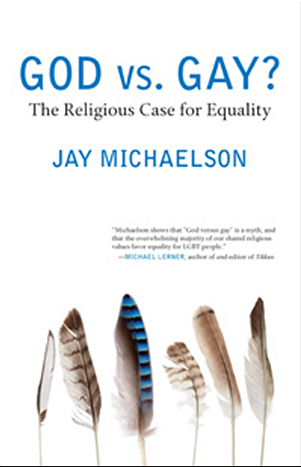
michaelsonIn my continued attempt to see what other people are seeing and how they resolve the apparent conflict of cleaving to the Bible as the Word of God and yet accepting actively gay couples into the community of faith, another in a long series of books as been recommended to me: Jay Michaelson’s God vs. Gay? The Religious Case for Equality. I don’t high hopes that Mr. Michaelson will be any more successful at showing me what I seem to be missing any more than anyone else has. All of the argument for supporting the acceptance of marriage equality within the Church and Synagogue must either drastically re-write (or at least radically reinterpret) the Bible or baldly insert what isn’t actually there.

I can’t find “loving gay couples” in the Bible, certainly not within the covenant community, nor is what we now call “sexual orientation” or “gender identity” even faintly presupposed in the Biblical text. I can purchase a used copy of Mr. Michaelson’s book for less than a dollar on Amazon, so I risk little in buying and reading what he wrote (and I risk even less because I just discovered his book is available at my local public library).

The core of every gay Christian’s (or ally’s) argument in support of gays participating in the Church while in same-sex romantic/erotic relationships (legally married or otherwise) is that “Jesus is love”. OK, I’m grossly oversimplifying the argument, but stripped down to its nuts and bolts, that’s it.

Pastor Pavlovitz’s article focuses on the damage done to various gay individuals when rejected by their churches and told that their actions and even their desires are sinful (which, by the way, was also a large part of Matthew Vines’ argument). The readers are meant to feel compassion for human beings who were born to desire members of their own sex rather than the opposite. The fault in all this is either God’s or in how we interpret the Bible.

I’m willing to accept the latter argument if you can convincingly show me where the error exists. I’m an advocate for (in theory) taking our understanding of Biblical exegesis “back to formula” and building it up from scratch, since two-thousand years of Christian and Jewish tradition have skewed how we define “sound doctrine” and obliterated how the original writers and readers of the Bible would have understood the message contained therein.

But what I see instead is the desire to not correctly understand the message of the Bible and then conform our lives to a behavioral standard set by God for humanity, but the requirement to fit the Bible into the current societal standards set by progressive cultural and political imperatives.

Besides the recent tide of Federal judicial decisions ordering various states to begin issuing marriage licenses to same-sex couples, Houston (Texas) Mayor Annise Parker and her administration’s subpoenas of the sermons of several local Pastors in relation to a lawsuit regarding the so-called “HERO” (Houston Equal Rights Ordinance ) legislation complicates the “war” between religion and the political structures supporting LGBTQ desires.

Parker
Houston Mayor Annise Parker

And I don’t know what to do with the overwhelming flood of anecdotal reports from people who say they were “born this way” and have never known any other way to relate romantically or sexually. I can’t say “no, that’s not how you feel” or “you are giving in to sinful impulses” when I have no ability whatsoever to experience that person’s reality. On top of that, most religious people who have the concept of sin know, at least on some level, when they’re sinning. But if what straight Christians consider sin is experienced only as love (or maybe sometimes just desire) by gay Christians, what am I to say to that?

I’m looking for an answer one way or the other. Unfortunately, Pavlovitz ends his article only with this:

We are losing credibility to those outside organized Christianity, not because we’re “condoning sin” but because when the rubber meets the road, we really don’t know how to “love the sinner” in any way that remotely resembles Jesus, and our “God is love” platitudes ring hollow.

Church, this is our legacy that we are building in these days to the LGBT community and those who love them, and I assure you it’s not a legacy of love.

I don’t know what the answer is for you, and I can’t tell you how your theology gets expressed in the trenches of real people’s lives. I only know that we as Christ’s church can do better, regardless of our theological stance. We have to do better.

This is where our faith is proven to be made of Jesus-stuff or not.

This is where the love of God we like to preach about is either clearly seen or terribly distorted.

I don’t really care about whatever credibility or lack thereof those outside the religious community see in Christianity since we are supposed to please God, not people. Also, in suggesting that Christianity doesn’t know how to “love the sinner,” he is at least hinting that there’s some sort of sin involved in homosexuality, though I doubt he meant to send that message.

While I agree that “demonizing” gay people is not how the Church should respond to them, I do agree that Jesus didn’t die to excuse or cover up sin but rather, to forgive it (once the sinner has sincerely repented). And again, I crash headlong into the issue of sin vs. (presumably) in-born orientation and behavioral expression of said-orientation.

If we are to respond to all sins as being “the same” with no one type of sin being better or worse than another, then I get it. We can’t react to a gay person in the Church any differently than a bank robber, embezzler, or drug abuser in the Church. Gay sin isn’t any more “icky” than embezzlement sin.

But that’s not the issue from Pavlovitz’s perspective or anyone else who supports wholehearted acceptance of the LGBTQ community within the covenant community. The issue is love equals acceptance and that being gay isn’t a sin, it’s a life. It’s built-in, and that being the case, God must approve since God made the person to be gay even as he made me to be straight.

But there’s no “smoking gun” in the Bible, and to the best of my knowledge, Adam, Eve, Noah, Abraham, Sarah, Isaac, Jacob, Moses, Aaron, Joshua, David, Solomon, Jesus, Peter, and Paul…well, none of them were gay nor were any of them in a “loving same-sex relationship”.

Despite the vast number of laws and commandments, both biblical and rabbinic, the rabbis insist that sometimes we are beholden to an even higher standard. This is the idea of lifnim mi-shurat ha-din, beyond the letter of the law. The sages recognize that one can observe the commandments and still engage in deplorable behavior, and they call one who does this naval b’reshut ha-torah, a scoundrel within the bounds of the law.

-from Walking with the Mitzvot, p.27
Edited by Rabbi Bradley Shavit Artson
and Rabbi Patricia Fenton
Published by the Ziegler School of Rabbinic Studies
aju.edu (PDF)

So who is observing the commandments and still engaging in “deplorable behavior” as far as the current debate goes, the Church or the gay Christians in it? I suppose that remains to be seen.

flag

I’m going to the library in a few minutes (as I write this, I’ve already started the book as you read this) to check out the Michaelson book. I’ll try again. I want to be fair. But more than that, I want to do what God wants me to do. I’m pretty lousy at that sometimes, but I’ve got to keep trying.
Israel and the Nations in the House of God

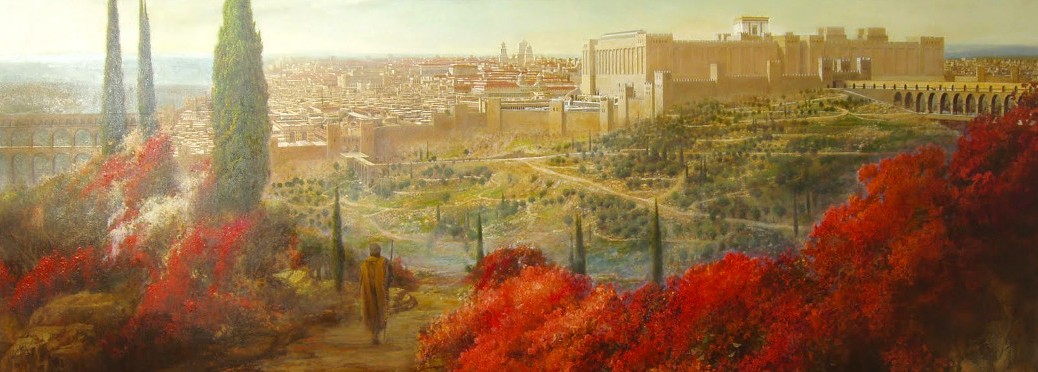
True, that particular parcel of land was later named Eretz Yisrael, but even then we saw not a small piece of land, but a polished mirror, reflecting the entire world. In this land will rise up the mount of the Lord “and to it shall flow all to the nations.” On this mount will stand the House of the Lord, “it shall be called a house of prayer for all the nations.”

-Rabbi Moshe Avigdor Amiel
Commentary on Lekh Lekha
Chapter 1: Abraham Recognized His Creator, p.135
Translated by Kadish Goldberg
Jews, Judaism, & Genesis: Living in His Image According to the Torah

As Christians (or “Messianic Gentiles” if you prefer), we have our own ideas of how God’s covenant promises to Abraham, Isaac, and Jacob somehow play in to attaching the non-Jewish people groups of the world to the God of Israel. It’s true that we disagree on many of the specifics of the New Covenant and how faith in the accomplished work of Messiah grafts us into the root, and we argue about those opinions day and night, typically by blogging.

Every so often, we employ the classic Jewish writings, not those found in the Bible, but those written afterward, sometimes many centuries afterward, to somehow prove our point. We conveniently forget that these Jewish sages and teachers would not have said or done anything they thought might give credence to the idea that the “founder of the Christian religion,” that is to say “Jesus” (Yeshua) could possibly be the Messiah, let alone of a Divine nature.

However, I believe that only by viewing the Bible through a “Jewish lens” and reading the sacred writings in as close an approximation as possible to how the original audience would have understood them, will we ever come close to capturing the true intent of not only the human writers, but of the Holy Spirit that inspired them. Thus, when I read Rabbi Amiel’s commentaries, which include his insights as to just how the rest of the world was supposed to be attracted to the God of Israel, I become interested.

amiel
Rabbi Moshe Avigdor Amiel

One caveat, though. We can’t read too much into these commentaries for, as I said above, R. Amiel and the sources he quotes would not be considering Jesus in any favorable light, given the long history of enmity that existed between our two faith groups. Nevertheless,I think by examining the Jewish perception of drawing the Gentiles near, we might gain some insights into how we Gentiles might better approach Hashem, God of the Hebrews.

“The Holy One, blessed be He, exiled Israel among the nations so that they would attract converts, as it is said, ‘and I shall plant her in the land’ — does one sow a se’ah unless he expects to reap several koor?” (Tractate Pesachim 87b.)

So it was with the first Jew, our father Abraham. His history, as described in the portion of Lekh Lekha, began in Galut, outside the Land of Israel. He, too, was exiled from his land and birthplace only in order to increase proselytes, as is written ‘and all the families on earth will be blessed through you.’

-Amiel
Chapter 2: Our Father Abraham’s Mission, p.141

Of course in Abraham’s day, Judaism, as such, did not exist. Abraham is noteworthy for coming to faith in the One God of all and acknowledging Him as his personal God. We do know from the Bible and midrash, that Abraham did “make souls” or taught his servants and others the ways of God, but would these people have “converted” to anything and if so, what?

His “converts” were not formally converted. Among the seventy souls who went down to Egypt, no mention is made of any converts. They were converted ideologically. They were influenced by Abraham’s noble spirit…

…Thus, the converts whom we are to attract through our exile among the nations are not formal converts — for “converts are as troublesome for Israel as is a skin affliction.” The converts referred to by the Rabbis are persons who are influenced in varying degrees by our sublime fragrance.

-ibid, pp.141-2

With the caveat I mentioned above in mind, how can we compare this to the actual result of the people of the nations being drawn to the God of Israel in the days of Messiah and afterward?

Go therefore and make disciples of all the nations, baptizing them in the name of the Father and the Son and the Holy Spirit, teaching them to observe all that I commanded you; and lo, I am with you always, even to the end of the age.”

Matthew 28:19-20 (NASB)

“You see, brother, how many thousands there are among the Jews of those who have believed, and they are all zealous for the Law…

…But concerning the Gentiles who have believed, we wrote, having decided that they should abstain from meat sacrificed to idols and from blood and from what is strangled and from fornication.”

Acts 21:20, 25

AbrahamSeemingly, there is a parallel between R. Amiel’s interpretation of the “mission of Abraham” to the nations and the mission to the Gentiles initiated by Yeshua and acted upon by Paul, James, and the Apostles. There’s a conversion without a conversion happening. Gentiles are added to the ranks of the ekklesia of Messiah without any formal conversion such as was typical of the proselyte rite in the late Second Temple period.

But how does R. Amiel and the Judaism he represents imagine this was to be done? Certainly not in the matter that the Christian believes.

“‘And I will make you into a great nation’ — therefore we say ‘God of Abraham.’ ‘And I will bless you’ — therefore we say ‘God of Isaac.’ ‘And I will make your name famous’ — therefore we say ‘God of Jacob.’ Are we then to conclude [the first blessing of the Amidah prayer] with all three? The verse specifies, ‘And you will be a blessing’ — we conclude with ‘you’ (singular), not with all three.

-Tractate Pesachim

Not only do the world’s three major faiths, our holy faith and those of the Christians and the Moslems, base themselves theologically upon our Holy Torah. Not only do they draw life-giving waters from our fountainhead, they also relate to us genealogically.

-Amiel
Chapter 3: God of Abraham, Isaac and Jacob, p.145

You may be aware that Abraham fathered both Ishmael, who became the father of the Arabs and is claimed by Islam, and Isaac, who, through his son Jacob, became the scion of the twelve tribes and finally the Jewish people. But how do Christians derive a genealogical connection to Abraham?

Esau, as you may have read, is Edom, a people who are thought to be the distant ancestors of the Romans, these are the Gentile nations from R. Amiel’s point of view, and thus the Christians, since Christians, by definition, are not Jewish (if that statement makes you uncomfortable when you think of “Hebrew Christians,” remember the Rav’s perspective on the matter is thoroughly Jewish and not easily adapted to Christianity’s framework of conceptualization).

But wait a minute. If both Islam and Christianity can be considered in some manner as physical descendants of Abraham, do we Christians then inherit all of the promises God made to Abraham including possession of the Land of Israel?

Hold your horses and remember your Bible. Even if the Gentile Christians are both “spiritual” and physical descendants of Abraham, there is this:

But God said to Abraham, “Do not be distressed because of the lad and your maid; whatever Sarah tells you, listen to her, for through Isaac your descendants shall be named.”

Genesis 21:12

Now Abraham gave all that he had to Isaac; but to the sons of his concubines, Abraham gave gifts while he was still living, and sent them away from his son Isaac eastward, to the land of the east.

Genesis 25:5-6

interfaithIt is only through Isaac that the promises of God are carried on to the next generation and beyond, not through Ishmael or any of Abraham’s other children. Furthermore, of Isaac’s sons, only Jacob inherits both the birthright and the blessing of the first-born.

As it is written, God spoke to Jacob:

And behold, the Lord stood above it and said, “I am the Lord, the God of your father Abraham and the God of Isaac; the land on which you lie, I will give it to you and to your descendants. Your descendants will also be like the dust of the earth, and you will spread out to the west and to the east and to the north and to the south; and in you and in your descendants shall all the families of the earth be blessed. Behold, I am with you and will keep you wherever you go, and will bring you back to this land; for I will not leave you until I have done what I have promised you.”

Genesis 28:13-15

Thus as we see in Tractate Pesachim, it is only through Abraham and through Isaac, and through Jacob that all of God’s promises are carried out. It is true that based on the commentary, we can consider Abraham the father to other nations, physically the Arab people, and midrashically the Christians, but that makes neither people or religion Jewish.

Expanding on his point, R. Amiel writes:

‘And all the families of the earth will be blessed through you.’ Of the End of Days, when ‘the Temple Mount shall be the highest of all, towering above the hills,’ it is written that ‘many nations will come streaming to it.’ This is to say that even though ‘the Lord shall be one and His name shall be One,’ all the nations of the world will not fuse into one nation. There will remain diverse peoples. National differentiation actually contributes significantly to human development, bringing not curses but blessings. But ‘many nations will come streaming to it,’ — all will flow to one central point, to the Mountain of the Lord which ‘shall be the highest of all, towering above the hills.’ Or, as the Torah says, ‘through you will be blessed all the families [plural!] of the earth.’ (emph. mine)

-Amiel, p.147

Up to JerusalemAs I said, the Rav isn’t going to take any Christian innovations regarding Biblical interpretation into account, so it would be easy to discount his comment above based on that. On the other hand, I think there’s some merit to the idea that, by viewing the Bible a bit more “Judaically,” we can get a more accurate picture not only of how Judaism sees the final resolution of the Gentiles to God, but perhaps how the original Jewish writers of the Bible saw this conclusion of human history.

For me, this does re-enforce my currently held belief that the peoples of all the nations remain distinct national groups differentiated from Israel and from each other, and yet all drawn to One God and One place, the Temple, to worship Him in the “House of Prayer for all peoples”.

I’ve said before that it is at least plausible to consider that when the Master issued his Matthew 28:19-20 directive, the Apostles likely believed they would comply by employing the traditional proselyte rite, bringing the Gentiles into discipleship by converting them to Judaism. This, though, violates prophesy as R. Amiel has pointed out. It is clear that the Gentiles were to be drawn near to God as Gentiles.

The Apostle Paul was the one to see this most clearly, but how does Judaism see it standing on the outside of the Apostolic Scriptures and looking in, so to speak?

What prevented their mass conversion was the law of brit milah, ritual circumcision, for they found that particular commandment to be the most difficult of all. The founder of the faith of the “New Testament” exploited this fear of circumcision and prevented the fulfillment of the promise ‘and I will make you a great nation.” Thus Israel is ‘the smallest of nations.”

-ibid, p.148

This is the Rav’s explanation for how Christianity “morphed” into its own, separate religious expression. Like the ancient Apostles, he believes the proper way to fulfill the prophesies is to convert Gentiles into Judaism, making Abraham’s descendants as numerous than the stars (Genesis 15:5). But this contradicts his view that the people of the nations will draw near to God as people of the nations and not as proselytes. R. Amiel’s only apparent option within his contextual framework, is to have the Gentiles “convert” in the sense of becoming Noahides, righteous Gentiles, which would satisfy the requirement of them retaining their national identity while still honoring the One God of Israel.

R. Amiel acknowledges that Abraham is the father of many nations and that the people of the nations are blessed through him, but the “nations inherited the legacy only partially; we (Jews) inherited it in its entirety.” (p.149)

My respectful response to the esteemed Rav is “yes and no.” I agree that we Gentile believers are not Israel and yet, we are not to be compared to the generic nations of the earth. Even if those nations comply with the Noahide Laws, that doesn’t provide those of us who are grafted in to the root through our faith in Messiah access to the New Covenant blessings. This is something that Rabbi Amiel could not anticipate, but we can. We can take what is valuable from the esteemed and honored sages, and in this case, look at it through a New Covenant lens in order to glean what is of value there.

Restoration
Photo: First Fruits of Zion

I mean no disrespect to Rabbi Amiel, those other Rabbis who contributed to the publication of his book, or the long history of the Sages in Judaism, but even as they were inspired and even as they possess authority from God to make halachah for their generations, they were also men, and as men, given the struggles of the last twenty centuries, there were places they just could not see and knowledge they couldn’t assimilate. No one comes to God without the involvement of the Holy Spirit. To everyone else, the good news of the Messiah doesn’t make a lot of sense:

For indeed Jews ask for signs and Greeks search for wisdom; but we preach Christ crucified, to Jews a stumbling block and to Gentiles foolishness, but to those who are the called, both Jews and Greeks, Christ the power of God and the wisdom of God. Because the foolishness of God is wiser than men, and the weakness of God is stronger than men.

1 Corinthians 1:22-25

All people, Jewish and non-Jewish, come with blind spots that can only be clarified through the Spirit of God. I suppose God could just re-write our programming and the entire world could wake up one morning all declaring faith in Christ and him crucified, but that’s not God’s plan. It would be easier if it were, but God left human free will intact. We have to be willing to hear the messages of the Gospel, and having heard them, we have to be willing to believe and then act on that belief.

The call of the Master is like hearing a knock on your front door. Is it a thief or a benefactor? We won’t know until we open the door, but if we’re wrong, then it’s too late to save ourselves of any threat that might enter. But if we take the risk and open the door, he will come in and with him…freedom.

May we all meet together one day on the Mountain of God, and may we join in prayer in His House.

‘And the souls which they had made in Charan.’

Reish Lakish said, “Whoever teaches his friend’s son Torah is considered by Scripture as though he himself had made [created] him, for it is said, ‘And the souls which they had made…'”

-Amiel
Chapter 4: Flesh and Soul, p.151

Relative Righteousness

‘This is the story of Noah. Noah was in his generations a man righteous and wholehearted.’

What is the implication of ‘his generations’? Rabbi Yochanan said, “Only in his generations, but not in others.”

Reish Lakish said, “If in his generations, then certainly in other generations.”

-Tractate Sanhedrin 108a

Rabbi Yochanan acted in accordance with the noble precept “judge every person positively.” If the text lends itself to both laudatory and pejorative readings, then certainly a man described by the Torah as ‘a man righteous and wholehearted’ should be given the benefit of the doubt. On the other hand, the Torah itself deprecates Noah for not having tried to influence others, in contrast to our father Abraham, about whom the Torah testifies ‘and the souls they had acquired (lit., “had made”) in Charan.’ The Rabbis explain: “He (Abraham) brought them under the wings of the Holy Presence, Abraham converting the men and Sarah the women. The Torah reckons this as if they had made them” (Tractate Sanhedrin 99b). Except for his immediate family, Noah “made” not a single soul and seemed uninterested in the fate of contemporary humanity.

-Rabbi Moshe Avigdor Amiel
Chapter 1: A Tzaddik in His Generations, p.95
Translated by Kadish Goldberg
Jews, Judaism, & Genesis: Living in His Image According to the Torah

I’ve read this criticism before. There’s more than a hint of “superiority” in attributing higher or better motives to Abraham, the first Hebrew, than to Noah who was a Gentile, at least on the surface. Of course, if Rabbi Yochanan is correct, then Noah really did forsake even the attempt to inspire anyone in his generation besides his family to repent of their sins and thus be saved of the coming destruction of the flood.

On the other hand, how can Reish Lakish possibly be right, since there is evidence showing that Abraham but not Noah had disciples who were devoted to the One God?

If, however, we assume that the leader is forged by his generation, the picture is reversed. Noah’s stature surpasses that of Abraham. Abraham functioned in a society amenable to moral improvement, wherein one could “make souls.” Noah lived in a totally corrupt society, yet remained unblemished by its immoral influences.

-Amiel, p.96

This doesn’t tell us if Noah tried to save anyone, but it does suggest that he would have universally failed, given the abject corrupt nature of the society around him.

All this is conjecture, of course, but have you ever wondered if the world we live in today is more like Noah’s or Abraham’s?

“But of that day and hour no one knows, not even the angels of heaven, nor the Son, but the Father alone. For the coming of the Son of Man will be just like the days of Noah. For as in those days before the flood they were eating and drinking, marrying and giving in marriage, until the day that Noah entered the ark, and they did not understand until the flood came and took them all away; so will the coming of the Son of Man be.”

Matthew 24:36-39 (NASB)

We can see that Jesus (Yeshua) is drawing a comparison between the days of Noah and the days of Messiah’s eventual return. In both cases, the general public didn’t have a clue that their time had come and that a revolutionary act of God was imminent. People will still be carrying on “business as usual” right up until the end.

stained glass jesusBut we can’t necessarily extend the comparison to include relative levels of corruption. After all, in the current age, people do respond to Christian missionary efforts and become disciples of Jesus and even some Jews and Gentiles have come to the realization of the revelation of the Jewish Messiah as the Jewish Messiah rather than the Goyishe King, if you’ll pardon my making a distinction.

Beyond the presumed difference in behavior in Noah and Abraham that Rabbi Yochanan and Reish Lakish represent, there’s the idea that God will continue to offer redemption should a generation be open to it, and withdraw that option should that generation be totally cold to God. Does God ever give up on an entire people group?

As for you, you shall go to your fathers in peace; you will be buried at a good old age. Then in the fourth generation they will return here, for the iniquity of the Amorite is not yet complete.”

It came about when the sun had set, that it was very dark, and behold, there appeared a smoking oven and a flaming torch which passed between these pieces. On that day the Lord made a covenant with Abram, saying,

“To your descendants I have given this land,
From the river of Egypt as far as the great river, the river Euphrates: the Kenite and the Kenizzite and the Kadmonite and the Hittite and the Perizzite and the Rephaim and the Amorite and the Canaanite and the Girgashite and the Jebusite.”

Genesis 15:15-21

Although God promises the Land of Canaan as a permanent inheritance to Abraham’s descendants, they would not be allowed to take possession of that Land until the current inhabitants had become so corrupt that they were (presumably) unable to be redeemed. This seems to indicate some sort of spiritual or moral “cut off point,” a state that once entered into can never be reversed.

Then the Lord spoke to Moses, “Go down at once, for your people, whom you brought up from the land of Egypt, have corrupted themselves. They have quickly turned aside from the way which I commanded them. They have made for themselves a molten calf, and have worshiped it and have sacrificed to it and said, ‘This is your god, O Israel, who brought you up from the land of Egypt!’” The Lord said to Moses, “I have seen this people, and behold, they are an obstinate people. Now then let Me alone, that My anger may burn against them and that I may destroy them; and I will make of you a great nation.”

Exodus 32:7-10

It seems like Israel had crossed that “line in the sand” or at least was standing right on top of it. If Moses hadn’t pleaded with God for Israel (Exodus 32:11-14), then the inheritors of the Land would only have come from the tribe of Levi, that is, the descendants of Moses.

That last point is debatable however, and God could have been testing Moses the way He tested Abraham at the Akedah (Gen. 22:1–19).

The famous “Great Commission” (Matthew 28:18-20) as Christianity calls it, was Messiah’s directive to his Jewish Apostles to do what had never been done before; make disciples of the people of the nations without requiring them to undergo the proselyte rite and convert to Judaism. It may have been (and I’m extending the previously mentioned midrash about Noah and Abraham) that like the people of Noah’s generation, the Gentiles were considered unable to be redeemed unless they converted and joined Israel and Jewish people “lock, stock, and barrel,” so to speak. If a Gentile were permitted entry into the ekklesia of Messiah and to remain a Gentile, was such a thing even possible?

Some men came down from Judea and began teaching the brethren, “Unless you are circumcised according to the custom of Moses, you cannot be saved.” And when Paul and Barnabas had great dissension and debate with them, the brethren determined that Paul and Barnabas and some others of them should go up to Jerusalem to the apostles and elders concerning this issue.

Acts 15:1-2

Peter's visionMany Jews didn’t seem to think so, not because they were mean-spirited or had anything against Gentiles as such, but because it seemed like a spiritual and covenantal impossibility. Even Peter, if he hadn’t experienced his vision (Acts 10:9-16),would never have understood that it was possible for Gentiles to be redeemed.

And he said to them, “You yourselves know how unlawful it is for a man who is a Jew to associate with a foreigner or to visit him; and yet God has shown me that I should not call any man unholy or unclean.

Acts 10:28

See? The vision was a metaphor, not a literal reality. It was never about food. It was about people.

Opening his mouth, Peter said:

“I most certainly understand now that God is not one to show partiality, but in every nation the man who fears Him and does what is right is welcome to Him.”

While Peter was still speaking these words, the Holy Spirit fell upon all those who were listening to the message. All the circumcised believers who came with Peter were amazed, because the gift of the Holy Spirit had been poured out on the Gentiles also. For they were hearing them speaking with tongues and exalting God.

Acts 10:34-35, 44-46

Obviously, those late Second Temple period Jews who thought Gentiles could not be brought to God on equal terms and yet remain Gentiles were wrong, but it took a lot of convincing. In fact, Luke’s Book of Acts and many of Paul’s epistles testify to how eagerly thousands upon thousands of Gentiles accepted the discipleship of Yeshua upon themselves, receiving the Spirit and the promise of the resurrection.

But what about we believers today? Oh yes, Christians sometimes go door-to-door passing out religious tracts, send missionaries to far away lands to preach the word of the Gospel, and otherwise proselytize the people around them, but do we ever give up on individuals or, Heaven forbid, entire groups of people?

For Easter one year, the church where I first became a believer many years ago, created a video project. They went to Portland and deliberately approached people who seemed extraordinarily (from these Christians’ point of view) unlikely to accept Christ or even to know much about him. The people they captured on video tape seemed to be what I believe were/are called punk rockers, people, with spiked, multi-colored hair and a proliferation of body piercings; people who didn’t look at all like the “clean-cut” Christians from that church in Boise, Idaho, who typically were socially and politically conservative, and most of whom were educated professionals.

When we screened some of the raw video prior to editing, a lot of people around me in the audience were laughing and making fun of the answers the “subjects” gave in response to the Christian interviewer’s questions about Jesus and Easter.

I was disgusted.

If that had happened today, I certainly would have spoken up, but way back then, I was considered what is called a “baby Christian,” someone new to the faith. I had very little experience as a Christian and didn’t know how or even if this was to be considered normal for a believer. All I knew was that a year from that point, none of the people in that Church would know if anyone they had spoken to in Portland might have made a confession of faith and become a brother or sister in Christ. They’d just written these folks off. More’s the pity.

Who are we? Are we worthy to be called by His Name?

Well, no one is worthy, but by our behavior, by our attitude toward individuals or entire groups or “types” of people, do be sanctify or desecrate the Name of God?

unworthyI can’t tell you about Noah’s righteousness relative to Abraham’s with any certainty, or for that matter, in relation to Moses, but I can tell you that the next time you see another believer operating with a “holier than thou” attitude (or the next time you operate with that attitude), chances are, the second you started making fun of someone else or denigrating them for some flaw or problem they possess, you ceased to have any claim to any righteousness you thought you had.

…as it is written, “There is none righteous, not even one…

Romans 3:10

So what’s the cure for this sickness of self-righteousness?

Now when they heard this, they were pierced to the heart, and said to Peter and the rest of the apostles, “Brethren, what shall we do?” Peter said to them, “Repent…each of you…”

Acts 2:37-38

Peter said other things, but I’m assuming that it is as believers we need to repent of how we judge others, not as those who still need to be baptized by the merit of Moshiach. But then again, if we are capable of acts of cruelty or even just indifference to whole populations of people because they don’t look, talk, or act like us, maybe we are not really disciples of the Master at all.

“And then I will declare to them, ‘I never knew you; depart from me, you who practice lawlessness.'”

Matthew 7:23

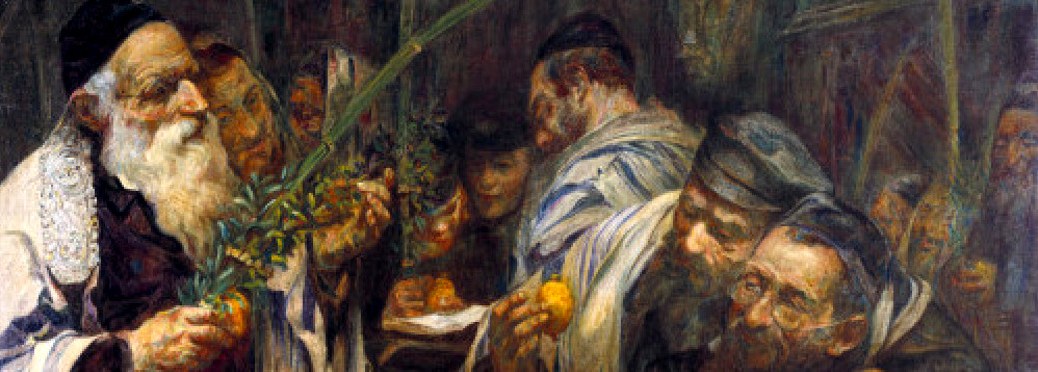
Who is Honored on Sukkot?

Epicurus used to say, “Were the gods to answer the people’s prayers, people would deteriorate and die, for so multitudinous are the tribulations which each one wishes upon his fellow.”

Epicurus may be right as regards the prayers of the nations, but not as regards our prayers. We well know “This is the book of the generations of man,” and every year we begin our supplications with “And now, Lord our God, place Your awe upon all whom You have made, Your dread upon all whom You have created…”

-Rabbi Moshe Avigdor Amiel
Chapter 13: The First Man and the Jewish Nation, p.75
Translated by Kadish Goldberg
Jews, Judaism, & Genesis: Living in His Image According to the Torah

Last week, I spent some time writing about those things that make Jewish people unique and distinct from the people of all the other nations, including Gentile Christians, in three blog posts: Upon Reading a Rant About “Messianic Jewishism”, Diminishing the Moon and Israel, and Are Messianic Jews Not Expected to Practice Judaism?. I suppose I could be accused of fomenting discord between Jewish and Gentile members of the ekklesia of Messiah, or to put it in more Christian-friendly terms, the members of the “body of Christ”.

In the spirit of unity which is aptly expressed during this time of Sukkot, I thought I’d take a different tack.

As we discussed last year, the fruit symbolizes the Torah inside a person, while the fragrance represents the Mitzvos, the deeds a person does which affect those around him or her. The four species represent those who have both Torah and good deeds, those who have one but not the other, and even those who have neither.

And what are we told to do? We bind them together! Every Jew is a unique and essential part of our nation.

from “Note from the Director”
News from Project Genesis and Torah.org for Sukkot
Torah.org

Unfortunately, I can’t find this note from Rabbi Yaakov Menken on the Project Genesis website which would allow you to read all of the Rabbi’s comment, but as you might imagine, he is specifically addressing unity among Jewish people and not including non-Jewish believers in Jesus (Yeshua). However, giving Rabbi Menken’s words a “Messianic spin,” I think we can include the entire population within the ekklesia of Messiah, the Jews and the Gentiles, at least for the sake of my example. While unity doesn’t require uniformity, we still are united with each other by love of the Moshiach, may he come swiftly and in our day.

Earlier in his email newsletter, the Rabbi wrote:

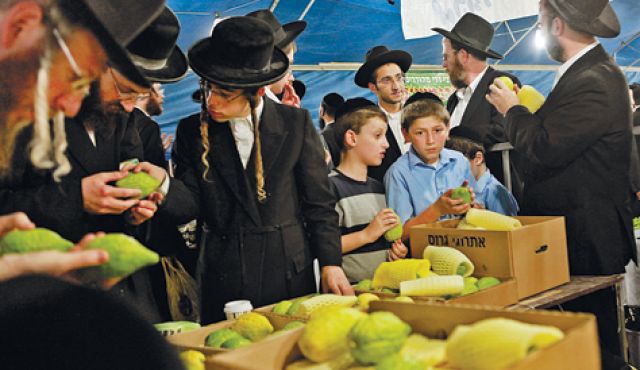
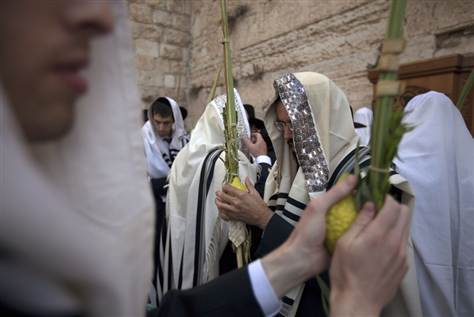
The Torah tells us to take four species: the Esrog, a citrus fruit with a pleasant taste and smell; the Lulav from a Date Palm which produces fruit but is not fragrant; Hadasim, myrtle branches which are aromatic but does not provide edible fruit; and aravos, from the willow, which has neither taste nor smell.

Consider the differences and the distinctions involved in each of the four species. What does a citrus fruit, a lulav, myrtle branches, and aravos from a willow have in common?

Not much apparently.

And yet all four of these highly different items are absolutely required for the observance of Sukkot as it is written:

Now on the first day you shall take for yourselves the foliage of beautiful trees, palm branches and boughs of leafy trees and willows of the brook, and you shall rejoice before the Lord your God for seven days.

Leviticus 23:40 (NASB)

four species
Photo by Gili Cohen Magen

Those distinctively different objects are required to be bound together and, in essence, to “work together,” in order for Sukkot to be observed properly. While it’s impossible to offer the appropriate sacrifices related to Sukkot today due to a lack of the Temple and the Priesthood, the celebration is nevertheless observed by religious Jews and not a few believing Gentiles as well.

In a recent comment on one of my blog posts and then again in commenting on a different blog post, I said:

According to Jewish tradition, on the first seven of the eight days of the festival, we are to extend a special invitation to a specific guest in this order:

  1. Abraham, who represents love and kindness
  2. Isaac, who represents restraint and personal strength
  3. Jacob, who represents beauty and truth
  4. Moses, who represents eternality and dominance through Torah
  5. Aaron, who represents empathy and receptivity to divine splendor
  6. Joseph, who represents holiness and the spiritual foundation
  7. David, who represents the establishment of the kingdom of Heaven on Earth

Now before you think I’ve flipped for considering something so far-fetched, look at this:

“I say to you that many (Gentiles) will come from east and west, and recline at the table with Abraham, Isaac and Jacob in the kingdom of heaven (meaning the Messianic Kingdom here on Earth established by Jesus upon his return)…”

Matthew 8:11

This at least suggests a sort of feast occurring during Sukkot in which we non-Jewish disciples of Christ will join the Jewish disciples in participating in the Sukkot festival with the greatest prophets, priests, and kings in the Bible, all in honor of King Messiah.

While I crafted the above quoted-statement to be easier for a traditional Christian to comprehend, I want all of us to understand that Jews and Gentiles will be together at the feast with Abraham, Isaac, and Jacob (and perhaps Moses, Aaron, Joseph, and David) to give glory and honor to King Messiah upon the establishment of his Kingdom. Maybe this will even happen on Sukkot, although of course, I can say that for sure.

Certainly the Prophets, Priests, and Kings represented by the Seven Ushpizin guests are not exactly alike, and although they exist within the unity of the Jewish people, they are not identical in type or function. So too it can be said that even though Jew and Gentile in the ekklesia of Messiah and as citizens in the Kingdom of Heaven have unity within that assembly, they also are not identical in type and function.

sukkotBut you won’t see Abraham, Moses, and David arguing about it, so why should we?

About twelve years ago, Rabbi Eliyahu Hoffman wrote a Sukkot commentary called “Shaking Up Our Priorities” which you can find at Torah.org. It’s worth the read and won’t take much of your time, but I’d like to quote just a part of it here:

One year, as he always did before Sukkos, R’ Yitzchak gathered his belongings, including all the rubles that he had put aside, and left home to travel to a nearby town where the Four Species could be bought. Travelling along the roadside, he stopped suddenly when he heard the sound of someone crying. Indeed, a Jewish man sat in a nearby field, head in his knees, crying and moaning bitterly. R’ Yitzchak approached him. “Reb Yid, what’s the matter?”

“Don’t even ask,” the Jew said, “a bittere pekel tzures – what a bitter portion the Almighty has dealt me! Woe is to me. I had one horse. That might not seem like much, but it was enough to support my family. It was a good horse. I rode it from town to town, delivering people’s mail, parcels – whatever they needed. I didn’t make a fortune, but we had what to eat, and we were happy. But today I awoke, and – woe is me – I found her dead. She must have passed away overnight. As it is, we live from hand to mouth. If I have to deliver by foot, I don’t stand a chance of making a living. Woe is me!”

“Tell me,” asked R’ Yitzchak, “what would a new horse cost you. I’m sure she was a good horse, but there are other horses out there.”

“Of course there are other horses, for someone who has 300 rubles to spend! It would take me almost a year to earn that kind of money! So you see, all is lost!”

Without further ado, R’ Yitzchak took out his wallet and counted out 300 rubles, leaving for himself only the smallest sum from all the money he had so carefully put aside. He placed it in the pocket of the forlorn Jew, who had all the while never taken his head out from between his knees. Sticking his hand into his pocket, he was flabbergasted to find the entire sum he needed to buy himself a new horse. “What… What have you done. I… I never expected.” Completely choked up with emotion, he barely managed to thank R’ Yitzchak for his magnanimity. Little did he know, R’ Yitzchak himself was not a rich man, and that he had just parted with the lion’s share of his own savings.

That year R’ Yitzchak had to settle for the plainest of Esrogim, much to the surprise and wonder of his friends and family. Despite their best attempts to find out, he told no one of what had come of his plans to purchase the most beautiful Esrog, nor of his savings, except to say, cryptically, that “the money was not lost – in fact it had just galloped off and was being put to very good use.”

If you are a (non-Jewish) Christian or otherwise are a person who does not observe Sukkot (or who does so in a rather casual manner), you won’t understand the tremendous significance involved in R’ Yitzchak’s generosity. In a sense, he had before him two apparently conflicting mitzvot. He could do as he had done every year and dedicate the more than 300 rubles it had taken him all year to save for the purchase of the most beautiful Esrog he could find in honor of the festival and God, or he could alleviate the sorrow of a Jew even poorer than he was by freely handing over his money for the purchase of a horse, and settle for the plainest Esrog he could still afford.

Again, from a Christian point of view (and probably the viewpoint of most people), the decision to help his fellow Jew seems clear, but remember, what is at stake is the honor of both God and of human beings at this Holy time of year.

Perhaps, even after performing tzedakah (charity) by giving up his Esrog money, R’ Yitzchak was still unsure that he did the right thing, for we find:

During Chol Ha-Moed (the Intermediate Days of Sukkos), R’ Yitzchak travelled to Lublin to visit his Rebbe, the famed Choize (Seer) of Lublin. At the festive Yom Tov meal, the Choize remarked to his disciples, “The mitzvah of Arba Minim must be performed with great joy. We must thank Hashem that we all managed to perform the mitzvah of waving the Lulav and Esrog. When we wave the mitzvos, all the Heavenly spheres and realms are awakened, and much joy and goodness permeate the upper realms, ultimately reflecting that joy and goodness back down to this world where we can reap its benefits. We all shook the Lulav and Esrog, but, R’ Yitzchak,” he said, turing as he did so to face him, “to wave a horse – now that is a truly original and exceptional way to perform a mitzvah!”

davening_morningChristians, most other non-Jews, and even some Jewish people often think of the Rabbinic Sages as inflexible, rule-bound, and even “anti-Bible” in considering halachah and Talmud as having any sort of authority when compared to the commandments clearly written in the Bible, but here we see that kindness, mercy, and “waving a horse” for Sukkot are not only original and exceptional ways to perform a mitzvah,” but deserving of special honor as expressing the heart of God.

In one of the commentaries for Tractate Yevamos 5 as collected and distributed in the Daf Yomi Digest by the Chicago Center for Torah & Chesed, we find the following based on “Each person shall fear his mother and father, and guard my Shabboses…”:

On today’s daf, we find that the Beraisa proposes that were it not for the verse, one might think that honoring parents overrides the Shabbos!

The famous Yehudi HaKadosh, zt”l, would deliver a regular Gemara shiur to his students that explored the commentary of Tosfos. One of his students was an extremely talented local boy who was unfortunately orphaned of his father. Once, the Rebbe interrupted their learning so that he could concentrate deeply on a certain subject. His young student knew well that such a break could last an hour or more, so he took advantage of the pause to go home and eat.

The boy ate a quick meal and hurried out back to his Rebbe’s home, but his mother called out after him that she wanted him to go up to the attic and bring something down for her. In his rush to return to study, he ignored her call, but half-way back the boy had second thoughts. “Isn’t the whole purpose of study to fulfill the mitzvos? Shouldn’t I honor my mother instead?” he asked himself. So he ran home and did as he was bid.

Afterward he returned to his studies, and as he opened the door to the Rebbe’s house, the Yehudi HaKadosh snapped out of his reverie and rose to his full height as a sign of respect. Beaming, the Yehudi HaKadosh asked, “What mitzvah have you just performed, because it has brought the spirit of the great Amorah Abaye with you into my house.”

The student told his story, and the Rebbe explained to the rest of the students: “It is well known that Abaye was an orphan—his name is an acronym of the verse, ‘For in You does the orphan find mercy.’ This is why his spirit accompanies a person who fulfills the mitzvah of honoring his parents—so that he should have a part in a mitzvah that was denied to him. You want to know why am I smiling? Because Abaye came and answered my question on the Tosafos!”

Again, this may not resonate with most people, including many Jews, but we see a comparison between the authority of a Rebbe over his young students and the mitzvah of honoring parents. It is said that a Rebbe is to be considered greater than one’s own father, so you can see that the young student put himself in a bind by going home to eat and then having to decide between his mother’s request and his obligation to promptly return to the Rebbe’s home.

MidrashIn choosing to honor his mother, he not only did the right thing from a human point of view, but he achieved a certain amount of respect from his Rebbe. Did “the spirit of the great Amorah Abaye” really accompany the boy to the Rebbe’s house and answer the Rebbe’s question on the Tosafos he had been pondering?

There’s no way to know for sure and probably no way to know if any of these events ever actually occurred. But whether or not they did, there’s a principle being taught here, the same principle as was taught in the previous Rabbinic story.

Even if we know nothing of the Torah, the mitzvot, or anything else, we know, or we should know as disciples of Rav Yeshua, our Rebbe, that extending mercy, kindness, compassion, and respect are the greater and loftier mitzvot, the acts of obedience and response to God that, even in moments of doubt, cannot fail.

I said in a comment last week that “if I’m going to err, I’d rather err on the side of humility”. I also quoted one of the Master’s parables:

And He began speaking a parable to the invited guests when He noticed how they had been picking out the places of honor at the table, saying to them, “When you are invited by someone to a wedding feast, do not take the place of honor, for someone more distinguished than you may have been invited by him, and he who invited you both will come and say to you, ‘Give your place to this man,’ and then in disgrace you proceed to occupy the last place. But when you are invited, go and recline at the last place, so that when the one who has invited you comes, he may say to you, ‘Friend, move up higher’; then you will have honor in the sight of all who are at the table with you. For everyone who exalts himself will be humbled, and he who humbles himself will be exalted.”

Luke 14:7-11

When we finally attend the “feast of Abraham, Isaac, and Jacob,” and it will be a massive affair no doubt, I suppose seating arrangements will be a big problem. What are you going to do with all of the people who show up from all over the world to honor King Messiah and to actually recline at the table with men like Jacob and Joseph? Where should we sit?

In retrospect, and considering the example the Master laid out for us, the answer should be obvious. We should consider ourselves as having no honor of our own, but only seek to honor the King and those Seven Ushpizin guests who represent the Prophets, Priests, and Kings of Israel, and indeed, all the Jewish people. If we mistakenly think we are greater than they, won’t our host, Yeshua, be forced to embarrass us by asking us to take the last place at the table?

Ben Zoma says: Who is honored? The one who gives honor to others…

(Talmud – Avot 4:1)

As non-Jewish disciples of the Jewish Messiah King, if we seek to honor him and believe we are worthy of honor, respect, equality, and inclusion within the ekklesia, then both the teachings of the Master and of the great Sages are clear that to be honored, we must honor others, and not deliberately strive to honor ourselves.

UnityThe Master also teaches:

Jesus answered, “If I glorify Myself, My glory is nothing; it is My Father who glorifies Me, of whom you say, ‘He is our God'”

John 8:54

If our Rebbe and Master did not glorify himself, should we not follow his example? Will he not take the different “species” within the body and unite us, regardless of our extreme differences…or perhaps because of them, and in our honoring him, won’t he honor us?

Chag Sameach Sukkot.

Are Messianic Jews Not Expected to Practice Judaism?

Question: Is formal conversion really necessary to be considered part of the Jewish people? After all, so many synagogues welcome non-Jewish members and so many rabbis sanction interfaith weddings.

Answer: It’s true that Jewish communities have become more inclusive of non-Jews, particularly non-Orthodox synagogues. Many Reform and some Conservative synagogues grant membership to non-Jews, Reform and Reconstructionist rabbis will officiate at interfaith weddings, and some Jewish cemeteries will grant burial rights to non-Jewish spouses.

“There are plenty of people who want to sojourn in the synagogue and not convert and still know they’re part of the Jewish family,” said the president of the Union for Reform Judaism, Rabbi Rick Jacobs. They’re “living in the Jewish community.”

-from “10 Questions About Jewish Conversion You Want to Know but are Afraid to Ask”
VirtualJerusalem.com

No, I’m not considering converting, but this particular question and answer has bearing on a theme I’ve been addressing this week. You could consider today’s “meditation” to be a “Part 3” to my Upon Reading a Rant and Diminishing blog posts.

The theme I’ve been discussing has to do with the relative roles of Jews and non-Jews within the modern Messianic Jewish (or just “Messianic”) community. As the comments section of my blog posts indicate, opinions vary widely. However, in the above-quoted question and answer, I see a sort of “marriage” between the two major viewpoints, an illustration of how a non-Jew can be part of the Jewish “family” as such.

We have to remember that this discussion or something like it, was taking place nearly two-thousand years ago. It was occurring in the synagogues and other communities established by the Apostle Paul as he endeavored to find a way for the Jewish and non-Jewish disciples of Messiah Yeshua (Christ Jesus) to co-exist in a mutually shared Jewish environment as co-equals (and please recall what I’ve said before about equality not requiring uniformity).

Jewish prayerBut there’s a distinction between the Jewish communities mentioned in the article I cited above and Messianic Judaism today. In all of the other Judaisms, it is well-known that they are first and foremost, Jewish communities, and that being a Gentile who is a participant in those communities does not automatically make the Gentile identical in form and function to the Jewish people in membership.

I only quoted part of the answer to the question above. Here’s the rest:

Indeed, surveys show that actual converts to Judaism are far outnumbered by Americans born outside the faith who consider themselves Jewish despite having never formally converted to Judaism. However, even in the most liberal Jewish communities, there is a dividing line that excludes non-Jews. Practically no synagogues allow non-Jews to be called to the Torah (unless they are accompanying a Jewish spouse at their kid’s bar mitzvah). Jews married to non-Jews are barred from admission to rabbinical school. And, of course, non-Jews can’t marry Jews under Conservative or Orthodox auspices.

Most importantly, you can call yourself whatever you want – friend of, member of, parent of. But unless you formally join, you’re no Jew.

The big issue that seemingly separates the Judaisms described above from Messianic Judaism, is the assumption by Gentile believers who are among Jews who have sworn fealty to the Moshiach, that by virtue of such a faith, all differences and distinctions between Jewish and Gentile disciples are rendered moot, and the ekklesia ceases to be a Jewish community in favor of a Messianic community, as if the two concepts are mutually exclusive.

And yet, we forget that the ekklesia of Messiah began most forcefully as a Jewish community, one in which few if any Gentiles were to be found.

So then, those [Jews] who had received his word were baptized; and that day there were added about three thousand [Jewish] souls. They were continually devoting themselves to the apostles’ teaching and to fellowship, to the breaking of bread and to the prayers.

And the Lord was adding to their number day by day those [Jews] who were being saved.

Acts 2:41-42, 47 (NASB)

“You see, brother, how many (tens of) thousands there are among the Jews of those who have believed, and they are all zealous for the Law…

Acts 21:20

All Jews, all living, working, and glorifying God together in Jewish community. No one batted an eye and in fact, the only upset occurred when Gentiles started to enter the mix in great numbers.

As Paul and Barnabas were going out, the people kept begging that these things might be spoken to them the next Sabbath. Now when the meeting of the synagogue had broken up, many of the Jews and of the God-fearing proselytes followed Paul and Barnabas, who, speaking to them, were urging them to continue in the grace of God.

The next Sabbath nearly the whole city assembled to hear the word of the Lord. But when the Jews saw the crowds, they were filled with jealousy and began contradicting the things spoken by Paul, and were slandering him. Paul and Barnabas spoke out boldly and said, “It was necessary that the word of God be spoken to you first; since you repudiate it and judge yourselves unworthy of eternal life, behold, we are turning to the Gentiles.

Acts 13:44-46

Apostle Paul preachingThe tale of Paul’s encounter at the synagogue in Pisidian Antioch is well-known, although most Christians are taught that these verses indicate Paul’s permanently turning away from the Jews to the Gentiles, which is patently untrue. Nevertheless, this is a portrait of the extreme difficulty that many Jewish communities had in understanding the New Covenant imperative of including the Gentiles in the community of Messiah without having them undergo the proselyte rite as formal initiates into Judaism.

Paul attempted to communicate that imperative to his Jewish listeners (see verse 48) by quoting Isaiah 49:6:

‘I have placed You as a light for the Gentiles,
That You may bring salvation to the end of the earth.’

(As a side note, when Paul says “I have placed You and “That You may…”, the “You” in both cases is singular in the Greek.)

In all this, I am not saying that Gentiles and Jews in Messiah cannot co-mingle and cannot share community. I am saying that it is not strange, bizarre, or even unBiblical to understand that community, the Messianic community, as distinctly Jewish.

On a previous and related blog post, Pete Rambo said:

The question Messianic Judaism has to answer is, ‘Who are they desiring to please? Abba, or Judaism?’

To quote Tony Stark by way of an answer, my response is, “Is it too much to ask for both?”

To find out more about how Jews and Gentiles in Jewish community finally didn’t work out in the late First Century CE, please read Zetterholm, Ancient Antioch, and “Honey, I Want a Divorce”.

It’s fairly easy to understand why “Messianic Gentiles” of one sort or another might object to the idea that Messianic Jews have a right to Jewish community and even a right to Jewish rituals, practices, and religious objects based on the long history between Christians and Jews, but what about Messianic Jews who object to this way of thinking?

No, I’m not talking about Messianic Jews who are willing to share their communal space with Gentiles with the understanding that Jewish and non-Jewish roles within the ekklesia are, by definition, differentiated. I’m talking about those few Jewish individuals who truly believe there is one and only one single application of the mitzvot for all populations everywhere and that Jews are not distinct in any behavioral or covenantal sense.

Question: I recently saw a “Jewish” professor speaking at an anti-Israel rally. When I voiced my disgust to a friend who knew him as a child, I learned that his parents converted to Catholicism back in Europe, he never had a circumcision or a bar mitzvah, and he is married to a non-Jewish woman. He claims in his speeches that he is a Jewish son of a Holocaust survivor. He may be the son of a survivor, but can we say once and for all that he is not Jewish?

-from “Is a Self-Hating Jew Still a Jew”
Chabad.org

self hatingThis may not seem applicable but hear me out. There are Jewish people who have come to faith in Messiah (or in Christ, as it were) who truly struggle with the apparent dissonance that results from being Jewish and being a Christian. After all, the Church generally teaches that you can’t practice Judaism and Christianity simultaneously. Actually, that part is probably true, but the underlying message is that you can’t be Jewish and be a Christian. You have to choose one. Messianic Judaism, to many Christians, seems like a messy “mash-up” of the two faiths (many Jews see it that way, too), a way to “pretend” to be one while actually being the other. But interestingly enough, Christianity was “invented” by Gentiles starting in the Second Century CE and beyond (see my aforementioned review of Zetterholm) and the original faith in Messiah has always been Jewish.

Hebrew Christians and Hebrew Roots Jewish people have the same struggle from two different directions. They both do not believe that “Judaism” has much if anything at all to do with faith in the Jewish Messiah. While they can acknowledge (and I could be stepping into deep doo doo expressing this opinion since I’m not Jewish) their Jewish ancestral and “DNA” heritage, there’s a difference (for them) between being Jewish and practicing Judaism. For them, faith in Messiah transcends Judaism and becomes something else entirely. So in this, Hebrew Roots is in agreement with traditional Christianity, though their expressions are quite different.

Chabad Rabbi Aron Moss answers the above-quoted question in part by saying:

And so, in a twisted way, he expresses his Jewishness by being the anti-Jewish Jew.

Yes, he is using his Jewishness as a weapon against Jews.

No, he should not be invited to speak at any Jewish event.

But yes, he is a Jew.

People like that can do a huge amount of damage. But the biggest damage is to themselves. Here is a Jewish soul yearning to connect to Jewishness, who has blocked his own path. Here is someone whose primary preoccupation, whose main claim to fame, is his Jewishness, but a tormented Jewishness. Rather than embrace it, he fights it. He is an accomplice in his own persecution.

While the “anti-Jewish Jew” in question doesn’t exactly fit the circumstance to which I am writing, there is an approximate match. I do not believe that you can separate being Jewish from practicing Judaism if you are at all a religious Jew in Messiah. Yeshua observed the mitzvot faithfully. So did his brother Jacob (James). So did Peter and the other apostles who walked with Yeshua. So did the later apostle Paul, emissary to the Gentiles. So did tens of thousands of other Jews in Messiah who were all zealous for the Torah of Moses (see the previously quoted Acts 21:20).

JudaismPracticing Judaism today is not like practicing Judaism in the days of the apostles. Practicing Judaism in the days of the apostles was not like how it was with the Prophet Daniel in the Babylonian exile. Practicing Judaism was also different in the days of Solomon, in the days of David, and it was different in the days of Moses.

Torah is Torah and the Word of God is permanent and inviolate, but how it is interpreted and applied across the wide tapestry of Jewish history is changeable and adaptable. The method of allowing non-Jews to join the assembly of Israel for example, has undergone much change since the days of Moses and Aaron, and it has changed again since the days of Paul, Peter, and James.

Of course, accepting the idea of the modification of the application of Torah is contingent upon the belief that God authorized or at least permitted the Jewish people to make such adaptations due to changes in circumstance and environment, particularly as related to the passage of time. Assuming this is true, then the current varieties of practicing Judaism are no less valid than they were Apostolic times. Are they all “right”? Probably, at least in the same sense that different Christian denominations are also all “right” (though it might be more accurate to say that none of them are completely right or completely wrong relative to their interpretation and application of the Bible).

I can’t throw out the baby with the bath water, though, whether it be in the case of Christianity or Judaism. Jesus taught and worked within the Judaism that existed in his day. He may have criticized specific teachings and practices, but he didn’t dismiss those Judaisms as entire ways of life with a wave of his hand. He accepted that these people were Jews and that by and large, especially when it came to the Pharisees, their overall teachings and halachah were acceptable and authoritative.

Jesus didn’t preach the destruction of Judaism with the idea of replacing it with “the Church” as Christianity teaches, nor did he believe Judaism (for Jews) should be replaced with anything else, as far as I can tell. Otherwise, he wouldn’t have operated within the normative Judaisms of the late Second Temple period nor would he have permitted the Jewish apostles to do so after his ascension to the right hand of the Father.

With all that in mind, why do both Jews and Gentiles in the Hebrew Roots system of belief insist that Jesus wants the destruction of the practice of observant Judaism among Messianic (or any other kind of) Jews now?

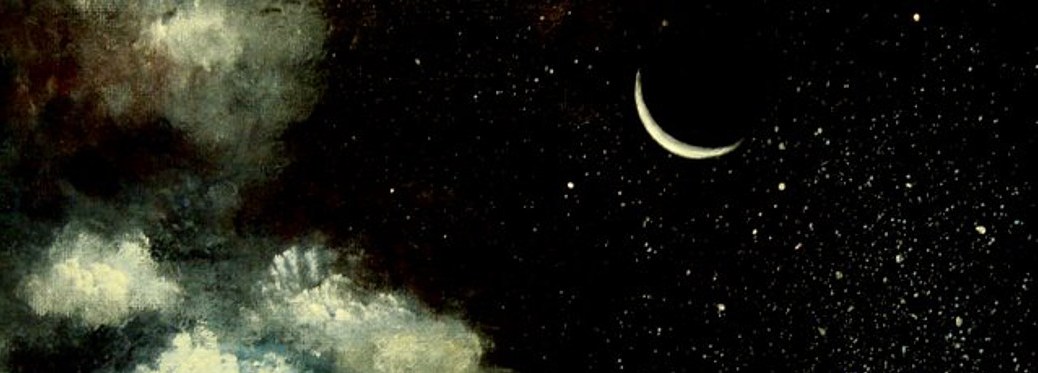
Diminishing the Moon and Israel

God made the two great lights, the greater light to dominate the day and the lesser light to dominate the night, and the stars.

Genesis 1:16 (JPS Tanakh)

R. Simeon b. Pazzi pointed out a contradiction [between verses]. One verse says: And God made the two great lights, and immediately the verse continues: The greater light . . . and the lesser light. The moon said unto the Holy One, blessed be He, ‘Sovereign of the Universe! Is it possible for two kings to wear one crown’? He answered: ‘Go then and make thyself smaller’. ‘Sovereign of the Universe’! cried the moon, ‘Because I have suggested that which is proper must I then make myself smaller’? He replied: ‘Go and thou wilt rule by day and by night’. ‘But what is the value of this’? cried the moon; ‘Of what use is a lamp in broad daylight’? He replied: ‘Go. Israel shall reckon by thee the days and the years’. ‘But it is impossible’, said the moon, ‘to do without the sun for the reckoning of the seasons, as it is written: And let them be for signs, and for seasons, and for days and years’. ‘Go. The righteous shall be named after thee as we find, Jacob the Small, Samuel the Small, David the Small’, On seeing that it would not be consoled the Holy One, blessed be He, said: ‘Bring an atonement for Me for making the moon smaller’. This is what was meant by R. Simeon b. Lakish when he declared: Why is it that the he-goat offered on the new moon is distinguished in that there is written concerning it unto the Lord? Because the Holy One, blessed be He, said: Let this he-goat be an atonement for Me for making the moon smaller.

-Tractate Chullin 60b

True, no human being ever heard the above conversation between the Holy One and the moon. We know of it only through our tradition. But we can actually see with our own eyes that very legend applying to that body which has been symbolized by the moon — Knesset Yisrael.

-Rabbi Moshe Avigdor Amiel
Chapter 5: The Moon and Knesset Yisrael, p.25
Translated by Kadish Goldberg
Jews, Judaism, & Genesis: Living in His Image According to the Torah

I read this chapter last Tuesday after I reviewed the latest set of comments on my recent blog post Upon Reading a Rant About “Messianic Jewishism” and I couldn’t help but be reminded of the general themes involved in said-blog post. While I don’t ascribe great credence to the idea that the Moon and God actually had a conversation, I think there’s a principle we can derive from the midrash on the “relationship” between the Moon and “Knesset Yisrael” or the Assembly of Israel. It’s the same principle the sages have derived.

How can Israel be compared to the Moon, the lesser of two “great lights?” Think about the relationship between the Moon and the Sun as compared to the relationship between Israel and God.

An adult sitting at his father’s table is considered a minor; a minor independent of his father’s table is considered an adult.

-from Tractate Kiddushin

yom kippur katanJust as the Moon is always dependent upon the Sun for light, and the Moon’s light would be immediately extinguished should the Sun “hide his face” so to speak, so too would Israel be extinguished should God hide His face from her.

And yet, the diminishing of the Moon is not one that is performed on it from outside but an act which the Moon, upon the command of God, performs upon herself, reducing herself in relation to the Sun and the stars.

The life of the moon is marked by a terrible tragedy. The Holy One, at first glance, seems to unequivocally accept her argument. He fully admits that her claim is reasonable, but as an expression of commendation for her just position, He demands more of her no more and no less than, “Go and diminish yourself.”

-R. Amiel, p.27

Rav Amiel compares this to Rosh Chodesh (festival of the New Moon), for on Erev Rosh Chodesh, “Jews offer prayer and supplication as they do on Yom Ha-kippurim, the Day of Atonement. This is Yom Kippur Kattan service” (ibid p.26). Just as the new or reborn Moon is in a greatly diminished state, so too is the rebirth of Israel (and keep in mind, Rav Amiel wrote this in the 19th century, long before the rebirth of the modern state of Israel).

R. Amiel speaks of the pogroms and other offenses the nations have committed against the Jewish people, and the utter dependence upon the leaders and rulers of the various nations in which “Knesset Yisrael” finds herself in, even for existence. Israel has been exiled, Jerusalem is in ruins, the Temple has been destroyed, the people have been scattered. Hostile churches (historically) have burned her volumes of Talmud, her Torah scrolls, and her synagogues.

However, even as the least among the nations as she currently may be, there is a consolation:

On the one hand, we are the smallest of all the nations, mocked and despised among the nations. On the other hand, we occupy “The Eastern Seat,” the seat of honor.

-ibid, p.28

The Jewish Paul…my kinsmen according to the flesh, who are Israelites, to whom belongs the adoption as sons, and the glory and the covenants and the giving of the Law and the temple service and the promises, whose are the fathers, and from whom is the Christ according to the flesh, who is over all, God blessed forever. Amen.

Romans 9:3-5 (NASB)

Rav. Amiel says something similar:

Israel orders the times for all nations and tongues. All our seasons, such as our “Festival of Freedom,” our “Festival of the Giving of the Torah,” are celebrated by all enlightened nations. In matters of time, we are emulated by all, even though sometimes the imitation is blemished by modifications — for example, the Sunday imitation of the Sabbath day — but it universally acknowledged that the original is ours.

Timewise, we are the most powerful of nations, the deciding factor. “Go and let Israel determine the days and years by you.” The nations’ calendar is based upon the birth date of a certain Jew.

-Amiel, p.28

The Rav, even in the admission of the lowered and diminished state of “Knesset Yisrael,” declares that in her weakness, Israel is great, for the rest of the nations follow her through (imperfect) imitation.

But he goes on:

This is our only consolation. It is, of course, only a partial consolation.

The moon “was not appeased.” Nor is Knesset Yisrael appeased. She thirsts for salvation and redemption, weeping bitterly, “When I remember this, O God, I moan…

-ibid, p.29

And does God not hear the cries of the oppressed and act in their defense?

“Because of the devastation of the afflicted, because of the groaning of the needy, Now I will arise,” says the LORD; “I will set him in the safety for which he longs.”

Psalm 12:5 (NASB)

Now, behold, the cry of the sons of Israel has come to Me; furthermore, I have seen the oppression with which the Egyptians are oppressing them.

Exodus 3:9

…but, ‘As the Lord lives, who brought up the sons of Israel from the land of the north and from all the countries where He had banished them.’ For I will restore them to their own land which I gave to their fathers.

Jeremiah 26:15

JewishI know people who criticized me and the topic of my other blog post don’t see themselves as in any way oppressing Israel or the Jewish people. They certainly have no deliberate intent to do so. In many ways, they see themselves as doing the opposite, lifting the Jewish people up and joining them by performing the identical mitzvot as an obligation in the merit of Messiah.

You might say to yourself that if God commanded Israel to diminish herself as He did (in midrash) to the Moon, should not Israel and the Jewish people be humble and elevate the Gentile to a higher level than the Jews, offering the Gentiles all of the mitzvot; the mitzvah of Shabbat, of Kashrut, of tzitzit, of tefillin, of the Moadim? Shouldn’t Israel be “fair” and at least share all of her mitzvot? Don’t they all belong to us (Gentiles) now anyway?

Maybe not, and we cannot consider Israel diminished forever, just as the sages have said, “for every descent, there is an ascent.”

Therefore, Heaven forbid that we discontinue the custom of Yom Kippur Kattan. Even in Eretz Yisrael of today, Knesset Yisrael is still compared to the moon. And so it will be until that hoped for time when “The light of the moon will be as bright as the sun, and the light of the sun as the light of the seven days.”

-Amiel, p.30

Then Jesus again spoke to them, saying, “I am the Light of the world; he who follows Me will not walk in the darkness, but will have the Light of life.”

John 8:12

And the city has no need of the sun or of the moon to shine on it, for the glory of God has illumined it, and its lamp is the Lamb.

Revelation 21:23

Moshiach is the light of Israel and the light of the world. Will he come to diminish Israel or to raise her up as the head of all the nations? As the people of the rest of the nations of the world who are called by Hashem’s Name, are we to continue to diminish Israel in disobedience to the Master? Why wait for his return? We can raise Israel up now by acknowledging her role and her place in the redemptive plan of God. We must do this now, lest we be counted among Israel’s enemies and even as disciples, be diminished ourselves in Messianic days.

Then it will come about that any who are left of all the nations that went against Jerusalem will go up from year to year to worship the King, the Lord of hosts, and to celebrate the Feast of Booths. And it will be that whichever of the families of the earth does not go up to Jerusalem to worship the King, the Lord of hosts, there will be no rain on them.Small plant

Zechariah 14:16-17

Admittedly, I’m playing a little fast and loose with my interpretation of that last passage of scripture, but do you really want to take the chance that I am wrong and God will not deliver consequences upon those of us to call ourselves disciples and yet fail to elevate Knesset Yisrael above all the peoples of the Earth?

There will be another “follow up” blog post on this subject tomorrow morning.