At the core of the pluralism issue is the debate over whether there’s “More than one way to be a good Jew.” Indeed, there have always been divergent streams of observance – like Chassidic, Sefardic vs. Ashkenazic, and even the Talmudic arguments between the Talmudic academies of Shammai and Hillel.
And yet, historic precedents show that there are limits to pluralism, beyond which a group is schismatic to the point where it is no longer considered Jewish. For example, everyone considers Jews for Jesus as outside of the legitimate Jewish sphere. The disagreement, then, lies in defining exactly what are the acceptable limits of divergence.
I’m continuing my email conversation with my Jewish friend as I described in yesterday’s meditation, and this “Ask the Rabbi” column seemed to fit right in. As you just read, there are a whole bunch of divergent streams of Judaism, but how far can you diverge and still be Jewish? According to the Aish Rabbi, being “Jews for Jesus” is going too far.
I should say at this point that “Jews for Jesus” is how most Jews see Messianic Judaism, thus Messianic Judaism isn’t viewed as a “Judaism” at all. One problem is, as a private communication revealed to me just recently, even many staunch Jewish disciples of Messiah aren’t all that observant. For instance, one Messianic Jewish conference (I’m deliberately concealing identifying information for obvious reasons) was scheduled during a major Jewish fast day. At another conference, the conference leaders ate the local hotel (non-Kosher) fare, and the very few Jewish attendees who kept kosher were forced to have catered kosher meals brought in or to drive some distance to a kosher eating establishment. And driving on Shabbat for the Jewish conference organizers and attendees wasn’t considered a big deal at all.
Why do I say all this?
Historically, any Jewish group which denied the basic principles of Jewish tradition – Torah and mitzvah-observance – ultimately ceased to be part of the Jewish people. The Sadducees and the Karites, for instance, refused to accept certain parts of the Oral Law, and soon after broke away completely as part of the Jewish People. The Hellenists, secularists during the Second Temple period, also soon became regarded as no longer “Jewish.” Eventually, these groups vanished completely.
-the Aish Rabbi
One of the big issues that may inhibit halachically, culturally, and religiously observant Jews from recognizing Messianic Judaism as a Judaism is, based on the quote above, the lack of consistent Jewish observance in Messianic Judaism. Except for in a few small corners of the movement (at least from an Orthodox Jewish perspective), Messianic Judaism presents the appearance of being not a Judaism (there are many other issues, such as the deification of Jesus and the supposed worship of a man, but I’m choosing to focus on the matter of community and observance right now).
It’s a terrible thing for a Jew to be cut off from his or her people.
For those of you who don’t know, the concept of Kareth or “cutting off” is a consequence of a Jew committing certain offenses, such as having a forbidden sexual relationship or worshiping a deity other than Hashem (known as Avodah Zarah). Messianic author and teacher Derek Leman even wrote an article on the topic a few years back.
Should a Jew in Messianic Judaism feel cut off from larger Judaism? Is that a consequence of being a Messianic Jew? Not according to Rabbi Stuart Dauermann in his article “The Jewish People are Us – Not Them,” which he wrote for the Fall 2013 issue of Messiah Journal (and which I reviewed), however, R. Dauermann admits that this has been a consequence of Messianic Judaism historically due to its associations with Evangelical Christianity. Evangelicals believe that once a Jew becomes a disciple of Messiah through the Messianic movement (or by converting to Christianity), they have more in common with Gentile Christians than non-Messianic Jews.
That’s a terrible burden to lay on any Jew’s shoulders.
But does it really have to be that way? Has it always been that way?
Early Christians were the original “Jews for Jesus.” They accepted the Divine revelation of the Torah, but not the eternal, binding nature of the commandments. Initially, these Jews were reliable in their kashrut, and counted in a minyan. But the turning point came when Paul, realizing that Jews wouldn’t accept the concept of a dead Messiah, opened up membership to non-Jews. At that point, these “Jews” experienced a total severing of Jewish identity.
Now that’s a glaring assumption by the Aish Rabbi. Let’s look at that again:
But the turning point came when Paul, realizing that Jews wouldn’t accept the concept of a dead Messiah, opened up membership to non-Jews. At that point, these “Jews” experienced a total severing of Jewish identity.
Evangelical Christianity believes that Paul broke with Jewish identity shortly after he encountered Jesus on the road to Damascus (see Acts 9) and that the extinguishment of Jewish identity in Messiah was by design. The Aish Rabbi says Paul may not have originally intended to break with Judaism and tradition, but when he couldn’t convince other Jews to “worship a dead Messiah,” Paul switched the object of his proselytizing from Jewish to Gentile populations and cut loose anything Jewish from devotion to Jesus.
No wonder so many Jewish people really hate Paul.
As Paul and Barnabas were going out, the people urged them to speak about these things again the next sabbath. When the meeting of the synagogue broke up, many Jews and devout converts to Judaism followed Paul and Barnabas, who spoke to them and urged them to continue in the grace of God.
–Acts 13:42-43 (NRSV)
I invite you to read the larger context which is captured in Acts 13:13-52, but basically, after Paul’s discourse in the synagogue at Pisidian Antioch, on how Jesus was indeed the Messiah, his Jewish audience was extremely eager for him to return next Shabbat to say more. Apparently the issue of a “dead Messiah” wasn’t a problem. The problem was this:
The next sabbath almost the whole city gathered to hear the word of the Lord. But when the Jews saw the crowds, they were filled with jealousy; and blaspheming, they contradicted what was spoken by Paul.
–Acts 13:44-45 (NRSV)
A certain number of God-fearing Gentiles generally attended this synagogue on a regular basis, so the huge crowds of non-Jews who showed up for the subsequent Shabbat to hear Paul must have been the result of word getting out and large crowds of idol-worshiping pagan Gentiles entering the Jewish community space.
So like I said, the “dead Messiah,” at least in this case, didn’t seem to be the problem, nor, as we know from many of Paul’s other letters as well as the record in Luke’s Acts, did Paul totally abandon his people or Jewish practice in order to invent a new, Law-free, religion exclusively for the Gentiles. As the Aish Rabbi himself stated, the early Jewish disciples ”accepted the Divine revelation of the Torah” and ”these Jews were reliable in their kashrut, and counted in a minyan.” I do not believe that ”these Jews” denied ”the eternal, binding nature of the commandments” nor that Paul taught Jews to neglect the Torah.
Paul said in his defense, “I have in no way committed an offense against the law of the Jews, or against the temple, or against the emperor.”
–Acts 25:8 (NRSV)
Paul continued to deny that he had committed any offense against the Torah or against Roman law for the rest of his life and unless we want to believe he was just lying to try to save his skin (didn’t do him very much good if that was his ploy), then we have to consider that the Aish Rabbi, representing the general Jewish view of Paul, and Evangelical Christianity, are both wrong about the Apostle to the Gentiles.
So we have some history that tells us the very first Jews who belonged to the Messianic stream of Judaism called “the Way” continued to be observant Jews and continued to be considered Jewish by the other branches of Judaism in the late Second Temple period.
But why can’t we have that now? Why can’t Messianic Jews be considered Jewish, even within Messianic Judaism? Why should a Jew in Messianic Judaism be considered cut off from his or her people in larger Judaism?
The Aish Rabbi ends his article this way:
I can’t predict what will happen to the various streams within Judaism today, but I do believe that the best bet for a strong Jewish future is to remain loyal to our faith and traditions.
I promise that the Rabbi was not considering Messianic Judaism in this opinion but I believe we should. What that means, is the Jewish people in Messianic Judaism, in order to ensure a strong Jewish future, must too remain loyal to Jewish faith and traditions. That’s why I wrote the blog post The Necessity of Messianic Jewish Community. That’s exactly why Messianic Jewish community is necessary, important, vital, critical.
There’s a lot more I could say about this, but for the sake of length, I’ll back off for now. It will probably be fuel for another blog post fairly soon. I don’t see this issue going away.
I know it’s odd for me, a non-Jewish person studying within the context of Messianic Judaism, to be so passionate about Jewish identity for Jews in Messiah. I suppose it all comes back to my own (Jewish) family who aren’t Messianic but who I believe really need to be even better at connecting with Jewish community. There’s a huge danger as each generation passes, of Jewish people simply fading away, not assimilating into Christianity necessarily, but just drifting into secular oblivion.
Within Messianic Judaism, many of the leading Jewish teachers and promoters are themselves intermarried, and if the mothers of their children aren’t Jewish, then neither are their offspring. If, as I stated above, there is a “crisis” of minimal or inconsistent observance of the mitzvot which further weakens the Jewish nature of Messianic Judaism and thus any connection with larger Jewry, will Jews be found within Messianic Judaism in twenty or thirty years?
Read today’s article, where you, in part, again defend Paul. Obviously, I have to come to read him very differently and would like to run something by you. Can you give me your thoughts on the following words of Paul, namely in Galatians 4:21-26 (and a bit beyond, in Galatians 5-1)?
“21 Tell me, you who want to be under law, do you not listen to the law? 22 For it is written that Abraham had two sons, one by the bondwoman and one by the free woman. 23 But the son by the bondwoman was born according to the flesh, and the son by the free woman through the promise. 24 This is allegorically speaking, for these women are two covenants: one proceeding from Mount Sinai bearing children WHO ARE TO BE SLAVES; she is Hagar.25 Now this Hagar is Mount Sinai in Arabia and corresponds to the present Jerusalem, for she is in slavery with her children. 26 But the Jerusalem above is free; she is our mother. “
“It was for freedom that Christ set us free; therefore keep standing firm and do not be subject again to a yoke of slavery.” (Galatians 5-1)
Here Paul, although supposedly speaking figuratively, plainly says that the covenant on Mount Sinai produced slaves (even though the opposite actually happened there – Jews were freed from slavery there, becoming servants of G-d). According to Paul, Jews who are still bound by Torah and the Mosaic covenant are not the spiritual children, but the children of the flesh and are born not of Sarah, but of Hagar. Christians (primarily his Gentile audience), however, are Sarah’s true children, who are free. Following Torah as given on Mount Sinai, according to Paul, is a yoke of slavery from which Christ came to set humanity free (Galatians 5-1).
Would love to hear what you thought of the above. May be the billions of Christians over the many centuries didn’t misread Paul after all but received much of their view of Judaism from him?
-from a private email discussion
There’s a lot more to this conversation. For a little background, the person asking the above-quoted questions is a Jewish friend of mine who believes that Paul was anti-Torah and anti-Judaism. He very gently but firmly is questioning my faith and our exchange, from my point of view, has reached something of an impasse. Not being a theologian or a historian, especially within the context of Messianic Judaism, I don’t always have all the convenient answers at my fingertips.
A “normative” (i.e. not Messianic) Jewish person has a wide variety of resources to draw from, such as Jews for Judaism, in questioning the validity of the “Christian texts,” while in response, all I’ve got is me.
For obvious reasons (obvious to my regular readership), I can’t really rely on traditional, Evangelical Christian apologetics, since I’m often a critic of Evangelical Christian theology.
To add a bit of dimension, where I “stalled” in the conversation, my friend questioned whether one could look at Paul’s letters in the same fashion as the writings of Moses. Moses received direct revelation from God while Paul was writing letters. Can his letters be elevated to the point of scripture inspired by the Holy Spirit? Moses knew he was recording the thoughts of God. Could Paul have imagined that his letters would also be included in canon?
In the body of believers, we tend to see deep theological meaning in Paul’s letters. Further, we (or at least I) believe that there are messages “encoded” within said-letters that are difficult to understand without a “Rabbinic” comprehension of the text. Scholars such as Mark Nanos and Roy Blizzard have written erudite works unpackaging the “hidden” meanings within Paul’s writing. But the Sages in more normative Judaism across the long centuries and into the modern era, reading the letters of Paul from a Rabbinic perspective, see nothing but a condemnation of Jewish people and Judaism in Paul’s writings. If Paul’s letters are so “Jewish” that most Christians don’t “get” Paul, why don’t most Jewish sages “get” Paul the way we do when peering through a Messianic Jewish lens?
In line with the above, I’ve attempted to answer the “Hagar and Sarah” question with my own commentary based on Ariel Berkowitz’s paper A Torah-Positive Summary of Sha’ul’s Letter to the Galatians. However my explanation of more hidden meanings doesn’t seem to pass the “pshat test,” whereby the plain meaning of the text is still the primary meaning, even if there are other more hidden and even mystic meanings contained within.
Finally, many if not most of Paul’s letters were written to a primarily Gentile audience, with many or most of them having limited literacy (according to my source) and for those fresh out of paganism, virtually no apprehension of Judaism, Jewish thought, Hebrew idiom and word play, and Jewish symbolism. If Paul were writing to a bunch of Rabbis or other learned Jews, we could understand Paul crafting letters with great amounts of complicated theological detail, but wasn’t he trying to get his ideas across to mostly common Greek-speaking people?
It’s possible that no one can answer these questions or at least that no one will be willing to answer these questions on my blog, so I may continue to be stuck until subsequent investigation (which experience tells me could be months or years) helps me to understand where the answers lie (or, Heaven forbid, that there are no answers to give to my Jewish friend). I should say that my primary goal isn’t to “convert” him or otherwise convince him to become “Messianic.” My goal is to show why any intelligent and reasonable person could accept the writings in what the Church calls “the New Testament” as scripture at all and why we would go jumping through all of the hoops we have been in order to refactor Paul as pro-Torah and pro-Judaism after nearly two-thousand years of Church doctrine has been teaching the exact opposite?
I plan to put links to this blog post in the relevant groups in both Facebook and Google+. I’d like to encourage the readers there to post your responses here so my friend (and any other interested parties) can read them. If they’re “trapped” in closed groups on either of those social networking platforms, then they will not be available for my audience here.
In this posting I query another of Tom Wright’s major emphases in his mammoth new work, Paul and the Faithfulness of God. This concerns his emphatic view that in Paul’s view ”Israel” becomes effectively the church, or more specifically becomes simply all those who put faith in Jesus.
-Larry Hurtado
“‘Israel’ and the People of God: Wright & Response”
from Larry Hurtado’s Blog
How Hurtado started commenting on Wright’s latest book is as follows:
Late in 2013 I was asked by the journal, “Theology,” to review N.T. (Tom) Wright’s then-forthcoming book on Paul. As I am committed to preparing an essay on Paul for a conference in Rome in June this year, I agreed. A few days later a huge parcel arrived for me, and upon opening it I found that I had agreed to read/review a work of two volumes comprising over 1600 pages! I’ve sent off the review now, and it’s been accepted for publication in due course. But, even with the special generosity of the editors, I had to confine the review to 1800 words, which required brevity and a selection of things to mention. I have more to say about the work, however, and so in this and subsequent postings will give some further observations and thoughts beyond what I was able to include in the “Theology” review.
Hurtado has written a small series of blog posts thus far, reviewing different aspects of Wright’s tome (and at 1600 pages, it can correctly be referred to as a tome).
This morning, Derek Leman wrote a brief blog post regarding “Hurtado’s critique of Wright’s low view of the Jewish people,” but I felt there were a few more things that could be said.
The first is that N.T. Wright is a well-known and read scholar and author, and I find his perpetuating Christian supersessionism (also known as “replacement theology” or “fulfillment theology”) by replacing Israel with “the Church” to be at least disturbing if not completely offensive. Not that Wright is trying to be offensive. He’s being honest within the context of his understanding and convictions. I just happen to believe he’s wrong and I’m gratified that a scholar of Hurtado’s stature is willing to challenge Wright’s low view of Judaism on his blog.
But (as I see it) Paul did continue to see the family of Abraham, the full company of the redeemed, as comprised of believing Jews (such as himself) who remained Jews, and gentiles who remained gentiles. To be sure, their respective identities were to have no negative impact upon accepting one another, for they were all “one in Christ Jesus” (Gal. 3:28). But along with that oneness there remained (for Paul) the significance of “Israel” as fellow Jews, who were (as he saw it) heirs of divine promises (Rom 9:4-5). Although at present, most of his fellow Jews were “enemies” (so far as concerns the gospel), they were, nevertheless, “beloved” by God, whose gifts and calling were irrevocable (11:28-29).
I hope you read that quote carefully. In the realm of Messianic Judaism in its various expressions, it is generally affirmed that Jews and Gentiles in Messiah are united and yet remain distinct identities, each possessing unique (though somewhat overlapping) responsibilities to God. Jews in Messiah are still Jews and Gentiles in Messiah are still Gentiles, though all are “one” in God’s love, in the promises of salvation, and participation in the Messianic Kingdom.
Larry Hurtado
Larry Hurtado is a Christian scholar of early Christianity, not a “Messianic”. And yet we see him stating something that is quite familiar to those of us who are affiliated with or otherwise “friends” of the Messianic Jewish movement. And this isn’t the first time. I’ve mentioned before, primarily in Larry Hurtado on ‘A Muslim Reads Galatians’ and Jewish Identity in the Way, that Hurtado is associated with supporting the continuation of Jewish identity and Torah observance among the early Jewish disciples of Jesus.
Today, the typical “Christian on the street” (so to speak) takes it completely for granted that when Jews came to Christ, they stopped being Jewish (or at least stopped behaving “Jewish”) and converted to Christianity. I don’t doubt that the vast majority of Evangelicals truly believe Paul preached a “Law-free” gospel of Christ and that the Jewish believers were no longer “under the Law.”
But the Christian on the street, that is, the average man or women in a church pew on Sunday morning, most likely doesn’t keep up with current Christian scholarship, nor are they aware that there are bodies of Christian scholars who disagree with each other and strongly debate key principles of Christian theology and doctrine. It is more comforting for traditional church goers to believe that everything is settled and has been for many centuries. Christianity is what it is. All the questions have long since been answered. There are no mysteries. Sunday school is merely to discuss what everybody already knows (except perhaps the “baby Christian” who has just come to faith). Even seasoned Pastors tend to believe that, though their knowledge base is usually much broader than that possessed by their flocks.
The implication of Hurtado’s statements upon Messianic Judaism is interesting and encouraging. In Messianic Judaism and the somewhat related movement of Hebrew Roots, we talk to ourselves all of the time about the Torah not being “dead” or “nailed to the cross” with Jesus. We talk (and sometimes argue) about Jewish distinctiveness and uniqueness of obligation within the wider Messianic body.
But having a conversation with yourself isn’t very illuminating and that dialogue most often stays within our particular silos, rarely escaping into normative Christianity (or Judaism), at least in a form that can be heard or accepted by those groups.
So when a Christian and not Messianic scholar and author such as Hurtado can independently study the Bible and arrive at a conclusion which states “Jews who remained Jews, and gentiles who remained gentiles” and yet “they were all ‘one in Christ Jesus'”, it is remarkable. The significance of Israel as Israel remained in the Apostolic Era, and even unbelieving Jews were considered beloved by God and possessing gifts and a calling that are irrevocable.
One Caveat to consider is that Hurtado is defining Paul’s perspective not necessarily his own. But if this is indeed how Paul saw things (and I think it likely), then Paul, the author of much of what we think of as early Christian theology and doctrine, was setting the pattern for how we Christian (Gentile) believers should understand ourselves in relation to the Jewish people and Israel.
It’s pretty hard to ignore Paul and still call yourself a Christian.
We’ve explained why midrash and aggadah are so vital to our Torah diet. We’ve explained that these stories speak to us from a higher plane of reality. And we’ve also demonstrated that even if you don’t get it, you still do get it—meaning that you’ve still got truth even if you’re clueless to the meaning inside.
We’ve also provided some guidelines to determine whether a story is an anecdote or a parable. Now, let’s take a test case. Let’s look at a story of the Talmud and see what’s meant literally, what’s meant to point to something deeper, and how it could be true for everyone on their level.
-Tzvi Freeman and Yehuda Shurpin
Death by Secrets
Part 5 of “Is Midrash For Real?” Chabad.org
That’s a really nice summary of the past four articles compressed into just a couple of paragraphs. Now’s the test. Run an actual story through the matrix and see if it makes sense. This last commentary by R. Freeman and R. Shurpin is quite a bit shorter than their previous missives. I could probably copy and paste the whole thing here and then comment on it, but I don’t think I’ll do that. You have the link above to see all of the contents.
So what’s the story they want to test?
Rabbah taught, “A man is obligated to get drunk on Purim until he cannot distinguish between ‘cursed is Haman’ and ‘blessed is Mordechai.’”
Rabbah and Rabbi Zeira held their Purim feast together. They became drunk. Rabbah got up and slaughtered Rabbi Zeira. The next day, Rabbah pleaded for divine mercy, and brought Rabbi Zeira back to life. A year passed, and Rabbah said to Rabbi Zeira, “Come, let us hold the Purim feast together!” Rabbi Zeira replied, “Miracles don’t happen every day.”
I’ve heard this one before. This story circulates every Purim (and as I write this, it is still before Purim). The commentary from Chabad tells us something useful right away.
In this case, I guarantee this is not meant to be taken at face value.
In other words, even if these two esteemed Ravs got drunk on Purim, it wasn’t to the degree that Rabbah murdered and then resurrected Rabbi Zeira. But then what does it mean and more importantly, how does this story ”speak to us from a higher plane of reality?”
Here’s where the title “Death by Secrets” comes in.
What we appear to be dealing with in this case is a real-life anecdote told in figurative terms. Rabbah and Rabbi Zeira were drunk, but not from the wine; and Rabbah slaughtered Rabbi Zeira, but not with a slaughtering knife. Everything was good, very good—to the point that Rabbah was ready to go it again. Just not something that us amateurs should attempt without clinical supervision.
What? OK, I was fine with ”a real-life anecdote told in figurative terms,” but what does it mean that Rabbi Zeira was “slaughtered but not with a knife” and “everything was very good and Rabbah was ready to go again?” Go at what?
”When wine enters,” the Talmud tells us, “secrets come out.” Rabbi Isaiah Horowitz, in his classic Shnei Luchot ha-Brit, describes how great sages and holy men would consume much wine and celebrate—and the channels of their mind would open so that the deepest secrets of the Torah would flow out of their mouths.
Interrupting the narrative for a moment. Sounds like something Carlos Castaneda was trying to do; apprehend Yaqui Indian sorcery through the use of mind-altering drugs. But to continue…
He cites stories of the Talmud to this effect. Rabbi Chaim ibn Attar, in his commentary to the Torah, Ohr ha-Chaim, describes how it was these secrets that emerged through the drinking of wine that carried Nadav and Avihu, the two sons of Aaron, to death as their souls departed from their bodies in ecstatic divine love.
Now, Rabbah was able to imbibe these secrets and remain alive, as his name implies: rab means “great.” But Rabbi Zeira could not contain such intense light: ze’ir means “small.” So Rabbah’s sharing of mystical secrets created such a great thirst for divine union in Rabbi Zeira’s soul that it departed, and his body was left dead. The next day is no longer Purim—no longer a day for escaping all bounds and limitations, but a day for fulfilling your purpose down here on earth inside a physical body—so Rabbah dutifully resurrects his colleague.
The next year, Rabbah had no regrets, and was ready to perform the same clinical procedure on Rabbi Zeira once again—take him for a ride up to heaven and back again the next morning. Or perhaps he figured Rabbi Zeira had enough time to also attain a higher level, and would be able to hang in there.
So we aren’t to believe that Rabbah literally murdered Rabbi Zeira but we are expected to believe that under the influence of alcohol, Rabbah’s “secrets” were spilled out, and he took Rabbi Zeira on an unexpected ride to heaven and then back to earth the next day.
Uh-huh.
Rabbi Zeira decided he didn’t want a second trip to heaven the following year, not because it would drive him to the point of insanity and even kill him, but because of his great humility.
Uh-huh.
But then Freeman and Shurpin give a more down-to-earth answer:
Whatever the case, the lesson remains the same: Don’t get carried away with your wine, no matter its substance. Keep your feet on the ground. If you know you’re the type to be easily carried away when drinking, avoid it altogether.
So it all depends on what kind of person you become when you get drunk. That’s the moral of the story and it seems to be the most useful lesson being taught, especially when imbibing at a celebration where others are present.
To be honest, I’m a little disappointed. That’s quite a build up to a conclusion that seems so pedestrian. I mentioned in last week’s review that based on Yann Martel’s novel Life of Pi, it’s not the more believable story that’s “real” but the most interesting tale.
Here we have three selections:
The literal meaning: Rabbah and Rabbi Zeira got drunk on Purim to the degree that Rabbah murdered Rabbi Zeira and, when he sobered up the next day, begged for divine mercy and resurrected Rabbi Zeira. The next year, Rabbi Zeira turned down Rabbah’s invitation to celebrate again because he couldn’t count on a second miracle should he die again.
The higher or mystic meaning: Rabbah and Rabbi Zeira got drunk on Purim, and Rabbah’s mystic secrets poured forth to the degree that he escorted Rabbi Zeira on an “unscheduled” trip to the heavenly realms (which rendered such ecstatic joy it killed him) and returned him to earth the next day (bringing him back to life). The following year, Rabbi Zeira turned down Rabbah’s invitation to a second trip because of his great humility.
The underlying truth: Rabbah and Rabbi Zeira probably did get drunk together on one Purim but because of his host’s behavior or perhaps his own (some people are less pleasant or controlled when drunk), Rabbi Zeira declined a subsequent invitation, being concerned about a repeat of previous events.
The moral of all three stories is, if you know you get too excited or carried away while drunk, avoid social situations that require alcohol consumption.
As far as which story you want to apply to the moral, I guess it depends on which one you find the most interesting or, if “interesting” isn’t what you want from your morality tales, which one seems the most plausible.
What Did I Learn?
I learned what I already knew, to take mystic and midrashic tales with a grain of salt. Don’t get me wrong. I love a good metaphor and a fantastic saga. I believe they can contain great truths about the reality of our lives. I just don’t think that contained within these stories are a higher mystic reality and must be objectively real. I don’t believe Rabbi killed Rabbi Zeirg with a knife because they were exceedingly drunk and then resurrected him the next day. Nor do I believe that under the influence of wine, the two of them took a trip to heaven in massive, mind-blowing joy and then returns the next day, anymore than I believe that any of Carlos Castenada’s adventures under the influence of hallucinogens were anymore than what a person experiences in a chemically induced, mind-altering state.
I’m sorry, I just don’t. I believe that, however these tales came about, they result in lessons of ethical and moral behavior that are designed to illuminate the communities in which the revered Talmudic sages resided. I wish I could say they were more than that. I really do like reading them and I do learn from each one. I guess I make a pretty lousy Jewish mystic. However, if you’re interested in reading more examples of Chasidic Tales, go to the Chabad webpage Stories from the Midrash.
Orthodox Judaism is the approach to religious Judaism which adheres to the interpretation and application of the laws and ethics of the Torah as legislated in the Talmudic texts by the Tanaim and Amoraim and subsequently developed and applied by the later authorities known as the Gaonim, Rishonim, and Acharonim.
Orthodox Judaism is not a unified movement with a single governing body, but many different movements adhering to common principles. All of the Orthodox movements are very similar in their observance and beliefs, differing only in the details that are emphasized. They also differ in their attitudes toward modern culture and the state of Israel. They all share one key feature: a dedication to Torah, both Written and Oral.
Note that the image above and all other images of Jewish people in this blog post are not specifically Messianic Jews. I say this so there will be no mistaken attributions assumed.
There have been some conversations going in the discussion sections of a number of my blog posts. They’re too numerous to reference here, but the general themes have to do with Messianic Jewish community, the role of Gentiles within a Messianic Jewish community space, Bilateral Ecclesiology, and just how “Jewish” Messianic Judaism should be.
Opinions span a broad spectrum as the Messianic Judaism and Hebrew Roots movements do themselves, but this morning, I read a rather interesting article that got my attention:
The Orthodox Jewish community has a certain mystique.
Whether it’s because we look, act or believe differently, people are intrigued by stories about the Orthodox Jewish community. Media outlets often oblige but whenever I read these stories, they don’t quite resonate with me. They don’t look like the Orthodox community I know. So I’d like to share a few things that happened to me over the last year that give a more accurate insight into the real Orthodox Jewish community.
My wife and I have experienced fertility problems. We thankfully had been blessed with two children but as they grew older we had been trying for some time to have another child to no avail. One day I was speaking with my rabbi about our situation and I conveyed to him that my wife and I wanted to pursue fertility treatments but because of the steep cost, we were having second thoughts. A few days later my rabbi said that he spoke with an anonymous individual with means in the Jewish community who had agreed to sponsor fertility treatment for young Jewish couples if they could not afford it. He would not know who we were and we would not know who he was. He was motivated purely out of a sense of loyalty to the continuity of the Jewish People.
That’s the Orthodox community I know.
-Shimon Rosenberg
“The Orthodox Community I Know” Aish.com
As I read through Mr. Rosenberg’s story about “the Orthodox Community I know,” I was struck by how different this would probably seem to most people who aren’t part of this community, and especially to Christians. Even those Christians who are supportive of the Jewish people and of Israel, don’t always understand (how could they?) Orthodox Judaism in general and the devotion of individual people in Orthodox Judaism to their community, lifestyle, and commitments in specific. And even most Jewish people who are not Orthodox don’t always understand the Orthodox.
Seven years ago, had I encountered the woman I am today, I would have pitied her: long sleeves and an ankle-length skirt in the middle of summer; no driving, writing, talking on the phone or cooking from sundown Friday until sundown Saturday; recently married to a man she’d never touched — not so much as a peck on the cheek — until after the wedding. I’d have cringed and dismissed this woman as a Repressed Religious Nut. Now my pity — or at least a patient smile — is for that self-certain Southern California girl I was at 25.
-Andrea Kahn
“What’s a Nice Cosmo Girl Like You Doing With An Orthodox Husband?” Aish.com
See what I mean?
Christians especially see Orthodox Jews as rule-bound, rigid, odd (to say the least), and on a path that will certainly lead them to Hell. After all, no one can be made righteous through their own acts as we see here:
For all of us have become like one who is unclean, And all our righteous deeds are like a filthy garment; And all of us wither like a leaf, And our iniquities, like the wind, take us away.
–Isaiah 64:6 (NASB)
Derek Leman
On that point, Derek Leman recently wrote a blog post called Our Deeds Are Not Filthy Rags which illuminates this matter and adds quite a wrinkle to the traditional Christian interpretation of the Isaiah verse. Also, Jacob Fronczak’s article “Sola Fide” in the latest issue of Messiah Journal deepens the exploration into this important topic.
I’m not trying to create a commentary on the nature of “salvation” and the differences between Christianity and Judaism, I’m just saying that we can’t automatically dismiss how Orthodox Jewish people (or any Jewish community) see their own relationship with God.
My friend Gene Shlomovich made a similar observation today on his blog:
So, the reason G-d chose Israel is because He already loved them and has promised their forefathers that He will take care of them. Does it make Jews somehow better than any other people? Not at all and it’s not the reason behind G-d’s love for Israel. After all, one parent’s child is not inherently better than a child of another parent. Your child is no more deserving of love than someone else’ – she is just yours. G-d loves Israel not because He has some grand plan and purpose for Israel (even though He does) or because Israel will proclaim her G-d and His Torah to all nations (which she certainly will). Neither did G-d set His affections on Israel because, as Christianity claims, “Israel was chosen to give birth to Jesus” and “to give nations the Gospel”, a useful tool that can be discarded once the chief purpose has been accomplished. No, these are all conditional reasons. G-d didn’t set His love on Israel because Israel was somehow capable of earning G-d’s love by her performance. Instead, G-d loves Israel because He loves Israel – that’s all there’s to it.
Depending on which denomination of Christianity you belong to or to which Christian doctrine concerning the Jewish people and Israel you adhere, you may actually believe that God still loves Israel and has future plans for her, but it’s really all about “the Church.” God may still use Israel, but their relationship isn’t what it once was, and God really loves the Church best.
I’m oversimplifying that viewpoint of course. I don’t have time to go into all of the details and you don’t want to read a ten-thousand word blog post.
But look at this:
Nine months later we gave birth to a beautiful baby girl.
The excitement began early Friday morning and as the day progressed I started thinking about Shabbat. What would we eat? How would I recite Kiddush? Light candles? I remembered hearing about an organization called Bikkur Cholim which means “visiting the sick.” It’s a volunteer-driven charity that looks after the needs of people in hospital. I called them and within a couple of hours someone came to our hospital room with literally bags of food, grape juice for Kiddush, electric candles to serve as Shabbat candles, even spices for havdallah. The food is free and the person delivering it is a volunteer. In the few moments I had to speak with him I learned that he was just a regular guy — an accountant — who takes off Fridays from work to volunteer for Bikkur Cholim. I asked him why he does it and he replied simply that it’s what God wants of us.
That’s the Orthodox community I know.
-Rosenberg
I’m talking about not just God’s love for Israel, but within the Orthodox Jewish community, one Jew’s love for another as well as the community’s love for one Jewish family.
I asked him why he does it and he replied simply that it’s what God wants of us.
That’s the Orthodox Jewish community most of us, particularly in the Church, don’t see.
No, I’m not saying Orthodox Judaism as a practice or a community is perfect. The fact that it contains human beings means it will, by definition, be imperfect, just as any other form of Judaism will be imperfect, just as any of the estimated 41,000 Christian denominations and their members will be imperfect, just as any human community anywhere across time and space was, is, and will be imperfect.
Jews don’t need to be perfect for G-d to be on their side – G-d already loves them as His own people and nothing can ever change it. No doubt, He has disciplined us when we sinned, and He did that many times. However, at the same time, He’s very merciful. He promised that He will not be angry with us forever (Isaiah 57:16). As that Deuteronomy prophecy promised us G-d Himself will “circumcise” the hearts of all Israel after He brings them to the Land. When He does, all Jews will be Torah-observant, to the last one.
-Shlomovich
The statement that Jews don’t need to be perfect for God to love them, particularly in Orthodox Judaism, might take some Christians by surprise. It is generally thought by some of the Christians I know that Jews believe they have to perform the mitzvot perfectly in order to please God.
Again, I’m steering clear of the whole “salvation” issue, and I’m instead talking about love. Please don’t try to “bust my chops” about Christians being saved and Jewish people not being saved. It’s not what I’m writing about and I won’t approve any comments on the topic.
But what does all this have to do with Messianic Judaism?
It has been argued by many non-Jews affiliated in one way or another with Messianic Judaism or Hebrew Roots, that the “Jewishness” of Messianic Judaism should be toned down a bit. Those Jewish people in the Messianic movement who advocate for wholly Jewish communities for disciples of Yeshua as Messiah are putting Judaism first and Messiah second. I myself have quoted Troy Mitchell of Beth Immanuel Sabbath Fellowship as saying:
“One who romanticizes over Judaism and loses focus of the kingdom of Heaven can be compared to a carpenter who is infatuated with the hammer, rather than the house it was meant to build.”
Of course, I usually aim that quote at non-Jews who are so enamored with Jewish practices that they leave faith in Jesus entirely and convert to Judaism, usually Orthodox Judaism. You’d think, given that, I wouldn’t be trying to paint such a rosy picture of Orthodox Judaism here.
But, on the outside looking in, we often criticize things we don’t understand. It’s easy for Christians or just about anyone else to be critical of Orthodox Judaism because we are outsiders. We aren’t like them. We’ve been taught that we should never be like them, and if we tried (by converting or otherwise affiliating with the Jewish community), we would lose our salvation and God’s love.
From an Orthodox Jewish point of view (not that I have that point of view, I just quote articles), God loves Orthodox Jews and, referencing Shimon Rosenberg, Orthodox Jews love each other.
Applied to the Jewish people within the various circles of Messianic Judaism, they are also loved by God and they are also Jews who love each other, both within their specific Jewish communities, and identifying with larger and even worldwide Jewry. That doesn’t mean Yeshua plays second-fiddle to Messianic Judaism anymore than Hashem plays second-fiddle to Orthodox Judaism. From an outsider’s point of view, it seems like an Orthodox Jew’s devotion is to the “rules” first and the will of God second, but as I quoted above:
I asked him why he does it and he replied simply that it’s what God wants of us.
The mitzvot, especially those that are performed for the well-being of other people, are done because ”it’s what God wants of us.”
Most non-Jews in Messianic Judaism and Hebrew Roots, and probably not a few Jewish people in those groups believe that it’s unBiblical, racist, and just plain wrong for Jews in Messianic Judaism to desire a community that is primarily or exclusively Jewish. The fact that Gentiles are “grafted-in” to the Jewish community, once called “the Way” and are considered equal co-participants in God’s love make it almost unthinkable that God would still reserve a “specialness” for the Jewish people and that God would not only tolerate but expect that Jews feel a “specialness” for each other.
Gentiles feel excluded by this sentiment among believing Jews. They (we) feel like we are rejected, inferior, second-class citizens, and “back of the bus” riders traveling on the road to the Kingdom.
To counter this, I can see at some point, a Messianic Jewish writer composing and publishing a small article called ”The Messianic Jewish Community I Know,” describing why it is important to have such a Jewish community for Messianic Jews. Granted, the uniqueness of Messianic Judaism when compared to the other Judaisms in our day (or historically), makes it more difficult to operationalize Jewish community within the larger community of disciples of Messiah, and I think we’re still working that out.
But the consequences of failing to support Jewish community within Messianic Judaism can be (and have been) disastrous.
Now I am speaking to you Gentiles. Inasmuch then as I am an apostle to the Gentiles, I glorify my ministry in order to make my own people jealous, and thus save some of them. For if their rejection is the reconciliation of the world, what will their acceptance be but life from the dead! If the part of the dough offered as first fruits is holy, then the whole batch is holy; and if the root is holy, then the branches also are holy.
–Romans 11:13-16 (NRSV)
According to Mark Nanos in his classic text The Mystery of Romans, the problem Paul was addressing in his letter were Gentiles who were flaunting their “freedom” (not being obligated to Torah observance to the level of the Jews) to the Messianic and non-Messianic Jewish populations of local synagogues in Rome, acting as a “stumbling block,” especially for the non-believing Jews who, because of Gentile arrogance, were inhibited from considering, let alone accepting, faith in Yeshua.
While the Nanos view would be considered controversial by many Christians, it does explain Paul’s rather harsh rebuke or even threat (Romans 11:21) to the “grafted in” branches. Paul was passionate for his people, the Jewish people, even his opponents, and Paul said he would surrender his own salvation if it would save some of them (Romans 9:3).
Paul never abandoned his people and God never abandoned Israel. We, as non-Jews, may not understand Jewish “choseness” but it exists. We, as non-Jews may not understand the need for Jewish people to have community specifically within a wholly Jewish context, but it exists. I live it out. I live with a Jewish wife. She needs to be a part of our local Jewish community and even though it is sometimes uncomfortable for me, she needs for me to not be a part of that community.
Admittedly, other intermarried couples share synagogue life, even within Orthodox Judaism (look at Chabad), but given my background in Hebrew Roots and my current relationships within different aspects of Messianic Judaism and normative Christianity (and the fact that our little corner of Idaho makes it difficult to be anonymous), it’s best for her that we have a clean line separating me from that part of her life.
I think it’s because I can see that line on a highly personal level and that I’ve gone through the struggle of making it OK for that line to exist and even to be necessary for my Jewish wife, that I can see the necessity for an exclusively Jewish community within the body of Messiah, too.
Humanity, when completely unbound by G-d’s Laws, when unrestrained by fear of Him, when viewing their fellow human beings not as created in G-d’s image but as an unprofitable animals to be destroyed is at its absolute worst. Unshackled from the divine, humanity is driven to satisfy the desires of its lower, animalistic nature. In such a state, human beings have the capacity to do much evil in their rebellion against the Almighty. Since there’s nothing they can do to G-d Himself, evil people can only resort to rejecting, despising and destroying everything that G-d loves and holds dear. This is why, I believe, Jews have suffered so much during the Holocaust and have been an object of hatred everywhere they went and to this very day. Their identification as the people loved and chosen by G-d has made them the perennial target for the worst humanity has to offer.
-Shlomovich
Gene wrote that in response to the question, ”If G-d is with Jews, why did the Holocaust happen?” Maybe I’m being extreme applying it to the current context, but I believe just because we don’t always understand the relationship God has with the Jewish people and that the Jewish people have with each other, we shouldn’t discount it, either. And as Christians, we absolutely should do nothing to destroy Jewish people and Jewish community. We have been warned.
In Jeremiah 31:3, God said to Israel ”I have loved you with an everlasting love,” and in John 13:34, Jesus gave his Jewish disciples a new commandment to love one another as he loved them. Christians generally apply that “new” commandment to themselves (ourselves), the commandment of self-sacrificial love, but I don’t want to set aside the immediate context in which Jesus uttered these words. He was talking to Jewish disciples within his Jewish community. He knew each and every one of them would suffer and all but John would die in excruciating ways for the sake of Heaven. That’s the kind of love the Jewish Messiah and Rabbi from Nazareth wanted each member of his Jewish community to have for all the other Jewish members.
Again, that doesn’t mean this commandment doesn’t have wider implications, but even Paul, the emissary to the Gentiles went ”first to the Jew” (Romans 1:16 for instance), because the Gospel message, the “good news” of the Kingdom of God, belongs first to the Jew and then also to the rest of the world.
In a comment on one of Derek Leman’s blog posts, I said:
That gets back to the one statement you made among your list of questions: “Maybe what they were impassioned about was the hereafter, the blessed age to come, not so much the Messiah.” In my opinion, the focus really wasn’t so much about the afterlife or eternity, but the restoration of Israel under the Messianic King, who would return the exiles, rebuild the Temple, teach Torah, and bring peace to all the nations of the world, with Israel as the head.
That’s something to be impassioned about in my humble opinion.
It’s not comfortable to belong to a group where certain members are more special than you are, especially if their being special has to do with an inborn trait such as, in this case, being Jewish. There’s no way to acquire being Jewish except through conversion, so we can never attain that particular position of being special. We can never fully belong to that group in a way that is identical to what the members of that group have between each other.
We Christians balk at that, in part, because anyone can become a Christian and Jewish Christians in the church (as opposed to Jews in Messianic Judaism) are just like everyone else, identical in role, function, and identity. That’s actually not a good thing, and I have had more than one Jewish person tell me that Jewish conversion to Christianity is just finishing the Holocaust that Hitler started.
Which is a really good reason why Messianic Jewish communities for Messianic Jews is so important and so necessary.
I have no desire to participate in any attempt to remove Jewish people as a distinctive people and community from the face of the Earth. That would be like wanting to remove the Jewish identities and specialness of my wife and three children, and frankly, I wish they were more observant and more mindful of their distinctiveness as Jews. This isn’t to say that I don’t want them to also embrace Messiah, but that’s out of my hands for lots and lots of reasons. I must trust in God that He loves my wife and children, not just because He loves human beings, but because He loves Jews.
Paul said “all Israel will be saved” (Romans 11:26). He also said ”If the part of the dough offered as first fruits is holy, then the whole batch is holy; and if the root is holy, then the branches also are holy” (Romans 11:16), meaning (I believe) if the first fruits, that is, the first Jews to come to faith in Yeshua are holy, all Jewish people, all the branches, are holy. While the Church struggles with the plain meaning of that text, I find it gives me some strength and assurance that God won’t throw the Jewish people in general and my Jewish family in specific under some cosmic bus just for giggles. I trust the Apostle Paul that he was using those words to caution arrogant Gentile believers in the Jewish synagogues in Rome that the calluses on the Jewish heart for Messiah will one day be made smooth and they will be healed.
In the end, all I have is my faith in God that, for the sake of the Jewish people, my Jewish people, my family, they will also be healed and saved.
In the meantime, I accept that there are some places my wife must go that I cannot and should not follow. And as objectionable and offensive as some members of my readership (and beyond) find the term “bilateral ecclesiology” and the concepts behind it, I ask that you try to see Jewish people and Jewish community requirements from my point of view, even if you can’t see it from theirs.
On the first day of the week, when we met to break bread, Paul was holding a discussion with them; since he intended to leave the next day, he continued speaking until midnight.
–Acts 20:7 (NRSV)
Christians sometimes cite Acts 20:7 as evidence that the early believers met on Sundays: “On the first day of the week, when we were gathered together to break bread.” The narrative does not support that interpretation. If Paul met with the Troasian believers on Sunday morning, they had a very long church service. Paul spoke until midnight: “Paul began talking to them, intending to leave the next day, and he prolonged his message until midnight.”
The Greek text of Acts does not indicate that they met on Sunday morning at all. Instead it literally says, “On the first of the Sabbath …” The word “day” does not appear in the Greek. According to the Jewish reckoning of time, the first of the week begins Saturday after sunset.
-D. Thomas Lancaster
from Torah Club Volume 6: Chronicles of the Apostles
Tzav (“Command”): Acts 20:1-21:14, pg 653
It’s been awhile since I dug into a Torah Club study but I needed to get my bearings.
I probably shouldn’t even write this but part of my returning to church is to “experience church” relative to my own unique perspectives and practices.
I’d like to think that Pastor Randy, the head Pastor at the church I attend, and I have formed a friendship, and within the confines of that relationship, we are free to engage in candid and forthright conversation. He reads my blog, when he has time (he’s a really busy guy), so nothing I put here is meant to be kept from him.
I know that my criticism of “the Church” does frustrate him on occasion and I think he is authentically puzzled why, when he presents his educated and logical arguments about theology, I just don’t “get it” and accept his basic understanding of the fundamentals of Christianity.
Last Sunday morning, Pastor’s message was based on Acts 20:1-12. I was particularly interested in his lesson on the following verses:
On the first day of the week, when we met to break bread, Paul was holding a discussion with them; since he intended to leave the next day, he continued speaking until midnight. There were many lamps in the room upstairs where we were meeting. A young man named Eutychus, who was sitting in the window, began to sink off into a deep sleep while Paul talked still longer. Overcome by sleep, he fell to the ground three floors below and was picked up dead. But Paul went down, and bending over him took him in his arms, and said, “Do not be alarmed, for his life is in him.” Then Paul went upstairs, and after he had broken bread and eaten, he continued to converse with them until dawn; then he left. Meanwhile they had taken the boy away alive and were not a little comforted.
–Acts 20:7-12 (NRSV)
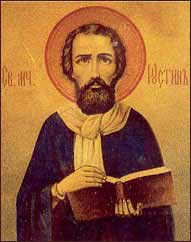
Pastor always includes a page of notes in the Church bulletin, and I review what he’s going to talk about before services start. When I came across the section called ”Parenthetic Conclusion: Sunday worship,” I knew where he was headed. Then there was the quote from Justin Martyr he inserted. I’ll only use part of it here:
But Sunday is the day on which we all hold our common assembly, because it is the first day on which God, having wrought a change in darkness and matter, made the world; and Jesus Christ our Savior on the same day rose from the dead.
-Justin Martyr
The First Apology
“Weekly Worship of Christians” (c. CE 155)
I won’t try to replicate all of Pastor’s points, but he did say the phrase “first day of the week” (although as Lancaster states above, the word “day” does not appear in the literal Greek) appears only three times in the New Testament (actually, there are a few more). In addition to the above-quoted verse, it can be found in Mark 16:9, the declaration of when Jesus rose from the tomb, and 1 Corinthians 16:2, which is part of Paul’s instructions to set aside funds for Paul’s intended donation to the poor and needy in Jerusalem.
There were a number of conclusions Pastor derived from Acts 20:7-12:
The Roman rather than Jewish calendar was being used to fix the date of the gathering, so that we see they were meeting on Sunday evening rather than Saturday night after Shabbat.
The breaking of bread was likely an enactment of the “Lord’s Supper” indicating the practice of communion.
Preaching and teaching of scripture was a common activity in such assemblies.
Collecting tithes for the church on Sunday was becoming a more common practice.
Both Pastor and my Sunday school teacher said this is evidence that “church services” within Paul’s lifetime weren’t all that different from what we have today: preaching the Word, meeting on Sunday, gathering tithes on Sunday (presumably as part of the service), and taking communion.
Sunday Worship
I’ll get into my reaction in a moment, but the one thing that puzzled me was Pastor’s proof that Paul had to be meeting with these believers in Troas on Sunday evening rather than just after Shabbat had ended (Saturday at sundown). He says that if this was a Saturday night, Paul, who intended to leave by ship the next day, would have had to wait two days, until Monday, to depart, so it had to be Sunday night.
But I either couldn’t hear the rationale or it went by so fast that I just plain missed it. I’ve read Acts 20 numerous times since listening to the sermon, but I just can’t see where this is coming from. I emailed Pastor after I got home from services asking for details, and hopefully he’s respond soon. Once I receive a response, I’ll edit this blog post to reflect his views.
Addendum, Tuesday, March 18: Pastor responded to my email with his explanation. He’s pressed for time, so the rationale is brief. I’ll put it in the comments below rather than interrupt the flow of the narrative here more than I already am.
Justin Martyr, Sunday, and Supersessionism
Now to my response. In the absence of the information Pastor possesses regarding why the assembly at Troas must have been meeting on Sunday, it is my opinion that a shift from a Saturday to Sunday Sabbath occurs here much too early in history. We have Justin Martyr’s writing declaring that Sunday is the proper day of Christian worship, but that isn’t published until some time after Paul’s death (and I find the reasoning, that it’s the day God separated light and darkness, completely disconnected from anything taught by Jesus or the Apostles). I don’t know that Martyr is relying exclusively on his interpretation of scripture and I suspect that he, like many of the other “church fathers,” may have had attitudes about Jewish people and Judaism that colored his thinking and possibly had him making doctrinal decisions about practice based on that bias.
I know Wikipedia is a poor source to quote, but it will have to do for my current analysis:
Justin was confident that his teaching was that of the Church at large. He knows of a division among the orthodox only on the question of the millennium and on the attitude toward the milder Jewish Christianity, which he personally is willing to tolerate as long as its professors in their turn do not interfere with the liberty of the Gentile converts; his millenarianism seems to have no connection with Judaism, but he believes firmly in a millennium, and generally in the Christian eschatology.
Justin saw himself as a scholar, although his skills in Hebrew were either non-existent or minimal. His opposition to Judaism was typical of church leaders in his day but does not descend to the level of anti-semitism. After collaborating with a Jewish convert to assist him with Hebrew, Justin published an attack on Judaism based upon a no-longer-extant text of a Midrash.
Economic supersessionism is used in the technical theological sense of function. It is the view that the practical purpose of the nation of Israel in God’s plan is replaced by the role of the Church. It is represented by writers such as Justin Martyr, Augustine, and Barth.
-from the Wikipedia page on Supersessionism (Replacement Theology)
None of what I just quoted is rock-solid evidence that Martyr’s declaration of Sunday as the proper meeting day for Christians was motivated by supersessionistic ideology (and it was stated above that Martyr was probably not anti-Semitic), but it does open the door to the possibility that Martyr may not have been operating purely on his understanding of scripture. Based on my understanding of early supersessionistic bias and the church fathers (See my four-part article ”Origins of Supersessionism in the Church” in issues 109-112 of Messiah Journal), I believe there was a focused effort to create a set of practices of worship that specifically separated the budding Gentile Christian Church from its Jewish origins and heritage, replacing the Jewish institutions to which Paul and the other Apostles were accustomed with completely separate rituals, including a calendar disconnected from the Jewish holy days.
Please keep in mind that I have no problem with Christianity choosing a day of the week for corporate worship, but I consider it a tradition based on an emerging (in the mid-second century) reverence for the day of Jesus’ resurrection, not necessarily on a decision of Paul or any of the other Apostles.
Breaking Bread
Depending on the translation you’re using for Acts 20:7, the words the NRSV Bible renders as “break bread” are also read as “the Lord’s Supper” (New Living Translation) or “break the Eucharist” (Aramaic Bible in Plain English). Actually, all of the other translations I’m looking at just say “break bread”. I can’t access the Greek for this term, so I don’t know if it contains something that doesn’t translate into English, but, as Sigmund Freud is supposed to have said, ”Sometimes a cigar is just a cigar.” In other words, just because something is longer than it is wide, doesn’t mean it’s a phallic symbol.
Applied to the current context, I might say, “Sometimes breaking bread is just breaking bread, grabbing a loaf and tearing it in two or more pieces.” The term “breaking bread,” as far as I know, could just as easily indicate a meal of fellowship. It’s typical to “break bread” with friends and companions as a sign of affiliation and trust. Why does it have to mean communion unless we’re trying to make this verse fit a later institution created by the Church?
We were gathered for the disciples came, A.V. and T.R.; discoursed with for preached unto, A.V.; intending for ready, A.V.; prolonged for continued, A.V. The first day of the week. This is an important evidence of the keeping of the Lord’s day by the Church as a day for their Church assemblies (see Luke 24:1, 30, 35; John 20:19, 26; 1 Corinthians 16:2). To break bread. This is also an important example of weekly communion as the practice of the first Christians. Comparing the phrase, “to break bread,” with St. Luke’s account of the institution of the Holy Eucharist (Luke 22:19) and the passages just quoted in Luke 24, and St. Paul’s language (1 Corinthians 10:16; 1 Corinthians 11:24), it is impossible not to conclude that the breaking of bread in the celebration of the Lord’s Supper is an essential part of the holy sacrament, which man may not for any specious reasons omit.
-from the Pulpit Commentary on Acts 20:7
The key scripture as far as “the Lord’s Supper” goes seems to be 1 Corinthians 11:17-34 but Acts 20:7 only mentions “breaking bread”. In comparison to that verse, almost all translations of 1 Corinthians 11:20 refer to “the Lord’s Supper”, so I can only imagine the original Greek is more specific here (only the Aramaic Bible in Plain English states, ”When therefore you assemble, it is not according to what is appropriate for the day of our Lord that you eat and drink.”).
I’m going to have to set the early initiation of what Christians call “communion” today to one side for the moment except to say that it is certainly not definitive that the group in Troas was assembled for the specific purpose of taking a weekly communion or Lord’s Supper. It’s even possible, as I mentioned above, that the very concept of a communion might have been a later invention of the Church.
Tithing
We see a strong record of Paul collecting money or directing the various assemblies to set aside money which he would collect when he arrived (1 Cor 16:1–4; 2 Cor 8:1–9:15; Rom 15:14–32). However, we also see Paul having a specific concern for the poor in Jerusalem (Gal. 2:10). Paul’s companions we find in Acts 20:4 were to accompany Paul to Jerusalem, presumably with donations from the various congregations they represented.
So Paul was collecting money for the poor and needy in Jerusalem, but this does not mean he was collecting money to pay for the operational costs of the local churches or the Jerusalem “church”.
No, I’m not saying that it’s wrong for the church to ask for donations from the congregants to support the costs incurred in running such an institution, I’m just saying the practice can’t be directly attributed to specific references in the Bible.
It is true that in ancient times, the Israelites did donate materials and services in the building of the Mishkan (Tabernacle) in the desert (Ex. 35:4-36:7), and King Solomon heavily taxed his citizens and required tens of thousands to contribute labor in the service of building the Temple in Jerusalem (starting 1 Kgs 6). But again, none of these point specifically to a church tithe. Frankly, neither does Abraham’s offering to Melchizedek (Gen. 14:20).
But like I said, I don’t think it’s wrong for the administrative office of the local church to request that members and attendees contribute to the upkeep of the church, since those attending are consuming the church’s resources. I also think it’s reasonable and Biblical for churches to collect money for the poor and even money to support missionaries (Paul alluded that he deserved to be supported but preferred to support himself to avoid being a burden). But I maintain that the modern concept of tithing, especially by having men pass around metal plates through the pews so that people can give their weekly donation, isn’t exactly what we see in Acts 20 or any of the other referenced scriptures.
Resurrection Day
I’m returning to the issue of Sunday here but with an eye on it being a day of reverence early on in the first century community of “the Way.” Do we actually see concrete evidence that the day of the Master’s resurrection was directly revered and added to (or replaced) the list of holy days traditionally observed in the various Judaisms? Did the followers of Christ move away from a Sabbath rest because Sunday became so incredibly important to them?
There’s no smoking gun but a lot of inference. I know that Sunday was an important day of gathering in the mid-second century, but is that because of what was gleaned from the Bible, or because the men establishing Sunday as the Christian assembly day needed to separate their religion from Judaism? In the latter case, the “invention” of Sunday worship would have come after the Apostolic Era ended and the church fathers would have just “mined” the various scriptures and verses to support such a decision, declaring it “Biblical” and “Holy Doctrine” of the Church.
Revelation 1:10 was brought up in Pastor’s sermon as well. John was “in the Spirit on the Lord’s Day” when he had his well-known (but not always well understood) set of revelations and visions, but what did “the Lord’s Day” mean to him at that time? It’s assumed by many Christians to mean “Sunday” but Pastor thinks rather that it indicates Resurrection Day, that is, Easter.
Frankly, I don’t think anyone knows, and I think Christian theologians have developed various educated theories over the centuries. Each church denomination has adopted a set of practices that appear to map to certain parts of the Bible, but the question for me is which came first?
Do we believe, for example, that Sunday is the official day of Christian worship because it was established in the Bible, or was Sunday established nearly a century after the Apostles were all in their graves because the leaders of the Gentile Christian church needed to separate their movement from Judaism (and in this case, especially Shabbat observance) and they found portions of scripture they could leverage to support their requirements?
Past and Present
I know that sounds terribly cynical and I know this will make a lot of Christians feel hurt and angry. I know it can’t possibly please Pastor Randy when I write these things, and I know he’s being absolutely honest and sincere when he preaches on Acts 20 and draws conclusions that are consistent with modern Christian practices.
However, I don’t think it’s all so clear. In fact, I believe if Paul were to walk into a Christian church today, even if he understood our language, he would hardly connect the experience to the practice of the assemblies he established in the diaspora nearly twenty centuries ago, and he absolutely wouldn’t see the Jewishness of everything he taught and the Jewish Messiah he lived and died for in modern Christian observance. I’m sure he’d wonder why modern disciples weren’t gathering on Shabbos.
I’m not saying modern Christian observance is bad or wrong as a set of practical traditions, just that it’s mostly not what Paul did. Yes, he’d understand collecting money for the poor. Yes, he’d understand preaching. Yes, he’d understand studying the scriptures with a learned teacher. Yes, he’d understand sharing a communal meal (though that’s more like Oneg than communion).
But I think it’s OK to admit that Christianity has evolved, and not in an entirely linear fashion, since the days when Paul planted his “churches.” I think it’s OK to admit that the majority of what Protestants believe and the majority of what they do has a history of more like five-hundred years rather than two-thousand. Evangelical Christianity is more a product of the Reformation than what you might call “Apostolic” or “Messianic Judaism”.
Purim
I knew it was Purim when I walked into the church Sunday morning. So did Pastor Randy and Pastor Virgil. So did those few people in the church I know to be Jewish. Most other people would have missed it, though. I kept pondering the significance of experiencing the “Christianization” of the scriptures in Acts 20 as I listened to the Pastor’s message in church on Purim. Why is there a desire to “rush” history, so to speak, and to give the early Judaism of our faith the bum’s rush out the door while the Pharisaic Apostle Paul (or Saul if you prefer) was still alive and desiring to reach Jerusalem before Shavuot or Pentecost (Acts 20:16). He’d already been delayed so he couldn’t be in the Holy city for the Pesach sacrifice and meal (Acts 20:5).
Paul and the Moadim
Paul was an observant Jew and as such, he desired to obey the mitzvot associated with the moadim, the appointed times chronicled in the Torah. This is a clue we should pay attention to. Paul’s desire to return to Jerusalem was connected to specific seasons and events, Passover and Pentecost, Pesach and Shavuot. Wouldn’t it make more sense to believe that Paul also revered the Shabbat as did his forefathers? The Church (big “C”) changed quite a lot of things later on, but for Paul, there was nothing inconsistent with being an Apostle of the Messiah and practicing the Judaism of the Way. In fact, departing from the Torah and the traditions would likely never have occurred to him.
Regrets and Conclusion
I’m actually feeling pretty down about having to write this. I’ve been keyed up since hearing the sermon. I was nervous around the others in Sunday school yesterday. I didn’t sleep well last night. Obviously this bothers me. Last week, I wrote about fellowship in the church and today it seems like I’m doing a big turn around by disagreeing with the conclusions of Pastor’s sermon. Believe me, I’m not disagreeing just to disagree. I’m not being oppositional or “anti-Church.” I’m being who I am as a believer operating with a particular understanding and perspective on the Bible. I’m looking through a different lens, I’m standing at a different look out point. The Bible I see looks a lot more “Jewish” than most of the people I worship with suspect. I apologize if what I’ve written results in hard feelings. That’s not my intention, believe me. But someone needs to stand up for the Jewish Apostle to the Gentiles, and represent who I believe he was and is, and what he was trying to teach.
I started writing this “meditation” early Sunday afternoon and stopped. I figured I needed a “cooler head” before actually getting into this, and I really thought about not writing it at all. I consulted with a good Christian friend. I agonized over it. Finally, I needed to do this. I’m sorry. It’s not against you, or Pastor, or anyone else. It’s for Paul and it’s to keep my head from exploding.
There’s the Paul the Christian church sees, the murderous Jewish Pharisee who encountered Jesus on the way to Damascus one day and became blind. Having his sight restored, he converted to Christianity and left his Judaism behind, preaching a Torah-free faith to Jew and Gentile alike. Then there’s Paul the Jewish Pharisee, who met the Messiah in a vision and having been blinded and his sight then restored, embarked on a journey to tell the good news of Moshiach to his brothers and sisters as well as the Gentiles, that the Messianic Age was at hand, the pinnacle of the history of the Hebrews was within reach, and even the Gentiles could be redeemed by coming alongside Israel through Messiah.
When Messiah returns, we’ll know, everyone will know. For now, I am a loyal subject of the Jewish King and I await his return. May he come soon and in our day. Amen.
"When you awake in the morning, learn something to inspire you and mediate upon it, then plunge forward full of light with which to illuminate the darkness." -Rabbi Tzvi Freeman


 It’s a terrible thing for a Jew to be cut off from his or her people.
 Evangelical Christianity believes that Paul broke with Jewish identity shortly after he encountered Jesus on the road to Damascus (see Acts 9) and that the extinguishment of Jewish identity in Messiah was by design. The Aish Rabbi says Paul may not have originally intended to break with Judaism and tradition, but when he couldn’t convince other Jews to “worship a dead Messiah,” Paul switched the object of his proselytizing from Jewish to Gentile populations and cut loose anything Jewish from devotion to Jesus.
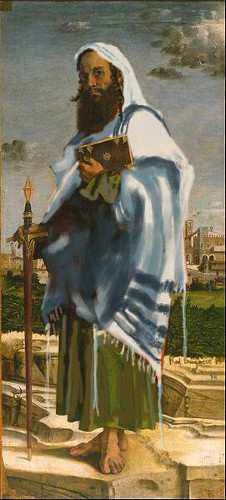 So like I said, the “dead Messiah,” at least in this case, didn’t seem to be the problem, nor, as we know from many of Paul’s other letters as well as the record in Luke’s Acts, did Paul totally abandon his people or Jewish practice in order to invent a new, Law-free, religion exclusively for the Gentiles. As the Aish Rabbi himself stated, the early Jewish disciples ”accepted the Divine revelation of the Torah” and ”these Jews were reliable in their kashrut, and counted in a minyan.” I do not believe that ”these Jews” denied ”the eternal, binding nature of the commandments” nor that Paul taught Jews to neglect the Torah.
 I know it’s odd for me, a non-Jewish person studying within the context of Messianic Judaism, to be so passionate about Jewish identity for Jews in Messiah. I suppose it all comes back to my own (Jewish) family who aren’t Messianic but who I believe really need to be even better at connecting with Jewish community. There’s a huge danger as each generation passes, of Jewish people simply fading away, not assimilating into Christianity necessarily, but just drifting into secular oblivion.












 Morning Meditations