Tag Archives: Judaism

Revisiting Calvin and the Gift of Choice

infinite_pathsHe predestined us to adoption as sons through Jesus Christ to Himself, according to the kind intention of His will…

Ephesians 1:5 (NASB)

Therefore, beloved, since you look for these things, be diligent to be found by Him in peace, spotless and blameless, and regard the patience of our Lord as salvation; just as also our beloved brother Paul, according to the wisdom given him, wrote to you, as also in all his letters, speaking in them of these things, in which are some things hard to understand, which the untaught and unstable distort, as they do also the rest of the Scriptures, to their own destruction. You therefore, beloved, knowing this beforehand, be on your guard so that you are not carried away by the error of unprincipled men and fall from your own steadfastness, but grow in the grace and knowledge of our Lord and Savior Jesus Christ. To Him be the glory, both now and to the day of eternity. Amen.

2 Peter 3:14-18 (NASB)

I thought I was through addressing the Arminianism vs. Calvinism debate, having explored it extensively in my multi-part blog series and topping it off with the rather metaphysical Schrödinger’s Free Will and God’s Sovereignty. Then we had a guest speaker give the sermon at church last Sunday. He covered the first eighteen verses of Ephesians 1 and spent considerable time supporting his belief in the Calvinistic argument. He had to make God subject to linear time to do it, and otherwise said pretty much what I’ve heard before.

Then, in Sunday school class, we studied part of 2 Peter 3 including the above-quoted verses and I started to wonder. If the names of those chosen by God for salvation are written in the Lamb’s Book of Life and we have no choice in the matter, then why did Peter write what he wrote? He’s encouraging believers (supposedly people already chosen and “sealed”) to be “diligent…spotless and blameless.” He also cautions his readers to “be on your guard so that you are not carried away by the error of unprincipled men and fall from your own steadfastness.”

What? How is that possible. I thought once chosen, no one could “fall” from “steadfastness.”

My sheep hear My voice, and I know them, and they follow Me; and I give eternal life to them, and they will never perish; and no one will snatch them out of My hand. My Father, who has given them to Me, is greater than all; and no one is able to snatch them out of the Father’s hand.

John 10:27-29 (NASB)

Can you have it both ways? Can you be “unsnatchable,” so to speak, and still be able to fall from steadfastness?

Actually, during the sermon, I thought about the whole idea of being chosen. Israel was chosen as a nation. God chose corporate, national Israel, not each individual Israelites.

Moses went up to God, and the Lord called to him from the mountain, saying, “Thus you shall say to the house of Jacob and tell the sons of Israel: ‘You yourselves have seen what I did to the Egyptians, and how I bore you on eagles’ wings, and brought you to Myself. Now then, if you will indeed obey My voice and keep My covenant, then you shall be My own possession among all the peoples, for all the earth is Mine; and you shall be to Me a kingdom of priests and a holy nation.’ These are the words that you shall speak to the sons of Israel.”

Exodus 19:3-6 (NASB)

But now listen, O Jacob, My servant, And Israel, whom I have chosen: Thus says the Lord who made you And formed you from the womb, who will help you, ‘Do not fear, O Jacob My servant; And you Jeshurun whom I have chosen.

Isaiah 44:1-2 (NASB)

I don’t think anyone can argue that the act of God choosing Israel and Israel’s acceptance of God’s choosing involved corporate Israel, not each individual Israelite. That means all of the Israelites present at Sinai and all of their descendents were and are chosen by God and members of the covenant beyond any “unchoosing.”

Well, of course, there is this:

For whoever eats the fat of the animal from which an offering by fire is offered to the Lord, even the person who eats shall be cut off from his people. You are not to eat any blood, either of bird or animal, in any of your dwellings. Any person who eats any blood, even that person shall be cut off from his people.

Leviticus 7:25-27 (NASB)

DespairNo one is exactly sure what it meant for an Israelite to be “cut off from his people,” but I found an interesting discussion on the topic at Biblical Hermeneutics. It may not mean that the guilty individual would be removed from the covenant. According to Jewish Virtual Library, it could mean a premature death “at the hand if heaven” (Rashi, Ket. 30b, et al.), however there are other opinions. The upshot, as I understand it though, is that even the Israelite who has committed a sin so severe as to be “cut off” is still, on some level, accountable for the conditions of the covenant, including the curses, just because that person is an Israelite.

Ancient Israelites and modern Jewish people are born into the covenant and are responsible to God whether they want to be or not. They have been chosen because they belong to a group. That seems to be a permanent condition, as I read the Bible:

Do not think that I came to abolish the Law or the Prophets; I did not come to abolish but to fulfill. For truly I say to you, until heaven and earth pass away, not the smallest letter or stroke shall pass from the Law until all is accomplished.

Matthew 5:17-18 (NASB)

And as you may have noticed, heaven and earth are still here, so the Torah is still in force for the Jewish people…all of them.

But what about us? What about the Gentiles who are called by His Name? If Israel was chosen corporately, why, according to Calvinism, are we chosen individually?

One reason might be the vast number of nations on the earth. Could God choose some nations (besides Israel) and not others? I suppose, but by what criteria would He choose? Of course, we can ask the same question about why He would choose one individual and not another. It’s certainly not by merit or anything we have done or could do. That’s the same for Israel, as I understand it. Midrash aside, God did not choose Israel because of her merit, either:

The Lord did not set His love on you nor choose you because you were more in number than any of the peoples, for you were the fewest of all peoples, but because the Lord loved you and kept the oath which He swore to your forefathers, the Lord brought you out by a mighty hand and redeemed you from the house of slavery, from the hand of Pharaoh king of Egypt.

Deuteronomy 7:7-8 (NASB)

God didn’t choose Israel because of her merit but in order to keep His promises. What promises?

Then behold, the word of the Lord came to him, saying, “This man will not be your heir; but one who will come forth from your own body, he shall be your heir.” And He took him outside and said, “Now look toward the heavens, and count the stars, if you are able to count them.” And He said to him, “So shall your descendants be.” Then he believed in the Lord; and He reckoned it to him as righteousness.

Genesis 15:4-6 (NASB)

God made His promise to Abram (Abraham) in a vision after the encounter with the Priest-King of Salem, Melchizedek (see Genesis 14:17-20, though in actuality, God first directly interacted with Abram and promised to make him a great nation at the beginning of Genesis 12). The text seems to indicate that it was Abram’s faith that was the key factor in God making a covenant with him, but if we accept that as fact, then we have to admit that Abram had a part in his being chosen by God. If that’s so, following the inevitable logic, then God renewed His promises to Isaac, and then to Jacob, and then to the Children of Israel through Moses, all of which culminated at Sinai.
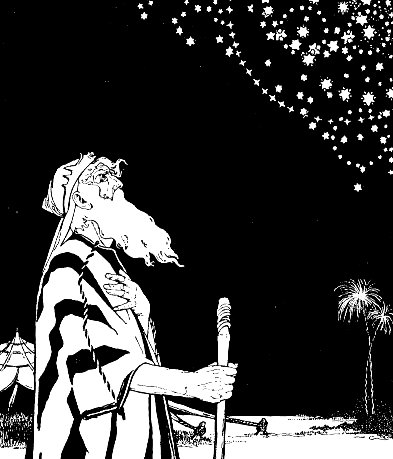
abraham1This choosing echoes down through history and will ripple even further and into the Messianic Age (all this is summarized in The Jesus Covenant: Building My Model). I can’t seem to find a way to pry the Jewish people or even one single, individual Jewish person out of the covenant promises that started with Abraham, continued into Sinai, and that were renewed for the future in Jeremiah 31 and Ezekiel 36.

Non-Jewish believers are attached as one of the conditions of the Abrahamic Covenant (but only one, not the whole thing), which, if we were to apply the same “logic” to us as we do to how the Israelites were “chosen” by God, seems to indicate that faith is also the “glue” connects us to God.

But how does God choosing Abraham filter down to God choosing Gentiles?

… and after he brought them out, he said, “Sirs, what must I do to be saved?” They said, “Believe in the Lord Jesus, and you will be saved, you and your household.” And they spoke the word of the Lord to him together with all who were in his house. And he took them that very hour of the night and washed their wounds, and immediately he was baptized, he and all his household. And he brought them into his house and set food before them, and rejoiced greatly, having believed in God with his whole household.

Acts 16:30-34 (NASB)

That seems pretty simple. But if the jailer and his household were “pre-chosen,” so to speak, why would he even ask that question? He’s been pre-selected. He has just come to the point where he has realized it. What if he wasn’t one of the chosen and he asked that question? Would Paul have said, “Sorry, pal. You aren’t one of the elect. You are out of luck”?

Probably not, but then I don’t think we have an example in the Bible of a person asking how to be saved who wasn’t going to be saved. Oh wait!

And someone came to Him and said, “Teacher, what good thing shall I do that I may obtain eternal life?” And He said to him, “Why are you asking Me about what is good? There is only One who is good; but if you wish to enter into life, keep the commandments.” Then he *said to Him, “Which ones?” And Jesus said, “You shall not commit murder; You shall not commit adultery; You shall not steal; You shall not bear false witness; Honor your father and mother; and You shall love your neighbor as yourself.” The young man *said to Him, “All these things I have kept; what am I still lacking?” Jesus said to him, “If you wish to be complete, go and sell your possessions and give to the poor, and you will have treasure in heaven; and come, follow Me.” But when the young man heard this statement, he went away grieving; for he was one who owned much property.

Matthew 19:16-22 (NASB)

But then again, the rich young ruler was Jewish and was already chosen by God because of Sinai. I’m not even sure how that’s supposed to work relative to the Jewish Messiah except that anyone who would come to the Father has to go through the Son. Did the young fellow lose salvation because his wealth meant more to him than obedience?

terror-keepers-of-the-faithQuestions remain. First of all, the idea of being chosen is rather “mushy.” Why was Israel chosen corporately but the rest of us must be chosen individually? Can any Israelite lose their chosenness? Evidence seems to say not, but my exploration of that area was hardly exhaustive. If a non-Jew is chosen can he or she lose that chosen status? Depending on which verses you read in the New Testament, the answer varies. What was the mechanism or process by which God chose Abraham and does that process apply to Gentiles since it is through Abraham that we are attached to the Messiah and thus to God?

Faith seems to play a part in both the choosing of Abraham and of the rest of us.

…and being fully assured that what God had promised, He was able also to perform. Therefore it was also credited to him as righteousness. Now not for his sake only was it written that it was credited to him, but for our sake also, to whom it will be credited, as those who believe in Him who raised Jesus our Lord from the dead, He who was delivered over because of our transgressions, and was raised because of our justification.

Romans 4:21-25 (NASB)

Ephesians 2:8 says that even faith is a gift from God, so we can’t say that our faith is what we bring to the table, so to speak. God gives us the faith we need in order to be chosen by Him. But then, I found a counter-argument to this point at faithalone.org:

From a cursory reading of this verse, it appears that the relative pronoun that (v 8b) has faith (v 8a) as its grammatical antecedent. However, in its Greek construction that is a demonstrative pronoun with adverbial force used in an explanatory phrase. This particular construction uses a fixed neuter singular pronoun (that) which refers neither to faith, which is feminine in Greek, nor to any immediate word which follows. (See Blass, Debrunner, Funk, 132, 2.) What all this means is that the little phrase and that (kai touto in Greek) explains that salvation is of God’s grace and not of human effort. Understood accordingly, Ephesians 2:8 could well be translated: “For by grace you have been saved through faith, that is to say, not of yourselves, it is the gift of God.”

Moreover, there is a parallelism between not of yourselves in v 8b and not of works in v 9. This parallelism serves as a commentary to v 8a (“For by grace you have been saved through faith”) which speaks of salvation in its entirety. It is difficult to see how faith, if it is the gift of God, harmonizes with not of works of v 9. We must conclude, then, that in Ephesians 2:8 salvation is the gift of God.

You can click the link I provided above to read the entire explanation, but if this analysis holds water, then I can say that faith is what we bring to the table. Salvation is the gift which we cannot earn through works so we cannot boast.

I know that nothing I’ve said here will convince a hard-core Calvinist that the whole “election” thing is wrong, but I think, once again, I’ve thrown enough monkey wrenches into the machine to keep Calvin and his supporters from thinking they’ve made a “slam dunk” with their arguments. Yes, the guest speaker at my church last Sunday provided a number of Bible verses that seem to support the “divine election” position, but there are just as many other parts of the Bible that support the idea that God, in His sovereignty, mercy, and love, has allowed human beings to participate in their own salvation by faith (or lack thereof, sadly).

schrodingers-cat-in-a-boxGod chose Abraham for a wonderful destiny, both as an individual and as the Father of the Hebrews. That promise passed down to Isaac, to Jacob, to Jacob’s twelve sons, to the twelve tribes, and ultimately to the Jewish people corporately. Non-Jews are grafted into a single condition, the promise of the Messiah, in the Abrahamic covenant, through faith, just as Abraham had faith, and that is our link to being chosen.

We’re chosen because of faith. Salvation is the resulting gift. I believe God loves human beings in a unique way, and out of that love, He chooses to allow us room in the universe to make independent decisions, much like a father will allow a child to make choices, even when the father knows some of those choices won’t be for the good.

There are times when love can kill. There are times when you love someone so much, you cannot allow him to breathe. He must do things the way you understand is best for him—because you cannot bear that one you love so much should be in any way distant from the truth as you know it.

“After all,” you imagine, “I must do for him what I would have done for myself!”

But true love makes room for the one you love.

-Rabbi Tzvi Freeman
“Love in Not Doing”
Based on letters and talks of the Rebbe, Rabbi M. M. Schneerson
Chabad.org

As for how God can write names in a book “before” Creation if both the book and God exist outside Creation and thus outside of time, you’ll have to see a certain cat in a box for the paradoxical answer.


I’m Not Who I Was

changing-courseDo not be dismayed by the hypocrisy of others, nor by your own inconsistencies. Our lives are all journeys through hills and valleys—no person’s spiritual standing is a static affair.

But the good each person achieves is eternal, as he connects to the Source of All Good, Who is infinite and everlasting. The failures, on the other hand, are transient and superficial, fleeting shadows of clouds, as stains in a garment to be washed away.

-Rabbi Tzvi Freeman
“Hypocrisy”
Based on letters and talks of the Rebbe, Rabbi M. M. Schneerson
Chabad.org

I’ve written over 900 blog posts for “morning meditations” and 214 for my previous blog (which stopped being active in 2011) called Searching for the Light on the Path. That’s over 1100 blog posts that record my progressive journey of faith, attempting to discover my position along the trail that leads to God.

In all that time and in all those blog posts, my opinions and beliefs have shifted a bit; perhaps more than just a bit in some areas. I’ve explored and opened myself up to some concepts and investigated and shut down others. Some people who were my friends or who were at least friendly to me have dropped me like a hot rock as I’ve developed my understanding of God, the Messiah, and the Bible in directions that oppose their belief systems. Other people have opened up to me and shared their highly valuable insights when seeing that I am not trying to impose my will on others, but seeking to discover God’s will for me and the world around me.

I suppose that last part sounds a bit narcissistic but then again, no one blogs except from their own perspective and as a means of presenting that perspective to anyone with Internet access.

I haven’t been directly accused of this, but I remember one blogger accusing another of hypocrisy based on the changing of the second blogger’s perspectives over time.

But aren’t we supposed to change? Aren’t we supposed to grow? What would happen if you learned basic arithmetic but never progressed beyond that point? What would have happened if no one anywhere across history ever developed algebra, calculus, or trigonometry? What would have happened if the best telescope we had in the world was still on the level of the one created by Galileo? What if our best medical technology for curing fevers and multiple other ailments was to apply leaches to human beings?

Are you a hypocrite if you learn something new and it changes how you see things and how you think?

As Rabbi Freeman said above, “Our lives are all journeys through hills and valleys—no person’s spiritual standing is a static affair.”

It’s interesting that a religious person should be the one to say that because, at least in Christianity, after achieving a certain level of knowledge, the expectation (this is just my opinion, of course) is that we should stay “static” with “the truth.” I’m not denying that there is Divine and eternal truth in our universe. Our universe was created by such truth. But that hardly means we know everything that there is to know about God or faith or that we even know enough. Is it enough to answer some altar call or to raise your hand in church as a profession of your faith in Jesus Christ? Is it enough to be saved?

It seems that a lot of Christian Bible studies and Sunday school classes aren’t really designed to teach people new ideas or to help people explore uncharted territory in theology, but to continue confirming what everyone already knows. Earlier today, I reviewed a television episode produced by First Fruits of Zion describing the meaning behind the name “Jesus.” However, the information presented, though very basic from my point of view, was designed to be new and even a tad bit “revolutionary” to the traditional conservative Christian audience targeted by these programs.

iam-not-a-numberIf someone who had been raised and educated spiritually in a “typical,” “ordinary” American church saw this or some other episode of FFOZ TV, they would very likely encounter what for them would be brand new information about topics they thought they knew completely.

I recently reviewed Scot McKnight’s book The King Jesus Gospel: The Original Good News Revisited. In the book, McKnight recounts a conversation he had with another Pastor about the meaning of the gospel. That Pastor too had stopped learning a long time ago and if he was studying at all, it was for the purpose of maintaining the pattern and level of knowledge he already possessed:

I replied, “A book about the meaning of gospel.”

“That’s easy,” he said, “justification by faith.” After hearing that quick-and-easy answer, I decided to push further, so I asked him Piper’s question: “Did Jesus preach the gospel?”

His answer made me gulp. “Nope,” he said, “Jesus couldn’t have. No one understood the gospel until Paul. No one could understand the gospel until after the cross and resurrection and Pentecost.” “Not even Jesus?” I asked.

“Nope. Not possible,” he affirmed. I wanted to add an old cheeky line I’ve often used: “Poor Jesus, born on the wrong side of the cross, didn’t get to preach the gospel.”

In my weekly conversations with my Pastor, I find myself challenged by a person who does study a great deal and who presents me with information I don’t possess which, in my case, is how traditional Christian theology, doctrine, and dogma works. For a Christian, I don’t know very much about how the formal “church” conceptualizes things. I often reference Jewish sources for my studies, both because I’m drawn to them and because they challenge my “Gentile” way of understanding God and faith. Both my Pastor and my studying help me grow, at least a little bit at a time.

We’re supposed to grow and we’re supposed to help other people grow. In the church (and in other Gentile-driven religious contexts based on the Bible), we have adopted a philosophy, not of growth, but of comfort. We want to be comfortable in what we think, feel, and believe. We don’t want to be challenged. Our day-to-day lives are challenging enough. We want to spend our Sunday services and Bible studies with people who think just like us, discussing things that we all understand in exactly the same way.

I know that sounds cynical, but it’s actually very human. All people who identify with a group that thinks, feels, and acts in a particular way relative to the larger environment want that. Christians want that, and religious Jews want that, and Hebrew Roots people want that, and progressives want that, and atheists want that, and everyone else wants that, too.

God is transcendent. He doesn’t fit in the little boxes we try to put Him in (if we are people who believe that God exists at all). Our hope, our goal, our journey should all be pointed in the direction of transcendence. We can never completely know the infinite God all in all, but we are tasked with approaching Him as closely as we can, knowing that it won’t be incredibly close.

Instead, we’ve reached an area of comfortable equilibrium and there we stay. It’s like two married people who behave more like roommates, including sleeping in separate bedrooms. It may be comfortable, but you’ll never experience passion that way.

The Rebbe would sit down with his students and say, time and time again:

The Baal Shem Tov taught that from every thing a person hears or sees in this world he must find a teaching in how Man should serve G‑d. In truth, this is the whole meaning of service of G‑d.

-Rabbi Tzvi Freeman
“All the World is My Teacher”
Based on letters and talks of the Rebbe, Rabbi M. M. Schneerson
Chabad.org

icarus-seeking-lightIn Greek mythology, the wings of Icarus melted when he flew too close to the Sun and he fell, but we will freeze into complete inaction and be totally ineffectual if we stay away from the flames of wisdom and knowledge. Challenge involves risk and risk feels dangerous. Sometimes we accept a challenge and the danger and then we (seemingly) fail and fall, ending up not getting what we want. Moses accepted the challenge of leading the Jewish people through a desert for forty years at the behest of God, and in the end, he was denied entry into Israel. He failed the challenge.

Or was it a failure?

Chassidic teaching explains that this is the deeper reason why Moses was not allowed to enter the Land of Israel. If Moses would have settled us in the Land, we could never have been exiled from it. If Moses would have built the Holy Temple, it could never had been destroyed. If Moses would have established the people of Israel in their homeland as a “light unto the nations,” that light could never have been dimmed.

If Moses would have crossed the Jordan, that would have been the end: the end of the struggle, the end of history.

G-d wasn’t ready for the end yet. So He decreed that Moses remain in the desert. But He did allow him to see the Land. And because Moses saw it, and because the effect of everything Moses did is everlasting, we, too, can see it.

At all times, and under all conditions, we have the power to ascend a summit within us and see the Promised Land. No matter how distant the end-goal of creation may seem, we have the power to see its reality, to know its truth with absolute clarity and absolute conviction.

We are still in the midst of the struggle. It is a difficult, oft-times painful struggle; but it is not a blind struggle. Moses has seen to that.

-Rabbi Yanki Tauber
“Land and See”
Based on letters and talks of the Rebbe, Rabbi M. M. Schneerson
Chabad.org

building-the-templeAll that isn’t in the Bible, but let’s go with it for now. If Moses had entered the Land, would the Messiah have come? What would have happened to the people of the nations of the world? Would we all have been drawn to the light of Israel in the days of Moses? What would that have meant? Becoming gerim, “resident aliens” and then having our descendants being assimilated and absorbed into tribal Israel? That would mean anyone outside of the original Israelites and their descendants would have had to ultimately become part of tribal Israel to become Holy unto God. But what about the rest of us?

God wasn’t ready for the end, perhaps not because of what it would have meant for Israel but because of what it would have meant for the majority of the world. All those things midrash says Moses would have done will actually be performed by Messiah, Son of David. But Israel had to suffer because Moses didn’t enter the Land and instead died in the desert. That’s a horrible realization; not comfortable at all.

We won’t come to learn the reality of our existence in a world created by God if we allow ourselves to remain in a comfortable place. Moses died, and Joshua was challenged with conquering a nation. David founded Jerusalem but the task of building the Temple was left to Solomon. Israel fell into exile on multiple occasions, her Temple destroyed, her Land lost for centuries. The Messiah came and died. Then he rose. Then he ascended. And then he didn’t come back. Human history has been spinning out of control ever since, or so it appears.

What can we do? We can stop being comfortable. “Comfortable” is not the condition of our current world. We need to read, to study, to challenge ourselves, to change as we encounter each new spark of the Divine that has been left here for us by the Source of that fire. We’re meant to grow, to develop, and to act. How else can we prepare the way for the return of the King?

The Truncated Gospel

bible_read_me“The shortest and easiest route home for the two missionaries would have been to continue following the imperial highway through the mountain pass of the Cilician Gates east and then branch right southward to Syria. Surely they might have felt that they had done enough and suffered enough and could now take the easy way home! But Paul was not satisfied with doing a work ‘somehow.’ Always he was constrained to do God’s work ‘triumphantly’ – to finish God’s work with joy on each occasion.

“True shepherds know that it takes time to get a new convert rooted and built up in Christ. This involves sacrifice and hardship for the leader, but there is no eternal fruit without the Cross.”

-from the Sunday School Bible Study notes for Acts 14:21-28
“What Makes a Good Missionary?”

The Sunday School class I go to after church services directly addresses the topic of the Pastor’s sermon and gives the students the opportunity to dig deeper and to comment on the message for the day. Pastor Randy has been in California for the past several weeks but will be back next Sunday when he will be teaching on the aforementioned portion of Acts. My Sunday School teacher hands the study notes out a week early so we have time to review and answer the questions on its pages.

A number of Pastor’s messages about Paul and Acts are mapped to the modern concept and activities of Christian missionaries. This has always bothered me and I never understood why until I took a look at the title of next Sunday’s notes: “What Makes a Good Missionary?” Then it just hit me. Using Paul, beyond a certain point, as a model of the modern missionary is anachronistic. It doesn’t fit. The foundation is different.

Here’s what I mean.

In Paul’s day, he and other Jewish apostles and disciples were attempting to spread the good news of the Jewish Messiah to Jews in Israel, Samaria, and in the diaspora and also to give that news to the Gentiles. Jews had been waiting and waiting for the arrival of the Messiah for centuries, and the need for him to come was especially acute during periods of exile and occupation. Israel was a land occupied by a foreign army and desperate to realize its own liberation and redemption. The news of an arrived Messiah who would be King and who would redeem national Israel would be beyond good news…it would be immense in its impact among world Jewry.

From that point of view, explaining why news of the arrived Messiah would be good news to the Jewish people is a no brainer, but we have to work a little harder (which Paul does) to explain why it is also good news to the people of the nations.

Today, we’ve gotten it somewhat backwards. Not that modern Christian missionaries are doing it wrong. Missionary work is the source of great spiritual and material blessings all over the world. But they are missing a few things.

As I mentioned in my book review of Scot McKnight’s The King Jesus Gospel, and as McKnight correctly points out, the plan of salvation is only part of the gospel message. Sadly, modern Christian missionaries believe the salvation plan is the only part of the gospel message.

The more complete message is contained in my review of the First Fruits of Zion television series episode The Good News. What teachers Toby Janicki and Aaron Eby make seem incredibly easy and obvious has actually eluded Gentile Christianity for nearly two thousand years.

What missionaries do today doesn’t map well to what Paul was doing. Paul was delivering the good news that the Messiah had come, had offered salvation from sins for both Jews and Gentiles (and this part was huge since the Jewish people had not anticipated salvation for Gentiles) and that he would return to liberate the captives among Israel, gather the scattered Jewish exiles to their Land, and he would bring peace to Israel and to the nations of the world. The nations would be blessed through Israel, particularly as Israel was made the head of the nations in God’s Kingdom.

I seriously doubt too many Christian missionaries are spreading around that kind of gospel message today. That’s why Paul is used anachronistically as a model for modern Christian missionary work. Most Gentile Christians lack Paul’s vision and emphasis. We don’t exactly preach a different gospel, but it certainly is a truncated one. It’s also kind of upside down.

Apostle-Paul-PreachesPaul always visited the synagogues first and appealed to the local Jewish authorities in whatever place he was visiting. The good news of Messiah would make the most sense to the Jewish people. It would only make sense to Gentile God-fearers because they were spending time in synagogues being immersed in Torah and thus, in the knowledge of Messiah. It wouldn’t make sense at all to pagan Gentiles who had no knowledge of Jewish history or teachings about God (see Acts 14:8-20).

Ok, your counter-argument is that times have changed. Gentiles are largely “in charge” of the worship of the Jewish Messiah and disseminating the information about his birth, death, resurrection, ascendance, and ultimate return (as strange as it sounds for Gentiles to be “in charge” of the iconic Jewish message and King). But does it make sense to strip out what’s going to happen upon the Messiah’s return and why that’s good news for Jewish people and Israel?

Much of the history of the church has been based on the idea that Gentile Christianity has replaced Jewish Israel in all of the covenant promises of God. This is patiently untrue and I’ve discussed it in more blog posts and magazine articles than I can count. But it does make sense for the supersessionistic church to remove the good news of Jewish ascendency and Israel’s national supremacy since it reverses the roles upon which the Gentile church has historically been based. As I’m sure you realize at this point, I think that historical foundation is dead wrong.

…these I will bring to my holy mountain, and make them joyful in my house of prayer; their burnt offerings and their sacrifices will be accepted on my altar; for my house shall be called a house of prayer for all peoples.

Isaiah 56:7

Thus says the Lord of hosts: In those days ten men from nations of every language shall take hold of a Jew, grasping his garment and saying, “Let us go with you, for we have heard that God is with you.”

Zechariah 8:23

I was glad when they said to me, “Let us go to the house of the Lord!” Our feet are standing within your gates, O Jerusalem.

Psalm 122:1-2

I realize that Psalm 122 isn’t a Messianic prophesy and is addressing the tribes of Israel, but I believe it also speaks to the spirit of the Messianic age, when we will all be glad to hear the call to go up to Jerusalem and to the House of God, the Holy Temple.

jerusalem_templeEverything in the Jewish message of the gospel points to Messiah, to the Temple, to Jerusalem, to Israel, and to the Jewish people. The mystery of that message isn’t how the Jews will be saved but how everybody else will be saved. From a Jewish point of view, as much today as when Paul was on his “missionary journeys,” the good news of Messiah was a Jewish message aimed straight at the Jewish people and at Israel. It was a given. The big shocker and the mystery of the gospel was how the Gentiles could be saved and redeemed by God as well.

While Peter was still speaking, the Holy Spirit fell upon all who heard the word. The circumcised believers who had come with Peter were astounded that the gift of the Holy Spirit had been poured out even on the Gentiles, for they heard them speaking in tongues and extolling God (emph. mine).

Acts 10:44-46

Given how the Gentile God-fearers and even the pagans (who were probably told what to expect by their God-fearing neighbors and relatives) reacted to Paul’s gospel message in the synagogue at Pisidian Antioch (see Acts 13:48) we can see that they too were amazed at the graciousness of the God of Israel.

We’ve lost how amazing it is that Gentiles can be saved by the God of the Jews. We’ve lost how the message of the gospel is not just about a plan of salvation but about the return of the King and how his Kingdom will be established, restoring Israel to her rightful place, and elevating the people who were chosen by God at Sinai.

It’s time for us to remember and to teach all of the gospel message, as Paul once did. It shouldn’t be hard. Paul’s sermons, some of then anyway, are preserved in our Bibles. It’s all right there in front of us. We just need to take off our blinders and learn how to see and read the message again. Then we can spread the word, not of a truncated gospel, but of overflowing good news to all, good news first and foremost to Israel and yes, then to the rest of the nations.

Praying Where God Has Placed His Name

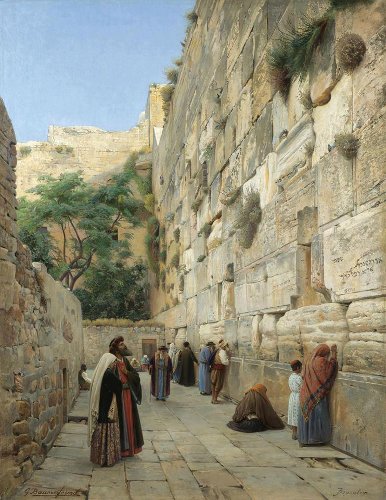
ancient-kotel-prayersWhen responding to the question, “Why do Jews pray at the Western Wall in Jerusalem,” Rabbi Tzvi Freeman had this to say.

I think what you’re really asking is: If G‑d is everywhere, why should prayer be more effective in one place than another? In truth, the same can be asked regarding praying in a synagogue vs. praying at home.

The question has been asked many times before in classical Jewish literature. Since this is a Chabad site, I’ll provide the answer given by Rabbi Schneur Zalman of Liadi (1745–1812), the first rebbe of Chabad.

The essence of his answer is that although G‑d is everywhere, His light shines stronger in some places than in others. He compares this to the human body: You are everywhere in your body, yet you are far more conscious of your mind than of your toes. So too, in the universe that G‑d created, there are places, times and states of being where we are able to be more aware of Him—and it is from those places/times/states that our prayers can fly best.

Any person is able to create for himself a time of day and a special place from which he or she reaches out to G‑d. And we all should—somewhere in our homes or gardens, set aside a place of prayer and meditation, along with a time of day or week that we sit there and connect. Even more special is a place that was chosen not just by us, but by G‑d as well. And that is the Temple Mount, which G‑d chose as His dwelling place in the time of King David.

Ever since then, that specialness has never left the Western Wall, the only remnant left standing.

The Talmud tells us that every synagogue is a “minor Holy Temple.” Thus the above also applies—in smaller measure—to any location designated to be a house of worship for G‑d.

I’ve probably mentioned this before, but one item on my bucket list (not that I have a well-defined bucket list) is to pray at the Kotel, otherwise called the Western Wall. I’m not even entirely sure that, from a Jewish point of view, it would be considered appropriate for a Christian to pray at the Kotel. After all, there is a certain controversy associated with some Jewish women davening at the Kotel, and I’m not even Jewish.

On the other hand, American Presidents and Catholic Popes have prayed at the Kotel, so I suppose it could be permissible for me to do so as well.

Why do I want to?

The Jewish person querying Rabbi Freeman was confused by the significance of even Jews davening at the Kotel. What’s the difference between praying there, in synagogue, at home, or, for a Christian, in church?

Rabbi Freeman answered the question from a Jewish point of view, but can any of that be applied to someone like me?

I think so.

So Abraham rose early in the morning and saddled his donkey, and took two of his young men with him and Isaac his son; and he split wood for the burnt offering, and arose and went to the place of which God had told him. On the third day Abraham raised his eyes and saw the place from a distance.

Genesis 22:3-4 (NASB)

So Jacob rose early in the morning, and took the stone that he had put under his head and set it up as a pillar and poured oil on its top. He called the name of that place Bethel; however, previously the name of the city had been Luz.

Genesis 28:18-19 (NASB)

But you shall seek the Lord at the place which the Lord your God will choose from all your tribes, to establish His name there for His dwelling, and there you shall come. There you shall bring your burnt offerings, your sacrifices, your tithes, the contribution of your hand, your votive offerings, your freewill offerings, and the firstborn of your herd and of your flock. There also you and your households shall eat before the Lord your God, and rejoice in all your undertakings in which the Lord your God has blessed you.

Deuteronomy 12:5-7 (NASB)

And every day, in the temple and from house to house, they kept right on teaching and preaching Jesus as the Christ.

Acts 5:42 (NASB)

Jacobs_LadderIt is said in midrash that the place where the Akedah (binding of Isaac) occurred was at the future Temple Mount in what would be Jerusalem. This is also supposed to be the identical site where Jacob experienced God at Beth El (literally, “House of God” in Hebrew). We also know from the Torah, that God intended to place His Name in a specific geographic location, which is also understood as the Temple Mount. Further, we see that the early Apostles of Messiah regularly taught and prayed at the Temple, specifically at Solomon’s portico (see Acts 3:11).

All of this seems to indicate that not only Jerusalem, but the site of the Temple, has a special significance to God. Yes, God is everywhere and we are not inhibited from praying to God anywhere, but no other place on Earth seems to hold the presence of God in such a way as Jerusalem and the Holy Temple.

And the Kotel is all that is left of the Temple, at least for now.

Also, if it is true that the Temple will be rebuilt and especially if Messiah, Son of David, will rule from Jerusalem and that his throne will be placed there, then any disciple of the Master should be drawn to the Holy City and to the location where Hashem’s Temple has and will once again be established.

Christians have to be careful though, because any attachment we show to Jerusalem and the Kotel can easily be misunderstood by Jewish people as our “taking over” Jewish Holy sites. The church as a long history of supersessionism, so it’s important to respect the overwhelming Jewish history and ownership of Jerusalem and Israel. However, many religious Jews believe that the people of the nations will one day be drawn to Messiah and worship God in Jerusalem, so in that context, we can present ourselves as desiring to honor Hashem at the Kotel. Even Solomon understood this from days of old.

“Also concerning the foreigner who is not of Your people Israel, when he comes from a far country for Your name’s sake (for they will hear of Your great name and Your mighty hand, and of Your outstretched arm); when he comes and prays toward this house, hear in heaven Your dwelling place, and do according to all for which the foreigner calls to You, in order that all the peoples of the earth may know Your name, to fear You, as do Your people Israel, and that they may know that this house which I have built is called by Your name.”

1 Kings 8:41-43 (NASB)

In desiring to pray at the Kotel, I am only responding to the prayers of the King.

I was glad when they said to me, “Let us go to the house of the Lord.”

Psalm 122:1 (NASB)

But again, Christians must not forget that it is Jewish eyes that are constantly looking toward Jerusalem and Jewish hearts that “sigh” for Messiah.

“Notwithstanding all this, the Jew … has his heart fixed upon Jerusalem, praying and sighing a waiting, and longing for the coming of the Messiah King, the promised Redeemer of the House of David.”

Rabbi Isaac Lichtenstein

The Evidence of Love

love-in-lightsThe Alter Rebbe repeated what the Mezritcher Maggid said quoting the Baal Shem Tov: “Love your fellow like yourself” is an interpretation of and commentary on “Love Hashem your G-d.” He who loves his fellow-Jew loves G-d, because the Jew has with in himself a “part of G-d Above.” Therefore, when one loves the Jew – i.e. his inner essence – one loves G-d.

“Today’s Day”
Friday, Menachem Av 12, 5703
Compiled by the Lubavitcher Rebbe; Translated by Yitschak Meir Kagan
Chabad.org

One of the scribes came and heard them arguing, and recognizing that He had answered them well, asked Him, “What commandment is the foremost of all?” Jesus answered, “The foremost is, ‘Hear, O Israel! The Lord our God is one Lord; and you shall love the Lord your God with all your heart, and with all your soul, and with all your mind, and with all your strength.’ The second is this, ‘You shall love your neighbor as yourself.’ There is no other commandment greater than these.”

Mark 12:28-31 (NASB)

I would hardly suggest that the commentary I found in an email I received from Chabad.org was intended to map back to the teachings of Yeshua (Jesus), but the comparison really stands out. Perhaps it is one of those lessons that is equally apparent from a Jewish and Christian point of view, except that Jesus was a Jewish teacher talking to a Jewish scribe within a wholly Jewish context. We non-Jews get that point (or should get it) somewhat after the fact, so it would be wise of us not to do away with the Jewish framework in which the Master was teaching. That’s what gives his lessons their full meaning.

The “Today’s Day” commentary is specifically addressing a Jewish audience as well, which is obvious since it discusses one Jew loving another Jew as being equal to loving God, rather than one human being loving another. The interesting question is, when Jesus was teaching the two greatest commandments, did he mean that loving your neighbor is loving your Jewish neighbor?

That could very well have been the case, if you look at who Jesus was addressing and where this conversation was taking place. I don’t mean that Jesus was unconscious of the larger application of his teaching, but it hadn’t gotten that far yet. He came for the lost sheep of Israel not the lost sheep of planet Earth…well, not at that time. He assigned that job (gathering the lost sheep from the nations) to Paul on the road to Damascus some time later.

As impossible as it sounds, as absurd as it may seem: The mandate of darkness is to become light; the mandate of a busy, messy world is to find oneness.

-Rabbi Tzvi Freeman
“The Mandate of Darkness”
Chabad.org

It’s important to remember that Rabbi Freeman is also addressing a Jewish audience, so don’t go crazy and assume he believes that Jews and Gentiles (particularly Christians) should all be “one.” Except that in Judaism, it is believed that Messiah will unite humanity in peace, not as a homogeneous body of human beings, but as Jews and Gentiles who are all subject to the King, who will come (return) and rule with a rod of iron. We will all be “one” in the sense that we will all be subjects of the King.

Even in the Messianic age though, as I understand it, people will still have the choice as to whether or not to acknowledge and obey the King. On the other hand, it does say that every knee shall bow. But there will still be Israel that is blessed by God and the people of the nations who are blessed through Israel; the people of the nations who are called by His Name.

But what is to be learned from this? Not that those of us who put ourselves under the authority of the King will all be cookie-cutter, carbon copies of one another. What is to be learned is that we will love one another and in fact, all disciples of the Master are commanded to love one another right now.

A new commandment I give to you, that you love one another, even as I have loved you, that you also love one another.

John 13:34 (NASB)

arguing-with-godWithin the context of being disciples of Jesus, both Jewish and non-Jewish followers are commanded to love each other, regardless of our differences. That’s a rather tall order. I once heard a retired Pastor say that he’s seen churches split over what color to paint the walls of the Fellowship Hall. We don’t get along easily, let alone love one another. But if the Baal Shem Tov is correct and loving your fellow human being (I’ll adapt his teaching to be more generalized) is equivalent to our inner essence loving God, then the reverse must be true. Hostility, envy, anger, and hatred toward our “neighbor” must also be the expression of those emotions toward God.

That’s a horrible thought.

I don’t know if it’s true or not but if we were to even pretend it is, our motivation to love should become a great deal more plain. If we say we love God with all our heart and with every fiber of our being (most people tend to exaggerate the extent of their ability to love, but let’s say we are capable of this), then the evidence of our statement is how we treat other people, particularly within the community of faith.

By this all men will know that you are My disciples, if you have love for one another.

John 13:35 (NASB)

See? Love (or lack thereof) of our fellow believer is evidence of whether or not we actually do love God. People will know us as disciples of the Master by how we love each other. God, of course, already knows.

What Christians See When Looking At Messianic Jews

sefer-torahFor every complex question, as H.L. Mencken once put, there is usually an answer that is “clear, simple and wrong.” His observation rings true when it comes to a question I get at least once a week. What do Jews believe about Jesus?

Jews as a group rarely agree on matters of Jewish belief. How could we agree on the essence of another? Yet, we ignore the question at our own peril.

-Rabbi Evan Moffic
“5 Rabbis Explain Jesus”
Huffington Post

An MJ friend wrote me describing the resistance he has been encountering from other Messianic Jews about Torah. He gets it. Mount Sinai is an eternal covenant between God and Jewish people.

-Derek Leman
“Do Messianic Jews Really Need to Keep Torah?”
Messianic Jewish Musings

And meanwhile, the Bible from cover to cover is about God’s-plan-through-Israel-to-the-world and yet the “through Israel” part is forgotten by most. Deuteronomy 4:6 is in the Bible. Verify this for yourself.

-Derek Leman
“Why Don’t Christians Believe Deuteronomy 4:6?”
Messianic Jewish Musings

“What is the Torah?”

I’ve been blogging and blogging and reading and reading trying to come up with an answer that will work between my Pastor and me during our usual Wednesday night discussions. Pastor Randy is away for several weeks in association with his doctorate studies, but I sent him a link to Derek Leman’s blog post Do Messianic Jews Really Need to Keep Torah, since it addresses the heart of our conversations. Pastor has no spare time for a long blog post, but he did send me a brief email saying that he believes the Abrahamic covenant is eternal, but the Mosaic covenant is not.

I suppose I should have expected that response, and it surprisingly hit me in a tender spot. So when Derek wrote Why Don’t Christians Believe Deuteronomy 4:6, it did absolutely nothing to improve my disposition.

Really, is there any hope for communication across the aisle, so to speak, or are we doomed to endless discussion and endless disagreements with no middle ground between any of us?

Do I really want to live a life of faith like this, at least communal faith?

But Rabbi Moffic said that “Jews as a group rarely agree on matters of Jewish belief.” Ever since Sinai, the Jewish people have been chosen and called out to be different from all of the other peoples and nations of the Earth, but how do they stand all of the internal dissonance? My guess is that, at some core level, no matter what other disputes and disagreements one Jew has with another, at the end of the day, a Jew is always a Jew.

iron-sharpens-iron-hotOK, I know there are problems with that statement and there are all kinds of disputes between different sectors of Judaism, but when “they” come for you because you’re a Jew, those disputes vanish like a snow cone in a blast furnace. Beyond a certain point, we can even grasp hope based on a Jewish Cantor welcoming even Messianic Jews on Tisha B’Av.

But that doesn’t translate very well if at all to differing groups of Christians.

John the Baptist described himself as “the voice of one crying in the wilderness” (John 1:23), and that worked pretty well for him up until his beheading, but I’m not sure how well it’s working for me.

Iron sharpens iron, so one man sharpens another.

Proverbs 27:17 (NASB)

OK, I get that. The constant “head-banging” is supposed to sharpen us, but it also can be painful, and frankly, I’m getting a headache.

I know, “if you can’t stand the heat…” Maybe I should get out of the kitchen.

But that’s where the food is.

For everyone who partakes only of milk is not accustomed to the word of righteousness, for he is an infant. But solid food is for the mature, who because of practice have their senses trained to discern good and evil.

Hebrews 5:13-14 (NASB)

At the end of the day, a Jew is a Jew and like it or not, all Jewish people have been bonded together since Sinai and probably before that. Does that work for Christians, though? Are we bound together so that, when adversity strikes, we’ll join with each other based on our common identity as disciples of Christ?

I’d like to think so, but I don’t know. Jews are bound not just based on belief and theology, but by 3500 years of common experience and even down to the level of DNA. Although Jews don’t think of themselves in terms of being “tribal” anymore, it’s still there beneath the surface. Tribes and clans and families are bonded beyond any unbonding, and God drew all Jewish people to Him under the chuppah of cloud and fire at Sinai and sealed the covenant with Torah.

The Birthright program exists to encourage young Jewish people who have little or no attachment to the Land and to the Torah to experience Israel. I hear there’s something about standing on the ground and breathing the air in Israel that has an effect on Jewish people (and perhaps a few Christians as well). I can’t say from experience, but for the sake of my Jewish children, I hope so.

I can only say that for Christians, a common faith in Jesus is the lynchpin that holds us together, at least in theory. But while it is presupposed that Jews will argue with Jews as an expected behavior, how am I as a Christian supposed to explain to another Christian that being Jewish and the existence of the Torah are inexorably linked and cannot be unlinked. Even an atheist Jew will one day confront the meaning of being Jewish beyond the mere ethnic and genetic identity.

jewish-davening-by-waterI recently wrote about Jews encountering themselves through the mitzvot and some Rabbis hope that encouraging a Jewish person to experience even a single mitzvah will make a difference. At the time, I applied that hope to Christians as well, but we must face the facts that Christians don’t think of themselves in the same way as Jewish think of themselves.

No wonder that we can’t get Christians to see Jews as they want to be seen.

There are days when I just want to scream to the Church, “Just let Jews be Jews! We don’t have to agree with them! They don’t need our permission!” But I suppose that wouldn’t go over very well.

Jews rarely agree with each other on matters of belief. Christians are expected to agree with each other on matters of belief. If they don’t, then it usually means some group will split off from their church to form a different church. That’s how Christians manage the dissonance of disagreement.

I have what I think of as a unique relationship with my Pastor in that we can regularly meet every week, disagree on fundamental issues, and still be friends. Pastor lived in Israel for fifteen years and is intimately acquainted with Jewish life in Israel, so on that basis, he knows what it is like to live among lots of Jewish people. And yet, every week when we meet, I still feel like I’m facing some sort of battle for the rights of Jewish people to define their own identity as Jewish based on the Torah, especially Jews who are disciples of Messiah.

I keep thinking of the venerable 19th century Rabbi Isaac Lichtenstein who became a devotee of Yeshua past the age of sixty and yet remained wholly Jewish in his practice, observance, identity, and discipleship. His life as a devout Jew and a Messianic disciple seems so open and clear. Reading The Everlasting Jew showed me how his life made so much sense the way he lived it.

I don’t see a dissonance between what R. Lichtenstein believed and how he lived and the Biblical life of Jesus, Peter, and Paul. I just wish everyone could see what I see, not because I’m so smart, but because I believe I’m seeing what God wants all Christians to see when we look at Messianic Jews.

Why is communicating that vision so hard?