Tag Archives: Judaism

The Evidence of Luke

Apostle-Paul-PreachesIn writing about Jesus, the early church, and the travels of Paul, Luke weaves his defense against the many charges made against Paul and the followers of Jesus. The accompanying chart shows the defenses put forth to Theophilus just in Acts (most of the defenses raised in Luke are discussed in the chapter on Luke). Some defenses are subtle: assertions of verifiable facts which belie the accusations. Others are explicit: citation of legal precedent directly contrary to the arguments of Paul’s opponents. In light of the number and breadth of charges, I have placed them in to two general categories for ease in analysis…

-John W. Mauck
“Chapter 4: For the Defense”
Paul On Trial: The Book Of Acts As A Defense Of Christianity (Kindle Edition)

This book was authored by an experienced attorney who believes that Luke and Acts were written as a formal legal argument for the defense of Paul as he awaited a hearing before Nero in Rome. Mauck’s analysis encompasses not just the immediate charges that were brought against Paul in Jerusalem (Acts 21-22), but any other charges that Paul may have faced or potentially could have faced as a result of his evangelical activities anywhere in the Roman empire. Maulk isn’t the only one to believe this is how Luke/Acts functions, and if he’s correct, then the points Luke makes in his writings are not only of critical interest as theological information to religious scholars and lay readers, but as actual legal evidence to the validity of the Jewish sect known as “the Way” as a legitimate Jewish religious stream (important in Paul’s case since Roman law only recognized Judaism as a legal religious movement outside the Roman/Greek pantheon of “gods”).

I was reading Chapter 4 last week and the chart provided by Maulk details the fifty-nine arguments in defense of Paul. I realized that the chart as a whole was a very nice compression of the entire Book of Acts and that many of the items supported a number of my positions on Acts as legal evidence. I won’t present all fifty-nine items in the following chart, only those that speak to specific points.

The original chart has four columns. The first cites the specific item being defended, the second and third columns indicate which charge or charges it involves. The fourth column gives an example or cites scripture illustrating the defense of the charge. For the sake of space and how WordPress blogs are laid out, I’ve eliminated the two middle columns.

Defense Passage Illustrative of Defense
1. Our faith is based on the Tanakh
Acts 26:22b-23 “[I am] saying no other things than those which the prophets and Moses said would come – “that the Christ [Messiah] would suffer, that He would be the first to rise from the dead, and would proclaim light to the Jewish people and to the Gentiles.”
2. The Inclusion of Gentiles was always God’s plan for the Jewish faith.
Acts 15:16-17 quoting Amos 9:12 So that the rest of mankind may seek the Lord
3. We are a self-governing sect within Judaism
Acts 1:15-26; Acts 3:42-47; Acts 4:32-35; Acts 6:1-7
4. Rejection of Jesus by Jewish leadership can be explained.
Acts 3:17 (ignorance); Acts 5:17 (jealousy); Acts 13:45 (jealousy); Acts 5:28 (fear)
6. The apostles and Paul are subject to duly constituted authority.
Acts 13:1-3; Acts 15:23 The apostles and the elders, and the brethren. To the brethren who are of the Gentiles…
7. The followers of Jesus are faithful Jews.
Acts 2:41; Then those who gladly received his word were baptized…about three thousand…
11. The presence of female prophets and evangelists is foretold in Torah.
Acts 2:17-18; quoting Joel 2:28-29 (Joel 3:1 in Heb).
25. Paul did not initiate inclusion of Gentiles, other Jewish leaders did so.
Acts 10 (conversion of Cornelius); Acts 15 (Jerusalem council)
28. The Gentile church and the Jewish church did not disconnect
Acts 11:19-29 (many Greeks in Antioch believed and joined the Jewish congregation)
38. Paul’s message was accepted by many Jews who checked the scriptures
Acts 17:10-15 they searched the Scriptures daily…
40. Our assemblies are not illegal collegia, but Jewish worship.
Acts 18:7-8 Paul moves preaching from synagogue to next-door home of synagogue leader.
43. The teachings of the Jewish prophet John confirm the Jewishness of faith in Jesus.
Acts 19:1-7 (encounter with disciples of John in Ephesus)
47. Paul was not teaching the Jews of the Diaspora to stop following Torah.
Acts 21:21-24 (meeting between Paul and James the leader of the Jerusalem congregation)
48. Paul’s opponents are anti-Gentile
Acts 22:21-22 (riot when Paul uses the word “Gentile” in his speech)
49. The Sanhedrin itself has sharply differing views on Jewish theology
Acts 23:9-10 (internal dispute over resurrection of the dead)
52. Even those accusing Paul of leaving Judaism admit the Way is a sect of Judaism
Acts 24:5 …a ringleader of the sect of the Nazarenes.

Point one is really both for Jewish and Christian readers, emphasizing that the “Christian” faith is based on documented scriptural evidence from the Tanakh or Old Testament. That states faith in Jesus is Jewish to both target audiences.

judaismPoint two is primarily for Christian readers illustrating that God didn’t bring us in after the Jews “failed” to accept Jesus as Messiah. We were supposed to be part of the “plan” all along with no Jewish “failure” implied.

Point three emphasizes to both audiences that “the Way” is Jewish.

Point four explains that having the Jewish leadership of the day reject Jesus as Messiah is not proof of the invalidity of Jesus as Messiah.

Point six shows that the authority of the early Jewish movement of Messiah is a Jewish movement under Jewish authority and that authority extended to both Jewish and Gentile members.

Point seven supports Jewish members remaining faithful (Torah observant) Jews after coming to faith in Jesus.

Point eleven I include since some people (OK, just one guy) in the blogosphere has “issues” with women in certain leadership roles, so I thought I’d offer evidence that women were intended all along to assume the roles of prophets and evangelists within “the Way.”

Point twenty-five is more for Jewish audiences who believe that Paul “invented” a new religion that included Gentiles at the expense of Jews and Judaism. In fact, Gentile inclusion not only involved Peter (Acts 10) and James and the Council (Acts 15) but a number of other Jewish believers who participated in preaching the Good News to the Gentiles in Syrian Antioch prior to the involvement of Barnabas and Paul (Acts 11).

Point twenty-eight is interesting since it can be interpreted a couple of ways. For some portions of the Hebrew Roots movement who are part of what could be called “the inclusionist group,” it could mean that Jewish and Gentile believers were identical units in every respect. For the Messianic Jewish movement and those within it who adhere to a “bilateral ecclesiology” viewpoint, it could mean that the early groups of believing Jews and Gentiles worshiped together in the synagogue (Acts 15:21) as part of the teaching/training of Gentiles in “the Way” of Messiah as differentiated from full conversion to Judaism and Torah observance.

Point thirty-eight says both that normative Jewish people accepted Jesus as the Messiah and that evidence in scripture supported the Messianic claim.

Point forty again verifies that “the Way” was not some newly invented religion but a functioning Judaism.

Point forty-three again verifies the “Jewishness” of the teachings of and Jewish faith in Jesus.

Point forty-seven supports that Paul was not teaching against Torah to the Jews.

Point forty-eight explains that Jewish hostility against “the Way” did not involve objections to believing in Jesus as Messiah but was specifically directed against Gentile involvement in the movement.

Point forty-nine illustrates that there was no one overarching “Judaism” or Jewish belief system in that day, and shows that even though there was some Jewish opposition to faith in Jesus, it did not mean such faith was not a legitimate Judaism.

Point fifty-two again confirms that even Paul’s Jewish opponents believed “the Way” was Jewish.

While Luke had one specific agenda for his writings, I have a different (though related) one for the use of the above-cited information. I want to “prove” the validity of “the Way” as Jewish to modern Jewish and Christian audiences. I’m hardly saying that I believe Gentile Christians are “Jewish” or should take on obvious Jewish identity markers or practices, but I do want to communicate that supersessionist and anti-semitic thoughts and practices in the church are not sustainable when examined against the Biblical record.

I want to illustrate also that since the faith of ancient Jews in Jesus as the Messiah was considered as an acceptable and valid form of Jewish worship, the same is true today, particularly within valid Messianic Jewish worship communities. I’m not trying to chase Jews into the church since, despite Maulk’s use of language, Peter, Paul, James, and the rest of the Jewish apostles and disciples didn’t worship and congregate in “church,” they did so at the Temple in Jerusalem and in synagogues in Israel and the diaspora. There is nothing about the Jewish worship of the Jewish Messiah that goes against Jewish Torah observance, Jewish lifestyle, and Jewish devotion to Hashem within a specifically Jewish community.

synagogueFinally, I want to demonstrate that while Jewish and Gentile believers worshiped closely together in community at the beginning of the movement of the Way, they were not necessarily identical units, with Gentiles observing the full yoke of Torah in the manner of Jews but without becoming proselytes. That’s the weakest of my arguments, since the chart information doesn’t address it specifically, but then, Maulk probably never considered that Gentiles could or would be required to take on the full Torah as normative Gentile behavior within the Way. Nothing in Luke or Acts even brings up the issue of full Gentile Torah observance as an expectation of Paul’s and in fact, the opposite is true.

The chart does say four things. That Gentile inclusion into the Kingdom was always part of the plan (Acts 15), that James and the Council made a ruling that was specifically tailored for Gentile inclusion and it applied to no other population, specifically Jewish believers (again Acts 15), that such a decision didn’t violate “the Way” as a Jewish sect (see points 3, 7, 25, 28, and 47), and that there was mutual community participation between Jews and Gentiles, at least in the early days of the movement (Acts 11).

It’s not incredibly overwhelming evidence and I don’t doubt that the various reader populations I’ve been addressing will continue to object, but hopefully I’ve given everyone something to think about. I’ve probably even raised objections among some Messianic Jews relative to the “closeness” between believing Jews and Gentiles I see demonstrated in Acts 11. At that point in history the only place where they could learn anything about Jewish religious practices and theology as related to Jesus was the synagogue. Paul and Barnabas spent an entire year educating the believing Gentiles in Antioch. I think it’s valid to say that they had close relationships which included table fellowship (although Galatians 2 seems to show that nothing is perfect).

I know I’m stirring the pot again and no doubt emotions are also being stirred among some folks reading this. But like I said, I hope a few new ideas and possibilities are also moving around. I hope and pray they produce healthy dialogue.

Peace.

135 days.

The Bible is Water

underwater“I’m not a MacArthurite.”

-Pastor Randy

That’s a relief. I was afraid I was going to offend him with my opinions or my opinionated attitude as I entered our conversation last night. Pastor Randy and I normally meet on Wednesday evenings at the church, and the place is usually packed with people involved in various functions. Circumstances worked out so we met on Monday night this week and the place was deserted (it’s the following Sunday as you read this). Thunderstorms were rolling over the valley, so thick, black clouds were looming across the sky accompanied by high winds and startling flashes of lightning. The perfect backdrop to discuss a controversial subject.

(Oh, you might want to read Part 1 and Part 2 of my previous blog post John MacArthur and Struggling with Biblical Sufficiency to get a context for what I’m saying today.)

Actually, it worked out much better than that. Also, having recently written Judging Outside the Box put me in a more even frame of mind, and I didn’t feel quite so quick to pronounce judgment on a man who has been a Pastor for forty years and who I know almost nothing about.

Pastor Randy did study at Master’s College but through a distance program since he lived in Israel at the time. He didn’t have a lot of contact with MacArthur, so it seems he could evaluate his teachings from a different perspective. Pastor has run into some “MacArthurites” who go, “MacArthur said this” and “MacArthur said that,” but after all, MacArthur is MacArthur, not God.

But that’s true of any man. MacArthur has a passion for studying the Bible and encouraging others to do likewise, and I admire that a great deal. I agree with MacArthur and Pastor Randy that many Christian churches have set the Bible aside and embraced multimedia entertainment programs to keep the “faithful” in the pews. Fluff and style have replaced substance. More’s the pity.

But one thing Pastor did say about MacArthur is that he is pretty much “black and white.” There are no colors in his universe and especially in his understanding of the Bible. His language is binary and there are only two characters, zero and one, off and on.

But then there’s this:

For the word of God is living and active and sharper than any two-edged sword, and piercing as far as the division of soul and spirit, of both joints and marrow, and able to judge the thoughts and intentions of the heart.

Hebrews 4:12 (NASB)

The writer is essentially saying Scripture is unique and there is no spiritual weapon for the believer that is superior to it. The Word of God penetrates the inner being and nature of a person. How? Because it is living and powerful, sharper than any other spiritual tool and able to go deeper and cut cleaner and truer than any other resource to which someone might turn. When utilized effectively and properly, Scripture reveals the deepest thoughts and intentions of the human heart.

-John MacArthur
“Chapter 1: Embracing the Authority and Sufficiency of Scripture”
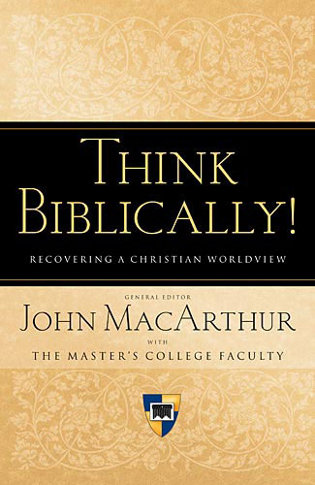
Think Biblically!: Recovering a Christian Worldview (ed. John MacArthur)

MacArthur has a tendency to construct ideas and phrases in almost martial terms, but I prefer to think of God as a teacher, “a bringer of light, wisdom, and understanding,” to quote actor Ian McKellen in his first go around playing Erik Lehnsheer over a decade ago.

Being invited into God’s “classroom,” so to speak, is like entering a pool of water that has infinite depth. And yet, the deeper you swim, the more you can see, the colors are more varied and more vibrant, and what prevents us from immersing even further isn’t the pressure but the intensity. A frail human being can only encounter so much of the mind of an infinitely complex God.

skyIn spite of MacArthur’s vast experience and the great volumes of materials he’s created, in spite of his many sermons (he’s just completed his goal of preaching through the entire New Testament verse by verse, from the beginning of Matthew to the end of Revelation), and indeed, in spite of his love of the Bible, which rivals the love of the most devout and observant Jewish person for Torah, there still are no colors in his pool, no shimmering schools of rainbow fish darting across its depths.

And yet, how can this be, when MacArthur in his chapter repeatedly references Psalm 19 and David’s own love of the Torah of God?

The law of the Lord is perfect, reviving the soul;
the testimony of the Lord is sure, making wise the simple;
the precepts of the Lord are right, rejoicing the heart;
the commandment of the Lord is pure, enlightening the eyes;
the fear of the Lord is clean, enduring forever;
the rules of the Lord are true, and righteous altogether.
More to be desired are they than gold, even much fine gold;
sweeter also than honey and drippings of the honeycomb.
Moreover, by them is your servant warned; in keeping them there is great reward.

Psalm 19:7-11 (ESV)

I agree with MacArthur that the Bible is the written foundation, the Word of God upon which we stand. I agree with David that the Torah of God is perfect, reviving the soul, making the simple one wise, rejoicing the heart, enlightening the eyes, and much sweeter than any other taste or experience. Not to say that Christians must imitate Jewish religious and identity behaviors because that would be missing the point (although most people who believe Christians and Jews must observe the Torah in an identical manner do miss the point that, in all the important ways, we already do). Performing the mitzvot isn’t something we do because it is written on a list, and we don’t honor the Torah above Messiah or worship a scroll before God.

But when Christians say they want to be “Christ-like,” what does that mean? What does MacArthur expect when he drives Christians back to reading and studying their Bible? Like Paul it’s unlikely that he expects to turn Gentiles into Jews, and like James and the Elders, it’s unlikely he will “command” the church to wear tzitzit and lay tefillin, for even if we did, these would be only superficial signs of the deeper matters of Torah, and what we are still failing to do.

He has told you, O man, what is good; and what does the LORD require of you but to do justice, and to love kindness, and to walk humbly with your God?

Micah 6:8

Then the King will say to those on his right, ‘Come, you who are blessed by my Father, inherit the kingdom prepared for you from the foundation of the world. For I was hungry and you gave me food, I was thirsty and you gave me drink, I was a stranger and you welcomed me, I was naked and you clothed me, I was sick and you visited me, I was in prison and you came to me.’

Matthew 25:34-36

Is the Bible sufficient for teaching us how to live a basic life of righteousness, holiness, and compassion? Oh yes. The lessons aren’t that tough and in fact, it’s one of the easier teachings the Bible has to offer. Yes, there are complexities we encounter as we insert the expectations of God into our twenty-first century world and I’m not saying all of our moral and ethical decisions are “no brainers,” but how difficult is it to understand that we are to feed the hungry, visit the sick, and comfort the grieving as a response to loving the Bible and loving God?

How difficult is it to understand that by feeding the hungry, visiting the sick, and comforting the grieving, we are learning how to love the Bible and to love God? Love and compassion are warm colors painted across the canvas of our lives by God. Sometimes we are the painter when we perform tzedakah, and sometimes we are the canvas when we allow God to tinge and hue our souls so that we will be emblazoned and illuminated.

The Bible is alive, almost as if it has an independent personality. Pastor Randy believes the Torah is alive and he is hardly a self-described mystic. But how else can we explain it?

Torah is not about getting to the truth.

When you are immersed in Torah, even while pondering the question, even while struggling to make sense of it all, you are at truth already.

Torah is about being truth.

-Rabbi Tzvi Freeman
“Being, Not Getting”
Based on letters and talks of the Rebbe, Rabbi M. M. Schneerson
Chabad.org

alizarin-crimsonLord kiss me once more
Fill me with song
Allah kiss me once more
That I may, that I may
Wear my love like heaven
Color sky havana lake
Color sky rose carmethene
Alizarian crimson

-lyrics from Wear Your Love Like Heaven (1967)
written by Donovan

To what shall we compare loving the Bible? Loving the Bible is like immersing in a pool of havana lake, like being encompassed overhead by an overarching rose carmethene sky…like being embraced in the richness of a shroud of alizain crimson.

Wear God’s love like heaven. Immerse in truth. Live truth. Be truth.

139 days.


Do Messianic Jews Hate Christians?

fire-breathingThat’s a rather inflammatory title and it doesn’t really communicate everything I’m about to say, but I had to start somewhere.

Please, brothers and sisters, do not listen to the false teachings of “First Fruit of Zion” and Boaz Michael or anyone from the Union of Messianic Jewish Congregations. You are NOT meant to stay in church on a permanent basis. You know this: doesn’t your spirit grieve there? I know that it does! Because my spirit grieves there too!

The Prophetic Expectation is that Non-Jews will grab hold of a Jew (in a nice way of course) and start down a path to learning the Torah of Moses (Acts 15:21).

I want to help the Christians in churches but my spirit cannot take it there much longer. And I’ll not have my daughter identifying with those who hate our Judaic heritage. May Heaven protect her from the spirit of lawlessness! And may G-d protect her bashert!

-Peter
“The Prophets vs. Boaz Michael: A Brief Look at the Prophetic Expectation for Non-Jews in the “Day” of the New Covenant Age”
orthodoxmessianic.blogspot.com/

I’m doing this against my better judgment. I know I could be letting myself be baited by someone you could think of as a troll. On the other hand, it disturbs me that so much disinformation is being spread, not only regarding the Messianic Jewish movement, Jewish people, and Judaism, but about a specific individual, namely Boaz Michael, and the organization which he founded and leads, First Fruits of Zion (FFOZ).

I know, this is a heck of a thing for me to post right before Shabbos and just days before I travel to Hudson, WI to attend the FFOZ Shavuot conference. The thing is though, I have a problem when I encounter what I believe to be injustice. I really don’t like bullies (though on occasion I feel sorry for some of them). But they need to be confronted. This has to stop.

What’s interesting about the blog owner I quote above and a number of the people who support his ideas, is that they not only appear to oppose the Messianic Jewish movement but the Christian church as well. That doesn’t leave many places left to look for believers.

As you can see from Peter’s words above, it’s as if Christians and the Protestant church are at least inferior to him/them if not down right opposed to the Word and will of God. On top of that, the very idea that the Jewish people within the Messianic Jewish movement might want to actually retain their own Jewish identity and uniqueness seems an undesirable outcome to them.

Do Messianic Jews Reject Christians?

There is a concern that, in order to be viewed as a legitimate branch of modern Judaism within the larger normative Jewish community, Messianic Jewish synagogues must expel all non-Jewish members and attendees. That seems odd, since most of the authentic Messianic groups of which I’m aware have a majority membership of non-Jewish worshipers. Furthermore if David Rudolph’s and Joel Willitts’ landmark book Introduction to Messianic Judaism (IMJ) can be taken at face value, then not only are Christians welcome within the ranks of Messianic Judaism, Christians and non-Jewish members of Messianic synagogues are absolutely required for the health of the body of Messiah!

Don’t believe me? I wrote eleven extensive reviews of different articles (the book has twenty-six different Jewish and Christian contributors) presented in the book which are collected on my blogspot. That single link leads to a page where you can review any or all of them.

On top of that, Pastor Jacob Fronczak, who periodically blogs for FFOZ, wrote an excellent review of the book, which takes much less time to read than my eleven missives. The upshot of all of those reviews and my experience in reading the book, not to mention my experience interacting with Messianic Jews, is that I am, as a church going Christian, not being set to one side as if I’m the left-handed, red-headed, foster child in the family. The fact that I’ve been invited for a second time to FFOZ’s Shavuot conference seems to indicate that I am welcome within their ranks.

If Messianic Jews were uncomfortable about the message having Christians attending their services and conferences is going to send to the other Judaisms in the world, you’d never know it by how many Christians actually attend their services and conferences.

No, I don’t feel rejected by Messianic Judaism, nor do I feel like a second-class citizen in Messianic Jewish groups or when I attend my local church. I don’t feel like Boaz Michael is treating me poorly by suggesting, both in his book Tent of David and personally as my friend, that I explore a church worship experience. After all, he and his wife Amber regularly attend a Baptist church in their own community when Boaz isn’t traveling. IMJ author and editor Joel Willitts regularly attends a Christian church in Chicago. And yet he is also close friends with IMJ co-editor David Rudolph and if they experience any dissonance in their personal and professional relationship, I couldn’t tell by reading their book.

churchesI doubt Messianic Judaism as an overarching concept and organization is perfect. I doubt each individual synagogue or all of the individual people who attend said-synagogues are perfect.

There probably are some Messianic Jews who have “issues” with large numbers of Gentile attendees in their synagogues. There are probably some who prefer a largely Jewish community rather than a largely Gentile community. I don’t blame them. Traditionally, any Jew who has publicly professed Jesus as Savior, Lord, and Messiah has been labeled a “Christian” by Jewish community and family and typically ostracized.

Also historically, the Christian church has typically required any Jew who “professes Christ” to surrender all Jewish worship and lifestyle practices and essentially to become a “goy.” If I were Jewish, I wouldn’t like that either (and having been married to a Jewish wife for 31 years, I have a little insight into that world).

So I, a Christian who goes to a small Baptist church in a suburban community in Southwestern Idaho, don’t feel rejected or pushed away by Messianic Judaism, nor have I ever gotten the impression that Messianic Judaism disdains the other Judaisms or Christianity.

Do Hebrew Roots Groups Hate Messianic Jews and Christians?

But what about Hebrew Roots or the subgroup in which Peter (and I really dislike calling out individuals for a “spitting contest” but sometimes enough is enough) purports to represent? How do they feel about Jews and how do they feel about “Christians?”

To be fair, every Hebrew Roots person I’ve ever met says they love Jews and they love Israel. I don’t doubt it. However, whenever Jews in the Messianic movement register distress at Hebrew Roots Christians mimicking Jewish religious and identity behaviors, typically Hebrew Roots people accuse the Jewish people of racism and exclusionism and other unpleasant things, seizing the “right,” based on various scriptures, to move into the Jewish space and claim everything in that space for Gentile use as “sharers” of all the “stuff.” It’s kind of like having your neighbors burst through your front door, raid your fridge for a beer, say that they’re moving in, and you have to “share” your stuff (food, bed, clothes, toothbrush) with them forever…and you don’t have a say in the matter.

Doesn’t sound very loving.

Actually, I’m more concerned about Hebrew Roots attitudes towards Christians and Christian churches. Granted, “the church” in all its iterations across history, has a rather poor track record in terms of supersessionism, pogroms, inquisitions and the like relative to the Jewish people, but that is slowly changing. However, regardless of how you feel about Christianity, no other group has kept the teachings of Jesus and his apostles and disciples intact for the past twenty centuries, just as the Jews have kept the Shabbat, the Torah, the Prophets, and the teachings of the sages for the sake of Israel and Hashem for as long and longer (much longer).

Most “Messianic Gentiles” I know in the Hebrew Roots movement go to church, at least occasionally. Most Hebrew Roots people who are Jewish (with either a Jewish mother, Jewish father, or both), are intermarried and some of their spouses self-identify as Christian and at least occasionally go to church. Many of the Hebrew Roots Jews and Gentiles have Christian family members and Christian in-laws, so it’s not like they are isolated entirely from Christian influences.

But when Hebrew Roots people characterize the Church as “Babylon” (which I’ve personally heard some of them say) or claim Christians are “lawless” or say they hate the “Judaic heritage” of Christianity, I take offense. Of all the non-Jews who claim to “keep the Torah,” the fact remains that probably over ninety percent of Gentiles who keep the weightier matters of the Law are church going Christians. Church going Christians donate food to the hungry, donate time in homeless shelters, donate time in food banks, visit the sick in hospitals, participate in prison ministries, mow the lawns of disabled people, shovel snow off the drives and sidewalks of the infirm and elderly in the winter, comfort the grief-stricken person whose spouse has just died of cancer.

I know Christian people who perform each of the mitzvot I’ve just listed and I’ve performed at least some myself as a “church going Christian.” If that’s not Torah, what is?

I have complained about my church experience in the past and I probably will in the future. It’s tough to get used to a new “culture” and the different ways people think about and do things within that culture. I also have been significantly challenged as far as my beliefs and my knowledge, particularly by the head Pastor of my church, who is highly intelligent, extremely well-read, who is fluent in Biblical Greek and Biblical and modern Hebrew (and other languages), who has lived in Israel for fifteen years, who maintains close friendships with Israeli Jews (believers and non-believers), and who vehemently opposes supersessionism and anti-Semitism in all their forms.

No, we don’t agree on everything, but I have to say that even when going “toe-to-toe” on some issue, I always encounter great integrity and respect in our transactions and never, ever have I been insulted, slighted, or treated poorly even to the smallest degree.

I can’t always say the same for many of my internet dialogues with “fellow brothers in Messiah.”

changing-courseI’m not writing this to change anyone’s mind. I know that’s probably useless. I’m saying this to show those people who think like me that you’re not alone. I’m saying that it’s possible to be a Christian, go to church, and still have close associations and friendships with Jews, both those who are Messianic and those who aren’t. I’m trying to see the best in people. That’s a Jewish and a Christian value. If that’s not your value, then maybe you need to re-evaluate what you believe and why? If you don’t love someone because they belong to a particular religious group, then maybe you need to reconsider whose teachings you’re actually following.

Dear Peter

You won’t like this, but I feel deeply sorry for you, Peter. I think sometimes you see yourself as the victim of both Messianic Jewish people and Christian people. I know you want to be accepted for the person you are and you really need to be right and to have others agree that you’re right.

You were right about one thing. You challenged me (on Gene’s blog I think) to get off the fence and go back to church. After all, you were attending a church and it was (I guess it’s not anymore) working for you and your family. You were right. I went back to church and it was the right thing to do. After a number of “settling in” struggles, I’m beginning to find my legs, so to speak. The transition period isn’t over yet, but I feel myself integrating into the community somewhat. I’m learning a lot of new things. My Pastor, as I said above, is a great person to talk to and he asks questions that aren’t always easy to answer. Those are really great questions.

And he’s willing listen and consider my point of view about the Messianic Jewish movement and how the modern movement connects back to the New Testament Jewish believers. If I had stayed in Hebrew Roots, as comfortable as it was and as much as I still love the people I fellowshiped with, I wouldn’t have learned any more than what I knew back then. Change is growth and I’ve changed and grown a lot. I’m not done yet.

So thank you for that.

One thing that is absolutely required in order to understand someone, in order to talk with someone, in order to learn from every person you meet, no matter who they are, is that you can’t continually feel like you are someone’s victim. When you always expect to be victimized, whether by Jewish people who are Messianics or non-Jewish people who go to church, the only response you can have is to become defensive and then to attack in order to protect yourself. No one learns a thing from someone if they are afraid of being attacked and are responding in kind.

The only reason I’m engaging you is that I see potential in you. I know, based on what you’ve blogged, that you have had some rough experiences in your life and you feel as if you’ve been treated unfairly. Most of what you blog about is a response from that position. If I thought you were just a jerk, you’d never hear from me again. I don’t think you’re a jerk but most of the time, it’s hard to tell the difference between a hurt and angry person and a bully. Because of that, I urge you to reconsider what you’re doing. It can’t turn out well. It never turns out well. It doesn’t communicate love for Jewish people and for Israel. It doesn’t communicate love for your brothers and sisters in the church, particularly those who are in the church you currently attend.

I don’t know what else to say to you, Peter. I don’t know what else to say to the thousands upon thousands of people out there like you who feel like you do…who feel like the church is their enemy…who feel like the church lied to them…betrayed them…kept the truth from them…people who feel like their Pastor or their friends in the church hurt them.

held-in-gods-handsMisunderstandings are only corrected through relationship and dialogue, but those conversations absolutely cannot be based on hostility, competition, or the desire to defeat or destroy the person you are speaking with. Until you reach the point where you can talk to people who you disagree with and not see it as a battle, you will never go any further in your path of faith or your walk with Messiah than the spot where you’re standing right now.

I know this won’t change you. As I write it, I hope it changes me so that I can be as compassionate as I want to be toward you and toward those who criticize me and disagree with me. I know God doesn’t love one of us and hate the other. Otherwise, why send Messiah to die for the whole world?

I don’t hate Jews. I don’t hate Christians. I don’t hate Hebrew Roots people (One Law, Two House, or anyone else). How could I when I know that even when I was Messiah’s enemy, he died for me? He displayed a love for an unbelieving and hostile humanity that he was willing to die for. Shouldn’t we try to live up to that, at least a little bit? We don’t have to die for each other (although we may be called to one day), but we can try to put down the boxing gloves, knives, and machine guns (all metaphors for our online arguments) and just talk.

Tuesday afternoon, I’m going to be showing up at Beth Immanuel Sabbath Fellowship in Hudson. There’s going to be a lot of people there. Some will be Christians. Some will be Jews. A lot will call themselves by different labels and titles. We probably won’t agree about everything we talk about. But we all have Messiah in common. That’s a start.

“Optimism is essential to achievement and it is also the foundation of courage and true progress.”

-Nicholas Murray Butler, American diplomat and educator

138 days.

John MacArthur and Struggling with Biblical Sufficiency, Part 2

doveThis is a continuation of yesterday’s “meditation” on John MacArthur and “Chapter 1: Embracing the Authority and Sufficiency of Scripture” from his book Think Biblically: Recovering a Christian Worldview. If you haven’t done so already, read Part 1 before continuing here.

In addressing Luke 16:27-31, MacArthur says:

The rich man’s perspective is the same view of many today who always seem to demand some kind of supernatural affirmation of spiritual truth. They imagine that the straightforward statements of Scripture and the power of the Gospel alone are not sufficient. But the Lord, through the words of the parable, argued otherwise and said that even though He Himself would rise from the dead, miracles are not necessary for the Gospel to do its work in changing lives. Why? Because the Word of God through the inspiration and illumination of the Holy Spirit is powerful enough — it is all-sufficient in what it teaches about redemption and sanctification.

-MacArthur, pg 27

To the degree that the Bible records numerous miracles of God (Moses, the Reed Sea, millions of Israelites walk on dry land but the pursuing Egyptians drown under thousands of tons of water…that sort of thing), apparently they have their uses, but I do agree that miracles alone will not insure faith. If they did, then millions of Israelites wouldn’t have struggled in their trust of God and been condemned to die in the desert after a forty year walk.

Setting that aside, I still have a hard time figuring out what MacArthur believes about the Holy Spirit. Most Christians I talk to pray to God that the Spirit will give them wisdom and understanding in their studies of Scripture, but it almost sounds like MacArthur believes that once the Spirit was done inspiring the Bible’s writers, it split the scene, leaving the book behind and saying, “This is all you need…see you in the next life.”

I know that’s a little harsh and MacArthur, as a self-proclaimed Evangelical, probably does believe in a supernatural God and that there are certain supernatural mysteries we don’t understand right now. But in focusing on the sufficiency of the Bible, I kept getting the feeling that MacArthur was leaving the actual influence of God in our lives out of the equation. I got the feeling from MacArthur that the power of God’s Spirit was only found in the pages of the Bible. If that’s so, why pray? Just read.

I personally don’t think that anyone comes to God without His direct intervention in our experiences. I believe this is true of me. I don’t believe that some human being thumping a Bible and quoting its eloquent words convinced me to become a Christian. I know from my own story that a series of extremely unlikely events occurred over six to twelve months that finally convinced me God was involved in my life.

I had resisted the Word and Will of God for forty years and He finally convinced me…but I didn’t start actually reading the Bible until I was already going to church, and I promise you that I had no idea what I was reading for the first several years. In many ways, I’m still wrestling with God and struggling with the Bible. MacArthur makes it seem as if the Bible were as easy to comprehend and absorb as the latest best-selling fiction novel on the market. For me, the Bible is like living within a riddle wrapped in a mystery inside an enigma (to paraphrase Winston Churchill’s famous statement about Russia). It contains many wondrous things of God, but they are only revealed during the journey of a lifetime.

MacArthur spends the second half of his chapter supporting the sufficiency of the Bible from the point of view of the Torah and the Prophets. He presents a pretty good illustration of Jewish devotion to Torah. I was amazed because everything I know about him (which admittedly, isn’t that much) tells me that as a dispensationalist, he believes the Torah “goes away” after Jesus and is no longer “sufficient” for the Jewish believer.

In quoting the Shema (Deut. 6:4-9), MacArthur says:

That was a simple way to summarize the myriad commands God had given Moses. But the law of God — His revealed Word — was and is the one resource for life and godliness. Everywhere they went, the children of God were always to meditate on and apply the words of the living God. Those words were to occupy their attention as a source and centerpiece of everything. For His people, that is still God’s design for life.

ibid, pg 28

simhat-torahMacArthur uses the past and present tense about the sufficiency of Torah twice in the previous paragraph, but I’m not sure he realizes the implications. He’s trying to transfer how he sees the Israelites of the past being devoted to Torah across history to the modern-day Christians and the Bible without explaining that normative Protestant Christianity generally dismisses the vast majority of the Torah.

On page 29, MacArthur says “the law” is the Hebrew word “Torah” (yeah, I know), “which basically means divine teaching (emph. mine). In quoting Psalm 19:7 (“The law of the Lord is perfect”), he says that “perfect” can also mean “whole,” “complete,” or “sufficient.” He actually quotes from Psalm 19:7-9 which is part of the Shabbat liturgy in most synagogues, and those words are amazingly beautiful to me.

For pages and pages and pages, MacArthur cites a stream of examples from Judaism about the perfection of Torah, that it is “reviving,” “restoring,” “transforming,” “converting,” and “refreshing.” He speaks of Torah “making the simple one, wise.” He speaks of David praising the “precepts,” meaning divine principles, statutes, and guidelines.” At one point (Pg 31), he states:

The result of applying Scripture’s principles, obeying its precepts, and walking in its pathways is true joy — “rejoicing the heart.”

I wonder if he realized that from a Jewish point of view, it is the performance of the mitzvot, the commandments such as charity, hospitality, and compassion, that “rejoices the heart?” What MacArthur is praising isn’t just the sufficiency of the Bible, but the Jewish worldview (not Christian worldview) of the sufficiency of the Torah, the mitzvot and, for a Jew, the traditions.

He also said:

If those who claim to follow Christ today were as excited about scriptural precepts as they are about the materialism of this world, the character of the church would be wholly different, and our testimony to the world would be consistent and potent.

Actually, I agree with him, but I’d have changed that sentence to say:

If those who claim to follow Christ today were as excited about scriptural precepts as religious Jews are excited about the Torah and the mitzvot, the character of the church would be wholly different, and our testimony to the world would be consistent and potent.

There were a bunch of other “nitpicky” things I noted about MacArthur’s chapter, but what impressed me the most (as you can probably tell) was how “Jewish” he seems to feel, at least sometimes, about the Bible. I think he’s right that anyone who calls himself or herself a Christian needs to be constantly reading and studying the Bible.

I’ve just started reading John W. Mauck’s book Paul On Trial: The Book Of Acts As A Defense Of Christianity, and Donald A. Hagner in the Foreword says in part:

Just as ministry is the work of the people and not the clergy (who are to equip the saints for ministry according to Eph. 4:11-12), so to the Bible is the book of all the people of God, not the domain of biblical scholars only. Indeed the writings that make up the Bible are meant to be studied by every Christian. The Word of God was written, after all, not to scholars but to the people of God in communities of faith.

I agree and find Professor Hagner’s statement to be wonderfully affirming and empowering. In a number of ways, I agree with MacArthur, but I think he overstates the matter of Biblical sufficiency to the point of being dogmatic and inflexible. It’s as if he leaves no room for discussion and basically says, “It’s my way or the highway.”

I seriously doubt that Moses and Paul had an identical worldview of the Word of God because the world around each of these men was very different. How Torah was understood and applied was based on who each of these men were and what they were trying to accomplish in accordance with their mission from God.

MacArthur, in championing the sufficiency of the Bible, failed to mention needing to understand the original languages of the Bible and especially needing to understand the original contexts, cultures, experiences, and lifetimes of each of the Bible’s authors in order to get a more accurate picture of what they, and God, were trying to say. He failed to mention that how we understand the Bible begins at the level of translation and that the same words and phrases of Scripture can be translated differently, even very differently by different people depending on their biases and worldviews. This is particularly true when comparing Evangelical Christianity and any of the streams of modern, normative Judaism and most pointedly, Messianic Judaism.

bible_read_meI think MacArthur is right though in that many churches have, for the most part, set the Bible aside as irrelevant or archaic and thus unable to reach the people who are trying to reach God in the twenty-first century. Although I seriously doubt MacArthur intended to give this impression, I think that the mass exodus from “the church” isn’t because it thumps too hard on the Bible but because “the church” all but ignores the Bible. I think this is why at least some Gentile Christians have been transitioning into the Hebrew Roots and Messianic Jewish movements, since both of these movements emphasize the study of and devotion to the Bible and specifically Torah.

If the church could learn one thing from the Hebrew Roots and Messianic Jewish movements, it is the continual reading and studying of the Bible, including reading the Bible as part of worship.

I’m not ready to take every book I’ve ever read except for the Bible, and toss them all into a giant campfire. I don’t think other sources of information are useless. If I want to learn something about a web-based technical support product or how online merchants can fight fraud, I’m not going to find the answers just by reading the Bible (OK, those are pretty far out examples and probably MacArthur wouldn’t expect to find them in the Bible, either, but I’m trying to make a point).

The Bible is the single most important and influential document ever written and the world would not know God without it, but we can learn a great deal by reading and studying other material as well. Learning more in the fields of history and archeology relative to Biblical times greatly enhances what we understand about the Bible itself. I disagree that we must throw all this other “stuff” under a bus in order to rightly state that we are seeking an encounter with God and pursuing a life of righteousness.

I also disagree that the Bible is a simple book. I will spend the rest of my life studying the Word of God, and I don’t expect, at the end of my days, to be hardly anymore enlightened about its mysteries than I am right now. May God grant me the wisdom and understanding to see Him and His will for me somewhere in the pages of His Word.

139 days.

John MacArthur and Struggling with Biblical Sufficiency, Part 1

think_biblicallyA truly Christian worldview begins with the conviction that God Himself has spoken in Scripture. As Christians, we are committed to the Bible as the inerrant and authoritative Word of God. We believe it is reliable and true from cover to cover, in every jot and tittle (cf. Matt 5:18). Scripture, therefore, is the standard by which we must test all other truth-claims. Unless that axiom dominates our perspective on all of life, we cannot legitimately claim to have embraced a Christian worldview.

John MacArthur
“Chapter 1: Embracing the Authority and Sufficiency of Scripture” (pg 21)
from Think Biblically: Recovering a Christian Worldview (ed. John MacArthur)

NOTE: I had a conversation with Pastor Randy last night (Monday) which amended a few things I understand about him and about MacArthur. This blog post and Part 2 which will be published tomorrow morning, were written before that encounter. I’ll post an update after the publication of Part 2.

I remember when I “discovered” the Bible contained internal inconsistencies that could not be “smoothed out” in any reasonable fashion. I remember when I realized that the different Gospel accounts of the timing of the death of Jesus didn’t match up. I remember hitting a wall, going into a tail spin, and experiencing a classic “crisis of faith.” It wasn’t pretty.

I eventually came out of it and retained my faith, but my view of the Bible has never been quite the same since. Yes, I believe it is the Word of God, His chronicle of the interactions between man and God, but I no longer believe that God literally spoke each word of the Bible in the ear of each of the Bible’s contributors as if He had dictated a series of letters to a series of secretaries (I guess I should say “administrative assistants” in this day and age). I believe that in some supernatural sense, God and the contributors became “partners” in the endeavor of composing what we have in our Bibles. It’s inspired by a Holy God but it contains the lived personalities and experiences of each person who did the actual writing.

Pastor Randy gave me the photocopied pages of this chapter written by MacArthur during last week’s Wednesday night meeting. I made the time last Friday to read the pages and found myself scribbling notes furiously in the margins and highlighting numerous sentences and paragraphs. Needless to say, I have some responses to MacArthur’s viewpoint about the Bible.

It might help before you continue, if you click the link of MacArthur’s name that I inserted above. It leads to his Wikipedia page and you can get a brief sketch of who he is, what he’s done, and what he believes about the Bible, Christianity and so on. That will provide the background for understanding his chapter and what I’m going to say about it.

Since we’re going to talk about the Bible being inerrant and sufficient, I suppose a few definitions are in order, via a bit of linkage: Biblical inerrancy and sufficiency of scripture (PDF).

First, something I agree with.

Christian bookstores are full of books offering advice drawn from sources other than the Bible on almost every conceivable subject — parenting, Christian manhood and womanhood, success and self-esteem, relationships, church growth, church leadership, ministry, philosophy, and so on. Various self-appointed experts who claim to have discovered some deep truth not revealed in Scripture have now become familiar fixtures on the evangelical landscape.

-MacArthur, pp 22-23

I almost never go into Christian bookstores anymore for exactly this reason. The products and marketing of said-products in Christian bookstores is little different from their secular counterparts. Oh, they are “dressed up” with “Christianese” terms and phrases to make them sound more “Biblical,” but the methods and techniques used to transmit information and often the information itself is strictly “Madison Avenue meets the Church.”

Also, many years ago, I attended a church that was all about selling itself. Dissatisfied with its image and how the church was growing, the board fired its Pastor and hired one who actually had a graduate degree in “Church Growth.” Interesting educational emphasis. The new Pastor came in with graphs and charts and statistics showing us how we needed to move locations, build a much larger facility with multi-purpose capacities, target an area of our valley that contained a specific demography of the population, and use other modern marketing techniques to attract a large influx of people “for the Lord.”

I couldn’t get out fast enough and I’ve never been back.

Oh, on top of all that, what MacArthur says about “various self-appointed experts who claim to have discovered some deep truth not revealed in Scripture” is spot on. For the better part of a decade, in one way or another, I was involved in the Hebrew Roots (One Law) movement. While most of the people I had regular fellowship with were good, well-grounded, honest, devoted disciples of Christ, the Hebrew Roots movement is totally unregulated and unrestricted, so just about anyone can pop up, put on a kippah and tallit, and call themselves a “Messianic Rabbi.” Then they get to sell their wares to whatever audience they can attract, based on the particular theological ax they’re grinding, and claim to have received some sort of “special anointment from the Lord” or “revelation of the end times.”

I’ve learned to beware of congregations that are run by “one-man shows” rather than being governed by a board based on a distributed leadership model.

If you can’t back up what you’re teaching with Scripture, then there’s a problem. But even then, lots and lots of stuff is taught that is supposedly based on Scripture, proving you can make the Bible say almost anything if you spin it fast enough.

Which brings me to MacArthur’s quoting from the Westminster Confession of Faith (1647 CE):

“The whole counsel of God, concerning all things necessary for his own glory, man’s salvation, faith, and life, is either expressly set down in Scripture, or by good and necessary consequence may be deduced from Scripture: unto which nothing at any time is to be added, whether by new revelations of the Spirit, or traditions of men.” (emph. mine)

-ibid, pg 22

It’s that “may be deduced from Scripture” part that makes things a little hazy. What MacArthur calls “deduced” could, in theory, be just about anything depending, again, on how hard and fast you spin the Bible. I know MacArthur probably had Judaism in mind when he mentioned “traditions of men”, leveraging the classic Christian view of all Pharisees making stuff up out of whole cloth and that the Rabbis being the direct inheritors of traditions and hypocrisy.

BiblicallyBut to be fair to the Rabbinic sages, they believe that they are actually “deducing” stuff from the Torah (Bible) in order to make the contents applicable to different generations and different circumstances (apparently) not anticipated by the literal text (using microwave ovens and driving cars on Shabbat comes to mind). According to MacArthur, this would be against the rules and that the Bible does anticipate all contingencies, circumstances, and technological advances. The Bible is sufficient. End of story.

Let’s drill down into a specific example using an issue that MacArthur definitely has strong feelings about.

Scripture reveals the deepest thoughts and intentions of the human heart, so that “all are naked and exposed to the eyes of him to whom we must give account” (Hebrews 4:13). Thus, the Bible can do what psychoanalysis can never do. It is sufficient to penetrate and lay bare the deepest part of a person’s soul. (emph. mine)

-ibid pg 27

Never mind that psychoanalysis, a therapeutic model based on the theories of Sigmund Freud that, to the best of my knowledge, is no longer practiced due to the amount of time it takes (years), the sheer expense of the treatment, and the fact that insurance companies don’t cover the costs involved. I think MacArthur probably means psychotherapy, but let’s continue.

He is also an advocate of Nouthetic Counseling, which stresses the Bible as a sufficient tool for counseling people with mental illnesses such as depression and anxiety. MacArthur rejects psychological theories and techniques, considering psychology and psychiatry as contrary to the Bible…MacArthur criticises “so-called Christian psychologists and psychiatrists who testified that the Bible alone does not contain sufficient help to meet people’s deepest personal and emotional needs,” and he claims “Such a thing as a ‘psychological problem’ unrelated to spiritual or physical causes is nonexistent.” Concerning people who consult secular mental health professionals, MacArthur believes “Scripture hasn’t failed them—they’ve failed Scripture.”

MacArthur has argued that “True psychology (i.e. “the study of the soul”) can be done only by Christians, since only Christians have the resources for understanding and transforming the soul. The secular discipline of psychology is based on godless assumptions and evolutionary foundations and is capable of dealing with people only superficially and only on the temporal level… Psychology is no more a science than the atheistic evolutionary theory upon which it is based. Like theistic evolution, Christian psychology is an attempt to harmonize two inherently contradictory systems of thought. Modern psychology and the Bible cannot be blended without serious compromise to or utter abandonment of the principle of Scripture’s sufficiency…. ”

His stance has caused several controversies, the most notable of which was the first time an employee of an evangelical church had ever been sued for malpractice. The case failed to come to trial because a judge ruled the case as having insufficient evidence.

Wikipedia: MacArthur on Psychology

Wikipedia doesn’t give a clear picture of MacArthur’s education, but I’m pretty sure it doesn’t include psychology, psychiatry, social work, or similar disciplines. I have an undergraduate degree in Psychology and a Master’s in Counseling with fifteen years of post-graduate clinical experience (before switching careers) and I have a little bit of an understanding of mental illness and its treatment. I can tell you that it is quite possible to provide successful treatment of a variety of disorders without consulting the Bible. This isn’t to say that I find the Bible useless in addressing our emotional and spiritual woes (and the Bible is uniquely able to address our spiritual hurts), but I know that I and many, many other mental health practitioners have successfully alleviated the painful struggles of countless men, women, and children who were suffering from depression and anxiety related symptoms.

Phobias are a perfect example and they can be treated with rationally based desensitization techniques that gradually enable the person who can’t even think about driving, getting in an elevator, or whatever without breaking out in a cold sweat, to do the very thing that formerly caused them to experience fear and dread.

john-macarthurGranted, it’s not a perfect tool, but even medicine “isn’t an exact science” (I remember the first time I heard a doctor tell me that, and it came as quite a shock). Nothing works perfectly all the time, but to do nothing at all would not only be immoral and unethical, but terribly cruel. Although MacArthur doesn’t speak about psychopharmacology, I suspect he’s against it, and that is even worse. Depression, for example, is very treatable using various medications and many depressions have a clear physiological basis. And let’s not get started on psychotic disorders which cannot be addressed without medication therapy. You can’t “talk” a person out of hallucinations.

I could spend all day on this one disagreement, but there are other issues to discuss, which I’ll get to in Part 2 of this article in tomorrow’s “morning meditation.”

140 days.

Save Me!

falling-save-meA guy is riding his motorcycle down a mountain road when suddenly he loses control and goes hurtling off the cliff. As he’s sailing through the air, he shouts out: “God! Please make a miracle! Save me!”

Within moments his shirt gets caught on a protruding branch – and he is left dangling thousands of feet above the ground.

There’s no way out, so he looks heavenward and shouts: “God! Please save me!”

“Do you trust Me, my beloved son?” calls the voice from heaven.

“Yes, God, I trust you. Just please save me!”

“Okay then,” says God. “Let go of the branch and I’ll catch you.”

The man thinks for a moment, looks around, and calls out: “Is anyone else out there?!”

“Recognizing God”
-from “Ask the Rabbi”
Aish.com

I’ve been writing a lot lately on topics that seem to inspire not only conversation (which is good) but emotional disagreement (which isn’t always good). I thought I’d back off a bit and discuss something that we all have in common: trusting God. I say we all have it in common (assuming you have faith in the living God of Israel), because trusting God isn’t always easy. The little story I quoted above is a joke but jokes are funny because they contain a truth we all understand.

Not only is trusting God difficult but the worse the situation is we find ourselves in, the more difficult of a time we have in trusting. Hence the punchline, “Is anyone else out there?”

Trusting God isn’t a matter of how well our lives are going. If we trust God only when things are doing well with us, it’s not trust. Trusting God is about the relationship we have with Him and to some degree, who we are as an individual personality.

The Aish Rabbi continues:

The key to forging a relationship with God is to trust Him. God is not some vindictive, punishing old man in the sky. God is our loving Creator, who wants only our best. Sometimes that calls for Him to “test” us with difficulties; but the intention is only to bring out our very best.

When we are children, we think we are the center of the universe. Then, through experience and trials, we become increasingly aware of the fact that there are things in life beyond our control. Whether it’s earthquakes, cancer, the rise and fall of fortunes, circumstances of our birth – and even birth itself… this can only be ascribed to a Higher Power.

Maimonides writes that there are two primary ways to attain recognition of God: by observing the wonders of Creation, and by performing mitzvot. Through nature, we see the beauty, splendor, and perfect unity of the world. Through mitzvot, we see how humanity can likewise attain unity and perfection.

trustingIn a way, we learn to trust God by acting the way we want Him to act (speaking of mitzvot). If we live a life that is upright, generous, charitable, merciful, compassionate, and wholesome, we will tend to think of God in that way. If our natures (which are sinful and thus very bad) are stingy, mean-spirited, cruel, hard-hearted, base, and immoral, we tend not to think of God that way, but we think we are going to be struck down any second by God. We expect, when hard times come, that we deserve it and we can’t trust God to help us out.

Trusting God depends on how well we can trust ourselves and how well others trust us.

Rabbi Mordechai Kamenetzky at Torah.org has a commentary based on last week’s Torah reading that also illustrates this point.

My dear friend Rabbi Benyamin Brenig of Golders Green, London recently related this wonderful story to me: Reuvain and Shimon were two men, who lived on opposite ends of town. They each inherited a fortune of gold. Each of them decided to bury their fortunes in their backyards. They wanted to make sure that they would have something to sustain them in their old age. On their respective properties, they each picked a landmark, paced twenty steps due north and dug a large hole.

Reuvain, the more nervous of the two, was careful to make sure that no one was watching. Every other second he glanced furtively over his shoulder to make sure that no one saw him bury the treasure. No one did.

Shimon, by nature, was trusting and carefree and he was not so careful. He was not worried that anyone would steal his fortune. But he was wrong. He was spotted by a nosy neighbor, who was also a thief.

In the middle of the night, the thief dug up the fortune. Out of mercy, he left few coins at the bottom of the pit, and removed the coins. He refilled the hole and packed the ground perfectly as if nothing was disturbed. Then he took off with the fortune.

Reuvain’s fortune, however, remained intact. But he was, by nature, a worrier. And so, the next day he decided to dig up the hole to make sure that the gold was still there. Accidentally, he counted only fifteen paces from his landmark and dug. There was nothing there. Reuvain was frantic. Someone must have seen him dig the pit, he figured. For the rest of his life, he worried. On his property, he had a pit filled with gold coins, but all Reuvain did was worry!

Shimon on the other hand had nothing but the remnants of a few coins. Everything else was stolen. But he never checked the fortune, and was merrily content, assured that when the time would come he could dig up the pit and retrieve his fortune. Reuvain, the millionaire, died heartbroken and frantic. Shimon, the man with but a few coins left for his old-age lived his life content as if he was the wealthiest man in the world.

The Torah tells us about the different types of blessings. For the faithful, Hashem says, “I will command my blessing in the sixth year,” in which Rashi assures us that even a bit will feel like a bounty. But we must acknowledge that despite Heavenly assurances, there are those who always worry. They need to see the money! They ask, “What will we eat in the seventh year? Behold! We will not sow and not gather in our crops!” Hashem must assure them that he will increase their bounty in a way that is visible to them.

Some of us can believe without seeing immediate results. We can sleep well, with full satisfaction on empty stomachs. The greatest expression of faith is when we do not see the blessing, but we feel it in our hearts and even in our stomachs. That blessing transcends tangibility, and the fear of deficiency. I think that is a noble goal.

For the rest of us, those who keep looking over their shoulder and check their fortunes every day, they need a different type of blessing. Sometimes we dig for tangible salvation, even though the treasure is sitting undisturbed in our own backyard.

waiting-for-mannaI know that was a long quote, but I think it’s a good story and it tells us something about God and who we choose to be in God. Once you bury gold in the backyard, you can no longer see if it is there or not unless you dig it up. You can be like Shimon who lost most of his gold but because he trusted in something more precious than gold, lived his life in security and happiness as if he were a wealthy man. Reuvain, by contrast, didn’t lose a dime, but because he thought he had lost everything due to his untrusting nature, he could not trust the One who is worth far more than gold coins, and thus he lived out his life, though wealthy, as if he were a pauper dressed in rags.

We can’t control the circumstances of our lives with any certainty. Yes, we can invest in IRAs, spend cautiously on personal comforts, give generously to the poor, treat the lonely and grieving with kindness and compassion, but like the residents of New York and New Jersey, we cannot anticipate when the next superstorm Sandy will come and wipe all of our material possessions away like a sandcastle on a beach.

Like Job, we can learn to trust in God whether he grants us much or little. And we can strive to learn to trust God as did Paul.

Not that I am speaking of being in need, for I have learned in whatever situation I am to be content. I know how to be brought low, and I know how to abound. In any and every circumstance, I have learned the secret of facing plenty and hunger, abundance and need. I can do all things through him who strengthens me.

Philippians 4:11-13

I’ll freely admit that I sometimes have trouble with matters of trust, but that’s my problem, not God’s. God is not only immensely trustworthy but infinitely so. And even if I were to lose everything, I could only try to aspire to be like Job when he said, “Though he slay me, I will hope in him; yet I will argue my ways to his face” (Job 13:15). The part about “argue my ways” may seem a little off base, but if I trust God, then I can trust Him with my heart, which includes all of my emotions, my disappointments, and my anguish, even my problems of trust in Him.

But in the end, we all will arrive at the same destination. In the end, we must all trust God and cry out to Him, “Save me!” Will we “let go” and let Him catch us?

141 days.