Tag Archives: love

Overcoming with Good

negativeThe Almighty’s perspective is the ultimate perspective. It is the basis of reality. The real question we need to ask ourselves is, “What does the Almighty consider my true value to be?”

From the Almighty’s viewpoint, the answer is, “You are My child and you are precious. You are created in My image. In essence you are a Divine Soul. I have created the world for you. Your entire being and your value is a gift from Me. When you see yourself from My perspective, you know that you have infinite value. Your intrinsic worth is greater than anything that can be measured materially.”

Rabbi Zelig Pliskin
Daily Lift #984
“Almighty’s Perspective on Your True Value”
Aish.com

Just to let you know, this has nothing to do with my recent commentary on John MacArthur and his Strange Fire conference.

However, I recently have become aware of a resurgence of poor attitudes among believers in the blogosphere and the wider realm of the Internet. I guess it’s easier for these sentiments to be expressed in a semi-anonymous environment where accountability doesn’t appear to be an issue.

I’m not here to add to that negativity. Believe me, resisting this temptation is difficult, but in the end, if I didn’t, I would be no better than those I find who have betrayed friendship and trust.

There is always injustice in the world. Just as the Master said to his disciples that “you always have the poor with you,” it’s sad to say that we always have the unjust with us as well. Jesus went on to say “and whenever you wish you can do good to them,” reminding his listeners (and us) that poverty is an opportunity for us to help others and to do the right thing in his name. What can we say of the unjust? What opportunity do they present?

I could say they offer us the opportunity to be just and humane as they are unjust and inhumane, but the mistake here would be in attempting to confront others who, in their own “wisdom” and self-service, see themselves as upholding the cause of right.

No, confrontation and the continuation of angry words profits no one and does not serve man or God.

But there is another opportunity here. The opportunity is to uplift and uphold those who have been trampled on under the muddy and self-righteous boot. The opportunity is to offer healing words, an olive branch of peace, friendship, and hope.

unpopularRabbi Pliskin wrote the words I quoted above probably with the idea that he was addressing a primarily Jewish audience, but his words are true for everyone. We were all made in the image of God. To denigrate any human being is to lower that Godly image and even to drag it into the gutter. When people do this in believing they are serving God, it is a sad and miserable thing. It’s especially poignant that the instigators are woefully unaware of what they are doing and who they are hurting.

“Then He will also say to those on His left, ‘Depart from Me, accursed ones, into the eternal fire which has been prepared for the devil and his angels; for I was hungry, and you gave Me nothing to eat; I was thirsty, and you gave Me nothing to drink; I was a stranger, and you did not invite Me in; naked, and you did not clothe Me; sick, and in prison, and you did not visit Me.’ Then they themselves also will answer, ‘Lord, when did we see You hungry, or thirsty, or a stranger, or naked, or sick, or in prison, and did not take care of You?’ Then He will answer them, ‘Truly I say to you, to the extent that you did not do it to one of the least of these, you did not do it to Me.’ These will go away into eternal punishment, but the righteous into eternal life.”

Matthew 25:41-46 (NASB)

…it would be better for him to have a heavy millstone hung around his neck, and to be drowned in the depth of the sea.

Matthew 18:6 (NASB)

I know that some in the Christian world feel they just have to “call out” people and behaviors, even to the point of betraying a trust to do so, but if you feel there is a conflict or you feel you have been hurt, there is a better way.

“But if your enemy is hungry, feed him, and if he is thirsty, give him a drink; for in so doing you will heap burning coals on his head.” Do not be overcome by evil, but overcome evil with good.

Romans 12:20-21 (NASB)

I encourage you all and especially my brothers and sisters in the faith, if you feel anger within you for another, if they are within the faith or not, consider the words of Paul. And please, please, consider the consequences for failure as spoken by our Master.

So you shall not wrong one another, but you shall fear your God; for I am the Lord your God.

Leviticus 25:17 (NASB)

For those among the believing community who purport to observe the Torah, this verse is the basis for one of the 613 commandments to not wrong someone in speech, which I would extend to wronging someone in the blogosphere or other text-based environment.

Standing before GodA large number of the mitzvot that are specific to “love and brotherhood” are found in Leviticus 19, such as “not to carry tales” (Lev. 19:16), “not to cherish hatred in one’s heart” (Lev. 19:17), “not to take revenge” (Lev. 19:18), “not to put anyone to shame” (Lev. 19:17), and “not to curse any other person (implying Jewish person)” (Lev. 19:14).

The core of these commandments is that all human beings are created in the image of God. To deliberately attempt to damage or cause harm to another person, regardless of the provocation, is to also deliberately attempt to damage or cause harm to God’s image.

Saying that you love God while trying to hurt another person is kind of crazy-making.

And He said to him, “‘You shall love the Lord your God with all your heart, and with all your soul, and with all your mind.’ This is the great and foremost commandment. The second is like it, ‘You shall love your neighbor as yourself.’ On these two commandments depend the whole Law and the Prophets.”

Matthew 22:37-40 (NASB)

Love of God and love of your fellow human being, regardless of who they are, even if they are not like you, even if they have different beliefs, even if they have a different outlook, are two acts that are inseparable. A man who says he loves God but hates or denigrates another person, plunging their name into the mud publicly, is a liar.

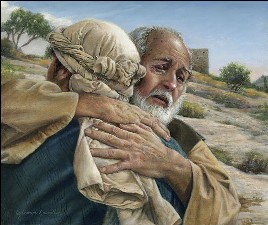
The image posted at the top of this blog post was the inspiration for today’s “extra meditation.”

Any negativity that comes to you today should be returned to the sender.

That is my only response to the negativity I’ve been addressing. There is no one to fight. There is no one to hate. Anger solves nothing and only robs the person giving into anger of his peace. I choose peace.

Today, any negativity I discover in the blogosphere or any other environment I encounter will be promptly returned to the sender. My peace will be preserved. This is also my gift to any friends who have been victims of negativity, hostility, or any other ungodly attitude.

open-your-handAnd in the end, the real victims of negativity are those who nurture it in their own hearts and attempt to send it out to others.

It is said that Shabbos is a small foretaste of the peace of the Messianic Era. The Queen arrives within just a few short hours. In the tiny march of time left until we light the candles, I implore anyone reading these words to set your house in order, and by the time the sun dips below the western horizon, please be ready to invite peace into your home, and into your heart. But of course, you will need to repent and ask God for forgiveness. And if you’ve hurt another human being, before God will forgive, you must repent and ask forgiveness from those you have hurt.

He who conceals a transgression seeks love,
But he who repeats a matter separates intimate friends.

Proverbs 17:9 (NASB)

Good Shabbos.

The Evidence of Love

love-in-lightsThe Alter Rebbe repeated what the Mezritcher Maggid said quoting the Baal Shem Tov: “Love your fellow like yourself” is an interpretation of and commentary on “Love Hashem your G-d.” He who loves his fellow-Jew loves G-d, because the Jew has with in himself a “part of G-d Above.” Therefore, when one loves the Jew – i.e. his inner essence – one loves G-d.

“Today’s Day”
Friday, Menachem Av 12, 5703
Compiled by the Lubavitcher Rebbe; Translated by Yitschak Meir Kagan
Chabad.org

One of the scribes came and heard them arguing, and recognizing that He had answered them well, asked Him, “What commandment is the foremost of all?” Jesus answered, “The foremost is, ‘Hear, O Israel! The Lord our God is one Lord; and you shall love the Lord your God with all your heart, and with all your soul, and with all your mind, and with all your strength.’ The second is this, ‘You shall love your neighbor as yourself.’ There is no other commandment greater than these.”

Mark 12:28-31 (NASB)

I would hardly suggest that the commentary I found in an email I received from Chabad.org was intended to map back to the teachings of Yeshua (Jesus), but the comparison really stands out. Perhaps it is one of those lessons that is equally apparent from a Jewish and Christian point of view, except that Jesus was a Jewish teacher talking to a Jewish scribe within a wholly Jewish context. We non-Jews get that point (or should get it) somewhat after the fact, so it would be wise of us not to do away with the Jewish framework in which the Master was teaching. That’s what gives his lessons their full meaning.

The “Today’s Day” commentary is specifically addressing a Jewish audience as well, which is obvious since it discusses one Jew loving another Jew as being equal to loving God, rather than one human being loving another. The interesting question is, when Jesus was teaching the two greatest commandments, did he mean that loving your neighbor is loving your Jewish neighbor?

That could very well have been the case, if you look at who Jesus was addressing and where this conversation was taking place. I don’t mean that Jesus was unconscious of the larger application of his teaching, but it hadn’t gotten that far yet. He came for the lost sheep of Israel not the lost sheep of planet Earth…well, not at that time. He assigned that job (gathering the lost sheep from the nations) to Paul on the road to Damascus some time later.

As impossible as it sounds, as absurd as it may seem: The mandate of darkness is to become light; the mandate of a busy, messy world is to find oneness.

-Rabbi Tzvi Freeman
“The Mandate of Darkness”
Chabad.org

It’s important to remember that Rabbi Freeman is also addressing a Jewish audience, so don’t go crazy and assume he believes that Jews and Gentiles (particularly Christians) should all be “one.” Except that in Judaism, it is believed that Messiah will unite humanity in peace, not as a homogeneous body of human beings, but as Jews and Gentiles who are all subject to the King, who will come (return) and rule with a rod of iron. We will all be “one” in the sense that we will all be subjects of the King.

Even in the Messianic age though, as I understand it, people will still have the choice as to whether or not to acknowledge and obey the King. On the other hand, it does say that every knee shall bow. But there will still be Israel that is blessed by God and the people of the nations who are blessed through Israel; the people of the nations who are called by His Name.

But what is to be learned from this? Not that those of us who put ourselves under the authority of the King will all be cookie-cutter, carbon copies of one another. What is to be learned is that we will love one another and in fact, all disciples of the Master are commanded to love one another right now.

A new commandment I give to you, that you love one another, even as I have loved you, that you also love one another.

John 13:34 (NASB)

arguing-with-godWithin the context of being disciples of Jesus, both Jewish and non-Jewish followers are commanded to love each other, regardless of our differences. That’s a rather tall order. I once heard a retired Pastor say that he’s seen churches split over what color to paint the walls of the Fellowship Hall. We don’t get along easily, let alone love one another. But if the Baal Shem Tov is correct and loving your fellow human being (I’ll adapt his teaching to be more generalized) is equivalent to our inner essence loving God, then the reverse must be true. Hostility, envy, anger, and hatred toward our “neighbor” must also be the expression of those emotions toward God.

That’s a horrible thought.

I don’t know if it’s true or not but if we were to even pretend it is, our motivation to love should become a great deal more plain. If we say we love God with all our heart and with every fiber of our being (most people tend to exaggerate the extent of their ability to love, but let’s say we are capable of this), then the evidence of our statement is how we treat other people, particularly within the community of faith.

By this all men will know that you are My disciples, if you have love for one another.

John 13:35 (NASB)

See? Love (or lack thereof) of our fellow believer is evidence of whether or not we actually do love God. People will know us as disciples of the Master by how we love each other. God, of course, already knows.

Learning Smallness

smallThe words of the wise are heard with pleasantness.

Ecclesiastes 9:17

The Talmud states that on Friday afternoon, a person must alert his household to prepare the necessities for Shabbos. However, he must do so in a soft voice, so that his words will be obeyed.

Many late Friday afternoons, people feel themselves under pressure while rushing to prepare for Shabbos. If one sees that some things have not yet been done, it is easy to lose composure and scream at other members of the household. The Talmud cautions against doing so and implies that shouted instructions are less likely to be carried out.

A politician who had concluded an address inadvertently left a copy of his speech on the lectern. In the margins were comments indicating manners of delivery, e.g. “gesture,” “clap hands,” “slow and emphatically,” etc. At one point he had written, “Argument awfully weak here. Scream loudly.”

If we have something of substance to say, the message will be adequately conveyed in a soft tone, because the content alone will carry it. Only when our words have little substance do we seek to make an impression by delivering them with many decibels.

Even in situations of great urgency, we have no need to lose our composure. I can attest that when life-threatening emergencies presented themselves in the hospital, greater efficiency and more rapid response ensued when everyone kept a cool head.

The words of Solomon are correct. The wise speak pleasantly, and those who shout may not be wise.

Today I shall…

…keep my voice soft and pleasant at all times, especially when I have something urgent to communicate.

-Rabbi Abraham J. Twerski
“Growing Each Day, Tammuz 4”
Aish.com

That isn’t easy to do. A sudden surge of adrenalin as you see a small child run into traffic after a ball will make just about anyone yell, “Stop!” Of course, under that circumstance, a raised voice is perfectly understandable and justified, but most of the time when we raise our voices or otherwise try to push our weight around, it’s not.

Although we don’t generally have audible “voices” in the blogosphere, nevertheless, we tend to “yell” at each other. As Rabbi Twerski taught in the above-quoted paragraphs, human beings tend to yell the loudest when our positions are the weakest. We tend to attack others when we feel insecure about ourselves.

What should we do instead?

The Alter Rebbe writes in his Siddur: It is proper to say before prayer, I hereby take upon myself to fulfill the mitzva – “Love your fellowman as yourself.” This means that the precept of ahavat yisrael is the entry-gate through which man can pass to stand before G-d to daven. By merit of that love the worshipper’s prayer is accepted.

“Today’s Day”
Monday, Tammuz 2, 5703
Compiled by the Lubavitcher Rebbe; Translated by Yitschak Meir Kagan
Chabad.org

Sounds sort of like this:

He said to him, “‘You shall love the Lord your God with all your heart, and with all your soul, and with all your mind.’ This is the greatest and first commandment. And a second is like it: ‘You shall love your neighbor as yourself.’ On these two commandments hang all the law and the prophets.”

Matthew 22:37-40 (NRSV)

forgive-nudnikI’ve wasted a certain amount of time being unkind lately. I’d like to say that I’ll never make that mistake again but I probably will. It’s a mistake because what I say won’t change people unless they want to change. It’s a mistake because what I’ve said does nothing to make me a better person. It’s a mistake because what I’ve said has distanced me from people I truly love.

I struggle between leaving the others who are sometimes abrasive to walk their path and the desire to inject a word of justice into unkind conversations.

But it never works out well for me or for anyone and it is not a path to God.

What is?

Nothingness is the medium through which all energy moves, from above to below and from below to above.

Below, in the human heart, a sense of nothingness that transcends ego. Above, a Nothingness that transcends all boundaries and planes.

The nothingness below fuses with the Nothingness above, locking heaven and earth in an intimate embrace.

That is why G‑d is found amongst the truly humble.

-Rabbi Tzvi Freeman
“Nothingness”
Based on letters and talks of the Rebbe, Rabbi M. M. Schneerson
Chabad.org

Moses was considered the most humble man on earth (Numbers 12:3) and yet Israel considers him their greatest prophet. Most of the “loud voices” on the Internet today (including mine) aren’t particularly concerned with humility and in fact, humility frightens them because they (we, I) consider it equivalent to being “nothing.” However as we’ve seen, nothingness is a desirable trait. So is being small, as Rabbi Freeman also teaches:

“Rebbe!” the man cried. “Nobody gives me respect! Everybody steps all over me and my opinions!”

—“And who told you to fill the entire space with yourself, so that wherever anyone steps, they step on you?”

hero-largeI think part of my desire to inject justice into other online realms is related to the sense of smallness. I experience being stepped on or seeing others step on those who I care about and I become indignant, like the person who cried out, “Rebbe! Nobody gives me respect!” I need to relearn humility as a desirable trait and as a result, learn to stop being concerned with the opinions and petty slights of others.

I mean, it’s not like I’m unaware of the humility of our Fathers or of my own experiences learning humility. If I focus on those areas where I need to improve and strive to encounter God with more dedication, I won’t have time to be concerned about the thoughts and opinions of others who seem to continually feel offended. I also may avoid offending those people I consider friends who may be hurt by what I say and do.

I suppose that at some point, maybe even fairly soon, I’ll encounter someone saying something that I object to and the temptation to respond will overwhelm my good sense. I pray that God will guard me from such a time and such individuals and most of all, guard me from my own foolishness in thinking that I must engage such people or express my own small opinion. The only thing I must do is to diminish in the Presence of God, and allow Him to overflow into the spaces I create in me.

Make yourself small and you will be great.

Know you are nothing and you will be infinite.

At the very least, don’t make such a big deal of yourself
and you will be all that much closer to the truth.

-Rabbi Tzvi Freeman
“Small and Infinite”
Based on letters and talks of the Rebbe, Rabbi M. M. Schneerson
Chabad.org

May God turn my heart and mind to Him alone and accustom me to seek the company of righteous people who are uplifting and inspiring. By being the lowest, sitting at the bottom of the abyss, I can only pray that He will one day raise me up to see light again.


Are People Evil or Just Different?

shabbat-queen-elena-kotliarkerLet your home be open to all.

-Ethics of the Fathers 1:5

I have traveled to many communities to lecture on various subjects. I have also attended other guest speakers’ lectures. Invariably, after the lecture, the speaker is invited to a home where a small group of people gather for an informal chat, while hors d’oeuvres are served.

It has been very distressing to me that even when my audience appears to receive my talk well, no one may invite me to a post-lecture gathering. Why? I keep kosher, many of these people do not, and they find it awkward that the guest would not partake of their refreshments.

This baffles me. If my lecture was not well received, I could understand people’s reluctance to invite me. But when the response is virtually ecstatic, and I receive immediate requests for repeat performances, why, then, am I shunned? If I were a person of any other faith or nationality, I would be welcomed in everyone’s home. Why are the doors of my own people closed to me? The abundance of kosher foods available no longer makes keeping kosher an inconvenience.

Observant Jews adhere to kosher laws as a matter of conviction. Even if someone is not of that mindset, he or she can at least maintain a home where every Jew can be welcomed (or at least have a cup of coffee!).

So many doors are closed to Jews. We should not be closing our doors to our own.

Today I shall…

…try and make my home a place where every Jew can feel welcome and comfortable.

-Rabbi Abraham J. Twerski
“Growing Each Day, Tammuz 5”
Aish.com

I know a lot of you Christians reading this may be asking what’s so special about the Jewish people that we should go to extra lengths to accommodate them. Why would Rabbi Twerski specify that he should make his home feel welcome and comfortable for just Jews and that all Jews should do the same for other Jews? Is it only a “kosher food” thing? Why shouldn’t we Gentile Christians be given extra consideration? After all, what are we, chopped liver?

No, it’s not that at all. But if we expand on the thought begun by Rabbi Twerski and acknowledge that the Jewish people were specifically chosen by God (and the birth, death, and resurrection of Jesus Christ didn’t “unchoose” them), and we know that they have been especially targeted for persecution and even destruction, even to this present day and even among the body of believers, then we must realize that as disciples of the Jewish Messiah and worshipers of the God of Israel, we have a special duty to show love to those whom God loves.

Thus says the Lord, who gives the sun for light by day and the fixed order of the moon and the stars for light by night, who stirs up the sea so that its waves roar—the Lord of hosts is his name: If this fixed order were ever to cease from my presence, says the Lord, then also the offspring of Israel would cease to be a nation before me forever.

Jeremiah 31:35-36 (NRSV)

As part of his blog post for today, Derek Leman discusses the interdependency between the Jewish people and the nations, and the nations as particularly represented by Gentile believers: Christians. At least one of my reviews of the Rudolph and Willitts book Introduction to Messianic Judaism (I gave my Pastor a copy but with his brutal reading and studying schedule along with his Pastoral duties, he won’t be able to crack it open until the latter part of July), also addressed this mutual dependence and interlinking relationship between believing Jews and Gentiles.

We really can’t do without each other and yet, the divisiveness between some believing Jews and Gentiles, at least on the web, exists in sharp contrast to this principle, more’s the pity.

how-it-feels-to-disagreeI was encouraged by one non-Jewish Hebrew Roots supporter when he said (amid a sea of negative comments), “That being said, I agree with your sentiments re: not vilifying each other…We should be in the business of building one another up, not tearing one another down.

I agree, too.

It stands to reason that as human beings, we are going to disagree with each other on a good many things. As religious human beings, we are going to disagree about religion. Persecutions, pogroms, and inquisitions have all been justified in the name of God. Wars have been fought and many people have died over religious differences. Today, the weapons of choice, at least in the western nations, are not bombs and bullets, but words and blogging. We don’t just disagree, we attack, we “demonize,” we declare our opponents not only wrong but actually “evil” and that their teachings are “sending people to hell.”

Is that really what we’re supposed to be up to as disciples of the Master? What ever happened to the “unified” (as opposed to “homogenized”) body of Christ? If the so-called body of Christ were actually a human body, it would be dismembered into hundreds of individual pieces and lying dead in a large pool of blood; a scene that could only appeal to the Jeffrey Dahmer’s of the world (no, I’m not accusing anyone of being like Dahmer, I just said that for effect).

The comment I quoted above about “not vilifying each other” is an exceptionally rare one on the web. It has been said that the Internet was made for (adult material), but it seems more realistic to say that it was made to encourage rudeness and divisiveness. Most people “hide” either behind some pseudonym or, if the blog or discussion board allows it, behind the mask of “Anonymous.” From that perch, any one can say anything that occurs to them in the emotional “heat of battle” with no apparent consequences. Almost no one would say the same things or at least not in the same way if they were having a face-to-face conversation.

Accept truth from whomever speaks it.

-Maimonides, Kiddush HaChodesh 17:24

Some extremely choosy people will accept guidance or teaching only from an acknowledged authority, because they consider accepting anything from anyone of lesser stature a demeaning affront to their ego.

Among my physician colleagues, I have observed this phenomenon when a patient requests consultation. Those doctors who have self-esteem and know that they are competent have no problem accepting consultation, but those who are less self-confident may interpret the request for consultation as an insinuation that they are inadequate. They may be insulted by this request, and if they do comply with it, they will accept as a consultant only the chief of the department at a university medical school or some other renowned personage. Any other consultant constitutes a threat to their ego, an admission that “he may know more than I do.”

Physicians are not the only guilty party; professionals and artisans of all types can also show a lack of self-confidence by displaying this intellectual snobbery.

The Talmud states that truly wise people can learn from everyone, even from people who may be far beneath them. Limiting ourselves to learning only from outstanding experts is not only vain, but it also severely restricts our education. Humility is essential for learning, and we should accept the truth because it is the truth, regardless of who speaks it.

Today I shall…

…try to learn from everyone, even from someone whom I may consider inferior to me in knowledge.

-Rabbi Abraham J. Twerski
“Growing Each Day, Tammuz 7”
Aish.com

Let’s change “consider inferior to me in knowledge” to “different from me,” or “someone who disagrees with me,” or “someone I don’t like.”

Agreeing with a statement made by someone you don’t like is probably one of the most difficult things for a person to do. Imagine you are against another person because of their religious, political, or moral beliefs. You disagree with each other on almost everything. Then the person says something that you can’t disagree with because it is also one of the principles you choose to live by. Imagine they said something like, “I agree with your sentiments re: not vilifying each other…We should be in the business of building one another up, not tearing one another down.

agree-or-disagreeWhat would you do? What would you say? Would you…could you say anything?

If you agree with them, you have to admit the two of you have something in common. If you agree, then you are saying there is at least one point on which the two of you can stand together, a platform that could potentially be used to construct a dialog and to find other points of agreement. You might even have to admit you could learn to cooperate on certain projects to accomplish goals you both believe are worthy.

What a shock. Could you do it?

Imagine you have either publicly or in your thoughts, vilified someone. You can’t stand them. You think they’ve done you wrong. You think their religious teachings are false, dangerous, heretical. You believe what they say “sends people to hell.”

You’ve worked up quite a justified dislike if not hate for that person. And then they go and ruin it all by saying something you completely agree with…a truth that’s impossible for you to deny (at least unless you are willing to go back on stuff you’ve said in the past).

It is possible to disagree with someone, even strenuously, and not personalize the conflict (I know…that’s probably a radical idea to some folks). I won’t name names but I recently publicly disagreed with someone, a leader within his own organization. Although I acknowledged that this person has many fine qualities, I expressed concern over an area of behavior I thought could be improved, relative to everything I’ve said so far in this blog post.

Sadly, that was interpreted as a personal attack by several people including an employee of the person I was mentioning, resulting in a list being posted of this person’s many fine recent activities “proving” that he was without fault and that I was wrong to criticize that individual about anything whatsoever.

This is the sort of discussion that is “crazy making.” A person can be a good person and still be vulnerable to human faults, frailties, and temptations. I’d like to think I’m a good person but I know for a fact that I make mistakes (hopefully writing this blog post isn’t one of them) and have faults that I continue to address (being married is an enormous help in this area since spouses are just made to point out how we should improve ourselves).

We really need to be able to acknowledge others we disagree with when they do good, and even if we find it necessary to disagree from time to time, said-disagreement doesn’t mean the other person if evil, rotten, criminal, or any other bad thing. They may even say the truth about stuff sometimes and we may even agree with them sometimes.

There are days when I think there are very few voices of reason and sanity on the web. I know that most of us are trying to be good people and to serve God to the best of our abilities. If we could acknowledge that quality about each other, maybe we’d be heading in the right direction and finally, finally starting to obey our Master:

I give you a new commandment, that you love one another. Just as I have loved you, you also should love one another. By this everyone will know that you are my disciples, if you have love for one another.”

John 34-35 (NRSV)

I promise that by Monday, I’ll feel better and that will be reflected in my blogging but in the meantime, I just want to take this opportunity to encourage you, me, and everyone else who puts their thoughts and feelings out into the public realm to shape up, start reading our Bibles more, and start realizing what God is actually trying to tell us. Hint: The Bible doesn’t say, “be more snarky.”

Acting for the Messiah

acts_isaac_maryThe Torah of Moses and the instructions of our Master Yeshua instruct us to open our hands to the poor and not hold back from providing for the needy. As disciples of the Master, it is our duty to fulfill these obligations to the best of our ability and to meet the need where it is greatest. Tororo, Uganda, like many other locations around the world, is subject to harsh poverty, low quality of life, and often a dangerous environment to live in, especially for the young.

-from the A.C.T.S. for Messiah website.

I know I said I wasn’t going to discuss the First Fruits of Zion Shavuot Conference anymore, but there is one important aspect I forgot to mention. During the conference, there were two meals not covered by the conference registration. They were fundraisers for a missionary effort called A.C.T.S. for Messiah, which according to their About page:

…is a non-profit organization dedicated to helping the orphaned, widows, poor and needy in Africa. This Messianic Jewish mission is based in the East African nation of Uganda where Emily Dwyer brings the Gospel of Yeshua to remote villages, teaches discipleship, feeds the hungry and cares for a group of orphaned children. Our ministry is based in the village of Tororo, Uganda.

One thing I know about the Christian church is that they’re very good at sending compassionate missions outside of their own walls, to destinations ranging from different cities in the U.S., to the towns, villages and refuge camps where ever they are found across far-flung corners of the Earth. Messianic Judaism and Hebrew Roots, not so much. Traditionally, Messianic Judaism and Hebrew Roots have focused their attention and resources on establishing their movements and the primacy of the Torah. But Messianic Judaism, thanks in part to the aforementioned Shavuot Conference, First Fruits of Zion (FFOZ) as an educational ministry, and other Messianic organizations, that viewpoint is becoming more balanced, resting upon (if I can “borrow” from the conference again) Torah, the Good News of Messiah, and the Holy Spirit.

I first encountered A.C.T.S. (the acronym means “Action, Compassion, Teaching and Service”) during last year’s conference. Fortunately this year, they accepted credit cards as well as cash, so I didn’t have to depend on the kindness of strangers (I don’t like traveling with cash) when I wanted to participate.

I’m incredibly pleased to see Messianic Judaism embrace this long-established function of the church in extending itself to uphold this principle of Torah and ancient Judaism. I think it means the movement is maturing beyond its “start-up” stage and is becoming a more holistically functioning expression of the Messiah’s love in the world.

And while you may think that such compassion is primarily Christian/Messianic, I just want to remind you that modern Judaism is an abundant source of love for others.

Dr. Rick Hodes concluded his May 19, 2013 commencement address at Brandeis University this way (the link above leads to the entire content of the article which includes many examples of Jewish compassion to the disadvantaged, the sick, and the dying):

You now start a lifelong link with a great name – Brandeis. What can we learn from Louis Brandeis? He was described as “the disturbing element in any gentleman’s club,” he owned a canoe, not a yacht, he angered clients by trying to be fair to both sides; the judge who succeeded him, called him “a militant crusader for social justice… dangerous because he was incorruptible.” Live up to his legacy.

Spread kindness. You are here because a lot of people helped you along the way. Maybe it was your 10th-grade math teacher who gave you a second chance, maybe it was someone who inspired you in a summer job.

This week, buy beautiful cards and send out four or five, to people who’ve helped you. Let them know you’ve just graduated from Brandeis and they were important to you. They’re going to feel great, and they’ll do it again for others.

Remember this: Run to do good. Create a momentum in the right direction. Get your hands dirty. Wear out your shoes. Don’t try to get too comfortable, please!

Now I imagine the start of a horse race and the bell rings. But you don’t need to race against each other. Whatever horse you choose, and whatever path you follow, I wish you great success and great happiness.

I wish you a lot more than luck, and may God bless you all.

syrian-refugeesThe Pastor of my church was raised by missionary parents and he became a missionary himself. The church I attend aggressively supports multiple missionary efforts around the globe. Many people who attend the church volunteer their time to travel to other countries to pray, encourage, support, build, teach, and do whatever else it takes to feed the hungry, heal the sick and injured, and show the love of Jesus Christ to whoever they may encounter.

A video news story was shown at the beginning of last Sunday’s worship service at my church (found online at CBN.com). It was a Skype interview of a missionary in Syria whose group is providing shelter, food, and support to anyone in need, Christian, Muslim, or anyone else. My words fail dismally to describe what this almost four-minute long video illustrates (I’ve posted the video from YouTube at the bottom of this blog post). The devastation of life is just ghastly, but one courageous group of Christians work to help just because God so loved the world, not just the Christian world, not just the white world, not just the American world, but every man, woman, and child who were created in the image of God.

In other words, everyone.

Part of why I’m writing this is to show that Messianic Judaism is indeed following the will of the Master and the teachings of the Torah, as is much of the traditional Christian church. Another part of why I’m writing this is to ask you to care. Yes, some of you really do care. Some of you give generously, work endlessly, pray fervently for those in need. But more of you…of us need to do the same. Love and worship is more than just showing up to the church on time for Sunday services and going to Sunday school afterwards, strolling through the Bible while drinking coffee and munching on muffins.

Love and caring means giving of whatever you have to give and sharing whatever God has given you to share.

Oh people, look around you
The signs are everywhere
You’ve left it for somebody other than you
To be the one to care
You’re lost inside your houses
There’s no time to find you now
Your walls are burning and your towers are turning
I’m going to leave you here and try to get down to the sea somehow

-Jackson Browne
Rock Me On The Water (1972)

Feed the hungry, take care of the widow and orphan, provide medical care for the sick, make a difference.

Act now.

111 days.

Bamidbar: Desperately Loving a Prostitute

hosea-and-gomerOn the face of it, the connections between the sedra and the haftarah of Bamidbar are slender. The first has to do with demography. Bamidbar begins with a census of the people. The haftarah begins with Hosea’s vision of a time when “the number of the children of Israel will be like the sand on the seashore, which cannot be measured or numbered.” There was a time when the Israelites could be counted; the day will come when they will be countless. That is one contrast between the future and the past.

-Lord Rabbi Jonathan Sacks
Chief Rabbi of Great Britain and the British Commonwealth
“Love as Law, Law as Love”
Commentary on Torah Portion Bamidbar
Chabad.org

It’s not often that I write about both the Torah and Haftarah portions of a weekly Torah reading, but in trying to decide on my sources, both seemed to tell the same story: the story of God’s love. I know most Christians read the beginning of the Book of Numbers and mentally shut down the instant the census begins, but this is why the Torah is not just any other book. This is why the Bible is to be discovered and explored like a lost continent, like a prehistoric forest, like the ruins of the grand halls of the antediluvian Kings.

Because the words on the surface are deceptive and only the superficial person sees merely black text on white paper.

So Moses and Aaron took those men, who were designated by name, and on the first day of the second month they convoked the whole community, who were registered by the clans of their ancestral houses — the names of those aged twenty years and over being listed head by head.

Numbers 1:17-18 (JPS Tanakh)

When the census was taken in the desert, families were recorded by the names of their fathers. Now that’s unfair! Who insisted on having these children in Egypt over their husbands’ protests? Who defied Pharaoh’s decree and risked their lives to carry, give birth to and nurse these children? Now that the children are to be counted, the mothers are no longer noteworthy? (See Rashi’s commentary on Exodus 38:8)

In truth, no one needs a census to identify his mother. Every child knows his mother. Every child knows his mother. She raised him, nursed him, nurtured and loved him. The question is, who is the father? How many children can answer that question with certainty? For that we need a census.

-Rabbi Lazer Gurkow
“The Jewish Father”
Chabad.org

Rabbi Gurkow goes on in his commentary to discuss how each child of a Jewish mother naturally knows his mother and then links this to the census and the importance of the Jewish father. He “smooths out” the apparent dissonance introduced by the “black and white” sense of the census and then says…

Children need both. They need to know that curiosity is normal and that answers are available to those who seek them. But they also need to know that moral standards are not negotiable. The young cannot expect to understand everything. Even adults don’t understand the reason for every moral standard. That is why we call them imperatives, not philosophies. On the deepest level, we don’t embrace morality because we understand its importance, but because we know it to be the right path.

The need for a mother and a father in parenting may contradict certain recent news stories addressing parenting and gender identity that we’ve all been hearing about, but in traditional Jewish (and Biblical) values, both are necessary and required for the proper raising of children. Both a mother and a father are necessary to teach children how men and women uniquely understand the world and in illuminating the different aspects of God. This is one way we learn to love, not just what it’s like to love and be loved by our parents (and others), but how to love and be loved by God.

The Sages tell us these were no ordinary censuses. Each time the Jewish people were counted, it was an expression of G‑d’s love for His people and His concern for every individual…

Yet this great power that the stars possess is not at all obvious. To us on earth, looking with the unaided eye and perhaps not thinking too much about the matter, the stars seem tiny and insignificant. Yet in fact, each star is a powerful and unique force.

So too is the case with each individual. In the context of the big wide world, he or she might feel insignificant. Yet, in truth, within each one of us there is an inner source of tremendous spiritual power, tailored to the unique and essential task we must carry out in the course of our lives.

-Dr. Tali Loewenthal
“Numbers and Stars”
Chabad.org

Under heavenThe Prophet Isaiah said of the stars that God knows each individual one by its name and counts each one as it rises and sets which, for a human being given the vastness of the stars of heaven, would be an insurmountable task. But it is also said that God knows each one of us by our names and “counts” us, and we too are precious to Him. Like a child with many brothers and sisters, it’s easy to fell “lost in the crowd, but this isn’t how God sees us. Though our numbers are legion, still God, our Father, loves each and every one of us with a love that is unique and special to each of His sons and daughters.

Are not two sparrows sold for a penny? And not one of them will fall to the ground apart from [the will of] your Father. But even the hairs of your head are all numbered. Fear not, therefore; you are of more value than many sparrows.

Matthew 10:29-31

But what of the Haftarah Portion for Bamidbar? Rabbi Sacks states quoting Hosea 1:16, 17:

The second goes deeper. The sedra and the book that bears its name are called Bamidbar, “in the wilderness.” The book is about the wilderness years in both a physical and spiritual sense: a time of wandering and internal conflict. Hosea, however, foresees a time when G‑d will bring the people back to the desert and there enact a second honeymoon:

. . . I will lead her into the wilderness
and speak tenderly to her . . .
There she will respond as in the days of her youth,
As in the day she came out of Egypt.

It’s important to understand something here. It’s important to understand the relationship between the Prophet and his wife, Gomer.

The story of Hosea is one of the strangest of that great chain of visionaries we call the prophets. It is the story of a marriage. The prophet married a woman called Gomer. He was deeply in love with her. We can infer this because, of all the prophets, Hosea is the most eloquent and passionate on the subject of love. Gomer, however, proved faithless. She left home, had a series of lovers, was serially unfaithful, and was eventually forced to sell herself into slavery. Yet Hosea, caught between anger and tender longing, found that he could not relinquish his love for her.

The love of Hosea for his wife Gomer, who “whored” herself after many lovers and finally who sold herself into prostitution is like God’s love for Israel, who “whored” herself after many “gods” and was equally faithless to her husband Hashem.

What man could embrace such a wife after this awful betrayal? No one (except God) would have blamed Hosea if he totally abandoned Gomer and pursued a more righteous wife (and how many other women were less righteous?). No one would have held it against him if he, the victim, would have walked away from Gomer and left her to the consequences of her decisions. But if he did so, if Hosea had cast Gomer aside, does that mean God should have done the same to Israel?

Lest you be wise in your own sight, I do not want you to be unaware of this mystery, brothers: a partial hardening has come upon Israel, until the fullness of the Gentiles has come in. And in this way all Israel will be saved, as it is written,

“The Deliverer will come from Zion,
he will banish ungodliness from Jacob”;
“and this will be my covenant with them
when I take away their sins.”

As regards the gospel, they are enemies for your sake. But as regards election, they are beloved for the sake of their forefathers. For the gifts and the calling of God are irrevocable. For just as you were at one time disobedient to God but now have received mercy because of their disobedience, so they too have now been disobedient in order that by the mercy shown to you they also may now receive mercy. For God has consigned all to disobedience, that he may have mercy on all.

Romans 11:25-32 (Isaiah 59:20,21; 27:9 [see Septuagint]; Jer. 31:33,34)

Wayward SonIf we know how to read the Torah and Haftarah properly, they tell us a tale of love that is immense and beyond human comprehension. The Torah is the Law of Love, not condemnation. We shouldn’t forget the timing either. Rabbi Sacks points out that Hosea is the portion from the Prophets always read on the Shabbat directly preceding Shavuot, which is the festival celebrating the giving of the Torah at Sinai.

The fact that tradition chose this of all prophetic passages tells us something deeply moving about how the Jewish people understood this festival, and about the Torah itself as the living connection between a people and G‑d.

I wrote yesterday about the relationship between love and the Bible and it seems like there is no escaping that theme as Shabbat approaches. We see that in spite of all rationality and reason, God loves Israel, and that such love is inescapably linked to Jewish love of God and the Torah. What is it then that God has done by giving us the Bible? What is the message beyond the simple words on the page? How does the very existence of the Bible mean Good News for the Jews, that the love of God can never be lost?

And what is the Good News for the Gentiles?

For God so loved the world, that He gave His only [unique] begotten Son, that whoever believes in Him shall not perish, but have eternal life.

John 3:16 (NASB)

I know that last verse is terribly over-quoted but how else am I to say what needs to be said?

Israel will not be lost! The Jewish people will never be abandoned. To believe otherwise is to completely misunderstand the Scriptures. And if we from among the nations who are called by His Name cling to Messiah and to the promise of his life and resurrection, then by the grace of God, neither will we.

Good Shabbos.

138 days.