Tag Archives: Messiah

Pinchas: Is It Too Much To Ask For Both?

The Torah portion of Pinchas begins with G-d saying to Moshe: (Bamidbar 25:11-12.) “Pinchas… has turned My wrath away from the Jewish people by displaying anger among them on My behalf.”

Pinchas’ conduct involved self-sacrifice, for his deed aroused the wrath of the tribe of Shimon, whose members sought to kill him. (See Sifri and Tanchuma, end of Parshas Balak; Sanhedrin 82b.)

After the Torah concludes the tale of Pinchas, it speaks about the division of Eretz Yisrael and the appointment of Yehoshua to lead the Jewish people into the Promised Land. The portion concludes with a section on offerings, a number of which could be brought only when the Jews were in Eretz Yisrael. (See Menachos 45b; Zevachim 111a.)

Since all the above is part of the portion titled Pinchas, it follows that the entrance to Eretz Yisrael and all related matters are somehow connected to the spiritual service of Pinchas.

What is the connection?

Our Rabbis tell us (Nedarim 22b. See also Shmos Rabbah, beginning of ch. 32.) that, were it not for the iniquities of the Jews, their first entry into Eretz Yisrael would have triggered the Redemption. Although this did not actually take place, in some respects the first entry resembled the future Redemption.

This similarity helps us understand the relationship between Pinchas and the entry into Eretz Yisrael, for our Sages state: (Targum Yonasan, Va’eira 6:18; Zohar, Vol. II, p. 190a; Pirkei d’Rebbe Eliezer, ch. 47; Yalkut Shimoni, beginning of Pinchas.) “Pinchas is Eliyahu,” and Eliyahu is the one who will bring the tidings of Redemption.

-Rabbi Sholom B. Wineberg
“Pinchas”
The Chassidic Dimension
Commentary on Torah Portion Pinchas
Based on the teachings of the Lubavitcher Rebbe
Rabbi Menachem M. Schneerson
Chabad.org

You can click the link I provided above to read the full “Chassidic Dimension” commentary (and remember, this is midrash, not concrete fact, so I make no claim as to how or if it can be applied to a specific understanding of the Biblical text), but what Rabbi Wineberg wrote reminded me of something else I recently read.

“If both Judaism and Christianity are correct in their definitions of redemption, then Jesus must do both what Judaism is expecting the Messiah to do, and what Christians expect him to do. This means that Jesus will do more than come back and save those who believe in him from sin and death. He will also re-gather his people Israel from exile and restore them to their land in a state of blessing and peace (Isaiah 35, 48:12-22, 52:1-12; Jeremiah 31).”

-Boaz Michael

I suspect that Boaz is sending out some “teasers” from First Fruits of Zion’s next project and if so, then it’s something I’ve been looking forward to since my last face-to-face conversation with him.

Both Rabbi Wineberg and Boaz talk about Israel’s redemption, but what does that mean? What is redemption within the Jewish religious context? We have a pretty good idea from Boaz’s statement above, but here’s a little bit more.

The mashiach will bring about the political and spiritual redemption of the Jewish people by bringing us back to Israel and restoring Jerusalem (Isaiah 11:11-12; Jeremiah 23:8; 30:3; Hosea 3:4-5). He will establish a government in Israel that will be the center of all world government, both for Jews and gentiles (Isaiah 2:2-4; 11:10; 42:1). He will rebuild the Temple and re-establish its worship (Jeremiah 33:18). He will restore the religious court system of Israel and establish Jewish law as the law of the land (Jeremiah 33:15).

Judaism 101

Wikipedia has a more condensed explanation:

In Judaism, (Hebrew ge’ulah), redemption refers to God redeeming the people of Israel from their various exiles. This includes the final redemption from the present exile. In Hasidic philosophy parallels are drawn between the redemption from exile and the personal redemption achieved when a person refines his character traits.

I’ll assume that most of my audience has a basic working knowledge of what Christians mean when they refer to redemption, but once again, I’ll invoke Wikipedia in order to offer a brief definition:

In Christian theology redemption is an element of salvation that broadly means the deliverance from sin. Leon Morris says that “Paul uses the concept of redemption primarily to speak of the saving significance of the death of Christ.” The English word redemption means ‘repurchase’ or ‘buy back’, and in the Old Testament referred to the ransom of slaves (Exodus 21:8). In the New Testament the redemption word group is used to refer both to deliverance from sin and freedom from captivity. Theologically, redemption is a metaphor for what is achieved through the Atonement. Therefore there is a metaphorical sense in which the death of Jesus pays the price of a ransom, releasing Christians from bondage to sin and death. Most evangelical theologians and Protestant denominations, however, reject the idea of Origen who held that redemption means that in the atonement God paid Satan with the death of Jesus.

Rabbi Wineberg is obviously addressing the Jewish and specifically the Chassidic viewpoint, while Boaz is saying that the Messiah will bring about both “redemptions” since they both are presupposed by the Biblical text. But how does this work or indeed, does it work at all?

One person commented critically about this on Facebook:

Sounds like Messianic theology to me please both groups so that every ome [sic] get to go! Makings all that Israel went though worth NOTHING. But this will please the people so tell them what makes them happy.

This isn’t the first time Boaz and FFOZ have been accused of playing both sides against the middle, but is that what they’re doing here? It would be impossible to tell based on a single quote, so let’s try another one from Boaz.

“I have to confess, I don’t really get it. If you believe in Jesus, you believe he is the King. The Lord. The Boss. Your Boss. There is no other option. It’s an integral part of his identity. The fact that some people have lost sight of that fact is evidence, to me, of how far we have come from a really Biblical idea of who Jesus is. We have forgotten that there is no such thing as a Jesus who is not our King, a Jesus we don’t have to obey.”

That one is also bound to draw some fire since the Messianic movement in all of its flavors has been rather “Torah-centric,” often at the expense of the Jewish Messiah. A lot of Christians who have been dissatisfied with the church have abandoned it in favor of the Torah and probably without meaning to, have fused the Torah and Jesus (Yeshua) into a single unit, as if they were interchangeable components; cosmic spark plugs, so to speak. Torah equals Messiah and Messiah equals Torah and pretty soon we forget that the Messiah was and is the living example of what a Torah lifestyle looks like (at least in the late second Temple period) and that he also has a life of his own, and a very critical life at that.

I actually started talking about this topic right after I returned home from the FFOZ 2012 Shavuot Conference. Blog posts “Redeeming the Heart of Israel,” Part 1 and Part 2 discuss the interactivity between Christianity and Judaism in bringing about national Jewish redemption.

Initially, I was very keen on this concept, since the mission of the church as presented in this paradigm, is to bring about Israel’s redemption by encouraging Jewish Torah observance, and this is something that is very dear to me on a personal level. But then, as I thought about it, I wondered where we could look in the Bible to support this viewpoint. Christianity is (and in this case, rightly so) a tad suspicious of Jewish religious pronouncements that seem to be disconnected from the Bible or which have a source largely based on Rabbinic midrash. If you can’t point to where in the Bible we can find Israel’s redemption linked to Torah obedience and to personal salvation all as the work of the Messiah, how real can it be? Can we successfully bridge Jewish and Christian conceptualizations of redemption so that we can envision all of this as what the Jewish King will accomplish upon his return?

I find this to be a compelling direction to investigate, but I suspect FFOZ has its work cut out for it, not just in performing the necessary scholarly research and constructing a book that is accessible to a mass audience made up of a broad spectrum of Jewish and Christian theologies, but in convincing that audience that the powers of the Messiah are indeed sufficiently vast as to encompass such a redemption.

I just finished a conversation on Facebook unrelated to this one, where the fellow and I were discussing the difficulties involved in truly seeing a situation from another person’s paradigm. We all almost exclusively tend to see the world from our own limited perspective. If you’re an evangelical Christian for example, your worldview is colored by that lived experience. The same is true if you are an Orthodox Jew, a Sunni Muslim, a Catholic priest, a liberal, progressive Democrat, or just about anybody else.

Although we like to believe so, Messianic Judaism doesn’t successfully meld Judaism and Christianity. Both are extremely different perspectives as we understand them currently and also historically. So saying something like, “If both Judaism and Christianity are correct in their definitions of redemption, then Jesus must do both what Judaism is expecting the Messiah to do, and what Christians expect him to do,” seems as if you are talking out of both sides of your mouth. Maybe both things can be true, but how can you see and understand the Messiah from the perspectives of both Christian and Jewish redemptive imperatives simultaneously?

It isn’t easy.

Rabbi Wineberg states:

The novel aspect of the future Redemption lies in the fact that at that time, G-dliness will be fully revealed. (Tanya ch. 37.) Nowadays, G-dliness is clothed in the material world, and manifest only in a contracted manner. In times to come, however, a greater level of Divine illumination will be found within this world — a level not subject to contraction or limitation.

On the Facebook thread discussing this topic, Pastor Bill Beyer replied:

Theology is not about making people happy. It’s about finding the truth. To say that Yeshua can only do one OR the other is limiting the power of the Messiah. Truth be told, scripture says he’s going to do even more than these two things.

The only limiting factor imposed on the Messiah is us. We place constraints on his power and what he will accomplish based on our viewpoints, doctrines, dogmas, and desires. Christians have been told that redemption means only personal redemption for believers. Jews have been told that redemption means only the national redemption of Israel and the ingathering of the exiles. To quote Tony Stark (played by Robert Downey, Jr.) from the first Iron Man (2008) film, “I say, is it too much to ask for both?”

I suspect the answer is right around the corner.

Good Shabbos.
Shlach: The Miraculous Messenger

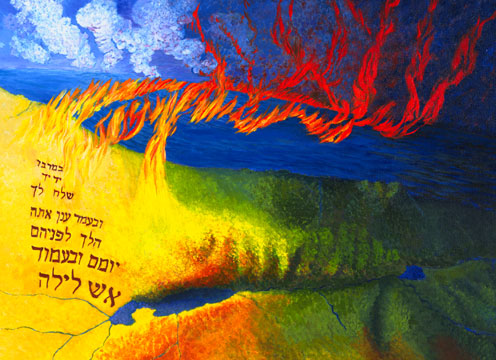
The Torah portion of Shlach relates how the men sent to spy out Eretz Yisrael returned and reported that the country was unconquerable. The Jewish people, they said, would be unable to enter the land, since “The inhabitants of the land are mighty.” (Bamidbar 13:28.)

Furthermore, say our Sages, (Sotah 35a.) the spies went so far as to say that even G-d would not be able to wrest the land from its inhabitants. Their words caused great consternation among the Jews, who feared that they would be unable to enter Eretz Yisrael.

How was it possible for the spies to mislead the Jewish people and convince them that even G-d could not help them, when the Jews themselves had constantly witnessed the miracles performed on their behalf, e.g., G-d provided their daily food and drink in a miraculous manner — manna from heaven and water from Miriam’s well.

Commentary on Torah Portion Shlach
from “The Chassidic Dimension” series
Based on Likkutei Sichos Vol. XVIII, pp. 171-174
and the teachings of the Lubavitcher Rebbe
Rabbi Menachem M. Schneerson
Chabad.org

Like the logic applied in our initial conundrum, the spies argued that after God created the laws of nature, He ruled that even He Himself would not be able to change those laws. God bound His own hands, as it were, by means of the laws that He Himself instituted. Until now, God’s leadership in the wilderness had been one of supernatural miracles that defied the laws of nature again and again. It was clear though that entering thelandofIsrael, for all its holiness, meant entering the confines of nature and living by its laws. This was why the ten spies thought that the Jewish people could not overcome the giants who lived in the land. They believed that God had indeed created a rock that could not be lifted. Moses himself used this argument in his prayer asking for God’s forgiveness, saying that destroying the Jewish people, God forbid, for their sin, would be proof for the surrounding nations of the erroneous claim that “God lacked the ability to bring this nation to the land which He swore to them…” (Numbers 16:14-15).

Joshua and Caleb, the remaining two spies, also saw that conquering the land was a supernatural task, but they said, “Yes, God can create such a rock that He cannot lift, but He can still decide to pick it up if He wants to.” They realized that on entering theHoly Land, God could paradoxically empower the Jewish people themselves with supernatural powers and this would become their very nature.

-Rabbi Yitzchak Ginsburgh
“The Rock that God Can Carry”
Commentary on Torah Portion Shlach
Wonders from Your Torah

I hadn’t heard this particular perspective on the “sin of the ten spies” before and that they believed that there was “a rock that God Himself couldn’t lift,” so to speak. I did however, realize that anyone who is “sent out” for a particular purpose is called “shlach,” including us.

I know it doesn’t sound like these two things are connected, but I can explain.

Go therefore and make disciples of all nations, baptizing them in the name of the Father and of the Son and of the Holy Spirit, teaching them to observe all that I have commanded you. And behold, I am with you always, to the end of the age.” –Matthew 28:19-20 (ESV)

WalkingThat command was originally given by the Master to the “eleven disciples (who) went to Galilee, to the mountain to which Jesus had directed them.” (v16) However, it has been inherited by every disciple who is called by his name, Jew and Gentile alike, and we have carried that mission upon us for nearly 2,000 years.

How are we doing so far?

Actually, not that bad. But we could be better, especially in the present age. It’s not so much that the Good News of Jesus Christ isn’t being spread to the four corners of the earth and that the vast, vast majority of the human race hasn’t heard of God, the Bible, and Jesus. They certainly have heard the Good News, however many of those people; perhaps most of those people, don’t see it as “good news” at all. Many people experience Christianity as “bad news.” They see us as superstitious, as old fashioned, as out of touch, as bigots, sexist, racist, anti-gay, anti-political correctness, anti-progressive.

Some of that is true, whether we intend it to be or not. Where have we gone wrong?

In the days of Moses, the ten spies gave an “evil report,” not because they were dumb or evil or cowards, but because they believed that the supernatural power of God would not go with them when they entered the land of Canaan. They believed that without the power of God, in terms of mere human strength, they would have no chance at defeating the mighty giants of the land. They felt abandoned and afraid.

Every time I read the words of “the great commission” as recorded in Matthew 28:19-20, I always puzzled over Christ’s final statement:

“And behold, I am with you always, to the end of the age.”

Now I realize what he was trying to say. He was trying to say that his disciples would not be alone in the enormous mission of taking the word of the Jewish Messiah to the nations of the world. Remember, nothing like that had even been dreamed of before let alone attempted. In a world full of false gods and polytheistic idol worshipers, how would the Word of the One God of Israel and the Messiah King of the Jews be received by the Gentiles? Would they listen to the Gospel message at all, or listen and then merely incorporate God into their panthenon of other gods, worshiping the God of Heaven as if he were just another idol of stone, wood, or bronze?

The Bible didn’t record the reaction of Christ’s “great commission” but it would be another fifteen years or so before any one of them would attempt to respond. Even then, Peter needed the prompting of not only a vision on a rooftop (Acts 10:9-16), but that of a messengers sent by the God-fearing Roman Cornelius with an unusual request. (Acts 10:17-23). The rest of this chapter in Acts tells the tale of God showing just how possible it was to carry the message of the Messiah to the Gentiles and how indeed, many Gentiles were eager to hear it.

Receiving the SpiritAnd in seeing that the Gentiles could receive the Holy Spirit, even as the Jews had already done (Acts 10:44-48), it was confirmed that the supernatural power of the Spirit of Messiah was with them “always, to the end of the age.”

That age hasn’t expired yet and neither has our calling. Not all of us enter what the church calls “the mission field” in a formal sense, but in truth, we are all “missionaries” or “sent ones.” We are shlach in the way we live our lives. Every word we speak and every action we take tells the tale of our Lord and Master, for good or for ill. Every deed of honor and praise glorifies the Name of God, and every mistake and mean-spirited act we commit drags that Name through the mud.

Joshua and Caleb understood that God would enable the Israelites to take the land, not by a series of supernatural miracles, but by making the people of Israel the miracle. We see in the book of Joshua and beyond how true this was. They didn’t have to believe in the miracles. They just needed faith in God. That first generation out of Egypt couldn’t overcome their “slave mentality” and when faced with such challenges, they balked. They didn’t have faith in themselves, let alone a God they felt would cease to provide protection from Heaven (I know, I’m applying midrash here, but I think it fits).

As believers and disciples of the Jewish Messiah, our teacher, our Master, and our King, what have we learned, not only from his lessons but from the lesson of the Shlach among the Israelites? Jesus already said that he would continue to be with us for the amount of time it takes to fulfill the directive to spread the Word of hope. He asks us to have faith. Faith in our Master, faith in the One Holy God of Israel…and faith in ourselves.

We see from the Biblical record that the taking of Canaan and the forging of Israel was no easy task, even though God was with the Children of Jacob. We see from the record of Paul’s letters that even though he was personally comissioned by the Messiah to be the “shlach to the Gentiles,” his task was at times brutally difficult. Our tasks are not easy, either. Living a life of faith and swimming against the tide or a world determined to deny God never is. We are reviled, called foul names, laughed at, ridiculed, and that’s only in the western nations. In other parts of the world, Christians are raped, beaten, tortured, and murdered for the sake of Jesus Christ. Under such terrific pressure, our sin is never in doing our best and failing, but only in failing to try.

“In fact, the spies’ sin, in fact any sin, can be understood using the same principles just applied. Sin is like a rock that by nature cannot be “lifted,” that is forgiven…But we know that even after sin, God remains open to teshuvah (repentance and return to God).”

-Rabbi Yitzchak Ginsburgh

“You do not always succeed, but you always have to try.”

-Gutman Locks
“Tefillin After 72 Years”
Stories of the Holocaust series
Chabad.org

A life of faith and miracles isn’t begun by waiting for God to make the first move. He’s waiting for us. So is everyone else. You can be the answer to someone’s prayer. All you have to do is try.

Good Shabbos.

Mourning for the Great Mountain

There is an interesting, but somewhat misunderstood, halachah. It has to do with not filling one’s mouth with laughter now while we do not have a Beis HaMikdash. In the words of the Orchos Tzaddikim: “One should only feel joyous in that which brings to enhanced service of God. He should never feel joy from that which causes another pain. For example, one who has wheat should not feel happy if there is a famine and he will make a large profit, since this is bad for others. One should also never take joy in another person’s death, even if he was left a legacy and will profit handsomely from this. Regarding such situations, one who shows proper decency and does not feel joy fulfills the mitzvah of ואהבת ’לרעך כמוך. One should accustom his heart to feel joy at his friend’s success. Most especially one should feel great happiness when he see others doing God’s mitzvos, since this is God’s will.

“Nevertheless, one should not fill his mouth with laughter in this world, as we find in Berachos 31. Since the Beis HaMikdash was destroyed, all joy has been mixed with sorrow. We also find in Niddah 23 that Rabbi Yirmiyahu tried to make Rabbi Zeira laugh but did not succeed.

When someone learned that the halachah not to fill one’s mouth with simcha is actually in the Shulchan Aruch, he was shocked and wondered how this could be prohibited.

He decided to ask the Sdei Chemed, zt”l, who was certainly a true scholar and fulfilled in every detail of halachah without compromise. “The halachah not to fill one’s mouth with laughter due to the destruction of the Beis HaMikdash is a middas chassidus. But this should not be confused with mockery. One who mocks is in one of the four groups that will not receive the Shechinah, as we find in Sotah 42!”

Daf Yomi Digest
Stories Off the Daf
“Rejoicing in the Right Way”
Niddah 23

This isn’t going to resonate well with most Christians because Christianity isn’t focused on the Temple as the point of connection between man and God. We focus on the life and spirit of Jesus Christ for that connection and, for most Christians, the Temple is superfluous. For most Christians, the Temple is a cosmic “so what?”

That’s kind of a shame because we may have to try to relate to it at some point, especially if traditional Jewish thought is correct and the Messiah, that is Jesus Christ, actually rebuilds the Temple.

The mashiach will bring about the political and spiritual redemption of the Jewish people by bringing us back to Israel and restoring Jerusalem (Isaiah 11:11-12; Jeremiah 23:8; 30:3; Hosea 3:4-5). He will establish a government in Israel that will be the center of all world government, both for Jews and gentiles (Isaiah 2:2-4; 11:10; 42:1). He will rebuild the Temple and re-establish its worship (Jeremiah 33:18). He will restore the religious court system of Israel and establish Jewish law as the law of the land (Jeremiah 33:15).

Judaism 101

However even if you have a tough time with that perspective, our story off the Daf can tell us a few other things, such as not rejoicing under circumstances when we win but someone else loses. We have a tendency to do that as human beings, but when we lose, when we’re hurt, when we’re afraid, we certainly don’t want others to feel happy about it. Most of the time, when we’re under duress, we don’t want people around us to feel happy about anything. We want them to feel upset, compassionate, and then try to help us.

What if a Christian sees a Jew under duress over the destruction of the Temple? I know it happened almost 2,000 years ago and Christians tend to think the Jews should “get over it” but that’s because we don’t understand the significance of the Temple in Judaism. We want Jews to realize that Jesus Christ is their temple and that it’s going to be all right because Jesus loves them. But most Jews aren’t going to relate to oto ha’ish that way, at least not right now (and I consider it a miracle any time a Jewish person does recognize the Jewish Messiah through the Gentile disguise that we have put on Christ).

I found the following footnotes for Chapter 11 of the Rambam’s The Laws and Basic Principles of the Torah at history.hanover.edu:

The whole of the following passage was deleted from most of the editions published since the Venice edition of 1574.

“If he did not succeed to this degree or he was killed, he surely is not [the redeemer] promised by the Torah. [Rather,] he should be considered as all the other proper and legitimate kings of the Davidic dynasty who died. G-d only caused him to arise in order to test the multitude. As it is written [Daniel 11:35], “Some of the wise men will stumble, to purge, to refine, and to clarify, until the appointed time, for it is yet to come.”

“Jesus of Nazareth who aspired to be the Mashiach and was executed by the court was also spoken of in Daniel’s prophecies [Daniel 11:14], “The renegades among your people shall exalt themselves in an attempt to fulfill the vision, but they shall stumble.”

The rest of the text is equally uncomplimentary toward Christianity, but that’s less to do with Jesus as Messiah and more to do with the subsequent “development” of the Christian/Jewish relationship over the past 20 centuries or so. However the beginning of Chapter 11 also says the following:

In future time, the King Mashiach[1] will arise and renew the Davidic dynasty, restoring it to its initial sovereignty. He will rebuild the [Beis Ha]Mikdash and gather in the dispersed remnant of Israel. Then, in his days, all the statutes will be reinstituted as in former times. We will offer sacrifices and observe the Sabbatical and Jubilee years according to all their particulars set forth in the Torah.

Whoever does not believe in him, or does not await his coming, denies not only [the statements of] the other prophets, but also [those of] the Torah and of Moshe, our teacher, for the Torah attests to his coming, stating: [Devarim 30:3-5]

This is similar to something the Master said 1,200 years earlier:

Do not think that I will accuse you to the Father. There is one who accuses you: Moses, on whom you have set your hope. For if you believed Moses, you would believe me; for he wrote of me. But if you do not believe his writings, how will you believe my words?” –John 5:45-47 (ESV)

Perhaps we Christians shouldn’t rejoice too much, not because we’re mourning the Temple and lament its loss, but because our human lives and failures made it necessary for Christ to suffer and die. True, he was resurrected again, just as the Temple will be remade by him (my opinion), but that doesn’t absolve us of our crimes, nor does it repair our present broken and suffering world. To those Christians who rejoice over Jewish suffering, you are missing the point, not only of the lesson of the Sages but of God’s own teachings. If the Jewish people mourn the Temple, they will also mourn Messiah.

“And I will pour out on the house of David and the inhabitants of Jerusalem a spirit of grace and pleas for mercy, so that, when they look on me, on him whom they have pierced, they shall mourn for him, as one mourns for an only child, and weep bitterly over him, as one weeps over a firstborn. –Zechariah 12:10 (ESV)

While the prophet is most likely speaking directly to Israel, Christ was pierced for us as well, so we should also mourn and not overly rejoice at our Salvation. True, we thank God for our redemption from death and our adoption as sons and daughters of the Most High, but there is still a lot of work to be done and if we are only happy for ourselves, how can we strive to reach out toward others in their suffering?

For I could wish that I myself were accursed and cut off from Christ for the sake of my brothers, my kinsmen according to the flesh. They are Israelites, and to them belong the adoption, the glory, the covenants, the giving of the law, the worship, and the promises. To them belong the patriarchs, and from their race, according to the flesh, is the Christ, who is God over all, blessed forever. Amen. –Romans 9:3-5 (ESV)

As Maimonides said, “Whoever does not believe in him, (the Messiah) or does not await his coming, denies not only [the statements of] the other prophets, but also [those of] the Torah and of Moshe, our teacher, for the Torah attests to his coming.”

Israel awaits his coming but they do not know who he is. We who do know his name must not rejoice that we hold that knowledge and others do not. We must not be bitter that others refuse to accept his name as Messiah. We must live our lives with caring and compassion for everyone, shunning no man whether Jew or Gentile, but welcoming everyone in peace to our Temple and our Great Mountain of God.

But there is another way of understanding it. With the help of verses such as “I will lift up my eyes to the hills – From whence comes my help?” (Psalm 121:1), where the psalmist lifts up his eyes to the “mountains” (as the Hebrew has it), the following explanation is given: “You shall become a plain – this is Messiah Son of David. And why is his name called Great Mountain? Because he is greater than the fathers, as it says, ‘Behold, My Servant shall deal prudently; He shall be exalted and extolled and be very high’ (Isaiah 52:13). He shall be higher than Abraham, more exalted than Jacob and higher than Jacob. … more exalted than Moses … and higher than the angels. This is why it says, ‘Who are you, O great mountain?'” (Midrash Tanchuma W, Toledot 14).

-Tsvi Sadan
“Great Mountain” (har hagadol) pg 58
The Concealed Light: Names of the Messiah in Jewish Sources


The Messiah’s Lament

Someone once asked the Chozeh of Lublin, zt”l, an interesting question about a well-known statement found on today’s daf. “Our sages tell us that a person who says something in the name of the one who originally said it brings redemption to the world. It seem strange that after all these centuries that the Jewish people have learned Talmud—which quotes the original source for every statement—we have not yet been redeemed!”

The rebbe immediately supplied an excellent reply to this question. “We can understand this in light of what I have already said: that there are two types of redemption. Besides a general redemption for the Jewish people through our righteous redeemer, there is also a personal redemption for every Jew. So the redemption alluded to here is not the ultimate redemption at all. It refers to every Jew’s personal needs, both material and spiritual. When a Jew says something in the name of its originator, he affords this type of redemption to the world.”

Rav Shmuel, the student of the renowned Be’er Mayim Chaim, zt”l, gave a similar response. “It is clear from the very words of our sages themselves that this does not refer to bringing Moshiach. Firstly, it says that it brings גאולה , redemption, not the גואל , redeemer. Secondly, our sages learn this from Esther. When Esther revealed the assassination plot of Bigsan and Seresh to Achasverosh, she told him this in the name of Mordechai. Just as there we find that this led to a specific redemption for the Jews and it was not the actual arrival of Moshiach, the same is true at all times. When someone says something in the name of its originator, a Jew somewhere is saved from difficulty!”

Daf Yomi Digest
Stories Off the Daf
“Bringing Redemption to the World”
Shabbos, June 9, 2012
Niddah 19

“O Jerusalem, Jerusalem, the city that kills the prophets and stones those who are sent to it! How often would I have gathered your children together as a hen gathers her brood under her wings, and you were not willing! See, your house is left to you desolate. For I tell you, you will not see me again, until you say, ‘Blessed is he who comes in the name of the Lord.’”Matthew 23:37-39 (ESV)

I’ve written about the connection between Jewish return to the Torah and Israel’s national redemption before, but I still don’t understand it very well. Our “story off the daf” for the previous Shabbat discusses what seems to be a related matter, but while I think it’s interesting and perhaps ultimately important, the ability to fully comprehend what it means against the larger backdrop of Israel, the Messiah, and humanity continues to elude me.

I usually “get in trouble” for two reasons when I opine in this direction. I am usually criticized for “buying into” the various arcane and mystic Jewish writings as if they are fact, and I am accused of applying midrash as if it can be directly attached to the Gospels. While none of this is necessarily true, I do believe it is important to illustrate that general Jewish thought and perspectives on matters such as redemption, the Messiah, and God can be bound by a single though slender thread as we weave our way from ancient to modern times. It’s the thread that’s important because it shows that the destruction of the Second Temple did not disconnect the Jewish people from their faith in or their covenant relationship with God.

What remains mysterious to me though, is how to connect the Jewish vision of Israel’s national redemption and the return of the Messiah back to what we see in the Scriptures. I think there is a clue, albeit a rather faint one, in the Master’s lament over Jerusalem from Matthew 23:37-39. Let’s consider a few things.

The general assumption in Christianity is that the Temple was destroyed and the Jews scattered because they had rejected Jesus as the Messiah. But is that true? Can we find anywhere in either Scripture or Rabbinic commentary that says the Jews will suffer exile for the rejection of the Messiah? If you know where this is found, please point me to it, because I have never seen such a pronouncement in the Bible.

Why do Jews believe the Temple was destroyed and the Jewish nation sent into exile?

Why was the Temple destroyed? One of the reasons given by our Sages was unwarranted hatred. The Jewish people, even during the siege of Jerusalem, remained fractionalized and divided. And on the individual level, there was a lack of concern, love, and respect for each other.

How can this be corrected? By showing unrestrained love. By reaching out to another person – any other person – and showing him care, consideration, and concern. Do a favor for someone else, not because there is a reason to do so, but because you care for him.

“Keeping In Touch: The Three Weeks”
Based on the teachings of the Lubavitcher Rebbe
Rabbi Menachem M. Schneerson
Adapted by Rabbi Eli Touger
Chabad.org

There are probably other traditional reasons but this is the one I encounter most often. Notice that a solution to the exile is also offered in showing “unrestrained love” toward your fellow. Our popular culture refers to “random acts of kindness” which sounds like a good idea, too.

Historically and in Scripture, we find that God has promised the destruction of the Temple and Israel’s national exile as consequences for disobedience to Torah and straying after “alien gods,” which of course, has little or nothing to do with a rejection of Jesus as Messiah (Post-Second Temple, the Jewish resistance to pursuing “alien gods” is one of the primary reasons why many Jews have rejected the Christian Jesus). Messiah, in Jewish thought, isn’t the cause of national exile, but the ultimate hope of its end.

Galut means exile. Nearly 2,000 years ago the Jewish nation was driven out of its homeland and sent off into a tear-soaked galut that lasts to this very day. We wait and yearn for the day when our galut and suffering come to an end, when we will be returned to the Holy Land, with the coming of our redeemer, the Moshiach.

-from “Moshiach 101”
Chabad.org

The mashiach will bring about the political and spiritual redemption of the Jewish people by bringing us back to Israel and restoring Jerusalem (Isaiah 11:11-12; Jeremiah 23:8; 30:3; Hosea 3:4-5). He will establish a government in Israel that will be the center of all world government, both for Jews and gentiles (Isaiah 2:2-4; 11:10; 42:1). He will rebuild the Temple and re-establish its worship (Jeremiah 33:18). He will restore the religious court system of Israel and establish Jewish law as the law of the land (Jeremiah 33:15).

Judaism 101

Now let’s return to the Messiah’s lament over Jerusalem. What does he say is Israel’s “crime?”

O Jerusalem, Jerusalem, the city that kills the prophets and stones those who are sent to it! How often would I have gathered your children together as a hen gathers her brood under her wings, and you were not willing!

In every era of disobedience in Israel, those messengers of God, the prophets, were imprisoned or killed when they brought a message that was intended to turn them from their sins back to God. It wasn’t so much that the identity of the prophets were in doubt, Israel just didn’t want to hear the message. They were not “willing to be gathered.” So too in the time of Jesus. Many believed he was the Messiah and while history records that the level of religious observance during the late Second Temple era was rather high among the general Jewish population, baseless hatred and hostility between a Jew and his fellow was also present. The message of Jesus was to love one another (John 13:34) but largely, the message was rejected.

So what is the consequence for such a rejection of the message of love and repentance? There are actually two. The first is:

See, your house is left to you desolate.

This is exactly what happened when the vast majority of the Jewish population was forced out of Israel. The Land of Israel (“house”) was left desolate, not only of the Jewish people but of the blessings of God. This desolation would continue to be literally true in the land as long as there was not a substantial Jewish presence. The famous American author Mark Twain (Samuel Clemens) described such desolation:

“….. A desolate country whose soil is rich enough, but is given over wholly to weeds… a silent mournful expanse…. a desolation…. we never saw a human being on the whole route…. hardly a tree or shrub anywhere. Even the olive tree and the cactus, those fast friends of a worthless soil, had almost deserted the country.”

from The Innocents Abroad

The punishment it seems, not only affected the Jewish people, but the Land of Israel as well.

But what of the second consequence:

For I tell you, you will not see me again, until you say, ‘Blessed is he who comes in the name of the Lord.’

The common understanding of this is plain. Israel will not see the Messiah again until it declares him (i.e. Jesus) as Messiah and Lord.

I must admit, it’s difficult to connect the national redemption of Israel and return of the Jewish people to the Torah with not only the Messiah’s return, but in Israel’s specifically recognizing Jesus as the Jewish Messiah. So in general, when do Jews believe the Messiah will come. Opinions vary, but the Judaism 101 site offers a summary:

Although some scholars believed that G-d has set aside a specific date for the coming of the mashiach, most authority suggests that the conduct of mankind will determine the time of the mashiach’s coming. In general, it is believed that the mashiach will come in a time when he is most needed (because the world is so sinful), or in a time when he is most deserved (because the world is so good). For example, each of the following has been suggested as the time when the mashiach will come:

  • if Israel repented a single day;
  • if Israel observed a single Shabbat properly;
  • if Israel observed two Shabbats in a row properly;
  • in a generation that is totally innocent or totally guilty;
  • in a generation that loses hope;
  • in a generation where children are totally disrespectful towards their parents and elders;

None of those options seems to directly connect to, “you will not see me again, until you say, ‘Blessed is he who comes in the name of the Lord.'” I must admit to being at a loss, although the first three and particularly the first option seem somewhat promising.

So, either I am unaware of some vital scripture or other piece of information that ties the Messiah’s lament to how Jews understand national redemption of Israel, the Torah, and the coming of Messiah, or there is a really big disconnect between Jewish thought, even within Messianic Judaism, and how the record of the Gospels and the writings of the apostles describe redemption and the return of Jesus.

I’m not writing this “meditation” to offer answers but to pose questions. This is my continued exploration into this topic, and I’m trying to understand without summarily dismissing the Jewish perspective on their own national redemption (as perhaps many other Christians would). I offer this subject up for discussion and commentary, particularly to my friends in the Messianic Jewish movement who may actually have a unifying solution. If there is an answer to the mystery, where can it be found?

Why were we made so small, with such great heavens above our heads? Because He desired creatures that would know wonder.

-Rabbi Tzvi Freeman
“Why the Heavens?”
Based on letters and talks of the Rebbe
Rabbi M. M. Schneerson
Chabad.org

A Few Thoughts on a General Soul

Hasidism teaches that while not all are able to attain the highest levels of elevated spirituality, the masses can attach themselves to the Tzadik, or truly righteous one, (in Hebrew: התקשרות לצדיקים) whereby even those of lesser achievement will reap the same spiritual and material benefits. By being in the Tzadik’s presence one could achieve dveikut through that of the Tzadik. The Tzadik also serves as the intercessor between those attached to him and God, and acts as the channel through which Divine bounty is passed. To the early Rabbinic opponents of Hasidism, its distinctive doctrine of the Tzadik appeared to place an intermediary before Judaism’s direct connection with God. They saw the Hasidic enthusiasm of telling semi-prophetic or miraculous stories of its leaders as excessive. In Hasidic thought, based on earlier Kabbalistic ideas of collective souls, the Tzaddik is a general soul in which the followers are included. The Tzaddik is described as an “Intermidiary who connects” with God, rather than the heretical notion of an “Intermidiary who separates”. To the followers, the Tzaddik is not an object of prayer, as he attains his level only by being completely bittul (nullified) to God. The Hasidic followers have the custom of handing pidyon requests for blessing to the Tzaddik, or visiting the Ohel graves of earlier leaders.

from the article “Hasidic philosophy”
Wikipedia.org

I can hardly tell you how the above-quoted paragraph seems to describe how I understand the Messiah.

OK, I know that Wikipedia has less than a stellar reputation as a direct resource, but given that Chasidic and Kabbalistic philosophy can be enormously difficult to comprehend (at least to me), I selected what I thought was the most accessible information source. But why am I posting a quote about bonding with a Chasidic tzadik at all? What possible relevance can it have to a Christian, even one who is trying to view his faith through a traditional Jewish lens?

Last week, as I’ve mentioned numerous times, I attended the First Fruits of Zion (FFOZ) 2012 Shavuot conference at the Beth Immanuel Sabbath Fellowship in Hudson, Wisconsin. Among the various teachers and speakers at this event was FFOZ author and staff member Aaron Eby. He said something about the Messiah during one of his presentations that I just had to write down. This probably isn’t word-for-word, but hopefully, it’s close.

Messiah has a general soul and he cannot separate his soul from the soul of Israel.

I’m not sure if the other stuff I have written down on this little piece of paper I’m looking at was said by Aaron or just my interpretation and expansion on what he said, but here it is.

When a Gentile takes hold of the tzitzit of a Jew, he is taking hold of Messiah. He is taking hold of the tzitzit of a Jew and being led to the Temple Mount. Find God in the Jewish people.

I’m obviously referencing Zechariah 8:23 in my notes, but let’s take a look at the verse in it’s context.

“Thus says the Lord of hosts: Peoples shall yet come, even the inhabitants of many cities. The inhabitants of one city shall go to another, saying, ‘Let us go at once to entreat the favor of the Lord and to seek the Lord of hosts; I myself am going.’ Many peoples and strong nations shall come to seek the Lord of hosts in Jerusalem and to entreat the favor of the Lord. Thus says the Lord of hosts: In those days ten men from the nations of every tongue shall take hold of the robe of a Jew, saying, ‘Let us go with you, for we have heard that God is with you.’” –Zechariah 8:20-23 (ESV)

These events occur in the Messianic age, so thus far, ten men of the nations haven’t taken a hold of the tzitzit of a Jew in the manner described by the prophet. However, we know that this will happen and we know we Christians should get used to the idea that it should happen, and that it is all part of God’s plan for the Jews and for us.

A few weeks ago, I wrote on another meditation something that caused quite a stir:

This is another reason why we Christians, and indeed, the entire world, owes the Jews a debt that can never be repaid. It is their King who will finally come and bring peace for everyone, not just the nation of Israel, but the nations of the earth.

The “push back” I received about those words was that we owe God the Father and Jesus Christ such a debt, not the Jewish people. The idea is that Christians should not glorify a people group but instead, glorify God. As far as that statement goes, I agree wholeheartedly. Our worship and devotion belongs only to the God of Israel. Jesus Christ came and even said that God sent him to the lost sheep of Israel. And we know from the very often quoted John 3:16 and many other scriptures that the scope of the Messianic covenant extends far beyond Israel and indeed, to the entire world.

ShavuotBut what was that thing about a “general soul?”

When Aaron made that statement, I immediately thought of the different ways I tried to explain why we Christians do owe a debt to the Jews. In the best way I knew how, I tried to show that the Messiah as an individual, cannot be separated from his people the Jews. In essense, Messiah is Israel and is their firstborn son. Now I have another way of thinking about Messiah as having a general soul that is inseparably joined to the soul of all his people. But maybe, if we can take a different look at Zechariah 8, the door swings both ways, so to speak. We in church, when we “take hold” of Christ, are also taking hold of Israel and the Jews. But we can also “take hold,” as the prophet said, of a Jew, and by doing so, be joined to Israel and her Messiah.

I want to be very careful here and explain that I’m not talking about substituting Judaism in the place of the Messiah. So many Gentiles in the Messianic Jewish movement have fallen into this trap and abandoned Jesus altogether, choosing instead to convert to a traditional Judaism. This is not what I’m suggesting at all. What I’m saying is that we cannot separate the Messiah from Judaism. Perhaps I’m also saying that we cannot separate Judaism from Messiah. I’m not particularly scholarly in these areas, so I don’t have the means to evaluate the mystical implications of all of this, but if nothing else, I see the Messiah and his general soul as a way for us to continually realize that we cannot say we love Jesus Christ and throw the Jews, Judaism, and national Israel under a bus at the same time.

If we accept Christ as Messiah and Lord, we accept all of him, just as he is and always will be. Totally joined to Israel and to every Jew who has ever existed.

So be careful what you say and how you treat the next Jewish person you meet. You never know if someday it may be his tzitzit you will be clinging to as you cling to the soul of the Messiah.

Since the Divine activating force responsible for the existence of created things must continuously be present within them, they are completely nullified in their source. This means, as the Alter Rebbe explained in the previous chapter, that in reality they do not “exist”.

Why, then, do we nevertheless perceive created beings as enjoying a tangible “existence”? — Only because we are unable to see or comprehend the Divine utterance that is contained within each created thing and that calls it into being.

The Alter Rebbe illustrated this by considering the sun’s rays. When they are not within their source, the sun, but diffused throughout the expanse of the universe, they are perceived as having independent existence. However, when they are contained within the sun-globe they clearly have no such “existence” at all.

From “Today’s Tanya Lesson” (Listen online)
Shaar Hayichud Vehaemunah, beginning of Chapter 4
Sivan 12, 5772 · June 2, 2012
Chabad.org

Gift of the Firstborn of Israel

Firstborn (bechor) as one of the names of the Messiah is seen in the heavenly conversation found in Psalm 89:27. There God himself says of the Messiah, “I will make him My firstborn. The highest of the kings of the earth.” The Bible gives to the firstborn a significance that goes far beyond the laws regarding earthly inheritance. Commenting on the verse, “Consecrate to me all the firstborn” (Exodus 13:2), the midrash says, “God said to Moses, ‘Just as I have appointed Jacob firstborn – as it says, “Israel is my firstborn son” (Exodus 4:22), so will I appoint King Messiah firstborn,’ as it is said, ‘I will appoint him firstborn'” (Exodus Rabbah 19:7).

-Tsvi Sadan from his book
The Concealed Light, pg 16
Firstborn (bechor)

A few days ago, on one of my meditations, I said:

The Master said that Salvation is from the Jews,” (John 4:22) but then, so is peace. This is another reason why we Christians, and indeed, the entire world, owes the Jews a debt that can never be repaid. It is their King who will finally come and bring peace for everyone, not just the nation of Israel, but the nations of the earth.

However, I had neglected to anticipate that this might be seen as offensive or at least inaccurate from a traditional Christian point of view. By way of explanation, I offered an additional comment:

Israel was always meant to the the beacon that would lead the rest of the world to God. Consider Isaiah 49:6 and Isaiah 51:4. By extension, Jesus said of himself that he was (and is) the light to the world (John 8:12) and he passed that torch (if you’ll pardon the obvious pun) to his disciples, including us, when we said that we are a light to the world (Matthew 5:14).

There’s an unbroken chain in the transmission of God’s Word from God Himself, to His people Israel, and to Israel’s firstborn son of Creation and the firstborn of the dead Jesus Christ. Jesus is called the King of the Jews, which hardly divorces his work of salvation from the Jewish people. We thank, praise, and honor God for our salvation and redemption from sin, however He chose to provide those gifts through the birth of Jesus and the light of His nation Israel, which was always to be our guiding light, since the very beginning.

God is God alone, but Jesus doesn’t exist in isolation. He was born, lived, died, and was resurrected within a specific context so that “The law will go out from Zion, the word of the LORD from Jerusalem.” (Micah 4:2)

(To be fair, I must say that the conversation that was started on my own blog post was continued at Steven’s blogspot, http://washedfeet.wordpress.com/)

To me, the connection between God, Israel as firstborn, and Jesus as firstborn is pretty self-evident, but apparently not everyone shares this view. In an attempt to be fair and check my thinking and perceptions, I decided to explore the names of the Messiah and how they reveal his character and relationship to God and Israel. Part of the result is that I found the above-quoted passage from Sadan’s book. It seems that not only does midrash confirm the near interchangeability between the Messiah and Israel but the Torah does too. If we feel we owe a debt of gratitude to Jesus Christ for being saved by the grace of God through the blood of the Messiah, then by inference, we are offering that gratitude to Israel as well; which is also God’s firstborn.

I know this will probably not sit well with some and it’s not like I’m going out of my way just to be a pest, but I do feel honor-bound to point out the truth of the Bible as best as I can understand it in defense of not only Israel but of God’s intent in choosing Jacob’s children as his own treasured, splendorous people. I do not believe the nature, character, and purpose of Messiah can be separated from Israel as a people or a nation, either in function or in prophesy.

The one who has “borne our griefs” and who has “carried our sorrows” that we Christians see in Isaiah 53:4 is viewed as the “Suffering Messiah,” Jesus Christ. The church can scarcely begin reading this passage before envisioning Jesus on the cross. However, from a Jewish point of view, it is Israel who is suffering, as a people, rather than Messiah:

“If the Holy One, blessed be He, is pleased with a man, He crushes him with painful sufferings. For it is said: And the Lord was pleased with [him, hence] He crushed him by disease (Isa. 53:10). Now, you might think that this is so even if he did not accept them with love. Therefore it is said: “To see if his soul would offer itself in restitution”. Even as the trespass-offering must be brought by consent, so also the sufferings must be endured with consent. And if he did accept them, what is his reward? “He will see his seed, prolong his days”. And more than that, his knowledge [of the Torah] will endure with him. For it is said: “The purpose of the Lord will prosper in his hand”. It has been taught: R. Simeon b. Yohai says: The Holy One, blessed be He, gave Israel three precious gifts, and all of them were given only through sufferings.. These are: The Torah, the Land of Israel and the World To Come.”

sourced from Talmud – Brachot page 5a

I’m hardly an expert, but is it so hard to imagine that Isaiah may have been referring to both Israel and Messiah? I’ve never been a big fan of always applying a prophesy to a single event or person. I believe it’s possible for Isaiah to have been giving a “multi-layered” message that to his immediate audience may have meant one thing, and to an “extended audience” may mean something else.

Admittedly, this is a dangerous thing to do and I’m stretching the limits of Bible interpretation quite a bit here, but for a good purpose. I’m trying to illustrate that Jesus is not only (in some mystical fashion) the personification of the Divine, but the living personification of Israel as a people. To say that we are “saved by Jesus” in some way is to say that “salvation is from the Jews.” (John 4:22 ESV)

The link between Jesus and the well-being of Israel wasn’t lost on Paul either, and he went out of his way to communicate that message to the non-Jewish disciples in Rome. Apparently the non-Jewish disciples didn’t have a problem with this understanding:

For they (the Gentile believers) were pleased to do it, and indeed they owe it to them. For if the Gentiles have come to share in their spiritual blessings, they ought also to be of service to them in material blessings. –Romans 15:27 (ESV)

More than a few non-Jews in the Messianic movement have been accused of worshiping Judaism rather than God and sad to say, that’s true in many cases. I suppose in my comments, I could be accused of “the glorification of the flesh of Israel,” (though I’ve never been comfortable with some of the stereotypical Christian phraseology) but that is not my intent. What I am trying to communicate is not the exalting of Israel as a people above God or above the Messiah. The Master himself said that no servant is greater than his master (John 13:16) and certainly Israel serves God and not the other way around. On the other hand, Israel serves God and the living, breathing, walking, talking, expression of the ideal Israel is the Messiah, the Savior, Jesus Christ, King of the Jews.

The rest of Sadan’s commentary on “firstborn” (bechor) as a name for the Messiah links these ideas together with how we disciples of the Master tend to see his most outstanding act on behalf of the world:

Reference to Messiah in connection with the command to consecrate all the firstborn is highly significant. Moses gives two reasons for the injunction: remembrance of the Exodus by celebrating Passover and remembrance of the death of the Egyptian firstborn. Exodus 13 appears to suggest that Israel’s freedom is achieved through the Passover lamb and the Egyptian firstborn. In addition to the classic clash over the rights of the firstborn, here the decisive divine act reveals that the right of the firstborn belongs not to Pharaoh but to Jacob. In a manner of speech, this massive human death is responsible for Israel’s redemption; in a sense, the death of the Egyptian firstborn was a sacrificial death.

The rather shocking idea that the death of the firstborn brings about redemption is found in the very command to consecrate all of Israel’s firstborn. The translation, “You shall set apart to the LORD all that open the womb, that is every firstborn” (Exodus 13:12), fails to reveal the true meaning. The Hebrew for “set apart” here actually signifies “sacrifice.” Israel, accordingly, was to sacrifice their firstborn. It is only in verse 15 that we learn that the death of the firstborn is replaced by the process of ransoming. Further still, it is the tribe of Levi that becomes the substitute for the firstborn (Numbers 8:18), since the Levites have no inheritance in Israel…

By appointing Messiah as the Firstborn, God thus sets him up to be the preeminent Firstborn, the ultimate Lamb. As such, he has no substitute; no one can pay the ransom for him. Rather, he is bound to pay the ultimate price to redeem Israel by sacrificing his own self.

Sadan, pp 16-17

There doesn’t appear to be a reasonable and legitimate way to separate Messiah as the firstborn, from Israel as the firstborn. Further, the ultimate and “preeminent Firstborn” must sacrifice himself as the “price to redeem Israel.” That was and is the great purpose of the Messiah as the sacrifice of the firstborn, to act as the substitute for firstborn Israel, much in the matter that the Levites were “sacrificed” for the sake of each firstborn child of the other tribes. It was Messiah’s purpose to die for the redemption of all Israel.

Most Christians are probably asking right about now, “but what about us?” That’s where God’s grace comes into play and where our gratitude should be expressed. Up until this point, everything is happening within the context of Israel’s relationship with God. Up until this point, the Gentiles; the rest of the world, haven’t been involved except in the role of conquerors and persecutors of the Jews. Except for Israel, up to this point, all of the other people groups on earth have been pagan, polytheistic, idol worshipers.

Period.

But the endlessly bountiful graciousness of God (and this was always part of His plan) opened the doors of salvation for the rest of us, too. Though from a Jewish perspective, this was completely “out of scope” for the plan, God allowed the sacrifice of the ultimate Firstborn to redeem not only Israel, God’s firstborn, but the entire human population of the earth.

I can’t even begin to express how amazingly HUGE this is. The Jewish disciples couldn’t have possibly understood the fantastic impact of the Master’s words in Matthew 28:18-20 when he commanded them to “make disciples of all nations.” I’m not even sure that they “got it” until nearly two decades later when Peter, seeing the Roman Centurion Cornelius and his household receiving the Holy Spirit, exclaimed:

While Peter was still saying these things, the Holy Spirit fell on all who heard the word. And the believers from among the circumcised who had come with Peter were amazed, because the gift of the Holy Spirit was poured out even on the Gentiles. For they were hearing them speaking in tongues and extolling God. Then Peter declared, “Can anyone withhold water for baptizing these people, who have received the Holy Spirit just as we have?” And he commanded them to be baptized in the name of Jesus Christ. –Acts 10:44-48 (ESV)

I think this must have been the moment when it truly dawned upon Peter what God had in mind and the staggering and mind-blowing impact the Messiah’s sacrificial and redemptive death and resurrection would have in the world. Not only would all Israel be saved (Romans 11:26) but “that the world might be saved through him.” (John 3:17 ESV)

The Jewish Pharisee Paul (also known as Saul among the Jews) was specifically commissioned by the Master (Acts 9) to be the emissary to the Gentiles and to carry the Good News of salvation offered by God through the Jewish Messiah to the nations. I promise you, the Gentiles had no idea what was about to happen to them, how their lives would be changed, and how the entire fabric of the next two-thousand years of human history would be inexorably altered by the will of God, all thanks to the grace of the Creator of the Universe and His choice of the Israelites as His “light to the nations” (Isaiah 49:6).

This entire debate started when I tried to describe Jesus as the Minister of Peace to the entire world. This point was entirely lost on my audience (apparently) and so, employing Sadan’s book once again, I’ll conclude with part of his commentary on another name for the Messiah: “Prince of Peace” (sar shalom):

Rambam very likely based his interpretation on the opinion of Rabbi Yose Haglili, who lived shortly after the destruction of the Temple and who is recorded as saying, “The name of Messiah is Shalom, as it is said, ‘Everlasting Father, Prince of Peace'” (Masechtot Ketanot, Derech Eretz II).

…The Prince of Peace therefore, is greater than Moses, Isaiah, Ezra, and the rest of Israel’s prophets, for none of them were able to establish lasting peace.

Sadan, pg 239

Pray for the peace of Jerusalem (Psalm 122:6) and the security of Israel, for in praying for Israel’s peace, you are praying for your own, thanks to Jesus Christ, our Lord, King, Master, and Savior.

Amen.