Tag Archives: messianic gentiles

Lessons in Spirituality and Righteousness

This week I wish to share with you some thoughts about Spirituality. Spirituality is feeling the presence of the Almighty. Feeling this connection to the Almighty is the greatest pleasure a person can know. It is the pleasure we feel when seeing a magnificent sunset, looking from a mountaintop over the beauty of the Almighty’s creation — or seeing your newborn baby for the first time.

-Rabbi Kalman Packouz
from Shabbat Shalom Weekly for
Torah Portion Chayei Sarah
Aish.com

These words were spoken by a well-known contemporary of Jesus, Rabbi Hillel, into which Jesus often engaged in discussion or controversy. However, on this particular subject, I am assuming that there would have been none. The statement is found in Chapter 2, Mishnah 5 when he said that an ignoramus or an uneducated person cannot be righteous. Nor can the bashful person learn (he is too shy to ask questions). Nor can the hot-tempered man teach. Nor can one who occupies himself over much in business grow wise (as he would have no time to study). And, in a place where there are no competent men strive to be a competent person.

A boor cannot be sin-fearing, an ignoramus cannot be pious, a bashful one cannot learn, a short-tempered person cannot teach, nor does anyone who does much business grow wise. In a place where there are no men, strive to be a man.

So why would Hillel, some two thousand years ago, declare that an uneducated person cannot be a righteous person?

-Roy B. Blizzard
from Passages in Translation: Pirkei Avot Chapter 2, Mishnah 5
BibleScholars.org

Two seemingly random quotes from distant sources speaking of spirituality and righteousness. Taking them in isolation, it would seem that anyone capable of feeling awe at the works of the Almighty can experience spirituality, but only an educated person can be righteous. Hardly seems fair, does it?

Maybe Rabbi Packouz makes the connection:

How does one develop spirituality? First, learn Torah. How many times have you heard people say, “I just love John Grisham … or Hemingway … or Dickens? But they never met those authors! However, they read their books and intuitively love the author for his writings. Ergo … read the Torah and love the Almighty!

The doorway to spirituality and righteousness is knowing God by studying Torah, and in this instance, I’m going to include the entire Bible as “Torah”.

But apparently, we have a problem as Dr. Blizzard notes:

The answer is that Hillel did not mean that the uneducated lack the desire to do good. It’s just that right actions require knowledge and people lacking knowledge will often not know the proper way to behave.

The point is that study is the key. And, basically, it has been and is being neglected in Christendom. The great Jewish scholar Maimonides taught in the Mishneh Torah written in the 12th century, until what period in life ought one to study Torah? His answer was “until the day of one’s death.”

God’s people should never use the feeble excuse, “well, we just don’t have time”. If God is the most important thing in your life and the Bible is His Word, one can only conclude that you need to make time!

He also cites this:

Be diligent to present yourself approved to God as a workman who does not need to be ashamed, accurately handling the word of truth.

2 Timothy 2:15 (NASB)

While study is thoroughly ingrained in religious Judaism, it’s something of a chore in many churches. I was fortunate to attend a local Baptist church for two years where regular Bible reading and study was encouraged. It is true that I brought a different perspective to their ranks and one they ultimately could not absorb, but thankfully they continue to study and draw nearer to our God.

Christian CoffeeBut that’s not the case in many modern churches as Dr. Blizzard stated in the above-quoted paragraph. I study because I’m “built” to study. I completely enjoy reading and studying the Bible, so I don’t experience it as difficult or something to be avoided (which isn’t to say I don’t find study challenging). That means I can hardly take credit for my efforts as if I had overcome some personal obstacle or barrier with the goal of bettering myself.

But for a lot of other folks, it seems like there are so many other priorities that get in the way, or at least those people organize their priorities differently (and notice that as I write, I am not also vacuuming the living room carpet or cleaning the master bathroom).

Rabbi Packouz expands on this initial set of statements about the benefits of Torah study, including learning how to perform the mitzvot, which pleases Hashem and allows us to connect to Him in ways that otherwise would be unavailable to us.

Of course, R. Packouz is writing to a Jewish audience, so in order for Gentile Christians to make use of his commentary, we need to adjust it to our identity and our unique role in the redemptive plan of God.

With the permission of the heavenly assembly and with the permission of the earthly assembly, I hereby prepare my mouth to thank, praise, laud, petition, and serve my creator in the words of his people Israel. I cannot declare that Abraham fathered me, nor can I claim to be his offspring according to the flesh. For I am a branch from the stem of the children of Shem, Ham, and Japheth, like a wild olive branch grafted into a cultivated olive tree, in order to sprout forth and produce fruit in the name of all Israel.

-Aaron Eby
“Declaration of Intent for Messianic Gentiles,” p.134
First Steps in Messianic Jewish Prayer

I quoted part of the “declaration” from Aaron’s book to illustrate what I said above, that Gentiles are unique and have a special role to play within the Messianic assembly and among all of the disciples of the Messiah.

Having said that, there are many ways in which Jewish and Gentile roles and practices overlap in the Master’s ekklesia:

  1. Have a constant awareness of our Father, our King, Creator and Sustainer of the universe. As soon you think of the Creator, you immediately connect with Him. Think of Him often.
  2. Feel a sense of awe for the Creator by frequently contemplating the size and complexity of the universe.
  3. Realize that you are created in the image of the Creator and you are His child. When looking in a mirror, say to yourself, “I am a child of the Creator.”
  4. Everything you have in life, you have because it is a gift from the Creator. Be constantly grateful. This gratitude creates love.
  5. The Almighty loves us more than we love ourselves. Frequently say to yourself, “The Almighty loves me even more than I love myself.”
  6. Realize that everything that the Almighty causes to happen in your life, He causes to happen for a positive purpose. Some you will recognize, some you won’t. Frequently repeat, “This, too, is for the good.”
  7. Respect each human being because each human being is created in the Almighty’s image.
  8. When you do an act of kindness, you are emulating the Almighty. Do so frequently.
  9. Every prayer you say, whether formal or in your own words, is an expression of connecting with the Creator.
  10. Make a blessing to thank the Creator before and after eating. This adds a spiritual dimension to the food you eat.

That’s the first ten of the twenty ways R. Packouz lists to connect with the Almighty. Notice that none of them are specific to either Jews or Gentiles (the same goes for the other ten). In fact, you could take that list of twenty ways of connecting with God into any church and I can’t see why any Christian Pastor or layperson would object to them at all, except they might want to substitute “Jesus” for “the Almighty”.

Path of TorahSpirituality and righteousness all center around developing an awareness of God through the wonders in the world around us and specifically by studying the Torah. By studying the Torah however, we can go beyond “mere” awareness of God and begin to grasp who He created us to be and what we are expected to do with the lives we’ve been granted. While we Gentiles are grafted into Israel as a wild branch is grafted into a cultivated tree, that doesn’t make Gentile believers Israel. However, that also doesn’t mean we’re nothing either or that we are separated from God’s unique and chosen nation.

I am the vine, you are the branches; he who abides in Me and I in him, he bears much fruit, for apart from Me you can do nothing.

John 15:5

Truly, truly, I say to you, a slave is not greater than his master, nor is one who is sent greater than the one who sent him.

John 13:16

We see here that disciples of the Master are “grafted in” to him as a branch is grafted into a vine. That however doesn’t make any one of us Yeshua (Jesus), because he also teaches that we “sent ones” are not greater than the one who sent us. We are servants of the Master and slaves to the Most High.

But if we are grafted into the vine of Messiah and are not Messiah, to extend the metaphor, we are also grafted into Israel and are not Israel. In fact, without the benefit of the covenant promises God made with national Israel and the Jewish people, we Gentiles would have no status or relationship to God at all. We are grafted in only by God’s abundant mercy to mankind, and by our faith in the accomplished works of our Master, the mediator of the New Covenant.

The rest of the “declaration of intent for Messianic Gentiles” goes thus:

Father in Heaven, I will rejoice in you alone, for you have sanctified me and drawn me near to you, and you have made me a son of Abraham through your King Messiah. For the sake of our Master Yeshua, in his merit and virtues, may the sayings of my mouth and the meditation of my heart be joined to the prayers of all Israel, and may they be favorable before you, O Lord, my rock and my redeemer.

Although you are reading this on Sunday morning or later, I’m writing it near lunch time on Friday. My personal Shabbos Project will begin in a few hours and I hope to improve upon last week’s experience (and I no doubt will be writing about “Shabbat Observance 2.0” subsequently).

We all discover ourselves by the light of Torah, but what is illuminated is different for each of us. This is sometimes the difference between being a Jewish or Gentile disciple of the Master, but there are also many other distinctions.

Although by necessity, I’ll be observing Shabbat alone, I know that it is designed to be celebrated in community. But there are ways in which we seek God that sometimes require that only the person and the Almighty be present. The Master sought to be alone often to pray, and yet he was also part of the larger community of Israel. When Paul became the Master’s emissary to the Gentiles, he was faced with the challenge of integrating Gentiles into Jewish communal and religious space, and that challenge remained before him for the rest of his life.

Shabbat candlesWhile I agree that community is a vital part of a life of faith, it is only half of that life. The Master indeed said we were to love our neighbors as ourselves but the prerequisite for doing so was to love the Almighty with all of our heart, spirit, and resources. Holiness, spirituality, and righteous living begin with one person studying the Torah, praying, and developing a growing awareness of God in the world around that person. Sometimes those experiences can be shared, but in the case of we “Messianic Gentiles,” often they cannot be, except “remotely” via the Internet.

But there’s nothing remote about God or the Torah. His inspired Word and His Created world are before each of us. Today they are before me and tonight, as I write this, so will the Shabbat. May the blessings of my mouth and the meditations of my heart always be pleasing before Hashem, my rock and my redeemer, and may I always be a faithful servant to my Master, Messiah Yeshua.

A Gentile’s Book Review of “First Steps in Messianic Jewish Prayer”

It is appropriate for Gentile disciples of Yeshua to participate in Jewish prayer. After all, the Temple in Jerusalem is to be called “a house of prayer for all peoples” (Isaiah 56:7). Yeshua did not come to create a separate religion for Gentiles with different prayers.

-Aaron Eby
“Prayer in Jewish Space,” p.33
First Steps in Messianic Jewish Prayer

I’ve quoted from Aaron’s book twice before, the first time in Messianic Jewish Shabbat Observance and the Gentile and just yesterday in Discovering Myself by the Light of Torah. I suppose it’s appropriate for me to do a more proper book review, and I’m writing it from the expected perspective: that of a non-Jew.

You see, for the most part, Messianic Jewish Prayer is Jewish Prayer. Aaron’s book can be thought of as a “Jewish Prayer 101” class complete with a minimalist siddur at the end of the book. It’s unique in that it has a specific focus on Yeshua HaMoshiach, but a focus on Messiah is not considered unusual according to Aaron:

The traditional Jewish prayers are constantly focused on the Messiah. Although they do not identify Yeshua by name, they do identify the Messiah by character and title.

Some people might object that the traditional Jewish prayers do not say anything about Yeshua since they do not mention him by name. The same is true of the Hebrew scriptures, yet we know that they say a great deal about Yeshua.

-Eby
“Prayer in Jewish Space,” p.29

Aaron starts out in Part One by describing “Prayer in Messianic Judaism” as distinct from the other Judaisms and Christianity. Although describing Jewish Prayer, as I said above, the specific focus is always on Messiah. In essence then, this is an instruction manual about prayer in Messianic Judaism which first and foremost should speak to Jewish people. Granted, devout Jewish people raised in religious households are raised in Jewish prayer, but many of the Jews attracted to Messianic Judaism have not had a traditional Jewish education. Still, the emphasis on Judaism must be recognized. The portions of his book that specifically address Gentiles in Jewish Prayer and in Jewish Space are called out and those are the parts I spent most of my time in.

In fact, the section of Part One called “Prayer in Jewish Space” seems to be a primer on how Jewish Prayer is conducted “procedurally” as well as in terms of “kavanah” (intent). I quoted from this chapter previously when addressing “Gentiles and Jewish Prayer.”

For example, one line in the traditional after-meal blessing offers thanks to God “for the covenant that [he] sealed in our flesh.” It seems problematic for a Messianic Gentile to say this. But should someone who is not Jewish then say “for the covenant that you have written on our hearts?” To do so would imply that Messianic Jews have only a fleshly covenant, whereas the new covenant that is written on hearts belongs only to Messianic Gentiles, God forbid.

-ibid, p.36

First Steps in Messianic Jewish Prayer

For the uninitiated Gentile or for those who are sensitive in one way or another to the distinctions made between Jews and Gentiles in Messianic Jewish space, parts of this book may be a little confusing or disorienting and even seem kind of annoying. At best, it will take some work for Gentiles, even those familiar with Jewish Prayer on some level, to get used to the flow of prayer outlined in the book during a synagogue service or even a Shabbat dinner. At worst, some Gentiles will feel put out not to be considered “Israel” and thus directed to pray the prayers in not exactly the same manner as their Jewish counterparts.

However, this book is designed to not only teach Messianic Jewish Prayer, but to continue to establish the distinctive roles Jews and Gentiles play in Messianic Judaism, with the understanding (from my point of view, anyway) that those roles are not firmly anchored or agreed upon at present.

That said, I was surprised when Aaron didn’t make much in the way of Jewish/Gentile distinctions relative to the standard prayers, particularly the Shema. But let me back up a step:

Gentiles who devote themselves to Yeshua of Nazareth are not only disciples; they are his subjects, and he is their King. In that sense they relate to the nation of Israel and the Jewish people in the same way that a conquered and annexed people is subordinated to a conquering king. These Gentiles are no longer separated from the Messiah or “alienated from the commonwealth of Israel and strangers to the covenants of promise” (Ephesians 2:12). Instead, they share in the inheritance and the destiny of the whole nation. In keeping with this identity, the God-fearing Messianic Gentile should not hesitate to join the Jewish people in formal prayer.

-ibid
“Declaration of Intent for Messianic Gentiles,” p.47

As a non-Jew in Messianic Jewish territory, you could choose to take this one of two ways. The first is that you could rejoice in your (our) unique role in the Kingdom of Messiah as grafted in Gentiles who had no hope and no belonging until our faith in Messiah brought us alongside Israel in devotion to God and sharers in the blessings of the New Covenant promises. The second is that you could feel pushed away, slighted, or “sent to the back of the bus,” so to speak, as if, as a Gentile, you aren’t worthy of sitting in the front of the synagogue with the Jews. By definition, if the nations of the Gentiles are to be considered vassal, then they serve Israel as well as Israel’s King. The wording Aaron uses could be spun in either direction:

As Messianic Gentiles engage in these prayers, they must not lose sight of their own important and esteemed position as the crowning jewels of the nations. A Messianic Gentile who participates in the prayers and petitions of Israel should thus consciously acknowledge that since he is not legally Jewish, his connection to Israel comes only through King Messiah.

-ibid

That’s where the “declaration of intent” comes in. Aaron has a difficult job as the author of this book in balancing the invitation of Gentiles into Jewish prayer and, at the same time, containing and protecting Jewish identity in Jewish space including in (Messianic) Jewish prayer. It’s our faith in Messiah that binds us and it’s difficult, particularly in egalitarian America, to accept the status of a subordinate or vassal citizen in the Kingdom of Messiah, with Jewish Israel being “large and in charge” of the rest of the world (that means the rest of us).

If you can accept that role as many Messianic Gentiles have done, then the only difficulty you may encounter is adapting your prayer life to the structure and language this book presents (depending on your experience in Jewish prayer up to this point). If you can’t, then you’re going to have a difficult time stumbling over the presuppositions Aaron makes about Jewish and Gentile roles in the Messianic Jewish synagogue.

shabbaton
Aaron Eby

Although I’ve attended Shavuot services and had a Shabbat meal or two at Beth Immanuel Sabbath Fellowship, which offers Jewish services and includes Jewish prayer, I’ve not had the pleasure of attending any of First Fruits of Zion’s (FFOZ) Shabbaton events. This would have given me a more personal look at how to use The Sabbath Table prayer book (which, as you read this, I’ll be using tonight for the first time), and thus experience Jewish prayer in the manner Aaron describes.

Although I’ve used a number of siddurs before, including Artscroll’s Sefard Siddur, this coming Shabbat will be a unique experience. I’m somewhat used to making the mental and linguistic adjustments Aaron’s book recommends for Gentiles since the language in traditional siddurs assumes the perspective of a Jewish man, but it’s refreshing to come across material that can be specifically adapted to me as a Messianic Gentile. I still expect to be challenged by the flow of Erev Shabbat prayers, especially since there won’t be anyone else present to emulate.

Aaron’s book devotes a lot of attention to the Shema and Amidah, which you’d expect, and as I mentioned before, I was surprised that these pages weren’t covered with caveats and alternate language for Gentiles, since this is the heart of Jewish prayer. Aaron continues to write for the reader, Jewish or Gentile, who knows little or nothing about Jewish prayer. Standard siddurs, although they contain many notes on a variety of topics, assume a certain amount of prior knowledge by the user. Aaron’s book opens the box, so to speak, and lets the reader look inside the prayers, what they mean, and how they were written.

But while there are few mentions of Jewish/Gentile distinction, they can be found:

Tefillin are a distinct marker of Jewish identity. It is not forbidden for a Messianic Gentile to wear them; however there are some communities in which it would be confusing or even offensive for a non-Jew to do so. It is important that Messianic Gentiles who wear tefillin are sensitive to the message that it communicates and that they conform to community standards; it may be advisable for Messianic Gentiles to avoid wearing them in public venues.

-ibid, p.65

And again…

Tzitziyot serve as a marker of Jewish identity. It is not forbidden for Messianic Gentiles to wear them; however, doing so may cause confusion and offense. It is advisable for Messianic Gentiles who choose to wear them to do so with utter discretion.

-ibid, p.69

Several years ago, for a variety of reasons, I put my tefillin and tallit in a box and shoved the box onto a shelf in the back of my closet. One of the reasons I did so was I became convinced that the part of Aaron’s statement about distinctiveness and Jewish identity is correct. This was filtered through the knowledge and experience of being married to a Jewish wife who had come to the conclusion that having a Gentile/Christian husband dressing up as a Jew was a pretty odd thing to do.

israel_prayingNo, she never mentioned it, but after being married for over thirty years, you pick up a few things about how your wife thinks. To honor her as much as for any other reason, I stopped doing pretty much anything that might appear “Jewish”.

I know Messianic Gentiles, including those within FFOZ and at Beth Immanuel, who wear tzitzit and kippot, and within their personal or community contexts, given Aaron’s words above, that would seem to make sense. In fact, since giving up the practice of wearing a kippah, tallit, and laying tefillin, even in private, I’ve been concerned about some potential “blowback,” even if it’s left unsaid, from some Messianic Gentiles and Jews concerning my non-use of Jewish “particulars”. Identity confusion goes both ways, and I can see how I might seem a little too “light” or “insubstantial” for actually not donning a tallit when I pray.

I wonder if someone like me would be considered offensive in a Messianic synagogue that more or less expected most Gentiles to wear a kippah and tallit, especially since Aaron presents the Shema as acceptable for Gentiles to recite, and especially because one of the customs during the Shema is to grasp the tzitzit together in the left hand?

I think the bottom line as Aaron suggested, is for the Messianic Gentile to adapt their practice based on the standards of their local worship community. Being “community-less” at the moment allows me to do more or less anything based on personal standards, but I’ve still got good reasons for not getting that box out of the closet and opening it up.

But that suggests another option. Many Hebrew Roots individuals and groups not only consider wearing a tallit to be an available option, but even an obligation and their right as grafted-in Gentiles. While I disagree with that opinion, since these people operate within their own communities and those communities have set standards permitting and even commanding Gentile men to wear tallitot, then technically, this part of Aaron’s book is adaptable to their needs.

I also started wondering (and I guess this is a community standard thing) if Gentiles could be considered as part of a minyan in Messianic Jewish synagogues. Aaron didn’t address that topic at all, and yet certain prayers, including Birkat HaMazon (Grace After Meals) require a minyan.

As I said, much of the book was taken up with a detailed description of the Shema and Amidah prayers, but then on page 103, starts an analysis of what most Christians call “The Lord’s Prayer.” Aaron refers to it as “Our Father”.

The Didache contains this prayer in a version that is quite similar to that of Matthew, and it instructs believers to recite it three times a day. From the earliest available records, Christians have used this prayer as part of liturgical worship. Like a majority of traditional Jewish prayers, the first-person pronouns of “Our Father” are plural (“us,” “our”). This suggests that the prayer was intended for corporate liturgical use.

-ibid, p.104

While some scholars have suggested that “Our Father” (the Lord’s Prayer) was meant to take the place of the traditional Jewish prayer service and even contains all of the basic elements of said-service, Aaron believes that it was meant to be included at the end of the Amidah for Messianic Jewish and Gentile believers, particularly because the Didache instructs Gentile disciples to recite it three times a day.

The Didache was a sort of “training manual” for how to teach a non-Jew to become a disciple of the Jewish Messiah. It’s thought to have been originally composed by the Apostles or those close to them. The earliest version may have been in the form of oral instructions that accompanied the well-known Acts 15 “Jerusalem Letter.” This all seems to say that the very earliest Gentile disciples of Messiah practiced Jewish prayer alongside their Jewish teachers and mentors, perhaps well beyond the First Century CE.

The final portion of the book is a sort of “mini-siddur” containing the text, in English and Hebrew, for:

  • I Hereby join
  • Declaration of Intent for Messianic Gentiles
  • Shema
  • Amidah
  • Our Father
  • Prayer for the Restoration of Zion

Aaron even put in a “Suggested Readings” list at the back of the book for those who want to go beyond the “Jewish Prayer 101” level.

Shabbat candlesI know many of us in the Messianic Jewish and Hebrew Roots movements have struggled at one time or another about how to use a siddur, how to adapt it to our faith in Messiah, and how to adapt it for a mixed Jewish/Gentile worship service. Over a decade ago, I regularly worshiped in our local Reform/Conservative synagogue during the time when my children were in Hebrew school, and I had no guide for this sort of thing. I felt pretty awkward.

That sort of dynamic is built-in to a Messianic shul and I think Aaron’s book is at least part of the answer to integrating Jews and Gentiles in a Messianic Jewish prayer service, at least enough to get a lot of people and communities started along the right path.

As I said, it’s not for everyone. If you, as a Gentile, think of yourself as part of “Israel” or a “spiritual Jews” or even espouse a “two-house” theology, then several parts of what Aaron wrote won’t suit you at all. Interestingly enough though, I’d still recommend First Steps in Messianic Jewish Prayer to just about anyone interested in the topic, because the research and level of description that has gone into the book illuminates the origin, purpose, and meaning of the prayers.

Shabbat Shalom.

The Faithful Servant

In Buenos Aires, thousands of Jewish families hosted others who’d never before experienced a Shabbat.

-Simon Apfel
“The Shabbat that Shook the World”
Aish.com

To me, that’s the exact point of Gentiles having a familiarity with the Torah and the Jewish people. True, the Shabbos Project being described in the above-referenced article is the effort of Jews encouraging other Jews to observe the Shabbat, but Jewish people only make up a tiny fraction of the world’s population. If Gentiles do have a special and sacred role in relation to Judaism, it is to undo much of what we’ve done over the long centuries, and to actually encourage the Jewish people to observe the mitzvot. Historically the Goyim, and particularly the Christian Church, has done everything in their/our power to discourage Jews in Judaism, resulting in a power surge of secularism and assimilation among Jewish people on our planet. I think God wants us to change that.

I know I’ve written a lot about this lately, really a lot, but when I read that one sentence from the Aish article, I was once again reminded of a Gentile’s duty to the Jewish people. It won’t matter much if Gentiles start keeping the Shabbat if more Jewish people don’t.

There isn’t much material in Jewish publications about Gentiles keeping the Shabbat, and what’s available is negative. At least Messianic Judaism is encouraging Gentiles to keep Shabbos on some level.

The upside of my personal Shabbat project, which starts tomorrow evening, is that I get to experience something unique and precious, an encounter with God on Shabbos. The downside is that it only benefits me. I have a Jewish family I’d love to see observe Shabbat more than just the lighting of candles. If somehow what I’m doing were to contribute to them, then my role in this world would be complete.

So when He had washed their feet, and taken His garments and reclined at the table again, He said to them, “Do you know what I have done to you? You call Me Teacher and Lord; and you are right, for so I am. If I then, the Lord and the Teacher, washed your feet, you also ought to wash one another’s feet. For I gave you an example that you also should do as I did to you. Truly, truly, I say to you, a slave is not greater than his master, nor is one who is sent greater than the one who sent him.”

John 13:12-16 (NASB)

…the Son of Man did not come to be served, but to serve.

Matthew 20:28

I know I’m taking these verses out of context, but I can’t get past the feeling that we can learn a principle from them, not just that we have a duty as believers to serve each other and to serve humanity, but specifically that we Gentile disciples, out of sheer gratitude for our being brought into the blessings of the New Covenant through Israel’s relationship with God, need to return the favor by bringing Jews back to their own Torah and to Hashem, God of Israel.

That’s a tough thing to do without being seen as intrusive and offensive. Dressing up in kippot and tallitot isn’t going to “provoke Jews to jealousness” (Romans 11:11) or to zealousness, but those of us who are friends and family members of Jewish people can certainly try to contribute. If nothing else, we just need to get out of the way of Jewish people and Judaism. For institutional Christianity, this means ceasing from preaching against Judaism. No, I don’t just mean preaching pro-Jewish people sermons, but actually ceasing from preaching against the practice of Judaism for Jewish people, including and especially Jews in Messianic Judaism. More than that, we need to continually look for opportunities to support Jewish observance of the mitzvot.

So on one hand, I’m looking forward to my personal Shabbos Project, but on the other hand, it’s going to be pretty hollow. Not just because I’ll be alone but because no Jewish people will be involved. I won’t have served my purpose unless or until I’ve done something to support even one Jewish person in lighting the Shabbos candles, saying the blessings, or participating in Jewish community.

Only then will I, as well as the other Gentiles who have captured this vision, be worthy of being called the “crowning jewels of the nations”. Only then will the Master say to us, “well done, good and faithful servant” (Matthew 25:21). After all, when we serve the Jewish people, we are serving the Master:

“Then the King will say to those on His right, ‘Come, you who are blessed of My Father, inherit the kingdom prepared for you from the foundation of the world. For I was hungry, and you gave Me something to eat; I was thirsty, and you gave Me something to drink; I was a stranger, and you invited Me in; naked, and you clothed Me; I was sick, and you visited Me; I was in prison, and you came to Me.’ Then the righteous will answer Him, ‘Lord, when did we see You hungry, and feed You, or thirsty, and give You something to drink? And when did we see You a stranger, and invite You in, or naked, and clothe You? When did we see You sick, or in prison, and come to You?’ The King will answer and say to them, ‘Truly I say to you, to the extent that you did it to one of these brothers of Mine, even the least of them, you did it to Me.’”

Matthew 25:34-40

Messianic Jewish Shabbat Observance and the Gentile

It is appropriate for Gentile disciples of Yeshua to participate in Jewish prayer. After all, the Temple in Jerusalem is to be called “a house of prayer for all peoples” (Isaiah 56:7). Yeshua did not come to create a separate religion for Gentiles with different prayers.

-Aaron Eby
Chapter 2: Prayer in Jewish Space, p.33
First Steps in Messianic Jewish Prayer

I mentioned in my previous blog post My Personal Shabbos Project that I was planning an undertaking for two Sabbaths in November (the first is just a week away as you read this) to actually do my best to authentically observe Shabbos. The family will be away, so I’ll have the ability to construct my observance without offending anyone or intruding on “Jewish space” as a goy.

To that end, I mentioned a couple of resources I’d be studying: The Sabbath Table and Aaron Eby’s aforementioned First Steps in Messianic Jewish Prayer.

I’ve been looking through Eby’s book and in the second chapter, I came across a section called “Gentiles and Jewish Prayer”. The quote at the top of the page is taken from the first paragraph in that section. It sounds very supportive, encouraging, and inclusive. This is the second paragraph:

Nonetheless, there are issues and boundaries that must be considered when a Gentile chooses to participate in Jewish prayer services. In the same way, the “house of prayer for all peoples” had distinct areas through which men, women, Jews, Gentiles, and priests could enter and different ways in which they could participate.

-ibid

This was certainly true in the time of Herod’s Temple, and I can imagine, relative to Gentiles, it was also true in the time of Solomon:

Also a gentile who is not of Your people Israel, but will come from a distant land, for Your Name’s sake — for they will hear of Your great Name and Your strong hand and Your outstretched arm — and will come and pray toward this Temple — may You hear from Heaven, the foundation of Your abode, and act accordingly to all that the gentile calls out to You…

1 Kings 8:41-43 (Stone Edition Tanakh)

The key phrase for me is “and will come and pray toward this Temple…” I don’t have any command of the Hebrew, so I don’t know really what “toward this Temple” is supposed to indicate. Were the gentiles to stand outside the Temple and pray in its direction? King Solomon doesn’t seem to be saying that gentiles anywhere on earth could just face Jerusalem, because he speaks of gentiles traveling to Israel because of God’s great reputation.

Most Christian English language Bibles use the word “toward” although the International Standard Version says “facing,” and both the Jubilee Bible 2000 and the Douay-Rheims Bible say “in this house” and “in this place” respectively. Put together, I get the definite impression that gentiles weren’t expected to enter any part of the Temple’s grounds when Solomon was King. At least in Herod’s Temple, there was a court of the Gentiles.

About the ninth hour of the day he clearly saw in a vision an angel of God…

Cornelius said, “Four days ago to this hour, I was praying in my house during the ninth hour; and behold, a man stood before me in shining garments…

Acts 10:3, 30 (NASB)

Cornelius the centurion was the quintessential God-fearer. Luke says that he was a “devout” man, indicating some level of Torah observance.

-D. Thomas Lancaster
“Cornelius, the God-Fearer of Caesarea,” p.18
Messiah Magazine, Fall 2014 edition

cornelius
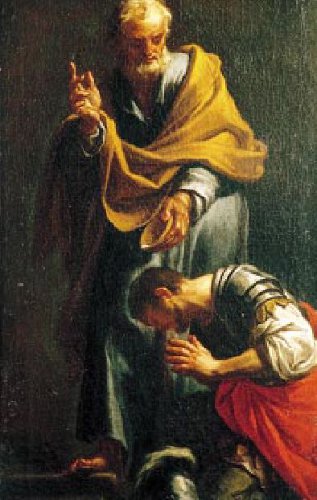
Peter and Cornelius

Clearly in the days of the apostles, the God-fearing Roman Cornelius had taken it upon himself to observe some of the mitzvot including the set times of prayer. Luke places the centurion praying at the ninth hour which corresponds to between two to three p.m., a time in both the ancient and modern worlds when devout Jews pray the Minchah or afternoon prayers. Exactly what and how Cornelius was praying we’ll never know, but his devotion to God and to the Jewish people got the attention of an angel and subsequently the apostle Peter.

So I agree that Gentiles were always meant to participate in the prayers, and both in the days of Solomon and Herod, we have indications that, as Eby says, there were distinctions regarding the placement of Gentiles in Jewish space, specifically the Temple.

I find this promising and more than a little daunting, which is why, even though ideally Shabbat observance is done in community, it is better for me to observe Shabbos alone, and particularly outside of Jewish space. Frankly, for me to have any sort of “thumbprint” placed upon my Sabbath practice, it’s just easier to do so in my own home.

Not that my home isn’t “Jewish space” since I live with a Jewish wife and daughter, but one of the requirements of my project is that I be alone so that, among other things, I don’t (metaphorically speaking) stomp all over their Jewish space with my big, fat feet. I have no desire to appear more “observant” than the Jewish people I live with, Heaven forbid. My role is supposed to be to encourage them to be more Torah observant.

It should be noted that until Peter and his party of Jewish companions entered Cornelius’s home, the centurion’s environment was composed exclusively of gentiles, so whatever Jewish observances he employed were not impinging on Jewish space. Of course God-fearing Gentiles regularly attended synagogue, but I can only imagine that they didn’t simply just “mix in” with the Jewish crowd but instead, had specific seating arrangements.

Eby in his book agrees with Lancaster and believes the “text implies that Cornelius prayed in what seemed to be a Jewish way” (p.33). Further, Eby says:

There is a delicate balance when it comes to the relationship of Gentiles to Jewish prayer. If the prayer of Messianic Gentiles is to be identical to Jewish prayer, it implies that these Gentiles have become Jews or that they fit into the same legal category as Jews. This is a type of replacement theology. On the other hand, if Messianic Gentile prayer is to be completely different from Jewish prayer, it denies the concept that it is through Israel that all nations connect with God.

-Eby, pp.33-4

Next, Eby speaks of “Blessings in Vain” and “Misappropriation of Identity,” both of which the Gentile (me) encounters in many of the blessings in a standard siddur, which, as Eby states, is “written from a first-person Jewish perspective.”

Fortunately, though I’m not terribly familiar with it yet, The Sabbath Table is written in such a way that it guides the Jewish and Gentile disciples along slightly different paths in the traditional liturgy, so the Gentile doesn’t have to “think fast on his/her feet,” so to speak, when reaching a part of the prayers where the reader is identified as Israel.

I remember encountering this issue in my “Hebrew Roots” days and I eventually learned to either avoid certain “problematic” areas of the siddur, or to broadly re-interpret them as meaning I supported Israel and her people rather than I was Israel.

Aaron Eby
Aaron Eby

Eby also suggests substituting “us” with “your people Israel” as a plea for Israel rather than as a request from Israel.

I know all this is going to rub some people the wrong way, but prior to the apostolic era, it was relatively rare for Gentiles to be in Jewish space and particularly to keep the Shabbat unless they were in the process of converting to Judaism or represented that equally rare phenomena (in those days) of being a Gentile married to a Jew.

Going back much further and into the time of Moses, any Gentile who wished to become attached to Israel and be considered a “resident alien” was actually obligated to a significant number of the mitzvot, including Shabbat observance, with the understanding that they would become permanent members of the community as Gentiles and that their descendents, starting at the third generation (grandchildren), would be absorbed into an Israelite tribe and clan (probably through intermarriage) and be considered Israelites; their ties to their Gentile ancestors obliterated.

But as Gentile disciples of Yeshua, we are not considered gerim as such (since Israel is no longer tribal), nor God-fearing Noahides, since all the nations of the earth are obligated to the basic laws of Noah, but we benefit from the blessings of the New Covenant, the promise of the resurrection, the giving of the Spirit (see Acts 10), and the life in the world to come.

Paul’s vision, his “gospel” included Gentiles in Jewish social and religious space and he staunchly defended his position, even in the face of James and the Apostolic Council (see Acts 15), and while his vision died with him, it has been reborn in modern Messianic Judaism.

Boaz Michael, President and Founder of First Fruits of Zion (FFOZ), defines Messianic Judaism in part by saying:

To me, Messianic Judaism is not just a Jewish-flavored version of Christianity. If I was asked to define Messianic Judaism, I would say, “Messianic Judaism is the practice of Judaism coupled with the realization that Yeshua of Nazareth is the Messiah, the New Testament is true, and the kingdom is at hand.”

-Boaz Michael
“Defining Messianic Judaism”
from the Director’s Letter, p.10
Messiah Journal, issue 117, Fall 2014

Boaz didn’t mention Gentiles in his definition of Messianic Judaism, but on pages 7 and 8, he states:

In many ways, the Messianic movement seems to be stuck in a rut, unable to resolve its most basic identity questions. Like one of those endless Messianic circle-dances, we are continually circling around the same sets of questions: Jewish identity, effective evangelism strategies, the role of tradition, the role of liturgy…and especially the role of Gentiles in the Messianic Jewish movement. (emph. mine)

I don’t know if the question of the role of the “Messianic Gentile” in Messianic Judaism is a problem in Messianic Judaism or just my own personal issue. I suppose I’m more sensitive to these matters than most because I’m intermarried, and particularly to a non-Messianic Jew. The divide between me being a Christian and her being Jewish is a well-defined line of demarcation.

Which brings me back to observing Shabbat individually and the “problem” of me being a Gentile and the Shabbat prayers being Jewish.

For example, one line in the traditional after-meal blessing offers thanks to God “for the covenant that [he] sealed in our flesh.” It seems problematic for a Messianic Gentile to say this. But should someone who is not Jewish then say “for the covenant that you have written on our hearts?” To do so would imply that Messianic Jews have only a fleshly covenant, whereas the new covenant that is written on hearts belongs only to Messianic Gentiles, God forbid.

-Eby, p.36

As my long-suffering wife would say, “Oy!”

Eby goes on to say that prayers in a Messianic Jewish synagogue should not be homogenized across the Jewish and Gentile population, and I agree, but that also would introduce a certain amount of “clashing” with one group saying one thing and another saying something completely different at the same time.

I can see the attraction of church only because it is homogenized. Everyone is the same, though I feel sorry for the “Christian Hebrews” in attendance since it is my firm belief that they aren’t “cookie cutter identical” to the Gentile Christian congregation in which they are embedded (I also can see the attraction of a homogenized [Jewish] synagogue environment for Messianic Jews and for the same reasons).

I don’t know how Paul did it. I wish he’d left more detailed instructions.

beth immanuel
Beth Immanuel Sabbath Fellowship

I remember feeling this sense of dissonance the second time I attended the Shavuot conference at Beth Immanuel Sabbath Fellowship. Although it advertises itself as “Messianic Judaism for the Nations,” within its walls, I experienced a severe case of identity confusion, probably because at that time, I had returned to regular church attendance and didn’t know if I was “fish or fowl”. How could I totally commit to church and still “feel” like a “Messianic Gentile?”

The dissonance damaged my Shavout experience and a few relationships along with it, much to my regret, and ultimately resulted in me bouncing back out of church since in the end, I didn’t have a single thing in common with the people there, at least in terms of theology and doctrine.

But “shoehorning” my way back into Messianic Judaism hasn’t proven particularly easy, either. When I’m just me, studying alone, praying alone (though I haven’t touched my siddur for months now), it’s just me and God and problems of identity and relationship aren’t a problem. God knows who I am and who I am created to be. I don’t know what He’ll think of all my preparations for Shabbat. Maybe He thinks they’re all foolish. I don’t know. If I’m doing this just for me, then I’m doing it in vain. Shabbat only means something if my intent is to honor God.

But dodging through this minefield of a Gentile and Jewish prayer and a Gentile and Jewish Shabbat observance makes me glad I’m doing all this in the privacy of my own home. If I slip or, Heaven forbid, get a little bit to “liberal” with the prayers, the only person who’ll be offended is God, and I’m hoping He’s more forgiving of me than I am of myself.

The Shabbat is supposed to be a delight. So why do I have a feeling of impending dread?

Actually, here’s part of the answer:

Don’t confuse God’s commandments with the traditions of men. Does God actually want such “extra effort” to do things He has never commanded?

Why was Jesus challenged so many times about what He did on the Sabbath? Was it because He was breaking God’s law? Or was it because His actions contravened the traditions men had ADDED to God’s commandments about the Sabbath?

What did Jesus actually mean by “The Sabbath was made for man, not man for the Sabbath”.

I just find something ludicrous in the fact that a refrigerator light can cause such concern and is that kind of thing REALLY what the Sabbath is about? Would applying duct tape to the switch (or disconnecting the light some other way) be pleasing to God or would leaving the light to shine displease Him ?

This is a recent comment on another blog post and it highlights one side of the argument. The other side is me trying to be sensitive to Jewish requirements as a non-Jew choosing to observe one or two Sabbaths using the only template I have available: a Jewish template. In trying to navigate the competing priorities of human beings, I’m letting them suck the joy out of what should be a joyous occasion. Really guys, I’m going to be alone so how I choose to observe Shabbos should be between me and God.

If I were in someone else’s house or in someone’s synagogue, I’d follow the requirements of my host, but in any real sense, my “host” will be God. Like I said, I’m following Jewish tradition to some degree because it’s the template I have available to me, and frankly, Jews have been observing the Shabbat for untold centuries before there were any Christians. You’d think we goyim would recognize by now that the Jewish people are the experts on Shabbat.

I probably won’t be perfect in my observance or meet everyone’s expectations, Jewish or Christian, but why should this be any different than anything else I’ve done or written about?

shabbos-candles-banner

Upon Reading a Rant About “Messianic Jewishism”

The Rav (Abraham Kook), zt”l, spoke about Knesset Yisrael as being endowed with two covenants, the covenant of Avot, which relates to the land of Israel, and the covenant of Sinai, which relates to the people of Israel.

-Rabbi Simcha Krauss
National President, Religious Zionists of America
from the Introductory Greetings (p.ix) to
Rabbi Moshe Avigdor Amiel’s English translation of
Jews, Judaism & Genesis: Living in His Image According to the Torah

So far I’m having a blast reading Rav Amiel’s book on Genesis, but that’s not why I’m writing this missive.

I came across something on Facebook written by Rabbi Stuart Dauermann that strongly echoes (though perhaps I am actually the “echo” to Rabbi Dauermann’s “voice” in this case) a topic I’ve written on many times before: the unique role of the Jewish person in Judaism and particularly in Messianic Judaism, a role that cannot be assumed by someone who is not Jewish.

I am going to copy and paste the entire body of text authored by R. Dauermann here, since as far as I know, the only place is exists online is on Facebook and depending on the privacy settings involved, it’s possible not everyone would be able to follow a link to its source. My commentary will follow:

We pause for a rant about what I term “Messianic Jewishism.”

If we ignore Paul’s teaching in Galatians and elsewhere we can get the Bible to say what we want. But no one seems to give a damn about how the privileges God gave to Israel are just being grabbed by others on their own terms, without so much as an “Excuse me.” Paul says this for example, “They are Israelites, and to them **belong** the adoption, the glory, the covenants, the giving of the law, the worship, and the promises. To them **belong** the patriarchs, and from their race, according to the flesh, is the Christ, who is God over all, blessed forever. Amen.” (Romans 9:3-5 ESV)

The religion we see developing in some corners of the MJ movement is NOT Messianic judaism because there is NO respect for the priority of the Jewish people in His covenantal purposes for Israel. What we have is a new religion which I call Messianic Jewishism. These are congregations that practice a kind of Judaism-lite, but by design, not really a Judaism, but a community with enough Jewish religious cultural flavoring for everyone in the fellowship to embrace it, enjoy it, practice it. It’s really Protestant Christianity with a tallis, and it is not Messianic JUDAISM but rather Messianic Jewishism. Messianic Judaism requires a deeper adherence to the communal boundaries and covenantal markers *given to* and *reserved for* the Jewish people. As I said, SOME people are grabbing whatever they can on their own terms using these things as they see fit, feeling absolutely entitled on the basis of their questionable interpretations of certain Bible verses, but with NO respect for the Jewish people who have given their blood for thousands of years to protect this patrimony given them by God.

If people wanted to convert, that would be something else. There is a responsible process whereby people can take on the covenantal calling of the Jewish people irrevocably and hook line and sinker. But this does NOT involve the kind of pirating of Jewish treasures which we see all around us, and the strange distortions of Jewish life, all done with a sense of entitlement because the people in question have a BIble verse that “entitles” them. And if you say “What do you think you are doing?” you will be accused of being a bigot and anti-gentile, neither of which is true. One can be pro-Jewish without being anti-gentile.

NO ONE IS SAYING that gentiles can’t touch, handle, taste Jewish things, But there is a conspicous failure to pay due respect to the fact that such are asking to handle Jewish treasures given to the JEWS by God.

I am NOT anti-gentile, but does ANYONE understand what I am saying?

Stuart Dauermann
Rabbi Stuart Dauermann

There were a large number of responses by the time I came across these words and I didn’t have the time to read through more than a smattering, but it seemed that the people commenting generally agreed with and were supportive of R. Dauermann’s statement.

I know that a number of my regular readers (and likely some of those who happen to “surf in”) will object to what Dauermann wrote and will object to my supporting what he wrote. Doubtless, many “proof texts” could be produced in an attempt to refute the idea that Gentiles attempting to observe the entire body of Torah mitzvot in the manner of the Jews are merely engaging in what has been called Evangelical Jewish Cosplay.

I know a number of you reading this are very sincere, devoted, and dedicated disciples of the Messiah and truly, honestly believe that how you observe your faith is exactly what God not only desires, but demands of you (and by inference, all believing Jews and Gentiles everywhere). I’m sorry, because I know what R. Dauermann wrote and what I’ve written here will doubtless cause you pain as well as result in you feeling insulted and even angry. Certainly you will attempt to defend your beliefs and practices, which I completely understand.

But what if you’re wrong?

A few months back, I wrote a two-part review (which you can read in Part 1 and Part 2 of my article “Acting Jewishly But Not Jewish”) of Mark Nanos’ forthcoming paper, ‘Paul’s Non-Jews Do Not Become “Jews,” But Do They Become “Jewish”?: Reading Romans 2:25-29 Within Judaism, Alongside Josephus.’ The paper suggests that although the First Century CE Gentiles entering the Jewish religious community of “the Way,” while not actually “converting” to Judaism, nevertheless “converted” to a way of life that resulted in them acting “Jewishly”.

I received a certain amount of pushback from some Messianic Jewish people who, like R. Dauermann, sought to shield and protect the unique role and identity of Jews in Messiah. This is obviously a tender subject for many in our little corner of the religious world.

It’s apparent to me by the way Dauermann’s words are crafted (and he even said so himself) that he was “ranting,” so to speak. That is, he was speaking from the heart and quite passionately. I can almost hear a raised voice in the words, “I am NOT anti-gentile, but does ANYONE understand what I am saying?” I think he’s frustrated. I don’t blame him.

But by the same token, what am I to say for those certain numbers of Gentiles out there who choose to believe that God commanded them (you) to don a tallit, lay tefillin, and daven in Hebrew from a siddur? What am I to write about those Gentiles who say they are obligated to observe the 613 commandments of the Torah of Moses, apart from the Rabbinic interpretations and totally committed Jewish lifestyle associated with said-commandments?

The question is, if you choose just how you are supposed to observe these mitzvot, diminishing or disregarding the Jewish praxis involved as interpreted by the Rabbinic Sages over the last two-thousand years or so, is what you’re doing really a “Judaism?”

Probably not, although I suppose that conclusion rests on how you define Judaism.

beth immanuel
Beth Immanuel Sabbath Fellowship

Even for those non-Jews who identify as Messianic Gentiles, who agree with the differentiation of roles between Jews and non-Jews in Messiah and who study and behave accordingly, it is arguable as to whether or not we are actually practicing a “Judaism,” even if we worship and fellowship alongside Messianic Jews in a Messianic Jewish synagogue (such as at Rabbi David Rudolph’s shul Tikvat Israel).

I’ve argued both sides of the issue (such as in Do Christians Practice Judaism? and Practicing Messianic What?) and the debate continues to rage.

In beginning to read Rabbi Moshe Avigdor Amiel’s book, from which I quoted above, I truly realize that he conceptualizes the Torah in general and Genesis (Beresheet) in particular, in a fundamentally different way than I do. Of course, he had the benefit of being born a Jew, being raised in a Jewish community, worshiping the God of his fathers as a Jew, being educated as a Jew, and speaking and writing fluent Hebrew (the book is actually two different versions between the covers, one in English and one in Hebrew) as a Jew.

This, and my many other explorations into various Jewish texts, show me that even though I can read them in English, they were written (at least the more scholarly ones) for Jewish people who conceptualize the Bible and associated interpretations in a very different manner than I do, and there are directions in which these texts travel that my thoughts are incapable of following. As I practice my faith, even though I study from a Messianic perspective, that hardly means I’m practicing any type of Judaism as such.

It stands to reason that I don’t consider myself Jewish or even practicing “Jewishly”.

There is, however, a necessity for me to “touch, handle, [and] taste Jewish things,” as R. Dauermann states, because of the intersection between my Messianic faith and Messianic Judaism as it exists within the overarching ekklesia of Messiah, but as I’ve said many, many times before, unity does not require uniformity. It doesn’t even always require being “separate but equal,” although I have also argued for the necessity of exclusive Messianic Jewish communities, at least for some MJ synagogues.

As Gentiles in Messiah who choose the path of studying the Bible and understanding the covenants from a Messianic point of view (and keeping in mind there probably isn’t any one single “Messianic point of view”), in my way of thinking, recognizing the covenant priority of the Jewish people in God’s redemptive plan for Israel is critical to how we not only see Jewish Messianics, but how we are to understand Gentile Messianics as well.

From a rant of my own written last February, I came down to saying don’t argue, though I realize that will always be taken as “let’s argue” by most humans, since we tend to be contrary by nature. But consider that in the long history of the Christian Church, any Jew who has come to faith in Jesus (Yeshua) as the long-awaited Messiah, has been without fail required to opt out of Yiddishkeit and effectively become a Gentile. Isn’t it understandable that Jews who enter the Messianic ekklesia would desire to rectify the insults and injuries of the past by preserving who they are as Jews?

I must admit that my own journey out of “One Law” was largely (but not exclusively) motivated by watching my Jewish wife’s involvement in Jewish community and my desire to cherish her Yiddisher Neshamah. Nothing quite teaches a Gentile about a Jew’s absolute need to be Jewish, to live Jewish, to be among Jewish community like being married to a Jewish spouse. Being married to the girl with the Jewish Soul has certain advantages that many others involved in “worshiping Jewishly” may lack in abundance.

Yesterday, I published a blog post that was highly critical of Christianity, accusing the early Church of virtually “kidnapping” the Jewish scriptures, particularly the Jewish Apostolic Scriptures, and I am sure I insulted many good Christian men and women in the process. I regret any pain I may have caused, but unfortunately, there was no other way to get my point across in the required manner.

But like it or not, the Church has committed many crimes against the Jewish people and their writings and we do so again by failing to acknowledge Jewish uniqueness in covenant connection with God, whether we call ourselves “Christian,” “Messianic,” or anything else.

I know I can’t cause even one single Gentile person to reconsider their commitment to the Torah as they see it, even as I at one time reconsidered my commitment and subsequently changed my direction. It’s possible that I’m totally unique in that regard, though the Gentiles involved in the educational ministry First Fruits of Zion must have faced a similar circumstance a number of years ago when they shifted their official position from One Law to a Differentiated model. And yet, I know it’s possible because I did it.

Orthodox Jewish manI inaugurated and celebrated that change almost three-and-a-half years ago when I wrote the first post for this blog called Abundant is Your Faithfulness.

Since that time, I’ve had many adventures, went back to church, left church…I’ve thought about giving up blogging and even “religion” a number of times, usually after encountering my own severe limitations as a human being or encountering the darker side of religious people.

We have just passed through the Days of Awe, exited Rosh Hashanah and Yom Kippur, and entered a new year. Erev Sukkot begins day after tomorrow at sundown and the year stretches out before us like a road paved in gemstones. Whatever our differences, we share one Messiah and one God. Would it really hurt we Gentiles to extend courtesy and honor to the Jewish people by recognizing that they are indeed unique and set apart by Hashem, their God and ours, as a people and a nation?

Oh, by the way, you won’t be able to engage Rabbi Dauermann by commenting on my blog since it’s quite likely he may not even read my “meditations” and certainly, he has never commented here. You can only “talk” to me.

One last thing. Although I don’t agree with everything Scot McKnight wrote in his article Does Personal Bible Reading Destroy the Church?, he does make a good point about everyone interpreting the Bible willy-nilly to come up with their own conclusions. We can’t all be right.

Addendum: Please keep in mind that there will always be rather negative influences who will read a blog post like this, draw the worst possible conclusions, and then post their opinions somewhere on the web, whether it be in my own comments section (no, not Cindy or Marleen) or on their own blog or website. I regret that I gave them more fuel to add to their “fire” but the only way I could possibly quench such “flaming” sentiments would be for me to cease to exist. Nevertheless, I apologize if my comments here have resulted in provoking anyone to slander (actually in writing, it’s libel) or otherwise making statements unbefitting a disciple of the Master and a child of God.

The Consequences of Disagreeing

Learn to disagree without creating an unpleasant argument.

A mature disagreement is when two people both listen carefully to the other’s position in order to understand the position and why the person feels that way.

The Torah obligates us to treat each person with respect – even if you disagree.

(For a series of probing questions on this topic, see Rabbi Pliskin’s “Gateway to Self Knowledge,” pp.125-7)

-Rabbi Zelig Pliskin
“Disagree Respectfully”
from “Today’s Daily Lift”
Aish.com

When I read this, I couldn’t help but think of my most recent What I Learned in Church Today blog post including Pastor Randy’s rebuttal to my comments. Though he may not believe this, I’ve been deeply concerned about how what I’ve written affects him and others. I was trying to communicate that in the aforementioned article but I’m not sure I was successful.

My problem is just how far to go in expressing my opinion, either in church itself or on my blog. I guess I could split the difference, since “church” doesn’t belong to me in the sense that I “own” the social and communal space, while I do “own” the communication conduit of my blog. I could keep mum at church and spew all of my thoughts and feelings out into the blogosphere (and I do the latter on a regular basis).

But I don’t exactly keep quiet in church, at least not in Sunday school. Granted, I don’t attempt to start a riot, and I do consciously limit the amount of interaction I allow myself to what I hope is a tolerable degree. I know I’m not always successful in this, however.

But as the quote from Rabbi Pliskin above suggests, the issue isn’t so much disagreement but whether or not respect is maintained. I don’t know if I’ve been doing this very well. When researching R. Pliskin’s write-ups on this topic, a few other entries came up in my search:

People can have diverse opinions. They can have different personalities. They can have different goals and objectives. Even so, they can choose to interact in peaceful ways, and discuss their differences with mutual respect. At times they will work out solutions to their mutual satisfaction, and at times they will not. Nevertheless, they can be calm, and think clearly about the wisest course to take.

(Growth Through Tehillim: Exploring Psalms for Life Transforming Thoughts, p. 92)

Disagree Respectfully

When it comes to being assertive, the ideal is to be able to speak up whenever appropriate and to do so respectfully.

Think of some situations in the past when you were not as assertive as you wish you were. Imagine yourself being able to say anything to anyone (as long as it is appropriate). Then take action to assert yourself in a way that you have not done so before.

(For a series of probing questions on this topic, see Rabbi Pliskin’s “Gateway to Self Knowledge,”pp.131-3)

Be Respectfully Assertive

SilenceAh, the words “When it comes to being assertive, the ideal is to be able to speak up whenever appropriate,” accuse me. Is it always appropriate to speak up? Isn’t “silence golden?” Shouldn’t I “go along to get along?”

I think people would be a lot more comfortable around me at church if I really did keep my mouth shut, and I can only imagine I’d cause Pastor Randy fewer headaches and gray hairs if I kept his sermons out of my blog. It’s going to come to that. Given the tone of the comments on the blog post in question, I don’t see any other reasonable choice on my part, especially if “respectfulness” is to be maintained rather than me just being “assertive” all the time. I’ve already taken it too far.

In exploring whether or not my pontificating about church is a sign of my personal arrogance, I consulted Rabbi Noah Weinberg’s series 48 Ways to Wisdom and specifically Way #29: Subtle Traps of Arrogance. Am I really all that smart or well-educated in theological knowledge that I always know better than trained and educated Pastors and Bible teachers? Am I infallible? Certainly not. Then where does this drive to learn more and express what I believe come from? You’d think I’d be smart enough to shut up, listen and learn.

Who is wise? He who learns from all people.

-Pirkei Avot 4:1

On the other hand, self-expression, particularly in writing, is how I process information and make sense out of it (which is what I’m doing right now). Until then, it’s just a bunch of thought fragments floating around in the global context of my mind or at best, scrawled and scribbled notes on torn and frayed pieces of paper. Dressing them up, so to speak, by blogging creates a framework within which I can organize that information and even respond to it in some fashion. It has the added (if sometimes dubious) benefit of eliciting responses from interested readers on the web.

R. Weinberg’s article ended with a bullet point summary:

  • If you’re busy patting yourself on the back for what you’ve achieved, you won’t make an effort to do more.
  • If you’re constantly defending your opinions, you’ll never be open to hearing new ideas.
  • If you are arrogant about your ideas, then you are limiting yourself.
  • If you’re grateful, you will grow.
  • If you experience pleasure in doing the right thing, then look for more pleasure.

I suppose the point stating “If you’re constantly defending your opinions, you’ll never be open to hearing new ideas” is the most applicable one since by the very definition of my “mediations”, I’m expressing opinions that are in need of defending, at least at the moment when someone disagrees. I guess turning it around, I’m the one disagreeing with traditional Church doctrine, and that has resulted in Pastor Randy having to comment on my blog to defend his position, something he wouldn’t have had to do if I’d have kept my hands off the keyboard and my opinions of his sermon to myself.

I suppose it also comes down to whether or not I’m limiting myself by being arrogant about my ideas.

study-in-the-darkBut these aren’t ideas I’ve cooked up out of “ham fat,” so to speak, but out of hours and hours of reading, listening to lectures and sermons online, and writing, and pondering, not in order to puff myself up, but to authentically read and understand the Bible as a single, unified document containing the single, unswerving intent and plan of God to redeem Israel and thus redeem all of Creation. For me, Christian theology and doctrine doesn’t provide the solution. No matter how I slice it, Christian doctrine forces the plan of God to “jump the tracks” at least once in the Bible, in order to take the plain meaning of Torah and the prophecies in the Tanakh (Old Testament) and make them fit traditional Christian beliefs as they have evolved in the centuries of the “post-Nicene Church”.

If the Bible is as Evangelical Christianity says it is, then both God and the Bible don’t make sense and further, they (in my opinion) pull a major bait-and-switch on Israel and the Jewish people.

I just want the Bible to make sense and from my current perspective, I believe it does.

But back to the question of what to do about this?

In general, writing little theological essays from my amateur’s point of view probably does little if any harm. According to one estimate, as of November 2013, there were over 152 million blogs in the Internet, and a new blog is being created somewhere in the world every half a second.

That’s a lot of blogs.

Among all of that, my one little blog is completely insignificant. Of course, I occupy a rather rarefied space in the blogosphere, not only as a religious blogger (plenty of those around), but one who specifically comments on non-Jewish participation in Messianic Judaism (or maybe it should be expressed as “Messianic Gentilism” or something like that).

Of course, the second I comment on a specific individual, such as a Pastor, or on the teachings of a particular church, things narrow down considerably in terms of the “influence” or at least the “impact” I can have on people’s lives.

I really don’t think I’m being arrogant in the sense that I’m always right and people had better see things my way or else, but that isn’t to say I couldn’t have done things better or have been more considerate. Where’s the fine line between being respectfully assertive and being arrogant? Where’s the line in the sand separating humble respect from passivity or censorship (even if self-imposed)?

The only solution that avoids hurting others in relation to church is to not talk at or write about church. Oh, I guess I can say “Hi, how are you,” but expressing a theological opinion in Sunday school will have to be a “no-no,” and certainly writing any commentary on sermons or Sunday school lessons must be taken off the table completely.

the-crossThat’s probably like closing the barn door after the horses have escaped but it’s better than continuing to hammer away at a nail that’s already been beaten flat (if you’ll pardon the mixed metaphor).

Better late than never.

What do I do from here? I have a pretty good idea about that but will let it cook for a day or two (or more — or less) longer just to make sure. Given a good enough reason, I can go off half-cocked but I’d like to avoid it if at all possible. I spent a long time praying and pondering before returning to church. I’ve made a nearly two-year investment in Christian community. In the aftermath of what I’ve done, I have to see just what is left…if anything.