Tag Archives: messianic judaism

Are Messianic Gentiles Korach?

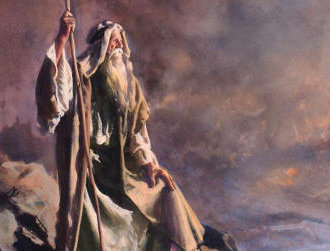
Korach, the son of Yitzhar, the son of Kehas, the son of Levi, separated himself.

Bamidbar/Numbers 16:1

This verse begins the passage that deals with the rebellion of Korach, who sought to overthrow Moshe and Aharon from their positions as leaders of the Jews. The verse stresses that Korach took himself apart — that is, he deliberately sought to develop machlokes, strife between the Jews and their leaders.

-from “A Torah Thought for the Day,” p.2
Sunday’s commentary on Torah Portion Korach
A Daily Dose of Torah

Over two weeks ago, I wrote a blog post called What Am I, Chopped Liver?, in which I attempted to illustrate that non-Jews who are somehow associated with the Messianic Jewish movement are not an afterthought of God or a devalued population without a role in God’s redemptive plan for Israel and the nations simply because we’re not Jewish.

I could never have predicted what happened next. As I write this (Monday afternoon) that fifteen day old blog post has collected 191 comments and counting. Apparently, I struck a nerve, a really sensitive one.

I’ve written several posts since then, but none has gained the traction of “Chopped Liver,” which is just fine.

But then I started studying for the coming week’s Torah Portion Korach.

Rashi explains that Korach wished to make the point that there was no reason for Moshe and Aharon to be seen as greater than the rest of the Jews, for all of them had been spoken to by God at Sinai. thus their assuming leadership represented a selfish act of self-promotion…

…No matter how holy the Jews, they still needed leaders — and Hashem had ordained that those leaders were to be Moshe and Aharon. Sadly, Korach refused to see the obvious answer, and came to his terrible end as a result.

ibid, pp.2-3

We need to look at Korach and his 250 followers in context. The failure of the ten spies had just occurred (see Shelah) and the Children of Israel, bewailing their fate, refused to enter the Land and conquer it. Instead, they begged for a new leader to guide them back to Egypt. Even the next morning when the people realized their error, it was too late. Hashem had already decreed that the current generation wander the desert for forty years, until the last one of them expired.

Not listening to Hashem again, the Israelites attempted to take the Land. Hashem was not with them and the local Canaanite armies easily routed Israel, sending her packing, so to speak.

From Korach’s point of view, this might all seem to be the fault of Moses and Aaron. Midrash states that Korach and his companions believed Moses had appointed himself and Aaron as leaders, and that their positions of authority did not come from Hashem. If Korach were right, then there was no absolute divine source that appointed Moses as the Leader and Prophet of Israel and he might be opposed, overthrown, and replaced. This was Korach’s intent.

Although Korach was dead wrong (literally as it turns out) and Hashem decreed his demise, I can’t think too harshly of Korach. Yes, he was misguided and confused, probably tortured by the humiliating defeat in Canaan, and the dreaded prospect of the Israelites spending the rest of their days wandering the desert of Sinai. But assuming he wasn’t just greedy for power, he probably thought he was doing the right thing, the only thing he could think of to save his people.

korach rebellionBut he lacked Moses’ perspective and his apprehension of the will of Hashem for Israel.

It is commonly thought that Korach’s sin was one of attempting to usurp the roles of Moses and Aaron and to make himself the leader and High Priest (a bit if hypocrisy if he really thought that all Israelites were complete equals).

But we “Messianic Gentiles” (or whatever you want to call us) are also trying to figure out our roles relative to Messianic Jews and within the context of Messianic Judaism. Can we Gentiles be compared to those involved in the Korach rebellion?

First of all, let’s understand how I’m using the term “Messianic Gentiles.” Why don’t I just call us “Christians?”

Well, in the most generic way of speaking, we are Christians. That is, anyone who follows Christ (Messiah) as a disciple can be called a Christian (and my Jewish wife calls me a Christian). I make the differentiation for two reasons.

The first is that, in modern times, there are a number of Jews who choose to follow the traditions of their Sages in how they observe the Torah, living like many, many other observant Jews all over the world…and yet they are also disciples of Yeshua, recognizing him as Moshiach and the coming Jewish King.

Calling them “Christians” would be a gross injustice because historically, Christianity has been directly opposed to Jews observing Torah, studying Talmud, gathering in synagogues on Shabbos, and honoring the traditions of the Sages.

The closest analog to modern Messianic Jews are the very early Jewish disciples of the Master we find in the Apostolic Scriptures, but we also have to remember that nearly two-thousand years of Judaism stand in between these two groups of Jews. And certainly by any comparison, those ancient and our modern Messianic Jews in no way resemble today’s Evangelical Christians.

The second reason is similar to the first. We Gentiles in Messiah, who associate ourselves with Messianic Judaism in terms of how we understand and study the Bible and the function of the New Covenant, are not opposed to Jews practicing Judaism in the manner of their forefathers. We have a different vision of the primacy of Israel in the current age and into the Messianic Era. We know that Yeshua is the center of God’s plan of redemption, that God’s redemption emanates from Yeshua to Israel, and only then, from Israel to the nations.

This understanding is only rarely found in any corner of mainstream Christianity, thus I refer to us as Messianic Gentiles to communicate the distinction, not to deliberately separate ourselves from the (much) larger ekklesia of Christ among the Gentiles, that is, the Christian Church.

So are we Messianic Gentiles guilty of the rebellion of Korach in seeking a role in Messianic Judaism?

Based on the initial criteria I cited at the top of this blog post, that Korach deliberately separated himself from his Israelite fellows in order to cause strife (at least according to Midrash), how can we say we have separated ourselves from Messianic Judaism if our intent is to join them, albeit as Gentiles and not Jews?

It seems more apparent that we’ve separated ourselves from the local church and from historical Christianity so it’s very likely if we are rebelling, it is against the Christian Church, not Messianic Judaism.

Mount SinaiBut what about the supposition I’m adapting from Korach, that we Gentiles are every bit as Holy to God as are the Jewish people, thus no role possessed by Jews should be denied us?

It’s difficult to make a direct comparison because Korach and his group were Levites and Israelites, so they had that in common with Moses and Aaron. We Gentiles don’t have tribe and ethnic identity in common with the Jews in Messianic Judaism. We can’t separate ourselves from something we never were in the first place.

That’s an important point because the Sinai Covenant, and for that matter the New Covenant, are both made exclusively with the Jewish people. The disciples from the nations aren’t named subjects to those covenants. It’s only by the mercy and grace of God that he has preordained “every knee will bow” and indeed, that Gentiles turning to Hashem en masse, is a rock-solid indication, based on scripture, that the coming of the Kingdom of Heaven into our world is imminent (but “imminent” in the timing of God, not necessary by the human calendar).

So if any Gentile were to claim equal rights to the Sinai and New Covenants as members and citizens of Israel, it would be the height of hubris, and indeed, pride and arrogance are things that Korach has been accused of throughout the ages. If any of we Messianic Gentiles made such a demand, we’d be on par with Korach, cut from the same cloth.

But that’s not what most of us are trying to do. We’re not claiming the Torah for our own. We are not calling Moses our Father and maybe not even our Teacher (apart from the veiled implications of Acts 15:21).

What we do want to know is, given our particular orientation as Gentiles standing on the foundation of the Jewish Bible, who are we, where do we belong, and what should we be doing?

Of course, as part of the exceptionally long dialogue on my aforementioned blog post and particularly my conversation with Rabbi Kinbar, our “place at the table” may have to be self-defined. The various leading organizations that can truly be termed “Messianic Judaism” have their hands far too full managing their own definition, identity, and role.

Korach disputed the validity of Moses and Aaron as God-assigned leaders of the Children of Israel. Are we Messianic Gentiles questioning the leadership of Jews in Messianic Judaism? Can there be a Judaism without Jews? If we non-Jews want to be part of Messianic Judaism, are the Jewish people our leaders and are we trying to “take over” Messianic Judaism from them?

Those are a lot of loaded questions.

If there are Messianic Jewish synagogues that are by and for Jews in Messiah only, then we don’t have a seat at that table and we don’t belong. If we don’t belong, they can hardly be our leaders.

If there are Messianic Jewish synagogues that welcome non-Jews as adjunct members or resident visitors and if those synagogues are led by a majority Jewish board of directors, then the board are our leaders.

synagogueThat gets a little complicated since, for instance, the local combined Reform/Conservative shul in my corner of Idaho has both Jews and Gentiles on the board, although, of course, the Rabbi is Jewish.

In a comment made by Rabbi Carl Kinbar recently:

At the same time, MJ leaders share the responsibility. It doesn’t take long for them to figure out that few congregations made up preponderantly of Messianic Jews will grow large enough to support their leader full-time.

Virtually all Messianic congregations where individuals (Jew or Gentile) simply walk in the door and stay, are largely (sometimes almost completely) Gentile in make-up. This is especially true of congregations in areas where there are few Jews to begin with. Jewish practices are usually, or perhaps inevitably, reconfigured to the point of being somewhat unrecognizable. Most MJs who take their Judaism seriously feel quite alienated in that kind of environment. They also feel the need to guard themselves lest they speak or act “too Jewish” and thus offend the Gentiles (and some other Jews, too). As a traveling speaker, I have experienced enough Messianic congregations to know what I’m talking about.

That said, no congregation that walls itself in can be spiritually healthy. Congregations that have a distinct vision must have a strong and persistent determination to maintain living relationships with those who have a different vision, theology, or idea of congregational fabric.

P.S., I also believe that it is not viable, in the long term, for largely MG congregations to restrict leadership positions to Jews even when there are equally or more qualified MGs. It will not work sociologically or psychologically. A large percentage of MG children who mature in that kind of environment will leave as soon as they can. (emph. mine)

I can only imagine the matter of leadership is managed on a community-by-community basis. Thus the question of who leads and who follows is highly variable depending on whatever congregation you are attending. Synagogues with a majority non-Jewish membership will likely have a significant Gentile presence on the board, while Messianic Jewish shuls made up of a majority of Jews with only a few Gentiles (non-Jewish spouses of Jewish members perhaps) might have few to no Gentiles on the board and most certainly a Jewish person in the role of Rabbi.

In any congregation, there has to be a method of leadership whereby the members feel they are represented by such leadership. In many churches and synagogues, board members are elected by popular vote, and it is the board that hires the Pastor or Rabbi, who then is an employee of the institution and who can even be fired by the board if necessary (or their contract can simply not be renewed once it becomes due).

I’ve been in a congregation, a very organizationally unsophisticated one, where there were multiple attempts, some successful, to lead a hostile takeover, a sort of bloodless coup, either deposing the previous leader out of hand or causing a split in the group.

This is not uncommon among small but growing Hebrew Roots congregations, but it’s also been known to happen in full-fledged Christian churches (I have no idea if splits happen in mainstream Jewish synagogues since I have no direct experience).

It’s always ugly and never serves to sanctify the Name of God.
messianic judaism for the nationsSo are we Messianic Gentiles rebels with or without a cause?

I would say no. Not if we aren’t intending to take control of something that isn’t ours, that is, the covenant inheritance of the Jewish people. We have a right to seek out our own identity and role as long as the identity and role we desire doesn’t already belong to another group.

I think this is why some within Messianic Judaism would rather the Gentiles all stay in the Church, because it solves this pesky problem by using the already existing identity for Gentile believers as Christians within the Church and Jewish disciples as Jews within Judaism.

But not all Jews in Messiah agree, and as far as my experience goes, most Messianic Jewish groups in the United States have a large if not a majority Gentile population.

So I suppose as long as we Messianic Gentiles aren’t plotting to overtly or covertly take over whatever Messianic congregations we are attending, then we aren’t rebels. Of course, any group in a congregation that attempts a takeover of said-congregation outside of the formal rules would be considered rebels, regardless of the ethnic make up of the house of worship.

So if we’re not taking over Jewish synagogues and we’re not claiming the Torah and Israel to be who we are equally along with the Jews, then no, we aren’t rebels, usurpers, or thieves. We are just pilgrims on a trail, traveling a path, searching for who we are in Hashem and in Messiah.

We may never find out who we are in Messianic Judaism or in direct relation with Messianic Jews. But as I wrote just recently, we have every likelihood of discovering who we are in Messiah, and then helping and supporting Jewish Torah observance and community in anticipation of the return of Messiah and the establishment of his Kingdom in Israel and among us all.


Connecting to the Tzaddik

“You ask how can you be bound (m’kushar)[1] to me when I do not know you personally…”

“…The true bond is created by studying Torah. When you study my maamarim, read the sichot[2] and associate with those dear to me – the chassidic community and the tmimim[3] – in their studies and farbrengens, and you fulfill my request regarding saying Tehillim[*]and observing Torah-study times – in this is the bond.”

-from “Today’s Day” for
Sunday, Sivan 24, 5703
Compiled by the Lubavitcher Rebbe; Translated by Yitschak Meir Kagan
Chabad.org

This sort of relates to the rather lengthy discussion taking place in the comments section of my What am I, Chopped Liver blog post. It speaks of one person being bound to another, even if they don’t personally know each other and even if they are separated by great distances (and maybe even by time).

In this case, it’s the bond between a Chassid and his (or her) Rebbe, and it’s established and maintained by the Chassid studying the informal and formal teachings of their Rebbe, as well as associating with current and former students of the Rebbe.

Yes, this is discussing a very specific relationship in the Lubavitcher community, however, I think I can adapt it for a somewhat different but related connection.

We’ve been discussing the status and halachah of non-Jews who are in some manner associated with the Messianic Jewish community, if only through how and what we study.

Mark Nanos
Mark Nanos

For instance, in reading, studying, and reviewing the Nanos and Zetterholm volume Paul within Judaism: Restoring the First-Century Context to the Apostle, I’m  attempting to gain a greater understanding of the Jewish Apostle Paul as applied to both the ancient and modern community of Jews and Gentiles in Messiah. In this, it can be said that I’m associated or connected to the Messianic Jewish community by my choice of study materials and how I’m allowing the essays in the aforementioned volume to modify and shape my understanding of the Apostolic Scriptures.

In other words, I’m a Gentile Christian who studies Messianic Judaism in order to stand on the Jewish foundation of the Bible.

Actually, it’s not just the foundation of the Bible that’s Jewish but the entire collection of books.

So what am I doing?

Adapting the quote above, I’m studying the teachings of my Rebbe (and all of the related teachings) in order to bind myself to my Master, even though he and I are separated by culture, nationality, history, and even death. Not that he’s dead of course, but I must go through death and resurrection one day as his disciple.

According to the second requirement, I must also associate with his students. That’s a tough one. Who do I associate with? The most obvious answer would be other Messianic Gentiles, but I only regularly see one in my little corner of Idaho and we don’t always speak to each other on matters of faith.

Can there be association via the Internet? If the answer is “yes,” then I regularly associate with Messianic Gentiles and a few Messianic Jews via conversations on this blog spot.

Again, this is a rather loose adaptation of a very specific process among the Chassidim.

Why do I bring this up?

MessiahBecause it gives us a loose set of guidelines as to how we are to relate to Yeshua and to each other. Chances are, just about everyone reading these words, or at least my regular readers, are already doing these things. We are already reading the Bible, including the Torah and the Prophets, studying the teachings of Yeshua in the Gospels, and of his disciples and apostles in the Epistles and Apocrypha. We also study related commentaries that offer additional insight into Jewish thought, not with the idea that we are obligated to take up all of the mitzvot, but to attain greater closeness to our own “Rebbe”.

In all likelihood, we are all, in some way, associating with other students of our Master, in the face-to-face or virtual worlds or both. Technically, we could go to a traditional church and associate with the Master’s students, but their understanding of his teachings are sometimes radically different from our own, so much so, that it seems as if we are speaking different languages to one another.

So I’m using some snippet of information from the Jewish world, applied very specifically to Chassidic Jews and adapting it for potential (or actual) use by Messianic Gentiles.

While periodically our bond with Messianic Jews, some of them anyway, can seem rather tenuous, based on the needs of the Messianic Jewish community, the bond between any disciples and their Rebbe, whether Jew or Gentile, should never come into question. It definitely should not come into question because we are “just” Gentiles.

After all:

For you are all sons of God through faith in Christ Jesus. For all of you who were baptized into Christ have clothed yourselves with Christ. There is neither Jew nor Greek, there is neither slave nor free man, there is neither male nor female; for you are all one in Christ Jesus. And if you belong to Christ, then you are Abraham’s descendants, heirs according to promise.

Galatians 3:26-29 (NASB)

Of course Paul is not obliterating the covenant distinctions between Jews and Gentiles anymore than he is destroying gender distinctions between men and women, but he is saying that we all have equal standing in the ekklesia of Yeshua. We are all “clothed in Messiah,” as it were, so that regardless of our social roles in the Messianic community, we can all consider ourselves as belonging to Messiah and descendants of Abraham’s based on God’s promise to Abraham that he would be the father of many nations.

AbrahamGentiles are not heirs of the Sinai covenant, as are the Jews, but we are all Abraham’s children spiritually, though the Jews are also physical descendants through Isaac, and then Jacob, and then all of Jacob’s offspring.

Even if you don’t always feel close to the Jews in the Messianic Jewish community, or for that matter, some of the non-Jews, the words of Paul attest that we can and are close to our Master, the mediator of the New Covenant promises, he who through God’s mercy and the Master’s faithfulness, brings those of us  who were once far off to be close to our Master for the glory of Hashem.

I just wanted you to know that.

Footnotes

1. The bond between Chassid and Rebbe is termed hitkashrut (see Elul 10).
2. Informal talks, as distinct from maamarim which are formal dissertations of chassidic philosophy.
3. Present as well as former students in the Lubavitcher yeshivot are known as “Tmimim.
*. “At the time this letter was written, it had not yet become widely known about the establishment of the practice to study Chumash with Rashi daily, and to study Tanya as apportioned for every day of the year.” Footnote 4, Page 328, Sefer Hamaamarim Basi Legani.

Book Review of Paul within Judaism, “The Question of Worship: Gods, Pagans, and the Redemption of Israel”

Paul’s convictions about the impeding dawn of God’s kingdom place him securely within the world of the late Second Temple Jewish apocalyptic hope. But Paul’s biblical tradition was Greek, not Aramaic or Hebrew. His audience–unlike that of Jesus and of the earliest disciples–was pagan, not Jewish. And he stretched his time-driven gospel over the spatial frame provided by antiquity’s map of the cosmos.

-Paula Fredriksen
from the beginning of her essay
“The Question of Worship: Gods, Pagans, and the Redemption of Israel”
Paul within Judaism: Restoring the First-Century Context to the Apostle (Kindle Edition)

I had a difficult time wrapping my head around Fredriksen’s essay at first but when I finally figured out where she was going, not only did everything click into place, but I saw the connections between what she was saying and what I wrote about not that long ago.

Fredriksen draws a sharp distinction between the teaching and mission of Jesus (Yeshua) and that of Paul. While Jesus operated almost exclusively within a Jewish context, speaking to Jews, drawing Jewish disciples, training Jewish apostles, Paul had an extremely different audience to contend with and an environment at odds with Jews and Judaism, the pagan arena of the diaspora.

While the message of Jesus, the repentance of the Jewish people and return to the Torah in preparation of the coming Kingdom of Heaven, was not particularly surprising, Paul’s role required him to do the astonishing. He had to bring Gentiles out of worshiping pagan gods and into exclusive devotion to the One God of Israel, while leaving them in their diaspora towns, cities, and countrysides, living among idol worshiping family, friends, and business associates.

The Church tends to take all this for granted, having Paul preached to them like any modern missionary they know or have read about, but in fact, he was charting a course through unexplored territory, doing what no one had ever done before, at least on such a large-scale, and dealing with Gentiles not only as different ethnicities, but as pagans.

Today, we separate one’s ethnic orientation from their religion, but in ancient times, no such distinction was made. Lifestyle, business, family life, everything tied together into one’s identity. So a Jew practiced Judaism and Gentiles practiced some form of pagan worship, although, as I said, it was really all a part of living your life as you had been born.

interfaithOccasionally, a non-Jew would undergo the proselyte rite and live among Jews as a Jew, but Paul was attempting to bring a large number of Gentiles into a form of Judaism, while having them remain wholly distinct from Jewish ethnicity and obligation to the Torah mitzvot.

What we think of as “religion” ancient people accordingly constructed as an inheritance: “mos maiorum, fides patrum, ta patria ethe, paradoseis ton patrikon (this last from Paul, Gal. 1:14). “Religion” as a category separable and separate from one’s “family”–household to empire–did not exist.

And…

Finally, gentile versus pagan masks the degree to which not only households but also cities were family-based religious institutions.

In some ways, what Jesus had attempted in the Jewish homeland among his own people was all but child’s play compared to the mission he gave to Paul. While Jesus was imploring the Jews around him to return to a Torah lifestyle that was their inheritance, Paul was directing pagan Gentiles to leave behind everything they had ever known to join with a foreign people, the Jewish people, in worshiping what for them would have been an alien God.

I suppose I’m leaving out the non-Jewish “God Fearers” who frequented synagogues in the diaspora nations, but according to Fredriksen, these “God Fearers,” while worshipping and praying to Israel’s God on Shabbos, also worshipped and prayed to the various pagan gods during the other days of the week. As long as they behaved themselves while in Jewish community, these “God Fearers” were not required to leave their other “gods” behind.

Changing gods “was tantamount to changing ethnicity” but without undergoing the formal rite of conversion, abandoning the pagan gods and worshiping the God of Israel only would seem not only bizarre, but an all but impossible act.

What was everyone, human and divine, so upset about? Paul (and others like him), in proclaiming the gospel, radically disrupted the long-lived and socially stable arrangements prevailing between synagogues, god-fearers, and the larger pagan community; and they disrupted relations within the pagan community itself, from those of immediate family right up through the larger family of fellow citizens and the cities’ gods.

It’s easy to see why just about everybody learned to hate Paul, from many of the Jews in the diaspora, to the citizens of the various pagan communities in which the Apostle operated. He was stirring up a hornet’s nest of trouble no matter who he talked to, Jew or Gentile. The Jews needed the good will of the Gentile community around them and the Gentiles needed to be able to live life as was expected of them by the self-same community. Paul threatened all of that.

Receiving the SpiritIt was a miracle that anyone bucked the system at all and came to faith, and yet it was a miracle God arranged.

But this, as I suggested above, put the Gentile disciples into an uncertain state:

But Paul’s pagans fell into neither category. Like converts, his pagans made an exclusive commitment to the god of Israel; unlike converts, they did not assume Jewish ancestral practices (food ways, Sabbath, circumcision, and so on). Like god-fearers, Paul’s people retained their native ethnicities; unlike god-fearers, they no longer worshiped their native gods. Paul’s pagans-in-Christ are neither converts nor god-fearers.

Then Fredriksen asked the poignant question:

So who and what are they?

The very same question I’ve been dealing with lately.

You may not like Fredriksen’s answer:

…they occupied a social and religious no-man’s land. Eschatologically, however, they represented a population long anticipated within centuries of Jewish restoration theology: they were pagans-saved-at-the-End.

Paul and the other apostles and elders in the ancient Messianic movement then known as “the Way,” would have seen these droves of Gentiles turning to Israel’s God through Jesus-devotion as the fulfillment of prophesy, that at the coming of the close of the present age, the Goyim would be redeemed as part of God’s overarching plan of redemption for Israel.

Seen from that perspective, it would have been a very exciting time for Paul. He couldn’t possibly have realized that nearly two-thousand years later, both Israel and the faithful among the nations would still be waiting for Messiah’s return. He may indeed have believed, as other Jews in Messiah did, that Yeshua’s coming back in power and glory was imminent.

I’ve mentioned in other blog posts, both related to this review series and otherwise, that in all likelihood, Paul had no idea how to fully resolve the social status of Gentiles in Jewish community, including the development of a complete and functional halachah for such a population.

If I’m reading Fredriksen right, he likely didn’t think this was a problem. If Messiah’s return was right around the corner, so to speak, why bother? The effort would be wasted and Yeshua would be back so quickly that he’ll be the one who will finish the job of establishing how Gentiles were supposed to be integrated.

Restoration
Photo: First Fruits of Zion

Or, given that all Jews were to be returned to Israel as part of the Messianic promise, all Israel’s enemies would be defeated and removed from the Jewish homeland, and all (or the vast majority) of Gentiles would reside in their own nations, the task of integration would be completely unnecessary. Except for events such as the moadim in which devoted Gentiles would come to Jerusalem to pay homage to God, Jews and Gentiles in the Messianic Kingdom might not do much mixing at all, at least as Paul may have seen things.

Here’s an important point Fredriksen made that I think should be shared:

What about Paul? Paul’s circumstances differed pointedly from those of the Baptizer and of Jesus. His “mission field” was the cities of the eastern empire. His hearers were not Jews but pagans. And these he called to repent not of “Jewish” sins (i.e., breaking the commandments), but of “pagan” sins (most especially idolatry and its perennial rhetorical companion, porneia).

I mentioned this above but here we see Fredriksen emphasizing the imperative of each population repenting of sins specifically connected to their own populations in terms of how they had come into relationship with God. For Jews, it was primarily the Sinai and New Covenants, and while the New Covenant blessings also could be applied to the Gentile believers in terms of the promise of the resurrection and giving of God’s Spirit, that overlap only covered just so much common ground.

One of the clearer commandments for the Gentiles was to worship the God of Israel only, but their/our lives were not so specifically defined and delineated as were the Jews.

The Gentiles were to practice righteousness and justice, but these concepts were less “about religious sentiment than about showing respect.”

So how were the Gentiles called to “fulfill the law” (Rom. 13:8-10; Gal. 5:14-15; 1 Cor. 14:34)?

The common translation of the Greek in Romans 5:1 is rendered “justified by faith” but Fredriksen suggests that this would better be understood as a directive for the non-Jewish disciples to practice piety toward God and justice (charity) toward others.

Piety toward God can be covered in commandments such as no other gods, no graven images (idols), and no abuse of God’s Name, while justice toward others is exemplified in no murder, no adultery (or other sexual sins), no theft, no lying, and no coveting.

So, reading Paul without anachronism, “fulfilling the law” for a Gentile means turning away from pagan idols and turning to God alone as the One God “through baptism into the death, resurrection, and impending return of his [God’s] son” and making “right toward each other by acting rightly toward each other–‘not like the ethne who did not know God’ (1 Thess. 4:5; cf. Rom. 1:18-32).”

JerusalemBut then “who enters the Kingdom,” as Fredriksen asks? This is also a question recently asked in the comments section of my aforementioned recent blog post.

Since approximately the second century, in part basing their view on their reading of Romans 9-11, most Christians have answered “only Christians.” This despite Paul’s insistence, in this very passage of Romans, that “the fullness of the ethne” and “all Israel” will be saved (11:25-26), and that God’s promises are “irrevocable” (11:29; cf. 15:8).

No, not “true Israel” or “new Israel” but “all Israel will be saved!” Exclamation point. End of story.

But Fredriksen says not just all Israel but “the fullness of the Gentiles”. That sounds like a lot, and that’s not a very Christian point of view.

God’s universalism, in short, is a very Jewish universalism. And his particular universalism is reflected in the ways that Paul imagines ethnicity in the eschatological community, both the proleptic one of the present ekklesia, before the Parousia, and the final community, once Christ returns.

In both present ekklesia and future Kingdom, Jews and Gentiles are “one in Christ” (Gal. 3:28) and yet Paul absolutely insisted that all those “in Christ” should and must remain Jew and Gentile, distinct from one another, and Paul “has no problem accommodating both difference and oneness.”

That may not have been a problem for Paul, especially as I said before, because he believed the present ekklesia was to be short-lived and Messiah would settle the matter once the Kingdom was established, but it’s a problem we struggle with today, if only for those of us who have left the anachronistic interpretive traditions of Christianity behind and who have chosen to engage with the Jewish scriptures on their own terms.

If the nations, through an eschatological miracle, now worship Israel’s god alone, then even though they remain ethnically distinct, they are spiritually joined to God’s family.

Even our ability to call God “Abba, Father” (Gal. 4:6; Rom. 8:15) is a deeply mystical mystery, one we may end up spending all of our lives exploring.

According to Fredriksen, the Jewish Paul believed “Eschatological Israel will stand together with but distinct from the other nations, for they are the nation long ago set apart by God.”

I completely and wholeheartedly agree, both with Fredriksen and with Paul (assuming Fredriksen’s understanding of Paul is correct).

The Jewish PaulIt may not seem so, but I’ve only scratched the surface of Fredriksen’s article regarding the connections between Gentile devotion to the God of Israel and the redemption of Israel herself.

So far, I’ve found all of the chapters I’ve read and reviewed to be very illuminating and edifying and I hope, if you choose to read the Nanos/Zetterholm volume, that you will as well.

There are only three essays left for me to consume, though it seems like I’ve gotten through little more than half the book.

I’ll post my next review soon.

Listening for the Spirit Within Us

Hashem descended in a cloud and spoke to him, and He increased some of the spirit that was upon him and gave it to the seventy men, the elders; when the spirit rested upon them, they prophesied, but did not do so again.

Two men remained behind in the camp, the name of one was Eldad and the name of the second was Medad, and the spirit rested upon them; they had been among the recorded ones, but they had not gone out to the Tent, and they prophesied in the camp.

Numbers 11:25-26 (Stone Edition Chumash)

When the day of Pentecost had come, they were all together in one place. And suddenly there came from heaven a noise like a violent rushing wind, and it filled the whole house where they were sitting. And there appeared to them tongues as of fire distributing themselves, and they rested on each one of them. And they were all filled with the Holy Spirit and began to speak with other tongues, as the Spirit was giving them utterance.

Acts 2:1-4 (NASB)

As at least some of you may know, the first quote is from Torah Portion Beha’alotcha, which was read in synagogues all over the world last Shabbos.

The second quoted scripture is the famous Pentecost event when the Apostles received the Holy Spirit of God and began speaking in many different languages, languages they did not normally know.

As Christians, we are taught that anyone who comes to faith in Yeshua (Jesus) immediately receives the indwelling of the Holy Spirit and that the Spirit will guide us in all things. Yeshua said something to this effect.

These things I have spoken to you while abiding with you. But the Helper, the Holy Spirit, whom the Father will send in My name, He will teach you all things, and bring to your remembrance all that I said to you. Peace I leave with you; My peace I give to you; not as the world gives do I give to you. Do not let your heart be troubled, nor let it be fearful.

John 14:25-27

However, in each and every scripture I’ve quoted, the objects of receiving the Spirit and the audience of Yeshua’s words are Jews. So far, all we know (if we knew nothing else) is that Jews receive the Holy Spirit under certain circumstances, perhaps like the seventy elders and the Apostles, to prepare a specialized population for a highly specific set of duties.

But then there’s this:

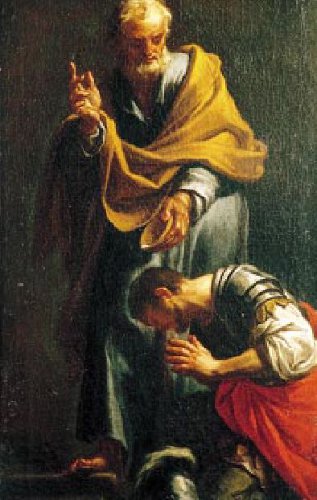
While Peter was still speaking these words, the Holy Spirit fell upon all those who were listening to the message. All the circumcised believers who came with Peter were amazed, because the gift of the Holy Spirit had been poured out on the Gentiles also. For they were hearing them speaking with tongues and exalting God. Then Peter answered, “Surely no one can refuse the water for these to be baptized who have received the Holy Spirit just as we did, can he?” And he ordered them to be baptized in the name of Jesus Christ. Then they asked him to stay on for a few days.

Acts 10:44-48

cornelius
Peter and Cornelius

Obviously the Roman (Gentile) Centurion Cornelius and all those other Gentiles in his household received the Holy Spirit. Peter and the Jews who were with him were direct witnesses to the event and it was something that was obviously apparent to them in a physical manifestation.

“These six brethren also went with me and we entered the man’s house. And he reported to us how he had seen the angel standing in his house, and saying, ‘Send to Joppa and have Simon, who is also called Peter, brought here; and he will speak words to you by which you will be saved, you and all your household.’ And as I began to speak, the Holy Spirit fell upon them just as He did upon us at the beginning. And I remembered the word of the Lord, how He used to say, ‘John baptized with water, but you will be baptized with the Holy Spirit.’ Therefore if God gave to them the same gift as He gave to us also after believing in the Lord Jesus Christ, who was I that I could stand in God’s way?” When they heard this, they quieted down and glorified God, saying, “Well then, God has granted to the Gentiles also the repentance that leads to life.”

Acts 11:12-18

Peter reported all this to the “apostles and the brethren” in Jerusalem, and after hearing his testimony, they glorified God saying “Well then, God has granted to the Gentiles also the repentance that leads to life.”

This was even confirmed later by Peter at the legal proceeding held by James and the Jerusalem Council for formally establishing the status of Gentiles in Messianic Jewish community:

After there had been much debate, Peter stood up and said to them, “Brethren, you know that in the early days God made a choice among you, that by my mouth the Gentiles would hear the word of the gospel and believe. And God, who knows the heart, testified to them giving them the Holy Spirit, just as He also did to us; and He made no distinction between us and them, cleansing their hearts by faith.”

Acts 15:7-9

Clearly, God intended for non-Jews to enter into the community of faith and be saved in a manner identical to the Jews, receiving the Holy Spirit, just as the Jewish believers did.

More than that, it was foretold long before these events that many nations would turn to the God of Israel:

Many nations shall become a people unto Me, but I will dwell among you — then you will realize that Hashem, Master of Legions, has sent me to you.

Zechariah 2:15 (Stone Edition Chumash)

Every Knee Shall Bow
Photo credit: art.jkirkrichards.com

The Tanakh is replete with prophesies regarding the nations turning to God at the dawning of the Kingdom of Heaven, a Kingdom Yeshua’s advent inaugurated into our world, but I’ll only quote this one as it was part of last week’s Haftarah portion.

It seems my last blog post caused a disturbance among some of my non-Jewish readers relative to the uncertainty of our status in modern Messianic Jewish community. It was never my intension to upset or disturb anyone. Actually, quite the opposite.

I wanted to emphasize that even though, as we saw in the passage I quoted from Zechariah, God will dwell among Israel, even as He rules the entire world, Gentile lives matter, too. We’re not just an afterthought in God’s redemptive plan. We are not just God’s left-handed, red-headed step-children, the ones you hide in the closet when company comes over. We have a very specific purpose in the Kingdom.

But it’s sometimes easy to get the idea that Gentiles are indeed an afterthought given all the emphasis on Jews and Judaism on Messianic Jewish websites and blogs, and in such publications, and sermons.

However, I also brought up some uncomfortable ideas regarding our existence in my previous article: we don’t have a very exact roadmap regarding mitzvot or lifestyle, at least nothing as detailed as do the Jewish people.

I decided to focus on the Holy Spirit in today’s “morning mediation” for a few reasons:

I will give you a new heart and put a new spirit within you; I will remove the heart of stone from your flesh and give you a heart of flesh. I will put My spirit within you, and I will make it so that you will follow my decrees and guard my ordinances and fulfill them.

Ezekiel 36: 26-27 (Stone Edition Tanakh)

This is part of the New Covenant promises Hashem made to Israel, the giving of the Holy Spirit, which we saw fulfilled in Acts 2 when it was given to the Jewish Apostles, and in Acts 10 when Peter witnessed it being given to the faithful Gentiles in the household of Cornelius.

But it’s interesting that a promise made exclusively to Israel somehow was transmitted to those Gentiles who came to faith in Yeshua as the foretold Messiah.

Actually, we have another giving of the Spirit that needs to be included.

Then Yeshua came from the Galil toward the Yarden to Yochanan, to be immersed by him. But Yochanan tried to prevent him, saying, “I need to be immersed by you, and yet you come to me?” Yeshua answered and said to him, “Permit me, for so it is appropriate for both of us to fulfill the entire tzedakah,” so he permitted him. When Yeshua was immersed, he quickly came up out of the water. Heaven was opened to him, and he saw the spirit of God descending in the likeness of a dove, and it rested upon him.

Matthew 3:13-16 (Delitzsch Hebrew Gospels)

hebrews_letterPart of what I learned in listening to D. Thomas Lancaster’s sermons on the Holy Epistle to the Hebrews is that Yeshua, as the arbiter of the New Covenant, came, in part, to deliver “samples” of the New Covenant blessings to Israel, and apparently through them, to the Gentiles. This was to be evidence that God will indeed keep His promises to Israel (and somehow some of those promises also apply to the nations) at the appropriate time.

We see the New Covenant promise of the giving of the Holy Spirit in Ezekiel 36, we see Yeshua receiving the Spirit in Matthew 3, the Apostles receive the Spirit in Acts 2, and some faithful Gentiles receive it in front of Jewish eyewitnesses in Acts 10.

This should be pretty encouraging to some of the people who were dismayed at the content and discussion regarding my chopped liver blog post.

There’s just one problem:

The eunuch answered Philip and said, “Please tell me, of whom does the prophet say this? Of himself or of someone else?” Then Philip opened his mouth, and beginning from this Scripture he preached Jesus to him. As they went along the road they came to some water; and the eunuch said, “Look! Water! What prevents me from being baptized?” [And Philip said, “If you believe with all your heart, you may.” And he answered and said, “I believe that Jesus Christ is the Son of God.”] And he ordered the chariot to stop; and they both went down into the water, Philip as well as the eunuch, and he baptized him. When they came up out of the water, the Spirit of the Lord snatched Philip away; and the eunuch no longer saw him, but went on his way rejoicing.

Acts 8:34-39 (NASB)

The Ethiopian eunuch (a subject worthy of his own study), who was (in my opinion) most likely a Jew, did not receive the Holy Spirit, or at least Luke didn’t record it. But why, if he received the Spirit, would Luke have omitted this important point? If it was just assumed by Luke, then why did he include that the eunuch was baptized, which also could have been assumed?

Furthermore:

It happened that while Apollos was at Corinth, Paul passed through the upper country and came to Ephesus, and found some disciples. He said to them, “Did you receive the Holy Spirit when you believed?” And they said to him, “No, we have not even heard whether there is a Holy Spirit.” And he said, “Into what then were you baptized?” And they said, “Into John’s baptism.” Paul said, “John baptized with the baptism of repentance, telling the people to believe in Him who was coming after him, that is, in Jesus.” When they heard this, they were baptized in the name of the Lord Jesus. And when Paul had laid his hands upon them, the Holy Spirit came on them, and they began speaking with tongues and prophesying.

Acts 19:1-6

Apparently it’s possible to come to faith in Yeshua, to receive a water baptism, but not to receive the Holy Spirit.

tongues of fireI’m just shooting in the dark at this point, but as a believer for many years, while I can recall the moment I came to faith, no specific physical event occurred indicating that I had received the Holy Spirit. I was baptized in the Boise River along with my wife and children in August of 1999, but nothing like the Acts 2 or Acts 10 events occurred (although Acts 10 does not describe what Peter witnessed that told him Cornelius and his household had received the Spirit except that they spoke in tongues  and praised God).

Is it possible in the community of faith for some of us to possess the indwelling of the Spirit of God and others to not possess it? Further, with no physical evidence of the Spirit resting upon us as described in the multiple Bible quotes I’ve offered, how can we say the Spirit is on us or in us at all? Did you speak in tongues and utter prophesies? I didn’t.

I know that there’s a general consensus in Evangelical circles that the “age of miracles” ended when Christian Biblical canon was closed, but there are all sorts of anecdotal stories other Christians tell of spiritual manifestations and even miracles that happen all around us (though they seldom if ever make it into mainstream news reports).

I don’t have a definitive answer to all this. Maybe someone out there does. I have to take it on faith that I do possess the Holy Spirit, only because Christian tradition says I must if I’m a believer.

On the other hand:

Not everyone who says to me, “My master! My master!” will enter the kingdom of Heaven, but rather the one who does the will of my Father who is in heaven. It will be that on that day many will say to me, “My master, My master, did we not prophesy in your name and in your name drive out demons and in your name do many wonders?” Then I will answer them, saying, “I have never known you. Depart from me workers of evil!”

Matthew 7:21-23 (Delitzsch Hebrew Gospels)

That’s rather sobering.

Think about it. There’s a class of believers who are capable of performing actual supernatural acts, apparently in the name of Yeshua, and yet, the Master does not know them and even calls them “workers of evil”.

How about this?

But also some of the Jewish exorcists, who went from place to place, attempted to name over those who had the evil spirits the name of the Lord Jesus, saying, “I adjure you by Jesus whom Paul preaches.” Seven sons of one Sceva, a Jewish chief priest, were doing this. And the evil spirit answered and said to them, “I recognize Jesus, and I know about Paul, but who are you?”

Acts 19:13-15 (NASB)

I’m not sure this is an example of what Yeshua was talking about, but just paying the Master lip service, so to speak, doesn’t seem to be enough to get you “into the club,” as it were.

So what do we do as faithful Yeshua-followers?

Yeshua said to him, “Love HaShem your God with all of your heart, with all of your soul, and with all of your knowledge.” This is the greatest and the first mitzvah. But the second is similar to it: “Love your fellow as yourself.” The entire Torah and the Prophets hang on these two mitzvot.

Matthew 22:37-40 (Delitzsch Hebrew Gospels)

I know Yeshua was speaking to a Jewish audience, but I think that it is appropriate to consider this a commandment that also applies to us, that is, we non-Jews in Messiah. Why shouldn’t we also love God with all of our resources and love other human beings as we love ourselves? It would seem this “Torah” is one that also forms the core of our existence as disciples of the Master and worshipers of Israel’s God.

I still feel like I’ve opened a can of worms I can’t seem to close again. With all of this, what are we supposed to do next, particularly if we, in some way, exist either directly or tangentially in Jewish community?

That might take a long time to find out. Certainly an inventory of each and every instruction Paul gave in his epistles to the Gentile disciples, as viewed from a Paul Within Judaism perspective, would be in order.

109
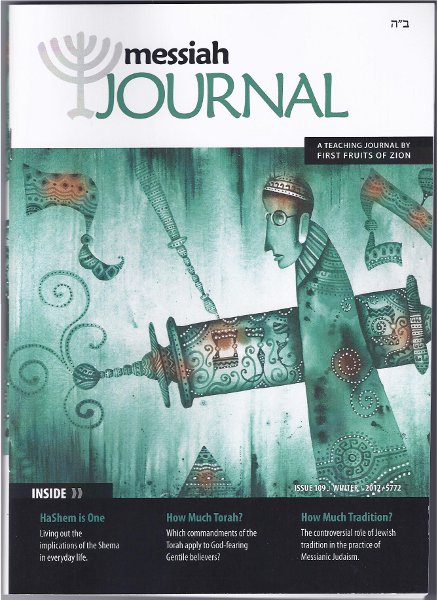
Messiah Journal 109

Actually, back in February 2012, First Fruits of Zion (FFOZ) published an article written by Toby Janicki in Messiah Journal issue 109 called The Gentile Believer’s Obligation to the Torah of Moses. Unsatisfied with my original review which I wrote at the time, I wrote another one over a year later (which was nearly two years ago now).

It doesn’t answer the conundrum regarding the Holy Spirit or how some people could sincerely believe they were serving Yeshua and yet be so horribly wrong, but as far as getting some sort of handle of who Gentiles are supposed to be in what is essentially, a Jewish religious form, it might be a good place to start, at least for those of you who are experiencing a crisis of community.

The rest will have to come along by the by.

In the Merit of Jewish Torah Observance Revisited

Rabbi Chayim Shmuelevitz used to comment on this that just as those who support Torah study financially have the merit of the Torah study of those they support, so too anyone who influences another person to study Torah shares in the merit of that person…

…Parents who influence and enable their children to study Torah have this merit, as do wives who enable their husbands to study Torah.

-Rabbi Zelig Pliskin
“Influence others to study Torah,” p. 309
Commentary on Torah Portion Bamidbar
Growth Through Torah

NOTE: It was brought to my attention that the previous incarnation of this blog post contained erroneous information. I have re-edited the text, images, and links to remove those errors.

Yes, I know this is midrash. I have an interesting relationship with midrash. I think of it as not so much literal fact or even a hidden spiritual truth, but rather as metaphor, a way to communicate something about people and their relationship to each other and to God.

As I write this, it’s Sunday morning and the first full day of Shavuot. Yesterday, my wife went to synagogue for Shabbat services and last night she returned for a study on the Book of Ruth, which is a traditional study for Jews on Shavuot. Not long from now, she’s leaving for shul again to help with the food preparations for the Shavuot gathering (all this will be over by the time you read these words).

As I mentioned a few days ago as well as on other occasions including this one, it is not only important to me as a general principle to encourage Jewish return to Torah study and observance, it’s important to me personally as a husband.

Rabbi Pliskin, citing Rabbi Shmuelevitz, commented that parents who encourage their children to study Torah, and wives who encourage their husbands to study Torah receive the merit of studying Torah themselves, even if they never actually do so in any regard.

in the merit of our forefathersYes, that’s midrash. We don’t really know through Biblical exegesis (at least those of us who lack a traditional religious Jewish education) how God views these “merits,” or if they represent some objective reality. However, I prefer to take this metaphor as an encouragement.

Of course, Rabbi Pliskin is writing to a Jewish audience and is not presupposing a non-Jewish husband married to a Jewish wife, but I believe there is some merit, even if it only exists inside my heart, in me encouraging and supporting my wife in Torah study and observance, even in the smallest degree. No, it’s not that God expects or requires me to observe Torah in the manner of the Jewish people, but I do think He expects and requires all non-Jewish disciples of the Master to recognize that we only receive the blessings of the New Covenant, such as the indwelling of the Holy Spirit and the promise of the resurrection, through the merit of Israel. After all, the New Covenant was made only with Israel and it is only through the mercy of God and the faithfulness of Messiah that we Gentiles can receive any of those blessings at all.

In return, what shall we do? Claim the Torah for ourselves as if we too stood at Sinai (which we didn’t)? Only the Jewish people can make that assertion. However, we can do the next best thing. We can encourage, support, and promote the Jewish return to Torah study and observance since it is the Jewish heritage and inheritance.

For nearly twenty centuries, Christianity has made a concerted effort to separate Jews from Torah, Talmud, and synagogue. Today, even the most enlightened churches continue to believe that the only way to “save” a Jew (or anyone else) is to have them exit Judaism and surrender any vestige of Torah study and observance, and instead to take on the traditions of the Gentile Christian Church.

But the Biblical record is clear that God has repeatedly urged the Jewish people, from Moses to Paul and beyond, to observe and obey His Torah, and when they don’t, the consequence is exile or worse.

burning talmudMistakenly, for the past two-thousand years, the Church has promoted and encouraged the Jewish people to disobey God, further exacerbating Jewish exile. By God’s grace, He has overridden our futile efforts to further damage the Jewish people and Judaism by re-establishing national Israel and beginning to return His people to their Land, all in preparation for the time of the Messiah and the completion of the New Covenant promises.

He has also drawn some few of we Gentiles to a greater knowledge of the Torah and specifically our esteemed and valued role as supporters of the Jewish people and their return to the mitzvot.

Hashem said to Moses, “Go to the people and sanctify them today and tomorrow, and they shall wash their clothing. Let them be prepared for the third day, for on the third day Hashem shall descend in the sight of the entire people on Mount Sinai.”

Shemos (Exodus) 19:10-11 (The Kestenbaum Edition Tikkun)

As Moses obeyed Hashem in directing the nation of Israel to be sanctified before God in preparation to receive the Torah, we Gentiles can take our cue from this lesson and, not direct, but rather clear the path for Jewish return to the Torah.

I’m in a rather unique position as a Yeshua-believing Gentile husband being married to a non-believing Jewish wife. I have a built-in opportunity to support her involvement in Jewish community and in Torah study and observance. Many of you don’t have that specific opportunity, but I believe many of you have others of which you can take advantage.

One of these things is not like the othersI believe that individual Christians and the Church as a whole has the opportunity to change its narrative from being anti-Torah and anti-Judaism to just the opposite. No, I’m not encouraging Gentile believers to take up the Torah as such, but they/you/we can start preaching and teaching the extreme value of Jewish Torah observance in God’s plan of global redemption. We’ve tried to take God’s gift of the Torah away from the Jewish people for untold centuries. It’s time we repented of this sin and made amends. It’s time we got out of Judaism’s way, including Messianic Judaism.

Without the Jewish Messiah King and without a Torah observant Israel, there are no blessings to radiate out to the nations. Ironically and tragically, by Christianity’s efforts to separate the Jewish people from Torah, we have been cutting ourselves off from the Savior of the World, the Church’s beloved Jesus.

According to Rabbi Yirmiyahu Ullman, it was on the festival of Sukkot each year when seventy oxen were sacrificed for the sake of the seventy nations of the world, that is, the global population of non-Jews:

Thus our Sages taught, “You find that during the Festival [Succot], Israel offers seventy oxen for the seventy nations. Israel says: Master of the Universe, behold we offer You seventy oxen in their behalf, and they should have loved us. Instead, in the place of my love, they hate me (Psalms 109).” Further, they remarked: “If the nations of the world would have known the value of the Temple for them, they would have surrounded it with a fortress in order to protect it. For it was of greater value to them than for Israel [instead, they destroyed it]” (Bamidbar Rabba 1).

If it is true that the ancient Roman armies, in destroying the Temple, were destroying Israel’s ability to offer atonement for the Gentiles before God, how much more so has the Christian Church, in striving to separate the Jewish people from Torah, been destroying the New Covenant salvation offered to us by Messiah, by Christ?

We can change this. There’s still time. Do what I do for I believe what I’m doing is right. If nothing else, at least get out of the way of Jewish people, both those in Messiah and otherwise, in returning to the Torah. If you have Jews in your church, encourage them to light the Shabbos candles, listen to podcasts on Torah study, read fine commentaries on Torah such as those published by Rabbi Pliskin. Encourage them to become more observant as Jews.

sefer torahMost importantly, if they are willing, encourage them in learning of how Jewish Torah observance and devotion to Messiah not only go hand in hand, but are absolutely necessary to fulfill and complete the redemptive plan of God for all Israel, and through Israel, the entire world. Then we Gentiles may be able to say that we have earned, however metaphorically, the merit of Torah study and observance, not by doing so ourselves, but by being part of the Messianic plan to return the Jewish people to their Torah and their Land.

Book Review of Paul Within Judaism, The Question of Identity: Gentiles as Gentiles–but also Not–in Pauline Communities

I have long puzzled over how to understand the gentiles in Paul, both from his perspective and their own perspective. I operate under the assumption that he is writing primarily to them and his goal is to articulate and manage just how they are connected to Israel through Christ. In the process, as I have discussed elsewhere, both he and they undergo various transformations in identity, changes that, I maintain, never separate him from Judaism and that affiliate gentiles with Israel but not as full members. They are not Jews and, in my view, they are not Christians…

-Caroline Johnson Hodge
Mark D. Nanos and Magnus Zetterholm, Editors
“The Question of Identity: Gentiles as Gentiles–but also Not–in Pauline Communities”
Paul within Judaism: Restoring the First-Century Context to the Apostle (Kindle Edition)

More than the previous essays I’ve reviewed from this volume, this one speaks in detail not only to the identity issues involved in being a “Gentile in Christ” in the time of the Apostle Paul, but also to those of us who call ourselves “Messianic Gentiles” today.

For the vast majority of mainstream Christians in churches, this identity conundrum does not exist. Being “Christians” is self-defining and self-explanatory and perhaps anachronistically, they believe they have direct one-to-one connectedness of identity with Paul’s own Gentiles. According to Hodge, nothing could be further from the truth, or at least further from the facts.

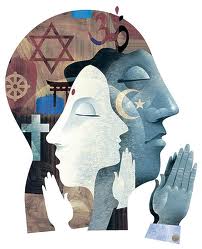
Many scholars use the term “Christian” for these gentile believers, even though there is fairly widespread agreement that it is anachronistic. There are good reasons not to use it: Paul does not use it himself…

At the scholarly level, it may well be agreed that Paul did not consider the Gentile disciples “Christians” nor that there is much, if any, comparison between the ancient ekklesia and the modern Church. Nevertheless, at the level of the local church and the local Pastor, I have heard it preached, specifically to Acts 20, that there are close comparisons that can be made between ancient believers and today’s Christian in the pew.

This is another case of the lag between academic discourse and what most Christians hear preached from the pulpit. It’s not so much because these Pastors are unaware of new research, but that such information does not make a good fit, either with the Pastors’ theology and doctrine or what would be accepted by their parishioners.

According to Hodge, Paul calls his Gentile disciples “beloved, holy ones, faithful ones, brothers and sisters, and a new creation,” but if they weren’t “Christians,” who were they?

She argues that defining their identity remains somewhat elusive and that these “gentiles occupy an in-between space, hovering around the borders of identities that they are not quite.”

ChurchThat’s not particularly satisfying but I know exactly how that “hovering” feels in my personal and congregational experience in various Messianic communities, or at least those few I’ve had the opportunity to visit.

Hodge’s line of pursuit in attempting to examine this “identity problem” is to trace how Paul “draws upon Jewish conceptions of gentiles, especially where they approach the boundaries of Jewish identity.”

Is it possible that there’s more than one kind of Gentile? According to Hodge, in the late Second Temple period when Paul was operating, there were two broad categories.

There’s the Jewish concept of the “generic” Gentile, that is, anyone who isn’t Jewish is a Gentile, regardless of how differentiated people from one culture or nation may be from another.

Then there are Gentiles in Christ, the disciples made by Paul and others.

And in Paul’s usage, this term has a doubleness to it in that there are two kinds of gentiles. First, there are the audiences of his letters, whom he addresses explicitly as gentiles in a number of places (Rom. 1:5-6, 13; 11:13; 15:6). Second, there are all the other gentiles who are not in Christ, the sort of gentiles that believers used to be.

That narrows things down but only a little. This believing group of Gentiles used to be, but no longer are, like the generic not-in-Christ Gentiles that populate the world. They used to be them but now they’re something else, occupying “a kind of liminal space between being those kinds of gentiles and now these kind of gentiles.”

Some of the characteristics of “these kinds of gentiles” in Christ include rejecting “idolatry and sexual immorality and [to] practice self mastery in holiness and honor.'”

Further:

Elsewhere Paul describes this as the life of the spirit, which they receive at baptism, so that, Paul says, “the just requirement of the Law might be fulfilled in us” (Rom. 8:4). But he is adamant that they not keep Jewish Law, especially with respect to circumcision for male gentiles. Indeed, gentiles-in-Christ are not quite gentiles and not quite Jews.

This level of ambiguity may have ultimately been unsustainable and resulted in the eventual schism between the Christ-believing Gentiles and the Messiah-believing Jews, although Hodge doesn’t address this point in her essay.

Who am IShe does say that while remaining gentiles, these non-Jewish believers did participate in Jewish community and Jewish practices, behaving “Jewishly” but not being Jewish, as Mark Nanos has previously stated.

In fact, there may have been “a sliding scale of gentile participation in Judaism” such that there was no one fixed standard for the behavior of non-Jews in Jewish community and worship space.

I hope I’m not being anachronistic in applying this to those modern “Messianic Gentiles” who operate within Jewish spaces such as Beth Immanuel (although arguably, Beth Immanuel could be recognized as a Gentile space that behaves very “Jewishly”) and Tikvat Israel. From personal observation, I’ve seen a wide degree of variability in just how “Jewish” many non-Jews behave within these communities and elsewhere.

Perhaps this isn’t a matter of a lack of accepted standards for Gentiles, but a reflection of the necessity of process for non-Jews in community with Jews.

Hodge approaches her investigation from two avenues: one that uses the logic of lineage and the other one that uses the logic of purity.

Seed of Abraham

Hodge cites Ezra, particularly Ezra 9, and Jubilees chapter 30 to illustrate how purity of lineage was used to create a strong distinction between the Jewish people and the rest of the world, effectively excluding Gentiles from community with Israel. Not just the priests, but each individual Jew was defined as “holy unto the Lord,” set apart, unique, special, particularly from the goyim.

Furthermore, Jubilees uses the holy seed idea to distinguish between gentiles and Jews. Although gentiles number among Abraham’s seed…

…they are not part of the holy seed that belongs with God…

And that holy seed that belongs with God” began with the progeny of Abraham’s son Isaac. It is of this holy lineage which Jubilees refers to as a “kingdom of priests.”

Paul uses the same argument, only leveraging it for Gentile inclusion rather than exclusion. His rather unique interpretation states that in the promise that Abraham will be the father to many nations, and that this promise was made before the giving of the Torah, the Gentiles-in-Christ inherit the role of “Abraham’s seed” due to the faithfulness of Messiah.

As I have discussed at length elsewhere, baptism in Paul is a ritual adoption, creating a kinship relationship between gentiles and Abraham (Gal. 3; Rom. 4)…

Indeed, one of these promises, foretold by Scripture to Abraham long ago, is that, “All the gentiles (ethnê) will be blessed in you” (Gal. 3:8; Gen. 12:3; 18:18).

Paul’s own creative interpretation of Scripture allows him to claim that these ethnê mentioned in Genesis are those gentiles who have been baptized into Christ. We should not be surprised at their inclusion in God’s plan; they were present in Abraham’s body at the time of the blessing.

puritySo, according to how I’m reading Hodge, Paul was employing not so much a literal interpretation of scripture, but using widely sweeping metaphors, his own personal midrash, to make linkages between Abraham and the Christ-believing Gentiles. Once having undergone baptism as a symbolic rite of adoption, a new kinship was formed between the faithful Gentiles and the Jews in Messiah.

However, the term “adoption” should not be assumed to be the same as the legal process in modern American courts whereby a child who is not biologically produced by two married people becomes legally indistinguishable from any children born to the marital couple.

Although the “Messianic Gentiles” who are “adopted” through the rite of baptism are equally “in Christ” with their Jewish counterparts, equally apprehending the blessings of the New Covenant, such as the Holy Spirit and promise of the resurrection, Hodge emphasized repeatedly that this “adoption” did not make the gentiles Jewish nor did it in any sense obligate them to observe the Torah mitzvot in the manner of the Jews.

Paul’s rather complex metaphorical language in his epistles was necessary to articulate a concept that even today is not well understood. Just how are Gentiles included in any of the blessings of a covenant God made exclusively with Israel? The “Abraham connection” is the key, but even then, as we continue to discover through Hodge’s article, exactly who and what we Gentiles are in Christ remains a puzzle, at least in the details.

Holy Bodies

The second tact Hodges employes is the sense of the Gentiles being set apart in Christ, being holy and in need of protection.

Paul does not develop a concept of a holy seed, but he does develop the idea of holy bodies for gentile believers. In 1 Corinthians 6, Paul offers a “before and after” assessment of the Corinthians…

Earlier in this review, I mentioned two types of gentiles in Paul’s day, believing vs. non-believing gentiles:

Here Paul seems to refer to their baptism with the term “washed,” implying that he understands it as a purifying rite that brings the gentiles into right relationship with God. In this passage and in others that similarly mark the baptized gentiles as now holy…

And…

As priestly bodies are “holy to the Lord,” Corinthian bodies “belong to the Lord” and not to porneia (1 Cor. 6:13, 19-20).

…so Corinthians are “members of Christ” (6:15) and must protect this holy body.

fragmented-bodyFrom Hodge’s perspective, the believing Gentiles in Corinth underwent “a material transformation that makes them into the Jewish body of Israel’s messiah.” Citing Benny Liew, she further states, “…on this multiethnic mixture, ‘Paul is engineering here nothing less than an inter-racial/ethnic bodily substitution….The Corinthian body…is, in other words, built on and through a racial/ethic other…'”

That’s a little difficult for me to get my brain around and it doesn’t seem to clear up who we “Messianic Gentiles” are supposed to be except that we are neither fish nor fowl, so to speak. The bottom line of this section of Hodge’s essay is that Gentiles in Messiah have a “holy, mixed identity.”

Gentiles as a Part of Israel’s Story

According to Hodge, the “seed of Abraham” argument and the “purity” discourse serve two separate rhetorical purposes. The Galatians “seed” commentary was focused primarily on explaining why Gentiles are not required to observe the Torah mitzvot as do the Jews. This is because their/our identity as “gentiles-in-Christ” and how we become part of Israel’s story is through Abraham and before Moses and the Sinai event. We are recipients of the promise to be Abraham’s children from the nations who can only fulfill that promise by remaining Gentiles.

While the Jews have a very specific set of responsibilities defining their identity, it’s not so clear what the obligations of the believing Gentiles are except:

In 1 Corinthians, Paul responds to competing ideas about how to live this new life in Christ. Throughout his letter he tries to control gentile bodies, urging harmony, cooperation, and self control. These persuasive aims are responsible at least in part for the ways Paul portrays gentile identity in each.

That’s bound to be a little disappointing to modern Messianic Gentiles who are hoping for something a little more codified. Nevertheless, we do have the general guidepost of separating ourselves from other, non-believing Gentiles and from our former lives, in order to live a life in Messiah that is pure, decent, and sanctified, being inhabited by the “pneuma” of Christ. We are called to worship the God of Israel as Gentiles and not as Israel. This was non-negotiable for Paul.

…when Christ returns to establish God’s kingdom, it is necessary for Israel and the gentiles to worship God not as one people, but as separate peoples–now worshipping together, as expected in the awaited age. Paul is clear in Romans 9-11, where he lays out this larger plan, that Jews and gentiles remain separate.

Rethinking the Question

maskSo, what is the real question?

If my analysis has shown that Paul’s portrayal of gentiles as mixed or ambiguous makes some sense in Jewish context of eschatological expectation, it simultaneously raises some important cautions about the concepts of identity. My initial question–who are the gentiles?–itself assumes that there is an answer…

But what if there isn’t an answer? What does that mean for Yeshua-believing Gentiles in Jewish communities today?

Hodge raises two problems. The first is that any assumption about the answer presumes an identity that is overly simplistic. While a nice, neatly wrapped gift of well-defined Gentile identity might be satisfying, it could also sell who we are in Messiah short, denying the complexity of our role and function in the Messianic ekklesia.

The other problem is that such an assumption confuses the strategies of the speaker, that is Paul, with a description of reality.

Remember, I called Paul’s letters an exercise in metaphorical or midrashic writing. Such commentaries are not meant to be taken in an overly literal manner, and yet much of Christian exegetical tradition does just that. If we’re attempting to build a literal model out of metaphorical material, no wonder we have chronically misunderstood Paul in the Church.

Hodge states:

…his [Paul’s] rhetoric is prescriptive, not descriptive, and his goal is to coax the gentiles to think and behave in certain ways.

Citing Brubaker, Hodge writes:

…that ethnic identity should be viewed as a process, a perspective on the world, rather than a thing that exists independent of human arguments.

I read that as Messianic Gentiles not having a fixed, static identity in Jewish space but rather, we are in the process of becoming, not just being. Also, that identity likely flexes depending on our specific circumstances and our relationship to Jewish community.

In the ancient world, there were “myriad social formations” that contributed to identity and I don’t think anything has changed relative to Gentile identity in Jewish space. While Galatians 3:28 defines both Jew and Gentile as “one in Christ,” that “oneness” does not imply identical identity in any manner. It does define a place where Jew and Gentile meet and whereby we take on a shift in identity from who we Gentiles were without God to who we are now with God.

But God is a God of Israel as well as the world and when a Jew comes to faith in Messiah, he/she changes less than does the Gentile.

The Jewish PaulThe Jew already has an identity with God as defined through the covenants. Faith in Messiah is the next step in the revelation of God to Israel, a continuation along the same, straight line. For the Gentile, the change in identity is radical to the extreme. Everything we were before as individuals and as people groups undergoes transformation. In ancient days, a lot of that transformation borrowed from Jewish praxis simply because no other model was available.

But now, as it existed then, Gentiles in Jewish community remain Gentiles and behave “Jewishly” on a sliding scale of behavior depending on role and circumstances, but still only vaguely defined. Being a Messianic Gentile is a continual journey of discovery, not a destination where we can hope to arrive, at least anytime soon.

I’ve found Hodge’s article thoroughly enjoyable and hopefully you will find it equally illuminating. Being Gentiles-in-Messiah isn’t about who we are but who we are becoming. Each day is new and we are new with the coming dawn.

Judaism is not all or nothing; it is a journey where every step counts, to be pursued according to one’s own pace and interest.

-from the Ask the Rabbi column
Aish.com