Tag Archives: messianic judaism

What Are We Looking For From God?

I recently blogged about a Christian turned Noahide who I accidentally discovered on the blogspot The Torah Way. In describing this person’s “journey” away from faith in Jesus (Rav Yeshua) to a traditional Noahide or “Righteous Gentile” viewpoint and praxis, I neglected to examine what they wrote on their other blog Cozy Kitchen Chats believing it was more or less a collection of recipes and other food related articles.

As it turns out, this is an older blog and contains a lot more detail about this woman’s (one of the things I discovered) spiritual travels.

I’m not trying to pick on her or demean her in any way. I do, however, find that what she’s been through over the past several years is illuminating, because she comes from a place that should be familiar to many of my readers.

Let’s go to the beginning, the very first blog post from July 17, 2014:

To formally introduce you to my Cozy Kitchen, I absolutely need to share with the you the Foundation of my world, Jesus Christ, the Son of God, my soon coming KING. I had always been brought up in the church, although I had bounced around from church to church seeking and hungering for something deeper. I tried small town churches, large Mega churches, Pentecostal churches, Baptist churches, even Catholic churches. Each had amazing truths and amazing people, but nothing felt comfortable to me. My heart was always drawn to the Church described in the Book of Acts.

This is a person devoted to Jesus as Savior and King in search of a church that reflects the Biblical “prototype” church, the ideal church where one can draw close to the Spirit of Jesus. Apparently, she couldn’t find it.

All I know is that I personally needed to walk away from everything I knew about the modern day church. I spent two years aggressively seeking God to show me the Truth, regardless what it may cost me, I wanted to know that I know Him and that I am following Him wholeheartedly. I read everything I could about the religions most commonly found in the United States. I set aside all that I knew, wiped away all the prejudice that I held and explored each asking the Holy Spirit to show me the Truth.

This part is funny in an ironic way, given where she’ll end up.

…at first I honestly didn’t like the Jesus I was learning about. Oh, I loved how others in the Bible would describe Him, but when I read His words, I thought they were harsh, aggressive and difficult to understand. I really liked Paul much more than Jesus, Paul’s teaching were soft and easy, Salvation by Grace alone, no actions or responsibility, once saved, always saved. Paul was much more appealing.

MessiahShe goes on to say that in order to learn more from Jesus, she set aside Paul’s writings so she could sit at the feet of her Master. That’s how she started out her blog.

I am here exclusively to show the Love of God to you and to serve you and others in anyway I can. Opening up my Cozy Kitchen Chats with you, I will share with you the Gospel of Jesus, how to have a thriving Christian home, how to serve your community and how to make YOUR own Cozy Kitchen your personal mission field.

But less than three months later:

I know this is topic that can really set some “believers” off balance, since there has always been a belief that the Torah or the Life Teaching and Instruction of God, given to Moses was done away with at the resurrection of Yeshua (Christ)

Nowhere in the Prophets nor in the instruction that was given to Moses was it ever mentioned that the Law would be done away with. During Yeshua’s time on earth, He never mentioned that the Law or the Word would be dismissed. He actual said the following.

First, she described a general dissatisfaction with all of the churches and Christian denominations she experienced and was determined to study the Bible at the feet of Jesus and gain wisdom from the Holy Spirit alone.

Then she discovered the Torah, started calling Jesus “Yeshua,” and described her understanding in terms more familiar with someone who was just introduced to either the Messianic Jewish or Hebrew Roots movements.

Based on a link she posted, her source material came, at least in part, from 119 Ministries (as of this writing, there’s a JavaScript pop-up that asks if you’re new and you have the option to click “Yes” or “No”. However, the box doesn’t go away when you click either button, so website content is blocked unless you edit the URL to go to the home page — Addendum: This problem has apparently been fixed, although the site still has connection difficulties).

Subsequently, she started writing about kosher foods, her opinion of the Christian Church and of Pastors continued to decline, she became focused on Sacred Name theology, and she decided that Christmas was pagan, thanks to 119 Ministries, and stopped celebrating it.

I don’t know if she actually started donning tzitzit, but it looks like she wanted to. Shabbat became important to her.
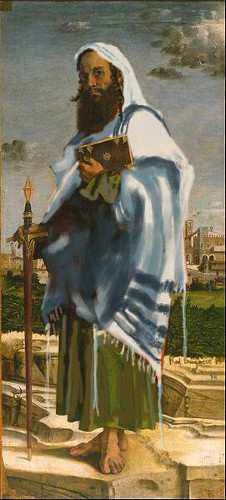
The Jewish PaulA really critical point though, is that her attitude about the Apostle Paul (Rav Shaul) changed remarkably. Remember, at the very beginning, she loved Paul’s teachings, but thought Jesus was too harsh and aggressive.

Don’t allow the mindless teaching of man separate you from the TRUTH. The Pharisees over taught the law with man made regulations to overwhelm man so he would not honor it, then the new Pharisees (Paulines, followers of Paul’s teaching rather than Jesus’) discounted the Sabbath with man made doctrines so men would not follow it. Seek God’s instruction to find the Truth.

Here, she’s reversed her original position and now sees the teachings of Paul in opposition to those of Jesus. Ironically (again), she denigrates the “man-made laws “of the “new Pharisees” and believes only in seeking God’s instructions of truth in Jesus. I say ironically because when she became a Noahide, she had to accept the validity of the teachings of the Rabbinic sages and their authoritative interpretations of Torah, which most Christians call “man-made laws”.

And most Christians consider the Sages to be something like “the new Pharisees”.

Here’s a little more:

A husband that truly LOVES his wife will catch on. Believers that are TRULY following, TRULY LOVING Him, TRULY READING Him will catch on. They will start to step away from Paul’s teaching or rather “un-teaching” and will seek to find out what the WILL of the Father is and what is meant by the “Word of God.” it’s an exciting time! An Awakening!

I’m emphasizing this because abandoning Paul is usually a major step in leaving Christianity, Hebrew Roots, and Messianic Judaism for a non-Jewish believer, since so much of our understanding of how to apply Torah to the Gentile and to live a life as devoted disciples of Rav Yeshua, depends on what he wrote.

She found this to be the best teaching on Paul she ever heard. I had a difficult time following the link and managed to navigate to the 119 Ministries video teachings page and found the correct video by searching for the lesson’s title: “The Deuteronomy 13 Test.”

I thought I should investigate what she was listening to in order to discover what was influencing her thinking and beliefs. The textual introduction to the “Deuteronomy 13 Test” states:

Have you ever considered why the Jews reject the Jewish Messiah, our Lord and Savior…What if it was because many today misunderstand Paul…Millions of Jews reject the Christian presentation of Jesus and Paul, alarmingly, because the Word of God says to. Sadly, if the misunderstanding continues, Jews are forever prevented from not only not knowing their Jewish Savior, but also from experiencing the blessings of the New Covenant. This teaching exposes the gap in the misunderstanding, and takes a first step into building a bridge…

119 video
Screen Capture: 119 Ministries

The video (about 41 minutes long) wasn’t exactly what I expected. It seemed, at the beginning, to be both very pro-Jesus and pro-Paul. The video instructor said that although Jesus and Paul didn’t teach against the Torah of Moses, but they did teach against the Oral Traditions, what is known today, according to this “teacher,” as the Talmud.

This instructor’s first mistake was defining the traditions and praxis of the Pharisees in the late second Temple period as the Talmud, which would not actually exist for centuries (Mishnah c. 200 CE, Gemara c. 500 CE)

This is very much an anti-Judaism (including Messianic Judaism) lesson. I needed to understand a little more about 119 Ministries itself. According to their site’s About page:

Our purpose is to seek and bring the truth to all nations, unlearn false doctrines and traditions of men, and to equip the body to live and practice the Word as God originally intended.

We find that continuously examining the Scriptures (in the same Hebraic first century context and perspective in which they were written and understood) reveals to His people much more understanding, as opposed to the more common Greek mindset that is a couple thousand years removed.

Sounds pretty much the same as when a Fundamentalist church says their doctrine is the only “sound doctrine.”

It’s difficult to tell if 119 Ministries is specifically “One Law” or “Two House,” but their Faith Statement says in part:

Another purpose of Yeshua was to begin calling back the scattered 10 tribes of Israel that were divorced, scattered, and became Gentiles.

This at least suggests a Two House theology, although it’s hardly conclusive.

Frankly, in listening to the above-mentioned anti-Judaism video teaching, it’s amazing that this woman finally became a Noahide, since as far as I can tell from her blogspot, 119 Ministries was her primary and possibly her only source of information relative to Hebrew Roots.

Listening to the 119 teacher was hard for me since his lesson was not only almost totally opposed to my personal beliefs, but it was thinly disguised anti-Jewish rhetoric which not-so-subtly was also a presentation of supersessionism, misappropriating the Torah from the Jewish people and denying observant Jews the right to establish their own interpretation of Torah.
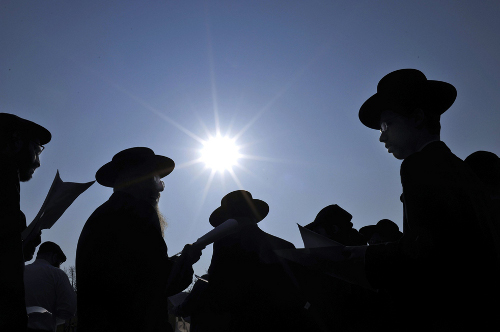
Orthodox JewsAbout halfway through the video, the teacher started hammering away against modern observant Jews. To be fair, he seemed just as prejudiced against normative Christianity.

The 119 Ministries video teacher says he wants to bring Jewish people to faith in Yeshua, but his attitude toward observant Jews is so poor that I can’t imagine any Jewish person wanting to listen to this fellow. In this, his concept of Jewish people who “reject Jesus” is pretty much that of normative Christianity, at least in its worst expression.

This teacher is a great example of how a person who continually quotes from the Bible (and he did so, scripture after scripture) can still grossly misrepresent the intent of Hashem, Rav Yeshua, and Rav Shaul (In doing some subsequent research, I discovered that the people behind 119 Ministries are well-meaning and kind, but I still have to disagree with almost all of their conclusions).

Toward the end of the video, the teacher cited Romans 11, Ephesians 2 and Numbers 15:15-16 as “proof” that the Law of Moses was meant to be observed by, not just the Children of Israel and their descendants, but by all humanity, so he tips his hand, so to speak, and reveals that his ministry supports One Law. He does it however, in a really easily refuted way, so I readily set it aside.

(I found this half-hour long YouTube video of an interview with the two guys who founded and operate 119 Ministries, Steve and John. They seem like really nice guys. If you want to get to know who they are and why they started their organization, click the link).

The bulk of this blog’s content was written between July and December of 2014. The last blog post of 2014 was published on December 15th. The next missive, the last one here, was from January 24, 2016, and is simply a link to her article Leaving Christianity at The Torah Way.

There’s a gap of over a year where something must have happened, where her fascination with 119 Ministries and what they teach must have waned in the extreme. She would never have become a Noahide if she was listening to their anti-Judaism, anti-Jewish people diatribes.

interfaithI wonder if she and her family (she’s married with two children) went through something like this:

Jewish Values vs. Other Faiths

I am struggling with the sense that on one hand I want to instill Jewish beliefs in my children, but on the other hand I feel this would be diminishing the value of other faiths. I feel that love, harmony and happiness are the most important values, and that we need to be accepting of everyone’s beliefs. People are different, so isn’t truth relative for each individual?

The Aish Rabbi Replies:

This is an important question, one that I think goes to the heart of today’s society.

If you think about it, you’ll realize that “truth” cannot simply be everything that everyone wants.

from the “Ask the Rabbi” column
Aish.com

I think this blog writer held on to the love and truth of Torah she discovered early on, but for some reason, everything else had to give way. Maybe she finally figured out that the video teachings she was consuming ultimately didn’t hold water and actually disrespected the Jewish people who are the sole human objects of the Sinai Covenant.

I don’t know. She took the path of many Christians who become disillusioned with the Church and find Hebrew Roots as an alternative. Eventually, it becomes too difficult to balance love of Torah but not of Judaism and Jews, as well as seeing Yeshua and Shaul being depicted as somehow against their own people.

Granted, a life either in Hebrew Roots or Messianic Judaism isn’t easy. If you’re a believing Gentile, being a Christian is the path of least resistance, and if you are an observant Jew, then Orthodox Judaism is probably a more understandable option.

But if you’re a Gentile who comes to doubt first Paul and finally Yeshua, and who believes normative, observant Judaism to be true, what do you do?

Jewish ConversionYou either convert to Judaism or become a Noahide.

I don’t know if these individuals finally end their search for truth (or TRUTH as the subject of today’s “meditation” likes to write it). We all want to know who we are from Hashem’s perspective, and what His purpose is for our lives. We all want the easy, pre-programmed answer, where we don’t have to think, we don’t have to doubt, and we don’t have to be anxious.

We all want to settle down and relax, secure in the knowledge that we are finally “right” about everything and we have nothing else left to search out and study, and no other questions to ask that we might not find ready-made answers for.

Good luck with that.

Not to say that there aren’t plenty people in houses of worship all around the world who don’t feel settled and secure and who have stopped asking all but the most elementary of questions. But I think that a sense of insecurity, at least a little bit, is built into our relationship with God.

If we finally come to the point where we have no more questions, then we are saying that there’s a limit to God and His relationship with us.

I can accept a person who goes through a developmental process in their faith, exploring and seeking to understand what the Bible is really saying. I’ve gone through that process and am still progressing along that path. I probably never will arrive at a “settled” place, though there are a few things I accept in my understanding now.

But there’s a difference between that and moving around from one faith discipline to another seeking a “TRUTH” that answers “everything”. A human being’s relationship with Hashem is more “edgy” than that. Just look at anyone in the Bible who was close to God. Abraham wasn’t settled and comfortable, neither was Moses. None of the Prophets had peaceful lives. Paul certainly didn’t. If anything, when Rav Shaul was introduced to Yeshua, his life became remarkably “unpeaceful”.

Why should our lives be any different?

A final word. Paul’s life was unsettled and violent and yet in his relationship with Messiah, he said he found “the peace of God, which surpasses all comprehension” and that guards “your hearts and your minds in Christ Jesus” ( Philippians 4:7 NASB).

peaceThere’s a peace that goes beyond our day-to-day lives, and even beyond our occasional crisis of faith as we continue to study the Bible. There’s a peace we only find if we lay aside our doubts and turn to Him in trust, knowing He desires that we draw close to Him. All the religious pundits in the churches, synagogues, on streaming video, and in the blogosphere don’t hold a candle to authentic trust in Hashem and the peace that He brings to our troubled souls.

I hope the anonymous woman whose journey I’ve attempted to chronicle finds peace in God.

But I also hope she never stops asking questions.

What Defines The People of God?

Chosen People Racist?

What’s behind the whole concept of the Jews as the Chosen People? Isn’t this idea racist?

The Aish Rabbi Replies:

All human beings are God’s people, as it says that Adam and Eve were created in the image of God. Further, the great prophet Malachi said, “Have we not all one father? Has not one God created us?” (Malachi 2:10) The Talmud likewise points out that one reason the entire human race descends from a single set of parents, Adam and Eve, is so that no one would be able to claim his ancestors are greater than his fellow’s (Sanhedrin 37a). Judaism does not believe there is an inherently superior race of human beings.

-From the “Ask the Rabbi” column
Aish.com

Yesterday, I posted a blog article called Giving Up the Identity Crisis, which was based on material I reported on in Where Are All The Gentiles Who Are Drawn To The Torah?; a comparison between modern Noahides and their communities, and we “Messianic Gentiles” or, if you prefer, Talmidei Yeshua (Gentile Disciples of Jesus).

I’ve been pondering the ramifications of giving up the identity crisis and becoming more comfortable with who I am. Relative to our relationship with God, there’s only really one thought to consider: you’re either Jewish or you’re not.

new heartThe Jewish people, the modern inheritors of the covenants Hashem made with the Children of Israel, are the only named participants in those covenants. For the rest of us, by attaching ourselves to the Jewish Messiah, we attach ourselves to Israel and thus by God’s grace and mercy, we are allowed to benefit from some of the blessings of the New Covenant.

But as the quote from the Aish Rabbi states, if the Jewish people are not inherently superior to the rest of humanity, and if we’re all created in the image of the Almighty, then why are there distinctions between Israel and the people of the nations at all?

Historically, however, the world slipped away from its relationship with God, and eventually the entire world was worshipping idols. Approximately 4,000 years ago, Abraham re-discovered the one God, and chose to accept the challenge of spreading the ideas of monotheism and morality to the world. Through his dedication and willingness to give up everything for God, he was chosen – and his descendants after him – to become the guardians of God’s message.

In other words, Abraham chose God, and thus God chose Abraham.

Abraham then passed this responsibility to his sons Isaac and Jacob. That mission was formalized 3,300 years ago at Mount Sinai, when God put these ideas into a written form (the Torah).

Oh, that.

Yes, Israel became the keepers of the Torah of Moses for many, many centuries as well as the only nation on the planet that paid homage to God and obeyed His laws and statutes.

the crowdOf course, in that time, there were a number of non-Jews who, seeing the wisdom and beauty of the Torah, attached themselves to Israel and eventually, after the third generation, assimilated completely into Israel, leaving behind their non-Israelite lineage.

But God didn’t desire that humanity either have to convert to Judaism (which is how modern Jews view the ancient assimilation process) or be out of relationship with Him. And while modern religious Jews believe that humankind is born into a relationship with the God of Israel through the Noahide covenant (see Genesis 9 and AskNoah.org), God had a better plan.

That plan was absolutely not to replace Israel and Judaism with Gentile Christianity. That plan was and is for the people of the nations to benefit from God’s ultimate redemption of Israel by redeeming us as well, at least those of us who accept that Moshiach is the mediator of the New Covenant, trust in him and obey God’s commandments as they apply to the Goyim.

We aren’t born into this covenant relationship, but we are grafted in essentially as “alien residents” among Israel (symbolically, since most of us don’t live among the Jewish people in national Israel) so that the barriers that previously separated us from Israel have been resolved.

Of course, this doesn’t mean that all Christians and all Jews get along. Quite the opposite in some cases. But it does mean that the Gentiles and Jews who revere Rav Yeshua (Jesus) within the context of the ekklesia (which does not mean “church”), and trust in Hashem to save, are part of a larger Messianic community that will be fully realized upon Moshiach’s return.

I’ve said all this before in one way or another, so why am I repeating myself (yet again) now?

jew and gentile
Martin Luther King Jr. in the front line of the third march from Selma to Montgomery, Alabama with Rabbi Joshua Heschel, March 21, 1965

Because (and this is a gross oversimplification) once you learn that the only two identities you can have are “Jewish” and “Other” within the devotees to Israel’s God, there’s not much else to be concerned about.

But like I said, this is a gross oversimplification. People love labels and love to differentiate between groups by those labels and what they think those labels mean.

However, what we call ourselves and what we tell ourselves that means is probably less important than what we actually do about it. Is the non-Jew who says he or she “observes the Shabbat” any more or less loved by God or created in His image than the non-Jew who volunteers at the local food bank, donates clothing to the local homeless shelter, or who spends time with hospitalized friends and relatives because tzedakah (charity) was made part of our obedience to our Rav and thus to God?

Don’t get me wrong, I think the blessing of lighting the Shabbos candles is very beautiful, and so is inviting God into the home to share our rest, but the Shabbat is a unique sign of the Sinai covenant, a covenant Hashem made exclusively with the Children of Israel (and the mixed multitude present who would assimilate into the Israelites within three generations).

Once we acknowledge that we are either Jewish or not and we learn to be OK with that, our identity problems go away for the most part.

I am a (non-Jewish) disciple of my Rav.

Another person might say “I am a (non-Jewish) Christian,” and essentially mean the same thing.

OK, there are differences, but if I obey my Rav by donating to my local homeless shelter and the Christian obeys Jesus by donating canned goods to the local food bank, are we not both being obedient and following his commands? Are we not both being faithful in the same way to the same Master?

churchSure, you might say that Christians believe in supersessionism, or deny that the Jewish people are still attached to God through the commandments and the Torah, or that they believe that Jesus “nailed the Law to the cross,” but which of us has a theology and doctrine that is 100% correct from Hashem’s point of view?

Probably no one. And yet with an imperfect understanding of the Bible, our Rav, and our God, we can still do good in His Name. That very likely describes 100% of Christians and observant Jews.

One Christian denomination rails against another spending a lot of time and resources to do so. One branch of religious Judaism rails against another spending a lot of time and resources doing so. And good grief, just look at those of us who live, study, and worship “outside the box,” so to speak. We waste a lot of time arguing about distinctions this and distinctions that.

Isn’t there a better way to use our resources and to obey our Rav?

There is once you let go.

Someone on a closed Facebook group recently asked non-Jewish group members why they became Messianic Gentiles and what was the biggest obstacle they had to overcome in entering into Messianic Jewish community.

I know these are important questions and answering them facilitates a sense of community among those who participate, at least a virtual community since these people (potentially) live all over the world, but in some ways, making that distinction also facilitates the identity crisis.

Inner lightWho is a Messianic Gentile and what does that mean? What’s a Messianic Gentile’s relationship with Messianic Jewish community and how (or if) do we fit in? There are a bunch of other questions attached to those and there is no one unified answer.

But what if those aren’t the most important questions to ask and asking the right question gives us a better answer?

We are all created in the image of God. The Aish Rabbi said that the Jewish mission is to be a light to the nations. My interpretation is that Rav Yeshua is that light (John 8:12) and by becoming his disciple, we too become lights to the world (Matthew 5:14-16).

Maybe all we really have to answer is the question, “How can I better shine my light onto the world?” That’s a totally inclusive question because it applies to everyone, Jew and Gentile alike. Sure, the answer is somewhat different depending on whether you’re Jewish or not, but not as much as you think.

Both the Jew and the Gentile are commanded to do kindness and give charity. Both the Jew and the Gentile pray. Both the Jew and the Gentile give thanks to God for what He provides us from His grace, mercy, and generosity (Psalm 145:16).

I’ve stopped worrying about what to call myself (this is a lot easier for me because I’m not part of a religious community that has a label and expects that label to mean something specifically defining). I suppose there are any number of words that others use to define me. My Jewish wife for instance, considers me a Christian. From her point of view, she’s probably right.

Who am IBut what about God’s point of view? Maybe the identity He assigned us, the person He created each of us to be, is based less on some theological system of belief and more on what we do about it.

If you behave like the person God created you to be, and strive each day to become a truer realization of that person, who cares what people call you? Who cares what you call yourself? It matters most of all how God sees you and your (our, my) response to Him.

Who am I? What do I call myself? Why, I’m “me”. I’m doing my best to be the person God created me to be. Or like Batman said, “It’s not who I am underneath, but what I do that defines me.”

The Question of Gentiles and Judaism

Dear Rabbi,

I have a question that has bothered me/intrigued me for years. What was Jesus’ true name? What was the name his mother called him? His disciples? The name that he told them that you can do all things “in my name.” I thought ya’ll may have something in your archives that would point to an answer.

Rabbi Rachael Bregman
“Rabbi, What’s Jesus’ Nickname?”
MyJewishLearning.com

I was a little surprised to read such an article at My Jewish Learning, but I guess I shouldn’t be, since the “About Us” page for this site states:

MyJewishLearning.com is the leading transdenominational website of Jewish information and education. Offering articles and resources on all aspects of Judaism and Jewish life, the site is geared toward adults of all ages and backgrounds, from the casual reader looking for interesting insights, to non-Jews searching for a better understanding of Jewish culture, to experienced learners wishing to delve deeper into specific topic areas.

The word “transdenominational” suggests a somewhat more liberal perspective relative to Judaism and perhaps other religious streams. But it wasn’t just that Rabbi Bregman considered the question, but the answer she gave that interested me. Here’s part of it:

This is from a real email I received.

I am a rabbi in a small city on the coast of Georgia; as the only rabbi in a 75-or-so-mile radius, I get many emails and phone calls with all kinds of questions from folks in the Christian community. This one is a favorite for several reasons.

First of all, there is a place where Judaism and Christianity intersect, and that place is Jesus. I love how the writer is looking to me, the local go-to expert on all things Jewish, to help him navigate that intersection. For his sake and for ours, I wish there was an archive of Jewish stuff , where we could look there to not only help our Christian, Muslim and other-faith friends understand their religions better but to also gain deep insight into our own. I mean, a great way to understand the tensions around Jewish religious practice at the time of the Second Temple is to read the Gospels.

By the way, Bregman never gets around to attaching a Hebrew name to Jesus, but she did end her brief blog post with this:

I don’t know any other names for Jesus, or for Allah or Buddha or Brahman, or for God. But what I learned from this man’s email is that many of us are seeking that name, and by sharing the search with one another we enhance the journey for us all.

rabbi bregman
Rachael Bregman – Photo: jacksonville.com

I think what I was impressed with the most was that Bregman seemed completely unthreatened by the question and didn’t mind taking a stab at the answer that wasn’t in some way dismissive of the Christian questioner. Even in my own home, bringing up certain subjects with my Jewish wife (the Apostle Paul being one of them) is likely to be met with a rather icy response.

So I decided to find out what I could about Bregman.

Rachael Bregman knows she doesn’t fit most people’s concepts of a rabbi, at least as seen on TV.
“They’re always old men with earlocks. They’re called peyas,’’ she said of the strands of uncut hair in front of the ears. “That’s spelled p-e-y-a-s … maybe. I know how to spell it in Hebrew.”

Bregman is a 36-year-old divorcee who left Atlanta three weeks ago with her rambunctious 8-month-old dog Safi, a pit bull-ridgeback-Lab mix, at least those are the breeds Bregman thinks she has identified.

Bregman knows big-city life, having grown up in Boston and lived in Atlanta, but she was drawn to Brunswick by the size of Temple Beth Tefilloh, a Union of Reform Judaism congregation chartered 127 years ago.

-Terry Dickson, July 24, 2013
“Woman is Temple Beth Tefilloh’s first rabbi in 50 years”
jacksonville.com

She also has a Facebook page that’s pretty accessible as long as you’re logged in to Facebook.

I know some people, both Jewish and otherwise, who have issues with female Rabbis (or with female authority in general), Reform Judaism, and liberal political and social viewpoints, but at least she seems approachable, even if asking a Rabbi about Jesus’s name might be somewhat awkward.

Of course many of the comments on My Jewish Learning’s Facebook page were a little less than completely cordial:

Daniel C: I’ve been following MJL for quite awhile and this is the first I’ve seen posted on the matter. If they now have Messianic Jewish leanings then they’ve become a Christian organ and I will no longer be following them.

Carol C: Agreed. Jesus has nothing to do with Judaism. We do not study him or ever mention him in our learning. But since the inception of Christianity his followers have used his name to persecute and murder us. Can’t deny that.

D.E: My Jewish Learning is not a JEWISH resource but a trans-denominational collaboration of mostly misinformed christians and URJ adherents. That it exists does not make it authoritative.

Lori F: Has this become a “jews for jesus” site now?

interfaithAnd the beat goes on. Actually, these responses are pretty predictable, although nothing I read in the original article seemed to support the idea of a Jew having any sort of “approach” to Jesus.

A number of Christians and “Messianic” folks also commented in a more direct attempt to answer the question, but that didn’t go over well. One Jewish fellow even called “Messianic Judaism” an “oxymoron,” but I can’t locate the specific entry anymore.

In spite of recent comments from the Vatican and the suggestion of a partnership between Christianity and Orthodox Judaism, I still think we have a long way to go in having a more comfortable conversation take place between Gentile “Talmidei Yeshua” and Jewish people.

I certainly don’t blame any Jew for experiencing some sense of threat at the idea of a Christian “incursion” into Jewish historical, social, and religious space, but from my particular point of view, it is occasionally frustrating. However, even my highly unusual theological and doctrinal viewpoint won’t earn me any points within normative Judaism anymore than it does with my long-suffering wife.

Still, as a Gentile, once you’ve accepted a certain “Judaicly-aware” consciousness regarding the central message of the Bible, particularly the New Covenant, and how the nations of the world even have a place in a wholly Jewish document, it’s difficult to not want to build some sort of “interface.”

But there are limits, sometimes rather severe ones. Having acknowledged to the Jewish people, including those within Messianic Judaism that what’s yours is yours, whether within Jewish community or standing outside of it, we non-Jewish yet “Judaicly-aware” Talmidei Yeshua struggle to find a place where we belong.

I sometimes suspect that’s why many/most/all of the non-Jews associated with the ancient Jewish community of Yeshua followers in the early decades and centuries of the common era finally broke away from their mentors and teachers in what I’ve previously termed a rather ugly divorce, in order to create a brand new religious entity (Christianity) where the Gentile might feel more at home.

That “solution” has worked out, albeit in a very uneasy (gross understatement) manner, for nearly twenty centuries now, but for a few of us on the fringes of both Christianity and Judaism, that’s not good enough anymore.

NoahOf course, normative Judaism’s response to someone like me is to give up Christianity in any form and become a Noahide or “righteous Gentile”. Judaism maintains that the rest of the world doesn’t need to convert in order to be “saved,” so it doesn’t actively seek converts. In fact, it tends to discourage conversion for a variety of reasons.

But according to this JTA news story published a few days ago, a group called the National Center to Encourage Judaism is attempting to break through that “taboo”.

Maybe it’s the centuries of living under Christian and Muslim rule. Maybe it’s the history of forced conversion. Maybe it’s that there’s no religion requirement for the Jewish afterlife.

Whatever the reasons, Jews have traditionally been uncomfortable proselytizing.

But a Maryland foundation is flouting the taboo by funding outreach programs to non-Jews in an effort to bring them into the fold.

I read an article years or even a decade or so ago (so I can’t remember the source) suggesting that Jews attempt to convert Gentiles to Judaism as a matter of Jewish survival, since except among Orthodox Jewish communities, Jewish families are in a decline.

But again, this effort is not without its Jewish critics:

Eli W: If these people weren’t so ignorant of Jewish law they would realize that soliciting converts if prohibited and that the conversion process they’re advocating wouldn’t result in valid conversions anyway.

Of course if these people weren’t so ignorant of Jewish law the attrition rate from their movements wouldn’t be so shockingly high and there would be no need for conversions to replenish dwindling numbers.

So maybe a proper Jewish education for Jews might be a better idea than trying to recruit non-Jews?

Mark J: when was it ruled that soliciting converts is prohibited? Before or after Moshe Rabenyu married his shiksa? The ban on soliciting conversions was made under duress as was the end of polygamy and I am sure many other rulings by ersatz rabbis who ruled out of fear of gentiles…

Eli W: Did you ever hear of work called the Shulchan Aruch? That and predecessor works like the Tur and Maimonides Mishna Torah have defined normative Jewish law for centuries. They preceded the crackpot websites that seem to be your source for Jewish law.

kiruv
Photo: OU.org

Dave M: Eli, you are very right on may of your comments. Except, my friend, many many groups are doing kiruv work eg. Chabad, Aish etc. but still the total result has been sadly very little. I am not sayng to stop. I am just saying let’s just ALSO put the information out there on the internet ie. information about Judaism in terms a non-Jew who knows nothing about Judaism can understand. Let’s spread the light of Torah around the world by talking about Judaism not by hiding it under a bushel basket.

There are voices that potentially could be involved in this debate that I’ve left out, mainly because I didn’t stumble across any convenient articles about them. Certainly Evangelical Christianity would have an opinion about Jews proselytizing Christians. Imagine an individual Jew or Jewish family going door to door in a largely Gentile/Christian neighborhood passing out booklets citing the social and spiritual advantages of becoming a Jews.

I don’t see that happening and I do believe that the Church would probably push back pretty hard if it ever did (also keep in mind that occasionally, converts to Judaism become vulnerable to abuse within Jewish community).

Then, of course, there’s what people in the Messianic Jewish and Hebrew Roots movements would have to say about it. Periodically, non-Jews involved in either movement decide to shoot out the other side and convert to (usually Orthodox) Judaism, mistaking becoming a Jew as the primary means of having a relationship with God.

In many ways, it would be so much easier to accept that Jews are Jews and Christians are Christians and that they are separate communities with nothing in common. If Christians would just mind their/our own business and keep their/our noses out of Jewish community, everyone would be happy.

So being “Judaicly-aware” and a self-described “Talmid Yeshua” is a somewhat risky venture. Many non-Jews have felt the necessity to convert to (non-Messianic) Judaism because of such an awareness, remain Gentile and claim the Torah as belonging to them anyway, or gone the two-house, “I’m a member of a lost tribe” route, essentially saying that they’re already Jewish and thus the Torah is theirs, too.

I have another solution. How about learning to be comfortable in your own skin?

That doesn’t mean you, as a Gentile, have to learn to be comfortable in a church. I tried that for a couple of years and it didn’t work out.

So, you either live near enough to a religious community that is accepting of Jews and non-Jews who are “Talmidei Yeshua,” or you just admit to yourself that you are who you are and that you don’t fit into someone’s pre-conceived identity category.

That has the disadvantage of meaning that you, more often than not, will have no community to which you relate, unless you can find one online. However, it has the advantage of meaning you don’t have to constantly argue with people, since you aren’t claiming anything that belongs to any other person or group.

Up to JerusalemThe double-edged sword is building an identity for yourself that’s consistent with what the Bible says about righteous people of the nations who become disciples of Rav Yeshua. If you’ve been reading this blog for any length of time, you know that’s not such an easy thing to do. On the other hand, at least you have the freedom to create yourself.

If you are a Talmid Yeshua and are in a church (and you’re open with your opinions and beliefs), you are liable to butt heads with clergy and worshippers. The same if you are in a normative synagogue. So you either keep your mouth shut (easier for some people more than others), find a more compatible community, or believe that God accepts you as you are, even if most people don’t.

From Judaism’s point of view, anytime a non-Jew expresses an interest in Judaism the question is, “What do we do with these Gentiles?” Certainly the Apostle Paul (Rav Shaul) faced that question on many occasions. It’s the whole point of the events Luke recorded in Acts 15 relative to the legal proceeding establishing Gentile status in ancient Jewish community, and the resultant “Jerusalem letter.”

As you’ve read above, these aren’t issues contained only within Messianic Judaism and Hebrew Roots. They’re spilling over into many other Jewish venues as well. They probably always have. And normative Judaism doesn’t seem to have any better answer to this question than the rest of us do, and we have the rather gruesome history of how the Church has treated the Jewish people and Judaism to thank for it.

I know that there are all kinds of religious pundits in a wide variety of camps who think they have the definitive answer. I think it’s much more interesting to explore the question and to keep creating a better “me,” whoever that happens to be and whatever that means to God.

Not a Noahide

I periodically “lurk” in a private Facebook group for “Messianic Gentiles.” I was actually surprised to have access to this group, but discovered that a friend of mine, who was already a member, added me as a member as well (I guess ordinary group members can add anyone they want without having to go through a moderator).

Anyway, I peek in every now and then to see what people are talking about. As it turns out, there are a lot of comparisons being made there between these Messianic Gentiles and Noahides. Some of the recent references have been posts originating at the Noahide World Center, specifically a free e-book download of a Siddur for Noachides as well as the same siddur as an app for Android.

I too have wondered in the past if there’s a favorable connection between being a non-Jewish disciple of the Jewish Messiah King and being a Noahide, at least relative to a non-Jews’s status and role in Jewish religious and communal space.

To that end, I began to peruse the AskNoah.org forums and even, at one point, exchanged messages with a Rabbi.

That didn’t end well and I concluded that my journey into considering myself a “Ger Toshav” with an unusual Messianic twist had hit a brick wall.

I took another look at their forums just now but can’t quote anything because each one displays the disclaimer:

All material posted to this forum becomes the exclusive copyright property of Ask Noah International Inc., and may not be published or re-used elsewhere without the express permission of Ask Noah International Inc.

OK. I’ll respect that.

So let’s go to the source:

Then God spoke to Noah and to his sons with him, saying, “Now behold, I Myself do establish My covenant with you, and with your descendants after you; and with every living creature that is with you, the birds, the cattle, and every beast of the earth with you; of all that comes out of the ark, even every beast of the earth. I establish My covenant with you; and all flesh shall never again be cut off by the water of the flood, neither shall there again be a flood to destroy the earth.” God said, “This is the sign of the covenant which I am making between Me and you and every living creature that is with you, for all successive generations; I set My bow in the cloud, and it shall be for a sign of a covenant between Me and the earth. It shall come about, when I bring a cloud over the earth, that the bow will be seen in the cloud, and I will remember My covenant, which is between Me and you and every living creature of all flesh; and never again shall the water become a flood to destroy all flesh. When the bow is in the cloud, then I will look upon it, to remember the everlasting covenant between God and every living creature of all flesh that is on the earth.” And God said to Noah, “This is the sign of the covenant which I have established between Me and all flesh that is on the earth.”

Genesis 9:8-17 (NASB)

NoahAccording to numerous sources including Jewish Virtual Library, the seven general laws for all of humanity derived from this portion of Genesis 9 are:

  1. Do Not Deny God
  2. Do Not Blaspheme God
  3. Do Not Murder
  4. Do Not Engage in Incestuous, Adulterous or Homosexual Relationships.
  5. Do Not Steal
  6. Do Not Eat of a Live Animal
  7. Establish Courts/Legal System to Ensure Law Obedience

Whether or not God holds the entire human race to these standards in the final judgment we’ll just have to wait and see. However, is this applicable to the non-Jewish disciple of Rav Yeshua (Jesus)? Does our devotion to our Rav not distinguish us at all from a non-believing world of secular atheists?

Granted, a non-Jew who becomes a self-declared Noahide is not an atheist, since he or she is professing faith in the God of Israel, but then again, the seven basic standards a Noahide adopts are also the standards that the rest of humanity will be judged by. No difference in expectation, except the Noahide voluntarily acknowledges those expectations while the non-Noahide either couldn’t care less or has some other moral/ethical/religious orientation that may or may not embrace some or all of the Noahide laws.

To be fair, I don’t think the private Facebook group I mentioned above sees non-Jewish Messianic disciples as wholly equivalent to Noahides in all respects. I think it’s a model for attempting to construct a relationship between (Messianic) Gentiles and Jews in (Messianic) Jewish religious and communal space.

It may also be an attempt to equip said-Gentiles with a set of tools and resources that are at once consistent with (Messianic) Judaism and also specifically crafted for the Judaicly-oriented non-Jew (hence the siddur for Noahides).

MessiahHowever, I think we need to be exceptionally clear that we take on board more as disciples of Yeshua than what the Noahide receives. While we non-Jews are not named participants in the New Covenant (see Jeremiah 31:27), through Hashem’s great grace and mercy, we non-Jewish devotees of our Rav are granted access to many of the blessings of the New Covenant, which includes the indwelling of the Spirit, the forgiveness of sins, and the resurrection into the world to come.

These are blessings identical to what the named participants of the New Covenant, that is, the Jewish people…Israel, will receive in Messianic Days. God made the covenant with them, but He also is “not wishing for any to perish but for all to come to repentance” (2 Peter 3:9).

The plain text of Genesis 9 really only promises that God won’t destroy all life by flooding again. It’s not even made exclusively with human beings, but with every living species. There’s no mention of attaining a spiritual knowledge of Hashem through His Spirit dwelling within us. Nor does this covenant speak of forgiveness of sins, and certainly not of everlasting life in the Kingdom of Messiah.

However, these blessings are all well documented in the New Covenant language we find in Jeremiah 31, Ezekiel 36 and elsewhere in the Tanakh (what Christians call the “Old Testament”).

I prefer to think that being a disciple of our Rav gives us a different role and status than the Noahide, although there certainly can be some overlap.

I’ve been approached online, both in the comments section of this blog and privately by email, to “come over to the Noahide side, we have cookies.” Both Jews and Noahides have attempted to induce me to abandon Rav Yeshua, and while I don’t doubt their motives are sincere, I have asked them to respect my wishes and my faith and desist.

I know there are non-Jews who consider themselves Noahides in the two synagogues in my local community. More power to them. We don’t interact, mainly because I don’t have a connection to local (or remote for that matter) Jewish community.

isolationBut even in isolation, once we have declared our devotion as disciples of our Rav, we have an obligation to stay the course, regardless of the personal difficulties involved. Who said a life of faith was easy? Who said you’d be accepted by everyone or anyone?

If I were a “standard” Christian, going to church each week and being in Christian community would serve my needs (but not my family’s needs), however those of us who view God, Messiah, and the Bible through a more “Jewish-focused lens,” are really neither fish nor fowl. We don’t fit in the Church and it would be disingenuous of us to attempt to enter Jewish community in the guise of a Noahide.

The aforementioned Facebook group is an attempt to offer the “Messianic Gentile” some sort of interface into Jewish community on their own grounds and using their own resources to define their roles, both among Jews and among themselves. That’s probably a good thing, though no one group can meet the needs of everyone who may identify as one of them (or something similar).

However, at the end of the day, you need to know who you are in relation to God and what that means (and doesn’t mean) for your life. Assimilating into a church as a Christian might be the easy way out, but it’s not who we are. Assimilating into a synagogue (Messianic or otherwise) as a Noahide might be the easy way out, but it’s not who we are (and forget about converting to Judaism, Orthodox or otherwise…the people of the nations are to have a role in the Kingdom).

WaitingWhether the rest of the Christian and Jewish world likes it or not, we were granted a unique place and role in relation to God and his plan of redemption, first for Israel, and then for the rest of us. Our particular perspective takes into account the primacy of Israel, the Jewish people and nation, in God’s plans, but it also acknowledges the special and specific place Rav Yeshua has as the mediator of the New Covenant and what that means to both Israel and the nations.

Traditional Christianity does (somewhat) the latter but not the former, while Noahides in Jewish community do the former but not the latter.

We do both…even if we have to do it alone.

Minor Convergence

I just returned from the Society of Biblical Literature conference in Atlanta and was flipping through a new book by James Dunn when I noticed the below discussion of Messianic Jews and footnote. Little by little, our little community is being recognized and appreciated.

-David Rudolph on Facebook

dunn rudolph

Although it’s more or less common for people writing from within the Messianic Jewish and Hebrew Roots movements to cite Christian scholarly sources, you don’t often find those sources acknowledging the existence, let alone referencing Messianic Judaism, and scholarly volumes written and edited by Messianic Jews. On the other hand, James D. G. Dunn has written on The New Perspective on Paul, so I would expect some overlap on viewpoint.

Today’s missive is intended to be brief. I just wanted to share this small mention of the Rudolph and Willitts volume in Dunn’s latest book, a volume which I reviewed in-depth (just search this blog for “Introduction to Messianic Judaism” to find all of my review articles).

Messianic Judaism is gaining some credibility, if not within the “average church,” then at least from one Christian scholar and researcher.

Can Messianic Judaism Directly Reach Out To Atheists?

An atheist cannot find God for the same reason a thief cannot find a policeman.

-Anonymous

Before anyone becomes upset, I am not saying that atheists are thieves. The quote simply means that an atheist cannot find God, not only because he/she isn’t looking for Him, but also because they are actively avoiding Him, just like a thief would avoid a law enforcement officer.

But it’s an interesting comparison, because if a cop did find a thief in the act of committing a crime, the thief would be “busted.” Once the thief saw the police officer and knew he/she couldn’t get away, they’d be facing the consequences for their actions.

arrestWhat happens when God “catches” an atheist? Well, this is where the metaphor starts to break down, because while God is aware of all human actions, we humans (and this is certainly true of atheists) aren’t always aware of God. Thus, although God sees our “crimes” (and any human action that opposes the will of God is the short definition of “sin,” which is analogous to “crime” in this example), we don’t see him “catching” us.

Rabbi Kalman Packouz posted the above-quoted sentence on this week’s Shabbat Shalom Weekly online column. He also said this:

Recently a friend of mine asked me, “Do you really believe in God?” When I answered “for sure” his response was “really?” Personally, I don’t find it particularly hard to believe that a rabbi believes in God. However, he seemed to be amazed that anyone believes in God.

In our experience at Aish HaTorah (a major international Jewish educational outreach organization), if you ask the young people who come through the doors of our world center in Jerusalem if they believe in God, four out of five will say “no.” What’s fascinating is that if you don’t ask the question directly, it’s possible to demonstrate to them that they do believe in God. Why? They are influenced by the society, the educational system and their friends to think that they don’t believe in God.

Do you want to demonstrate to someone that deep down they not only believe in God, but that they believe that God loves them? Here are the questions to ask…

I highly encourage you to click the link I provided above and read all of Rabbi Packouz’s discussion on how to illuminate anyone (or at least any secular Jew) to investigate their lack of belief in God. It’s really quite interesting (an equally enthralling question is if R. Packouz’s “method” were applied to non-Jews, would they become Noahides?). I’m not sure how it would play out for the rest of us, but on the surface, his arguments are compelling.

He finishes up his column with the following:

How can one intelligently deal with the question of the existence of God? Start on Aish.com and search the articles on “God” and “Evidence of God”. Go to AishAudio.com (search “evidence”) and listen to the four lectures “Evidence of God’s Existence” by Rav Noah Weinberg (the founder and head of Aish HaTorah and my teacher). Also, I highly recommend Permission to Believe by Lawrence Kelemen available at your local Jewish bookstore, at JudaicaEnterprises.com or by calling toll-free to 877-758-3242.

chabad
Credit: jewishvenice.org

I’m actually considering buying the Kelemen book (I’ve checked and it’s not available through my local library system), since it would be interesting to see how religious Jews reach out to secular Jews (besides the methods employed by Chabad).

It occurs to me that there’s a vacuum of this sort of information relative to Messianic Judaism.

Oh sure, Christianity’s efforts to evangelize the world are quite well known. If a traditional Christian wanted to know how to reach out to secular people in his/her community, all that person would have to do is approach their Pastor. I’m sure churches give classes on this sort of thing, and I know churches periodically organize their parishioners to canvas their local neighborhoods, knocking on doors, and handing out pamphlets.

But what does Messianic Judaism (and I’m using the term in the widest possible way) do to attract new members and to share their perspective on the “good news of Messiah?”

Just about anyone I’ve ever encountered, either within a Messianic Jewish (MJ) or Hebrew Roots (HR) environment, came to those venues by way of the Christian church. That is, whether they were Jew or Gentile, they first became a Christian and attended one or more churches before something happened to take them away from a particularly Christian viewpoint, and shifting them to a more Judaicly-aware perspective.

Oh, there may have been one or two exceptions, but I feel pretty confident, even based on anecdotal evidence, that most people, Jew and Gentile alike, come to a Judaic interpretation of all of the Bible, including the Apostolic Scriptures, only after converting to Christianity. I’m not saying that to be insulting. It just seems to best reflect the reality of how people come to the MJ or HR movements.

Of all of the resources available online and in brick-and-mortar stores, I can’t think of even one single book, audio, or video that teaches people like me how to share the message of Rav Yeshua (Jesus Christ) specifically from a Messianic Jewish perspective.

You may be wondering why some slight adaptation of traditional Christian evangelical methods couldn’t be used. However, Christians and religious Jews see the Bible, God, and faith in fundamentally different ways (Christians tend to be internally based, with their faith hinging on personal beliefs, while Jews tend to be externally based, with their faith being acted out through performance of the mitzvot). Messianic Judaism isn’t just Christianity wearing a kippah. It’s a Judaism that acknowledges the revelation of the Messiah as illustrated in the Apostolic Scriptures, and one that has an unusually liberal policy on Gentile admission.

With all that said, is it even possible to share a Messianic Jewish view of our Rav and what the Bible is saying about him and redemption directly with an atheist, or must Christianity and the Church always be the first step?

encounterActually some time ago, I thought I’d found one such resource. It was either a book or a lecture (or lecture series) on audio CD, but a Google search does nothing to find it. Maybe I was mistaken, or maybe whatever it was has leaked out of my memory for good.

Christians have a well-honed machine for evangelizing as many people as it can reach, and at least some corners of Orthodox Judaism understand how to communicate their faith to secular Jews, but what does Messianic Judaism bring to the table? Instead of appealing to Christians in churches to take a Messianic look at the Bible, at their faith, at their Christ, can they reach out to people who do not have faith at all?

Christians can (which is how I came to faith in the first place). Jews can (and I know of more than one religious Jew who started out as a secular adult, and then became religious). What about Messianic Judaism?