Tag Archives: midrash

Mourning for the Great Mountain

There is an interesting, but somewhat misunderstood, halachah. It has to do with not filling one’s mouth with laughter now while we do not have a Beis HaMikdash. In the words of the Orchos Tzaddikim: “One should only feel joyous in that which brings to enhanced service of God. He should never feel joy from that which causes another pain. For example, one who has wheat should not feel happy if there is a famine and he will make a large profit, since this is bad for others. One should also never take joy in another person’s death, even if he was left a legacy and will profit handsomely from this. Regarding such situations, one who shows proper decency and does not feel joy fulfills the mitzvah of ואהבת ’לרעך כמוך. One should accustom his heart to feel joy at his friend’s success. Most especially one should feel great happiness when he see others doing God’s mitzvos, since this is God’s will.

“Nevertheless, one should not fill his mouth with laughter in this world, as we find in Berachos 31. Since the Beis HaMikdash was destroyed, all joy has been mixed with sorrow. We also find in Niddah 23 that Rabbi Yirmiyahu tried to make Rabbi Zeira laugh but did not succeed.

When someone learned that the halachah not to fill one’s mouth with simcha is actually in the Shulchan Aruch, he was shocked and wondered how this could be prohibited.

He decided to ask the Sdei Chemed, zt”l, who was certainly a true scholar and fulfilled in every detail of halachah without compromise. “The halachah not to fill one’s mouth with laughter due to the destruction of the Beis HaMikdash is a middas chassidus. But this should not be confused with mockery. One who mocks is in one of the four groups that will not receive the Shechinah, as we find in Sotah 42!”

Daf Yomi Digest
Stories Off the Daf
“Rejoicing in the Right Way”
Niddah 23

This isn’t going to resonate well with most Christians because Christianity isn’t focused on the Temple as the point of connection between man and God. We focus on the life and spirit of Jesus Christ for that connection and, for most Christians, the Temple is superfluous. For most Christians, the Temple is a cosmic “so what?”

That’s kind of a shame because we may have to try to relate to it at some point, especially if traditional Jewish thought is correct and the Messiah, that is Jesus Christ, actually rebuilds the Temple.

The mashiach will bring about the political and spiritual redemption of the Jewish people by bringing us back to Israel and restoring Jerusalem (Isaiah 11:11-12; Jeremiah 23:8; 30:3; Hosea 3:4-5). He will establish a government in Israel that will be the center of all world government, both for Jews and gentiles (Isaiah 2:2-4; 11:10; 42:1). He will rebuild the Temple and re-establish its worship (Jeremiah 33:18). He will restore the religious court system of Israel and establish Jewish law as the law of the land (Jeremiah 33:15).

Judaism 101

However even if you have a tough time with that perspective, our story off the Daf can tell us a few other things, such as not rejoicing under circumstances when we win but someone else loses. We have a tendency to do that as human beings, but when we lose, when we’re hurt, when we’re afraid, we certainly don’t want others to feel happy about it. Most of the time, when we’re under duress, we don’t want people around us to feel happy about anything. We want them to feel upset, compassionate, and then try to help us.

What if a Christian sees a Jew under duress over the destruction of the Temple? I know it happened almost 2,000 years ago and Christians tend to think the Jews should “get over it” but that’s because we don’t understand the significance of the Temple in Judaism. We want Jews to realize that Jesus Christ is their temple and that it’s going to be all right because Jesus loves them. But most Jews aren’t going to relate to oto ha’ish that way, at least not right now (and I consider it a miracle any time a Jewish person does recognize the Jewish Messiah through the Gentile disguise that we have put on Christ).

I found the following footnotes for Chapter 11 of the Rambam’s The Laws and Basic Principles of the Torah at history.hanover.edu:

The whole of the following passage was deleted from most of the editions published since the Venice edition of 1574.

“If he did not succeed to this degree or he was killed, he surely is not [the redeemer] promised by the Torah. [Rather,] he should be considered as all the other proper and legitimate kings of the Davidic dynasty who died. G-d only caused him to arise in order to test the multitude. As it is written [Daniel 11:35], “Some of the wise men will stumble, to purge, to refine, and to clarify, until the appointed time, for it is yet to come.”

“Jesus of Nazareth who aspired to be the Mashiach and was executed by the court was also spoken of in Daniel’s prophecies [Daniel 11:14], “The renegades among your people shall exalt themselves in an attempt to fulfill the vision, but they shall stumble.”

The rest of the text is equally uncomplimentary toward Christianity, but that’s less to do with Jesus as Messiah and more to do with the subsequent “development” of the Christian/Jewish relationship over the past 20 centuries or so. However the beginning of Chapter 11 also says the following:

In future time, the King Mashiach[1] will arise and renew the Davidic dynasty, restoring it to its initial sovereignty. He will rebuild the [Beis Ha]Mikdash and gather in the dispersed remnant of Israel. Then, in his days, all the statutes will be reinstituted as in former times. We will offer sacrifices and observe the Sabbatical and Jubilee years according to all their particulars set forth in the Torah.

Whoever does not believe in him, or does not await his coming, denies not only [the statements of] the other prophets, but also [those of] the Torah and of Moshe, our teacher, for the Torah attests to his coming, stating: [Devarim 30:3-5]

This is similar to something the Master said 1,200 years earlier:

Do not think that I will accuse you to the Father. There is one who accuses you: Moses, on whom you have set your hope. For if you believed Moses, you would believe me; for he wrote of me. But if you do not believe his writings, how will you believe my words?” –John 5:45-47 (ESV)

Perhaps we Christians shouldn’t rejoice too much, not because we’re mourning the Temple and lament its loss, but because our human lives and failures made it necessary for Christ to suffer and die. True, he was resurrected again, just as the Temple will be remade by him (my opinion), but that doesn’t absolve us of our crimes, nor does it repair our present broken and suffering world. To those Christians who rejoice over Jewish suffering, you are missing the point, not only of the lesson of the Sages but of God’s own teachings. If the Jewish people mourn the Temple, they will also mourn Messiah.

“And I will pour out on the house of David and the inhabitants of Jerusalem a spirit of grace and pleas for mercy, so that, when they look on me, on him whom they have pierced, they shall mourn for him, as one mourns for an only child, and weep bitterly over him, as one weeps over a firstborn. –Zechariah 12:10 (ESV)

While the prophet is most likely speaking directly to Israel, Christ was pierced for us as well, so we should also mourn and not overly rejoice at our Salvation. True, we thank God for our redemption from death and our adoption as sons and daughters of the Most High, but there is still a lot of work to be done and if we are only happy for ourselves, how can we strive to reach out toward others in their suffering?

For I could wish that I myself were accursed and cut off from Christ for the sake of my brothers, my kinsmen according to the flesh. They are Israelites, and to them belong the adoption, the glory, the covenants, the giving of the law, the worship, and the promises. To them belong the patriarchs, and from their race, according to the flesh, is the Christ, who is God over all, blessed forever. Amen. –Romans 9:3-5 (ESV)

As Maimonides said, “Whoever does not believe in him, (the Messiah) or does not await his coming, denies not only [the statements of] the other prophets, but also [those of] the Torah and of Moshe, our teacher, for the Torah attests to his coming.”

Israel awaits his coming but they do not know who he is. We who do know his name must not rejoice that we hold that knowledge and others do not. We must not be bitter that others refuse to accept his name as Messiah. We must live our lives with caring and compassion for everyone, shunning no man whether Jew or Gentile, but welcoming everyone in peace to our Temple and our Great Mountain of God.

But there is another way of understanding it. With the help of verses such as “I will lift up my eyes to the hills – From whence comes my help?” (Psalm 121:1), where the psalmist lifts up his eyes to the “mountains” (as the Hebrew has it), the following explanation is given: “You shall become a plain – this is Messiah Son of David. And why is his name called Great Mountain? Because he is greater than the fathers, as it says, ‘Behold, My Servant shall deal prudently; He shall be exalted and extolled and be very high’ (Isaiah 52:13). He shall be higher than Abraham, more exalted than Jacob and higher than Jacob. … more exalted than Moses … and higher than the angels. This is why it says, ‘Who are you, O great mountain?'” (Midrash Tanchuma W, Toledot 14).

-Tsvi Sadan
“Great Mountain” (har hagadol) pg 58
The Concealed Light: Names of the Messiah in Jewish Sources


The Messiah’s Lament

Someone once asked the Chozeh of Lublin, zt”l, an interesting question about a well-known statement found on today’s daf. “Our sages tell us that a person who says something in the name of the one who originally said it brings redemption to the world. It seem strange that after all these centuries that the Jewish people have learned Talmud—which quotes the original source for every statement—we have not yet been redeemed!”

The rebbe immediately supplied an excellent reply to this question. “We can understand this in light of what I have already said: that there are two types of redemption. Besides a general redemption for the Jewish people through our righteous redeemer, there is also a personal redemption for every Jew. So the redemption alluded to here is not the ultimate redemption at all. It refers to every Jew’s personal needs, both material and spiritual. When a Jew says something in the name of its originator, he affords this type of redemption to the world.”

Rav Shmuel, the student of the renowned Be’er Mayim Chaim, zt”l, gave a similar response. “It is clear from the very words of our sages themselves that this does not refer to bringing Moshiach. Firstly, it says that it brings גאולה , redemption, not the גואל , redeemer. Secondly, our sages learn this from Esther. When Esther revealed the assassination plot of Bigsan and Seresh to Achasverosh, she told him this in the name of Mordechai. Just as there we find that this led to a specific redemption for the Jews and it was not the actual arrival of Moshiach, the same is true at all times. When someone says something in the name of its originator, a Jew somewhere is saved from difficulty!”

Daf Yomi Digest
Stories Off the Daf
“Bringing Redemption to the World”
Shabbos, June 9, 2012
Niddah 19

“O Jerusalem, Jerusalem, the city that kills the prophets and stones those who are sent to it! How often would I have gathered your children together as a hen gathers her brood under her wings, and you were not willing! See, your house is left to you desolate. For I tell you, you will not see me again, until you say, ‘Blessed is he who comes in the name of the Lord.’”Matthew 23:37-39 (ESV)

I’ve written about the connection between Jewish return to the Torah and Israel’s national redemption before, but I still don’t understand it very well. Our “story off the daf” for the previous Shabbat discusses what seems to be a related matter, but while I think it’s interesting and perhaps ultimately important, the ability to fully comprehend what it means against the larger backdrop of Israel, the Messiah, and humanity continues to elude me.

I usually “get in trouble” for two reasons when I opine in this direction. I am usually criticized for “buying into” the various arcane and mystic Jewish writings as if they are fact, and I am accused of applying midrash as if it can be directly attached to the Gospels. While none of this is necessarily true, I do believe it is important to illustrate that general Jewish thought and perspectives on matters such as redemption, the Messiah, and God can be bound by a single though slender thread as we weave our way from ancient to modern times. It’s the thread that’s important because it shows that the destruction of the Second Temple did not disconnect the Jewish people from their faith in or their covenant relationship with God.

What remains mysterious to me though, is how to connect the Jewish vision of Israel’s national redemption and the return of the Messiah back to what we see in the Scriptures. I think there is a clue, albeit a rather faint one, in the Master’s lament over Jerusalem from Matthew 23:37-39. Let’s consider a few things.

The general assumption in Christianity is that the Temple was destroyed and the Jews scattered because they had rejected Jesus as the Messiah. But is that true? Can we find anywhere in either Scripture or Rabbinic commentary that says the Jews will suffer exile for the rejection of the Messiah? If you know where this is found, please point me to it, because I have never seen such a pronouncement in the Bible.

Why do Jews believe the Temple was destroyed and the Jewish nation sent into exile?

Why was the Temple destroyed? One of the reasons given by our Sages was unwarranted hatred. The Jewish people, even during the siege of Jerusalem, remained fractionalized and divided. And on the individual level, there was a lack of concern, love, and respect for each other.

How can this be corrected? By showing unrestrained love. By reaching out to another person – any other person – and showing him care, consideration, and concern. Do a favor for someone else, not because there is a reason to do so, but because you care for him.

“Keeping In Touch: The Three Weeks”
Based on the teachings of the Lubavitcher Rebbe
Rabbi Menachem M. Schneerson
Adapted by Rabbi Eli Touger
Chabad.org

There are probably other traditional reasons but this is the one I encounter most often. Notice that a solution to the exile is also offered in showing “unrestrained love” toward your fellow. Our popular culture refers to “random acts of kindness” which sounds like a good idea, too.

Historically and in Scripture, we find that God has promised the destruction of the Temple and Israel’s national exile as consequences for disobedience to Torah and straying after “alien gods,” which of course, has little or nothing to do with a rejection of Jesus as Messiah (Post-Second Temple, the Jewish resistance to pursuing “alien gods” is one of the primary reasons why many Jews have rejected the Christian Jesus). Messiah, in Jewish thought, isn’t the cause of national exile, but the ultimate hope of its end.

Galut means exile. Nearly 2,000 years ago the Jewish nation was driven out of its homeland and sent off into a tear-soaked galut that lasts to this very day. We wait and yearn for the day when our galut and suffering come to an end, when we will be returned to the Holy Land, with the coming of our redeemer, the Moshiach.

-from “Moshiach 101”
Chabad.org

The mashiach will bring about the political and spiritual redemption of the Jewish people by bringing us back to Israel and restoring Jerusalem (Isaiah 11:11-12; Jeremiah 23:8; 30:3; Hosea 3:4-5). He will establish a government in Israel that will be the center of all world government, both for Jews and gentiles (Isaiah 2:2-4; 11:10; 42:1). He will rebuild the Temple and re-establish its worship (Jeremiah 33:18). He will restore the religious court system of Israel and establish Jewish law as the law of the land (Jeremiah 33:15).

Judaism 101

Now let’s return to the Messiah’s lament over Jerusalem. What does he say is Israel’s “crime?”

O Jerusalem, Jerusalem, the city that kills the prophets and stones those who are sent to it! How often would I have gathered your children together as a hen gathers her brood under her wings, and you were not willing!

In every era of disobedience in Israel, those messengers of God, the prophets, were imprisoned or killed when they brought a message that was intended to turn them from their sins back to God. It wasn’t so much that the identity of the prophets were in doubt, Israel just didn’t want to hear the message. They were not “willing to be gathered.” So too in the time of Jesus. Many believed he was the Messiah and while history records that the level of religious observance during the late Second Temple era was rather high among the general Jewish population, baseless hatred and hostility between a Jew and his fellow was also present. The message of Jesus was to love one another (John 13:34) but largely, the message was rejected.

So what is the consequence for such a rejection of the message of love and repentance? There are actually two. The first is:

See, your house is left to you desolate.

This is exactly what happened when the vast majority of the Jewish population was forced out of Israel. The Land of Israel (“house”) was left desolate, not only of the Jewish people but of the blessings of God. This desolation would continue to be literally true in the land as long as there was not a substantial Jewish presence. The famous American author Mark Twain (Samuel Clemens) described such desolation:

“….. A desolate country whose soil is rich enough, but is given over wholly to weeds… a silent mournful expanse…. a desolation…. we never saw a human being on the whole route…. hardly a tree or shrub anywhere. Even the olive tree and the cactus, those fast friends of a worthless soil, had almost deserted the country.”

from The Innocents Abroad

The punishment it seems, not only affected the Jewish people, but the Land of Israel as well.

But what of the second consequence:

For I tell you, you will not see me again, until you say, ‘Blessed is he who comes in the name of the Lord.’

The common understanding of this is plain. Israel will not see the Messiah again until it declares him (i.e. Jesus) as Messiah and Lord.

I must admit, it’s difficult to connect the national redemption of Israel and return of the Jewish people to the Torah with not only the Messiah’s return, but in Israel’s specifically recognizing Jesus as the Jewish Messiah. So in general, when do Jews believe the Messiah will come. Opinions vary, but the Judaism 101 site offers a summary:

Although some scholars believed that G-d has set aside a specific date for the coming of the mashiach, most authority suggests that the conduct of mankind will determine the time of the mashiach’s coming. In general, it is believed that the mashiach will come in a time when he is most needed (because the world is so sinful), or in a time when he is most deserved (because the world is so good). For example, each of the following has been suggested as the time when the mashiach will come:

  • if Israel repented a single day;
  • if Israel observed a single Shabbat properly;
  • if Israel observed two Shabbats in a row properly;
  • in a generation that is totally innocent or totally guilty;
  • in a generation that loses hope;
  • in a generation where children are totally disrespectful towards their parents and elders;

None of those options seems to directly connect to, “you will not see me again, until you say, ‘Blessed is he who comes in the name of the Lord.'” I must admit to being at a loss, although the first three and particularly the first option seem somewhat promising.

So, either I am unaware of some vital scripture or other piece of information that ties the Messiah’s lament to how Jews understand national redemption of Israel, the Torah, and the coming of Messiah, or there is a really big disconnect between Jewish thought, even within Messianic Judaism, and how the record of the Gospels and the writings of the apostles describe redemption and the return of Jesus.

I’m not writing this “meditation” to offer answers but to pose questions. This is my continued exploration into this topic, and I’m trying to understand without summarily dismissing the Jewish perspective on their own national redemption (as perhaps many other Christians would). I offer this subject up for discussion and commentary, particularly to my friends in the Messianic Jewish movement who may actually have a unifying solution. If there is an answer to the mystery, where can it be found?

Why were we made so small, with such great heavens above our heads? Because He desired creatures that would know wonder.

-Rabbi Tzvi Freeman
“Why the Heavens?”
Based on letters and talks of the Rebbe
Rabbi M. M. Schneerson
Chabad.org

My Beloved Profound Mystery

And that is what the Zohar says on the verse: “My soul, I desire You at night.” “One should love G-d with a love of the soul and the spirit, as they are attached to the body and the body loves them….” This is the interpretation of the verse: “My soul, I desire You,” which means, “Since you, G-d, are my true soul and life, therefore do I desire You.” That is to say, “I long and yearn for You like a man who craves the life of his soul, and when he is weak and exhausted he longs and yearns for his soul to revive in him (lit., ‘to return to him’).

“Likewise when he goes to sleep, he longs and yearns for his soul to be restored to him when he awakens from his sleep. So do I long and yearn to draw within me the infinite light of the blessed Ein Sof, the Life of true life, through engaging in the [study of the] Torah when I awaken during the night from my sleep”; for the Torah and the Holy One, blessed be He, are one and the same.

Today’s Tanya Lesson (Listen online)
Likutei Amarim, beginning of Chapter 44
By Rabbi Schneur Zalman of Liadi (1745-1812)
founder of Chabad Chassidism
Elucidated by Rabbi Yosef Wineberg
Translated from Yiddish by Rabbi Levy Wineberg and Rabbi Sholom B. Wineberg
Edited by Uri Kaploun

Beloved of the soul, source of compassion,
Shape your servant to your will.
Then your servant will run like a deer to bow before you.
Your love will be sweeter than the honeycomb.
Majestic, beautiful, light of the universe,
My soul is lovesick for you;
I implore you, God, heal her
Be revealing to her your pleasant radiance;
Then she will be strengthened and healed
And will have eternal joy.
Timeless One, be compassionate
And have mercy on the one you love,
For this is my deepest desire:
To see your magnificent splendor.
This is what my heart longs for;
Have mercy and do not conceal yourself.
Reveal yourself, my Beloved,
And spread the shelter of your peace over me;
Light up the world with your glory;
We will celebrate you in joy.
Hurry, Beloved, the time has come,
And grant us grace, as in days of old.

“Yedid Nefesh”
-by Eleazer Ben Moses Azikri
A sixteenth-century Kabbalist
Quoted from easwaran.org

I think it’s safe to say that God loves you more than you love God. I don’t say that to be mean or to minimize your capacity to love God, only that God is infinite and His love is infinite. We are finite and mortal and frail. And yet in reading the excerpt I quoted from the Zohar and the beautiful and classic words of Yedid Nefesh, I can see that at our best, when we are able to touch the hem of the garment of God, our ability to love exceeds mere flesh and bone and blood and the soul of God becomes one with the soul of man.

I wonder if Paul’s commentary in his letter to the church at Ephesius is a “midrash” of such a love between humanity and the Divine?

Husbands, love your wives, as Christ loved the church and gave himself up for her, that he might sanctify her, having cleansed her by the washing of water with the word, so that he might present the church to himself in splendor, without spot or wrinkle or any such thing, that she might be holy and without blemish. In the same way husbands should love their wives as their own bodies. He who loves his wife loves himself. For no one ever hated his own flesh, but nourishes and cherishes it, just as Christ does the church, because we are members of his body. “Therefore a man shall leave his father and mother and hold fast to his wife, and the two shall become one flesh.” This mystery is profound, and I am saying that it refers to Christ and the church. –Ephesians 5:25-32 (ESV)

It is a profound mystery indeed.

You are altogether beautiful, my love;
there is no flaw in you. –Song of Solomon 4:7 (ESV)

Is this the soul of God speaking to man or the soul of man speaking to God?

Or both, intertwined in a graceful yet ephemeral dance?

Is It Better to Rule?

This week’s reading describes the miracle of the Mahn (Manna), the miraculous bread which G-d gave to our ancestors to eat in the desert. The people said they were hungry, they complained, and they were given an open miracle in return — along with instructions. They were told to gather only what they needed for the day, except on the sixth day, when they were told to gather a double portion for the Sabbath. So almost everybody did exactly what they were told to do. But the Torah tells us that “they didn’t listen to Moses, and men left it over until morning, and it became wormy” [Ex. 16:25]. Who didn’t listen? The Medrash tells us: Dasan and Aviram.

You just have to ask, who were these guys? In modern language, what was their problem?

We first meet Dasan and Aviram much earlier. Moses goes out and sees an Egyptian beating a Jew, and in order to protect his brother from death, he kills the Egyptian. The next day, he finds Dasan and Aviram fighting with each other, and he says to the attacker, why are you hitting your friend?

He answers back, “who made you ruler and judge over us? Are you saying you’re going to kill me like you killed the Egyptian?” The Medrash says that what Moses found so frightening about this exchange is that there were wicked people, informers among the Jews.

-Rabbi Yaakov Menken
Director, Project Genesis – Torah.org
Challenging Authority “for its own sake”
Commentary on Torah Portion Beshalach
ProjectGenesis.org

Some people just aren’t satisfied with what they’ve got. That seems to be the premise of the midrash for Dasan and Aviram, according to Rabbi Menken. I have a tendency to give the newly freed slaves of the Egyptians a break because after centuries of servitude to a corrupt and idolatrous kingdom, they are suddenly thrust into a world they could hardly have imagined and after all, learning to wait for God’s provision isn’t something they really understood. But Dasan and Aviram are a different case. Midrash states that they questioned authority, not because they didn’t understand and desired to comprehend the will of God, but just because they could.

But they weren’t simply informers, they were troublemakers at every opportunity. They finally met their end during the rebellion of Korach, which they joined. Korach was jealous of Moses and Aharon for the honor they received. But if Korach had become the leader instead, Dasan and Aviram would still have been simply members of the tribe of Reuven. What did they stand to gain from getting involved in the argument?

They were obviously sincere to a certain degree, because they merited to be part of the Exodus. But they could not get over their desire to challenge authority, apparently simply for its own sake. Even on something so trivial as gathering extra Mahn, they couldn’t resist seeing if they could find a flaw in the orders Moses gave them. And that was the same trait that eventually led to their deaths in Korach’s rebellion.

But that’s not really relevant to us today, is it? I mean after all, we don’t find people today, apparently well-meaning in some way, but acting out, against authority, just “because,” do we? Or perhaps it is more common than ever.

Rabbi Menken’s last paragraph obviously communicates more than a little irony, and he points to last time we see such rebellion against authority from these two Reubenites, just because they were jealous and had a desire to rebel.

Now Korah, son of Izhar son of Kohath son of Levi, betook himself, along with Dathan and Abiram sons of Eliab, and On son of Peleth — descendants of Reuben — to rise up against Moses, together with two hundred and fifty Israelites, chieftains of the community, chosen in the assembly, men of repute. They combined against Moses and Aaron and said to them, “You have gone too far! For all the community are holy, all of them, and the Lord is in their midst. Why then do you raise yourselves above the Lord’s congregation?” –Numbers 16:1-3 (JPS Tanakh)

The two same malcontents who insisted on disobeying Moses in regards to the manna are also backing up Korah in his opposition against Moses and Aaron. They are nothing if not persistent, but as the subsequent verses in this chapter and Rabbi Menken’s commentary tells us, they finally came to a bad end.

Unfortunately, as Rabbi Menken suggests, discontent within the community of faith isn’t exactly a rare occurrence. In fact, it seems to happen all the time. Jewish blogger Shmarya Rosenberg even suggests (incorrectly) that Jesus broke from the traditional sects of Judaism in the late Second Temple period, and formed his own branch because he too was rebelling against religious authority which, in that place and time, had become corrupt and laden with many superfluous, man-made rulings.

A student of one of Hillel’s students attacked these rabbis’ extremism: “You blind guides!” he said, “You strain out a gnat and swallow a camel!”

That student, fed up with the growing halakhic extremism that dominated Israel from the last few years of Hillel’s life until the Destruction, did what many other disgruntled Jews did with regard to the rabbis or to the Temple cult – they walked away and formed their own version of Judaism or joined one of the many sects that began at that time.

His sect, known in history as the Jerusalem Church, grew. An offshoot from it – one the student’s brother, who was then the sect’s leader, opposed – is Christianity.

This is a completely distorted view of Jesus and the early formation of Christianity, but it does illustrate that when the Messiah walked among his people as a man, there were many branches of Judaism in existence which often zealously disagreed with each other on many basic tenants of Jewish belief and practice.

Progressing only slightly forward into history, we are keenly aware that the Gentile disciples of the Jewish Messiah would eventually turn against their Jewish mentors and by the second and third centuries of the Common Era, would create a religion that was completely distinct from and excised of any traces of its Jewish origins. This could be viewed as a historical extension of a “Dasan and Aviram” type of rebellion against the Jewish authority which was established by God through the Messiah.

Why do we have people like this among us? As Rabbi Menken previously pointed out, it wasn’t as if Dasan and Aviram were completely evil and beyond redemption. After all, they merited leaving the “enthrallment” of Egypt along with the rest of the Israelites, so they couldn’t be “that bad,” could they? This example may tell us that the “rebels” in the community of faith today aren’t necessarily “all that bad” but then again they aren’t necessarily all that good, and can still be really annoying nudniks. Maybe they’re just people who will never be satisfied with anything that even slightly disagrees with their own personal desires.

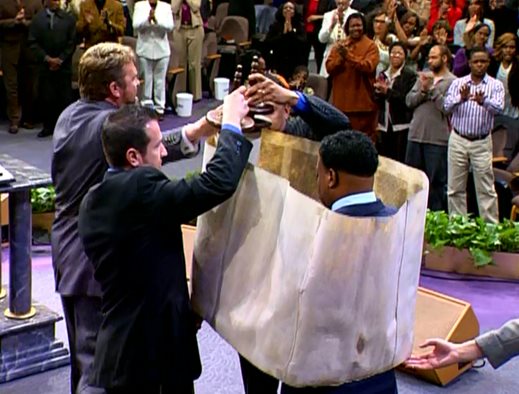
In the past couple of days, the Messianic blogosphere has been alive with passionate discourse about one such “extremist nudnik.” In an opinion piece at the Huff Post called Eddie Long Is Not a King, Rev. Wil Gafney, Ph.D, an Associate Professor of Biblical Hebrew and Jewish and Christian Scripture, posts a commentary on the extremely controversial YouTube video of “troubled pastor” Eddie Long, of the New Birth Missionary Baptist Church in Atlanta GA, being “apparently crowned king with the ritual use of a Jewish Torah scroll.” The real “nudnik” of this sad and sorry tale though, is a fellow named Ralph Messer, as Rev. Gafney states:

The unidentified man who, (in the YouTube video to which I had access he is identified subsequently as Ralph Messer), represents himself as a Jew. He may well be some sort of Messianic Jew, a person who claims Jewish heritage and recognizes Jesus as the Son of God, but who is not part of one of the major Jewish movements: Orthodox, Reform, Conservative, Reconstructionist, Reform, Renewal. He does not, however, represent recognizable Jewish thought or practice in his (mis-) representations of the Torah and other Jewish sancta — or for that matter, New Testament and Christian biblical interpretation and theology.

I won’t present any more details about this story since I would end up just duplicating what’s been thoroughly covered in much more worthy blogs, such as the one maintained by Dr. Rabbi Michael Schiffman, however, I would like to suggest that one of the motivations for such bizarre and unBiblical behavior on the part of men like Long and Messer is the same motivation Dasan and Aviram had in rebelling against the authority of Moses, Aaron, and ultimately God. This desire lead them, like Nadab and Abihu, to offer, “unauthorized fire” or in this case, to misuse a holy sefer Torah for unholy purposes.

Some people just have a problem with legitimate authority and having such a problem, do what Korah did and rebel by attempting to recreate that authority within themselves. This is at the heart of the theological arguments that have supported supersessionism in the ancient and modern church. I can’t truly say that the Christian church stands in total opposition and rebellion against the authority of God, since it is abundantly obvious that God has been using His Christian church to perform His will for centuries. I can say that the seeds that were planted 2,000 years ago which resulted in the weed that opposed the Jerusalem Council and denied the Jewish foundations of the church, were born of rebellion, but it was perhaps a “necessary” rebellion (Romans 11) so that the Gentiles could find a place within their Messianic covenant relationship to God.

That doesn’t make it any less painful or harmful and I believe the time for that “rebellion” is coming to a close.

People like Long and Messer seem to be establishing themselves as “authorities” simply because they can draw a following and they can magnify themselves by creating the illusion that they are “anointed” by God. But what do the people who follow these “rebels” want? Perhaps they are looking for whatever the rest of us are searching for, too.

Where was the knowledgeable one who wove his spell to bring his familiarity with the Atman out of the sleep into the state of being awake, into the life, into every step of the way, into word and deed? Siddhartha knew many venerable Brahmans, chiefly his father, the pure one, the scholar, the most venerable one. His father was to be admired, quiet and noble were his manners, pure his life, wise his words, delicate and noble thoughts lived behind its brow – but even he, who knew so much, did he live in blissfulness, did he have peace, was he not also just a searching man, a thirsty man? Did he not, again and again, have to drink from holy sources, as a thirsty man, from the offerings, from the books, from the disputes of the Brahmans? Why did he, the irreproachable one, have to wash off sins every day, strive for a cleansing every day, over and over every day?

from the novel Siddhartha (1951 U.S. publication)
by Hermann Hesse

This may seem like an odd source to quote within a Christian (and tangentially Jewish) context, but take one giant step backward from your religion and consider what human beings are looking for in general. What does the praying Christian have in common with the Jewish man davening in a minyan or a Muslim kneeling on his prayer mat? What do they have in common with the Buddhist, the Wiccan, and the New Age mystic? Aren’t we all, in our many and diverse ways, seeking God, in whatever way we may conceive of Him (or “Her”)?

I’m not saying that each and every one of these religious paths is equal in its validity or potential to arrive at the true “destination” of God, but the need to strive for that destination is the same in each of us. Some of our paths are legitimate and worthy, and many, many other paths lead to dead ends, darkness, and many ghastly conclusions in the spiritual travels of such seekers.

There are paths that lead people who desire a sincere and simple relationship with God to people like Ralph Messer, more’s the pity. Messer took the true message found in our Bibles and twisted it into a horrible distortion of God, misusing and desecrating the holy Torah of the Jewish people in order to glorify a misguided and selfish man. There is a legitimate path that allows man to understand God through the revelation of Torah, but Messer chose not to take it, perhaps because he would have to become a humble student and not an exalted “teacher.”

Milton, in his classic Paradise Lost, allows the “character” Satan to utter the famous line, “It is better to rule in hell than to serve in Heaven.” That seems to sum up anyone who would usurp the authority of God and the Bible (and Torah) for their own purposes rather than submit to the legitimate authorities God has established and to humbly serve under them. Jesus taught the exact opposite (John 13:1-17)  of Milton’s “adversary” when he washed the feet of his disciples and explained that “a servant is not greater than his master, nor is a messenger greater than the one who sent him” (v. 16). It is terrible to forget the words of the Master and to seek to rule over yourself and others, thinking you are better than those who came before you.

It is better to serve in Heaven than to rule in hell. Seek out those who are truly appointed by God and repudiate those who aren’t, so that the others who seek God just as you do, will be saved. Do not take such actions out of the desire to glorify yourself or whatever group or religion you serve but to glorify God only, lest you become like Dasan and Aviram and surrender to the temptation to serve only yourself. Should you feel that temptation within you, as if being who God made you to be isn’t good enough to satisfy you or Him, consider the parable of the Stonecutter by R’ Abraham Twerski MD. Perhaps it will add some perspective and even a hint of wisdom.