Tag Archives: New Testament

Questioning Paul

Read today’s article, where you, in part, again defend Paul. Obviously, I have to come to read him very differently and would like to run something by you. Can you give me your thoughts on the following words of Paul, namely in Galatians 4:21-26 (and a bit beyond, in Galatians 5-1)?

“21 Tell me, you who want to be under law, do you not listen to the law? 22 For it is written that Abraham had two sons, one by the bondwoman and one by the free woman. 23 But the son by the bondwoman was born according to the flesh, and the son by the free woman through the promise. 24 This is allegorically speaking, for these women are two covenantsone proceeding from Mount Sinai bearing children WHO ARE TO BE SLAVES; she is Hagar. 25 Now this Hagar is Mount Sinai in Arabia and corresponds to the present Jerusalem, for she is in slavery with her children26 But the Jerusalem above is free; she is our mother. “

“It was for freedom that Christ set us free; therefore keep standing firm and do not be subject again to a yoke of slavery.” (Galatians 5-1)

Here Paul, although supposedly speaking figuratively, plainly says that the covenant on Mount Sinai produced slaves (even though the opposite actually happened there – Jews were freed from slavery there, becoming servants of G-d). According to Paul, Jews who are still bound by Torah and the Mosaic covenant are not the spiritual children, but the children of the flesh and are born not of Sarah, but of Hagar. Christians (primarily his Gentile audience), however, are Sarah’s true children, who are free. Following Torah as given on Mount Sinai, according to Paul, is a yoke of slavery from which Christ came to set humanity free (Galatians 5-1).

Would love to hear what you thought of the above. May be the billions of Christians over the many centuries didn’t misread Paul after all but received much of their view of Judaism from him?

-from a private email discussion

There’s a lot more to this conversation. For a little background, the person asking the above-quoted questions is a Jewish friend of mine who believes that Paul was anti-Torah and anti-Judaism.  He very gently but firmly is questioning my faith and our exchange, from my point of view, has reached something of an impasse. Not being a theologian or a historian, especially within the context of Messianic Judaism, I don’t always have all the convenient answers at my fingertips.

A “normative” (i.e. not Messianic) Jewish person has a wide variety of resources to draw from, such as Jews for Judaism, in questioning the validity of the “Christian texts,” while in response, all I’ve got is me.

For obvious reasons (obvious to my regular readership), I can’t really rely on traditional, Evangelical Christian apologetics, since I’m often a critic of Evangelical Christian theology.

To add a bit of dimension, where I “stalled” in the conversation, my friend questioned whether one could look at Paul’s letters in the same fashion as the writings of Moses. Moses received direct revelation from God while Paul was writing letters. Can his letters be elevated to the point of scripture inspired by the Holy Spirit? Moses knew he was recording the thoughts of God. Could Paul have imagined that his letters would also be included in canon?

In the body of believers, we tend to see deep theological meaning in Paul’s letters. Further, we (or at least I) believe that there are messages “encoded” within said-letters that are difficult to understand without a “Rabbinic” comprehension of the text. Scholars such as Mark Nanos and Roy Blizzard have written erudite works unpackaging the “hidden” meanings within Paul’s writing. But the Sages in more normative Judaism across the long centuries and into the modern era, reading the letters of Paul from a Rabbinic perspective, see nothing but a condemnation of Jewish people and Judaism in Paul’s writings. If Paul’s letters are so “Jewish” that most Christians don’t “get” Paul, why don’t most Jewish sages “get” Paul the way we do when peering through a Messianic Jewish lens?

The Jewish PaulIn line with the above, I’ve attempted to answer the “Hagar and Sarah” question with my own commentary based on Ariel Berkowitz’s paper A Torah-Positive Summary of Sha’ul’s Letter to the Galatians. However my explanation of more hidden meanings doesn’t seem to pass the “pshat test,” whereby the plain meaning of the text is still the primary meaning, even if there are other more hidden and even mystic meanings contained within.

Finally, many if not most of Paul’s letters were written to a primarily Gentile audience, with many or most of them having limited literacy (according to my source) and for those fresh out of paganism, virtually no apprehension of Judaism, Jewish thought, Hebrew idiom and word play, and Jewish symbolism. If Paul were writing to a bunch of Rabbis or other learned Jews, we could understand Paul crafting letters with great amounts of complicated theological detail, but wasn’t he trying to get his ideas across to mostly common Greek-speaking people?

It’s possible that no one can answer these questions or at least that no one will be willing to answer these questions on my blog, so I may continue to be stuck until subsequent investigation (which experience tells me could be months or years) helps me to understand where the answers lie (or, Heaven forbid, that there are no answers to give to my Jewish friend). I should say that my primary goal isn’t to “convert” him or otherwise convince him to become “Messianic.” My goal is to show why any intelligent and reasonable person could accept the writings in what the Church calls “the New Testament” as scripture at all and why we would go jumping through all of the hoops we have been in order to refactor Paul as pro-Torah and pro-Judaism after nearly two-thousand years of Church doctrine has been teaching the exact opposite?

I plan to put links to this blog post in the relevant groups in both Facebook and Google+. I’d like to encourage the readers there to post your responses here so my friend (and any other interested parties) can read them. If they’re “trapped” in closed groups on either of those social networking platforms, then they will not be available for my audience here.

Thank you.

Hurtado, Wright, and the Significance of Israel

In this posting I query another of Tom Wright’s major emphases in his mammoth new work, Paul and the Faithfulness of God. This concerns his emphatic view that in Paul’s view ”Israel” becomes effectively the church, or more specifically becomes simply all those who put faith in Jesus.

-Larry Hurtado
“‘Israel’ and the People of God: Wright & Response”
from Larry Hurtado’s Blog

For those of you who don’t know, Larry Hurtado is a scholar of the New Testament and Christian origins with quite a number of published works to his name. I follow his blog because I find his research and insights into the early church to be interesting and informative.

How Hurtado started commenting on Wright’s latest book is as follows:

Late in 2013 I was asked by the journal, “Theology,” to review N.T. (Tom) Wright’s then-forthcoming book on Paul. As I am committed to preparing an essay on Paul for a conference in Rome in June this year, I agreed. A few days later a huge parcel arrived for me, and upon opening it I found that I had agreed to read/review a work of two volumes comprising over 1600 pages! I’ve sent off the review now, and it’s been accepted for publication in due course. But, even with the special generosity of the editors, I had to confine the review to 1800 words, which required brevity and a selection of things to mention. I have more to say about the work, however, and so in this and subsequent postings will give some further observations and thoughts beyond what I was able to include in the “Theology” review.

Hurtado has written a small series of blog posts thus far, reviewing different aspects of Wright’s tome (and at 1600 pages, it can correctly be referred to as a tome).

This morning, Derek Leman wrote a brief blog post regarding “Hurtado’s critique of Wright’s low view of the Jewish people,” but I felt there were a few more things that could be said.

The first is that N.T. Wright is a well-known and read scholar and author, and I find his perpetuating Christian supersessionism (also known as “replacement theology” or “fulfillment theology”) by replacing Israel with “the Church” to be at least disturbing if not completely offensive. Not that Wright is trying to be offensive. He’s being honest within the context of his understanding and convictions. I just happen to believe he’s wrong and I’m gratified that a scholar of Hurtado’s stature is willing to challenge Wright’s low view of Judaism on his blog.

But Hurtado said something else in last Sunday’s blog post:

But (as I see it) Paul did continue to see the family of Abraham, the full company of the redeemed, as comprised of believing Jews (such as himself) who remained Jews, and gentiles who remained gentiles. To be sure, their respective identities were to have no negative impact upon accepting one another, for they were all “one in Christ Jesus” (Gal. 3:28). But along with that oneness there remained (for Paul) the significance of “Israel” as fellow Jews, who were (as he saw it) heirs of divine promises (Rom 9:4-5). Although at present, most of his fellow Jews were “enemies” (so far as concerns the gospel), they were, nevertheless, “beloved” by God, whose gifts and calling were irrevocable (11:28-29).

I hope you read that quote carefully. In the realm of Messianic Judaism in its various expressions, it is generally affirmed that Jews and Gentiles in Messiah are united and yet remain distinct identities, each possessing unique (though somewhat overlapping) responsibilities to God. Jews in Messiah are still Jews and Gentiles in Messiah are still Gentiles, though all are “one” in God’s love, in the promises of salvation, and participation in the Messianic Kingdom.

Larry Hurtado
Larry Hurtado

Larry Hurtado is a Christian scholar of early Christianity, not a “Messianic”. And yet we see him stating something that is quite familiar to those of us who are affiliated with or otherwise “friends” of the Messianic Jewish movement. And this isn’t the first time. I’ve mentioned before, primarily in Larry Hurtado on ‘A Muslim Reads Galatians’ and Jewish Identity in the Way, that Hurtado is associated with supporting the continuation of Jewish identity and Torah observance among the early Jewish disciples of Jesus.

Today, the typical “Christian on the street” (so to speak) takes it completely for granted that when Jews came to Christ, they stopped being Jewish (or at least stopped behaving “Jewish”) and converted to Christianity. I don’t doubt that the vast majority of Evangelicals truly believe Paul preached a “Law-free” gospel of Christ and that the Jewish believers were no longer “under the Law.”

But the Christian on the street, that is, the average man or women in a church pew on Sunday morning, most likely doesn’t keep up with current Christian scholarship, nor are they aware that there are bodies of Christian scholars who disagree with each other and strongly debate key principles of Christian theology and doctrine. It is more comforting for traditional church goers to believe that everything is settled and has been for many centuries. Christianity is what it is. All the questions have long since been answered. There are no mysteries. Sunday school is merely to discuss what everybody already knows (except perhaps the “baby Christian” who has just come to faith). Even seasoned Pastors tend to believe that, though their knowledge base is usually much broader than that possessed by their flocks.

The implication of Hurtado’s statements upon Messianic Judaism is interesting and encouraging. In Messianic Judaism and the somewhat related movement of Hebrew Roots, we talk to ourselves all of the time about the Torah not being “dead” or “nailed to the cross” with Jesus. We talk (and sometimes argue) about Jewish distinctiveness and uniqueness of obligation within the wider Messianic body.

But having a conversation with yourself isn’t very illuminating and that dialogue most often stays within our particular silos, rarely escaping into normative Christianity (or Judaism), at least in a form that can be heard or accepted by those groups.

So when a Christian and not Messianic scholar and author such as Hurtado can independently study the Bible and arrive at a conclusion which states “Jews who remained Jews, and gentiles who remained gentiles” and yet “they were all ‘one in Christ Jesus'”, it is remarkable. The significance of Israel as Israel remained in the Apostolic Era, and even unbelieving Jews were considered beloved by God and possessing gifts and a calling that are irrevocable.

One Caveat to consider is that Hurtado is defining Paul’s perspective not necessarily his own. But if this is indeed how Paul saw things (and I think it likely), then Paul, the author of much of what we think of as early Christian theology and doctrine, was setting the pattern for how we Christian (Gentile) believers should understand ourselves in relation to the Jewish people and Israel.

It’s pretty hard to ignore Paul and still call yourself a Christian.

Review: John MacArthur on Judaism, Part 2

Now, I’ve entitled this portion, beginning in chapter 18 verse 18 through chapter 19 verse 7, we’ve entitle (sic) it From Judaism to Jesus because it does portray for us a transition. We have made the mention in past studies that the Book of Acts records for us transitions and we see the fading out of Judaism and the coming in of Christianity. In understanding this, we have to understand that it sometimes was a slow transition. Salvation is not a transition; it’s a momentary miracle. But losing all of the trappings of Judaism came a little slower. People would get saved and then find it hard to let go over everything, and so there was a certain amount of difficulty in making the transition from Judaism to Jesus. And as I said last week, we find that true very often today, even with Jews who come to Jesus Christ and find it difficult to break with patterns that were so much a part of Judaism.

Now, I think part of this is due to the fact, maybe most of it is due to the fact that Judaism in itself is such a distinct kind of life. Now, we could talk for a long time about the distinctions of Judaism and I don’t mean to do that, but in some generality to point out to you the distinctness of Judaism, in order that you might understand how difficult the transition comes about.

-John MacArthur
“From Judaism to Jesus, Part 2,” January 20, 1974
Commentary on Acts 18:24-28
GTY.org

I reviewed part one of this series last week and I can’t say I’ve received Pastor MacArthur’s rendering of ancient or modern Judaism with any sort of enthusiasm. MacArthur characterizes the Book of Acts as a chronicle of transition, literally “from Judaism to Jesus.” I couldn’t disagree more, but to give him a fair shake (to the best of my admittedly waning ability), I’ll continue to read the sermons of this series and offer my comments.

MacArthur says that the transition away from Judaism was really difficult for the Jewish people because of this:

For example, a Jewish town or a Jewish city or township or village, no matter whether it was centered right in the midst of a Pagan country or whether it was butted up against a Pagan society in another city, still maintained an amazing uniqueness, and no matter how much interrelation and intercourse economically and culturally and all it happened to have with Pagans, it seemed never to be tainted by Paganism. There was just such a unique identity and this was particularly around the time of Christ and the time of the New Testament.

You couldn’t even enter a Jewish town or enter a Jewish village without feeling like you had almost stepped into another world. You get that feeling today when you go to Jerusalem, not so much when you see the hustle and bustle of a modern city, but when you happen to be isolated with a group, say, of Orthodox Jews who are doing what only Orthodox Jews do, you feel that somehow something’s wrong. You’re out of whack or they’re out of whack with the world.

Interestingly enough, even among modern observant Jews, the sense of distinctiveness between the Jewish community and the surrounding peoples is considered not only normal but necessary in order to fulfill the requirements of God for the Jewish people.

MacArthur distinguishes Christianity and Judaism in a number of ways during his sermon, but I found this paragraph rather telling.

I think that, for most of us, we tend to look at religion in this frame. But Judaism was not such an isolated creed of theology. You see, it was a whole way of life. It pervaded every single human relationship. It pervaded every single attitude toward eating and drinking and clothing and all kinds of things in terms of economy, not just a set of observances, not just a creed, but a way of life and you could never just suck Jewish theology out and remove Judaism. No, because Judaism was a way of life.

Although, at least in theory, being a Christian should also be a way of life, in fact, MacArthur seems to say that Judaism is more of a way of life than Christianity. He says this is why the Jewish people had so difficult a time in giving up Judaism, because it completely defined every aspect of Jewish living. Really, MacArthur. You say all that and you still don’t see a problem with requiring that Jewish people surrender everything that defines them, makes them unique, and enables them to continue forward through history without being destroyed on the altar of assimilation?

To his credit, MacArthur does say that there was faith, grace, and salvation in the Old Testament, but he blows past that part very quickly and “starts in” on the Rabbis.

…throughout the history of Israel, there have always been rabbis, which means teacher or master. And all of these rabbis were teaching and interpreting and adding to Scripture. And, of course, the esteem of a rabbi was so great that what the rabbi said was often written down. And all of these things were gathered and gathered and accumulated until today, you have this monstrous set of volumes known as the Talmud. And the Talmud is all of these rabbinical statements added onto the Biblical, and you will find that if you visit any rabbi who was at all involved in what he ought to be involved in as a rabbi, you would find that he has not only prescribed his life around the Old Testament, but perhaps even more so around the Talmud where he is following up all of the interpretations and suggestions of all the rabbis, some of which, most of which are unnecessary and unbiblical.
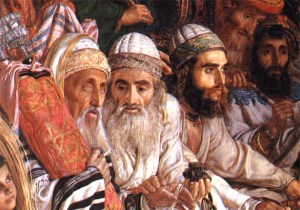
ancient_rabbisThis is MacArthur’s conceptualization of Rabbinic Judaism, the body of religious and cultural Judaism that enabled the continuation of the Jewish people after the destruction of the Temple and after most of collective human Israel had been exiled from their Land. In the world according to MacArthur, the Rabbis were just a bunch of guys who added unnecessary stuff to the Bible.

He briefly makes some sort of commentary on the “Shimah.” I’ll take it for granted that whoever transcribed MacArthur’s sermon didn’t know the accepted English spelling of “Shema” and that MacArthur didn’t find it necessary to proofread the text. On the other hand, his sermons could have been transcribed years or decades after the fact.

But then there’s this story:

There was a rabbi by the name of Rabbi Jacanon Van Saccai (sic). It was written of him that he said this at his death. And it was interesting because he was called The Light of Israel. He lived at the time of the destruction of the temple. He was a very famous man, highly esteemed. And he was the president of the San Hedron (sic) or the ruling body of Israel. So he was not a small-time rabbi, but a very important man. On his deathbed, he began to weep just bitterly and profusely, and some of his students who had studied under him and sat at his feet couldn’t believe this.

Just to clarify, MacArthur is referring to Rabbi Yohanan ben Zakkai who I’ll discuss a bit later, and the “San Hedron” is the Sanhedrin, which is not a ruling body but the highest religious court assembly in ancient Israel.

And they asked him how such a man who had lived as he could have such fear of death, and this was his reply and I quote, “If I were now to be brought before an Earthly kind who lives today and dies tomorrow, whose wrath and whose bonds are not everlasting and whose sentence of death even is not that to everlasting death, who can be assuaged by arguments or perhaps bought off by money, I should still tremble and weep. How much more reason have I for it when about to be led before the King of Kings, the Holy One, Blessed by (sic) He who liveth and abideth forever, whose chains are chains forevermore, whose sentence of death kills forever, whom I cannot assuage with words nor bride (sic) with money and not only so, but there are before me two ways: one’s a paradise and the other one to hell. And I know not which of the two ways I shall have to go. How then shall I not shed tears?” End quote. The man believed that there was only one (way) to enter into heaven and that was to keep the law and he knew in his conscious (conscience?) that he hadn’t done it, and he had a fear of spending forever in hell. You see, he had no concept of faith, no concept of grace. He was in a system that bound him and if he didn’t do what the system wanted him to do, he believed he’d go to hell forever.

This is a fairly well-known story, but my memory of it didn’t match MacArthur’s description which seems to contain blatant assumptions about why the revered sage was so fearful. I did a bit of research and found more about the rather tragic deathbed scene as recorded by Rabbi Dovid Rosenfeld at Torah.org

In spite of it all, R. Yochanan was plagued with doubts for the rest of his life. The Talmud records that on his deathbed, he tearfully told his students that he has two paths before him — to Heaven and to Hell — and he was literally unsure along which one he would be led (Brachos 28b). He took it upon himself to change the course of Jewish history, and to his dying moments was never truly sure he had chosen right. (I heard this explanation of the Talmud from R. Berel Wein.)
jewish-traditionBut according to Rabbi Rosenfeld, R. Yochanan was not terrified of “going to Hell” because he relied on an unreliable Torah and lacked the grace of Jesus Christ, he was deeply troubled that he had not made the correct decision in preserving the Jewish people and the Torah.

According to the Talmud (Gittin 56), when the Romans had surrounded Jerusalem in the final siege that heralded the destruction of the Temple, many Jewish people wanted to fight and die rather than give in to the Romans, but R. Yochanan was concerned that this would only result in total extermination of the Jews and elimination of the Torah from all the earth.

As the story goes, R. Yochanan had himself smuggled out of Jerusalem in a coffin and eventually made an arrangement with the Roman general Vespasian to establish a center of learning in Yavneh, along with its sages, so that the study and observance of Torah could continue.

This agreement wasn’t incredibly popular with a lot of Jewish people as you might imagine, and even to the end of his days, R. Yochanan was tortured with whether or not he made the right decision to hand Jerusalem and the Temple over to the enemy, even to preserve Jewish lives and ensure the continuation of Torah study.

Sorry to occupy so much space on what seems to be a minor portion of MacArthur’s sermon, but I felt it necessary to set the record straight and present the Jewish point of view (to the best of my ability) on the life and death of Yochanan ben Zakkai.

MacArthur tends to play fast and loose with Jewish history, Jewish concepts, and Jewish people (see his comments on “sloppy” below), and since he’s made the decision to eliminate Judaism at Acts 2 and to declare that it was going through a slow and agonizing death, I have some concerns that MacArthur, for all of his apparent education, may not truly understand some of the things and people he’s talking about.

Now that we have MacArthur’s opinion on R. Yochanan, this is how he sees the apostle Paul:

Well, now watch. Into this system comes a man by the name of Paul and he’s running around say(ing), “Grace. Grace. Forget all the laws.” And the Jews are having culture shock. There’s no way they can handle that. That’s why when he went into the synagogue the reaction was so violent. See?

Never mind a more scholarly approach that does not present Paul as rather gleefully “Law-free,” such as what I’ve been studying in the Mark Nanos books The Mystery of Romans and The Irony of Galatians. According to MacArthur, Paul just made Judaism go away and proceeded to enter the various synagogues in the diaspora claiming, “Grace. Grace. Forget all the laws.” This isn’t a description of a real to life, complicated, intelligent human being with a very difficult task as the Jewish emissary of Messiah to the Gentiles. MacArthur seems to be describing Paul as a cartoon. Who’s adding to scripture now?

And what about Peter and Acts 10?

“And which were all matter of four-footed beasts of the earth, wild beasts, creeping things,” that’s snakes and reptiles and birds, fowls of the air. “And there came a voice to him, ‘Rise, Peter. Kill and eat.'” Now, that sounds like a simple thing. He sees in his vision all these animals and the voice says, “Go ahead, Peter, just kill them all and eat.”

Now what’s he saying? Well, in effect, he’s saying there’s no distinction because in the Old Testament there were certain things a Jew couldn’t eat, right? And Peter had lived all his life that way. And now in the New Covenant, Jew and Gentile were going to be one in the church, and God didn’t want any difference anymore. There is no difference.

You think Peter could’ve gone, “Oh, fine Lord. Sure. Just pass the plate. I’ll eat whatever’s there.” No. Couldn’t handle it.

Verse 14. “And Peter said, ‘Not so Lord.'” Peter actually said, “No, Lord.” That’s pretty flagrant disobedience. This can’t be. Are you kidding me? “For I’ve never eaten anything that is common or unclean in my life, I’ve never done that. Salvation or no salvation, I can’t handle it.” See.

jewish-t-shirtMaybe what’s rubbing me the wrong way is MacArthur’s casual and even disrespectful manner in talking about Yochanan ben Zakkai, Paul, and Peter. He seems to be making fun of them because they couldn’t “let go” of this “Jewish stuff.” Maybe it’s because my wife and kids are Jewish. I just get the feeling MacArthur wants to laugh at them or to discount them. I hope I’m not being too personal in my review.

It also seems like MacArthur is reading a lot into the text (adding to scripture?), as if God really expected Peter to start shoveling a sheet load of “trief” down without so much as a by your leave. In fact, the vision of Peter in Acts 10 had nothing to do with unclean food:

And he said to them, “You yourselves know how unlawful it is for a man who is a Jew to associate with a foreigner or to visit him; and yet God has shown me that I should not call any man unholy or unclean. (emph. mine)

Acts 10:28

There’s also a difference between unkosher animals and unclean foods, but for the sake of time, I’ll refer you to the First Fruits of Zion (FFOZ) television episode All Foods Clean or my review of the program for the details.

Of the lives of the apostles, MacArthur said:

Now, we want to live by biblical doctrine, but I’m not interested in going back there. I’m not interested in having trouble over what I eat like Peter did. I’m not interested in going over to the temple in Jerusalem and making vows like Paul did and having to take a Nazarite vow and cut all my hair and haul my hair half way across the world so I can burn it properly in Jerusalem. I’m not interested in all the trappings of Judaism.

I suppose I don’t blame him for saying that since he believes Judaism was horribly burdensome and became extinct after Acts 2, but he really shouldn’t worry since, not being Jewish, he wouldn’t have been required to observe Torah in the manner of believing (or unbelieving) Jews (see the Acts 15 legal decision). Besides, a Nazarite vow was totally voluntary and most Jews likely never took that particular vow.

But what does any of this have to do with Acts 18:24-28? Not much. Apparently it takes MacArthur quite a while to set the stage for what he’s actually going to talk about.

And you see, here’s Paul. You say, “He’s a Christian. What’s he doing?” Sure, he’s a Christian, but as a Christian, he’s also a Jew. He’s been a Christian a little while. He’s been a Jew all his life. And he’s saying to himself, “I’m grateful to God for what He did, and the way that I know best how to show Him how grateful I am is to do what all good Jews do.” And the high point of their thanks is to take a Nazarite vow, and so he did what a Jew would do. Because that was his life, that was the way he thought.

This is part of what was taught during the sermon and at Sunday school last week at the church I attend. I didn’t go last week, but I did do the homework for class, which is based in part on MacArthur’s opinion of Paul and Nazarite vows. I didn’t find anything in Numbers 6 that mapped to why MacArthur believes one takes such a vow out of gratitude for what God has done. My understanding is that one took a Nazarite vow in order to temporarily experience a heightened state of ritual purity.

Now a Jew named Apollos, an Alexandrian by birth, an eloquent man, came to Ephesus; and he was mighty in the Scriptures. This man had been instructed in the way of the Lord; and being fervent in spirit, he was speaking and teaching accurately the things concerning Jesus, being acquainted only with the baptism of John; and he began to speak out boldly in the synagogue. But when Priscilla and Aquila heard him, they took him aside and explained to him the way of God more accurately. And when he wanted to go across to Achaia, the brethren encouraged him and wrote to the disciples to welcome him; and when he had arrived, he greatly helped those who had believed through grace, for he powerfully refuted the Jews in public, demonstrating by the Scriptures that Jesus was the Christ.

Acts 18:24-28 (NASB)

I didn’t really think much about all this. It made sense in those days that because information traveled rather slowly throughout the then-civilized world, different bodies of believers might have inconsistent knowledge of the teachings of the Master and the experience of disciples in other places.

But MacArthur interprets this portion of scripture in a unique way:

Now, Apollos is a Jew and he is from the city of Alexandria.

He was a powerful man in terms of teaching. And let me just say at this point that his power at this point was the natural. He was not a Christian at this point, so consequently, did not have the indwelling Holy Spirit.

I believe that Apollos was not a Christian but that he was a student of John the Baptist.

Now, see, here is a man who accepted all the way of the Lord in the Old Testament, accepted the ministry of John the Baptist, saw that John pointed to Jesus and said, Behold the lamb of God that taketh away the sin of the world,” and he believed that Jesus was the Messiah. You say then, “Why wasn’t he a Christian?” Because he didn’t know what happened in the death, resurrection and Pentecost that followed the life of Jesus. He was pre-cross.

On the wrong side of the cross? Oh gee. Is that concept even in scripture as applied to the apostolic age? And Apollos didn’t have the Spirit?  What about verse 25 where it says, “and being fervent in spirit?” In reading MacArthur’s sermons, I get the impression the man is always shooting from the hip. Anyway…

No, he wasn’t a Christian. But technically, neither were any of the apostles, including Paul, or any of the Jewish (and arguably Gentile) disciples. You can’t anachronistically force the concept of Christianity as we understand it today back into the apostolic era. Apollos was a Jew and he practiced Judaism as a disciple of Moshiach (Messiah).

And just to wrap things up:

Now, there’s another angle in this word. It’s used one other time in Ephesians 5:15, which would be helpful. Paul says “See that you walk acrabos, with exactness.” The Christian should live his life with the same kind of preciseness that we interpret the Scripture, with the same kind of preciseness that God wrote it. God didn’t give us a sloppy revelation, did he? And God doesn’t want us to slop up his revelation and God doesn’t want us to slop up our lives either. Same word in all three areas.

Well, there you meet two in transition, Paul and Apollos. And how exciting it is to see what God is doing in their lives and how grateful we are that the Spirit of God brought about the transition that they might have influence on us.

MacArthur in churchSee what I mean about “sloppy?”

What really scares me is the thought that, back in January 1974 (and no doubt today), the people listening to MacArthur’s sermon probably lapped it up. How many of them would have decided to look up his references and examine his sources, especially about Jewish Biblical and Rabbinic history? After all, the entire thrust of this sermon series is to declare the elimination of Judaism in any form in the pages of Luke’s Acts of the Apostles. But I don’t find MacArthur’s presentation on Judaism to be either serious or accurate.

It’s like he’s saying, “Gee, look how dumb these Jews were. They had Jesus and grace and still couldn’t give up that nasty, ol’ law. Thank the Lord we’re nothing like them. I’m so glad God doesn’t care about what food I eat or what day of the week I worship, or any of that terrible stuff.”

OK, I made that last bit up, but it certainly seems to fit the tone of what MacArthur was preaching.

I can’t do this. I can’t think like he does. I can’t believe like he does. How am I supposed to participate in the rebuilding of the Tent of David in the Christian church when men like MacArthur and sermons such as this one are expending no small effort in cheerfully burning that tent down to the ground?

See Part 3 of my review on this series to see how it turns out.

The Mystery of Romans: A Review of Chapter One

The Mystery of RomansMoreover, Paul does not seem to be confronting an inflated view of the Torah in Rome among the Christian gentiles (“judaizing”) as is often assumed. Instead, he confronts the failure of the Christian gentiles in Rome to respect the role of Torah in the life of Israel as God’s special gift; in fact, he emphatically elevates the status of the Torah. Note, for example, the great advantage of the Jewish people is “that they were entrusted with the oracles of God” (3:2), and elsewhere in the litany of Jewish privileges he includes “the giving of the Law” (9:4); that the “Law is spiritual” (7:14) and again, “the Law is holy, and the commandment is holy and righteous and good” (7:12); and further that “the gifts [which clearly included as central the Law; cf. 9:4] and the calling [Israel’s election] of God are irrevocable” (11:29). Paul refers to the “Law of faith (3:27) and asserts that he is not teaching that faith nullifies the Law: “Christ is the end [goal] of the Law” (10:4). In fact, he even regards the “love” he is calling for among his Christian gentile readers “the fulfillment of the law” (13:8-10; cf. 8:4), not a demonstration of its failure but the embodiment of its true aims.

-Mark D. Nanos
“Chapter 1: To the Jew First and Also to the Greek,” pg 22
The Mystery of Romans: The Jewish Context of Paul’s Letter

No, I haven’t given up on my serial review of the articles in First Fruits of Zion’s (FFOZ) periodical Messiah Journal issue 114, but I’m also reading the Nanos “Romans” book (his book on Galatians is waiting in the wings) and I want to discuss my impressions so far (just gotten through Chapter 1 at this point).

As I read, I usually keep some post-it notes and a pen handy to take notes and stick on the appropriate pages for later reference (beats marking up the inside of the book with my poor handwriting). All I’m going to do here is review my notes and do a “data dump” into this blog post, along with a few of my thoughts on the matters brought up. To start off, I can certainly see why Nanos is considered “Messianic Judaism-friendly”.

For instance, in footnote 5 on page 23:

I don’t mean to suggest the doing of the Law was an “entrance requirement” for salvation, but rather the application of the Law and Jewish customs to the lifestyle of those believing in Jesus as the Christ; for the Jew believing in Christ Jesus would continue to be a Jew and thus obey the Law, and the gentile believing in Christ Jesus would continue to be a gentile and thus not under the Law, however, the gentile would now through Christ Jesus have a new relationship with Israel that made it necessary to respect the “rules of behavior” that had been developed in Judaism to define the minimal requirements of Law and custom for the “God-fearing” gentile wishing to associate with God and his people. Thus the phrase “Law-respectful gospel” is offered here to contrast with the “Law-free gospel” usually assumed to represent Paul and Pauline Christianity, incorrectly in my opinion.

A lot is packed into that one short paragraph regarding Nanos and his opinions on the relationship Jews and Gentiles in Messiah have with Torah, the Gospel, and each other. He is definite that the “Messianic Jew” remains a Jew and thus fully bound to the Torah of Moses, while the Gentile is bound, not to Torah as such, but to the essentials of the Acts 15 legal ruling that authoritatively established the halachah for Gentile admission into “the Way.”

Nanos, in my opinion, is also correct in saying that much of Christianity believes that Paul established a “law-free gospel” for both Gentiles and Jews in Christ and that the Church’s viewpoint has largely ignored what Paul was really saying. The quote from page 22 of the Nanos book above shows multiple examples of how Paul had a high view of Torah for the Jewish people in Messiah (and all of Israel). We also see from the “footnote 5” quote that Gentiles were admitted into the community of Messiah but with a different legal status than the Jews, one that did not make them “Israel” but that affirmed the Jewish people as “Israel” and “God’s people”. Gentiles are “associating” with God and Israel within the Messianic body.

That’s disturbing language for some Christians and Hebrew Roots adherents as it appears to develop “classes” within the body of Messiah, with the Jews in the ascendant position and the Gentiles being subordinate to them. My Pastor is an example of a Christian who believes Jews and Gentiles are totally uniform in identity and status based on the absence of the Law, while many in Hebrew Roots believe in the same uniformity, but based on an identical binding of Jew and Gentile to Torah.

Nanos also associates “Law-respecting lifestyle” for the Gentile with the concept of halachah, which literally means “walking” and denotes rules of behavior, usually as legally defined within a Rabbinic Jewish court system. As Nanos says, “it denotes rules of behavior…and is a frequent idiom in the Bible as well for discussing proper behavior” (pg 22, footnote 6). This again harkens back to the Acts 15 decision for Gentile disciples, which Paul appears to be upholding in his letter to the Romans (chapters 5-16, according to Nanos, and particularly chapter 14).

Upon his arrival he would execute his customary two-step pattern to ensure the restoration of the dispersed of Israel in the synagogues of Rome first, thereafter bringing the good news to the gentiles also, which was, surprisingly, a necessary part of the process of Israel’s restoration, a “mystery” in which those addressed shared an extremely significant role.

-Nanos, pg 26

everlastingI’ve been writing about the “extremely significant role” of gentile Christians as “a necessary part of the process of Israel’s restoration” ever since I attended my first FFOZ Shavuot conference in May of 2012. I often include a link to my blog post Provoking Zealousness as an illustration of this principle. I originally wondered where Boaz Michael came up with such a concept, and I can see now that in part, it must have come from the research and writing of Mark Nanos.

In May 2012, this whole idea of the Gentiles exalted role in relation to Israel was as clear as “Mississippi mud” to me, but I chose to struggle with it rather than discarding it out of hand. I’m glad I did. Things are much clearer for me now.

Paul’s concerns are those of a Jewish missionary, and his message and framework of thinking are those of one who considers himself working within the historical expectations of Israel — the Savior of Israel has come to Zion to rebuild the tabernacle of David and to bring light to all the nations — for the One God of Israel is the One God of the whole world.

-ibid, pp 26-7

I don’t know if Boaz Michael was thinking of Nanos when he conceived of and authored his book Tent of David: Healing the Vision of the Messianic Gentile, but the connection seems very apparent, and dovetails well with Boaz’s message to the “Messianic Gentile” audience of the book in how we have a critical role in restoring Israel that must be communicated to our traditionally Christian brothers and sisters in the Church.

Notwithstanding the many historical concerns associated with harmonizing the Paul of Romans with the Paul of Luke-Acts (note the conclusion of Beker, “Luke’s Paul as the Legacy of Paul,” p. 511: “The history of research has made it abundantly clear that the attempt to harmonize the historical Paul with the Paul of Luke-Acts has come to a radical end”), features of Luke’s presentation of Paul’s view of Law-respectful behavior and his two-step missionary pattern are to be noted in the Paul we meet in the text of Romans (see particularly chapters 4 and 5 herein). Note the challenge of Jervell, “Retrospect and Prospect in Luke-Acts Interpretation,” on p. 403: “What made the Lucan Paul possible? We have at least three different Pauls: The Paul of the Pauline letters, the Paul of Acts, and the Paul of the deuteropauline letters and Pastorals…”

-ibid, pg 28, footnote 13

I include this note here to illustrate that the confusing image I get of Paul in different parts of the New Testament isn’t some failing on my part. New Testament scholars experience Paul this way too, and struggle to make sense of how one man can present himself or be presented in such contradictory ways. Just who the heck is Paul, anyway? If we are to accept that the New Testament is the inspired Word of God and therefore “profitable for teaching, for reproof, for correction, for training in righteousness,” (2 Timothy 3:16) then we must believe that all that we read of Paul and about Paul is correct and consistent with a single man, who himself was consistent in regard to his faith in Messiah and his approach to the Jewish people, the Torah, and God.

So if the fault in understanding Paul isn’t to be found in an inconsistent and flawed New Testament record, it must be found in ourselves and how we are reading that inspired record. Where is the Holy Spirit when we need Him the most?

These observations challenge the prevailing views of Paul’s purpose for writing to Rome and, necessarily, the hermeneutical assumptions that lie behind the interpretation of Romans. Was Paul opposed to the practice of the Law and Jewish customs in the church in Rome? Did he believe that the church needed to sever ties with Judaic notions of righteous behavior? Was legalism his central concern, that is, faith versus works or grace versus the law? Was the church a completely separate institution from the synagogue that must seek to assert a Law-free interpretation of salvation and Christian behavior over against Judaism?

-ibid, pp 28-9

My Pastor would probably say “yes” to answer all those questions and then move on as if nothing were wrong, but I can’t do that. Nanos can’t either.

This reading of Romans suggests that the traditional answers to these questions are inadequate and that the historical situation addressed in Romans should be approached in a vastly different light than it has been in the past. For example, the message derived from Paul’s letter to Galatia should not be allowed, as it has so often in the past, to dictate the probable interpretation of Paul’s intentions toward Rome. The implied audience and the circumstances are quite different, including the important fact that Paul had an instrumental role in the development of the community he wrote to in Galatia while he had never been to Rome. Galatians was written to confront Christian gentiles attempting to “judaize,” and thus, in the opinion of Paul, to compromise the universal application of the promised salvation to all people equally through faith in Jesus Christ, whether Jew or gentile, for Paul emphatically argued that the One God of Israel was also the One God of the nations equally accessible to gentiles through faith in Jesus Christ.

ibid, pg 29

Mark NanosTraditional answers are inadequate and we cannot apply the situation and circumstances that inspired Galatians to what we see in Romans. We cannot ignore the context of each letter, the period of time in which each one was written (in all likelihood, Galatians was written before the Acts 15 decision and Romans afterward), Paul’s intent, his state of mind, the identity of his audience, and how they likely would receive and comprehend Paul’s words within their historic, cultural, linguistic, educational, and national context…a context which we either largely lack or ignore in favor of our historical, cultural, and traditional interpretation of Paul within the Christian Protestant church.

Nanos goes on to give a smart summary of why Paul wrote Galatians and how his motivation was different in writing Romans based on different circumstances. The Gentiles in the Galatian churches were somehow led to believe that only by converting to Judaism and observing all of the Torah mitzvot in the manner of the Jews could they be justified before God. This may have been driven by Jewish ethnocentrism or the belief that the Jews and only the Jews had the inside track with God, the Messianic Gospel notwithstanding.

In Romans, the problem seemed to be the opposite among the Gentiles. They believed that the grace of Jesus Christ diminished if not extinguished the binding of the Jewish believers and non-believers to Torah and even watered down any Gentile sensibilities required for Gentile/Jewish fellowship within the synagogue. There seems to have been a dynamic play between the Gentile position and the Jewish “pushback”, with each population asserting that they had the upper hand, the Gentiles because of grace and the Jews because of the Law. Paul was trying to “balance both sides of the equation,” so to speak. No easy task as anyone from the modern Messianic Jewish movement has discovered in speaking with our more traditional Christian brothers in the Church.

These traces have survived in the texts of Romans and the Apostolic Fathers in spite of Roman Christianity’s later disregard for these Jewish roots as it developed into the thoroughly gentile organization (the “gentilization” of the church).

-ibid, pp 32-3

It wasn’t that long ago that I had my own gentilization experience in my Sunday school class, and I can tell you it was disturbing. According to Nanos, we see the first, encroaching shadows of this behavior among the Gentile disciples in the synagogue in Rome, and it has been “snowballing” ever since.

Nanos repeatedly declares in this chapter of his book that Paul’s letter to the Romans was a reminder to the church in Rome, a large group of Gentiles associating with Jews under the authority of the synagogue, “of the importance of their ‘obedience of faith’…to clarify just how important the halakhah that had been developed in the synagogues of the Diaspora to define the behavior incumbant upon righteous gentiles really was now for redefining the Christian gentiles…” (ibid, pg 34).

In modern Judaism, there is also the concept of righteous Gentiles usually associated with those non-Jews who served some role in rescuing Jewish victims of the Nazi Holocaust, but a Gentile can be considered righteous as a Noahide as well. I find it rather illuminating to classify the status of the early Gentile believers in Jesus the Messiah as “righteous Gentiles” seeing that no one, Jewish or Gentile, has any righteous standing before God apart from faith in Messiah.

On page 37, Nanos states that the Gentile believers were “equal coparticipants in the blessings of God through faith without the need to become Jews.” He goes on to say that the Gentile “coparticipants” possessed an “explicit obligation…to serve non-Christian Jews in love by subordinating themselves to the authority of the synagogue…” inserting the idea that the problem with the Jewish/Gentile relationship in the synagogue did not only involve believing Jews. Was this the first recorded occasion of (Gentile) Christians playing the “grace” and “salvation” card in a game with the Jewish people, asserting superiority over the ancient people of God? Many Christians have historically played that card and many Churches today continue to do so, much to their shame.

However, Romans includes the unmistakable caveat that while Israel’s historical place is preeminent it is not exclusive, and while Christian gentiles must practice the intentions of the apostolic decree they must not misunderstand this and assume, as some were being tempted to assume in Galatia, that they are thereby in need of placing themselves fully under the Law…in order to be equal coparticipants in the blessings God promised to Abraham and revealed in Jesus Christ for all who believe in Him.

-ibid, pp 38-9

returning-the-torahI know I continue to repeat myself, but how like the current difficulties we experience in the Messianic movement were the struggles of Paul and the “church” in Rome. Paul could see clearly their dilemma and ours, but in the final chapter of his life, he was helpless to stop the rift between Gentiles and Jews from forming and ultimately dividing them and us. The question is, can we succeed where Paul (apparently) failed? Paul knew the answers we struggle so hard to acquire and yet he still couldn’t stop destiny’s cruel hand. On the last page of this chapter (40), Nanos reiterates what he said before about the true role of the Gentile in the Jewish community of “the Way”:

…Paul’s intended trip to Rome to bring about in Rome the beginning of the “fulness of the Gentiles.” This procedure would mark, paradoxically, the end of the suffering of the part of Israel presently hardened as it triggered the saving jealousy of “some of them,” resulting in the eschatological restoration of “all” of Israel — for of at least one mystery Paul was certain: “all Israel will be saved.”

The only hope Christianity and the Messianic Jewish movement has of coming to terms and then to unity is in the realization of Paul’s goal for the Romans, the proper orientation of the Gentile believers, not only to Messianic Jews, but to Israel as a whole, and that by provoking Jewish “zealousness” to repentance and Torah, we will not only help in sealing that ancient and bleeding wound, but summon the coming of Messiah, Son of David, may he come soon and in our day.

If this is what only one chapter of the Nanos “Romans” book holds, I’m looking forward to reading (and reviewing) the rest of it.

The Face of the King

lion-in-the-stormThe sticks on which you write will be in your hand before their eyes. Say to them, ‘Thus says the Lord God, “Behold, I will take the sons of Israel from among the nations where they have gone, and I will gather them from every side and bring them into their own land; and I will make them one nation in the land, on the mountains of Israel; and one king will be king for all of them; and they will no longer be two nations and no longer be divided into two kingdoms. They will no longer defile themselves with their idols, or with their detestable things, or with any of their transgressions; but I will deliver them from all their dwelling places in which they have sinned, and will cleanse them. And they will be My people, and I will be their God.

Ezekiel 37:20-23 (NASB)

Tales of the Messianic Era series

This is a time yet to come. This is a time when God will restore all of the Jewish people to the Land of Israel as a single, united people. The kingdoms will not be divided as they were in days of old. One Israel under One God.

“My servant David will be king over them, and they will all have one shepherd; and they will walk in My ordinances and keep My statutes and observe them. They will live on the land that I gave to Jacob My servant, in which your fathers lived; and they will live on it, they, and their sons and their sons’ sons, forever; and David My servant will be their prince forever. I will make a covenant of peace with them; it will be an everlasting covenant with them. And I will place them and multiply them, and will set My sanctuary in their midst forever. My dwelling place also will be with them; and I will be their God, and they will be My people. And the nations will know that I am the Lord who sanctifies Israel, when My sanctuary is in their midst forever.”’”

Ezekiel 37:24-28 (NASB)

More over, united Israel will be ruled by One King, King Messiah, Son of David. But look at this. Messiah, the King of Israel and Ruler of the World will be their prince forever.

That would be pretty hard to do if Messiah were merely mortal. Of course, in the Messianic age, many will be resurrected, never to die again, so we could say the same of Messiah. But as a Christian, I must believe that Messiah is more.

God also says that the people of Israel, the Jewish people, will “walk in My ordinances and keep My statutes and observe them.” I know I recently wrote about all this, but I’m going through my notes on my recent reading of the latter portion of Ezekiel, so I thought this would be a good time to try to pull them together. I hope I can avoid repeating myself too much.

One puzzling thing I found was this:

Then I heard one speaking to me from the house, while a man was standing beside me. He said to me, “Son of man, this is the place of My throne and the place of the soles of My feet, where I will dwell among the sons of Israel forever.

Ezekiel 43:6-7 (NASB)

I checked a large number of translations of Ezekiel 43:7 and all except one said that the Divine Presence would inhabit Ezekiel’s Temple, the Temple of the Messianic Era, forever (Young’s Literal Translation says “to the age”). You can read the larger context of that chapter to confirm that God is speaking of inhabiting the Temple of Jerusalem in the Messianic age forever. Why is this such a big deal?

I saw no temple in it, for the Lord God the Almighty and the Lamb are its temple.

Revelation 21:22 (NASB)

This describes events after the arrival of the New Jerusalem, after the thousand-year reign of Messiah, after all that had to come to pass has come to past. Humanity is restored in the Garden as such, and God dwells with His people as He did in the beginning.

temple_jerusalemSo how can God dwell in Ezekiel’s temple forever if in the New Jerusalem there is no temple. More to the point, God and the Lamb are the temple. I’m not even sure what that means. I posed the question to a friend of mine and he suggested that as human history ends and we all move into eternity, maybe “forever” ends, too. After all, Messiah said that the Torah wouldn’t pass away until heaven and earth passed away (Matthew 5:18). At some point, heaven and earth, as we understand them, must pass away and something eternal must come in their stead.

Still, one of the things I’m trying to accomplish on this “mission” is to discover any dissonance between how the Tanakh (Old Testament) and the New Testament depict the Messiah and the age to come. The above definitely seems to qualify.

Alas, you who are longing for the day of the Lord,
For what purpose will the day of the Lord be to you?
It will be darkness and not light…

Amos 5:18 (NASB)

We all want the Messiah to come to rescue and repair our broken world, but we also forget that it won’t be *poof* Messiah comes and instantly everything is fixed. There is going to be terrible war against Israel’s enemies which probably will include everyone. It won’t be pretty. Good thing the Church will be raptured up to Heaven for those seven years (I say this somewhat tongue-in-cheek).

Then one of the elders answered, saying to me, “These who are clothed in the white robes, who are they, and where have they come from?” I said to him, “My lord, you know.” And he said to me, “These are the ones who come out of the great tribulation, and they have washed their robes and made them white in the blood of the Lamb.

Revelation 7:13-14 (NASB)

Wait a minute. Who is coming out of the tribulation?

Verse 14 doesn’t identify these people beyond saying that they are the ones who came out of the great tribulation, but they can’t be the Church, at least from a Christian point of view, since the last we see of the Church on earth is in Chapters 4 and 5. Everything in Chapters 6 through 19 is about the tribulation which the Church misses…

…or do they (we)?

It was also given to him to make war with the saints and to overcome them, and authority over every tribe and people and tongue and nation was given to him. All who dwell on the earth will worship him, everyone whose name has not been written from the foundation of the world in the book of life of the Lamb who has been slain. If anyone has an ear, let him hear. If anyone is destined for captivity, to captivity he goes; if anyone kills with the sword, with the sword he must be killed. Here is the perseverance and the faith of the saints. (emph. mine)

Revelation 13:7-10 (NASB)

What are “saints” doing on earth during the tribulation and undergoing such harsh conditions for the perseverance of their faith? Of course, they could be people who came to faith after the Church was raptured, but would they be called “saints?” Usually people in the Church are called “saints.”

waiting-for-mannaThe doctrine of the Rapture didn’t come along until the 17th century, so it wasn’t as if the concept most Christians are pinning their hopes and dreams on has been around since the beginning. In fact, Googling “rapture doctrine” returns a series of links, many of which lead to web pages (of unverified validity) that criticize this very recent Church doctrine.

2 Thessalonians 2:3 speaks of apostasy or “falling away” of the faithful that will occur when many are deceived by the “man of lawlessness.” I can’t directly tie any “falling away” to Christians expecting a rapture to Heaven that never arrives, but I could very well believe that a lot of Christians will indeed fall away once the tribulation starts and they’re still here during the war between Messiah and Israel’s enemies. Why weren’t we given the break and free passage to Heaven we were promised from the pulpit?

I’m not saying all this to be mean-spirited but as a cautionary tale. What if Amos 5:18 is talking to believers, explaining to us that we shouldn’t be so quick to desire the coming of Messiah because it will be “the great and terrible day of the Lord.”

“I kept looking in the night visions,
And behold, with the clouds of heaven
One like a Son of Man was coming,
And He came up to the Ancient of Days
And was presented before Him.
“And to Him was given dominion,
Glory and a kingdom,
That all the peoples, nations and men of every language
Might serve Him.
His dominion is an everlasting dominion
Which will not pass away;
And His kingdom is one
Which will not be destroyed.”

Daniel 7:13-14 (NASB)

This is obviously a vision of Messiah’s coming, but I’ve always wondered why Daniel phrased it “one like the Son of Man?” Here we have a description of the Son of Man’s Kingdom never being destroyed, we have a vision of him coming on clouds of heaven (as opposed to just being born and being a great but totally human Jewish leader as most of Judaism believes of the Moshiach), and we get the sense that he is more than human.

Renowned Talmud scholar Daniel Boyarin wrote a book called The Jewish Gospels: The Story of the Jewish Christ, which I reviewed on more than one occasion. Boyarin, who is Jewish and not a believer, makes a credible case for why a large number of first century Jews in Israel and the diaspora came to faith in Yeshua (Jesus) as Messiah. Part of his evidence for why Yeshua would be seen as a legitimate candidate for Messiah comes from Daniel 7.

This classic and mysterious Jewish text by a well-known but possibly not a well understood prophet may be one of the keys to unlocking the identity of Moshiach. I sometimes receive criticism from Jewish people for my continuing faith, but somewhere between traditional Christian evangelism and Jewish anti-missionaries, may be an unbiased truth in the reading of the Bible. We must seek it out in order to escape our “religious blinders” about Messiah, so that we can see him as he truly is, not as how one doctrine or another imagines him to be.

And the children of Zion, rejoice and jubilate with the Lord your God, for He gave you the teacher for justification, and He brought down for you rain, the early rain and the late rain in the first month.

Joel 2:23

the-teacher2I had to go to Chabad.org to find a translation that describes Messiah as a teacher. Most Christian Bible translations render “He gave you the teacher” as something like “He has given you the early rain…” (NASB translation).

The Douay-Rheims Bible says “he hath given you a teacher of justice,” and Young’s Literal Translation says “He hath given you the Teacher for righteousness.”

The Jewish understanding of Messiah is that, among other things, he will come to teach us what we need to know of his ways and how we should serve him. Christianity expects a warrior, a priest, and a King, but we miss how he will teach us the Torah of justice and righteousness, tzedakah if you will (see my review of the FFOZ TV episode Seek First the Kingdom for a more detailed description of the relationship between tzedakah [charity] and justice and righteousness).

So what can we conclude from my brief (and hardly comprehensive) review of Messianic prophesy?

  • Messiah will come as the One and eternal King of Israel, return the exiled Jews to their Land, the Land of Israel, and unite them as a one people in one Kingdom ruled by one King Messiah forever.
  • The “law of the land” (Israel) will be Torah, and the Jewish people will walk in God’s statues and ordinances as in days of old, but with the Torah written on their hearts rather than on scrolls.
  • The Divine Presence will once again inhabit the third and final Temple in Jerusalem forever (though we have difficulty reconciling this with Rev. 21).
  • There will be “saints” going through the tribulation who suffer and who are killed for the sake of their faith, drawing into sharp dispute the accuracy of the modern doctrine of “the Rapture,” which states “the Church” will be literally removed from earth and into Heaven for the entire length of those troubled days.
  • The Messiah is the Son of Man and the Prince, who seems to be more than a man, who will reign eternally, who will come on the clouds of heaven, possibly in direct contradiction of modern Jewish religious thought (for the most part) which states Messiah will be completely human with no supernatural (and certainly no Divine) nature.
  • Of his many roles in the age to come, Messiah will be a teacher of justice and righteousness.

Who is the King in the age to come? Who is Messiah, Son of David, Son of God?

Christians know him as Jesus Christ. Most religious Jews see him as King Messiah. Any similarity between the two is faint at best and at worst, nonexistent.

But if you believe in a Messiah at all as either Christian or Jew, you have a duty to set aside your preconceptions and what you have been taught (and what has been assumed by your religious stream for hundreds of years) and investigate for yourself what the scriptures say. In my case, this is paying close attention to any dissonance that may occur between the Old and New Testaments. Messiah is an objective being, apart from our need to paint his portrait one way or the other. Instead of seeking his portrait, I need to see his face.

What Else Could We Possibly Need?

the-teacher2The unique quality of Mashiach is that he will be humble. Though he will be the ultimate in greatness, for he will teach Torah to the Patriarchs and to Moshe Rabeinu (alav hashalom), still he will be the ultimate in humility and self-nullification, for he will also teach simple folk.

“Today’s Day”
Monday, Menachem Av 1, Rosh Chodesh, 5703
Compiled by the Lubavitcher Rebbe; Translated by Yitschak Meir Kagan
Chabad.org

I agree that through the Abrahamic Covenant we are to understand that the New Covenant is also a way of understanding God’s relations with Gentiles in the coming age. Though not stated directly, when Israel is living the New Covenant promises the nations will be part of expanded Israel (Ephesians 2 language) and the parts of Torah that are for everyone will be the ways the nations follow.

from Derek Leman’s comment to me in his blog post
The New Testament is Not the New Covenant (Updated)

This is about the closest I’ve ever gotten to reblogging someone else’s blog post. I generally prefer to be inspired by the work of others and to add my own commentary, but I couldn’t think of anything to add to what Derek already wrote. He’s offered his audience a nice, neat, concise description of the role the New Testament writings play in the lives of believers and why the written Apostolic Scriptures are not equivalent to the New Covenant as mentioned in Jeremiah 31 (please click the link I’ve provided above to read Derek’s excellent article, including the comments section where Derek responds to Scot McKnight and 2 Corinthians 3:14-18).

This has important implications for Christianity and particularly churches that still cling to the old, outmoded doctrine of supersessionism, which is also sometimes known as replacement theology or fulfillment theology. If Christianity is supposed to replace Judaism in the covenant promises, we need something with which to replace the Law…and it’s not in the NT documentation.

I know what you’re going to say. Grace replaced the Law. Except that isn’t true. Grace is all over the Tanakh (Old Testament) starting with Adam and Eve in Eden and beyond. It was faith and grace that brought Abraham near to God. It was grace that followed Jacob and his children on their journeys and down into Egypt. It was grace that brought Moses close to God and grace that sent Moses down into Egypt to bring up the Children of Israel.

And in spite of all of their failures, it was grace that constantly brought Israel back to God when she strayed after other “lovers” like an unfaithful mate.

It was grace that brought the Messiah down to us from Heaven, the Divine in the form of flesh and blood, to announce the good news of redemption and salvation for Israel and through Israel, even for the people of the nations.

So grace didn’t “replace” the Law. In terms of its function in the life of humanity, it likely preceded the Law, at least in the form of a document, but at Sinai grace and Torah co-existed; two sides to the same coin. In fact, I’ll make a case that the Torah was one of God’s greatest gifts of grace to Israel rather than a puzzle that was always too hard for the Israelites to solve.

The law of the Lord is perfect, restoring the soul;
The testimony of the Lord is sure, making wise the simple.
The precepts of the Lord are right, rejoicing the heart;
The commandment of the Lord is pure, enlightening the eyes.
The fear of the Lord is clean, enduring forever;
The judgments of the Lord are true; they are righteous altogether.
They are more desirable than gold, yes, than much fine gold;
Sweeter also than honey and the drippings of the honeycomb.
Moreover, by them Your servant is warned;
In keeping them there is great reward.

Psalm 19:7-11 (NASB)

Many Christians think God only gave the Law to illustrate how tough it was to keep and to show, by comparison, how easy the yoke of Messiah was to uphold.

But again, that implies replacement, and we don’t see the Messiah bringing a different and better gift. Everything he taught and the entire way he lived was all built on what happened at Sinai. However, if Messiah is the culmination of the promises, what Torah always points to as the model of Holiness for Israel before the Father, then where do the Gentiles come in?

lifting-torahI’ve already answered that question. If you put that together with Derek’s commentary on the Old and New Covenants, you get a fairly complete picture of the history of how God works with human beings and the nature of salvation and redemption. You need only make the Jewish Gospel (part 1) and (part 2) more explicit, and you pretty much have the whole enchilada, so to speak.

How Christians have been taught to read and understand the Bible has missed some very important points and as a result, the church has felt well justified in walking all over Judaism and the Jewish people for many centuries. We are just now coming out of a very dark period and beginning to learn to take seriously the words of Messiah when he said “salvation comes from the Jews” (John 4:22). Gentile believers have not replaced the Jews in the covenant promises nor have we taken them over so that we too must look and act “Jewish” thereby eliminating the Jewish people as distinct and chosen.

It is human nature to want what you don’t have. We always want to acquire more.

A person is both wise and wealthy when you master the art of appreciating what you already have. View all that you have as a personal gift to you from our Father, our King, Creator and Sustainer of the universe. The outcome of mastering this is that you will live a joyous life. (Guaranteed!)

-Rabbi Zelig Pliskin
“Daily Lift #874”
Aish.com

We who were once far away have been brought near by grace through faith, just as Abraham was brought close. As Paul shows us (Galatians 3:16), it is through his “seed,” that is, Messiah, that we non-Jewish disciples of Christ are brought into a relationship with God alongside the Jewish people, the inheritors of Sinai. It is through Israel’s Messiah that we Gentiles are also gathered by God, all of us who believe and are willing.

With such good and gracious gifts of God being given to mankind, what else could we ask for? What else could we possibly need? If we think we’re missing something, as the Chabad commentary about Mashiach states at the beginning of today’s “meditation,” a wise and humble Messiah will teach us all Torah as it applies to our roles and our lives, and the finger of God will complete the job of writing that Torah upon our hearts.