Tag Archives: One Law

Unity in Messiah: A Commentary on One Law and Gentiles

As for the assembly, there shall be one statute for you and for the alien who sojourns with you, a perpetual statute throughout your generations; as you are, so shall the alien be before the LORD. There is to be one Torah and one ordinance for you and for the alien who sojourns with you.

Numbers 15:15–16

But does the Torah really make different laws for Jews and Gentiles? According to Numbers 15:15–16, there is to be only one law for both Jews and Gentiles.

This seems simple enough. According to these verses, there is one law for both Jews and Gentiles. Therefore, Gentile believers should keep the whole Torah.

But wait. It’s not that clear.

“One Law and the Gentiles”
Commentary on Torah Portion Shelach
First Fruits of Zion (FFOZ)

I quoted from this article just the other day as an example of what sometimes provokes other believers to anger and how I want to avoid being excessively and needlessly provocative. While the “One Law” issue is a “non-event” for the vast majority of the Christian world, this is a “hot button” issue in certain small (relative to the overall body of believers worldwide) religious circles in the blogosphere.

But then, I’ve been thinking about an ad I received by email recently. Eichers.com has extended its annual Talis and Tzitzit sale to June 24th. As I read the advert, I found myself involuntarily pining for the days when I used to actually don a tallit to pray.

Then my reality check came in and I closed the ad, but not before I started pricing tallit gadolim (just “window shopping”).

Many years ago, my wife arranged for a friend who was visiting Israel, to purchase my first tallit at the Galilee Experience. It was a total surprise when it arrived from Israel by mail and my wife presented it to me.

But that was a long time ago, and to put it mildly, my wife’s attitude about Christians and tallitot has changed considerably. For that matter, so has mine.

I don’t really regret the “course correction” I’ve instituted in my life, but I do need periodic reminders of who I am and what I need to be doing that’s important to God in order to counterbalance my attraction to various aspects of Judaism as a worship practice. Really, if I had my “druthers” and it didn’t matter to God (or anyone else, especially the Missus) one way or the other, comparing evangelical Christian worship and study to a (Messianic) Jewish template, I’d probably choose Jewish practice.

In any conceivable way, nothing would be removed from my devotion to Yeshua (Jesus), but a richness in spiritual texture and connectedness to the people of God that extends all the way back to Sinai would be the platform and environment for that devotion.

I know that if any Hebrew Roots people with a bent for “One Law” ever read this, they’d probably say, “go for it!”

But, no. I have good reasons not to. It’s not my world and my practice. God chose the Jewish people for a reason and He gave them the Torah as the conditions of the Sinai covenant for a reason. Then He made it possible through the emergence of the New Covenant for Gentiles to be grafted in, and provided conditions for we grafted in Gentiles in a binding legal ruling that outlines a distinction in how Gentile disciples are obligated to the Torah.

I can live with that, knowing that we Gentiles have a unique role in supporting Messianic Jewish return to Torah and in perfecting the world in preparation of Messiah’s return.

women_praying_at_the_wallAlso, living with a Jewish wife and daughter, I have a special appreciation for their own uniqueness as Jews and how my mimicking Jewish behavior in some sort of evangelical Jewish cosplay cheapens who they are and totally misrepresents me and all other Gentile disciples of the Master.

It was also no coincidence (in my opinion) that Chabad.org’s “mitzvah minute” email was on Tzitzit: Fringe Judaism this past week.

Most people don’t think of Judaism as a fringe religion. Yet that’s our uniform. Under their shirts, Jewish men and boys wear a poncho called a tallit katan (literally: small cloak), with fringes hanging from each corner, just as the Torah prescribes (Numbers 15:37–40), “They shall make fringes on the corners of their garments . . .”

That’s “Judaism,” not Christianity that wears the fringes. I’m not a thief. I don’t take things that belong to someone else. Donning a Tallit Gadol for prayer belongs to someone else…Jewish people.

Jacob Milgrom contends that in the ancient Near East the ornateness of the hem was a mark of nobility. Hence the wearing of tzitzit denoted that all Israelites were members of a priestly nation with a universal mission. That status and its attendant obligations rest on God’s deliverance of Israel from slavery, as the passage makes clear at the end: “I the Lord am your God who brought you out of the land of Egypt to be your God: I, the Lord your God.” (Numbers 15:41)

-Ismar Schorsch
“The Distinction between History and Memory,” pg 522 (June 16, 2001)
Commentary on Torah Portion Shelach
Canon Without Closure: Torah Commentaries

I assume D. Thomas Lancaster wrote the small article on “One Law and the Gentiles” and in referencing Numbers 15:15-16, he says:

First of all, the context deals not with the application of Torah as a whole, but specifically with the sacrifices. In other words, if an alien wanted to offer a sacrifice in the Temple he needed to follow the same Torah guidelines as the Israelite. The passage is not saying that all the laws of Torah apply equally to Jews and Gentiles.

Second, by the time of the apostles, the word translated as “alien” (ger, גר) was no longer understood as just a Gentile non-Jew. The Hebrew word had shifted its semantic value to refer specifically to a Gentile who had gone through a full, legal conversion to become Jewish, i.e., a proselyte. That conversion process included circumcision, immersion, and a sacrifice. That’s how the Greek version of the Torah (lxx) translates the word too. That’s probably how the apostles would have understood it.

Interestingly enough, Lancaster (I presume) says the Didache actually agrees with the surface reading of Numbers 15:15-16:

If you are able to bear all the yoke of the Lord [i.e., Torah], you will be perfect; but if you are not able, do as much as you are able to do. (Didache 6:2)

Wait a minute! What just happened? Did Lancaster say that the Didache supports an identical application of the Torah mitzvot on both Jewish and Gentile disciples of Jesus?

The Didache agrees with Numbers 15:15–16. There is not supposed to be a different Torah for Gentile believers. The Gentile believers are not supposed to have a different type of worship or religion. There is only one Torah for God’s people. The only question left open is to what extent the Gentile believer is obligated. Most of the laws of the Torah apply equally to Jewish and Gentile disciples of Yeshua.

On the other hand, Gentile believers are not obligated to keep all of the ceremonial laws as the Jewish believers such as circumcision and other distinct markers of Jewish identity like the calendar, the holy days, the dietary laws, and so forth. Despite that, the Bible does not create alternative Gentile versions of these institutions.

In the days of the apostles, the Gentile believers kept most of those things along with the Jewish believers as part of their participation in their shared religion.

The Torah, the conditions for the Sinai covenant, are the same conditions for the New Covenant. God didn’t re-write the conditions, just the material upon which they are written, on paper and tablets formerly, but later, on the human heart.
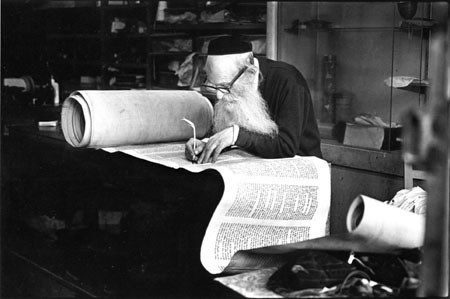
sefer-torahSo Torah applies to all who come under the New Covenant. The only question is how the roles and applications differ between those who entered into covenant with God at Sinai vs. those of us who were later grafted in, that is, between Jews and Gentiles.

Lancaster ended his small write-up by saying that in the apostolic era, it was likely the Gentile disciples, especially those embedded in Messianic Jewish synagogues in the diaspora, would have appeared much more Jewish than we Christians do today. Their practice and observance would have been modeled on their mentors, and as Lancaster mentioned, the Didache seems to support this view and was formally taught to newly-minted non-Jewish disciples.

So where does that leave me? Right where I am.

If I lived in a different environment, if my wife was Messianic, if a thousand other things were changed, how I outwardly worship God would probably not look the same as it does now. But there are no “what ifs” in God’s creation, there is only here and now and what is real.

What matters about discipleship and devotion to the Master is doing the will of God. I pray. I study. I worship in fellowship. I perform many of the mitzvot in the Torah such as giving charity to the poor, providing food for the hungry, visiting the sick, comforting those who grieve.

The message of the Good News of Messiah changes not at all for the Jew or the Gentile, and the coming of the Kingdom alters not one little bit for the descendants of Israel or the people of the nations. In fact, being a devoted Gentile who has fully apprehended a Messianic world view and perception of the Bible makes me a lot more valuable to the cause of Christ for Jewish and Christian people than if I felt that I would only be on God’s “approved list” if I looked and acted “Jewish”.

I know parts of what I’ve written will make certain people unhappy, but please remember, I’m not telling you or anyone else what to do, I’m just talking about who I am and what I need to do. I can’t allow how others view me to affect what I must do and refrain from doing before God.

The Kotzker Rebbe said that the mistake of the spies was in the words “and so we were in their sight.” It should not bother a person how others view him. (Otzer Chayim)

A person who worries about how others view him will have no rest. Regardless of what he does or does not do he will always be anxious about receiving the approval of others. Such a person makes his self-esteem dependent on the whims of others. It is a mistake to give others so much control over you. Keep your focus on doing what is right and proper.

-Rabbi Zelig Pliskin
from his commentary on Torah Portion Shelach (pg 330)
Growth Through Torah

There is “one law” but it is applied differently, even within formal Judaism, depending on who you are. It’s applied differently also for the Gentile. There is One God who is God of all. There is one Messiah who brings salvation to the world. There is one Kingdom waiting for the devoted to enter. There is one world to come where we will return to the Garden, because that’s where it all began.

If that’s not unity in Messiah, what is?
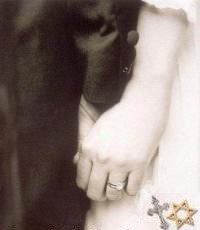
intermarriageFinal note: distinctiveness in identity and practice does not mean dissolution, disagreement, or disconnection. My wife and I are obviously different as man and woman, and we are different as Christian and Jew. Nevertheless, we are a family together with our children and grandson, and we share strong connections within that context. The same can be said for the Messianic community of Jews and Gentiles. We form a unity not in spite of our differences, but because of them. That is the beauty of “one new man” (Ephesians 2:15). You are changed, not in terms of ethnicity, nationality, or obligation, but because, men and women, Jew and Gentile, no matter how one differs from another, we are all interconnected in Messiah, may he come soon and in our day.

Addendum: See the “sequel” to this “meditation”: Walking in the Dust of the Footsteps of Moshiach.

Is It For His Glory?

There is to be one law and one ordinance for you and for the alien who sojourns with you.

Numbers 15:16

The Torah says there is to be only one law for both Jews and aliens sojourning with the Jewish people. On the surface, this appears to be a simple statement, but when we dig deeper into biblical studies and interpretations, it becomes a complicated issue.

“One Law and the Gentiles”
Commentary on Torah Portion Shelach
First Fruits of Zion (FFOZ)

Be careful not to become involved in quarrels with your friends. Arguments will only create distance between you and others.

The most effective approach to avoid needless arguments is to master the ability to remain silent. You don’t have to say everything you think of saying. At times there is an actual need to clarify a specific point and it’s appropriate to speak up. But a large percentage of arguments come from making comments that don’t need to be made.

-Rabbi Zelig Pliskin
quoted at Aish.com

When I read the commentary at FFOZ about “One Law and the Gentiles”, I immediately wanted to jump on it as yet another classic example of the ongoing debate within various branches of Messianic Judaism, Hebrew Roots, and Evangelical Christianity. Then I thought about how such debates can be damaging and when I should ignore such temptations. Then again, I’ve also learned that sometimes you have to speak up for what you believe is right.

The trick is to find the right topic and the right timing. That isn’t always easy and in fact, there are times when no matter how well you craft your message, it’s going to provoke a hostile if not violent response:

“And when the blood of Your witness Stephen was being shed, I also was standing by approving, and watching out for the coats of those who were slaying him.’ And He said to me, ‘Go! For I will send you far away to the Gentiles.’”

They listened to him up to this statement, and then they raised their voices and said, “Away with such a fellow from the earth, for he should not be allowed to live!”

Acts 22:20-22 (NASB)

Of course, this is a pretty extreme example. Most of our online debates, arguments, and trolling don’t come anywhere near actual riot conditions. On the other hand, why do we fight at all?

A couple of weeks ago I spoke to several pastors and asked them, “How many of you have received a nasty email in the last six months?” Every single person in the room raised their hand—including me.

Let me be clear; I believe the majority of people are civil and respectful in their online dialogue. However, there remains a vocal minority who insist on remaining unpleasant both in tone and word. And these unkind words come from many who self-identify as Christians, who somehow believe that malice is an acceptable form of communication.

Which raises a question: Why do so many Christians persist in being mean?

-Pastor Michael Hidalgo
“When Did Christians Get So Mean?” June 9, 2014
Relevant Magazine

Pastor Hidalgo went on to say:

Many of us have the luxury of not having to look beyond the small world we create for ourselves. We attend churches, listen to talk radio and watch news programs that only serve to affirm our previously held beliefs. We have fallen asleep in the insulated comfort of accepted, collective thinking. We live among those who think like us, look like us, talk like us, and we assure ourselves we are right and others are wrong.

It may do us well to break out of these enclaves we create for ourselves.

churchI worship in an “enclave” where my “previously held beliefs” are not at all affirmed, so I can’t expect to be insulated within a comfortable cocoon as the Pastor suggests most Christians may be. In fact, I’ve tried to nudge some of my fellow-Christians out of that cocoon, and while they haven’t “gotten mean” or anything like it, some didn’t really understand that there could a life for a believer outside of their own highly-specific context, especially a valid and sustainable Christian life.

More’s the pity.

I think that’s what triggers a lot of the “yelling” online, because the blogosphere isn’t a cocoon, it’s the wild, wild west, where anything can and usually does happen, and any opinion can be expressed with impunity.

But an opinion may or may not be “truth”:

We forget that every venomous word we speak or write to others is an assault on the heart of a man or a woman made in the image and likeness of the Almighty.

Some, no doubt, believe they need to stand up for truth. A few believe standing up for truth demands they attack those who seek to distort the truth. But this is not the case. If the truth is spoken without grace it is not true at all. It turns out we can be right about a lot of things, but if we do not have love we are dead wrong.

So on the one hand, we must stand up for truth, but on the other hand, the way we do it is very important, for even if we are actually “right” about what “truth” is once in a while, if he have to do a hatchet job on another human being to defend that truth, then we’ve defended truth at the cost of denigrating a person created in God’s image.

Pastor Hidalgo suggests that our first response to another person with whom we disagree is to listen. That’s not easy to do when, particularly on the web, upon detecting something “wrong,” we’ve been conditioned to stop receiving information and to start sending it in abundance. We’ve been taught that we have free speech rights and that we possess the truth, and we have not only the right but the responsibility to shove that truth down everyone else’s throat until they choke on it.

Then we’ve won.

Hooray.

But why are we really supposed to share the truth of the Bible? To sanctify the Name of God, to spread His Name throughout all the earth, to illuminate people with the Good News of Messiah.

But as I said, Paul found out on an endless number of occasions, that no matter how you listen and how well you craft your message, there will always be times when you and your message will be rejected, and there will always be people who are so convinced of the truth and rightness of their own message, that they cannot possibly give you a fair hearing. In fact, the minute you start saying anything contrary to their version of truth, they’ll start bombarding you with their own, and eventually when they realize you’re never going to change your mind and agree with them, they’ll boot you out and start “badmouthing” you to all their (virtual) “friends”.

Well, that’s the classic scenario anyway. It doesn’t describe all of the possible responses to disagreements in the world of religious blogging, so please don’t start taking all this personally. I’m probably not even thinking about you at all.

graceThis is obviously a continuation of what I’ve been writing about for the past week or so. What is the answer to surviving not only a community of faith in the local church but the extended world of faith on the Internet? I’m sure there must be an answer. Pastor Hidalgo summarizes that answer with a single word: “grace.” I think in the ideal, that’s probably the right answer, but most of us aren’t “ideal”. That’s why this life is a journey of struggle, exploration, and experience, not just reading the Bible and being programmed to be Christ’s perfect little disciple.

The Bible isn’t a record of how people got “perfect” once they heard about God, it’s a chronicle of how God was and is gracious with a whole planet full of damaged, imperfect, grumpy human beings across thousands upon thousands of years of history. God has promised us a better way to be human beings, but dangles “perfection” in front of us like a carrot, with the guarantee of a good meal only if we faithfully hang on long enough:

“Behold, days are coming,” declares the Lord, “when I will make a new covenant with the house of Israel and with the house of Judah, not like the covenant which I made with their fathers in the day I took them by the hand to bring them out of the land of Egypt, My covenant which they broke, although I was a husband to them,” declares the Lord. “But this is the covenant which I will make with the house of Israel after those days,” declares the Lord, “I will put My law within them and on their heart I will write it; and I will be their God, and they shall be My people. They will not teach again, each man his neighbor and each man his brother, saying, ‘Know the Lord,’ for they will all know Me, from the least of them to the greatest of them,” declares the Lord, “for I will forgive their iniquity, and their sin I will remember no more.”

Jeremiah 31:31-34 (NASB)

This stuff hasn’t happened yet, no matter how much some Christians believe it has (or wish it had). We are imperfect people living in an imperfect world. We want to “know God” perfectly and to have His Word written on our hearts (and not just in our Bibles), but the finger of God has only just started moving, and it’s having to chisel through lots of stone in order to get at the heart that’s supposed to be tender flesh.

The problem is, we don’t want to be tender, we want to be stony. Tenderness can be hurt but rocks are pretty tough. We like being tough. We like being right. We like making the other poor, dumb fool be wrong. It makes us feel better about ourselves.

No, I’m not saying you shouldn’t take a stand. I take a stand often enough, both here on this blog and at church in Sunday school. But it matters how you take your stand. If expressing truth, however you understand it, involves insulting or embarrassing another person, you’re probably doing it wrong. I know. I’ve gotten it wrong often enough, including quite recently.

light-in-my-graspI actually agree with FFOZ’s commentary on One Law and how Torah does and doesn’t apply to Gentile believers. I even agree that the FFOZ author wrote the article in a measured and respectful manner. I know that regardless of all that, the message will cause “all the wheels to fall off the cart,” so to speak, for a number of folks who have a very different opinion on the matter, and for some of them, their self-esteem and self-image are tightly dependent on believing their opinion is universally correct.

But that’s how most of us operate. We personalize disagreement and conflict rather than realizing God hasn’t called us to be the best bloggers in the religious world. He’s called us to be the best representatives of His Good News to the world, religious and otherwise. How do we do that? By arguing? By being right all the time? Most of us are wrong most of the time.

Truth is knowing when to speak and when to be silent. Truth is knowing when to talk and when to listen. Truth is the ability to hang on at the right times and to know when to let go.

Professor Henry Jones (Sean Connery): Junior, give me your other hand! I can’t hold on!

Indiana Jones (Harrison Ford): I can get it. I can almost reach it, Dad…

Professor Henry Jones: Indiana. Indiana… let it go.

Professor Henry Jones: Elsa never really believed in the grail. She thought she’d found a prize.

Indiana Jones: And what did you find, Dad?

Professor Henry Jones: Me? Illumination.

-from Indiana Jones and the Last Crusade (1989)

Professor Jones’ quest to discover the resting place of the Holy Grail ended up in the loss of the grail, yet he didn’t consider it a loss at all. What he found wasn’t a treasured object, a valued prize, or even immortality (by drinking water from the grail). He found illumination from God.

Yes, this is fiction and there was never such a thing as the “Holy Grail” but besides being a good adventure story, there’s a lesson in values here.

Kazim (Kevork Malikyan): [to Indy] Ask yourself, why do you seek the Cup of Christ? Is it for His glory, or for yours?

That should be a question we all ask ourselves before we speak up in Sunday school class, or put our fingers on the keyboard to either write a blog or respond to someone else’s.

Rabbi Avraham Mordechai of Gur explained that the nature of a person with humility is not to be stubborn about his own opinions and wishes. He is compliant and will easily give in to the opinions and wishes of others. The other spies were all very distinguished and important men. Moshe feared that Yehoshua might concede to their opinions and be swayed by them even though he felt differently. Therefore, Moshe especially prayed for Yehoshua not to be negatively influenced by the others.

Rabbi Zelig Pliskin
Rabbi Zelig Pliskin

When a question of Torah ideals is involved, one must not budge. That is when it is appropriate to resist. When dealing with basic principles, remain steadfast and do not allow others to sway you. One needs wisdom to know the difference between situations when it is proper to give in to others and when it is not. For this we need the Almighty’s assistance.

Dvar Torah for Torah Portion Shelach
based on Growth Through Torah by Rabbi Zelig Pliskin
quoted by Rabbi Kalman Packouz on Shabbat Shalom Weekly
Aish.com

Addendum: Yesterday, I read a commentary about Pastor John MacArthur’s parenting advice to a Christian parent of a gay child. In tomorrow’s “morning meditation,” I respond.

What Good is There in the Hebrew Roots Movement?

rootsNOTE: I wrote this commentary a few days before my recent blog post, Can Jesus Inherit Lineage from his Adoptive Father Joseph?.

I’ve heard it said that there are two kinds of people in the world: those who define themselves by what they’re for, and those who define themselves by what they’re against. I know it’s really more complicated than that, but if you’ve spent any amount of time in the blogosphere, it might seem just that simple. I sometimes get the feeling that the Internet was created to assist the latter sort of person to quickly, easily, and sometimes anonymously express their opinions about who and what they oppose.

I try to define myself by what I am for and generally post blogs on whatever happens to be rolling around inside my skull at any given point in time. I also have participated in debates about the relative merits of Christianity, Judaism, Messianic Judaism, and Hebrew Roots (I’m using these terms in the most general way possible). I want to talk about some of the differences between certain groups, primarily Messianic Judaism and Hebrew Roots but first, I’d like to provide some links that quickly define Christianity and Judaism just to be able to set them to one side.

The next set of definitions are based on well over a decade of experience in the Hebrew Roots movement. Not everyone is going to agree with me, but as I’ve suggested, that’s the nature of the blogosphere and probably human nature as well.

Nearly a year ago, I wrote a blog post called What is Messianic Judaism, so you can refer back to that for additional details, but as far as a thumbnail sketch goes, the following should serve fairly well.

Messianic Judaism, in its ideal form, is a stream of Judaism that operates alongside the other branches of Judaism such as Orthodox, Conservative, Reform, and so on. It’s principle difference is the belief by the Jewish adherents within that stream that Yeshua (Jesus) of Nazareth, as we see him in the Apostolic Scriptures, is the prophesied Messiah, who came once to redeem humanity from sin, and who will come again to liberate Israel, restore the captives to their Land, and usher in an era of worldwide peace.

In its current form (again, I’m speaking generally), the majority of members of Messianic Jewish congregations are non-Jews who have chosen to come alongside the Jewish believers while maintaining the distinction between Jews and Gentiles worshiping within a Jewish context. Messianic Jewish groups are led by the Jewish membership, and established by and for Jews in Messiah. Additionally, like other Jewish streams, many traditional and cultural practices are upheld, such as common halachah observed by many religious Jews. Both Torah and Talmud are studied, the traditional festivals are observed, observance of a Saturday Shabbat is practiced, and worship services are what would be found in any synagogue setting.

Hebrew Roots is a general umbrella term defining groups of primarily non-Jewish believers in Yeshua (Jesus) who adopt some Jewish/Hebraic religious practices and traditions to varying degrees. There are a number of sub-sets within Hebrew Roots, the two primary groups being:

  • One Law: This group tends to practice what they call “Messianic Judaism” and believes that the New Testament supports Jewish and non-Jewish believers having no distinctions in identity and practice. In the ideal sense, it makes no difference if the groups are organized and operated by Jews or Gentiles, although the vast majority of One-Law groups are almost always Gentile driven. One Law groups distinguish themselves from Messianic Judaism and the other Judaisms by a general dislike if not disdain of anything that isn’t “written Torah,” although it is impossible for them to practice any religious, synagogue-like service without borrowing heavily from Jewish tradition. One Law groups also tend to dislike if not disdain the traditional Christian church and claims that Christians are universally “anti-Judaic” and even apostate.
  • Two House: This group tends to believe that non-Jewish people who are attracted to Judaism and the Torah are the descendants of the “lost ten tribes” of Israel and that God has supernaturally inspired them to return to a Jewish/Hebraic worship practice and lifestyle. They do not believe that non-Jewish Christians have the same obligation to the Torah as Jewish people do, but they believe that, because they are “Israelites,” they are not truly non-Jewish, and therefore are part of the modern Jewish people. A different stream of two-house doesn’t literally believe that they are the biological descendants of Israel, but that they are spiritual descendants and thus not really Gentiles.

many people

I want to make clear that my definitions are extremely general and within those two groups, there are multiple (probably hundreds) variations of belief and practice. Also, “Hebrew Roots” can include any congregation of Christians (though most won’t claim that particular label), that incorporate some “Jewishness” in their religious lives. This could include church services that use certain Hebrew words, keeping a “kosher-style” diet based on Leviticus 11, wearing kippot and tallitot during services, but not necessarily believing that the full yoke of Torah is incumbent upon them, let alone any significant number of traditions. The one element that unifies all Hebrew Roots groups is the belief that something went wrong in traditional Christianity, usually its historic rejection of the Jewish/Hebrew identity of Jesus and his teachings. The label “Hebrew Roots” is used to separate this group of non-Jewish believers from what they see as the flawed theological, doctrinal, and cultural identity typically associated with the “Christianity” label.
Just to give you an idea of how some Hebrew Roots groups define themselves, I culled the following comments from a One Law blogspot:

As for Seventh-Day Adventists…don’t know much about them except they are Christian and, therefore, anti-Judaic.

In short, the Christian message to Jews is anti-Judaic: “Stop practicing Judaism!”

Yeshua kept the Law, but not any form of Judaism.

Christians believe that the Sinaitic Torah has been abolished; Messianics believe it is valid. Christians believe that the New Testament is anti-Judaic; Messianics believe that the Apostolic Writings are pro-Judaic. And there are divisions with the system of Christianities and also within the Messianic movement. These are all caused by certain convictions.

Are these convictions worth dividing over?

I believe so. We can’t build Messianic communities in the same way that Christians build their communities.

Admittedly, these comments were taken out of context (I added the emphasis because it was apparently missed before), but as you can see, they communicate a less than complementary attitude toward any form of Christianity and sometimes Judaism (although arguably, each and every one of the non-Jewish followers in this movement are Christian by definition).

To be fair, I should mention that at times, there is a positive and supportive connection between Hebrew Roots and the Christian church.

Now that I’ve got all that out of the way, what good can I say about Hebrew Roots? It’s not a matter of whether or not I agree with their basic doctrines. What we all share is faith in Jesus Christ. In that sense, Christianity, Messianic Judaism, and Hebrew Roots have a common Messiah and thus a common bond. Where we differ is how we conceptualize the meaning of the Messiah in our lives and what we believe our response should be to him and to the human beings around us. Probably thousands if not tens of thousands (or more) books, blogs, and websites have been created and dedicated to waging the “war” between Messianic Judaism vs. Hebrew Roots, or Hebrew Roots vs. Christianity, or Christianity vs. Messianic Judaism. I don’t want this to be another blog post carrying on the battle.

I’m not saying I won’t complain again, but I want to take this opportunity to say that in spite of our different outlooks, we must admit that we have things in common as well…all of us who claim the name of Christ, though others call him Messiah.

We believe in the God of the Bible. We believe that all of the Bible is “inspired by God and profitable for teaching, for reproof, for correction, for training in righteousness” (2 Timothy 3:16). We believe that Jesus (Yeshua) is the Messiah spoken of in the Jewish prophesies, that it was necessary for him to come once to redeem us from sin, and that he’ll come a second time to establish the Messianic Kingdom and bring world-wide peace. We believe that Jesus taught from the Torah and the Prophets, and that we all have a responsibility to follow teachings such as feeding the hungry, clothing the unclothed, visiting the sick, comforting the grieving, and performing many other acts of kindness as “the weightier matters of the Torah.”

Hebrew Roots folks also uphold the “Jewishness” of Jesus and his Apostles, the continued authority of Torah, the continued Jewish practice of Paul, of Paul not teaching against Torah, the continued vital importance of the Jewish people and Israel in God’s plan. Traditional Christianity isn’t as good at recognizing this and although some of the details between Messianic Judaism and Hebrew Roots differ, we all should recognize what we hold as common beliefs.

more-silosBut as long as we continue to define ourselves by who we oppose, we will always be stuck inside our little silos and the only people we will ever talk to is ourselves. One of the reasons I chose to return to a church worship setting is that I didn’t want to get stuck in a silo. I wanted to talk to people who didn’t always think like me, in order to build bridges, share information, and contribute to mutual learning “across the aisle.”

Given my regular meetings with my Pastor and some other relationships I’m nurturing within the church I attend, I think I’m headed in the right direction. Nothing is perfect, and sometimes I become frustrated and discouraged, but overall, I’ve been able to express a number of my opinions and beliefs and not only have I not been given the boot yet, but some people seem authentically interested in continuing our dialog.

That wouldn’t be possible if I took the attitude that anyone who isn’t like me or who doesn’t think or believe as I do must be “bad.”

I once heard President and Founder of First Fruits of Zion (FFOZ) Boaz Michael say (this isn’t an exact quote) that hitting someone over the head with a Torah scroll won’t give them a different insight into the Torah. We can’t just beat people up with our beliefs. Plenty of atheists complain that Christians are hitting them with their Bibles in their evangelical efforts and guess what? Hostile or aggressive behavior doesn’t change people. You can’t yell at someone as an effective method of convincing them your position has merit. You certainly can’t inspire someone to listen to you if you call them names and denigrate their faith and their worship context.

But we all do that all the time.

While I agree there are some lines in the sand I am not willing to cross, I also must admit that it is important to acknowledge good in someone when you see it, even if you don’t agree with that person on other occasions. In the blogosphere, we all get caught up too much in being theology police. Building the road to accepting each other as members of the body of Messiah requires a willingness to talk to people who are different than you, and to listen to them as well. You may never come to a place where you will always agree on everything, but you may build a place where two people who both love Messiah can get together and share who they are with each other. Once you do that, who knows what you could end up learning and building upon the foundation you’ve started?

Every person you meet has a wellspring deep inside.

If you can’t find it, your own wellspring needs clearing.
Remove the rust from your shovel, sharpen its blade, and dig harder and deeper.

-Rabbi Tzvi Freeman
“Dig Deeper”
Based on letters and talks of the Rebbe, Rabbi M. M. Schneerson
Chabad.org

Addendum: August 8, 1:15 p.m. Mountain Time: Peter, the person who commented below, chose to take our conversation back to his blog. To be fair, I thought it was important to display the continued results of our dialog which can be found in the comments section. I see we have a long way to go.

Separating the Wheat from the Chaff: Where are the Scholars?

Separating-the-Wheat-from-ChaffLast week a friend pointed me to a web site where a guy, claiming expertise in something else (cryptography, I think, but it doesn’t matter) also claimed to have established beyond dispute and for the first time in modern scholarly studies the “true” meaning of a particular Greek word used by Paul. Moreover, on this basis the guy claims a radically different understanding of what Paul had to say on the topic with which this Greek word is associated. So, what did I think?

Well, I have to say that it’s curious that someone with no training in a given field, lacking in at least some of the linguistic competence required (both relevant classical language and key modern scholarly languages), thinks himself able to find something that has eluded the entire body of scholars in that field who labor year-upon-year to try to discover anything new and interesting. It’s also curious that, as is typical, the guy doesn’t submit his findings to scholarly review for publication in peer-reviewed journals or with a peer-reviewed publisher, but flogs his thinking straight out on his web site, complete with bold claims about its unique validity. We mere scholars in the field, by contrast, do submit our work for critique by others competent in the subject. We present at symposia and conferences where other scholars can engage our views. We strive to get published in peer-reviewed journals and with respected publishers. Even after publication, we hope for critical engagement by other scholars.

-Larry Hurtado
“Expertise and How to Detect It”
Larry Hurtado’s Blog

I was reading the various articles and blogs I use for morning studies and came across this piece by Hurtado. It brought to the forefront something that Messianic Judaism and particularly the large number of Hebrew Roots bloggers seem to struggle with. There are a great many pundits in the religious blogosphere and, as Dr. Hurtado points out, not all of them are scholars in a strictly defined sense. And yet, like the individual Hurtado describes, that doesn’t stop most people from presenting an opinion as fact without any significant scholarly or educational basis.

Before continuing, I want to say that I don’t describe myself as an expert or scholar in religious studies. The purpose of my blog is not to lay down doctrine and theology as if I’m a teacher or instructor of any kind. My blog is simply an expression of my thoughts and feelings on any given morning. I ask more questions than I provide answers and even when I seem to present conclusions, they are my opinions and often, I publish them on the web to inspire conversation so that I can learn more from my readers. I do not fit Dr. Hurtado’s definition of a scholar nor would I ever claim to.

But what about scholarship in the Messianic Jewish and Hebrew Roots spaces (I separate the two movements because to me, they don’t represent the same emphasis, at least in terms of population)?

I believe there is a growing scholarly expression existing within Messianic Judaism. Educational organizations such as The New School for Jewish Studies and The Messianic Jewish Theological Institute kinbaroffer the promise of an organized educational basis for producing scholars in this specific area of religious studies. I’ve not taken any courses from either school so I can’t personally attest to their quality, but there is at least an effort being made to build a valid, intelligent, and organized teaching framework from which to produce teachers and researchers within the Messianic Jewish space.

I’m less familiar with any organized group of teaching institutes within the wider collection of Hebrew Roots groups. The only two that immediately come to mind are TorahResource.com, which was founded by Tim Hegg and TNNOnline.net which seems to be edited by someone named J.K. McKee (I should say that I’ve met Hegg on several occasions and, while he and I may not always agree, I more than acknowledge his educational and scholarly background, however I’ve never met McKee and don’t know what he brings to the table, so to speak).

Dr. Hurtado continues:

Now, of course, I believe in freedom of speech and thought, and I wouldn’t press for a gag on the sort of dubious stuff that I criticize here. But in scholarly life the peer-testing of claims/results is absolutely crucial, and it’s really considered rather unscholarly (and so of little credibility) to present as valid/established claims that haven’t gone through such testing. People (specifically those not clearly qualified in a field) have always been able to make bold claims about a subject of course, asserting their idiosyncratic “take” over against whatever view(s) is/are dominant in the subject. But before the World Wide Web I guess it was much more difficult to get such unqualified opinion circulated. Now, however, ”the Web” and the “Blogosphere” make it so easy.

But, frankly, when I’m shown something that hasn’t been through the rigorous scholarly review process (often, it appears, peer-review deliberately avoided), and comes from someone with no prior reputation for valid contributions in the subject, I’m more than a bit skeptical. If the work is really soundly based, then why not present it for competent critique before making such claims?

Obviously, Hurtado sets some very specific standards for information he’s willing to take seriously, which makes about 99% of the blogosphere unacceptable as sources of theological scholarship. But the question we must ask ourselves is whether or not either the Messianic Jewish or Hebrew Roots movements have any process in place for a “rigorous scholarly review process” and have access to writers with “prior reputation for valid contributions in the subject(s)” being addressed in their respective areas (I’m not being snarky here, I’m asking a serious question).

I do know based on my ten plus years of history within Hebrew Roots that it tends to be a magnet for just about anyone with an opinion. Some of the individuals presenting information are well-meaning and are trying to work through both intellectual and personal issues in regard to how they see Christianity and Judaism. Others, unfortunately, have theological axes to grind and produce vast amounts of dreck designed to provide religious “thrills and chills” but which have absolutely no basis in fact or scholarly research.

For example, I’ve heard people claim that the lost ark of the covenant was hidden underneath the crucifixion site of Jesus and that his blood “anointed” it. I’ve heard people say that the “lost years of Jesus” were spent with the young Yeshua traveling through India at the side of his “uncle” Nicodemus. I’ve heard some folks claim to have possession of the lost original Hebrew manuscript of the Gospel of Matthew. I even read one individual say on a blog that the reason the Temple in Jerusalem was destroyed was that the Jewish priests failed to share the pronunciation of the Tetragrammaton with the nations of the world, thus preventing the Torah from going forth from Zion (see Isaiah 2:3 and Micah 4:2).

All of that stuff is baloney, but it’s important to remember that Hebrew Roots is an extremely wide container and its contents are enormously varied.

yeshiva1I more or less regularly read a few blogs in the Hebrew Roots space, not because I agree with their opinions but so I can be aware of them. I absolutely avoid the kind of “crazy” material posted on the web that makes claim to the sort of “hidden truths” I listed above.

Mainstream Christian and Jewish educational and research foundations have a long, world-wide history and are well established, but the Messianic Jewish and Hebrew Roots movements are in their infancy. I place Messianic Judaism as an entity in a rather narrow field in order to exclude the more “loosely defined” collections of non-Jewish folks out there who have shall we say, rather unusual and unsubstantiated statements to make. Unfortunately, that puts them in the same container as others in Hebrew Roots who are sincerely attempting to study and research the Bible in a manner that will provide illumination within their own context.

But at this point, I’m asking a question because I don’t know. Given the brief set of statements made by Dr. Hurtado (I provided a link to his blog post above), do either Messianic Judaism or Hebrew Roots in its various forms, have or are they building an educational and scholarly system that would provide the same level of peer review and well researched papers as Hurtado describes from his own experiences as an educator and researcher?

One of the books produced by those I would consider established scholars in Messianic Judaism is Introduction to Messianic Judaism. Do you think this book would meet Dr. Hurtado’s expectations for scholarly and peer-reviewed work? Are there other books and papers that would do so within Messianic Judaism? What about Hebrew Roots? Do the writings of Hegg and McKee fit the bill? Are there others doing similar work within that space?

The Internet is a wild west show with no oversight and anyone can create a blog and start publishing anything they want within minutes. It’s important to be able to separate the wheat from the chaff. In order to do so, where do we begin?

Sharing the Birthday Boy’s Chair

boys-fightingSupersessionism is when a Theology attempts to push Jews out of their seat. Inclusionist Messianic Judaism (i.e. One Law) says that Jews remain Jews and remain obligated to the Sinaitic Covenant. Thus, it can’t be considered supersessionist–because Jews keep their seat. They remain the older brother–and that means being a role model and also teaching the younger, adopted brother (Gentiles) how to understand and practice Torah.

-Commentary from a Hebrew Roots blog post

OK, I’ll bite. I know I shouldn’t, but I will. Like the politically correct pundits and visionaries popular in the mainstream media, the term “inclusionist” seems all nice and cozy, but it doesn’t always fit well when translated into other venues.

Do I believe in “inclusionism?” First, we need a definition of “inclusion.”

  1. The act of including or the state of being included.
  2. Something included.

There were also entries for how inclusion is used in Geology, Biology, Computer Science, and Mathematics, but they didn’t seem particularly relevant to the conversation.

Of course, I support inclusion as applied to equal access to resources in society such as education, jobs, housing, and the “pursuit of happiness,” but that has to be filtered through a few things such as “citizenship.” If you’re a citizen in this country, you have rights, such as the right to vote, for example. If you aren’t a citizen, your rights aren’t the same and sometimes you don’t have access to the identical resources in society as do citizens.

With that in mind, let’s return to the specifics of the subject at hand.

Bob (Craig T. Nelson): You need an invitation?
Lucius (Samuel L. Jackson): I’d like one, yes.

-from the film The Incredibles (2004)

I’ve written about supersessionism or replacement theology many, many times before, including in a four-part series in Messiah Journal last year. As a Christian husband married to a Jewish wife, I am very sensitive (some might say, “overly sensitive”) to the basic tenet that has been supported in the majority of the history of the church that Christianity has replaced Judaism in all of the covenant promises God made to Israel. In essence, the church is supposed to be the “New Israel” and Judaism and the Jewish people are now “has beens” relegated by God to the backwaters of eternity.

However, according to the person I quoted above, supersessionism is “solved” when Christians don’t try to push Jews “out of their seat” but rather, try to crowd into the same seat with them. Does that work? I don’t think so.

I’ve blogged and blogged about how this doesn’t work in so many different ways that you’d think one of them would “stick” by now, but as Rabbi Dr. Michael Schiffman recently said, maybe the person commenting or I or both of us are “addicted to negativity.” I hope not, but there’s something about misinformation and disinformation that gets under my skin.

Let’s accept the existing metaphor used by my source, that supersessionism is the pushing of Jews (presumably by Christians) out of their seat, or their accepted identity and role as defined by the Bible and God. What does it do to push the Jews out of their seat and to sit in it instead as usurpers?

Usurp, as a transitive verb is:

    1. to seize and hold (as office, place, or powers) in possession by force or without right (usurp a throne)
    2. to take or make use of without right (usurped the rights to her life story)
  1. to take the place of by or as if by force : supplant (must not let stock responses based on inherited prejudice usurp careful judgment)

Used as an intransitive verb:

  1. to seize or exercise authority or possession wrongfully

Boiling it all down, it would be as if I lead a political coup in a nation, kicked the King off the throne and replaced the King as ruler of the nation.

OK, I get that and I agree. I have no right to replace the King. The metaphor seems to hold up pretty well when compared to what we understand about supersessionism.

But what about sharing the throne? What if I lead a political coup and demand that the King share the throne with me? I’m not kicking him out of his chair, so to speak, but I’m demanding that he share the throne with me, insisting that I have rights to sit in his chair, too. Do I really have a right to do that? Not if I don’t have legitimate claim to royal authority. If I do, then either I’m the rightful King and the person now on the throne is a pretender, or I am in line for the throne once it becomes available.

boys-birthday-partyNeither of those metaphors works very well when we apply them to the covenant relationship Judaism enjoys relative to God. In fact, as Gentiles “grafted in” to the Jewish olive tree, we don’t suddenly become Jewish and thus have rights to “share the throne” in the manner of those who were born as “Princes.” If Christians aren’t Jews, then no matter how much we share access to God and to salvation and a place in the world to come, we don’t actually become Jewish and thus, hold an identity and responsibilities exactly equal to those who originally came to be a light to the world.

Let’s change the picture a little bit. There’s a children’s birthday party. Naturally the “birthday boy” gets the seat at the head of the table and is served a double portion of ice cream and cake because, after all, he’s the birthday boy, this is his home, and it’s his special time.

Now let’s say that one of the other kids gets jealous. Maybe his birthday has come and gone and he didn’t get such a nice party or maybe he just sees all the attention the birthday boy is getting and he wants it, too. He can push the birthday boy out of his chair and try to take the double portion of ice cream and cake, but as we see from our above metaphors, we know it’s wrong to do so. Let’s say the jealous birthday boy knows it’s wrong, too.

But, hey! What if we “share?”

So the jealous boy goes to sit in the same chair as the birthday boy, “shoehorning” himself into a very limited space meant to be occupied only by one person. He brings his own spoon and insists that the birthday boy share his seat, his cake, his ice cream, and his presents.

Does that seem right to you?

No, of course not. Only the birthday boy is the birthday boy. Even if the jealous boy was born on the same day (and he probably wasn’t), it’s still not his party, his cake, his ice cream, or his presents. He gets his own seat, his own cake, and his own ice cream because he’s an invited guest. Maybe he’s even a special guest because he’s the birthday boy’s best friend (think David and Jonathan). Maybe after the party is over, the birthday boy will share all his gifts and play with him. All the jealous boy has to do is accept who he is, where he’s seated, and be kind and patient. All the jealous boy has to do is realize that it’s the birthday boy’s day, not his own.

That’s what happens at most birthday parties for children. We teach children who is the special person who is having the birthday and who are the guests. We teach them that only special friends and relatives are invited to be guests at the banquet. There are other kids who don’t know the birthday boy who don’t get invited and don’t get ice cream, cake, and a door prize.

If the jealous boy realizes all that, then he realizes that even though he’s not the birthday boy, he’s special too, and he has no reason at all to be jealous. By being rude and trying to “share” something that clearly doesn’t belong to him, he risks losing everything. By understanding that he is special and a friend and a guest, he will someday gain everything.

Now he told a parable to those who were invited, when he noticed how they chose the places of honor, saying to them, “When you are invited by someone to a wedding feast, do not sit down in a place of honor, lest someone more distinguished than you be invited by him, and he who invited you both will come and say to you, ‘Give your place to this person,’ and then you will begin with shame to take the lowest place. But when you are invited, go and sit in the lowest place, so that when your host comes he may say to you, ‘Friend, move up higher.’ Then you will be honored in the presence of all who sit at table with you. For everyone who exalts himself will be humbled, and he who humbles himself will be exalted.”

Luke 14:7-11 (ESV)

Now, was that so hard to understand? Even a little child can get it.

Debate or Beer?

beerOne of the glories of life in the Messianic Jewish community is the unity of worship and service between its Jewish and Gentile members within a specifically Jewish context. In recent years, however, a trend has developed that challenges the Messianic Jewish community on this very issue. This trend involves various groups and movements that teach that all Jews and Gentiles under the new covenant are called to keep the same Torah in all regards.

In so doing, these One Law movements not only misinterpret a great body of Scripture, but they also miss the unique calling of Jews and Gentiles within the Body of Messiah, robbing both groups of the biblical richness of their identity. They lose the new covenant vision of unity in Messiah between Jews and Gentiles and replace it with a man-made rallying cry, which One Law advocate Tim Hegg has expressed as “One people, One Messiah, One Torah.”

-Daniel Juster and Russ Resnik
“One Law Movements: A Challenge to the Messianic Jewish Community” (January 2005)
As downloaded from Messianic Jewish Musings
Original Source: MJ Studies

This has already started something of a minor “buzz” in the Messianic Jewish and Hebrew Roots blogospheres. I wasn’t going to write about it, but since a certain amount if misinformation (or disinformation) is already becoming promoted (no, not at Derek’s blog) on the web, I felt it necessary to present a more balanced perspective. Also, since the Juster and Resnik paper significantly mentions Acts 15 and since I’ve already spent a lot of time and effort addressing Acts 15 from the current perspective of First Fruits of Zion (FFOZ) as published in D. Thomas Lancaster’s commentary in Torah Club Volume 6, I thought my perspective might provide just a little illumination.

I also want to say that FFOZ is mentioned in the Juster and Resnik paper and not in a complementary fashion. The paper was published in 2005 and references material produced by FFOZ from 2003 which was written by then-contributor Tim Hegg, a well-known Hebrew Roots scholar and proponent of “One Torah.” Since that time, FFOZ has shifted its theological and doctrinal perspective to be quite a bit more like that of Juster and Resnik as documented in their paper. It’s not identical but it’s pretty close. Unfortunately, this dates the Juster/Resnik paper somewhat, but the other content they present is fairly well “spot on.”

A few things.

By the time of Yeshua, an interpretative tradition was developing concerning the requirements for Gentiles. These later became formulated as the Noahide laws, binding on all people and rooted in the covenant with Noah. Already in the first century, Judaism made a distinction between universal requirements and requirements that were the particular responsibility of Jews.

Juster/Resnik, pg 4

This statement could be misconstrued to suggest that Juster and Resnik believe the Acts 15 letter is a reworking of the Noahide Laws and that such laws were the only restrictions incumbent upon the Gentile believers in Christ from the perspective of James and the Jerusalem Council. However, a further reading of the paper reveals this is not entirely true.

As has been noted, these are very similar to the Noahide laws. This does not mean that Gentiles are free to murder, steal, and dishonor their parents. The passage assumes a universal morality, as do Paul, Peter, and James (who were present that day), and John in their writings. As Romans 2 notes, Gentiles can perceive the law of God, even without the revelation of Moses, and are responsible for many standards that are also expressed in the Bible. For example, classic Roman moral law taught the ideals of monogamous marriage, honoring parents, honesty and much more. The essential and unique addition of New Covenant ethics is the sacrificial example of Yeshua.

-ibid

noah-rainbowI disagree that the halachah developed by James for the Gentile believers was a reworking of the Noahide Laws although this is a commonly held belief by many scholars and laypeople. But according to Lancaster, it would make little sense to require the Gentile believers to comply only to the Noahide Laws when in fact all of humanity is accountable to God by those standards. In fact, as I’ve mentioned on one of my blog posts, Lancaster states that James only uses the Noahide Laws as a starter and seems to leverage Leviticus 17 and 18 to forge a distinct Gentile identity in Messiah based, to some degree, on the stranger or “ger” in Israel.

In those chapters, the Torah describes the sins of the Canaanites, warns the people of Israel against imitating their ways, and prescribes four prohibitions which both the Israelite and the stranger who dwells among the nation much keep. “These correspond to the four prohibitions of the apostolic decree, in the order in which they occur in the apostolic letter.” [Richard Bauckham, “James and the Jerusalem Church,” in “The Book of Acts In Its Palestinian Setting, (Grand Rapids, MI: Wm. Eerdmans Publishing Co., 1995), 459]

-D. Thomas Lancaster
Torah Club, Volume 6: Chronicles of the Apostles
from First Fruits of Zion (FFOZ)
Torah Portion Mishpatim (“Judgments”) (pg 461)
Commentary on Acts 15:20-31

I would also direct the reader to Toby Janicki’s article The Gentile Believer’s Obligation to the Torah of Moses, found in issue 109 of Messiah Journal (Winter 2012), pp 45-62 to understand how the deceptively brief “four prohibitions” are extended to provide a rich and robust Torah observance for the non-Jewish believers that does not intrude on Jewish identity or unique covenant obligation to God.

Having read one staunch critic of the paper as well as Leman this morning, I agree that the Noahide Laws cannot be applied to the “fourfold decree” of the apostles, but that doesn’t shoot down the foundation of Juster’s and Resnik’s argument opposing the position of “grafted in” Gentile believers and Jewish believers forming a fused and completely uniform corporate identity. The so-called “One Law/One Torah” position by necessity, essentially eliminates the Jewish people in Messiah and replaces them with “One Torah” cookie cutter produced humanity. This may be inadvertent replacement theology on the part of One Law/One Torah advocates, but it is replacement theology nonetheless.

As far as I can tell, the criticism of the Juster/Resnik paper I read this morning is based on only a single element and since the Juster/Resnik position, as we see in Lancaster, is otherwise well supported, then the basic assumption of the paper remains valid.

Acts 15 specifically declares that nothing should be required of the Gentiles but four laws, three of them related to blood. Galatians 5 warns Gentiles not to receive circumcision or they will be required to keep the whole Torah. The clear implication here is that without circumcision, Gentiles are not required to keep the whole Torah. Colossians 2 warns that no one is to judge the Colossians with regard to Sabbath, New Moons or festivals. These are a shadow; the substance is Messiah. In Galatians 4:10 Paul writes that he fears that he labored over the Galatian Gentile congregations in vain because they were now observing “special days, months, seasons and years.”

Juster/Resnik, pg 2

This is probably one of the more devastating portions of their argument since the statement emphasized in the quote above plainly illustrates that the non-Jewish believers could not be obligated to keep the Torah mitzvot in the manner of the Jews unless they were circumcised (i.e. converted to Judaism).

line-in-the-sandOne of the comments I made on Leman’s blog was that Juster and Resnik seem to draw a hard and clear line in the sand between Jewish and Gentile Torah observance, especially in their belief of how Paul saw the matter, while the Lancaster commentary appears to allow for more leeway, providing a sort of “permission” for Gentiles to extend themselves into more of the mitzvot without an implicit or explicit command to be obligated to full Torah observance over some undefined period of time.

One of the things I liked about the Juster/Resnik paper is that it was very clear in showing what Paul, or James for that matter, didn’t say (I apologize in advance for the length of this quote):

One Law teachers make a big point of James’s statement that “Moses has been read every week in the Synagogue” (Acts 15:21). This is taken to imply that Gentile believers will, in the normal course of their new life, attend synagogue and adopt more and more of the whole Torah. Since Torah life is good and beautiful, why wouldn’t he? On this basis, the verse is taken as an exhortation to further learning and the adoption of the whole Torah. Thus, One Law teachers transform an ambiguous statement into a strong and unambiguous exhortation.

They apparently overlook, however, the fact that these words spoken in the council were not included in the apostolic letter that was circulated among the congregations. If this were such a crucial exhortation to Gentiles, it is amazing indeed that the apostles, under the guidance of the Holy Spirit, did not think it important enough to put in their letter!

It is most telling that in all the epistles to congregations there is not a single word commanding Gentiles to adopt the whole Torah, and no direct statement of hope that they will eventually adopt a fully Torah- keeping life in the same way as the Jews. There is no word of such an exhortation or even mild encouragement throughout the whole book of Acts, which is written in part to show the relationship of Jewish-Gentile fellowship!

Even were we to say that Gentiles are free to embrace Torah, the calendar of Israel, and more, there is no word that there is any covenant responsibility for Gentiles to do so. Acts 21 reinforces this impression. Here James tells Paul of the rumor that he teaches Jews who embrace Yeshua to forsake Torah. This of course is not true. So, Paul demonstrates this to be a false rumor by his Temple involvement. James reminds Paul that Gentiles were freed from responsibility for the full weight of Torah. Neither Paul nor James gives the slightest hint that they were encouraging full Torah observance among Gentiles. Paul could have said, “Not only do I not teach Jews to forsake Moses, but I even encourage Gentiles to embrace more and more of the Torah as they come to understand and appreciate it.” This is the emphasis of the One Law teachers, but there is not one word in the New Testament that explicitly encourages Gentiles to grow in keeping the whole Torah.

Galatians 5 is a watershed passage. Here Paul in the strongest terms exhorts Gentiles not to receive circumcision. Some One Law teachers want to allow a legitimate option of circumcision, so they add the proviso that it should not be done for the wrong reasons. Yet, this is not in the text. The New Covenant offers the fullness of God’s blessing upon Gentiles without the necessity of circumcision. This was not the case in the Mosaic order.

ibid, pg 5

white-pigeon-kotelI think when added to the body of work produced by Lancaster, we find ample support for the Juster/Resnik position. I mentioned on Leman’s blog that I hope, given the age of the paper, the authors would be willing at some point to update and expand the document to reflect changes that have occurred in the movement and in research over the past eight years.

But given my numerous blog posts of this week, lest you think I’m talking out of both sides of my mouth, I also said this on Leman’s blog:

My blog post tomorrow is my tying up all the loose ends of my “rant” for this week regarding these sorts of debates. One of the problems I have with some of our discussions is they tend to overlook the fact that, even though we disagree, we *all* still are part of the body of Messiah. I believe it is important to point out error and to support a more correct interpretation of the Bible, but how do we balance that against the need to bring organization and some manner of unity to *all* of the members of the body of Yeshua, Jewish and Gentile alike?

Rob Roy, a One Law supporter, said on the same blog post:

Probably a sign that folks are growing tired of this debate.

I’m getting tired of it, too. But my question to Derek stands. In spite of the radical differences in perspective, theology, and theory between Messianic Judaism and certain expressions of Hebrew Roots, we are all disciples of the same Master and members of the body of Messiah. If the internal organs of a person’s body fought each other as much as we do, the person would die. What’s going to happen to the body of Messiah because of us and because of the much wider “battle” of body parts we find in the various Christianites of the modern era?

My appeal to “come together” will be published in tomorrow’s morning meditation. In the meantime, we still have to talk and we’ll still disagree. May God have mercy on our limitations and particularly on our foolishness in presuming we know more than our Master.

Now can we all go out for a beer or two and loosen up or are we going to just fragment the body some more?